
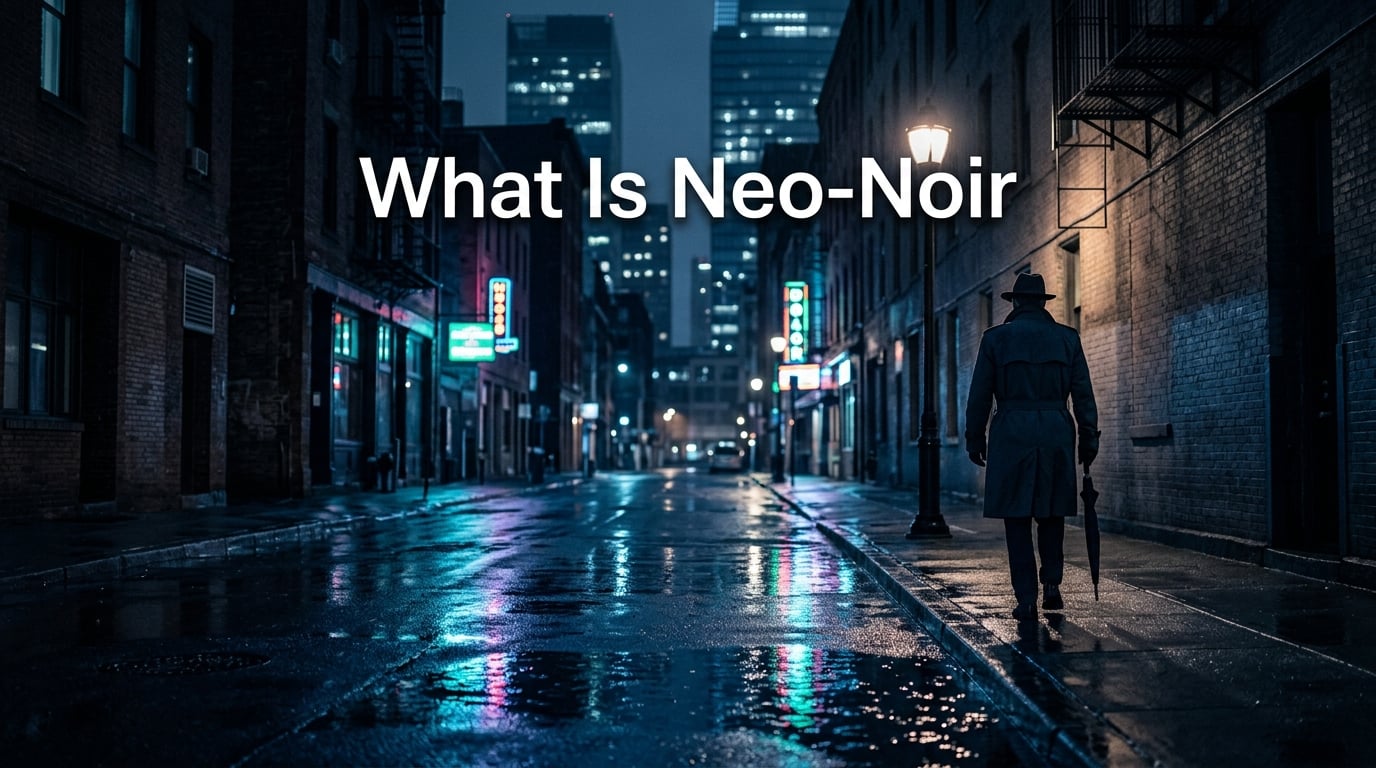
Neo-noir is a film genre that emerged in the 1970s, updating the visual style, themes, and sensibilities of classic film noir with modern techniques, contemporary social attitudes, and fewer censorship restrictions. The term literally translates to “new black,” combining the Greek prefix “neo” (new) with the French “noir” (black), and it has become one of the most influential movements in modern cinema.
If you have ever watched Chinatown, Blade Runner, or Drive and felt that intoxicating blend of moral ambiguity, shadow-soaked visuals, and cynical storytelling, you already understand the appeal. In this 2026 guide, we break down what is neo-noir, where it came from, and how to spot it the next time a film pulls you into its dark orbit.
Our team has spent years studying film genre theory, and we built this guide to answer the questions that come up again and again on forums and in classrooms. Whether you are a film student, a screenwriter, or a curious movie fan, you will leave with a clear framework for identifying neo-noir the moment it appears on screen.
Table of Contents
What Is Neo-Noir? Definition and Origins
Neo-noir is a film genre that revives the visual style and storytelling traditions of 1940s and 1950s American film noir while updating them with modern themes, explicit content, color cinematography, and contemporary social commentary. The classic noir era is generally considered to have ended around 1958-1959 with Orson Welles’ Touch of Evil, and everything that follows in that stylistic lineage falls under the neo-noir umbrella.
Philosopher Mark Conard offers one of the cleanest definitions we have found: neo-noir is “any film coming after the classic noir period that contains noir themes and noir sensibility.” That sensibility is what matters most, because neo-noir is defined less by strict rules and more by mood, tone, and attitude.
The Origin of the Term
The word “noir” itself was coined not by American filmmakers but by French critics. Raymond Borde and Etienne Chaumeton used the term “film noir” (literally “black film” or “dark film”) in their 1955 essay to describe the cycle of pessimistic, shadow-drenched American crime films that flooded French cinemas after World War II.
The prefix “neo” was attached later, as critics and scholars needed a way to distinguish the wave of noir-influenced films that began appearing in the late 1960s and 1970s. These new films were not simply remakes of older noirs, they reimagined the genre for a changed world.
Why Neo-Noir Emerged in the 1970s
Three forces converged in the late 1960s and early 1970s to make neo-noir possible. First, the collapse of the Hays Production Code in 1968 (replaced by the MPAA rating system) freed filmmakers to depict violence, sexuality, and moral complexity that earlier noir could only hint at.
Second, the cultural trauma of Vietnam and the political scandal of Watergate shattered public trust in institutions and authority figures. That cynicism became the emotional fuel for a new generation of dark, distrustful crime films.
Third, a wave of film school-educated directors (the “movie brat” generation, including Coppola, Scorsese, and Spielberg) grew up loving classic noir and wanted to bring its DNA into contemporary storytelling. Chinatown (1974) and Taxi Driver (1976) became the movement’s twin launching pads.
Key Characteristics and Tropes of Neo-Noir
Neo-noir films share a recognizable constellation of characteristics: morally ambiguous protagonists, cynical worldviews, criminal psychology, and a distrust of authority that pervades every scene. These traits are inherited from classic noir but pushed further, darker, and more explicitly than the original movement could manage.
Moral Ambiguity and the Anti-Hero
The neo-noir protagonist is rarely a clean-cut hero. Instead, you get detectives with obsessions that border on madness, vigilantes who blur the line between justice and revenge, and corrupt insiders who know the system is rotten because they helped build it. Jake Gittes in Chinatown, Travis Bickle in Taxi Driver, and Lou Bloom in Nightcrawler are all variations on this archetype.
What makes these characters compelling is that the films rarely judge them cleanly. The audience is left to sit with uncomfortable questions about complicity, violence, and whether doing the right thing is even possible in a corrupted world.
The Reimagined Femme Fatale
Classic noir gave us the femme fatale, the seductive woman who lures the protagonist into danger. Neo-noir keeps the archetype but reimagines her with far more complexity. The modern femme fatale is not just a temptress, she can be a victim, a schemer, a survivor, or all three at once, and the films increasingly let her drive the story on her own terms.
Evelyn Mulwray in Chinatown, Bridget Gregory in The Last Seduction, and Catherine Tramell in Basic Instinct all demonstrate how neo-noir expanded the role beyond a simple trope into something psychologically richer.
Criminal Psychology and Distrust of Authority
Neo-noir spends more time inside its characters’ heads than classic noir ever did. You get voiceover narration, fragmented memory, unreliable narrators, and protagonists whose grip on reality is questionable. Memento (2000) pushes this to its extreme with a protagonist who cannot form new memories.
The genre’s institutional distrust is equally important. Police departments are corrupt, politicians are bought, and the justice system serves the powerful. This is not paranoia but the operating assumption of the neo-noir universe, a reflection of post-Vietnam, post-Watergate disillusionment that still resonates in 2026.
Visual Style: Lighting, Color, and Cinematography
Neo-noir borrows classic noir’s visual language of shadow and contrast but updates it with color cinematography, modern camera technology, and editing techniques that were unavailable to 1940s filmmakers. The result is a look that is instantly recognizable, even when the setting is a sunny Los Angeles afternoon rather than a rain-soaked alley.
Low-Key Lighting and Chiaroscuro
Low-key lighting is the backbone of noir visuals, and neo-noir keeps it front and center. Faces are half-lit, deep shadows swallow backgrounds, and single light sources carve characters out of darkness. This technique, called chiaroscuro, creates tension visually before a single line of dialogue is spoken.
Watch The Godfather for a masterclass in this approach. Gordon Willis earned the nickname “The Prince of Darkness” for his insistence on shooting Marlon Brando’s eyes in shadow, a choice that would have been unthinkable under the bright, even lighting standards of studio-era Hollywood.
Modern Visual Adaptations
Color changed everything. Neo-noir filmmakers use saturated reds, sickly greens, and electric blues to create moods that black-and-white could never achieve. The neon-drenched streets of Blade Runner, the bleach-bypass desaturation of Se7en, and the candy-colored violence of Drive all belong to this tradition.
Neo-noir also embraces nonlinear storytelling. Jump cuts, fragmented timelines, and unreliable narration became signature tools. Pulp Fiction shattered chronological convention entirely, while Memento told its story in reverse to force the audience into the protagonist’s disorientation.
Neo-Noir vs Classic Film Noir: Key Differences
The simplest distinction is chronological: classic film noir refers to the cycle of American crime films produced roughly between 1940 and 1959, while neo-noir covers everything in that stylistic tradition made afterward. But the differences go deeper than the calendar, and this is one of the most common questions we see on film forums.
Here is a breakdown of how the two compare:
| Element | Classic Film Noir (1940-1959) | Neo-Noir (1970s-present) |
|---|---|---|
| Visual format | Black and white | Color (though some neo-noirs use B&W) |
| Censorship | Hays Production Code limited violence, sex, and moral resolution | MPAA rating system allows explicit content |
| Social context | Post-WWII anxiety, urban alienation | Post-Vietnam, post-Watergate cynicism; ongoing institutional distrust |
| Narrative structure | Mostly linear, often with voiceover framing | Frequently nonlinear, fragmented, or unreliable |
| Violence and sexuality | Implied, suggested, off-screen | Graphic, explicit, on-screen |
| Protagonist | Often a private detective or ordinary man drawn into crime | Wider range: cops, criminals, vigilantes, ordinary people, even assassins |
| Femme fatale | Seductive woman who destroys the hero | More psychologically complex, sometimes the protagonist herself |
One thing worth noting that comes up constantly on Reddit: many film fans find the line between noir and neo-noir “useless, arbitrary, even contradictory.” Our take is that the distinction is useful for film history and criticism, but the most important thing is recognizing the shared sensibility. If a film feels noir, made after 1960, it is probably neo-noir.
Notable Neo-Noir Examples Through the Decades
Neo-noir has produced some of the most acclaimed films in cinema history. Below is a chronological tour of the genre’s defining works, each chosen because it demonstrates a different facet of what neo-noir can do.
Chinatown (1974) – Roman Polanski’s masterpiece is often considered the film that launched the neo-noir movement. Jack Nicholson’s Jake Gittes investigates a water rights conspiracy in 1930s Los Angeles and discovers that power and corruption go all the way to the top. Its infamous ending, “Forget it, Jake, it’s Chinatown,” distills noir fatalism into a single line.
Taxi Driver (1976) – Martin Scorsese and Paul Schrader created the definitive urban alienation story. Robert De Niro’s Travis Bickle is a Vietnam vet descending into madness in a decaying New York, embodying the genre’s capacity for psychological interiority.
Blade Runner (1982) – Ridley Scott fused neo-noir with science fiction, creating a template that would spawn an entire subgenre (more on neon noir below). Harrison Ford’s Rick Deckard is a classic noir detective transplanted into a dystopian future, complete with voiceover, rain, and a femme fatale.
Blood Simple (1984) – The Coen Brothers’ debut announced a new voice in neo-noir. Their trademark mix of dark humor, crime, and moral chaos would define their career and influence countless imitators.
Pulp Fiction (1994) – Quentin Tarantino shattered narrative structure while steeping his film in noir dialogue, hitmen, and double-crosses. The question of whether Pulp Fiction qualifies as neo-noir comes up frequently, and our answer is yes: its crime setting, moral ambiguity, and nonlinear storytelling place it squarely in the tradition.
L.A. Confidential (1997) – A loving homage to 1950s noir set in the era when classic noir was dying. Curtis Hanson’s film about corrupt LAPD officers and Hollywood glamour is practically a textbook on the genre.
Memento (2000) – Christopher Nolan used reverse chronology to trap the audience inside a protagonist’s broken memory, pushing neo-noir’s love of unreliable narration to its logical extreme.
Drive (2011) – Nicolas Winding Refn delivered a synth-soaked, neon-lit fairy tale about a stoic getaway driver. The film revitalized interest in the genre and helped define the modern neon-noir aesthetic.
Nightcrawler (2014) – Jake Gyllenhaal’s Lou Bloom is a freelance crime videographer who films accidents and murders for local news. The film updates noir’s critique of media and morality for the gig-economy era.
John Wick franchise (2014-present) – Yes, John Wick is neo-noir. Beneath the action choreography lies a story about grief, a criminal underworld with its own codes, and a protagonist defined by loss and vengeance. The shadowy cinematography and moral universe are pure noir DNA.
Subgenres of Neo-Noir: Neon Noir and Sunshine Noir
As neo-noir evolved, two distinct subcategories emerged that are worth knowing. Both are widely cited by critics and appear in nearly every comprehensive guide to the genre.
Neon Noir refers to films that lean heavily into the genre’s visual identity: rain-slicked streets reflecting electric signs, neon color palettes, and urban decay. Blade Runner is the founding text, and its influence ripples through cyberpunk cinema, The Matrix, and beyond. The neon-noir look has become so iconic that it now defines how we imagine future cities on screen.
Sunshine Noir is the inverse trick. Instead of darkness and shadows, these films use bright, sun-drenched settings, often Southern California, to hide moral rot beneath the surface. The Big Lebowski, Inherent Vice, and the television series True Detective Season 2 all play with this idea. The sunshine is a lie, and the darkness lives in the characters and the systems they inhabit.
Neo-Noir on Television and Streaming
Neo-noir found a natural home on television, where the long-form format allows for the slow-burn moral complexity that the genre thrives on. As streaming platforms have invested heavily in prestige drama in 2026, neo-noir has become one of the dominant modes of serious television storytelling.
True Detective Season 1 (2014) is perhaps the most celebrated example. Its Louisiana setting, philosophical pessimism, and damaged investigators felt like a 10-hour neo-noir novel brought to life. The series proved that the genre could sustain serialized storytelling without losing its power.
Fargo, inspired by the Coen Brothers’ film, blends noir crime with Midwestern dark humor across multiple seasons and time periods. Mindhunter brought neo-noir’s obsession with criminal psychology into the world of FBI profiling. Peaky Blinders and Better Call Saul both draw heavily on noir visual language and moral ambiguity.
Streaming has expanded the genre globally as well. Korean cinema and television, in particular, have embraced neo-noir aesthetics, with works like Oldboy and the series My Mister demonstrating the genre’s international reach.
FAQs
What is a neo-noir in simple terms?
A neo-noir is a modern crime film that borrows the dark mood, shadowy visuals, cynical characters, and moral ambiguity of classic 1940s film noir but updates them with color cinematography, explicit content, and contemporary themes. If a film made after 1960 feels like film noir, it is probably neo-noir.
How is neo-noir different from regular noir?
Classic film noir refers to American crime films made between roughly 1940 and 1959, shot in black and white under the censorship of the Hays Production Code. Neo-noir covers the same stylistic tradition made afterward, using color, explicit violence and sexuality, nonlinear storytelling, and themes shaped by post-Vietnam and post-Watergate cynicism.
Is John Wick considered neo-noir?
Yes. Beneath the action sequences, John Wick is built on neo-noir foundations: a grieving anti-hero, a criminal underworld with its own moral code, shadowy cinematography, and themes of vengeance and loss. The franchise’s visual style and moral universe place it squarely in the neo-noir tradition.
Is Pulp Fiction neo-noir?
Yes. Pulp Fiction uses crime settings, hitmen, double-crosses, morally ambiguous characters, and a shattered nonlinear narrative. Its dialogue-heavy style and moral chaos are direct descendants of film noir, updated with Quentin Tarantino’s postmodern sensibility.
What is an example of a neo-noir movie?
Chinatown (1974) is widely considered the first major neo-noir film. Other defining examples include Taxi Driver (1976), Blade Runner (1982), L.A. Confidential (1997), Memento (2000), Drive (2011), and Nightcrawler (2014).
Is American Psycho a neo-noir?
American Psycho has strong neo-noir elements, including an unreliable narrator, moral emptiness, urban alienation, and criminal psychology. However, it blends these with satire and horror, so it is better described as a neo-noir-adjacent film rather than a pure example of the genre.
Wrapping Up: Why Neo-Noir Endures
What is neo-noir, at its core? It is the ongoing conversation between filmmakers and audiences about darkness, morality, and the systems that fail us. The genre endures because its central question, whether decency can survive in a corrupt world, never stops being relevant.
If you want to explore further, start with Chinatown and Blade Runner, then work your way forward through Drive and Nightcrawler. Pay attention to the lighting, the narrators you cannot trust, and the heroes who are not really heroes. Once you learn to see neo-noir, you will find it everywhere, on streaming services, in video games, and in the stories we keep telling ourselves about crime, power, and the human capacity for self-destruction.