
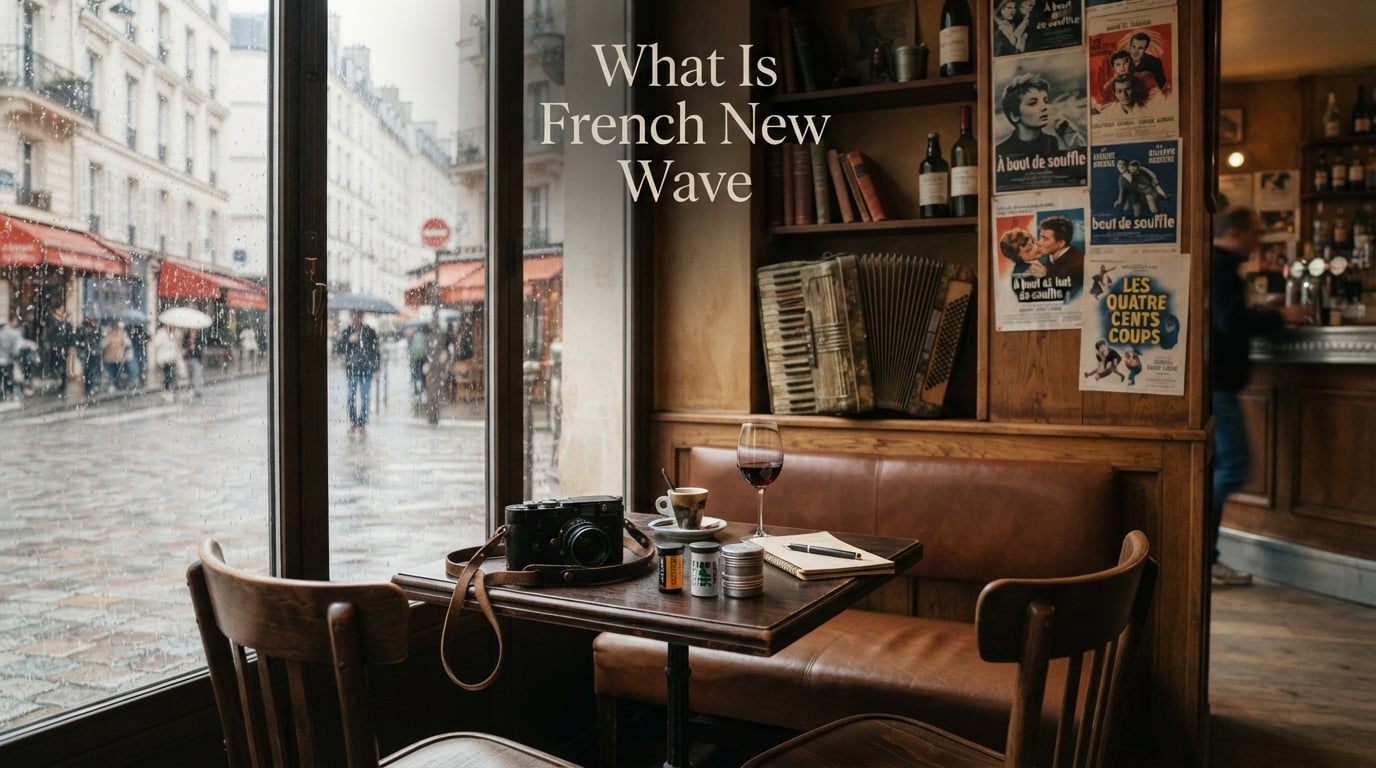
The French New Wave, or La Nouvelle Vague, was a revolutionary film movement that swept through France in the late 1950s and transformed cinema forever. A small group of young critics picked up cameras, took to the streets of Paris, and made movies that broke nearly every rule the industry had established. Their films felt raw, personal, and electric. I fell in love with this movement on a rainy afternoon when a friend pressed a copy of Breathless into my hand, and I want to share what made it so special.
In this guide, I’ll walk you through where French New Wave came from, who shaped it, the techniques that defined it, and the films you should watch first. You’ll also find a list of essential directors, a breakdown of the four signature techniques, and practical guidance on streaming these classics today. Whether you’re a film student, a casual movie fan, or just curious about one of cinema’s most important movements, this guide will give you everything you need to understand French New Wave.
Table of Contents
What Is French New Wave? Definition and Origins of La Nouvelle Vague
The French New Wave was a radical art film movement that emerged in France between 1958 and the mid-1960s. The French name is La Nouvelle Vague, and the English translation is simply “New Wave.” It refers to a generation of French filmmakers who rejected the polished, scripted, studio-bound productions that dominated post-war French cinema and replaced them with spontaneous, low-budget, personal films shot on location.
The roots of the movement trace back to the pages of Cahiers du cinéma, a film journal founded in 1951. Writers at the magazine, including André Bazin, argued that cinema was an art form and that the director should be treated as its author. Two young Cahiers critics, François Truffaut and Jean-Luc Godard, sharpened this idea into the provocative claim that the best Hollywood directors were secretly auteurs despite working inside the studio system. The essay “A Certain Tendency in French Cinema” by Truffaut in 1954 became a manifesto. When the French film industry began to falter in the late 1950s, a government program allowed first-time directors to make features cheaply, and these critic-turned-directors finally had their chance behind the camera.
The first wave of New Wave films arrived in 1958-1960, including Truffaut’s The 400 Blows, Godard’s Breathless, Alain Resnais’s Hiroshima mon amour, and Claude Chabrol’s Le Beau Serge. By the mid-1960s, the movement had reshaped how films could be financed, shot, edited, and shown around the world. To understand French New Wave fully, you need to know its key directors.
Who Were the Key Directors of French New Wave?
The French New Wave was carried by a tight circle of fiercely individual filmmakers who had grown up together as critics. Six directors form the core of the movement, and each brought a different sensibility to the revolution.
- Jean-Luc Godard (1930-2022): The most radical and philosophically playful of the group. His Breathless (1960) became the movement’s defining film. Also made Contempt, Band of Outsiders, Alphaville, and Weekend.
- François Truffaut (1932-1984): The movement’s emotional heart. His semi-autobiographical The 400 Blows (1959) launched the wave. Also directed Shoot the Piano Player, Jules and Jim, Day for Night, and The Story of Adele H.
- Claude Chabrol (1930-2010): The first of the Cahiers critics to direct a feature. Le Beau Serge (1958) and Les Cousins (1959) opened the movement. He made over fifty films, often in a Hitchcockian suspense mode.
- Alain Resnais (1922-2014): A slightly older filmmaker who shaped the Left Bank wing. Hiroshima mon amour (1959) and Last Year at Marienbad (1961) explored memory and time in groundbreaking ways.
- Louis Malle (1932-1995): Started as co-director with Jacques Cousteau on The Silent World before turning to fiction. Elevator to the Gallows (1958) and The Lovers (1958) earned him early international attention.
- Agnès Varda (1928-2019): Often called the “mother” or “godmother” of the New Wave. Her Cleo from 5 to 7 (1962) and The Beaches of Agnès are essential viewing.
Other important figures include Jacques Rivette, Eric Rohmer, Chris Marker, and later Alain Cavalier. Together, they made French New Wave not a single style but a permission slip for any filmmaker with something personal to say.
What Are the Four Primary Characteristics of French New Wave Films?
The four primary characteristics of a French New Wave film are jump cuts, on-location shooting, handheld camera work, and natural lighting. These choices were both practical (low budgets) and philosophical (the desire for spontaneity and authenticity).
1. Jump Cuts and Discontinuous Editing
A jump cut is a sudden, jarring cut that skips forward in time within a single shot. Godard used jump cuts so aggressively in Breathless that audiences gasped. Where classical editing hid the cuts and created smooth continuity, New Wave editors made the seams visible. The technique forced viewers to feel the construction of the film and reminded them they were watching a movie.
2. Location Shooting
Instead of expensive studio sets, New Wave directors took their cameras out into the streets of Paris and the countryside. Real cafés, real apartments, real metro stations stood in for Hollywood-style backlots. Location shooting gave the films an immediacy and documentary-like texture that traditional French cinema lacked.
3. Handheld Camera Work
Lightweight Éclair Coutant cameras, designed for television news, allowed directors to move freely without dollies and tripods. The handheld look created energy, intimacy, and a sense of discovery. Raoul Coutard, Godard’s and Truffaut’s regular cinematographer, became one of the most influential camera operators in film history because of this work.
4. Natural Lighting
Combined with location shooting, natural lighting rejected the heavily controlled lighting setups of studio films. Real daylight, street lamps, and available interior light gave the images a freshness that artificial rigs could not match. It also meant shoots moved quickly because crews followed the sun instead of rigging hundreds of lamps.
Other techniques are common too: improvised dialogue, breaking the fourth wall, characters who talk directly to the camera, long takes, and looser scripts. The combination is what defines a French New Wave film.
What Is Auteur Theory and How Does It Connect to the New Wave?
Auteur theory is the idea that the director is the primary author of a film, the way a novelist authors a book. The theory was developed in the pages of Cahiers du cinéma in the 1950s and became the philosophical engine of French New Wave.
Truffaut’s 1954 essay “A Certain Tendency in French Cinema” attacked what he called the “tradition of quality,” in which French studios hired literary writers to write scripts and technicians to direct them. Truffaut argued that true cinema needed a director with a personal vision, the way a painter has a personal style. The term auteur came from an earlier French policy that gave directors final cut and other artistic rights.
Once Truffaut, Godard, and their Cahiers colleagues started making their own films, auteur theory stopped being theory and became practice. They wrote, directed, and edited their own movies, often funding them through their producer Georges de Beauregard or through state advance on receipts. The resulting films were unmistakably the work of one sensibility. Hitchcock, Hawks, and Ford were retroactively claimed as auteurs, and the entire concept of the director as artist, which now dominates art cinema worldwide, was born.
What Films Should You Watch First?
If you’re new to the movement, start with these essential films. They are widely available and give you a clear cross-section of the New Wave.
- The 400 Blows (1959, Truffaut): A 14-year-old boy wanders Paris after a difficult childhood. The defining coming-of-age film of the era and a touchstone for everything that followed.
- Breathless (1960, Godard): A young car thief hides out in Paris with an American girlfriend. A small, cheap film that rewrote the rules of editing and performance.
- Jules and Jim (1962, Truffaut): Two friends love the same woman across decades. Playful, romantic, and visually inventive.
- Cleo from 5 to 7 (1962, Varda): A singer waits for medical results while wandering Paris. A landmark film by a female director and a perfect entry point.
- Hiroshima mon amour (1959, Resnais): A French actress and a Japanese architect remember a postwar affair. Dense, poetic, and revolutionary.
- Le Samourai (1967, Melville): A hitman follows his own strict code. Cool, stylish, and hugely influential on everyone from John Woo to The Driver.
- Band of Outsiders (1964, Godard): Three bored kids plan a heist and dance at a cafe. The most playful Godard feature.
After these, branch into the rest of the directors’ filmographies. Every single Cahiers critic turned director has at least three essential films.
What Is the Difference Between Left Bank and Right Bank Filmmakers?
The French New Wave is usually split into two informal groups. The Right Bank group, also called Rive Droite, included critics-turned-directors working at Cahiers du cinéma. The Left Bank group, or Rive Gauche, included filmmakers with looser ties to the magazine and stronger ties to the French literary and experimental scenes.
The Right Bank filmmakers, including Godard, Truffaut, Chabrol, Rohmer, and Rivette, focused on narrative and the possibilities of cinema as a pop language. They worked fast and often referred to Hollywood genres like noir and the musical. The Left Bank group, including Resnais, Varda, Marker, and later Chris Marker, treated cinema more as a poetic and philosophical form, willing to stretch documentary, essay, and narrative together.
The split was never strict. Varda is often classified as Left Bank but worked across both worlds. Resnais and Truffaut remained close friends throughout their careers. But the distinction helps explain why a Resnais film like Last Year at Marienbad feels so different from a Godard film like Breathless, even though both are part of the New Wave.
How Did French New Wave Influence Modern Cinema?
The influence of French New Wave on modern filmmaking is hard to overstate. Almost every independent and art cinema tradition of the last sixty years owes something to it.
In the United States, the New Wave inspired the New Hollywood generation: Martin Scorsese, Francis Ford Coppola, Steven Spielberg, and Brian De Palma. Scorsese’s Mean Streets is openly indebted to Breathless. The handheld, location-shot American indie film of the 1980s and 1990s, from John Cassavetes to Spike Lee to Richard Linklater, comes from the same well. Wong Kar-wai in Hong Kong, Park Chan-wook in South Korea, and the entire New Queer Cinema movement all claim French New Wave as a forefather.
Beyond narrative, the New Wave’s commercial tactics, advance on receipts, low budgets, fast shoots, became standard practice for independent producers worldwide. The phrase “Nouvelle Vague” itself was borrowed in dozens of countries: the Czech New Wave, the Japanese New Wave, the New German Cinema, the British New Wave, the Taiwanese New Wave, and the Brazilian Cinema Novo all took the French model and adapted it locally.
More subtly, the New Wave taught filmmakers that a movie could feel like one person’s vision. The very idea that we now talk about “a Tarantino film” or “a Greta Gerwig film” is a direct inheritance of auteur theory and the New Wave generation that made it real.
Where Can You Watch French New Wave Films Today?
One of the most common frustrations I hear from readers is that French New Wave films can be hard to find. The good news is that streaming has made them far more accessible than they were ten years ago. Here is where to look first.
The Criterion Channel is the single best home for French New Wave online. It is a paid streaming service dedicated to classic and art cinema and has themed collections, restored prints, and supplementary features on Godard, Truffaut, Chabrol, Varda, and the rest of the movement. If you can only subscribe to one service for New Wave films, this is the one.
Many New Wave films also rotate through the major subscription services. HBO Max, MUBI, and the TCM channel regularly carry Truffaut and Godard. Max even has a curated “French New Wave” collection in some regions. Amazon Prime Video offers rentals and purchases of restored prints of most major New Wave films. Physical media is still thriving for this movement, and the BFI, Criterion, and Cohen Film Collection Blu-rays are widely available.
If you want a quick starter plan, watch The 400 Blows, Breathless, and Cleo from 5 to 7 in that order. Each film runs about ninety minutes, and together they cover the movement’s emotional, intellectual, and stylistic range.
Frequently Asked Questions About French New Wave
What is an example of a French New Wave film?
The most famous example is Breathless (1960) by Jean-Luc Godard, a low-budget crime drama shot on the streets of Paris that popularized jump cuts and a documentary-style energy. Other essential examples include The 400 Blows (1959) by Francois Truffaut, Cleo from 5 to 7 (1962) by Agnes Varda, and Hiroshima mon amour (1959) by Alain Resnais.
Why do people like French New Wave?
People like French New Wave because the films feel spontaneous, personal, and alive in a way that classical studio movies often do not. They broke the rules of editing, dialogue, and performance, which makes them feel fresh even decades later. Viewers also appreciate the strong directorial voices: Godard’s playfulness, Truffaut’s warmth, and Varda’s humanism all shine through in ways that mainstream cinema rarely allows.
What are the four primary characteristics of a French New Wave film?
The four primary characteristics of a French New Wave film are jump cuts and discontinuous editing, on-location shooting, handheld camera work, and natural lighting. Together they produce a spontaneous, documentary-style look that rejected the polished, controlled look of traditional studio filmmaking. Improvised dialogue and breaking the fourth wall are also common but secondary traits.
What is the difference between Czech New Wave and French New Wave?
Both movements emerged in the late 1950s and 1960s and shared a rejection of studio conventions, but they came from very different political and cultural contexts. The French New Wave was led by critics at Cahiers du cinema and focused on personal expression, genre play, and auteur theory. The Czech New Wave, including directors like Milos Forman and Vera Chytilova, emerged from a brief cultural thaw in communist Czechoslovakia and combined formal experimentation with sharper political allegory. The French side influenced Hollywood; the Czech side fed into later Czech surrealism and the Eastern Bloc dissident tradition.
Final Thoughts on French New Wave
The French New Wave is more than a chapter in film history. It is a reminder that movies can be made with almost nothing but a strong idea, a small camera, and a director with something to say. Every independent filmmaker working today, from Sundance darlings to TikTok auteurs, is a distant cousin of Godard and Truffaut.
Start with The 400 Blows or Breathless, work through the essential directors I listed above, and let the films pull you forward. If you want to keep exploring, the Criterion Channel has themed collections that will guide you through the rest of the movement. The French New Wave rewards patience, attention, and curiosity, and once it clicks for you, you will never look at a movie the same way again.