
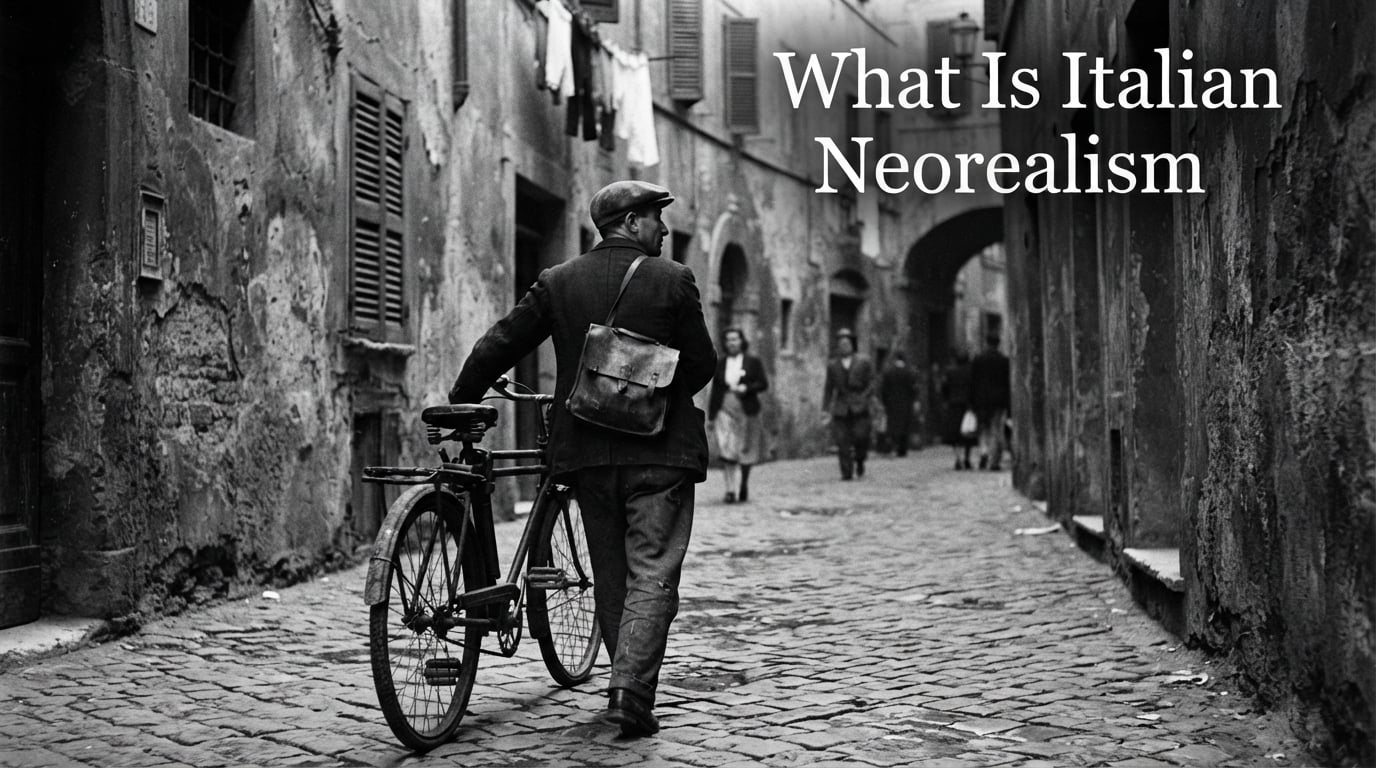
Italian Neorealism was a national film movement that emerged in post-World War II Italy between 1943 and the early 1950s, characterized by stories set among the poor and working class, shot on real locations with non-professional actors. It became known as the Golden Age of Italian Cinema.
If you have ever watched Bicycle Thieves and felt like you were walking through postwar Rome rather than watching a film, you already understand the spirit of Italian Neorealism. I have spent years studying this movement and watching its key films, and I still find something new in each one.
In this guide, I will walk you through what Italian Neorealism is, where it came from, the directors who shaped it, and why it still matters in 2026. We will look at the key characteristics, the most important films, the women whose contributions often get overlooked, and how this movement influenced everything that followed.
Table of Contents
What Is Italian Neorealism in Film?
Italian Neorealism, or neorealismo, was a cinematic movement that redefined storytelling after World War II. Filmmakers rejected polished studio productions in favor of raw, documentary-style films shot on real streets with everyday people.
The movement focused on the struggles of ordinary Italians during a time of poverty and reconstruction. It combined social commentary with technical innovation, using available light, handheld cameras, and improvised dialogue.
Roberto Rossellini once said, “I try to capture reality, nothing else.” That single sentence captures what makes the movement powerful: a commitment to truth over artifice.
The Core Idea Behind the Movement
Neorealism asked a simple but radical question: what if films looked and felt like the lives of the people around us? Instead of glamorous stars, directors cast factory workers, shopkeepers, and children playing in the streets.
Instead of constructed sets, they filmed in bombed-out buildings, rural villages, and crowded markets. This was filmmaking as journalism, as witness, and as resistance.
Historical Context: How Post-War Italy Shaped Italian Neorealism
Italian Neorealism could not have existed without the devastation of World War II. When Allied forces liberated Italy in 1943 and 1944, the country faced widespread poverty, unemployment, and political uncertainty.
The fall of Mussolini’s fascist regime in 1943 ended two decades of state-controlled cinema. Under fascism, the polished productions known as Telefoni Bianchi (“white telephone” films) had dominated screens with escapist stories of wealthy families.
Young filmmakers wanted something completely different. They wanted to show what the war had actually done to their country and its people.
The Destruction of Cinecittà Studios
The famous Cinecittà studios in Rome were seized by the Allies in 1944 and converted into a refugee camp housing thousands of displaced Italians. By the time the studios were returned to the film industry, much of their equipment had been lost or damaged.
This destruction forced filmmakers out of the soundstages and into the streets. Many directors saw this not as a setback but as a creative opportunity. They had to invent new ways of working, and those inventions defined the movement.
Economic Hardship and the Working Class
Italy’s economy was shattered after 1945. Rationing continued into the early 1950s, unemployment was high, and millions lived in poverty. Audiences could no longer relate to the wealthy characters of pre-war cinema.
Neorealist filmmakers responded by telling stories about bums, factory workers, mothers, and children just trying to survive. These were the people Italian audiences saw when they looked out their windows.
Key Characteristics of Italian Neorealism
Italian Neorealism is defined by a set of techniques and themes that broke sharply from classical cinema. Understanding these characteristics is essential to recognizing the movement in any film you watch.
- Location shooting: Films were shot in real streets, apartments, and rural areas rather than studios.
- Non-professional actors: Directors cast ordinary people, often in roles mirroring their actual lives.
- Documentary style: Natural lighting, handheld cameras, and improvised dialogue created a sense of realism.
- Working-class focus: Stories centered on the poor, unemployed, and marginalized rather than the elite.
- Social commentary: Films tackled political issues like poverty, injustice, and post-war trauma.
- Episodic structure: Plots were loose and open-ended, sometimes with unclear resolution.
- Everyday language: Dialogue used regional dialects and conversational speech, not polished literary lines.
Why Non-Professional Actors Were Central
Using non-professional actors was not just a budget choice. It was a philosophical decision. Directors believed that trained performers brought habits of performance with them, gestures and expressions shaped by other films.
An amateur actor brought something different: their actual face, their real posture, their real reaction to being filmed. Vittorio De Sica cast Enzo Staiola, a shoeshine boy he met on the street, as the son in Bicycle Thieves. Staiola had never acted before, and his performance still moves audiences today.
Low Budgets and Creative Freedom
Most neorealist films were made on shoestring budgets, often under $200,000 in today’s money. This forced filmmakers to be resourceful: using natural light, real locations, and minimal crews.
Critics originally saw these low budgets as a limitation. Over time, audiences and filmmakers recognized them as a kind of freedom. Without expensive sets and stars, every artistic decision became content, not decoration.
Notable Directors Who Defined Italian Neorealism
Four directors stand at the center of Italian Neorealism. Each brought something different to the movement, and their combined work shaped what we now recognize as neorealist cinema.
Roberto Rossellini (1906-1977)
Rossellini is widely called the father of Italian Neorealism. His trilogy of war films, Rome Open City (1945), Paisà (1946), and Germany Year Zero (1948), set the template for the movement.
He shot Rome Open City while the war was still being fought in northern Italy. He used bombed-out buildings as sets, worked with non-professional actors, and finished the film on a famously tight budget. The result won international awards and launched the movement globally.
Vittorio De Sica (1901-1974)
De Sica started as an actor before becoming a director. His films Shoeshine (1946), Bicycle Thieves (1948), and Umberto D. (1952) are considered the emotional heart of Italian Neorealism.
Bicycle Thieves is often cited as the greatest neorealist film ever made. It tells the story of a poor father searching post-war Rome for his stolen bicycle, the tool he needs to keep his job. The film won a special Academy Award in 1950 and still influences filmmakers today.
Luchino Visconti (1906-1976)
Visconti is considered the founder of Italian Neorealism, even before Rossellini. His 1942 film Ossessione, often cited as the first neorealist film, adapted James Cain’s The Postman Always Rings Twice with a gritty, working-class setting.
Visconti’s aristocratic background created an interesting contrast with his subjects. He brought a European art-house sensibility to the movement, mixing social realism with literary adaptation. His later film Rocco and His Brothers (1960) pushed neorealist themes into the 1960s.
Federico Fellini (1920-1993)
Fellini started his career working with Rossellini before launching his own directorial career. His early films I Vitelloni (1953) and La Strada (1954) carry neorealist themes but move toward a more poetic, symbolic style.
By the time Fellini made La Dolce Vita (1960) and 8½ (1963), he had moved far from strict neorealism. Still, his early work belongs to the movement’s foundation, and he always credited neorealism with shaping his visual imagination.
Landmark Films of Italian Neorealism
Certain films defined the movement and remain required viewing for anyone interested in film history. These are the works that established Italian Neorealism on the international stage.
Rome Open City (1945)
Roberto Rossellini’s Rome Open City is the film that launched Italian Neorealism to the world. It was shot on a tiny budget while the war was still ending, using whatever locations were available in a half-destroyed Rome.
The story follows Italian resistance fighters during the Nazi occupation of Rome. Mixed in with the action is the story of a pregnant woman and a priest, ordinary people caught up in extraordinary events. The film won the Grand Prix at the Cannes Film Festival in 1946.
Bicycle Thieves (1948)
Vittorio De Sica’s Bicycle Thieves is the emotional peak of the movement. The plot is simple: a working-class father needs his bicycle for his new job pasting up posters, the bike gets stolen, and he spends a day searching Rome for it.
What makes the film powerful is its refusal to resolve cleanly. The father does not win a triumphant victory. Instead, the film ends with him doing something broken and human, something that shows both desperation and love. I have watched this film three times and each viewing hits differently.
Paisà (1946)
Rossellini’s follow-up to Rome Open City used a six-episode structure to show different encounters between American soldiers and Italian civilians during the liberation. Each episode is self-contained, and several end in tragedy.
The film shows the rough edges of the liberation: misunderstandings, cultural clashes, and moments of real human connection. It is one of the most technically inventive films of the decade.
Shoeshine (1946) and Umberto D. (1952)
De Sica directed two more essential neorealist films. Shoeshine followed two boys who shine shoes on Roman streets and get drawn into petty crime. The film won an honorary Academy Award in 1947.
Umberto D., made years later, follows an elderly pensioner trying to survive in post-war Italy. The film is quiet, observational, and devastating. Many critics consider it De Sica’s masterpiece.
La Strada (1954)
Fellini’s La Strada marks the end of strict neorealism and the beginning of something more lyrical. Still, it carries the movement’s core themes: poverty, loneliness, and the search for human connection.
The film follows a young woman sold to a traveling strongman, played by Anthony Quinn. It won the first Academy Award for Best Foreign Language Film in 1957 and remains widely taught in film schools.
Women in Italian Neorealism: A Hidden Story
Italian Neorealism is often remembered as a movement of male directors with male protagonists. That memory is incomplete. Women played important roles both in front of and behind the camera, even when history has overlooked them.
Anna Magnani and the Faces of Post-War Italy
Anna Magnani became the most famous actress of the movement through her role in Rome Open City. She played a pregnant widow helping the resistance, and her raw performance broke every convention of the glamorous film heroine.
Magnani went on to star in many of Italy’s most important postwar films. She won the first Academy Award for Best Foreign Language Actress in 1956 and remained one of Italian cinema’s most powerful presences through the 1960s.
Women Working Behind the Camera
Women also worked as screenwriters, editors, and producers during the neorealist period, though their names rarely appear in standard histories. Lina Wertmüller, who worked as an assistant director during the movement’s peak, went on to become the first woman ever nominated for the Academy Award for Best Director.
This hidden history is something I think about a lot when watching neorealist films. The movement’s visible faces were mostly men, but the production work, the family labor, and the on-set collaboration depended heavily on women.
The End of the Movement and Its Lasting Legacy
Italian Neorealism began fading in the early 1950s as Italy’s economy improved and audiences craved different stories. Several factors contributed to its decline.
Italy’s Economic Miracle
Between 1950 and 1963, Italy experienced an economic boom known as the “Economic Miracle.” Poverty dropped sharply, consumer goods became widely available, and audiences wanted lighter entertainment.
Filmmakers like Fellini moved toward more stylized, personal stories. Studios invested in bigger productions. The gritty black-and-white style of neorealism began to feel distant from everyday life.
Criticism From Within the Movement
Some filmmakers, including Rossellini himself, began questioning whether neorealism had become a formula. They worried that location shooting and non-professional actors had turned into clichés rather than commitments.
By 1954, the new wave of Italian cinema, the commedia all’italiana, was emerging. Directors made comedies about contemporary Italian life, often with more polished styles. Neorealism as a movement was effectively over by the mid-1950s.
Influence on the French New Wave and Beyond
The most lasting legacy of Italian Neorealism is its influence on filmmakers around the world. The French New Wave, launched in the late 1950s by directors like Jean-Luc Godard and François Truffaut, took neorealism’s techniques and applied them with a more individual, auteur-driven approach.
American filmmakers also absorbed neorealist ideas. Martin Scorsese has cited Bicycle Thieves and Rossellini’s work as direct influences on his own films, including Mean Streets and Raging Bull. Satyajit Ray’s Indian neorealist films, the Brazilian Cinema Novo movement, and countless independent filmmakers worldwide all carry forward the neorealist commitment to truth on screen.
Why Italian Neorealism Still Matters in 2026
The questions Italian Neorealism asked are still relevant in 2026. What stories does our cinema tell? Whose lives are left out? Are we making films that look like the world around us?
Documentary-style dramas, streaming-era independent films, and cinema from the Global South continue to draw on neorealist traditions. The movement never really ended. It just kept spreading, picked up by new filmmakers in new places.
Frequently Asked Questions About Italian Neorealism
Who is the father of Italian Neorealism?
Roberto Rossellini is widely called the father of Italian Neorealism. His 1945 film Rome Open City, shot on a tiny budget with non-professional actors during the final months of World War II, established the techniques and themes that defined the movement.
What is Neorealism in simple terms?
Italian Neorealism is a film movement from 1943 to the early 1950s that told stories about poor and working-class Italians after World War II. Filmmakers shot on real streets using non-professional actors and focused on everyday struggles rather than glamorous studio productions.
Who are the most famous Neorealist artists?
The most famous Neorealist directors are Roberto Rossellini, Vittorio De Sica, Luchino Visconti, and Federico Fellini. Notable actors include Anna Magnani, Enzo Staiola, and non-professional performers who became icons of the movement.
Why did Italian Neorealism use non-professional actors?
Italian Neorealism used non-professional actors for artistic and philosophical reasons. Directors believed trained performers brought habits from other films, while amateurs offered genuine reactions and unfamiliar faces. Casting real workers, children, and ordinary people also kept costs down and made films feel like documentary reality.
When did Italian Neorealism end?
Italian Neorealism is generally considered to have ended in the early-to-mid 1950s. Several factors led to its decline, including Italy’s post-war economic recovery, criticism from filmmakers who felt the style had become a formula, and the rise of new styles like the commedia all’italiana comedy genre.
What films defined Italian Neorealism?
The most important Italian Neorealist films include Rome Open City (1945), Shoeshine (1946), Paisà (1946), Bicycle Thieves (1948), Germany Year Zero (1948), Umberto D. (1952), and La Strada (1954). These works established the movement’s techniques and themes on the international stage.
Conclusion
Italian Neorealism was more than a moment in film history. It was a complete rethinking of what cinema could be, who could be in it, and what stories it could tell.
The movement taught us that powerful films do not require big budgets or famous faces. Stories about factory workers, children, and unemployed pensioners can move audiences as deeply as any romance or war epic.
If you want to understand Italian Neorealism, start with Bicycle Thieves and Rome Open City. Then move on to Paisà, Umberto D., and La Strada. Watch them in order if you can, and notice how the techniques evolved from documentary urgency toward something more poetic by the mid-1950s.
In 2026, more than seventy years after these films first hit the screen, the questions Italian Neorealism asked are still worth asking. Whose stories are we telling? Whose faces are we filming? And what does it really look like outside our window? Rossellini, De Sica, Visconti, and Fellini answered those questions in their time. The rest of us are still answering them in ours.