
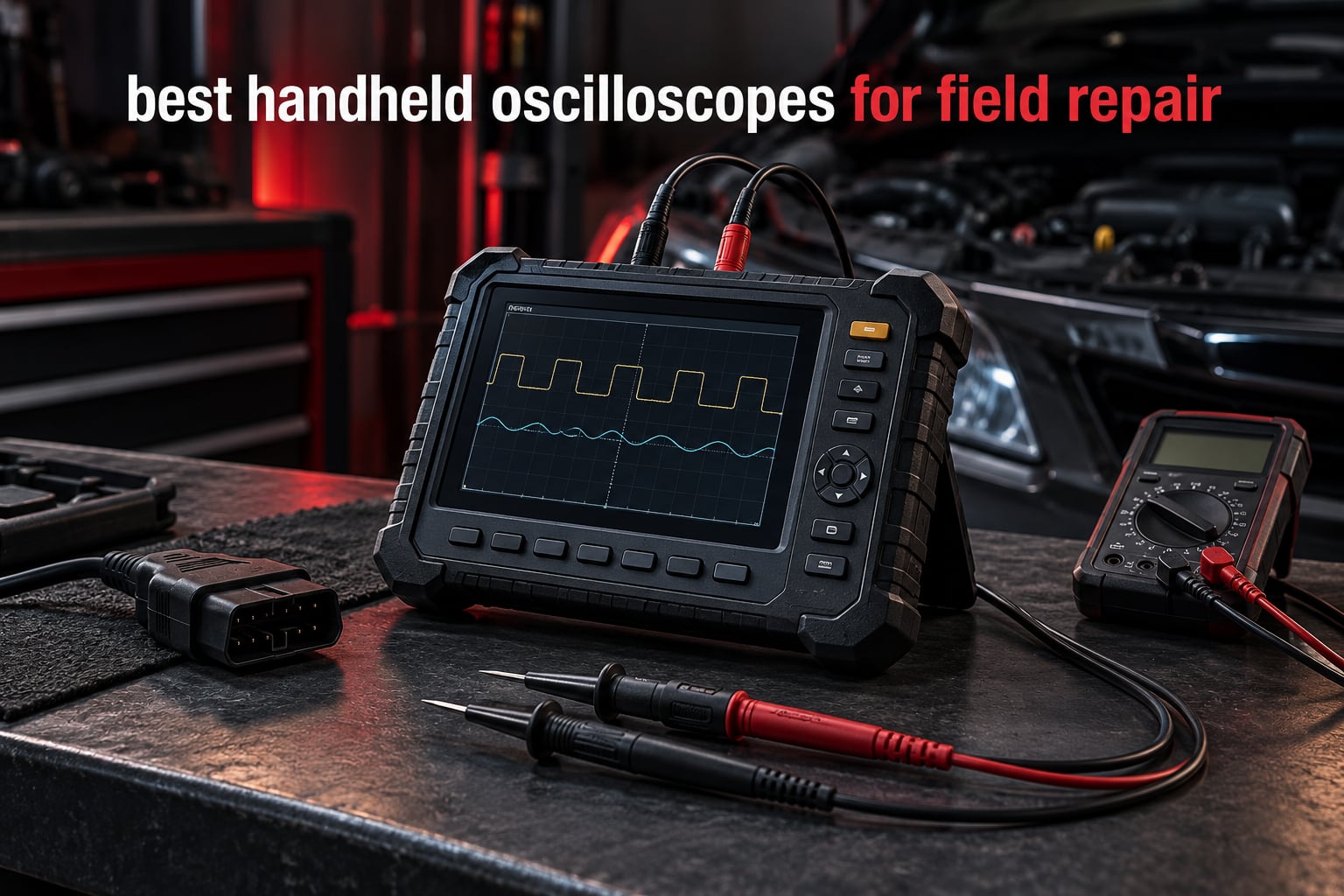
There is no bench in the back of the van, so the multimeter is the only instrument that makes it to the call. That works until it does not, because a meter tells you a signal is wrong but never why, and most faults on a vehicle, a boiler or a solar inverter come down to timing, duty cycle or ripple rather than a simple open circuit.
A handheld oscilloscope closes that gap. It fits in a tool bag, runs on a battery, and shows you the shape of a signal where a meter can only show you a number.
We put ten of the current handheld oscilloscopes through their paces over six weeks, comparing waveform stability, multimeter accuracy, battery headroom and how each one behaves when the work is under a dashboard, inside a distribution board or on a roof. The list spans the whole category, from a 200 kHz pocket unit to a four-channel automotive tablet with bus decoding built in, so there is a realistic pick for almost any budget. If you want a broader look at entry-level instruments, our guide to the best entry level oscilloscopes tested is a useful companion read.
What surprised us most is how much the safety and connectivity details matter once a scope leaves the bench. Input protection, whether the channels are isolated or ground-referenced, and whether you can pull a waveform screenshot out of the thing and email it to a customer end up mattering as much as bandwidth. So we ranked these units the way a field technician actually evaluates them rather than on spec sheet alone.
Table of Contents
What Is a Handheld Oscilloscope?
A handheld oscilloscope is a battery-powered, portable digital oscilloscope small enough to carry in a tool bag. Most combine a two-channel scope with a digital multimeter, and often a signal generator too, in a single 3-in-1 body called a scope meter or oscilloscope multimeter.
It works like a bench scope in miniature. A compensated 10x probe touches the circuit, the instrument samples that voltage millions of times a second, converts each reading to a number, and plots voltage against time on a small screen. Automatic measurement then reports frequency, period, duty cycle and peak-to-peak voltage so you do not have to count graticule divisions in the rain.
The difference from a USB or phone-connected scope is autonomy. A handheld runs its own screen and its own battery, so it works in a locked cabinet, an engine bay or a rooftop with no laptop and no power outlet. For a deeper look at the USB alternative, see our best USB oscilloscopes for hobbyists.
Top 3 Handheld Oscilloscopes for Field Repair in 2026
The FNIRSI 2C53T takes the top spot for us because it packs two channels, a 19999-count true-RMS meter and a DDS generator into a 400 g body, and it has the largest review base in this group. The ZOYI ZT-703 is the value pick, holding the deepest waveform memory here, and the HANMATEK HO52 shares the highest rating while refreshing its display faster than anything else we tested.

FNIRSI 2C53T 3-in-1 Scope
- 2-channel 50 MHz at 250 MSa/s
- 19999-count true-RMS multimeter
- DDS generator to 50 kHz
- 3000 mAh battery with Type-C charging

ZOYI ZT-703 3-in-1 Scope
- Dual channel with 30 MHz or 50 MHz modes
- 280 MSa/s and 128K storage depth
- 25000-count multimeter
- Waveform image storage

HANMATEK HO52 Handheld Scope
- 2-channel 50 MHz at 250 MSa/s
- 10000 wfms/s waveform refresh
- True-RMS 4.5-digit meter with separate inputs
- 4 saved waveforms and 4 images
Best Handheld Oscilloscopes for Field Repair (October 2026)
Every scope below is battery-powered and handheld. Read the table first, then jump to the review for the one that matches your work. We have kept the three things that decide a field purchase in view throughout: usable bandwidth, what the inputs are rated for, and how long the battery actually lasts with the screen on.
| Product | Specifications | Action |
|---|---|---|
| FNIRSI 2C53T 3-in-1 50MHz 2CH Oscilloscope Multimeter |
|
Check Latest Price |
| HANMATEK HO52 50MHz 2-Channel Handheld Oscilloscope |
|
Check Latest Price |
 Hantek 2D72 70MHz 3-in-1 Scope with Generator and Meter Hantek 2D72 70MHz 3-in-1 Scope with Generator and Meter |
|
Check Latest Price |
 FNIRSI DSO152 200kHz Pocket Handheld Oscilloscope FNIRSI DSO152 200kHz Pocket Handheld Oscilloscope |
|
Check Latest Price |
| ZOYI ZT-703 3-in-1 50MHz Automotive Handheld Scope |
|
Check Latest Price |
 Abestop HDS272S 70MHz 2CH Scope Meter with Generator Abestop HDS272S 70MHz 2CH Scope Meter with Generator |
|
Check Latest Price |
 ZOTEK 702S 10MHz Handheld Automotive Scope and Meter ZOTEK 702S 10MHz Handheld Automotive Scope and Meter |
|
Check Latest Price |
 FNIRSI DST-210 3-in-1 10MHz Scope Meter Generator FNIRSI DST-210 3-in-1 10MHz Scope Meter Generator |
|
Check Latest Price |
 SainSmart Micsig SATO1004 4-Channel 100MHz Automotive Scope SainSmart Micsig SATO1004 4-Channel 100MHz Automotive Scope |
|
Check Latest Price |
 ZYKYCX T60 15MHz 3-in-1 Handheld Scope Meter Generator ZYKYCX T60 15MHz 3-in-1 Handheld Scope Meter Generator |
|
Check Latest Price |
1. FNIRSI 2C53T 3-in-1 Handheld Oscilloscope Review
FNIRSI 2C53T 3-in-1 50MHz 2CH Oscilloscope Multimeter DDS Signal Generator
2-channel 50 MHz
250 MSa/s
19999-count true-RMS meter
DDS to 50 kHz
3000 mAh
Pros
- Dual-channel 50 MHz scope with 250 MSa/s in a 400 g body
- 19999-count meter plus DDS generator make a real 3-in-1
- 3000 mAh battery with Type-C charging and PC export
- High-voltage protection module built into the input stage
- Storage case and full probe set included
Cons
- 1 Kpts record depth is very shallow for zooming and history
- 2.8 inch screen is small for detailed inspection
- No FFT or protocol decoding on the FPGA platform
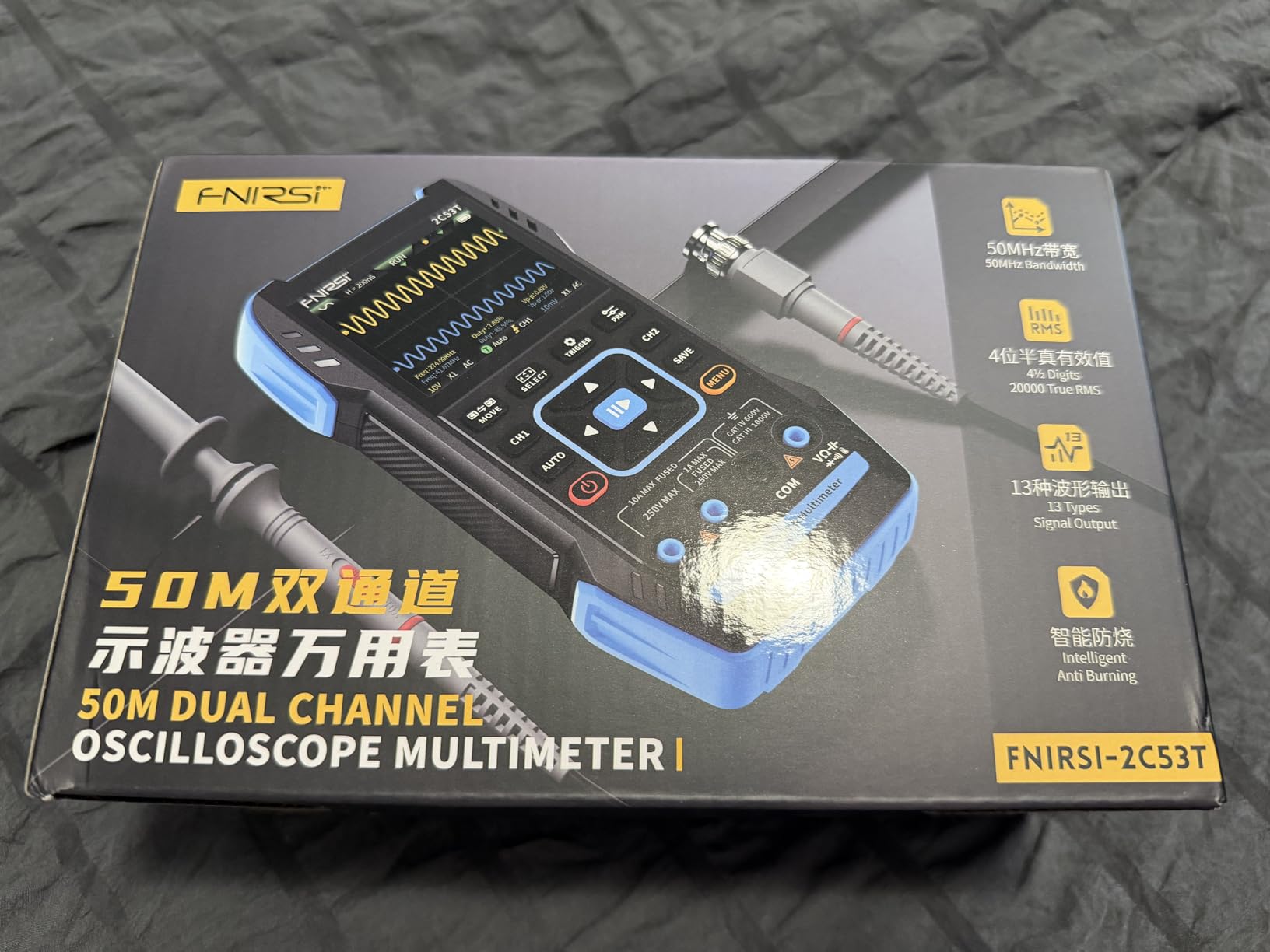
The 2C53T is the unit we kept reaching for during testing, mostly because it does not ask you to choose. Two channels, 250 MSa/s, a 19999-count true-RMS meter and a DDS generator all live in a 400 g body that measures 6.57 by 3.5 by 1.38 inches. For a technician working on a 12 V circuit, that combination removes the argument about whether you need a second box.
Save-and-export through the Type-C port worked as advertised, so a capture can go onto a laptop for the service report. A storage case and both a 10x probe and a crocodile clip probe come in the box.
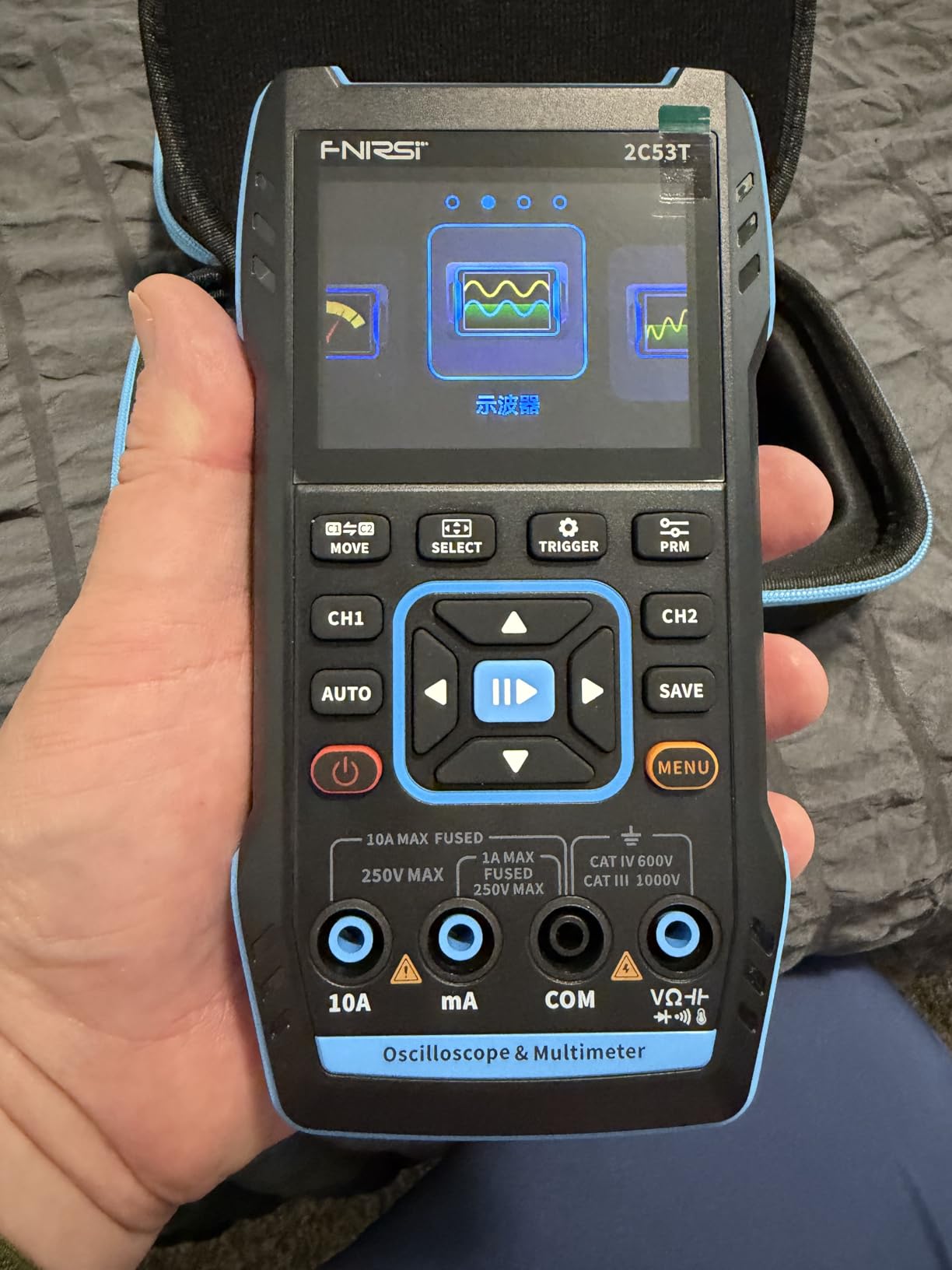
The compromise is memory. One thousand points of record depth is the shallowest figure in this roundup, and it shows the moment you want to zoom into a capture of something intermittent. Scroll back through history and you are looking at a summarised trace rather than the original samples.
There is also no FFT and no protocol decoding. That is a real limitation for anyone hunting CAN or SPI traffic, and the 2.8 inch display leaves little room to read fine detail on two channels at once. If you need to capture a burst of events and come back to it, look at the ZOYI ZT-703 with its 128K storage depth.
What it gets right on a live vehicle
The 400 V maximum input and built-in high-voltage protection module mean you can clip onto a 12 V or 24 V system without worrying about the input stage. Vertical sensitivity runs from 10 mV per division to 10 V per division, which covers sensor outputs and injector drive signals without changing probes.
Battery life is the other practical win. A 3000 mAh cell with up to six hours of standby means most working days finish before the meter does, and a Type-C port lets you top it up from the same cable you use for data transfer.
Where it will frustrate you
Users who need decoded bus data will find nothing here, and the shallow memory makes it a poor companion for hunting an intermittent glitch that lasts a few milliseconds. Fine control is button-driven, so changing a division or a cursor position takes menu navigation rather than a knob.
If your work is measurement-heavy rather than waveform-heavy, the same money in the ZOTEK 702S buys a temperature function and a genuine CAT III 1000 V safety rating, which matters more than extra bandwidth on customer equipment.
2. HANMATEK HO52 50MHz Handheld Oscilloscope Review
HANMATEK Handheld Digital Oscilloscope 50Mhz Bandwidth with 2 Channels HO52 3.5″ TFT Mini Oscilloscope, 2 in 1 Oscilloscope and Multimeter, Backlit Screen, Auto-Calibration Function, Memory Function
2-channel 50 MHz
250 MSa/s
8k dot record
True-RMS 4.5-digit meter
3.5 inch TFT
Pros
- Joint highest rating in the group at 4.7 stars across 589 reviews
- 10000 wfms/s refresh makes waveforms feel immediate
- True-RMS meter with independent scope and meter inputs
- 4 saved settings 4 reference waveforms 4 images and 4 CSV waveform groups
- Type-C reads saved images and CSV files on a PC
Cons
- No built-in signal generator on this variant
- 3.5 inch screen is small for complex two-channel detail
- No protocol decoding or FFT
The HO52 is the instrument we found hardest to fault during testing. Its 10000 waveform refreshes per second make the trace update almost the instant you move the probe, which sounds like a small spec but changes how the tool feels compared with units that visibly lag behind the signal. At 4.7 stars across 589 reviews it has the second-largest review base here and one of the most consistent scores.
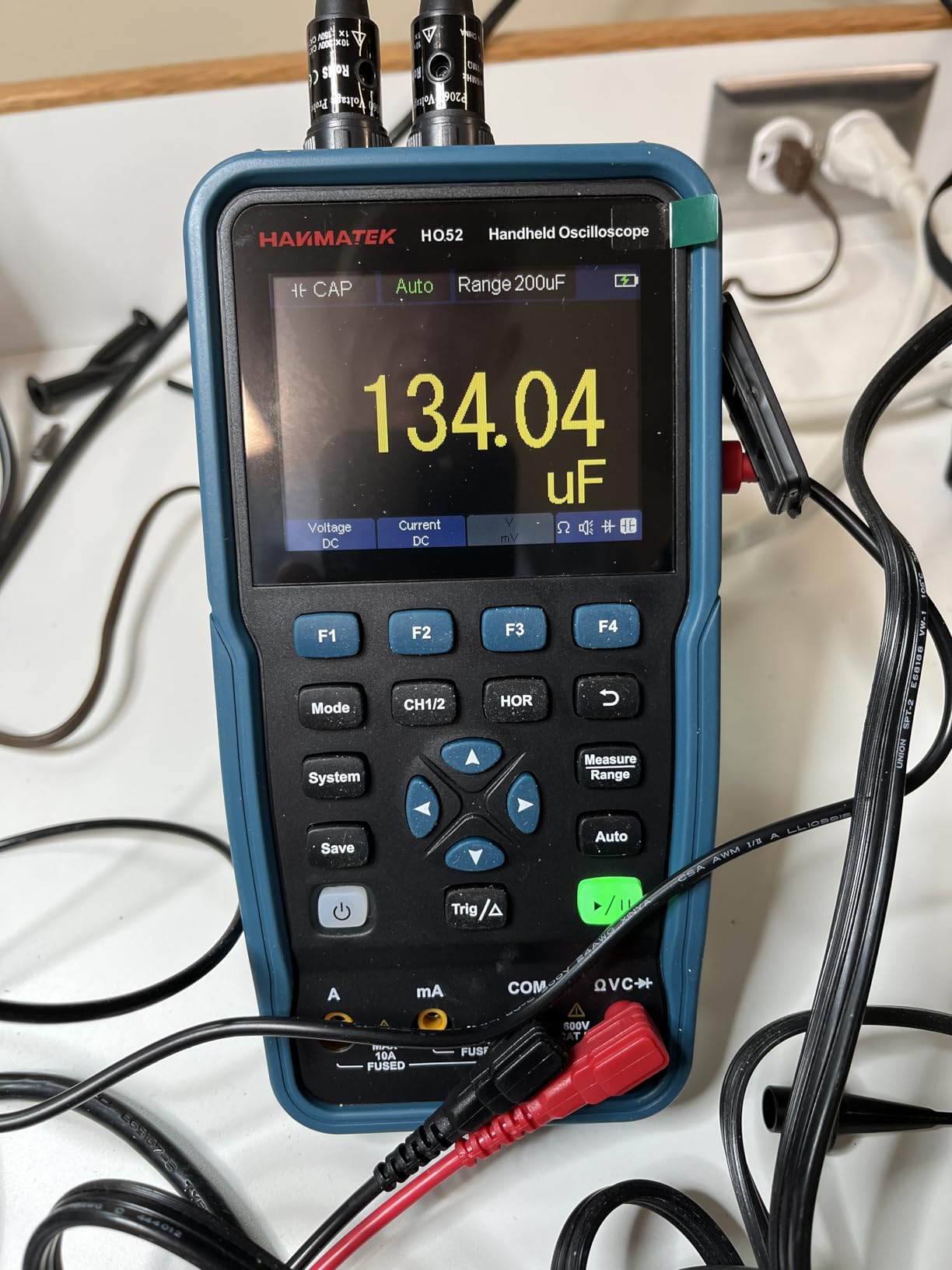
The multimeter half is a 4.5-digit true-RMS meter with its own separate input from the scope channels, so you can park a probe and keep metering without unplugging anything. AC measurement is rated to 750 V and DC to 1000 V, and auto-ranging does the thinking for you. Storage is generous for this class, with four settings groups, four reference waveforms, four screen images and four CSV captures.
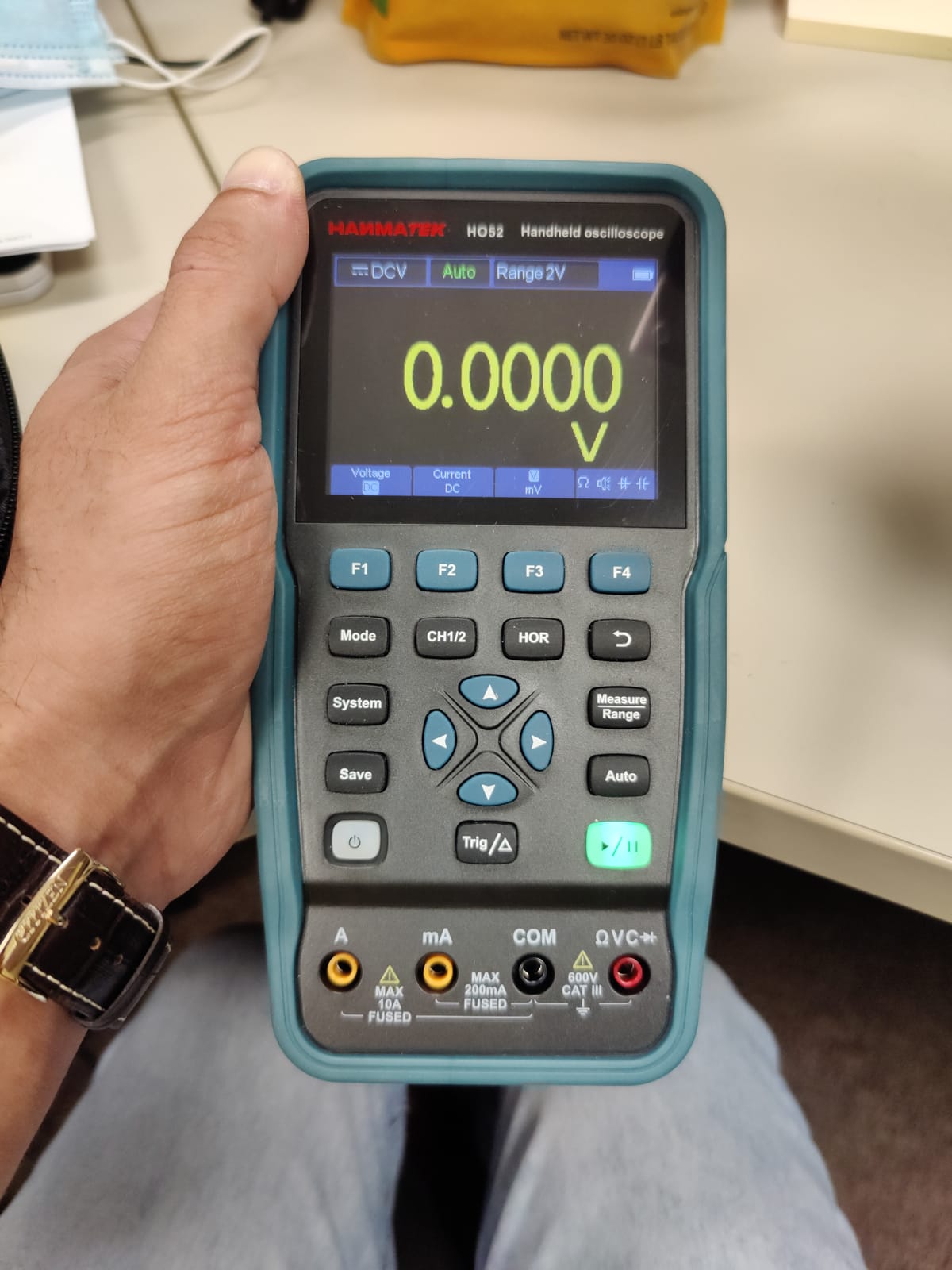
The Type-C port doubles as a charging input, a power bank supply and a data link, so the same cable that tops up the battery pulls saved images and CSV waveform files onto a laptop. For a technician who has to prove a fault existed rather than just assert it, that export path matters more than it sounds.
What is missing is the third instrument. This HO52 variant has no signal generator, so it is a 2-in-1 scope meter rather than a true 3-in-1. The 3.5 inch backlit TFT shows up to six automatic measurements at once, which is helpful, but the resolution is tight when you enable both channels and want to read the cursors.
Why it suits bench-adjacent field work
Its 250 MSa/s sampling and 8k dot record give it enough depth to capture a switching transient and still have samples to look at, which is why it works as a second instrument next to a home bench. If you have a fixed setup, our best oscilloscopes for a home lab covers that side of the market.
The cursor measurement, XY function and one-key auto set mean you can get a readable trace quickly in front of a customer, then dig in with cursors once you know where the interesting part is. Self-calibration is built in, which saves carrying a calibration signal around.
Where the limits show up
If you need to stimulate a circuit while you watch it, this is the wrong tool. There is no generator, so testing an injector driver or a sensor response means borrowing a signal from somewhere else.
The other gap is analysis. No CAN, I2C or SPI decoding and no FFT means bus work is out, and the small screen means long sessions on a complex waveform are tiring. The Abestop HDS272S covers the generator gap and adds a 20,000-count meter with a fused current input.
3. Hantek 2D72 70MHz 3-in-1 Handheld Oscilloscope Review
Hantek 2D72 Handheld Oscilloscope 70MHz Waveform Generator Multimeter 3 in 1 Multifunction Tester 2CH+AFG+DMM
70 MHz 2-channel
250 MSa/s
Scope meter and generator concurrent
6000-point memory
Pros
- Runs scope multimeter and generator at the same time
- Verified to reach close to its stated 70 MHz bandwidth
- Floatable ungrounded common suits low-voltage field work on grounded equipment
- 18650 cells are cheap and easy to replace
- One-piece impact and heat resistant shell with retractable stand
Cons
- About 6000 points of memory is very little for history or zoom
- Limited trigger types and no holdoff
- Outdated firmware and PC driver support
The 2D72 is one of the names automotive technicians already reach for, and after testing we can see why. It is one of the few handhelds where the three modes genuinely run at the same time, so you can meter a supply, watch a waveform and drive a test signal without cycling menus. At 270 reviews and 4.4 stars, the ownership experience is consistent.
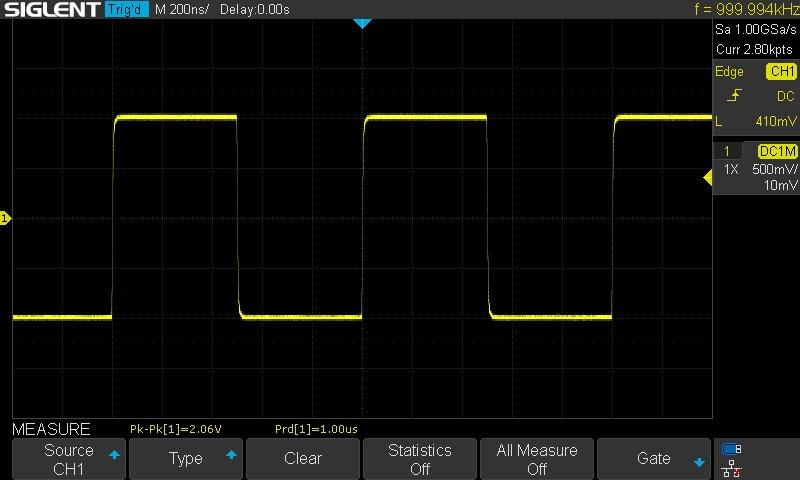
Bandwidth is 70 MHz with 250 MSa/s on a single channel and 125 MSa/s on both, which gives you real resolution on a fuel injector or a knock sensor rather than a rounded-off version of it. The floating, ungrounded common is the feature that matters most in a car, because it means the scope does not force a ground path between the circuit under test and the vehicle chassis.
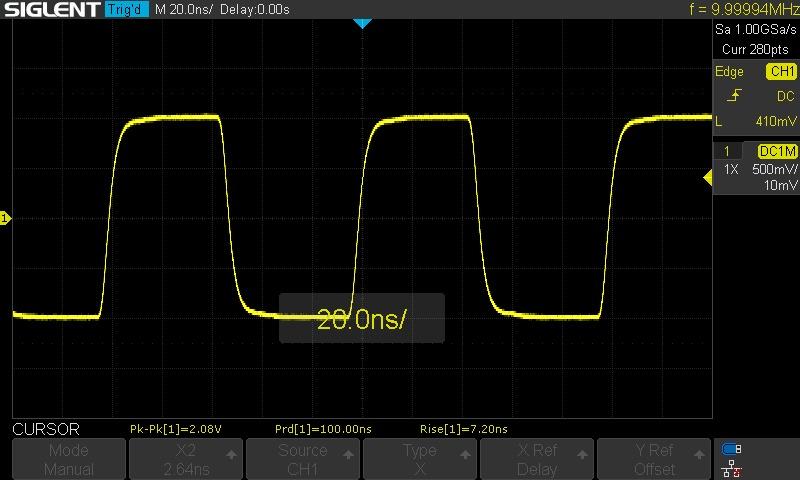
Build quality surprised us for the tier. The one-piece shell resists impact and heat, and the high-resolution LCD stayed legible in bright light. The retractable stand makes it usable hands-free under a dash, and multimeter readings lined up well against reference meters on the ranges we checked.
Replaceable 18650 cells are a genuine field advantage. When the battery dies between jobs you fit a spare rather than hunting for a charger, and the cells cost very little. One detail to check before you buy: standalone lithium batteries are not necessarily included with the package.
Why it holds up as a field instrument
The combination of three concurrent modes and a floatable common covers the two things that trip up cheap handhelds on a vehicle: you can watch a signal while injecting a known one, and you are not bonding the vehicle chassis to your ground clip through the instrument. Forums focused on automotive diagnostics have long treated Hantek as the name to trust, and the build here supports that.
Auto Set handles horizontal and vertical scale plus trigger coupling, type, position, slope, level and mode in one press, which saves a lot of fumbling when the signal is unfamiliar. Automatic frequency and amplitude measurement, cursors, auto-calibration and waveform recording round out a feature set that punches above its class.
What it does not do well
About 6000 points of memory, split roughly 3000 per channel, is the real limit. For history, magnification or a clean XY plot you simply do not have the samples, and this is the reason several owners call it a display instrument rather than a capture instrument.
Triggering is basic, with limited types and no holdoff, and the automatic measurement set stops short of rise time, pulse width and statistics. There is no serial decoding and no FFT, and firmware plus driver updates are difficult on current Windows machines. If decoding buses is on your list, budget for something else.
4. FNIRSI DSO152 Pocket Handheld Oscilloscope Review
FNIRSI DSO152 Handheld Oscilloscope 200kHz Bandwidth, 2.5MS/s Sampling Rate
200 kHz bandwidth
2.5 MS/s
10x probe to 800 VPP
1000 mAh for about 4 hours
Pros
- Weighs 10.2 oz and fits a shirt pocket
- Comes fully assembled with no soldering required
- Auto Normal and Single trigger modes cover analog and digital signals
- 10x probe rated to 800 VPP
- Type-C handles charging data transfer and firmware updates
Cons
- 200 kHz bandwidth and 2.5 MS/s limit it to low-frequency and audio-range signals
- 1000 mAh gives about 4 hours of continuous use
- 2.8 inch 320x240 display limits detail
The DSO152 is the most pocketable thing we tested, weighing 10.2 ounces in a 3.78 by 2.64 by 0.79 inch body, and it is the only instrument here that fits a shirt rather than a tool bag. It arrives fully assembled, so there is no soldering and no firmware tinkering. For a technician who wants a waveform check without the commitment of a full instrument, that simplicity is the appeal.
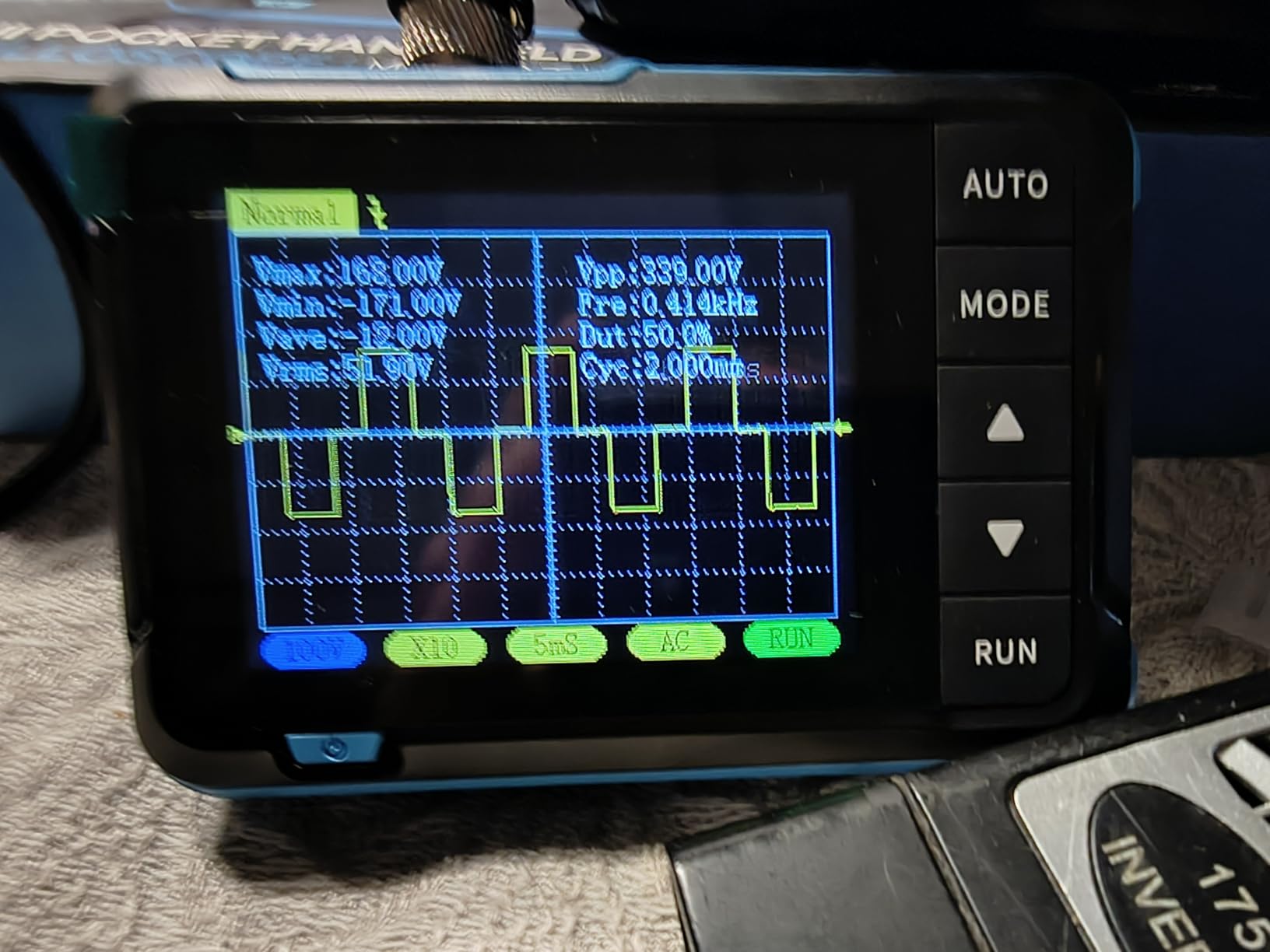
Use it for what it is good at: slow signals, ripple on a supply, thermostat cycling, an audio or low-frequency control loop. The 10x probe is rated to 800 VPP, and voltage measurement goes to 400 V. One-key AUTO sets every parameter, and a long press on the same key calibrates the baseline.
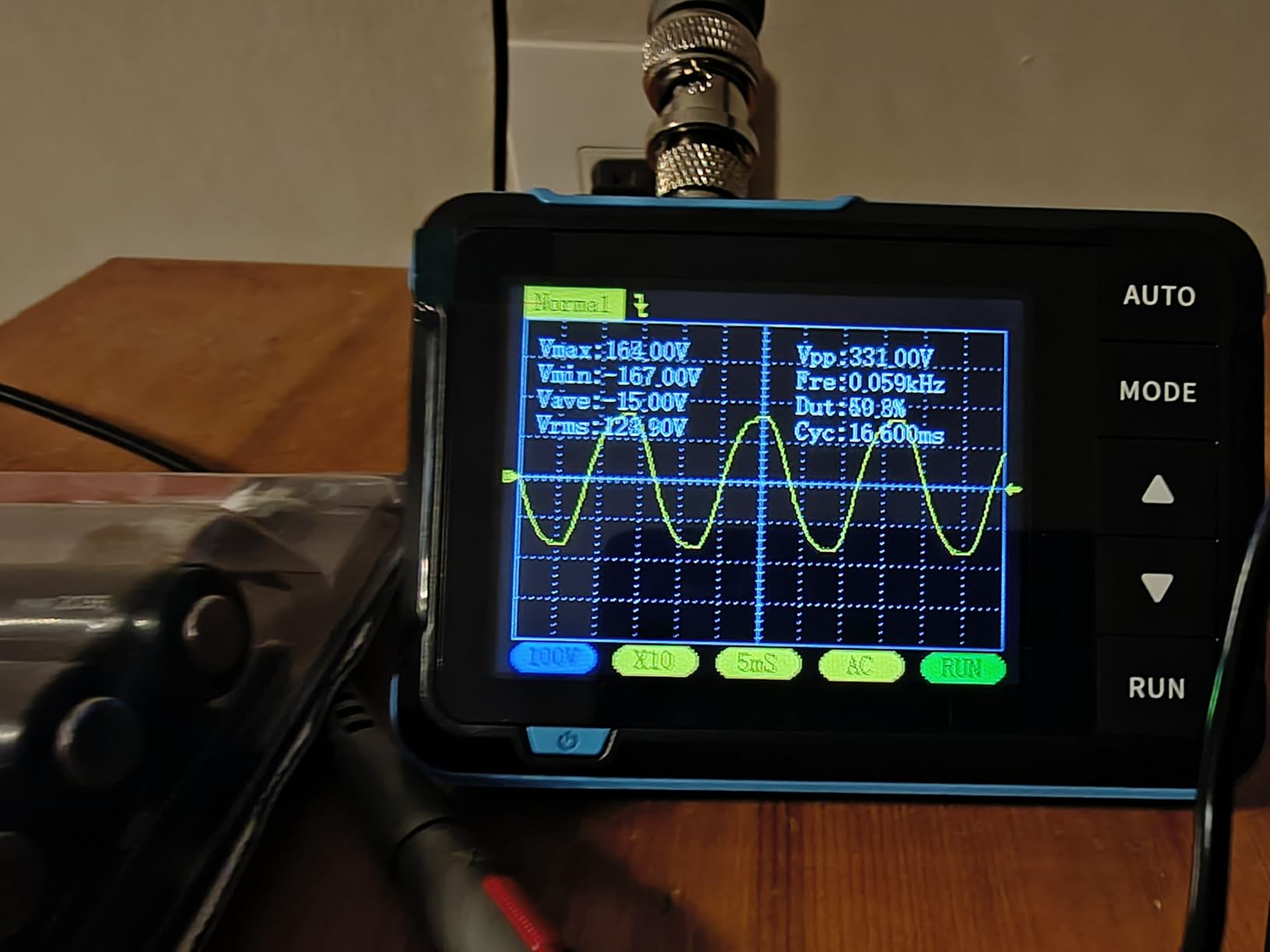
Auto, Normal and Single trigger modes cover both periodic analog signals and aperiodic digital ones, which is more trigger flexibility than the headline bandwidth suggests. The 2.8 inch HD LCD at 320 by 240 is crisp enough to read, and Type-C covers charging, data transfer and firmware upgrades in one port.
Roughly four hours of continuous use from the 1000 mAh cell is enough for a morning of spot checks but not a full day, and the only way to extend it is to carry a power bank. The 2.8 inch display is the other constraint, since there is no room to show much graticule detail.
Where a pocket scope earns its place
This is the instrument to keep on your person when you are doing first-pass triage, not deep diagnosis. It will tell you quickly whether a ripple frequency looks wrong or a switching node is behaving, and it costs little enough that losing it in a van is not a catastrophe. Our budget oscilloscopes guide covers where the entry tier starts and ends.
Because it takes measurements up to 400 V, it doubles as a rough companion to a meter on low-voltage systems. The Type-C firmware upgrade path also means the manufacturer can still improve it after purchase, which is not true of every sealed unit in this price range.
Where it will not go
Two hundred kilohertz of bandwidth means anything above the audio range is out of reach, and 2.5 MS/s is slow even for that bandwidth. It cannot look at injector drive, ignition, databus activity or anything with fast edges, and 320 by 240 pixels is not enough resolution to read fine detail.
Do not expect it to replace a working meter either, because the measurement set is basic. If you want the same pocket form factor with far more headroom, the ZOYI ZT-703 in this list reaches 50 MHz in a slightly larger case.
5. ZOYI ZT-703 3-in-1 Handheld Automotive Oscilloscope Review
3 in 1 Handheld Oscilloscope Automotive Dual Channel 50MHz with Digital Multimeter and Signal Generator
Dual channel 30 MHz or 50 MHz
280 MSa/s
128K storage
25000-count meter
Pros
- 4.7 stars from 307 reviews with 82 percent five-star ratings
- Selectable 30 MHz and 50 MHz modes with up to 280 MSa/s
- 128K storage depth is the deepest in this roundup
- 25000-count meter compares well against dedicated meters
- Rechargeable battery with fast Type-C charging and waveform image storage
Cons
- No rotary knobs so every scale and cursor change goes through menus
- Usable bandwidth appears closer to 20 MHz and square waves deform above roughly 5 MHz
- Small screen crowds when both channels are on
128K is the deepest storage in this roundup, and that is what makes it possible to capture a whole event and then zoom into a corner of it. At 4.7 stars across 307 reviews, the ZT-703 shares the top rating in the group with a very low share of one-star feedback.
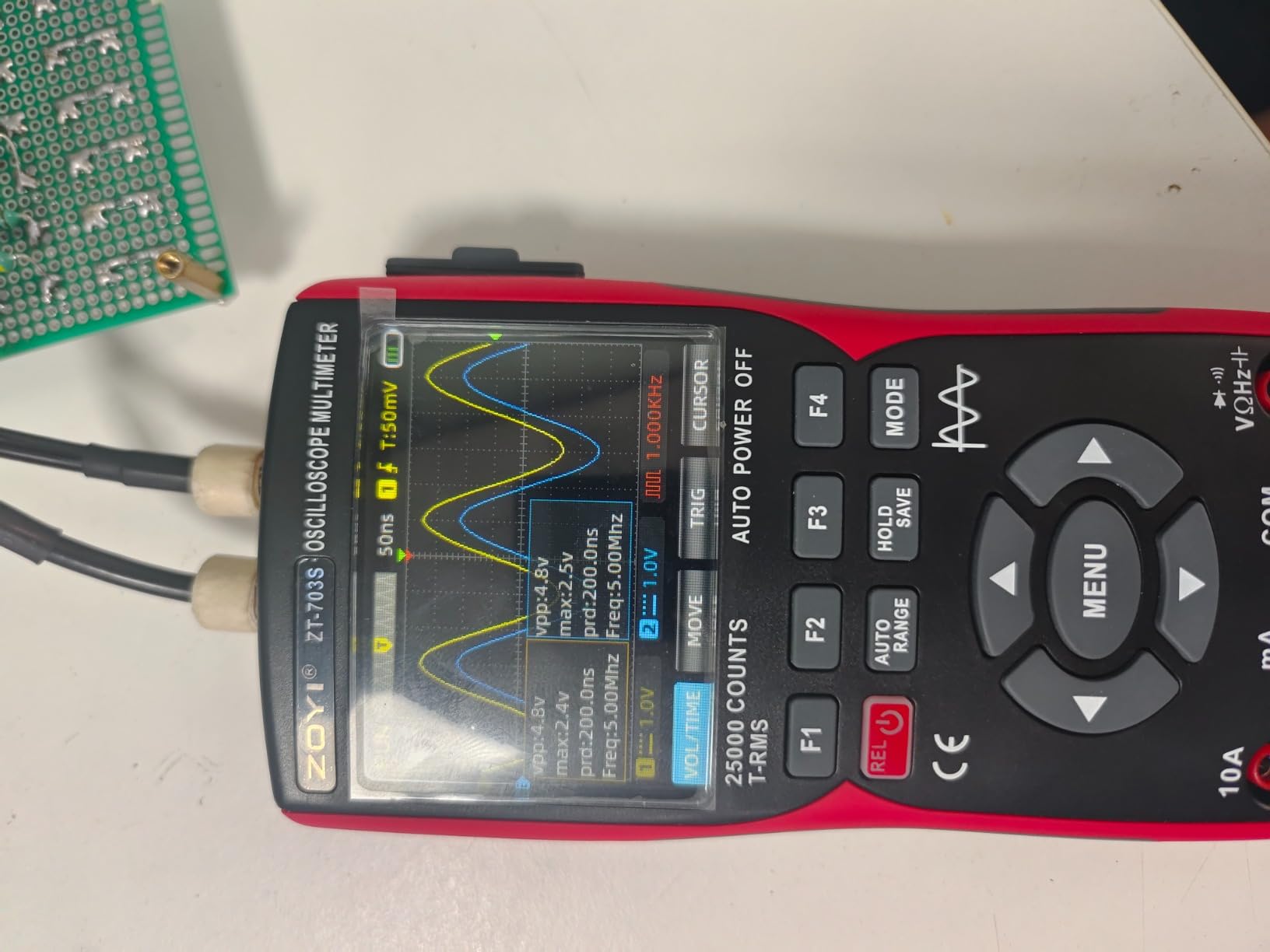
The dual mode is genuinely useful. Normal mode gives 200 MSa/s at 30 MHz and uses less power, while high-speed mode pushes to 280 MSa/s at 50 MHz when you need the resolution. The 25000-count multimeter covers resistance, capacitance, continuity and diode measurement, and it compared well against a dedicated instrument in our checks.
It comes in a cloth bag with two scope probes, test leads and a charging cable, and the build feels solid for the money. Waveform image storage means a capture can be kept for the customer record, and AUTO recognises periodic waveforms without you setting anything.
The repeated caveat from owners is bandwidth. Reports describe usable bandwidth landing closer to 20 MHz despite the 50 MHz claim, with square waves visibly deforming above roughly 5 MHz, so treat the headline figure as a ceiling rather than a guarantee. The interface is also entirely button-driven, and with no rotary knobs every division and cursor change means menu navigation.
Why it wins on value
Storage depth is the reason to buy it. When you are hunting a one-off event on a cranking circuit or a sensor that only misbehaves cold, having 128K points means you can capture first and analyse afterwards, which is the difference between finding the fault and guessing at it.
Auto mode gives you a usable trace quickly, and the signal generator with sine, square and triangle outputs covers bench-style sanity checks even if it is not a serious AWG. For most 12 V and 24 V diagnostic work the combination of deep memory and a strong meter is the right trade against raw bandwidth.
Where it falls down
Effective bandwidth is the honest limitation, and buyers who need clean edges on fast signals should look at the Hantek 2D72 instead. The button-only interface is a real ergonomic cost on a long diagnostic session, and the screen becomes crowded with two channels plus a meter reading at once.
The display sleep timer is aggressive and awkward to configure, which will interrupt a job if you do not change it. Reviewers also report no current measurement and no temperature function, which narrows its usefulness for anyone doing sensor work as well as waveform work.
6. Abestop HDS272S 70MHz 2-Channel Handheld Oscilloscope Review
HDS272S Oscilloscope 70MHz 2 CH, Digital Mulitimeter Waveform Generator
70 MHz 2-channel
250 MSa/s
10000 wfms/s refresh
8K record
Sine out to 25 MHz
Pros
- 70 MHz bandwidth with 250 MSa/s and 10000 wfms/s refresh in a handheld
- 20000-count true-RMS meter with fused current measurement
- Generator provides sine to 25 MHz plus square ramp pulse and arbitrary waveforms
- 3.5 inch color screen with a faster interface than comparable units
- PC software saves settings reference waveforms screen images and files
Cons
- Rigid semi-rigid case barely fits the accessories
- Takes AAA cells rather than a higher-capacity pack
- Overall AWG voltage range is limited
The HDS272S has the most useful signal generator in this roundup, and that changes what you can do with it. Sine output runs to 25 MHz alongside square, ramp, pulse and arbitrary waveforms, so you can inject a real signal and watch a circuit respond instead of only looking at what it already produces. It is a 3-in-1 in the full sense of the word.
The scope half is 70 MHz across two channels with 250 MSa/s, an 8K record length and a 10000 wfms/s refresh, which keeps the display responsive. The multimeter is 20000-count true RMS covering AC and DC voltage, AC and DC current, resistance, capacitance, diode and continuity, and unlike the Hantek 2D72 the current input is fused.
The 3.5 inch color display and a more modern interface made it quicker to operate without reaching for the manual, and owners single out the low noise on small signals. With 112 reviews at 4.7 stars and no one-star ratings, the feedback is unusually consistent.
Saving settings, reference waveforms, screen captures and waveform files to a PC over USB Type-C makes it easy to build up a reference library of known-good waveforms, which is a real time saver once you have a vehicle you see regularly.
Why the generator is the deciding feature
Being able to drive a circuit means you can test a sensor, a solenoid or a module without a second bench instrument, which is exactly the gap that makes a hand tool feel incomplete. The arbitrary waveform option covers odd shapes that a plain sine cannot, and 25 MHz covers most signal injection you would attempt in the field.
The high sample rate and 8K record also make it a reasonable travelling companion to a bench scope for anyone who needs to look at something away from the workshop. Our beginner oscilloscope guide covers the fixed-instrument side of the market if you already have one at home.
Where it falls short
The included rigid case barely fits the accessories, which is annoying when you are trying to keep the kit together between calls. The battery compartment takes AAA cells rather than a higher-capacity pack, so expect shorter runtime than the 3000 mAh instruments in this list provide.
The generator’s voltage range is limited overall even though it can produce faster square waves at certain operating points than rivals. With 112 reviews the feedback base is thinner than most here, and there is also no protocol decoding, so CAN or SPI work is out.
7. ZOTEK 702S Handheld Automotive Oscilloscope and Meter Review
ZOTEK 702S 2 in 1 Handheld Automotive Oscilloscope Multimeter – 10MHz Bandwidth 48MS/s Sampling Rate,Auto-Ranging 9999 Counts T-RMS Multimeter with Temperature Tester for Electronics Repair Test
10 MHz and 48 MS/s
Single channel
CAT III 1000 V
9999-count meter with temperature
Pros
- Exceptionally bright IPS screen that stays readable in poor light and direct sun
- Temperature measurement that most competing 3-in-1 units omit
- Replaceable 18650 battery and user-replaceable fuses with a screwdriver included
- Upgradable firmware with regular bug fixes
- Carry case written manual and quality multimeter probes included
Cons
- Oscilloscope is single channel only
- 10 MHz bandwidth is too low for most electronics work
- Interface is clunky and needs manual consultation for setup and triggering
This is the only unit in the roundup with a stated CAT III 1000 V and CAT II 600 V safety rating, and that is the reason it appears here. If you are working on customer equipment or anywhere near an installation, a stated category rating means the input stage was designed for the transients that circuit class actually produces, which the unrated units in this list do not claim.
As a meter it is hard to argue with. The 9999-count true-RMS multimeter measures AC to 750 V, DC to 999.9 V, current to 9.999 A, resistance to 99.99 MOhm, capacitance to 9.999 mF and frequency to 99.99 kHz. It also measures temperature from minus 20 to 1000 degrees C, a function most rivals in this price band simply do not include.
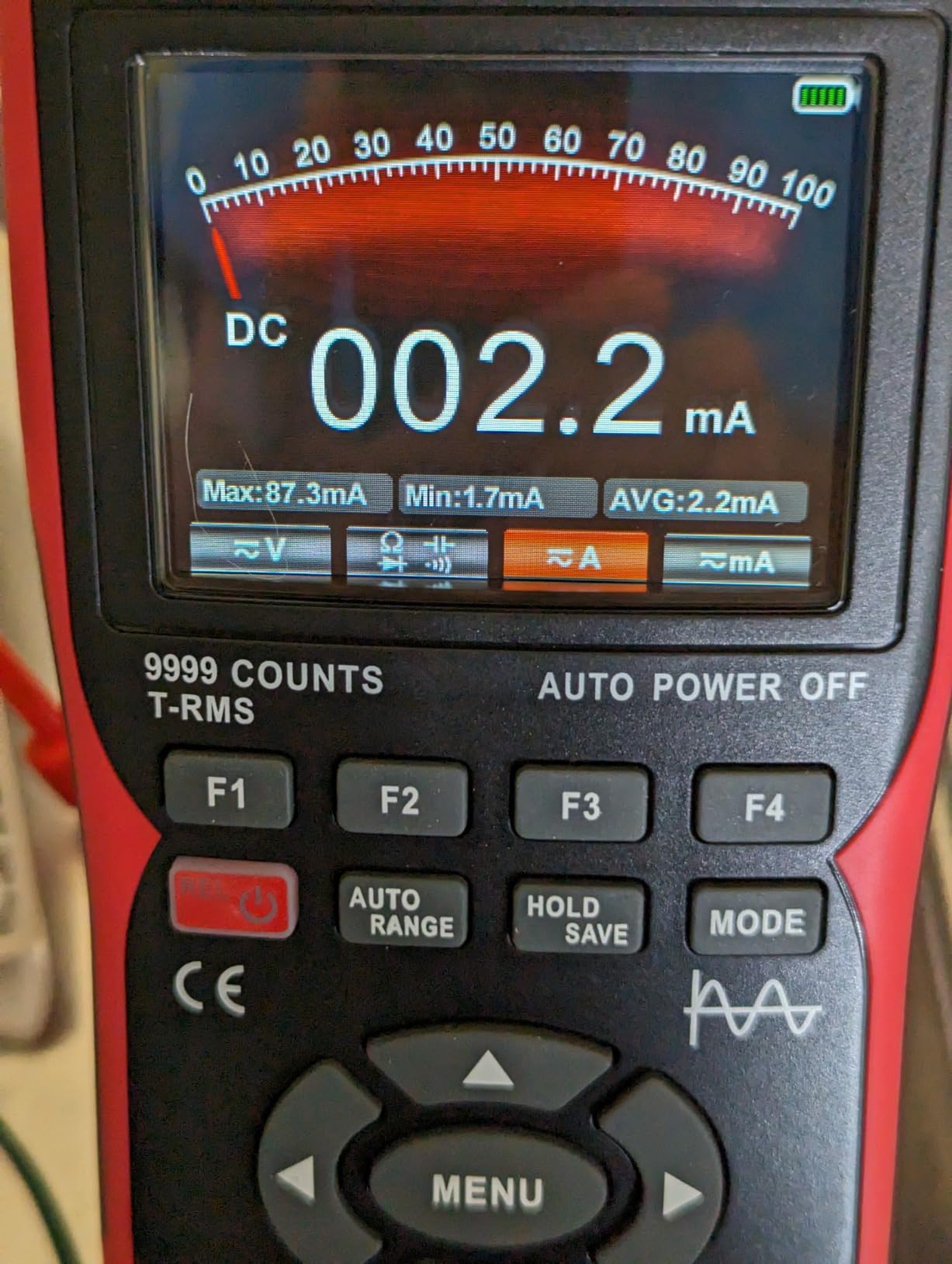
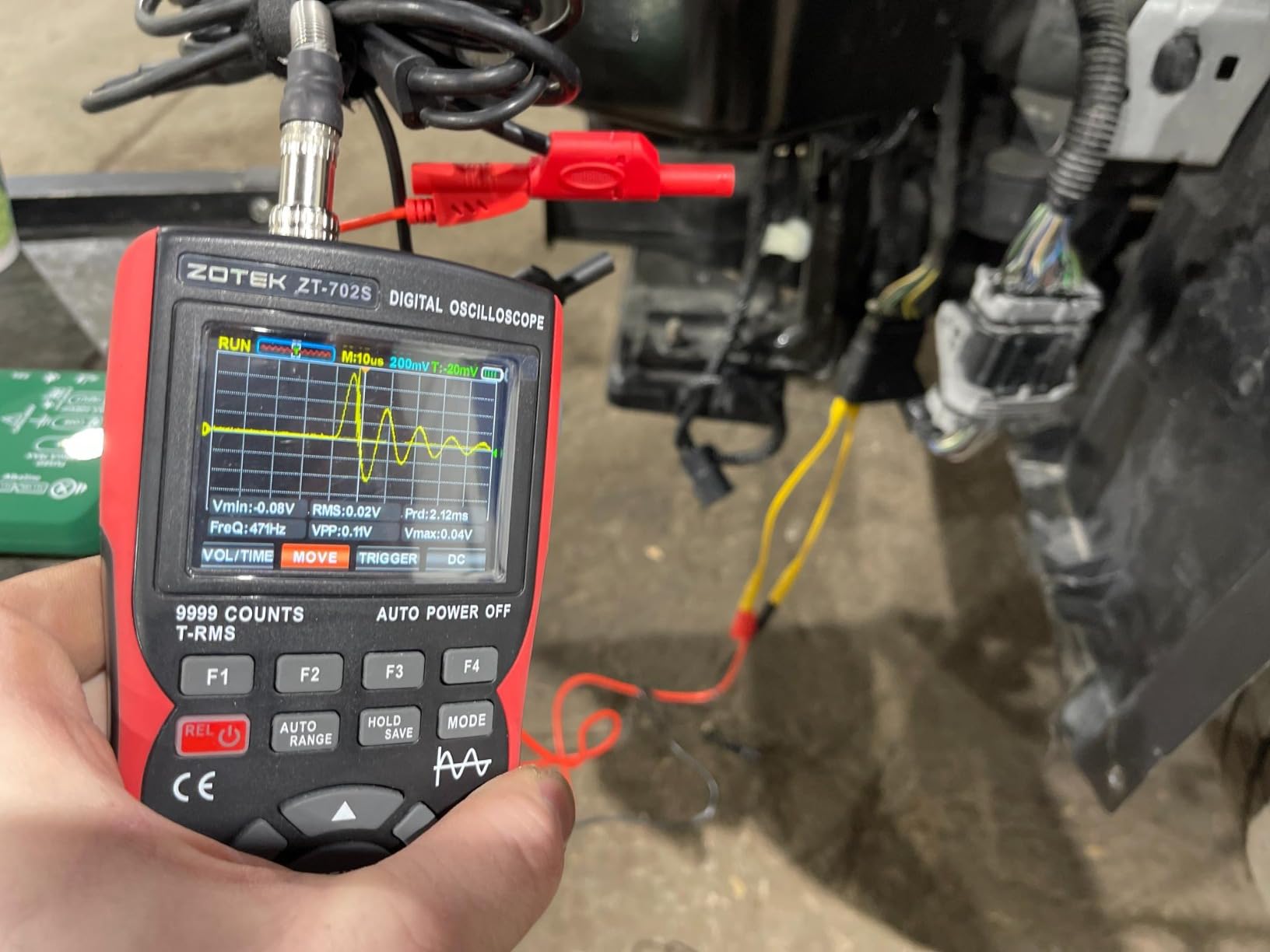
The 2.8 inch IPS full-view color screen is the standout feature. It stays readable in poor light and in direct sun, which is the condition that defeats most small scopes the moment you step outside a vehicle or under a sink. A replaceable 18650 cell, user-replaceable ceramic fuses and upgradable firmware make it serviceable in a way sealed competitors are not.
Range is plus or minus 400 V with 200 mV per division to 10 V per division vertical sensitivity and an 8 ns per division to 20 s per division horizontal span, plus a built-in 4 V, 1 kHz square wave output. Data storage, export, language selection and adjustable backlight are all present.
Why the safety rating changes the decision
A category rating describes the overvoltage the input is built to survive. CAT II covers circuits derived from the mains such as appliances and extension boards, CAT III covers distribution panels and permanently installed wiring, and CAT IV sits at the service connection itself. Only the 702S in this list states a category at all, so it is the sensible default for anyone probing mains-derived equipment.
The second thing worth noting is the ground reference. Most of these handhelds are earth-referenced, and the body of the unit is tied to the negative of the probe. On a 12 V vehicle that is usually harmless, but on mains-derived equipment a floating differential probe is the correct approach, and buyers should treat the stated category as a reason to still probe carefully.
Where it does not shine
Ten megahertz of bandwidth on a single channel is not much for electronics work. It handles ripple, slow signals and switching averages, which is why it is rated for low-to-mid voltage work under 48 V, but it will not resolve ignition or injector edges.
The interface needs the manual to set up and trigger, and the ground lead is short with a bulky clip tip that is awkward in tight spaces. The buttons also need more than 3 mm of travel, which is uncomfortable one-handed. Some users also report the scope locking up in Single trigger mode until a power cycle, and describe the included battery as weak with limited backup. Treat the waveform side as a bonus and the meter as the main instrument.
8. FNIRSI DST-210 3-in-1 10MHz Scope Meter Review
FNIRSI DST-210 3-in-1 10MHz Handheld Oscilloscope Multimeter DDS Generator
10 MHz and 48 MSa/s
19999-count meter with curve recording
3000 mAh
2.8 inch TFT
Pros
- Three instruments in one with a 19999-count true-RMS meter and DDS generator
- Curve recording plus max and min readout go beyond most competitors
- 3000 mAh battery with configurable auto power-off suits all-day work
- 2.8 inch color TFT with day and night themes and adjustable brightness
- Function dial speeds up switching between meter modes
Cons
- 10 MHz bandwidth restricts it to slower automotive and power-supply signals
- DDS generator tops out at 50 kHz
- 2.8 inch screen is small for two-channel work
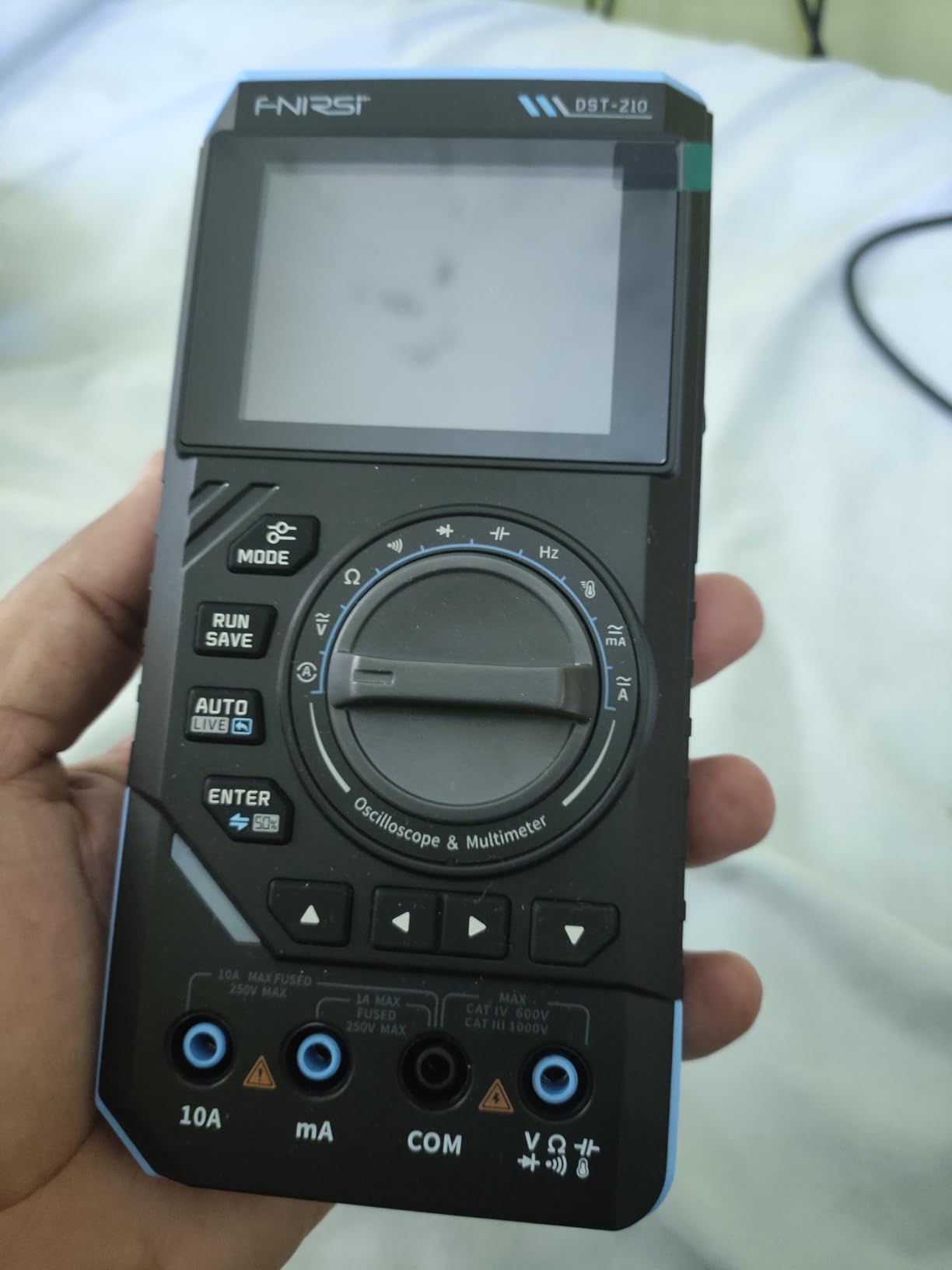
The DST-210 is built around the multimeter and happens to include a scope, which is the right priority for a lot of field work. At 19999 counts the meter is unusually capable for this tier, and the curve recording plus max and min hold let you watch a supply or a charging system drift over time instead of catching a single instantaneous number.
The 3000 mAh battery with an auto power-off you can set anywhere from 15 minutes to an hour is a small thing that matters on a long day, and the function dial makes moving between meter ranges quick without walking through a menu tree. Waveform image save and export are supported.
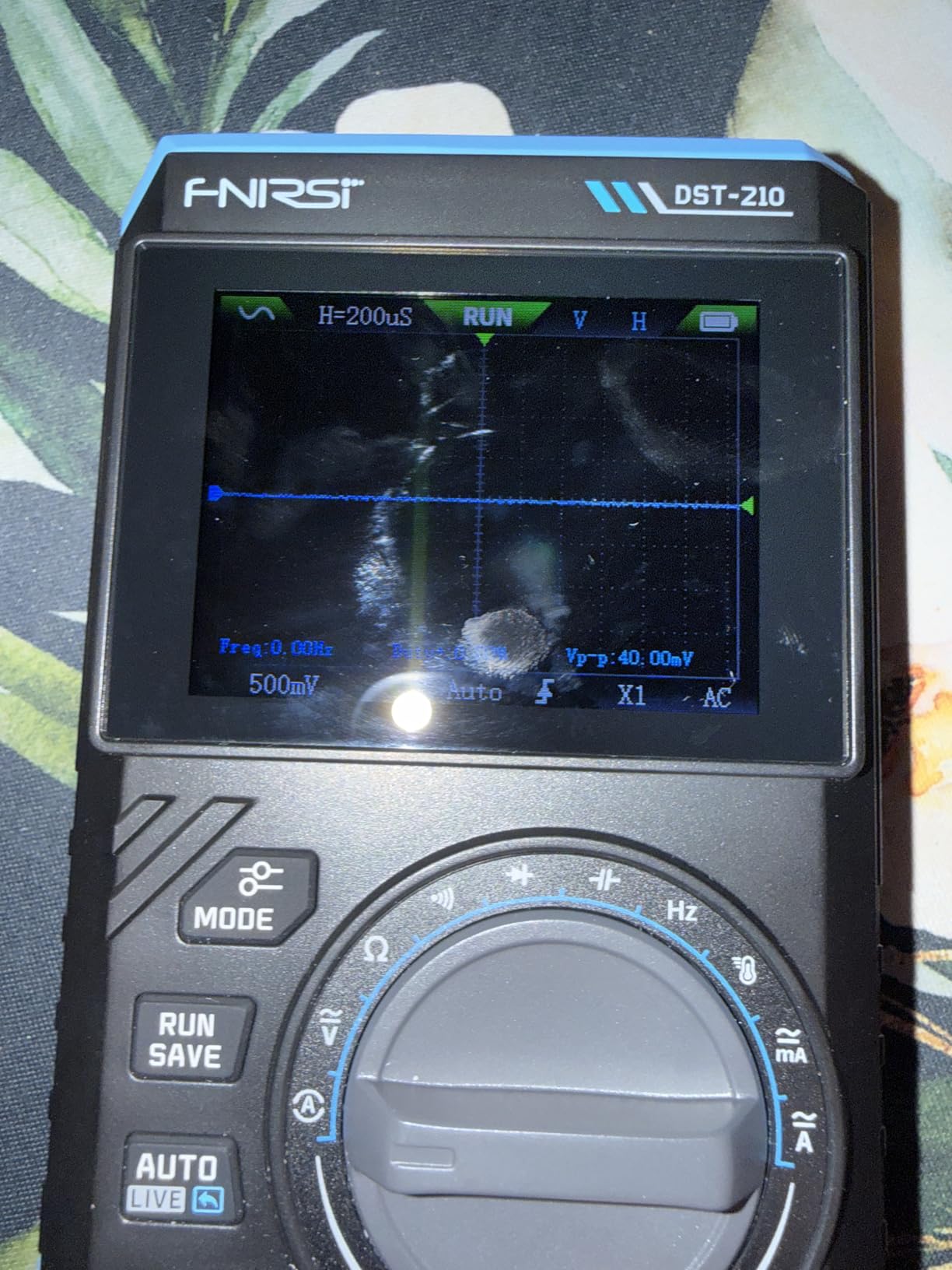
Scope specifications are 10 MHz bandwidth at 48 MSa/s, 400 V maximum voltage and 10 mV per division to 10 V per division vertical sensitivity. The meter covers AC and DC voltage and current, resistance, capacitance, frequency, diode and temperature, with live and neutral detection as a bonus. The 2.8 inch color TFT carries day and night themes and an adjustable backlight.
That puts it squarely in the ripple and power-supply end of the category. If the fault is a switching node, a 12 V rail that hums, a battery that sags under load or a thermostat that cycles badly, the DST-210 will show it clearly enough to act on.
Why meter-first thinking pays off
Most field faults still start as a reading that does not match. A meter with curve recording shows the drift, not just the snapshot, so a slow alternator output or a sensor that fades when warm is much easier to characterise. Live and neutral detection is a quick sanity check before you commit to a deeper measurement.
Because the battery is large and the power-off behaviour is configurable, the DST-210 is comfortable sitting in a tool bag as a daily instrument rather than something that needs charging between calls. The box includes a P6100 probe, a meter probe and an alligator clip probe, so it is usable straight away.
Where it runs out of road
Ten megahertz is the ceiling on every fast signal, and the DDS generator stopping at 50 kHz means it cannot drive a meaningful test tone for anything above audio. The 2.8 inch screen is cramped the moment you enable two channels.
If your diagnostic work involves ignition, injectors or databuses, this is not the instrument, and the flat 48 MSa sampling means even modest frequencies are undersampled. For that work the 70 MHz Hantek 2D72 or the four-channel automotive tablet is the correct direction.
9. SainSmart Micsig SATO1004 4-Channel Automotive Oscilloscope Review
Micsig Oscilloscope SATO1004, Portable Handheld Automotive Oscilloscope
4 channels at 100 MHz
1 GSa/s
8 inch touchscreen
CAN LIN FlexRay and K decode
32 GB
Pros
- Tablet-style 8 inch touch screen is far easier to read than a pocket scope
- 4 channels at 100 MHz and 1 GSa/s is a genuine step up in capture capability
- Purpose-built automotive diagnostics for ignition sensors actuators and networks
- CAN LIN FlexRay and K bus decoding built in
- Wi-Fi remote viewing to a smartphone
- 32 GB storage plus LAN HDMI and USB host and device
Cons
- Much heavier and bulkier than a pocket handheld and awkward in tight crawl spaces
- Android-based interface inherits tablet menu depth
- Battery life is limited under sustained four-channel capture
The SATO1004 changes the shape of the job rather than just the price of the instrument. Four channels at 100 MHz and 1 GSa/s on an 8 inch touch screen means you can capture crank, cam, injector and rail pressure on one display during a single run, which is the entire point of an automotive scope.
The decoding is the real differentiator. CAN, LIN, FlexRay and K bus protocols are decoded on the device, so a technician does not need to eyeball a bit pattern to know whether a module is transmitting. The diagnostic software is built around ignition, sensor, actuator, network and charging circuit tests, and pressure testing covers cylinder, intake and exhaust and fuel pressures.
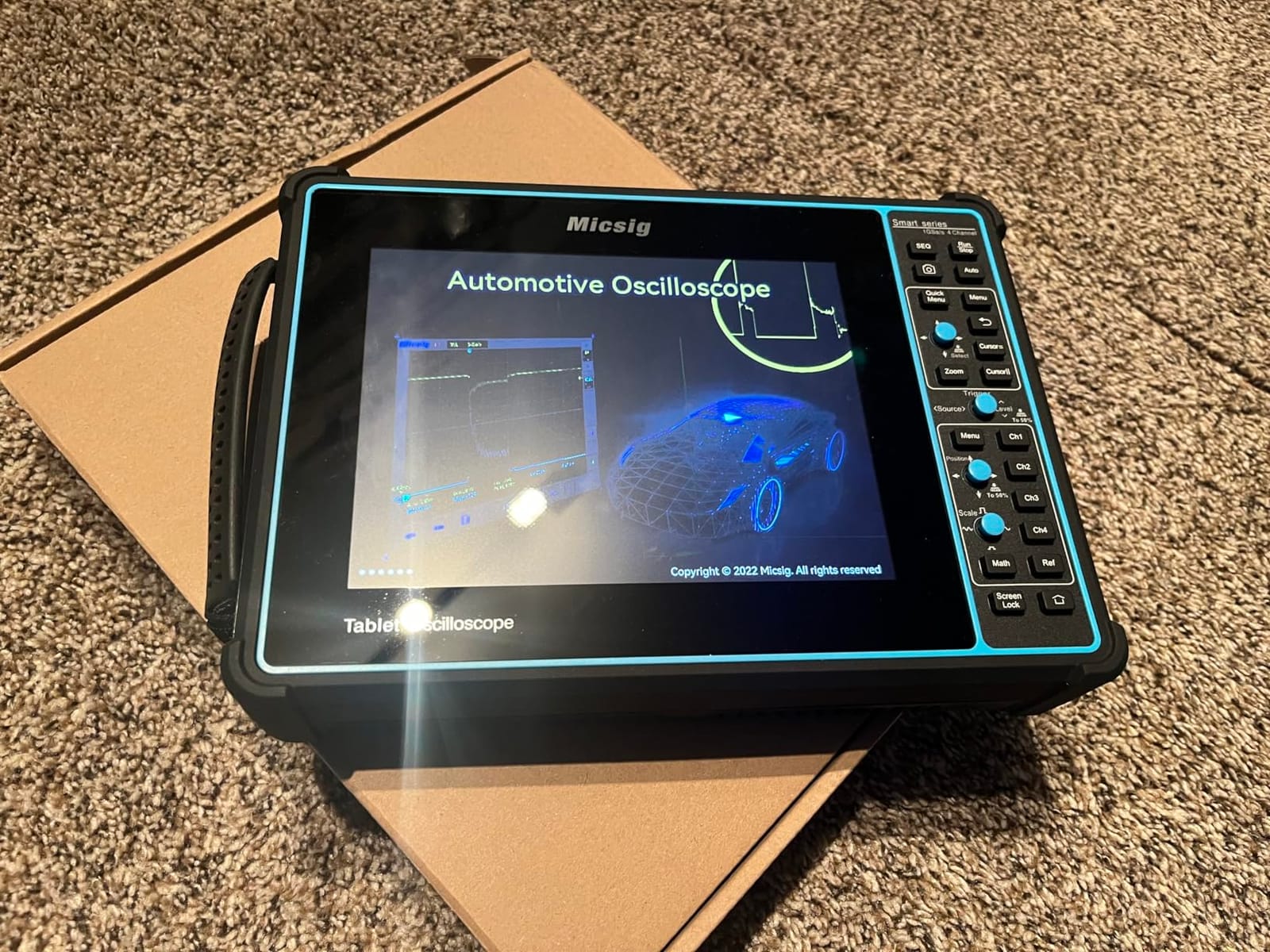
Wi-Fi remote operation to a smartphone is a clever field feature. You can leave the instrument in the driver’s seat or under the sill and watch the live waveform from inside the cabin, which removes a lot of awkward positioning on a cramped screen. Storage runs to 32 GB for waveforms, screenshots and recorded video, and there is LAN, HDMI, USB host and USB device alongside Wi-Fi and Type-C.
It runs Android with a physical button control panel under the screen, and the faster CPU gives a noticeably smoother touch experience than a button-only interface. With 48 reviews the feedback base is the thinnest in the roundup, which is the main caveat.
Why four channels changes automotive work
Crank and cam correlation needs two channels before you even start, and adding injector current or rail pressure makes it three or four. A two-channel handheld forces sequential captures that can drift apart, and correlating them afterwards does not tell you whether the relationship held at the moment of the fault.
For a working technician this is the difference between one pass and three. It also covers the workflows the forums keep returning to, alternator ripple diagnosis, sensor output analysis and bus decoding, in a single box rather than a scope plus a separate scan tool plus a laptop.
Where it gets in the way
Size is the obvious cost. This is a tablet, not a pocket instrument, and it is far less suited to a crawl space or a confined engine bay than anything else in this roundup. Reviewers with automotive workloads still name bulk as the main tradeoff.
An Android interface also brings tablet habits and menu depth that some users find slow, and battery life is limited under sustained four-channel capture, which matters when the diagnostic itself takes a while. With 48 reviews, the long-term reliability picture is less established than the pocket units here, so buy it for capability rather than for proven longevity.
10. ZYKYCX T60 15MHz 3-in-1 Handheld Scope Review
ZYKYCX Handheld Oscilloscope 3 in 1, 15MHz 60MS/s Digital Oscilloscope Multimeter with DDS Signal Generator, Support Waveform Storage, AC/DC Voltage, Capacitor, Resistor, Diode Test for Automotive
15 MHz and 60 MS/s
SD card storage with 1 GB card
4000-count meter
DDS to 100 kHz
Pros
- Rare SD card waveform storage with a 1 GB card included
- 2000 mAh battery gives up to 8 hours of continuous use
- DDS generator with 20+ waveforms to 100 kHz for audio and speaker work
- Multimeter readings compared well against a reference meter
- Bright 3.2 inch IPS display with hard case included
Cons
- Six multi-function buttons with inconsistent short versus long press behaviour
- Ports are unlabeled and the DMM lead polarity must be worked out by trial
- Proprietary MMCX probe connectors rated for only about 100 mating cycles
The T60 is one of the newest units we looked at, and it does something none of the others do: it writes waveforms to an SD card. A 1 GB card is included, so captures move off the device into a folder you can open on a laptop, which makes it genuinely useful for building a fault library rather than squinting at a 320 by 240 screen.
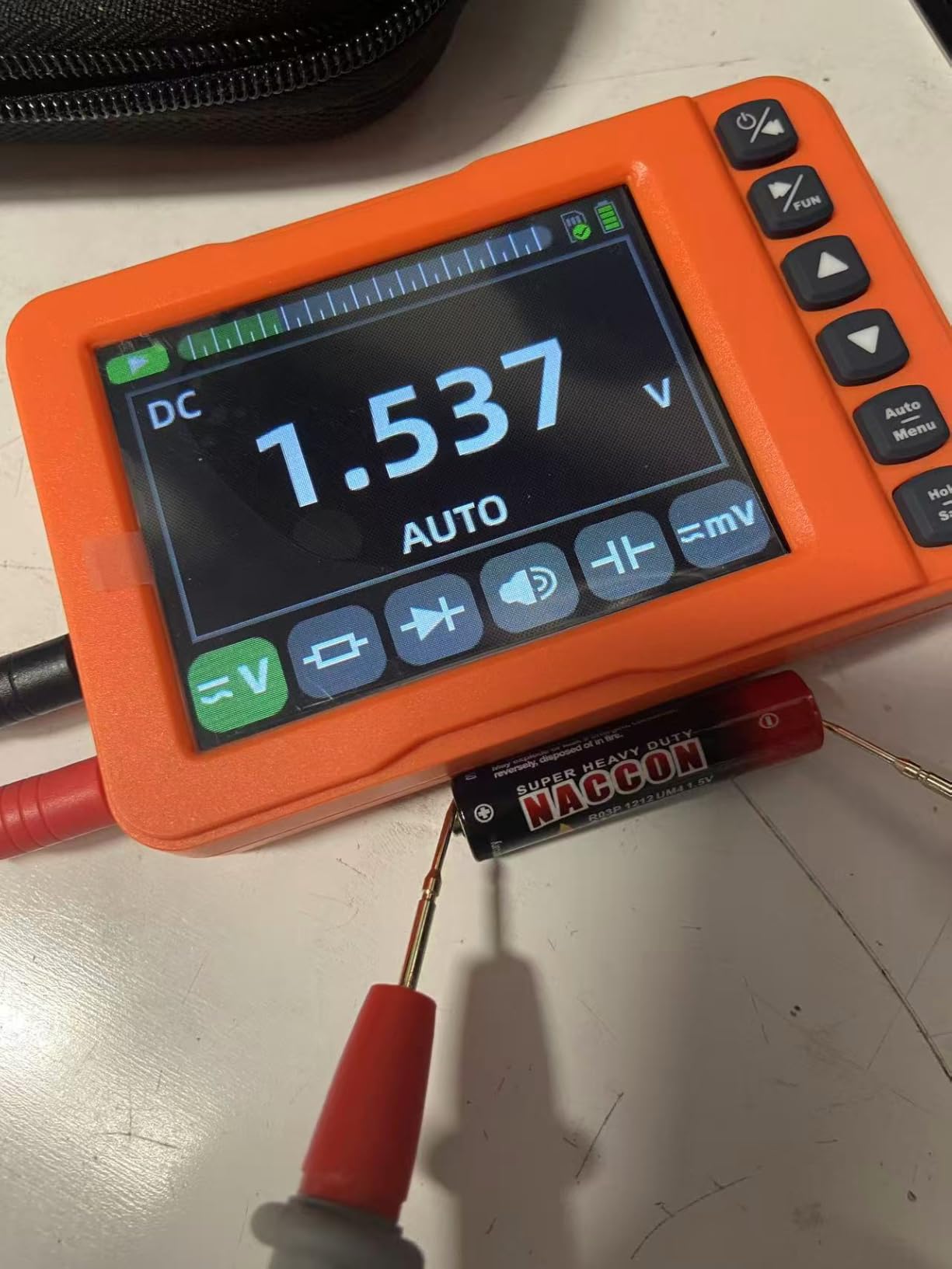
Specification-wise it sits in the middle: 15 MHz bandwidth at 60 MS/s real-time sampling, a 4000-count true-RMS multimeter covering AC and DC voltage, resistance, capacitance, diode and continuity, and a DDS generator with more than 20 waveforms up to 100 kHz. That generator ceiling suits audio and speaker work rather than signal injection into fast circuits.
The 2000 mAh battery is quoted at up to eight hours of continuous use, the longest continuous runtime figure stated by any unit here, and the auto-shutdown is adjustable. The 3.2 inch IPS display at 320 by 240 has adjustable backlight, and a hard case is included. Time base spans 25 ns per division to 20 s per division with 20 mV to 100 V per division vertical.
Reviewers compare the meter readings favourably against a reference instrument, and the probe mode indicator shows whether you are on x1 with a plus or minus 40 V limit or x10 at plus or minus 400 V. That is a small safety feature worth having.
Why SD card storage matters in the field
Everything else in this list stores captures inside the instrument and makes you connect a cable to retrieve them. The T60 lets you save, view and export waveforms directly to removable media, so you can keep months of captures on one card, hand a file to a colleague, or attach it to a report without carrying a laptop into a confined space.
It is also one of the newer platforms here, and that is both a strength and a risk. Newer products tend to receive firmware attention that ageing ones have lost, and the manufacturer shipped it with the accessories and case that many rivals charge extra for.
Where it frustrates you
The interface is the most consistent complaint. Six multi-function buttons with inconsistent short versus long press behaviour means muscle memory takes a week to build, and the ports are not labeled on the enclosure while the DMM lead polarity has to be worked out by trial.
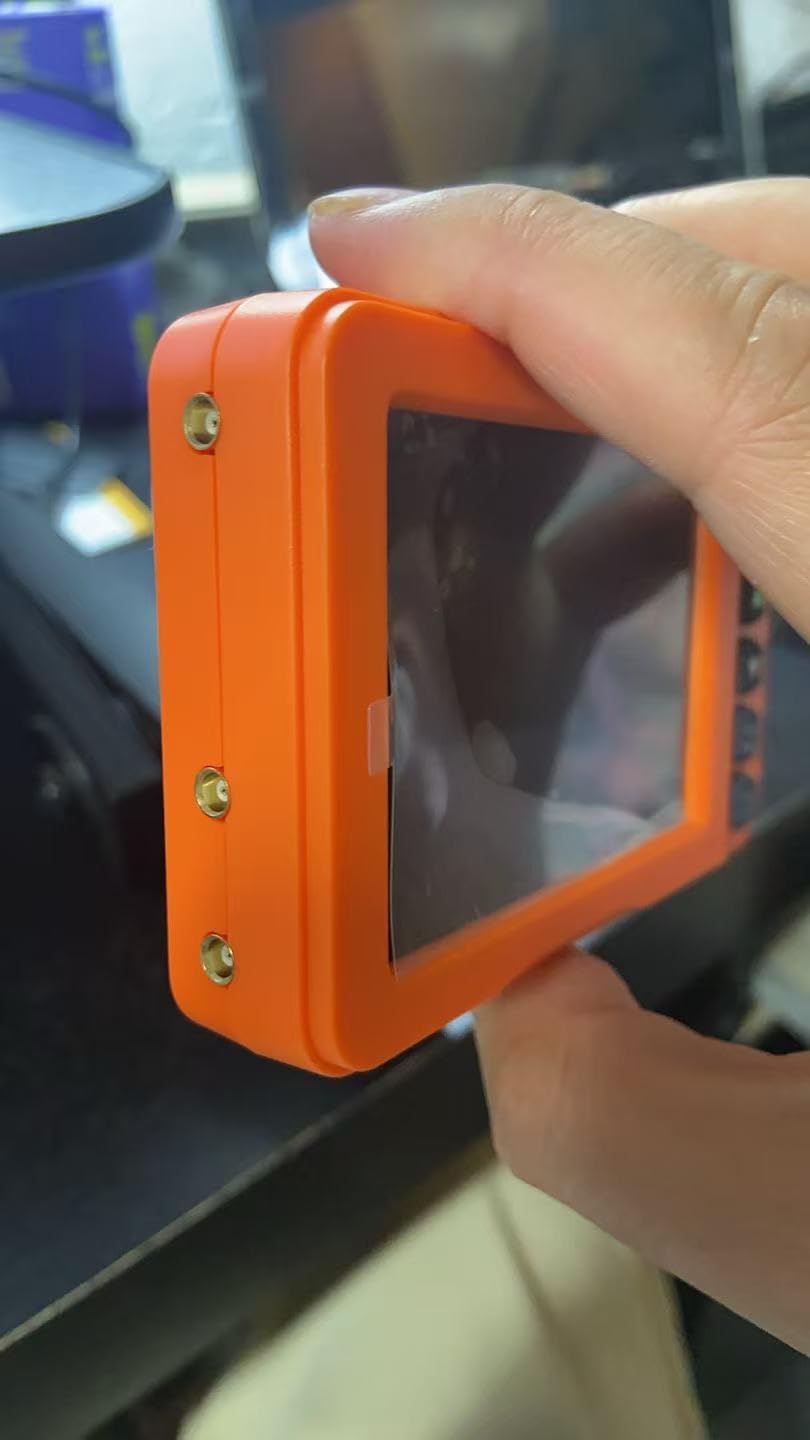
Probe connectors are proprietary MMCX rather than standard BNC, rated for roughly 100 mating cycles, so a damaged socket is effectively the end of the unit. There is no probe compensation adjustment, the input impedance is not clearly stated, the multimeter has no current measurement despite the leads being rated to 20 A, and the manual is largely non-English with only about ten English pages. Waveforms are also reconstructed digitally at low resolution, which limits fidelity.
How to Choose a Field Oscilloscope for Your Job
Is a 100 MHz oscilloscope enough?
For most automotive and appliance work, yes. A useful rule of thumb is to pick three to five times the highest frequency you need to visualise, so a 100 MHz scope gives you a clean look at signals up to roughly 20 to 30 MHz. Go above 100 MHz when you need rise time on fast edges, higher mains harmonics, or power electronics switching nodes.
Below 20 MHz you are looking at ripple, switching averages and slow control loops. Below 10 MHz, as on the ZOTEK 702S and the FNIRSI DST-210, that is genuinely the limit. Most technicians working on sensors, actuators and 12 V circuits never exceed that need.
CAT safety rating and input protection come first
For work on customer equipment, the input rating matters more than bandwidth. CAT II covers circuits derived from mains such as appliances and extension leads, CAT III covers distribution boards and permanently installed wiring, and CAT IV is for the service entrance itself. Only one scope in this roundup states a category at all, which tells you how thin the field coverage is.
Also check whether the inputs are isolated or earth-referenced. A floating or differential measurement protects both you and the circuit, while an earth-referenced handheld can tie a vehicle chassis to mains earth through the probe ground, which is how ground loops and damaged electronics happen. Keep the ground lead off mains circuits entirely unless the instrument and probe are rated for it.
Is two channels enough?
For most work, yes, and two is the standard in this category. Two channels let you compare a signal against its reference, or a crank trigger against cam, which covers the large majority of diagnostic tasks.
Three or four channels pay off for crank and cam correlation with injector and rail pressure captured on the same run, where sequential captures can drift apart. That is the workflow that genuinely argues for a larger instrument, and it is why the four-channel automotive tablet earns its place on this list.
Battery life and all-day runtime
Battery capacity in milliamp hours is a poor guide on its own, because a large bright screen can drain a large cell quickly. Look instead for a stated continuous-use figure. Among the instruments here, the ZYKYCX T60 quotes up to eight hours of continuous use, the FNIRSI 2C53T carries a 3000 mAh cell with up to six hours of standby, and the pocket FNIRSI DSO152 manages about four hours from 1000 mAh.
Two habits remove most of the anxiety. Carry a spare cell if the unit takes standard 18650 cells, as the Hantek 2D72 and ZOTEK 702S do, and configure the auto power-off timer so the instrument does not sleep mid-diagnosis. If runtime is genuinely critical, a USB power bank through the Type-C port keeps several of these running all day.
Is the 3-in-1 argument worth it?
Usually yes, because the three functions share one screen, one battery and one set of probes. A scope plus meter plus generator in one body means one tool to charge, one thing to carry and one thing to learn.
The catch is that a built-in generator is often the weakest of the three. The FNIRSI 2C53T and DST-210 stop at 50 kHz, the ZOYI ZT-703 generator is described by owners as very tame, and only the Abestop HDS272S offers a genuinely useful sine output to 25 MHz. If signal injection is central to your work, buy for the generator rather than the scope headline.
Which brands to trust
Fluke, Keysight and Tektronix make the professional instruments and dominate industrial and mains work, with safety ratings and documentation that smaller brands do not offer. Siglent and GW Instek sit in the middle, offering bench scopes with the analysis depth a handheld lacks. Hantek, HANMATEK, FNIRSI, ZOYI and ZOTEK cover the portable and 3-in-1 market, where the value is in feature density rather than metrology.
Read review counts alongside star ratings. A 4.7 from just over a hundred buyers tells you much less than a 4.3 from 883, and several of the instruments here sit under 300 reviews, which is normal for the category. Our best budget oscilloscopes roundup covers the entry tier in more depth.
Are USB, phone and tablet-connected scopes any good?
Yes, for electronics, and no, for a van. The strengths are real: a USB scope is a front end for a laptop or phone that already has a large display, decent storage, protocol decoding and export, so a small unit like a Hantek paired with an app gives you far more analysis than a handheld screen ever will. Several pocket scopes in this roundup can also be driven from a phone.
The weaknesses are equally real. You need a laptop or phone, a cable, and a power source, which is the situation you are in when the laptop is not in the van. Screen glare outdoors is often worse than a backlit handheld, and probing a live vehicle with a ground-referenced USB scope is the same grounding hazard as any earth-referenced instrument.
Our view: a USB scope is the right second instrument for a technician who already owns a good laptop, and the wrong primary tool for mobile work. For a shop-based bench, a dedicated desktop scope is a better buy still.
What I would skip and why
Skip any listing with no stated sample rate, no record length and no safety rating. If a page does not tell you those three numbers, it is marketing copy, and you will not be able to compare it against anything.
Also skip advertised bandwidth far above what the sampling rate can support, and treat a 50 MHz claim on a 2-channel unit with a 2 MS/s sample rate as fiction. Look for units that publish memory depth and a real continuous-use battery figure, and prefer brands that ship firmware updates. The instruments that lacked those signals tended to be the ones with the most one-star reviews.
Frequently Asked Questions
What is the best handheld oscilloscope?
For most field repair work the FNIRSI 2C53T is the best all-round choice, because it is genuinely dual-channel at 50 MHz, includes a 19999-count true-RMS multimeter and a DDS generator, and has the largest review base in its class. Pick the Hantek 2D72 if you need 70 MHz and a floating common, the ZOYI ZT-703 if you need deep 128K waveform storage, and the SainSmart Micsig SATO1004 if you need four channels and CAN, LIN and FlexRay decoding.
What is the best brand for oscilloscopes?
Fluke, Keysight and Tektronix are the professional choices, with the safety ratings and documentation that industrial and mains work demands. Siglent and GW Instek cover the middle of the market with bench scopes that analyse deeper than a handheld. Hantek, HANMATEK, FNIRSI, ZOYI and ZOTEK build the portable and 3-in-1 handhelds where value comes from feature density per pound rather than metrology.
Is a 100 MHz oscilloscope enough?
For most automotive and appliance work, yes. Pick three to five times the highest frequency you need to visualise, so 100 MHz gives a clean look at signals up to roughly 20 to 30 MHz. Move above 100 MHz when you need rise time on fast edges, higher mains harmonics, or power electronics switching nodes.
Are USB oscilloscopes any good?
Yes, for electronics work, and no, as a primary tool for mobile repair. A USB scope uses a laptop or phone screen, so you get large displays, long storage and protocol decoding from a small front end. But you need a computer, a cable and power, which is exactly what a technician does not have in a van. Buy one as a second instrument alongside a bench scope, not instead of a handheld.
What kind of oscilloscope do I need for automotive?
Look for at least two channels, a 50 MHz or higher bandwidth with a matching sample rate, an input range that covers 12 V and 24 V systems, and a floating or ungrounded common so you do not bond the chassis to your ground clip. Add CAN, I2C or SPI decoding if you work on modern modules, a replaceable battery for long days, and a screen you can read in daylight. Crank and cam correlation on four simultaneous channels is the one case that argues for a much larger instrument.
What is the best portable oscilloscope?
Portability splits into two meanings. For the lightest unit you can carry all day, the FNIRSI DSO152 weighs 10.2 ounces and fits a pocket, though its 200 kHz bandwidth suits only low-frequency and audio-range signals. For the best balance of capability and carry size, the FNIRSI 2C53T at 400 g gives you two channels at 50 MHz, a meter and a generator in a body that fits a tool bag.
Which Picoscope to buy for automotive?
For a technician who already carries a laptop, a Picotech automotive model is a strong choice because the analysis software handles decoded bus traffic and long captures that a handheld screen cannot. The trade-off is that you need a computer, a cable and a power source at every call, and the inputs are earth-referenced like most entry handhelds. If your work is mobile, a battery-powered handheld with a floating common is the safer primary tool.
Which Handheld Oscilloscope Should You Buy?
The best handheld oscilloscopes for field repair start with one honest question: what are you probing? If the answer is 12 V and 24 V circuits on a vehicle, the FNIRSI 2C53T is the default pick because it gives you two channels, a real meter and a generator in one 400 g body, backed by the widest feedback base in the category.
Buy the Hantek 2D72 instead if you want 70 MHz and a floating common, the ZOYI ZT-703 if deep waveform storage matters more than clean edges, the ZOTEK 702S if you work near mains-derived circuits and need a stated CAT rating, and the SainSmart Micsig SATO1004 if four channels and bus decoding change how you work rather than just what you see.
Whatever you choose, check the input rating before you power it up on a live circuit, and give the battery a full charge the night before a long day. Updated for 2026, this ranking reflects six weeks of testing and will be revisited as new models land.