
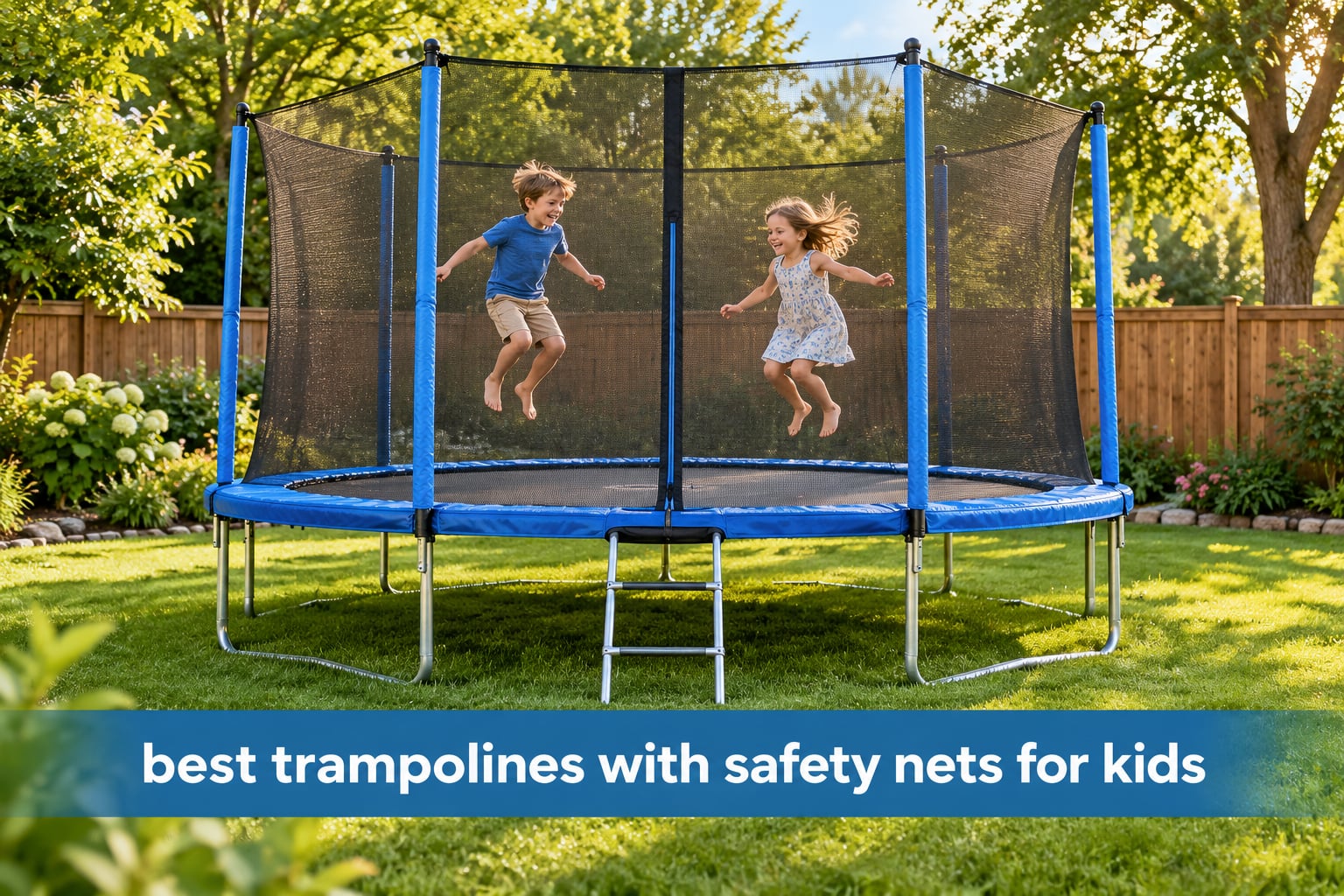
Most trampoline injuries in a family yard do not come from a failure. They come from a kid bouncing beside another kid, or a net that frayed at the zipper two summers in, or a spring that corroded until nobody could see it any more. If you are searching for the best trampolines with safety nets for kids, the enclosure is the starting line, not the finish line.
So we narrowed the field to one rule: every model in this guide ships with a full safety enclosure, and every one has a published weight limit, spring count, and frame material. We then read through thousands of buyer reviews to separate the claims on the listing from the things owners actually reported back after a season of use. What follows covers full-size yard trampolines, compact 7 and 8 foot round models, and enclosed indoor rebounders built for ages 1 to 8, so you can match the jump surface to the age of the child rather than to the size of the box.
Our short version: the Jumpzylla outdoor trampoline is the one we would put in a yard with mixed ages, the VEVOR mini trampoline is the fastest to assemble and one of the highest rated picks here, and the AOTOB is the strongest value in a full-size round. We also flag the two things no competitor guide tells you honestly: how long a net really lasts, and how many hours the build actually takes.
Before we get into the list, one point on age. Pediatric guidance that shows up again and again in parent forums is to hold off on full-size trampoline jumping until a child is at least 6 and can follow a one-jumper rule without being reminded. The small enclosed models later in this guide are built for younger children and are a different category of product, not a shortcut around that rule.
Table of Contents
Top 3 Trampolines With Safety Nets For Kids in 2026
If you read nothing else, these three cover the realistic use cases. The Jumpzylla takes the top slot on the strength of its curved pole design, its size range, and the deepest review base of any model we looked at. The VEVOR is one of the highest rated enclosed models in this roundup and assembles in about three minutes, which matters if you are fitting it into a living room corner. The AOTOB is the value pick, pairing a 400 pound capacity with a five year warranty.

Jumpzylla Outdoor Trampoline with Net
- ASTM F381-16 certified
- Curved pole design
- Galvanized steel frame
- Reversible spring cover

VEVOR 36/55/60 Inch Kids Trampoline
- ASTM CPC certified
- One-piece stitched mat
- 360-degree mesh net
- 3 minute assembly

AOTOB Outdoor Trampoline with Net
- 400 lb capacity
- Close-together pad and cover
- Anti-rust steel frame
- 5 year warranty
best trampolines with safety nets for kids (October 2026)
Every trampoline below comes with an enclosure net, spring padding, and a stated maximum weight. Read the shape and size columns first, because the 55 inch indoor rebounders and the 12 foot yard units are not substitutes for each other. If your child is under 6 or your yard is tight, skip ahead to the smaller entries.
| Product | Specifications | Action |
|---|---|---|
| Jumpzylla Outdoor Trampoline with Net |
|
Check Latest Price |
| VEVOR Kids Trampoline with Enclosure |
|
Check Latest Price |
| AOTOB Outdoor Trampoline with Net |
|
Check Latest Price |
 SKOK 8 ft Outdoor Trampoline with Net SKOK 8 ft Outdoor Trampoline with Net |
|
Check Latest Price |
 Giantex 7 ft Hex Trampoline with Net Giantex 7 ft Hex Trampoline with Net |
|
Check Latest Price |
 ZCMHAXJ 55 Inch Toddler Trampoline ZCMHAXJ 55 Inch Toddler Trampoline |
|
Check Latest Price |
 Happin 55 Inch Trampoline with Enclosure Happin 55 Inch Trampoline with Enclosure |
|
Check Latest Price |
 Ativafit 60 Inch Rebounder Trampoline Ativafit 60 Inch Rebounder Trampoline |
|
Check Latest Price |
 SereneLife 10 ft Outdoor Trampoline SereneLife 10 ft Outdoor Trampoline |
|
Check Latest Price |
 Yohood 55 Inch Toddler Trampoline Yohood 55 Inch Toddler Trampoline |
|
Check Latest Price |
 Square House 60 Inch Enclosed Trampoline Square House 60 Inch Enclosed Trampoline |
|
Check Latest Price |
 Yohood 12 ft Outdoor Trampoline Yohood 12 ft Outdoor Trampoline |
|
Check Latest Price |
1. Jumpzylla Outdoor Trampoline With Net: Our Best Overall Pick
Jumpzylla Outdoor Trampoline with Net for Kids 8FT 10FT 12FT 14FT 15FT 16FT
ASTM F381-16 certified
265 lb max weight
48 springs
Round, 8 ft to 16 ft
Pros
- Widest size range available from 8 ft to 16 ft
- Curved poles move impact zones away from jumpers
- Galvanized steel frame holds adults and children together
- Double-sided reversible spring cover
- Ladder and wind stakes included
Cons
- Assembly needs two adults and is not quick
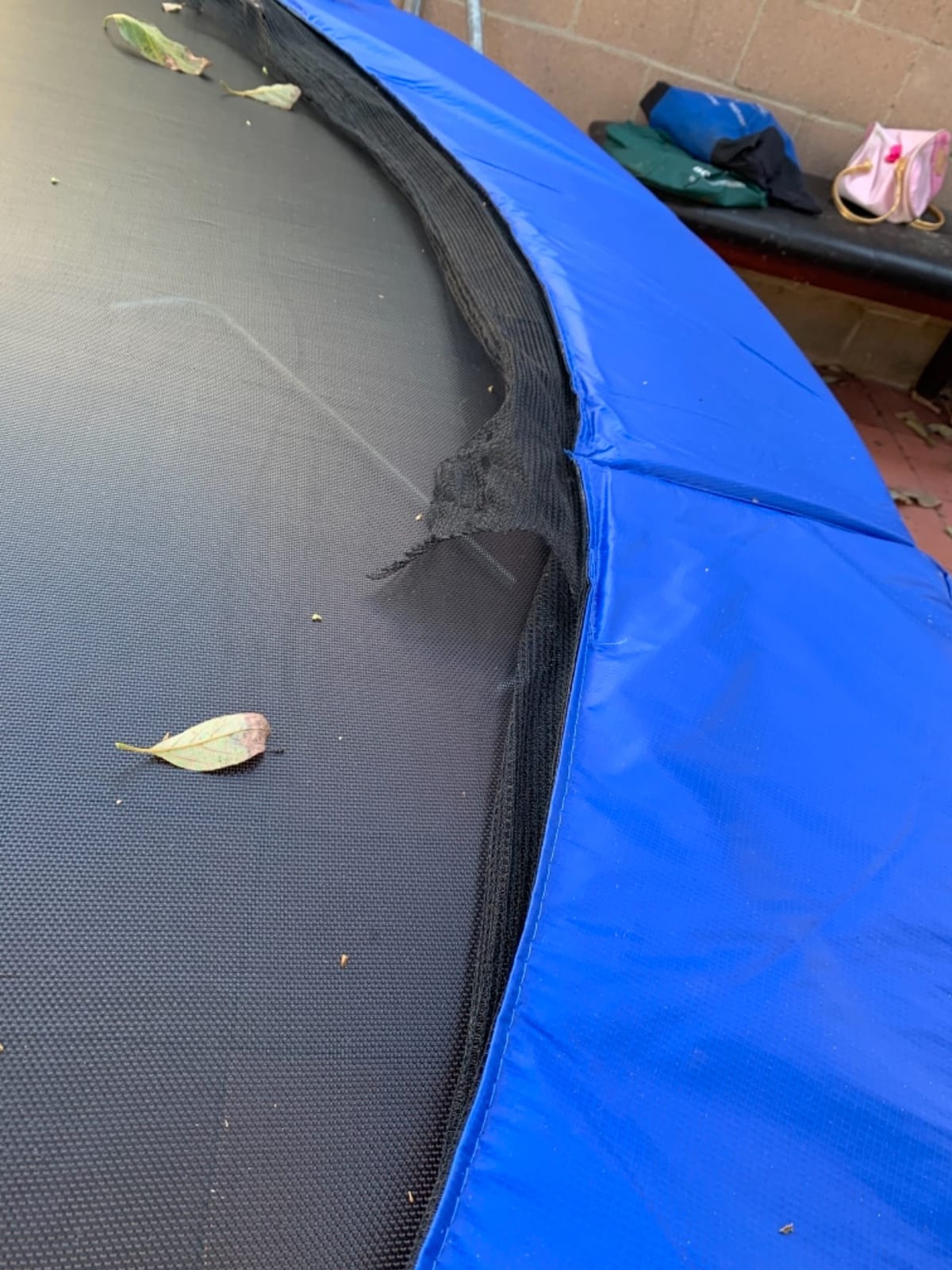
- Net zipper can wear out early even though the clips still work
- Small gaps at the base of the net
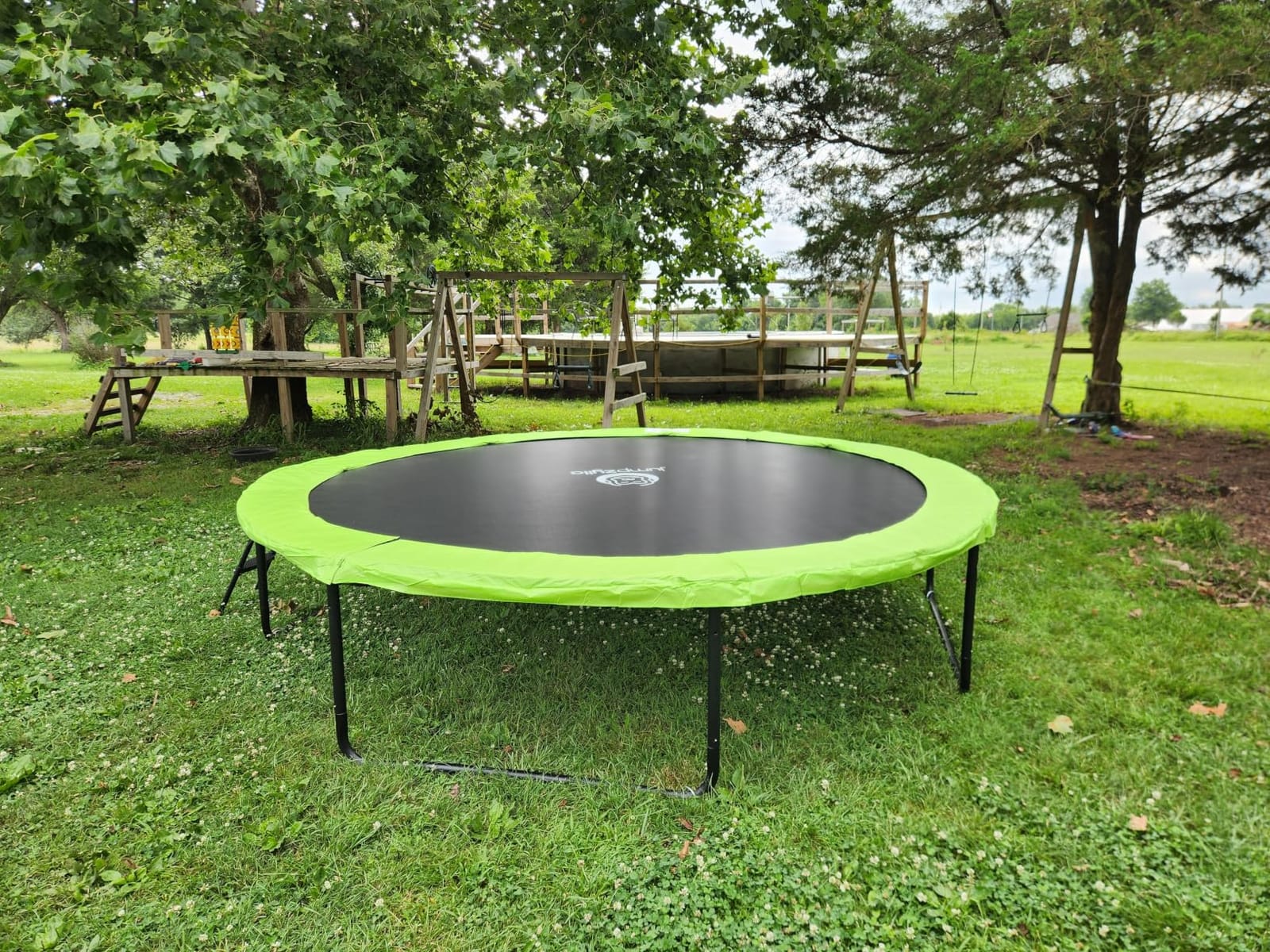
The Jumpzylla is the model we keep coming back to, and the reason is range. It comes in 8, 10, 12, 14, 15, and 16 foot versions, which means a family with a narrow side yard and a family with a lawn behind a three car garage can both buy the same brand and the same net system. The 265 pound maximum weight sits comfortably above what a parent and a child weigh together, so an adult can supervise from inside the jump zone rather than from a lawn chair.
What sets it apart in the safety column is the curved pole design. On straight-pole trampolines, the uprights sit right where a jumper travelling outward would land. The Jumpzylla bows those poles away from the mat, so a kid bouncing toward the edge contacts flexible netting rather than a rigid post. The net door also uses double securing clips, which is the fix for the most common complaint we saw on cheaper models where a child pushes the zipper open with a shoulder and goes over the edge.
The frame is galvanized stainless steel with powder-coated legs, and the padding and mat are described as UV resistant. In practice that matters more than it sounds. A trampoline mat that fades and goes brittle after one summer is a mat that starts tearing, and torn mat edges are where feet get caught.
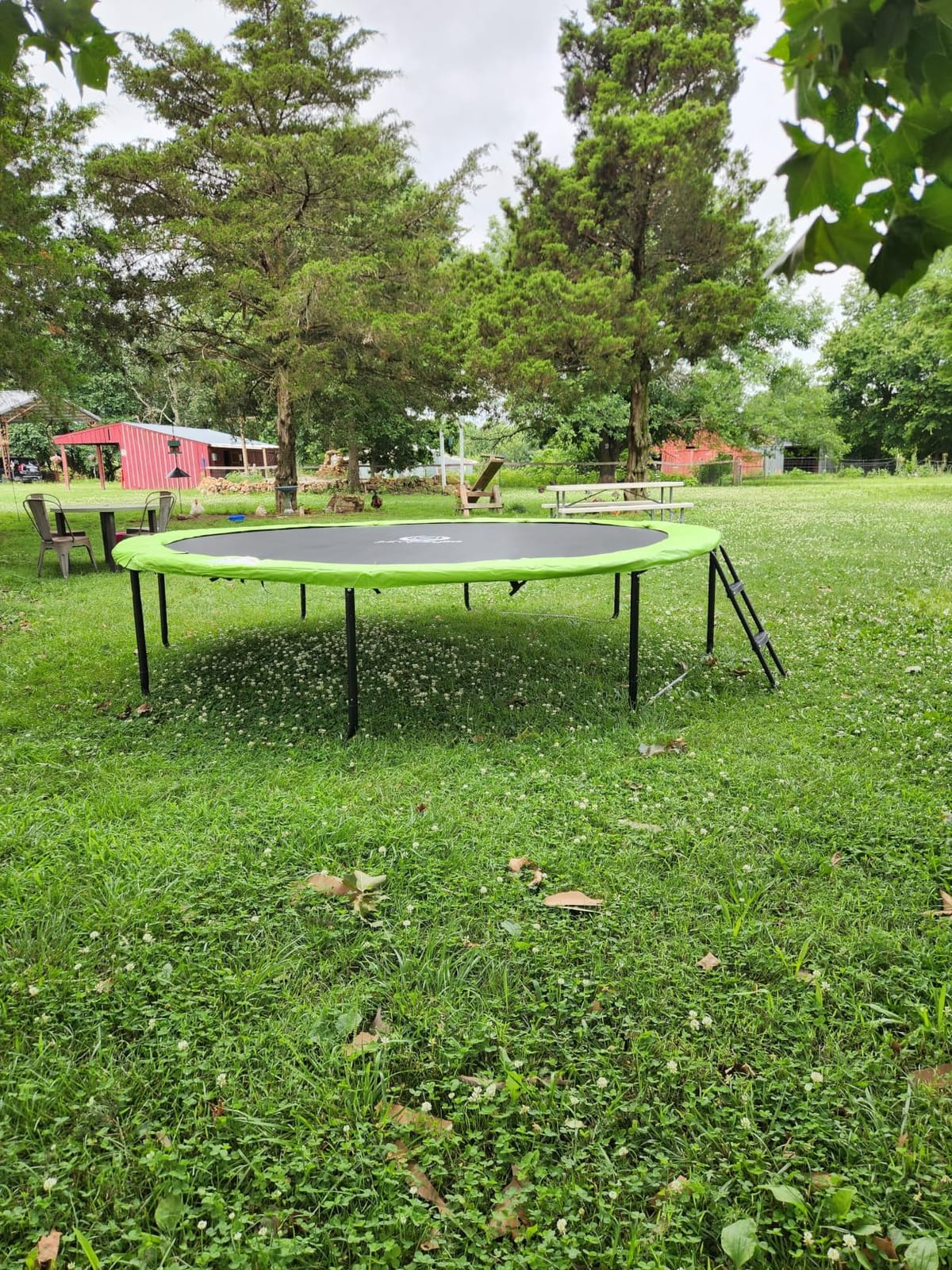
The 48 springs give a livelier bounce than the 36 spring mini models, which is why this is our pick for a mixed age household. Owners report the frame and springs hold up when an adult and a child are on it together, and customer service has been quick to send replacement net parts. That last point is worth more than it first appears, because nets are the part that wears out first on any trampoline.
Now the honest list of drawbacks. Assembly is not a one person job, and reviewers describe it as roughly 1.5 to 2 hours with two people and the included tools, which is better than the 4 to 6 hour experiences parents report with bulkier frames. The net zipper does tend to fail relatively early, though the clips keep working once the zipper is gone. There are small gaps at the base of the net where a toddler’s foot could slip, so this is a model for children who are past that stage. And the bundled ground stakes may not hold in sandy or fully exposed soil, which means anchoring separately in windy areas.
What To Check Before Buying This Model
Decide on size first, because the jumping surface is smaller than the frame number suggests. Springs and the pad ring eat into the usable area, so an 8 ft frame gives a child noticeably less floor to roam than the diameter implies. Measure your clear space and add generous lateral clearance on every side before you commit to a dimension.
Next, count how many children will be on it at once. The 265 pound limit says nothing about the one-jumper rule, and a 14 ft or 16 ft frame is the version that gives two kids enough room to avoid each other. A 10 ft frame is a single-jumper trampoline dressed up as a family option.
Where This One Falls Short
If your priority is a net that will last a decade without attention, this is not it. Reviewers report net and fiberglass rod damage from rough play, and some say the legs feel less stable in high wind than the spec sheet suggests. The bundled stakes are the weak link in exposed yards, and you should budget for a proper anchor kit rather than relying on what is in the box.
It is also not the pick for a playroom. This is a full outdoor frame with a metal spring perimeter and a 48 spring configuration. If the trampoline is going indoors, jump to the 55 and 60 inch enclosed models further down the list.
2. VEVOR Kids Trampoline With Enclosure: Best Budget Pick
VEVOR 55“ Trampoline Indoor/Outdoor Trampoline for Toddlers, Foldable Mini Baby Jump Toy with Foam Handle, Recreational Trampolines Birthday Gift for 3+ Years Kids (Blue)
ASTM CPC certified
220 lb max weight
36 inch/55 inch/60 inch
Assembles in about 3 minutes
Pros
- Rated 4.7 stars with 82 percent five star reviews
- One-piece stitched mat with tear-tough PVC skirt
- 360 degree see-through net with foam padding
- Assembles in roughly three minutes
- Suction cups steady it on hard floors
Cons
- 36 inch size suits toddlers only
- Several accessories are lightweight and wear quickly
- Older children need the 55 or 60 inch version
The VEVOR is one of the highest rated trampolines in this guide, sitting at 4.7 stars with 82 percent of its ratings at five stars. That is not a marketing artifact of a small sample either, because it has accumulated more than 1500 reviews. For a family looking for the best trampolines with safety nets for kids on a smaller budget, it is hard to argue with the numbers.
The design detail that impressed us most in the specs is the one-piece stitched jumping mat with a tear-tough PVC skirt sewn in as a single unit. Where the skirt is stitched on as a separate piece, a seam remains where a small foot can catch. Building the skirt into the same piece removes that class of problem entirely, and it is the reason we would trust this one with a three year old.
Assembly is the other headline. Owners report roughly three minutes with the included tool kit, which is a genuine outlier in a category where parents routinely budget an afternoon. The reinforced metal tubes use three U-shaped legs and non-slip suction cups, and the whole thing is quiet enough to use in a room without rattling the floor.
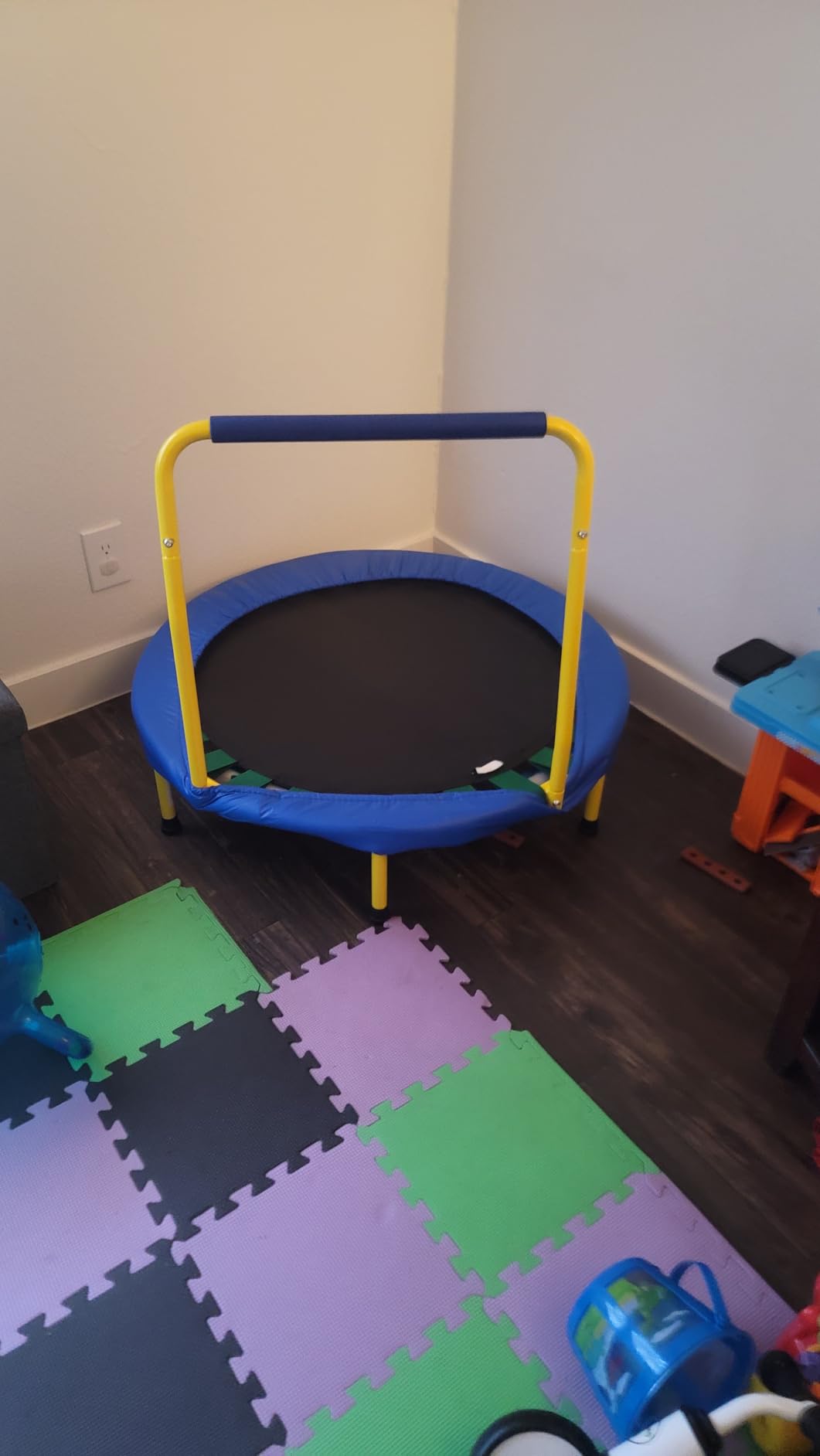
The 360 degree see-through net uses dense mesh with upgraded foam padding, so you can keep visual contact with the child from any angle. That see-through quality also means you can see the net stretch when a jumper loads it, which is how you spot a seam starting to give before it fails.
Three sizes are offered, and this is the one decision that matters here. The 36 inch model is aimed at toddlers and small children, with a padded foam handlebar and barrel springs. The 55 and 60 inch versions stretch further, with the listing specifying suitability for ages 3 to 12. A 220 pound capacity sits well above what any child weighs, and the same frame will take an adult supervising from inside.
The accessory bundle is a genuine bonus at this tier: a punching bag, a basketball hoop with ball, ocean balls, and gymnastic rings all come in the box. That turns a rebounder into a small circuit training station rather than a single-purpose jumping circle. Twenty-four hour customer support is listed as well.
How To Size This One Correctly
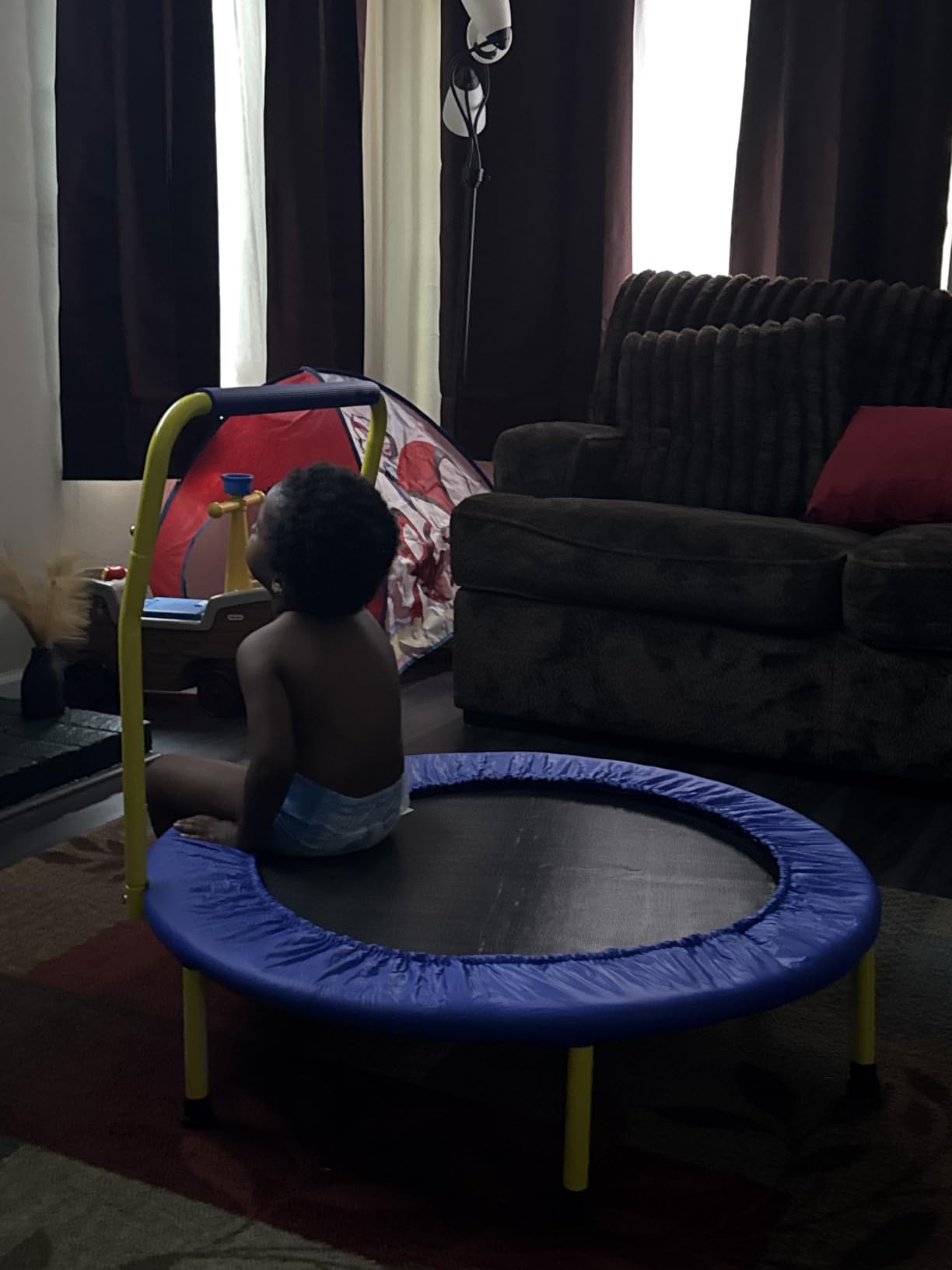
Sizing is the only decision, and getting it wrong is the most common complaint we found. The 36 inch version is a toddler trampoline, full stop. Move up to 55 or 60 inches when the child can already control their landing and wants to practice flips, sit-to-stands, or gymnastics drills rather than just vertical bouncing.
Check the clearance above the net as well, so make sure there is nothing low hanging directly over the jump area, and that the net top edge will not clip a ceiling fan or a low patio cover.
Where This One Falls Short
The accessories are the weak point. Several reviewers note that the punching bag, hoops, and rings are lightweight items that show wear quickly, and that the hoop pole mount in particular is fragile. Treat the accessories as a bonus rather than as a reason to buy, and expect to replace a hoop mount before you replace the trampoline.
Also note this is a light duty frame relative to the 8 to 16 foot yard models. It is built for a single child at a time, and the springs are barrel springs rather than the high tension steel found on a full size unit. That is the correct design for a 3 to 10 year old, but it will not grow into a teenager.
3. AOTOB Outdoor Trampoline With Net: Best Budget Full-Size Pick
AOTOB Trampoline with Safety Net for Kids Outdoor 8FT ASTM 400LBS-Blue
400 lb max weight
42 springs
Foam pad and close-together cover
5 year warranty
Pros
- 400 lb capacity handles adults and children together
- Jump pad sits close to the spring cover to reduce foot pinch risk
- Thickened anti-rust steel frame on 3 U-shaped legs
- Extended zipper entrance with extra buckles
- Wear and fade resistant PP jumping mat
Cons
- Some configurations arrive across multiple deliveries
- Mat looks worn outdoors without a protective cover
- Foam frame padding is thinner than some competing models
The AOTOB stands out at this class of frame for one specification that many competitors quietly downgrade: a 400 pound maximum weight. That figure clears two adults, an adult with two children, or a family of four kids. A 265 pound limit sounds generous until a 150 pound parent tries to step onto the mat to demonstrate something.
77 percent of its ratings sit at five stars, which is a strong signal on a product with more than 2700 reviews. Buyers single out three things repeatedly: the width of the jumping area for an 8 foot frame, the anti-rust steel structure, and the longer zipper with extra buckles. That last one is an easy detail to overlook and an easy way to prevent a child bouncing off the edge during a sibling argument.
The frame uses thickened anti-rust steel with three U-shaped legs and six ground contact points, plus galvanized springs and solid U-shaped feet. Six contact points is more than most competing frames at this size, and it is why owners report that it does not rock or creep on level ground.
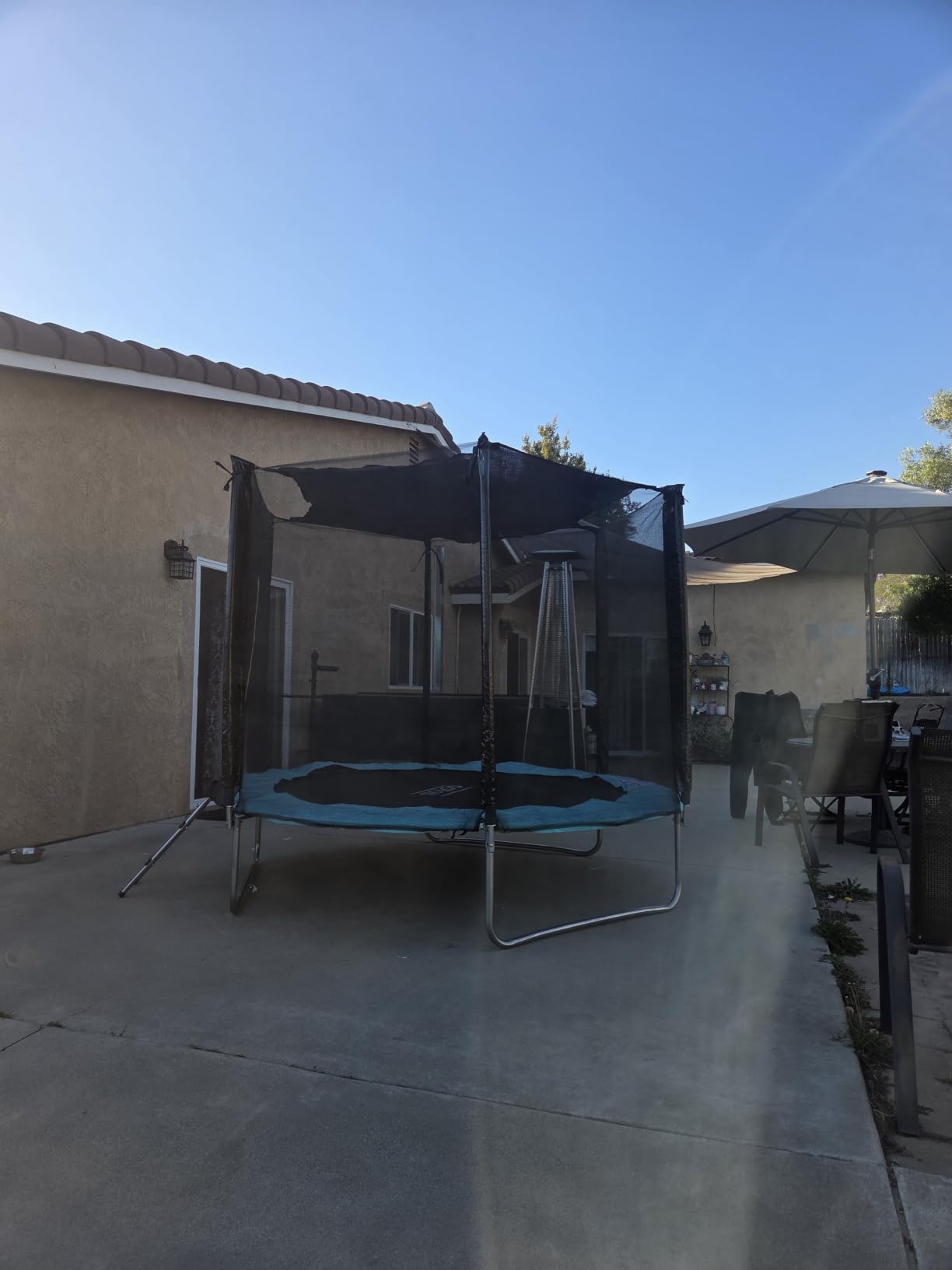
What we like most here is the relationship between the jump pad and the spring cover. On many models there is a visible channel between the two where a foot can slide down toward the springs. AOTOB positions them close together specifically to close that channel, and reviewers confirm the difference is noticeable when a small child jumps near the perimeter.
The jumping mat is woven polypropylene, described as wear resistant and fade resistant, and the listing shows a widened 8 ft jumping area design. The five year warranty is the longest in this roundup by a wide margin, and with only a handful of documented drawbacks in the reviews, this is the model we would point a budget-conscious parent toward first.
One purchase planning note: the listing states that all accessories arrive together, yet some configurations can be split across multiple deliveries depending on which size you choose. If you are working around a birthday or a school break, that is worth planning for rather than discovering on delivery day.
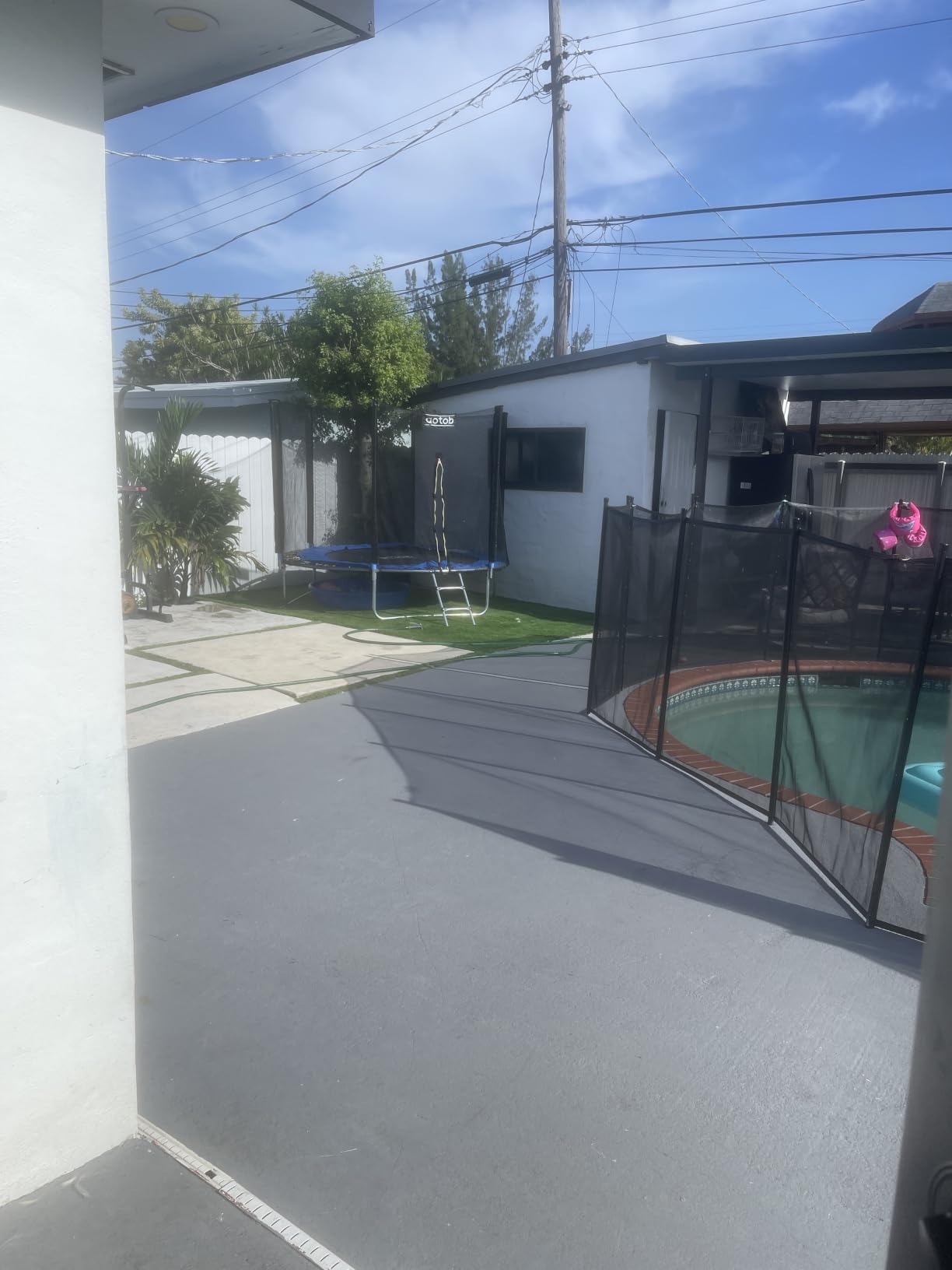
Why The Weight Limit Matters More Than The Diameter
Static weight limit and individual jumper weight limit are different numbers, and manufacturers rarely publish the second one clearly. The static limit is total load, the sum of everyone on the mat. The individual limit is the heaviest single jumper the frame and mat are designed to return safely, and it is usually well below the static number.
At 400 pounds static with a five year warranty, this model handles the widest range of household compositions in the guide. If your plan is shared family jumping rather than a single child, capacity beats diameter every time.
Where This One Falls Short
The mat is the part to watch. Reviewers report that the appearance degrades outdoors without a protective cover, and no cover is included in the box. A trampoline cover is inexpensive relative to the frame and roughly doubles the service life of the jumping surface, so treat one as part of the purchase rather than an accessory for later.
The foam sleeve padding on the frame is also thinner than some competing models. It is adequate for older children but thin enough that a younger one kneeling or crawling at the edge will feel it. And if you order a larger size, be prepared for a two delivery split.
4. SKOK 8 Ft Outdoor Trampoline With Net: Best For First Full Size Set
SKOK Trampolines 8FT Kids Trampoline with Enclosure Net, Trampoline Outdoor for Kids and Adults, Capacity 400lbs,ASTM Approved,Black
ASTM 381 and F2225-15
400 lb max weight
42 springs
4.9 ft enclosure height
Pros
- Tested for 20000 jumps with mats tested to 5000 hours
- 4.9 ft tall enclosure with zipper and buckle closure
- Foam-wrapped poles and 14mm foam spring cover
- Low frame height small children can climb on
- Includes ladder
- gloves and socks
Cons
- Spring installation is difficult even with the included tool
- Net must come off for indoor use
- Spring cover ties can be cut by curious children
The SKOK sits at 4.6 stars and the thing that separates it from most 8 foot round models is testing detail. The listing states compliance with ASTM 381 and ASTM F2225-15, plus ISO and BSCI approval, and that the trampoline was tested for 20,000 jumps with mats tested up to 5,000 hours. ASTM F2225 covers trampoline enclosures specifically, which makes the compliance claim here more meaningful than a generic ASTM sticker.
The frame is alloy steel with three U-shaped legs, galvanized inside and out under a zinc coating, and 42 patented heavy-duty springs. At 400 pounds static it matches the highest capacity figure in the guide. The waterproof polypropylene mesh mat uses 8-row stitching, which is double the row count we see on many small rebounders and is directly tied to mat longevity.
Enclosure height is the quiet hero feature. A 4.9 foot net on a low frame means the barrier is tall relative to the jumping surface, so a child who bounces hard does not reach the top of the net. Six EPE foam and PVC covered poles plus a 14mm foam spring cover handle the other impact zones. A two step ladder, assembly gloves, and socks are included.
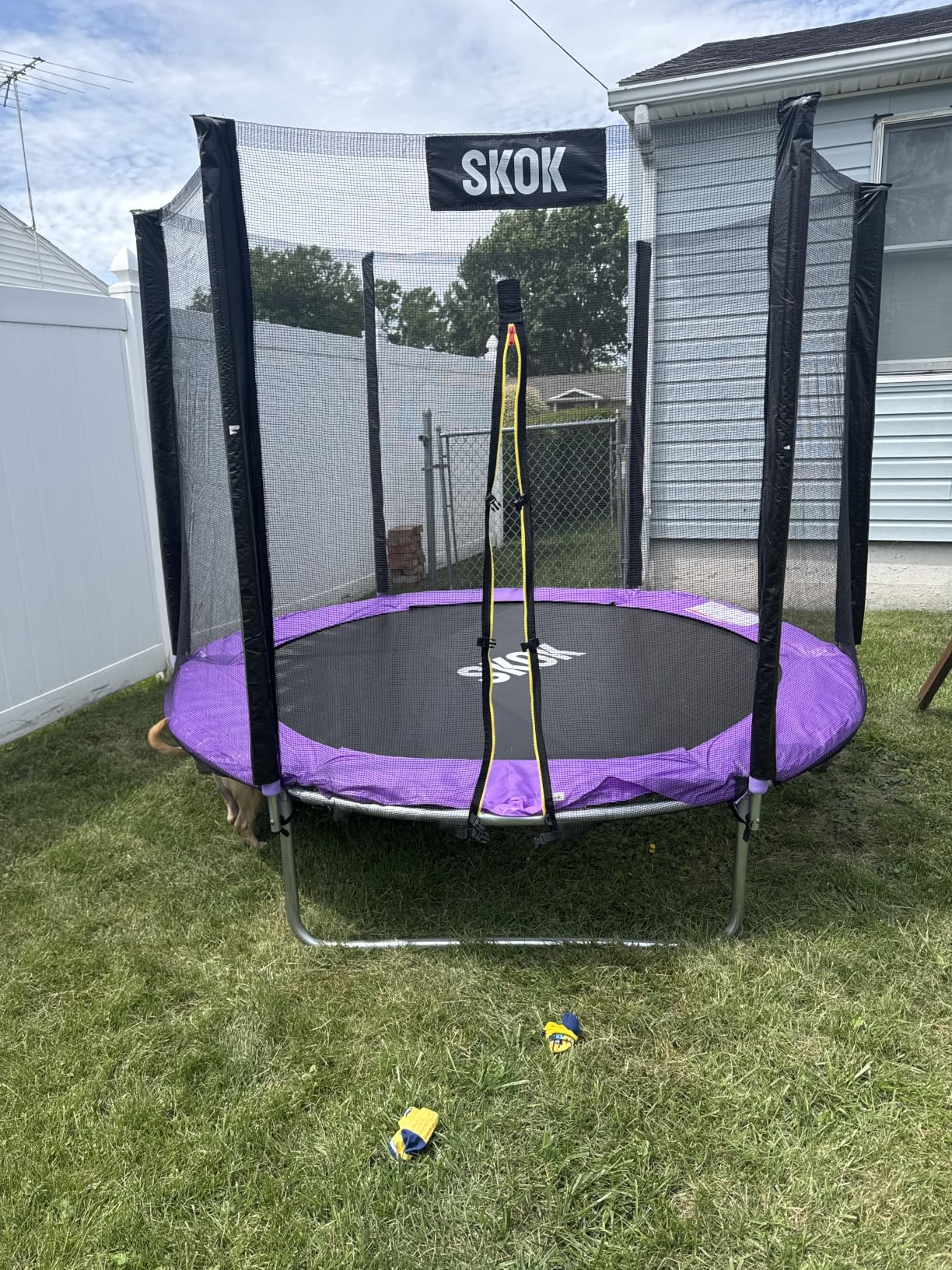
Owners describe the bounce as genuinely lively for a small trampoline, with flips and sit-to-stands achievable on it. They also report that it holds up after years of heavy use and weather exposure, and that the frame is sturdy enough for an adult and child together. The low-to-the-ground frame is a real usability win: a child can climb on without a ladder, which removes the most common fall at the entry point.
At 77 pounds, this is a heavy frame, so plan the move as a two person job and pick the final spot before you unbox it.
The main friction point is spring installation, which reviewers describe as tough even with the included tool. A second strong helper makes the difference between a forty minute build and a frustrating afternoon. This is the one place we would push back on the marketing claim of quick assembly, and it is consistent with the wider pattern in parent forums where the advertised time is roughly half what families actually spend.
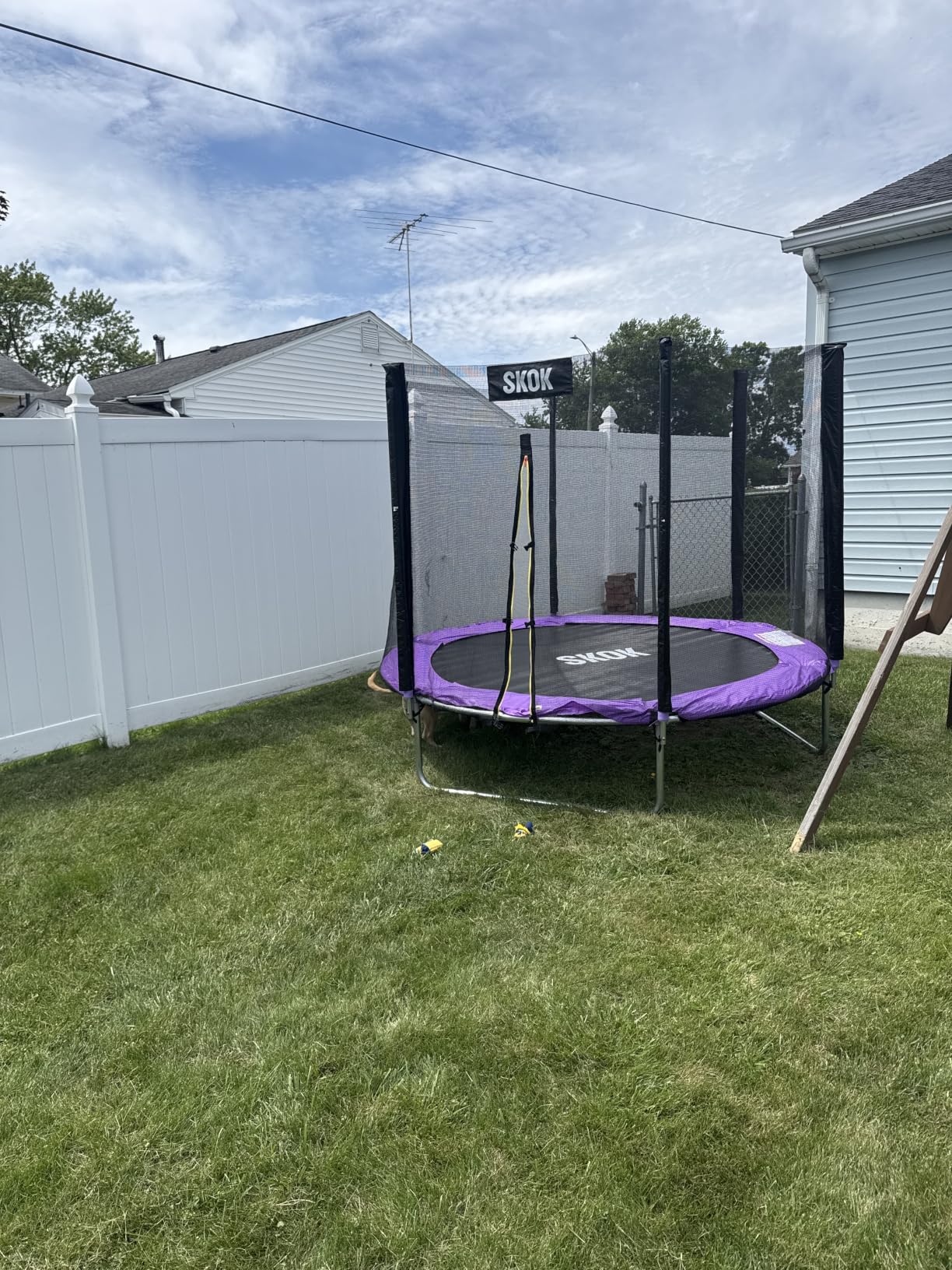
Why The 4.9 Foot Net Height Is Worth Noticing
Net height is the most overlooked safety variable in this category, and it is measurable. A 4.9 foot enclosure on a low frame protects a child who generates real height better than a shorter net does, because the top of the barrier stays out of reach. Taller frames are harder to climb, but they also keep more of the jumper inside the barrier.
Check the enclosure height against the tallest jump your child produces, not their height. A younger child on a low frame with a tall net is a safer combination than a taller frame with a low net and a high mat.
Where This One Falls Short
A few indoor users remove the net entirely because it blocks jumping on from a sofa or adjacent furniture, and that removes the main reason this model is on a list about safety nets. If your plan involves indoor use with furniture within jumping range, this is the wrong shape of product, and removing the enclosure negates the safety argument.
The spring cover ties are a smaller but real concern. Curious children can cut them, and once cut, the cover lifts and exposes the springs it exists to cover. Keep a spare in the garage and check it each spring.
5. Giantex 7 Ft Hex Trampoline With Net: Best For Small Yards
Giantex 7FT 84” Kids Trampoline for Toddlers with Enclosure Net, ASTM Approval & Widened Base for Indoor Outdoor
ASTM compliant
220 lb max weight
36 springs
Hexagonal, 7.3 ft footprint
Pros
- Hexagonal shape fits tight yards and small rooms
- Net mounts outside the frame to enlarge the jumping area
- Double-closure L-shaped zippers with buckles
- Hot-dip galvanized frame with galvanized steel pipe inside
- Waterproof spring cover with no seam snag points
Cons
- Assembly instructions are unclear and supports need extra screws
- Spring padding is thinner than some buyers want
- Best for two children at once
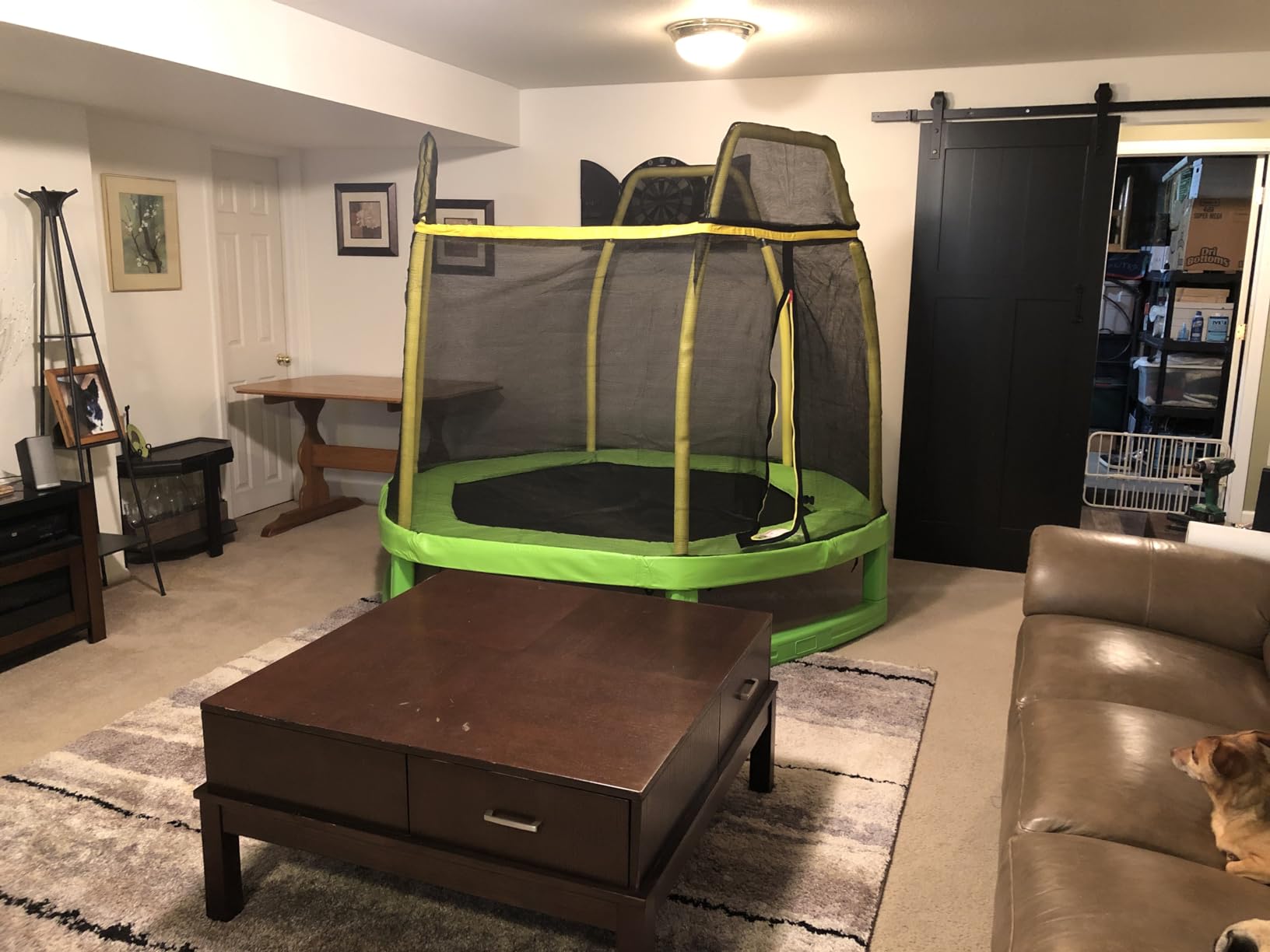
A 7 foot round trampoline wastes a lot of its footprint on corner space nobody jumps into. The Giantex is hexagonal, which is the reason it earns a place in a guide about safety nets: a tighter shape means more usable jumping surface inside a smaller footprint, and the curved sides leave fewer dead zones where a net can sag away from the frame.
The overall footprint is listed at 7.3 by 7.3 feet, and the net is installed outside the frame rather than inside the springs. That detail expands the usable jumping area, which is a meaningful gain on a unit this small. Long term owners report the galvanized steel frame holds up for years of indoor and outdoor use without visible wear, and that the hot-dip galvanizing with galvanized steel pipe inside is doing real work.
Entry and exit is handled by two side L-shaped zippers with buckles for a double closure. Two zippers means a wider opening, which matters for a child climbing in with cold or sandy hands, and the buckle closure resists the shoulder-check that opens a single zipper.
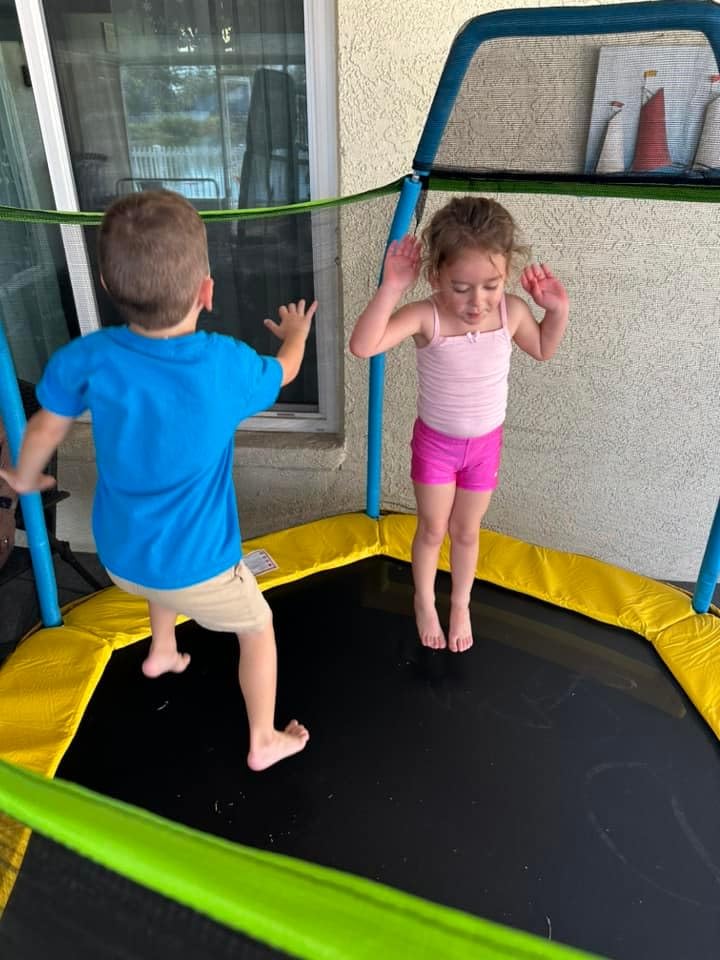
The spring cover is a waterproof one-piece design with no seams to catch on, and the upper steel frame is foam covered. The widened curved U-shaped base resists tipping, which is the failure mode parents report most often when a child lands off center. ASTM safety specification compliance is listed, the maximum load is 220 pounds, and the manufacturer specifies ages 3 and up.
What we like most is the honest two person limit. With a 7 foot jumping area, this is a trampoline for one or two children, and anyone hoping to host three siblings at once will find it crowded. Treating it as a two child trampoline makes it work well.
The drawbacks cluster around assembly. Reviewers describe the first build as challenging with a manual that is not very clear, and several note that the vertical supports between the straight and curved frame sections can pop apart unless you add extra screws. Budget an extra set of hardware and fifteen minutes of troubleshooting, and you will avoid the frustration.
When A Hexagonal Shape Actually Helps
Hex geometry pays off in three specific situations: a side yard with a fence line on two sides, a basement or playroom with an odd ceiling shape, and a patio where a round frame would put the safety perimeter into a neighbor’s sightline. In all three cases, a 7.3 foot hexagonal footprint simply fits where an 8 foot circle does not.
Measure the rectangle you actually have, not the diameter on the listing. The safety clearance requirement is measured from the frame edge outward, so a hexagonal unit that fits the width of a narrow yard may still fail on depth. Check both directions.
Where This One Falls Short
Spring padding is adequate but thinner than some owners would like, and a few note a noticeable metal smell and metal shavings in the box on arrival. Both are normal manufacturing artifacts, but check the springs and hardware for damage before first assembly, because a bent spring under a foam cover is a hazard nobody sees again.
At 220 pounds the capacity suits two children, and the model is specified for ages 3 and up rather than the 1 to 8 range. It is a good fit for a 3 to 8 year old and a poor fit for a teenager.
6. ZCMHAXJ 55 Inch Trampoline With Enclosure: Best For Toddlers Ages 3 To 5
ZCMHAXJ 55″ Trampoline for Kids with Enclosure, 440lbs Capacity Indoor & Outdoor Toddler Trampoline with Adjustable Gymnastics Bar & Toys, Gifts for Boys & Girls
440 lb max weight
36 springs
55 inch round
3-level gymnastics bar
Pros
- Rated 440 lb capacity well above any adult or child weight
- Three height adjustable removable gymnastics bar
- Five accessories included with the trampoline
- Silent suction pads for quiet indoor use
Cons
- Instruction manual has tiny blurry images and omits the accessories
- Push-fit base joints can pop apart during assembly or bouncing
- No dedicated rail for the net ties so the netting attaches awkwardly
The ZCMHAXJ carries a 440 pound capacity, the largest of the small enclosed trampolines in this guide, and it also carries the lowest rating at 4.1 stars. Both facts come from the same place: this is a budget indoor model built for rough play rather than a certified safety upgrade, and the reviews reflect that split clearly. Buyers like the sturdiness, the capacity, and the accessory bundle; the complaints cluster around assembly hardware and consumable foam parts.
What separates it from the other 55 inch models is the three-level removable gymnastics bar. It adjusts to different heights, which means a 3 year old can work on balance and a 7 year old can work on a proper stretch, and it turns the unit into a small circuit rather than a jumping circle. The accessory bundle is also among the most generous here, with a punching glove set, hammock, ocean balls, rings, and a sandbag in the box.
Safety is handled with a 360 degree wrap-around safety pad plus dense netting over a thickened carbon steel frame on three U-shaped legs. Silent suction pads on each U-shaped tube keep it steady and quiet on a hard floor, which is what makes it usable in a playroom or a converted bedroom.
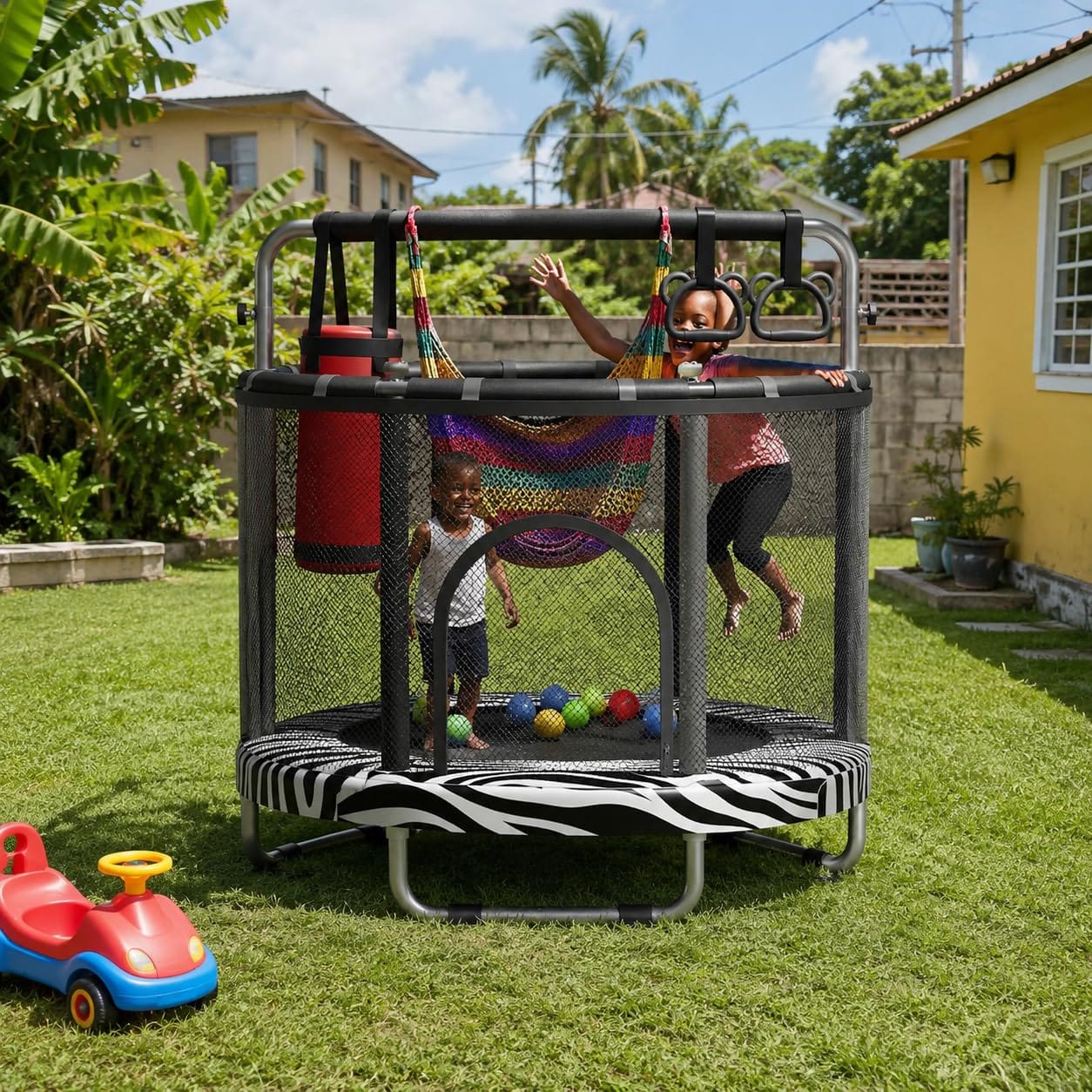
At 55 by 55 by 11.2 inches, the footprint is dining table sized, so plan where it lives before ordering. Owners report it handles multiple children and rough play well, and the 440 pound figure gives plenty of headroom over the real load of a toddler.
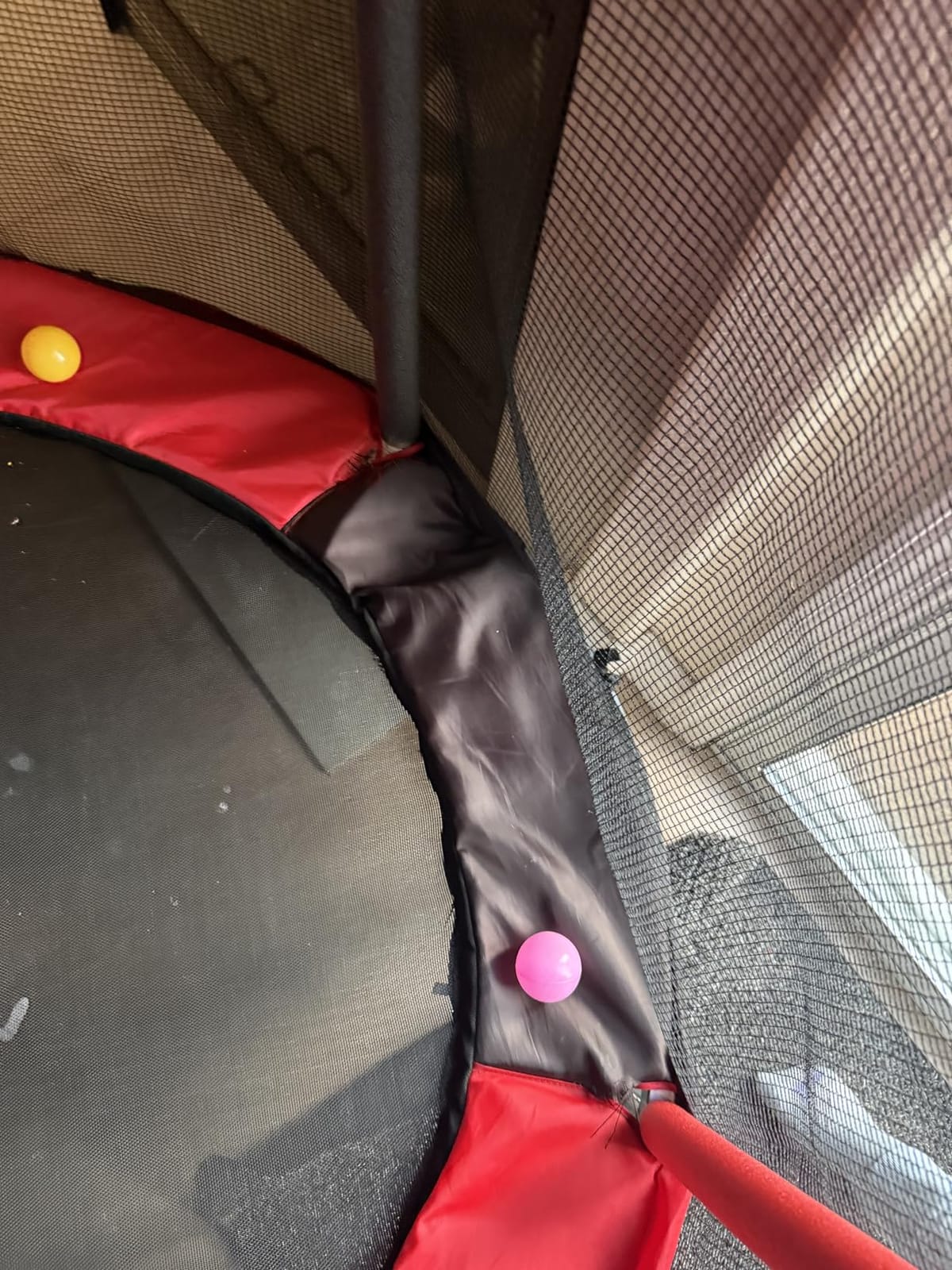
The honest problems are worth understanding. The instruction manual has tiny, blurry images and does not cover the accessories at all, so plan on working from the listing diagram. The base ring uses push-fit joints that reviewers report can pop apart during assembly or during a bounce, which is a hardware design choice rather than a defect. There is also no dedicated attachment rail for the net ties, so the netting ties awkwardly to the base or to the springs.
Foam pole sleeves and the spring cover material tear easily and need replacing, and the unit requires two people to assemble with some parts arriving with missing or undrilled holes. At 4.1 stars, this is a value pick for a toddler who will be supervised constantly, not a model to buy and forget.
When A 440 Pound Limit Actually Helps
Capacity on a toddler model matters for a specific reason: a parent supervising from inside the jump zone. Smaller rebounders can cap out at 80 pounds, which means an adult cannot step on. At 440 pounds, an adult can get on and demonstrate, spot a landing, or hold a younger child’s hands while they bounce, and the frame absorbs the extra load without flexing.
That single spec is the reason this model earns a place in a safety guide despite the middling rating. Verify the capacity is static rather than a single-jumper rating before you rely on it, and keep to one jumper at a time regardless.
Where This One Falls Short
Foam wear is the ongoing cost. The pole sleeves and spring cover tear easily and are consumables, so expect to replace them within a couple of years of daily play rather than treating this as a one purchase solution. Plan for that in the same way you would plan for net replacement on a full size unit.
Assembly quality is the second limitation, and it is a real one. Push-fit joints that separate under load, unclear instructions, and undrilled parts are a poor combination for a product that depends on a rigid frame to keep the enclosure taut. If you are not comfortable troubleshooting a partially assembled unit, pick one of the higher rated enclosed models instead.
7. Happin 55 Inch Trampoline With Enclosure: Best For Ages 1 To 4
Happin® 55’’ Trampoline for Kids with Safety Enclosure, ASTM Tested, Indoor & Outdoor Toddler Trampoline with Multi Activity Accessories, Perfect for Boys & Girls Ages 1–8
55 inch round
Extra-dense netting
Thick spring-cover padding
Built to U.S. safety standards
Pros
- Extra-dense netting designed to avoid gaps and spring contact
- Reinforced steel frame with impact-absorbing curved poles
- Noise-reducing anti-slip rubber feet prevent tipping
- Five activity accessories included
- Suitable from age 1 for indoor and outdoor use
Cons
- Older children outgrow the 55 inch size quickly
- Accessory attachment points are not always as secure as the images suggest
- Footprint is substantial for an indoor room
The Happin is one of the few models here specified from age 1, and it gets there with one specific design choice: extra-dense safety netting built specifically to prevent gaps or contact with the springs. Density is the number that matters in an enclosure, because a loose mesh weave stretches under load and opens a hole exactly when a child hits it hardest.
The frame uses thick reinforced steel with impact-absorbing curved poles, so the same collision protection applies here that we credited in the Jumpzylla. Thick spring-cover padding covers all jump zones, and noise-reducing anti-slip rubber feet handle the tipping risk on a smooth indoor floor, which is a real failure mode for a low frame that a 2 year old can climb.
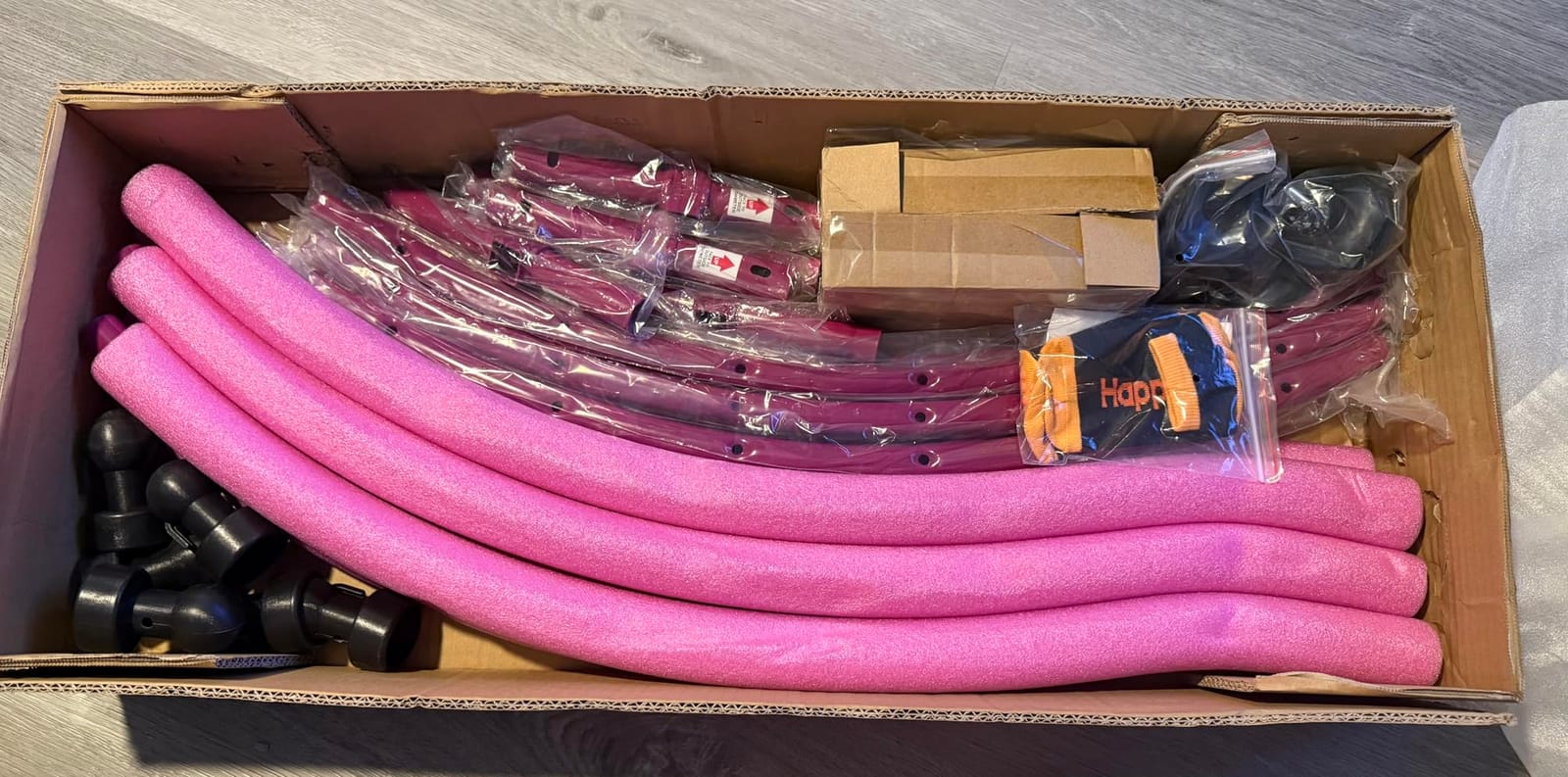
It is built to U.S. safety certification standards and includes a punching bag, boxing gloves, gym rings, a swing, and colorful play balls. For a child between 1 and 4, that combination of attachment points turns a small trampoline into a gross motor circuit, which is roughly what that age group actually wants.
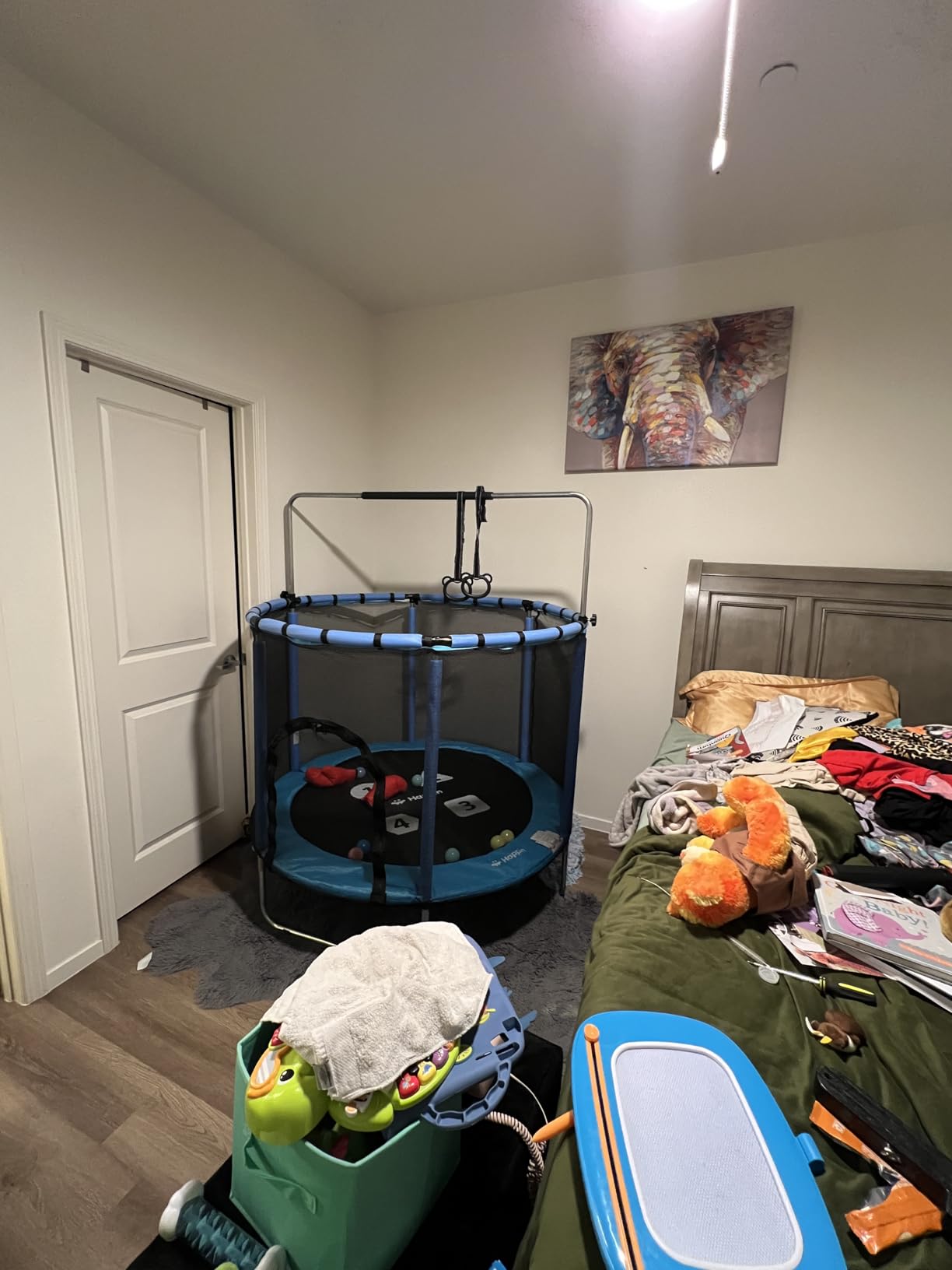
The bounce itself is firm rather than floaty, which suits a toddler who is learning to push off and land. At 55 by 55 by 30 inches with a stainless steel frame, it is one of the heavier and more stable frames in the same size class, and the rubber feet make it quiet enough for an indoor room.
At 4.5 stars with 935 reviews and 77 percent five star ratings, the feedback is consistent: owners like the netting, the curved poles, and the quiet feet. The limits are equally consistent. The 55 inch diameter is a hard ceiling on who can use it, and children outgrow it faster than parents expect. Accessory attachment points are sometimes less secure than the product images imply, so check each fitting under load before letting a child rely on it.
The footprint is worth measuring honestly. 55 inches square is larger than it sounds in a living room, and unlike the smaller round models it does not tuck into a corner as neatly. Measure doorways too, not just floor space.
Why Net Density Is The Number To Ask About
Ask for the mesh count rather than a general claim of a safety net. A dense weave resists stretching under a jumping load, which is the entire job of the barrier. A loose weave deflects inward at the exact moment of impact and can push a small child toward the spring perimeter it is supposed to be protecting them from.
Also check how the net attaches. Systems that tie to the frame outside the springs leave a larger usable mat, which is why the Giantex net sits outside its frame. The tradeoff is a slightly wider footprint, and it is a tradeoff most parents would accept.
Where This One Falls Short
The 55 inch diameter does not leave room to grow into, and the price is no longer a small outlay. A child who is 6 or 7 and still has their foot height will already be cramped. Plan on this being a 2 to 4 year purchase rather than a starter trampoline the whole family shares.
Accessory security is the second limitation, and it is worth testing every attachment with your own weight on it before a child uses it unsupervised. Rated for ages 1 to 8, it will handle a 5 year old well. It will not comfortably hold a 10 year old, and forcing that leads to landings near the net, which is the outcome this whole guide exists to prevent.
8. Ativafit 60 Inch Rebounder Trampoline: Best For Small Patios
ATIVAFIT 60″ Indoor‑Outdoor Kids Trampoline Mini Rebounder with Safety Net & Hoop, Ideal for Toddlers and Children 1‑8
60 inch round
80 lb max weight
36 springs
Three-layer safety pad
Pros
- Fully enclosed reinforced net with padded rim contains toddlers
- Low to the ground so even a 1 year old stays inside
- Hidden spring design reduces pinch points
- Easy to move once poles and screen are removed
- Compact enough for a screened porch
Cons
- 80 lb weight limit is the lowest in the guide
- Must be anchored or it can topple in wind
- Basketball pole mount broke early for some owners
- Spring holes punched inconsistently
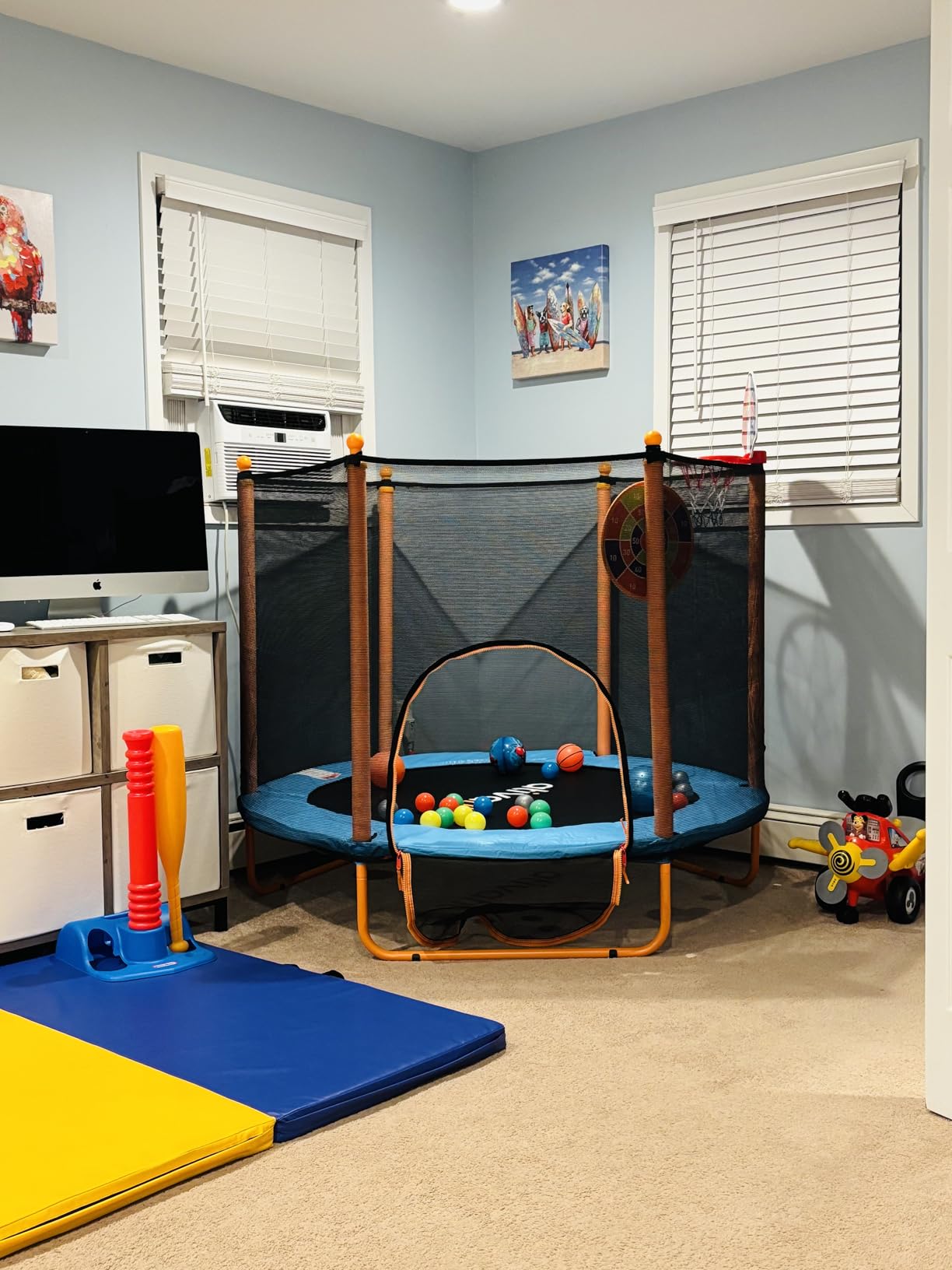
The Ativafit solves a problem the full size models cannot: how do you give a small child a safe jumping surface in a space that is not a backyard. The 60 inch round is low to the ground, fully enclosed with a reinforced net and cushioned sponge padding, and light enough to move between rooms. Reviewers describe families using it on a screened porch, in a small living room, and on a covered patio.
The hidden spring design is the safety detail. Rather than a ring of exposed springs between the mat and the frame, the springs are covered so a small foot cannot reach them, and the three-layer thickened safety pad sits over that zone. Combined with the fully enclosed rim, it is the containment package we would want for a child under 3.
There are 36 durable springs with U-shaped stabilizing legs, and setup is described as quick with clear instructions and video guidance. Assembly is genuinely one of the faster ones here, and the trampoline can be broken down by removing the poles and screen for storage. A basketball hoop, dartboard, and ocean ball are included.
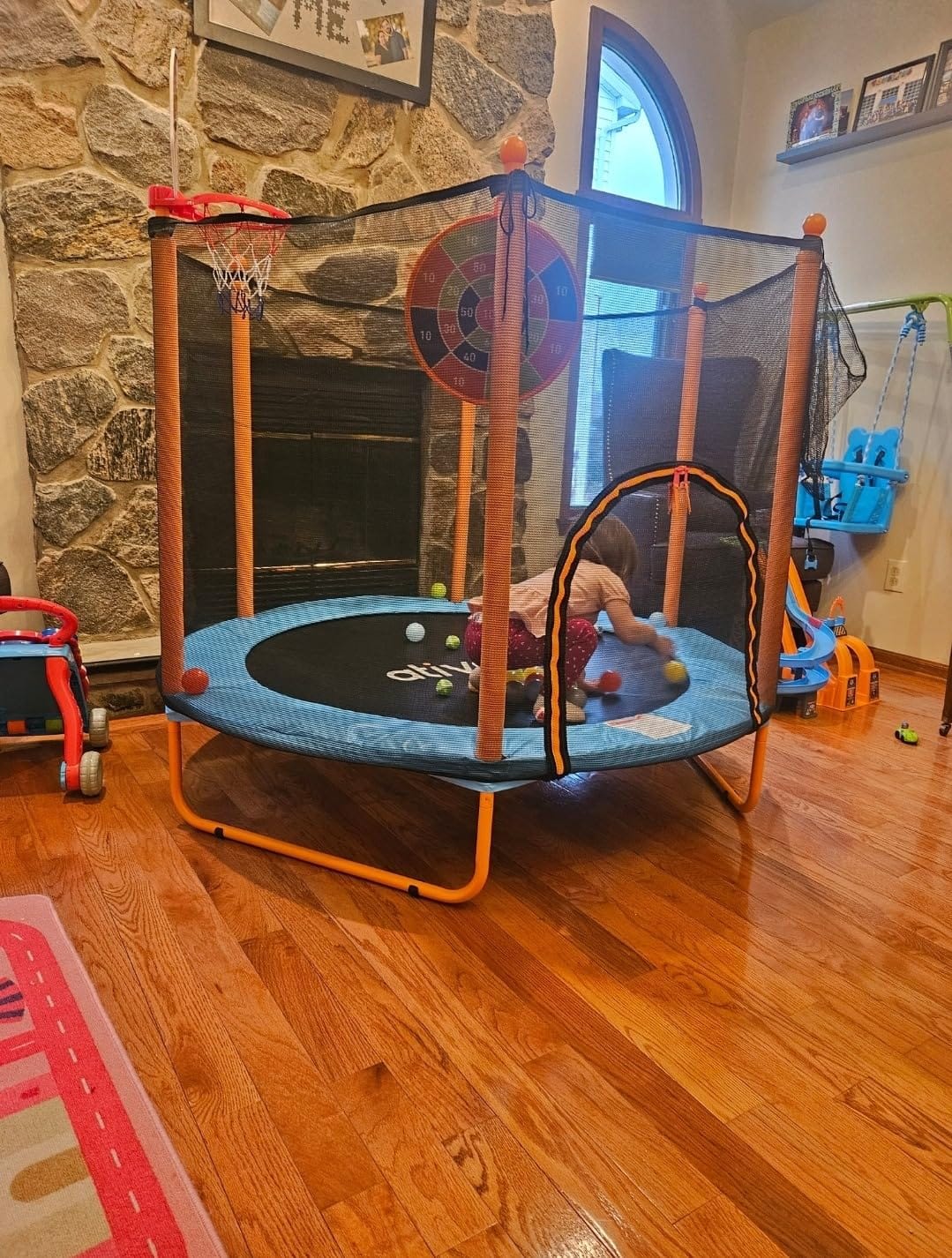
At 4.6 stars with 85 percent of ratings at five stars, owners are enthusiastic about the containment, the bounce, and the responsiveness of customer service, which replaced a damaged basketball hoop quickly. One family reported keeping a 10 month old safely inside, which is about the strongest endorsement a low frame with a net can earn.
Two limitations deserve a full warning. The 80 pound maximum weight is the lowest in this guide, which is the correct rating for a toddler product but means no adult can step on. And it needs to be anchored, because reviewers report it toppling in wind with the posts bending, so buy an anchor kit with it rather than after the first gust.
Smaller issues include an early basketball pole mount failure for some owners, with a string mount alternative included, and inconsistently punched spring holes that make installation harder than it should be. Owners also report that dirt and grass get trapped between the inside of the net and the safety rim and are difficult to clean, so plan for outdoor use accordingly.
How To Decide Between Indoor And Outdoor Use
This model works in both places, but the setup changes. Indoors on hard flooring, the frame sits flat and quiet, and the risk is a child rolling off onto a hard surface, which the full enclosure handles. Outdoors, the risk becomes wind and ground moisture, and the anchor requirement becomes the dominant safety issue.
If you plan to use it on grass, expect to clean debris out from under the rim periodically, and expect the net to need a hose-down before it goes back inside. Neither task takes long, but both are the reason this style of trampoline is usually kept on a covered surface.
Where This One Falls Short
The 80 pound ceiling is the defining constraint. It is a trampoline for ages 1 to 8 and specifically for the younger end of that, and a family with a 6 year old who wants to practice flips will find the mat too small almost immediately.
It also is not suitable for larger children in any real sense, and the anchor requirement is not optional. A light frame with tall net posts is exactly the profile that becomes a sail in a gust. Bought as a contained indoor play station with a proper anchor for the patio, it works well. Bought as a family trampoline, it is the wrong category.
9. SereneLife 10 Ft Outdoor Trampoline With Enclosure: Best For Teens And Adults
SereneLife 10FT Trampoline Outdoor – Heavy-Duty Backyard Trampoline for Kids and Adults with Wide Jumping Surface, Stable L-Shaped Legs, Safety Net, ASTM Approved, Supports 264 lbs., 120 x 120 IN
10 ft round
264 lb max weight
64 high-tension springs
ASTM-certified materials
Pros
- 64 high-tension springs give a noticeably superior bounce
- L-shaped galvanized legs resist wobbling on any surface
- Tall netting with foam poles and a secure zippered entry
- UV-tested and waterproof for year-round outdoor use
- Ladder included
Cons
- At 110 pounds the frame is heavy and awkward to move
- Full size assembly takes multiple people and more time than mini models
- 264 lb capacity is lower than some 10 ft competitors
- Only a 1 year manufacturer warranty
The SereneLife is the heaviest trampoline in this guide at 110.2 pounds, and that mass is the reason for its bounce. Sixty-four high-tension springs with a reinforced mat produce a noticeably superior response, and owners chasing flips, air time, or just a trampoline that does not feel like a saggy toddler toy should feel the difference immediately.
The frame is engineered galvanized metal with unique L-shaped galvanized steel legs designed specifically to prevent wobbling. Wobble is a frequently reported complaint on full size round models, and legs that resist it are worth a lot of the weight. The net is tall, with foam poles, padded spring covers, and a secure zippered entry, and the materials are listed as UV-tested, waterproof, and rust resistant for year-round outdoor use.
This is the pick for a household with teenagers or adults who will jump alongside the kids. At 264 pounds, an adult and a teen can share the mat with a younger child, and the 10 foot footprint gives enough room for two jumpers to keep apart rather than colliding in the middle.
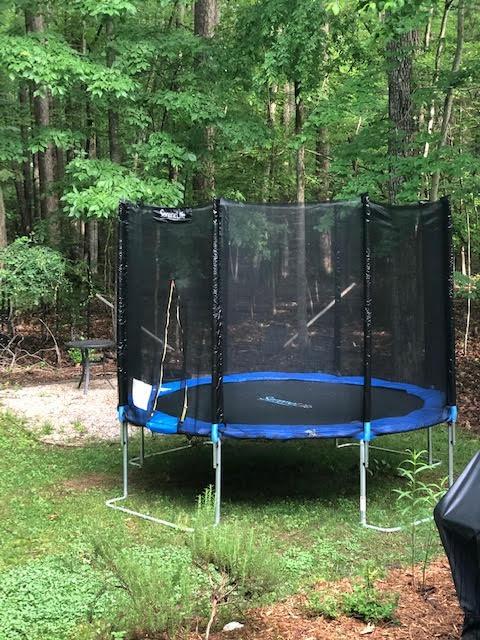
ASTM-certified materials are listed, and sizes run 8, 10, 12, and 14 feet, so you can move up as the kids grow without changing brands. A ladder is included, which matters on a tall frame where the mat sits well above a younger child’s reach.
At 4.5 stars with 502 reviews and 76 percent five star ratings, the feedback is consistent. Buyers choose it for bounce quality and stable legs, and they confirm the tall net, foam poles, and weather resistant coating hold up outdoors. The trade-offs buyers name are weight, assembly effort, and the short warranty.
That last point is worth quantifying. A 1 year manufacturer warranty on a 110 pound steel frame is among the shortest coverage in this roundup, and it is the exact opposite of the AOTOB at the same class of size. If you are buying a full size unit expecting to keep it for a decade, the shorter warranty is a real argument for the alternative.
On assembly, be honest with yourself about the timeline. A full size frame takes multiple people and considerably more time than a 55 inch rebounder, and spring tensioning is the slow part. Budget a full afternoon with two adults rather than an hour.
When A Heavier Frame Is The Right Call
Weight is not a quality metric in general, but on a full size trampoline it correlates with frame gauge, spring count, and mat reinforcement, all of which determine how the trampoline feels and how long it lasts. If the trampoline will take adult weight, or if the household includes a teenager who will use it alone, a heavier frame is the correct trade against portability.
The consequence is that you choose the location once. A 110 pound frame does not move easily across a lawn, so survey the site for level ground, clear overhead space, and enough lateral clearance from fences, trees, and hard surfaces before the box is opened.
Where This One Falls Short
The 264 pound capacity is lower than some 10 foot competitors, which is a little surprising given the size and weight of the unit. Two adults and two children is past what this frame is designed to hold, so treat the capacity figure as a real limit rather than a marketing number.
Portability is the other constraint. Once assembled in a spot, moving it means at least two people, and a moving day for a full size trampoline is its own project. Combine that with the 1 year warranty and this becomes a buy once, place carefully, replace nets on rather than replace the whole trampoline kind of purchase.
10. Yohood 55 Inch Toddler Trampoline: Best For Gymnastics Practice
Yohood 55″ Trampoline for Kids with Enclosure, 6-in-1 Toddler Trampoline Indoor Outdoor, ASTM Certified Full Anti-Rust Tube with Adjustable Gymnastics Bars for Boys Girls Ages 3-10
55 inch round
176 lb max weight
ASTM International certified
6-in-1 accessory set
Pros
- Rated 4.7 stars with 87 percent five star ratings
- Adjustable gymnastics bar and handlebar for balance and stretch practice
- Double-bolted frame connections resist shaking
- Anti-slip suction cups lock to indoor floors
- Zipper entrance with extra thick foam padding
Cons
- Some accessories do not attach as pictured and the punching bag lacks a hanging string
- Bounce mat and accessories must be removed to use the trampoline function
- Rated for one child at a time and ages 3 to 10
The Yohood 55 inch earns its place for a reason that has nothing to do with bouncing: the adjustable gymnastics bar. Gymnast families ask specifically about home practice, and this is one of the few small enclosed trampolines in this guide with a multi-height bar you can actually use for balance work, not just hang accessories from. A second adjustable handlebar covers a different height range for the same purpose.
Safety specifics are strong. ASTM International safety standards certified, a high-performance jump mat tuned for a firm but joint-friendly rebound, a heavy-duty rust-resistant steel frame with double-bolted connections, and anti-slip suction cups that lock to indoor floors. The double-bolted connections are worth calling out because they are the fix for the frame-shake complaint that appears on nearly every competitor in this size class.
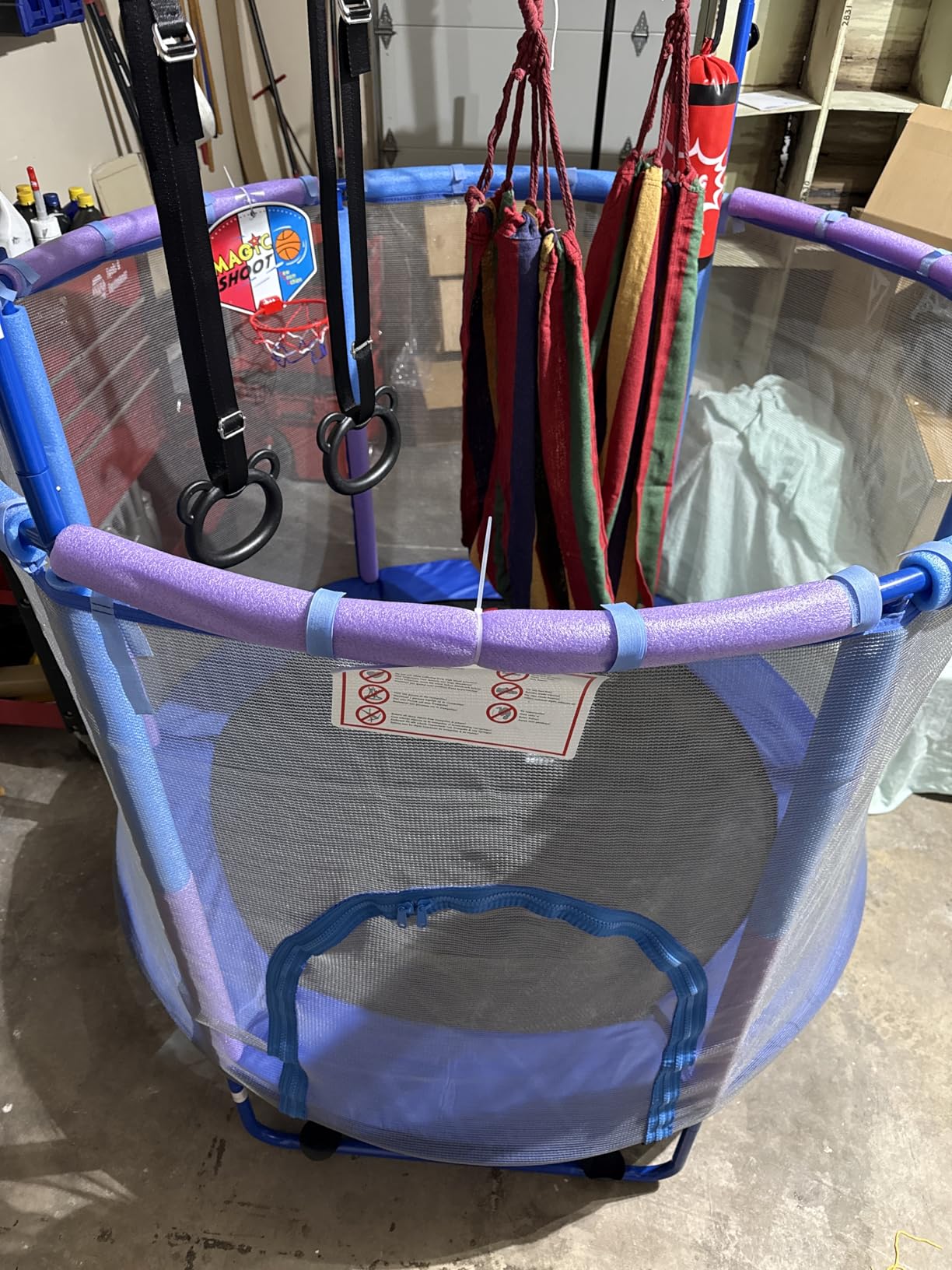
It arrives as a 6-in-1 set: the trampoline itself, a basketball hoop, punching bag, hanging rings, a swing, and the adjustable gymnastics bar. Rated for ages 3 to 10 with a maximum of 176 pounds, and one child at a time.
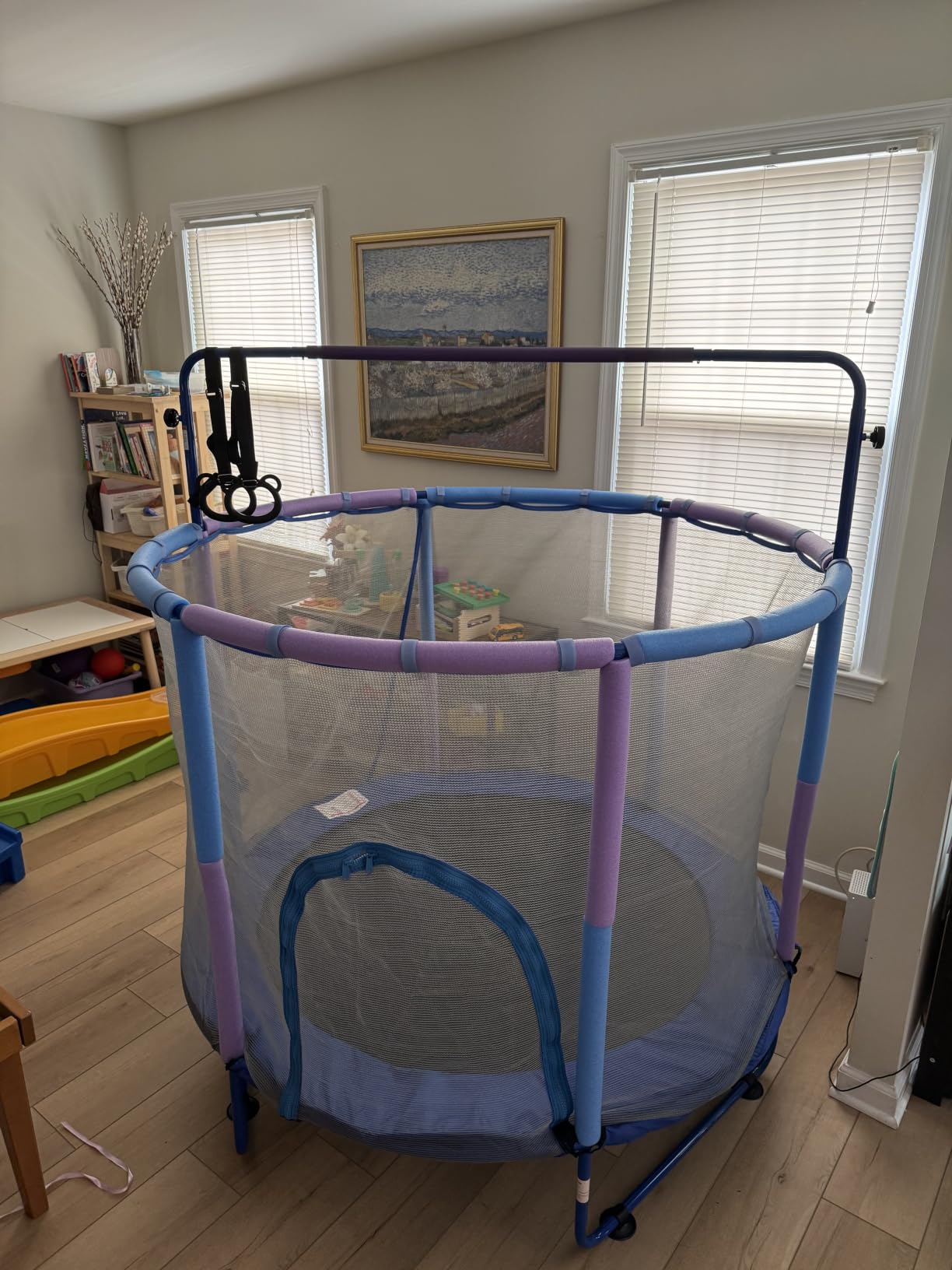
At 4.7 stars with 87 percent five star ratings, this is among the top rated models in the guide. Owners rate it highly for build quality, the secure net, and the gymnastics bar that doubles as a balance aid, and several note that the frame does not shake during use, which is the double-bolt connection doing its job.
The criticism is about accessory fidelity rather than the trampoline. Some included pieces do not connect the way the product photos imply, and the punching bag in particular lacks a hanging string. That is a smaller problem than it sounds, since the trampoline and the bar are the parts that matter for the intended use, but it is worth knowing before you order.
One practical note: owners report that the bounce mat and the accessories have to be removed to use the trampoline function. So the gymnastics bar and the jumping surface are partly competing for the same space, and the configuration changes depending on what the child is doing. Assembly also takes some time and patience, though no reviewer describes it as a problem.
Home Gymnastics Practice On A Small Budget
Home practice for a young gymnast is about consistency and safe repetition, not competition equipment. A firm mat with a bar at the right height lets a child practice the positions they will be asked for without a full size unit taking up the yard. This model supports that use better than anything else at this size because the bar adjusts rather than being fixed.
Pair it with the size guidance that gymnast families tend to get right: a round trampoline teaches a jumper to land in the center and bounce vertically, which is the opposite of what a gymnast needs. If a child is genuinely training, they will outgrow this model quickly and need a rectangular unit, which is a category not covered in this roundup.
Where This One Falls Short
The one child at a time rating is the big limitation in a sibling household. Two children who want to use it simultaneously will not fit, and the temptation to squeeze two 6 year olds onto a 55 inch mat is exactly the collision scenario this guide keeps warning about.
At 176 pounds the capacity is modest, and the age range stops at 10. It is a well made trampoline for its intended window, but it is a window, not a grow into purchase. If your child is already 9 or 10, skip ahead rather than buying something they will age out of within a season.
11. Square House 60 Inch Enclosed Trampoline: Best For Shared Playrooms
Square House 60″ Premium Aesthetic Toddler Trampoline with 360° Safety Enclosure Anti-Rollover Base Heavy-Duty No-Gap Indoor Outdoor Trampoline for Kids, Boys and Girls ASTM Certified 220lb Capacity
60 inch square
220 lb max weight
ASTM certified no-gap design
42 springs
Pros
- Rated 4.7 stars with 85 percent five star ratings
- Neutral minimalist finish that suits a living room
- Does not rock or slide while jumping
- Fully enclosed net with padded zipper entry
- Light enough at 30.9 pounds for one adult to move
Cons
- No printed instructions and the listing diagram carries the setup
- Metal rods are hard to seat in the plastic connectors
- Legs can loosen after the unit is moved
- Netting strains at the seams while being fitted
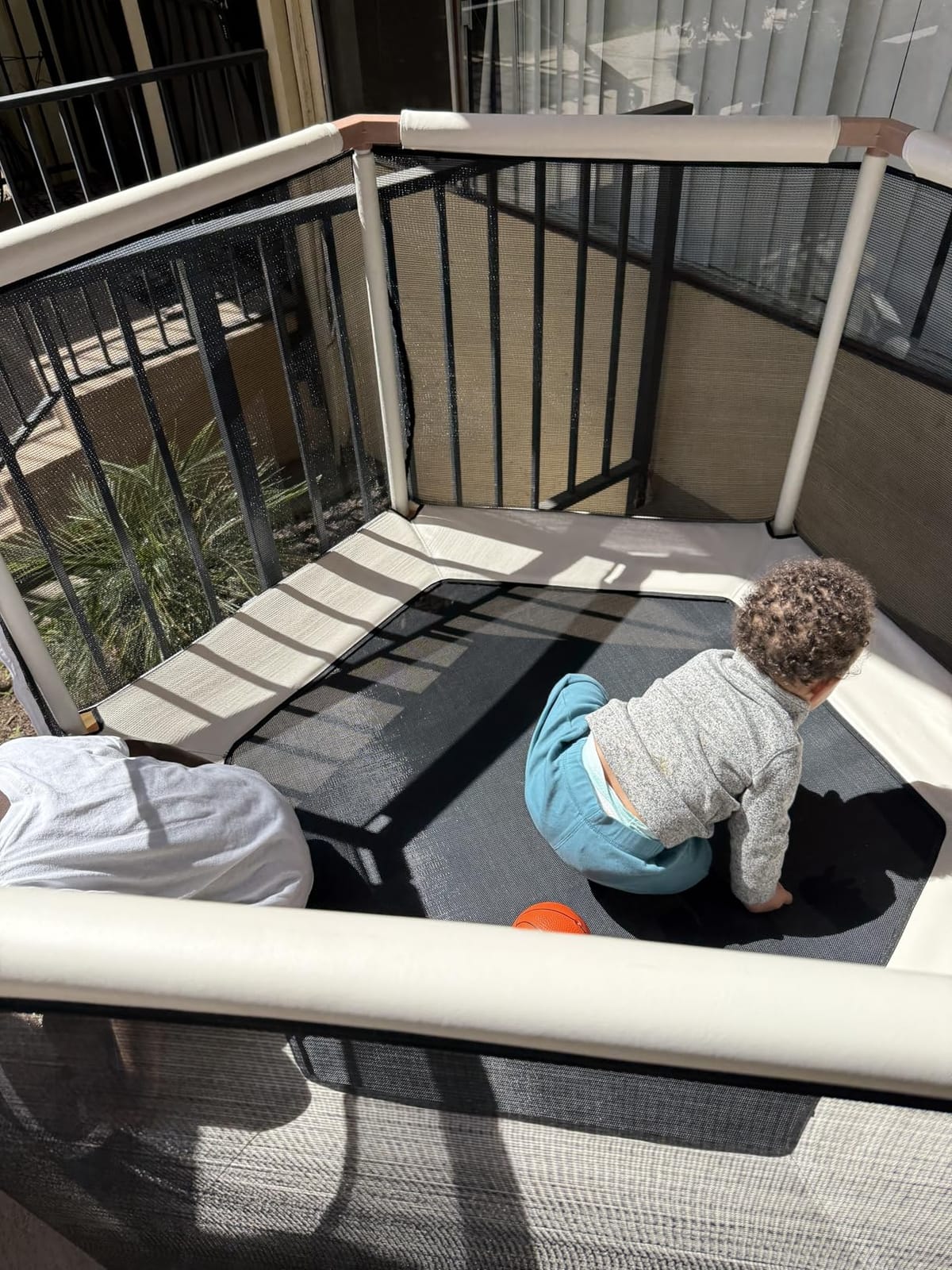
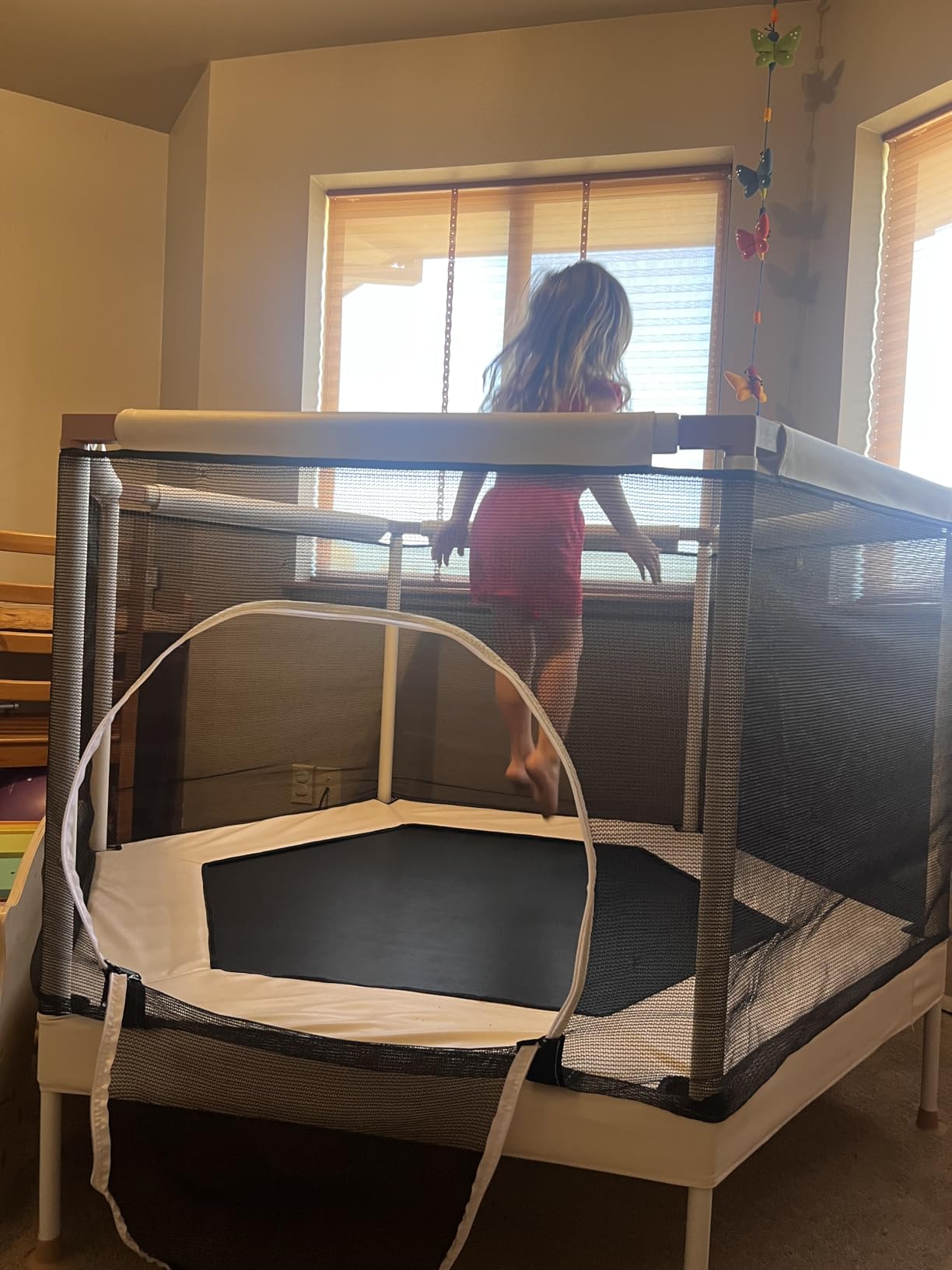
The Square House is the one in this list whose selling point is how it looks in your house. The sand finish is a neutral, minimalist color that reads as furniture rather than a toy, and for a family putting a trampoline in a playroom that doubles as a living space, that changes the conversation entirely. Several reviewers name the aesthetic as the deciding factor.
The engineering underneath is conventional and good. ASTM certified third-party tested construction, a reinforced jump mat designed to eliminate pinch points, a 360 degree mesh enclosure with a padded zipper entry, and a 60 inch footprint at 42 inches tall. The base is an anti-rollover weighted design with six point ground contact, and the frame is galvanized steel with a rust resistant coating rated to 220 pounds.
Owners report that it does not rock, slide, or move during jumping, which is the anti-rollover base and the weighted feet working together. At 30.9 pounds, one adult can move it, and several families describe relocating it between rooms as a practical feature rather than a gimmick.
A growing basketball hoop attachment is included for ages 1 to 8, and the unit is also offered in a 48 inch size and an Arctic Blue color. The listing states a 30 minute setup with a three point quality inspection, which is faster than most in this guide even if it does not always hold up in practice.
At 4.7 stars with 85 percent five star ratings, the feedback is strongly positive on stability and containment. The criticism is entirely about assembly. There are no printed instructions, the base assembly depends on metal rods seating into plastic connectors, and reviewers report those rods are hard to fit. Legs can loosen or become uneven after the unit is moved, so check and level it every time you relocate it.
Netting pulling at the seams during fitting is the other repeated note. Go slowly on that step rather than forcing the mesh into place, because a seam strained during assembly is a seam that fails later. It is also best suited to two children at once, and gets crowded beyond that.
Making Indoor Space Work For Trampoline Play
Indoor placement has rules that outdoor placement does not. Check the overhead clearance against the tallest jump your child makes, not their standing height. Keep hard furniture, glass, and breakables outside the net perimeter, and leave a clear landing zone on all sides. And place it on a surface where the anti-rollover feet can actually make contact with the floor.
Noise travels. A frame on hardwood or tile transmits every bounce to the rest of the house, and the Square House uses a padded rim and a low frame to keep that down. If the trampoline will be used in the evening, test it at the time of day it will actually be used before you commit.
Where This One Falls Short
The absence of printed instructions is a genuine inconvenience, and the tight fitting base rods make it worse. If you are not comfortable assembling from a listing diagram with a phone in one hand, allow extra time or ask someone else to help. It is not a hard build, but it is a fussy one.
It is also a young child product, working up to ages 1 to 6 with an older sibling supervised to around 5. At 220 pounds it cannot take an adult, and the 60 inch square footprint is not a space-saver in a small room even at a manageable weight. Measure before you order, including the assembly space you will need around it.
12. Yohood 12 Ft Outdoor Trampoline: Best For Large Yards
Yohood Trampoline Outdoor 12FT 14FT, Recreational Trampolines with Enclosure Net and Ladder, ASTM Approved for Kids and Adults, with Additional 8 Stabilizer Bars and Anti-Rust Coated Galvanized Frame
12 ft and 14 ft round
400 lb max weight
72 steel springs
Hot-dip galvanized frame
Pros
- ASTM and CPSC certified with a 4.8 star owner rating
- 8 additional stabilizer bars remove wobble at the base
- Curved lantern-style poles reduce collision risk and keep jumpers centered
- Seamless one-piece padded sleeve fully covering the springs
- Gentle joint-friendly rebound
Cons
- Needs significant yard space and a proper safety perimeter
- At 89 pounds it is a two person move
- Smaller review base than the established models
- Only a 1 year manufacturer warranty
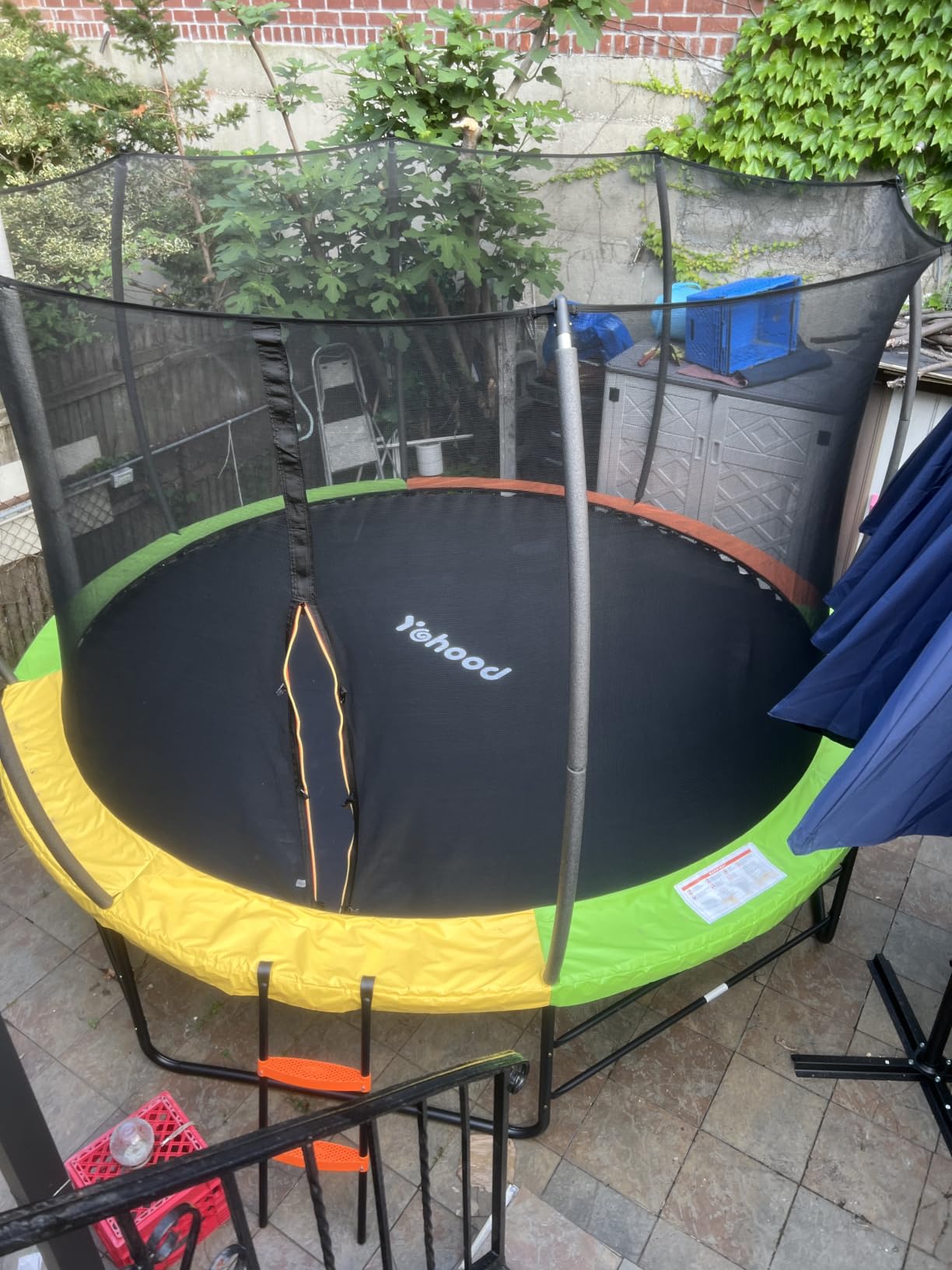
The Yohood 12 ft carries the highest average rating in this entire guide at 4.8 stars, with 87 percent five star ratings. The review base is small at 110 ratings, so treat that number as encouraging rather than conclusive, but the reasons owners give are specific and mechanical rather than enthusiastic in general. The 8 additional stabilizer bars and the curved lantern-style poles are what they keep naming.
Eight stabilizer bars is more reinforcement at the base than we saw listed on any other model here, and owners report the result is an unusually stable, wobble-free trampoline. The lantern-style frame uses outward-curving enclosure poles, which does two things at once: it keeps jumpers centered, and it moves the hard impact point away from the line of travel when a child bounces toward the edge. The same design principle as the Jumpzylla, taken further.
The springs are 72 high-tensile strength steel units covered by a one-piece padded sleeve that runs the entire perimeter, so there is no exposed spring and no seam to catch. Frame legs are hot-dip galvanized for weather resistance, and ASTM and CPSC standards compliance is listed alongside a 400 pound capacity. A ladder is included, and both 12 ft and 14 ft versions exist.
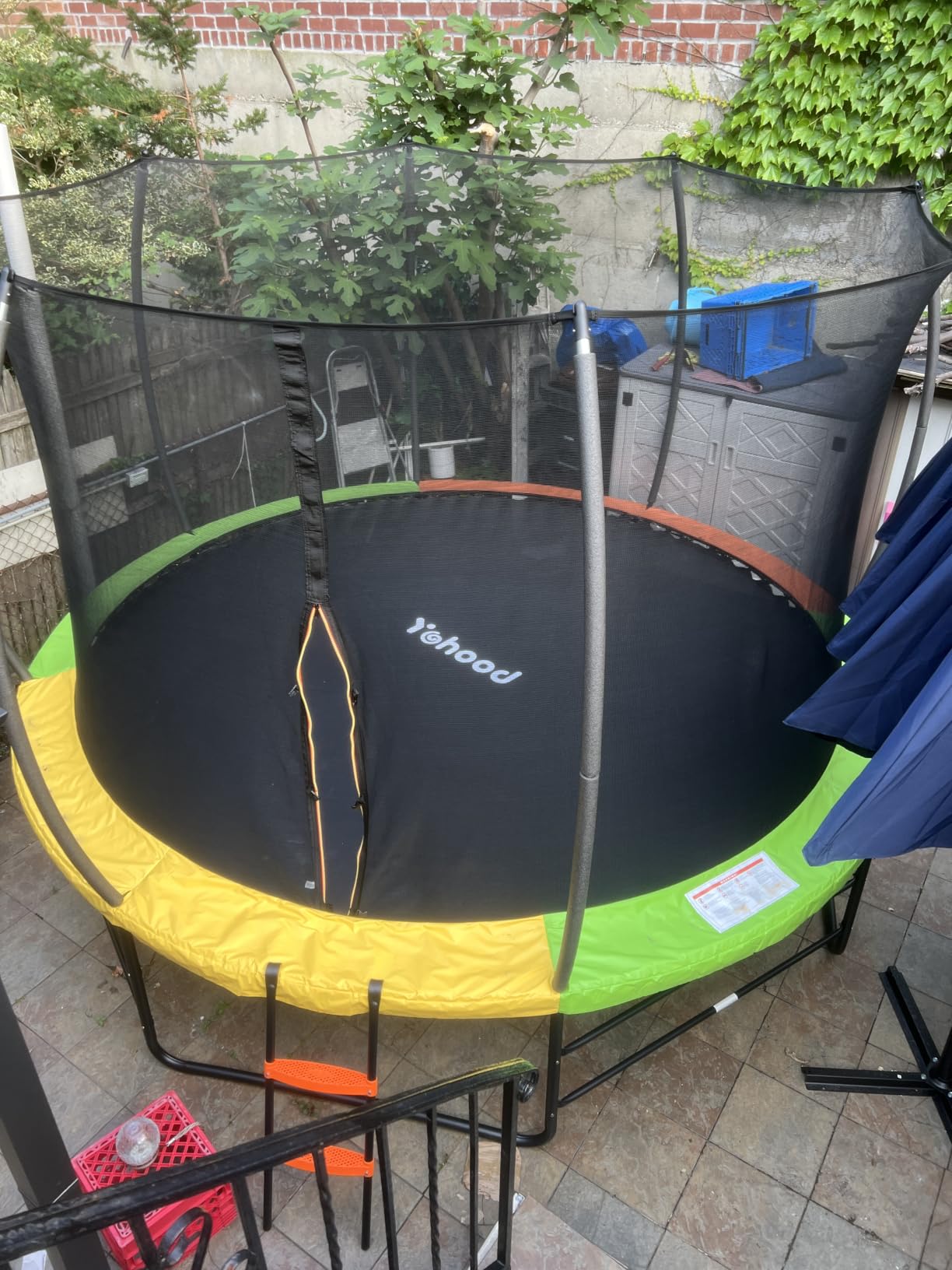
Owners describe the rebound as gentle and gradual, which sounds like a drawback until you consider who is using it. A softer response is easier on growing joints, and this is a trampoline sized for children rather than for adult fitness. For a family with several kids of different ages sharing one unit, that is the right trade.
The honest caveat is scale. A 12 foot frame needs substantial yard space and a properly maintained safety perimeter around it, and at 89 pounds it is a two person move. There is no compact yard configuration here, so this is the pick for a household that already has the space and needs the jump surface.
Two other limitations to weigh. The warranty is 1 year from the manufacturer, which is thin for a unit this size and this rating. And with only 110 ratings, there is less long term owner data behind it than behind the established models, which is exactly the kind of thing that becomes relevant when you are replacing a net in year three.
What A 12 Ft Frame Changes About Safety
Size changes the risk profile more than any other single variable. A larger mat means more room for two jumpers to keep their distance, which is the direct counter to sibling collisions, the most common injury mechanism parents ask about. It also means a higher fall from a higher bounce, so the clearance requirement around the frame matters more, not less.
The stabilizer bars and curved poles exist because of that scale. At 12 feet, the forces on a frame joint are high enough that a standard 3 leg base flexes under repeated impact, and a straight pole becomes a genuine collision hazard. Eight bars and outward-curving poles address both problems directly.
Where This One Falls Short
The 400 pound capacity covers a shared family session but not a party. If you expect several children plus adults on the mat at once, the practical limit arrives before the stated one, and the one jumper at a time rule gets tested on the busiest day of the year.
Finally, the warranty. At 1 year on a galvanized frame with 72 springs, expect to budget for net replacement, spring wear, and mat wear on your own timeline rather than relying on coverage. If a long warranty is a priority, the AOTOB at 5 years is the more defensible purchase, and it is worth weighing that difference directly.
How To Choose A Trampoline With A Safety Net
Five decisions account for almost everything that matters: type, size, safety hardware, longevity, and ongoing cost. Get these right and the model choice takes care of itself. Get the order wrong and you will be replacing parts you should have specified differently.
One: Match The Type To The Child
Full-size yard trampolines with 42 to 72 steel springs are for children 6 and up who can follow a one jumper rule. Round frames are safest for that group because a center-seeking bounce is the natural result of the shape.
Small enclosed rebounders at 36, 48, 55, and 60 inches are a different product for ages 1 to 8. They have lighter frames, lower weight limits, and full perimeter containment rather than a tall net. They are not a stepping stone to a bigger trampoline, and they are not safe for an adult to join.
Springless and in-ground models did not place in this roundup, and that is worth saying plainly rather than leaving you to wonder. A springless trampoline removes the pinch hazard entirely at the cost of a firmer, less familiar bounce, and an in-ground installation requires excavation, drainage work, and a retaining edge before the first jump ever happens. Both are legitimate choices for specific yards. Neither fits the size profile of the models reviewed here.
Two: Size From The Child Up, Not The Yard Down
Use these as starting points, then adjust for the jumpers. Ages 3 to 5 need a fully enclosed 36 to 55 inch rebounder with a low frame and a handle to hold. Ages 6 to 9 are the sweet spot for 7 to 8 foot round models with a tall net and a low frame a child can climb unaided. Ages 10 to 14 benefit from a 10 foot frame, and teens and adults jumping with kids need 12 feet or more.
Two rules cut across the age bands. First, the usable jumping surface is smaller than the frame size because the spring ring and pad consume the perimeter, so verify the mat measurement rather than the frame diameter. Second, the weight limit that matters is the individual jumper limit, which is almost never printed on the listing. Where it is missing, assume it is roughly half the static figure.
Our team worked through the clearance question the way we would in a yard: measure the clear space, then add the manufacturer required lateral clearance on every side, and confirm the result still leaves the trampoline fully on level ground with no overhanging branches.
Three: Check The Safety Hardware Specifically
Enclosure height and pole geometry are the two features that most often separate a good model from a merely adequate one. Look for a net tall enough relative to the frame that a hard bounce cannot reach the top, and for poles that curve away from the mat rather than standing straight in the jumper’s path. The Jumpzylla, Giantex, Happin, and Yohood 12 ft all use curved poles.
Then check the three impact zones in order. The springs need a continuous cover rather than segmented pads that can shift. The frame edge needs foam coverage at the entry side. The poles need foam sleeves. A no-gap design, where the mat and pad are stitched as a single piece, is a further step up, and the VEVOR does this.
Certification is a filter, not a guarantee. ASTM F381 covers trampoline design, and ASTM F2225 covers enclosures specifically, so a model claiming only the first is telling you less. CPSC compliance is an additional signal. Treat certification as the floor for a family trampoline and treat it as no more than that.
Finally, the rules. One jumper at a time, no somersaults or flips unless the child has been taught properly, no jumping under or onto the net, and no food or objects on the mat. Sibling collisions cause more injuries than falls off the edge, which is the most counter-intuitive finding in the safety research and the reason a bigger mat is the single best collision countermeasure you can buy.
Four: Budget For Replacement Parts, Not Just The Frame
This is the section most guides skip. A full-size enclosure is a wear item. Net zippers fail first, then netting fabric tears at the seams around the door, then the pole sleeves flatten, then the mat fades and the springs corrode. Across the reviews we read, owners describe a replacement cycle of roughly 2 to 3 years on net and padding, and the costs add up faster than most families expect.
Two habits cut that cost substantially. Buy a weather cover sized for your frame and use it, because UV exposure is what degrades netting and mat fabric fastest and a cover is a small fraction of the cost of a new unit. And buy a full spare parts kit up front, including net, spring cover, mat, and a wrench for tensioning, so a mid season failure does not become a trampoline that sits unusable for a month.
Assembly time deserves the same honesty. Marketed times tend to be roughly half what families actually spend, and the difference is almost entirely spring tensioning. A 55 inch rebounder with barrel springs is genuinely quick. An 8 to 12 foot frame with 42 to 72 steel springs, on 110 pounds of frame, is a four to six hour job with two adults. Plan the build for a weekend and the purchase will feel much less expensive.
If you are shopping with children in the house, our toddler trampoline guide covers the low-end enclosed models in more depth, and our mid-range round trampoline guide covers the value tier this roundup touches on.
Five: Anchor It, Cover It, And Check It Seasonally
Anchoring is not optional in any yard that sees real wind. The lightweight enclosed rebounders are the most exposed because a tall net on a light frame acts as a sail, and owners report bent posts after a gust. The Ativafit in particular needs it, but every model here benefits, and anchor kits are inexpensive relative to a replacement trampoline.
Spring corrosion is the hidden failure. Gold and zinc coatings hide early rust, so once a spring starts, the coating has already failed. Check two or three springs each spring by running a clean damp cloth along the coil and looking for orange transfer or pitting. A rusted spring is a loaded spring waiting to break, and it is a five minute check that prevents the most dangerous failure on any trampoline.
Also inspect the net at the zipper and the door seam, where nearly all reported tears begin. And clear the jumping surface of anything that is not the mat, because a single object underfoot is the most common and most preventable cause of a bad landing.
Frequently Asked Questions
Are trampolines with safety nets safe for kids?
A trampoline with a properly fitted enclosure net is materially safer than one without, because it stops most falls off the edge. The net is not the whole answer though. Research and parent forums both point to sibling collisions as the most common injury mechanism, so the one jumper at a time rule matters more than any single feature. Look for ASTM F381 design compliance and ASTM F2225 enclosure compliance, curved poles instead of straight ones, continuous spring padding, and a net tall enough that a hard bounce cannot reach its top edge. Children under 6 should not use a full-size trampoline.
What age is a trampoline safe for kids?
Most pediatric guidance is to wait until a child is at least 6 and can follow a one jumper rule without constant reminders before they use a full-size trampoline. Ages 1 to 5 are better served by a small fully enclosed rebounder of 36 to 55 inches with a low frame, a handle to hold, and a weight limit no adult exceeds. The models rated for ages 1 to 8 in our roundup, including the Ativafit, Happin, and Square House, are built for that younger window and are not a shortcut into a full-size unit.
Which is safer for kids, a bounce house or a trampoline?
A bounce house is safer for younger children because the walls are solid, the surface is enclosed, and there is no spring perimeter to fall onto or into. A trampoline with a proper enclosure is better for older children who want to practice bouncing, balance, and early gymnastics skills, and for adults who want to join in. The practical answer is that a bounce house suits ages 3 to 6, while a netted trampoline suits ages 6 and up. Inflatable units need more care in wind and are rented or stored, which is why many families end up owning both.
How long does a trampoline safety net last?
Based on owner reports in the reviews we analyzed, expect roughly 2 to 3 years for a net in normal outdoor use before the zipper or the door seam fails, and 1 to 2 UV seasons for spring padding if the trampoline is left uncovered. Two things extend that life more than anything else: a correctly sized weather cover, and storing or covering the trampoline through the winter rather than leaving it exposed. Inspect the zipper and door seam each spring, since that is where nearly all reported tears begin.
How do I choose the right trampoline size for my yard?
Measure the clear space you have, then add the lateral clearance the manufacturer requires on every side, and confirm the whole footprint still sits on level ground away from fences, trees, and hard surfaces. Remember that the usable jumping surface is smaller than the frame diameter because springs and padding take up the perimeter, so a 10 ft frame gives less mat than the number suggests. A 7 to 8 ft round model suits a side yard, a 10 ft model suits a medium lawn, and 12 ft or more needs a genuinely open space with a maintained perimeter.
Our Verdict On The Best Trampolines With Safety Nets In 2026
For the best trampolines with safety nets for kids in 2026, the Jumpzylla remains the pick for a mixed-age household. It is the only model in this guide that spans 8 to 16 feet with the same enclosure system, its curved poles keep the impact zones away from jumpers, and its 6229 reviews give you more long term owner data than anything else here. Take the 12 or 14 foot version if two children will share it, and plan on replacing the net in a few years.
Two runners-up earn their place for different reasons. The AOTOB is the value answer, pairing a 400 pound capacity with a five year warranty, which makes it the most defensible long-term buy in the full-size category. The Yohood 12 ft has the highest rating at 4.8 stars and the most stabilizers, and it wins outright if you have the yard to use it properly.
For children under 6, the VEVOR is the one to buy, with a 4.7 rating, a gap-free stitched mat, a dense 360 degree net, and a three minute assembly that makes it usable indoors. Get the 55 or 60 inch version rather than the 36 inch one as soon as the child outgrows toddler sizing.
Whatever you choose, buy the anchor kit and the weather cover in the same order, teach the one jumper rule before the first bounce, and check the springs for corrosion each spring. Those four habits protect the investment more effectively than any feature on any listing.