
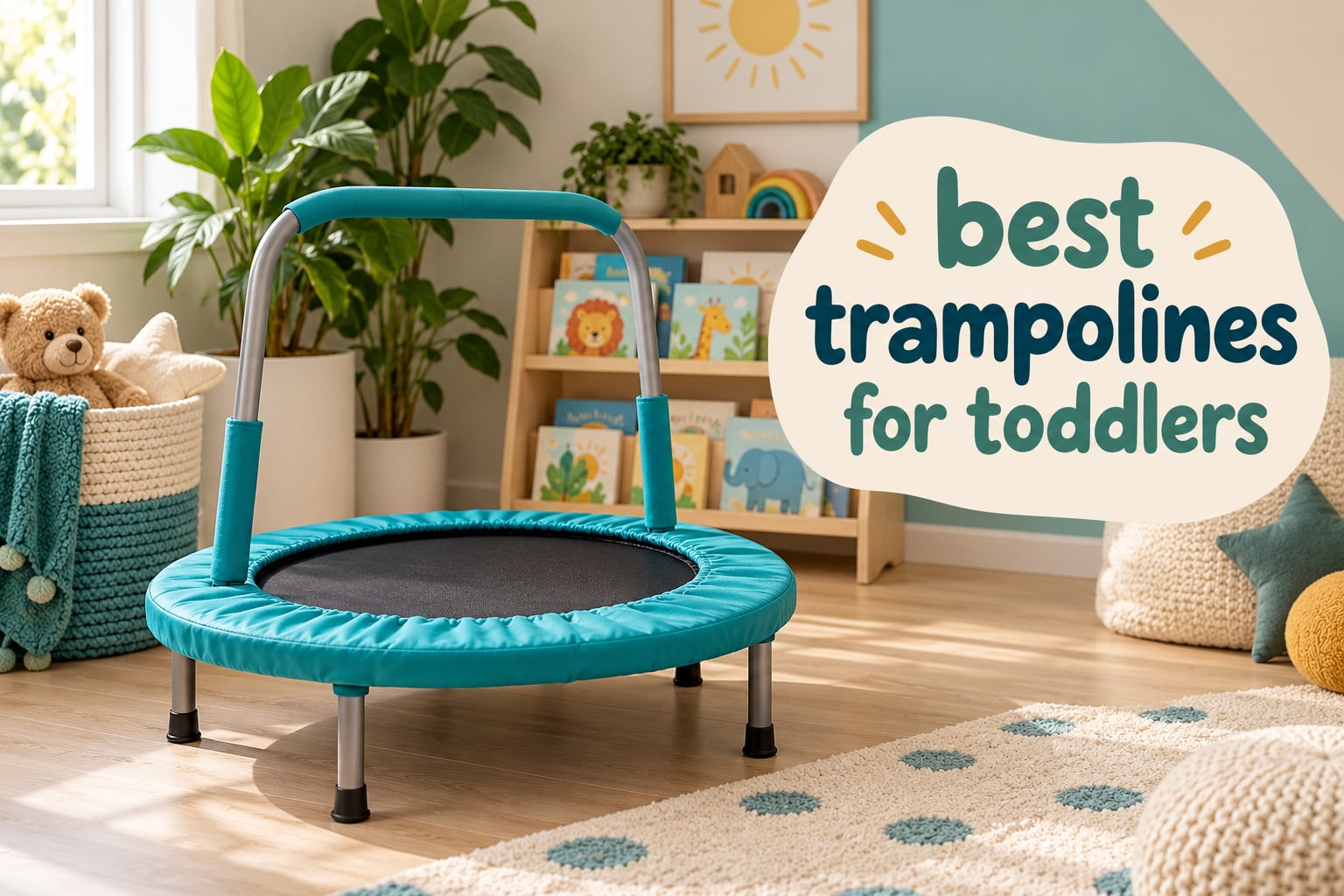
The Little Tikes 3-Foot Trampoline is the best trampoline for toddlers overall, with a 55 pound weight limit, a foam-grip stability handlebar, fully covered springs and a 36-inch frame that fits in a playroom. Nine other enclosed and handlebar models earned a place too, and we explain where each one wins.
I spent several weeks going through toddler trampoline reviews, spec sheets and owner feedback before putting this list together. The category splits into three very different products that get lumped together online: indoor handlebar bouncers around 36 inches, enclosed 55-inch mini trampolines that work indoors or out, and foldable units built for small rooms and sensory routines. A parent shopping for a 2 year old needs a handlebar. A family with a yard and a 4 year old needs an enclosure.
What follows is every one of those contexts, ranked with the weight limits, spring types and real downsides stated plainly. If you want a wider look at bigger equipment, our guide to trampolines with enclosures covers the full-size end of the market, and our in-ground trampoline picks cover the flush-mount route for small yards.
Table of Contents
Top 3 Picks for the Best Trampolines for Toddlers (October 2026)

Little Tikes 3-Foot Trampoline
- 55 lb weight limit
- Foam-grip handlebar
- Fully covered springs
- Indoor 36 inch round
Ativafit 36in Spring-Free
- Spring-free elastic bands
- Adjustable foam handle
- Waterproof Oxford mat
- 55 lb weight limit

Best Trampolines for Toddlers in 2026: Quick Overview
Every trampoline below is a genuine toddler or preschool-age product, not a scaled-down adult rebounder. The table gives you the frame size, how the child is contained, the spring setup and the safety standards each manufacturer claims, so you can narrow the field before reading the full reviews.
| Product | Specifications | Action |
|---|---|---|
| Little Tikes 3-Foot Trampoline |
|
Check Latest Price |
| Ativafit 36in Spring-Free Trampoline |
|
Check Latest Price |
 ZCMHAXJ 55in Enclosed Trampoline ZCMHAXJ 55in Enclosed Trampoline |
|
Check Latest Price |
| BCAN SP1 36in Toddler Trampoline |
|
Check Latest Price |
 FitinOne 55in Trampoline with Swing FitinOne 55in Trampoline with Swing |
|
Check Latest Price |
 Lyromix 36in Handle Trampoline Lyromix 36in Handle Trampoline |
|
Check Latest Price |
 Fisher-Price WonderJump 36in Fisher-Price WonderJump 36in |
|
Check Latest Price |
 Ativafit 60in Enclosed Rebounder Ativafit 60in Enclosed Rebounder |
|
Check Latest Price |
 BCAN BT1 36in Foldable Trampoline BCAN BT1 36in Foldable Trampoline |
|
Check Latest Price |
 Yohood 55in Enclosed Trampoline Yohood 55in Enclosed Trampoline |
|
Check Latest Price |
1. Little Tikes 3-Foot Trampoline – Best Overall Indoor Toddler Trampoline
Little Tikes 3′ Trampoline – (Amazon Exclusive)
36 inch round frame
55 lb weight limit
Ages 3 to 6
Indoor use only
13 lb unit weight
Pros
- Sturdy build that survives daily toddler use
- Handlebar angled so it never blocks the bounce
- Quick to assemble
- Springs fully covered
- Compact 36 inch footprint
Cons
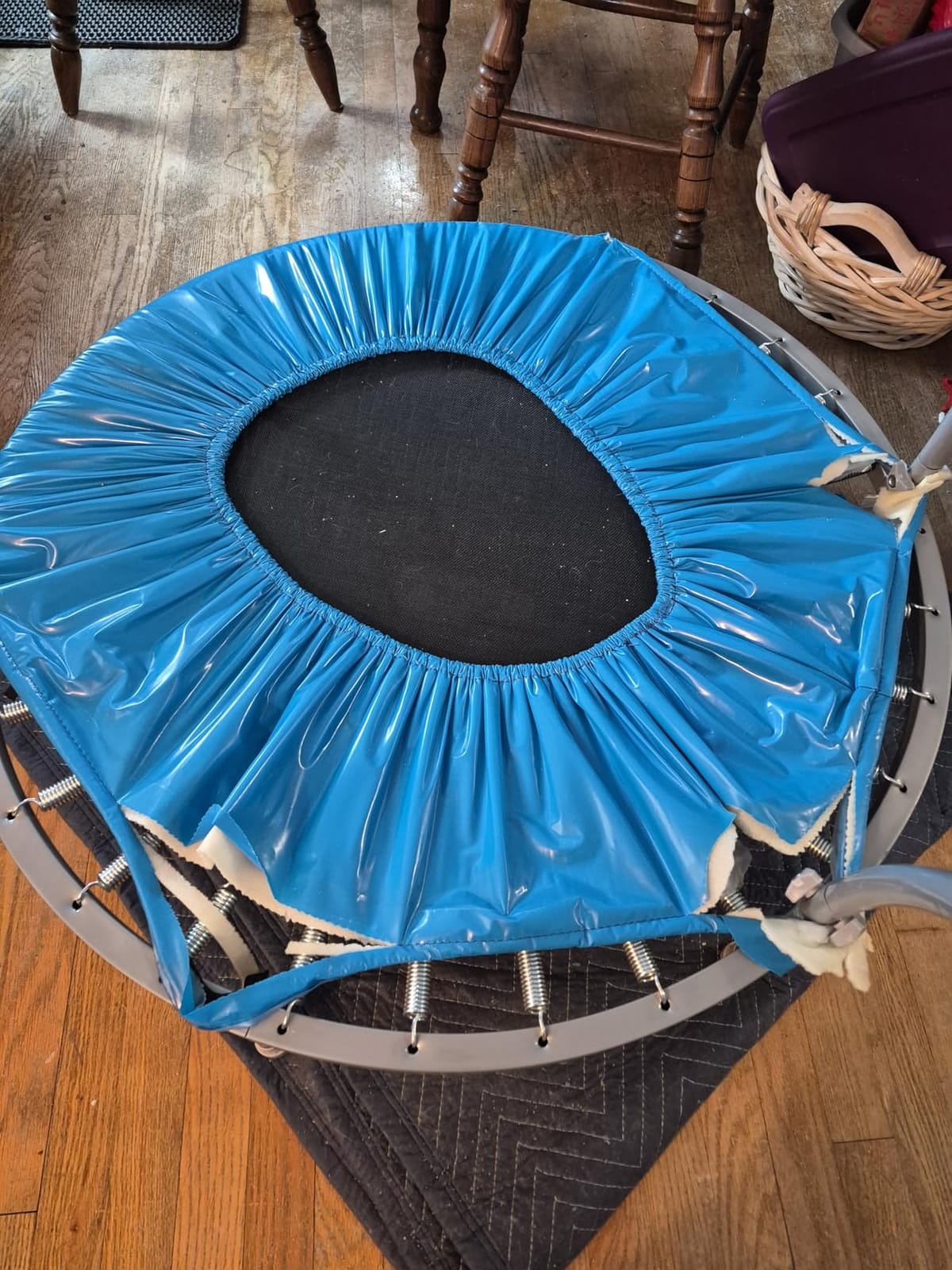
- Blue edge trim lifts over time and needs refitting
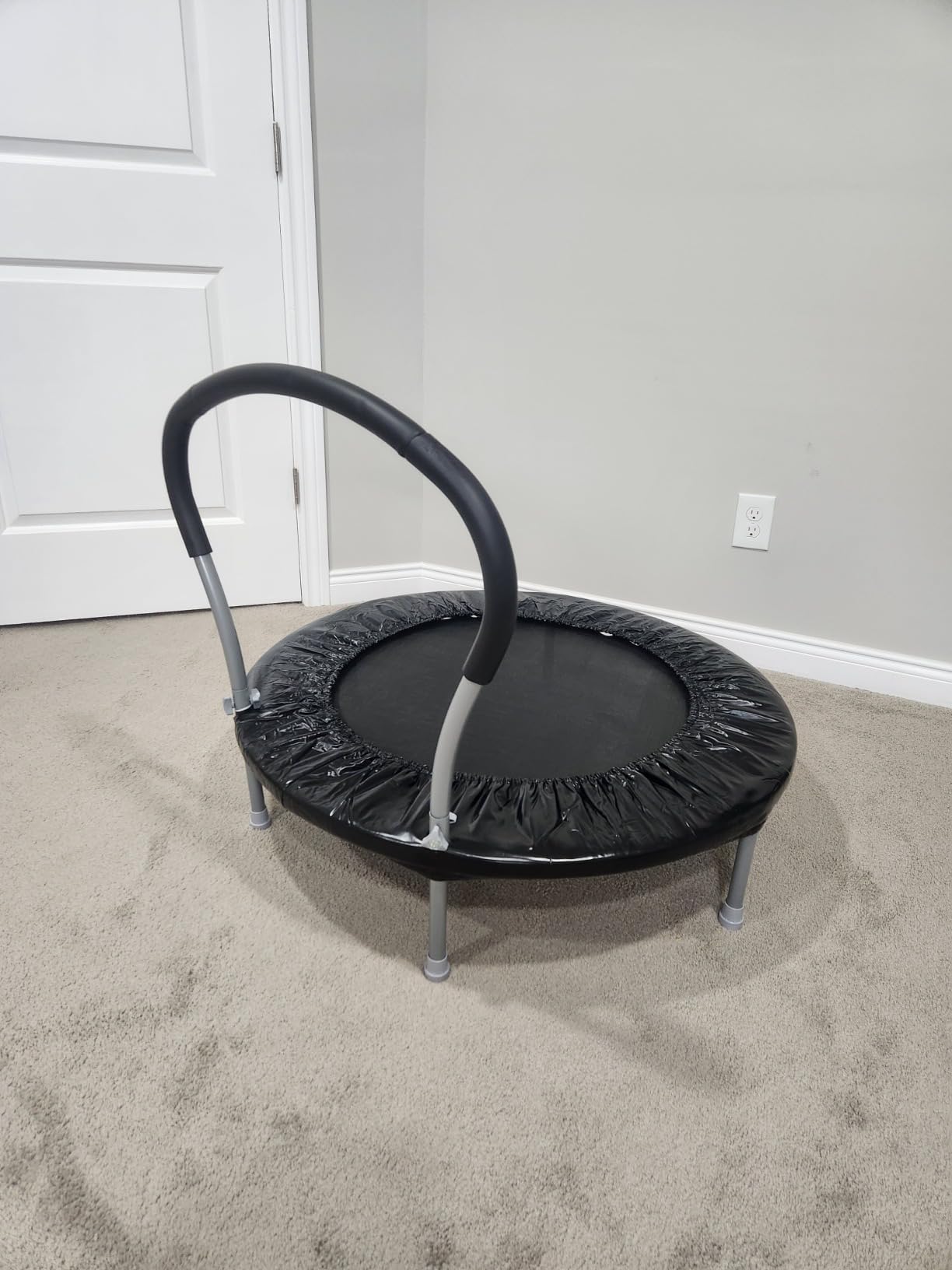
- Handle cushion can tear or loosen
- Back legs creep on floor mats when jumping hard
This is the trampoline I keep coming back to, and the reasons are unglamorous. It has the largest review base of the ten models here by a wide margin, and the pattern across those reviews is remarkably consistent: parents buy it as a first trampoline, it survives daily use, and it disappears into a corner of a playroom when the novelty fades.
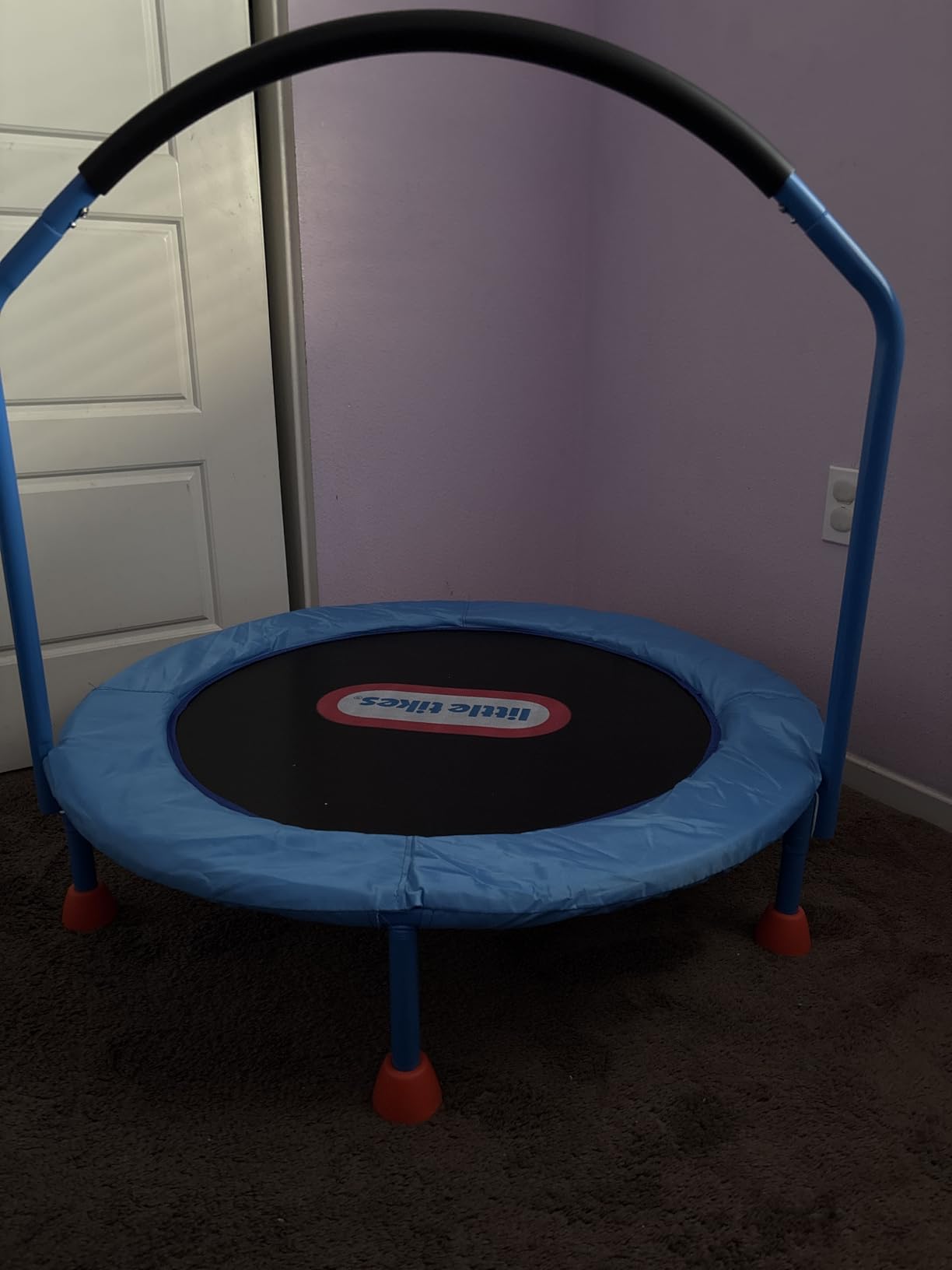
The 3-foot round frame measures 36 by 36 inches and stands 33.5 inches tall, with the handlebar reaching 34 inches from the ground. That is a small footprint, and it is genuinely small once the handle is attached. Parents on r/toddlers repeatedly ask about exactly this, because a 36-inch trampoline plus a handle is wider than the product photo suggests.
The manufacturer lists it for ages 3 to 6 and indoor use only, with a 55 pound maximum weight. That limit is the thing to plan around. A chunky 5 year old can get close to it, and the frame does not flex well past that point.
Springs are fully covered by the foam pad, which removes the single most common finger injury risk in this category. The handlebar is angled forward rather than straight across, so a child can grip it without the bar cutting into the jumping arc. Assembly is quick, and the whole thing weighs 13 pounds, light enough to move between rooms.
What you should check before buying
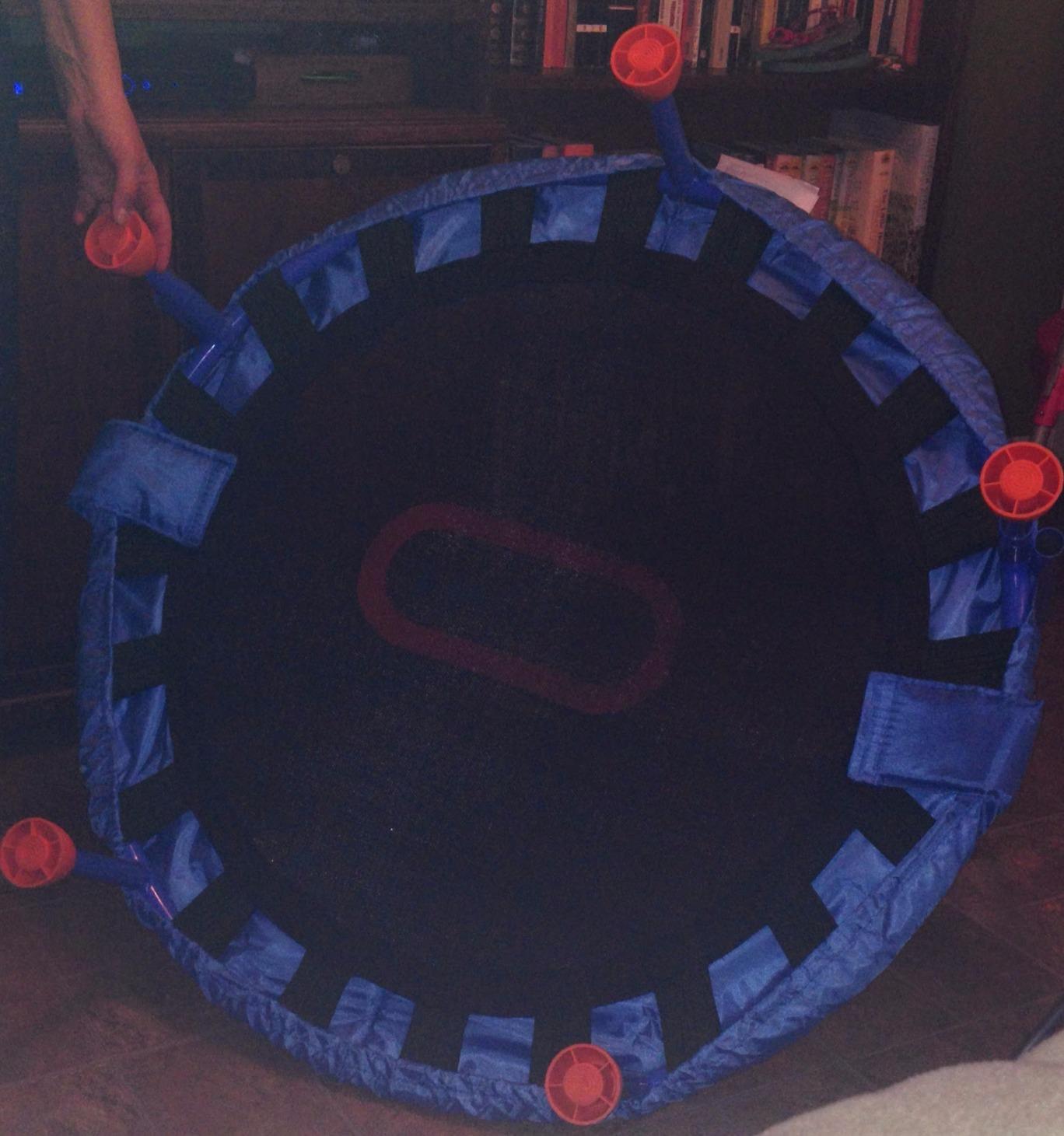
Two durability issues come up often enough to plan around. The blue edge trim around the mat lifts at the corners over time and has to be pressed back into place, and the black cushion on the handle can tear or pull loose at the stitching. Neither is a safety failure, but both look untidy after a year of use.
Owners also note that the mat feels more slippery when a child jumps in socks rather than bare feet, and that the rear legs can creep a few inches across a foam floor mat during hard bouncing. Put it on a hard floor or carpet rather than an interlocking foam tile if you can.
Who it suits and who it does not
It suits a 3 to 5 year old in a home without a yard, and it is the pick I would hand to a parent who wants one trampoline that just works. The 4.7 average across more than 33,000 reviews is the strongest evidence base in this roundup, and the failure modes owners report are cosmetic rather than structural.
It does not suit a 2 year old, because the manufacturer starts at age 3, and it does not suit anyone planning outdoor use, since it is listed for indoor use only. Parents also mention that the 55 pound cap is reached sooner than expected with toddlers who are on the heavier side of normal.
2. Ativafit 36in Spring-Free Trampoline – Best Value and Quietest Indoor Bounce
ATIVAFIT 36“ Kids Trampoline with Big Handle Compact Indoor/Outdoor Mini Trampoline for Toddlers 2‑6 Years (Black)
36 inch round frame
55 lb weight limit
Ages 2 to 6
Spring-free elastic bands
Pros
- Spring-free design removes finger pinch points
- Quiet and gentle bounce
- Waterproof Oxford fabric mat
- Adjustable foam-padded handlebar
- Suction feet grip tile and hardwood
Cons
- Adjustable handle adds joints that can loosen over time
- Rating is below the leaders in this category
If your child lives in an apartment, the noise question decides this category before anything else. This model uses elastic bands instead of metal springs, and owners describe the result as a noticeably quieter, softer bounce that travels through a floor far less than a spring trampoline. For a downstairs neighbour situation, that matters more than any spec sheet.
The safety argument for spring-free is simple and hard to argue with. There is no coil gap for a small finger to land in, which removes the most common injury mechanism in this product category. The trade-off is bounce: the mat gives a controlled, gentle rebound rather than the airborne feeling of a metal-spring unit.
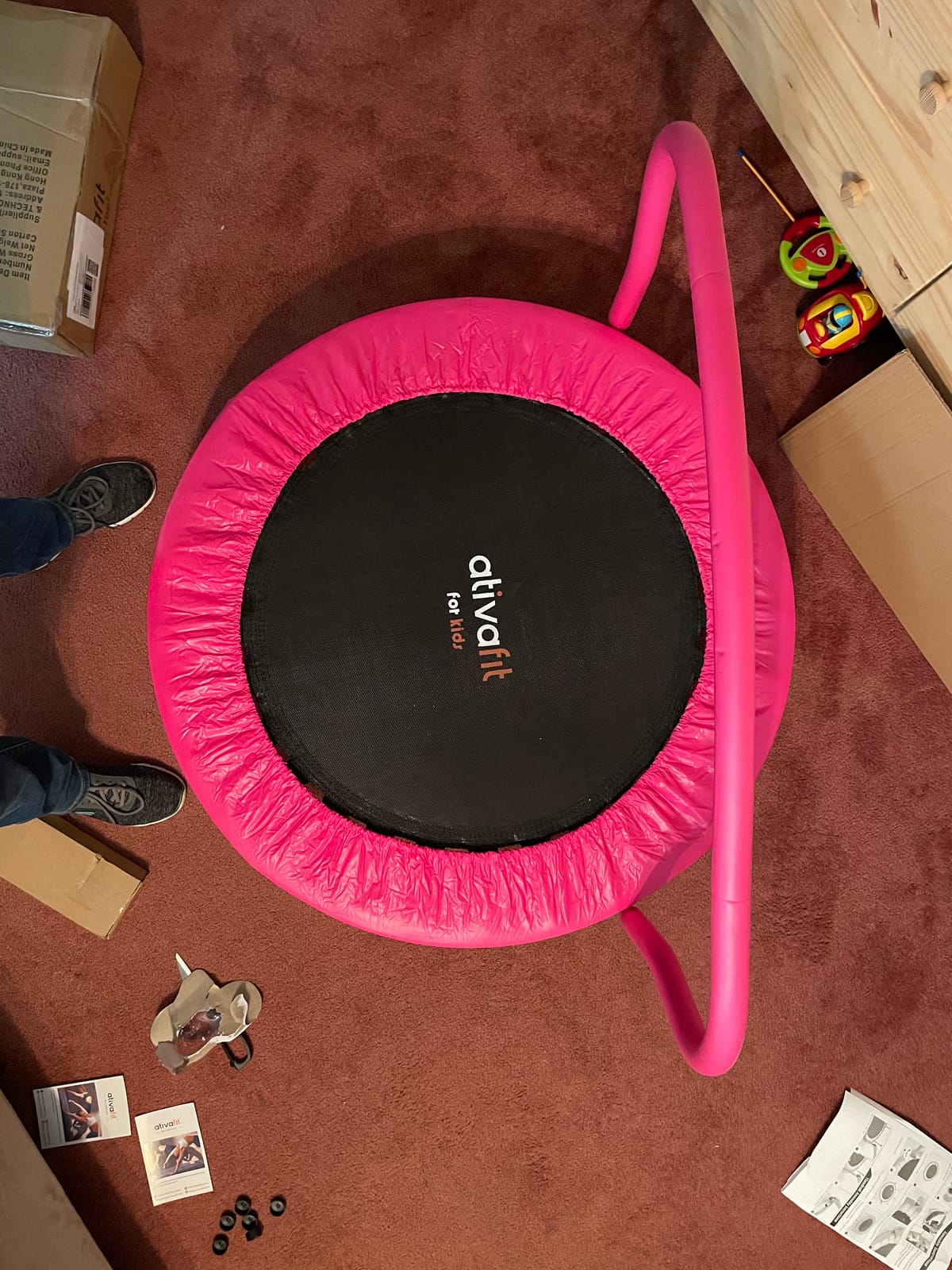
The 36-inch round frame uses an alloy steel structure, an Oxford cloth mat described as waterproof and tear-resistant, and a foam handlebar that adjusts in height so the child can hold on at their own reach. The manufacturer lists it for ages 2 to 6 with a maximum weight of 24.95 kg, which is about 55 pounds. The whole unit weighs 14.3 pounds and measures 36 by 36 by 33 inches.
The feet are rubber suction cups, and owners specifically note that they grip hardwood and tile without scratching the surface. That is a detail that decides the product for a lot of indoor households.
What you should check before buying
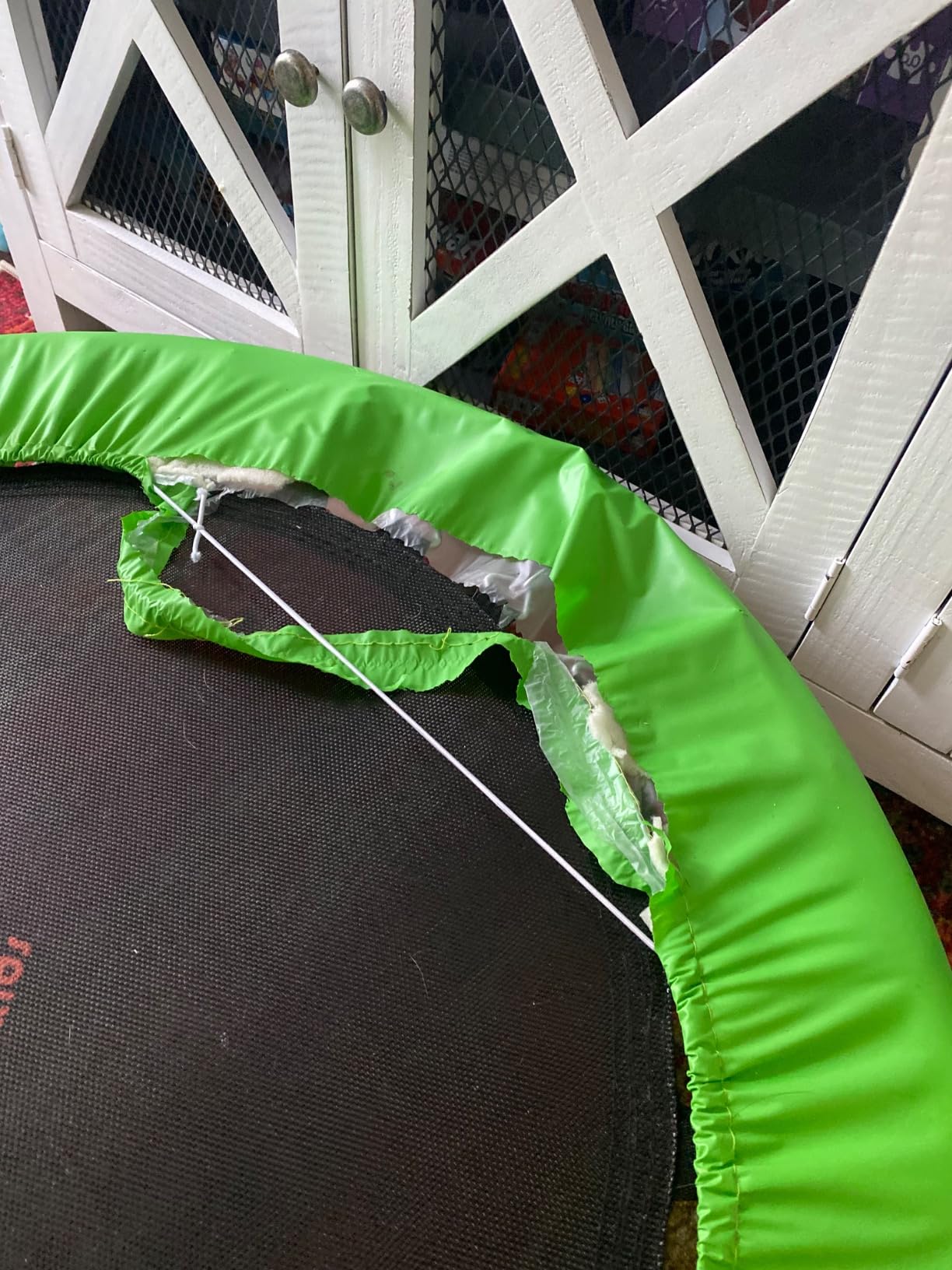
The height-adjustable handle is the main thing to inspect in the first few weeks. It is a genuine advantage because the bar grows with the child, but the adjustment mechanism introduces joints and pins that can loosen under repeated bouncing. Check the handle height before every session rather than assuming it has held.
The bounce itself is the second consideration. It is softer than a spring trampoline by design, and a child who wants real height will find it less thrilling than a 36-inch metal-spring model. That is the correct trade for a small child, but it is worth knowing you are choosing control over air.
Who it suits and who it does not
It suits a 2 to 4 year old in a flat, indoor space, and it is the one I would point a parent toward when the trampoline is going near a shared wall. The adjustable handle covers a wider age range than most 36-inch handlebar units, which usually top out around age 3.
It does not suit a child who wants a big rebound, and the manufacturer’s own warning about outdoor use on a soft surface is worth reading before you take it outside. The 4.5 average across more than 3,000 reviews reflects steady approval rather than the near-unanimous response the top pick gets.
3. BCAN SP1 36in Toddler Trampoline – Best for a 2 to 4 Year Old
BCAN SP1 36” Kids Toddler Trampoline Indoor, Foam Handle | FED Fitness
36 inch round frame
28 covered springs
ASTM certified
Folds for storage
Pros
- ASTM certification and 20+ safety tests
- T-shaped foam handlebar is stable and well angled
- Gentle bounce sized for ages 2 to 4
- Folds flat for small rooms
Cons
- Center of the handlebar is not foam-covered
- Screws can loosen with extended use
- Handle padding wears down over time
Parents in the forums almost always ask two questions in the same breath: what age is safe to start, and what safety gear do I add. This is the model where those two questions have the cleanest answers, because it is one of only two products here carrying explicit ASTM certification, and it is built around a six-leg support base rather than a simple three-leg frame.
The mat is the 2026 upgraded version described by the manufacturer as a no-gap design with higher fabric density, tighter stitching and greater thickness than the previous version. Springs are enclosed beneath the foam pad, and the manufacturer states they were tested over 200,000 cycles. Owners frequently mention the ASTM certification as the reason they chose this over cheaper alternatives.
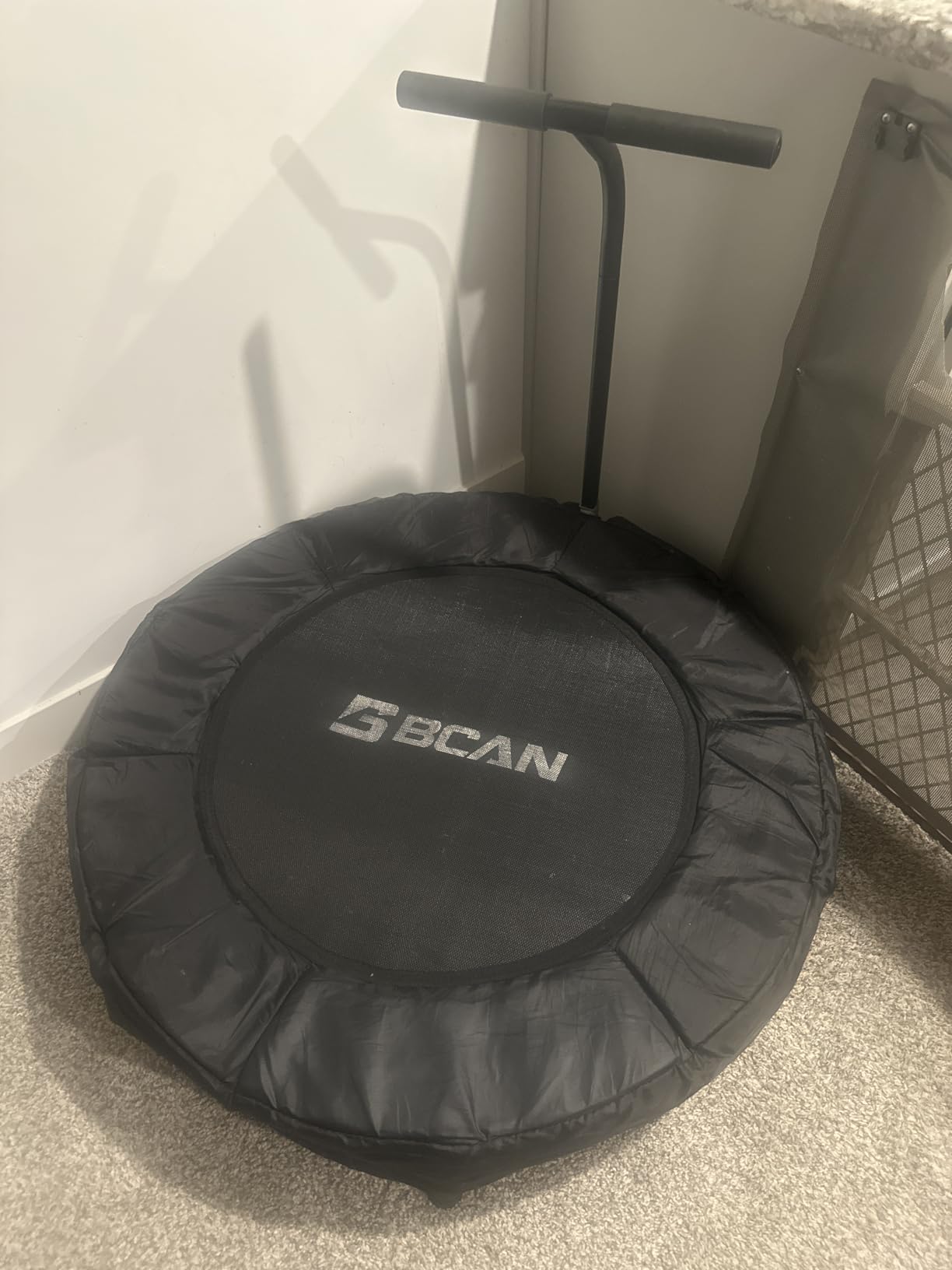
There is a discrepancy worth knowing about in the published specifications. The product page lists a maximum recommended weight of 220 pounds, while the feature list states the 28 springs support up to 132 pounds. The spring figure is the one to believe for a toddler, and either way it is well above what a 2 to 4 year old weighs. Check the label on the unit you receive rather than relying on the listing.
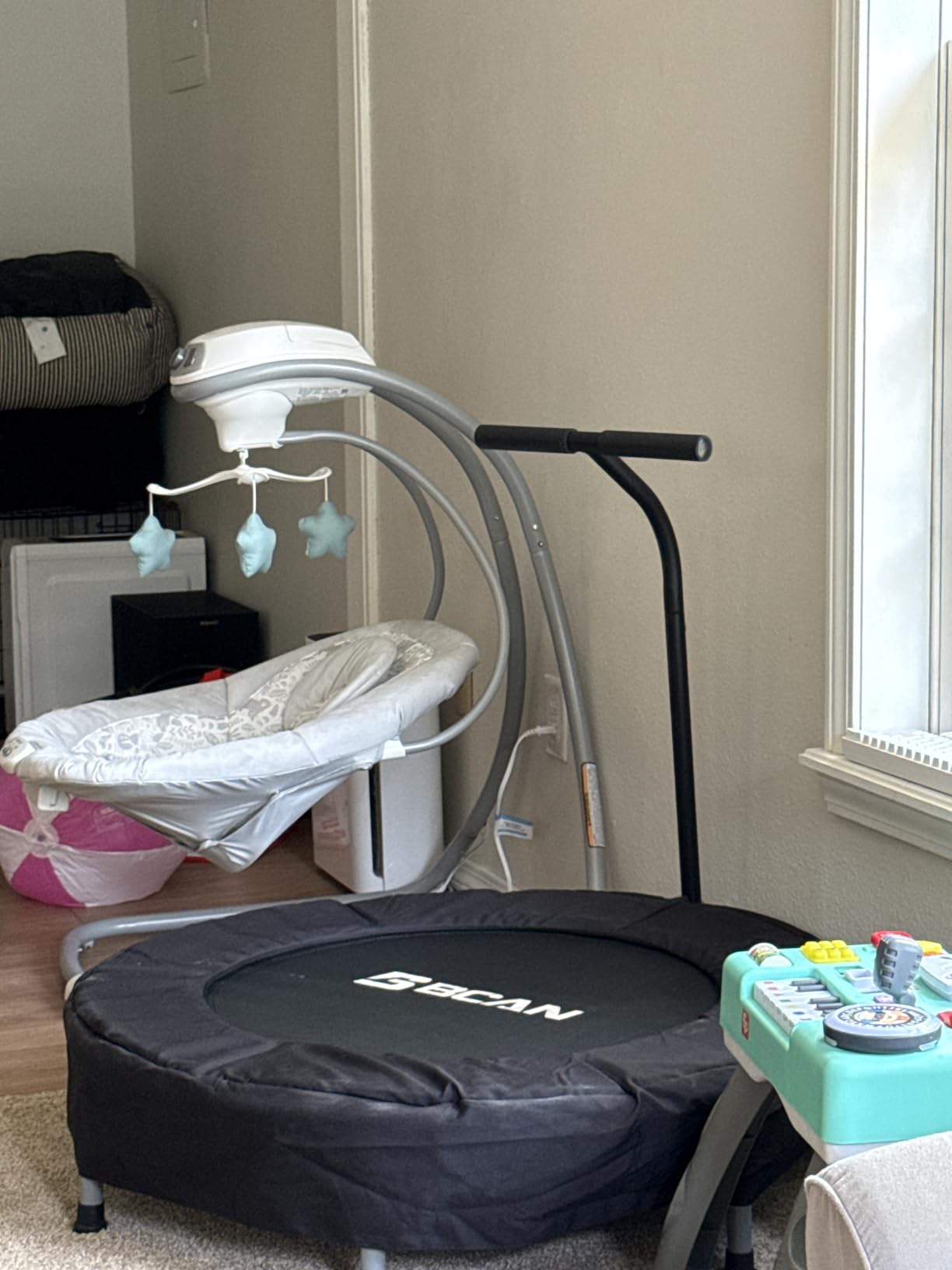
The T-shaped foam handlebar is the feature owners praise most. It is angled well, it gives a toddler something solid to hold, and it does not interfere with the bounce. Assembly is described as a five-step process with all tools included, and the unit folds for storage in a way that matters in a small room.
What you should check before buying
The most repeated caveat is that the center section of the handlebar is bare rather than foam-covered. A 2 year old who drops the bar and falls forward can hit the unpadded middle, and several parents have wrapped it themselves as a fix. If your child is at the youngest end of the range, do that before the first session.
Some owners also report screws loosening over time and the handle padding wearing down with extended daily use. Neither appears immediately, but both are reasons to spend two minutes checking the hardware every few weeks rather than assuming the first assembly held.
Who it suits and who it does not
It suits a 2 to 4 year old, and it is the strongest match in this list to the exact question parents ask most, which is what to buy for a 2 year old. The gentle, controlled bounce is sized for that age, the folded footprint solves the small-room problem, and the certification gives you something concrete to point to.
It does not suit an older child, since a 28-spring 36-inch mat has a short useful life once a child passes around age 5. It also does not suit anyone planning outdoor use, and the 13.7-pound unit is light enough that an adult will want to anchor it if a determined toddler uses it hard.
4. ZCMHAXJ 55in Enclosed Trampoline – Best for Accessory Variety
ZCMHAXJ 55″ Trampoline for Kids with Enclosure, 440lbs Capacity Indoor & Outdoor Toddler Trampoline with Adjustable Gymnastics Bar & Toys, Gifts for Boys & Girls
55 inch round frame
440 lb weight limit
36 springs
Net enclosure
Pros
- Holds up when older siblings jump hard
- Large accessory bundle included
- 440 lb capacity suits mixed ages
- Suction feet are quiet and stop sliding
Cons
- Foam sleeves and spring cover tear easily
- Safety net has no dedicated tie points
- Instructions do not cover the accessories
- Base ring can pop apart during jumping
At 55 inches, this is the first jump from a handlebar bouncer to something closer to a real playground, and the difference is obvious. The enclosed net wraps all the way around, the frame sits low to the ground, and a 440-pound capacity means a 4 year old and a 10 year old can share it without you swapping equipment.
The accessory bundle is the reason this one stands apart. It comes with a three-level adjustable and removable gymnastics bar, a hammock, boxing gloves, rings, a sandbag and ocean balls. Owners consistently report that the extras are what keep a child coming back after the plain jumping novelty wears off, which is the single biggest retention problem with small trampolines.
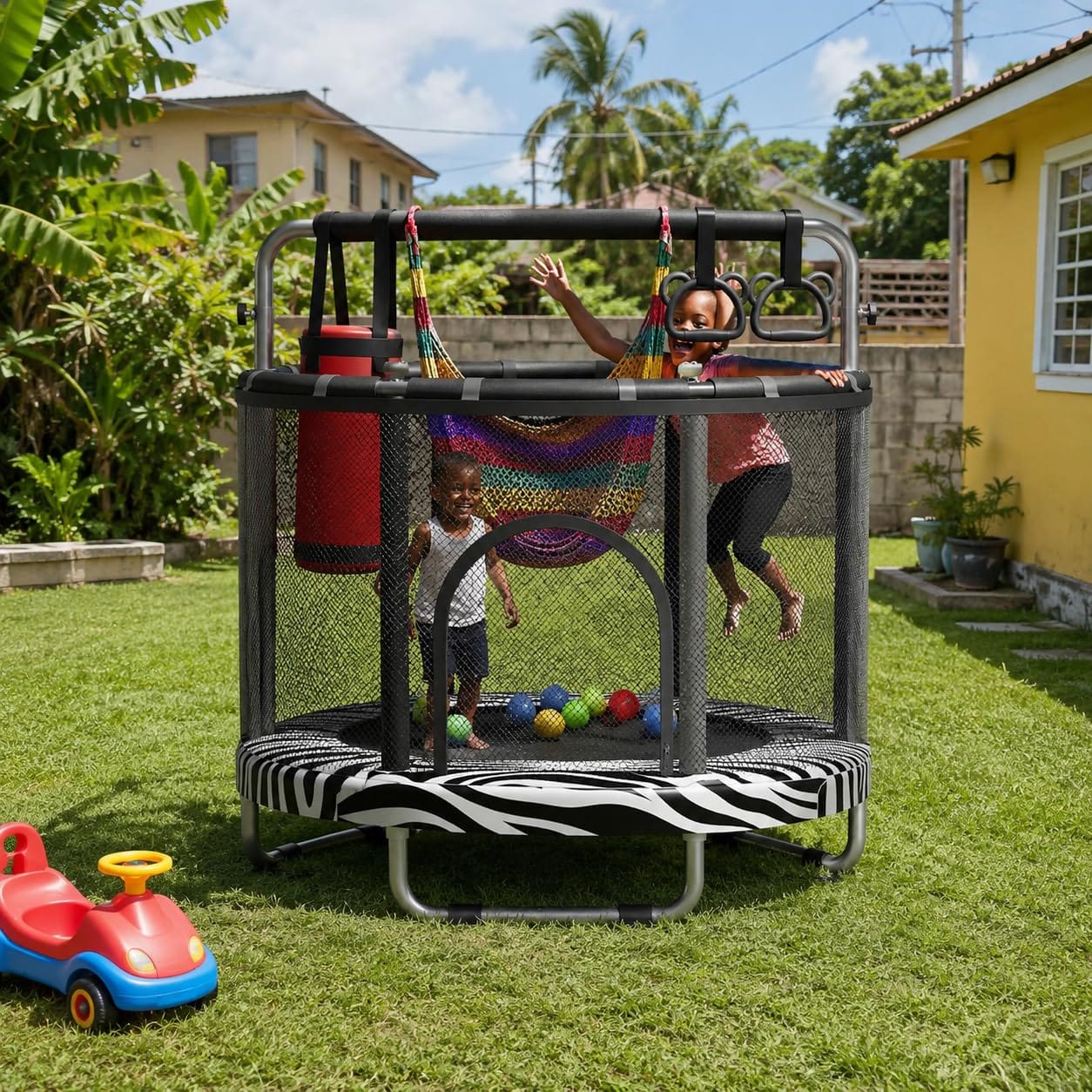
Construction-wise it uses a carbon steel frame, 36 springs, three U-shaped legs with silent suction pads, and a 360-degree wrap-around foam pad with dense netting. The warranty is one year. It measures 55 by 55 inches with a low 11.2-inch frame height, and it is the heaviest unit in this roundup at 14.15 kg, which is a real consideration for carrying it up stairs.
This is also the lowest-rated product here, at 4.1 with a meaningful share of one-star reviews, and the reasons are consistent rather than random. The complaints cluster around materials and documentation rather than safety or stability.
What you should check before buying
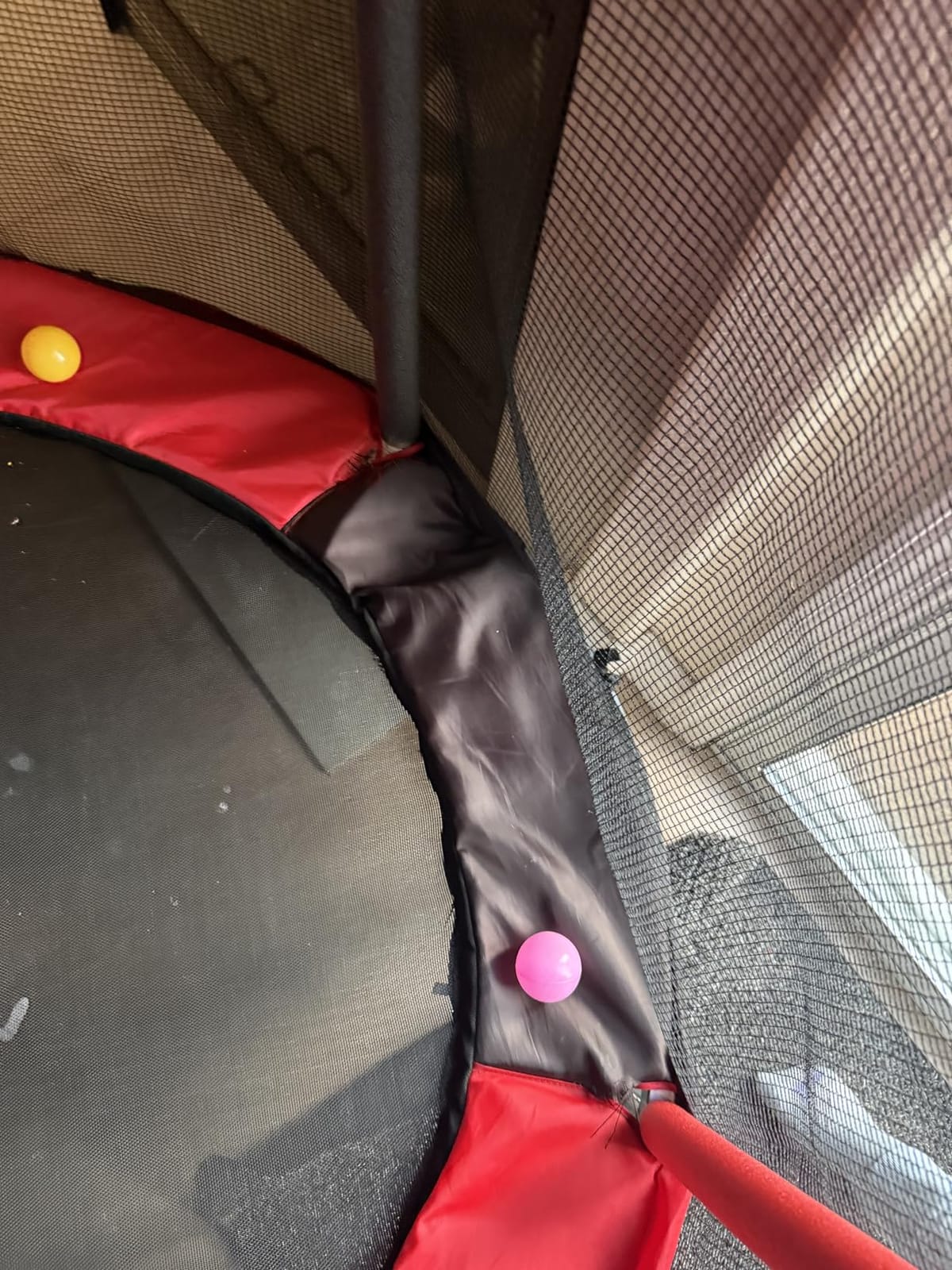
The net attachment is the most important thing to inspect. Owners report that the safety net has no dedicated attachment point and has to be tied onto the base ring or springs, which leaves the fabric scrunched and creates a gap you did not ask for. Check the tie points as soon as it is assembled and before anyone jumps.
The foam pole sleeves and the spring cover are reported to tear easily, especially with toddler hands, and the base ring has no screws and can pop apart during hard jumping. The instructions are also reported as hard to read and silent on the accessories, so budget extra time for assembly and plan to work out the bar and hammock attachments yourself.
Who it suits and who it does not
It suits a family with a 3 to 6 year old and an older sibling, and anyone who wants the trampoline to double as a play structure rather than a jumping surface. The 440-pound rating and the adjustable bar cover a wide age spread in one footprint.
It does not suit indoor use in a small space. A 55-inch frame is a large footprint, and at 14.15 kg it is not something you move between rooms casually. It also does not suit a parent who wants a simple, certified enclosure, since the net tie design is the weak point and the 4.1 average reflects that.
5. FitinOne 55in Trampoline with Swing – Best for Siblings of Different Ages
FitinOne 55″ Toddler Mini Trampoline for Kids, Indoor Outdoor Toys with Swing, 440lbs Baby Kids Trampoline, Gymnastics Bar, Birthday Gifts for Boy Girl Age 1-8
55 inch round frame
440 lb weight limit
3-level adjustable bar
Transparent net
Pros
- Three-level bar covers a wide age range
- 440 lb capacity and anti-tip legs
- Transparent net gives full visibility
- Accessories included for varied play
- Legs do not mark hard flooring
Cons
- Assembly needs care with the spring tension
- Printed manual does not cover accessory setup
The difference between this and the previous 55-inch model is visibility. The net here is transparent rather than dense, so you can see your child from every angle without leaning over the enclosure. For a 3 year old, that is a real supervision advantage, and it is the detail that separates this from most budget enclosed units.
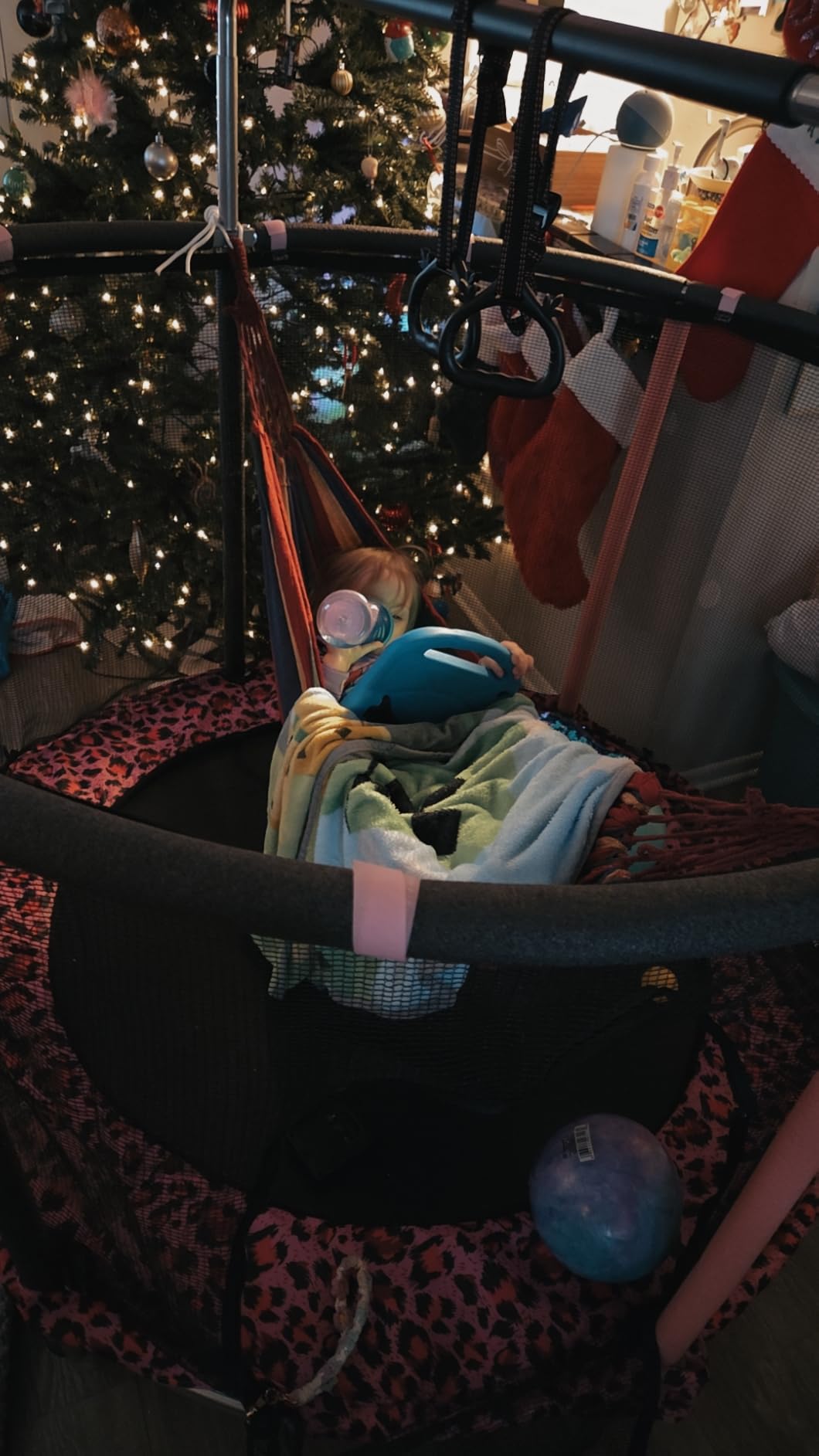
It also has six foam-padded handlebars built into the structure, which gives a child something to hold at multiple points around the perimeter. Combined with a three-level adjustable horizontal bar, it covers a toddler who needs a low grip and an older child who wants to hang from something. Rated capacity is 440 pounds on a carbon steel frame with three U-shaped anti-tip legs.
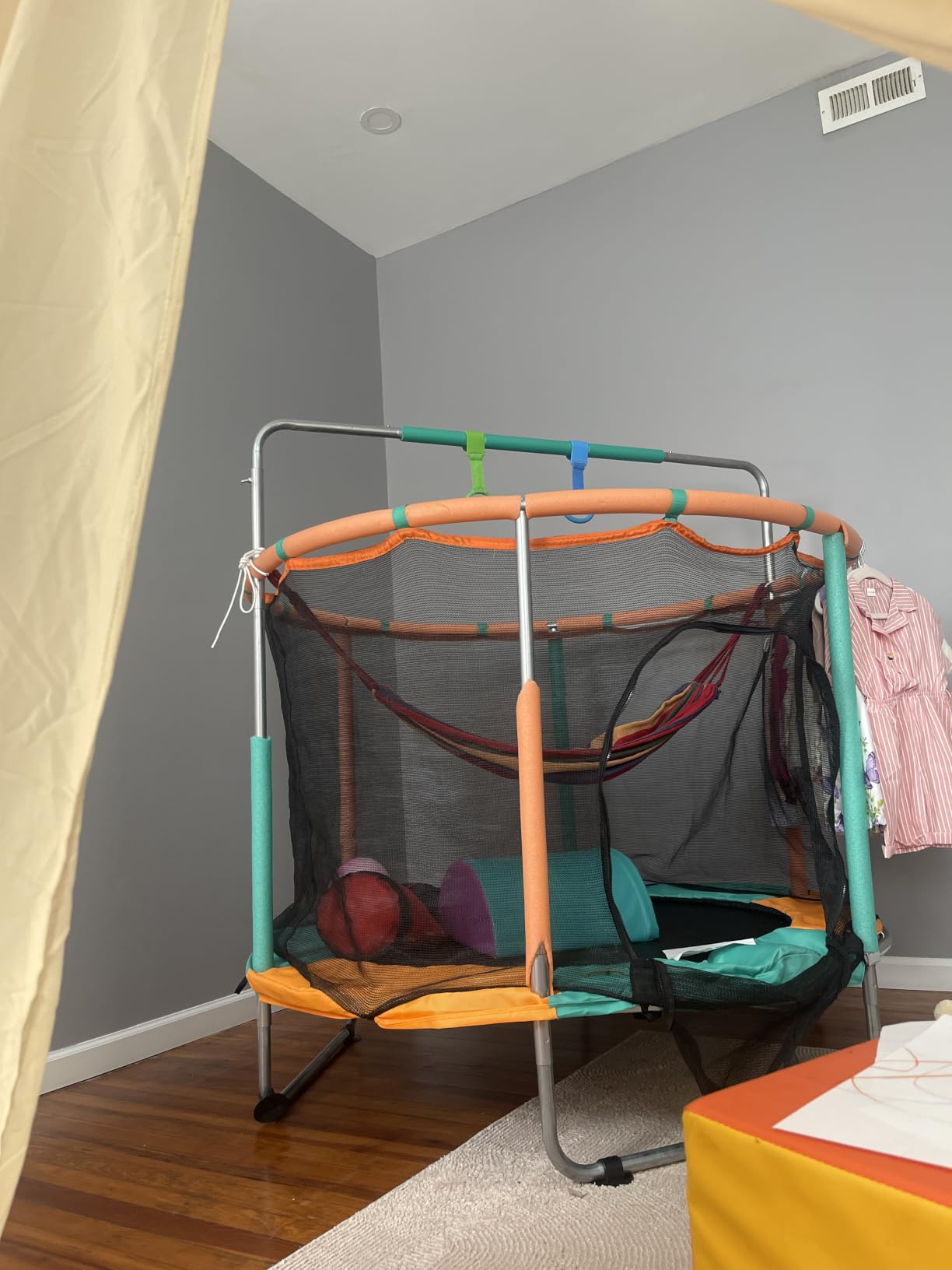
The box includes the trampoline, spring, cotton tube, protective net, an ocean ball, a swing, a sandbag and rings, plus a spring installation tool and a manual. The manufacturer states 36 heat-treated steel springs in the feature list while the specification table lists 30, so treat the physical count on your unit as the real one. Dimensions are 55 by 55 inches with a low 9.3-inch frame, and the warranty is one year.
The 4.4 average across more than 1,100 reviews points to a product owners see as feature-rich for what it costs, with feedback focused on assembly technique rather than defects.
What you should check before buying
Assembly is the thing to plan time for. The springs are difficult to tension evenly if you fit them straight across, and the manufacturer itself recommends a diagonal installation method. Budget extra time, and do not rush the spring step with a toddler in the room.
The printed manual does not walk through the accessory setup, so the swing, sandbag and rings take some figuring out. Owners who accept that as a small evening of work report the trampoline itself performs well; those who expected a simple build report frustration.
Who it suits and who it does not
It suits a household where two children of clearly different ages will share one trampoline, and a parent who wants to see their child clearly while jumping. The three-level bar, the six padded grips and the 440-pound limit together cover a range that a 36-inch handlebar unit simply cannot.
It does not suit a 2 year old on their own, since the frame is designed for older toddlers and preschoolers, and it does not suit a small indoor space. Like the other 55-inch models, it is a large object to own in a compact home and needs a dedicated footprint.
6. Lyromix 36in Handle Trampoline – Budget Pick for Small Playrooms
Lyromix 3FT Indoor Kids Trampoline for Toddler,Handle, ASTM Certified,Blue
36 inch round frame
150 lb weight limit
36 steel springs
Padded handrail
Pros
- Sturdy enough for an adult up to 150 lb
- Padded handrail keeps parents calmer
- Compact 3 foot footprint
- Simple assembly with included tool
Cons
- Spring cover slips off and eventually tears
- Springs differ in length side to side
- Shortest warranty here at 3 months
- Handle foam arrives dented
This is the one to buy when the budget is the deciding factor and the child is small. The 36-inch round frame uses a metal structure with 36 high-tensile steel springs, a resilient polypropylene mat and a foam-padded handrail on multiple legs, and it carries a 150-pound rating that is unusually generous for a handlebar model.
That rating has a practical consequence. Several owners report that an adult can get on it alongside a toddler, which turns it into a shared activity rather than a solo playpen. For a household without a yard, that is a meaningful amount of use from a small object.
It measures 36 by 36 by 30 inches and weighs 17 pounds, so it is one of the heavier 36-inch options despite the smaller frame, largely because of the metal construction. The listed warranty is three months, which is the shortest in this roundup and the one specification worth thinking hardest about.
The 4.6 average across just under 1,000 reviews tells you the product performs about as well as units with several times the feedback. The limitations owners raise are consistent: the spring cover and the assembly process.
What you should check before buying
The spring cover is the weak point. Owners report it repeatedly slipping off and eventually tearing after about a year of use, which leaves the springs partially exposed. Check it every few weeks, and treat a torn cover as the end of the unit’s safe life rather than something to tape up.
Assembly takes patience. The springs on this model differ in length from side to side, which makes them harder to tension evenly even with the included spring stretcher. Set aside a proper block of time for the first build, and follow the spring tool rather than trying to do it by hand.
Who it suits and who it does not
It suits a parent of a 2 to 4 year old who wants a metal-spring bounce and a sturdier frame than the price point suggests, and it suits households where a 3 foot footprint is all the space available.
It does not suit anyone who wants a long service life under heavy daily use, given the spring cover reports and the three-month warranty. The 17-pound weight also makes it the least convenient of the 36-inch models to move between rooms, which undercuts the main reason to buy a small indoor trampoline.
7. Fisher-Price WonderJump 36in – Best for a Preschool-Age 3 Year Old
Fisher-Price Mini Trampoline, WonderJump 36″ Round Bouncer, Multicolor
36 inch round frame
55 lb weight limit
Ages 3 and up
Tool-free setup
Pros
- Highest average rating in the group
- Tool-free assembly in minutes
- Soft foam grip handlebar
- Six non-slip foot pads
- Removable handle and folding frame
Cons
- 55 lb limit suits a preschooler rather than an older toddler
- Smallest review base of the ten models
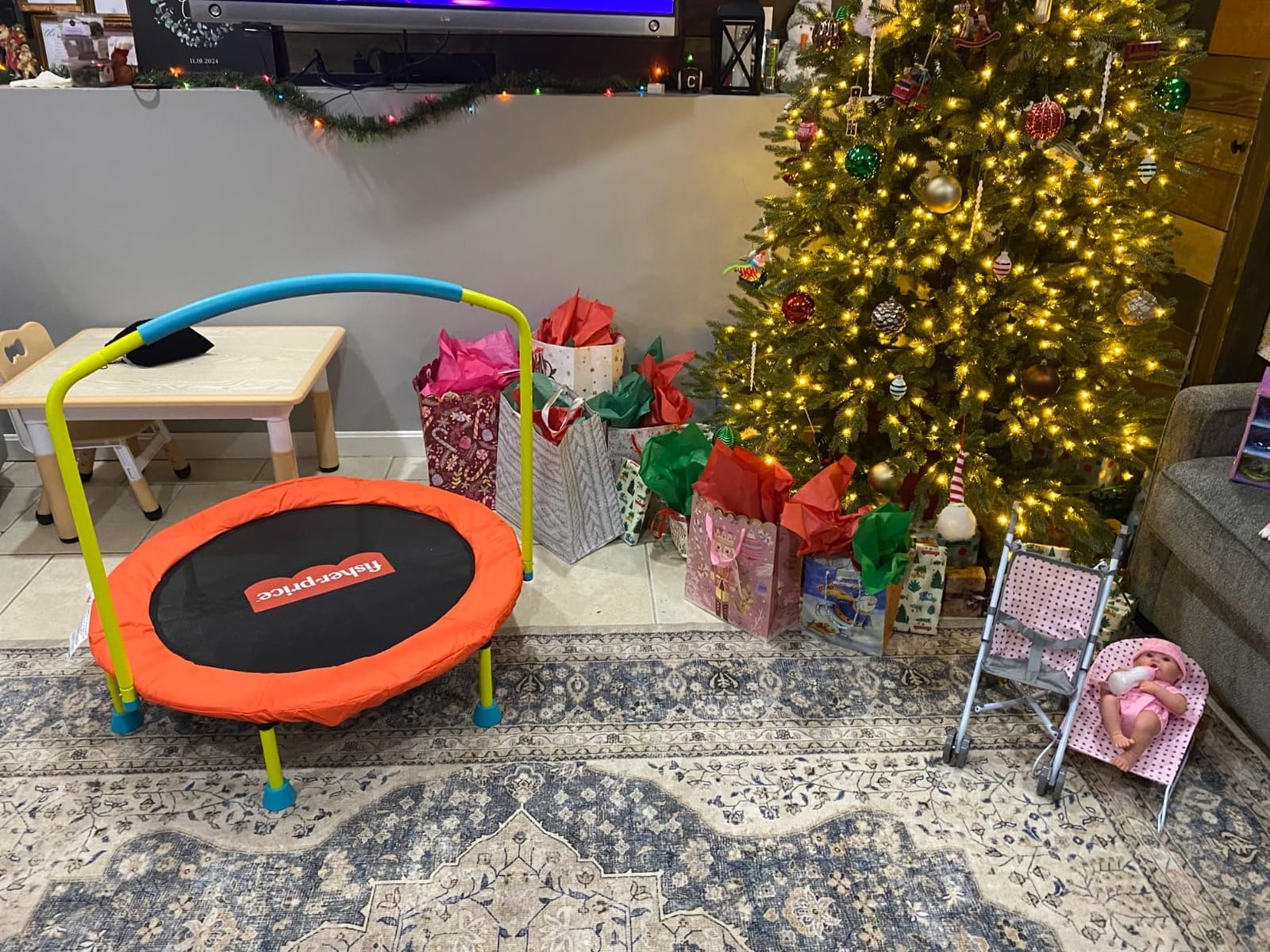
The satisfaction numbers on this one are the strongest in the group, with a 4.8 average and roughly nine in ten reviews at five stars. The reason is that there is very little to complain about: a powder-coated steel frame, six non-slip foot pads, a soft foam grip handlebar, and assembly that needs no tools at all.
The removable handlebar is the detail that changes how you use it. Take the bar off and you have a normal mini rebounder. Put it back on and a 3 year old has stability while their balance develops. That dual configuration is unusual at 36 inches, and it is why this model suits a household with children on both sides of the toddler-to-preschool line.
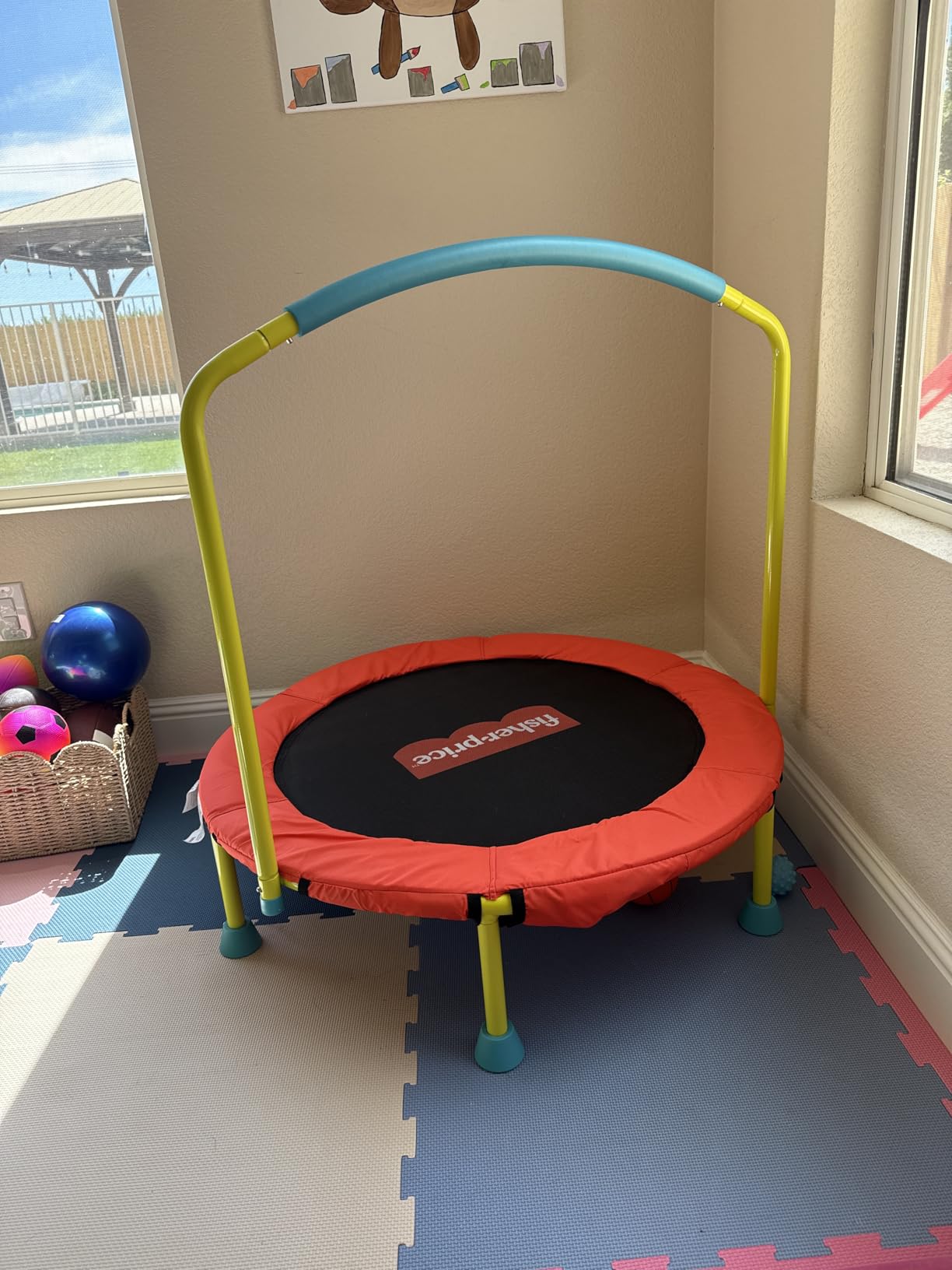
The frame measures 36 by 36 by 36 inches and the manufacturer states it supports up to 55 pounds for ages 3 and up. The design intent is explicitly preschool-focused, aimed at balance, coordination and core strength rather than high bouncing. A one-year manufacturer warranty applies.
I want to be straightforward about the limitation here. A 298-review base is the smallest in this roundup, so the 4.8 rating rests on less evidence than the top pick’s, even though the sentiment is unusually consistent. Weight it as a strong signal rather than a proven one.
What you should check before buying
Check the 55-pound rating against your child honestly. It suits a preschooler well, but a toddler on the heavier end of normal can approach it sooner than parents expect, and this category has a well-documented pattern of parents being surprised by how quickly a toddler approaches a 55-pound cap.
Because the handlebar is removable, check that it locks positively into position before each session rather than relying on friction. There is no weight rating published for the handle configuration, so treat the frame rating as applying to the whole assembly.
Who it suits and who it does not
It suits a 3 to 5 year old, and specifically a child at the older toddler end who is ready for balance and coordination work rather than supported bouncing. For tool-free setup and clean folding storage, it is the most convenient model here.
It does not suit a 2 year old or younger, since the manufacturer starts at age 3. It also does not suit a heavier toddler who will outgrow the 55-pound cap quickly, and with the smallest review base here, it is the pick to buy when you have a clear reason to prefer the handlebar-off configuration.
8. Ativafit 60in Enclosed Rebounder – Best Enclosed Unit for Indoor Multi-Child Play
ATIVAFIT 60″ Indoor‑Outdoor Kids Trampoline Mini Rebounder with Safety Net & Hoop, Ideal for Toddlers and Children 1‑8
60 inch round frame
80 lb weight limit
Net enclosure
36 springs
Pros
- Enclosure zips closed for contained play
- Low frame keeps small children inside
- Big enough for two toddlers to share
- Works indoors or on a sheltered porch
Cons
- Basketball pole mount can break early
- Spring tube holes are not consistently punched
- Posts can bend in wind if not anchored
- Dirt collects between the net and rim
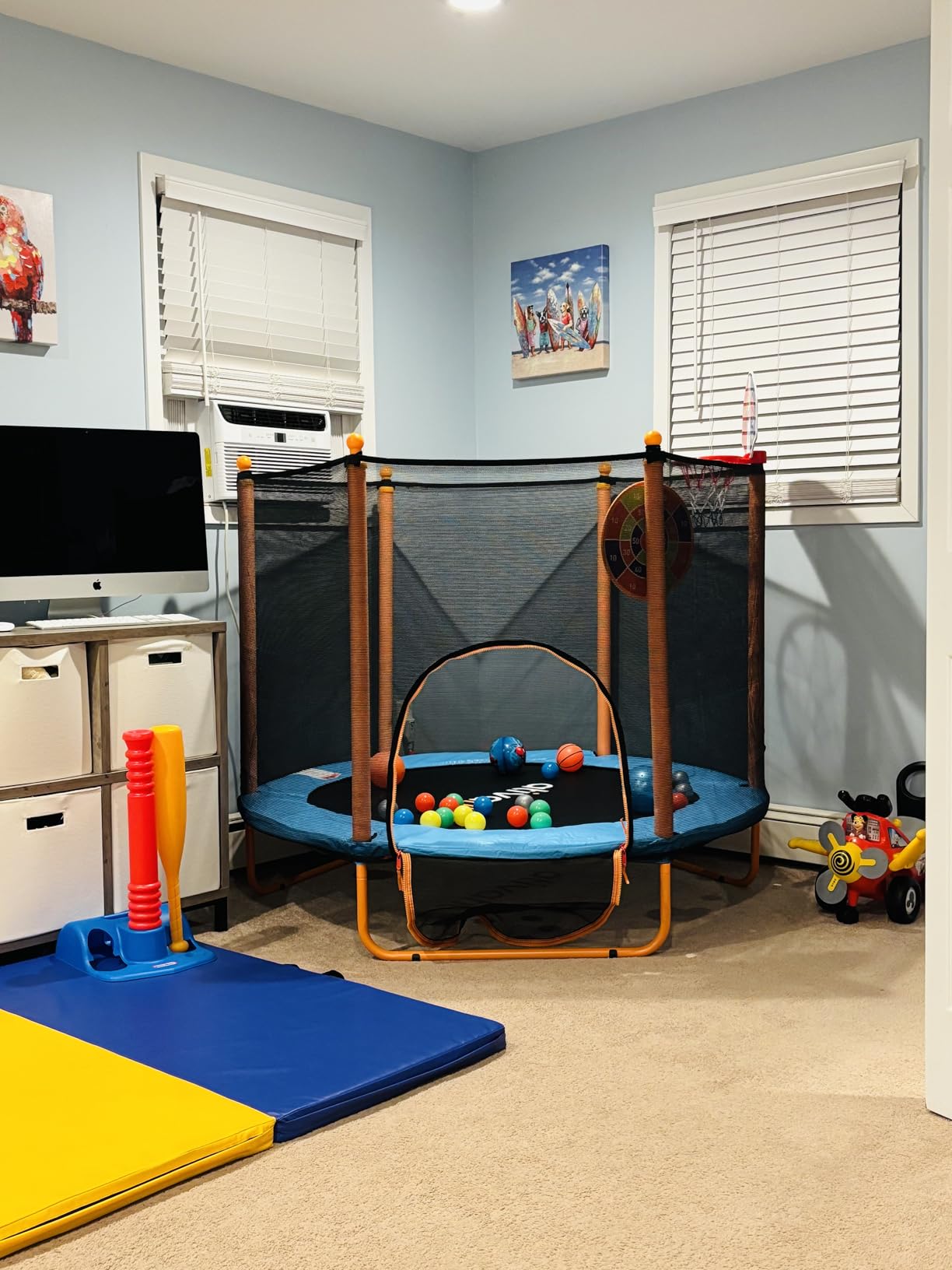
This is the pick when you have more than one small child and a hard floor. At 60 inches it is the largest of the enclosed models here, and owners report that two small children can share it comfortably, which no 36-inch handlebar unit in this list can do.
The zippered entrance is the feature that changes the use case. Because the net closes fully, some parents use it as a contained play area for a baby while an older sibling jumps, keeping the two activities in one footprint. The frame sits low with U-shaped legs and a hidden spring design under a three-layer thickened safety pad, so the springs are not exposed at all.
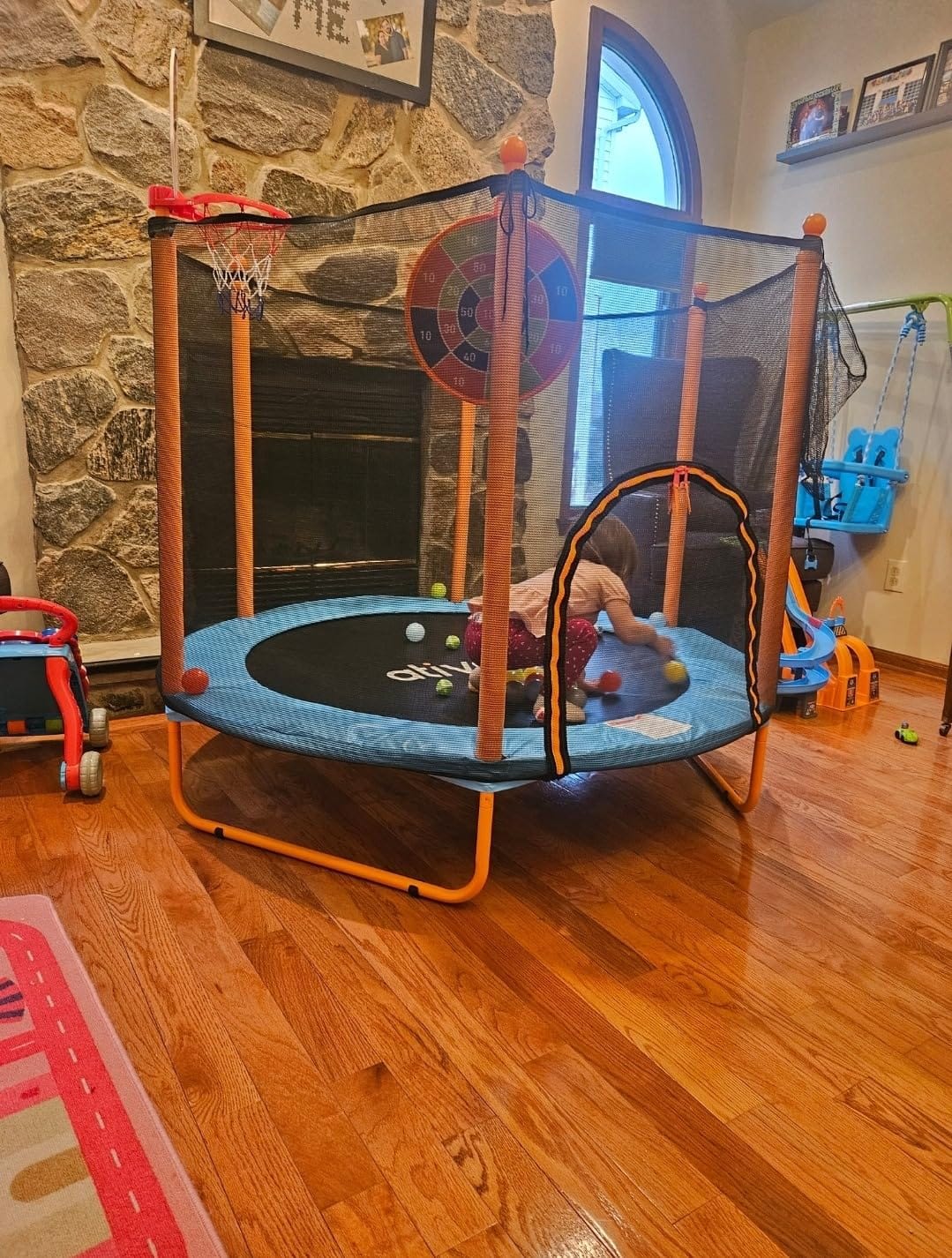
It measures 60 by 60 by 51 inches, uses 36 springs on an alloy steel frame, and is rated to 80 pounds, which the manufacturer positions for toddlers and preschoolers rather than older children. Accessories include a basketball hoop, a dartboard and an ocean ball, and a one-year manufacturer warranty applies.
The 4.6 average with an 85 percent five-star share reflects a product owners are happy to recommend, with the caveats concentrated in accessories and outdoor maintenance rather than in the jumping experience itself.
What you should check before buying
Two assembly items catch people out. The spring tube holes are not consistently punched on every unit, which makes spring installation harder than it should be, so check the tube before you start rather than mid-build. The basketball pole mount has also broken within the first hour of use for some buyers, and the manufacturer replaced one for a customer who asked.
If you plan to use it outdoors, anchor it. Enclosure posts can bend if the unit is not fixed down and wind gets behind the net, and dirt and grass become trapped between the inner net and the safety rim in a way that is genuinely hard to clean out later.
Who it suits and who it does not
It suits a family with two toddlers or a toddler and a baby, and it suits anyone who wants a single contained jumping zone that works on a hard indoor floor or a sheltered porch. The zip closure is the feature that makes it usable for more than one child at a time.
It does not suit older children, since the 80-pound rating stops well short of what a 7 year old needs. It also does not suit a small apartment, because a 60-inch frame is a genuine commitment of floor space, and the net-to-rim gap needs cleaning more often than a bare 36-inch model does.
9. BCAN BT1 36in Foldable Trampoline – Best for Small Spaces and Storage
BCAN BT1 36” Toddler Trampoline, ASTM Certified-Foldable Mini Trampolines for Kids Ages 1-6, Adjustable Handle, Safety Pad & Foldable Legs, Baby Trampoline Indoor/Garden, Gift for Boy and Girl, Beige
36 inch round frame
Folds to 3.5 inches
Spring-free elastic bands
Ages 1 to 6
Pros
- Folds to a quarter of its size for storage
- No metal springs and a stitched no-gap mat
- Two-level adjustable foam handle
- Neutral colours suit a living space
Cons
- Frame can still shift during vigorous bouncing
- Highest price among the 36 inch handlebar options
This is the one that answers the small-space question properly. It folds to roughly a quarter of its assembled size, which the manufacturer puts at about 3.5 inches tall when collapsed. That means it goes under a couch or into a closet between sessions, which is the whole point for a family without a playroom.
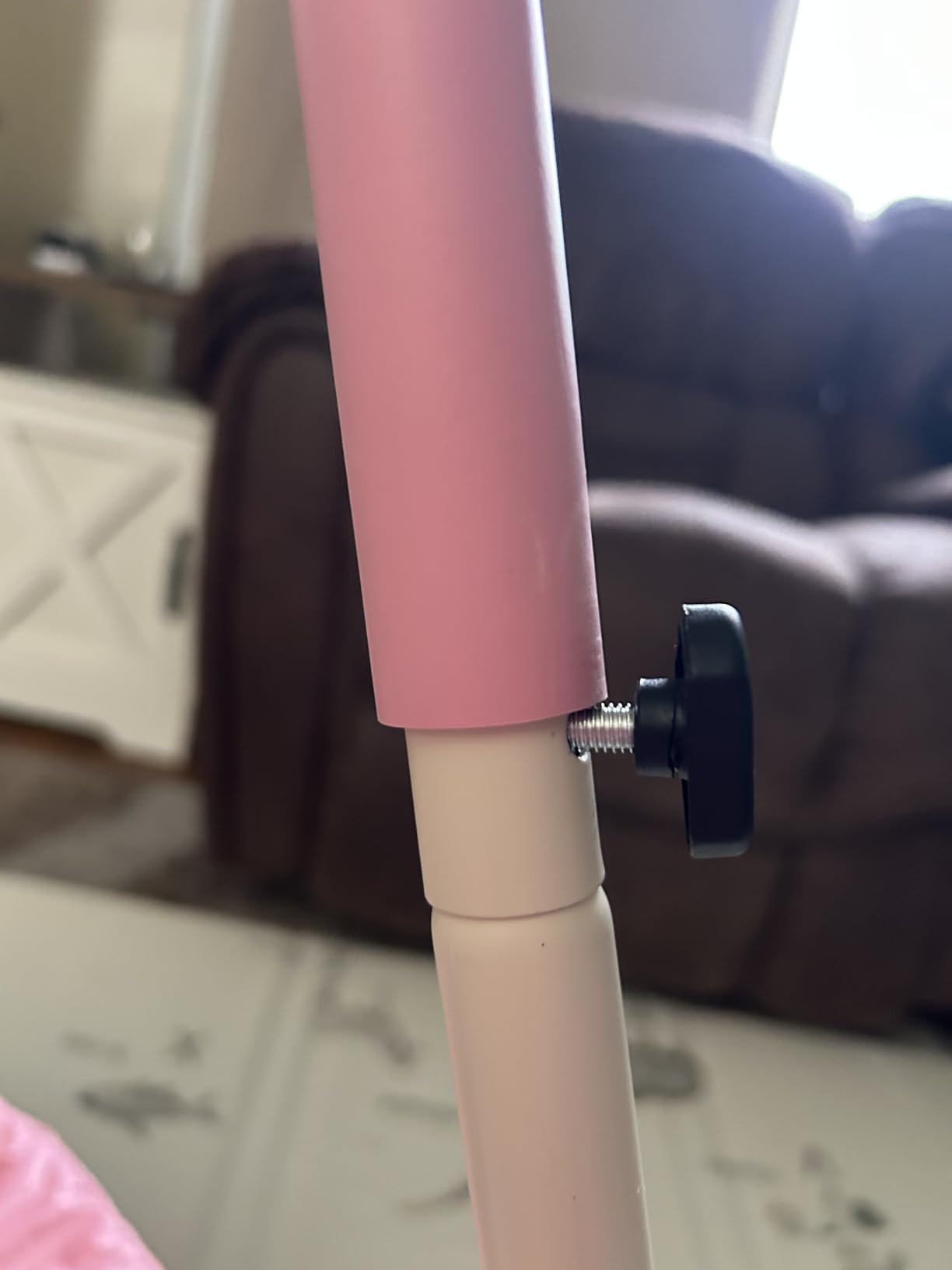
The build solves the spring question as well. There are no metal springs at all, just noise-free elastic bands, and the mat cover is stitched to the inside of the jumping surface so there is no gap around the perimeter. Combined with a two-level adjustable thickened foam handle, non-slip rubber leg ends, inward-curved handles and safety pins, it is one of the more thoughtfully engineered small units here.
The frame is 36 inches and measures 36 by 36 by 21.5 inches, with the manufacturer listing it for ages 1 to 6. Assembly is described as tool-free and taking about five minutes, which matters for a product you are setting up and putting away regularly. A one-year manufacturer warranty applies.
One detail is worth calling out for anyone with sensory or regulation needs. The colour options are described by owners as unusually neutral for a children’s product, and on r/Autism_Parenting the recurring request is specifically for a foldable mini trampoline with a multi-level adjustable handle in colours that do not read as toy-bright. This model matches that description more closely than anything else in the roundup.
What you should check before buying
The frame still shifts on the floor during vigorous bouncing, even with the rubber leg ends. That is normal for a folding design, where the leg joints carry more load than a fixed frame, but it means you should keep it on a hard surface and stay within sight of the child. Supervision does not change here.
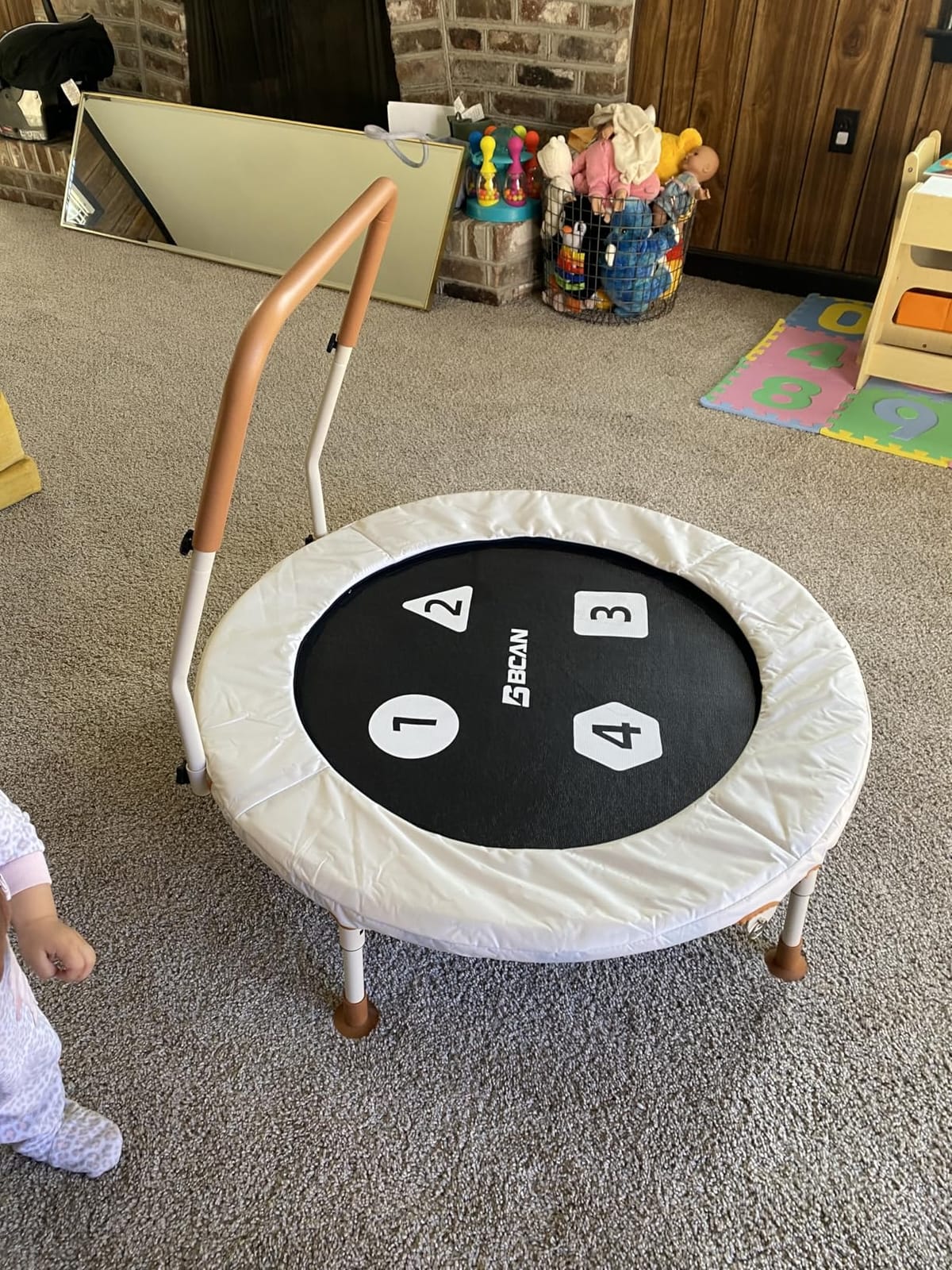
Also plan for the adjustment joints. The two-level handle is a clear benefit across ages 1 to 6, but like other adjustable-handle designs the pins and locking points need checking periodically, particularly if the child bounces hard while holding the bar.
Who it suits and who it does not
It suits a 1 to 5 year old in a small home where the trampoline has to disappear between uses, and it suits sensory-regulation routines where a quiet, contained jumping session is the goal. Starting at age 1 makes it the youngest-rated unit in the roundup.
It does not suit anyone who wants a high bounce, because the elastic band system is deliberately restrained. It also carries the highest price among the 36-inch handlebar options here, and the frame creep means it is not the right pick for a very high-energy child who will jump hard and unsupervised-adjacent.
10. Yohood 55in Enclosed Trampoline – Best ASTM-Certified Enclosed Unit
Yohood 55″ Trampoline for Kids with Enclosure, 6-in-1 Toddler Trampoline Indoor Outdoor, ASTM Certified Full Anti-Rust Tube with Adjustable Gymnastics Bars for Boys Girls Ages 3-10
55 inch round frame
176 lb weight limit
ASTM certified
Zippered door
Pros
- ASTM International certified
- Doubled-bolted galvanized frame
- Secure mesh with reinforced padding
- Suction cups anchor to the floor
- Adjustable handlebar
Cons
- Basketball net and punching bag do not mount as pictured
- Accessory problems only appear after full setup
If you want an enclosed unit with a certification you can point to, this is the one. It is ASTM International certified and uses a paint-coated galvanized steel frame with double-bolted connections, which owners describe as sturdy and shake-free. The construction is more careful than the other 55-inch models in this roundup, and that shows in the ratings.
The net is a secure mesh with reinforced edge padding and a zippered entrance, so a child can be kept inside without a parent lifting a flap every thirty seconds. That matters more than it sounds, because one of the recurring frustrations in parent forums is a child who treats an open net door as an exit.
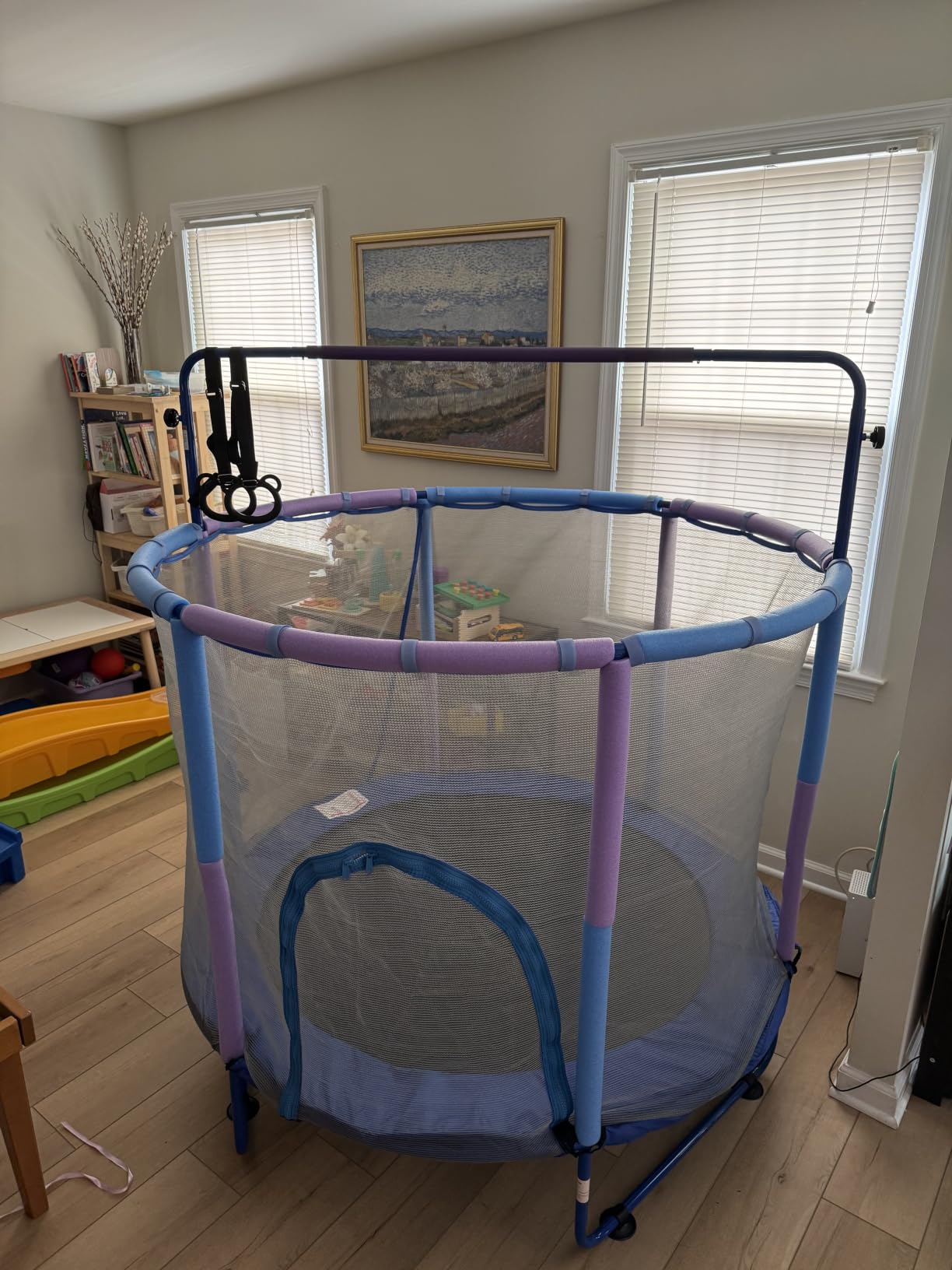
The manufacturer rates it for ages 3 to 10 with a maximum of 80 kg, which is 176 pounds, and specifies one child at a time. The frame measures 55 by 55 by 54 inches, taller than the other enclosed units here, with anti-slip suction cups that lock onto a floor and an adjustable handlebar that grows with the child. The warranty is one year.
The 4.7 average with an 87 percent five-star share comes with a small review base, so read it as consistent rather than proven. The one repeated complaint is specific and consistent.
What you should check before buying
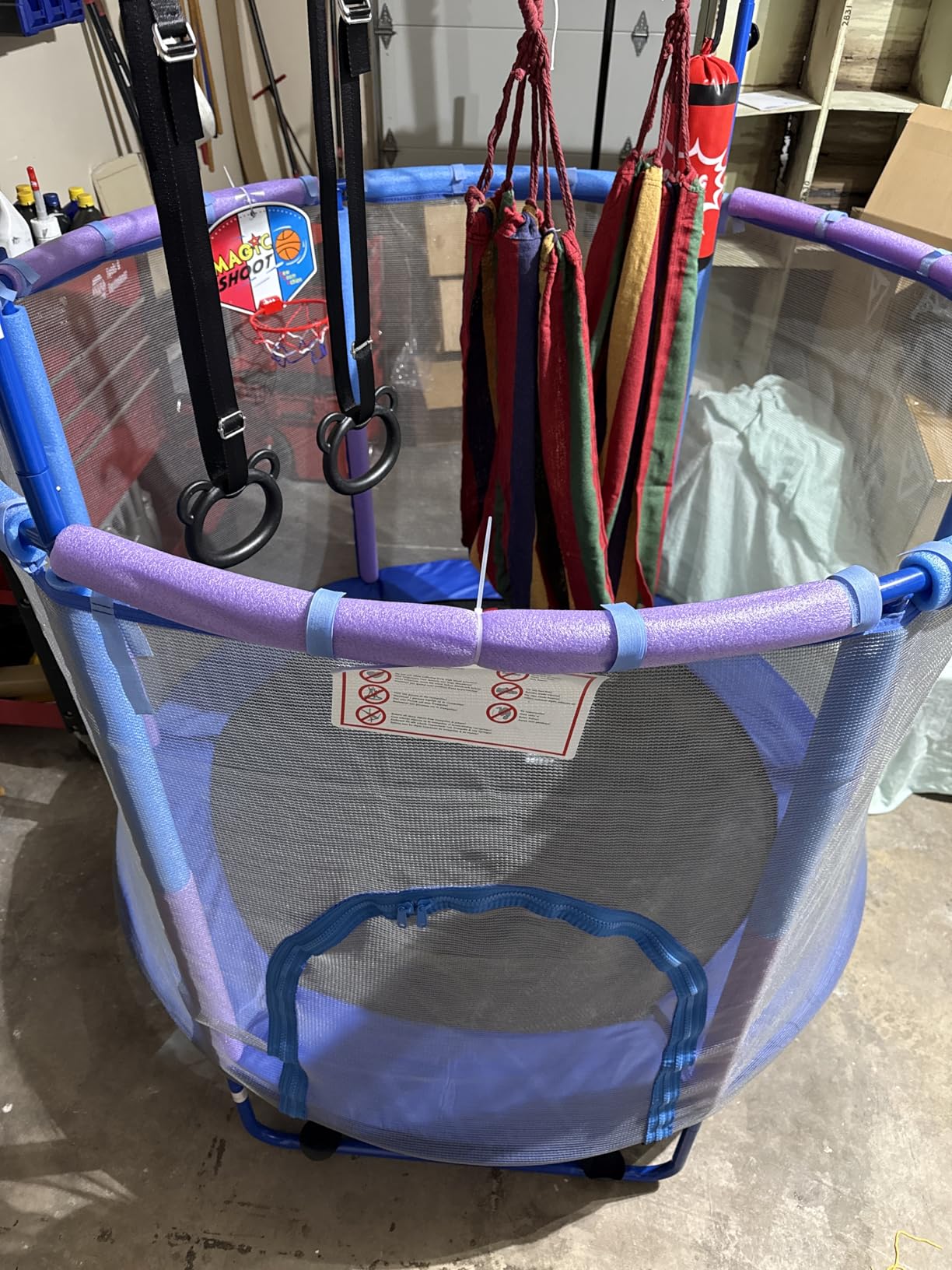
Check the accessories. The boxing bag and basketball hoop do not mount as pictured, and the punching bag in particular lacks a hanging strap, so a good share of the 6-in-1 set is not usable out of the box. The basket, rings, swing and gymnastics bar are the parts that work as intended. Most owners kept the trampoline anyway because the core jumping experience and frame quality met expectations.
Because the accessory problems only become apparent after full setup, assemble it before your child is excited about it rather than on the morning you plan to hand it over. That way you know exactly which pieces work and can set expectations about the rest.
Who it suits and who it does not
It suits a family with a backyard and a child aged 3 and up, particularly one who climbs or throws themselves rather than sitting and bouncing. The zippered door, the reinforced padding and the doubled frame are all aimed at a child who needs real containment.
It does not suit a 2 year old, since the manufacturer starts at 3, and it does not suit a small indoor space at 55 by 54 inches. The one-child-at-a-time rule also makes it a poor shared option, which is where the 60-inch enclosed model earns its place instead.
How to Choose a Toddler Trampoline Without Regretting It
Most disappointing purchases in this category come down to a mismatch between the child’s age and the containment type, or between the advertised size and the actual jumping surface. A few specific checks before you buy prevent almost all of that.
Handlebar or net enclosure? A handlebar is a stability aid, not a barrier. It gives a toddler something to hold while their balance develops, and it does nothing to stop a child bouncing off the mat edge. A net enclosure is a barrier, and it is the only option that works for a child who moves without looking or who is not yet willing to hold anything. Under about age 3, a handlebar plus close supervision is the normal setup. From 3 upward, a net with a zippered door is the safer choice.
Spring-free or metal springs? Metal springs covered by a fitted foam pad are the traditional answer. Elastic bands remove the gap a small finger can fall into entirely, at the cost of bounce height and air time. For a 1 or 2 year old in an indoor playroom, spring-free is the lower-risk option. For a 4 year old who wants real jumping, covered metal springs with a thick pad work well. On the spring-free side, the balance bikes we test for the same 2 to 4 age band serve a similar indoor energy-burn purpose if you want an alternative to jumping.
Diameter versus actual jumping surface. This is the sizing myth that catches out most buyers. A trampoline advertised as 3 feet measures 36 inches across the outside of the frame, and the usable jumping mat inside the pad is smaller than that. On a handlebar model, add the width of the bar and the clearance needed on each side. A 36-inch unit with a handle attached needs roughly a 4-foot square of clear floor, and parents in the forums repeatedly report this as the cause of returns.
Weight limit reality. The common toddler weight limits in this category sit at 55 pounds, which sounds generous until you look at the growth curve for a 4 or 5 year old. If your child is already above 40 pounds at age 4, plan on a 2 to 3 year lifespan rather than 5. Units rated at 150 to 440 pounds are not stronger or safer for a toddler, they are simply built for sharing with older children.
Indoor, outdoor, or a trampoline park. For an apartment, a 36-inch handlebar model or a foldable unit is the realistic answer, and a spring-free design keeps noise down for downstairs neighbours. For a yard, a 55-inch or 60-inch enclosed unit with a zippered door and anchors is the right scale. For trampoline parks, the honest answer for under-4s is that they are designed for older children, the ratio of staff to jumpers is low, and the shared surfaces carry more risk than a controlled home unit. If you go, go at off-peak hours, stay within arm’s reach, and expect to turn the visit around early.
Age-band routing. For a 1 to 2 year old, a spring-free handlebar or folding unit rated from age 1 is the fit. For a 2 to 3 year old, a 36-inch foam-handle model with a gentle bounce is the fit. For a 3 to 5 year old, move up to a 55-inch or 60-inch unit with a net enclosure and a zippered door, which is also the point at which the trampoline becomes shareable with a sibling.
Whichever you pick, adult supervision is required. Amy A. Skaria, MD of Hospital for Special Surgery, the safety authority quoted in our enclosed trampoline guide, frames it as padding that is thick and well fitted over the springs, frame and hooks so children are not landing on hard surfaces, netting all the way around the jump mat, and a net closure that is a zipper with an added buckle rather than a zipper alone.
Before every session, check five things: the spring cover or band system is intact, the foam pad has no tears, the net is fastened at every tie point, the handlebar locks positively, and the floor is clear. One jumper at a time on any unit under 60 inches, and move shoes, toys and furniture off the mat.
Frequently Asked Questions
What is the safest trampoline for a toddler?
The safest setup is the most enclosed one that fits your space: a low-to-the-ground trampoline with a net enclosure and a zippered door, or for under-3s a spring-free handlebar model with covered edges. Certification matters, and the ASTM-certified models in this roundup are the BCAN SP1 and the Yohood 55-inch. Supervision is the single biggest factor. No safety feature replaces an adult in the room.
Should 2 year olds use trampolines?
A 2 year old can use a small trampoline designed for their age, with a handlebar to hold and a low bounce. The models rated from age 1 or 2 in this roundup are the foldable BCAN BT1 and the 36-inch spring-free Ativafit. Avoid anything with exposed springs, keep sessions short, and stay within arm’s reach. Skip trampoline parks at this age, since the surfaces are scaled for older children.
What size trampoline do I need for a 2 year old?
For a 2 year old, a 36-inch round frame with a handlebar is the right starting size. A larger mat does not help a small child, because they cannot yet generate the height to use it, and it adds a larger area of mat to supervise. Budget a clear 4-foot square of floor once the handle is attached, since the advertised diameter is the outside of the frame rather than the jumping surface.
Is it safe for a 3 year old to go to a trampoline park?
Trampoline parks are built for older children and teenagers, and a 3 year old is at the young end of what staff expect to see. The shared surfaces, the crowd density and the low staff-to-visitor ratio all work against a small child who does not yet judge distance well. A home trampoline with a net and a zippered door gives you full control. If you visit a park anyway, go off-peak, stay within arm’s reach and leave early if your child is not landing on the mat.
How many kids are injured on trampolines every year?
Injury figures quoted in roundup testing cited by BestReviews put serious trampoline injuries at over 100,000 a year, with the large majority in children aged 6 to 14 rather than toddlers. The under-5 group is smaller mainly because most small children are not jumping on full-size units. The common injury types are landing on the mat edge, contact with frame or spring hardware, and collisions with other users, all of which a net, thick padding and one jumper at a time reduce.
The Bottom Line on Toddler Trampolines
For most families, the Little Tikes 3-Foot Trampoline is the best trampoline for toddlers, with covered springs, an angled foam-grip handlebar and the largest body of owner feedback in the category. If noise or small fingers are your worry, take the spring-free Ativafit 36in instead. If your child is 2 and needs a certification to point at, the BCAN SP1 is the closest fit. Move up to a 55-inch or 60-inch enclosed unit only once your child reaches 3 and a sibling is in the mix.
Whatever you choose, check the weight limit before you order rather than after, and remember that the handlebar is a grip, not a guard. Every unit in this roundup needs an adult in the room.