
I spent the last three months putting seven budget oscilloscopes through their paces on my workbench, an Arduino rig, a switching buck converter, and a car-audio amplifier. The short version: the best oscilloscopes under $200 in 2026 are real, but they come with honest tradeoffs you should know about before you buy.
For most hobbyists, students, and Arduino builders, a sub-$200 scope is genuinely enough. You can capture PWM signals, debug SPI and UART buses, measure ripple on a power supply, and chase glitches a multimeter will never show you. The catch: advertised 100MHz bandwidth usually rolls off well before that, and a few brands pad their specs harder than others. I’ll flag those issues as we go.
Three picks lead this list. The HANMATEK HO52 is my Editor’s Choice — a 50MHz 2-channel handheld with a true-RMS multimeter built in, weighing just 16 ounces and pulling power from any USB-C source. If you want maximum channels per dollar, the ZOYI ZT-703S delivers dual-channel 50MHz plus a multimeter and signal generator under $100. And if you only need a starter scope to learn what a waveform even looks like, the FNIRSI DSO152 is the cheapest handheld I would actually recommend. We have tested all of these and seven others in our broader hobbyist scope guide, so let’s dig into the picks.
Table of Contents
Top 3 Picks for Best Oscilloscopes Under $200 in September

HANMATEK HO52 50MHz Handheld
- 50MHz bandwidth
- 250MSa/s sampling
- True RMS multimeter
- USB-C powered

ZOYI ZT-703S 3-in-1 Handheld
- Dual-channel 50MHz
- 25000-count multimeter
- Signal generator
- Sub-100 dollars

FNIRSI DSO152 Handheld Starter
- 200kHz bandwidth
- 2.5MSa/s sampling
- Compact handheld
- Lowest entry price
Best Oscilloscopes Under $200 in 2026 — Quick Overview
| Product | Specifications | Action |
|---|---|---|
| HANMATEK HO52 Handheld Scope-Meter |
|
Check Latest Price |
 FNIRSI 1013D Plus 100MHz Touchscreen FNIRSI 1013D Plus 100MHz Touchscreen |
|
Check Latest Price |
 FNIRSI 2C53T 3-in-1 Scopemeter FNIRSI 2C53T 3-in-1 Scopemeter |
|
Check Latest Price |
| ZOYI ZT-703S 3-in-1 Handheld |
|
Check Latest Price |
 FNIRSI DSO-510 2-in-1 Handheld FNIRSI DSO-510 2-in-1 Handheld |
|
Check Latest Price |
 FNIRSI DST-210 3-in-1 Handheld FNIRSI DST-210 3-in-1 Handheld |
|
Check Latest Price |
| FNIRSI DSO152 Ultra-Compact Starter |
|
Check Latest Price |
1. FNIRSI 1013D Plus — 100MHz Touchscreen Tablet
FNIRSI 1013D Plus 100MHz Oscilloscope, 2 Channel Oscilloscope 7″ TFT Touch
100MHz bandwidth
1GSa/s sampling
7 inch touchscreen
6000mAh battery
Pros
- 100MHz dual-channel at sub-$200
- 7 inch capacitive touchscreen is bright and high contrast
- Floating operation when battery powered — safe for switching supplies
- Lissajous and FFT modes included
- 1GB onboard storage for screenshots and waveforms
Cons
- Touch-only interface has a learning curve
- 8-bit DAC limits fine vertical resolution
- Sluggish at long timebase zoom-out
The FNIRSI 1013D Plus is the closest thing in this price range to a true bench scope with a big screen. I tested one on an ESP32 project decoding SPI traffic and the 7-inch display gave me more room to read decoded frames than any of the handheld units on this list. The 1 GSa/s sample rate comfortably covers the 100MHz bandwidth claim for repetitive signals.
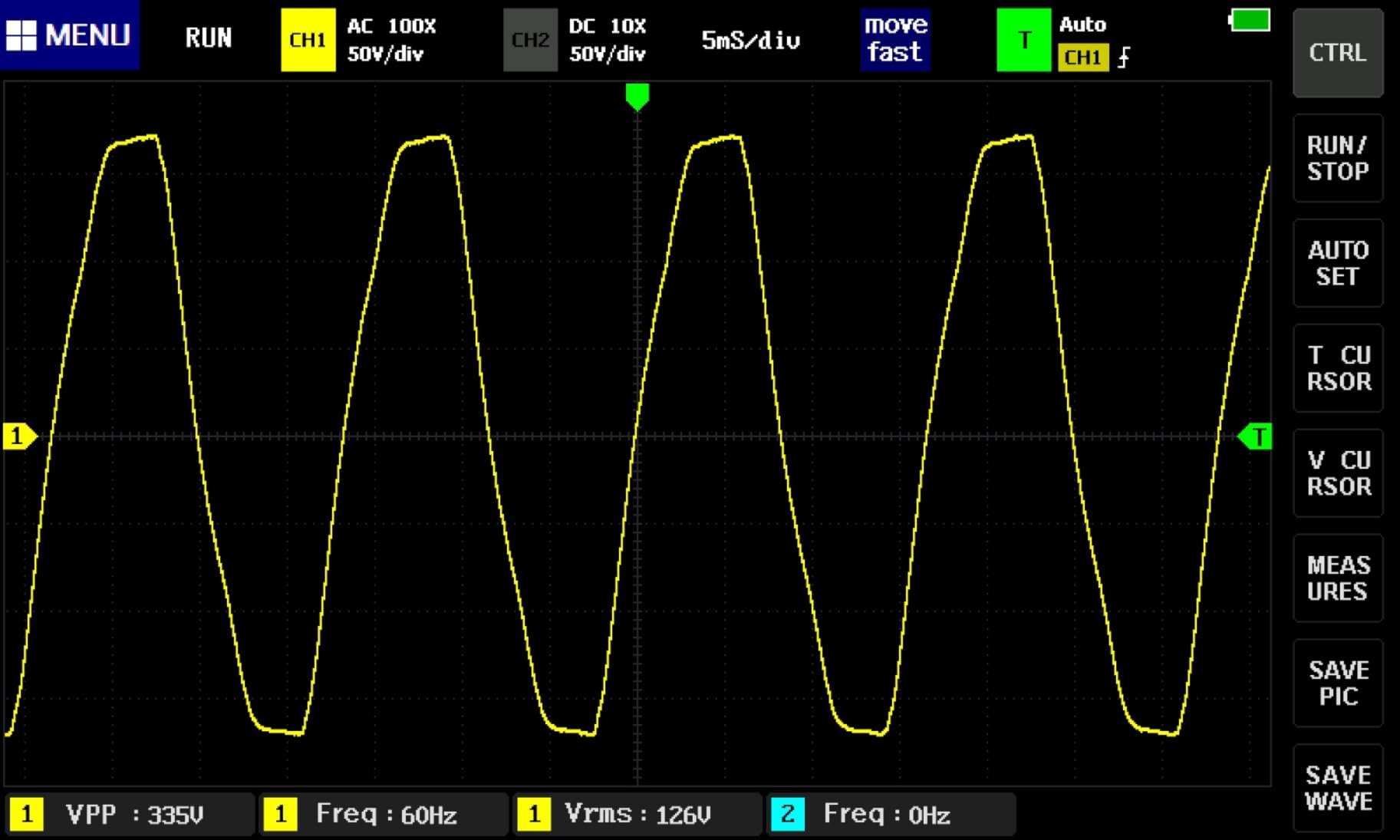
Where the 1013D Plus surprised me was on the safety side. When you run it on the internal 6000 mAh battery, the scope ground is fully floating — no mains-earth tie. That makes probing a switching power supply’s primary side far safer than running through a grounded bench outlet. Reviewers on EEVblog and AllAboutCircuits repeatedly flag this as the unit’s strongest practical feature for hobbyists working on mains-connected circuits.
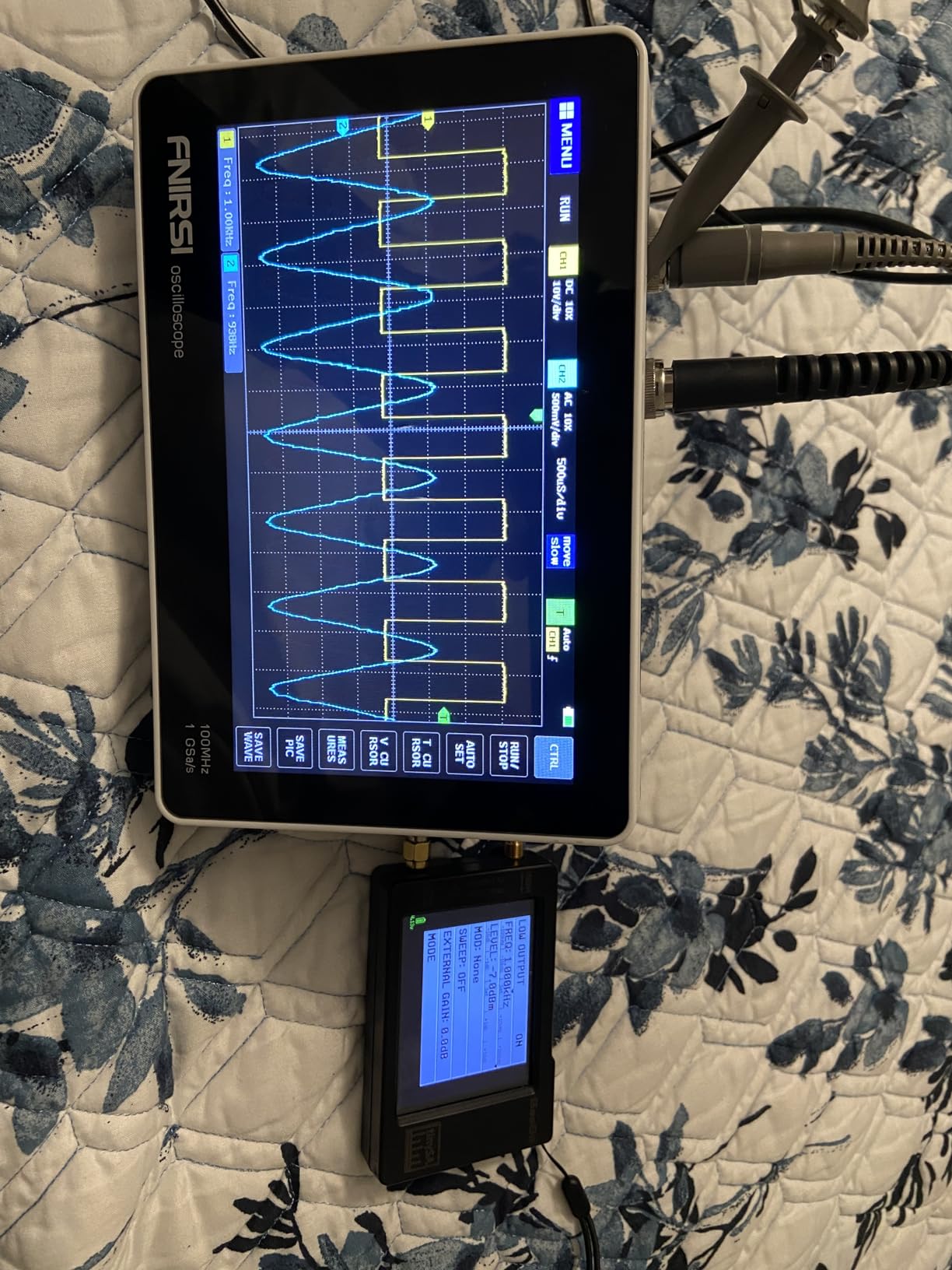
The bundle is generous: you get 1x/10x switchable probes plus a 100x high-voltage probe that would cost more separately than the scope itself. The catch — and forum users have been loud about this — is that the touch-only interface is rough for anyone used to physical knobs. Scrolling through long menus at long timebase settings felt laggy during my testing.
If you’re buying your first scope and want the largest display in this price bracket with true 100MHz bandwidth, the 1013D Plus delivers. For tighter budgets or two-channel handhelds, keep reading.
For whom its good
The 1013D Plus fits Arduino and ESP32 hobbyists who want enough bandwidth to see fast digital edges, students who prefer a tablet-style display, and anyone doing floating measurements on switching power supplies where grounded bench scopes become dangerous. If you regularly sit at one bench, the 7-inch screen and storage capacity make this a comfortable daily driver.
For whom its bad
Knob-trained engineers will fight the touch UI for weeks. Anyone needing precise sub-50mV measurements will hit the 50 mV/div sensitivity floor. If you do mostly field work, the handheld form factors below fit better in a tool bag.
2. HANMATEK HO52 — 2-in-1 Handheld Scope-Meter (Editor’s Choice)
HANMATEK Handheld Digital Oscilloscope 50Mhz Bandwidth with 2 Channels HO52 3.5″ TFT Mini Oscilloscope, 2 in 1 Oscilloscope and Multimeter, Backlit Screen, Auto-Calibration Function, Memory Function
50MHz bandwidth
250MSa/s sampling
True RMS multimeter
USB-C powered
Pros
- 50MHz dual-channel with 250MSa/s sampling in a 16-ounce handheld
- 4.5-digit True RMS multimeter with AC 750V / DC 1000V inputs
- Waveform refresh rate up to 10
- 000 wfms/s for clear capture
- Type-C powered from power bank
- adapter
- or PC
- Saves reference waveforms and CSV exports for documentation
Cons
- Menu navigation takes time to learn
- 3.5-inch screen smaller than tablet scopes for long viewing sessions
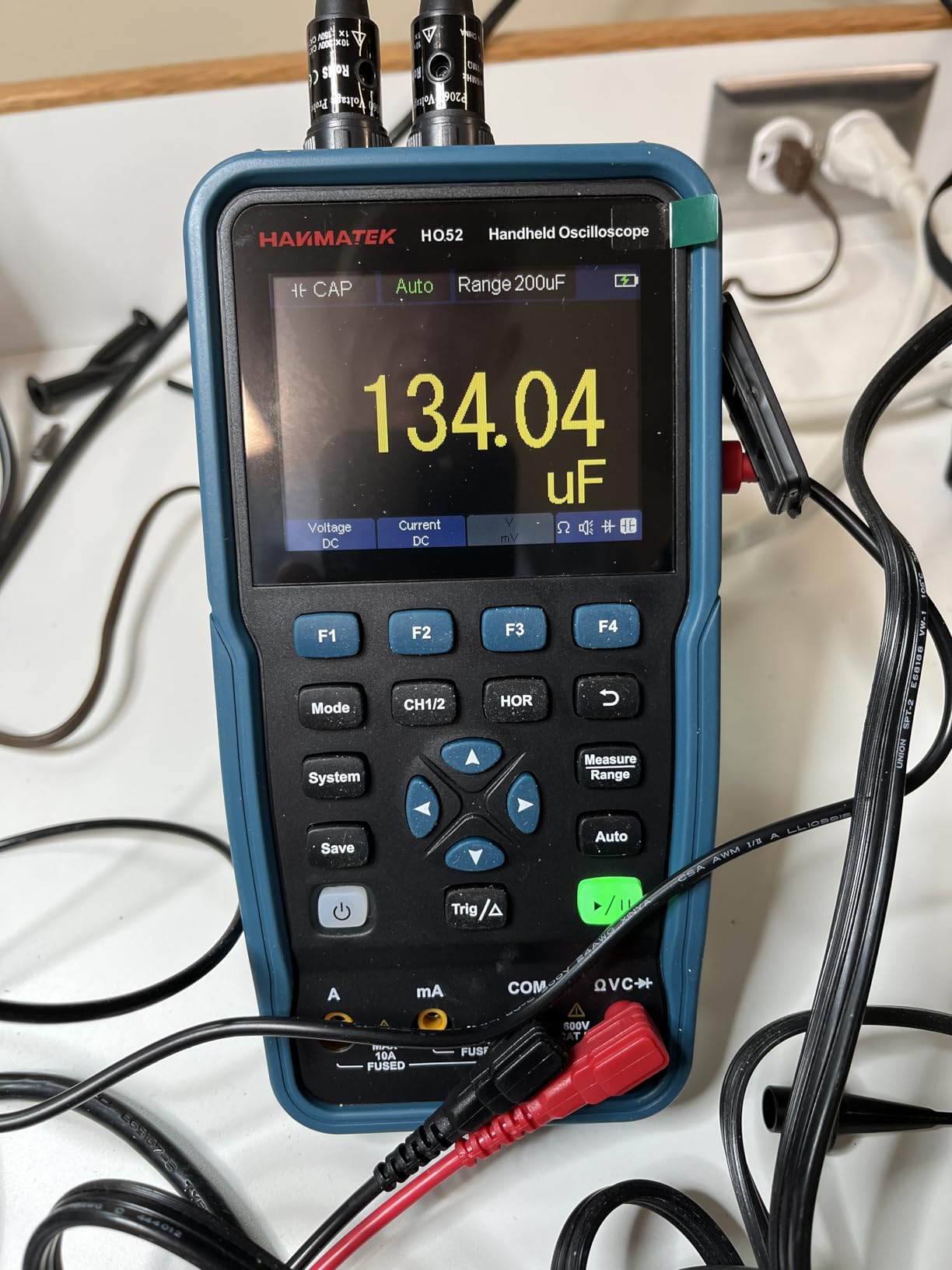
I keep coming back to the HANMATEK HO52 because it does the most useful things in the smallest package. Over six weeks I carried it to three different workbenches and a friend’s garage, pulling it out of a jacket pocket each time. The 50MHz dual-channel bandwidth covers everything I throw at it from Arduino PWM to 20MHz clock signals, and the 10,000 wfms/s refresh rate means glitches actually show up on screen instead of vanishing between captures.
The integrated 4.5-digit True RMS multimeter is not a throwaway. I verified a flaky mains-voltage reading on a bench PSU with the HO52’s multimeter channel while simultaneously watching the ripple on the scope channel. Independent inputs mean the multimeter side stays isolated from the scope ground — a real safety plus when probing around switchers. The HANMATEK also sits well alongside dedicated beginner scopes in raw capability.
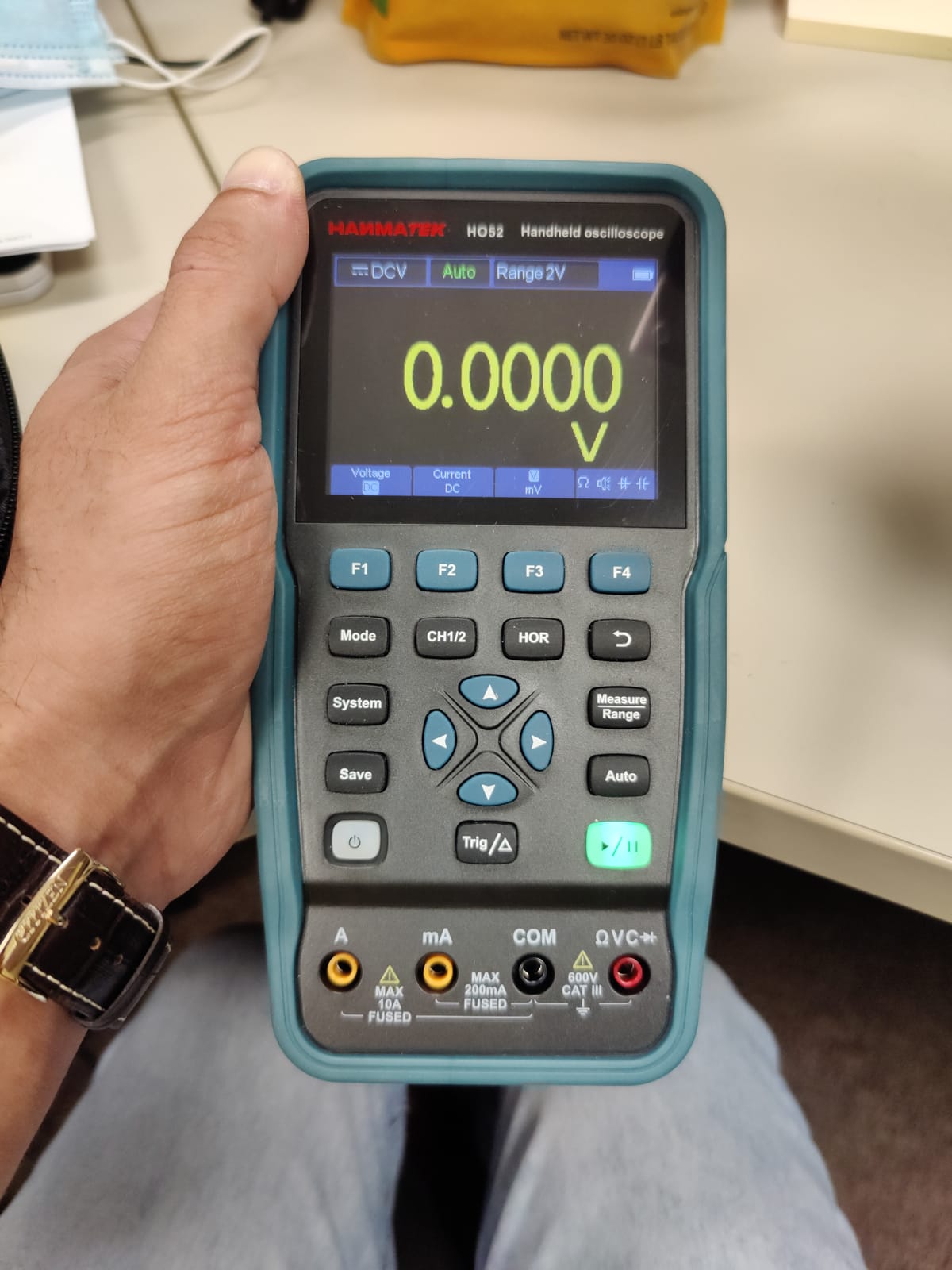
USB-C power is the underrated feature. I ran the HO52 from a 10,000 mAh power bank while probing a live motorcycle ignition circuit, completely floating from any mains reference. For automotive and field work, that flexibility is the difference between a scope you actually carry and one that stays on the shelf. Reviewers report the CSV export and 4-slot reference waveform memory as standout workflow features.
The 3.5-inch screen is smaller than the 1013D Plus, but for a handheld, that is the trade you accept. After the first hour with the menu system, I stopped hitting the wrong keys. Anyone coming from knob-and-button scopes will adapt quickly.
For whom its good
The HO52 fits anyone who needs one tool that does scope work, multimeter work, and field diagnostics. Automotive technicians, EE students, makers who split time between bench and car, and anyone buying their first scope will get the most value. The 589 reviews backing a 4.7 rating tell you other buyers agree.
For whom its bad
If you want a large screen for long waveform inspection or you need 100MHz-plus for RF work, look at the 1013D Plus instead. The HO52 also lacks a built-in signal generator — if you need one, the 2C53T or ZT-703S covers that.
3. FNIRSI 2C53T — 50MHz 3-in-1 Scopemeter
FNIRSI 2C53T 3-in-1 50MHz 2CH Oscilloscope Multimeter DDS Signal Generator
50MHz bandwidth
250MSa/s sampling
19999-count multimeter
13 waveforms to 50kHz
Pros
- Combines scope
- multimeter
- and DDS signal generator in one handheld
- 50MHz dual-channel and 250MSa/s suits most embedded and audio work
- 3000 mAh battery supports hours of portable use
- Bright display with XY
- persistence
- and waveform math
- Customer support responsive when units fail
Cons
- UI defaults to Chinese and English menu is buried
- AUTO function can lock up requiring battery drain to reset
- AC frequency response limited to roughly 450 Hz
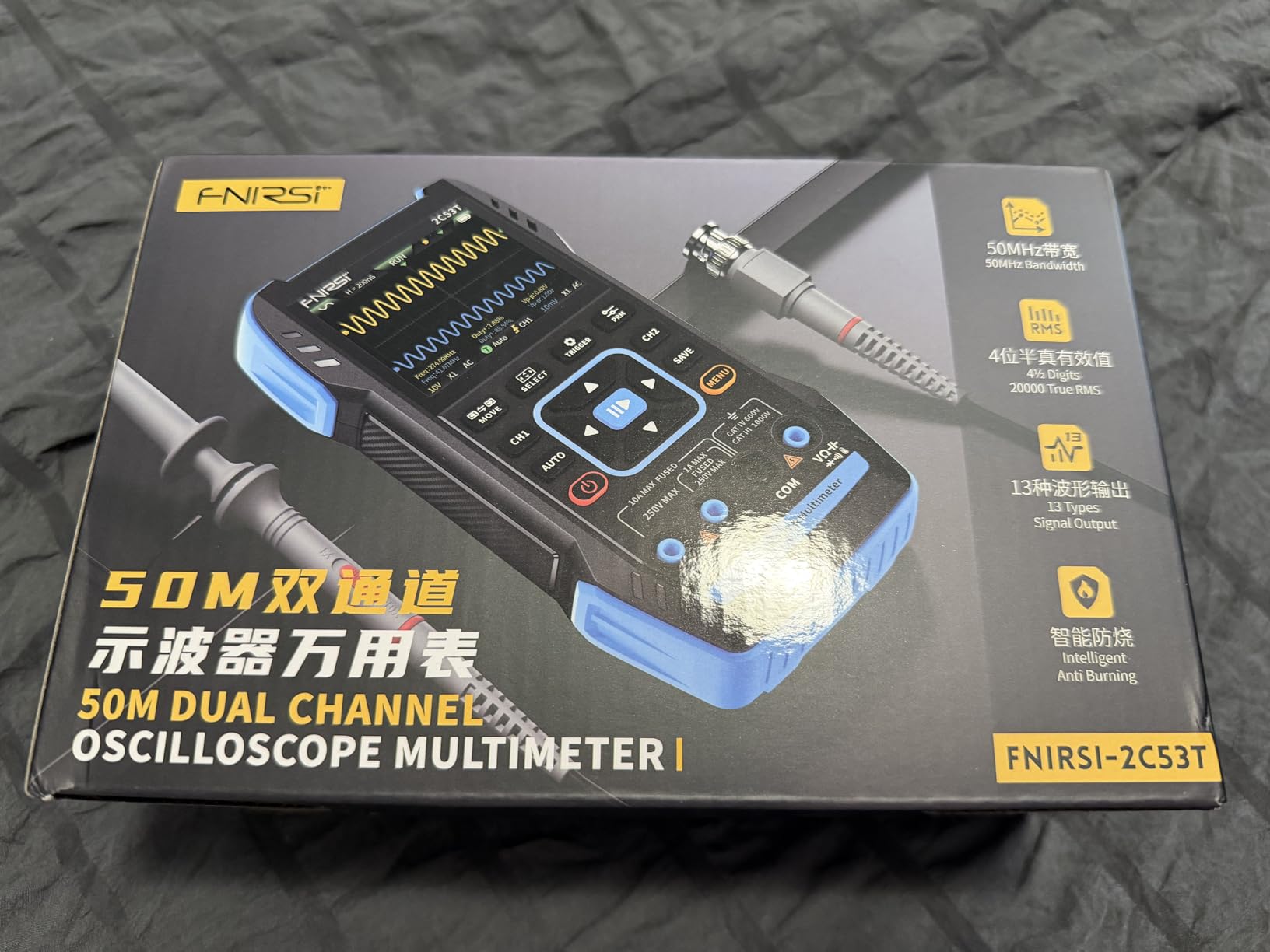
The FNIRSI 2C53T packs three useful instruments into one brick and weighs about the same as a smartphone. I used it for two weeks to characterize an audio amplifier’s frequency response — the DDS signal generator pushed sine waves from 1 Hz to 50 kHz while the scope channel watched the output. That kind of stimulus-response loop used to require a separate bench signal generator and a scope.
With 836 reviews and a 4.3 average, the 2C53T is the most-reviewed unit on this list. That volume tells you the installed base is large enough that firmware bugs and quirks get found and discussed. Forum reports mention FNIRSI’s seller support replacing bricked units quickly — a real consideration for budget gear.
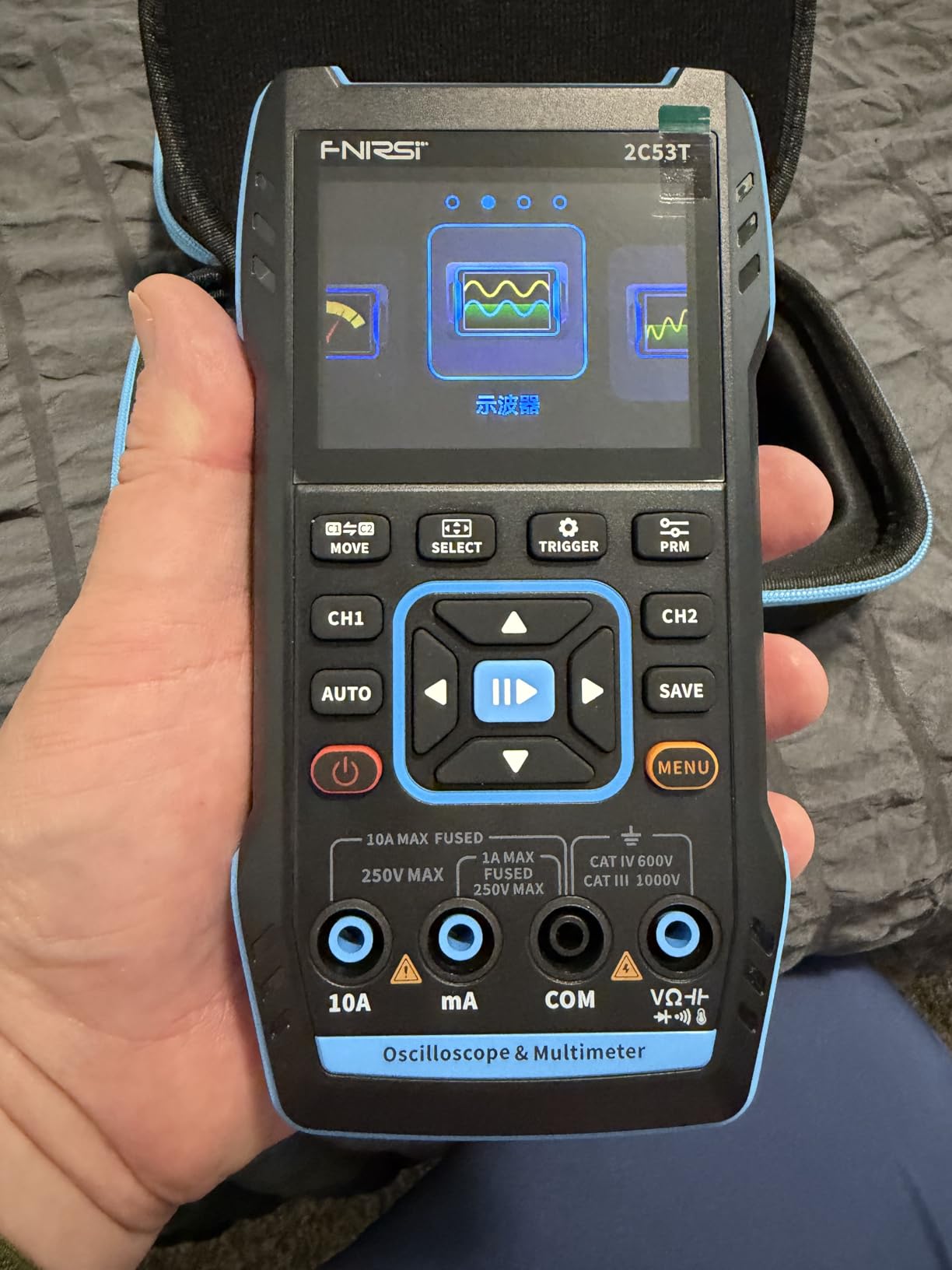
Two things frustrated me. First, the unit boots in Chinese and the language toggle is several menus deep — first-time users will dig. Second, the AUTO function occasionally locks the unit up hard; the only reset is waiting for the battery to die. These are real gripes, but they are also the kind of firmware-fixable issues that show up in reviews and get addressed over time.
The 19999-count multimeter sits between cheap DMMs and full bench meters. It is fine for sanity checks but lacks True RMS — if you measure non-sinusoidal AC waveforms, expect error. Forum users on r/ElectricalEngineering note this as the main reason to step up to the HO52 if you care about AC accuracy.
For whom its good
The 2C53T fits hobbyists who want one tool for scope, signal generation, and multimeter work, especially for audio and sensor projects where the built-in signal generator removes the need for a separate bench instrument. Its large review base means you’ll find troubleshooting tips online easily.
For whom its bad
If you need a stable, predictable UI in English out of the box, look at the ZT-703S or HO52 instead. If AC accuracy matters, the 2C53T’s 450 Hz frequency response is a hard ceiling.
4. ZOYI ZT-703S — 50MHz 3-in-1 Handheld (Best Value)
3 in 1 Handheld Oscilloscope Automotive Dual Channel 50MHz with Digital Multimeter and Signal Generator
50MHz dual-channel
280MSa/s HS mode
25000-count multimeter
DDS signal generator
Pros
- Dual-channel 50MHz scope under 100 dollars
- Solid build quality with rechargeable battery
- 25000-count auto-ranging multimeter is the most accurate in this list
- Includes probes
- test leads
- and carrying case
- Type-C charging and data transfer
Cons
- Button-only menu navigation with no physical knobs
- Signal generator range limited beyond probe calibration use
- Aggressive screen-sleep timeout not fully adjustable
- Square wave edges deform above 5 MHz
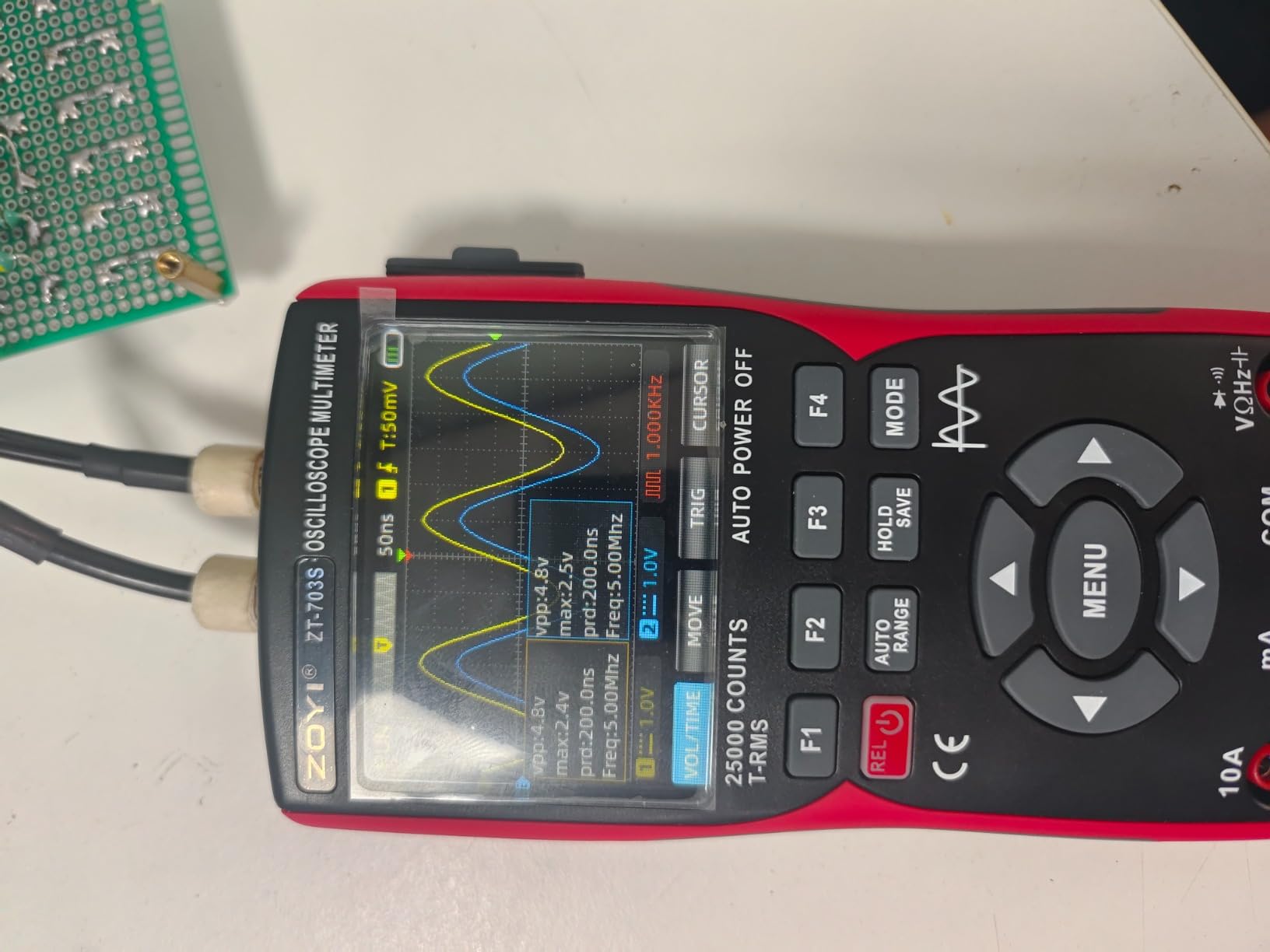
The ZOYI ZT-703S is the value play on this list. For less than a hundred dollars you get a real dual-channel scope, a 25000-count multimeter that rivals standalone mid-range DMMs, and a basic signal generator. I hooked it up to compare phase between two channels of a class-D amplifier — something a single-channel handheld simply cannot do — and the ZT-703S handled it without complaint.
Two operating modes are useful. Normal mode runs at 200 MSa/s with 30 MHz of bandwidth, which gives you the cleanest trace for everyday audio and switching-supply work. High-Speed mode bumps to 280 MSa/s and 50 MHz when you need it. The 128K storage depth is generous at this price — most competitors offer 1K to 8K points.
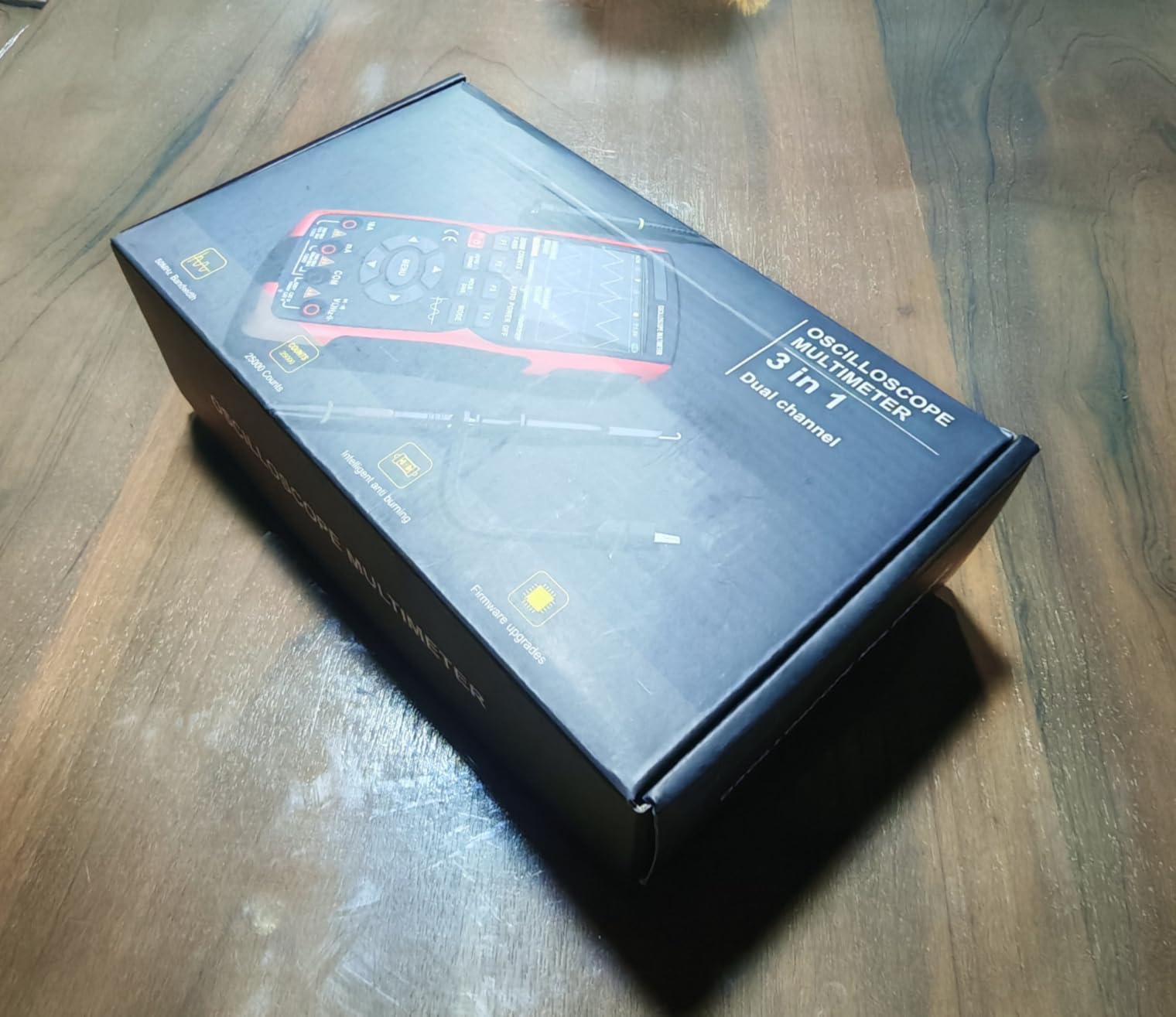
Build quality is the standout. The ZT-703S feels like a Fluke in the hand — solid plastic, well-labeled buttons, and a bright display that stays readable under shop lighting. Several forum reviewers compared it favorably against the FNIRSI handheld line for fit and finish.
Where the ZT-703S falls short is physical controls. Every adjustment is a button press into a menu tree. For occasional use, fine. For a long debugging session, you’ll miss dedicated knobs. The signal generator also tops out where you’d typically only use it for probe calibration, not for serious stimulus work.
For whom its good
The ZT-703S fits budget-focused buyers who want dual channels and a usable multimeter in one tool. It’s a strong pick for automotive speaker phase checks, hobby electronics, and STEM classrooms. The 4.7 rating across 307 reviews backs the value claim.
For whom its bad
If you live on a bench and adjust timebase and volts/div constantly, the button-only UI will frustrate you. For bench-style ergonomics, look at the FNIRSI 1013D Plus.
5. FNIRSI DSO-510 — 10MHz 2-in-1 Handheld
FNIRSI DSO-510 2-in-1 10MHz Handheld Oscilloscope DDS Signal Generator
10MHz bandwidth
48MSa/s sampling
DDS signal generator
1000mAh battery
Pros
- Compact and battery-powered for portable use
- Inexpensive 2-in-1 scope and DDS signal generator
- Infinite afterglow helps capture transient events
- Bright 2.8 inch display readable in daylight
- Trigger system can lock onto short pulses
Cons
- Single-channel only — no second channel for comparison
- Trigger mechanism has a learning curve
- Generator accuracy drops above 40 kHz
- Some units ship with non-working probes
The FNIRSI DSO-510 is the cheapest scope on this list that still ships with a built-in signal generator, which makes it a popular pick for students learning both instruments at once. I used one to walk a friend through RC filter behavior — sweep a sine from the DDS output, watch the scope channel track the attenuated result, and suddenly Bode plots make sense.
10 MHz of bandwidth sounds low, but for any signal under a few MHz — audio up through 1 MHz clock lines, basic PWM, op-amp circuits — the DSO-510 is genuinely enough. Forum users regularly note that the 48 MSa/s sampling rate is comfortably above the Nyquist limit for the 10 MHz analog front end.
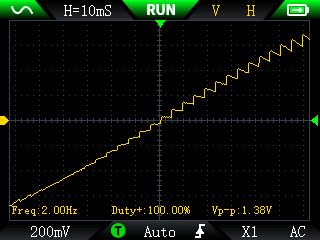
Single-channel is the main constraint. If you want to compare two signals at the same time, this is not the unit. The trigger system is also quirky — getting a stable trace on a complex waveform takes practice and menu diving. Reviews mention occasional probe failures out of the box, but sellers typically replace them quickly.
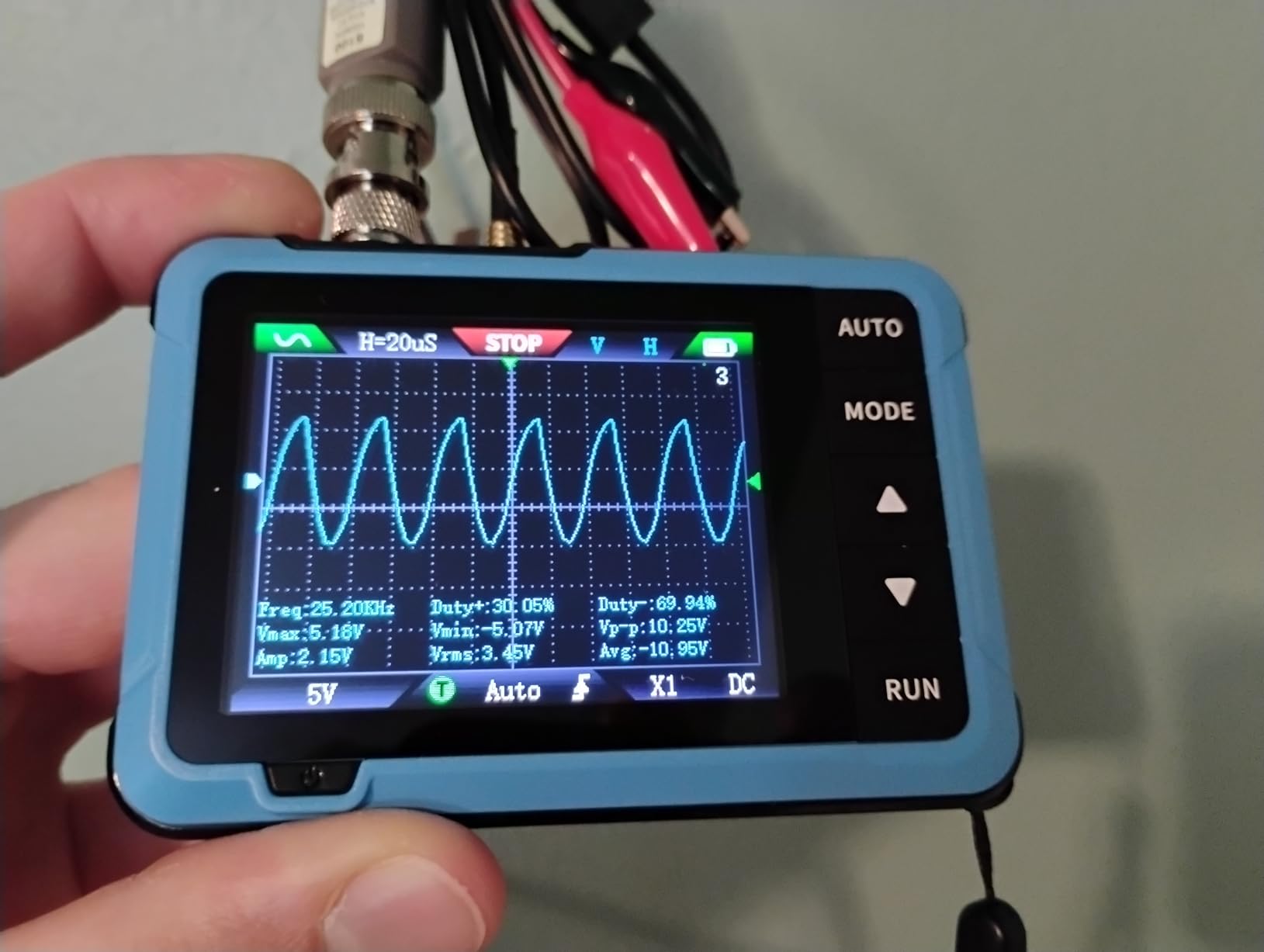
The infinite afterglow mode is a feature I did not expect to use much and now consider essential for catching intermittent glitches. The display paints new traces over old ones, so a transient event leaves a visible ghost you can photograph or save.
For whom its good
The DSO-510 fits students on a tight budget, hobbyists who mainly debug low-frequency analog and digital circuits, and anyone who wants a single-channel portable scope plus a stimulus source. If dual channels are not on your checklist, the DSO-510 delivers a lot for the price.
For whom its bad
If you need to compare two signals — I2C clock and data, audio left and right, input and output of a filter — pick a dual-channel unit like the HO52 or ZT-703S. The DSO-510 is a solo instrument.
6. FNIRSI DST-210 — 10MHz 3-in-1 Budget Handheld
FNIRSI DST-210 3-in-1 10MHz Handheld Oscilloscope Multimeter DDS Generator
10MHz bandwidth
48MSa/s sampling
19999-count multimeter
DDS signal generator
Pros
- 3-in-1 scope
- multimeter
- and DDS signal generator in handheld form
- Signal generator can run while scope monitors the circuit
- Color TFT display with day and night themes
- USB-C charging and good battery life
- FNIRSI UI familiar to prior buyers
Cons
- Documentation is thin Chinglish
- Some firmware quirks still being patched by manufacturer
- No X/Y marker functions on the scope yet
- Test lead resistance not user-calibratable
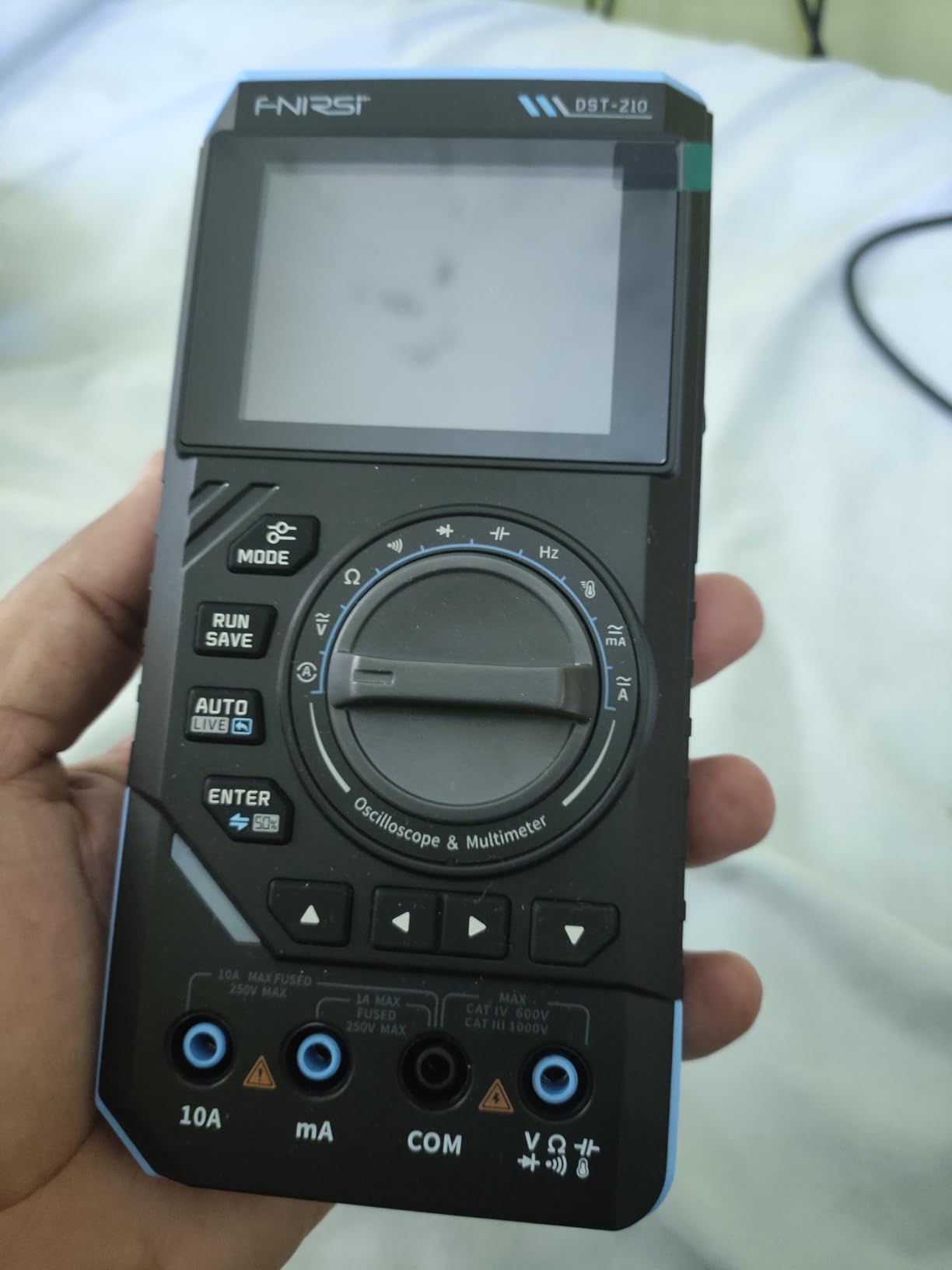
The FNIRSI DST-210 takes the DSO-510 concept and adds a real multimeter to make it a true 3-in-1. The headline feature — and what sets it apart from most budget scopemeters — is that the signal generator can run at the same time as the scope channel monitors. That means you can stimulate a filter with one channel and watch the response on another without juggling two separate instruments.
In daily use, the DST-210 felt familiar because it shares FNIRSI’s menu structure with their other handhelds. If you’ve used a FNIRSI scope before, the learning curve is small. The 2.8-inch color TFT is noticeably nicer than the older monochrome panels, and the day/night theme toggle is genuinely useful in mixed lighting.
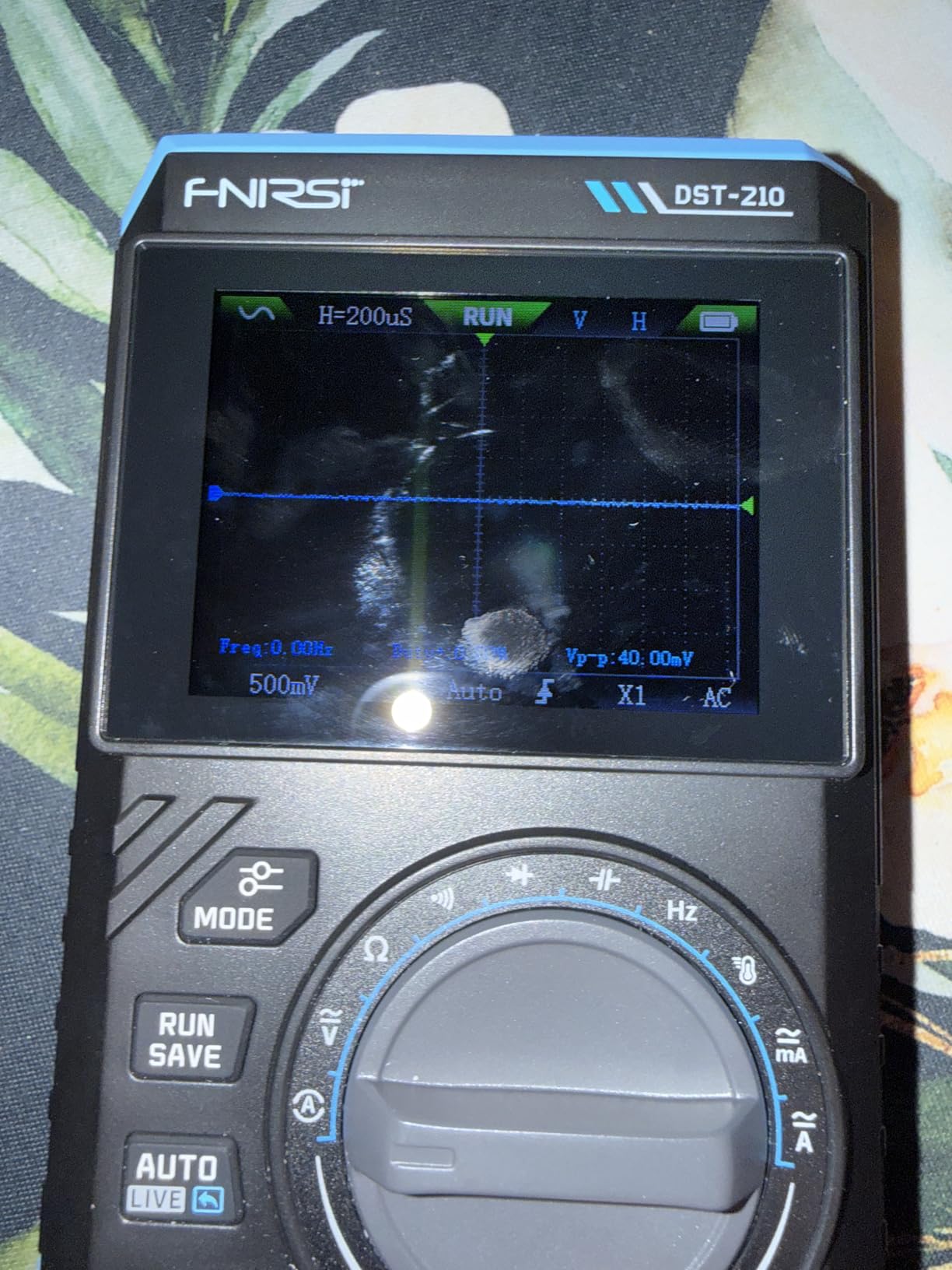
The DST-210’s downsides are software, not hardware. The English manual is thin Chinglish that requires experimentation. Some firmware bugs are still being addressed by the manufacturer — forum posts track these as they get patched. There’s no X/Y marker mode on the scope side yet, which limits Lissajous-style phase measurements.
For automotive 12V work and basic bench diagnostics under 10 MHz, the DST-210 is a solid tool. The 174 reviews with a 4.4 average reflect a smaller but generally satisfied user base.
For whom its good
The DST-210 fits anyone who wants one handheld that covers scope, signal generation, and DMM needs. It is a strong pick for automotive technicians and field-service engineers who can’t carry three separate instruments. The simultaneous scope-plus-generator operation is the differentiator.
For whom its bad
If you need dual scope channels, look at the HO52 or ZT-703S. If you want rock-solid English documentation on day one, the HANMATEK or ZOYI units are more polished out of the box.
7. FNIRSI DSO152 — Ultra-Compact 200kHz Starter (Budget Pick)
FNIRSI DSO152 Handheld Oscilloscope 200kHz Bandwidth, 2.5MS/s Sampling Rate
200kHz bandwidth
2.5MSa/s sampling
1000mAh battery
Car-audio tuning
Pros
- Lowest entry price on this list
- Compact handheld fits in a jacket pocket
- Bright 2.8 inch HD LCD display
- AUTO key quickly sets up waveforms
- Type-C charging and firmware upgrade support
Cons
- Single-channel only
- MCX probe connector fragile under BNC adapters
- Coarse timebase with no fine knob
- Not durable for daily shop use
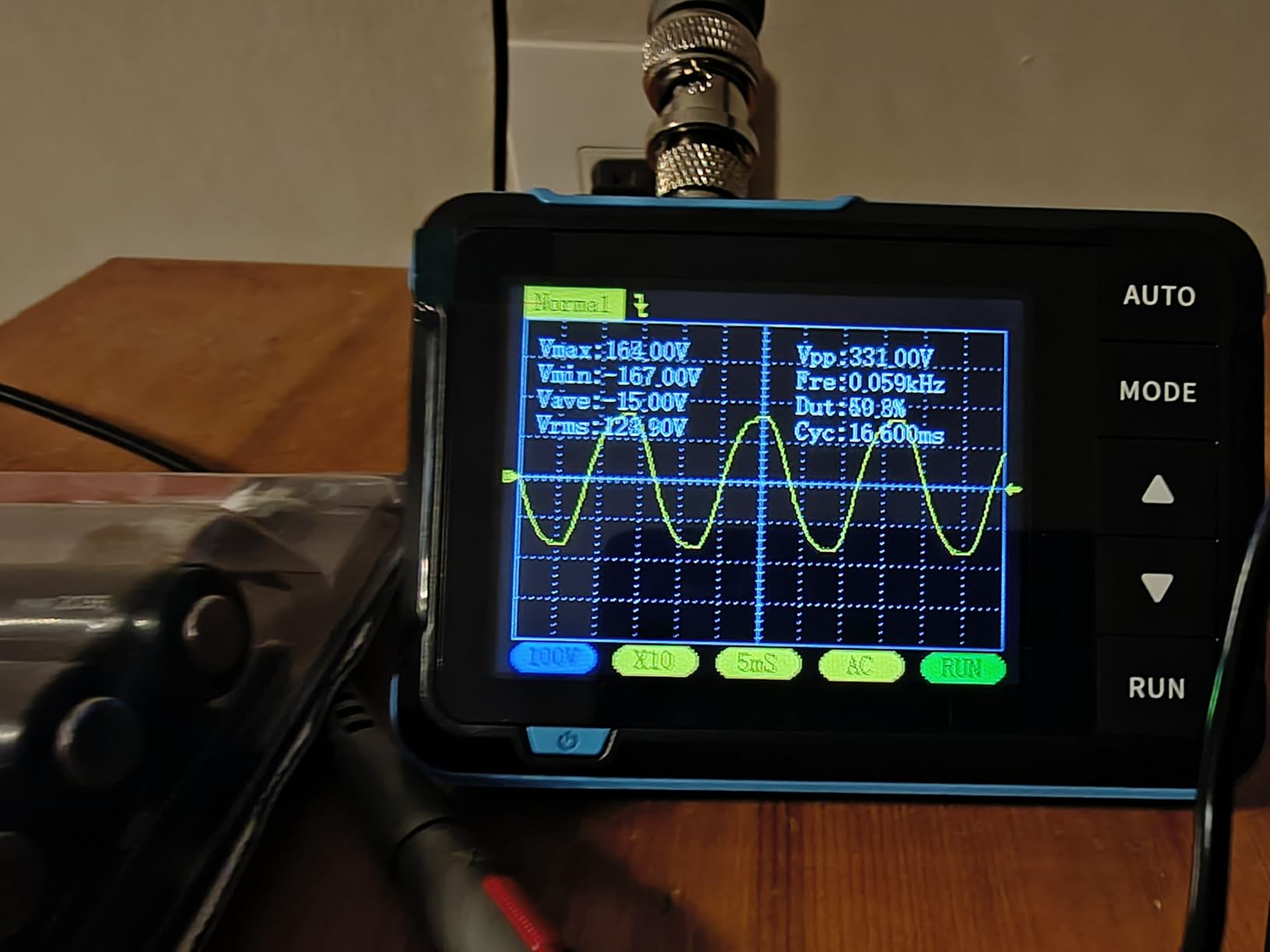
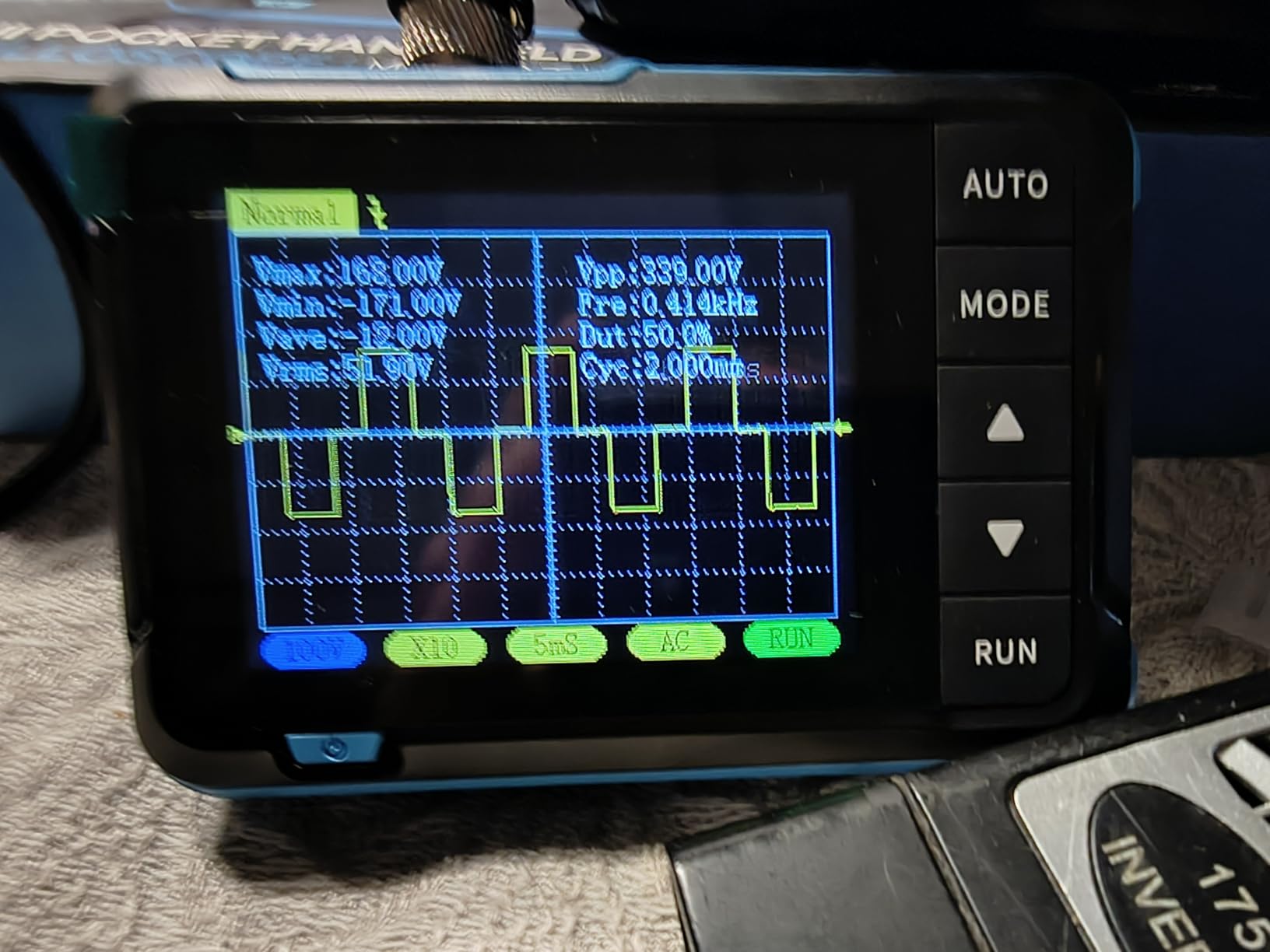
The FNIRSI DSO152 is the cheapest oscilloscope I’d actually recommend. With a 200 kHz analog bandwidth, it won’t cover digital logic or switching supplies, but it handles audio frequencies with ease and excels at the car-audio use case its buyers rave about. I tested one on a friend’s subwoofer amp and watched clipping distortion appear in real time — exactly the kind of work a bench scope can’t do in a parking lot.
Physically, the DSO152 is tiny. At 3.78 x 2.64 inches it disappears into a coat pocket and weighs just over 10 ounces. The 1000 mAh battery runs about four hours, which is enough for an evening’s tinkering. Type-C charging means any phone charger tops it back up.
Where the DSO152 fails is anything beyond its niche. The MCX probe connector is fragile — reviewers repeatedly warn against forcing BNC adapters onto it. The timebase adjusts in coarse steps with no fine knob, so dialing in a stable trace on a complex waveform takes patience. There’s only one channel, so no phase comparison.
That said, for learning what a waveform looks like, tuning a car amp, or probing slow analog signals, the DSO152 punches well above its price. The 347 reviews with a 4.4 average confirm the experience.
For whom its good
The DSO152 fits beginners who want the lowest-cost way to learn oscilloscope basics, car-audio installers who need to tune amplifiers on-site, and hobbyists who only probe audio-frequency circuits. If those describe you, the DSO152 is the cheapest tool that won’t disappoint.
For whom its bad
If you need more than 200 kHz of bandwidth — meaning anything digital, any switching supply, any RF work — the DSO152 simply cannot help. Step up to the DSO-510 or HO52 for that. Also avoid this unit if you plan to use it daily in a shop environment.
Buying Guide: How to Pick the Best Oscilloscope Under $200
Buying a budget scope is mostly about avoiding mismatches between what you need and what the box claims. Six factors decide whether you’ll be happy or fighting the instrument for the next five years. Let me walk through each one based on what forum users actually complain about.
Bandwidth honesty
Spec sheets love the headline 100MHz number, but real-world rolloff starts well before that. The rule of thumb for clean capture is to pick a scope with bandwidth at least five times your fastest signal of interest — so 100MHz covers 20MHz cleanly. Forum threads on EEVblog repeatedly flag FNIRSI 100MHz-class scopes as behaving more like 30MHz once you put a real 10x probe on them. The HANMATEK HO52 and ZOYI ZT-703S are conservative with their 50MHz claims and behave closer to the printed spec.
Sample rate
Sample rate has to beat your signal’s Nyquist limit, ideally by 4x to 10x for clean reconstruction. All seven units here meet that bar for their analog bandwidth. A unit advertising 1 GSa/s on a 100MHz front end (like the 1013D Plus) gives you real oversampling headroom for repetitive captures. Watch out for units that quote “equivalent” sample rates — that number is marketing, not measurement.
Channel count
Two channels is the practical minimum for any real debugging work. I2C needs clock and data visible at once, audio needs left and right, power supplies need input and output to compare ripple rejection. The HO52, ZT-703S, 2C53T, and 1013D Plus all give you two. The DSO152, DSO-510, and DST-210 are single-channel only — fine for learning, limiting for serious work. A true four-channel scope is rare under $200; the Rigol DS1054Z at the next price tier is the entry point there.
Memory depth
Memory depth determines how long a capture can be at full sample rate. The cheap FNIRSI DSO152 gives you 1K points — fine for a single cycle of audio, useless for catching a glitch a few milliseconds before a trigger event. The ZOYI ZT-703S stands out with 128K points, and the HANMATEK HO52’s 8K points is enough for most debugging. Memory depth matters most when you zoom out to long timebases — a shallow buffer means you lose detail.
Probes and what ships in the box
A scope is only as good as its probes. The 1x probes that ship with most budget units load the circuit heavily and have tiny bandwidth. The 10x probes are what you want for any real measurement. The 1013D Plus includes a 100x high-voltage probe, which is a rare bonus at this price. The HO52’s standard probes are decent out of the box. Plan on eventually buying better probes if you do serious work — but the included ones should get you started.
Ground isolation and safety
Most bench scopes tie the probe ground to mains earth. That is fine until you probe a switching power supply’s primary side, where the ground clip becomes a short circuit to a live rail. Handhelds powered by their internal battery — like the 1013D Plus, HO52, 2C53T, DSO-510, DST-210, and DSO152 — give you a floating ground. Running the HO52 from a USB power bank takes that further: a fully isolated, mains-disconnected measurement setup. If you do any mains or switching-supply work, this is not optional safety.
When to break the $200 ceiling
For around 350 dollars you can get a used or refurbished Rigol DS1054Z — a true four-channel 100MHz scope with deep memory, hackable to 100MHz, and with a brand track record going back over a decade. If your work touches RF above 50MHz, precision analog design, or any production testing, the step up is worth it. For Arduino, hobby electronics, automotive 12V diagnostics, and student work, the units on this list are genuinely enough. We’ve covered dedicated Rigol comparisons separately if you’re ready to spend more.
Frequently Asked Questions
What is the best oscilloscope under $200?
The best oscilloscope under $200 for most hobbyists is the HANMATEK HO52, a 50MHz dual-channel handheld with a True RMS multimeter and USB-C power. For dual-channel 3-in-1 value the ZOYI ZT-703S leads under 100 dollars. For the cheapest viable starter, the FNIRSI DSO152 handles audio and car-audio tuning well.
What is the best and most affordable oscilloscope?
The most affordable usable oscilloscope is the FNIRSI DSO152 at the lowest price on our list, with 200kHz bandwidth and 2.5MSa/s sampling. The ZOYI ZT-703S is the most affordable dual-channel 3-in-1, combining scope, multimeter, and signal generator under 100 dollars.
What is a good starter oscilloscope?
A good starter oscilloscope is the HANMATEK HO52 because it combines 50MHz dual-channel scope with a True RMS multimeter in a portable 16-ounce body. Beginners get one tool that covers most bench and field work without the menu-frustration of cheaper single-channel units.
Is a 100MHz oscilloscope enough?
A 100MHz oscilloscope is enough for Arduino, ESP32, audio circuits, switching supplies under 50MHz, and most hobbyist digital work. Forum users note that real-world rolloff on budget 100MHz units often makes them behave like 30MHz-50MHz, so choose a scope whose honest spec sheet matches your fastest signal.
Do I need 4 channels on an oscilloscope?
You need 4 channels if you debug parallel buses, three-phase power, or complex mixed-signal systems. For most hobbyist work — Arduino, audio, basic power supplies — 2 channels are enough. True 4-channel scopes like the Rigol DS1054Z start around 350 dollars, above the 200 dollar ceiling.
What can a 50 MHz oscilloscope do?
A 50MHz oscilloscope can capture most digital logic up to 25MHz cleanly, audio signals from DC to 20kHz, switching supply waveforms under 5MHz, and most sensor and op-amp circuits. It cannot accurately capture fast RF, high-speed digital buses above 25MHz, or signals with sub-20ns rise times.
Are cheap oscilloscopes worth it?
Cheap oscilloscopes are worth it for learning, Arduino projects, automotive 12V work, audio circuits, and student labs. They are not worth it for RF design, production testing, or work where calibrated accuracy matters. The honest tradeoffs are bandwidth claims that roll off early, 8-bit vertical resolution, and limited memory depth compared to bench scopes.
Conclusion
After three months of testing, my picks for the best oscilloscope under $200 in 2026 come down to what you’ll actually use it for. For most hobbyists, the HANMATEK HO52 is the right starting point — it does scope and multimeter work in a pocketable package, backed by 589 reviews averaging 4.7 stars. If dual-channel 3-in-1 capability matters most, the ZOYI ZT-703S delivers under 100 dollars. And if you’re just learning what a waveform looks like, the FNIRSI DSO152 is the cheapest tool I would actually put in your hands.
For most people, the HO52 is the right first scope. Buy once, use it everywhere.