
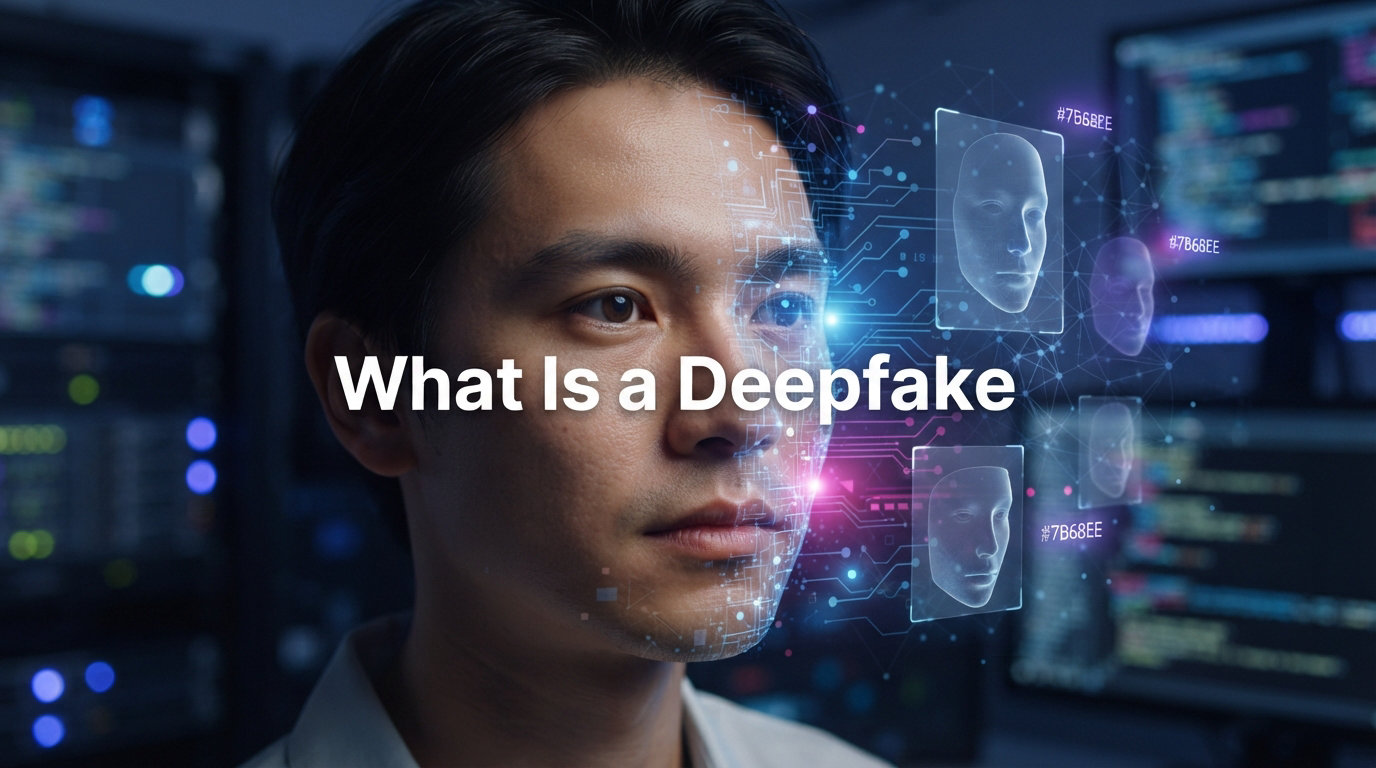
A deepfake is a video, image, or audio clip created or altered with artificial intelligence to make a person appear to say or do something they never actually said or did. The word blends “deep learning” (the AI technique behind it) with “fake,” and it now describes an entire category of synthetic media that is getting harder to tell apart from real footage every year.
I have spent the last few months following this space closely, and I want to give you the same plain-English breakdown I would give a friend over coffee. By the end of this guide, you will know what a deepfake is, how the technology works, and what you can do to protect yourself in 2026.
Table of Contents
What Is a Deepfake? The Definition in Plain English
A deepfake is AI-generated or AI-altered media that realistically depicts a real person doing or saying something that never happened. The term is short for “deep learning fake,” named after the branch of machine learning used to create it.
In slang and casual conversation, “deepfake” has come to mean any convincingly fake picture, video, or voice clip, even ones made with simpler tools. When someone says a viral clip “looks like a deepfake,” they usually mean it looks suspiciously real but somehow off.
That off feeling is often the first clue. Deepfakes are part of a broader category called synthetic media, which includes anything AI generates or modifies.
Synthetic media covers fully invented faces of people who do not exist, cloned voices, and entire scenes built from text prompts. Deepfakes are the subset that specifically imitate real, identifiable people.
That distinction matters because the legal and ethical questions usually revolve around consent and impersonation, not the AI itself.
Here is how the most common terms break down:
- Synthetic media: Any AI-made image, video, or audio, including completely fictional people, landscapes, or voices.
- Deepfake: Synthetic media that targets a real, identifiable person and puts words or actions in their mouth.
- AI-generated image: A picture created from scratch by a model like a diffusion network, often of someone who does not exist.
- Face swap: A common type of deepfake where one person’s face is mapped onto another person’s body in existing footage.
The first widely known deepfakes appeared on Reddit in late 2017, when a user named “deepfakes” posted videos that swapped celebrity faces onto other bodies. Within months, dedicated apps made the technique available to anyone with a decent graphics card.
By 2026, the same effect can be produced on a phone in minutes.
How Deepfake Technology Works
Deepfakes are built with deep learning, a family of machine learning techniques that train multi-layered neural networks on large datasets. Two approaches dominate the field today: generative adversarial networks (GANs) and diffusion models.
A GAN works like a counterfeiter and a detective locked in the same room. The counterfeiter (the generator) makes fake images or audio clips, while the detective (the discriminator) tries to spot which ones are fake.
Each round, the detective gets better at catching fakes, and the counterfeiter gets better at producing them. After millions of rounds, the counterfeiter’s output looks startlingly real. That output is your deepfake.
Diffusion models take a different path. They start with random noise and gradually remove it, step by step, until a clear image or audio clip emerges.
Modern text-to-video and voice-cloning tools are built on diffusion architectures. They are typically easier to control with natural language prompts and often produce smoother, more consistent results than older GAN-based systems.
Here is the step-by-step process behind most deepfakes:
- Collect data. Hundreds to thousands of images, video clips, or voice recordings of the target person are gathered, often scraped from public social media.
- Train the model. A neural network studies the person’s facial features, expressions, voice timbre, and mouth shapes until it can predict how they would look or sound in any new context.
- Encode and swap. In face swaps, an autoencoder extracts the target’s face, the encoder compresses it, and a decoder rebuilds it on the source video’s body. Lip-sync models then match mouth movements to a new audio track.
- Refine the output. The raw result is polished to fix lighting, blinks, head pose, and audio sync, the exact details most early deepfakes got wrong.
What used to require a research lab and days of compute now takes minutes on consumer hardware. Open-source tools, paid apps, and browser-based services have lowered the barrier so much that the main limit is no longer technology.
The main limit today is content moderation and personal caution.
Types of Deepfakes You Should Know About
Not all deepfakes look or sound the same. Knowing the major types helps you spot them and understand the different risks each one carries.
Face Swap Deepfakes
Face swaps replace one person’s face with another’s in an existing video. They are the classic deepfake and still the most common type online.
Early examples were easy to catch because the swapped face did not blink. Modern swaps handle blinks, lighting, and head rotation convincingly. Most non-consensual imagery and many celebrity fakes fall into this bucket.
Voice Cloning Deepfakes
Voice cloning uses AI to generate speech that sounds like a specific person. Some systems need only a few seconds of clean audio to clone a voice convincingly.
This category powers most of the CEO fraud and family-emergency scam calls you may have read about.
Lip Sync Deepfakes
Lip sync deepfakes take a real video and change what the person appears to be saying. The face stays the same, but the mouth movements are re-animated to match new audio.
Political manipulation and fabricated interview footage often use this technique.
Full Body or Puppet Deepfakes
Full puppet deepfakes generate the entire person, head, body, hands, and all, performing actions they never did. These are computationally expensive but increasingly common in synthetic influencer marketing.
They also show up in targeted fraud schemes.
Real-Time Deepfakes
Real-time deepfakes are generated live during a video call. With the right software and a reasonably powerful laptop, a scammer can appear on a Zoom or Teams call as someone else, complete with matching voice.
This is the type most associated with the highest-dollar fraud cases of 2026.
Dangers and Risks of Deepfakes
The risks are no longer theoretical. Deepfake-related fraud attempts have grown sharply every year, and the targets range from ordinary individuals to Fortune 500 finance teams.
Financial Fraud and CEO Impersonation
One of the most expensive categories is business email compromise amplified by deepfake audio or video. A finance employee gets a call or video chat that looks and sounds exactly like the CFO.
The fake CFO then instructs an urgent wire transfer, and the money is gone before anyone realizes. Reported losses from this kind of fraud crossed one billion dollars globally in recent years, and a growing share involves synthetic media.
Non-Consensual Intimate Imagery
The majority of deepfakes online are non-consensual intimate images, almost exclusively targeting women. These fakes can ruin careers, relationships, and mental health.
Several U.S. states and dozens of countries now have laws specifically criminalizing this category. Enforcement is uneven, and the content spreads faster than it can be removed.
Political Manipulation and Elections
Deepfakes can put words in a politician’s mouth right before an election, fabricate scandals, or stage fake statements of concession. Even when a fake is later debunked, the initial impression often sticks.
Researchers call this the liar’s dividend: once people expect fakes to exist, they can dismiss real recordings as fake.
Identity Theft and Account Fraud
Voice cloning has been used to bypass phone-based identity verification at banks and telecoms. Some fraudsters use cloned voices to authorize transfers, reset passwords, or impersonate customers at call centers.
As more institutions rely on biometric authentication, the stakes keep climbing.
Erosion of Trust in Media
Perhaps the deepest risk is the slow erosion of trust in everything we see and hear. If any video could be a deepfake, then real videos become easier to dismiss.
That cynicism is itself a weapon, even before any specific fake is produced.
How to Detect a Deepfake
You will not catch every deepfake with the naked eye, especially the best ones. But you can catch most of them, and a short checklist makes a big difference.
Visual Cues to Watch For
- Eyes and blinks. Unnatural blink rate or eyes that do not quite track movement.
- Skin and hair. Blurry edges where the face meets the neck, hairline, or glasses.
- Lighting mismatch. Shadows on the face that do not match the scene.
- Mouth movements. Lip sync that is slightly off, odd teeth, or strange jaw motion.
- Background warping. Subtle blurring or warping around the head when the person turns.
Audio Cues to Watch For
- Flat emotional range or robotic pacing.
- Odd breaths, clicks, or missing breaths mid-sentence.
- Background noise that cuts in and out unnaturally.
- A voice that sounds almost right but the cadence feels wrong.
Behavioral and Contextual Checks
- Was the clip shared by a source you trust, or did it arrive in a panic-inducing DM?
- Does the same footage appear on the official channel of the person supposedly in it?
- Is the request urgent, secretive, or financial? Scammers love pressure.
- Can you verify the event through a second independent source?
Detection Tools
A growing number of services offer deepfake detection for both individuals and enterprises. Microsoft, Intel, and several startups have released tools that score media for signs of synthesis.
For most readers, the practical habit is simpler: slow down, verify through multiple channels, and treat any high-stakes media with healthy skepticism.
Are Deepfakes Illegal? The Legal Landscape in 2026
The short answer is that deepfakes themselves are not banned, but specific uses of them absolutely are. Most countries treat harmful applications through existing fraud, harassment, defamation, and privacy laws rather than a single “deepfake law.”
In the United States, several states have passed laws criminalizing non-consensual intimate deepfakes and deepfakes used in elections. Federal rules require disclosure when AI-generated content is used in political advertising.
The European Union’s AI Act, which came into force in 2026, classifies certain deepfake applications as high-risk and imposes transparency duties on creators and platforms.
Three rules hold up across most jurisdictions:
- Consent matters. Using someone’s likeness without permission for harmful purposes is usually illegal.
- Context matters. Satire, parody, and artistic work are usually protected speech; fraud and harassment are not.
- Disclosure matters. Many jurisdictions require clear labeling when AI is used to generate or alter media, especially in elections and advertising.
If you have been targeted by a deepfake, document everything, report it to the platform, and contact local law enforcement. Laws are catching up, but they only help when incidents are reported.
Positive Uses of Deepfake Technology
It would be unfair to leave the topic on danger alone. The same technology that fuels fraud also powers some genuinely helpful applications.
In healthcare, synthetic voices restore speech to people who have lost it to ALS or throat surgery. Museums and educators have used deepfake-style technology to bring historical figures back to life for interactive lessons.
In film and gaming, AI-assisted dubbing lets actors perform in languages they do not speak while keeping their original expressions. Accessibility researchers use voice cloning to give people who have lost their voice a digital version that still sounds like them.
The technology itself is neutral. The choices we make about consent, disclosure, and accountability are what determine whether a deepfake is a tool or a weapon.
Frequently Asked Questions About Deepfakes
What does deepfake mean in slang?
In slang, a deepfake refers to any video, image, or audio clip that looks convincingly real but has been generated or altered by AI to depict a real person saying or doing something fake. People also use the word loosely to describe anything that feels suspiciously synthetic, even when it is a simpler edit.
How do you tell if a picture is a deepfake?
Look at the eyes, hairline, ears, and skin texture. Real photos have consistent lighting and fine details like individual hairs and pores. Deepfakes often blur or smudge around the face edges, mismatched shadows, or odd symmetry. Reverse image search and metadata checks add extra confidence.
How does a deepfake work?
A deepfake is built by training a neural network on many examples of a target person’s face or voice. The model learns their patterns, then generates new content that mimics those patterns. Generative adversarial networks and diffusion models are the two main approaches used today.
Can deepfakes be detected?
Yes, most deepfakes can be detected, especially with dedicated detection tools. Human eyes catch obvious flaws like lighting mismatches or odd lip sync, while AI-based detectors analyze pixel-level and audio-level artifacts that are hard to spot manually. No detector is perfect, so verification through multiple channels is still the safest approach.
Are deepfakes illegal?
Deepfakes themselves are legal in most places, but specific uses are not. Non-consensual intimate imagery, fraud, election interference, and identity theft using deepfakes are illegal in a growing number of jurisdictions. Laws continue to evolve in 2026, with many countries requiring disclosure when AI generates or alters media.
Final Thoughts on What a Deepfake Really Is
A deepfake is simply synthetic media that imitates a real person using AI, and the technology behind it keeps getting cheaper, faster, and harder to spot. Knowing what is a deepfake and what signs to look for is the single best defense you have.
If you take one thing away from this guide, let it be this: slow down before reacting to any shocking media, verify through a second source, and treat urgent requests for money or credentials with extra suspicion.
The technology will keep improving, and so will the scams built on it. Staying curious and skeptical is what keeps you ahead.