
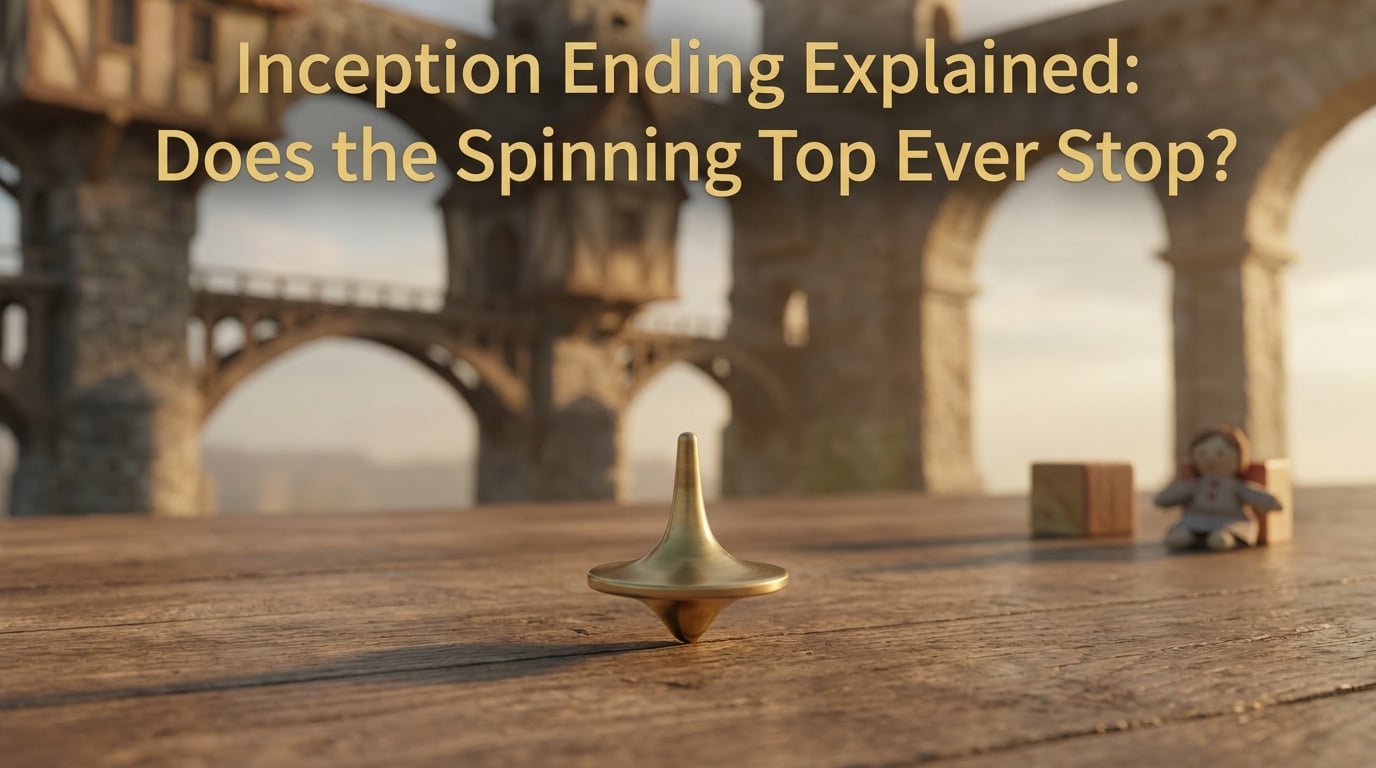
Christopher Nolan cut to black in 2026 most debated movie moment, and over fifteen years later, people are still arguing about it. The spinning top wobbles. The screen goes dark. And millions of viewers leaned forward waiting for an answer that never came.
If you have watched Inception and walked away confused, frustrated, or somewhere in between, you are not alone. The Inception ending explained properly requires digging into totem rules, Cobb’s emotional arc, and what Christopher Nolan himself has said about that final shot. That is exactly what this guide breaks down, scene by scene, theory by theory.
We will walk through what happens in those final moments, what the spinning top actually represents, both sides of the dream versus reality debate, and why Cobb walking away without looking might be the most important detail of all.
Table of Contents
The Final Scene: What Actually Happens
After completing the inception job on Robert Fischer, Cobb returns to the United States and walks through customs at Los Angeles International Airport. Miles, his father-in-law, meets him at the arrivals gate. The scene feels deliberately ordinary after the chaos of layered dream worlds.
Cobb arrives home and sees his two children, James and Philippa, playing in the backyard. They are in the same position he last saw them, down to their clothing. For the entire film, whenever Cobb has seen his children in dreams, they never turn around. He never sees their faces. This time, they do.
His daughter turns. His son turns. They recognize him, run toward him, and Cobb drops to his knees to embrace them. Before joining them, he sets the spinning top on the table. He spins it. He looks at it for a moment.
Then the children call out to him. Cobb turns away from the top and walks toward his kids. The camera stays on the spinning top. It spins smoothly at first. Then it begins to wobble. The wobble becomes more pronounced. And right at the moment where it seems like it might fall, the screen cuts to black.
That wobble is what has fueled over a decade of frame-by-frame analysis. Some fans swear the wobble means the top is about to fall. Others argue the wobble is meaningless because Cobb broke the fundamental rule of his totem long before this scene.
What the Spinning Top Totem Really Means
In the world of Inception, a totem is a small personal object that behaves differently in dreams than in reality. Each dream sharer creates their own totem with a unique physical property only they understand. The purpose is simple: if someone else tries to recreate your totem in a shared dream, they will get the detail wrong, and you will know you are dreaming.
Cobb’s totem is a small brass spinning top that once belonged to his wife, Mal. In the real world, physics takes over. The top spins, wobbles, and eventually falls. In a dream, the top spins perfectly and indefinitely, never losing momentum, never toppling over. That is how Cobb tests whether he is awake or dreaming.
Here is where things get complicated. The totem system has a fundamental flaw that the film itself acknowledges. Cobb tells Ariadne never to let anyone else touch her totem, because knowing its exact weight and feel is what keeps the system reliable. But Cobb’s totem was Mal’s. She touched it. He took it after her death. In a sense, the totem has already been compromised.
There is also a deeper problem. The top tells Cobb whether he is in someone else’s dream. But if Cobb is in his own dream, his subconscious already knows how the top should behave. His mind could simply make the top fall, tricking him into believing he is awake when he is not. The totem was never designed to protect Cobb from himself.
This is why many fans and film analysts argue that the spinning top is a red herring. It was never a reliable test. Cobb was never going to get a trustworthy answer from it, and deep down, he probably knew that.
The Two Interpretations: Dream vs Reality
The Inception ending meaning splits cleanly into two camps, and both sides have real evidence from the film to back up their position.
The Reality Interpretation
Those who believe Cobb is awake point to several details. The top wobbles at the end, and a wobble suggests it is about to fall, which would indicate reality. Cobb’s father-in-law is physically present at the airport, greeting him in a way that would be difficult for his subconscious to fabricate convincingly.
The children have also aged. They are wearing slightly different clothes than in the dream sequences. The casting credits list two sets of actors for the children at different ages, confirming they are not identical to the dream versions. These details suggest the reunion is real.
Structurally, the film has earned this ending. Cobb went through an entire arc of confronting his guilt over Mal’s death in limbo. He resolved his deepest trauma. Returning to his children in reality is the narrative payoff the story has been building toward.
The Dream Interpretation
The other camp argues that Cobb never woke up. They point out that the airport scene has an oddly dreamlike quality. Everyone from the team happens to be there, passing through without interacting. Saito makes a phone call and suddenly all legal problems vanish. The sequence feels too convenient, too orchestrated.
There is also the question of how Cobb and Saito escaped limbo. The film shows Cobb finding an elderly Saito in limbo, reminding him of their arrangement. But we never see the actual kick that brings them back. We simply cut from that conversation to Cobb waking on the plane. Some viewers see this gap as evidence that Cobb never made it out.
The children in the yard are in nearly the same position as every dream version. They are wearing similar clothes. They are the same age as Cobb remembers them. For someone who has been away for months or years, the uncanny familiarity of the scene feels suspicious.
Ultimately, the dream interpretation argues that Cobb’s mind constructed the happy ending he desperately wanted. He could not face reality without Mal, so his subconscious gave him a reality where everything worked out. The top never falls because there is no reality to fall back to.
Why Cobb Walks Away (The Real Answer)
Here is the detail that matters most, and the one that most articles about the Inception ending skip over entirely. Cobb spins the top, looks at it for barely two seconds, and then walks away to greet his children without checking the result.
This is a man who has spent the entire film compulsively checking his totem. He spins it in hotel rooms, in warehouses, in the middle of dangerous missions. The top is his anchor to reality. He does not trust his own mind without it.
Until this moment.
When Cobb hears his children’s voices and sees their faces, he turns away from the top. He chooses not to look. This is the first time in the entire film that Cobb voluntarily ignores his totem. The question of whether the top falls or keeps spinning becomes irrelevant because Cobb has decided he no longer needs the answer.
This is what forum discussions on Reddit consistently circle back to. The most upvoted threads on r/movies about the Inception ending arrive at the same conclusion: the point was never about the top. The point was about Cobb reaching a place emotionally where reality or dream no longer matters to him. He is with his children. That is enough.
From a character arc perspective, this is Cobb’s resolution. He spent years trapped in guilt over Mal’s death, unable to dream without his subconscious sabotaging him. He carried Mal as a projection in every shared dream, a hostile force destroying his missions. In limbo, he finally confronted the truth that he planted the idea in Mal’s mind that her reality was not real. He accepted responsibility. And when he let go of Mal’s projection, he also let go of the need to constantly verify his own reality.
Walking away from the top is Cobb choosing to live in the moment rather than questioning it. Whether that moment is real or constructed, the emotional truth is the same. He is home.
Cobb and Mal: The Backstory That Changes Everything
To fully understand the weight of the ending, you need the backstory between Cobb and Mal. Without it, the spinning top is just a plot device. With it, the top becomes a symbol of grief, guilt, and the dangerous power of planting ideas.
Cobb and Mal spent fifty years together in limbo, a deep subconscious space where dreamers can become lost. They built entire worlds, lived entire lifetimes. But Mal decided limbo was real. She did not want to leave. Cobb knew they had to wake up, but Mal refused to accept that their world was a dream.
So Cobb did something drastic. He performed inception on Mal. He went into her mind and planted the idea that her world was not real. He used the spinning top as the trigger, spinning it inside her locked safe so she would find it and question everything. The idea took root. Mal agreed to wake up.
But inception is powerful because the idea becomes the person’s own. They believe it came from within. When Mal woke up in the real world, the idea did not go away. She continued to believe that the real world was another dream layer. She became convinced that the only way to wake up was to die.
Mal killed herself, and she framed it so that Cobb would be blamed if he did not jump with her. She died believing Cobb would follow her into what she thought was the next level of reality. Cobb did not jump. And for the rest of the film, he carries the guilt of having planted the idea that killed her.
This is why Mal appears as a violent projection in every dream sequence. She is Cobb’s guilt made manifest, his subconscious punishing him. And this is why the spinning top is so loaded with meaning. It was the tool he used to inception Mal. When he spins it, he is not just testing reality. He is reliving the moment that destroyed his wife.
The ending takes on an entirely different dimension when you understand this context. Cobb walking away from the top is not just him choosing not to check reality. It is him choosing to stop torturing himself with the object that reminds him of Mal’s death. He is finally letting go.
Christopher Nolan’s Explanation
So what does the man who made the film have to say about all this? Christopher Nolan has addressed the ending in several interviews, and his answer is both clear and deliberately unsatisfying for anyone wanting a binary answer.
At a Princeton commencement address, Nolan said the real point of the ending is not whether the top falls. He explained that the emotional meaning of the scene is about Cobb’s journey. Cobb has been so obsessed with the distinction between dreams and reality that it has consumed his life and destroyed his marriage. The ending represents Cobb reaching a point where he no longer cares about that distinction because he has found something more important.
Nolan pointed out that the audience’s fixation on the spinning top mirrors Cobb’s own unhealthy obsession. Viewers freeze-framing the final shot to look for a wobble are doing exactly what Cobb does throughout the film. They are missing the point by focusing on the wrong question.
In a separate interview, Nolan said that the ending is meant to feel like a half-remembered dream. He wanted the audience to walk out of the theater uncertain, talking to each other, constructing their own interpretations. The ambiguity is not a puzzle to be solved. It is the intended experience.
Michael Caine, who plays Cobb’s father-in-law Miles, offered his own interpretation during a film screening. He said that whenever Nolan was on set and a scene included the character of Miles, that scene was set in reality. Since Miles appears in the final scene, Caine concluded that Cobb is awake. Of course, Caine is an actor, not the director, but it is a fun data point.
The most authoritative answer comes from Nolan himself, and it is essentially this: the question of dream or reality is less important than the emotional truth of Cobb choosing his children over his uncertainty. That is the Inception ending explained by the person who wrote it.
FAQs
Does the top ever stop spinning at the end of Inception?
The film cuts to black before the top stops or continues spinning indefinitely. The top begins to wobble, suggesting it might fall, which would indicate Cobb is in reality. However, Christopher Nolan has said the answer is less important than the fact that Cobb walks away without checking.
Why did Saito grow old but not Cobb?
Both Saito and Cobb were in limbo, but they entered at different times and in different ways. Saito arrived in limbo first after dying in the snow fortress level, meaning he spent more subjective time there alone. Cobb entered limbo later to find Saito, and time moves at different rates depending on the dream level, which is why Saito appears decades older.
Why did Cobb incept his wife?
Cobb performed inception on Mal because she had become convinced that limbo was their real life and refused to wake up. He planted the idea that her world was not real by spinning the top inside her safe. The idea persisted after they woke up, leading Mal to believe the real world was also a dream, which ultimately caused her suicide.
Why can’t Cobb see his kids’ faces?
Cobb cannot see his children’s faces in dreams because his subconscious is protecting him from the pain of being separated from them. Seeing their faces would make the dream feel too real and too painful, knowing it is not actual reality. This changes in the final scene when the children finally turn to face him.
Conclusion: What the Ending Really Means?
The Inception ending explained comes down to this: Christopher Nolan built a film where the question of dream versus reality is the wrong question. The right question is whether Cobb can let go of his guilt and be present with the people he loves.
The spinning top is not the answer. Cobb walking away from it is.
Whether the top falls or keeps spinning, Cobb has made his choice. He chooses his children over certainty. He chooses to stop testing, stop questioning, and stop punishing himself for what happened to Mal. That is the real ending of Inception, and it is far more powerful than a simple yes or no about the top.
So does the spinning top ever stop? Maybe. Maybe not. But Cobb decided it did not matter, and according to Nolan, neither should we.