
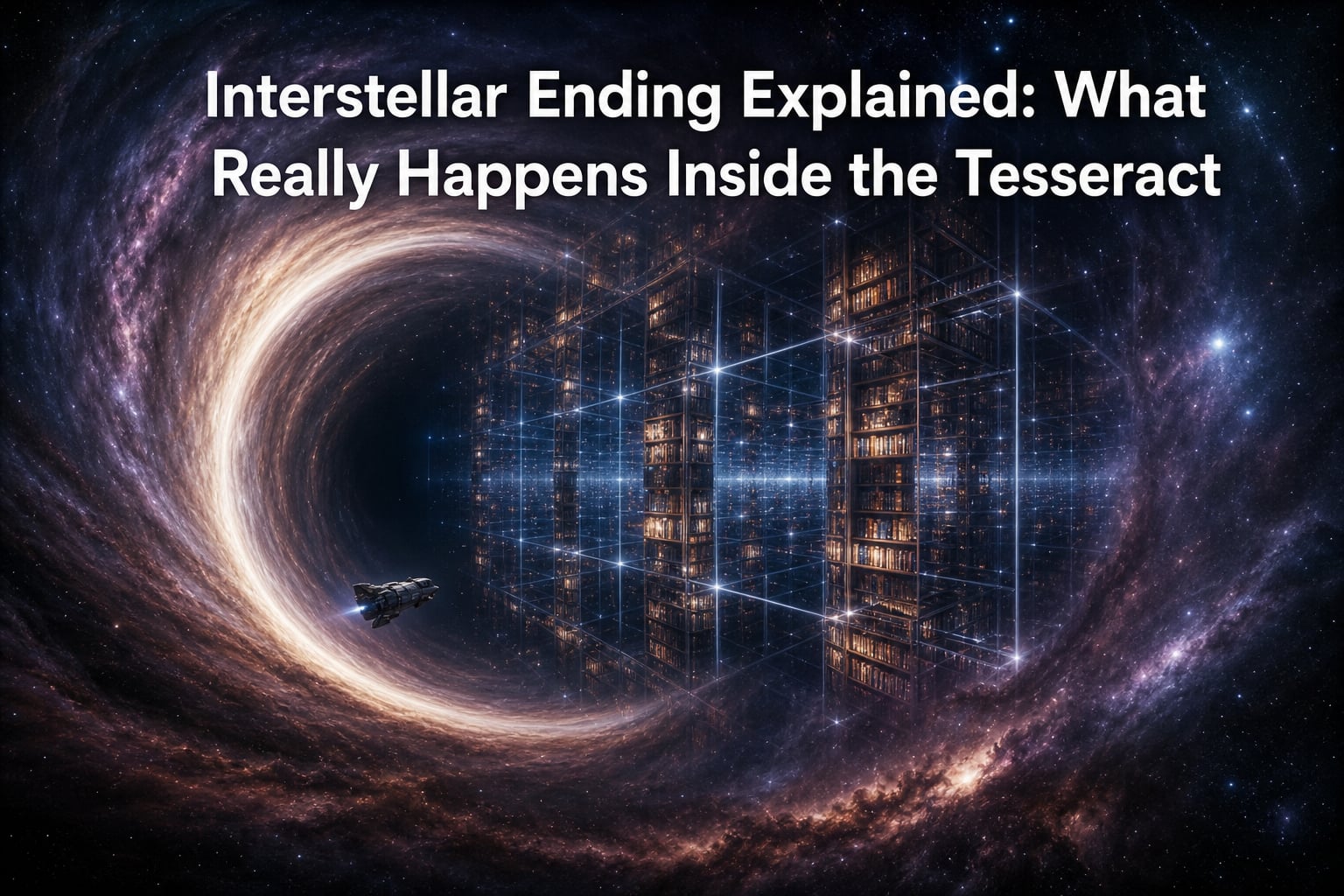
Christopher Nolan’s Interstellar ends with one of the most debated sequences in modern science fiction. Cooper falls into a black hole and suddenly finds himself inside a kaleidoscopic space made entirely of bookshelves, reaching through time to communicate with his young daughter. Audiences have called it brilliant, confusing, and everything in between.
I have watched the Tesseract scene more times than I can count. I have read Kip Thorne’s companion book “The Science of Interstellar,” combed through Reddit threads, and studied the physics Nolan used to construct this sequence. What I found is that the scene is far more logical than most viewers realize on first watch.
This Interstellar ending explained guide breaks down exactly what happens inside the Tesseract, why it was built, how Cooper communicates through time, and what the entire sequence means for the story. Whether you are trying to understand the bootstrap paradox, figure out the 4D versus 5D question, or simply make sense of that final bookshelf scene, you will find clear answers here.
Major spoilers ahead for Interstellar (2014). If you have not seen the film, come back after you have.
Table of Contents
What Is the Tesseract in Interstellar?
The Tesseract in Interstellar is a four-dimensional construct created by advanced future beings that allows Cooper to perceive time as a spatial dimension, moving through different moments in his daughter Murph’s bedroom simultaneously. Inside it, every moment from Murph’s childhood bedroom exists at once, stretched across infinite repeating surfaces that Cooper can physically navigate.
That definition is the short answer. The longer answer requires understanding what a tesseract actually is in mathematics.
In geometry, a tesseract is the four-dimensional analog of a cube. Just as a three-dimensional cube has length, width, and depth, a tesseract adds a fourth spatial dimension. You cannot truly visualize a 4D object in three dimensions, but mathematicians represent it as a cube within a cube, with lines connecting corresponding corners. Nolan took this concept and translated it into a cinematic space where that fourth dimension is not another spatial direction but time itself.
The film’s scientific consultant, physicist Kip Thorne, worked with the visual effects team to design the Tesseract so that it felt grounded in real physics. The idea was that beings existing in five spatial dimensions could fold time into a physical space that a three-dimensional being like Cooper could perceive and interact with. The Tesseract is essentially a translation device, converting something beyond human comprehension into something Cooper’s brain can process.
Many viewers ask a key question that competitor articles often skip: why did the Tesseract manifest specifically as Murph’s bookshelf? The answer lies in how the future beings designed it. They needed Cooper to communicate with Murph, and gravitational signals only work through physical objects. The bookshelf was the gravitational anchor point in Murph’s room, the place where anomalies had already been occurring since she was a child. The Tesseract was built around that specific location and that specific emotional connection because those were the variables that would allow Cooper to successfully transmit the data.
How Cooper Enters the Tesseract
Understanding the Interstellar Tesseract scene requires tracing the events that lead Cooper into it. The sequence begins with a desperate decision.
Cooper and the crew of the Endurance need to reach Edmunds’ planet, but the ship does not have enough fuel to travel there directly from Miller’s planet. Their only option is to use Gargantua, the supermassive black hole, as a gravitational slingshot. This maneuver would accelerate the ship using Gargantua’s gravity, essentially stealing energy from the black hole to fling the Endurance toward Edmunds’ planet.
The problem is weight. The Endurance is too heavy to escape Gargantua’s pull after the slingshot. Cooper makes the call to detach his ship, the Ranger, from the Endurance and sacrifice himself by falling into Gargantua’s event horizon. This allows the Endurance, with Amelia Brand aboard, to reach escape velocity and continue to Edmunds’ planet.
What happens next is where audiences get confused. Cooper crosses the event horizon of Gargantua, which in real physics means no information can ever escape. But Cooper does not get torn apart by spaghettification, the stretching process that extreme gravity would normally inflict on anything crossing an event horizon. Instead, he wakes up inside the Tesseract.
The film’s explanation is that the future beings saved him. They intercepted Cooper at the event horizon and placed him inside the Tesseract construct. Kip Thorne has explained in interviews that from a physics standpoint, a sufficiently advanced civilization with mastery over five dimensions could create a region of spacetime near the singularity where the tidal forces would not destroy a human body. The Tesseract is that region.
This is also why the question of how Cooper survived the black hole is so common in Reddit threads. The short answer is that he never truly reached the singularity. The future beings pulled him into the Tesseract before spaghettification could occur, kept him there long enough to transmit the quantum data, and then ejected him safely.
What Cooper Sees Inside the Tesseract
The interior of the Tesseract is one of the most visually stunning sequences in Interstellar. But what is Cooper actually seeing, and how does it work?
When Cooper regains consciousness inside the Tesseract, he finds himself surrounded by glowing, repeating lines of light that stretch in every direction. As he looks closer, he realizes each surface is a window into Murph’s bedroom at different moments in time. He can see Murph as a child, as a teenager, and as an adult, all simultaneously. Every moment the bedroom has ever existed is laid out before him like a physical space he can move through.
The Tesseract works by converting time into a spatial dimension. In our three-dimensional experience, time flows linearly and we can only exist in one moment at a time. Inside the Tesseract, Cooper exists in a higher-dimensional space where all moments coexist. He can move forward and backward through Murph’s timeline the same way you can walk from your kitchen to your living room.
This is where the common question about dimensions comes in: was Cooper in the 4th or 5th dimension?
The answer requires a distinction. Cooper himself is a three-dimensional being. The Tesseract he moves through is a four-dimensional space, where the fourth dimension is time rather than another spatial direction. The beings who created the Tesseract exist in five dimensions, meaning they have five spatial dimensions plus time. They built a 4D construct (three spatial dimensions plus time as a navigable dimension) that a 3D being like Cooper could perceive. So Cooper experienced a four-dimensional space created by five-dimensional beings.
The film visualizes this concept with extraordinary care. The infinite bookshelf walls are not random. Each panel represents a specific moment in Murph’s bedroom, arranged so that moving along one axis moves through time and moving along another axis shifts perspective within the same moment. Cooper can see the bookshelf, the window, the bed, the floor, and Murph herself from any angle at any point in time.
One detail many viewers miss is that Cooper initially panics. He bangs on the surfaces, trying to reach Murph, but cannot pass through them. He realizes he is watching the past but cannot directly interact through conventional means. This is when TARS, his robot companion who also fell into the black hole, explains the mechanism: the beings constructed this space so that gravity can cross the dimensional barrier. Cooper cannot physically touch Murph, but he can exert gravitational force on objects in her room.
This is the key to understanding everything that follows. The Tesseract does not give Cooper time travel in the traditional sense. He cannot change the past because the past has already happened. What he can do is send information backward through time using gravity, which turns out to be the only force that can cross dimensional boundaries. Everything Cooper does inside the Tesseract has already happened in Murph’s timeline. He is not changing the past but fulfilling it.
How Cooper Communicates With Murph Through Time
The communication mechanism inside the Tesseract is where the Interstellar tesseract scene transforms from confusing to emotionally devastating. Let me walk through exactly how Cooper sends messages to Murph.
Gravity is the medium. Inside the Tesseract, Cooper discovers that he can interact with objects in Murph’s room by pushing against the dimensional surfaces. When he presses on a panel, a gravitational force manifests in the corresponding moment in Murph’s bedroom. This is the same force that has been causing the gravitational anomalies Murph noticed as a child.
The first message Cooper sends is the dust pattern. If you recall the early scene where Murph watches dust collect on her bedroom floor in a pattern, those lines were binary code spelling out the coordinates of NASA’s secret facility. Cooper pushed the dust into that pattern from inside the Tesseract, sending his past self and Murph to NASA. This is one of the first moments viewers realize the causal loop at work.
The second message is the books falling off the shelf. Young Murph believed a ghost was pushing books off her shelf, and she interpreted the pattern as the word “STAY.” That ghost was Cooper inside the Tesseract, desperately trying to stop himself from leaving. He pushes books off the shelf to spell the message, hoping his past self will see it and choose not to go on the mission.
But Cooper cannot change the past. He has already left. The “STAY” message was always part of the timeline. This is the emotional core of the scene: Cooper is forced to watch himself leave Murph, knowing that every attempt to change things is what creates the very events he is reacting to.
The most critical message is the quantum data. Professor Brand’s gravity equation could not be solved without quantum data from inside a black hole, specifically from the singularity. No human instrument had ever captured this data because nothing can escape a black hole. But Cooper is inside Gargantua, and TARS has been collecting the quantum data as they fell through the event horizon.
Cooper needs a way to transmit this complex data to the adult Murph, who is now a scientist working on the gravity equation. He realizes that the watch he gave Murph before leaving is still in the bedroom. The second hand of the watch can be manipulated through gravity to tick in Morse code patterns.
This is the mechanism the film uses for the data transmission. Cooper uses gravitational force inside the Tesseract to push the watch’s second hand, making it tick in Morse code. TARS feeds him the quantum data, and Cooper translates it into Morse code ticks on the watch. Adult Murph returns to the bedroom, finds the watch, recognizes the anomalous ticking pattern, and decodes the quantum data.
Many viewers miss the connection between the gravitational anomalies and the watch mechanism, but they are the same phenomenon. The same gravitational force that knocked books off the shelf and pushed dust into patterns also moves the watch hand. The entire communication system relies on one principle: gravity can cross dimensional boundaries, and Cooper can control it inside the Tesseract.
The Bootstrap Paradox Explained
No Interstellar ending explained article is complete without addressing the bootstrap paradox, which is the logical structure underlying the entire plot.
A bootstrap paradox is a time travel paradox in which an object or information exists without ever being created. The information is sent back in time, received, and then becomes the basis for its own existence. There is no original source. The term comes from the phrase “pulling yourself up by your bootstraps,” meaning something that creates itself without external input.
Interstellar is built on this paradox. Here is the causal loop in full.
Future beings, who are descendants of humanity that survived thanks to the gravity equation, build the Tesseract inside Gargantua. They place Cooper inside it so he can send quantum data back to Murph. Murph receives the data, solves the gravity equation, and humanity leaves Earth. Humanity eventually evolves into the five-dimensional beings who build the Tesseract. Those beings then place Cooper inside the Tesseract to send the data to Murph.
The question of who originally solved the equation has no answer. That is the nature of a bootstrap paradox. The data was never independently discovered. It exists in a closed loop: Cooper sends it, Murph uses it, humanity survives, humanity evolves, evolved humanity helps Cooper send it. Every link in the chain depends on every other link.
The same paradox applies to Cooper’s NASA coordinates. Cooper sends the dust coordinates to young Murph, which leads Cooper to NASA, which sends Cooper to space, which eventually puts Cooper in the Tesseract, where he sends the dust coordinates. Neither the mission nor the data has an independent origin point.
Some viewers find this circular logic frustrating, but the film handles it consistently within its own rules. Nolan chose a deterministic time travel model where events cannot be changed. Everything Cooper does inside the Tesseract has already happened. He is not rewriting the past but discovering that he was always part of it. This is why the “STAY” message fails. Cooper was always going to leave, and his attempt to stop himself was always part of the timeline.
The bootstrap paradox also explains the wormhole near Saturn. The future beings placed the wormhole so that humanity could reach Gargantua and the other planets. Without the wormhole, Cooper never reaches the black hole, never enters the Tesseract, and never sends the data. The wormhole exists because the future beings created it, and the future beings exist because the data was sent. Another closed loop.
Who Are They: The Future Beings Explained
Throughout Interstellar, characters refer to mysterious beings as “they.” They placed the wormhole. They built the Tesseract. They saved Cooper. But who are they?
The film strongly implies that “they” are future humans, not aliens. Several pieces of evidence support this reading.
First, the beings understand human emotional bonds. The Tesseract was specifically built around Murph’s bookshelf, the location with the strongest emotional resonance for Cooper. Aliens with no connection to humanity would have no reason to design the construct around that specific relationship. Future humans would understand that Cooper needed an emotional anchor to navigate the Tesseract effectively.
Second, the beings are described as five-dimensional. The film suggests that humanity, after solving the gravity equation and leaving Earth, eventually evolved beyond three-dimensional existence. They became beings of higher spatial dimensions, which is how they can manipulate time and space in ways that seem impossible to Cooper.
Third, the Tesseract is described as being built for Cooper specifically. TARS tells Cooper that “they” constructed this space knowing he would need to communicate with Murph. This level of specificity suggests beings with intimate knowledge of human history and the importance of the Cooper-Murph relationship.
The most compelling theory from Reddit discussions and Kip Thorne’s writings is that these future humans are the descendants of Plan B survivors. Plan B involved Dr. Mann and other astronauts using frozen embryos to colonize a new planet, independent of whether Earth’s current population survived. If Plan B succeeded, those colonists could have evolved over thousands or millions of years into five-dimensional beings. They would then reach back through time to ensure Plan A also succeeded, saving the original human population.
Whether they are Plan B descendants or future humans from Cooper Station who evolved over eons, the key point is that “they” are us. The film’s message is that humanity saves itself, not through external intervention but through its own future evolution reaching back to ensure its own survival.
The Significance of Love as a Dimension
One of the most polarizing elements of Interstellar is the suggestion that love functions as a measurable force. Amelia Brand first proposes this idea when explaining why she believes Edmunds’ planet is the right choice. She argues that love is not just a social construct but something quantifiable that transcends time and space.
Many viewers dismissed this as unscientific sentimentality. But the Tesseract scene reframes Brand’s theory in a way that changes how you understand it.
Inside the Tesseract, Cooper does not navigate by mathematics or star charts. He finds the right moment in Murph’s timeline by following his emotional connection to her. He locates the exact instant when adult Murph returns to the bedroom by feeling his way through the timelines, drawn to the moments of greatest emotional significance.
The film suggests that love is not a force in the physical sense but rather a navigation tool. In five-dimensional space, where all moments exist simultaneously, you need a way to locate specific points in time. Love provides that specificity. Cooper’s bond with Murph is what allows him to zero in on the right moment from an infinite field of possibilities.
This also explains why the Tesseract was built around Murph’s bookshelf. The future beings could have built it anywhere, but they chose the location with the strongest gravitational and emotional significance for Cooper. The bookshelf is where Murph noticed the anomalies, where Cooper said goodbye, and where the watch remained. It is the gravitational and emotional epicenter of their relationship.
Nolan is not claiming that love literally bends spacetime. Rather, he is using love as a metaphor for the kind of connection that transcends ordinary perception. In a five-dimensional framework, where time is just another direction, the emotional bond between father and daughter becomes a coordinate system that Cooper can follow.
What Happens to Cooper After the Tesseract
After Cooper transmits the quantum data through the watch, the Tesseract begins to collapse. The future beings have served their purpose, and the construct dissolves around Cooper, ejecting him through a wormhole.
Cooper is found floating near Saturn by a human patrol ship. He wakes up on Cooper Station, a massive cylindrical space habitat named after his daughter. Thanks to the quantum data Murph received, humanity solved the gravity equation and built these enormous stations to transport the surviving population off Earth.
Due to extreme time dilation near Gargantua, barely any time has passed for Cooper while decades have passed on Earth and the stations. Murph is now an elderly woman on her deathbed, surrounded by her own children and grandchildren. She is celebrated as the scientist who saved humanity.
The reunion between Cooper and elderly Murph is the emotional climax of the film. Murph tells Cooper that no parent should have to watch their child die, and that he should go find Brand. She knows Brand set off for Edmunds’ planet alone and suspects Cooper needs to be there for her.
In the final scene, Cooper steals a ship and heads toward the wormhole. On Edmunds’ planet, Brand is shown alone, removing her helmet in the breathable atmosphere. She is building a camp and preparing for the colonization effort, unaware that Cooper is on his way. She mourns the loss of Dr. Wolf Edmunds, whose body she found at the site, but she is carrying on the mission.
This ending answers the question of whether Cooper was hallucinating. He was not. The Tesseract was real, the quantum data was real, and Cooper Station proves that Murph received and used the data to save humanity. The entire Tesseract experience had measurable, physical consequences. Murph solved the equation, the stations were built, and humanity survived. If the Tesseract had been a hallucination, none of this would exist.
Interstellar Ending Explained: The Tesseract Scene in Full Context
Now that we have covered each element individually, let me put the entire Interstellar ending explained picture together in one continuous thread.
Humanity is dying on Earth due to a blight that kills crops. A wormhole appears near Saturn, placed by future humans who evolved beyond three dimensions. NASA sends missions through the wormhole to find habitable planets. Cooper, a former NASA pilot, is recruited and leaves his daughter Murph behind.
Cooper and his crew reach Gargantua, a supermassive black hole near the wormhole’s exit. Time dilation near Gargantua means every hour spent near it costs years on Earth. After visiting Miller’s planet and losing decades, Cooper and Brand decide to slingshot around Gargantua to reach Edmunds’ planet.
To save fuel and allow Brand to reach Edmunds’ planet, Cooper sacrifices himself by falling into Gargantua. Instead of dying, he is intercepted by future beings and placed inside the Tesseract, a four-dimensional space built around Murph’s bookshelf. Inside it, Cooper can see every moment of Murph’s bedroom simultaneously and interact with objects through gravitational force.
Cooper sends three messages through time. He pushes dust into binary coordinates leading to NASA. He knocks books off the shelf spelling “STAY.” And he manipulates the watch hand in Morse code to transmit quantum data from inside the black hole. Adult Murph decodes the watch and solves Professor Brand’s gravity equation, enabling humanity to build massive space stations and leave Earth.
The Tesseract collapses. Cooper is ejected through the wormhole and rescued near Saturn. He wakes up on Cooper Station, meets his dying daughter one last time, and sets off to find Brand on Edmunds’ planet. The film ends with Brand beginning colonization, alone but hopeful, as Cooper approaches.
Everything in the film operates as a closed causal loop. The wormhole, the coordinates, the Tesseract, and the quantum data all exist because future humanity created them to ensure its own survival. Humanity saves itself through love, sacrifice, and the determined ingenuity of a father and daughter who never stopped trying to reach each other across impossible distances.
FAQs
What was the point of the tesseract in Interstellar?
The Tesseract was built by future evolved humans to give Cooper a way to transmit quantum data from inside the Gargantua black hole back to his daughter Murph. Without this data, Murph could never solve the gravity equation needed to save humanity. The Tesseract converted time into a navigable spatial dimension so Cooper could locate the exact moments he needed to interact with.
Was Cooper in the 4th or 5th dimension?
Cooper experienced a four-dimensional space. He is a three-dimensional being who was placed inside a 4D construct where time functions as a spatial dimension he could move through. The beings who created the Tesseract exist in five dimensions, meaning they built a lower-dimensional interface that Cooper’s brain could process. So Cooper was in a 4D space created by 5D beings.
Was Cooper hallucinating at the end of Interstellar?
No, Cooper was not hallucinating. The Tesseract was real and had measurable consequences. Murph received the quantum data Cooper transmitted through the watch, solved the gravity equation, and humanity built the Cooper Station space habitats as a result. If the Tesseract had been a hallucination, humanity would not have survived and Cooper would never have woken up on the station.
How did Murph know Brand was alive?
Cooper told elderly Murph during their reunion on Cooper Station that Brand had continued to Edmunds’ planet alone. The film’s final scene shows Brand on Edmunds’ planet building her camp, confirming she survived. Murph likely also had access to mission data and tracking information through NASA’s systems, but the primary way she knew was because Cooper told her directly before setting off to find Brand.
Who built the tesseract in Interstellar?
The Tesseract was built by future humans who evolved beyond three-dimensional existence into five-dimensional beings. The film strongly implies these are descendants of humanity who survived thanks to Murph solving the gravity equation. They reached back through time to ensure their own existence by helping Cooper transmit the quantum data. This creates a bootstrap paradox where the cause and effect form a closed loop.
Conclusion
The Interstellar ending explained through the Tesseract scene reveals a carefully constructed story about love, sacrifice, and humanity’s capacity to save itself across time. The Tesseract is a four-dimensional bridge built by future humans, designed to let Cooper transmit quantum data through gravitational waves using a watch and a bookshelf. Every event in the film forms a closed causal loop where humanity reaches back through its own evolution to ensure survival. The scene is not a hallucination or a plot hole but a deliberate, scientifically grounded sequence that rewards close attention and multiple viewings.