
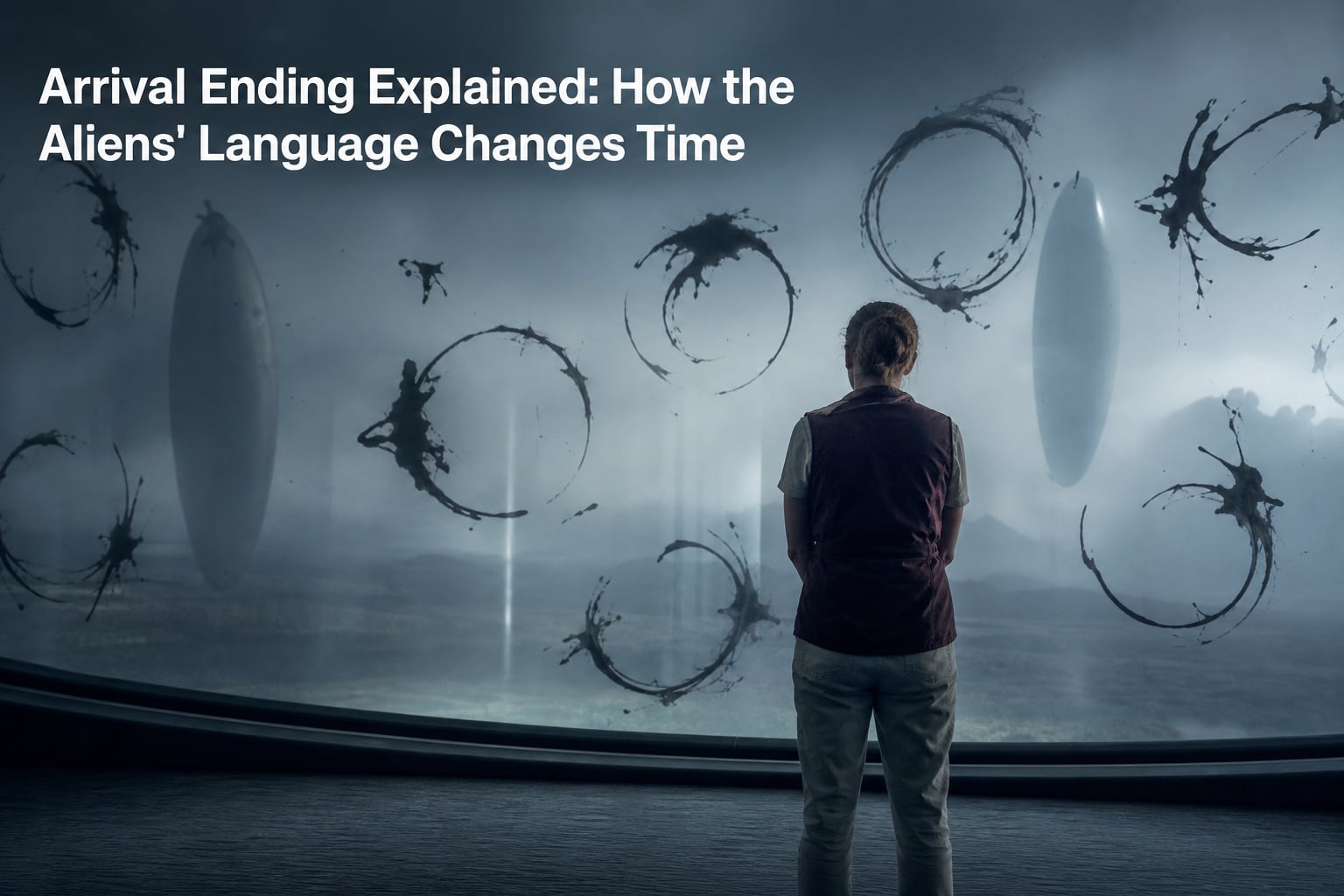
Spoilers for Arrival follow. The Arrival ending is not a reveal that Louise Banks has been remembering a daughter who died. Her visions are memories of events that have not happened yet, and she begins receiving them after learning the heptapods’ written language.
That is the story’s big idea: the circular alien language changes Louise’s time perception, allowing her to experience her life non-linearly. She can see her future daughter Hannah, the marriage that will end, and the moment that prevents a global military conflict.
This Arrival ending explained guide separates the plot mechanics from the film’s emotional point. It also clears up the General Chang phone call, the heptapods’ purpose, and why Louise makes a painful choice with open eyes.
Table of Contents
The Arrival ending reveals that Louise’s flashbacks are future memories
At the start, the film presents Hannah’s birth, childhood illness, and death as a tragic past that has shaped Louise’s isolation. The editing invites us to read these scenes as flashbacks because that is how a human viewer normally organizes a story.
The ending asks us to revise that assumption. Hannah has not been born when the heptapods arrive; Louise will meet physicist Ian Donnelly, marry him, and later have Hannah after the alien encounter.
Louise does not suddenly invent a future in the final act. Her first future memories appear while she is learning to communicate with Abbott and Costello, the two heptapods inside the Montana vessel.
The twist works because the film hides its timeline in plain sight
The daughter scenes contain no label saying “past,” so the audience supplies one. Denis Villeneuve uses Louise’s grief, the muted visual tone, and the familiar rhythm of a bereavement story to make that reading feel natural.
Once Louise begins understanding the alien language, the scenes gain a different status. They are not premonitions in the ordinary sense, because she does not merely predict possibilities; she experiences future moments with the felt detail and emotional weight of memory.
That distinction answers a common viewer question. Louise is not shown changing the past, and the film never frames Hannah as a person who already existed before the first contact mission.
Quick answer: Louise sees Hannah because learning the heptapods’ language gives her access to non-linear time perception. The film’s “flashbacks” are future memories shown out of chronological order.
The plot begins with language, not with a conventional alien threat
Twelve alien vessels appear around Earth, and nations rush to learn what the visitors want. Louise is recruited because the first obstacle is not a weapon or a machine: it is translation.
She and Ian start with basic shared concepts, using written words and images to establish meanings such as “human” and “Louise.” The work is slow, uncertain, and risky, which matters because the film does not treat translation as simply swapping one dictionary for another.
When the heptapods offer a “weapon,” several governments interpret the word as a threat. Louise argues that the intended sense may be closer to “tool” or “gift,” exposing how much hangs on context when no shared language exists.
Warning: Do not read the word “weapon” as proof that the heptapods plan to conquer Earth. The film makes the ambiguous translation part of the crisis, then identifies their real gift as a new way of perceiving time.
The heptapod language changes time by requiring a whole thought at once
The heptapods speak in inky, whale-like sounds, but their written language does the most narrative work. Each written symbol is a circular logogram: a complete expression arranged as a single form rather than a left-to-right chain of words.
A human sentence unfolds in sequence. The writer can begin before knowing every later word, revise course midway through, and reach the final period only after moving through the sentence.
A heptapod logogram works differently in the film. To create its final shape, the writer must know the entire statement before making the first mark, because every curve, gap, and splash belongs to the completed circle.
The circular writing reflects the heptapods’ non-linear perception
The circular language is not presented as magic ink by itself. It is a visible expression of how the heptapods think: they perceive a complete span of time rather than advancing through moments one after another.
For them, a future event is not hidden in the way it is for humans. They can act with knowledge of outcomes while still participating in the moments that lead to those outcomes.
The film extends that cognition to Louise as she becomes fluent. Her brain gradually stops treating time as a one-way line and starts organizing experience as a whole pattern.
Louise’s breakthrough follows a clear sequence
Louise establishes reference points. She gives the heptapods names and teaches them to associate human words with people and objects.
Louise learns the written logograms. She moves beyond spoken sound and studies the visual structure of the alien language.
Louise starts having future memories. Her experience of Hannah arrives in fragments, at first without a full explanation.
Louise understands the heptapods’ gift. She recognizes that their language carries a way of thinking, not only information.
Louise acts from that knowledge. She uses a future memory of General Chang to stop the present crisis.
This sequence also explains why the plot does not give every soldier or linguist the same ability. Louise has spent sustained time with the writing system and makes the conceptual shift the film imagines, while most people around her have not.
Reading tip: Watch the whiteboard scenes and the circular symbols on a rewatch. The film repeatedly contrasts the human need to build meaning piece by piece with the heptapods’ completed circles.
The Sapir-Whorf hypothesis supplies the film’s speculative starting point
The Sapir-Whorf hypothesis, often called linguistic relativity, is the idea that the language people use can influence habitual thought and perception. In its modest form, it asks whether linguistic patterns make some distinctions easier to notice, remember, or discuss.
Arrival takes that premise to a dramatic science-fiction extreme. It proposes that mastering a genuinely non-linear language can alter a person’s experience of time itself.
That is a compelling story device, but it is not a settled finding from linguistics. Learning another human language does not give someone access to future memories, and real language acquisition is far more gradual, social, and messy than the film’s compressed mission timeline.
The film uses a strong version of linguistic relativity
A strong version says language determines what a speaker can think. A weaker version says language influences habits of attention without locking people inside a fixed mental world.
The film needs something stronger than the cautious scholarly claim. Louise’s new language changes cognition so profoundly that causality and memory no longer feel separate to her, which is why the premise is best treated as speculative fiction informed by linguistics.
That framing respects both sides of the film’s appeal. The translation scenes take meaning, grammar, and cultural context seriously, while the time effect gives the story its metaphysical reach.
The logograms make intent visible before the sentence begins
Human writing can reveal intention over time. A reader may not know whether a sentence is a question, warning, joke, or confession until its final words change the sense of its opening.
The heptapod logograms remove that delay. In the movie’s logic, the symbol arrives as a finished act of communication, so the writer’s beginning already contains the writer’s ending.
This is why the alien language is more than an attractive visual motif. Its circular writing lets the audience see the film’s theory of time in a single image.
The General Chang call forms a causal loop rather than a contradiction
The immediate crisis peaks when China prepares to attack one of the vessels after interpreting the heptapods’ message as hostile. Louise enters the vessel alone, meets a heptapod that tells her to use the gift, and then experiences a future memory of a diplomatic reception.
At that future event, General Shang tells her that she prevented the conflict by calling him in his private number and speaking his late wife’s final words in Mandarin. He gives Louise both pieces of information only because, from his perspective, she has already used them.
Louise returns to the present and makes the call. She repeats the phrase, General Shang stands down, and the nations resume cooperation.
The phone call has no first moment of origin inside the story
This is a closed causal loop. Future Shang gives Louise the number and words because past Louise called him, while past Louise can call him only because future Shang gave her the number and words.
The film does not stop to solve that loop with an external cause. It asks the audience to accept a world in which the heptapods’ non-linear view of time permits information to circulate across a completed timeline.
That can feel paradoxical if every event must have a prior chronological source. Within Arrival, though, cause and effect are part of one circular structure, much like the language Louise has learned to read.
The heptapods help humanity because they will need humanity later
The visitors state that they are offering a gift because they will need humanity’s help in three thousand years. The film does not reveal the later problem, so this remains a promise of future reciprocity rather than a subplot with a detailed solution.
Their immediate goal is to distribute the language across humanity. The threat of international conflict becomes the pressure that forces the countries to choose between fragmented, fearful communication and shared understanding.
Abbott’s injury also makes the stakes personal. The heptapods know the shape of their futures, yet they participate in them, a point that anticipates Louise’s later decision about Hannah.
Common mix-up: General Chang does not give Louise a present-day secret code. The information comes from her future encounter with him, and she carries it back through her new time perception to make the present-day call.
Louise chooses Hannah because the ending values experience despite loss
After the crisis, Louise sees the fuller outline of her future with Ian and Hannah. She knows Hannah will die young from an illness, and she knows Ian will leave when he learns that Louise understood this fate before they had their daughter.
Louise still embraces Ian and moves toward that life. The choice is not presented as ignorance, nor as a cheerful claim that grief is insignificant.
It is the film’s hardest question: if joy and loss are both known in advance, is a life less worth living? Louise’s answer, expressed through action rather than a speech, is no.
The ending treats foreknowledge as emotionally costly
Louise’s knowledge does not protect her from pain. If anything, it means she carries an awareness of Hannah’s death through the ordinary, tender moments that lead there.
That is why the final montage feels bittersweet rather than triumphant. The film places a global act of communication beside a private decision to love someone whose loss is already part of the same complete pattern.
Ian’s future departure adds an ethical complication. The story leaves room for viewers to question Louise’s silence, even as it asks them to understand the depth of her choice.
The determinism question remains intentionally open
Arrival leans toward determinism: events appear fixed, and Louise sees them as facts rather than branches she can simply select or erase. Yet the characters still make choices, speak words, and act with intention.
The film’s position is less “choice is fake” than “choice can be meaningful even when its outcome is known.” Louise’s acceptance is an act of agency within the form of life she perceives.
I read the ending as an argument for attention. Knowing an ending does not cancel the lived value of the moments inside it.
Villeneuve’s visual choices make time feel circular before the plot explains it
Villeneuve keeps the first contact scenes restrained: fog, vast empty space, and the white barrier of the vessel make communication feel slow and fragile. The visual distance matches the linguistic distance between humans and heptapods.
The logograms then provide a sharp contrast. Their black circles are complete forms that appear on the barrier all at once, making the alien language feel both physical and conceptually unfamiliar.
The film’s editing also trains the audience into its central mistake. By cutting to Hannah without announcing a time shift, it lets our linear expectations do the work of the misdirection.
The source story shares the premise but gives the adaptation its own shape
Arrival adapts Ted Chiang’s “Story of Your Life,” retaining Louise, the heptapods, and the connection between language and a non-linear experience of time. The film builds a more urgent geopolitical conflict around the first-contact event.
That added pressure makes the translation problem immediately consequential. A single disputed word can push nations toward violence, while a shared language becomes the route back to cooperation.
The adaptation’s emotional focus remains Louise and Hannah. The final scenes turn an abstract idea about time perception into a question about whether love is worth choosing when loss is part of the knowledge.
FAQs
How do aliens perceive time in Arrival?
The heptapods perceive time non-linearly, experiencing past, present, and future as parts of a whole rather than as a sequence. Their circular written language reflects this cognition because a logogram is created as a complete statement. As Louise becomes fluent, the film suggests that she begins to experience time in the same way.
What was the twist at the end of the movie Arrival?
The twist is that Louise’s scenes with her daughter Hannah are not memories of a past child. They are future memories she gains after learning the heptapods’ language. Hannah is born after the alien arrival, and Louise chooses to have her despite knowing that Hannah will die young and that Ian will eventually leave.
What did Louise say in Mandarin in Arrival?
Louise repeats the private final words of General Shang’s late wife, information Shang tells her during a future reception. She uses those words in a present-day phone call to persuade him not to attack. The scene creates a closed causal loop: future Shang gives her the words because she used them in the past.
How was the alien language in Arrival created?
In the film, the heptapods’ written language consists of circular logograms whose final form requires the writer to know the full statement before beginning. The design expresses their non-linear perception of time. The film uses this fictional language concept to dramatize linguistic relativity, rather than presenting it as a real method for seeing the future.
Final Thoughts
The simplest Arrival ending explained answer is that Louise’s daughter scenes come from her future, not her past. Learning the heptapods’ circular language changes her perception so she can remember events across a non-linear timeline.
That ability lets her avert war through the General Chang call, but the film saves its most personal consequence for Hannah. Louise sees love and loss together, then chooses the life that contains both.
For a rewatch in 2026, notice every time the film asks whether meaning can survive uncertainty: the first lessons on the whiteboard, the disputed word “weapon,” the completed circles of the logograms, and the final embrace. Each one points to the same idea: communication can change not just what people know, but how they understand the shape of experience.