
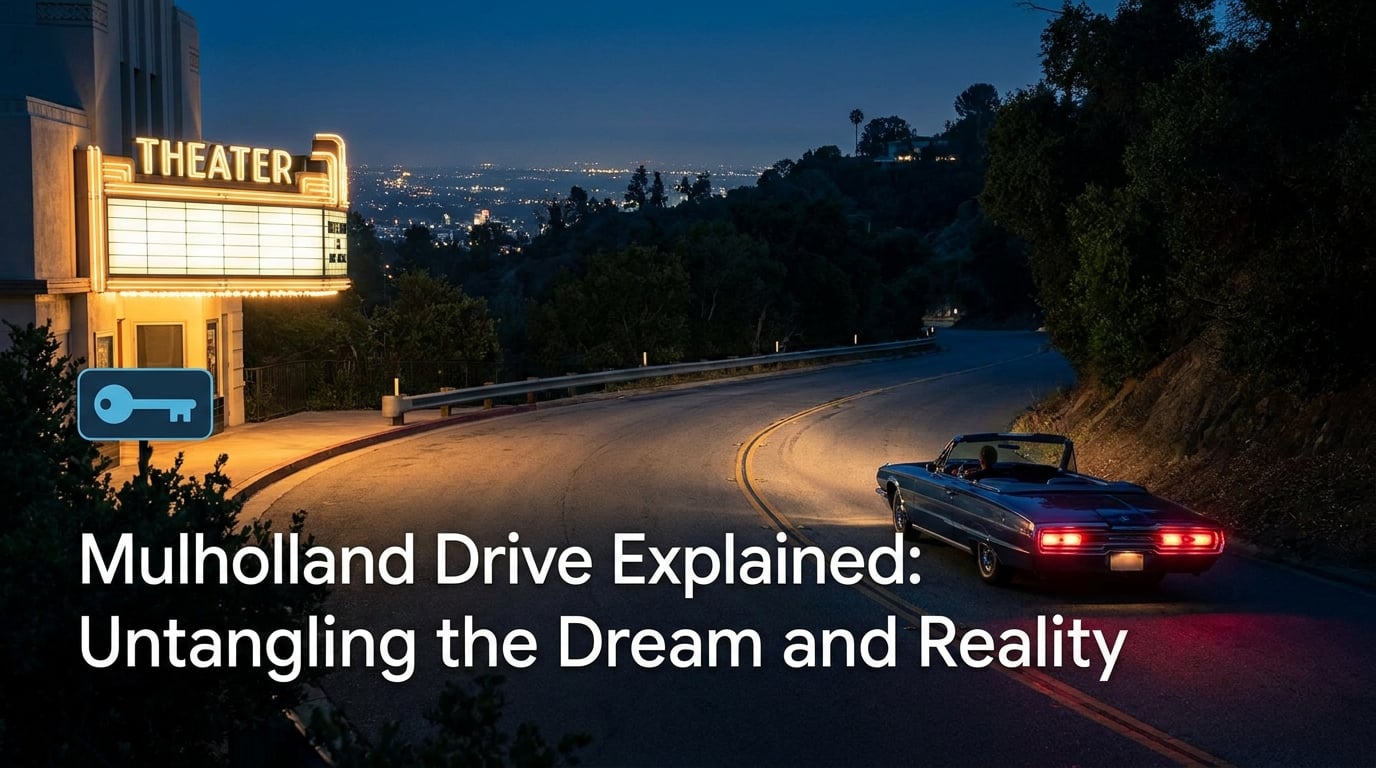
Mulholland Drive explained in one sentence: David Lynch’s 2001 film presents Naomi Watts’ Betty as Diane Selwyn’s ideal dream self, then reveals the painful reality of Diane’s failed Hollywood hopes, lost relationship with Camilla, and crushing guilt.
That framework makes the film far less confusing, but it should not flatten it into a puzzle with only one authorized answer. Lynch turns a breakup, jealousy, and a Hollywood disappointment into a dream sequence that feels seductive, funny, frightening, and finally unbearable.
First-time viewers often reach Club Silencio feeling that the movie has changed channels. That reaction is part of the design: the early story invites us to enjoy Betty Elms’ bright, can-do mystery, while the later scenes make us reconsider what we have been watching.
This guide separates the widely accepted dream-and-reality reading from details that remain open. We will track Betty and Diane, Rita and Camilla, the blue key and blue box, the monster behind Winkie’s, the old couple, and the final whispered “Silencio.”
Table of Contents
Mulholland Drive explained: the first part is Diane’s dream and the last part is her reality
The clearest reading is that the film’s opening roughly two-thirds is a dream created by Diane Selwyn, while the portion after Club Silencio returns to her waking life. In the dream, Diane is Betty: talented, innocent, welcomed in Los Angeles, and able to rescue the woman who rejected her.
In reality, Diane is isolated and unhappy. She has had an affair with actress Camilla Rhodes, watched Camilla move on with director Adam Kesher, and paid a hitman to kill her.
The dream does not replay those events accurately. It recasts them so Diane gets the admiration, control, romance, and moral innocence that real life denied her.
The short version: Betty’s Los Angeles is an idealized Hollywood dream where kindness and talent solve problems. Diane’s Los Angeles is the nightmare underneath it: rejection, dependency, resentment, and guilt.
The major hinge is Club Silencio. Betty and Rita hear a performer announce that everything is an illusion—”No hay banda”—then watch a singer perform “Llorando,” a Spanish-language version of “Crying,” even after her body collapses while the voice continues.
That scene tells the viewer that performance has separated from reality. Betty then trembles, finds the blue box, disappears, and Diane wakes in the same apartment space; the fantasy can no longer hold together.
The boundary is deliberately not a stopwatch. A few scenes may be memories, fantasies, or transitions rather than cleanly assigned to one side, which is why treating every image as a one-to-one code creates new problems.
The film’s basic chronology runs from ambition to guilt
Diane arrives in Los Angeles with hopes of becoming an actress, aided by a modest win at a jitterbug contest and support from Aunt Ruth.
She meets Camilla, who becomes both a more successful actress and Diane’s lover.
Camilla pulls away, becomes linked romantically to Adam, and humiliates Diane by bringing her to the Mulholland Drive gathering.
Diane hires a hitman at Winkie’s. He says that a blue key will appear when the job is done.
Camilla is killed, the blue key arrives, and Diane’s guilt produces the long fantasy of Betty and Rita.
Diane wakes, faces the key, is haunted by figures from her dream, and dies by suicide.
This reconstruction explains the emotional movement better than it explains every surreal detail. The film’s power comes from watching a mind attempt to turn unbearable knowledge into a story where it can be the hero.
The dream sequence retells Diane’s life as wish fulfillment
The dream begins with a crash on Mulholland Drive, but it is already rewriting Diane’s worst memory. Camilla survives as an amnesiac woman who calls herself Rita after seeing a Rita Hayworth poster; in Diane’s fantasy, Camilla needs Betty instead of leaving her.
Betty then arrives from Canada with sunny confidence, a loving aunt, and a suitcase full of possibility. She is welcomed by Coco, charms everyone she meets, and performs an audition with such ease that a casting room goes silent.
Those moments are not simply backstory. They give Diane what she longs for: effortless talent, professional recognition, independence, and a version of Camilla who is vulnerable, grateful, and emotionally available.
Betty is Diane’s repaired self
Betty Elms is best understood as Diane Selwyn rebuilt according to Diane’s wishes. She is blonde, optimistic, skilled, and unhurt by the compromises and rejection that have made Diane resentful.
Her audition is particularly revealing. Diane may have wanted to be seen as a serious actor, yet the dream gives Betty an immediate, intimate triumph before a room of men who had the power to dismiss her.
The casting director then rushes Betty toward a film directed by Adam. That reverses reality, where Adam’s project and Camilla’s success represent the world Diane cannot enter on her own terms.
Rita is Camilla made dependent and remorseful
Rita is Camilla after Diane’s dream has stripped away her confidence and memory. She cannot even name herself until she borrows an identity from a poster, so Betty becomes the capable investigator, protector, and desired partner.
The dream also invents a corpse in Diane’s apartment. Betty and Rita find it before they know what it means, allowing Diane’s mind to put the dead woman at a distance while still admitting, in disguised form, that a death is at the center of the story.
When Rita puts on the blonde wig, she resembles Betty without becoming her. The unsettling image suggests that the two women’s identities are beginning to blur because Diane’s wish and her memory of Camilla cannot stay separate.
Adam is less a villain than Diane’s imagined rival
Adam Kesher is a director whose career appears to be dictated by ominous men, a cowboy, and a forced casting choice. Diane’s fantasy reduces him from a successful person with agency into someone whose privileges are also controlled by bizarre powers.
The dream humiliates him further: his wife betrays him, his home and money are threatened, and he is told who must be cast. These scenes let Diane imagine Adam as trapped and powerless, just as she feels trapped in reality.
That does not mean Adam is innocent of every slight or that the film offers a simple factual record of Diane’s relationship. It means the dream arranges him around Diane’s jealousy, turning him into an obstacle that external forces appear to reward.
A useful viewing rule: ask what each dream event gives Diane emotionally. If a scene makes Betty admired, Rita dependent, Adam diminished, or Camilla available, it belongs naturally to the wish-fulfillment pattern.
The Hollywood dream becomes a nightmare about who gets chosen
Mulholland Drive uses Hollywood not just as a setting but as the engine of Diane’s fantasy. Betty arrives with the story America likes to tell about Los Angeles: a talented outsider is discovered because talent is obvious and good people recognize it.
Diane’s reality suggests a harsher account. Connections, attractiveness, chance, desire, and power affect who gets seen, while personal disappointment can turn into a private story of unfairness.
The casting scenes make that contrast sharp. Betty’s audition feels almost magical, whereas the film’s actual industry scenes are full of closed rooms, coded conversations, and people deciding that “this is the girl” before an artist has a real choice.
The phrase “this is the girl” is repeated as if it were a spell. In the dream it seems to impose Camilla on Adam; in reality, Diane may hear it as proof that someone else was selected for the part, the lover, and the life she wanted.
The Mulholland Drive dinner is the dream’s hidden wound
Diane’s recollection of the dinner on Mulholland Drive provides the emotional cause of the fantasy. Camilla leads Diane up a different route after the limousine stops, a gesture that is both intimate and cruel because Diane must be guided into a world where she does not belong.
At Adam’s house, Camilla kisses another woman in front of Diane and appears close to Adam. The scene turns private rejection into public humiliation, with smiles and party chatter making Diane’s distress more painful rather than less.
The earlier crash is the dream’s distorted echo of this ride. In fantasy, the car stops before the planned killing and Camilla escapes; in reality, Diane is the person who set a killing in motion.
The symbols externalize guilt, desire, and the breakdown of fantasy
The symbols in Mulholland Drive work best as emotional signals, not as a codebook where each color equals one fixed thing. Blue repeatedly marks the point where a comforting fiction meets knowledge that cannot be avoided.
The blue key means the murder has been completed
In the reality section, the hitman tells Diane that a blue key will appear when the job is done. She later finds the key on her coffee table, a small physical confirmation that Camilla has been killed.
The key is therefore not a mystical object Diane needs to decode. It is evidence of an action she ordered and cannot reverse.
In the dream, Rita carries a blue key before Betty discovers the matching blue box. The dream has taken a grim confirmation of murder and turned it into a mystery that Betty can solve beside Rita.
The blue box ends the story Diane can tolerate
When Rita opens the blue box, Betty disappears. The box functions like a trapdoor from wish fulfillment into reality: the fantasy has reached the fact it was designed to hide.
Its exact mechanics are not literal, and the film does not ask us to imagine a box physically transporting anyone. What matters is the match between key and box, cause and consequence, guilt and awakening.
Club Silencio says that the performance is real even when it is artificial
Club Silencio is the film’s clearest statement about illusion. The master of ceremonies insists that there is no band, then demonstrates that sound can continue after a performer stops producing it.
But the scene does not say that emotion is fake. Rebekah Del Rio’s “Llorando” moves Betty and Rita precisely because a performance can be constructed and still express a real feeling.
Many viewers single out this scene as the point that stays with them longest, and that response makes sense. Diane’s dream is artificial, but the grief running through it is not; the song gives the dream a voice just before it collapses.
The Winkie’s figure carries Diane’s fear into daylight
The frightened man at Winkie’s describes a nightmare about a figure behind the restaurant, then dies of fright when he sees it. On the plot level, the scene is detached from Betty and Rita’s detective story, which makes it feel like a warning from outside the dream’s neat narrative.
On a psychological reading, the figure is Diane’s buried dread: the ugly knowledge behind ordinary surfaces, waiting behind the diner where she hires the hitman. The filthy bag associated with the figure also holds the blue box, tying the dream’s hidden machinery to the place of Diane’s moral collapse.
There is no need to treat the figure as a literal demon with a biography. It is more frightening as an image of what Diane refuses to look at, and it anticipates the way guilt becomes visible at the end.
The cowboy represents judgment inside Diane’s fantasy
The cowboy appears to Adam as a calm, oddly formal authority. He tells Adam to accept the casting choice and later promises another meeting if Adam does well, language that makes the dream feel governed by rules Diane cannot control.
He can be read as a moral witness, a stand-in for the power Diane imagines directing Hollywood, or a dream figure who announces that fantasy has conditions. His blankness is part of the effect: he is less a fully drawn person than an intrusion of judgment.
The old couple turns early happiness into accusation
The smiling elderly couple who greet Betty at the airport initially represent approval, safety, and perhaps the cheerful support Diane associates with her earlier self. They return at the end in miniature form, burst from the blue bag, and chase Diane through her apartment.
They are often read as guilt made grotesque. The dream’s most harmless, congratulatory faces become persecutors once Diane can no longer keep the murder outside her consciousness.
The scene also gives weight to the jitterbug contest. Diane’s past achievement may be one of the small promises that carried her toward Hollywood, so the figures who once seemed to celebrate that promise become the nightmare of a life that did not fulfill it.
Interpretation warning: readings involving childhood trauma or sexual abuse appear in some extended analyses, but the film does not state them plainly. They can be discussed as possible psychoanalytic approaches, not presented as settled plot facts.
The ending returns us to Diane’s reality and shows why she dies
After the blue box opens, Diane wakes in a shabby apartment rather than Betty’s bright world. Camilla visits, but the encounter is tense and fleeting; Diane’s behavior shows need, anger, and an inability to accept that the relationship has ended.
The hitman sequence explains the blue key’s real origin. Diane meets him at Winkie’s, points out Camilla, and hears that the key will appear when the job is complete.
That knowledge recasts the dream’s investigation. Betty tried to save Rita from a crime, while Diane paid to have Camilla killed and then built a story in which the woman survives long enough to love her.
Diane dies because guilt overwhelms her, not because the film solves a crime
Diane sees the blue key and is tormented by visions of the old couple. She reaches for a gun and dies by suicide, ending a film about a consciousness that has run out of places to hide.
The ending is tragic because the dream offered a brief emotional repair. Betty could be talented and generous, Rita could need her, and the crime could become a mystery with a solution; waking life gives Diane none of those consolations.
The final image of the blue-haired woman above Los Angeles followed by “Silencio” is not a tidy explanation. It returns us to the image of a city built on screens, secrets, and silence, then asks us to sit with what Diane could not bear to say aloud.
David Lynch leaves room for more than one reading
The dream theory organizes Mulholland Drive more convincingly than most alternatives because it accounts for the identity changes, the blue key, the hitman, Club Silencio, and Diane’s final terror. Even so, Lynch does not make the film feel like a detective solution waiting to be marked correct.
He released ten clues in a DVD-era extra, and viewers often use them to locate repeated names, objects, and exchanges. They are helpful prompts for attention, not a declaration that every ambiguity has been closed.
That restraint matters. A dream can mix a remembered phrase, a fear, a fantasy, and an unrelated sensation without arranging them like a conventional plot, and the film follows that emotional logic.
The trauma reading is possible but should remain a reading
Some critics and viewers trace the Jitterbug imagery, Diane’s fragmentary memories, and the film’s sexual dynamics toward repression or earlier trauma. That approach can help explain why the fantasy has such a childlike split between radiant innocence and monstrous punishment.
It should not replace the text’s clearest facts: Diane experiences romantic rejection, commissions a murder, and collapses under guilt. The film supplies enough evidence for that tragedy without requiring a hidden history as a factual answer.
A better way to hold both ideas is to say that Mulholland Drive uses dream imagery associated with vulnerability, desire, shame, and regression. It invites psychoanalysis, but it does not force one clinical diagnosis onto Diane.
David Lynch’s death makes rewatching feel different, not simpler
David Lynch died in January 2025, and many fans returned to his work afterward. That context can make Mulholland Drive’s interest in performance, memory, dread, and unspoken feeling feel especially poignant.
It does not turn the film into a memorial or change what its images mean. It is simply a reminder that this David Lynch film still produces the same productive confusion and emotional aftershock for new viewers in 2026.
A second viewing makes the clues easier to place
A rewatch is not required to understand the basic story, but it is the best next step once the dream/reality framework clicks. The aim is not to hunt every Easter egg; it is to notice how Diane’s emotional needs shape the early scenes.
Watch the first section as Diane’s revised memory
Notice whenever Betty succeeds instantly, receives praise, or wins access to people who matter.
Notice whenever Rita is helpless, grateful, or physically drawn toward Betty.
Notice the way Adam loses control over his film and is repeatedly humiliated.
Notice repeated names, faces, and objects that later return in Diane’s waking life.
This approach answers a common frustration: viewers often assume the early plot must be solved on its own terms. It becomes clearer once it is viewed as a rearrangement of material that Diane already knows.
Watch Club Silencio as an instruction, not a plot twist
Listen to the scene’s insistence that the performance is recorded or constructed, then look at Betty and Rita’s reaction. The message is not “nothing mattered”; it is “the thing that moved you was never as stable as you thought.”
That distinction makes the shift to Diane feel less arbitrary. The film has already told us that appearances, sounds, identities, and even the story we are following can come apart.
Watch the final section for facts before symbols
Start with the literal chain of events: Diane loved Camilla, Camilla rejected her, Diane hired a killer, and the key appeared. Once those facts are firm, the old couple, blue imagery, and ominous figures read as expressions of guilt rather than random horror.
That order is also kind to a first-time viewer. It lets the film remain strange without demanding that every strange image carry the same kind of answer.
FAQs
What is the message behind Mulholland Drive?
Mulholland Drive examines how guilt, heartbreak, and failed ambition can turn the Hollywood dream into a nightmare. Diane Selwyn creates a fantasy in which she is the gifted Betty and Camilla is the dependent Rita, but the fantasy collapses under the reality that Diane arranged Camilla’s murder.
Are Diane and Betty the same person in Mulholland Drive?
Yes, in the dominant dream-versus-reality interpretation, Betty is Diane’s idealized dream identity. Betty has the talent, confidence, and hopeful future Diane wants, while Diane’s waking life is marked by disappointment, jealousy, and guilt.
What does the blue-haired woman represent in Mulholland Drive?
The blue-haired woman is commonly read as an eerie observer connected to Club Silencio, illusion, and the film’s final silence. She is not explained as a literal character; her presence helps turn Los Angeles into a dreamlike space of performance, mystery, and judgment.
What was the point of the old couple in Mulholland Drive?
The old couple first embody the warm approval and optimism surrounding Betty’s arrival in Los Angeles. When they return as tiny, terrifying figures after Diane wakes, they are commonly read as guilt transforming that early happiness into an inescapable accusation.
Conclusion
Mulholland Drive explained through Diane’s dream is not a claim that every image has only one meaning. It is the framework that connects the film’s central facts: Betty is Diane’s wished-for self, Rita is a remade Camilla, the blue key confirms murder, and Club Silencio announces that the beautiful illusion cannot last.
For a second viewing, begin at the airport and watch for every moment when Diane’s fantasy makes her admired, makes Camilla need her, or cuts Adam down to size. Then let the film keep a little of its silence; its ambiguity is not a flaw to eliminate but part of the feeling it leaves behind.