
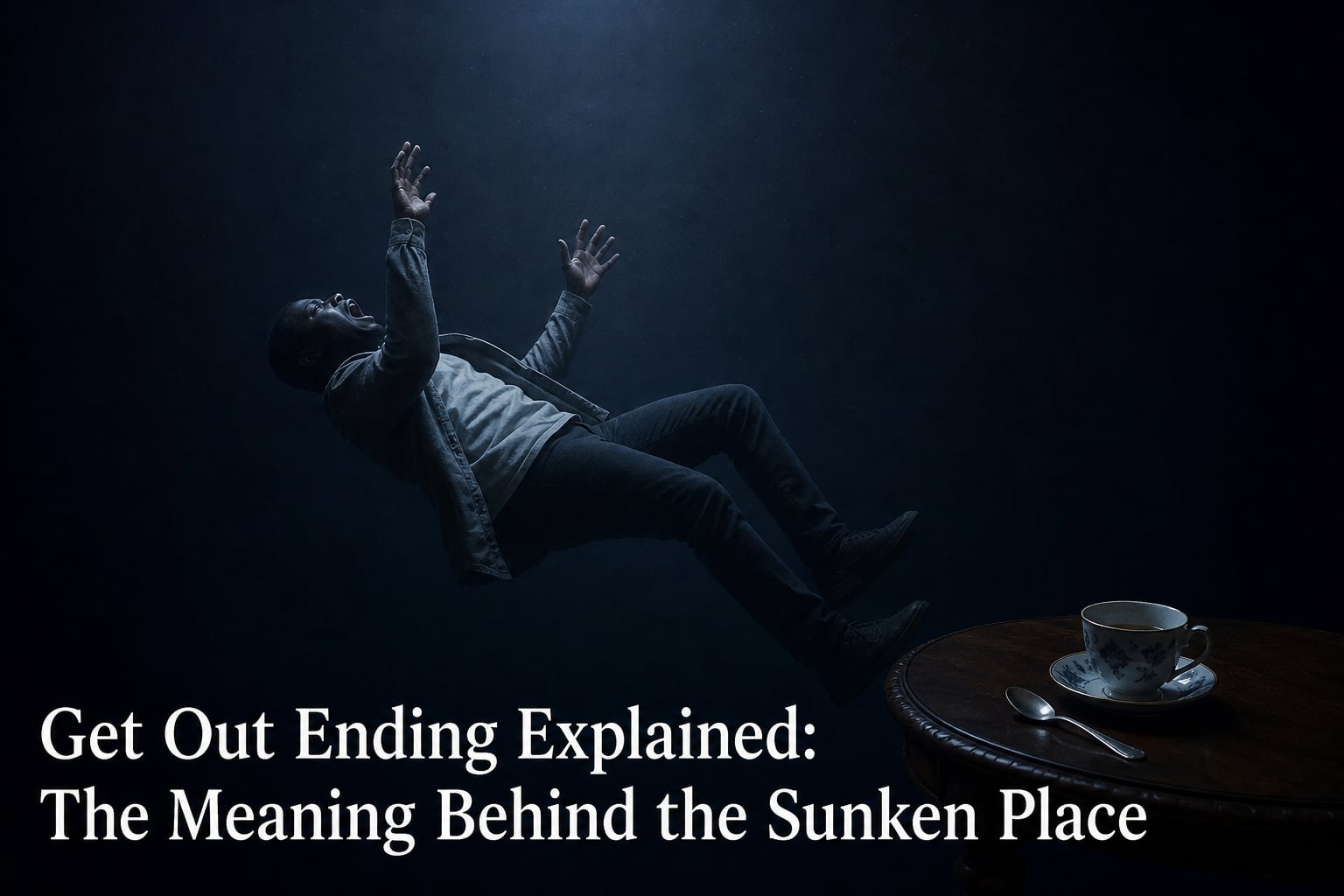
Jordan Peele once said that the Sunken Place means “we’re marginalized, have been marginalized, and no matter how hard we scream, the system silences us.” That single sentence captures the heart of his 2017 horror masterpiece Get Out, a film that rewired the horror genre and forced audiences to confront the insidious machinery of racism hiding behind polite smiles.
When Chris Washington (Daniel Kaluuya) agrees to spend a weekend with his white girlfriend Rose Armitage’s (Allison Williams) family in upstate New York, he walks into a nightmare dressed as hospitality. The film builds to a finale that leaves viewers shaken, confused, and desperate to understand what they just witnessed.
In this deep dive, I break down the Get Out ending explained with full Sunken Place meaning, exploring the symbolism Peele layered into every frame. From the hypnotic teacup to the cotton in Chris’s ears, every detail carries weight.
Table of Contents
What Is the Sunken Place in Get Out?
The Sunken Place is a psychological void where victims of the Armitage family’s hypnosis are trapped, fully conscious but completely paralyzed. They can see through their own eyes but cannot control their bodies, speak, or cry for help. It is a prison of the mind, not the body.
Visually, Peele represents this state as a dark, bottomless abyss. The victim falls backward into a tunnel of shadow while their body remains above, operated like a puppet by whoever holds control. The camera technique used to create this effect, called “dry-for-wet” filming, involves submerging the actor in water and filming them in slow motion to produce an eerie, weightless descent.
Jordan Peele described the Sunken Place meaning in his own words at a 2017 screening: “The Sunken Place is this system that is silencing you, sitting back and watching you, and there’s nothing you can do about it.” He wanted audiences to feel the helplessness that marginalized people experience daily in a society that claims to be post-racial.
The concept is not just horror filmmaking. It is a direct commentary on how institutions, systems, and individuals can strip a person of their autonomy while smiling to their face. The Armitage family embodies this idea perfectly with their warm hugs and cold calculations.
How Missy’s Hypnosis Creates the Sunken Place
Missy Armitage (Catherine Keener), Rose’s mother, is the architect of the Sunken Place. She is a psychiatrist who uses her professional skills for sinister purposes. Her method relies on a simple but terrifying technique: a silver spoon stirred in a teacup, accompanied by her calm, rhythmic voice.
The process begins with conversation. Missy asks Chris about his smoking habit and his mother’s death, probing for emotional vulnerabilities. When she finds his deepest wound, the guilt over not being there when his mother died, she weaponizes it. The clink of the spoon against the ceramic cup becomes the trigger that sends his mind into the abyss.
Once the trigger is planted, anyone can activate it. Later in the film, Rose uses a camera flash to trigger Andre Hayward (who has been reprogrammed as “Logan King”), and the same flash eventually saves Chris. The brilliance of Peele’s design is that the tool of imprisonment, the flash, becomes the instrument of liberation.
The hypnosis creates what psychiatrists call a fugue state, a dissociative condition where a person loses awareness of their identity and actions. In Get Out, this state is weaponized to separate the victim’s consciousness from their body, leaving the body as an empty vessel for someone else to inhabit.
The Sunken Place as a Metaphor for Systemic Oppression
Jordan Peele built the entire Sunken Place concept as a metaphor for systemic oppression. The imagery of falling backward into darkness, screaming without being heard, mirrors the experience of Black Americans navigating institutions that were designed to control them.
The Sunken Place is not a single act of violence. It is the accumulation of microaggressions, silencing, and erasure that strips away a person’s voice and agency. Chris is lured into the Armitage trap through the exact mechanism of white liberalism: polite smiles, declarations of progressiveness, and the insistence that “we are not racist.”
Peele released Get Out in February 2017, during the transition between the Obama and Trump administrations. The timing was deliberate. The film critiques the myth of a post-racial America by exposing how racism evolved from overt hatred into something more insidious: a system that smiles at you while stealing your autonomy.
Consider the Armitage family themselves. Dean Armitage (Bradley Whitford) proudly tells Chris that he would have voted for Obama a third time. He praises Chris’s genetics and physical attributes as if appraising merchandise. This is the face of modern racism in Peele’s vision, not a slur screamed in the street but a compliment delivered over a glass of lemonade.
The Sunken Place metaphor extends to every marginalized voice in America. As Peele himself stated, it represents being “forced to sit back and watch.” Whether it is the criminal justice system, housing discrimination, or workplace inequality, the Sunken Place captures the sensation of seeing injustice happen to you and being unable to stop it.
The Sleep Paralysis Inspiration Behind the Sunken Place
Jordan Peele drew the Sunken Place from a deeply personal source: his own experience with sleep paralysis. In interviews, he described waking up unable to move while his mind raced with terrifying awareness. That exact sensation became the foundation for Chris’s torment.
Sleep paralysis occurs when the brain transitions between sleep stages and the body’s natural muscle atonia, which prevents you from acting out dreams, persists into wakefulness. The result is a state where you are conscious but cannot move or speak. Many sufferers report a sensation of falling, pressure on the chest, or a dark presence in the room.
Peele translated this into one of the most visually striking sequences in modern horror. The “dry-for-wet” technique, which involves filming an actor underwater to simulate the feeling of weightlessness, creates the effect of Chris falling through an endless void. His body contorts and stretches as gravity warps around him. The slow-motion cinematography and dim lighting sell the dreamlike terror.
By grounding the horror in a real, documented phenomenon, Peele made the Sunken Place relatable to anyone who has ever experienced sleep paralysis. Millions of people know what it feels like to scream silently while your body refuses to respond. That universal dread amplifies the racial metaphor at the film’s core.
The Cotton Symbolism: Turning Oppression Into Resistance
One of the most overlooked details in Get Out is the cotton Chris uses to block the hypnosis trigger. When he tears open the armrest of the chair he is strapped to, he finds cotton stuffing inside. He packs it into his ears, blocking the sound of the television that Missy uses to keep him under.
The symbolism here is layered and devastating. Cotton is the crop that fueled centuries of chattel slavery in America. Enslaved Black people were forced to pick cotton under brutal conditions, their labor building the wealth of the nation while their bodies were treated as property. By using cotton as the tool of his liberation, Chris turns the very symbol of his ancestors’ oppression into a weapon of resistance.
This is what makes Get Out more than just a horror film. Peele does not simply critique racism. He shows how the tools of oppression can be reclaimed and inverted. The cotton that once bound enslaved people becomes the material that frees Chris from the Armitage trap.
The chair itself adds another layer. Chris is restrained with leather straps, evoking images of electric chairs and lynching violence. The television playing old footage of Armitage family members and auction-style selections reinforces the connection between this modern horror and the historical atrocities it mirrors.
This detail is easy to miss on first viewing, which is exactly Peele’s style. He rewards attentive audiences with layers of meaning that deepen with every rewatch.
The Order of the Coagula: What the Armitage Family Really Does
The Armitage family belongs to a secret society called the Order of the Coagula. The word “coagula” comes from the Latin alchemical phrase “solve et coagula,” meaning “dissolve and join together.” This perfectly describes their procedure: dissolving one person’s consciousness and joining it with another’s body.
The Coagula procedure involves transplanting the brain of an older white person into the body of a younger, healthy Black person. The white person’s consciousness takes over, while the Black victim’s mind is trapped in the Sunken Place. Jim Hudson (Stephen Root), a blind art dealer, wants Chris’s body specifically for his photography eye.
The annual Armitage gathering, which Chris attends under the guise of a family party, is actually a silent auction. The guests bid on Chris’s body using bingo cards, treating a human being as a commodity. This scene is a direct parallel to slave auctions, where Black bodies were sold to the highest bidder.
Peele makes the auction scene deliberately uncomfortable. The guests are polite, cultured, and affluent. They discuss Chris like he is a piece of art, which is exactly how Jim Hudson sees him. The horror is not in gore or jump scares but in the banality of evil, the casual cruelty of people who see themselves as progressive.
The other victims we see in the film reinforce the scope of the operation. Andre Hayward is now inhabited by someone calling himself Logan King. Georgina (Betty Gabriel) is revealed to be inhabited by Rose’s grandmother, Marianne. Walter (Marcus Henderson) carries the consciousness of Roman Armitage, Rose’s grandfather and the founder of the Order. The family has been doing this for generations.
How Chris Escapes the Sunken Place
Chris’s escape from the Sunken Place is one of the most satisfying sequences in modern horror. It happens in stages, each one powered by a detail Peele planted earlier in the film.
Step 1: The camera flash. Earlier in the film, a guest at the party uses a camera flash that temporarily frees Andre/Logan from his programming. The flash snaps the victim’s real consciousness to the surface, overriding the implanted identity. When Rod (Lil Rel Howery) sends Chris a flash photo on his phone, the effect triggers Chris’s awareness even before he is strapped to the chair.
Step 2: The cotton. Chris remembers the cotton he pocketed earlier when he tore open the chair armrest. By stuffing cotton into his ears, he blocks the audio track from the television that Missy uses to keep victims in their trance state. This is the critical move that breaks the hypnosis.
Step 3: Playing dead. Chris closes his eyes and pretends to remain under. When Missy and Jeremy return to collect him, they believe the procedure is proceeding as planned. Chris waits for the right moment and strikes, catching them off guard.
Step 4: Physical escape. Chris frees himself from the chair, kills Dean with a set of antlers mounted on the wall, and fights his way through the house. He kills Missy and Jeremy, then confronts Rose in a final, brutal confrontation.
Each step reflects a different form of resistance. Awareness, preparation, patience, and action. Peele constructs the escape as a metaphor for how marginalized communities survive and fight back against systems designed to erase them.
Get Out Ending Explained: What Happens in the Final Scene
The final scene of Get Out is a masterclass in tension and release. Chris has escaped the house and is driving away when Rose, bleeding from a gunshot wound, appears in the road with a rifle. She shoots at him, and Chris crashes the car.
What follows is a desperate struggle. Chris pins Rose to the ground and begins to choke her. For a moment, the film holds its breath. Is Chris about to commit murder? Can he retain his humanity after everything that has been done to him?
Then the headlights appear. A police car pulls up, and the audience tenses. In America, a Black man with his hands around a white woman’s neck, standing over her body, would almost certainly be killed or arrested on sight. Peele weaponizes this knowledge, making the audience brace for tragedy.
But the door opens, and it is Rod, not the police. “I told you not to go to that house,” he says. He takes Chris away, and Rose is left dying on the road. The film ends with Chris safe, rescued by his best friend rather than destroyed by the system.
Chris’s survival is not luck or coincidence. It is an act of resistance. Every choice Peele made in the ending, from the cotton to the flash to Rod’s arrival, reinforces the idea that Black survival itself is a form of rebellion in a system built to consume Black bodies.
The forum discussions on Reddit and film communities frequently highlight this point. Chris’s escape is a fantasy fulfillment that the original ending refused to provide, and that contrast makes the theatrical ending even more powerful.
Rose’s Final Smile: What It Means
As Rose lies dying, she smiles at Chris. This moment has generated enormous discussion among fans and critics. The smile is not one of pain or delirium. It is deliberate, cold, and knowing.
Rose’s smile represents the persistence of white supremacy. Even as she dies, she believes she has won. In her mind, the system will ultimately protect her and punish Chris. She expects the police to arrive, see a Black man standing over a white woman, and do what they always do.
The smile is the face of a system that does not need any single individual to survive because the machinery continues regardless. Rose dies, but the Order of the Coagula, the auction guests, the surgeons, and the ideology they represent are still out there.
Reddit users on r/movies and r/FanTheories have extensively debated this scene. The consensus is that Rose’s smile is Peele’s reminder that defeating one family does not defeat the system. The horror of Get Out is not just what happens in the Armitage house. It is the knowledge that the Armitages are a symptom, not the disease.
This detail separates great horror from cheap thrills. The scare does not end when the credits roll because the real-world parallels continue long after the movie is over.
The Alternate Ending: Chris Goes to Prison
Peele’s original ending for Get Out was far darker. In the alternate version, the headlights that appear belong to an actual police car, not Rod. The officers arrest Chris for the murders of the Armitage family, and the final scene shows him in a prison cell, visited by Rod.
Rod asks Chris to tell him what happened, but Chris simply says, “I’m good.” He has given up. The system has won. Despite escaping the Armitage house, Chris cannot escape the justice system that sees a Black man as guilty by default.
Peele changed this ending after test audiences found it too devastating. In interviews, he explained that during the testing process, which overlapped with the early days of the Trump presidency, audiences needed to see Chris survive with his freedom intact. The theatrical ending gives Chris the hero moment that Peele felt audiences, particularly Black audiences, deserved.
The debate over which ending is better continues to rage in film communities. Some argue the prison ending is more realistic and therefore more powerful. It shows that even if you escape the literal monsters, the system will still find a way to punish you for surviving.
Others prefer the theatrical ending because it refuses to give the audience the easy comfort of “realism.” By having Rod show up instead of the police, Peele denies the system its expected victory. Chris walks away free because a friend believed him when the world would not.
Both endings make the same point from different angles. The prison version says the system will always win. The theatrical version says that solidarity and resistance can sometimes break through. Peele chose hope, and that choice itself became a statement.
Georgina, Walter, and the Other Victims
The film hints at a larger tragedy beyond Chris’s story. Georgina and Walter are both victims of the Coagula procedure, their bodies inhabited by Rose’s grandparents. Their behavior throughout the film, the unnatural movements, the crying, the moments of lucidity, all point to the real consciousness trapped beneath.
Georgina’s tears are particularly haunting. When she cries while serving tea, it is not the host personality shedding tears. It is the original Georgina, buried deep in the Sunken Place, weeping at her own enslavement. The camera flash that briefly restores Andre/Logan confirms that the victims are still aware, still fighting, still screaming in the dark.
Walter’s nighttime running is another detail Peele layers with meaning. Roman Armitage, inhabiting Walter’s body, runs at night to maintain the physical fitness of the body he stole. But the eerie, repetitive nature of the runs also suggests the trapped consciousness trying to break free through sheer physical exertion.
These details enrich the film’s world and make the Coagula operation feel like a genuine institution rather than a one-off scheme. The Armitages have been doing this for decades, and Chris is just their latest acquisition.
Why the Camera Flash Breaks the Hypnosis
A common question among viewers is why the camera flash specifically disrupts the Sunken Place hypnosis. The answer lies in how the procedure works at a neurological level.
The Coagula procedure separates the victim’s consciousness from their body using the hypnosis trigger, typically the teacup spoon sound. The victim’s original mind is pushed into the Sunken Place, while the transplanted consciousness operates the body. This arrangement is maintained through the audio conditioning that Missy installs.
The camera flash works because it is an overwhelming sensory input that the conditioning cannot account for. The sudden burst of light floods the visual cortex and momentarily overrides the implanted identity, allowing the original consciousness to surface. This is why Andre/Logan briefly returns to his true self when the flash goes off at the party.
Peele never explicitly explains this mechanism in the film. He trusts the audience to piece it together from the visual evidence. This is part of what makes Get Out so rewatchable: the clues are all there, but they reward close attention rather than hand-holding.
The Cultural Impact of the Sunken Place
The Sunken Place has transcended the film itself to become a cultural shorthand for systemic silencing. People use the phrase in political commentary, social media posts, and everyday conversation to describe the experience of being ignored or dismissed by institutions that claim to serve them.
During the racial justice movements of 2020 and beyond, references to the Sunken Place surged online. Activists used the metaphor to describe how Black voices are often tokenized, ignored, or actively suppressed in corporate, academic, and political spaces. Peele’s creation had become part of the cultural vocabulary.
The film also revitalized the horror genre, proving that socially conscious horror could be both commercially successful and critically acclaimed. Get Out earned four Academy Award nominations, including Best Picture, and won Best Original Screenplay for Peele. It was the first horror film nominated for Best Picture since The Silence of the Lambs in 1992.
For Black audiences, the film was a rare experience: seeing their specific fears and experiences reflected on screen without being reduced to trauma porn or educational content. Peele made a horror film that was genuinely terrifying because the monster was not a supernatural entity but a system that is very real.
FAQs
What is the significance of The Sunken Place in Get Out?
The Sunken Place is Jordan Peele’s central metaphor for systemic oppression. It represents how marginalized people are silenced, stripped of their autonomy, and forced to watch as systems control their lives. Peele described it as the feeling of being marginalized and screaming without being heard.
What does the ending of Get Out symbolize?
The ending of Get Out symbolizes Black resistance and survival. Chris’s escape from the Armitage house, aided by the cotton he uses to block the hypnosis and Rod’s arrival instead of police, represents an act of defiance against a system designed to consume Black bodies. His survival is framed as rebellion, not luck.
How did Chris Get Out of The Sunken Place?
Chris escapes the Sunken Place by stuffing cotton from the chair armrest into his ears, blocking the audio trigger that keeps him hypnotized. He then plays dead, waits for the right moment, and physically fights his way out of the Armitage house. A camera flash earlier also helped trigger his awareness of the trap.
Why did everyone go silent when Chris went upstairs in Get Out?
The party guests went silent because the Armitage gathering was actually a silent auction where guests bid on Chris’s body using bingo cards. The guests were members of the Order of the Coagula evaluating Chris as merchandise, and the silence marked the transition from social performance to business transaction.
Why was Rose smiling at the end of Get Out?
Rose’s smile as she dies represents the persistence of white supremacy. Even in death, she expected the system to punish Chris, believing police would arrive and see a Black man standing over a white woman. Her smile reflects the confidence that the system she served would ultimately win, even if she personally did not survive.
Is a sunken place like in the movie Get Out real?
The Sunken Place in Get Out is fictional, but it draws from real experiences. Jordan Peele was inspired by his own episodes of sleep paralysis, a documented condition where a person wakes up unable to move. The metaphor also reflects real-world experiences of systemic silencing and marginalization faced by Black Americans and other marginalized groups.
Why did Rose smile when Chris choked her?
Rose smiled because she believed the police would arrive at any moment and arrest or kill Chris for attacking a white woman. Her smile was the expression of someone who trusted the system to do what it has always done. When Rod arrives instead of the police, her confidence shatters.
What is the Order of the Coagula in Get Out?
The Order of the Coagula is a secret society that transplants the brains of older white people into the bodies of younger, healthy Black people. The name comes from the alchemical phrase meaning to dissolve and join together. The Armitage family runs the operation, holding annual auctions where members bid on Black victims.
Conclusion
The Get Out ending explained with full Sunken Place meaning reveals a film that operates on multiple levels simultaneously. On the surface, it is a horror thriller about a man trapped in a nightmare. Beneath that, it is a devastating critique of how racism adapts, evolves, and hides behind smiles and handshakes.
Jordan Peele gave audiences a metaphor that transcends cinema. The Sunken Place is now part of how we talk about marginalization, silencing, and resistance. It appears in conversations about workplace discrimination, political representation, and the criminal justice system because the feeling it captures is real.
Chris Washington’s survival matters because it refuses the narrative that the system always wins. The cotton, the camera flash, Rod’s arrival, each element reinforces that resistance is possible even when the odds are stacked against you. Peele chose hope over despair, and that choice was itself an act of defiance.
If you have not watched Get Out recently, it rewards rewatching. Every viewing uncovers new layers, new symbols, and new connections between the film’s fictional horror and the real-world systems it mirrors. The Sunken Place is still with us, and understanding it is the first step toward dismantling it.