
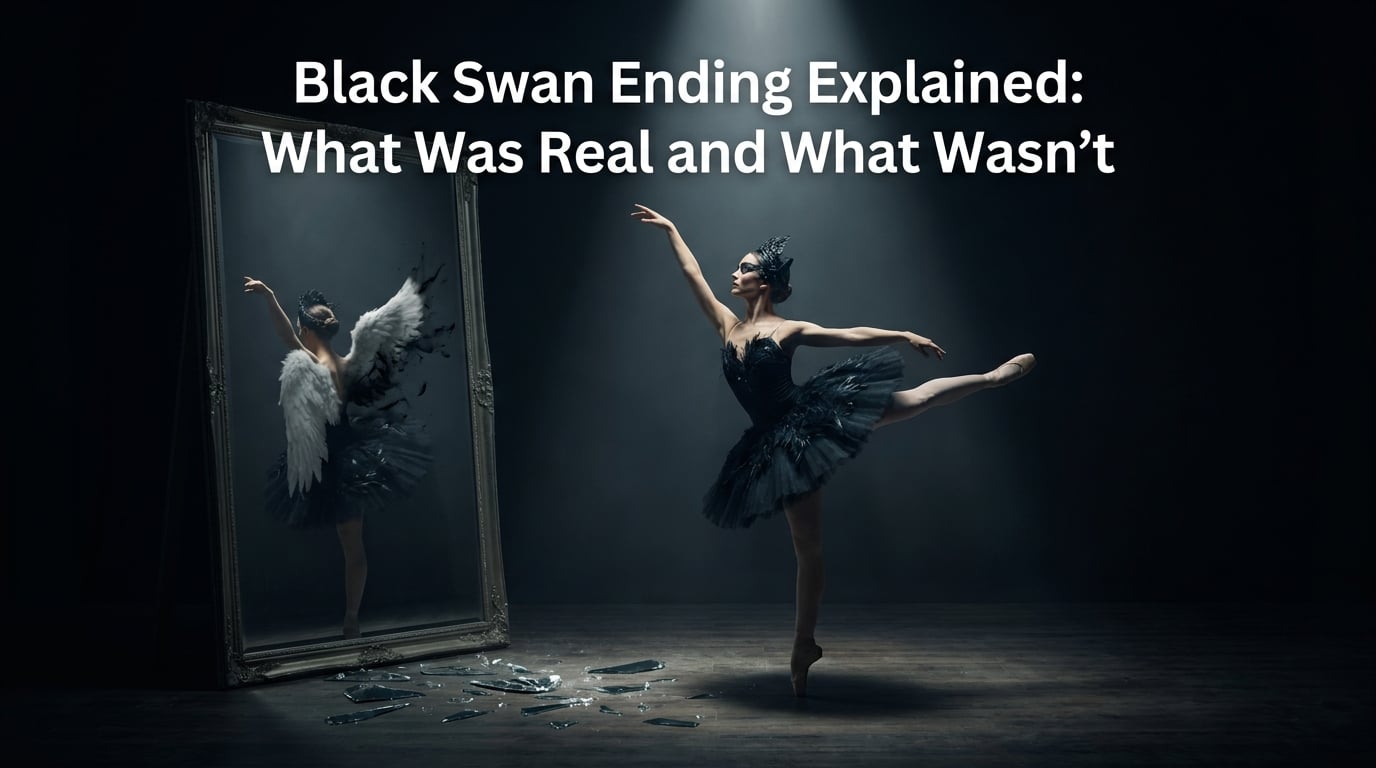
If you have ever finished Black Swan and felt like the ground shifted under you, you are not alone. The short answer: Nina Sayers does not kill Lily in the final act. She stabs herself with a broken shard of mirror, performs her Swan Queen role, leaps to her death, and the screen fades to white. Whether that final moment is literal death or symbolic transcendence is the question that has fueled a decade of debate.
I have watched the film four times, and each viewing reveals another layer of what was real versus what Nina’s fractured mind invented. This Black Swan ending explained guide walks through every ambiguous scene, what Aronofsky actually intended, and where the evidence lands.
Table of Contents
What Was Real in Black Swan?
Most viewers walk away from Black Swan unsure which scenes actually happened. Here is the clearest breakdown I can offer based on the film’s internal logic, the script, and director Darren Aronofsky’s own commentary.
What was real in Black Swan:
Nina’s casting as the Swan Queen and her rising obsession with the role
The encounter with Lily (Mila Kunis) and her introduction to Nina’s world
The club scene and Lily bringing Nina home
Nina’s mother Erica finding them asleep together on the couch
The hallway fight that Nina imagined was with Lily
Nina’s self-inflicted stabbing with a mirror shard in the locker room
Her final performance of Swan Lake on opening night
What was a hallucination in Black Swan:
The bathroom fight where Nina appears to kill Lily
The mirror version of Lily staring back at Nina
The “perfect” transformation into the Black Swan mid-performance
Lily appearing in the dressing room to “replace” Nina
The moment Lily seemingly confesses to sabotaging her
The whole movie works on the principle of the unreliable narrator. Nina’s mental state is the lens, and everything you see is filtered through her deteriorating grip on reality.
Black Swan Movie Plot Summary: Setting Up the Ending
Black Swan follows Nina Sayers (Natalie Portman), a devoted ballet dancer in a New York City company run by Thomas Leroy (Vincent Cassel). When prima ballerina Beth Macintyre (Winona Ryder) retires, Thomas casts Nina as the Swan Queen in his production of Swan Lake.
The role requires Nina to play two opposing characters: the innocent White Swan (Odette) and the seductive, dangerous Black Swan (Odile). Nina embodies the White Swan perfectly but cannot access the dark sensuality the Black Swan demands.
Enter Lily, a new dancer whose loose confidence is everything Nina lacks. As opening night approaches, Nina’s obsession with perfection collides with mounting pressure from her overbearing mother, her controlling director, and her own fractured psyche. By the time we reach the final act, the line between Nina’s reality and her hallucinations has effectively dissolved.
Was Lily Real or a Hallucination in Black Swan?
This is the question that divides Black Swan fans most sharply. The answer, frustratingly, is both.
Lily as a person is real. She exists, she is a dancer in the company, and she does bring Nina home from the club. The scenes where Lily takes Nina under her wing, parties with her, and introduces her to a looser version of herself all happened.
What is not real is the version of Lily that Nina projects onto her. The seductive, scheming Lily who tries to steal her role, who confronts her in the bathroom, who replaces her at the performance – that Lily is a hallucination. Nina’s mind invents a dark double to play the Black Swan role she cannot access in herself.
The film’s trick is that we meet the real Lily first, so by the time the sinister Lily appears, we do not question her. Aronofsky uses our trust in the established character to smuggle Nina’s delusions past our defenses.
The Bathroom Confrontation: Did Nina Kill Lily?
After the company learns the understudy will replace Nina, she runs through the backstage hallway and bursts into the bathroom. She finds Lily there, and the two fight. Nina slams Lily’s head against the mirror, then against the tile, until Lily goes still.
This is the scene that convinces viewers Nina has committed murder. It feels visceral, physical, and real.
It is also the film’s biggest misdirection. When Nina emerges from the bathroom and returns to her dressing room, Lily is standing in the doorway. Alive. Unhurt. Watching Nina with quiet confusion.
The bathroom fight never happened. Nina fought with herself. The body she imagined killing was her own reflection, the dark version of herself she needed to destroy in order to become the Black Swan. Aronofsky has confirmed in interviews that this sequence exists entirely inside Nina’s fractured perception.
The Locker Room Stabbing: What Really Happened?
Immediately after the Lily reveal, Nina looks down and sees a shard of mirror protruding from her own stomach. The twist lands hard: she stabbed herself during the imagined fight.
This is the most important piece of evidence for how to read Black Swan’s ending. Nina did not murder anyone. She turned the weapon on herself in a dissociative episode, believing she was killing her rival.
The self-inflicted wound explains the earlier “rash” on Nina’s back that she keeps scratching open, the skin peeling from her fingers, and her shoulder blade popping unnaturally. These were all manifestations of Nina’s body rebelling against the impossible demands of perfection. The body horror in Black Swan is not supernatural – it is Nina’s mind punishing her physically for the psychological strain she is under.
Critics often miss this distinction. Black Swan is not a movie about a woman possessed or haunted. It is about a woman whose mind turns inward with such violence that her body becomes a battleground.
The Final Performance: Did Nina Die at the End of Black Swan?
Nina performs Swan Lake’s final act bleeding from the abdomen. As the Swan Queen, she is supposed to leap from a cliff and die. Nina completes the choreography perfectly. Her eyes close, the music swells, and the screen fades to white.
Did Nina die at the end of Black Swan? The film leaves this deliberately ambiguous, and the answer depends on whether you read the ending as literal or symbolic.
The literal reading: Nina bleeds out on stage from a fatal self-inflicted wound. The leap is the choreography completing itself; the fade to white is death. Thomas and the company rush to her because she has collapsed from blood loss, not because the performance moved them.
The symbolic reading: Nina achieves the perfect performance and transcends her limitations. The fade to white is not death but artistic transcendence – the moment the dancer and the role become one. She has finally become the Black Swan, and the white light is her transformation completing itself.
Natalie Portman’s own interpretation: In interviews following the film’s release, Portman has stated that she does not believe Nina dies. She reads the final moment as Nina achieving the perfection she sought, the Black Swan fully realized, the body and the role finally merged. The white light is release, not expiration.
Aronofsky has refused to commit to a single answer. He has described the ending as “a transformation” rather than a death, suggesting he sees the fade to white as completion rather than conclusion.
What Mental Illness Does Nina Have in Black Swan?
The film does not diagnose Nina explicitly, which is part of why the ending works. Aronofsky layers several overlapping conditions to create her breakdown.
Psychosis is the most accurate umbrella term. Nina experiences hallucinations, delusions, and a deteriorating hold on consensus reality. The mirror Lily, the bathroom murder, and the body horror transformations all point to psychotic features.
Obsessive-compulsive tendencies drive her perfectionism. She picks at her skin, ritualistically checks her reflection, and rehearses obsessively. The ballet world rewards this behavior, which makes it harder for her to recognize it as illness.
Anxiety and panic disorder underpin her relationship with Thomas and her mother. Nina cannot assert boundaries, cannot say no, cannot name what she needs. Her anxiety presents as compliance.
Body dysmorphia and possible disordered eating surface in her relationship with her body. She sees herself as inadequate, then monstrous, then transformed. Her sense of self is inseparable from how her body looks and performs.
What Black Swan captures so well is how these conditions reinforce one another. Nina’s perfectionism feeds her anxiety, which feeds her psychosis, which feeds her body dysmorphia, in a cycle that the ballet company actively rewards. The institution does not cause her breakdown, but it certainly enables it.
The Swan Lake Symbolism: White Swan vs Black Swan
Aronofsky built the entire film around Tchaikovsky’s ballet, and the Swan Lake symbolism is the key to understanding Nina’s arc.
The White Swan, Odette, is pure, fragile, and destined to die. The Black Swan, Odile, is her dark double – seductive, manipulative, and ultimately victorious. The two roles are traditionally danced by the same ballerina, which is exactly what the role demands of Nina: she must contain both.
Throughout the film, Nina fights to play the Black Swan because she only knows how to be the White Swan. She is innocent, controlled, virginal. She cannot access the sensuality and aggression the role requires.
The hallucination of Lily is Nina’s mind inventing the Black Swan for her. Lily is everything Nina is not – loose, sexual, confident, dark. By “killing” Lily at the end, Nina symbolically absorbs her. She takes the Black Swan into herself.
That is why the final performance works. Nina does not just dance the Black Swan. She becomes her. The transformation the ballet demands has finally happened, and the cost is the White Swan – the innocent, compliant Nina – has to die so the Black Swan can live.
Director Darren Aronofsky’s Intended Ending Meaning
Aronofsky has spoken about Black Swan as a film about the price of perfection and the cost of artistic ambition. He has described Nina’s journey as a transformation rather than a tragedy, which is a deliberately ambiguous framing.
In his director’s commentary and press interviews, he emphasizes that the Swan Queen role requires the dancer to die at the end of the ballet. Nina does what every Swan Queen does – she completes the role, leaps, and falls. Whether that fall is metaphorical or literal is the question he wants viewers to sit with.
He has also discussed the mother-daughter relationship as central to the film. Erica, Nina’s mother, projects her own failed ballet career onto Nina and keeps her infantilized. The moment Nina breaks free of her mother – symbolically by killing the dark Lily – is the moment she becomes an artist.
Aronofsky has compared Nina’s arc to other transformation stories, including The Red Shoes and Carrie. In each case, a young woman sacrifices something essential to access a power that destroys her. Black Swan does not celebrate or condemn that sacrifice. It simply shows the cost.
FAQs
What was actually real in Black Swan?
Nina was really cast as the Swan Queen, really met Lily, really brought her home from the club, really imagined a hallway fight where she killed Lily, and really stabbed herself with a mirror shard. The bathroom murder, the sinister Lily who replaces her, and the body horror transformations were all hallucinations.
Did Nina die at the end of Black Swan?
The film leaves this ambiguous. The literal reading is that Nina bleeds out on stage from her self-inflicted wound. Natalie Portman has said she does not believe Nina dies, and Aronofsky has described the ending as a transformation rather than a death. The fade to white can be read as either completion or expiration.
Was Lily real or a hallucination in Black Swan?
Lily as a person was real. She was a dancer in the company who befriended Nina. The seductive, scheming version of Lily who tries to steal her role and replace her in the performance was a hallucination – a dark double Nina’s mind invented so she could access the Black Swan role she could not play herself.
Did Nina and Lily actually hook up?
The implied sexual encounter between Nina and Lily was a hallucination. Nina’s mother walks in on them asleep together on the couch, but the sexual content Nina remembers about the night is her mind filling in details that match her fears about losing control. The actual night appears to have been innocent.
What mental illness did Nina have in Black Swan?
Nina shows symptoms of psychosis, including hallucinations and delusions, along with obsessive-compulsive tendencies, severe anxiety, and body dysmorphia. The film does not diagnose her specifically. The ballet company rewards her perfectionism, which makes it harder for her to recognize her breakdown until it is too late.
Final Thoughts
The Black Swan ending works because it refuses to give you a single answer. Nina’s journey is a transformation, a breakdown, and a triumph at the same time. Whether the fade to white is death or transcendence depends on how you read the film’s central question: what does it cost to become who art demands you be?
My own reading after multiple viewings is that Nina achieves the role but loses herself in the process. The White Swan had to die so the Black Swan could live. Whether that means literal death or psychological death, Aronofsky leaves to you. That ambiguity is the point.
If you rewatch Black Swan now, watch for the small visual cues Aronofsky plants throughout – Nina’s reflection moving independently, her skin flaking off, the eyes of the other dancers tracking her. The film tells you the truth early. You just have to be willing to see it.