
The ending of Park Chan-wook’s 2003 masterpiece reveals that the woman Dae-su has fallen in love with, Mi-do, is actually his own daughter — manipulated into the relationship by Lee Woo-jin as revenge for a high school rumor that drove Woo-jin’s sister to suicide. This Oldboy ending explained guide breaks down every layer of the twist, the hypnosis debate, and that final smile that has haunted audiences for over two decades.
When I first watched Oldboy, I sat in silence through the entire credits scroll. I did not move. I did not check my phone. I just sat there, trying to process what I had seen. That was years ago, and I have rewatched the film more times than I can count since then. Every viewing reveals something new.
If you finished the film and felt confused, disturbed, or emotionally wrecked, you are not alone. The Oldboy 2003 ending is layered, ambiguous, and deliberately cruel in the best possible artistic sense. This article gives you the full picture: the twist, the motivation behind it, the symbolism of every major scene, and the three interpretations of that devastating final shot.
One warning before we proceed: this is a complete breakdown. Every spoiler is on the table. If you have not seen the film, go watch it first. Come back here after. You will not regret it.
Table of Contents
The Setup: 15 Years in a Private Prison
Oh Dae-su begins the film as an ordinary, flawed man. He is drunk, loud, and sitting in a police station after being arrested for public intoxication. His friend comes to pick him up. On the way home, Dae-su vanishes. He is snatched off the street and locked in a room.
That room becomes his entire world for the next 15 years. He does not know who took him. He does not know why. He is fed dumplings through a slot in the door. A television is his only connection to the outside world. Through it, he learns that his wife has been murdered and that he is the prime suspect.
Dae-su spends those years training. He punches the walls, builds his body, and writes journals documenting every person he may have wronged in his life. He is trying to figure out who could hate him enough to do this. The answer turns out to be far more personal than anything he imagined.
He is also subjected to hypnosis while imprisoned. A female hypnotist uses a rotating spiral and commands to manipulate his subconscious. She makes him fall in love with a woman he has never met. This is the seed of the entire trap, planted during his imprisonment and designed to bloom after his release.
Then one day, without warning, he is released. He wakes up on a rooftop with a suit, a phone, and money. A stranger hands him a cell phone. Woo-jin’s voice is on the other end, and the game begins.
Lee Woo-jin’s Revenge: Why He Destroyed Dae-su
The man behind everything is Lee Woo-jin, a wealthy businessman played with chilling calm by Yoo Ji-tae. His motivation stretches back to high school, where a single careless moment destroyed his life.
As a teenager, Woo-jin had an incestuous relationship with his sister, Lee Soo-ah. Dae-su, a classmate, witnessed them together and told others. The rumor spread through the school like wildfire. The shame was unbearable for Soo-ah, and she ultimately killed herself.
Woo-jin never forgave Dae-su. But he did not want to simply kill him. Death would be too quick, too clean. Woo-jin wanted Dae-su to experience the same shame, the same loss, and the same horror that his sister felt. He wanted Dae-su to understand what it means to have an incestuous relationship exposed.
This is where the genius and cruelty of the plan emerges. Woo-jin spent 15 years building an elaborate trap. He tracked down Dae-su’s daughter, raised her under a different identity, and positioned her so that Dae-su would meet her, fall in love with her, and sleep with her after his release. The hypnosis ensured the attraction. The situation was engineered so precisely that Dae-su never had a chance.
A frequently debated question from film forums is whether Soo-ah was actually pregnant when she died. Some viewers believe she showed signs of pregnancy, which would have made the situation even more devastating. Others argue it was a phantom, or pseudo-pregnancy — a psychosomatic condition triggered by trauma and stress. The film does not give a definitive answer, and that ambiguity is intentional. What matters is that the shame of the rumor and exposure killed her, regardless of whether a pregnancy existed.
Woo-jin’s revenge is not about anger. It is about empathy turned into a weapon. He wants Dae-su to feel exactly what Soo-ah felt. And by the end of the film, he succeeds completely.
The Twist: Mi-do Is Dae-su’s Daughter
The Oldboy twist ending lands in the penthouse confrontation scene, and it is one of the most devastating revelations in cinema history. Everything builds to this moment.
Dae-su tracks Woo-jin to his penthouse, expecting a fight. Instead, Woo-jin hands him a photo album. The album contains photographs of Dae-su, Mi-do, and the woman who raised Mi-do. As Dae-su flips through the pages, the photos age. Mi-do grows up. And the truth becomes inescapable: Mi-do is Dae-su’s biological daughter.
The woman Dae-su loves, the woman he has slept with, is his own child. Woo-jin engineered the entire relationship from the start. The hypnosis, the timing of their meeting, the romantic situations — all of it was designed to trap Dae-su in an incestuous relationship and then reveal the truth at the moment of maximum psychological damage.
This is where the Oldboy incest twist elevates the film from a standard revenge thriller into something far more disturbing. Dae-su is not just a victim of imprisonment. He is a victim of emotional and psychological engineering so precise that he never had agency in his own love story. The woman he genuinely fell for was placed in front of him like a piece on a chessboard.
What makes this scene so powerful is the performance. Choi Min-sik’s face as the realization dawns is one of the most haunting expressions ever captured on film. His reaction is not anger at Woo-jin. It is pure, unfiltered horror at himself. He realizes that the rumor he spread about Woo-jin and his sister — the careless, thoughtless gossip — is now being reflected back at him in the most personal way imaginable.
The green box from the photo album, the gift box shown earlier in the film that seemed innocuous, becomes the vehicle for this revelation. Park Chan-wook plants the box early so that when it returns, it carries the weight of the entire film’s tragedy inside it.
Why Dae-su Cut Out His Tongue
After the revelation, Dae-su does something that shocks even Woo-jin. He cuts out his own tongue.
The surface-level reason is practical: Dae-su is begging Woo-jin not to tell Mi-do the truth. He wants to protect her from the same shame and horror that destroyed Soo-ah. By cutting out his tongue, he physically demonstrates that he will never speak the rumor, never reveal the truth, and never spread another word that could destroy a life. It is a desperate, grotesque promise sealed in blood.
The symbolic meaning runs far deeper. Dae-su’s original sin was his tongue — the careless words that spread the rumor about Woo-jin and his sister. By removing it, he is punishing the very instrument of his crime. He is silencing the part of himself that started this entire cycle of destruction.
Woo-jin’s reaction to the tongue cutting is key. He appears shaken, almost disgusted. This is not what he expected. He anticipated anger, violence, perhaps Dae-su attacking him. Instead, Dae-su submits completely. The act confirms that Woo-jin’s revenge has worked — Dae-su has been broken in exactly the way Soo-ah was broken. There is nothing left to take from him.
The pacemaker scene that follows adds another layer. Woo-jin reveals that the remote he has been holding is not connected to a pacemaker in his own chest. It is a bluff. Dae-su’s final desperate threat — trying to scare Woo-jin by claiming he has a pacemaker — is empty. Woo-jin was always in control, and the pacemaker was a theatrical device to keep Dae-su off balance.
Woo-jin’s Suicide: Revenge Complete
After confirming that Dae-su is utterly destroyed, Woo-jin takes the elevator to the ground floor of his building. He pulls out a small device, reveals that he has an actual heart condition or simply loses the will to live, and shoots himself. The exact mechanics are left somewhat ambiguous, but the meaning is clear.
Woo-jin kills himself because his life’s purpose has been fulfilled. For 15 years, the only thing keeping him alive was the need for revenge. Once Dae-su is broken, Woo-jin has nothing left. There is no satisfaction, no joy, no closure. Just emptiness. The revenge did not heal him. It simply ended his reason to exist.
This is one of the most important thematic statements in the film. The cycle of revenge produces no winners. Woo-jin loses his sister, then dedicates his entire existence to destroying the man responsible, then finds that the completion of that revenge leaves him with nothing. He is as hollow as Dae-su is broken.
The contrast between Woo-jin and Dae-su in this moment is stark. Woo-jin, with all his wealth and power, chooses death. Dae-su, with nothing left, chooses to keep living — at least long enough to seek the hypnotist and attempt to erase the truth from his own mind.
The Hypnosis Scene: Did It Actually Work?
After Woo-jin’s death, Dae-su seeks out the hypnotist who helped orchestrate his manipulation. He asks her to erase the memory of Mi-do being his daughter. He wants to go back to living in ignorance, loving her without the burden of the truth.
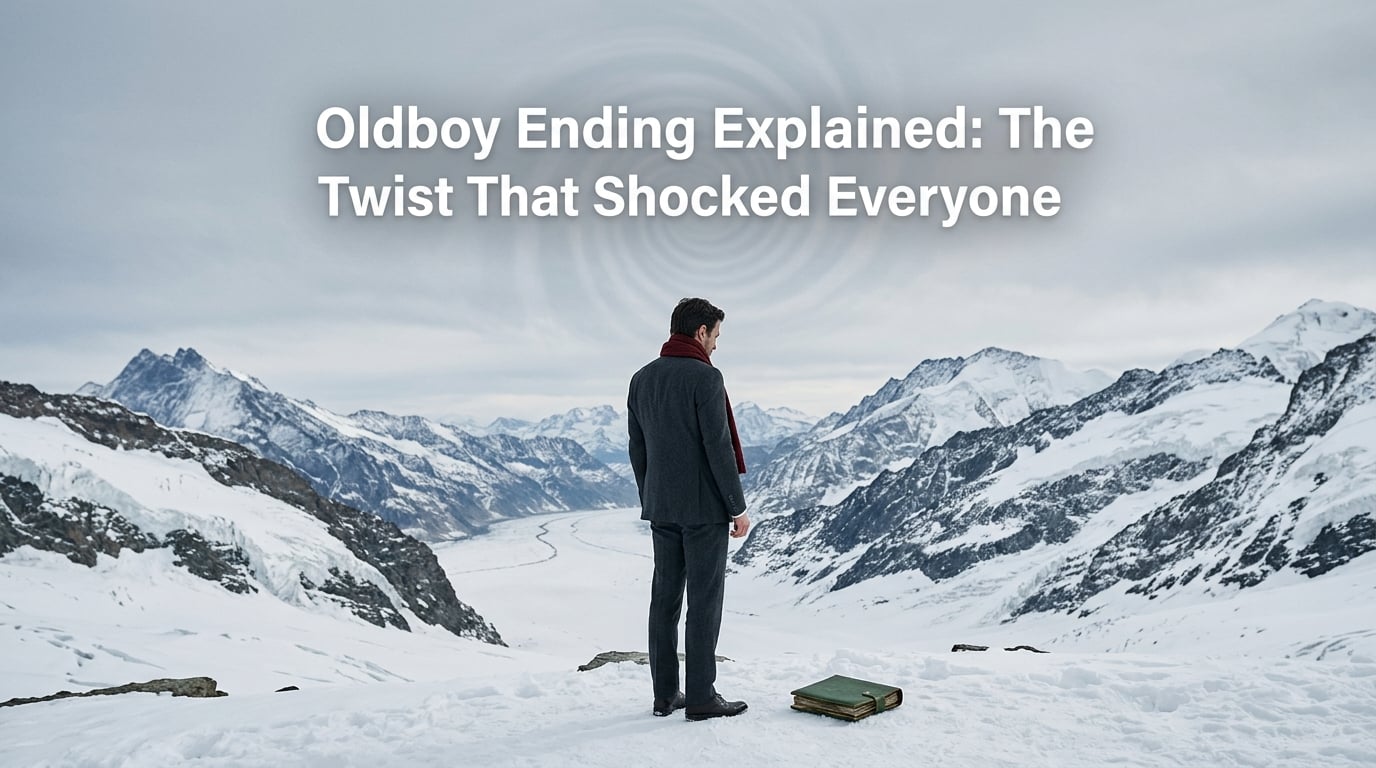
The hypnotist agrees. She puts Dae-su under and splits his personality, creating a version of him that will not remember the truth. She describes the process as separating the monster — the version of Dae-su that knows the truth — from the man who can love Mi-do without guilt. The scene takes place in a snowy mountain landscape, which gives it an almost dreamlike quality.
This is where the Oldboy hypnosis ending becomes the most debated topic in the entire film. Did the hypnosis work? Film forums on Reddit and movie discussion sites have argued about this for years, and there are two main camps.
The first camp argues the hypnosis worked. Dae-su asked to forget, and the hypnotist delivered. In this reading, the final scene shows Dae-su living happily with Mi-do, genuinely unaware of the truth. He chose ignorance, and the hypnosis gave it to him. This is the optimistic reading — a happy lie replacing a devastating reality.
The second camp argues the hypnosis failed. Hypnosis cannot truly erase deeply held knowledge, especially something as traumatic as what Dae-su experienced. In this reading, Dae-su remembers everything but chooses to act as if he does not. He is consciously performing ignorance for Mi-do’s sake and for his own survival.
There is evidence for both interpretations, and Park Chan-wook has deliberately refused to clarify. The film gives no definitive answer because the answer is not the point. The question itself — would you rather live a happy lie or face a horrible truth — is the real subject of the ending.
The Final Smile: Three Interpretations
The Oldboy final scene meaning hinges on a single shot: Dae-su’s face as Mi-do approaches him in the snow. The hypnotist walks away. Dae-su stands alone. Mi-do comes toward him, smiling, calling him by a loving name. And then his expression changes into what viewers have spent years trying to decode.
It is not a full smile. It is not a grimace. It is something in between, something that looks like a man experiencing two emotions simultaneously. That fraction of a second has generated more analysis than entire films, and here are the three most compelling interpretations.
Interpretation 1: The hypnosis worked, and he is happy. In this reading, Dae-su has genuinely forgotten the truth. His smile is real. He loves Mi-do, the hypnosis erased the horror, and they will live together in blissful ignorance. This is the most hopeful reading, and also the most unsettling — because it means the lie wins.
Interpretation 2: The hypnosis failed, and the smile is pain. Here, Dae-su remembers everything. He knows Mi-do is his daughter. The smile is not happiness but agony — a man forcing himself to appear content so that Mi-do never suspects the truth. He is sacrificing his own sanity to protect her from the same shame that killed Soo-ah. The smile is a mask worn by a man who has chosen to be a monster so that the woman he loves can stay innocent.
Interpretation 3: The ambiguity is the point. The most cinematically sophisticated reading is that it does not matter whether the hypnosis worked. Park Chan-wook deliberately left the expression ambiguous because the question is unanswerable. Would ignorance be a mercy or a prison? Would knowledge be liberation or torture? The film refuses to resolve this because no answer would be satisfying. The discomfort of not knowing is the intended final emotion.
Personally, I lean toward Interpretation 2. The pain in Dae-su’s expression is too specific, too loaded, to be simple contentment. He looks like a man holding back a scream. But I respect that the film does not tell us, and I think that ambiguity is what makes the ending endure in conversations decades after the film’s release.
The Alpha-Beta Riddle: A Clue Hidden in Plain Sight
One scene that confuses many first-time viewers is the riddle scene. During his investigation, Dae-su encounters a man who poses him a riddle involving Greek letters — alpha and beta. The riddle appears to be a throwaway puzzle, but it foreshadows the film’s central theme.
The riddle involves the concept of doubling and mirroring, of things that appear to be one thing but are actually another. This directly parallels the relationship between Dae-su and Mi-do, which appears to be a romance but is actually a parent-child bond. The riddle is Park Chan-wook planting the thematic seed of duality and hidden identity long before the twist is revealed.
Understanding the riddle scene helps you appreciate how carefully constructed the screenplay is. Every element serves the central thematic architecture: the hallway fight (a man fighting through obstacles that mirror his internal struggle), the live octopus scene (consumption as desperate vitality), the dumplings (a connection to his prison that he uses to trace his captor). Nothing is wasted.
What Oldboy Really Says About Revenge
The Oldboy ending explained at its deepest level is about the absolute futility of revenge. Every character who pursues vengeance ends up destroyed by it. Woo-jin gets his revenge and immediately kills himself because there is nothing left. Dae-su gets his revenge against his captor and loses everything that matters — his identity, his truth, his autonomy.
This places Oldboy squarely within Park Chan-wook’s Vengeance Trilogy, alongside Sympathy for Mr. Vengeance (2002) and Lady Vengeance (2005). All three films explore the same thesis from different angles: revenge does not heal, does not satisfy, and does not restore what was lost. It only creates new wounds.
What sets Oldboy apart is how personal the destruction is. The other films in the trilogy deal with revenge that kills bodies. Oldboy deals with revenge that kills the soul. Woo-jin does not want Dae-su dead. He wants Dae-su to wish he were dead, and then to keep living anyway. That is a far more sophisticated and disturbing form of punishment.
In the context of Korean cinema, Oldboy arrived at a moment when South Korean film was gaining international recognition for its boldness, technical innovation, and willingness to explore darkness without flinching. The film won the Grand Prix at Cannes in 2004, with Quentin Tarantino as president of the jury. It introduced global audiences to a tradition of filmmaking that did not feel obligated to provide happy endings or moral clarity.
Park Chan-wook’s deeper point is about shame. Dae-su’s careless words created shame that killed Woo-jin’s sister. Woo-jin’s revenge creates an even deeper shame that destroys Dae-su from within. Shame is the real villain of this film, and it is transmitted from person to person like a virus, growing stronger with each transmission until there is nothing left but suffering.
What the Audience Is Supposed to Feel
If you finished Oldboy feeling sick, hollow, or disturbed, the film did exactly what it was designed to do. Park Chan-wook is not interested in comfortable viewing experiences. He wants you to sit with the discomfort and interrogate your own assumptions about justice, revenge, and whether ignorance can ever be preferable to truth.
The film asks you to consider: if you could erase a devastating truth from your mind, would you? Is a happy lie better than a devastating reality? There is no correct answer, and the film does not pretend there is one. It simply presents the question in the most viscerally powerful way possible and leaves you to wrestle with it.
This is why the Oldboy 2003 plot twist continues to resonate with new audiences every year. It is not just shocking for the sake of being shocking. The twist serves the thematic purpose of the film. It is the mechanism through which Park Chan-wook delivers his argument about the nature of revenge and the impossibility of undoing damage once it has been done.
FAQs
Is the girl in Oldboy his daughter?
Yes. Mi-do is revealed to be Oh Dae-su’s biological daughter. Lee Woo-jin tracked her down after Dae-su’s imprisonment, raised her under a different identity, and used hypnosis to ensure Dae-su would fall in love with her after his release. The photo album in the penthouse scene confirms the blood relationship.
Who killed Dae-su’s wife in Oldboy?
Lee Woo-jin had Dae-su’s wife killed as part of his revenge plan. The murder was committed by an associate, and Dae-su was framed as the prime suspect. This ensured that even if Dae-su escaped his prison, he would have no family to return to and no one looking for him, leaving him isolated and vulnerable to Woo-jin’s manipulation.
What is the message behind Oldboy?
The central message is that revenge destroys everyone involved. Lee Woo-jin achieves his revenge but kills himself because his purpose is gone. Oh Dae-su gets revenge against his captor but loses his identity, his truth, and his autonomy. The film argues that the cycle of vengeance produces no winners and that shame, once set in motion, is unstoppable.
Did the hypnosis at the end of Oldboy work?
The film deliberately does not answer this question. Some viewers believe the hypnosis erased Dae-su’s memory of the truth, pointing to his seemingly peaceful expression. Others believe it failed and he remembers everything but chooses to pretend otherwise. Park Chan-wook has refused to clarify, making the ambiguity itself the intended artistic statement.
Why did Dae-su cut out his tongue?
Dae-su cuts out his tongue to beg Woo-jin not to reveal the truth to Mi-do. Symbolically, his tongue was the instrument of his original sin — spreading the rumor about Woo-jin and his sister. By removing it, he is both promising never to speak another destructive word and punishing the part of himself that started the cycle of shame.
What does the final scene in Oldboy mean?
The final scene shows Dae-su’s ambiguous expression as Mi-do approaches him after the hypnosis. Three main interpretations exist: the hypnosis worked and he is genuinely happy, the hypnosis failed and he is masking his pain with a smile, or the ambiguity is deliberate and the question of happy ignorance versus painful truth is the actual point of the ending.
Final Thoughts
Having this Oldboy ending explained in full does not diminish its power. If anything, understanding the mechanics of Woo-jin’s plan and the layers of Dae-su’s final expression makes the film more disturbing, not less. You realize how carefully every piece was placed, how inevitable the trap was from the very first scene.
The Oldboy 2003 ending works because it refuses to give you what you want. You want Dae-su to win. You want the revenge to be satisfying. You want closure. Instead, Park Chan-wook gives you a man standing in the snow with an expression you cannot read, holding a truth he may or may not remember, next to a woman who may never know what he has done. That is not a plot hole or a lazy ending. It is a deliberate, surgical refusal to provide comfort — and that is exactly why the film remains a masterpiece over two decades later.
If this breakdown helped you understand the film more deeply, I encourage you to rewatch it with this context in mind. You will notice details that were invisible the first time: the way Mi-do’s apartment is staged, the specific dumplings Dae-su traces back to his prison, the riddle’s reflection of the central deception. Oldboy rewards every rewatch, and each viewing deepens the horror, the admiration, and the lingering sense that you have witnessed something that cinema was not supposed to be capable of.