
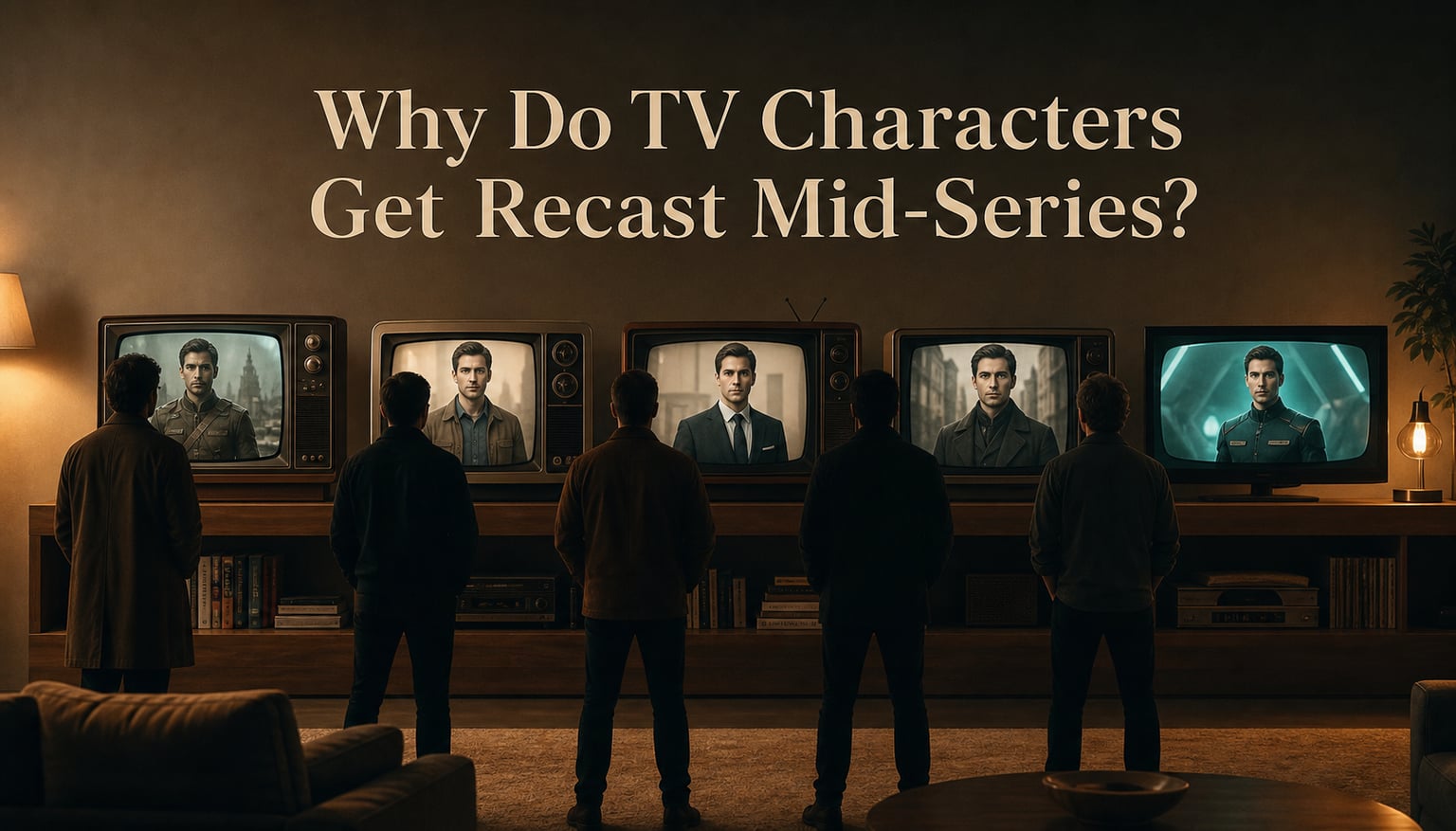
TV characters get recast mid-series because the original actor can no longer continue in the role. The most common causes are scheduling conflicts, creative differences with showrunners, contract and salary disputes, health or personal reasons, child actors aging out of their parts, and behind-the-scenes feuds. Classic examples include Darrin Stephens in Bewitched, Daario Naharis in Game of Thrones, and the title role in The Witcher.
I have followed the TV industry closely for years, and I have watched recasts become one of the most talked-about parts of modern television. Whether it is a Darrin swap from the 1960s or the Henry Cavill departure from The Witcher in 2026, the question always comes back: why does this keep happening? Let me walk you through what our team has learned about how and why networks replace actors mid-series, and what it means for the shows we love.
Table of Contents
Scheduling Conflicts Force Networks to Find New Actors
Scheduling conflicts are the single biggest reason TV characters get recast mid-series. An actor signs on for a pilot or a single season, then books another project with overlapping production dates. The network has a choice: delay the show, lose the role entirely, or recast. Most of the time, recasting is the least painful option, especially when the character has become essential to the show’s ongoing story.
The most famous recent example is Daario Naharis on Game of Thrones. Ed Skrein played the sellsword in Season 3, then departed for the lead role in the 2016 film Deadpool. HBO recast the character with Michiel Huisman for Seasons 4 through 6, and most viewers barely noticed the change. It is one of the cleanest recasts in modern fantasy TV, and it would not have happened if Skrein’s schedule had not collided with the Deadpool shoot.
Henry Cavill’s exit from The Witcher is a more dramatic scheduling story. He announced his departure in October 2022, just one month before his Superman comeback was confirmed. Liam Hemsworth took over the role starting with Season 4. The Witcher is one of the most-watched fantasy dramas of the streaming era, and the recast became global news. Fans spent months debating whether Hemsworth could match Cavill’s gravel-voiced Geralt, and most reviewers agreed he brought his own spin to the character rather than copying his predecessor.
Spartacus: Blood and Sand also had a notable scheduling-driven recast when Andy Whitfield was diagnosed with non-Hodgkin lymphoma. The show paused production, then recast the lead with Liam McIntyre for Seasons 3 and 4 once it became clear Whitfield could not return. Starz handled the transition with remarkable transparency, even producing a documentary about Whitfield’s battle that aired alongside the recast seasons.
I have seen this pattern repeat on shows like 13 Reasons Why, where Timothy Granaderos replaced Brandon Flynn in Season 3 due to other project commitments. Scheduling is rarely about the show itself being the problem. It is almost always about the actor’s broader career pulling them somewhere else. Studios understand this, which is why recasting has become a routine tool rather than a last resort.
Creative Differences Lead to Behind-the-Scenes Shake-Ups
Creative differences are the second leading cause of mid-series recasts. An actor disagrees with where their character is going, clashes with a new showrunner, or simply does not fit the show’s evolving tone. The replacement is often framed as a “retooling” in press releases, but the underlying cause is usually a breakdown in creative trust between the actor and the production team.
The Dynasty reboot on The CW had two separate Cristal recasts. Nathalie Kelley played Cristal Flores in Season 1. After she left due to creative frustrations with the role, Ana Brenda Contreras replaced her in Season 2. When Contreras also departed, Daniella Alonso took over in Season 3. Three actresses, one character, in three seasons. The show’s writers eventually leaned into the instability by treating each new Cristal as a deliberate storytelling choice rather than a forced swap.
Roseanne had a similar shake-up when original Becky actress Lecy Goranson left over a contract dispute and was replaced by Sarah Chalke. Goranson later returned, then Chalke played a different character, Becky #2, in later seasons. The show handled the swap with humor, but the underlying issue was creative disagreement about the role’s direction. Both actresses eventually came back, which made the recast feel less like a firing and more like a reshuffling.
Batwoman also fell into the creative differences category when Ruby Rose stepped down after just one season, citing the physical demands of the role and concerns about on-set safety. Javicia Leslie took over as Ryan Wilder, a brand-new character rather than a direct recast of Kate Kane. The show pivoted its entire identity rather than pretending the original actress had not left. Critics called it one of the smartest mid-series pivots in modern superhero TV.
Our team has noticed that creative difference recasts tend to follow major showrunner changes. When a new executive producer takes over a long-running show, they often want to put their stamp on the cast. It is one of the most predictable patterns in network television, and it is why veteran showrunners are so protective of their casting choices from day one.
Health and Personal Reasons for Mid-Series Actor Changes
Health issues are an underappreciated driver of TV recasting. Long production schedules, demanding stunt work, and the strain of celebrity life can all force an actor to step away. Personal reasons, including family needs and mental health, also fall into this category. Networks have become much more open about these reasons over the past decade, partly because audiences have grown more sympathetic to the realities of long-term employment in entertainment.
The Wheel of Time had a high-profile recast when Barney Harris, who played Mat Cauthon in Season 1, was replaced by Dónal Finn for Seasons 2 and 3. Amazon and Sony never publicly disclosed the reason, but reports pointed to a combination of personal circumstances and creative disagreements about the role’s evolution. Harris reportedly wanted to take the character in a different direction than the showrunners had planned, and the disagreement became unworkable by the end of the first season.
Miss Ellie Ewing on Dallas was famously recast after Barbara Bel Geddes suffered a heart attack in 1984. Donna Reed stepped in for the 1984 to 1985 season, then Bel Geddes returned once she recovered. It remains one of the most graceful examples of a health-driven recast in TV history. Reed even earned an Emmy nomination for the role, which is rare for a replacement performer.
On the personal side, Julia Butters left American Housewife after four seasons to pursue a role in Quentin Tarantino’s Once Upon a Time in Hollywood. The show wrote Anna-Kat Otto out and recast the role with Giselle Eisenberg starting in Season 4, then later with Hannah Stocking. Career opportunity is technically a personal reason, and it ranks among the most common non-conflict causes of recasting in modern streaming series.
Mental health has become an increasingly cited reason for recasts and departures. I have watched several young actors in long-running fantasy dramas step back from a series to recover from burnout. It is a trend the industry has only recently begun to handle openly. Where a vague “creative differences” statement used to suffice, networks now sometimes issue statements acknowledging anxiety, depression, or family emergencies as the cause of an actor’s departure.
Contract Disputes and Salary Negotiations
Contract and salary disputes drive a surprising number of recasts. Many TV actors sign contracts for one or two seasons, with renewal terms that networks can refuse if the budget gets tight. When an actor demands a raise that the studio will not meet, the studio may simply replace them. This is one of the most business-driven reasons for recasting, and it has become more common in the streaming era as platforms tighten their budgets.
The Adventures of Superman had two different Lois Lanes. Noel Neill played Lois in the theatrical serials, then Phyllis Coates took over for the first TV season in 1952. When contract negotiations fell through for the second season, Neill returned to the role. The original recast was contract-driven, not creative. It is also one of the earliest documented cases of an actor being replaced because of business terms rather than performance.
Cagney & Lacey had one of the most famous contract recasts in TV history. Meg Foster played Christine Cagney in the pilot and first episode, but the producers felt she lacked chemistry with Tyne Daly’s Mary Beth Lacey. Sharon Gless stepped in for the remaining six seasons, won two Emmys, and the show became a cultural touchstone. Sometimes the studio’s instinct about chemistry is right, and the recast that happens for the wrong reasons ends up launching the right career.
Modern streaming-era contracts are more rigid than the multi-season deals of the past. Most streaming platforms commit to a single season at a time, which makes both sides wary about long-term commitments. When a show gets renewed, actors often negotiate a new deal, and those negotiations can collapse quickly. The result is more recasts during renewal windows, especially for shows that suddenly become hits and need to bring cast salaries in line with the show’s new value.
I have noticed that contract-driven recasts tend to happen during renewal windows, typically between seasons. The actor’s team signals they want a pay bump, the studio signals they want a budget cut, and suddenly the announcement comes that the character will be played by someone new in the next season. The press coverage usually focuses on the creative or personal angle, but the underlying driver is almost always a failed negotiation.
Child Actors Aging Out of Their Roles
Child actors aging out of their roles is one of the most unique reasons for TV recasting. A 7-year-old cast as a 10-year-old will not look the same by Season 5. Networks have three choices: age up the character with a new actor, recast with an older child, or write the child out. The third option is the rarest, because networks hate losing the family chemistry that drew viewers in the first place.
The Waltons had one of the most famous child actor recasts when Richard Thomas left after Season 5 to pursue a film career. Robert Wightman took over as John-Boy Walton for Seasons 6 through 8. The show wrote the transition as John-Boy covering the Vietnam War, which made the recast feel like a natural story choice rather than an awkward swap. It also helped that both actors had similar features and could pull off the same earnest sincerity.
Boy Meets World dealt with the same challenge when Lily Nicksay, who played Morgan Matthews, was replaced by Lindsay Ridgeway as the character aged up. The transition happened between Season 2 and Season 3, and the show barely addressed it on screen. The audience just accepted that Morgan had grown up. This silent-swap approach works particularly well for child characters because viewers expect them to look different as the seasons pass.
Last Man Standing had a similar experience. The show recast two of Tim Allen’s on-screen daughters between seasons. Alexandra Krosney played Kristin Baxter in early seasons, then Amanda Fuller took over. Molly McCook replaced Molly Ephraim as Mandy Baxter. Both swaps were driven by the original actresses moving on to other projects as their characters aged. The new actresses matched the physical type of the originals, which made the swap less jarring than it could have been.
Modern TV production schedules make this worse. A streaming series that takes two to three years between seasons can see its child cast age dramatically during production. It is one of the structural challenges of long-form television that networks have not solved. Some shows, like Stranger Things, have committed to aging the cast along with the in-show timeline, which removes the recast question entirely for those characters.
Behind-the-Scenes Feuds and Cast Tensions
Behind-the-scenes feuds are the most public reason for recasting, even when the network tries to keep them quiet. Tensions between cast members, conflicts with producers, and personal disputes can all lead to an actor being replaced. These recasts tend to dominate entertainment news for months, especially when the original actor is willing to discuss the dispute on talk shows or podcasts.
The Fresh Prince of Bel-Air had the most famous feud-driven recast in TV history. Janet Hubert played Aunt Vivian in Seasons 1 through 3, then was replaced by Daphne Maxwell Reid starting in Season 4. Hubert later revealed that the conflict was with Will Smith himself, and the two did not speak publicly for decades. Their 2021 reconciliation on a Fresh Prince reunion special was one of the most-watched TV moments of that year, and it gave fans the closure they had wanted since the original swap.
Batman (1966) had multiple Catwoman recasts over its three-season run. Julie Newmar originated the role in Seasons 1 and 2. Lee Meriwether played a different version of Catwoman in the 1966 film, then Eartha Kitt took over for the show’s third season after Newmar left over a salary dispute. Each Catwoman brought a completely different energy to the role, and the show’s handling of the swap set a template that superhero series still follow today.
On the drama side, conflicts between cast members and showrunners have driven several fantasy-drama recasts. I have seen shows where an actor’s social media posts, public comments at conventions, or off-set behavior led to quiet contract non-renewals that were eventually framed as creative decisions. Studios prefer to keep the personal reasons out of public discussion, both to protect the actor’s future prospects and to avoid legal exposure.
Our team has learned that most feuds are never officially confirmed. The press release will say something like “the actor has chosen to pursue other opportunities,” but the truth is usually more complicated. Studios prefer the polite version because it protects both sides and avoids legal trouble. It is one of the unspoken rules of modern TV publicity: never confirm a feud, even when the entire industry knows it happened.
How TV Shows Handle Recasting On-Screen
How shows handle recasting on-screen is one of the most interesting creative challenges in television. Some shows pretend nothing changed, others explain the swap through the plot, and a few go so far as to invent new characters who happen to look exactly like the old ones. The choice usually comes down to how central the character is to the story and how iconic the original actor’s performance has become.
Doctor Who has the most famous on-screen explanation of all. When the lead actor changes, the show uses a regeneration plot device where the character physically transforms into a new body. It is built into the show’s lore, and it has allowed the lead to be recast 15 times since 1963. Few series have ever matched Doctor Who’s willingness to build the recast directly into its storytelling DNA.
The “parallel universe” or “twin” trope is another common approach. Shows often reveal that the new actor is playing a previously unknown sibling, a long-lost relative, or an alternate-reality version of the character. It is a narratively lazy but commercially safe choice. The audience knows what is happening, but the show has given them permission to accept the swap without breaking immersion.
Some shows simply choose the silent swap. The new actor appears, the audience is expected to accept it, and the show never explains the change. This works best when the character is a supporting role rather than a lead, and when the new actor does a good job of capturing the original performance. Friends’ Carol Willick, played by two different actresses over the run, is a classic example of this approach.
Other shows write the original character out and introduce a new one who happens to fill the same narrative role. Batwoman’s transition from Kate Kane to Ryan Wilder is the most successful modern example of this approach. The show made the change feel intentional rather than forced, and the writers gave Ryan a distinct personality that made the audience forget she was originally a recast.
I have noticed that shows that address recasting directly tend to survive the swap better than shows that pretend it never happened. Transparency wins audience trust. The audience is smarter than networks often give them credit for. A well-planned explanation, even a flimsy one, beats silence almost every time.
Successful vs Unsuccessful Recasts: What Makes the Difference
Whether a recast succeeds or fails depends on three things: the quality of the new actor’s performance, how the show frames the change, and how iconic the original performance was. Get any one of these wrong and the audience will revolt. Get all three right and the recast can become one of the most celebrated moments in a show’s history.
The Spartacus recast of Naevia is a textbook success. Jui Huang played the role in the unaired pilot, then Cynthia Avila took over for the early episodes of Season 1. When Avila could not continue, Lesley-Ann Brandt stepped in for the rest of the run. Three actresses, one character, and the audience barely noticed because each transition was handled with care. Brandt in particular became so popular that fans often forget she was not the original choice.
Bewitched’s Darrin swap is the opposite example. Dick York played the role for the first six seasons, then was replaced by Dick Sargent for the final three seasons due to York’s severe back pain and on-set health issues. The audience noticed, the new Darrin lacked York’s energy, and the show’s ratings declined noticeably during the Sargent era. It is one of the most studied case studies of a recast that hurt a long-running show.
The Aunt Viv recast on Fresh Prince sits in the middle. Janet Hubert’s performance was beloved, but Daphne Maxwell Reid eventually won over most viewers. The feud with Will Smith kept the story alive, but the show itself survived the change because the core cast around the swap remained strong. By the end of the series, most fans could not remember which Aunt Viv had appeared in which episode.
What I have learned from watching decades of recasts is that audience acceptance depends more on character continuity than actor continuity. If the character’s purpose in the story stays the same and the new actor brings similar emotional energy, viewers will adjust. If either piece breaks, the recast becomes a permanent asterisk on the show’s legacy, and the audience will bring it up every time the show is discussed.
Frequently Asked Questions About TV Recasting
Why do characters get recast on TV shows?
Characters get recast because the original actor can no longer continue in the role. The most common reasons are scheduling conflicts with other projects, creative differences with the showrunner, contract and salary disputes, health or personal issues, child actors aging out of their roles, and behind-the-scenes feuds with cast or crew members.
What actors regret leaving their TV shows?
Several high-profile actors have publicly expressed regret about leaving long-running shows. These include Shannen Doherty from Charmed, who later said the decision was made for her, and Richard Thomas from The Waltons, who eventually returned for guest appearances after leaving to focus on film work.
Why did they change the Daario Naharis actor on Game of Thrones?
Ed Skrein was replaced by Michiel Huisman as Daario Naharis after Skrein left to take the lead role in the 2016 film Deadpool. HBO chose to recast the character rather than write him out, and Huisman played Daario for Seasons 4 through 6 of the series.
Why did they recast Mat Cauthon on The Wheel of Time?
Barney Harris played Mat Cauthon in Season 1 of The Wheel of Time but was replaced by Dónal Finn starting in Season 2. The official reason was not publicly disclosed, but reports cited a combination of personal circumstances and creative differences about the character’s direction.
How do TV shows explain character recasts to viewers?
TV shows use several techniques: the parallel universe or twin trope, written-in physical transformations like Doctor Who’s regeneration, simply introducing a new character who fills the same role, or the silent swap where the show never acknowledges the actor change. Doctor Who has used this most famously with its 15 lead actor transitions since 1963.
The Takeaway on TV Character Recasting
TV characters get recast mid-series for a handful of predictable reasons: scheduling, creative differences, health, contracts, aging, and feuds. Our team has watched these patterns play out across decades of television, from Darrin in Bewitched to Geralt in The Witcher. None of these recasts happen in a vacuum. Each one reflects a specific set of business and personal pressures that pushed the original actor out and pushed the production toward a replacement.
Understanding why shows recast their characters helps you appreciate just how complicated long-form TV production really is. The next time you see a new face in a familiar role, you will know exactly what is probably happening behind the scenes. You will also have a better sense of whether the swap is likely to succeed, based on how the new actor is performing and how the writing room is framing the change for the audience.