
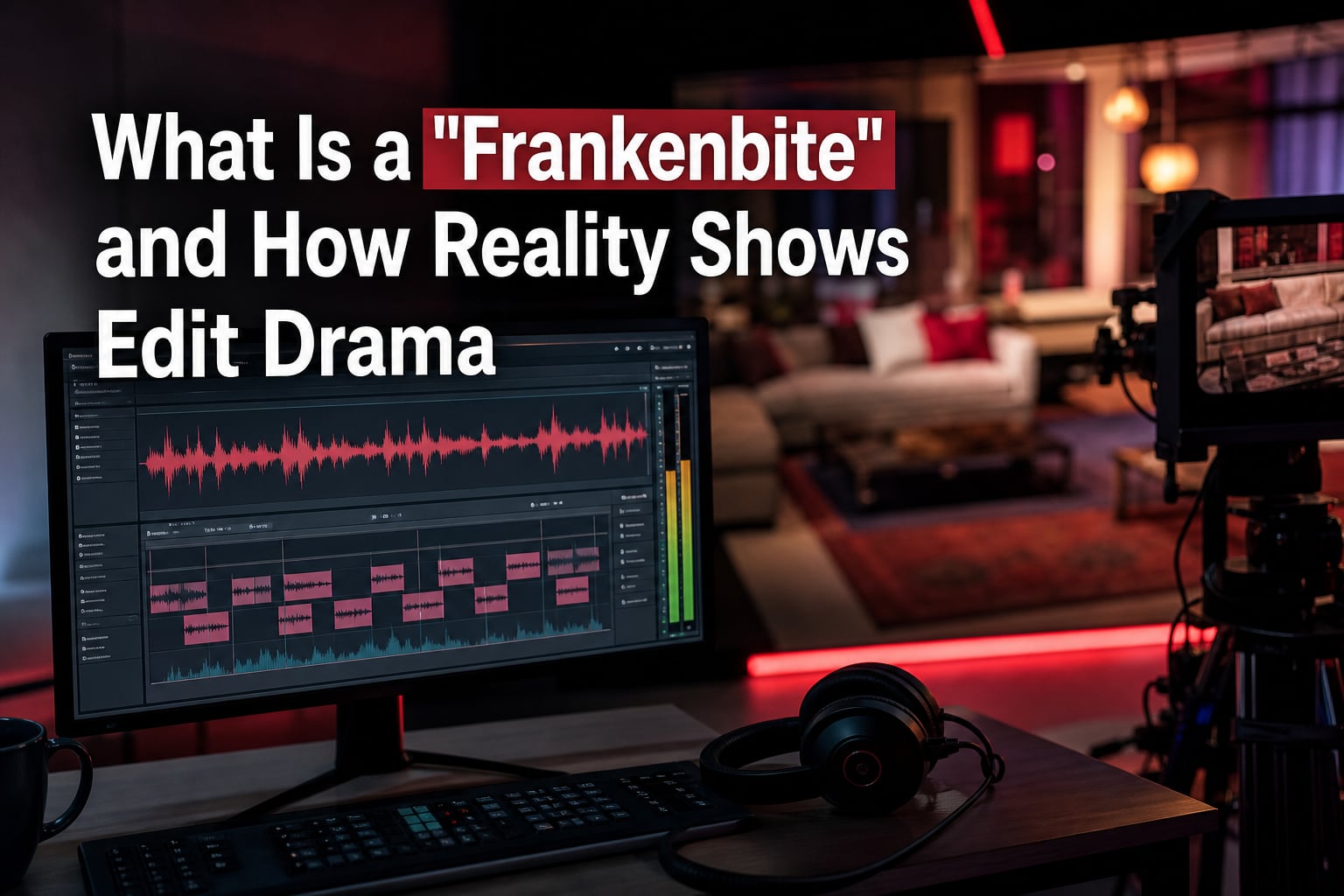
A frankenbite is an audio clip assembled from separate recordings so it plays as one statement, sometimes changing what a person appears to have said. The name combines Frankenstein and soundbite: separate pieces of dialogue are joined into a new whole. In reality TV editing, that can be a practical way to shorten a long conversation, or a misleading way to manufacture a sharper line.
That distinction matters because reality programs are made in post-production, not simply recorded and played back. A contestant may have said every word heard in an episode, yet the order, timing, question, reaction shot, and surrounding scene can give those words a meaning they never had in the room.
This guide explains what is a frankenbite, how editors can make one sound smooth, why a production might use one, and what viewers can look for without jumping to conclusions. The goal is media literacy, not assuming that every awkward cut proves a show is lying.
Short answer: A frankenbite is constructed dialogue. It becomes ethically serious when the construction changes a speaker’s meaning, invents a claim, or assigns a reaction to the wrong moment.
Table of Contents
What is a frankenbite, and where does the name come from?
A frankenbite is a piece of dialogue editing that stitches together words, phrases, or sentences from more than one recording. It may pull from the same interview, different parts of a day, or separate confessional sessions, then present the result as one uninterrupted soundbite.
The word is industry slang built from Frankenstein and soundbite. Like the fictional creature, the finished line is assembled from parts; unlike a simple cut that removes a pause, the parts may not have originally sat next to one another.
Frankenbiting differs from ordinary trimming when it changes meaning.
All filmed television uses edits. A conversation that runs for an hour cannot fit intact into a short episode, so editors routinely remove repetition, pauses, false starts, and off-topic remarks. That kind of compression can preserve the speaker’s point.
Frankenbiting starts when dialogue assembly crosses beyond a clean shortening. Combining a subject from one answer with a judgment from another, for example, can make it look as though the speaker made a claim about a person or event they were not discussing.
People also use the term loosely for edits that are merely suspicious-looking. It is more precise to reserve it for an assembled audio statement, then separately ask whether that statement is fair, misleading, or fabricated.
Reality-TV terms explain where the pieces often come from.
A confessional is the interview-style footage in which a cast member speaks directly to a producer or camera. Productions may record these interviews repeatedly across a season, sometimes after events have happened, so they are useful for explaining an episode’s story.
An OTF, or on-the-fly interview, is a shorter interview recorded close to an event. B-roll is supplemental image footage: a person walking, a close-up of hands, a wide shot of a villa, or a reaction that may not show the exact instant the audio occurred.
Room tone is the low, steady sound of a location when nobody is speaking. In dialogue editing, matching room tone, ambient noise, microphone character, pitch, and timbre helps two separate fragments sound like one take.
How reality shows edit drama with a frankenbite
Reality-show editors build a scene from many hours of camera footage, field audio, interviews, and pickup material. A frankenbite is one post-production tool among picture cuts, music cues, reaction shots, producer questions, and narration.
Editors first select dialogue that serves the episode’s story.
A production team has to turn open-ended events into a watchable episode with a beginning, turn, and payoff. If several cast members discuss the same conflict in scattered pieces, the editor may locate the lines that explain the issue most quickly.
That selection alone shapes narrative construction. A calm, nuanced answer can lose its qualifiers when only its most forceful phrase is used, even if no words are rearranged.
Editors then assemble phrases across takes or interviews.
Imagine someone says, “I was frustrated during the challenge,” in one confessional and later says, “She did not listen to me.” A dialogue editor could place the phrases together so the viewer hears a compact thought. The technical result may sound natural even though the sentence was not said in that form.
The difficult part is not only finding useful words. Editors need compatible source audio: the same microphone if possible, similar distance from it, matching background sound, and a delivery that will not reveal an abrupt tonal shift.
Editors smooth the audio seam so the construction is hard to hear.
At a basic level, the work can involve tightening the gap between words and laying room tone under the join. More involved work may require matching loudness, reducing a background bump, or using a short breath from nearby audio so the rhythm sounds continuous.
Audio from two days can differ in noise, voice texture, pace, or emotion. That is why professionals discussing the practice often focus on the craft problem of timbre matching and staggered tracks; a clean edit takes more than simply dropping one clip after another on a timeline.
Editors cover the seam with images that do not show the speaker’s mouth.
A cut is easier to hide if the viewer is seeing a reaction shot, a wide angle, b-roll, a hand, or the back of the speaker’s head. The line can continue while the picture changes, making it difficult to compare lip movement to each word.
This does not mean every cutaway is evidence of manipulation. Reality shows need cutaways to keep scenes visually clear and to cover ordinary edits, but a conspicuous cutaway at the exact point where an unusually pointed phrase begins is a useful clue to review.
Editors use music and pacing to tell viewers how a line should feel.
Music can turn a neutral pause into suspense, and a reaction shot can frame a statement as insulting, flirtatious, or threatening. A producer does not need to alter a word for the scene’s emotional meaning to shift.
This is why audio editing is only part of the question. The strongest reality TV manipulation claims examine the whole construction: the dialogue, the image placed over it, the sequence of events, and whether the scene leaves out context that changes the apparent point.
Viewer tip: Watch a disputed scene once with attention on the audio, then again with attention on the image. A break in either track may be ordinary post-production; both tracks together tell you more about how the moment was built.
Producers use constructed dialogue to compress stories and heighten stakes.
Reality television follows people whose days are repetitive, conversations overlap, and conflicts often develop in fragments. Story compression can help an episode explain a complicated situation without making viewers sit through every repeated exchange.
On a competition series such as Survivor, a dating format such as The Bachelor or Love Island, or an ensemble show such as the Real Housewives franchise, editors must track several people and parallel storylines. Confessionals can clarify motivation, while a compact dialogue sequence can identify the disagreement at the center of a scene.
Drama amplification is a different goal. The most quotable, blunt, or emotional wording creates stronger episode hooks and social discussion than a hesitant, qualified explanation. That commercial pressure helps explain why a line can be edited toward conflict, but it does not settle whether the resulting portrayal is fair.
The ethical line runs from compression to reframing to fabrication.
Not every assembled soundbite carries the same ethical weight. A useful way to assess frankenbiting is to ask whether the edit preserves the speaker’s original meaning, changes the context around a real idea, or creates an idea the person did not express.
Compression preserves the core point while saving time.
Suppose an interviewee repeats the same thought three times and an editor removes the repeats, pauses, and producer prompts. The sentence may be shorter than the original answer, but its subject, sentiment, and practical meaning remain intact.
That is ordinary editorial compression, even if a line has been tightened. Viewers may reasonably prefer more transparency, but the harm risk is low when the edit does not change what the person meant.
Reframing keeps real words but changes their apparent target or force.
Reframing can occur when a comment from one discussion is placed over footage from another, or when a reaction filmed at a separate moment is inserted after a remark. The words may be authentic, yet the scene tells viewers they were about someone else or provoked a response they never did.
This is where context stripping becomes important. A person who says “that was ridiculous” about a challenge rule may appear to be insulting a castmate if the line is paired with that castmate’s close-up.
Fabrication creates a statement the speaker did not make.
The highest-risk form combines fragments so they express a new accusation, admission, or insult. It can also remove a key negative or qualification, leaving a sentence that points in the opposite direction from the original answer.
Fabrication can have effects beyond an episode. Forum discussions about reality TV repeatedly return to contestants who feel they were turned into villains, and to the difficulty of proving what happened when viewers do not have access to raw footage or production records.
Participant contracts can limit the practical path to challenge an edit.
Participants may sign releases and production agreements that give producers wide editorial discretion. The exact terms vary by production and jurisdiction, so no single clause explains every dispute, but contractual consent can make public correction or legal action harder than viewers expect.
Consent to editing is not the same question as whether an edit was responsible. A responsible discussion can hold both ideas at once: television needs editing, and an edit that harms someone’s reputation by inventing meaning deserves closer scrutiny.
Warning: A clipped sentence, dramatic score, or cutaway is not proof that a person was frankenbited. Treat visible clues as reasons to ask questions, not as a basis for attacking cast members, editors, or producers online.
Viewers can spot possible frankenbites by checking audio, picture, and context.
No outside viewer can confirm a frankenbite from one clue alone. Still, fans who make timestamped breakdowns often notice recurring patterns, and those patterns can make a scene worth watching again more carefully.
Listen for a changed voice texture. Background hum, microphone tone, breath, pace, or vocal energy can shift abruptly in the middle of a sentence.
Watch for a cutaway when a key word lands. B-roll, a wide shot, a reaction, or the speaker’s back may hide the mouth at an audio seam.
Check whether the sentence has an odd rhythm. A jump from one cadence to another, an unnatural pause, or a sudden change in emotion can signal a join.
Notice mismatched visual continuity. Hair position, food on a plate, daylight, seating, clothing, or a drink level can suggest footage from different moments is being paired.
Question a too-perfect explanation. A person speaking in a heated scene may suddenly offer an unusually polished summary that sounds more like a later confessional.
Separate reaction shots from proof. An eye roll or shocked face can be real footage without being a response to the exact line that precedes it.
Look for the missing setup. Ask what question was asked, what happened immediately before, and whether a qualifier such as “sometimes” or “I worry” may have been removed.
These checks work best when paired with restraint. Fans may compare previews, episode recaps, interviews, and uncut material released by a show, but speculation should stay labeled as speculation unless direct evidence appears.
Reality TV is constructed, but construction does not make every moment fake.
Reality TV is neither a neutral security camera feed nor automatically scripted fiction. Casting, scheduling, producer prompts, camera coverage, confessionals, music, and editing all influence what reaches the audience, even when the participants’ actions and words are spontaneous.
A program can accurately compress an event, then use a dramatic reaction shot that overstates it. It can also stage an activity or ask someone to repeat an entrance for the camera without scripting their private feelings. Those practices should not be collapsed into the specific claim that an editor invented dialogue.
The better question is not “Is this show real?” but “What claim is this scene asking me to believe, and what editing choices support that claim?” That approach gives viewers room to enjoy the format while keeping a healthy distance from a producer-built narrative.
FAQs
What exactly is a Frankenbite?
A frankenbite is a line of audio assembled from separate recordings so it sounds like one continuous statement. It can be a minor time-saving edit or a misleading construction, depending on whether the edit preserves the speaker’s original meaning and context.
How do reality TV shows create drama?
Reality shows create drama through casting, story selection, producer questions, confessionals, music, reaction shots, pacing, and editing. A frankenbite can sharpen a story by combining dialogue, but music, visuals, and removed context can shape a scene even when every word remains in its original order.
What is frankenbiting in film?
Frankenbiting in film or television is the practice of building a seemingly continuous quote from separate pieces of recorded dialogue. Editors may use it to make speech concise or clear; the ethical risk rises when it makes a person appear to say something they did not mean or say as a complete thought.
How staged are reality TV shows?
Reality shows vary widely. They are commonly planned, cast, prompted, filmed from several angles, and edited into stories, but that does not prove every interaction is scripted. A staged setup, ordinary time compression, and fabricated dialogue are different practices that should be judged separately.
What are the ethical concerns of frankenbiting?
The main ethical concern is false meaning. Joining real words can strip context, attach a remark to the wrong person, or create an accusation or insult that was never made. Because an edited persona can affect a participant’s reputation and work, the issue is larger than a clever audio trick.
Where did the term Frankenbiting come from?
Frankenbiting combines the words Frankenstein and soundbite. The term compares an assembled audio quote to a creation made from separate parts, usually describing dialogue editing in reality television and other unscripted formats.
How are TV shows edited?
Television editors select footage, organize scenes, trim dialogue, combine camera angles, add b-roll, shape audio, and use music to create a clear episode. In unscripted television, confessionals and reaction shots help explain events, while the final sequence determines how viewers interpret them.
Conclusion
What is a frankenbite? It is assembled audio that can turn scattered recorded pieces into a smooth soundbite. The same mechanics can serve harmless story compression or create a damaging false impression, so the relevant issue is not the existence of a cut but the meaning the cut constructs.
When a reality-show moment feels unusually neat, listen for changes in sound, look at what the camera is showing, and ask what context the episode does not provide. That habit makes it easier to recognize how reality shows edit drama without treating every contestant or every editor as a suspect.