
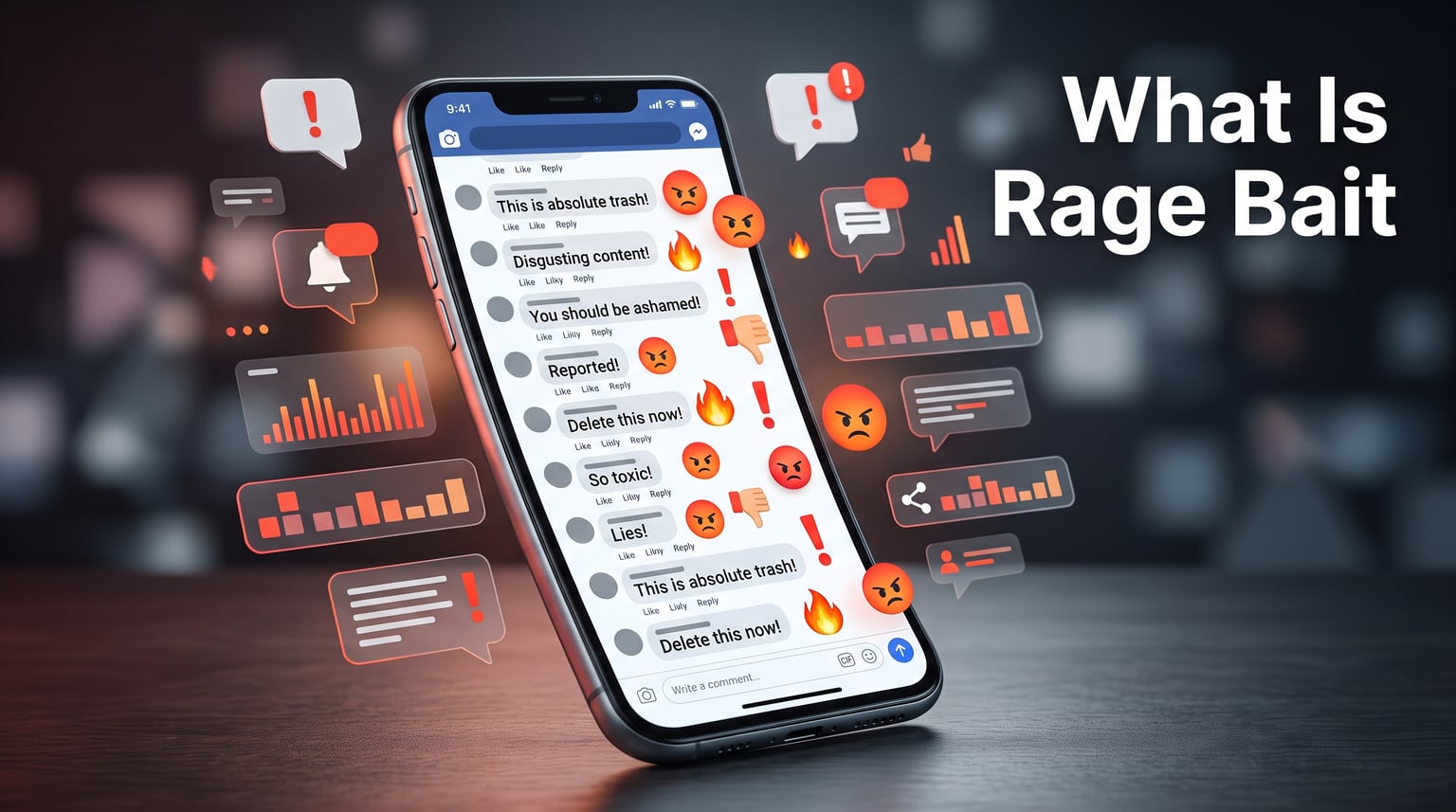
I used to think those absurdly confident takes in my feed were just, well, dumb opinions. Then I learned the term “rage bait” and everything clicked. If you’ve ever felt your blood pressure spike over a wild social media post, only to realize the creator was probably smirking behind the screen, you’ve already met rage bait. And in 2026, it’s officially the Oxford Word of the Year, which tells you how much it’s shaping the way we argue online.
This guide breaks down what rage bait is, where the term came from, how it differs from clickbait, why creators keep making it, and the practical steps I use to spot it before I waste another hour arguing with a stranger on the internet.
Table of Contents
What Is Rage Bait – Definition and Meaning
Rage bait is online content deliberately created to provoke anger, outrage, or moral panic in order to drive engagement and revenue. The goal is not to inform or persuade. The goal is to make you so fired up that you comment, share, quote-tweet, or watch the whole video before you even realize you’ve been played.
Merriam-Webster defines rage bait (also spelled ragebait or rage-bait) as content, usually found online, that tries to provoke anger or outrage as a means of gaining attention or making money. In 2026, Oxford named it the Word of the Year, a reflection of how central this tactic has become to digital life.
Think of it as the angrier cousin of clickbait. Instead of teasing your curiosity, rage bait targets your emotions directly. The creator says or does something outrageous, often confidently wrong, and waits for the pile-on to start.
Where Does Rage Bait Come From? Origin and Etymology
The term rage bait started showing up in internet slang around the early 2010s. It grew out of two older concepts: clickbait (sensational headlines designed to attract clicks) and trolling (posting inflammatory content to upset people for fun).
By the late 2010s, social media algorithms had gotten sophisticated enough to reward engagement of any kind, including the angry kind. Creators noticed that angry comments boosted their reach more than polite agreement. The tactic shifted from accidental trolling to a calculated business model.
The word hit mainstream dictionaries in the early 2020s. By 2026, Oxford Languages elevated it to Word of the Year status, noting that data showed a sharp rise in usage across social platforms, news headlines, and everyday conversation.
The rise tracks closely with what researchers call outrage culture, an online environment where provocative content travels faster because it triggers stronger emotional reactions than balanced content does.
Rage Bait vs Clickbait – What’s the Difference?
Rage bait and clickbait both exploit your emotions for engagement, but they target different buttons. Clickbait relies on curiosity gaps. Rage bait relies on anger, disgust, or moral outrage.
Here’s a quick breakdown of how they differ:
- Clickbait uses headlines like “You won’t believe what happened next” to spark curiosity and drive clicks.
- Rage bait uses statements like “this is the worst movie ever made” delivered with total confidence to spark anger and pile-ons.
- Clickbait’s reward is the click. The content often disappoints on the other side.
- Rage bait’s reward is the engagement storm. Comments, quote posts, and angry replies all count.
- Clickbait can be harmless curiosity bait.
- Rage bait often involves confidently incorrect claims, deliberately offensive takes, or staged drama.
The two overlap in practice. Many viral posts use both tactics at once: a sensational headline and an infuriating take inside. The key difference is the emotional target. Curiosity versus outrage.
Stanford communication scholar Angele Christin, who studies outrage content, has noted that rage bait tends to be more ideological than classic clickbait. It’s not just trying to get you to click. It’s trying to recruit you into an argument.
Common Examples of Rage Bait
Rage bait comes in many shapes, but it usually follows a recognizable formula. Here are the most common forms I see in my own feeds:
- Confidently incorrect statements: A creator shares a hot take that is factually wrong but delivered with absolute certainty, prompting corrections and debate.
- Deliberate mistakes in tutorials: Cooking videos, DIY guides, or “history facts” that include obvious errors designed to trigger comment-section lectures.
- Polarizing hot takes: “Unpopular opinion: [provocative claim about a popular thing]” with no nuance or acknowledgment of other views.
- Culture war hooks: Content framed around divisive political or social issues, often stripped of context.
- Staged drama: Fake arguments, fake “exposes,” or fake controversies designed to look spontaneous.
- Trolling with plausible deniability: Posts that are obviously inflammatory but allow the creator to claim “it’s just a joke” when called out.
You will find rage bait on YouTube, TikTok, Instagram Reels, X (Twitter), Facebook, and even news headlines. Reddit threads calling out rage bait have become their own genre.
Why Creators Use Rage Bait – The Monetization Engine
Creators use rage bait because the algorithm pays them to. That is the uncomfortable truth at the center of this phenomenon. Platforms reward engagement, and angry engagement is engagement.
Stanford research on creator economies shows that engagement-based payment programs, like YouTube’s ad revenue share or TikTok’s Creator Rewards Program, pay based on views, watch time, and interactions. Rage bait outperforms calm content on every one of those metrics. People stay longer, comment more, and share more when they are angry.
For full-time creators, the math is simple. A calm, thoughtful video might get 50,000 views. A rage bait version might get 500,000 views with thousands of angry comments. The paycheck scales accordingly.
This is also why creators who try to “be reasonable” often get buried. The algorithm does not reward balance. It rewards reaction. That structural incentive is what keeps rage bait profitable.
From the creator’s perspective, rage bait is not always malicious. Many start with good content and discover the bait formula works. Then the algorithm quietly pulls them toward more extreme takes. Over time, the bait becomes the brand.
How to Identify Rage Bait – 6 Telltale Signs
After months of testing my own reactions, I have landed on six reliable signs that something is rage bait. None of these are foolproof alone, but together they paint a clear picture.
- Total confidence with no evidence. The creator delivers an inflammatory claim with zero sources, hedging, or acknowledgment of complexity.
- Deliberately outrageous framing. The hook is designed to provoke. Look for phrases like “the truth nobody talks about” or “this ruined everything.”
- No room for nuance. Real opinions often include “I think” or “in my experience.” Rage bait speaks in absolutes.
- Cherry-picked examples. One bad apple is presented as proof the whole barrel is rotten.
- Comments are more heated than the content. If the comment section is a war zone but the post itself is short or vague, that is bait.
- Pattern repeats across an account. One hot take is a person. Ten hot takes a week is a strategy.
The single best test: pause before engaging. If you feel your pulse rise before you finish the first sentence, the post did its job. That emotional spike is the bait doing its work.
AI-Generated Rage Bait – The 2026 Problem
In 2026, the rise of generative AI has supercharged rage bait in ways researchers are still measuring. Tools like ChatGPT, Claude, and image generators let anyone mass-produce inflammatory content at near-zero cost.
What used to take a creator an afternoon now takes minutes. AI can generate hundreds of polarizing takes, dozens of fake “news” headlines, and endless variations of the same outrage hook. The result is a flood of low-cost rage bait that platforms struggle to moderate.
Stanford’s research team has flagged AI-generated rage bait as a growing concern. When bots can flood feeds with synthetic outrage, real conversation gets buried under noise. Detection is hard because AI can mimic confident, casual writing styles almost perfectly.
The defense is the same as ever, but more important now. Slow down. Verify sources. Notice when an account is producing suspiciously high volumes of takes. Trust your gut when something feels engineered.
The Psychological Impact of Rage Bait
Forum threads and mental health surveys keep surfacing the same pattern. People feel exhausted, manipulated, and angry after long sessions online. Rage bait is a major driver of that fatigue.
Constant exposure to outrage trains your brain to treat every scroll as a fight. Over time, that affects sleep, mood, and real-world relationships. Some users describe feeling “permanently annoyed” even when they log off.
The manipulation is structural. The algorithm hands you rage bait because anger keeps you online. The longer you stay, the more ads you see, and the more money the platform makes. Your mental health is, quite literally, an externality.
How to Handle Rage Bait When You See It
Knowing what rage bait is only helps if you change how you respond. Here is the playbook I use, and what researchers recommend:
- Do not engage in the comments. Engagement is the goal. Every reply, even a correction, feeds the algorithm.
- Mute, block, and report strategically. Most platforms let you mute keywords or block accounts. Use these tools to clean your feed.
- Verify before reacting. Pause, search the claim elsewhere, and check the source. Most rage bait falls apart under 30 seconds of fact-checking.
- Curate your feed actively. Follow creators who inform rather than inflame. The algorithm learns from your choices.
- Take breaks. Stepping away from social media resets your emotional baseline and makes bait easier to spot.
If someone is rage baiting you personally, the same rules apply. Do not engage. Screenshot if you need to document it, then block. Most rage bait is built to provoke a response, so silence is the most powerful counter.
Frequently Asked Questions About Rage Bait
What is an example of rage bait?
A common example is a creator sharing a confidently wrong opinion, like claiming a popular movie is the worst ever made, delivered as fact with no nuance. The goal is to trigger angry comments and shares. Other examples include deliberately incorrect tutorials, fake controversies, and polarizing hot takes designed to spark arguments.
What is the meaning of rage baiting?
Rage baiting is the act of creating or sharing content specifically designed to provoke anger or moral outrage in order to boost engagement. The rage baiting meaning centers on manipulation. The creator profits from your emotional reaction, whether through ad revenue, algorithmic reach, or simply the satisfaction of causing conflict.
What to do if someone rage baits you?
Do not engage. That is the single most effective response. Screenshot the post if needed for documentation, then mute or block the account. Reporting the content helps platforms identify repeat offenders. Avoid the temptation to reply, because every response, even criticism, gives the bait exactly what it wants.
Why do people ragebait?
People ragebait because angry engagement pays. Algorithms reward reaction, and platforms pay creators based on views, comments, and watch time. Rage bait reliably outperforms calm content on every metric that matters to monetization. For some creators, it is also a form of trolling for personal satisfaction.
What is an example of a rage bait headline?
A rage bait headline typically uses absolutes and outrage triggers. Examples include u0022Why everyone is wrong about [topic],u0022 u0022The truth about [popular thing] they do not want you to know,u0022 or u0022I can’t believe this is still allowed.u0022 These headlines share three traits: confidence, controversy, and a complete absence of nuance.
Is rage bait the same as trolling?
Not exactly. Trolling is posting inflammatory content for personal amusement or to upset people. Rage bait is more calculated and usually tied to monetization goals. A troll might do it for laughs. A rage baiter usually does it for reach and revenue, though the line between the two is often blurry.
Final Thoughts on Rage Bait
Rage bait is not going away. If anything, AI tools will make it cheaper and more common in 2026 and beyond. But the more you understand how it works, the less power it has over you.
Spot the formula. Slow your scroll. Curate your feed. And remember that the angriest person in your mentions is often the most calculated one. Rage bait only works if you take the bait. Once you stop biting, you take back your time, your mood, and your feed.