
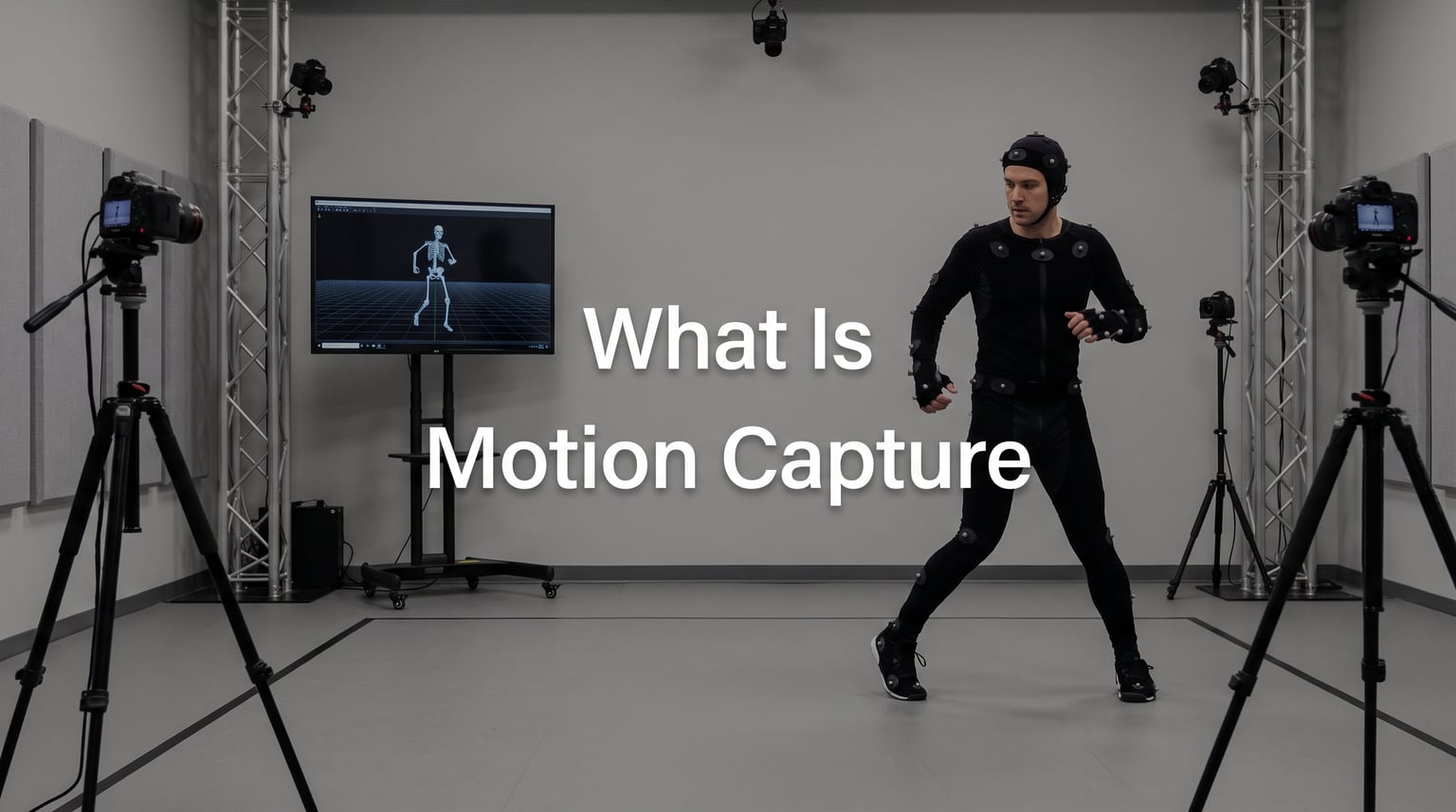
Motion capture (often called mocap or mo-cap) is the process of recording the physical movement of people or objects and translating that movement into a digital format that computers can read. Once captured, the data drives digital characters in films and video games, powers sports biomechanics analysis, supports medical rehabilitation, and fuels virtual reality experiences. In 2026, motion capture sits behind nearly every realistic digital character you see on screen, from Marvel heroes to fantasy creatures.
I first encountered mocap on a soundstage in 2019, watching an actor in a black suit covered in tiny reflective dots bring a video game villain to life. The cameras ringing the room picked up his every gesture, and the digital skeleton updated on the monitor in real time. That moment cracked open the question I want to answer here: what is motion capture, how does it actually work, and why should anyone outside a Hollywood studio care?
By the end of this guide, you will understand the technology behind motion capture, the four main system types, the industries that depend on it, and how indie creators can start using it on a budget. I have spent three years writing about animation, VFX, and live event technology, and I have pulled together the most current research for 2026.
Table of Contents
How Does Motion Capture Work
Motion capture works by tracking specific points on a body or object, recording those points through space, and converting the recorded 2D positions into 3D coordinates that drive a digital skeleton. Once the skeleton is solved, animators can apply that movement to any character in their pipeline. The full process usually takes place in a controlled capture volume, where cameras and sensors can see the performer clearly from every angle.
The basic workflow has six steps that any mocap studio follows, whether they are shooting a blockbuster film or an indie game cutscene.
Plan the capture. The director and animators define which body actions and facial expressions the scene needs. This shapes costume and marker placement decisions.
Calibrate the volume. Technicians map the capture space using a calibration wand so the software knows the exact position of every camera or sensor.
Dress the performer. The actor wears a mocap suit fitted with reflective markers, IMU sensors, or both, depending on the system.
Record the performance. Multiple infrared cameras track the markers at high frame rates (often 120 to 240 fps) while sensors stream rotation data.
Solve the skeleton. The software interprets the marker or sensor data and assigns each movement to a virtual bone structure.
Clean and retarget. Animators fix glitches, fill gaps, and map the solved motion onto the final character rig.
Real-time motion capture has changed the workflow since about 2026. Modern systems can solve and preview animation while the actor is still performing. This saves hours of cleanup and lets directors make creative decisions on the spot. The trade-off is that real-time feedback requires more expensive hardware and tightly tuned software.
History of Motion Capture
The history of motion capture began long before digital computers existed. In 1878, photographer Eadweard Muybridge used a series of trip-wired cameras to settle whether a galloping horse ever has all four hooves off the ground. His sequential images became the earliest recorded form of motion analysis, and they remain the visual shorthand for capturing movement more than a century later.
Animated shorts in the early 1900s used hand-drawn rotoscoping, where artists traced over live-action footage frame by frame. Rotoscoping is technically not mocap, but it influenced the idea that real human motion could drive animation. By the 1970s, researchers began experimenting with electronic sensors and early computer graphics to digitize movement directly.
The 1980s and 1990s turned experimental technology into production tools. Hollywood used mechanical exoskeletons and magnetic trackers for early films, then moved to optical systems when infrared cameras became affordable. The breakthrough moment for mainstream audiences came in 1999, when Andy Serkis performed as Gollum in The Lord of the Rings using a marker-covered facial capture rig. Audiences suddenly understood that motion capture could deliver emotional, subtle acting, not just stunt work.
Avatar in 2009 pushed the technology further by combining facial capture with body suit data and underwater performance. The 2010s saw inertial mocap suits become small enough for ordinary game developers and YouTube creators. Today in 2026, AI-driven markerless systems are stripping away the suits entirely, letting webcams and phones interpret body pose from ordinary video. The story of motion capture is one of constant miniaturization and accessibility.
Types of Motion Capture Systems
The four main types of motion capture systems are optical (marker-based), inertial (sensor-based), markerless (vision-based AI), and mechanical or magnetic (legacy systems). Each captures movement in a different way and fits different budgets, capture volumes, and production scales. Most modern studios mix more than one type to handle faces, hands, and bodies at the same time.
Optical Motion Capture
Optical motion capture uses multiple infrared cameras that track reflective or active LED markers placed on a performer. Triangulating the markers across at least two camera views gives a precise 3D position for every point at every frame. This is the gold standard for film and AAA games because of its accuracy, but it requires a controlled studio, line-of-sight to every marker, and significant post-processing.
Inertial Motion Capture
Inertial motion capture uses small IMU sensors (combining gyroscopes, accelerometers, and magnetometers) to measure rotation and acceleration directly on the body. No cameras are needed, which makes these systems portable and suitable for outdoor shoots, soundstages with limited line of sight, or even drone flights. The trade-off is drift over time, which is why inertial data is often cleaned up using periodic optical references.
Markerless Motion Capture
Markerless motion capture uses computer vision and AI models to estimate human pose from ordinary video. Modern systems analyze body landmarks frame by frame and reconstruct a 3D skeleton without markers or suits. This approach has exploded since about 2026 because it works with smartphones, webcams, and even archived footage. Quality still lags behind optical mocap for sub-millimeter work, but for many indie and educational uses the convenience wins out.
Mechanical and Magnetic Motion Capture
Mechanical mocap uses exoskeletons with joint angle sensors, while magnetic mocap uses sensors that read their position relative to a magnetic field. Both are now considered legacy systems. Mechanical rigs were bulky and restrictive, and magnetic systems suffered from interference in environments with metal. They are still occasionally found in university labs and some specialized biomechanics research setups.
| System Type | Best For | Strengths | Limitations |
|---|---|---|---|
| Optical | Feature films, AAA games | High accuracy, sub-millimeter | Needs controlled studio, occlusion issues |
| Inertial | Outdoor shoots, locomotion | Portable, no line-of-sight issues | Drift over long takes |
| Markerless (AI) | Indie creators, education, archival | No suit needed, low setup time | Lower precision, needs good lighting |
| Mechanical/Magnetic | Legacy research labs | No camera infrastructure | Restrictive, interference-prone |
Applications of Motion Capture
Motion capture powers everything from blockbuster films and console games to orthopedic rehab and live concerts. Every application leans on mocap’s core promise: capturing natural human movement in real time, then redeploying that movement in a digital context where it would be impossible or impractical to record it directly. Below are the six largest application areas in 2026.
Film and Television
Hollywood is the most visible consumer of motion capture. Andy Serkis’s work as Gollum, King Kong, and Snoke set the standard for creature performance. The Planet of the Apes reboot series used full-body and facial capture together to portray primate actors with human emotion. Avatar: The Way of Water in 2026 remains the high-water mark for capturing water-based performance, using specially designed underwater mocap systems to keep markers readable on submerged actors.
Video Games
Modern games like God of War Ragnarok, The Last of Us Part II, and the Uncharted series rely heavily on facial and body mocap to give characters emotional weight. Performance capture (often shortened to perfcap) captures both body and face in the same shoot, allowing full-scene conversations to be staged like a film. Indie developers increasingly use AI markerless tools for mocap on a budget, which has become one of the most discussed topics on game dev forums.
Sports and Biomechanics
Sports scientists use inertial and marker-based mocap to study joint angles, stride length, and injury risk. Olympic teams, NFL franchises, and elite soccer clubs all keep mocap labs to analyze athletes in motion. The same data helps running gait analysis, golf swing correction, and injury rehabilitation. Movement analysis through mocap has become standard practice in professional sports science.
Medicine and Rehabilitation
Hospitals and physical therapy clinics are now using markerless mocap systems to track patient recovery without expensive labs. Stroke patients recovering arm function can be assessed continuously with a simple camera. Surgical teams rehearse procedures on digital twins fed by mocap data. Motion analysis in healthcare is one of the fastest-growing fields in 2026.
Music and Live Performance
This is a gap most competitors do not cover. Motion capture is rapidly changing how concerts, music videos, and broadcast performances are produced. Artists like Madison Beer and The Weeknd have used mocap stages to project real-time avatars onto screens behind them. Virtual idols such as Hatsune Miku and Aespa’s AI members depend entirely on live mocap or motion-derived animation. For touring acts, mocap also provides reference data for backup dancers who perform in multiple physical locations.
Virtual Reality, Robotics, and Engineering
VR telepresence systems map a user’s full body into a virtual room using mocap-style tracking. Industrial robotics developers record human motion to teach robots how to grip, lift, and assemble parts safely alongside people. Military and aerospace training simulations use mocap-driven avatars to rehearse dangerous procedures. Even ergonomics studies in office and warehouse design rely on mocap to measure posture and strain.
Advantages and Disadvantages of Motion Capture
Motion capture delivers realistic movement far faster than manual keyframe animation, but it costs more upfront and produces data that still needs cleanup. Whether mocap is the right choice depends on the project, the budget, and the artistic goals. I have asked animators across studios what they wish they had known before their first mocap shoot, and the tradeoffs below come straight from that experience.
| Advantages | Disadvantages |
|---|---|
| Realistic human movement in a fraction of the time of keyframe animation | High upfront equipment or studio cost |
| Real-time preview lets directors iterate on performance | Marker occlusion can cause data gaps |
| Captures subtle acting that hand animation usually misses | Inertial systems drift over long takes |
| Reusable across multiple characters and projects | Clean-up is still required, often hours per minute of footage |
| Integrates with Unreal, Unity, and Maya pipelines | Specialized costumes and suits add setup time |
Forum discussions consistently note that mocap can deliver 90 percent of the work, but the final 10 percent always needs an animator’s touch. The most common complaints from indie users are drift in inertial suits, occlusion in optical shoots, and the steep learning curve of the cleaning software. Choosing mocap purely to skip animation work rarely pays off, so plan for cleanup time in your schedule.
For most indie productions, mocap makes sense when you need a large volume of realistic humanoid movement. For stylized, low-volume, or non-human animation, traditional keyframe or rigging tools are still faster and cheaper.
How to Get Started With Motion Capture on a Budget
You can start motion capture as a hobby with just a smartphone and free software in 2026. The democratization of mocap is one of the biggest stories of the past five years, and AI tools have made it possible to capture decent body motion without spending thousands on suits and cameras. Below is the practical path I recommend to anyone curious about trying mocap at home.
Step 1: Pick a Free or Low-Cost Tool
FreeMoCap is an open-source markerless system that uses ordinary webcams to extract skeletal motion. ManyCreatures and DeepMotion offer AI-powered motion capture from regular video for under $20 per month. Blender has built-in motion tracking tools, and iPi Soft sells a markerless capture license designed for indie budgets. Mobile apps like Move AI let you record with a phone, upload the footage, and receive a clean skeletal animation back.
Step 2: Set Up Your Capture Space
Your space does not need to be a studio. A living room with good lighting, a clear background, and one or two cameras at chest height is enough for markerless capture. Cover any mirrors, close blinds to control sunlight, and mark a small performance area on the floor with tape. Move AI and similar AI-based systems can reconstruct motion from a single phone camera for simple shots.
Step 3: Record and Clean
Perform a few test moves before recording the final take. Watch the AI skeleton overlay on screen and adjust your position if joints are flipping or disappearing. Export the cleaned motion as FBX or BVH and import it into Blender, Unreal, or Unity. Budget an extra hour of cleanup for every minute of raw motion when you are learning.
Step 4: Know When to Upgrade
When you find yourself needing more actors at once, outdoor capture, or very precise facial animation, a beginner-friendly inertial suit becomes worth the investment. Systems like the Rokoko Smartsuit Pro 2 and the Xsens Awinda exist in the under $5,000 range and dramatically expand what is possible. Until then, AI markerless tools are enough to finish most indie projects.
FAQs
What is the difference between animation and motion capture?
Traditional animation (especially keyframe animation) is created entirely by an animator who manually sets each pose. Motion capture records a real performance and translates it into animation data. Mocap tends to look more natural and is faster for realistic human motion, while hand-crafted keyframe animation gives more stylized control.
Is motion capture the same as CGI?
No. Motion capture is the recording of real movement into digital data. CGI (computer generated imagery) is the visual output created with that data and other software. Mocap is one ingredient of many in a CGI pipeline, along with modeling, lighting, rendering, and compositing.
What are the cons of motion capture?
The main cons are high upfront equipment cost, occlusion problems with marker-based optical systems, drift over time with inertial suits, and the need for animator cleanup on every take. Mocap also requires specialized suits or capture volumes and a learning curve for the associated software.
Can you do motion capture with a phone?
Yes, in 2026 you can do a workable form of markerless motion capture using apps like Move AI, Plask, or the phone-based workflow in DeepMotion. You record with one or two phones on a tripod, upload the footage, and receive a skeletal animation. The accuracy is lower than professional optical mocap but is enough for indie games, learning projects, and reference animation.
How much does professional motion capture cost?
A professional optical capture studio day runs between $5,000 and $25,000 depending on location and number of cameras. Markerless and inertial solutions drop the cost dramatically, with consumer inertial suits starting around $1,000 and software-only AI markerless options available for free or under $30 per month.
What is motion capture used for?
Motion capture is used for film and TV creature performance, AAA video game animation, sports biomechanics and injury analysis, medical rehabilitation, virtual reality telepresence, robotics training, military simulations, ergonomics assessment, and increasingly for live music performances and virtual idols.
Conclusion
Motion capture is the bridge between physical performance and digital storytelling. In 2026, mocap is no longer just a Hollywood tool: AI markerless systems have brought it into indie game studios, classrooms, rehab clinics, and concert stages. The core idea has stayed the same since Muybridge’s horse photographs in 1878. Record real movement faithfully, then reuse it wherever digital characters need to feel human.
If you are new to the technology, start with a free AI markerless tool on your phone to see how the workflow feels before investing in suits or studio time. Compare your results with keyframe animation on a small project and you will quickly see where motion capture earns its place in your pipeline. The future of mocap is portable, markerless, and powered by AI, and 2026 is the right moment to begin learning it.