
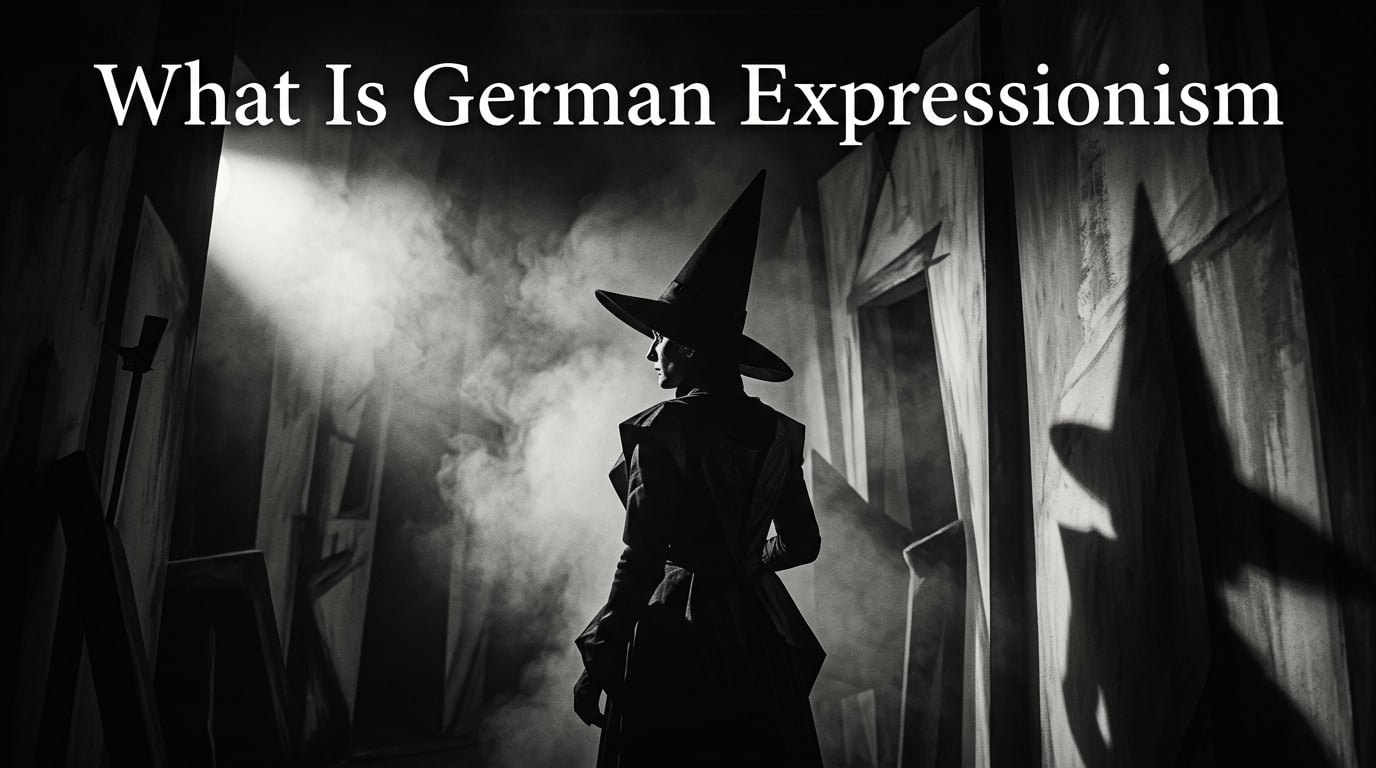
If you have ever watched a Tim Burton film and wondered where those twisted, shadow-drenched visuals came from, you were looking at the descendants of German Expressionism. This movement shaped how we depict fear, anxiety, and inner turmoil on screen and on canvas. Understanding it changes how you see everything from classic horror to modern blockbusters.
When I first started studying film history, I assumed German Expressionism was just a style of old horror movies. The reality is far more layered. It was a full avant-garde movement that swept through painting, printmaking, sculpture, architecture, and cinema in the early 20th century. The artists and filmmakers involved were processing trauma on a national scale.
In this guide, we break down what is German Expressionism across every medium it touched. You will learn about its origins in post-WWI Germany, the two artist groups that defined the movement, the landmark films that still influence directors today, and the visual techniques you can spot in artwork from 2026 all the way back to 1905.
Table of Contents
Quick Definition
German Expressionism was an early 20th-century avant-garde movement (roughly 1905 to 1933) that prioritized subjective emotional experience over realistic depiction. It used distorted shapes, jagged lines, non-naturalistic colors, and deep shadows to express anxiety, despair, and psychological turmoil.
Two main artist groups:
Die Brücke (The Bridge) — Founded 1905 in Dresden
Der Blaue Reiter (The Blue Rider) — Founded 1911 in Munich
Key terminology:
Helldunkel — “Light-dark” or “twilight of the soul,” referring to the movement’s dramatic contrast between light and shadow
Chiaroscuro — The lighting technique of extreme contrast between dark and light areas
Avant-garde — Radical, experimental art that pushes boundaries of accepted norms
What Is German Expressionism? The Core Idea
At its heart, German Expressionism rejected the idea that art should faithfully reproduce what the eye sees. Instead, German expressionists believed art should externalize what the soul feels. If an artist felt terror, the painting should look terrifying. If they felt spiritual ecstasy, the canvas should radiate that feeling through every brushstroke.
This philosophy separated German Expressionism from movements like Impressionism, which focused on capturing fleeting moments of light and atmosphere. Expressionists wanted none of that gentle observation. They simplified forms, flattened perspective, stripped away decorative details, and replaced natural colors with ones chosen for emotional impact rather than accuracy.
A face might be painted sickly green. A street might curve at an impossible angle. A shadow might stretch across a wall like a living thing. None of this was accidental. Each distortion was a deliberate choice to make the viewer feel something rather than simply recognize something.
The movement drew heavily from German Romanticism, which had already established a tradition of prioritizing emotion, intuition, and the sublime over rational order. But where Romanticism leaned toward awe and wonder, Expressionism often plunged into darker territory: madness, alienation, urban anxiety, and the collapse of certainty.
Many people today encounter the term through cinema and assume German Expressionism was purely a film movement. It was not. The visual arts came first. Painters, printmakers, and sculptors established the aesthetic language years before filmmakers picked up cameras and translated those same principles to the screen.
Historical Context: Why Germany, and Why Then
You cannot understand German Expressionism without understanding the trauma that birthed it. Germany in the early 20th century was a nation in crisis, and the art that emerged from that crisis was a direct response to collective suffering.
The movement’s earliest roots trace back to 1905, before World War I began. But it was the war and its aftermath that gave German Expressionism its defining darkness. When soldiers returned from the trenches, they brought back experiences that defied traditional representation. Millions were dead. Millions more were physically and psychologically shattered.
Germany lost the war and faced crushing reparations under the Treaty of Versailles. The Weimar Republic that followed was politically unstable, economically desperate, and socially fractured. Hyperinflation wiped out savings overnight. Political violence erupted regularly in the streets. There was a pervasive sense that the old order had failed and something nightmarish had taken its place.
Artists and filmmakers channeled this collective anxiety into their work. The distorted streetscapes of The Cabinet of Dr. Caligari were not just creative choices. They reflected a nation that felt reality itself had become unhinged. When forum users on Reddit describe German Expressionism as “loneliness as style,” they are picking up on something real: the movement captured the experience of living in a society that had lost its footing.
There was also a deeper distrust of authority running through the movement. WWI soldiers had been sent into mechanized slaughter by leaders who seemed indifferent to human cost. This skepticism toward authority figures, government, and institutional power surfaces repeatedly in Expressionist art and film. The authority figures in these works are often madmen, tyrants, or malevolent forces.
The political environment of the Weimar Republic also created a unique cultural opening. Despite its instability, Weimar Germany had a remarkably vibrant arts scene. Censorship was relatively lax compared to the Imperial era that preceded it and the Nazi regime that followed. Filmmakers and artists had unusual freedom to experiment, push boundaries, and explore dark subject matter.
That freedom ended abruptly in 1933 when the Nazi Party rose to power. The Nazis declared Expressionist art “degenerate” and either destroyed it or removed it from museums. Many artists fled the country. The movement effectively died, but its visual language had already spread far beyond Germany’s borders.
The Two Pillars: Die Brücke and Der Blaue Reiter
The visual art side of German Expressionism was defined by two major groups. While they shared a rejection of realism, their approaches, philosophies, and subjects differed in important ways. Understanding both gives you a complete picture of the movement’s range.
Die Brücke (The Bridge)
Die Brücke was founded in 1905 in Dresden by four architecture students: Ernst Ludwig Kirchner, Fritz Bleyl, Erich Heckel, and Karl Schmidt-Rottluff. The name “The Bridge” was deliberate. They saw themselves as a bridge between the old traditions of German art and a new, more honest form of creative expression.
The group was raw, direct, and confrontational. They drew inspiration from African and Oceanic art, medieval German woodcuts, and what they saw as “primitive” forms of expression that cut through academic pretension. Their work featured bold, crude lines, aggressive colors, and subjects that included nudes, street scenes, circus performers, and dancers.
Printmaking, especially woodcuts, was central to Die Brücke’s identity. The woodcut medium suited their aesthetic perfectly. It forced simplification, produced rough textured lines, and had deep roots in German artistic tradition going back to the Renaissance. Emil Nolde, who joined the group briefly, became one of its most famous printmakers, known for religious subjects rendered in intense, almost violent colors.
Die Brücke disbanded in 1913, but its influence on modern printmaking and painting was permanent. The group’s emphasis on directness and emotional rawness became a hallmark of Expressionist visual art worldwide.
Der Blaue Reiter (The Blue Rider)
Der Blaue Reiter formed in 1911 in Munich, founded by Wassily Kandinsky and Franz Marc. The name came from a painting by Kandinsky depicting a blue rider on horseback. Where Die Brücke was earthy and confrontational, Der Blaue Reiter was more spiritual, intellectual, and experimental.
Kandinsky was moving toward pure abstraction, believing that art could communicate spiritual truths without representing physical objects at all. Franz Marc painted animals, particularly horses, using non-naturalistic colors to convey spiritual meaning rather than physical accuracy. His famous Blue Horse I and The Yellow Cow used color symbolically: blue represented the spiritual, yellow represented feminine joy, and red represented violence and matter.
The group was more diverse than Die Brücke. It included artists working in very different styles, and it embraced not just painting but music theory, folk art, children’s art, and art from non-Western cultures. They published an almanac in 1912 that compiled essays, images, and musical scores, arguing for a synthesis of all the arts.
World War I effectively ended Der Blaue Reiter. Both Marc and another member, August Macke, were killed in combat. Kandinsky returned to Russia. The group never reformed, but its ideas about abstraction and spirituality in art proved enormously influential on 20th-century modernism.
| Feature | Die Brücke | Der Blaue Reiter |
|---|---|---|
| Founded | 1905, Dresden | 1911, Munich |
| Key Artists | Kirchner, Nolde, Heckel, Schmidt-Rottluff | Kandinsky, Marc, Macke, Munter |
| Philosophy | Raw, direct, confrontational emotion | Spiritual, intellectual, abstract |
| Signature Medium | Woodcuts and printmaking | Painting and abstraction |
| Color Use | Aggressive, unnatural, jarring | Symbolic, spiritual meaning |
| Influences | African and Oceanic art, medieval woodcuts | Music theory, folk art, children’s art |
| Dissolved | 1913 | 1914 (WWI outbreak) |
German Expressionism in Film
The film side of German Expressionism is what most people recognize today, even if they do not know the name. During the Weimar era, German cinema produced some of the most visually inventive films in history, and their influence ripples through every horror and noir film made since.
The Cabinet of Dr. Caligari (1920)
Robert Wiene’s The Cabinet of Dr. Caligari is widely considered the first true German Expressionist film. Its plot involves a sinister doctor who uses a sleepwalker to commit murders in a small town. But the story matters less than how it looks.
Every set is painted with jagged, impossible angles. Doors lean. Windows are crooked. Streets twist in directions that no real city would allow. Shadows are painted directly onto the floors and walls rather than created with actual lighting. The result is a world that feels like a nightmare you cannot wake from.
The film also introduced one of the most famous twists in cinema history: the revelation that the entire story may be the delusion of a patient in an insane asylum, with Dr. Caligari revealed as the asylum director. This framing device, where reality itself is questioned, became a recurring theme in Expressionist and later psychological thrillers.
Nosferatu (1922)
F.W. Murnau’s Nosferatu was an unauthorized adaptation of Bram Stoker’s Dracula, and Stoker’s estate successfully sued to have it destroyed. Fortunately for film history, copies survived. The film’s vampire, Count Orlok, is one of the most genuinely unsettling creatures ever put on screen.
Unlike the suave Dracula of later Hollywood films, Orlok is a rat-like monstrosity with elongated fingers, hollow eyes, and a skeletal frame. Murnau used real locations rather than painted sets, but achieved Expressionist effects through camera techniques: negative imagery, speed manipulation, and dramatic shadows created by natural light.
The most famous scene shows Orlok’s shadow climbing a staircase ahead of his body. That single image, a shadow acting independently of its caster, captures the essence of German Expressionist cinema in one frame.
Metropolis (1927)
Fritz Lang’s Metropolis scaled German Expressionism up to epic proportions. It depicts a futuristic city divided between wealthy elites who live in towering pleasure gardens and workers who toil underground to keep the machines running. The film’s massive sets, robotic doppelgangers, and themes of class division expanded what Expressionist visuals could accomplish.
While earlier Expressionist films used distortion to convey madness and fear, Metropolis used it to convey social commentary. The towering cityscape, the menacing Machine-Man, and the catacomb-like worker quarters all used Expressionist techniques to critique industrial capitalism and class exploitation.
Beyond the Famous Trio
Forum discussions reveal that many viewers want recommendations beyond the three films everyone mentions. If you want to explore further, consider The Last Laugh (1924), Faust (1926), Sunrise (1927), and M (1931). Fritz Lang’s M in particular bridges the gap between Expressionism and the darker psychological crime films that followed.
What makes these films distinctly German Expressionist rather than simply “films with shadows”? It comes down to intent. The visual distortions exist to externalize internal states: paranoia, dread, moral corruption, existential fear. A film can have dark lighting without being Expressionist. The movement requires that the visuals serve psychological expression.
Key Characteristics and Visual Techniques
Whether in paint or on film, German Expressionism shares a recognizable set of visual signatures. Learning to spot them helps you identify the movement across different mediums and time periods.
Distorted shapes and jagged lines: Forms are stretched, twisted, or broken apart. Buildings lean at dangerous angles. Human bodies are elongated or compressed. Nothing sits quite right, mirroring a world that feels fundamentally unstable.
Non-naturalistic colors: Colors are chosen for emotional effect, not accuracy. A face might be green, a horse might be blue, a sky might be blood red. Die Brücke artists were especially aggressive with color, slapping unnatural hues onto canvases to maximize emotional impact.
Deep shadows and high contrast: In film, this manifested through chiaroscuro lighting, extreme contrasts between light and dark areas. In painting, artists used heavy outlines and dark backgrounds to create similar dramatic contrast. The German term helldunkel, meaning “light-dark,” captures this duality and is sometimes translated as “twilight of the soul.”
High angles and extreme camera positions: Expressionist filmmakers used unusual camera placements to create a sense of unease. Looking down at characters made them seem small and powerless. Tilted angles, sometimes called Dutch angles, made the world feel off-balance.
Impossible sets and environments: Rather than filming in realistic locations, Expressionist filmmakers built sets with deliberately distorted geometry. Walls met at wrong angles. Doorways were the wrong size. Staircases led nowhere. These spaces externalized the mental states of the characters within them.
Subjective experience over objective reality: This is the philosophical throughline. Every visual distortion serves the goal of showing you what a character feels rather than what physically exists. A paranoid character sees threatening shadows everywhere. A doomed character walks streets that curve toward oblivion.
Modern Legacy: From Film Noir to Tim Burton
German Expressionism did not disappear when the Nazis shut it down in the 1930s. Its visual DNA migrated across the world and continues to shape cinema in 2026.
When Jewish and anti-Nazi filmmakers fled Germany, many went to Hollywood. They brought Expressionist techniques with them. The heavy shadows, morally ambiguous characters, and urban paranoia of 1940s film noir descend directly from German Expressionist cinema. Films like The Third Man (1949) feel almost like spiritual sequels to Caligari and Nosferatu.
Tim Burton is the most commonly cited modern descendant. Edward Scissorhands, Batman Returns, The Nightmare Before Christmas, and Sweeney Todd all draw on Expressionist visual language: distorted architecture, exaggerated shadows, characters who are physically external manifestations of inner states. Burton’s suburbia twists at unnatural angles just as Caligari’s streets did a century earlier.
The movement also influenced the horror genre fundamentally. Universal’s classic monster films of the 1930s, particularly Frankenstein and Dracula, borrowed Expressionist lighting and set design. Modern horror directors like Guillermo del Toro continue this tradition, blending Expressionist atmosphere with contemporary storytelling.
Even superhero films carry Expressionist DNA. Forum users have noted the Expressionist qualities of Batman v Superman, with its brooding visual palette and distorted sense of reality. The movement’s core idea, that visuals should express inner psychological states rather than mirror the external world, has become so embedded in filmmaking that we barely notice it anymore.
The movement ended because the political situation in Germany made it impossible to continue, not because artists lost interest in its ideas. Expressionism survived by evolving, absorbing into other traditions, and reemerging whenever filmmakers wanted to show audiences something that realism alone could not capture.
FAQs
Is German Expressionism horror?
German Expressionism is not exclusively horror, though it heavily influenced the genre. It was a broad art movement spanning painting, printmaking, sculpture, and cinema. Its dark visual style and themes of anxiety and madness naturally lent themselves to horror films, which is why the most famous German Expressionist works (Nosferatu, The Cabinet of Dr. Caligari) are horror. But the movement also addressed spirituality, urban alienation, social critique, and abstract emotion.
What are the main themes of German Expressionism?
The main themes include anxiety and despair, madness and psychological turmoil, distrust of authority, urban alienation, the conflict between modernity and humanity, spiritual searching, and the trauma of war. Visual themes include distorted reality, nightmarish imagery, deep shadows, and non-naturalistic color used to express emotional states rather than depict the physical world accurately.
What is an example of German Expressionism?
The most famous examples include the films The Cabinet of Dr. Caligari (1920), Nosferatu (1922), and Metropolis (1927). In visual art, key examples include Ernst Ludwig Kirchner’s street scenes, Emil Nolde’s intense religious woodcuts, Franz Marc’s blue horse paintings, and Wassily Kandinsky’s early abstract works. All share distorted forms and emotionally charged colors designed to express inner feeling rather than external reality.
How to identify a German Expressionism painting?
Look for distorted shapes, jagged or rough brushwork, non-naturalistic colors chosen for emotional impact, flattened perspective, simplified forms, bold dark outlines, and subjects depicting anxiety, urban life, nudes, or spiritual themes. Woodcut prints with crude dramatic lines are also strong indicators. If the painting prioritizes emotional truth over visual accuracy, it likely has Expressionist roots.
Why did German Expressionism start after WWI?
German Expressionism started before WWI, with Die Brücke founded in 1905, but the war and its aftermath gave the movement its defining dark tone. The trauma of mechanized warfare, economic collapse under the Treaty of Versailles, political instability of the Weimar Republic, and collective grief created an environment where artists needed to express anguish that realism could not capture. The war intensified the movement’s focus on anxiety, madness, and distrust of authority.
Is German Expressionism only about film?
No. German Expressionism was a visual art movement first, including painting, printmaking, sculpture, and architecture. The two founding groups, Die Brücke and Der Blaue Reiter, were painters and printmakers. Film came later and adopted the visual language these artists had already established. Many sources focus heavily on film because the movies are more accessible today, but the art movement was broader and came first.
Conclusion
Understanding what is German Expressionism gives you a lens for interpreting some of the most powerful visual art and cinema of the past century. It was a movement born from trauma, driven by the belief that art should express what we feel rather than what we see.
From Kirchner’s aggressive woodcuts to the painted nightmare streets of Caligari, from Kandinsky’s spiritual abstractions to the shadow of Nosferatu climbing a staircase, the movement gave artists and filmmakers permission to distort reality in service of emotional truth. That permission changed everything that followed.
Next time you watch a film heavy with shadows and impossible angles, or see a painting where the colors refuse to behave naturally, look for the Expressionist DNA underneath. It is everywhere, and now you know how to spot it. If you want to go deeper, start with the three landmark films, then explore the woodcuts of Die Brücke and the spiritual abstractions of Der Blaue Reiter. The movement rewards every layer of attention you give it.