
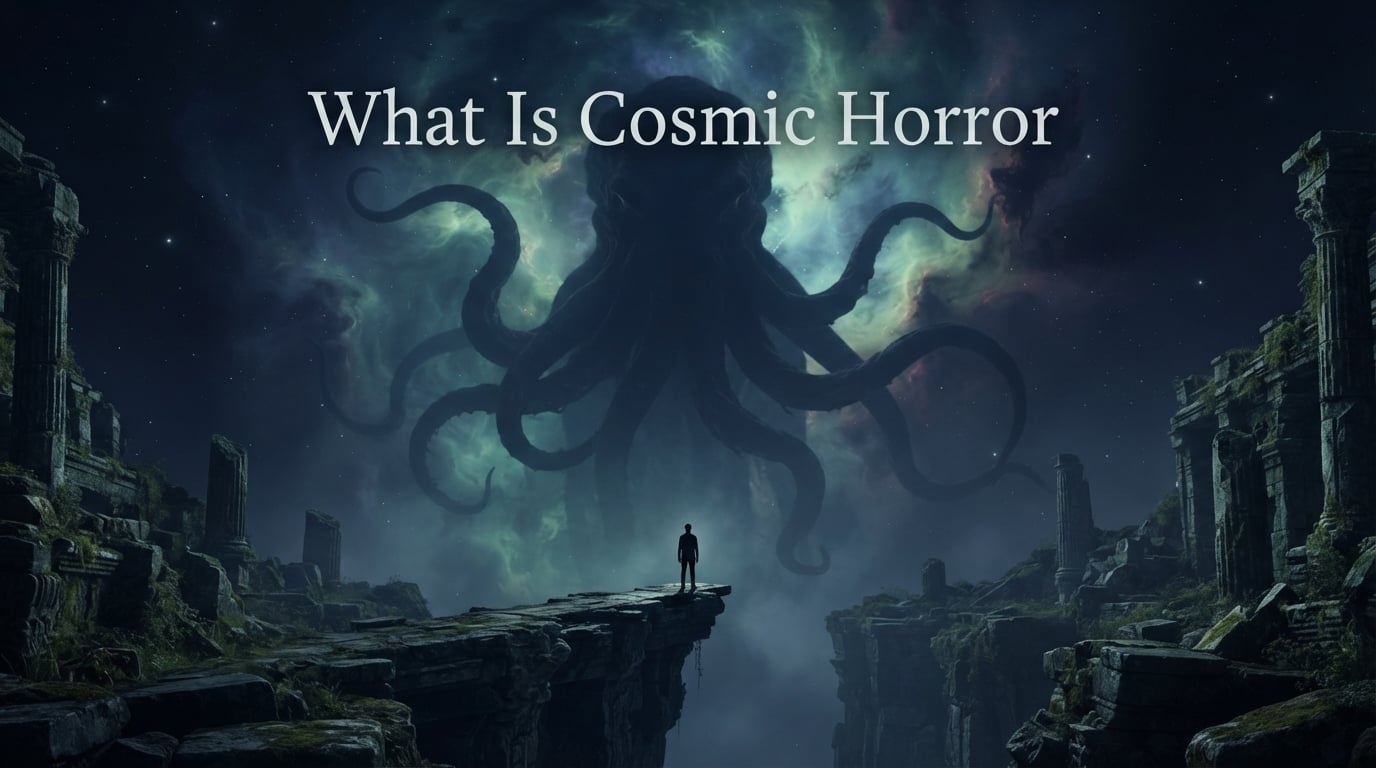
Cosmic horror is a horror subgenre that explores existential dread through the fear of human insignificance in an indifferent universe, where ancient unknowable entities render humanity utterly powerless. The fear does not come from monsters in the closet or killers in the woods. It comes from the realization that the universe itself does not care whether we live or die, and that forces beyond our comprehension have always existed.
If you have ever felt small while staring at the night sky, you have brushed against the feeling that cosmic horror tries to capture. Our team has spent years reading, watching, and analyzing this genre, and in this guide we break down exactly what cosmic horror is, where it came from, and why it still terrifies readers in 2026.
We will cover the defining characteristics, the role of H.P. Lovecraft, the controversy surrounding his legacy, the best examples across books and film, and the psychology behind why this genre refuses to fade. By the end, you will be able to identify cosmic horror anywhere you encounter it.
Table of Contents
What Is Cosmic Horror in Simple Terms?
In plain language, cosmic horror is fiction that scares you by showing how tiny and powerless human beings really are. The threat is not a vampire or a serial killer. The threat is the universe itself, and the ancient beings in it that predate humanity by millions of years.
Imagine learning that everything you understand about reality is wrong. The laws of physics are a comforting illusion. The gods of old myths were real, but they were not gods at all. They were something older, stranger, and completely indifferent to whether you exist. That is the heart of cosmic horror.
The genre is sometimes called Lovecraftian horror or eldritch horror, and the three terms overlap heavily. We will sort out the differences in a later section. For now, the key idea to hold onto is this: cosmic horror is about dread that comes from incomprehension, not from danger you can fight.
The Origins of Cosmic Horror and H.P. Lovecraft’s Role
Cosmic horror as a recognizable genre was largely shaped by the American writer H.P. Lovecraft, who lived from 1890 to 1937. Lovecraft published most of his work in pulp magazines like Weird Tales, and he built an interconnected mythology that writers still borrow from today. His 1928 novella The Call of Cthulhu introduced the tentacled entity that became the face of the genre.
Lovecraft did not invent cosmic horror from nothing. Earlier writers like Algernon Blackwood, Arthur Machen, and Lord Dunsany explored themes of vast unknowable forces and human smallness. What Lovecraft did was codify these ideas into a recognizable philosophy. In his 1927 essay Supernatural Horror in Literature, he argued that the oldest and strongest kind of fear is fear of the unknown.
Lovecraft’s mythology included the Great Old Ones, ancient beings who sleep in the depths of the ocean or between the stars. He gave us the fictional Necronomicon, a forbidden book of magic, and the fictional town of Arkham, Massachusetts. After his death, friends and admirers like August Derleth expanded what became known as the Cthulhu Mythos, turning Lovecraft’s scattered references into a shared universe that other writers could contribute to.
Today, Lovecraft’s influence runs far beyond horror literature. You can see his fingerprints on science fiction, fantasy, video games, tabletop roleplaying, and even academic discussions about existentialism. The genre he helped define has outlived him by nearly a century, and it shows no sign of fading.
Why H.P. Lovecraft Remains Controversial
Any honest guide to cosmic horror has to address a difficult truth. H.P. Lovecraft was a virulent racist, even by the standards of his own time. His personal letters are filled with white supremacist beliefs, and some of his stories use racist tropes and dehumanizing descriptions of non-white characters. This is not a minor footnote. It is central to understanding why the genre has a complicated relationship with its founding figure.
The World Fantasy Award trophy was once a bust of Lovecraft’s face. In 2015, after years of pressure from authors and readers, the organization replaced it with a different design. The change was not about erasing Lovecraft from literary history. It was about refusing to hand his likeness to every new winner of a major award in a diverse field.
Modern readers and writers have responded to this controversy in several productive ways. Some engage critically with Lovecraft’s work, naming the racism while still analyzing what makes the fiction effective. Others have reclaimed the genre entirely. Victor LaValle’s The Ballad of Black Tom retells Lovecraft’s The Horror at Red Hook from the perspective of a Black protagonist, exposing the racism baked into the original. N.K. Jemisin, Silvia Moreno-Garcia, and Ruthanna Emrys have all written cosmic horror that centers voices Lovecraft would have excluded.
The result is a richer genre. Cosmic horror no longer belongs to one man. It belongs to everyone who wants to explore what it means to be small in a vast universe, and the best contemporary work in the genre knows its history without being trapped by it.
Key Characteristics of Cosmic Horror
If you want to identify cosmic horror when you see it, look for these recurring traits. Most cosmic horror stories will hit several of them at once.
Human insignificance: Humanity is not special. We are a footnote in a universe that has existed for billions of years without us.
The unknowable: The source of fear cannot be fully understood or described. Attempting to comprehend it drives characters toward madness.
Cosmic indifference: The ancient beings in these stories are not evil in any human sense. They simply do not care about us, the way you do not think about individual ants.
Forbidden knowledge: Learning the truth about reality is dangerous. Books, artifacts, and revelations that pull back the veil tend to destroy the people who find them.
Madness and psychological decay: Characters who encounter cosmic forces often lose their grip on sanity long before they face any physical threat.
Isolation: Protagonists are usually alone, or cut off from anyone who would believe them. The horror is something no one else can see or understand.
Reality breakdown: The rules of the world stop working. Time bends, space folds, and the line between dream and waking life dissolves.
These characteristics are why cosmic horror feels different from a slasher film or a ghost story. There is no monster to defeat and no curse to lift. The horror is structural. It is the architecture of reality itself turning out to be hostile, or worse, indifferent.
Cosmic Horror vs Lovecraftian Horror vs Eldritch Horror
These three terms get used almost interchangeably, and that is mostly fine. But there are subtle distinctions worth knowing if you want to talk about the genre precisely.
Cosmic horror is the broadest term. It describes any horror fiction that draws fear from humanity’s smallness in a vast, indifferent universe. A story can be cosmic horror without referencing Lovecraft at all.
Lovecraftian horror is cosmic horror that follows the conventions Lovecraft established, or that directly references his mythos. If a story features tentacled ancient gods, forbidden tomes, and academic protagonists slowly going mad, it is Lovecraftian.
Eldritch horror is the narrowest and most atmospheric term. Eldritch means strange, otherworldly, and unsettling in a way that defies normal description. It usually refers to the specific quality of wrongness that cosmic beings project, the feeling that something should not exist.
Think of it as concentric circles. All eldritch horror is cosmic horror, and most Lovecraftian horror is both. But not all cosmic horror is Lovecraftian, and a story can be cosmic without being particularly eldritch in tone.
Examples of Cosmic Horror in Books, Movies, and Podcasts
The best way to understand cosmic horror is to experience it. Here are standout examples across different media that capture the genre’s core ideas.
In books: H.P. Lovecraft’s At the Mountains of Madness follows an Antarctic expedition that uncovers the ruins of a civilization older than humanity. Jeff VanderMeer’s Annihilation drops a team of scientists into a zone where biology and reality have started breaking down. Victor LaValle’s The Ballad of Black Tom reclaims Lovecraftian horror from a Black perspective. John Langan’s The Fisherman blends cosmic dread with grief in a story that keeps widening in scope.
In film and television: Ridley Scott’s Alien (1979) is frequently cited as cosmic horror in space, where the crew of the Nostromo encounters a creature that operates outside any framework they understand. Alex Garland’s Annihilation (2018) adapts VanderMeer’s novel and renders the cosmic dread visually. The Void (2016) and Color Out of Space (2019) wear their Lovecraftian influences openly. HBO’s adaptation of Lovecraft Country tackled the genre and its racist foundations at the same time.
In podcasts and audio: The Magnus Archives, a British horror fiction podcast, is widely praised in horror communities for its sustained cosmic horror arc. Listeners on Reddit’s horror forums consistently recommend it as one of the best modern entries in the genre, particularly for how it builds existential dread over hundreds of episodes rather than relying on monster reveals.
In video games: Bloodborne is perhaps the most celebrated cosmic horror game ever made, burying its Lovecraftian themes beneath a gothic surface that slowly peels away. Call of Cthulhu adaptations and Sunken City also draw directly from the mythos.
The Psychology Behind Why Cosmic Horror Works
Here is a question that comes up constantly in horror forums. How is cosmic horror supposed to be scary when the horror is, by definition, incomprehensible? If you cannot understand the threat, how do you fear it?
The answer lies in how our brains process uncertainty. Psychological research on the unknown shows that ambiguity activates threat-response systems more reliably than clearly defined dangers. When you can see the monster, your brain categorizes it and starts planning. When you cannot see it, or when it defies categorization, your brain stays in a state of heightened alert with no resolution. That sustained alertness is what dread feels like.
Cosmic horror exploits this mechanism relentlessly. The genre refuses to give you a clean look at the thing behind the curtain because a clean look would make it manageable. Instead, it feeds you fragments. A description that breaks down mid-sentence. A shape that the human eye refuses to focus on. A revelation that rewrites everything you assumed about the story so far.
There is also a deeper existential layer. Cosmic horror taps into fears that almost everyone carries quietly. The fear that our lives do not matter on a cosmic scale. The fear that the universe is not just indifferent but hostile. The fear that the comforting stories we tell ourselves about purpose and meaning are inventions, and that nothing is watching over us. Good cosmic horror does not create these fears. It opens a door to them and lets you stand in the doorway for a while.
This is why the genre resonates so strongly during periods of cultural uncertainty. Readers on horror forums have noted that cosmic horror felt especially relevant during the early 2020s, when global events made humanity feel small and out of control. The genre gives shape to a feeling that is hard to articulate any other way.
FAQs
What classifies as cosmic horror?
Cosmic horror is classified by its focus on human insignificance in an indifferent universe, fear of the unknowable, ancient entities beyond human comprehension, madness brought on by forbidden knowledge, and the breakdown of reality. The threat cannot be fought or fully understood, only endured or escaped.
What are examples of cosmic horror?
Notable examples include Lovecraft’s The Call of Cthulhu and At the Mountains of Madness, Jeff VanderMeer’s Annihilation, the film Alien (1979), the video game Bloodborne, and the podcast The Magnus Archives. Modern books like Victor LaValle’s The Ballad of Black Tom and N.K. Jemisin’s The City We Became also expand the genre.
Is Pennywise a Lovecraftian horror?
Yes. Stephen King has stated that Pennywise in IT is a cosmic entity that crashed to Earth in prehistoric times and feeds on fear. Pennywise’s true form is described as incomprehensible deadlights, which places IT firmly in the cosmic horror tradition even though the novel also works as a small-town horror story.
Is Stranger Things cosmic horror?
Stranger Things uses some cosmic horror elements, particularly the Upside Down as an alien parallel dimension and the Mind Flayer as a vast unknowable entity. However, the show leans more heavily on science fiction, 80s adventure, and monster-of-the-week conventions, so most critics classify it as cosmic-adjacent rather than pure cosmic horror.
Why is H.P. Lovecraft so controversial?
H.P. Lovecraft held virulently racist and white supremacist views that appear in his personal letters and sometimes in his fiction. His work includes dehumanizing depictions of non-white characters and cultures. The horror community continues to grapple with this legacy by critiquing his work directly and by championing modern authors from diverse backgrounds who reclaim and reshape the genre he helped create.
Where to Go From Here?
Cosmic horror is a genre built on a simple, unsettling premise. We are small, the universe is vast, and some truths are better left uncovered. Whether you encounter it in a Lovecraft novella, a Victor LaValle novel, a podcast like The Magnus Archives, or a film like Annihilation, the feeling it creates is unmistakable.
If you are new to the genre, start small. Read The Call of Cthulhu to understand the foundation, then branch into modern voices like LaValle, Jemisin, and VanderMeer to see how the genre has grown beyond its origins. The best cosmic horror being written today does not just repeat what Lovecraft did. It asks who gets to feel small, who gets to go mad, and who gets to survive.
That openness is exactly why cosmic horror will keep thriving in 2026 and beyond. The dread is universal, but the stories are finally as diverse as the universe they describe.