
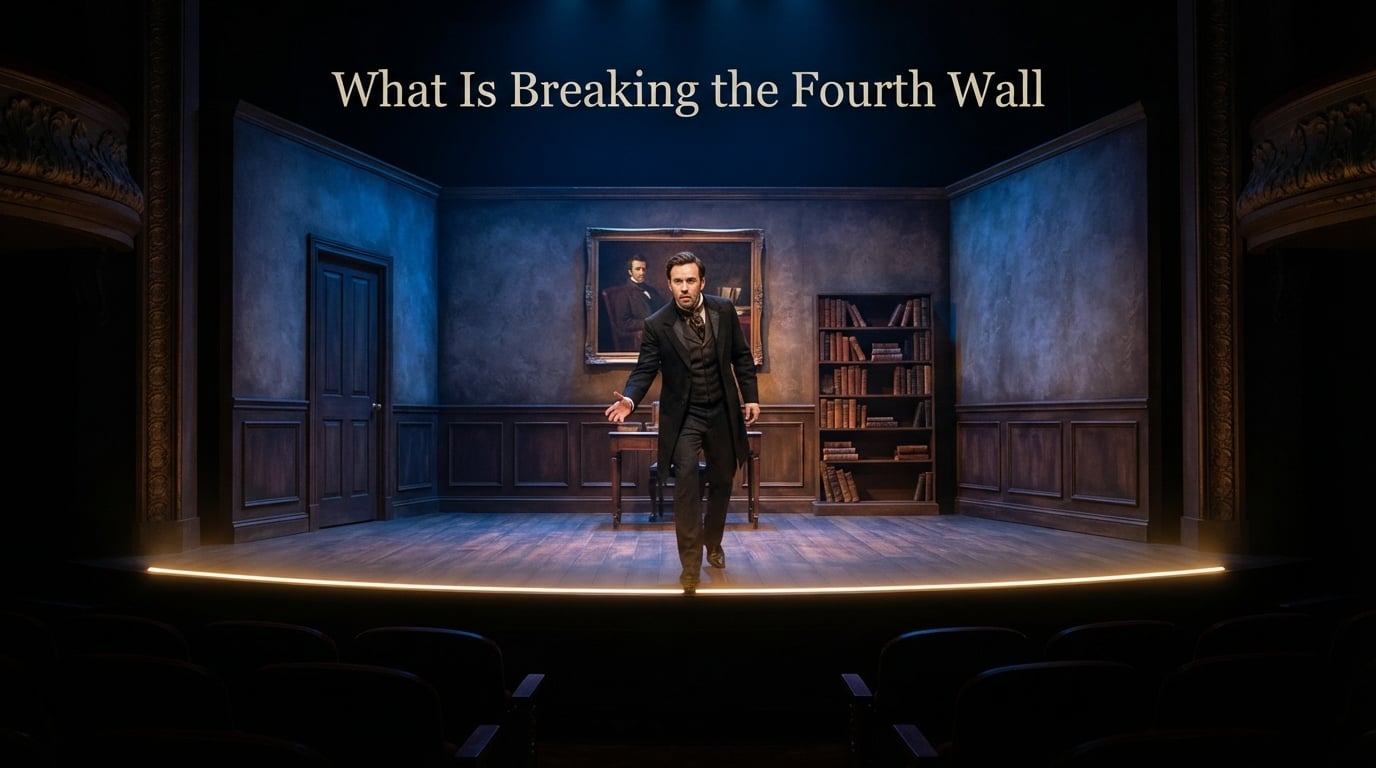
Breaking the fourth wall is when a character in a movie, TV show, play, book, or video game stops pretending you’re not there and talks directly to you. The “fourth wall” is the invisible barrier between the story and the audience, and breaking it means that barrier just fell. You’ve seen it hundreds of times even if the name sounded unfamiliar, and once you learn to spot it, you’ll find it almost everywhere.
I remember the first time I caught a fourth wall break on purpose. It was an episode of The Office, and Jim Halpert glanced at the camera right after Pam set up a wedding date. The look lasted less than a second, but it told me Jim knew I was watching. That tiny moment pulled me into the show in a way straight dialogue never could, and I’ve been hooked on the technique ever since.
This guide walks through what breaking the fourth wall actually means, where the term came from, why writers use it, and when it works best. We’ll cover famous examples from Deadpool to House of Cards, peek into video games and novels, and answer the questions people ask most about this storytelling trick.
Table of Contents
What Is the Fourth Wall?
The fourth wall is an imaginary wall that separates the performers on a stage, or actors on a screen, from the audience watching them. In traditional theater, the stage has three real walls: the back wall and the two side walls that frame the action. The fourth “wall” is the invisible one facing the audience, and it keeps the fiction safe from real life.
Think of it as a one-way mirror. You can see the characters through it, but they cannot see you. That arrangement creates what theater professionals call suspension of disbelief, the agreement between the storyteller and the audience to pretend the make-believe world is real for a while.
The idea of a fourth wall has been a core theatrical convention since at least the 18th century. It is what lets a Shakespeare tragedy feel real in a packed theater and what makes a sitcom feel like a window into someone’s living room. Every time you forget you’re watching a show, you’re enjoying the fourth wall doing its job.
What Are the First, Second, Third, and Fourth Walls?
Strictly speaking, only the fourth wall is imaginary. The first, second, and third walls are real physical structures of a stage. The first wall is the floor, the second wall is the back of the set, and the third wall is usually the side facing the wings. The fourth wall is the empty space between the actors and the audience where no wall actually exists.
You may have heard someone mention “breaking the third wall” in a casual chat. That phrase is mostly a mix-up, but a few creators use it intentionally to mean breaking out of the layer just below the fourth, the world inside the fiction itself. For example, a character realizing they are inside a video game would be a third-wall break, while a character talking to the player holding the controller would be a fourth-wall break.
For most writers and audiences today, only the fourth wall really matters. The other walls do their job by being solid, invisible, and silent. Breaking the fourth wall is the moment that invisible barrier cracks open.
What Does Breaking the Fourth Wall Mean?
Breaking the fourth wall means a character becomes aware of the audience, the camera, or the fact that they are part of a story, and acts on that awareness. It can be as small as a glance into the lens, or as loud as a full monologue addressed to the viewer. Either way, the audience is suddenly being acknowledged by someone inside the fiction.
A classic example is the Netflix series House of Cards. Kevin Spacey’s character, Frank Underwood, regularly turns to the camera and speaks straight to us, sharing his schemes and cynical thoughts. We become his secret confidant. The moment he speaks, the show stops being a window and becomes a shared secret.
This storytelling move has a few names. Writers call it direct address, camera acknowledgment, or meta-commentary. Film theorists use the term metatheatrical. The labels differ, but the effect is the same: the audience suddenly shares a moment with a character who knows they are being watched.
The Origin of the Fourth Wall Concept
The phrase “fourth wall” dates back to the early 1800s and is usually credited to the French philosopher Denis Diderot. In his writings on drama, Diderot described the stage as having three walls, with an imaginary fourth wall running along the front, parallel to the footlights, that separated the actors from the audience. Treat the audience as if they didn’t exist, he advised, and the illusion of real life on stage would hold.
This convention took root in theaters built with a proscenium arch, the framed opening that hides the stage from view like a picture frame. By the late 19th and early 20th centuries, the “fourth wall” had become standard shorthand for the invisible barrier across that opening. Theater practitioners called it maintaining the illusion, and directors spent careers training actors to ignore the audience entirely.
Not everyone agreed with the convention. In the 1920s and 1930s, the German playwright Bertolt Brecht deliberately broke the fourth wall in his epic theater to keep audiences from getting lost in the story. He wanted viewers to think, not feel, so his characters openly addressed the crowd, sang songs that interrupted the plot, and held up signs. Brecht’s approach, called the Verfremdungseffekt, is still studied in film schools today. Modern directors from Deadpool to Fleabag owe him a debt.
Why Do Characters Break the Fourth Wall?
Writers break the fourth wall for several reasons, and the best ones usually pick a reason that fits the story. Some common purposes include:
Building intimacy: When a character talks directly to you, you feel like a confidant instead of a stranger. House of Cards uses this to make us complicit in Frank Underwood’s schemes.
Adding humor: Deadpool leans on wall breaks for laughs. The character undercuts dramatic moments by joking about the genre he lives in.
Delivering exposition: Direct address can skip long flashback scenes. A narrator’s aside can tell us a character’s backstory in seconds.
Creating shock value: A sudden, unscripted-feeling wall break can jolt an audience awake. Fight Club and American Psycho use this to unsettle viewers.
Commenting on the medium: Some shows use wall breaks to make a point about storytelling itself. Mystery Science Theater 3000 mocks bad movies by watching them with us.
Behind all these uses lies one shared psychological effect. When a character sees you, you feel seen back. The technique turns a passive audience into a participant, and that shift is powerful in any medium.
Famous Examples of Breaking the Fourth Wall
Some wall breaks have become so iconic they define their shows. Here are the ones most people recognize, grouped by medium.
Film. The Marvel anti-hero Deadpool is probably the most quoted example in 2026. Ryan Reynolds’ character regularly jokes with the audience, comments on the budget, breaks the fourth wall during fight scenes, and even apologizes for a low-budget montage. Older examples include Ferris Bueller, who skips school by talking directly to the camera for an entire movie, and the characters of Annie Hall, who step outside the story to argue with the audience.
Television. Beyond House of Cards and The Office, modern shows use wall breaks all the time. Phoebe Waller-Bridge’s Fleabag rebuilt the technique into an entire emotional arc. The BBC sitcom Catastrophe, the mockumentary Modern Family, and the comedy Ted Lasso all use camera glances for quick punchlines or emotional gut-punches.
Theater. Stage actors have been breaking the wall since Shakespeare’s days, when prologues and asides spoke directly to the groundlings. Modern plays like Our Town, Six Characters in Search of an Author, and The Resistable Rise of Arturo Ui all mix audience address with traditional drama. A 21st-century hit musical, The Book of Mormon, talks to the crowd constantly.
Animation and comics. Comic books made wall breaking cool decades before film caught up. She-Hulk breaks it on the page and on screen. Deadpool does the same in animated series. Family Guy’s Peter Griffin routinely addresses the viewer, and the comic strip Pearls Before Swine talks to the reader on every panel.
Subtle vs Obvious Fourth Wall Breaks
Not all wall breaks are created equal. Some are loud and impossible to miss; others are so quiet you might miss them on the first watch. Understanding the difference helps you spot the technique and decide when to use it in your own work.
Obvious fourth wall breaks usually involve full sentences addressed to the audience. Deadpool, Fleabag, and House of Cards all use obvious breaks. The character literally talks to you, sometimes for minutes at a time. These moments can carry big emotional weight or huge laughs, but they are heavy-handed, and using them too often can wear out the audience fast.
Subtle fourth wall breaks are tiny signals. A quick glance at the camera, a knowing pause, a small smirk, or a costume detail that reacts to a viewer joke. The Office is the master of subtle breaks. Jim’s looks into the camera last only a second, but they turn ordinary dialogue into an inside joke between him and the viewer.
Both styles can work, but they serve different purposes. Obvious breaks create intimacy and confession. Subtle breaks create complicity and warmth. Mixing them carefully is what makes a writer’s voice feel unique. If every scene is a wall break, none of them feel special.
Breaking the Fourth Wall in Video Games
Video games may be the most interesting place to break the fourth wall, because the audience is often the one holding the controller. Game designers have experimented with the technique for decades, and a few titles turned it into the core of the experience.
The Stanley Parable is a 2013 indie game built entirely around wall breaks. The narrator describes what the player is doing, and the player character, Stanley, sometimes reacts to the narration. The whole game is a comic tug-of-war between the narrator and the player, with multiple endings based on how often you listen to him or defy him.
Other well-known examples include the Metal Gear Solid series, where Colonel Campbell calls Snake on the codec to break up gameplay and later references the player’s actual playtime. Undertale has characters react to player choices and even reset attempts. Deadpool the video game leans hard on the wall-break tradition. In The Elder Scrolls IV: Oblivion, one NPC even says, “I used to be an adventurer like you, then I took an arrow in the knee,” a line that became a famous meme and a small, accidental wall break in spirit.
These games treat the player as part of the story, which gives wall breaks a unique power. You are not just watching a character be self-aware. You are the reason they are.
Breaking the Fourth Wall in Literature
Books broke the fourth wall long before film existed. Novelists from Laurence Sterne’s Tristram Shandy in 1759 to Italo Calvino’s If on a winter’s night a traveler in 1979 have played with the boundary between reader and writer. The technique is sometimes called meta-fiction, fiction that knows it is fiction.
A famous modern example is Lemony Snicket’s A Series of Unfortunate Events. The author narrator interrupts the story to beg the reader to stop reading, complains about the plot, and warns of doom ahead. The effect is funny, unsettling, and oddly intimate, like a friend begging you to put the book down.
Other books use wall breaks more sparingly. Pride and Prejudice opens with a narrator who speaks directly to the reader’s sense of universal truth. Mark Z. Danielewski’s House of Leaves plays with the page itself, hiding text in different directions and treating the reader as part of the haunting. Even a basic instructional book like How to Read Literature Like a Professor addresses the reader in second person.
When done well, literary wall breaks turn a private reading session into a quiet conversation between author and reader, like a one-sided phone call you actually enjoy.
When Should You Break the Fourth Wall?
Like any storytelling tool, fourth wall breaks work best in the right hands, at the right moment. Here are five rules I lean on after watching hundreds of examples across film, TV, and games.
Pick a reason. If you cannot name why a wall break belongs in a scene, it probably does not. Decide if you want humor, intimacy, exposition, or shock, then commit.
Earn it. The longer you make the audience believe the fourth wall is solid, the more impact the break has. A show that breaks the wall every minute feels less special than one that saves it for a key moment.
Stay in character. Even when a character is being meta, they should sound like themselves. Deadpool’s sarcasm fits him. Frank Underwood’s political cynicism fits him. Random quips from a serious character feel fake.
Match the tone. Comedies can break the wall often. Dramas need to do it less, and only when the emotional payoff justifies it. A horror movie that breaks the wall at the wrong moment kills the fear.
Stop when it stops working. The Office eventually reduced its camera glances because they lost surprise. Fleabag ended its run because the second season would have overused the device. Know when the well is dry.
Used with care, fourth wall breaks make a story feel like a shared secret between the creator and the audience. Used carelessly, they feel like a writer who ran out of ideas.
For readers who want to see the technique in action, my recommended shortlist for 2026 starts with the Deadpool films, Fleabag on BBC, the first three seasons of House of Cards, and The Stanley Parable. Each one shows a different flavor of the technique and uses it well in its own medium.
FAQs
What is the 1st, 2nd, 3rd, and 4th wall?
In theater, the first wall is the floor of the stage, the second is the back wall of the set, and the third is one of the side walls. The fourth wall is the invisible barrier across the front of the stage that separates the actors from the audience. Breaking the fourth wall means that invisible barrier is broken when a character acknowledges the audience.
What is a 3rd wall break?
A third wall break happens when a character becomes aware of the layer of their own fiction, such as a video game character realizing they are inside a game. It is one level deeper than a fourth wall break, which involves acknowledging the audience watching the story from outside.
What does it mean for a show to break the fourth wall?
When a show breaks the fourth wall, a character speaks directly to the audience, glances at the camera, or otherwise lets the viewer know they are aware of being watched. The technique is common in comedies like Deadpool and dramas like House of Cards.
Is breaking the fourth wall good or bad?
It depends on the story. Breaking the fourth wall can be brilliant when it builds intimacy, humor, or surprise. It can feel lazy or distracting when it is used too often or without a clear reason. The best examples earn the moment by waiting for the right scene.
Who broke the fourth wall first?
The earliest well-known examples come from ancient Greek and Roman theater, where prologues and asides spoke to the crowd. In modern form, French philosopher Denis Diderot described the fourth wall in the 1750s, and playwright Bertolt Brecht made deliberate wall breaks a hallmark of his 20th-century epic theater.
Final Thoughts on Breaking the Fourth Wall
Breaking the fourth wall is one of the oldest tricks in storytelling, and one of the most fun. It works because it makes us feel like insiders, like characters are letting us in on a secret the rest of the world doesn’t get. Used sparingly and with intent, it can turn an ordinary story into something the audience never forgets.
Next time you watch a show or play a game, keep an eye out for a glance, a smirk, or a direct line to the viewer. That moment is the wall cracking, and once you see it, you’ll spot it in nearly every medium, from a Shakespearean aside to a Deadpool credits scene. Keep watching, keep playing, and enjoy the secret.