
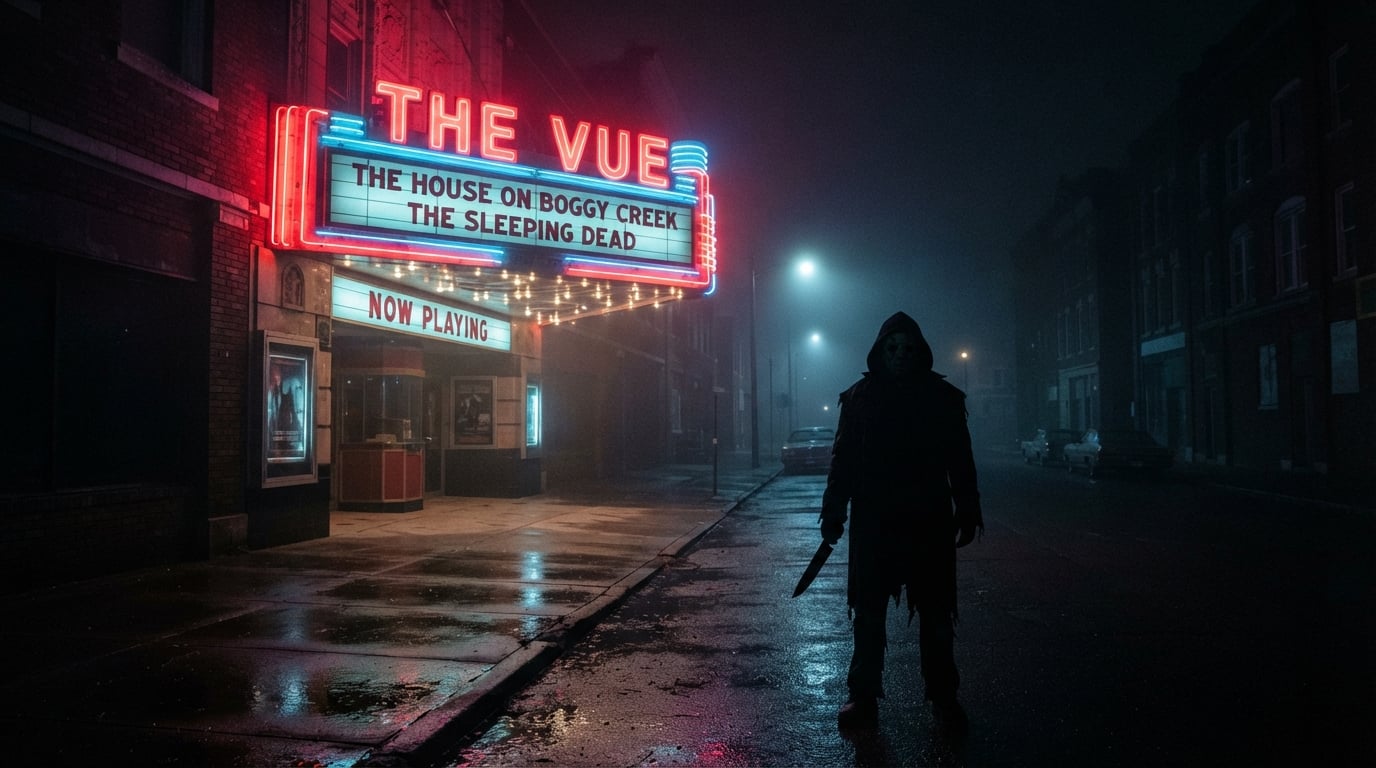
A slasher film is a subgenre of horror cinema built around a killer who stalks and murders a group of people, usually teenagers, using bladed or sharp weapons. The formula almost always features a masked or anonymous antagonist, a high body count, and a lone survivor known as the “Final Girl.”
I have spent years digging into horror film history, and slasher films remain my favorite corner of the genre. They are formulaic by design, yet the best ones keep finding new ways to make us jump. In this guide, I will walk you through what makes a slasher a slasher, where the genre came from, the franchises that defined it, and why slashers keep coming back in 2026.
Table of Contents
What Is a Slasher Film? The Core Definition
A slasher film is a horror subgenre defined by a psychopathic killer who systematically stalks and murders a group of victims, often teenagers, using bladed weapons such as knives, machetes, or axes. The genre relies on a tight formula: an iconic masked killer, escalating body count, point-of-view shots of both hunter and prey, and a lone survivor.
Think of films like Halloween, Friday the 13th, and Scream. Each follows the same blueprint with small variations. The killer is usually male, often wears a mask, and seems unstoppable until the final act. Victims are picked off in a deliberate order, usually after engaging in risky behavior. The Final Girl survives because she is the most resourceful, not the luckiest.
Slasher films sit within the broader horror genre but are distinguished by their focus on visceral, close-contact violence rather than supernatural dread. While ghost stories and haunted house films trade in atmosphere, slashers lean on the physical threat of an embodied killer with a blade. That distinction matters for both casual viewers and film students trying to classify a film correctly.
The word “slasher” itself became the standard label in the late 1970s. Trade publications and drive-in theater ads started using the term to market films that emphasized graphic knife murders. By 1980, the label stuck across fan communities and academic circles alike. Today, “slasher film” is a recognized category in every major film database.
Core Characteristics That Define a Slasher Film
The defining characteristics of a slasher film include a masked or anonymous killer, a group of victims, escalating body count, suspense built through point-of-view shots, and a final confrontation with the surviving Final Girl.
The Killer: Masked, Silent, and Iconic
The killer is the engine of every slasher film. He (and occasionally she) is usually masked to strip away humanity and make the threat feel universal. Michael Myers wears a white Captain Kirk mask. Jason Voorhees wears a hockey mask. Ghostface wears a hooded robe with an elongated face. These costumes have become shorthand for the genre itself.
Killers in slasher films are often given supernatural or seemingly indestructible qualities. Michael Myers survives gunshots and fire. Jason Voorhees rises from a lake after being presumed dead. Ghostface can be killed and replaced. This “unkillable” quality lets the franchise keep churning out sequels without closing the door permanently.
The killer usually has a defining weapon that becomes part of his identity. Leatherface uses a chainsaw. Pinhead from Hellraiser uses hooks. The aim is to make the threat instantly recognizable on a movie poster. The weapon, the mask, and the signature kill are the three ingredients that turn a villain into an icon.
The Final Girl: The Survivor Who Earns Her Escape
The Final Girl is the last woman standing. She is usually the most cautious, the most intelligent, and often the most sexually reserved of the group. Coined by film scholar Carol Clover in 1992, the term has become one of the most discussed concepts in horror studies.
Laurie Strode in Halloween, Alice Hardy in Friday the 13th, and Sidney Prescott in Scream all follow this pattern. They are not passive victims waiting to be rescued. They fight back, they think tactically, and they face the killer alone in the final act. The Final Girl represents the genre’s strange mix of punishment and empowerment.
Modern slashers have started breaking the Final Girl rules. Sidney Prescott survives but is scarred. Ginny from Friday the 13th Part 2 survives by pretending to be dead. Julie from Halloween 4 uses a straight razor. The trope has evolved to include women who fight back with whatever they can grab, regardless of moral purity. Audiences in 2026 expect more from Final Girls than they did in 1978.
The Body Count: Predictable, Ritual, and Punishing
Body count is more than a number in slasher films. It is the genre’s primary unit of measurement. Sequels are routinely judged by how many teenagers they can put on a slab. The original Friday the 13th killed 10 people. Jason Goes to Hell killed 18. The numbers climbed with each decade.
The order of death is rarely random. Slasher films follow a moral code that became known as the “sex equals death” rule. Characters who drink, do drugs, or have sex tend to die first. The virtuous survive. Critics call this puritanical. Fans call it the genre’s strange moral scaffolding.
Modern slashers sometimes invert the order. Cabin in the Woods (2011) killed the virgin first as a joke. Happy Death Day (2017) let its protagonist die over and over. Totally Killer (2023) flipped the formula by sending the Final Girl back in time. The body count is still high, but the rules are no longer fixed.
The Setting: Isolated, Familiar, and Vulnerable
Slashers almost always trap victims in an isolated setting. Summer camps, sorority houses, suburban neighborhoods, hospitals, and cabins in the woods are the genre’s most common backdrops. The isolation removes the ability to call for help and forces characters to face the killer alone.
Settings matter because they signal vulnerability. A babysitter alone in a house. A counselor alone in a camp. A nurse alone on a night shift. The genre leans into everyday locations made terrifying by removing escape routes. Modern slashers have expanded to cruise ships, road trips, and college dorms, but the rule holds: the victims must be trapped.
History and Origins of the Slasher Genre
Slasher films originated in the late 1950s and 1960s, drawing on Alfred Hitchcock’s Psycho (1960), Michael Powell’s Peeping Tom (1960), and Italian giallo cinema from directors like Mario Bava and Dario Argento.
Alfred Hitchcock’s Psycho and the Birth of the Genre
Psycho (1960) is the most cited starting point. Hitchcock murdered his leading lady, Janet Leigh, in the shower just 30 minutes into the film. That single scene changed horror cinema forever. It proved that anyone could die, that the killer could be the quiet man behind the counter, and that violence could be the main event.
The same year, Michael Powell released Peeping Tom in Britain. The film was so reviled it ended Powell’s career. Looking back, it gave us the killer’s point-of-view shots that would become a slasher staple. Both films planted the seeds for everything that came after.
Hitchcock’s fingerprints are still visible on the genre. The Bates Motel inspired the look of a dozen rural slashers. Bernard Herrmann’s shrieking violin score influenced every synth-driven slasher theme since. Even the false protagonist move, killing Janet Leigh early to shock the audience, became a recurring trick in Friday the 13th, Sleepaway Camp, and Scream.
Italian Giallo: The Cinematic Godfather
Italian giallo films of the 1970s were thrillers with graphic violence, sexual content, and mystery plotting. Directors Mario Bava (A Bay of Blood, 1971) and Dario Argento (Deep Red, 1975; Suspiria, 1977) created a visual language that American slashers would copy directly.
Giallo gave slashers their gloves, their knives, their colorful lighting, and their elaborate death scenes. A Bay of Blood is sometimes called the first true slasher, predating Halloween by seven years. Without giallo, there is no slasher boom.
Argento’s influence in particular is hard to overstate. Deep Red features a gloved killer, a killer’s POV shot, and a black-gloved murder weapon. The murder set pieces in Argento’s films read like shot-for-shot templates for the Golden Age slashers that followed. John Carpenter has openly credited Argento as a major influence on Halloween.
Other Early Influences
Bob Clark’s Black Christmas (1974) is widely considered the first true North American slasher, with an unseen killer, telephone threats, and sorority house victims. Tobe Hooper’s The Texas Chain Saw Massacre (1974) brought grindhouse intensity and inspired the chainsaw-wielding Leatherface. These films paved the way for the boom that started in 1978.
Clark’s later Deathdream (1974) and Prom Night (1980) helped refine the slasher template. The Texas Chain Saw Massacre added the rural American horror location and the masked family of killers. Together with Black Christmas, these films proved that low-budget horror could be both brutal and commercially viable.
The Golden Age of Slasher Films (1978-1984)
The Golden Age of slasher films lasted from 1978 to 1984, beginning with John Carpenter’s Halloween and ending as the formula grew tired and parodies like Saturday the 14th started landing in theaters.
This six-year stretch produced more slasher films than the previous two decades combined. Independent distributors like Compass International, New Line Cinema, and Crown International Pictures rushed low-budget slashers into drive-ins and malls. Most made small amounts of money. A few made millions.
The release of Halloween (1978) on a $325,000 budget that returned $70 million worldwide sparked a feeding frenzy. Friday the 13th (1980) followed and made Jamie Lee Curtis’s mother, Janet Leigh, an ironic bookend to the era she helped begin. A Nightmare on Elm Street (1984) brought the supernatural slasher to full flower with Freddy Krueger.
By 1985, the Golden Age was over. Audiences were tired. Slasher sequels were arriving in theaters without marketing or fanfare. The genre would not regain cultural dominance until 1996.
Notable Golden Age Slashers
The Golden Age produced dozens of memorable entries beyond the Big 3. Prom Night (1980), The Burning (1981), Sleepaway Camp (1983), The House on Sorority Row (1982), and Final Exam (1981) all became cult favorites. Some were critical successes. Many were panned. All helped refine the slasher formula in real time.
My Bloody Valentine (1981) brought the slasher to a coal mining town. Graduation Day (1981) set the action at a high school. Humongous (1982) tried to turn a killer baby into a franchise. The Golden Age was wide open to experimentation, and nearly every permutation of the formula got at least one film.
The Big 3 Slasher Franchises
The Big 3 slasher franchises are Halloween, Friday the 13th, and A Nightmare on Elm Street. Together they defined the genre, created three of horror’s most recognizable villains, and launched the modern horror franchise model.
Halloween (1978)
John Carpenter’s Halloween introduced Michael Myers, the silent Shape who escapes a sanitarium on Halloween night to stalk babysitters in his hometown of Haddonfield, Illinois. The film was shot for $325,000 in 21 days. It earned $70 million worldwide and became the most profitable independent film of its time.
Carpenter’s iconic synth score did as much work as the killer. It taught the slasher genre that sound design is half the scare. The franchise has spawned 13 films, three reboots, and the recent Blumhouse trilogy. It is the longest-running slasher franchise in history.
The 2018 Blumhouse trilogy, including Halloween (2018), Halloween Kills (2021), and Halloween Ends (2022), returned the franchise to its original setting and star. Jamie Lee Curtis reprised her role as Laurie Strode, now a hardened survivor prepared for Michael’s return. The trilogy earned over $500 million combined and proved the appetite for legacy slasher sequels was still strong.
Friday the 13th (1980)
Sean S. Cunningham’s Friday the 13th was a summer camp slasher that grossed nearly $60 million on a $550,000 budget. The original killer was Pamela Voorhees, not Jason. Jason did not become the hockey-masked monster until the third film in 1982.
The franchise has produced 12 films, a remake, and a crossover with Freddy Krueger. Jason Voorhees became a video game villain and a Saturday morning cartoon character. The hockey mask has been worn by more trick-or-treaters than any other costume in horror history.
The legal history of Friday the 13th is almost as dramatic as the films. The original director Victor Miller and screenwriter Tom Savini spent decades in court over the rights to the franchise. A 2023 settlement finally gave Cunningham full control. New entries in the franchise have been rumored ever since, though none had been greenlit as of 2026.
A Nightmare on Elm Street (1984)
Wes Craven’s A Nightmare on Elm Street introduced Freddy Krueger, a burned child killer who murders teenagers in their dreams. The premise was a stroke of genius. If you die in your dream, you die in real life. Sleep became terrifying.
Robert Englund’s performance as Freddy made him a horror icon. The film earned $57 million on a $1.8 million budget. The franchise produced 9 films, a remake, and two seasons of a TV series. Freddy Krueger remains the most quotable slasher villain of all time.
The 2010 remake cast Jackie Earle Haley as Freddy. It was met with mixed reviews and underperformed at the box office. The franchise has been relatively dormant on the big screen since, though Robert Englund reprised the role for a brief cameo in The Goldbergs in 2018. The 2023 sequel novel The Realms of the Dead by Christopher Belmont kept the dream mythology alive.
The Final Girl Trope Explained
The Final Girl is the last surviving female character in a slasher film, usually distinguished by intelligence, sexual restraint, and direct confrontation with the killer. The concept was named by Carol Clover in her 1992 book Men, Women, and Chain Saws.
Laurie Strode, played by Jamie Lee Curtis, became the template. She is a babysitter who is also a responsible student. She does not drink or have sex in the film. When Michael attacks, she fights back with limited resources. She survives because she earns it.
Clover argued the Final Girl lets male viewers identify with a female character during the genre’s most vulnerable moments. Modern interpretations see the trope as both empowering and regressive. It puts women in danger and rewards them only for being the most moral. The debate continues in every horror studies class.
Contemporary Final Girls look different than 1978. Sidney Prescott in Scream (1996) is sexually active and still survives. Tree Gelbman in Happy Death Day (2017) is a sorority mean girl who lives through repetition. Erin in The Strangers (2008) survives simply by being smart under pressure. The trope has been reworked to fit modern audiences without losing its core.
The 1990s Slasher Revival and Scream
The 1990s slasher revival began with Wes Craven’s Scream (1996), which deconstructed the genre by making characters aware of slasher rules. The film earned $173 million worldwide and launched a new wave of self-aware slashers.
Before Scream, the slasher genre was stuck. The late 1980s and early 1990s produced sequels that even hardcore fans struggled to defend. Films like Jason Goes to Hell: The Final Friday (1993) and Halloween: The Curse of Michael Myers (1995) earned money but did not excite audiences.
Scream flipped the formula. Its characters quoted horror trivia, predicted who would die, and broke the third wall. Kevin Williamson’s screenplay was sharp, funny, and affectionate toward the genre it was parodying. The film did not mock slashers. It celebrated them while updating the rules.
The Scream franchise has produced 6 films across nearly 30 years. Scream VI (2023) moved the action to New York City and brought in a new generation of Final Girls. The franchise has become the most consistent active slasher series in 2026.
Cultural Impact and Criticism
Slasher films have been criticized for glamorizing violence against women, rewarding sexual morality with survival, and desensitizing audiences to graphic killing. They have also been praised for giving women protagonists, building community among horror fans, and creating enduring horror icons.
The MPAA ratings system was reshaped by slashers. The Texas Chain Saw Massacre was initially banned in the UK. A Nightmare on Elm Street faced censorship battles across the American South. The creation of the PG-13 rating in 1984 was partly a response to parents bringing young children to slasher sequels.
Academics have written entire books on slasher politics. Carol Clover, Robin Wood, and Barbara Creed all found rich material in what looked like disposable horror. The genre became required reading in film schools. Slashers proved that low-budget scares could carry serious cultural weight.
Feminist readings of slashers have produced some of the most interesting criticism in horror studies. Some scholars argue the genre punishes women for sexual activity. Others argue the Final Girl gives female viewers a hero who fights back. Both interpretations have merit. The debate has been running for 40 years and shows no sign of slowing down.
International Slasher Films
International slasher films have added fresh voices to the genre. Inside (2008, France), Calibre (no, that is a thriller), and High Tension (2003, France) brought European intensity. Australia’s Wolf Creek (2005) redefined realistic violence. Japan’s Audition (1999) is widely considered one of the most disturbing slashers ever made.
Detention (2019, Taiwan) and The Tag-Along (2015, Taiwan) brought Asian horror to the slasher format. South Korea’s The Wailing (2016) mixed slasher tropes with supernatural mystery. These international entries show that the slasher formula travels well beyond American drive-ins.
British slashers have their own proud tradition. Eden Lake (2008), Severance (2006), and the recent In the Earth (2021) all lean on the slasher structure while adding distinctly British flavor. Ireland’s Grabbers (2012) managed the rare feat of being a comedic horror slasher hybrid.
The Modern Slasher Revival
The modern slasher revival began in the 2010s with films like You’re Next (2011), The Purge (2013), and It Follows (2014), and continues today with X, Pearl, Scream VI, and the Fear Street trilogy.
What changed is the self-awareness. Modern slashers quote earlier slashers. Scream (1996) opened the door by making characters discuss horror rules out loud. Cabin in the Woods (2011) deconstructed the entire genre. Happy Death Day (2017) turned the formula into a comedy.
The Peacock series Chucky, Ti West’s X trilogy, and the Fear Street Netflix adaptations prove the slasher is not going anywhere. New filmmakers are finding fresh ways to use the formula. The Final Girl is no longer always white, straight, or alone. The genre is finally catching up to its audience.
X (2022) and its prequel Pearl (2022) by Ti West brought a 1970s aesthetic back to the genre. Totally Killer (2023) added time travel. There’s Someone Inside Your House (2021) modernized the high school setting. Each new entry proves the formula can be twisted in fresh ways.
Streaming services have made the modern revival possible. Netflix, Shudder, Hulu, and Amazon have all invested in slasher content. The Fear Street trilogy (2021) was a Netflix original. Chucky found a home on SyFy and then Peacock. The barrier to entry for new slasher filmmakers has never been lower.
Frequently Asked Questions About Slasher Films
What’s the difference between horror and slasher?
Horror is the broad genre that includes ghosts, monsters, psychological terror, and supernatural dread. Slasher is a specific subgenre of horror focused on a single killer who stalks victims and uses bladed weapons. All slashers are horror films, but not all horror films are slashers.
Who are the big 3 slashers?
The Big 3 slasher franchises are Halloween (Michael Myers), Friday the 13th (Jason Voorhees), and A Nightmare on Elm Street (Freddy Krueger). Together they defined the genre’s golden age and remain its most recognizable icons.
What was the first slasher film?
There is no single first slasher film, but the most cited candidates include Psycho (1960), Peeping Tom (1960), Black Christmas (1974), and The Texas Chain Saw Massacre (1974). Mario Bava’s A Bay of Blood (1971) is often considered the first film to use the modern slasher formula.
Is Michael Myers considered a slasher?
Yes, Michael Myers is one of the most iconic slasher villains in cinema history. He is the masked killer from the Halloween franchise, first appearing in John Carpenter’s 1978 film. He is often called the original slasher and helped define the entire genre.
How did slasher films originate?
Slasher films originated from a combination of Alfred Hitchcock’s Psycho (1960), Michael Powell’s Peeping Tom (1960), and Italian giallo thrillers of the early 1970s. These films introduced the killer’s point of view, graphic violence, and the trope of the female victim that became the genre’s foundation.
Why are slasher films so popular?
Slasher films are popular because they offer a reliable formula, clear stakes, and cathartic scares. Fans know what to expect, but each film finds new ways to deliver the body count. The genre also creates iconic villains that become part of pop culture.
What is the final girl in a slasher film?
The Final Girl is the last surviving female character in a slasher film, named by scholar Carol Clover in 1992. She is typically intelligent, sexually restrained, and faces the killer alone in the final act. Famous Final Girls include Laurie Strode, Sidney Prescott, and Nancy Thompson.
Is Saw considered a slasher film?
Saw is often debated as a slasher film. It features a killer using bladed tools to trap victims in lethal games. Most fans and critics include it in the broader slasher subgenre, though it lacks the typical stalking structure of classic slashers.
Final Thoughts on the Slasher Genre
A slasher film is more than a masked killer with a knife. It is a formula that has shaped horror for nearly 50 years and shows no signs of slowing down. The combination of a recognizable villain, a rising body count, and a Final Girl who fights back gives the genre a clockwork structure other horror subgenres cannot match.
From Psycho to Pearl, slasher films have evolved while keeping their core appeal intact. They reflect the anxieties of each decade. The original Halloween played on suburban fears. Scream riffed on media saturation. X examined aging and ambition. The genre keeps finding new monsters to wear the mask.
If you want to understand horror cinema, you start with the slasher film. Watch the original Halloween if you have not seen it. Then watch a modern entry like X or Scream VI. You will see the same bones under both films, and that is exactly the point. The formula works because it has been refined by generations of filmmakers who love the genre as much as the fans do.