
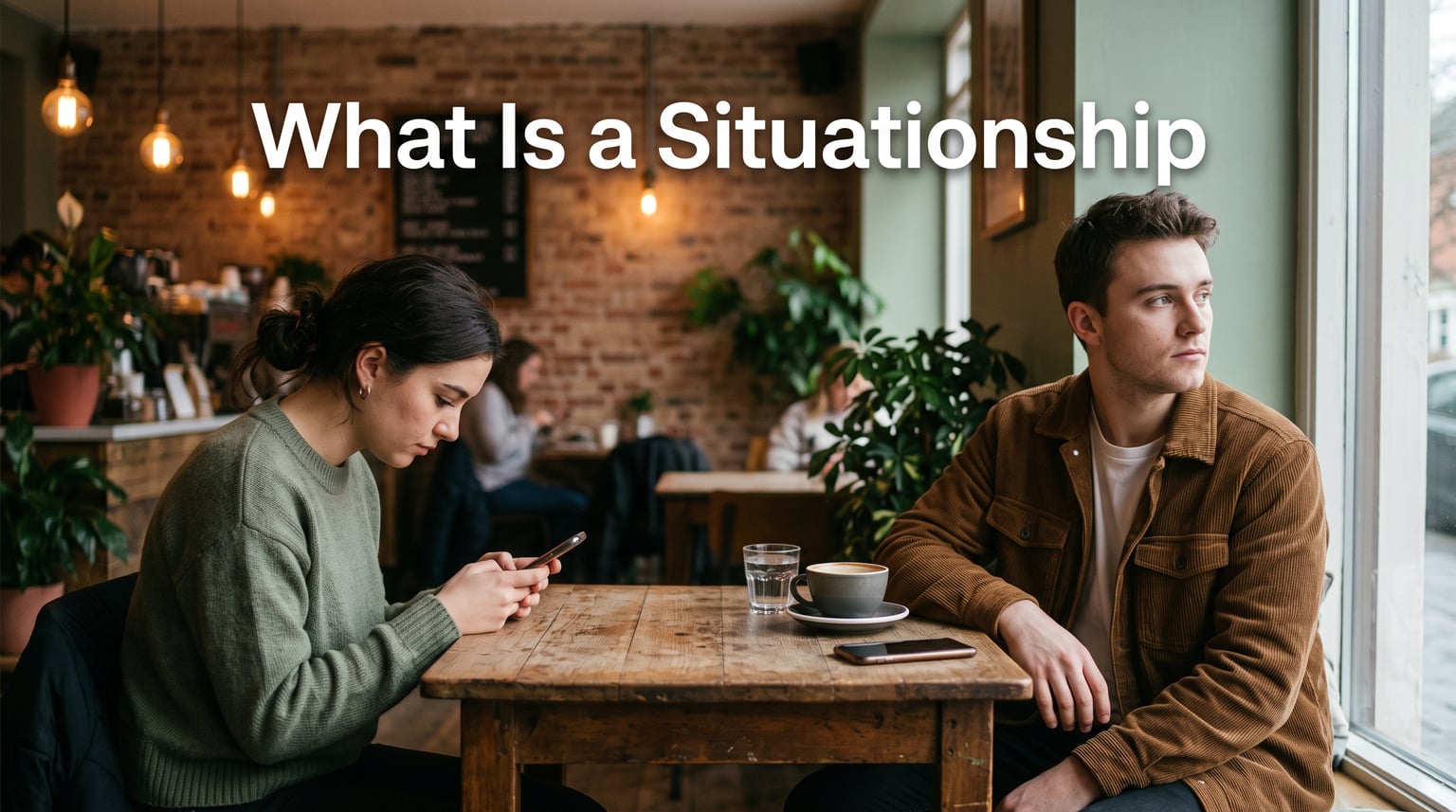
You have been seeing someone for a few months. You text almost every day, spend weekends together, and things feel genuinely good — except nobody has said what “this” actually is. You are not officially a couple. You are not just friends. You exist in a strange, undefined space somewhere between the two.
That is what people are calling a situationship, and if it sounds familiar, you are in extremely good company.
In 2026, this term is everywhere — in therapy sessions, Reddit threads, and coffee conversations between friends who are trying to make sense of modern dating. This guide breaks down exactly what a situationship is, why they happen, the real psychological cost of staying in one, and most importantly, what you can actually do about it.
Table of Contents
What Is a Situationship?
A situationship is a romantic or sexual relationship where the people involved have not formally defined their connection or committed to each other.
Merriam-Webster defines it as “a romantic or sexual relationship that is not considered to be formal or established.” In practical terms, it sits in the gray area between casually dating and being in an actual relationship — close enough to feel like one, undefined enough to keep both people in a permanent state of uncertainty.
The word is a blend of “situation” and “relationship.” It started appearing in online communities in the early 2010s and became mainstream on social media through the mid-2020s. It resonated because it named something people had been experiencing for years without a word for it.
The four core characteristics that make something a situationship rather than just casual dating are:
No labels or formal commitment — neither person has said “we’re together” or “we’re exclusive”
Emotional and/or physical intimacy exists — this is not purely transactional; there are real feelings involved
Inconsistent communication — the connection ebbs and flows with no predictable pattern
No future plans discussed — conversations about “where this is going” are avoided or deflected
What separates a situationship from plain casual dating is the depth of emotional investment. In a situationship, at least one person usually has genuine feelings and some hope that things will progress. That emotional stake is exactly what makes it so exhausting to be in one.
10 Signs You Are in a Situationship
Knowing the definition is one thing. Recognizing it in your own life is harder, especially when you are in the middle of it. Here are ten signs that what you are dealing with is a situationship.
1. There are no labels. You have been spending significant time together, but if someone asks “are you two dating?” neither of you has a clean answer. The relationship exists but has no name.
2. Plans are always last-minute. You rarely get advance notice. It is usually a “what are you doing tonight?” message that decides whether you see each other. Consistent, planned dates are rare or nonexistent.
3. You have never had the DTR talk. The “define the relationship” conversation has never happened — and one or both of you is actively avoiding it. The subject gets changed, joked away, or met with vague answers like “I’m just not looking for anything serious right now.”
4. You are not integrated into their life. You have not met their close friends. You are not on their social media. You are not invited to family events or significant occasions. You exist in a separate compartment from the rest of their world.
5. Communication is inconsistent. Some days they text constantly. Other days you barely hear from them. There is no reliable pattern, which keeps you in a constant low-grade state of alertness waiting to see what kind of day it is going to be.
6. The connection feels superficial. Despite spending real time together, the conversations rarely go deep. You know surface-level details but not the things that actually matter — their fears, their goals, their past, their values.
7. There is no future talk. They never mention plans that involve you more than a week out. Talk of the future is either absent or deliberately vague. “We should go there sometime” with no actual follow-through is a hallmark of this dynamic.
8. You feel like a secret. This is one of the most common things people describe on forums and in therapy: the nagging sense that you are not someone they want others to know about. Being kept out of their public life signals that they have not decided if you are worth committing to.
9. You carry most of the emotional weight. One person usually cares more in a situationship. If you are the one reading this article, there is a reasonable chance you are the person doing most of the hoping, most of the accommodating, and most of the waiting.
10. Things never actually progress. Months pass and the dynamic stays exactly the same. There are no steps toward being more official, no increase in commitment, no acknowledgment that things are growing. You stay stuck at the same level indefinitely.
Situationship vs Relationship vs Friends With Benefits
These three terms get used interchangeably, but they describe meaningfully different things. Here is how they actually differ.
Situationship vs Relationship
A committed relationship has mutually agreed-upon exclusivity, an acknowledged label, and a shared sense of direction. Both people know what they are to each other and can say so clearly. A situationship has the emotional and physical elements of a relationship without any of the agreement or security.
The key difference is not the depth of feeling — situationships can involve real, strong feelings on both sides. The difference is whether both people have explicitly chosen each other and committed to building something together. In a relationship, that question has an answer. In a situationship, it does not.
Situationship vs Friends With Benefits
Friends with benefits (FWB) is a more transactional arrangement. Two people who are already friends agree to add a physical component while keeping things explicitly non-romantic. Both people typically understand and accept the arrangement. The “benefit” is physical; the emotional element is usually not part of the deal.
A situationship is messier. The emotional connection is real and often significant — but the relationship structure is absent. Someone in a situationship is often hoping things develop into something more. Someone in a true FWB arrangement typically is not. The confusion and pain of a situationship often comes precisely from the fact that it feels like more than FWB but never becomes an actual relationship.
The Key Distinction
If you are trying to figure out which one you are in, ask yourself one question: is the ambiguity intentional and agreed upon, or is it just… happening? In FWB, both people agreed to the terms. In a situationship, the terms were never actually discussed. That absence of conversation is the defining feature.
Why Situationships Happen: The Psychology Behind Them
Understanding why situationships happen can be genuinely helpful — not to excuse the behavior, but to understand the forces at work so you can make a clear-eyed decision about what to do next.
Attachment Styles Play a Major Role
Attachment theory, developed by John Bowlby and expanded by researchers like Mary Ainsworth, describes the patterns of relating that we develop in childhood and carry into adult relationships. Two attachment styles show up constantly in situationship dynamics.
People with an anxious attachment style tend to want closeness and reassurance. They often accept less than they want because they fear that asking for more will push the other person away. They interpret small crumbs of attention as meaningful signals and hold on to the hope that things will eventually change.
People with an avoidant attachment style tend to value independence and feel uncomfortable with closeness or commitment. They can genuinely enjoy the emotional connection of a situationship while also pulling back whenever things start to feel too serious. The undefined nature of a situationship often suits them — it provides connection without the vulnerability of commitment.
When these two styles pair up, you get the classic situationship setup: one person getting closer, one person pulling back, and neither person saying what they actually want.
The Slot Machine Effect
Intermittent reinforcement — where positive responses come at unpredictable intervals — is one of the most psychologically powerful conditioning mechanisms known. Slot machines work on this principle. So do situationships.
When someone gives you warmth and attention inconsistently, your brain becomes more focused on getting that attention, not less. The unpredictability of the connection actually strengthens your attachment to it. This is sometimes called the slot machine effect, and it explains why people stay in situationships long after they have admitted to themselves that it is not making them happy.
Fear on Both Sides
Situationships are often fueled by two different kinds of fear operating simultaneously. The person who wants more is often afraid that asking will end things entirely. The person who is holding back is often afraid of commitment, of getting hurt, of being truly seen and chosen. Neither person feels safe enough to be honest, so the situation just continues.
The Emotional Cost of Staying in a Situationship
One thing that does not get said enough in articles about situationships is this: the ambiguity itself is harmful. It is not a neutral state. Sustained uncertainty about your relationship status has a real, documented impact on your psychological wellbeing.
People in situationships frequently describe a persistent background anxiety — a low hum of “where do I stand?” that follows them through daily life. Your nervous system is designed to notice threats and seek resolution. Not knowing whether you are safe in a relationship puts your system in a state of ongoing low-level alert.
Over time, this erodes self-worth. Many people start to internalize the undefined status as a reflection of their own value — “if they really wanted me, they would have committed by now.” That thought pattern, even when you know intellectually it is not true, does real damage.
There is also an opportunity cost. Time spent waiting for a situationship to become something real is time not spent building a relationship that is actually working. Forum communities are full of people who spent one, two, or even three years hoping a situationship would progress, only to watch the other person eventually commit to someone else within months.
Naming what it is costing you is not about being dramatic. It is about making a genuinely informed decision about your time and emotional energy.
How to Have the Define the Relationship (DTR) Talk
The DTR conversation — defining the relationship — is the one most people in a situationship know they need to have and keep putting off. Here is how to actually approach it.
When to Have It
A good general guideline: if you have been spending consistent, meaningful time with someone for around three months and still have no clarity about what you are to each other, it is time to have the conversation. Three months is enough time to know whether someone is interested in building something with you.
Do not wait until you are already upset or resentful. The conversation goes better when you approach it from a grounded place, not from a point of emotional explosion after weeks of swallowed frustration.
How to Prepare
Know what you actually want before you start the conversation. “I just want clarity” is too vague. Be specific with yourself: do you want exclusivity? A committed relationship with a label? A timeline for deciding? Know your own answer first, because you will need to communicate it.
Also decide in advance what you will do if the answer is not what you hoped for. This is not pessimism — it is protection. Going in with a clear personal boundary gives you something to stand on if the conversation does not go the way you want.
Conversation Starters That Actually Work
Here are five ways to open the DTR conversation that are direct without being aggressive:
“I really enjoy what we have, and I want to be honest with you about where I am at. I am developing feelings and I want to know if we are on the same page about where this is going.”
“I have been thinking about us, and I want to understand what this is for you. I am not trying to pressure anything — I just need clarity for myself.”
“I like spending time with you. I also know I eventually want a committed relationship, and I am trying to figure out if that is something you are open to with me.”
“Can we talk about what we are? I find myself wondering, and I would rather know than keep guessing.”
“I want to be honest with you: I have stronger feelings than I think I have been letting on. I want to know if you feel the same way or if we are in different places.”
None of these give an ultimatum. All of them are honest, respectful, and give the other person the space to respond truthfully. That is the goal.
What to Do With Their Answer
If their answer is enthusiastic and they want the same things you do — great. Make it official and move forward. If their answer is vague (“I don’t know,” “I’m not really thinking about it,” “let’s just see what happens”) — that is an answer. Vagueness from someone who has had months to figure out how they feel about you is a form of no. If their answer is a clear “I don’t want a relationship” — believe them the first time.
Your Three Options: Stay, Leave, or Transform
Once you understand what a situationship is and have had (or attempted) the DTR conversation, you are left with three real options. None of them are wrong — but one of them is probably right for you specifically.
Option 1: Stay (If This Actually Meets Your Needs)
Not everyone who is in a situationship is suffering. Some people genuinely want something low-commitment at a particular point in their lives, and both people are on the same page about that. If you are honest with yourself and what you have is genuinely satisfying as-is — no hidden wish for more — staying is a legitimate choice.
The key word is “honest.” Be ruthlessly clear with yourself about whether you are actually content or whether you are settling and hoping things change.
Option 2: Leave (If You Want More)
If you want a committed relationship and the other person has made it clear — directly or through continued vagueness — that they do not, leaving is the only option that actually respects your own needs. Staying in hope of changing someone who has not expressed a desire to change rarely works and always costs you time.
Leaving a situationship is genuinely painful, especially when the connection was real. But the connection being real does not mean the relationship is right.
Option 3: Transform (Set a Deadline and Have the Talk)
If you have not yet had a clear DTR conversation and you are not ready to walk away, give yourself a specific timeframe — sixty or ninety days — and commit to having the defining conversation by that date. Use that time to show up fully, pay attention to whether things are genuinely growing, and then actually have the talk when your deadline arrives.
The key here is the deadline. Without one, “I’ll bring it up soon” becomes another year in a situationship.
FAQs
What does it mean to be in a situationship?
Being in a situationship means you are in a romantic or sexual connection with someone that has emotional and sometimes physical intimacy, but no formal definition, commitment, or agreed-upon label. You function like a couple in many ways — spending time together, texting regularly, sharing real feelings — but neither person has explicitly agreed to be in a relationship. The defining feature is the ambiguity: the relationship exists, but its status does not.
What is the 3-3-3 rule for dating?
The 3-3-3 rule is a general dating guideline: go on at least 3 meaningful dates, invest about 3 weeks of consistent time getting to know each other, then use the 3-month mark as your signal to either have the define-the-relationship (DTR) conversation or reassess the connection. It is not a rigid formula, but it gives people a rough framework for pacing a new connection — long enough to see someone clearly, short enough that you are not spending a year in relationship purgatory waiting for clarity that may never come.
How long do situationships typically last?
Situationships typically last anywhere from a few weeks to over a year, though the average tends to fall between 3 and 6 months. The range is wide because the undefined nature of the arrangement means there is nothing to formally end — one person usually just gradually fades out, meets someone they do want to commit to, or the other person finally asks for clarity and gets a clear answer. Without a defining conversation, situationships can drag on much longer than they should.
How do you know if you are in a situationship?
You are likely in a situationship if: you do not have a clear label for what you are, your plans together are mostly last-minute, you have not met their close friends or family, the future is never discussed, communication is unpredictable, and you have never had a direct conversation about where things are going. The clearest signal is the anxiety: if you regularly wonder where you stand with someone you are regularly spending time with, that uncertainty itself is a sign that no one has actually defined the relationship.
The Bottom Line on Situationships
A situationship is a romantic connection with real feelings, real time, and real emotional investment — but without the mutual agreement that turns a connection into a relationship. It sits in the gray area, and the gray area has a cost.
If you are reading this, you probably already know which category you are in. The hardest part is not understanding the term. The hardest part is deciding what you are going to do about it.
The most important thing you can do is stop waiting for clarity to arrive on its own. Clarity does not fall into situationships uninvited — you have to go get it. That means knowing what you want, having the honest conversation, and then actually following through on what you hear. You deserve a relationship where the question “what are we?” has an answer both people are proud to give.