
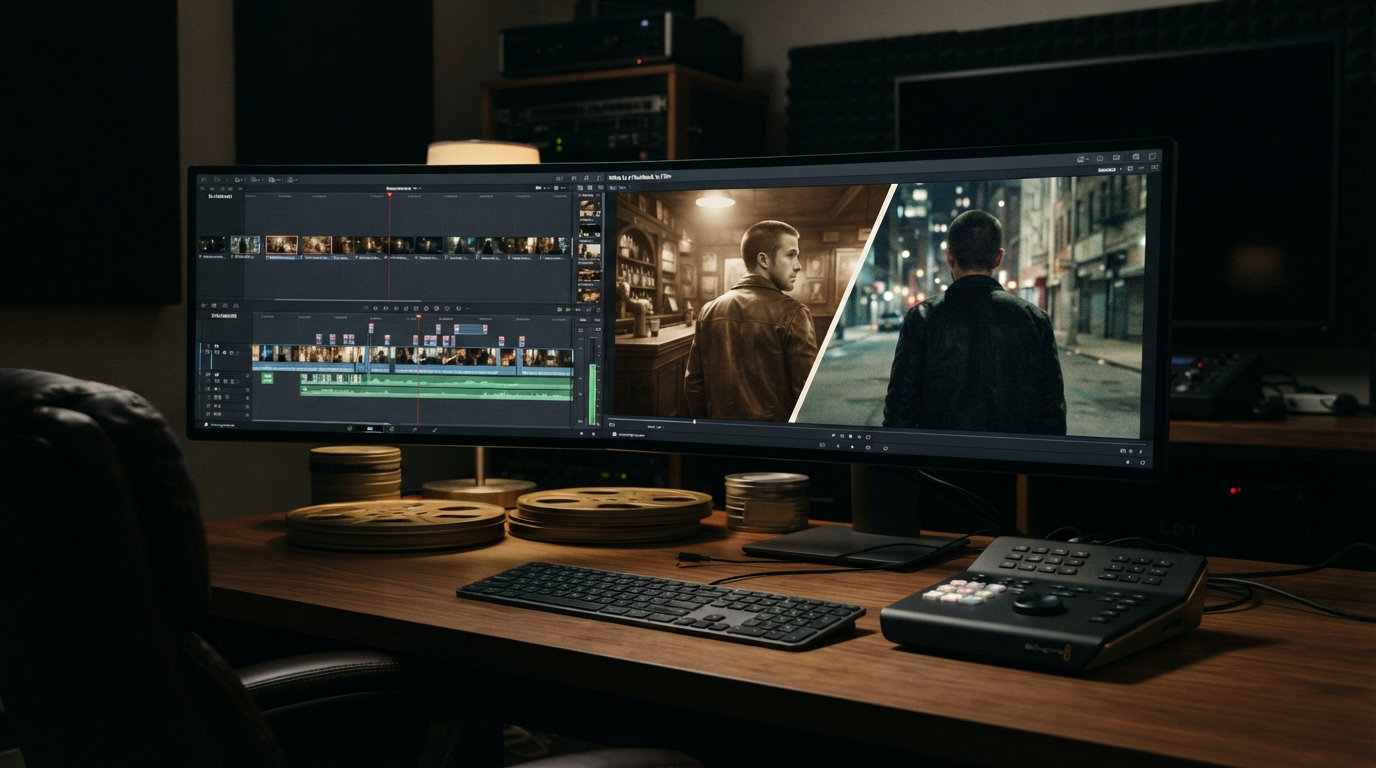
Ever watched a movie where a sudden scene pulls you into a character’s past, complete with softer colors and a dreamy filter, before snapping back to the present? That moment is what filmmakers call a flashback in film. It’s one of the most common narrative devices in cinema, and when used well, it can hit an audience harder than any dialogue scene.
In this guide, I’ll walk you through exactly what a flashback is, how it shows up on screen, why screenwriters reach for it, and the rules for formatting one in a script. We will also clear up a common confusion: people searching for the 2026 thriller movie titled Flashback often stumble into articles about the storytelling technique instead, and I want to make sure you leave knowing which one you came for.
By the end, you’ll understand the technique deeply enough to spot it, analyze it, and even write one yourself.
Table of Contents
What Is a Flashback in Film? A Clear Definition
A flashback in film is a narrative interruption that transports the audience from the present timeline into a scene set in the past. It depicts events that occurred before the current moment of the story, often experienced through a character’s memory, dream, or recollection.
The formal storytelling term for this technique is analepsis, borrowed from literary theory and now widely used in film studies. When a movie opens with a scene from the past before jumping forward to “present day,” that’s called an external analepsis. When a character remembers something during an ongoing scene, that’s an internal analepsis.
Think of flashbacks as the film equivalent of a character saying, “Let me tell you how I got here.” Instead of telling, the movie shows you. That single shift from telling to showing is what gives flashbacks their emotional punch.
Why the Term Matters
Search engines and film theorists both lean on the word “analepsis” to disambiguate the storytelling technique from the 2021 psychological thriller Flashback starring Dylan O’Brien. When you see “analepsis” in a serious discussion about cinema, you can be confident the writer is talking about the narrative device rather than the movie.
The History and Origin of the Cinematic Flashback
Flashbacks existed in literature long before cinema arrived. The epic form, including The Odyssey and the Mahabharata, frequently interrupts forward action to recount earlier events. When film emerged in the late 1800s, early directors borrowed that exact pattern.
The earliest film theorists identified flashbacks in silent short films of the 1900s and 1910s. D.W. Griffith’s The Birth of a Nation (1915) used flashbacks extensively, which helped cement the technique as a standard tool rather than an experimental gimmick.
By the 1940s, Hollywood had refined the flashback into a precise craft. Film noir in particular weaponized the technique. Citizen Kane (1941) famously structures its entire plot around a series of flashbacks, each one revealing a different layer of the title character’s life. That decision changed cinema forever.
Flashbacks in Modern Cinema
Today’s filmmakers approach flashbacks with more subtlety than their mid-century predecessors. Hard dissolves, wavy borders, and obvious “dreamy” filters once telegraphed a flashback; contemporary audiences find those markers patronizing. Modern films lean on color grading, sound design, and performance cues instead, which I will cover in detail below.
How Flashbacks Work: Visual and Audio Techniques
The technical execution of a flashback is where artistry meets engineering. Five main signals tell an audience they have just crossed into the past.
1. Color Grading and Saturation
The most common cue is a shift in color palette. Present-day scenes often appear neutral or slightly cool, while flashback scenes lean warmer, more saturated, or deliberately faded. Christopher Nolan’s work, including Memento and parts of Inception, manipulates color so subtly that audiences feel the shift before they consciously notice it.
2. Film Grain and Aspect Ratio
Directors sometimes shoot flashback scenes in a different aspect ratio (4:3 instead of 16:9, for example) or add film grain. This was the dominant signal in 1990s and early 2000s cinema and still works in period pieces.
3. Focus Pulls and Slow Motion
A soft focus or a slow-motion sequence frequently marks memory. The technique is older than cinema itself and remains effective because human memory itself feels slightly slowed or sharpened when we reach for distant events.
4. Sound Design
Audio cues close a loop that visuals alone cannot. Reverb, muffled dialogue, the crackle of a vintage recording, or a subtle musical sting (often a piano or strings motif) all signal “we are now in the past.” Christopher Nolan’s team is famous for layering Hans Zimmer’s score to differentiate timelines aurally rather than visually.
5. Performance Cues
The actor’s eyes do the rest. A slight squint, a wistful half-smile, or an absence of muscle tension in the present tense contrasts against the heightened emotional register of the remembered event. That contrast is what makes a flashback feel remembered rather than merely shown.
Types of Flashbacks Every Filmmaker Should Know
Not all flashbacks behave the same way. Film scholars classify them by scope and by their position within the larger story.
Internal Analepsis
An internal analepsis occurs when a character triggers a memory within the present timeline. Someone looks at a photograph, hears a song, or visits a place, and we cut to what happened in the past. The framing story stays alive; the flashback drops in and pulls out.
External Analepsis
An external analepsis covers the gap between the story’s start and the present chronology. Movies that open with a dramatic scene from years earlier (before cutting to “Six Months Earlier” or “Present Day”) use external analepsis to hook the audience before settling into the main story.
The Framing Flashback
A framing flashback wraps the entire film. The protagonist narrates from a later point in life, and most of the runtime unfolds as remembered events. The Shawshank Redemption uses this structure effectively.
The Nested Flashback
A nested flashback places a flashback inside another flashback. Rare, but powerful when done well. Inception layers multiple dream sequences that act as nested flashbacks. Audiences have to track several timelines at once, which is exactly the disorientation the film wants to create.
Famous Flashback Examples in Movies
Studying real examples is the fastest way to internalize how flashbacks function. The following films are essential viewing.
Citizen Kane (1941)
Orson Welles structures the entire mystery around flashbacks. A reporter interviews five people about Charles Foster Kane, and each interview unlocks a different scene from Kane’s past. The film practically invented the modern nonlinear story.
The Godfather Part II (1974)
This sequel intercuts Michael Corleone’s present-day collapse with young Vito Corleone’s rise in early 1900s New York. The parallel editing creates meaning neither timeline could carry alone. Film schools still use this movie as the textbook example of parallel flashback construction.
Eternal Sunshine of the Spotless Mind (2004)
Charlie Kaufman’s script traps the audience inside a memory that is actively being erased. Scenes shift mid-sentence as the protagonist’s mind deletes them, which means almost the entire movie operates as one long, unstable flashback.
Arrival (2016)
Denis Villeneuve conceals the central flashback until late in the film, turning what seems like chronological storytelling into revealed nonlinear structure. The emotional reveal depends entirely on that hidden flashback working.
Recent Examples (2026 Releases)
Contemporary streaming-era cinema leans on flashbacks more than ever. Limited series like The Bear, Severance, and True Detective: Night Country use quick flashback vignettes to deepen character psychology. Feature films such as The Fabelmans (2026) and Past Lives (2026) build their entire emotional architecture on flashback structure.
How to Write a Flashback in a Screenplay
If you’re writing a script, the formatting of a flashback is strict. Industry software (Final Draft, Highland, WriterDuet) all follow the same conventions.
The Standard Method
Begin the flashback with a scene heading that reads FLASHBACK: added to the slugline. For example:
INT. CHILDHOOD BEDROOM - DAY (FLASHBACK)
Then write the flashback scene normally. When the flashback ends, return to the present with a new slugline:
BACK TO PRESENT or END FLASHBACK followed by:
INT. KITCHEN - DAY (PRESENT)
Alternative: BEGIN FLASHBACK / END FLASHBACK
Some screenwriters prefer a parenthetical at the start of action:
BEGIN FLASHBACK … scene … END FLASHBACK
This style works better for short memory snippets rather than extended flashback sequences.
Visual Cue in Action Lines
Whatever convention you choose, describe the trigger. If the present-day character looks at an old photograph, write that into the action. Otherwise the audience cannot follow the cut. The trigger is the connective tissue between timelines.
Avoid Spelled-Out Cues
Do not write things like “he remembers when” or “she recalls the day that…” inside action lines. Sluglines and structure carry the timeline. Save description for what we actually see and hear.
Flashback vs Flashforward: Key Differences
The flashforward, formally called prolepsis, is the opposite move. Instead of looking back, the film jumps forward to reveal something that has not yet happened.
Flashbacks draw their emotional power from memory and context. We already know enough about the character to feel the past event’s weight. Flashforwards draw their power from mystery and anticipation. We do not yet know the character and need to wait for meaning to land.
Many classic films layer both. The Godfather Part II intercuts an external analepsis (Vito’s past) with proleptic hints (Michael’s future isolation). Combining the two devices lets a film operate on multiple emotional registers at once.
As a rule, use flashbacks when your audience already cares about the character. Use flashforwards when you want them to start caring.
The Psychology Behind Why Flashbacks Work
Flashbacks feel emotionally true because human memory itself works that way. We do not experience the past as a clean file; we experience it as fragments triggered by present sensations. When a film shows a flashback triggered by a scent, a song, or a location, the audience’s brain fires the same associations. The viewer does not just watch the memory; they live inside it.
Neuroscientists call this state “mental time travel.” Cinema triggers it efficiently because film is, by nature, a recorded past. Every image on screen is technically a memory captured by a camera at an earlier moment. Flashbacks take that foundation and amplify it.
That is why overusing flashbacks can feel manipulative. Each one suggests an emotional weight that the surrounding story must justify. When the past genuinely deepens the present, audiences lean in. When the past is just exposition in disguise, audiences check out.
Common Mistakes to Avoid When Using Flashbacks
Many working screenplays earn feedback that their flashbacks feel “patronizing” or “obvious.” Here are the patterns that cause that.
Mistake 1: Using Flashbacks for Pure Exposition
If your flashback only delivers plot information and no emotional beat, your present-day scene probably needs a rewrite instead. A flashback should cost something, emotionally or narratively, to use.
Mistake 2: Forgetting the Trigger
Every internal flashback needs a clear present-tense trigger. Without one, the cut feels random and the audience stays disoriented longer than the scene can afford.
Mistake 3: Over-Reliance on Visual Clichés
Wavy edges, slow zoom, sepia tone. These were once necessary. Today, they read as a lack of trust in the audience. Trust your craft.
Mistake 4: Burying the Audience in Timelines
Three flashback layers can work. Five cannot, unless your screenplay is Inception. Track your timelines carefully and give the audience a way to anchor themselves.
When NOT to Use a Flashback
If the past event can be dramatized in present day through dialogue and action, leave it there. Flashback is a high-cost narrative tool. Spend the budget only when nothing else will do the job.
FAQs
What is an example of a flashback in a movie?
In The Godfather Part II, scenes of young Vito Corleone building his criminal empire in early 1900s New York appear as flashbacks while we simultaneously follow his son Michael’s present-day collapse. The two timelines intertwine to deliver meaning each one carries alone.
How do you show a flashback in a film?
Most films use one or more signals: a change in color grading, added film grain, a softer focus, slow motion, a layered audio mix, or a subtle musical cue. Pair these with a clear present-tense trigger, such as a character looking at a photograph, so the audience can follow the cut back in time.
What is flashback in simple terms?
A flashback is a scene in a movie that takes the audience back in time from the present story to show something that happened in the past, usually to a character’s memory. It is the film equivalent of a character remembering an earlier event instead of just talking about it.
Why are flashbacks used in films?
Filmmakers use flashbacks to reveal backstory, deliver exposition in a more engaging way, create emotional depth, set up twist endings, explain character motivation, and connect past events to present choices. When used well, a flashback deepens audience investment in the central character.
How do you indicate a flashback in a screenplay?
The standard convention is to add FLASHBACK to the scene heading slugline, write the scene, then end with END FLASHBACK or BACK TO PRESENT followed by a new slugline returning to the present timeline. Some writers prefer BEGIN FLASHBACK and END FLASHBACK markers in the action lines instead, especially for short memory beats.
Conclusion
A flashback in film is more than a quick cut to the past. It is a precise narrative instrument that, when used with care, deepens character, hides twists, and turns a simple story into a memory you cannot shake. Whether you’re a screenwriter drafting your first script or a viewer trying to understand what just happened on screen, recognizing how flashbacks work makes every film richer.
Next time you watch a movie, try tracking the flashbacks. Notice the trigger, the visual cues, and the emotional cost. You’ll start spotting analepsis in almost every prestige drama you queue up.