
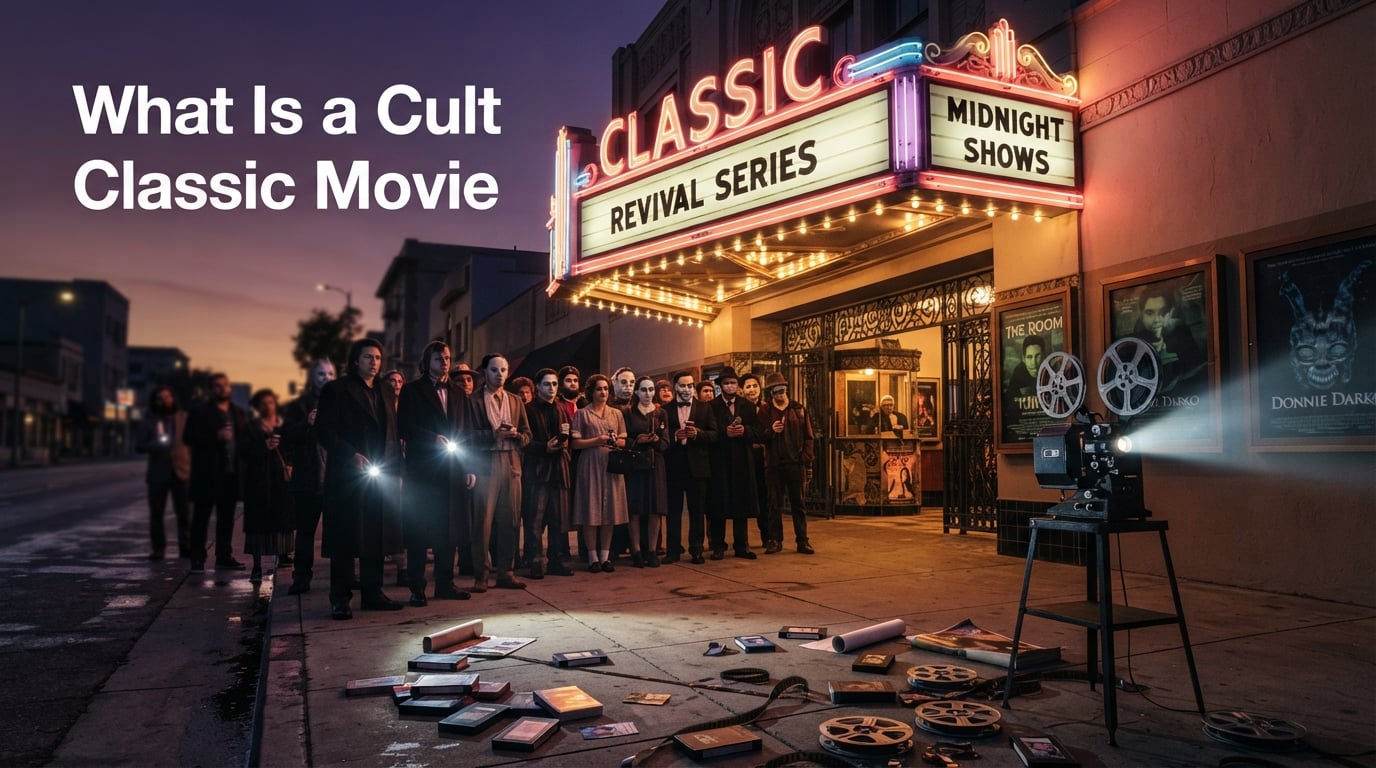
A cult classic movie is a film with a small but intensely devoted fanbase, often one that was initially rejected, ignored, or underperformed at the box office. The defining quality of a cult classic movie is the relationship between film and audience: a small group of fans treats the movie like a shared secret, returning to it repeatedly, quoting it endlessly, and building community around it.
I have spent years digging through midnight screenings, repertory theaters, and now endless streaming queues, and the pattern is always the same. The films people love hardest are rarely the ones that opened big on Friday night. In this guide, I will explain exactly what makes a cult classic movie, how these films earn their status, and why the streaming era has rewritten the rules for finding them.
Whether you are a casual moviegoer trying to understand why your friend has watched Blade Runner fourteen times, a film student looking for a clean definition, or just someone curious about the term you have heard on every movie podcast, this guide is for you. By the end, you will be able to spot a cult classic on your own and you will know how the streaming era is changing the entire game.
Table of Contents
What Is a Cult Classic Movie?
A cult classic movie is a film that has acquired a passionate, niche following that treats the work with a level of devotion usually reserved for religious or artistic movements. The word “cult” is borrowed from sociology: just as a cult forms around a charismatic leader or set of beliefs, a cult film gathers a tight community of fans around a shared obsession.
The phrase “cult classic” usually refers to a specific kind of film, and a few related terms help draw the boundaries. A cult film is the broad category of any movie with a devoted, non-mainstream following. A cult classic usually implies the film has endured for years and feels like a touchstone for its fans. A midnight movie is a specific subtype that became famous through late-night theatrical screenings, where audiences dress up, shout lines, and throw props.
You will sometimes hear people call any old favorite a “cult classic.” That is a misuse. A cult classic movie is not just beloved. It is beloved in a particular way, by a particular community, often in opposition to the mainstream opinion of its time.
Why Is It Called a “Cult” Classic?
The label itself is revealing. In sociology, a cult is a small group united by intense devotion to a person, idea, or practice, often in ways that look strange from the outside. Calling a film a “cult” classic borrows that exact dynamic. The fans behave a bit like members of a movement. They adopt rituals, share in-jokes, and treat the work as a kind of scripture.
There is also a subtle self-aware humor in the term. Fans usually know that their favorite film is not for everyone, and they lean into that. Cult classic fans are not trying to convince the world. They are content to be a chosen few, which is part of what makes the community so tight-knit.
What Makes a Movie a Cult Classic?
Five qualities tend to separate true cult classics from simply popular films. If you watch for these traits, you can usually identify one within the first hour of viewing.
A devoted, self-selecting fanbase. The audience is small, but they treat the film like an inside joke. They evangelize. They rewatch. They collect soundtracks, posters, and props. The Rocky Horror Picture Show still sells out theaters every weekend because the fanbase never went away.
Initial rejection or underperformance. Most cult classics either flopped at the box office, were dismissed by critics, or both. This early rejection is part of the mythology. It gives fans the feeling that they discovered something the world missed.
Quotable dialogue and repeatable moments. Cult classics usually contain lines and scenes that fans can recite from memory. Think “I’m the Dude” from The Big Lebowski or “You’re tearing me apart, Lisa” from The Room. These moments become shared language inside the fandom.
Audience participation and ritual. The most visible sign of cult status is the way fans watch the film together. Costumes, callouts, props, sing-alongs, and quote-alongs are all rituals that turn a screening into an event.
Subversive, transgressive, or unusual themes. Cult classics often push against the norms of mainstream Hollywood. They can be violent, strange, weirdly funny, overly sincere, or stylistically bizarre. Their willingness to be different is part of what attracts fans in the first place.
How Do Movies Become Cult Classics?
Becoming a cult classic is rarely an overnight process. Most cult classics earn their status over years or even decades, through a slow build of word-of-mouth discovery. I have watched this happen with several modern films that flopped on release and only found their audience years later.
The traditional path usually runs through repertory theaters and midnight screenings. A small audience falls in love, brings friends, and word spreads through college campuses, fan conventions, and fanzines. By the 1980s and 1990s, the home video market supercharged this process. Suddenly, a film that flopped in theaters could find its audience one VHS rental at a time. Clerks, Fight Club, and Donnie Darko all followed this path.
There is usually a turning point where the cult following tips over into the mainstream. A high-profile cast member wins an Oscar. A parody on a major TV show introduces the film to a wider audience. A remastered Blu-ray brings sharper visuals to a film that was previously hard to find. Once the tipping point arrives, the term “cult classic” starts appearing in print and the film canonizes itself.
Today, that pathway has changed dramatically. Streaming platforms and short-form video have compressed the timeline from years to months, and that shift has real consequences for what counts as a cult classic in 2026.
Cult Classic vs. Mainstream Hit: Is Harry Potter a Cult Classic?
The short answer is no. Harry Potter is a global mainstream phenomenon, not a cult classic movie, and the difference matters. A cult classic movie depends on a small, devoted fanbase that exists somewhat outside the mainstream. Harry Potter is the mainstream.
The key distinction is exclusivity. Cult classics feel like a discovery. They require a bit of digging, a bit of taste-making, and a willingness to embrace something the wider world has not embraced. Harry Potter needs no introduction. It is one of the bestselling book-to-film franchises of all time, and its audience is essentially universal.
You will see similar debates about Star Wars, Marvel films, and Disney animation. None of these are cult classics in the strict sense, even when individual entries are divisive. A useful rule of thumb: if your non-film-friend has not heard of it, it might be a cult classic. If your grandma owns the t-shirt, it is probably not.
There is one important exception. A specific, obscure entry in a large franchise can sometimes develop a cult following even when the franchise as a whole is mainstream. The Star Wars Holiday Special, for instance, or the famously weird 1994 Fantastic Four film, both have devoted fanbases despite their parent franchises being household names.
Cult Classics in the Streaming Era (2026)
The streaming era has changed the cult classic movie in ways the original definition never anticipated. In 2026, a film no longer needs midnight screenings or a sympathetic video store clerk to find its audience. It needs an algorithm and a few passionate voices online.
Streaming has both democratized and disrupted cult status. On the positive side, niche films are now available 24/7 to anyone with a subscription. A teenager in Ohio can now watch El Topo or Hausu the same week it is rediscovered in Tokyo. The discovery barrier has fallen. The Room, which once required a midnight run in Los Angeles, became a global meme phenomenon after clips hit YouTube.
On the other hand, streaming has flattened the sense of discovery. When every film is one click away, the feeling of stumbling onto a hidden gem is harder to manufacture. Cult status used to be earned through scarcity and ritual. Now it can be assigned by a Netflix algorithm or a trending hashtag on TikTok.
I have noticed another shift. Films are achieving cult classic status much faster than they used to. In the 1970s, a film might take ten years to develop a following. Today, a movie can flop in theaters, find a second life on TikTok within months, and be declared a cult classic by the end of the year. Everything Everywhere All at Once and Uncut Gems both followed this rapid timeline. It will be interesting to see whether these films hold their cult status over time, or whether the speed of discovery changes the texture of fandom itself.
The biggest change, in my view, is the rise of participatory fandom online. Communities on Reddit, Letterboxd, Discord, and TikTok now do the work that repertory theaters used to do. They surface overlooked films, share in-jokes, and turn individual viewers into a coordinated community. That is essentially the cult classic formula, just running on a different engine.
10 Iconic Cult Classic Movie Examples
If you want to understand the cult classic movie in practice, start with these ten films. Each one earned its status through devoted fans, repeated viewings, and a refusal to be forgotten.
- The Rocky Horror Picture Show (1975). The original midnight movie. Audience participation screenings have run continuously for fifty years.
- The Room (2003). Tommy Wiseau’s “Citizen Kane of bad movies” is now a participatory ritual on par with Rocky Horror.
- Blade Runner (1982). Initially a commercial failure, now a foundational sci-fi text whose director’s cut is the standard version.
- The Big Lebowski (1998). Inspired its own religion, Lebowski Fest, and an entire lifestyle subculture around “The Dude.”
- Donnie Darko (2001). A box-office disappointment that became a teen cult phenomenon on DVD.
- Fight Club (1999). Another divisive film that grew into a generational touchstone through DVD and VHS rentals.
- Dazed and Confused (1993). A hangout movie that defines a specific slice of 1970s nostalgia for an entire generation.
- The Princess Bride (1987). A rare example of a film that is both mainstream beloved and a deeply quoted cult favorite.
- Office Space (1999). A workplace comedy that found its audience years later and became required viewing in actual offices.
- Heathers (1988). A dark high-school satire that influenced an entire wave of black-comedy filmmakers.
Frequently Asked Questions
What makes a movie a cult classic?
A movie becomes a cult classic through a small but intensely devoted fanbase, initial rejection by mainstream audiences or critics, quotable dialogue, audience participation at screenings, and subversive or unusual themes. The combination of devoted fans plus mainstream underperformance is what separates a cult classic from a merely popular film.
Is Harry Potter considered a cult classic?
No. Harry Potter is a global mainstream franchise, not a cult classic. Cult classics depend on a niche, devoted following that exists somewhat outside the mainstream. Harry Potter is universally known, commercially massive, and needs no discovery, which makes it the opposite of a cult film.
What is an example of a cult classic movie?
The Room (2003) is a famous example of a cult classic. It was a critical and commercial failure but developed an intensely devoted fanbase that hosts participatory screenings worldwide. Other examples include The Rocky Horror Picture Show, The Big Lebowski, Blade Runner, and Donnie Darko.
What are the top 10 cult classic movies?
Common picks for the top cult classics include The Rocky Horror Picture Show, The Room, Blade Runner, The Big Lebowski, Donnie Darko, Fight Club, Dazed and Confused, The Princess Bride, Office Space, and Heathers. Each one built a devoted fanbase through quotable dialogue, repeated viewings, and audience participation.
Can a filmmaker intentionally create a cult classic?
Filmmakers can aim for the qualities that attract cult followings, including distinctive style, unconventional storytelling, and transgressive themes. However, cult status depends on audience behavior, not intent. Even carefully crafted oddities can flop without a devoted community to carry them. Most cult classics become cult classics by accident.
Final Thoughts
A cult classic movie is more than a forgotten film with a small audience. It is a film whose small audience treats it like a way of life. The defining traits are devotion, discovery, and community, and these have not changed even as the way we discover films has shifted dramatically.
The streaming era has not killed the cult classic movie. It has accelerated it. Films that might have taken a decade to find their audience now do it in a season, sometimes in a weekend. The mechanism is the same: a small, devoted community falls in love with a film and refuses to let it disappear. The channels are just different.
My advice, after watching dozens of these films across theaters, DVDs, and streaming, is simple. Pick one you have never seen, give it your full attention, and see whether it grabs you. The best cult classics do not announce themselves. They just sit there, waiting for the right viewer, ready to become someone’s favorite movie of all time. Once you find one that clicks, you will understand exactly what people mean when they say the cult classic movie is its own special kind of magic.