
If you’ve ever watched The Real Housewives, Survivor, or Love Island, you’ve already seen a confessional in reality TV – you just may not have known the official name for it. That cutaway moment where a cast member suddenly breaks the fourth wall and speaks directly into the camera, sharing gossip, strategy, or secret thoughts, is the single most recognizable storytelling device in the genre.
I’ve been watching and dissecting reality TV confessionals for years, and I can tell you they are far more carefully constructed than they appear. In this guide, I’ll explain exactly what a confessional in reality TV is, how production teams film them, who controls the questions, and why this format has shaped both television and our digital culture since the late 1990s.
Table of Contents
What Is a Confessional in Reality TV?
A confessional in reality TV is a dedicated direct-to-camera interview segment where cast members share private thoughts, reactions, motives, and gossip with the audience. It functions as a stylistic device – essentially an aside – made up of cutaways to a close-up shot of a cast member speaking straight to the lens.
Think of it as the reality TV version of a character talking to the audience in a play. The cast member acknowledges the camera (and by extension, you), then spills what they really think about another contestant, a fight they just had, or their secret strategy to win.
Wikipedia’s definition nails it well: “A confessional is a stylistic device used in many reality television shows. It is a type of aside, consisting of cutaways to a close-up shot of cast members talking directly to camera.” You’ll see this format on every major reality subgenre – competition shows, dating shows, survival shows, makeover shows, and even vocational programs like Hell’s Kitchen.
Confessionals aren’t optional decoration. They’re the narrative engine that turns hundreds of hours of raw footage into a 45-minute episode. Without them, viewers would watch people living, competing, or fighting – but they’d rarely understand why any of it matters.
How Confessionals Work Behind the Scenes
Confessionals are filmed after events occur, often on the same day or several days later, then edited to look like immediate reactions. This is the single biggest secret of reality TV production, and it’s why the format is often called “staged actuality” by media scholars.
Here’s the actual workflow I learned after speaking with multiple reality TV crew members over the past few years.
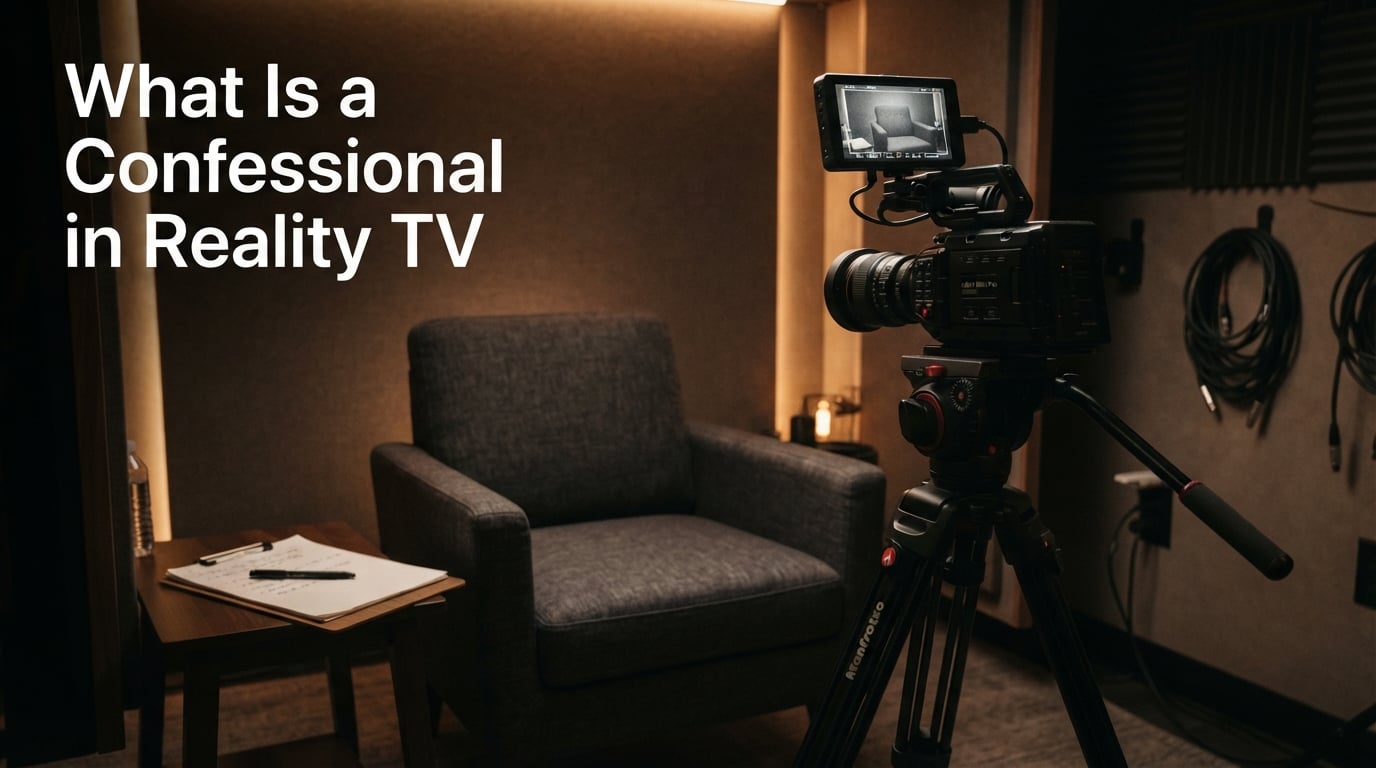
The Booth Setup
Every show that uses confessionals has a dedicated private space. On Big Brother, it’s the famous Diary Room. On Love Island, it’s the Beach Hut. On The Real Housewives, cast members film in a small room at the production house, often before or after group filming.
The setup typically includes:
A single camera positioned at eye level
Soft lighting (sometimes a ring light or diffused studio lighting)
A stool or chair with no visible microphone (mics are usually lavalier)
Sometimes a green screen for travel montages or location-themed backgrounds
The space is intentionally small. Producers want intimacy – that close-up shot where you can see every eyelash and every nervous swallow.
Producer Prompting
This is the part most viewers don’t realize. A producer sits just off-camera (or communicates through an earpiece) and asks prompting questions to draw out usable content. The producer might ask, “How did you feel when she said that?” or “Walk me through what you were thinking in that moment.”
Contestants do not write their own lines. They’re responding to specific, leading questions designed to elicit dramatic, emotional, or strategic soundbites. The skill of a good reality TV producer is asking these questions without making the response feel scripted.
The Time Illusion
Confessionals create what production crews call the “time illusion” – the appearance that contestants are reacting in real time to events that just happened. In reality, those reactions are filmed hours or days later.
To maintain this illusion, production teams enforce strict visual continuity rules:
Cast members wear the same outfit and hairstyle when filming all confessionals about a specific day’s events
Makeup artists touch up contestants before each confessional session
Producers ask questions phrased in present tense (“So she’s lying to you right now?”)
Editors cut confessional footage right after the triggering scene
Reddit users on r/explainlikeimfive frequently ask about this. The honest answer: it’s mostly about discipline. A contestant wearing yesterday’s outfit while discussing yesterday’s fight sells the illusion. A contestant in a different shirt breaks it immediately.
OTF (On the Fly) Confessionals
Some shows also use “OTF” or on-the-fly confessionals, where producers catch contestants in the moment – walking between rooms, before bed, or right after a confrontation. These feel more authentic because they actually are in real time. Viewers tend to notice and praise OTF moments as more genuine.
The History and Evolution of the Reality TV Confessional
The confessional as a TV device actually predates reality TV. Court shows like The People’s Court (1981) and Judge Judy (1996) used direct-to-camera addresses to plaintiffs and defendants. Documentary filmmakers had used the technique for decades before that.
But reality TV transformed it into something new.
The Real World Era (1992)
MTV’s The Real World is widely credited with turning the confessional into the genre’s signature move. Producers realized that 24/7 camera footage alone made for boring episodes – viewers needed context, motive, and reaction. The cast interview cutaway solved all three problems.
Big Brother and the Diary Room (1999)
When Big Brother launched in 1999, the Diary Room became the most famous confessional booth in television history. Contestants entered voluntarily to share thoughts, vent, or scheme. The Diary Room format has been copied by dozens of international franchises over the past 25 years.
The Real Housewives Era (2006)
The Real Housewives of Orange County introduced a new confessional style – glossy, filtered, and theatrical. Producers discovered that the right camera angle and lighting could turn a cast member into a breakout star. Lisa Rinna, Bethenny Frankel, and Kenya Moore all became icons largely because of their confessional charisma.
Post-COVID and the iPhone Era (2020 onward)
The pandemic forced productions to adapt. With cast members quarantined, many shows began incorporating confessionals filmed on iPhones or via video calls. This style persists today – you’ll see it on The Kardashians and several Hulu shows – and it makes confessionals feel more like social media content than traditional TV production.
The Role of Producers in Shaping Confessionals
Producers don’t just record confessionals – they engineer them. The confessional interview is where most reality TV storylines actually get written, before editors ever touch the footage.
A skilled producer knows how to ask questions that lead contestants toward specific emotional beats. If the storyline of the week is “Melissa betrayed me,” the producer’s job is to extract soundbites that reinforce that narrative – sometimes pulling them from unrelated conversations.
Bethenny Frankel, one of the most successful Housewives in history, has talked openly about how she understood this system early. She treated confessionals like performances, giving producers exactly what they needed – sharp one-liners, emotional reactions, and clear villain-versus-hero framing.
Critics call this manipulation. Fans call it entertainment. The reality is somewhere in between. Producers can prompt, but they can’t make a contestant say something they genuinely don’t believe. The best confessionals come from a mix of producer direction and authentic reaction.
The prompting itself is a learned skill. Producers are trained to ask open-ended questions (“Tell me about that moment”) rather than yes-or-no questions, because open-ended responses give editors more usable material. A good producer also knows when to stay quiet – silence often produces the most powerful confessional moments, when contestants fill the gap with raw emotion.
Behind the camera, producers keep detailed notes about which confessionals covered which storylines. This database becomes the editor’s roadmap when assembling episodes weeks later. Without that documentation, the tight, dramatic narratives audiences expect would be impossible to build.
Why Confessionals Matter for Storytelling
Confessionals solve the biggest problem in reality TV: viewers can’t read minds. When two contestants fight over a dinner, the footage alone tells you what happened. A confessional tells you what it meant.
This is also why viewers form parasocial relationships with reality stars. A confessional creates intimacy – the illusion that the cast member is confiding in you personally. Academic studies have linked this format to stronger audience attachment than traditional documentary footage.
Confessionals also drive social media. Every memorable one-liner from a Housewives episode becomes a meme, a TikTok, and a quote in headlines the next morning. The format has shaped influencer culture in return – today’s influencers often film confessional-style content because audiences have been trained to expect it.
For audiences, confessionals provide something traditional documentaries never could: direct access to a person’s interior life. We get to hear what contestants actually think, free from social niceties and group dynamics. That access is what keeps viewers coming back episode after episode.
In 2026, the confessional in reality TV remains the genre’s most important storytelling tool. It bridges the gap between unscripted footage and structured narrative – and it’s the reason reality TV feels both real and dramatically satisfying at the same time.
FAQs
How do confessionals in reality TV work?
Contestants sit in a private booth or room, like Big Brother’s Diary Room or Love Island’s Beach Hut, and speak directly to the camera. A producer sits just off-camera asking prompting questions to draw out reactions, strategy, or gossip. The footage is then edited to appear as immediate responses to scenes the viewer is watching.
What shows have confessionals?
Almost every major reality TV show uses confessionals, including Survivor, Big Brother, The Real Housewives franchise, Love Island, The Bachelor, RuPaul’s Drag Race, The Challenge, Below Deck, Vanderpump Rules, and Hell’s Kitchen. The format is standard across competition, dating, survival, and makeover subgenres.
When are confessionals filmed?
Confessionals are usually filmed after the events they describe – sometimes hours later, sometimes days later. Producers enforce strict visual continuity rules so contestants wear the same outfit and hairstyle when discussing specific scenes. Some shows also use on-the-fly (OTF) confessionals captured in real time.
What is the diary room in reality TV?
The Diary Room is the most famous confessional booth in reality TV, introduced on Big Brother in 1999. It’s a private room where contestants enter voluntarily to share thoughts, vent, or speak to producers. The Diary Room has been copied by reality franchises worldwide and remains the gold standard for the confessional format.
Why do reality TV shows use confessionals?
Confessionals provide narration, exposition, and commentary that helps viewers understand contestant motivations and storylines. Without them, reality TV would lack emotional context – viewers would see events without understanding what they meant to the people involved. Confessionals are essentially the genre’s voiceover narration.
Do contestants know the questions in advance?
Generally no. Producers ask prompting questions in real time during the confessional session, often pulling topics from events that happened earlier that day. Some experienced reality stars learn to anticipate likely questions and prepare angles in advance, but the actual question is delivered live.
Final Thoughts on the Confessional in Reality TV
A confessional in reality TV is more than just a cutaway interview – it’s the storytelling engine that turned a messy, unscripted genre into one of the most powerful formats on television. From its roots in documentaries and court shows to its modern iPhone evolution, the confessional bridges raw footage and structured narrative.
Now that you know what a confessional in reality TV is, how it’s filmed, and why producers love it, you’ll never watch a cutaway the same way again. Pay attention to the lighting, the outfit continuity, and the producer’s prompts – you’ll start to see the construction behind the confession.
If you’re a media student, screenwriter, or just a curious viewer, understanding the confessional is the first step toward understanding how reality TV actually works.