
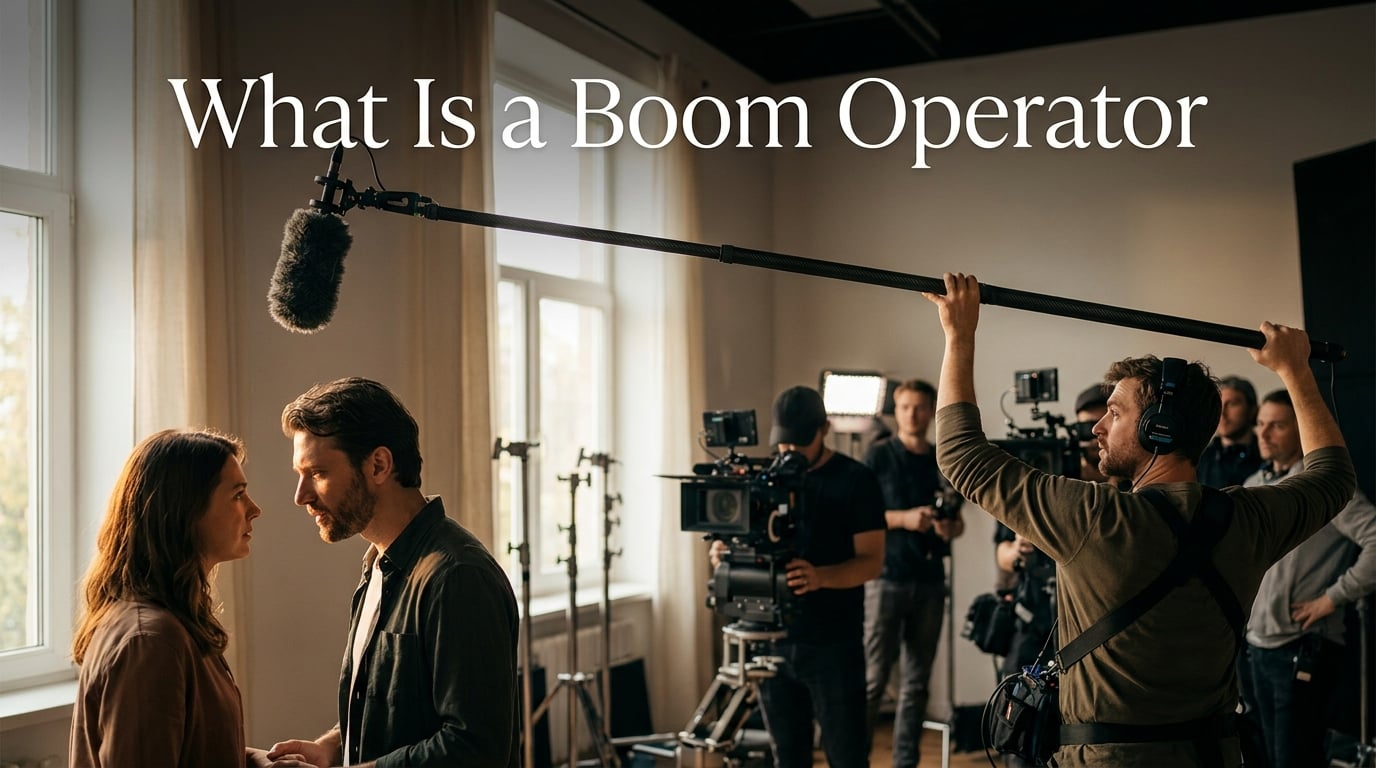
A boom operator is the film crew member who holds a microphone on a long pole above the actors to capture clean dialogue on set. I have watched these professionals work for 14-hour stretches, arms raised, eyes locked on a moving shot, never letting the mic dip into the frame or cast a shadow on a wall behind the talent.
If you have ever wondered what is a boom operator and why the role matters so much to a film production, you are in the right place. In this guide I will walk you through the definition, daily responsibilities, the gear they use, where they fit in the sound department hierarchy, the physical demands of the job, and how you can start a career as a boom operator in 2026.
There is a common mix-up worth clearing up right away. A boom operator in film has nothing to do with the military role of the same name or with construction crane operators. The media boom operator is a sound technician, often credited as First Assistant Sound, and they are the unsung hero of every well-recorded scene you have watched on screen.
Table of Contents
What Is a Boom Operator? A Clear Definition
A boom operator is a member of a film or television sound department who physically holds and positions a boom microphone during a take. The microphone is mounted on a long pole, usually called a boom pole or fishpole, and the operator maneuvers it just above the actors to capture the cleanest possible dialogue.
The boom operator is sometimes also credited as the First Assistant Sound. They report to the production sound mixer, who runs the recording equipment, and they collaborate with the utility sound technician, who handles wireless lavaliers and cable management.
At its core, the job is simple in description but brutally difficult in practice. You need to follow actors as they move, predict where they will walk next, keep the mic close enough to capture every whisper, and never let the boom dip into the camera frame or cast an unwanted shadow. It is part audio engineering, part physical endurance sport, and part choreography.
Boom Operator in Film vs Other Meanings
The term boom operator shows up in a few different industries, and search engines reflect that confusion. In aviation, a boom operator is a crew member on a tanker aircraft who refuels other planes mid-flight. In construction, a boom operator runs heavy equipment with a long arm. Neither role has anything to do with microphone placement.
In this article, and on most film career resources, a boom operator means one thing: a sound department professional who swings a microphone on a pole above the actors during a film or television production.
Boom Operator Responsibilities on a Film Set
The primary responsibility of a boom operator is to capture clean, usable dialogue audio during every take. Everything else on the list flows from that single goal. Let me break it down.
Microphone Placement and Tracking
The boom operator holds the microphone just out of frame, typically 12 to 24 inches above and ahead of the actor’s mouth. They must track the actor’s movement smoothly, adjusting the pole in three dimensions to keep the mic in the optimal position throughout the take.
If an actor crosses a room, sits in a chair, then stands again, the boom operator follows the entire blocking. The mic angle changes, the pole rotates, and the operator’s body often shifts position to maintain the right height and distance.
Shadow Control and Frameline Awareness
A boom microphone can ruin a shot in two common ways. First, the microphone itself can dip into the camera frame. Second, the pole or the operator’s hand can cast a shadow on the wall or set behind the talent. The boom operator watches both continuously.
This means the operator must understand camera framelines, lens choices, and lighting setups even though they are not a camera or lighting professional. They listen to the director and DP, anticipate when the camera will move, and adjust accordingly.
Dialogue Quality and Mic Technique
Beyond positioning, the boom operator listens to the actor’s delivery and adjusts the mic to favor the active speaker. In a two-person conversation, the operator may subtly tilt the mic toward whichever actor is talking, then swing it back the moment the other actor responds.
They also monitor for unwanted noise. A rustling cable, a brushing sleeve, a creaking floorboard, or a breath through the mic grille can all ruin a take. The operator learns to absorb these problems before they reach the recorder.
Communication with the Sound Mixer
The boom operator and the production sound mixer wear headsets and stay in constant contact. The mixer might call out, “Bring it in tighter” or “Watch the top of frame” during a take. The boom operator responds with quiet acknowledgments, often using a clicker or finger taps to avoid speaking into the open mic.
Equipment a Boom Operator Uses Every Day
A boom operator’s gear list looks deceptively simple until you realize how specialized each item is. Here is what you will find in a typical kit.
The Boom Pole
The boom pole, also called a fishpole, is the long telescoping pole that holds the microphone at the end. Standard lengths range from 8 to 18 feet when extended. Carbon fiber poles are popular because they are light, rigid, and do not conduct sound or temperature the way aluminum does.
A quality boom pole can cost anywhere from a few hundred to a few thousand dollars. The pole you choose affects your stamina because heavier poles wear out your arms faster across a 12-hour shooting day.
Shotgun Microphone
The most common microphone for boom work is the shotgun mic. Shotguns have a tight polar pattern that picks up sound from directly in front of the mic while rejecting sound from the sides. This lets the operator point the mic at the actor’s mouth from above and ignore a noisy air conditioner on the wall.
Popular shotgun models include the Sennheiser MKH 416, the Rode NTG5, the Sanken CS-3e, and the Schoeps CMIT 5U. Each has a slightly different sound character, and experienced operators learn which microphone suits which voice and which environment.
Windscreen and Shock Mount Accessories
Outdoor shoots require wind protection. The microphone is wrapped in a soft fuzzy cover called a dead cat or dead kitten, depending on size. Underneath that, a zeppelin or blimp houses the microphone and provides the first layer of wind reduction.
Inside the blimp, a shock mount isolates the microphone from vibrations traveling up the pole. Without these accessories, even a light breeze would create low-frequency rumble that ruins the take.
Headphones, Harness, and Pouch
The boom operator wears closed-back headphones to monitor the audio live. Many operators also wear a harness or vest that distributes the weight of the cable across their body instead of letting it pull on the boom pole.
A small pouch holds clickers, gaffer tape, backup batteries, and the tools needed to fix the rig quickly between takes.
Where the Boom Operator Fits in the Sound Department
The sound department on a typical film production has three main roles, and the boom operator sits in the middle of the chain.
The Production Sound Mixer
The production sound mixer is the department head. They choose and set up the recording equipment, mix levels on the fly, and own the final production sound quality. They are the boss that the boom operator reports to.
The Boom Operator (First Assistant Sound)
The boom operator is the physical executor of the audio capture. While the mixer handles electronics, the operator handles placement. Together they form the core of any production sound team.
The Utility Sound Technician (Second Assistant Sound)
The utility sound technician, sometimes called the second assistant sound, handles wireless lavalier microphones, runs cables, marks blocking, keeps production reports, and generally supports both the mixer and the boom operator. This is often the entry-level position in the sound department.
Why the Hierarchy Matters
Understanding the chain helps newcomers plan a career path. Most boom operators start as utility sound technicians, get promoted when they prove they can hold a mic steady for hours, and eventually a small percentage moves up to production sound mixer on lower-budget productions before retiring or moving into sound supervision.
Skills Every Boom Operator Needs
The skill set for a good boom operator blends physical ability, technical knowledge, and people skills. Here is what I look for when I am staffing a sound team.
Physical Stamina and Strength
Holding a boom pole above your head for an entire shooting day is genuinely hard work. A typical day on a feature film runs 10 to 14 hours. Your arms, shoulders, back, and core take a beating. Operators build stamina through targeted training, and the best ones treat the job like an athlete would.
Hand-Eye Coordination and Spatial Awareness
You need to track the actors, the camera, and the lighting all at the same time. When the actor turns and walks toward the camera, you need to swing the pole back and up. When the camera pushes in for a close-up, you need to lift the boom higher to stay above the frame.
A Good Ear for Audio
The boom operator is the first line of defense against bad audio. You need to recognize the moment a mic starts to sound boomy, harsh, or distant and adjust the position before anyone else notices. This comes from listening critically to recorded audio for hundreds of hours.
Communication and Discretion
You are part of a quiet team in the middle of a noisy set. You must communicate clearly with the mixer using headsets, hand signals, and clicks. You must avoid distracting the actors. And you must not bump into the lighting stands, the dolly track, or the camera operator.
Patience and Composure Under Pressure
When a director calls for the 12th take of a single scene, you still have to hold the mic steady. When an actor improvises a line and walks in an unexpected direction, you still have to track them. Calm under pressure is not optional.
History of the Boom Microphone
The boom microphone has a longer history than most people realize. The first boom mic was invented in 1929 by French sound engineer René Barthélémy, who developed a long stick-mounted microphone to capture dialogue for early sound films.
Before the boom, microphone placement was rigid. Mic stands and hidden booms built into set walls limited how actors could move and how directors could block scenes. Barthélémy’s invention freed the actors to walk around the set, which changed cinema forever.
Throughout the 1930s and 1940s, boom technology matured alongside film production. The introduction of shotgun-pattern microphones in the 1960s gave operators even more control over background noise, and the rise of carbon fiber poles in the 1990s reduced operator fatigue dramatically.
Today, the role continues to evolve with wireless digital shotgun systems and remote-controlled boom rigs. Even with all the new technology, a human is still usually behind the pole, making judgment calls about placement and movement.
A Day in the Life of a Boom Operator
Let me walk you through a real day on a television drama set, because this is the part most articles skip and it is the part that actually helps you decide if the job is for you.
Morning Call and Setup
Call time is usually around 6:30 or 7:00 a.m. The sound team arrives first to set up before the rest of the crew. The mixer tests the recorder and checks the wireless frequencies. The boom operator inspects the boom pole, microphone, shock mount, and windscreen, then heads to the first set to plan the day’s positions.
Rehearsal and Blocking
Once the actors arrive, the director walks them through the scene. The boom operator watches from the side, often with the production sound mixer, and decides where to stand. They check the camera angles with the DP and identify the framelines they must avoid.
During rehearsal, the operator practices the movements, listens to the audio, and makes notes. This is when they identify problems like a noisy air vent, a creaky floorboard, or a flag that blocks the mic shadow.
Filming the Scene
The director calls action, the actors perform, and the boom operator swings into position. Every take is a fresh chance to nail the audio. Between takes, the operator lowers the pole, stretches the arms, drinks water, and prepares for the next setup.
Wrapping the Day
After the last scene, the sound team wraps cables, packs the cart, and the production sound mixer hands off the day’s audio files to post-production. The boom operator heads home to rest, recover, and prepare for the next early call.
Physical Demands and Work Conditions
I want to be honest about the physical side of this job because most articles underplay it. Boom operating is hard on the body.
Your shoulders, forearms, wrists, and upper back take the brunt of holding a long pole with a microphone at the end for hours at a time. On a 12-hour day, you might hold the pole up for 4 to 6 hours of actual filming, plus dozens of short setups.
You also work in all kinds of environments. Hot studio lights in summer, freezing outdoor locations in winter, tight interiors where you must squeeze into corners, and windy exteriors that test your mic rigging skills. Good footwear, layers of clothing, and a stretching routine become part of the job.
Many operators I know cross-train at the gym with light weights, yoga, and grip-strength work. The professionals last decades. The ones who skip self-care often get injured or burn out within five years.
Boom Operator Salary and Pay Rates
Pay for boom operators varies widely based on experience, location, union status, and the size of the production. Here are realistic ranges in 2026.
Entry-Level and Non-Union Rates
On small independent films, commercials, and student productions, a boom operator might earn $150 to $300 per day. Many beginners work at these rates while building a reel and a network.
Union Rates (IATSE)
On union productions covered by IATSE in major U.S. hubs like Los Angeles and New York, daily rates for a First Assistant Sound typically start around $500 to $700 per day, with overtime adding significant additional pay. Experienced union operators on major television shows and feature films can earn $1,000 to $1,500 or more per day.
Annual Income Outlook
Because much of the work is freelance, annual income fluctuates. A mid-career union boom operator who works steadily can clear $80,000 to $150,000 per year, while top-tier operators on long-running shows can earn more. Beginners should expect to build up to consistent work over several years.
How to Become a Boom Operator
If the job description above sounds like something you would enjoy, here is a realistic path into the field.
Step 1: Learn the Basics of Audio
Start by studying audio fundamentals. Take a course in sound engineering, watch YouTube tutorials from working boom operators, and read books on production sound. You need to understand signal flow, microphone patterns, and basic recording theory before you walk on set.
Step 2: Practice with Your Own Equipment
Buy or rent a basic boom pole, a budget shotgun microphone, and a recorder. Practice at home with friends acting out scenes. Film yourself and listen back. Train your arms to hold the pole steady for longer and longer stretches.
Step 3: Work as a Production Sound Utility
Most boom operators start as utility sound technicians. Look for entry-level work on small productions, internships at sound rental houses, or PA positions on larger sets where you can meet the sound team. Offer to carry cables and learn the workflow.
Step 4: Build a Portfolio and Network
Shoot short films with friends, volunteer on indie projects, and build a reel of your boom work. Join industry groups, attend film mixers, and connect with production sound mixers on LinkedIn and in local filmmaking communities. Most boom operators find steady work through referrals.
Step 5: Pursue Union Membership
Once you have a few years of experience and a network, pursue IATSE membership in your local chapter. Union membership unlocks better pay, health benefits, and access to larger productions.
Common Mistakes Beginner Boom Operators Make
I have seen the same handful of mistakes sink new operators on set. Avoiding them will set you apart from the pack.
Holding the Mic Too Far Away
New operators are often afraid of dipping into the frame and they hold the mic too high. This makes the dialogue sound distant and roomy. Bring the mic in close, then back off only as much as you must to stay out of frame.
Letting the Mic Dip After the Take
The director calls cut, you relax, and the mic drops into the shot. The camera operator yells, the director resets, and you have just wasted a minute of company time. Hold the mic steady until the camera is fully off the actors.
Ignoring Cable Management
A dangling cable can swing into frame, brush the actors, or get caught on the dolly. New operators forget the cable because they are focused on the pole. Practice your cable-handling until it becomes second nature.
Standing in the Wrong Spot
Beginners often stand where it is comfortable instead of where the audio is best. Sometimes the best mic position is cramped, awkward, or directly under a hot light. Embrace the discomfort.
Not Listening Back
Skipping the playback review is a huge mistake. Listen to every take critically. Identify the noises you missed and adjust for the next setup. This habit separates amateurs from professionals.
Frequently Asked Questions
How much do boom operators get paid?
Boom operator pay depends on experience, location, and union status. On small indie productions, beginners typically earn $150 to $300 per day. Union boom operators covered by IATSE in major U.S. hubs earn $500 to $1,500 or more per day depending on the production budget and overtime. Mid-career operators working steadily can clear $80,000 to $150,000 per year.
How hard is it to be a boom operator?
Being a boom operator is physically and mentally demanding. You must hold a long pole above your head for hours at a time, follow actors precisely, monitor the camera frameline, and listen critically to audio. The job requires upper body stamina, sharp spatial awareness, good communication, and the ability to stay calm under pressure. Beginners often find the early years the hardest because they are learning on set with no room for error.
Is a boom operator a pilot?
No. The boom operator discussed in film production is a sound department technician, not a pilot. The term boom operator does appear in aviation, where it refers to a crew member on an aerial refueling tanker. That is an entirely different career. In film and television, a boom operator is the audio professional who holds the microphone on a pole above the actors.
What equipment does a boom operator use?
A boom operator’s standard kit includes a boom pole (8 to 18 feet), a shotgun microphone (such as a Sennheiser MKH 416 or Rode NTG5), a shock mount, a windscreen kit (blimp, dead cat, dead kitten), closed-back headphones, a harness or cable pouch, and basic tools like gaffer tape and a clicker. Many operators also carry an anemometer to check wind speed on outdoor shoots.
Do I need a degree to become a boom operator?
A formal degree is not required to become a boom operator, although a degree in film, audio engineering, or communications can help. Most working operators build their skills through hands-on practice, mentorship, and on-set experience. Real-world work and a strong portfolio matter more than a diploma in this field.
What is the difference between a boom operator and a sound mixer?
The production sound mixer runs the recording equipment, manages levels, and owns the final audio quality. The boom operator physically positions the microphone during the take. They work as a team: the mixer listens through headphones and guides the operator on placement while the operator executes the swings and tracks the actors. Together they form the core of any production sound department.
Final Thoughts on Becoming a Boom Operator
A boom operator is the bridge between the actors and the audience, the person who makes sure every whispered line lands with clarity and weight. The role combines physical endurance, technical precision, and quiet teamwork, and it rewards people who love working behind the camera as much as the directors and cinematographers do.
If you are considering this career path in 2026, start by practicing with a basic boom pole and shotgun microphone, work as a utility sound technician on small productions, and build your network one set at a time. Within a few years of focused effort, you can build a sustainable career as a professional boom operator.