
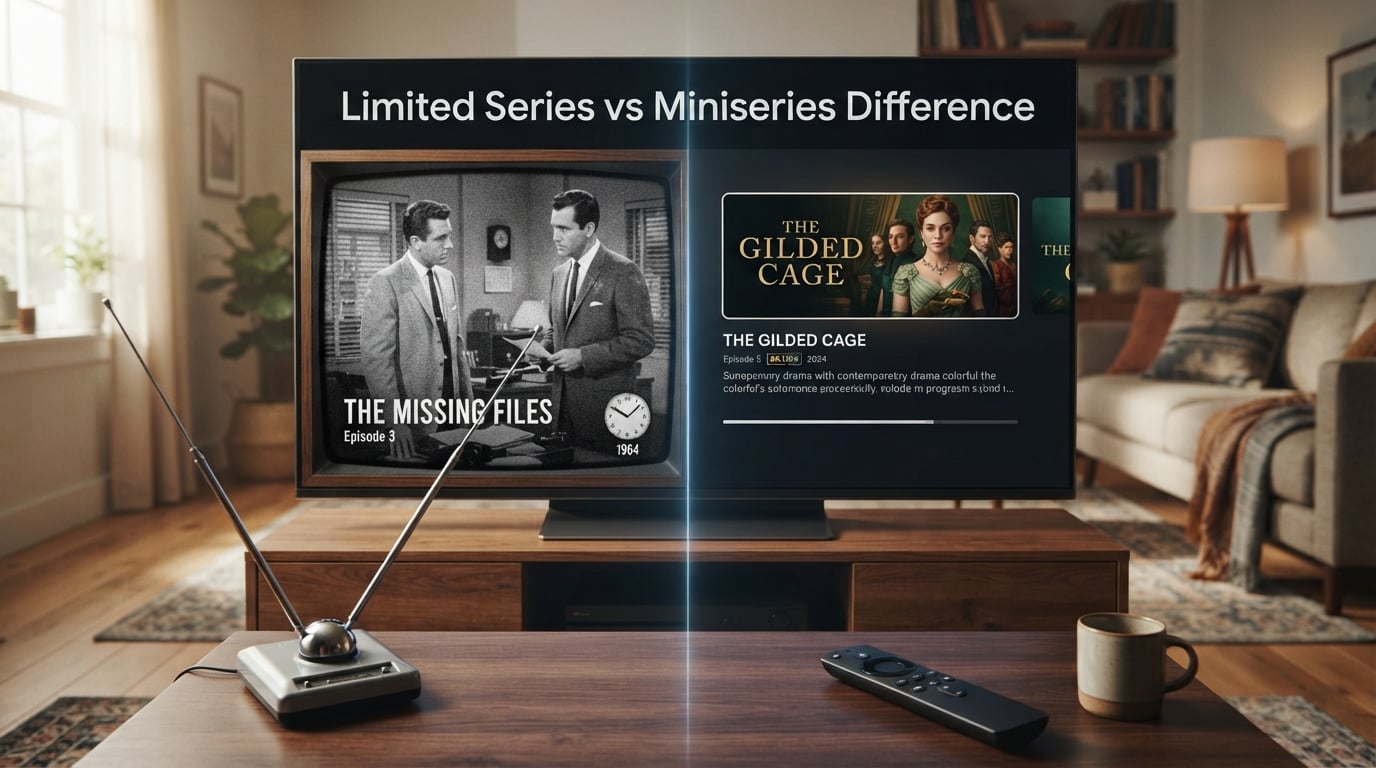
If you have scrolled through Netflix, HBO, or any major streaming platform lately, you have probably seen shows labeled as a “limited series” and wondered how that differs from the classic “miniseries.” The Limited Series vs Miniseries Difference comes down to more than just terminology. It shapes how a show is produced, how it airs, how the Television Academy categorizes it, and whether it can ever come back for another season.
In short: a limited series is a self-contained TV show with a predetermined number of episodes that tells one complete story with a definitive ending, designed as a single-season production. A miniseries is the older broadcast-era term for essentially the same concept, traditionally aired on consecutive nights over a fixed run. The labels overlap heavily today, but the industry shifted to “limited series” for specific reasons tied to streaming, prestige TV, and Emmy rules.
Understanding this distinction helps you know exactly what you are committing to when you press play. Some viewers love knowing a show will wrap up cleanly. Others get frustrated when a “limited” show suddenly announces a second season. This guide breaks down every angle so you never feel misled again.
Table of Contents
What Is a Limited Series?
A limited series is a television program with a fixed, predetermined number of episodes that tells a single complete story from start to finish. It is conceived as a one-season production with no intention of continuing beyond its planned run.
Every episode moves the narrative toward a known conclusion. There are no filler episodes, no open-ended cliffhangers designed to bait a renewal, and no “story engine” meant to churn out content indefinitely. The writers know the ending before the first episode films.
The limited series has become the dominant prestige TV format on streaming platforms over the past decade. Networks like HBO, Netflix, Hulu, and Apple TV+ lean heavily on this structure for true crime adaptations, historical dramas, and literary adaptations.
Key characteristics of a limited series include:
A self-contained story with a definitive ending, planned before production begins.
A predetermined episode count, typically between 4 and 10 episodes.
Released as a single season, usually through weekly episodes on streaming or cable.
Eligible for Emmy consideration in the Outstanding Limited or Anthology Series category.
Marketable as a binge-worthy commitment that viewers can finish in a weekend.
Streaming platforms favor the “limited series” label because it signals premium quality and finite scope. It tells subscribers they will get a complete experience without investing years into an open-ended show that might get canceled mid-plot.
What Is a Miniseries?
A miniseries is the traditional broadcast television term for a program that tells a complete story across a predetermined, limited number of episodes. The format exploded in popularity during the 1970s and 1980s as “event television” designed to draw massive audiences over several nights.
Classic miniseries were often aired on consecutive nights or across a single week, creating a shared cultural moment. Networks treated them as major events with heavy promotion, big budgets, and A-list talent. Think of them as the appointment-viewing blockbusters of their era.
The term itself reflects its era. “Mini” distinguished these short-run programs from full television series that ran for multiple seasons. A miniseries was something special, a departure from the weekly grind of regular programming.
Defining traits of a traditional miniseries include:
A finite story told over a set number of episodes, usually between 2 and 6 parts.
Aired in a concentrated window, often on consecutive nights or across one to two weeks.
Produced primarily for broadcast television and early cable.
Historically categorized separately from regular series in awards ceremonies.
Designed as a standalone event with no planned continuation.
Iconic miniseries like Roots (1977), Shogun (1980), and Band of Brothers (2001) defined the golden age of the format. They drew tens of millions of viewers and proved that finite storytelling could be both commercially successful and critically acclaimed.
Limited Series vs Miniseries Difference: The Core Distinctions
The limited series vs miniseries difference is nuanced because the two formats share the same fundamental DNA. Both tell self-contained stories over a predetermined number of episodes with no guarantee of continuation. The differences are mostly about era, distribution method, industry labeling, and how each term is used today.
Here is a side-by-side breakdown of how the two compare:
| Characteristic | Limited Series | Miniseries |
|---|---|---|
| Era of origin | Streaming age (2026 onward, popularized 2010s+) | Broadcast television era (1970s-2000s) |
| Primary distribution | Streaming platforms, premium cable | Broadcast networks, early cable |
| Airing pattern | Weekly episodes or full-season drop | Consecutive nights or concentrated week |
| Typical episode count | 4 to 10 episodes | 2 to 6 episodes (sometimes longer) |
| Current industry usage | Dominant modern term | Largely retired, used for older content |
| Emmy category | Outstanding Limited or Anthology Series | Formerly Outstanding Miniseries (merged in 2014) |
| Renewal possibility | Possible but marketed as finite | Originally strictly one-time events |
The numbered list below highlights the practical differences that matter most to viewers:
Distribution method: Miniseries aired on broadcast TV in concentrated bursts. Limited series release on streaming platforms either weekly or all at once for binge-watching.
Release strategy: A miniseries built event television by airing nightly. A limited series builds anticipation through weekly drops or encourages bingeing with a full-season release.
Industry labeling: Streaming platforms almost exclusively use “limited series” today. “Miniseries” appears mostly in references to older programming or in casual conversation.
Awards classification: The Television Academy merged the miniseries category into the limited series category in 2014, effectively retiring the older term for competitive purposes.
Cultural connotation: “Miniseries” evokes the golden age of broadcast event TV. “Limited series” signals modern prestige streaming content.
Marketing position: Platforms use “limited series” to promise a complete story without an open-ended commitment, attracting viewers who want closure.
In everyday conversation, many people use the two terms interchangeably. Forums like Reddit and Quora are filled with users asking whether there is any real difference at all. The honest answer is that the formats are nearly identical in structure. The distinction lives mostly in when and where each term was used.
How Many Episodes Is Each Format?
Episode count is one of the clearest practical indicators of both formats. Neither a limited series nor a miniseries runs indefinitely, but the ranges differ slightly based on era and platform.
A limited series typically runs between 4 and 10 episodes. Streaming platforms favor shorter seasons of 6 to 8 episodes, which fits comfortably into a weekend binge. Each episode usually runs 45 to 70 minutes, giving creators room for depth without overstaying.
A traditional miniseries often ran between 2 and 6 episodes, though some landmark productions stretched longer. The Television Academy currently defines a limited or anthology series as having two or more episodes with a total running time of at least 150 minutes. That threshold keeps the door open for both short and longer productions to qualify.
Broadcast-era miniseries could run much longer. Roots spanned 8 episodes aired over 8 consecutive nights. The Thorn Birds ran 4 episodes but totaled nearly 9 hours of content. The format was flexible, but the key rule held: the story had a definitive endpoint.
The episode count matters because it signals commitment level. A 4-episode limited series asks for roughly 4 hours of your time. A 10-episode run asks for a full weekend. Either way, you know the finish line before you start.
Why the Industry Shifted From Miniseries to Limited Series
The terminology shift from “miniseries” to “limited series” was not random. It reflected broader changes in how television was produced, distributed, and consumed.
In the broadcast era, “miniseries” carried prestige. It meant a major network event with a big budget and big stars. But as cable and then streaming disrupted traditional television, the word began to feel dated. It evoked a specific era of 1970s and 1980s event programming rather than cutting-edge storytelling.
Streaming platforms wanted a fresh label. “Limited series” sounded modern, flexible, and premium. It distanced new programming from the older broadcast model while preserving the core promise of a finite, complete story. The term also aligned with the binge-watching culture that streaming created.
Several practical factors drove the change:
Emmy consolidation: In 2014, the Television Academy merged the Outstanding Miniseries and Outstanding TV Movie categories, then later restructured around “Limited or Anthology Series.” This officially retired “miniseries” as an awards label.
Streaming branding: Platforms like Netflix and Amazon needed terminology that fit their release models. “Limited series” worked better for both weekly drops and full-season dumps.
Prestige repositioning: “Miniseries” felt like yesterday’s format. “Limited series” signaled something new and exclusive, even though the structure was essentially the same.
Flexibility for renewal: The word “limited” leaves a subtle door open. If a show performs well, platforms can announce a second season without technically breaking a promise, since “limited” is vaguer than “mini.”
This last point is a frequent source of viewer frustration. When a show labeled “limited series” gets renewed, some audiences feel misled. The industry counts on this flexibility, but it muddies the water for anyone trying to understand the terminology.
Can a Limited Series Get a Season 2?
Yes, a limited series can return for another season, and this is one of the most misunderstood aspects of the format. The label promises a complete story within its run, but it does not legally or contractually prevent continuation.
When a limited series performs exceptionally well, networks and streamers often find a way to bring it back. This can happen in several ways. Sometimes the same characters return for a new story arc. Sometimes the show transforms into an anthology, keeping the title but shifting to an entirely new cast and plot each season.
Real examples of limited series that continued include:
The White Lotus (HBO) was conceived as a limited series but renewed as an anthology, with each season set in a different resort location.
Big Little Lies (HBO) was billed as a limited series, then renewed for a second season due to overwhelming demand and critical success.
Fargo (FX) operates as an ongoing anthology limited series, with each season telling a completely new story set in the same universe.
True Detective (HBO) follows the same model, returning with new casts and storylines across multiple seasons.
The pattern is clear. A “limited” label means the current story has a definitive ending. It does not mean the property is permanently retired. Studios treat successful limited series as valuable IP that can spawn sequels, spin-offs, or anthology continuations.
For viewers, the takeaway is simple. Enjoy the complete story you are promised. Just do not be shocked if a smash hit finds its way back for more.
Anthology Series vs Limited Series vs Miniseries
The anthology series adds another layer to this conversation. It is related to both formats but operates on a different structural logic that is worth understanding.
An anthology series returns season after season with a brand-new story, cast, and sometimes setting each time. The through-line is a thematic or titular connection, not a continuous narrative. American Horror Story, Black Mirror, and Fargo are prime examples.
Here is how the three formats relate to each other:
Miniseries: A one-time finite story, traditionally aired on broadcast TV, never intended to return.
Limited series: A finite story designed as a single season, but with the flexibility to return if it succeeds, either as a sequel or an anthology.
Anthology series: An ongoing format where each season is a new self-contained story under a shared brand or theme.
The lines blur in practice. Many modern anthology series are categorized as “limited series” for Emmy purposes because each individual season functions as a self-contained limited run. The Television Academy uses the umbrella category “Outstanding Limited or Anthology Series” precisely because the formats overlap so heavily.
For the average viewer, the distinction matters less than the promise each format makes. All three guarantee a complete story within their run. The difference is whether the show might come back, and if so, whether it will tell the same story or a new one.
Emmy Awards and Industry Categorization
The Television Academy plays a major role in how these terms are used and understood. Emmy categorization effectively defines what counts as a limited series in the professional industry.
As of 2026, the Emmy category is called Outstanding Limited or Anthology Series. To qualify, a program must have two or more episodes with a total running time of at least 150 minutes. The story must be fully resolved within its run, with no ongoing story arc continuing into another season.
The rules are specific about what disqualifies a show from this category. If a program continues its story into a subsequent season with the same characters and ongoing narrative, it is classified as a drama or comedy series instead. This is why shows like The Crown or Succession compete in drama categories while Chernobyl and The Queen’s Gambit qualify as limited series.
The category merger history is important context. Before 2014, the Emmys had a separate Outstanding Miniseries category. The Academy merged it with the TV Movie category, then later restructured the whole system around limited and anthology series. This official change cemented “limited series” as the industry-standard term and effectively retired “miniseries” from awards competition.
Understanding these rules helps explain why platforms are so careful with labeling. A show’s Emmy category affects its prestige, marketing, and awards campaign budget. The label is not just for viewers; it has real industry stakes.
Popular Examples of Each Format
Concrete examples make the distinction clearer than any definition. Here are standout shows from each category that illustrate how the formats work in practice.
Landmark miniseries from the broadcast era:
Roots (1977) is perhaps the most influential miniseries ever made. It aired over 8 consecutive nights on ABC and drew over 100 million viewers for its finale, redefining event television.
Band of Brothers (2001) was a 10-part HBO miniseries following a World War II paratrooper company. It set the modern standard for prestige finite storytelling.
The Thorn Birds (1983) was a 4-part romantic drama that became one of the highest-rated miniseries in television history.
Shogun (1980) was a sprawling historical epic that helped establish the miniseries as a vehicle for ambitious literary adaptations.
Defining limited series from the streaming era:
Chernobyl (2019, HBO) is a 5-episode historical drama that many consider the gold standard of the modern limited series format.
The Queen’s Gambit (2020, Netflix) is a 7-episode chess drama that became a cultural phenomenon and won 11 Emmy Awards.
Mare of Easttown (2021, HBO) is a 7-episode crime drama showcasing how limited series attract A-list film talent to television.
Beef (2023, Netflix) is a 10-episode dark comedy that demonstrates how streaming platforms use the limited series format for bold, original storytelling.
Notice the pattern. Miniseries examples cluster in the broadcast and early cable era. Limited series examples dominate the streaming age. The storytelling DNA is the same. The labels simply reflect when each show was made and how it reached audiences.
Common Viewer Confusion Points
Even after understanding the definitions, several points consistently trip up viewers. These come straight from real discussions on Reddit, Quora, and other forums where people try to make sense of the terminology.
The biggest source of confusion is inconsistency across platforms. Netflix, HBO, Hulu, and Apple TV+ do not apply the labels uniformly. Some slap “limited series” on anything short. Others reserve it for specific Emmy-eligible productions. This inconsistency makes it hard to know what you are actually getting.
Another common frustration is the renewal bait-and-switch. Viewers invest in a limited series expecting closure, only to see a second season announced months later. While the story they watched was complete, the marketing implied finality. This feels misleading even though no rules were technically broken.
People also struggle with whether the terms are interchangeable. The honest answer is that in casual modern usage, they often are. If you call Chernobyl a miniseries, most people will understand exactly what you mean. The industry just prefers “limited series” now.
Finally, the anthology question creates ongoing confusion. When a show like The White Lotus returns with new characters, viewers wonder if it is still the same show. Understanding that anthology series function as recurring limited runs clears up most of this uncertainty.
FAQs
Is a limited series the same as a mini series?
In practical terms, yes. Both formats tell a self-contained story over a predetermined number of episodes with a definitive ending. The main difference is era and industry usage. Miniseries is the traditional broadcast television term, while limited series is the modern streaming-era label that replaced it after the Emmy category was restructured in 2014.
How many episodes is considered a limited series?
A limited series typically runs between 4 and 10 episodes, with most streaming productions landing in the 6 to 8 episode range. The Television Academy requires at least two episodes with a total running time of 150 minutes or more to qualify for the Outstanding Limited or Anthology Series Emmy category.
What makes a TV show a limited series?
A show qualifies as a limited series when it tells one complete story with a definitive ending across a predetermined number of episodes, with no ongoing narrative arc planned for future seasons. The story must be fully resolved within its single-season run to meet industry and Emmy classification standards.
Can a limited series become a regular series?
Yes. While a limited series is designed as a finite single-season story, successful shows can return as anthologies or sequels. The White Lotus, Big Little Lies, and Fargo all began as limited series and continued in new forms. The label promises a complete story, not a permanent end to the property.
What do you call a TV show with limited episodes?
A TV show with a limited, predetermined number of episodes telling a complete story is called a limited series in modern usage or a miniseries in traditional broadcast terminology. Other related terms include limited-run series, event series, and self-contained series, though limited series is now the industry standard label.
How many episodes to be considered a miniseries?
Traditional miniseries ranged from 2 to 6 episodes, though landmark productions like Roots spanned 8 parts. There is no strict minimum. The defining feature is that the story has a predetermined endpoint, not the specific episode count. The Emmy threshold of 150 total minutes applies to both formats.
The Bottom Line
The Limited Series vs Miniseries Difference ultimately comes down to timing, terminology, and distribution rather than fundamentally different storytelling. Both formats deliver a complete, self-contained story with a definitive ending across a predetermined episode count. The miniseries defined the golden age of broadcast event television, while the limited series defines the streaming era of prestige programming.
If you take away one thing, let it be this. When a platform labels something a limited series today, you are getting a finite story that will reach a conclusion. Whether it might return someday is a separate question, but the story you press play on will finish. That guarantee is what makes both formats so appealing in an age of endless, open-ended television.
Next time you see “limited series” on your favorite streaming app, you will know exactly what it means, where the term came from, and why the industry chose it over the classic miniseries label.