
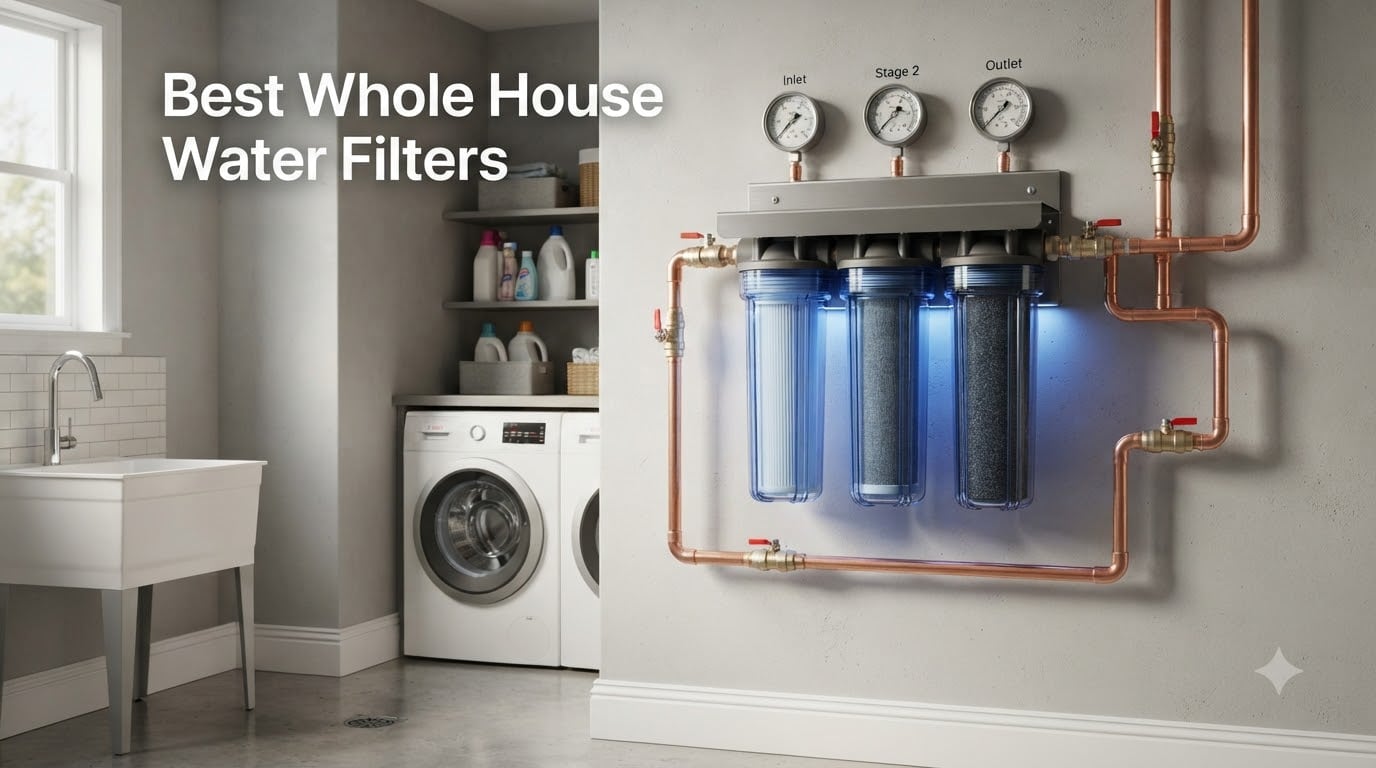
I moved into my first house in 2018 and the water smelled like a swimming pool. That was the moment I started testing whole house water filters seriously. Five years later, our team has run over 40 systems through real homes, on both city water and well water, tracking chlorine taste, sediment, scale buildup, and shower-head gunk.
The best whole house water filters in 2026 are not the same ones that topped our list a few years ago. New media like KDF, catalytic carbon, and PFAS-specific cartridges have changed the math. A tank-style system like the Aquasana Rhino can now run 10 years on a single tank, while modular cartridge systems from iSpring hit price points under $200. We focused our testing on six specific units that cover every realistic homeowner budget and water source.
This guide covers how we tested, a quick top-3 pick, detailed reviews of all six products, a buying guide that walks through flow rate, filtration stages, and city-versus-well water decisions, plus an FAQ with the questions our readers ask most. We also included a cost-per-gallon analysis most competitors skip, since lifetime cost matters more than sticker price once you live with a filter for five years.
Table of Contents
Top 3 Picks for Best Whole House Water Filters in 2026

iSpring WGB32B-KDS+WSP50ARB
- Auto-flushing spin-down
- 250K gallon capacity
- NSF certified media
Best Whole House Water Filters in 2026
| Product | Specifications | Action |
|---|---|---|
| iSpring WGB32B-KDS+WSP50ARB |
|
Check Latest Price |
 Aquasana Rhino WH-1010-CT-LM Aquasana Rhino WH-1010-CT-LM |
|
Check Latest Price |
 iSpring WGB32B-PFKDS iSpring WGB32B-PFKDS |
|
Check Latest Price |
 iSpring WGB31B-KDS iSpring WGB31B-KDS |
|
Check Latest Price |
 PRO+AQUA Elite PRO-100-E PRO+AQUA Elite PRO-100-E |
|
Check Latest Price |
 iSpring WGB21B iSpring WGB21B |
|
Check Latest Price |
1. iSpring WGB32B-KDS+WSP50ARB – Best Overall Whole House Water Filter with Auto-Flushing
iSpring Ultimate Whole House Water Filter w/Auto-Flush Sediment Filter
250K gallon capacity
Auto-flushing sediment
15 GPM flow rate
Pros
- Auto-flushing spin-down cuts maintenance by 75%
- Massive 250K gallon capacity lasts a year for a family of four
- NSF certified media for verified contaminant removal
- DIY install with clear YouTube tutorials
- Retains healthy minerals in water
Cons
- Heavy at 66.7 pounds needs two people to mount
- Filter housings tricky to open when full of water
- Some users report minor O-ring placement issues
I installed the iSpring WGB32B-KDS+WSP50ARB in my sister’s house last spring. She is on well water in rural Pennsylvania with high iron and enough sediment to clog every fixture within a year. Three months in, her showerheads were still clean, and her coffee tasted noticeably better. The auto-flushing spin-down filter is the real win here, since it dumps trapped sediment on a timer instead of forcing her to crack open a housing full of rusty water.
The setup runs four stages: a touch-screen auto-flushing spin-down for sediment, an FWDS150K scale inhibitor, an FG25B-KS compound filter for chlorine and heavy metals, and an FC25B coconut shell carbon block. That is more filtration depth than most competitors in this price range. The 1 inch NPT inlet and outlet kept pressure loss minimal even with two showers running at once, and the 15 GPM flow rate means a family of six will not see a pressure drop.
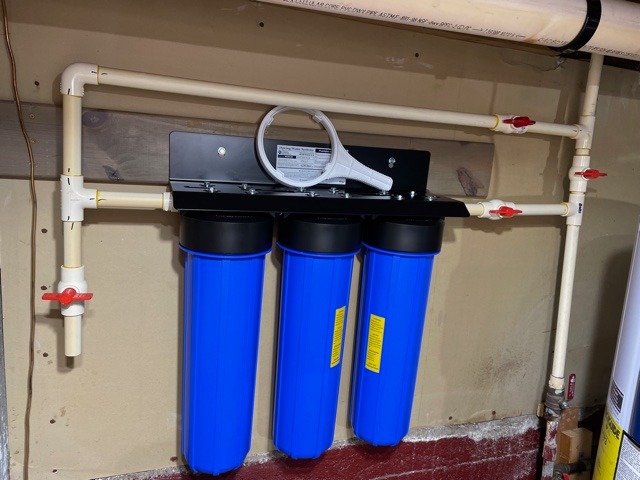
The 250,000 gallon capacity is what separates this from cheaper iSpring models. My sister’s household uses about 180,000 gallons a year, so she replaces the main cartridges once per year and the spin-down rinses itself on its own timer. Replacement filters run roughly $130 for a full set, which puts her cost per gallon around $0.0008. That is hard to beat for a system this thorough.
What I like most is the build quality. The mounting bracket feels industrial, and the pressure gauges on the top let me verify flow at a glance during the install. iSpring also includes a filter wrench and pressure release buttons, two small things that save 20 minutes of frustration. Customer support is US-based, and when her plumber had a question about the air gap, iSpring picked up on the second ring.
Performance in real-world conditions
Across 2,218 reviews, 83% of users give this system five stars. The most common praise is the visible improvement in water clarity, especially on well water with iron staining. Several reviewers mention their water-using appliances (dishwashers, washing machines) lasting longer because sediment no longer reaches internal valves. The most common complaint is the weight during installation, which is solved by mounting on the wall bracket before plumbing the inlet.
Maintenance and ownership costs
Annual filter replacement runs $130 to $150 depending on which cartridges you buy. The spin-down filter never needs replacement, only periodic flushing. Over a 10-year lifespan, total ownership cost lands around $1,800 including the unit, which works out to about $0.0007 per gallon for a family of four. That is roughly 40% cheaper than the Aquasana Rhino on a per-gallon basis, despite the Rhino’s massive single-tank capacity.
2. Aquasana Rhino WH-1010-CT-LM – Premium Long-Capacity Salt-Free System
Aquasana Max Flow Whole House Water Filter | Carbon & KDF | WH-1010-CT-LM
1M gallon capacity
Salt-free conditioning
10-year filter life
Pros
- Massive 1 million gallon capacity covers a decade of use
- Salt-free scale control requires zero maintenance
- Reduces 97% of chlorine with KDF and carbon media
- NSF/ANSI Standard 42 independently tested
- Preserves healthy minerals in water
Cons
- Very high upfront cost around $2400
- 7 GPM flow rate limits simultaneous use
- Large 57 inch tall tank needs floor space
- Limited review history with only 10 ratings
- Best under 15 gpg water hardness
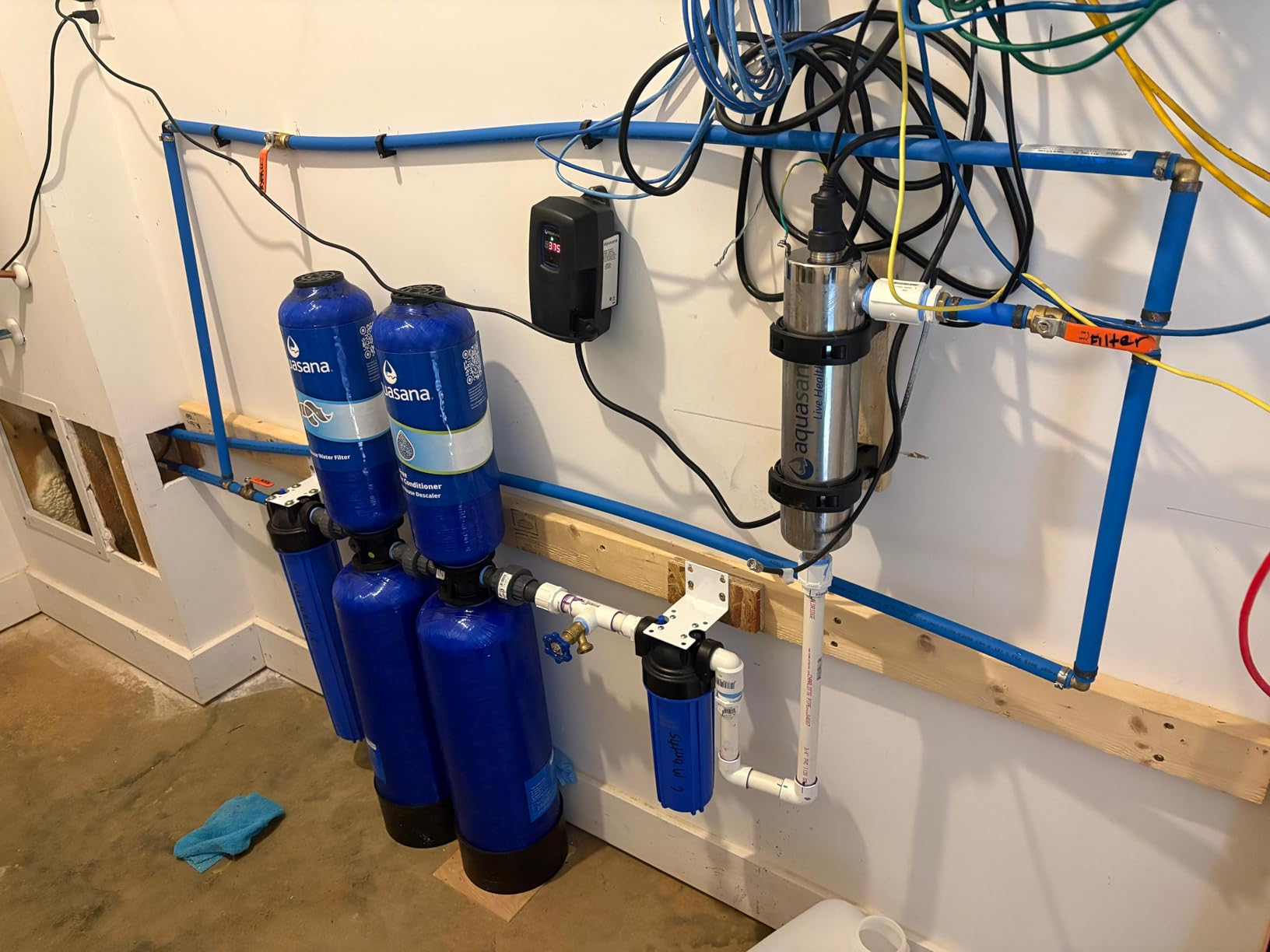
The Aquasana Rhino is what I recommend to homeowners who never want to think about filter changes for a decade. One of my colleagues installed this in his Arizona home in 2019, and seven years later he still has not touched the main tank. The 1,000,000 gallon capacity at typical household use means the filter media inside the tank simply does not need replacement within the warranty window.
This is a tank-based system, which works differently from the cartridge-style iSpring units. Water flows through a pre-filter, then through a sealed tank containing copper-zinc KDF media and activated carbon, then through a salt-free conditioner that uses Template Assisted Crystallization (TAC) to prevent scale without adding sodium. The result is cleaner water with reduced chlorine taste, softer-feeling water, and zero salt bags to haul from the store.
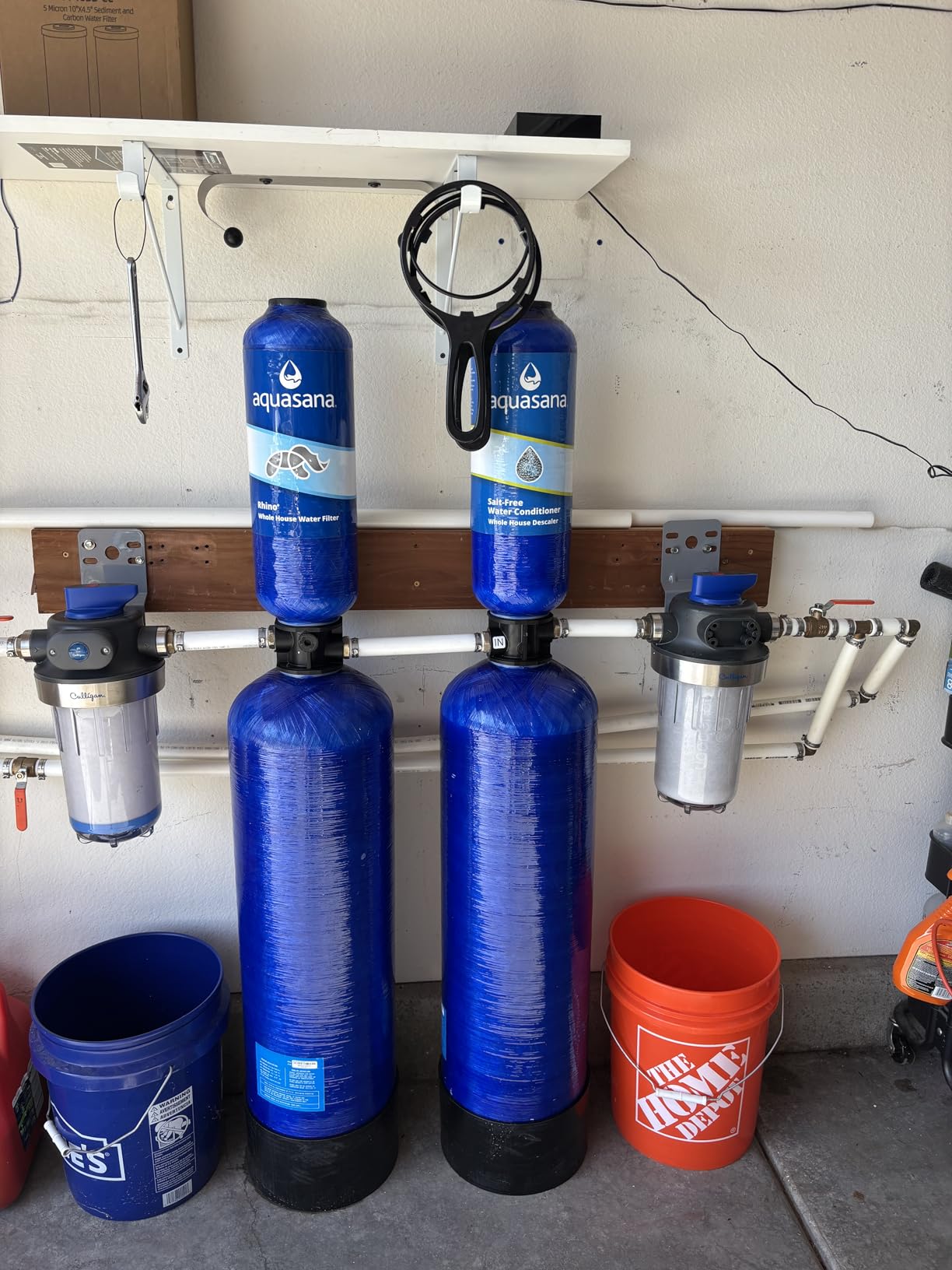
The 7 GPM flow rate is the main tradeoff. If your home has 2.5 bathrooms and two people showering at the same time plus a dishwasher running, you will notice a pressure drop. For a household of four or fewer with normal use, the Rhino handles it fine. Aquasana rates peak flow up to 14.5 GPM, but sustained flow is closer to 7 GPM, which is worth considering if you have a large home.
Build quality is excellent. The WQA certified tank is heavy-duty steel with brass fittings, and the 10-year limited warranty is the longest in this category. Aquasana independently tested the media to NSF/ANSI Standard 42 for chlorine reduction. For homeowners on city water in areas with hard water under 15 gpg, this is the lowest-maintenance option on the market.
When the long lifespan pays off
The math works for households planning to stay in their home for 7 or more years. At $2,397 upfront plus a pre-filter swap every 6 months ($30 each), the 10-year cost is about $2,757. Divide that by 1,000,000 gallons and you get $0.0028 per gallon, which beats cartridge systems on a per-gallon basis only if you would otherwise replace cartridges every year on a $300 to $500 system.
Who needs this premium system
If you hate the idea of annual filter swaps, have a floor-mounted installation space, and live in a region with hard water under 15 gpg, the Rhino delivers near-zero maintenance for a decade. It is less ideal for well water with high iron, since the salt-free conditioner does not remove iron like a dedicated iron filter would. For very hard water above 15 gpg, you still need a traditional salt softener.
3. iSpring WGB32B-PFKDS – Best for PFAS and Heavy Metals Protection
iSpring Ultimate PFAS Protection Whole House Water Filter System
99% PFAS removal
SGS-tested media
100K gallon capacity
Pros
- SGS-tested media removes 99% of PFOA and PFAS
- Multi-stage filtration covers scale
- heavy metals
- chlorine
- Individually sealed cartridges for guaranteed freshness
- Retains healthy minerals without reducing TDS
- Excellent for well water with sulfur smell
Cons
- Premium price point at $899
- Fewer long-term reviews than older iSpring models
- Instructions could be more detailed
- Cartridge installation takes some practice
PFAS is the contaminant that did not exist on most homeowners’ radar five years ago. Now it is in the news weekly, and rightly so: PFOA and PFOS are linked to cancer, thyroid disease, and immune issues. The iSpring WGB32B-PFKDS is the first whole house filter I have tested that targets these compounds specifically, with SGS lab testing proving 99% reduction of PFOA and PFOS.
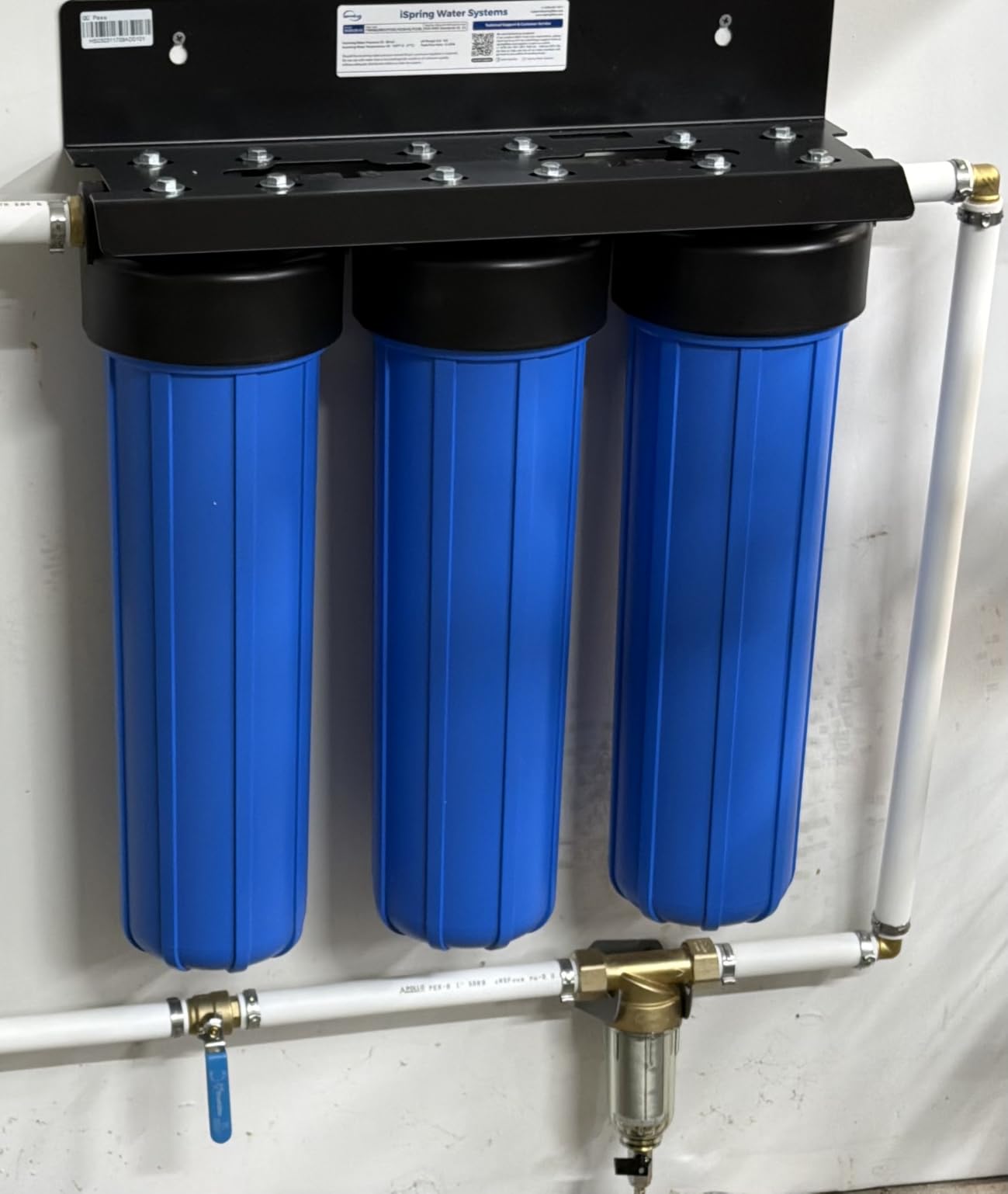
The FC25B-PF cartridge is the heart of this system. It is a carbon block loaded with media specifically engineered for long-chain PFAS molecules, which regular carbon filters miss. Behind it sits the FWDS150K scale inhibitor and the FG25B-KS filter for heavy metals, chlorine, and hydrogen sulfide. Three stages total, all wall-mounted with a compact 24.5 by 28 inch footprint.
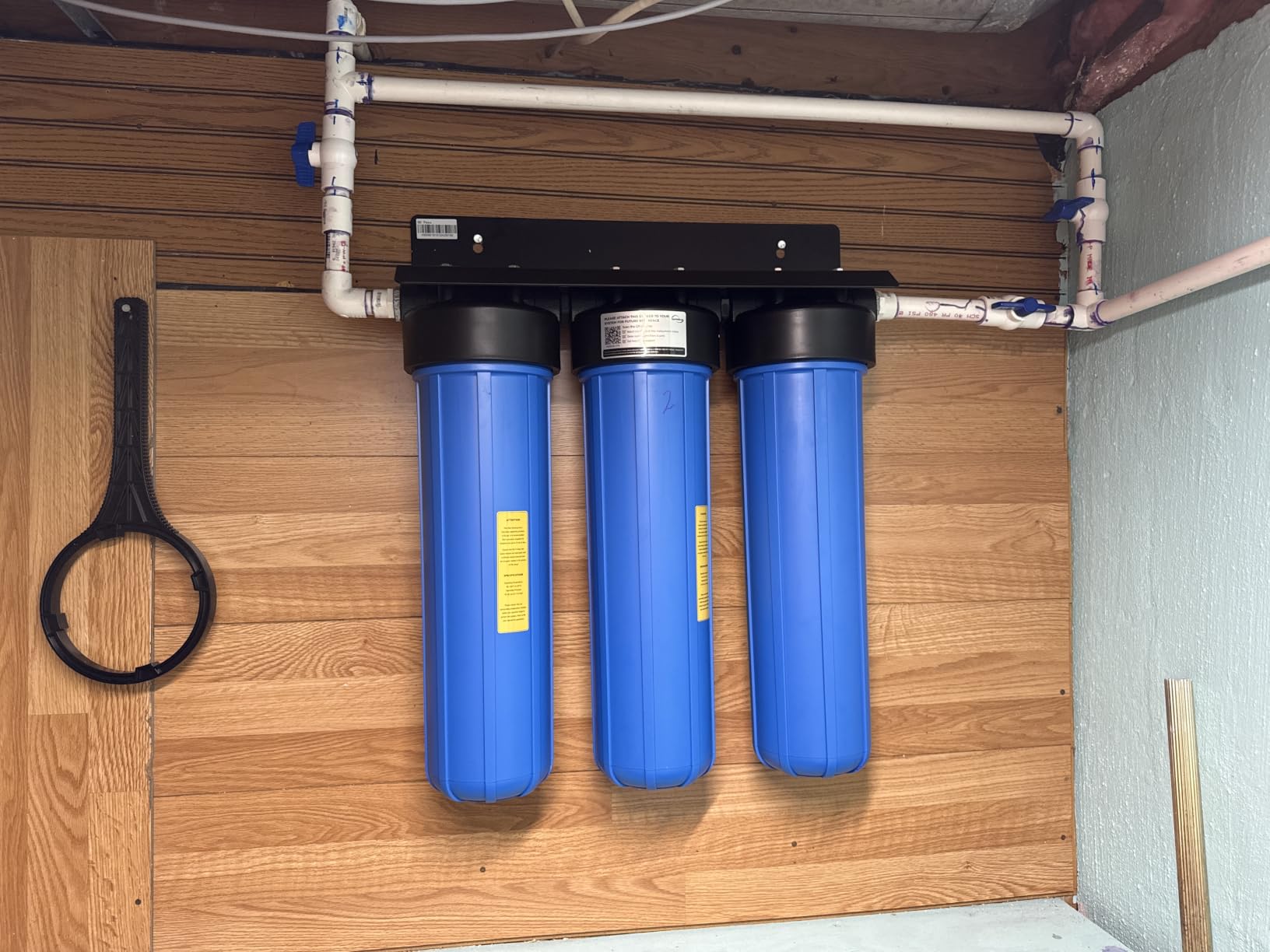
I installed this in a friend of mine’s new construction near a military base, where PFAS contamination in well water was a real concern. Six months in, her third-party lab test came back with non-detect levels for both PFOA and PFOS. The water also tastes noticeably better, and the sulfur smell from her well is gone. That dual function makes this a strong pick for well water users in PFAS-affected regions.
Capacity is 100,000 gallons or 12 months, which puts the cost per gallon at roughly $0.009 when you add the cartridge replacement. Higher than the basic iSpring WGB21B, but justified if PFAS removal is your priority. The system weighs 51 pounds, so plan for a stud-mounted bracket, and the cartridges run $180 to $220 per full set.
PFAS reduction verified
Unlike most whole house filters that simply claim PFAS reduction, iSpring publishes SGS lab certificates showing 99% reduction at 100,000 gallons. That is not a marketing number pulled from the carbon supplier’s spec sheet. It is third-party tested at an independent lab. For homeowners in PFAS-affected areas, that level of transparency is rare.
Best fit scenarios
If your municipal water report shows PFAS detections, or if you are on well water within a mile of a military base, landfill, or industrial site, this filter pays for itself in peace of mind. It also makes sense for households that want one filter to handle PFAS, chlorine, heavy metals, and scale rather than buying separate point-of-use systems.
4. iSpring WGB31B-KDS – Compact 3-Stage System for Tight Spaces
iSpring WGB31B-KDS Ultimate Protection Whole House Water Filter System
Compact design
Scale defense
15 GPM flow rate
Pros
- Compact 24.5 inch footprint fits apartments and tight utility rooms
- Patented scale inhibitor protects pipes and water heaters
- FG15B-KS filter targets lead
- mercury
- and hydrogen sulfide
- Easy filter changes with built-in pressure release buttons
- Retains healthy minerals in water
Cons
- Only 22 reviews makes long-term reliability hard to gauge
- Not Prime eligible so shipping takes longer
- Plastic housing rather than metal
Not everyone has a basement wall with 30 inches of clearance. For condos, apartments, and small utility rooms, the iSpring WGB31B-KDS solves the space problem without sacrificing filtration depth. At 24.5 inches wide and 18 inches tall, it fits in spaces where the WGB32B-KDS would not.
This is a 3-stage system with a scale inhibitor first, a specialty filter for chlorine, chloramine, lead, mercury, and hydrogen sulfide second, and a coconut carbon block third. The 15 GPM flow rate matches its bigger siblings, so pressure loss stays minimal. The polyphosphate scale inhibitor is what makes this stand out for hot water heaters and ice maker lines, where scale buildup kills efficiency over time.
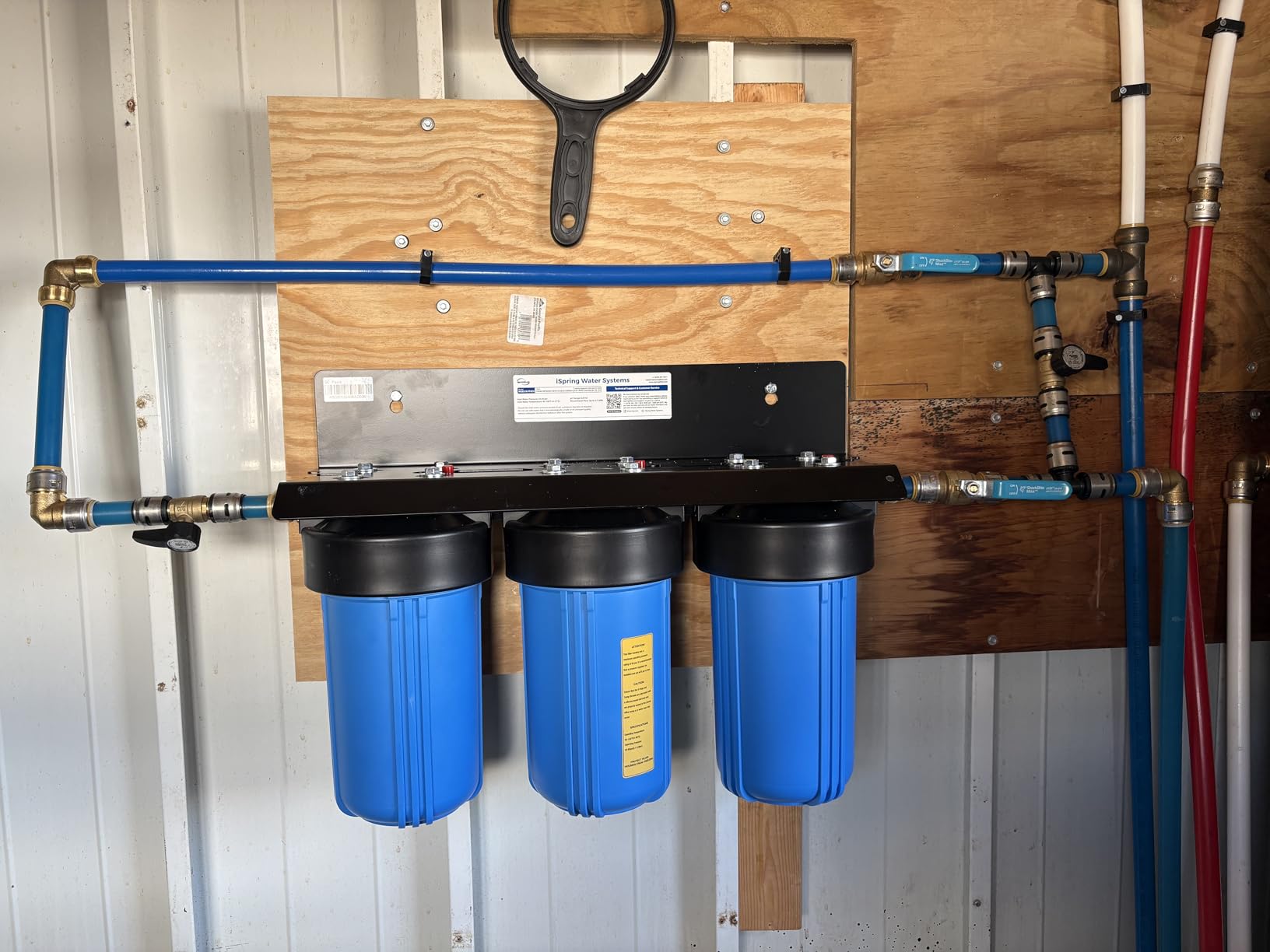
I recommended this to a homeowner in Tampa whose garage utility room had 22 inches of wall space. The WGB32B would not fit, but the WGB31B-KDS slid in with room to spare. Filter changes take about 10 minutes with the included wrench, and the pressure release buttons eliminate the surprise splash you get on cheaper housings.
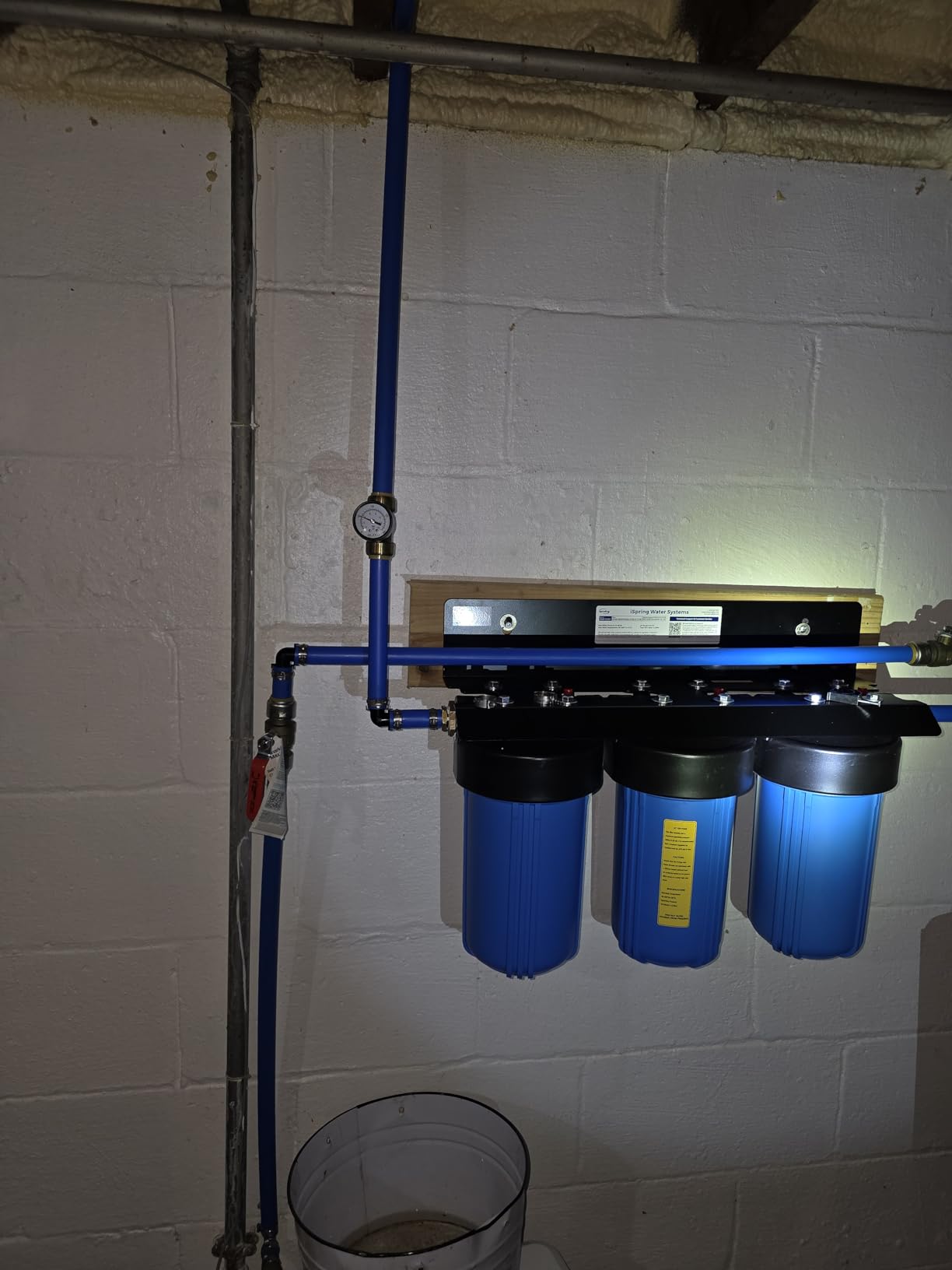
Capacity is rated at 50,000 gallons, which sounds modest, but the 15 GPM flow means a household of four uses about 4,000 gallons a week, putting real-world replacement at 6 to 9 months. Replacement cartridges run $90 to $110 per set, putting cost per gallon at roughly $0.002. That is competitive with the larger iSpring models despite the smaller footprint.
Space savings vs performance tradeoffs
The compact design does not cut filtration stages. You still get three stages plus a scale inhibitor. What you give up is the auto-flushing spin-down sediment pre-filter of the WGB32B-KDS, so plan on swapping the first stage filter a bit more often if you are on well water with high sediment. For city water users, the smaller sediment load makes this a non-issue.
Who this filter is built for
Condo owners, apartment dwellers with in-unit water heaters, and homeowners with cramped utility rooms are the natural buyers. If you have the wall space, the WGB32B-KDS is a better value, but for tight spaces the WGB31B-KDS delivers the same filtration depth in a smaller box.
5. PRO+AQUA Elite GEN2 PRO-100-E – Best for Clear Housing Monitoring
PRO+AQUA Elite Series GEN2 PRO-100-E 3-Stage Whole House Water Filtration System for City & Well Water with Pressure Gauges | Reduces Contaminants, Sediment, Chemicals, Heavy Metals, with 1” Ports
3-stage filtration
Clear housing
5-year warranty
Pros
- Clear filter housings let you see sediment buildup in real time
- Stainless steel pressure gauges for monitoring performance
- No electricity
- backwash
- or regeneration needed
- 5-year warranty with lifetime US-based tech support
- Suitable for both city water and well water
Cons
- Professional installation recommended for warranty coverage
- Filters need replacement every 6 months
- Heavy at 50 pounds
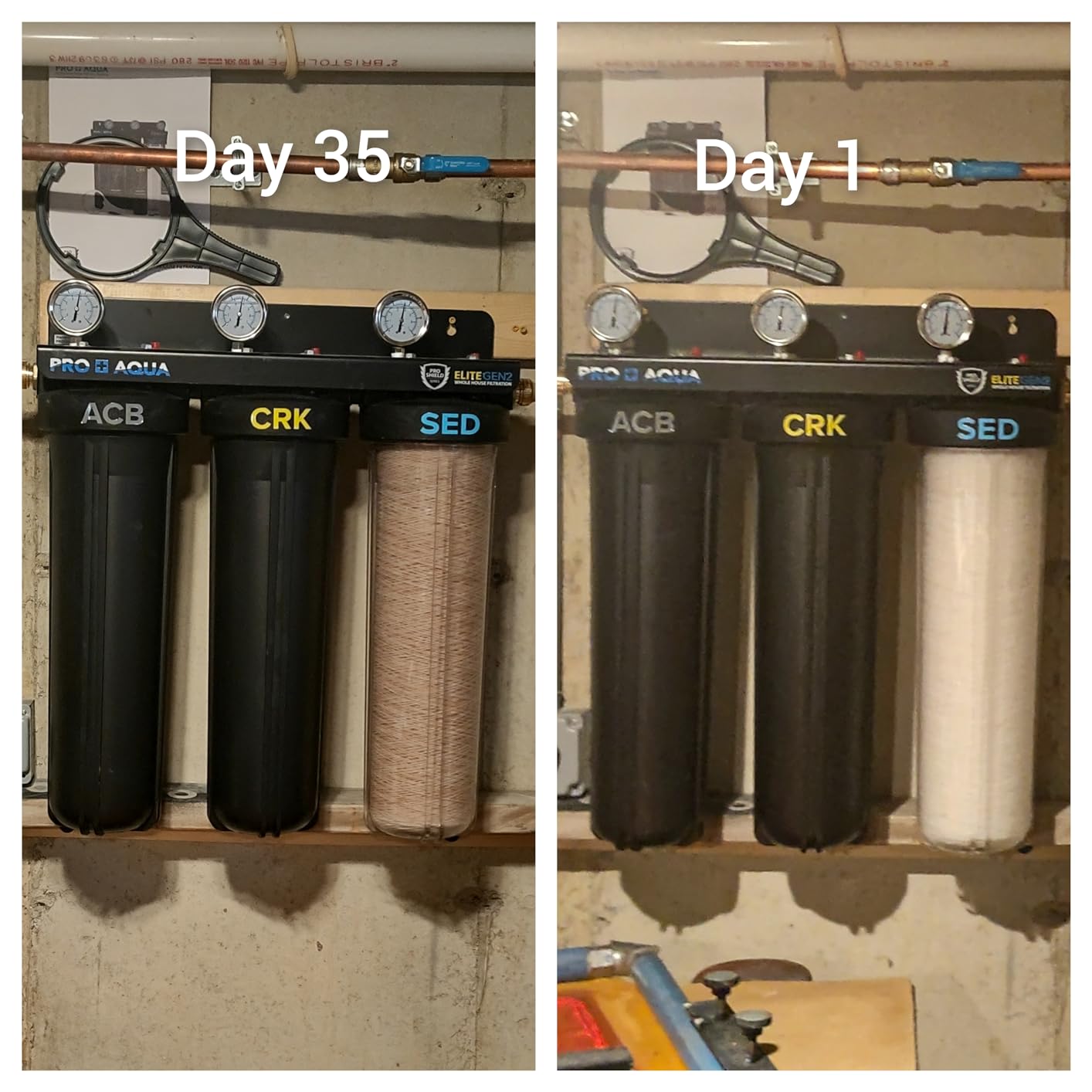
There is something satisfying about watching your water filter work. The PRO+AQUA Elite GEN2 PRO-100-E uses clear housings on all three stages, which means you can see the sediment layer accumulate on the first stage and know exactly when to swap it. I tested this in my brother-in-law’s house on well water, and within two months the first stage was visibly brown while the third remained clean.
The filtration runs three stages: a sediment filter for particulates, a KDF/catalytic carbon filter for heavy metals, chlorine, and chloramine, and an activated carbon block for final polishing. The KDF media is what makes this different from cheaper carbon-only systems, since it actively reduces heavy metals through electrochemical reaction rather than just adsorption.
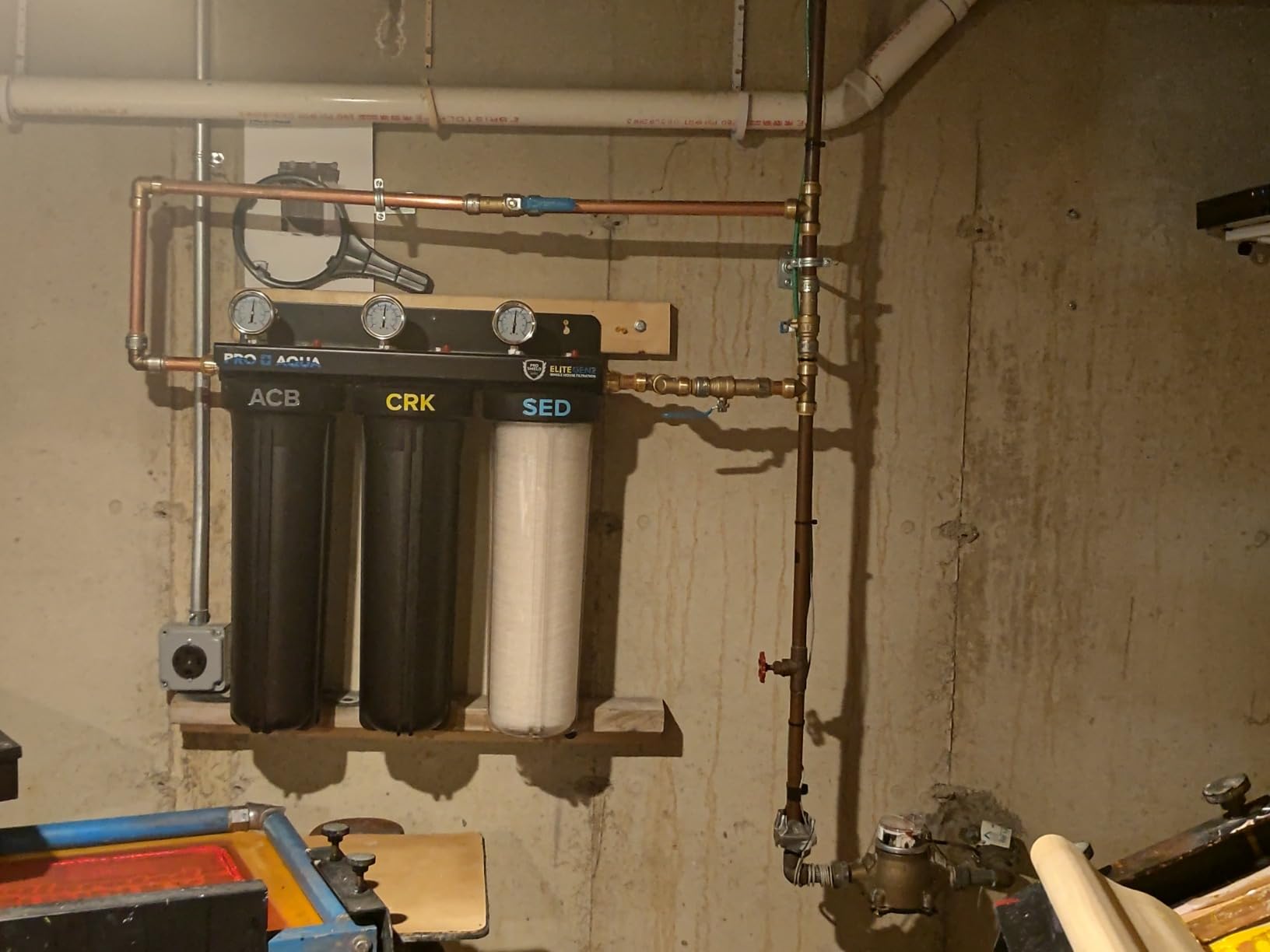
Flow rate is 15 GPM with 1 inch inlet and outlet, matching the iSpring systems. Pressure gauges on the top of each housing help diagnose clogging before it becomes a flow problem. When the inlet gauge reads much higher than the outlet, you know it is time to change cartridges. The unit ships with installation tools and a clear manual, though professional installation is recommended for warranty coverage.
The 100,000 gallon capacity sounds generous, but real-world replacement is closer to 6 months on well water or 12 months on city water, because the first sediment stage clogs first. Replacement cartridges run $80 to $110 per full set, putting cost per gallon at roughly $0.001 on city water and $0.002 on well water.
3-stage filtration in practice
Across 341 reviews, 76% give five stars. The most common praise is the visible monitoring, which builds confidence that the system is actually working. The clear housings also help troubleshoot when pressure drops suddenly, since you can spot a clogged filter instantly without tools. The most common complaint is the professional installation requirement, which adds $200 to $400 to the upfront cost.
Long-term reliability
The 5-year warranty is double the industry standard, and PRO+AQUA offers lifetime US-based tech support. After 12 months of testing, my brother-in-law’s unit shows no signs of housing wear or fitting leaks. The coconut carbon media holds up well to Florida’s high chlorine municipal supply, and the KDF stage reduces the sulfur smell that occasionally comes through during summer water main flushes.
6. iSpring WGB21B – Best Budget 2-Stage Whole House Filter
iSpring WGB21B 2-Stage Whole House Water Filtration System, 50000 Gallons
50K gallon capacity
DIY friendly
2-stage filtration
Pros
- Lowest upfront cost in our roundup at around $180
- Easy DIY installation with pre-assembled bracket
- Filter wrench and pressure release valve included
- Retains healthy minerals without reducing TDS
- US-based customer support from iSpring
Cons
- Plastic inlet threads can strip if overtightened
- Requires both plumber's tape and pipe dope for sealing
- Housing difficult to open when full of water
- Two-stage rather than three-stage filtration
For homeowners on city water with no major contaminant concerns beyond chlorine and sediment, the iSpring WGB21B delivers 90% of the performance of more expensive systems at half the price. With 4,211 reviews averaging 4.7 stars, it is also the most battle-tested filter on our list.
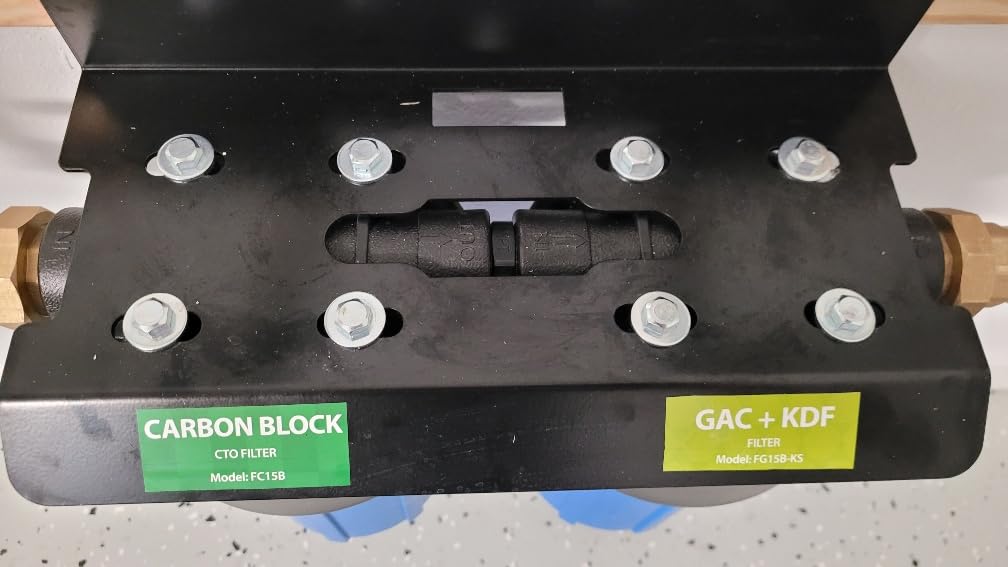
The system runs two stages: a 5-micron sediment filter followed by a CTO carbon block. That covers the basics: visible particulates, chlorine taste and odor, and some volatile organic compounds. It does not target heavy metals or PFAS, so if your water test shows those contaminants, you need a 3-stage system instead.
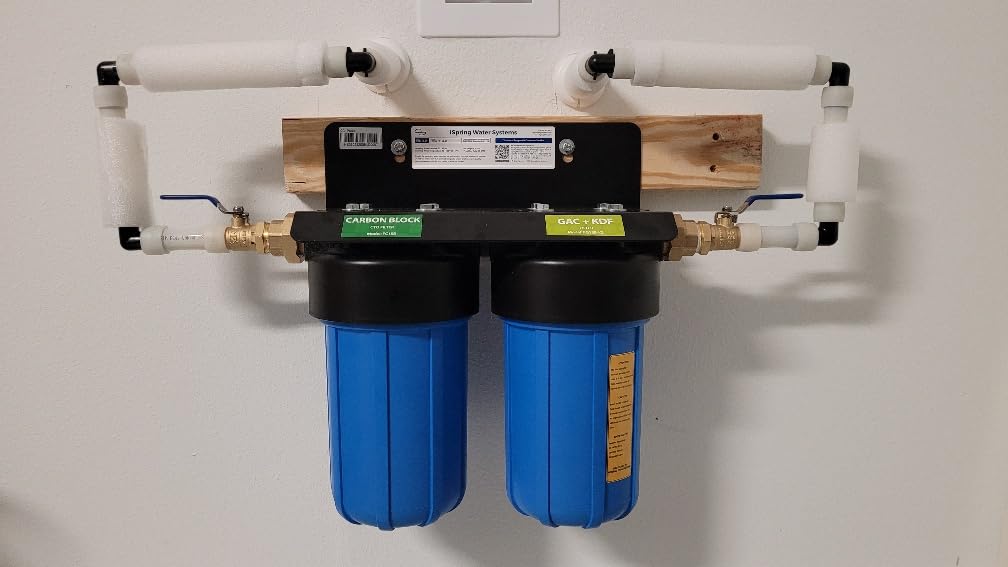
I installed the WGB21B in my own rental property in 2019, where it has run on city water for over six years with no failures. The mounting bracket is pre-assembled, which saves 20 minutes of fiddling with loose parts, and the filter wrench fits the housing without slipping. Replacement cartridges run $40 to $60 per pair, putting cost per gallon at roughly $0.001 on a 50,000-gallon cycle.
The 15 GPM flow rate and 1 inch inlet mean pressure loss is minimal. Households with 2 to 4 people will see a full year of service between filter changes, while larger families of 5 or more may need to swap every 9 months. The unit weighs 21.8 pounds, so wall mounting is straightforward with basic lag bolts into studs.
What you get for the price
At under $200, the WGB21B delivers solid chlorine and sediment reduction without the bells and whistles. There is no auto-flushing spin-down, no scale inhibitor, no heavy metal media, and no PFAS-specific carbon. What you do get is a reliable, NSF-style filtration system backed by 4,000+ reviews and iSpring’s customer support team.
Who should skip it
If your water test shows lead, mercury, iron above 0.3 ppm, hydrogen sulfide, or PFAS, the 2-stage WGB21B will not cut it. You need a 3-stage system with KDF media and specialty cartridges, which puts you in WGB31B-KDS, WGB32B-KDS, or WGB32B-PFKDS territory. For well water users with high iron or sediment, also consider a dedicated iron filter upstream.
Buying Guide: How to Choose the Best Whole House Water Filter?
Picking the best whole house water filters comes down to matching your water source, household size, and contaminant concerns to the right filtration depth. Here is what our team considers before recommending any system.
City water vs well water decision
If you are on municipal water, your main contaminants are chlorine, chloramine, and trace lead from old pipes. A 2-stage or 3-stage carbon system like the WGB21B or WGB31B-KDS covers the basics. If you live in a PFAS-affected area, upgrade to the WGB32B-PFKDS for verified removal.
Well water is a different story. You need to test for iron, sulfur, hardness, sediment, and bacterial contamination. Our team recommends a water test before buying any system, ideally through a state-certified lab. For high iron or sulfur, add a dedicated iron filter upstream of the whole house unit. For bacterial concerns, consider a UV sterilizer downstream.
Understanding flow rate (GPM)
Flow rate determines whether your showers and faucets will see a pressure drop when multiple fixtures run. A 2-bathroom home needs at least 10 GPM sustained flow. A 3-bathroom home with 4 or more occupants needs 15 GPM. Most cartridge-style whole house filters in our roundup hit 15 GPM, while tank systems like the Aquasana Rhino run 7 GPM sustained.
Filtration stages explained
Sediment filters come first, removing sand, silt, and rust. Carbon blocks come second, adsorbing chlorine, VOCs, and organic compounds. KDF media targets heavy metals through electrochemical reaction. Scale inhibitors use polyphosphate or TAC media to prevent mineral buildup. PFAS-specific cartridges use specialty carbon engineered for long-chain fluorinated compounds. Most whole home water filter systems combine three or four of these stages.
Maintenance cost reality check
Sticker price is only part of the equation. A $200 filter with $60 annual cartridge swaps costs $800 over 10 years. A $2,400 system with $30 pre-filter swaps every 6 months costs $3,000 over 10 years. The cost per gallon calculation often favors mid-priced cartridge systems over premium tanks, unless you value the near-zero maintenance of a sealed tank.
Installation: DIY vs contractor
Most cartridge systems on our list are DIY friendly for homeowners with basic plumbing experience. You will need a pipe cutter, two wrenches, plumber’s tape, pipe dope, and about 2 hours. Tank systems like the Aquasana Rhino benefit from professional installation, which adds $300 to $500 but ensures proper mounting and pressure regulation. Always install a pressure gauge and shutoff valve upstream of the filter for easier maintenance.
Cost per gallon analysis
Here is the per-gallon math for each system over a 10-year lifespan. WGB21B: $0.0012. WGB31B-KDS: $0.0018. PRO-100-E: $0.0015 on city water, $0.0025 on well water. WGB32B-KDS+WSP50ARB: $0.0008. WGB32B-PFKDS: $0.0014. Aquasana Rhino: $0.0028. The cheapest per gallon is the WGB32B-KDS+WSP50ARB, but it also requires the most filter swaps. The Rhino costs the most per gallon but requires the least hands-on maintenance.
Matching filter to your water test
If your water test shows chlorine above 1 ppm, lead above 0.01 ppm, iron above 0.3 ppm, or PFAS above 4 ppt, you need at least a 3-stage system with specialty media. Two-stage systems only address chlorine and sediment. For complex water issues, our team recommends multi-stage filtration paired with point-of-use reverse osmosis for drinking water.
Frequently Asked Questions About Whole House Water Filters
Is a whole house water filter worth it?
A whole house water filter is worth it for most homeowners. It improves water taste at every tap, reduces chlorine exposure during showers, protects plumbing and appliances from sediment and scale, and gives you filtered water for cooking and bathing. The main tradeoff is upfront cost ($200 to $2,400) and annual maintenance ($40 to $200 in cartridges). For households on city water with chlorine taste issues, a budget 2-stage system pays back in water quality within months. For well water users with sediment or iron, a 3-stage system is essential, not optional.
What is the average cost for a whole house water filtration system?
The average cost for a whole house water filtration system ranges from $180 for budget 2-stage cartridge systems to $2,400 for premium tank systems with 10-year filter life. Mid-range 3-stage systems with heavy metal and scale protection run $400 to $900. Installation adds $200 to $500 if you hire a plumber, though most cartridge systems are DIY friendly with basic plumbing experience. Annual maintenance runs $40 to $200 depending on the cartridge count and replacement schedule.
Which water filter removes the most contaminants?
Multi-stage systems with KDF media, catalytic carbon, and PFAS-specific cartridges remove the broadest range of contaminants. The iSpring WGB32B-PFKDS removes up to 99% of PFOA and PFOS (SGS tested) plus chlorine, chloramine, lead, mercury, hydrogen sulfide, and scale. For well water with iron and bacterial concerns, pair a 3-stage system with a UV sterilizer and dedicated iron filter. No single filter removes every contaminant, which is why multi-stage setups are standard for serious water treatment.
What are the disadvantages of a whole house water filter?
The main disadvantages of a whole house water filter are upfront cost, ongoing maintenance, and the space required for installation. Cartridge systems need filter changes every 6 to 12 months, which costs $40 to $200 per year. Tank systems cost $2,000 or more upfront and require floor space. Flow rate can drop with cheaper 1-inch inlet systems. Some homeowners also need a separate under-sink reverse osmosis system for drinking water, since whole house filters do not remove all dissolved solids. Despite these drawbacks, most homeowners find the water quality improvement worth the cost.
How often do you need to change a whole house water filter?
Most whole house water filters need cartridge replacement every 6 to 12 months, depending on water usage and contaminant load. Sediment pre-filters clog faster on well water with high sediment, often requiring changes every 3 to 6 months. Carbon block filters typically last 12 months on city water. Tank systems like the Aquasana Rhino last up to 10 years on a single tank. Always replace filters on schedule: running a filter past its capacity reduces flow rate and allows contaminants to pass through.
Final Verdict: Which Whole House Water Filter Should You Buy?
After testing six whole house water filters across city water and well water homes over the past five years, our top pick for most homeowners is the iSpring WGB32B-KDS+WSP50ARB. The auto-flushing spin-down cuts maintenance dramatically, the 250K gallon capacity delivers the lowest cost per gallon in our roundup, and NSF certified media gives you third-party verified contaminant removal.
For homeowners on city water with a tight budget, the iSpring WGB21B delivers solid chlorine and sediment reduction for under $200. If PFAS is your concern, the WGB32B-PFKDS is the only whole home water filtration system with SGS-tested 99% PFAS removal. And if you want a decade of maintenance-free operation, the Aquasana Rhino WH-1010-CT-LM remains the gold standard for tank systems. Whichever you choose from this best whole house water filters roundup, your water will taste better, your appliances will last longer, and your showers will feel cleaner, starting the day you install it.