
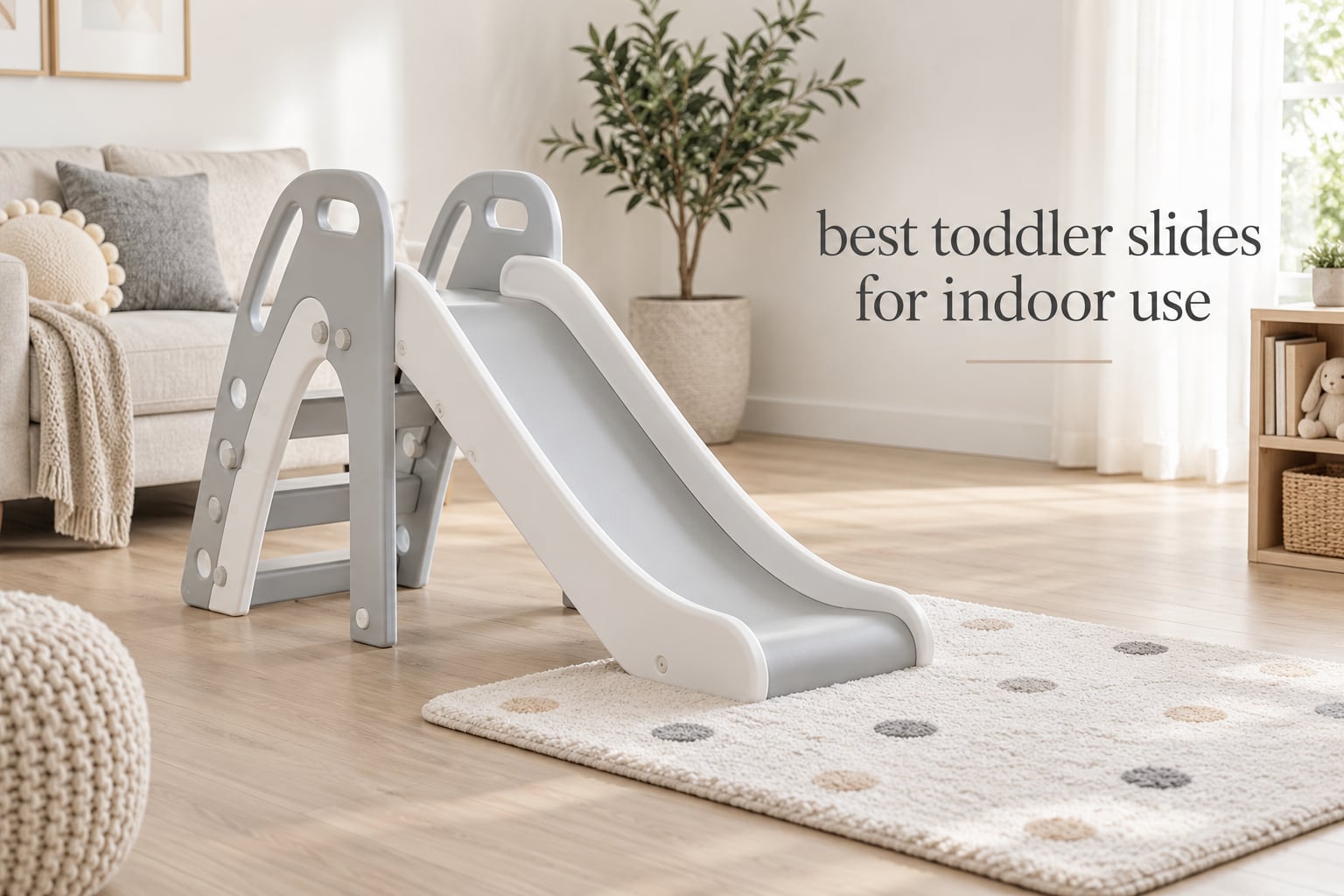
An indoor toddler slide solves three problems at once: it burns off the kind of energy that usually ends up in a tantrum, it replaces screen time with something physical, and it works on a January afternoon when going outside is not happening. The catch is that most slides sold online are designed for a backyard, where a long run-out zone and a soft landing surface are free. Indoors, every extra inch of footprint has to come out of a room you also eat dinner in.
That is what makes choosing the best toddler slides for indoor use different from picking an outdoor playset. You are not only weighing age range and weight limits. You are weighing folded versus unfolded height, whether the slide drifts across laminate when a toddler pushes off the top step, and whether the room still functions as a room afterwards. Our team compared ten indoor toddler slides and climber playsets, measured them against their published dimensions, weight limits and materials, and looked hard at the complaints that show up in real reviews rather than the claims on the listing.
This guide covers compact plastic slides, foldable designs, wooden-style builds and multi-activity playsets, with a best pick for small apartments, playrooms and everything between. We also added sections on slide height versus child height, flooring, cleaning and the one rule that matters more than any safety rail.
Table of Contents
Top 3 Indoor Toddler Slides for 2026
Our top three picks cover the three situations parents ask about most: a first slide for a young toddler, a compact foldable that disappears between play sessions, and an extended slope for a tall two-year-old. Each of the ten slides below earned its place on specifications, stability and how well it suits a shared indoor floor.

Little Tikes First Slide
- Gentle slope sized for first-time sliders
- Tool-free assembly
- Removable steps for storage

Step2 Play & Fold Junior Slide
- Folds flat for storage
- Double-walled plastic
- Wide ladder with sure-grip rails

Little Tikes Junior Play Slide
- Wide steps and stable base
- No tools to set up or store
- Compact for small rooms
10 Best Toddler Slides for Indoor Use in 2026 at a Glance
The table below lists all ten picks with their headline specifications. Every product here fits a typical indoor ceiling height, but footprint varies enormously, from a 46 inch long basic slide to a 60 by 53 inch activity centre that needs its own corner of the room. Foldable models are the ones worth measuring twice, because the folded profile is what determines whether the slide lives in the closet or permanently under the coffee table.
| Product | Specifications | Action |
|---|---|---|
| Little Tikes First Slide |
|
Check Latest Price |
| Step2 Play and Fold Junior Slide |
|
Check Latest Price |
| Little Tikes Junior Play Slide |
|
Check Latest Price |
 Arlopu Foldable Climber Slide Arlopu Foldable Climber Slide |
|
Check Latest Price |
 Nyeekoy 3 in 1 Toddler Slide Nyeekoy 3 in 1 Toddler Slide |
|
Check Latest Price |
 Step2 Sports-Tastic Activity Center Step2 Sports-Tastic Activity Center |
|
Check Latest Price |
 Babytronic 6 in 1 Climber Playset Babytronic 6 in 1 Climber Playset |
|
Check Latest Price |
 BIERUM 9 in 1 Activity Center BIERUM 9 in 1 Activity Center |
|
Check Latest Price |
 Gupamiga Folding Play Climber Gupamiga Folding Play Climber |
|
Check Latest Price |
 LulliSpace 6 in 1 L-Shaped Slide LulliSpace 6 in 1 L-Shaped Slide |
|
Check Latest Price |
1. Little Tikes First Slide: Best Overall Indoor Toddler Slide
Little Tikes First Slide (Blue/Green)
46 in L x 9 in W x 20 in H
Ages 16 months to 6 years
Up to 60 lb
Steps remove for storage
Pros
- Highest rated in the group at 4.8 stars
- Gentle slope works for first-time sliders
- No tools required for assembly
- Steps remove for compact storage
Cons
- 9 inch width feels tight for larger children
- Sliding only with no extra play features
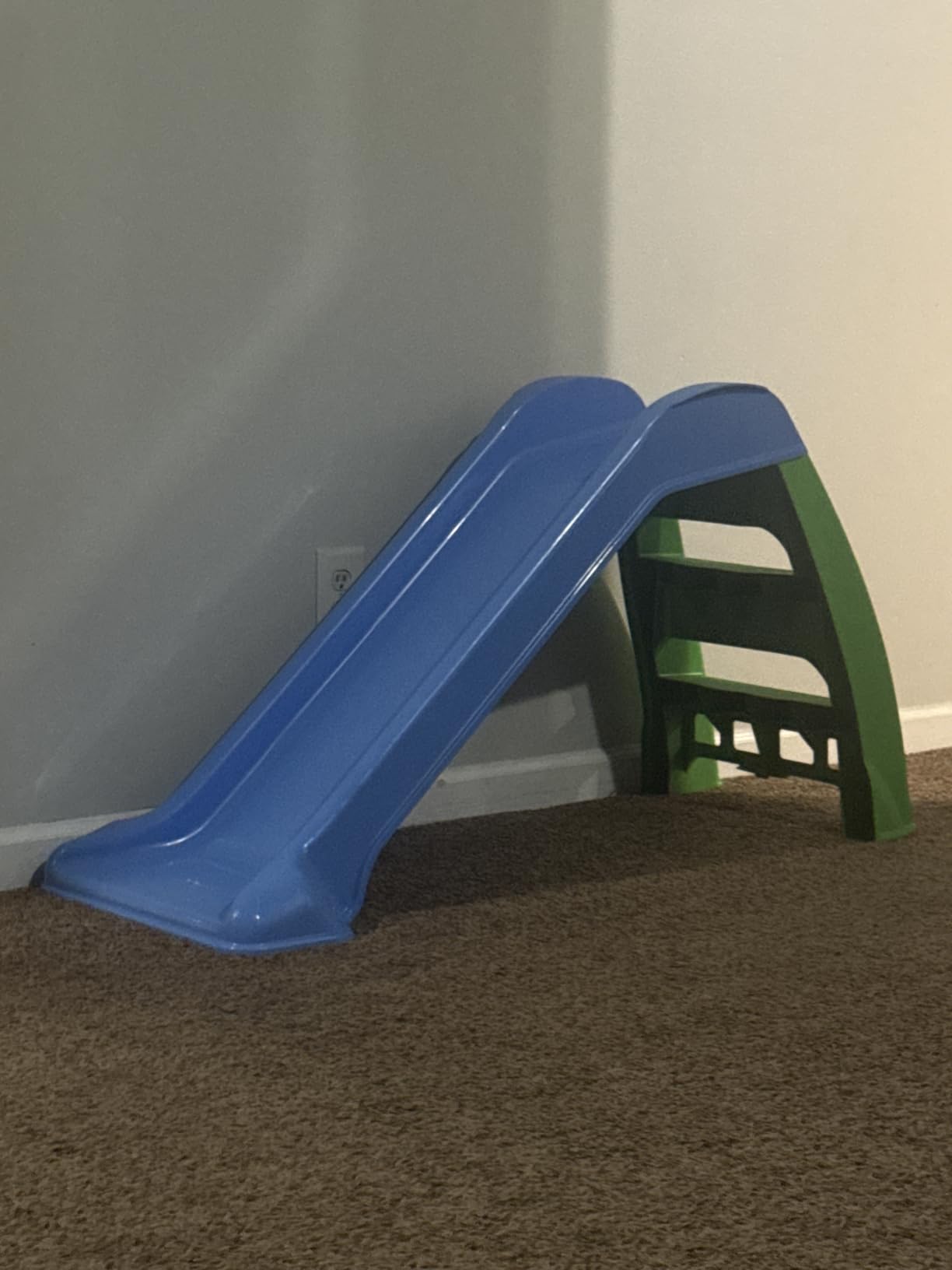
This is the slide we kept coming back to. The Little Tikes First Slide is a basic plastic chute, 46 inches long, 20 inches tall at the platform, and 9 inches wide, and almost everything about it is deliberately restrained. That restraint is the point. There is no ladder to grip incorrectly, no gap to catch a foot, and no hoop that snaps in the first week.
The gentle slope is the feature that separates it from the steeper models. Parents on r/toddlers describe children arriving home from daycare putting both hands down on a slide before committing to it. A first slide should reward that hesitation with a slow start rather than a fast one, and this one does.
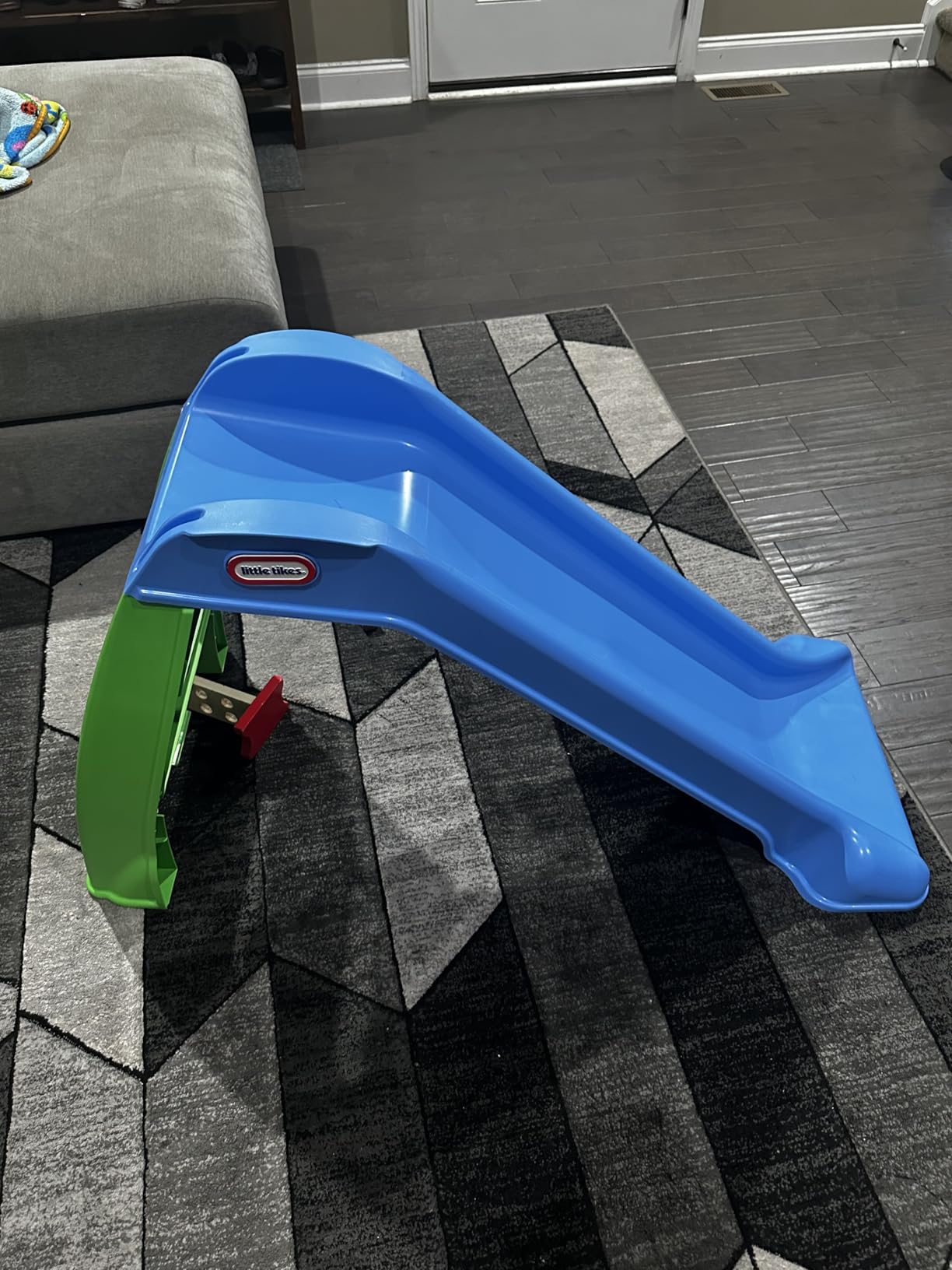
Storage is where it quietly wins. The steps unscrew and lift away, which means the slide collapses to roughly the height of the base and can be moved against a wall. Across more than 1,600 reviews the recurring complaint is width: at 9 inches across, a larger child or an adult helper cannot get a proper grip. For a 16-month-old to a three-year-old, that trade is worth taking.
The listed weight capacity goes up to 60 lb and the manufacturer age range runs from 16 months to 6 years, which means this single slide can serve a family through two or three children. It ranks at the top of the Freestanding Slides category, and 87 percent of reviews are five star.
Why this one fits a first-time indoor room
The footprint is the number that decides most purchases. At 46 by 9 inches, this slide takes up about the space of a yoga mat laid flat, and it works in a living room, a playroom or the gap between a sofa and a wall. The wider multi-activity playsets in this roundup need three to four times that floor space.
Because the steps come off, you can keep the base out and set up for a full session, then strip it back when the room needs to reset. That flexibility is why it works as an everyday indoor option rather than a set-up-and-take-down piece of equipment.
Where it will disappoint you
There is nothing to do on this slide except slide. Parents who bought it expecting a play gym tend to find the novelty fades around the eight-month mark, roughly when a toddler discovers the stairs or the sofa cushions are more fun. If you want a hoop, a ring toss or somewhere to hide, this is the wrong slide.
The narrow deck is also the honest drawback. A child who has outgrown baby slides, or a tall two-year-old who already approaches the platform at chest height, will feel cramped. In that case step up to the foldable models below rather than stretching this one’s limits.
2. Step2 Play & Fold Junior Slide: Best Foldable Indoor Slide
Step2 Play & Fold Junior Slide, Kids Indoor/Outdoor Play Slide, Backyard Playground Set, Easy Grip, Wide Ladder, Outside Jungle Gym, For Toddlers 1.5-4 Years Old
43.5 in L x 17.75 in W x 25.5 in H
Ages 18 months to 4 years
Rated to 43 lb
Folds flat
Pros
- Folds flat between play sessions
- Double-walled plastic resists cracking
- Easy-grip steps with side rails
- 3 year limited warranty
Cons
- Adult assembly required before first use
- Listing data includes unrelated components
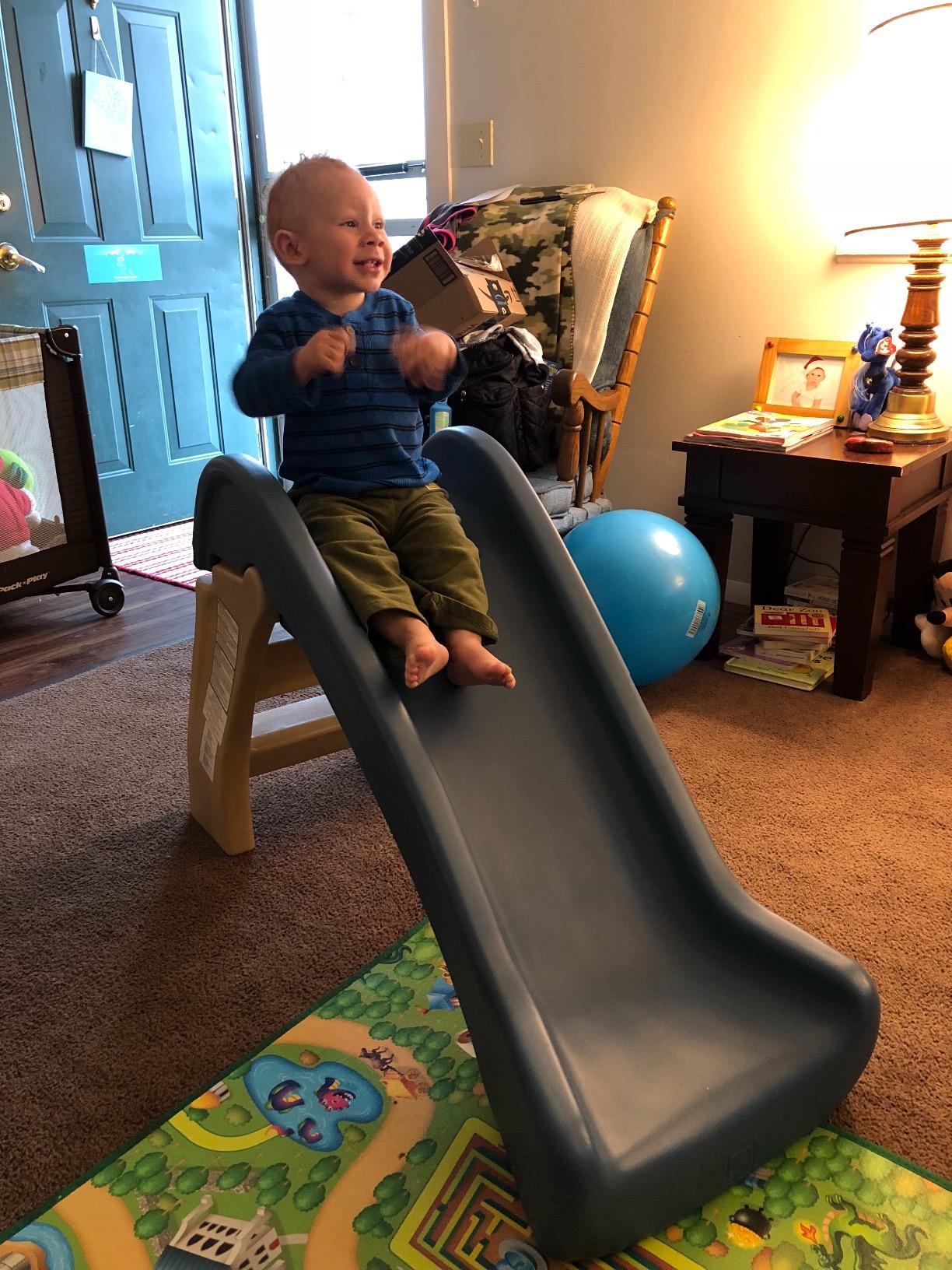
Whether a slide folds is the number one practical filter in parent discussions, and this one folds properly. The Step2 Play and Fold Junior collapses into a flat panel rather than a stack of loose parts, which means it can go behind a sofa or inside a closet without becoming an obstacle itself. It is 43.5 inches long, 17.75 inches wide and 25.5 inches high at the platform.
The build is heavier duty than the price suggests. Double-walled plastic resists chipping, fading and cracking, and Step2 backs it with a 3 year limited warranty, the longest on this list. Reviewers rate the grip on the steps and the side rails as the standout feature, and the wide ladder is easier for a wobbly two-year-old than the narrow ladders on baby slides.
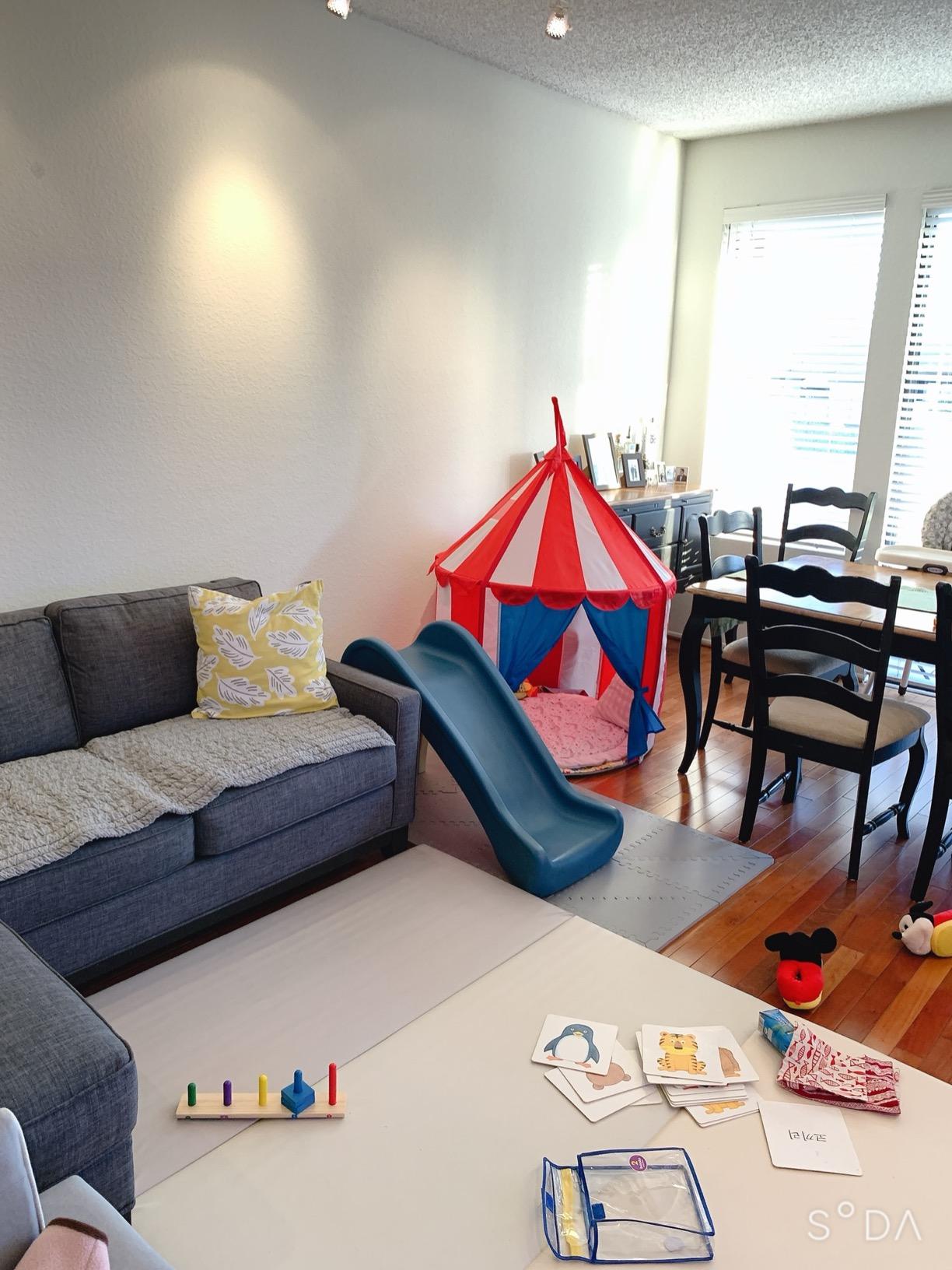
At 4.8 stars across more than 1,000 reviews, with essentially no one-star share, this is the most consistent product we tested. Owners credit the double-walled construction for surviving multiple children and for not fading after a summer of outdoor use that was never supposed to happen.
Why folding beats a fixed frame indoors
A fixed slide is always a piece of your room’s furniture. A foldable one is equipment you deploy on a bad-weather morning and put away afterwards. That single difference decides the question for most apartments, and it also matters in a house where the playroom doubles as a dining room or a home office.
The trade is assembly. Unlike the two Little Tikes slides on this list, this one needs an adult to put it together before first use. Budget twenty minutes and keep the hardware bag, because a missing screw during assembly is the most common complaint in this category.
Where it will disappoint you
Twenty-five and a half inches is a taller platform than the baby slides, which is good for a two or three-year-old but unnecessary for an eighteen-month-old who just wants a short chute. Buy this if your child is walking confidently and climbing; for a child who still needs a hand on both sides, the First Slide is steadier.
One more detail: the listing data for this product includes component information unrelated to the slide itself, so read the parts list in the manual rather than trusting the online spec block. When you already know how to spot it, we can point you toward our picks for backyard slides if your child will use it outside too.
3. Little Tikes Junior Play Slide: Best for Ages 18 Months to 2 Years
Little Tikes Junior Play Slide Green/Blue, 5 ft or less
36.88 in L x 10.25 in W x 19.25 in H
Ages 18 months to 4 years
4100 g
No tools to assemble
Pros
- Wide steps and wide base feel stable
- No tools for setup or storage
- Compact for small rooms
- Made in USA
Cons
- Shortest slide length on the list
- Listing lists a 9.3 lb maximum weight recommendation
The Junior Play Slide is one of the most-reviewed products in this roundup, with more than 2,300 ratings at 4.6 stars and 79 percent five star. It has been on the market long enough that a whole generation of first slides came out of the same mould, which means parts, advice and replacement pieces are easy to find.
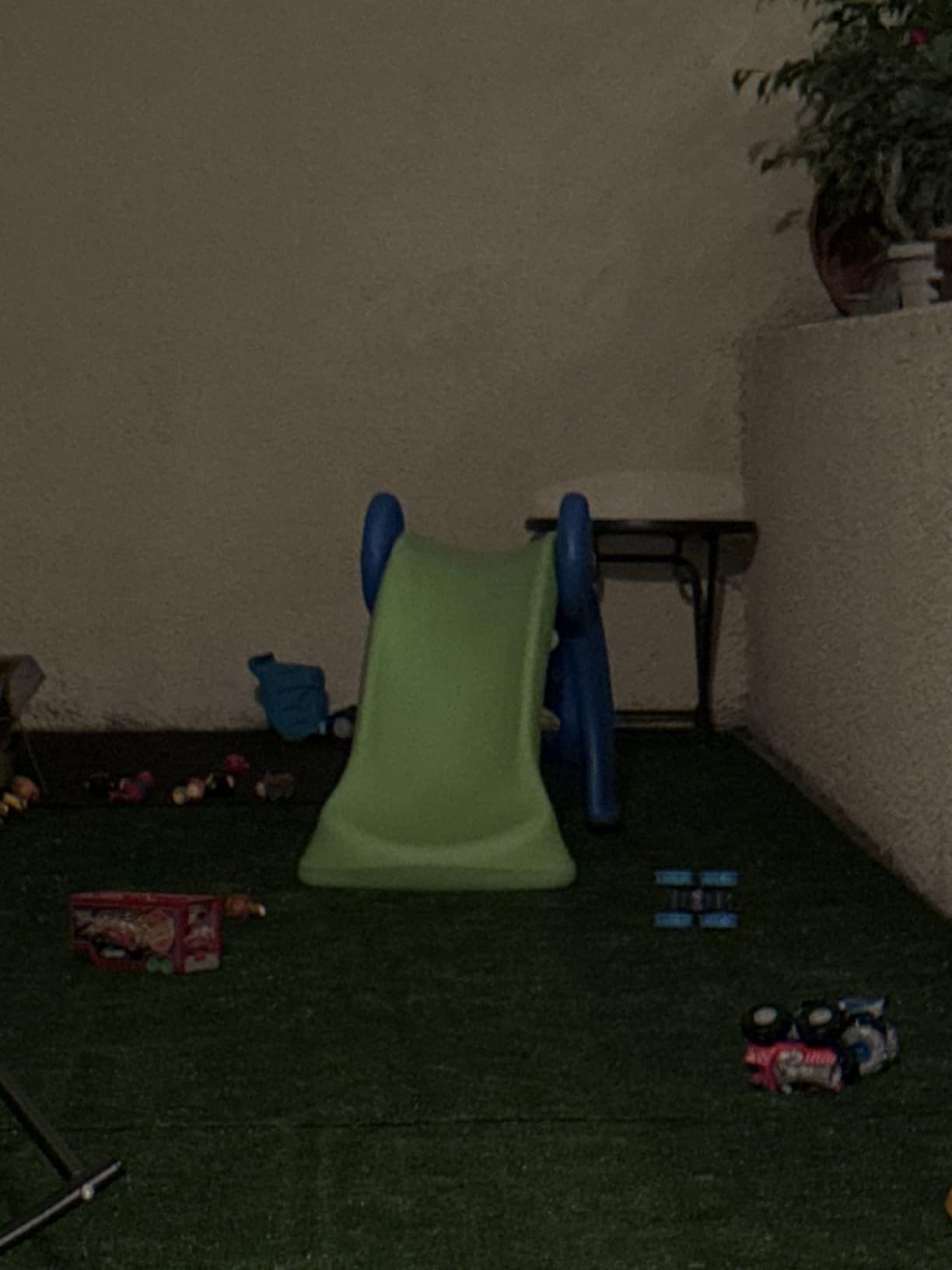
What it does well is stability. The steps are wide, the base flares out, and there is no gap anywhere for a foot to catch. At 36.88 inches long and 19.25 inches high, it is the shortest and lowest slide here, which is exactly right for a child who is still steadying themselves on a couch cushion.
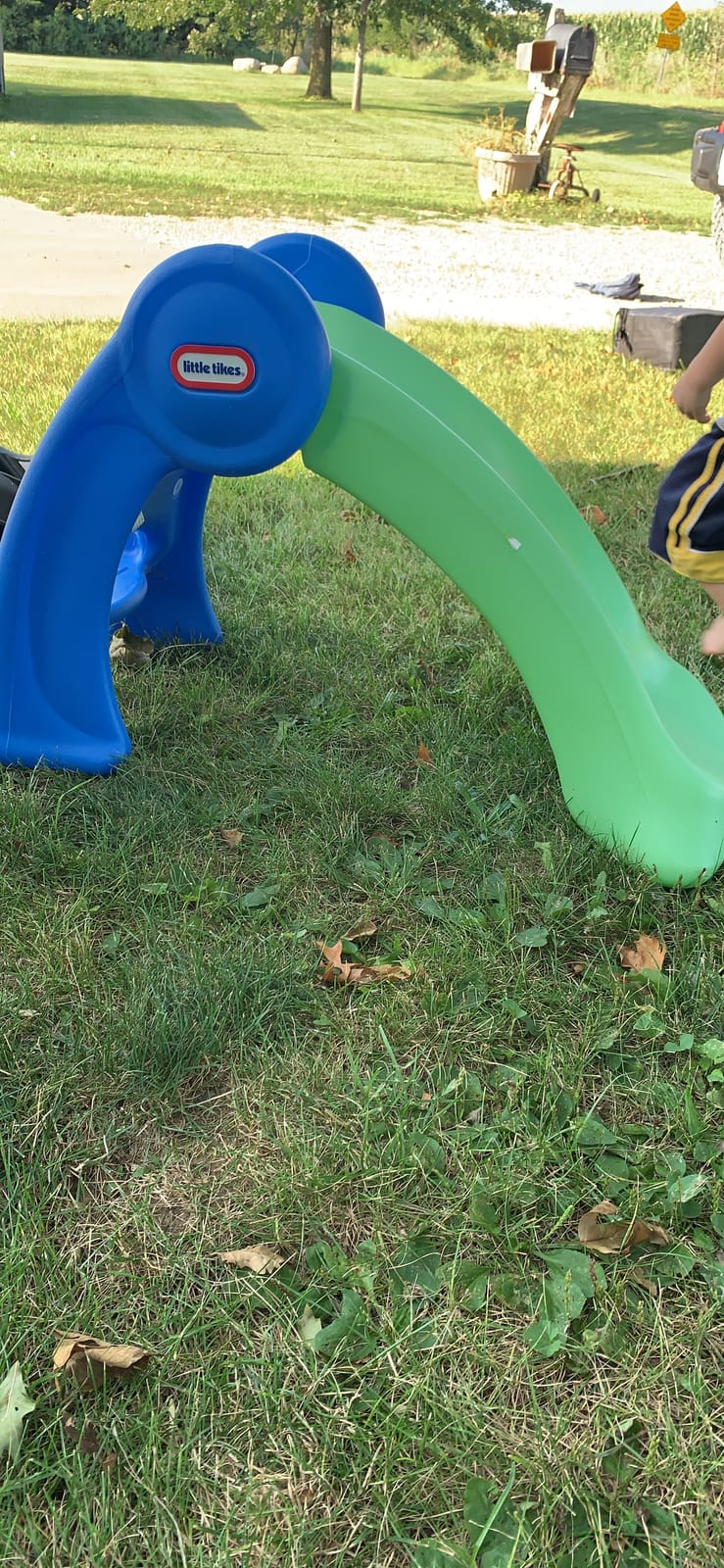
Like the First Slide, it needs no tools to set up or store. Parents in small-space situations appreciate that it can be carried between rooms by one adult and leaned against a wall when it is not in use, and the smooth plastic wipes down with a damp cloth in seconds.
One thing to check before you buy: the listing states a maximum weight recommendation of 9.3 lb, which is far below the other products in this guide. That figure is likely a listing artefact rather than a real structural limit, but confirm the current spec on the product page before committing for a child who is already walking and running.
Why short beats long for a new walker
A short slide is a confidence tool. The faster the run-out and the longer the chute, the more control a child needs to sit down and push off. This one keeps the whole descent to a couple of seconds, so an 18-month-old gets a win instead of a tumble.
The wide base also matters in carpet. On a soft floor the slide sinks slightly into the pile and stops drifting, which is one of the easiest ways to solve the sliding-across-the-room problem that parents complain about on smooth surfaces.
Where it will disappoint you
It will be outgrown. A 36 inch slide with a 19 inch platform is a first-and-a-half slide, not a slide for a tall three-year-old. Forum threads about replacing a plastic Little Tikes slide once a child outgrows it are common, and the resale cycle is real, so plan on roughly two years of use per child.
Because the platform is low, older toddlers often climb the sides or the back rather than the steps. If your child is a climber and you want the slide to be the only route up, the taller foldable models are a better fit.
4. Arlopu Foldable Toddler Climber Slide: Best for Tall Toddlers
Toddler Indoor Slide, Foldable Baby Climber Playset with Basketball & Hoop
74.8 in L x 17.7 in W x 33.4 in H
Max weight 110 lb
ASTM and CPSIA certified
Three glide zones
Pros
- Longest slide surface in the roundup
- Anti-slip pads on a triangular base
- Acceleration deceleration and buffer zones
- ASTM and CPSIA certified
Cons
- Basketball hoop is largely decorative
- About 20 minutes to assemble and a large footprint
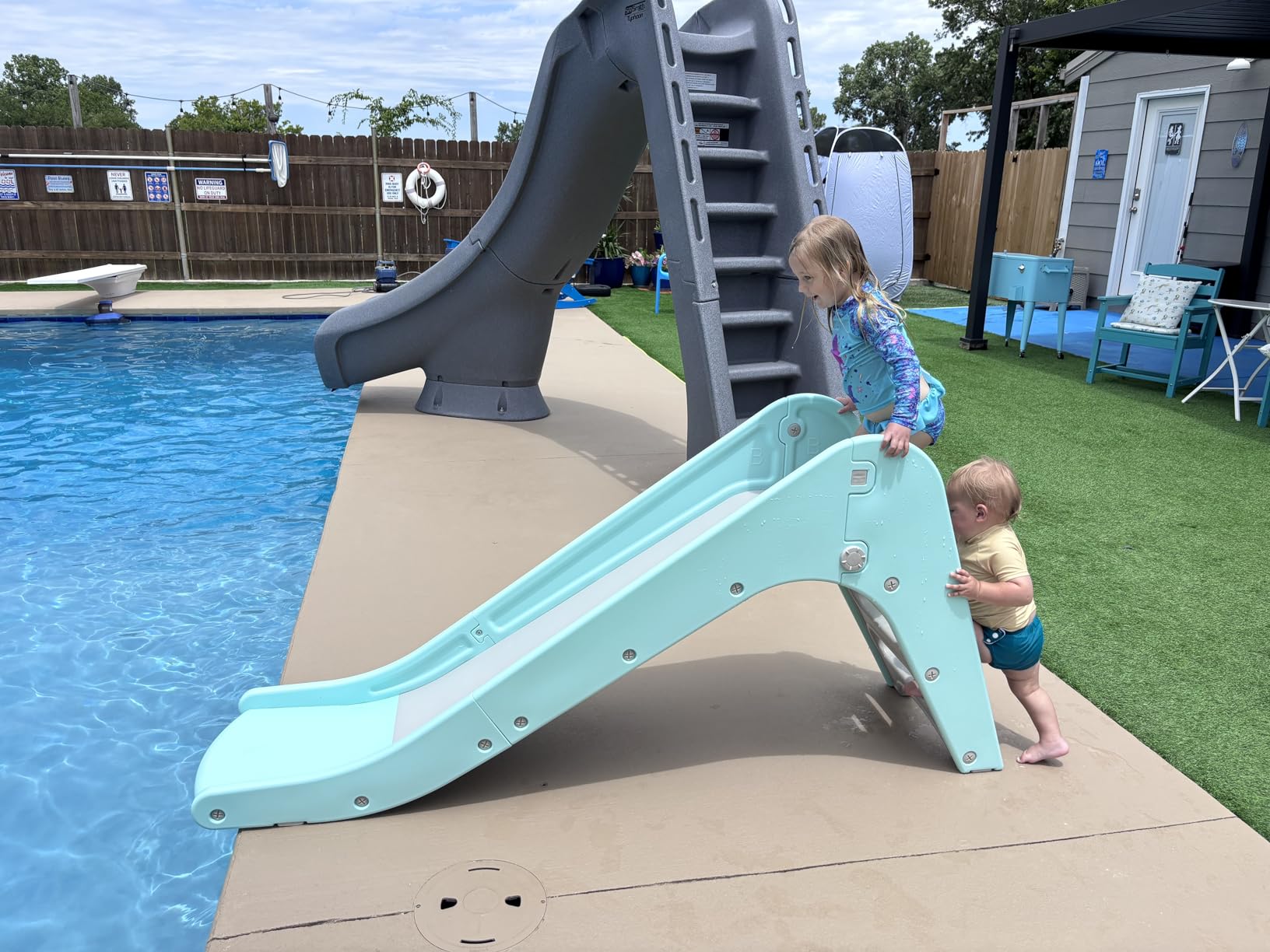
Most parents buying a toddler slide are actually buying the wrong height. Forum threads asking for a larger slide for a tall two-year-old turn up regularly, and this is the answer to them in our list. At 74.8 inches long and 33.4 inches high, it is closer to a backyard playset than to a baby slide, and a 110 lb weight limit carries a much bigger child.
The slide surface is built in three zones. The top accelerates, the middle levels out, and the bottom acts as a buffer so the child slows before reaching the floor. That design is the reason reviewers describe the ride as gentle rather than startling, even on a slide this long. The triangular base sits on anti-slip pads, which is our preferred answer to floor drift.
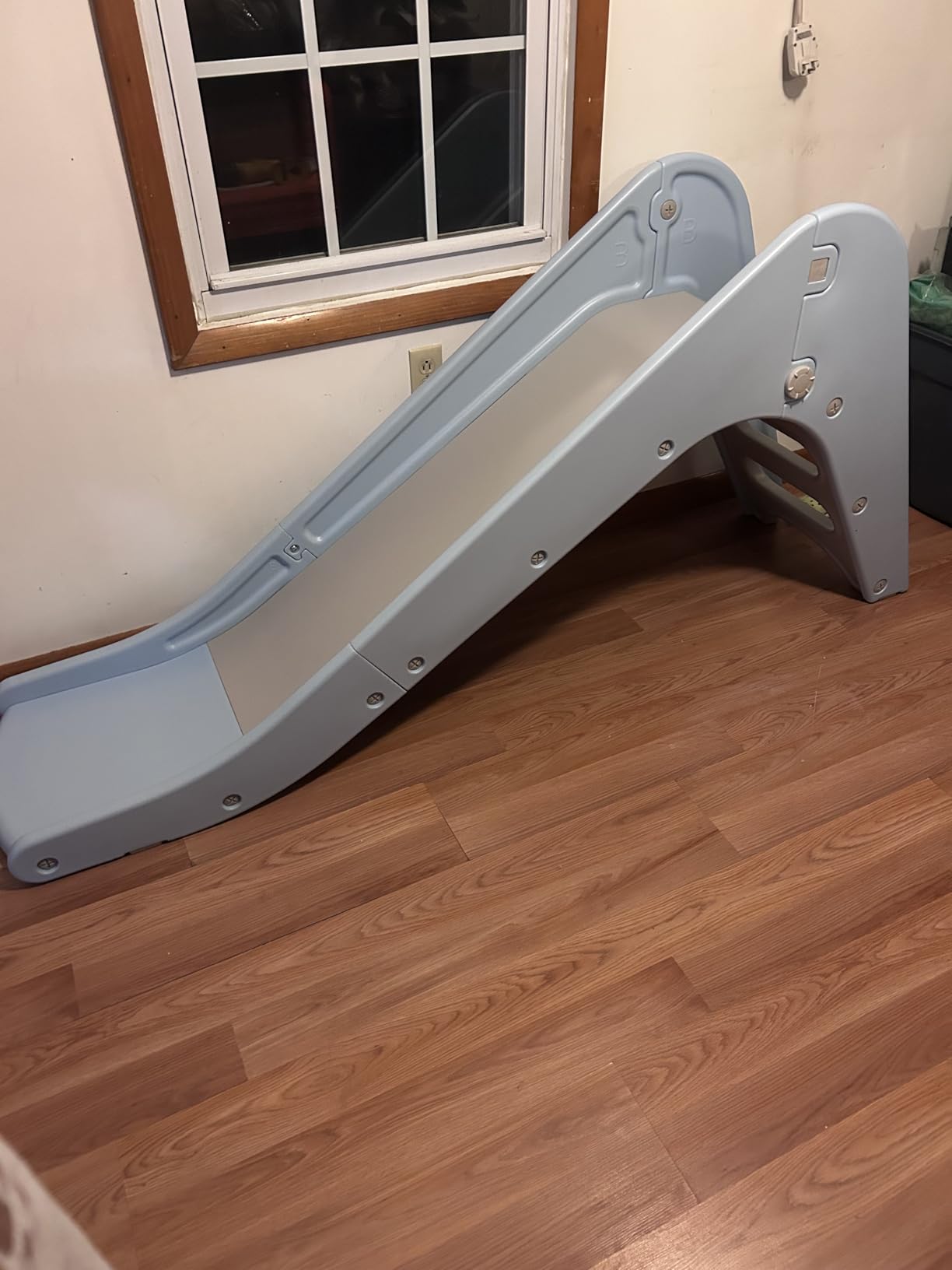
At 4.7 stars across 705 reviews, with 87 percent five star, owners consistently call it sturdier and smoother than cheaper plastic slides. It comes in five colourways, holds an ASTM and CPSIA certification, and works as a portable unit you can move between the living room and a covered patio.
Why height matters more than length
A taller platform produces a steeper start, which feels faster and more thrilling to an older child. That is exactly what keeps a three-year-old interested, but it is the opposite of what a one-year-old needs. If you have siblings four years apart, this serves the older end and the First Slide handles the younger end.
It also lasts. A 110 lb capacity means this is the slide in our list most likely to be handed down rather than resold, which changes the maths if you are buying for a family with more than one child to come.
Where it will disappoint you
Size. At nearly 75 inches long and 21 lb heavy, this is not an apartment slide. You need a clear run of roughly 9 feet in front of it for the landing zone, plus the footprint of the structure itself. If you are in a small flat, this is the wrong pick no matter how well built it is.
The side basketball hoop is the weakest feature. Reviewers call it a gimmick, and a hoop mounted high on the side of a climbing frame is awkward to reach and can work loose over time. Assembly runs about twenty minutes, so budget for it before the first play session.
5. Nyeekoy 3 in 1 Toddler Slide: Budget Pick Indoor Slide
Nyeekoy 3 in 1 Toddler Slide Indoor & Outdoor Playground
48 in L x 21.7 in W x 20.5 in H
Only 7 lb
Ages 0 to 3
Lightweight and foldable
Pros
- Stairs slide and hoop in one unit
- Only 7 lb so one adult can move it
- Tool-free assembly
- Rounded corners and buffer zone
Cons
- Geared to under-3s only
- Dinosaur styling will not suit every room
The Nyeekoy 3 in 1 is the value pick because it does something the more expensive activity centres do not: it stays light. At 7 lb you can carry it up a flight of stairs, shift it to clear a playroom, or move it out of the way when guests arrive without calling for help.
It packs a stair, a slide, a basketball hoop and a ball into a 48 by 21.7 inch footprint at 20.5 inches high. Assembly is tool-free, corners are rounded, and there is a bottom buffer zone to slow the run-out. The listed maximum weight of 88.3 lb is far more than the average toddler needs.
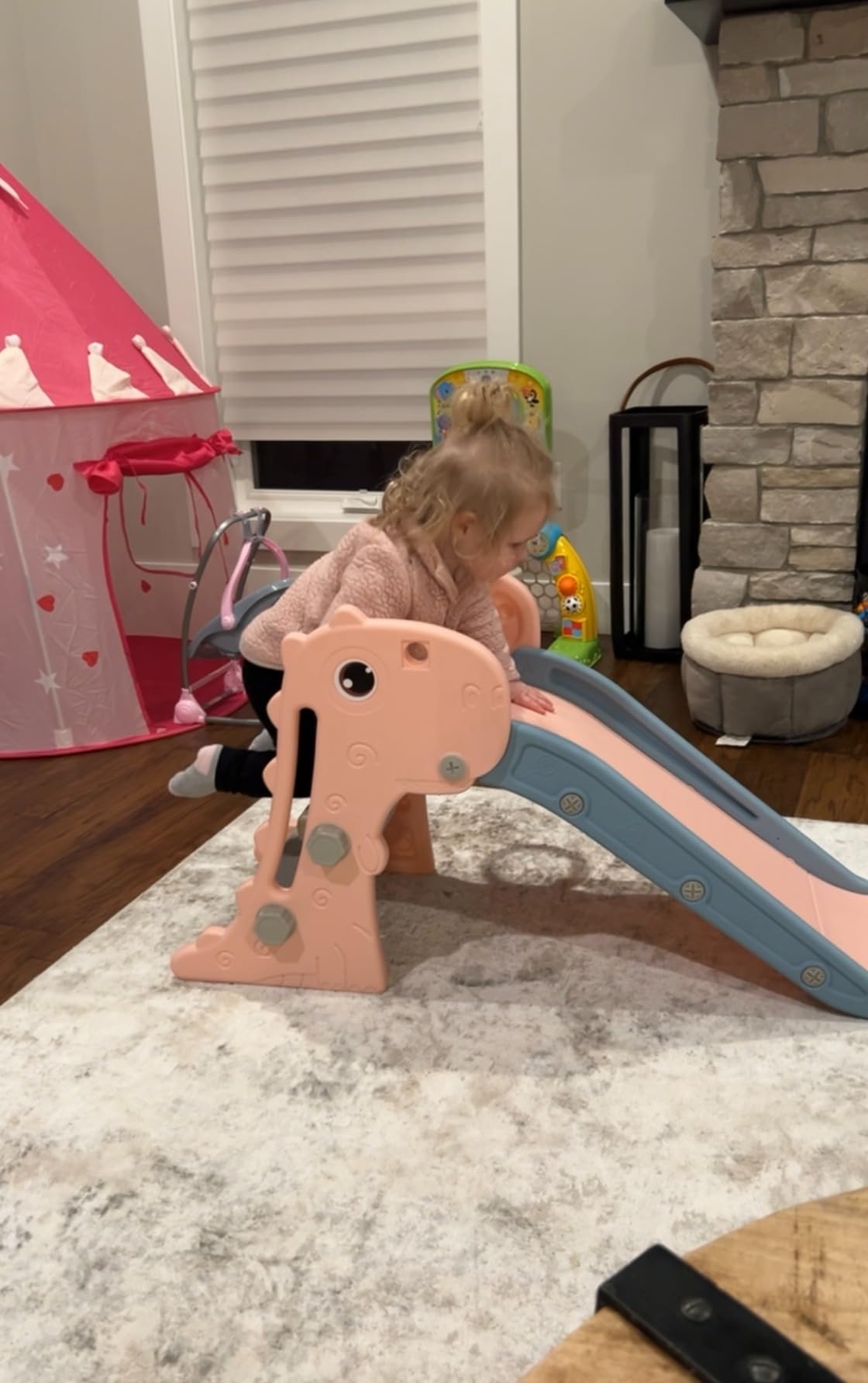
Reviewers like the pink and blue colourways and the dinosaur styling, which some families find charming and others find loud. At 4.6 stars from 579 reviews with 80 percent five star, the practical complaints are limited: the age range tops out at 3, and the light build suits indoor sliding rather than vigorous climbing.

Why weight is the number that matters in a small flat
Every other large play structure in this roundup needs two adults and a clear path to reposition. Seven pounds changes the behaviour entirely. Parents of children who nap in the afternoon report setting the slide up as an activity, then putting it away before quiet time. That flexibility is what this product is really selling.
It is also the one we would pack for a grandparent’s house or a holiday rental, since it collapses to a shape that fits in a car boot and needs no tools to rebuild.
Where it will disappoint you
The age ceiling. Marked for ages 0 to 3, this is a toddler product and nothing more. A four-year-old will grow past it quickly, and the light plastic does not feel built for an adult climbing up for a photo, which parents sometimes try.
On slick hard floors, the light build means less base mass holding it in place. Put a rug underneath and the issue disappears, which is true of every slide in this guide but matters most here.
6. Step2 Sports-Tastic Activity Center: Best All-in-One Indoor Play Set
Step2 Sports-Tastic Activity Center, Toddler Sports Playset, Indoor/Outdoor Slide, Play Gym Includes Bat & Balls, Made of Durable Plastic, For Toddlers 1+ Years Old
29.02 in L x 27.01 in W x 15.51 in H
Only 8 lb
Ages 12 months to 3 years
2 year warranty
Pros
- Climbing sliding and batting in one unit
- Quick frustration-free assembly
- Easy to wipe clean
- Bat and balls included
Cons
- Bulky footprint for a basic slide
- 4.4 stars is among the lowest rated of the ten picks
Step2 Sports-Tastic is the oldest and most reviewed product in this guide at more than 3,000 reviews, and at 4.4 stars it is also the lowest rated, with a smaller share of five star feedback than the rest. That combination is worth understanding: the star figure reflects an assembly and durability grumbling that is easy to avoid rather than a design fault.
What it offers is variety in a genuinely small package. At 29 inches by 27 inches and only 15.5 inches high, it is barely bigger than a square rug, yet it includes a climb, a slide and a bat with balls. For a one-year-old who is not interested in sliding alone, that balance of activities is the reason it keeps working.

It is also light at 8 lb, wipes clean with soapy water or household disinfectant, and carries a 2 year limited warranty. Reviewers consistently call assembly frustration-free, which matters more than it sounds: the most common complaint in this category is not a broken slide but an unclear build.
If you are weighing a compact play gym instead of a straight slide, this is the best of that style on our list. If you specifically want the longest, steepest slide, look at the taller models further down.

Why low profile beats tall platform indoors
A 15.5 inch platform means the whole unit sits low to the ground, so a tumble is a small tumble. For a child under two, who is more likely to topple sideways off a platform than to get hurt on the slide itself, that geometry is the safest option here.
The flat square footprint also tucks under a table or sits neatly in a corner when play is over, and the wipe-clean surface makes it practical for a playroom that doubles as a multipurpose space.
Where it will disappoint you
The 4.4 star average. Owners report occasional assembly friction and durability complaints under heavy use, and the activity mix means it does one thing at a time rather than giving a child a proper sliding experience.
It is also not really a slide-first purchase. If your child already spends most of their playtime going down something, spend the same effort on a longer chute instead. Our outdoor comparison covers playground slides for backyards if that is where you are headed.
7. Babytronic 6 in 1 Climber Playset: Best Mid-Size Indoor Playset
Babytronic 6-in-1 Toddler Slide for Kids 1-3, Baby Indoor Climber Playset
59 in L x 27.6 in W x 36 in H
15.7 lb
ASTM certified HDPE
Supports up to 110 lb
Pros
- Six stations including storage and telescope
- ASTM certified HDPE rated to 110 lb
- Quick assembly with clear instructions
- Folds to store
Cons
- Smaller than the listing photos suggest
- Screws can be loosened by curious toddlers
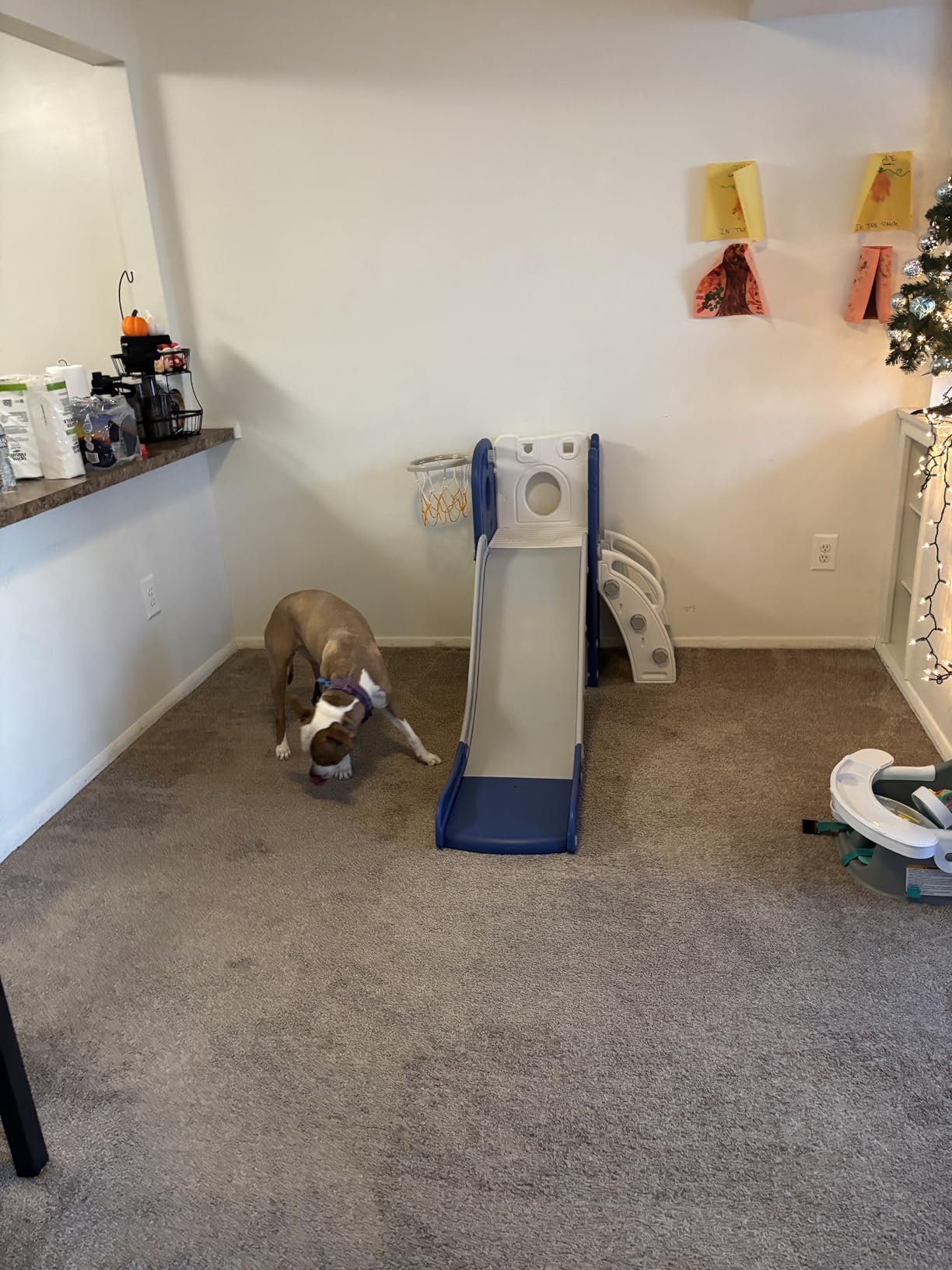
The Babytronic 6 in 1 sits in the awkward middle of this roundup, and that is exactly why it works. It is a real climb-and-slide structure at 59 inches long and 36 inches high, but at 27.6 inches wide it is a full foot narrower than the 9 in 1 model below, which makes it fitable in a room that cannot hold that one.
The activity list runs to six: slide, basketball hoop, telescope, storage and two more stations, with a basketball included. The frame is ASTM certified HDPE rated to 110 lb, and the slide surface is smooth with rounded edges. Assembly is quick and the instructions are clear, which puts it ahead of several competitors on both counts.

It folds and stands freely on its own, so the storage problem is solved the same way as the Step2 foldable, just with more to fold. At 15.7 lb it is a two-person carry, or a one-person carry if you plan ahead.
Reviewers rate it 4.6 stars from 301 ratings with 79 percent five star. Parents praise quick assembly and the way it holds up when several toddlers use it at once, and the most common note is simply that it runs smaller than the photographs suggest.
Why the mid-size is the smart buy
Footprint is the number parents underestimate. The 9 in 1 activity centre needs roughly 32 square feet of floor including its approach; this one needs about 13 square feet of structure and half that again for climbing room. If your room is a living room rather than a dedicated playroom, that difference decides the purchase.
It also covers a wide age band. A 36 inch platform suits a two or three-year-old, while the hoop and telescope keep a younger sibling occupied, which solves the sibling age-gap problem that one slide rarely handles.
Where it will disappoint you
The size surprise is real and it is the top complaint. Measure your intended spot and compare it against 59 by 27.6 inches before you commit, and do not rely on the product photographs for scale.
A second, smaller issue: parents report that curious toddlers can back out the screws. A dab of removable thread locker on the visible fasteners after assembly prevents an afternoon’s worth of wobble developing three months in.
8. BIERUM 9 in 1 Toddler Activity Center: Best for a Dedicated Playroom
BIERUM 9 in 1 Toddler Slide, Kids Slide for Toddlers Age 1-3 Outdoor Indoor
59.8 in L x 53.5 in W x 36.2 in H
Rated to 154 lb
ASTM and CPSIA certified HDPE
Nine play stations
Pros
- Nine stations in one structure
- Highest weight capacity in the roundup at 154 lb
- Anti-slip steps with dual handrails
- Three slide zones
Cons
- Largest footprint of any pick at 60 by 53 inches
- Steep slide needs a hand and supervision
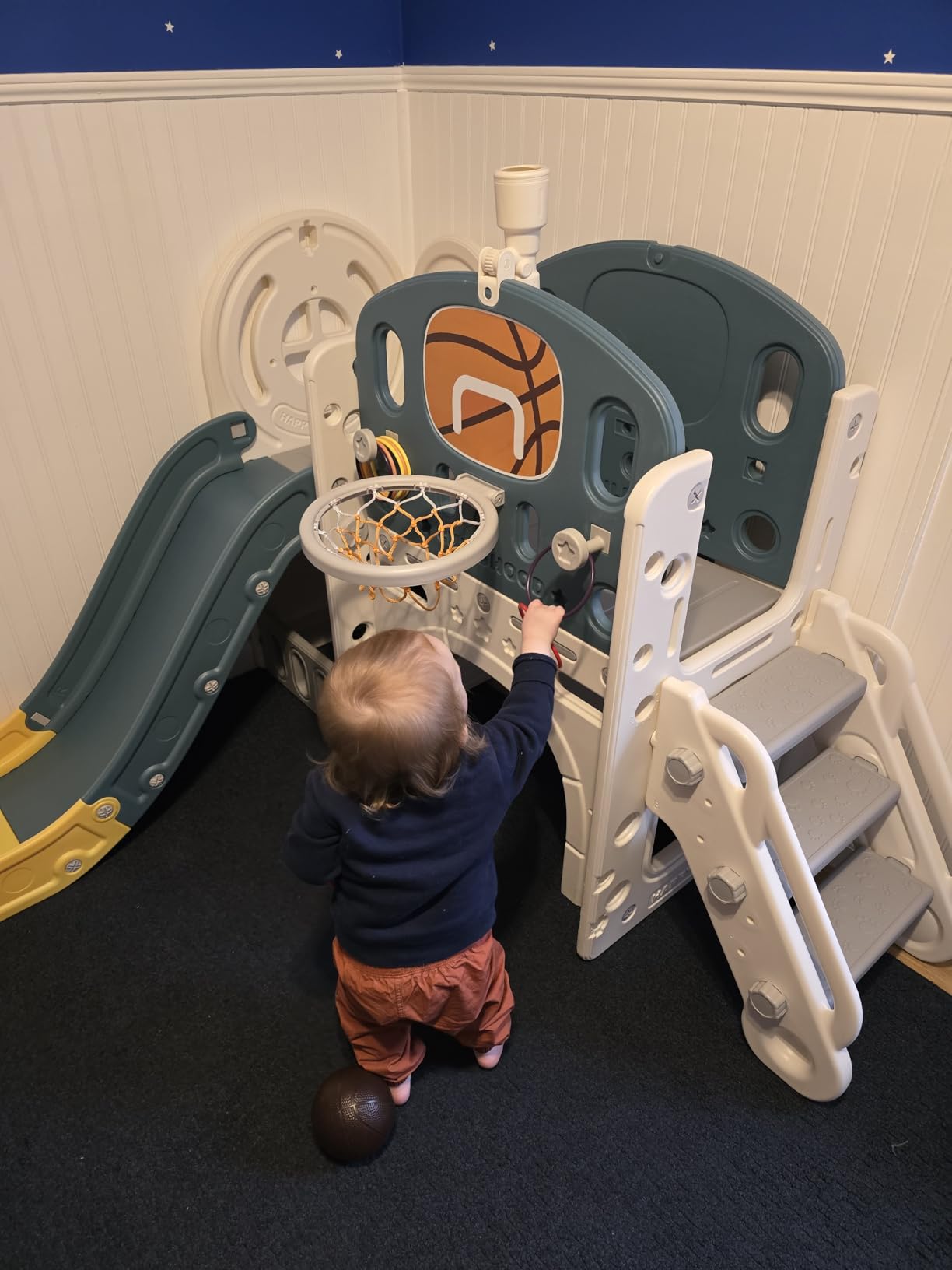
If you have a room that is already a playroom, the BIERUM 9 in 1 converts that room completely. Nine stations in one structure: a climber, a slide, a basketball hoop with a ball, two ring toss sets, eight throwing rings and a telescope. Nothing else in this roundup holds a child’s attention through as many repeats.
The build is substantial. It is ASTM and CPSIA certified HDPE with a listed capacity of 154 lb, the highest here, and the staircase has anti-slip treads with dual handrails and a wide waiting area at the top, which is the detail that makes a shared slide safer.

The slide is built in three zones so the child accelerates, decelerates and runs out at the bottom rather than landing hard. Assembly is tool-free and the extras come in the box, so there is nothing extra to buy before the first session.
At 4.6 stars from 512 reviews with 80 percent five star, reviewers treat it as a rainy-day indoor playground. The most common drawbacks are the footprint and a slide steep enough that younger toddlers want a hand going down.
Why the footprint is the whole decision
This structure is roughly 60 by 53 inches before you add the approach and the landing run. Call it a five-foot square of activity zone including clearance. In a basement, a converted garage or a dedicated playroom that is the entire point, because that space exists to be used hard.
In a living room it is a problem, and there is no way around it. The mid-size model above handles the same nine-activity idea in less than half the floor area, and the height versus child height table in our buying guide will tell you whether a 36 inch platform is even appropriate.
Where it will disappoint you
The slide angle. Several reviewers say a two-year-old still comes down with both hands on the rails, which is normal but does mean close supervision rather than independent play. One review also reported missing step risers and an incorrect replacement part, so check the parts inventory the day the box arrives.
Two colours and a busy visual design also make it feel like a dedicated-room object rather than something that belongs in a shared space. If you want the same sturdiness in a smaller footprint, the Babytronic is the closer fit.
9. Gupamiga Folding Play Climber Slide: Best Neutral Colourway
Toddler Slide Large Play Climber Slide PlaySet with Extra Long Slipping Slope Indoor Slide Kids Slide Toddler Playground Toddler Slide Outdoor Toys for Toddlers (Grey)
Grey and white finish
150 lb bearing capacity
Folding design
Ages 6 months and up
Pros
- Neutral grey and white suits adult rooms
- Folds up to free floor space
- Handles at the top for safe sitting
- Light enough to move between rooms
Cons
- Some buyers report wobble on the steps
- Can rock on slick hard floors without a mat
Almost every slide in this roundup is a primary colour. The Gupamiga is grey and white, which sounds like a small thing until the slide is sitting in your living room rather than a nursery. It is the pick we would make for a shared multipurpose room where nothing is allowed to look like a toy.
It folds up against a wall to free the floor, and it is light enough for one adult to carry between rooms. At the top of the structure there are handles that give a small child something to grip while sitting down at the edge, a detail most listings never mention.
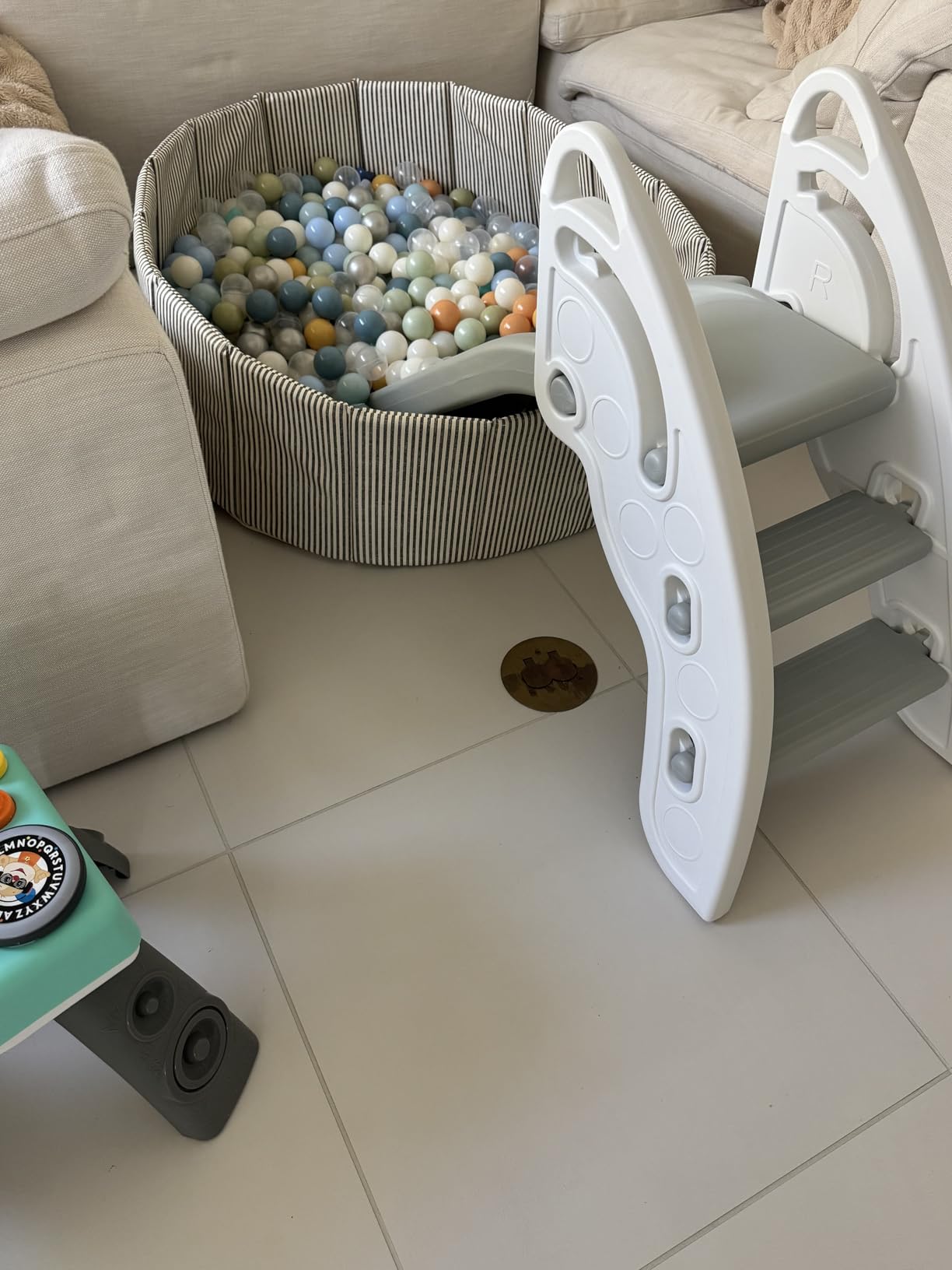
The build carries a stated 150 lb bearing capacity with integral moulded parts and no sharp edges. Rated 4.5 stars across 490 reviews with 77 percent five star, the family consensus is that it looks good and works, with two recurring gripes: perceived wobble on the steps and rocking on smooth floors unless a mat goes underneath.
Both gripes are manageable. A rug under the base handles the second entirely, and the first improves once the slide is fully extended and seated flat.
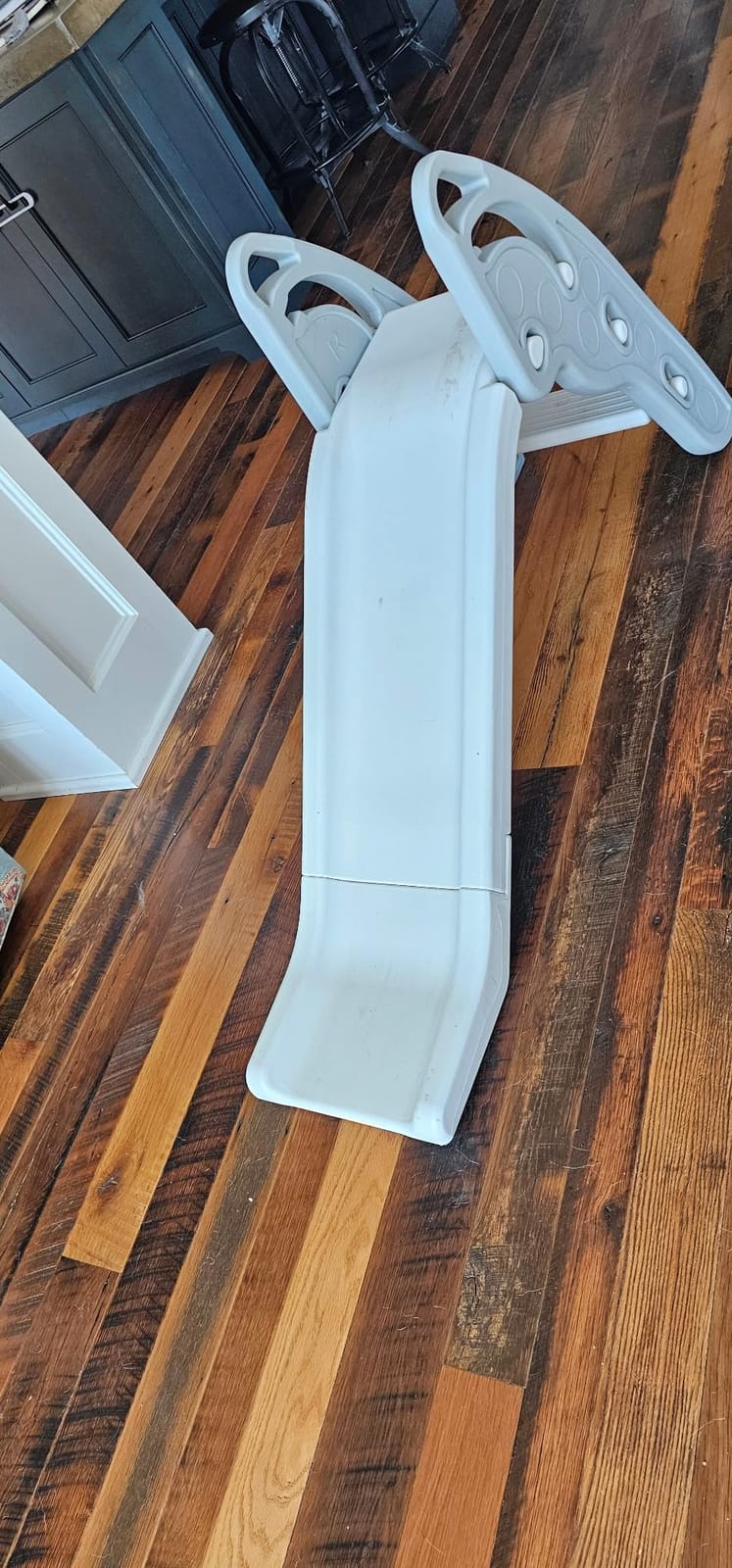
Why colour is a real buying criterion
The reason so many families end up with a slide they tolerate rather than enjoy is visual. A bright plastic structure that dominates a neutral living room tends to get folded away and forgotten, and a slide that gets folded away is a slide that stops being used.
This one can stay out. The grey and white also disguise scuffs and sticky-hand marks better than a saturated blue or red, which matters in a room where the floor and the slide share the same sightline.
Where it will disappoint you
Feel. Several reviewers describe the plastic as flimsier for the price, particularly on the steps, and that perception is the main reason it sits at 4.5 rather than 4.7. If your child climbs hard, the double-walled Step2 model feels more substantial for a similar footprint.
It rocks on slick hard floors without a mat. Parents on forums report the same thing, so put a rug or a foam mat underneath before the first session rather than after the first complaint.
10. LulliSpace 6 in 1 L-Shaped Slide: Best Climb Support for New Walkers
LulliSpace 6 in 1 Toddler Slide,Kids Climber Slider for Indoor Outdoor Playground with Basketball Hoop,Storage and Telescope,L Shaped Slide for Toddler Climber Playset
L-shaped slide with top guardrail
Max weight 120 lb
20.5 lb
Metal and plastic build
Pros
- Top guardrail and thickened handrails on both sides
- Wide base resists tipping while climbing
- Accessories include binoculars basketball storage and telescope
Cons
- Lowest rated here at 4.3 stars with 7 percent one star
- Mixed metal and plastic build wears at the joints
- Heaviest unit at 20.5 lb
The LulliSpace L-shaped slide is the most supported climber in this roundup. There is a guardrail at the top of the ladder, thickened handrails on both sides the whole way up, and a wide base structure shaped to resist tipping while a child pulls themselves over the edge. For a toddler who is still climbing-assisted, that geometry is the whole point.
The L-shaped slide run also changes the feel of the descent: the child comes down and turns, rather than shooting straight forward into the room. The listed capacity is 120 lb, and the accessories include binoculars, a basketball, storage and a telescope.
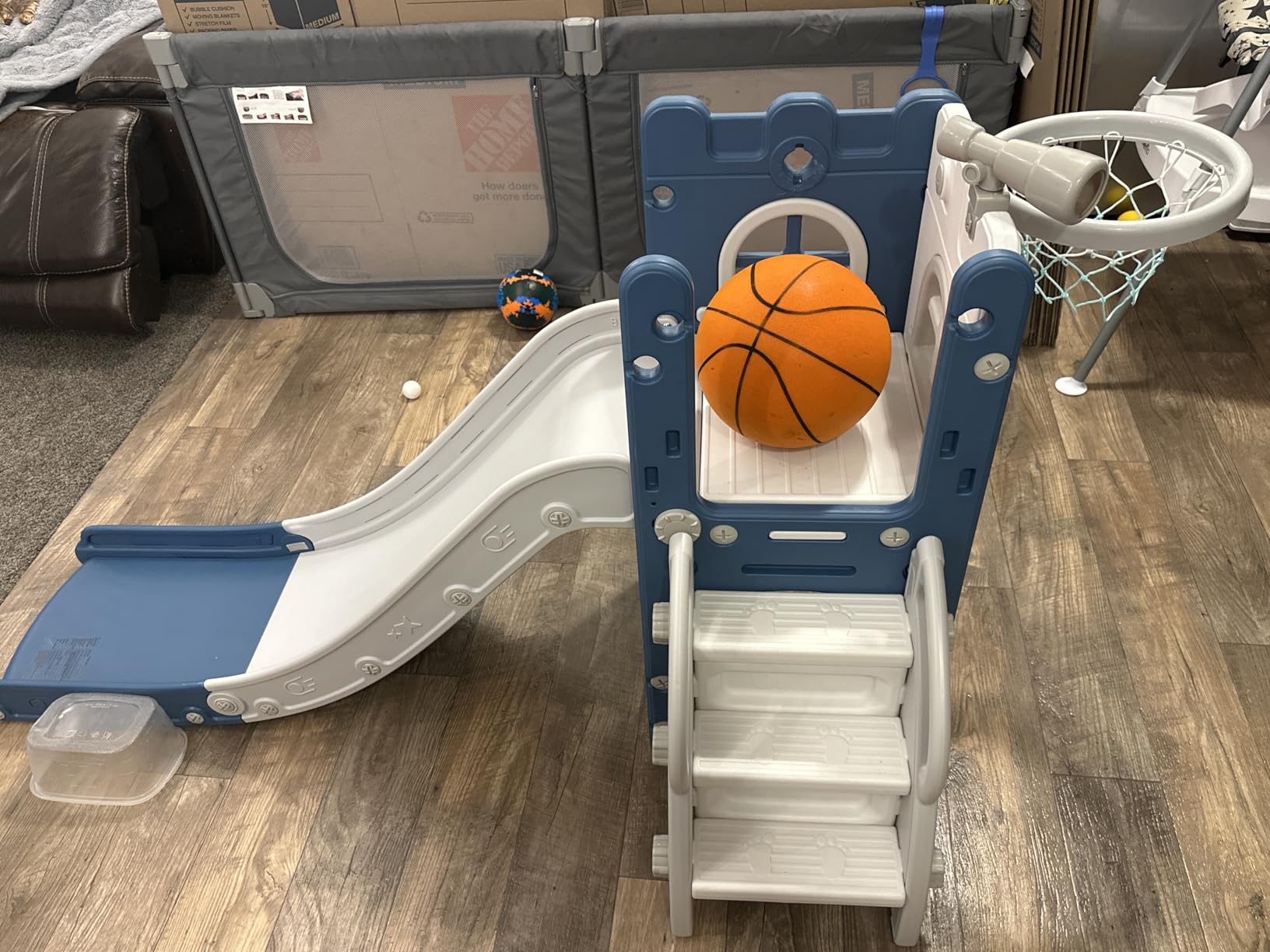
At 4.3 stars from 672 reviews with 69 percent five star, this is the lowest-rated product we included, and we included it on purpose. It ranks well in search and the safety architecture is genuinely good, but a meaningful share of reviews flag sturdiness and finish issues, which is worth knowing before you buy.
The mixed metal and plastic construction is the likely source. Joints between the two materials wear faster than a single-material moulding, and a heavy 20.5 lb unit is a two-person carry. Check every fastener after the first month of use.
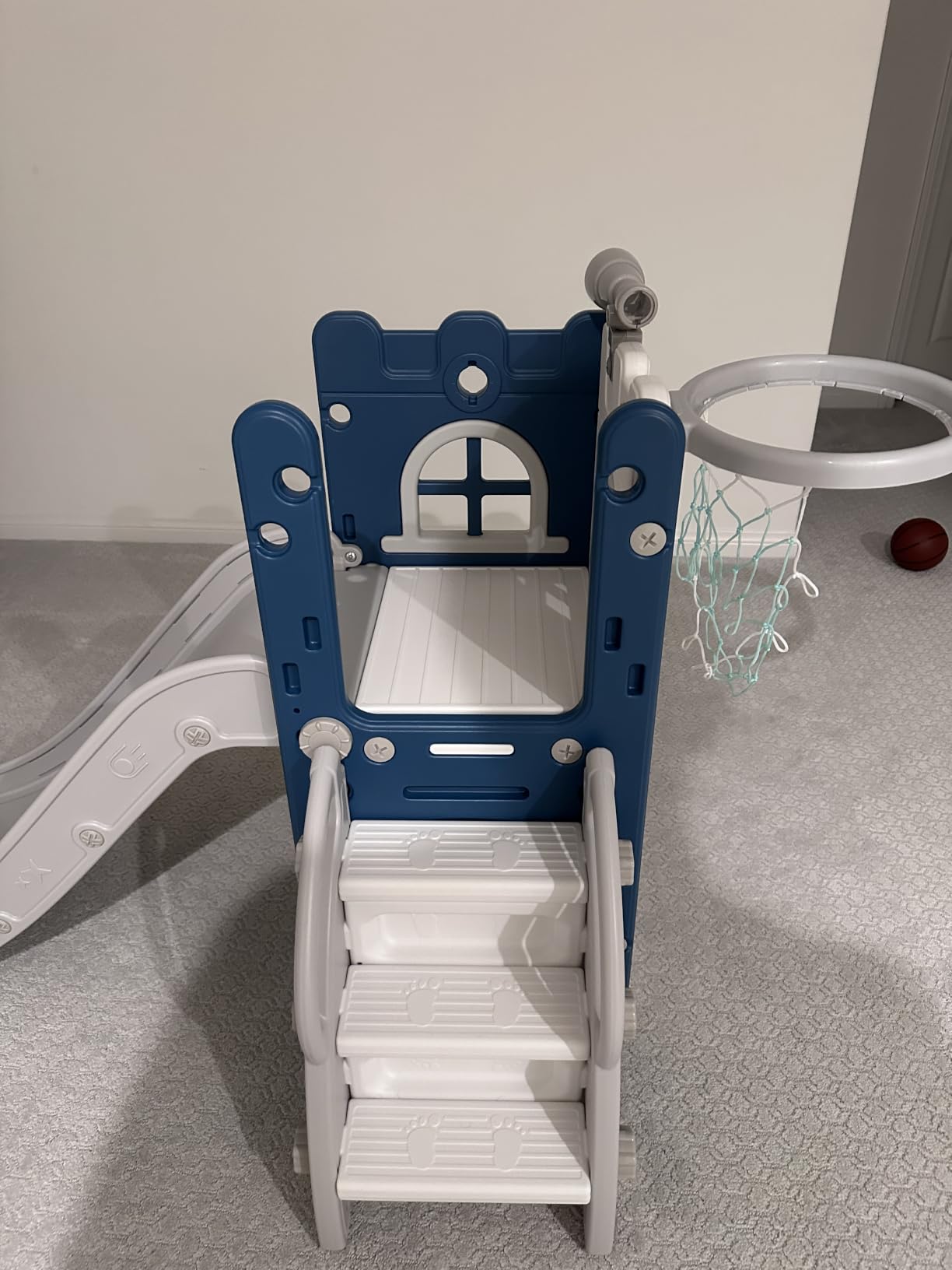
Why the top guardrail changes the experience
Most slides in this category are open at the top, which means a child must pivot at the edge of the platform with nothing to hold. The guardrail here gives a handhold at the exact moment of transition, and parents of climbers consistently describe that as the difference between independent play and being lifted down by an adult.
Combined with the L-shaped run, it also solves the landing zone problem partially. Because the child turns as they descend, they do not shoot out into a room the way they would from a straight slide.
Where it will disappoint you
The rating. Seven percent one star feedback is the highest share in this roundup, and the complaints cluster around finish and joint durability rather than any single failure. Buy it for the climbing support; do not buy it expecting the consistency of the two Little Tikes slides.
At 20.5 lb in a building with stairs, this is not a portable object. If you need to move it daily, the 7 lb Nyeekoy is the realistic option instead.
How to Choose an Indoor Toddler Slide
Choose by footprint first and features second. Almost every disappointing purchase we see discussed in parent forums comes down to a slide that physically dominated the room, not a slide that lacked features. Measure the space, then measure again with the approach and landing area included.
Measure the whole footprint, not the slide length
Footprint means the full length by width of the structure plus the run-out in front of it. The structure is the easy number, because every listing publishes it. The run-out is the one parents forget, and it is the reason a 46 inch slide feels enormous in a small room.
Our rule of thumb: keep at least 3 feet of clear floor in front of the slide exit, and never place the exit pointing at a door, a corner or a hard edge. Measure from the top of the ladder, not from the base, because the climbing zone is the part that gets blocked first.
Match slide height to your child, not to the age label
This is the guidance no competitor publishes, and it answers the most common question parents ask. Age labels are broad because children vary enormously in size at the same age, and tall toddlers are routinely sold the wrong slide.
The general rule: keep the platform height at or below the child’s chest, so they can see over the edge and sit down without straddling it. For a one-year-old walking but not climbing confidently, that means a platform in the 15 to 20 inch range. For a three-year-old, 25 to 36 inches opens up a proper slide. Beyond 36 inches you are buying outdoor equipment, and the run-out space required grows with it.
In our list, the Junior Play Slide at 19.25 inches and the First Slide at 20 inches suit the under-two end. The Step2 Sports-Tastic at 15.5 inches is the lowest and the safest profile for a new walker. The Step2 Play and Fold at 25.5 inches, the Arlopu at 33.4 inches and the two larger playsets at 36 inches suit a two- to three-year-old. The 36 inch platforms are steep, so expect to hand your child down the first few times.
Decide between foldable, removable steps and fixed
These are three different solutions to the same problem. A foldable slide collapses into a flat panel, which is the most compact option and the reason the Step2 Play and Fold ranks where it does. Removable steps, as on the Little Tikes First Slide, shrink a slide without folding it and take seconds rather than a folding sequence.
A fixed slide costs nothing in build quality and is often the sturdiest option, but it stays in the room. If you share your floor space with dining, work or sleep, foldable or removable is not a nice-to-have.
Check the weight limit and the age rating separately
They measure different things. The age rating reflects when a child has the balance and judgement to use the slide alone; the weight limit reflects the structure’s structural capacity. A product can have a high weight limit and still be too advanced for the child using it, which is exactly the situation with the taller models on this list.
Also note the spread across our picks: the Step2 Play and Fold is rated to 43 lb, while the BIERUM 9 in 1 lists 154 lb and the Babytronic lists 110 lb. The differences are larger than most listings suggest, so match the number to your child now and to a possible second child later.
Decide plastic, wood or cardboard
Plastic, mostly HDPE, dominates this category because it is light, wipe-clean and cheap. The ASTM and CPSIA certifications on the BIERUM, Babytronic and Arlopu units are the safety standard worth checking for. Double-walled plastic, as on the Step2 Play and Fold, resists cracking better than single-wall construction.
Wood slides feel warmer and last longer, but they are heavier, need more floor protection and are harder to wipe down. Cardboard slides exist as a cheap, storable, zero-assembly alternative and get discussed on parenting forums, but they suit younger toddlers who are still climbing-assisted and do not handle a vigorous four-year-old well.
Consider whether you are in a flat or a house
In an apartment, weight and footprint rule everything out. A 7 lb unit you can carry up stairs and fold flat beats a 21 lb steel-frame structure every time, and noise to downstairs neighbours is a real consideration, which favours plastic and folding designs over wooden builds. If you have baseboard heaters, check the clearance before you buy, since a fold-flat slide stores better than any fixed frame.
In a house with a dedicated playroom, the trade flips. A 9 in 1 activity centre earns its footprint there, and a fixed wooden slide stops being a problem. Our guide to playground slides for backyards covers the heavier end if you have space outdoors too.
Plan your cleaning routine before you buy
Plastic HDPE needs almost nothing: warm soapy water, a damp cloth and a wipe-down of the step treads, which is where sticky hands collect. Do not use a solvent or an abrasive pad, both of which can scratch the surface and create a place for grime to settle.
Wood needs a dry wipe rather than a wet one, and any spill should be dried promptly. Cardboard cannot be cleaned properly at all, which is the real argument against it for a shared or allergy-affected child. Wipe-down routine aside, check that you can reach every step tread, since that is where indoor grime accumulates fastest.
Indoor Slide Safety: What Parents Need to Know
Yes, indoor slides are safe for toddlers, with one condition: one child at a time, and an adult within arm’s reach. Falls on indoor slides are overwhelmingly minor and overwhelmingly caused by collisions from a sibling on the slide at the same time, not by the equipment itself. The rest come from landing zones that were never cleared.
Keep the run-out area empty for at least 3 feet past the bottom of the slide. That means no coffee table, no rug edge, no radiator, no window ledge. Keep the climb zone clear too, and check that the slide is seated flat and fully locked before the first child of the day climbs.
Flooring changes everything. On carpet, a slide sinks slightly into the pile and stays put. On laminate or vinyl, a light plastic slide can drift across the room during a hard push-off, which is the single most repeated complaint in parent discussions about indoor slides. A rug or foam mat under the base fixes it, and a heavier slide fixes it permanently.
For children under two, hands-on support is normal, not a sign of a problem. A surprising number of toddlers put both hands down on the way down even on gentle slides. Sit at the bottom, guide the first few descents, and move to a shorter slide if they cannot do it without help at all.
Finally, check the hardware after the first month. Sliders loosen from jumping and climbing, and a screw with a dab of thread locker is a two-minute fix compared with a structure that has developed a wobble. If your child will also use it outdoors at any point, our backyard slide guide covers weather ratings that indoor-only products do not need.
Frequently Asked Questions
Are indoor slides safe for toddlers?
Yes, indoor slides are safe for toddlers when one child uses the slide at a time and an adult stays within arm’s reach. Most injuries come from collisions between siblings or from cluttered landing zones rather than from the equipment. Keep at least 3 feet of clear floor past the bottom of the slide, keep the climbing zone clear, and place a rug under the base on smooth floors to stop the slide drifting.
What is the best slide for a 2-year-old?
The Little Tikes First Slide is our best pick for most 2-year-olds, with a gentle slope, a 20 inch platform and a listed capacity of up to 60 lb. For a tall 2-year-old who has outgrown a baby slide, choose a taller platform in the 25 to 33 inch range, such as the Step2 Play and Fold Junior or the Arlopu foldable climber, both of which have buffer zones at the bottom of the run.
Is there an indoor slide for toddlers that is foldable?
Yes. The Step2 Play and Fold Junior Slide is our best foldable pick: it collapses into a flat panel rather than a stack of parts, weighs 5.4 kg, and stores against a wall or inside a closet. Two other options fold or break down too, the Nyeekoy 3 in 1 at 7 lb for full portability and the Babytronic 6 in 1 for a larger multi-activity unit.
What is the recommended slide height for a 3-year-old child?
For a 3-year-old, a platform height between 25 and 36 inches works well, keeping the top of the slide at or below the child’s chest so they can see over the edge and sit down safely. Below 20 inches is better suited to a child under two, and anything above 36 inches requires more landing clearance than most indoor rooms allow.
Does an indoor slide work on carpet?
Yes, and carpet is the easiest surface to use. A slide sinks slightly into the pile and stays in position, which removes the drifting problem parents report on laminate and vinyl. On hard floors, place a rug or foam mat under the base to stop the slide shifting during play, and expect to reposition a lighter slide after a hard push-off without one.
What are the best indoor slides for small spaces?
The Little Tikes First Slide, the Little Tikes Junior Play Slide and the Nyeekoy 3 in 1 are the strongest compact options. All three are under 5 feet long and can be carried or partially disassembled by one adult, which matters more in a flat than any feature list. Avoid the 60 by 53 inch activity centres unless you have a dedicated playroom.
Conclusion
The Little Tikes First Slide is the best of the ten we compared for most families in 2026, because a gentle slope, a 46 inch footprint and removable steps cover the widest range of rooms and children. Buy the Step2 Play and Fold Junior if your room has to reset every evening, the Nyeekoy 3 in 1 if you carry things up stairs, and the Arlopu foldable climber if you have a tall toddler who has already outgrown a baby slide. Measure the landing zone before you order, put a rug under the base, and let one child at a time do the sliding.