
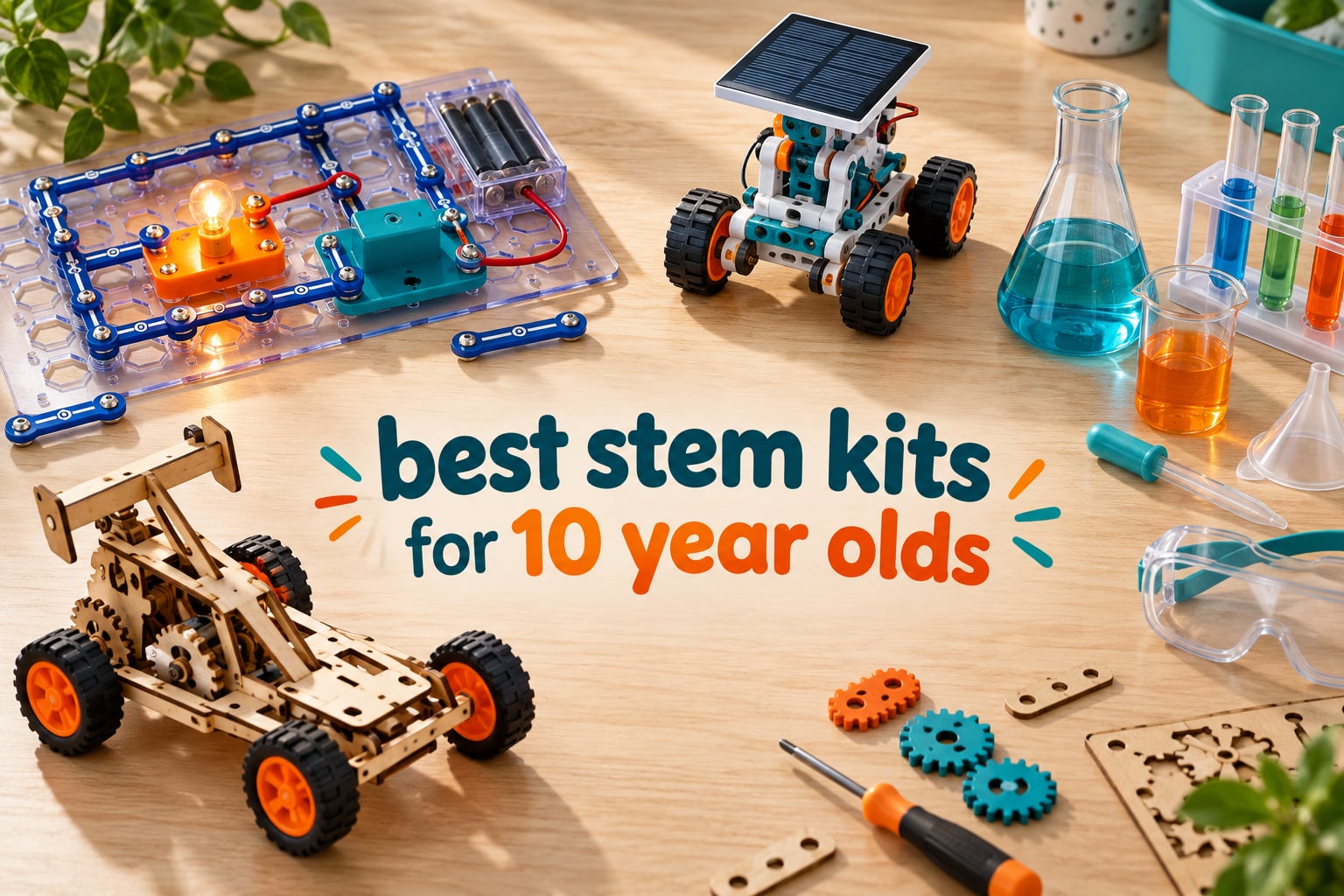
Last updated October 2026. We compared 12 kits across circuit building, science, engineering, coding and mechanics, then checked what a 10-year-old can realistically finish, rebuild and explain to someone else. Every kit below comes with the parts in the box, so you are not chasing add-ons on launch day.
STEM means Science, Technology, Engineering and Mathematics, and a STEM kit is a boxed set of parts, tools and guided projects that lets a child build, experiment or program something hands-on. For a 10-year-old, the sweet spot is a kit that demands real reading comprehension and steady hands without turning into homework.
The two failure modes we see most often are age mismatches in both directions. A kit marketed for ages 5 to 8 is built around snap-together plastic and picture instructions, and a 10-year-old finishes it in an afternoon. A kit pitched at 13 and up assumes algebra and soldering patience, and it sits in a box for a year. The right kit sits in the middle: readable, multi-model, and re-playable.
If your child is already drawn to robots and programming, our robotics kit roundup goes deeper on that category. For building-focused kits rather than electronics, the engineering STEM toys guide covers the construction side.
Below, the quick overview table gives you every pick at a glance, then each kit gets an honest write-up covering what your child actually builds, whether a screen is required, and who should skip it.
Table of Contents
Top 3 Picks for the Best STEM Kits for 10 Year Olds (October 2026)
The three below cover the widest range of interests: circuits, earth science and chemistry. Every other pick is organised in the numbered sections that follow.

Snap Circuits Jr. SC-100 STEM Kit
- 100+ projects from 29 parts
- No soldering or tools needed
- Color-coded numbered modules

Sillbird 12-in-1 Solar Robot Kit
- 12 buildable models from 190 parts
- Solar and lamp dual power
- No batteries required

National Geographic Earth Science Kit
- Over 100 activities
- Two geologic dig kits included
- Full-color learning guide
Quick Overview: All 12 STEM Kits Compared in 2026
Every kit in this list ships with everything needed to start the first build. Read across for the category, the replay value, and whether a screen is involved at all.
| Product | Specifications | Action |
|---|---|---|
| Snap Circuits Jr. SC-100 STEM Electronics Kit |
|
Check Latest Price |
| Sillbird 12-in-1 Solar Robot Building Kit |
|
Check Latest Price |
| National Geographic Earth Science Kit |
|
Check Latest Price |
 National Geographic Magic Chemistry Set National Geographic Magic Chemistry Set |
|
Check Latest Price |
 Smartivity Hydraulic Aeroplane and Dart Launcher Smartivity Hydraulic Aeroplane and Dart Launcher |
|
Check Latest Price |
 National Geographic Gross Science Kit National Geographic Gross Science Kit |
|
Check Latest Price |
 Thames and Kosmos Mega Cyborg Hand Thames and Kosmos Mega Cyborg Hand |
|
Check Latest Price |
 Smartivity Robotic Mechanical Hand Smartivity Robotic Mechanical Hand |
|
Check Latest Price |
 COBFDHA 6-in-1 Solar Robot Kit COBFDHA 6-in-1 Solar Robot Kit |
|
Check Latest Price |
 Smartivity DIY Pinball Machine Smartivity DIY Pinball Machine |
|
Check Latest Price |
 Makeblock mBot STEM Coding Robot Makeblock mBot STEM Coding Robot |
|
Check Latest Price |
 Poraxy 5-in-1 Wooden Vehicle STEM Kit Poraxy 5-in-1 Wooden Vehicle STEM Kit |
|
Check Latest Price |
Are STEM Kits Worth the Money?
Yes, but only the multi-build ones. A kit earns its place when it contains 10 or more projects, when difficulty rises across those projects, and when there is a path to expand the parts set. Those three signals separate a kit your child returns to for months from a single-build novelty that ends up in a closet by week two.
A kit with one model, no add-on path and a flat manual usually costs you a demo session. That is not a bad purchase, but it is a party trick rather than a learning investment, and the honest way to shop is to check the project count before anything else.
Shelfware, not quality, is the concern that repeats. On the AskReddit thread asking parents which STEM tools made the biggest difference at home, the recurring test was whether the kit was still in use weeks later.
1. Snap Circuits Jr. SC-100 – Circuit Building With 100+ Projects
SNAP CIRCUITS Jr. SC-100 STEM Electronics Kit, 100+ Projects, Ages 8+
29 snap parts
100+ projects
Ages 8 and up
12 x 9.5 x 1.75 inches
Pros
- No tools
- soldering or extra equipment needed
- 100+ projects from one box
- Color-coded and numbered parts
- Expands with other Snap Circuits kits
Cons
- Alkaline batteries required for working projects
- Later manual projects need adult help
- Some parts sit loose on the grid
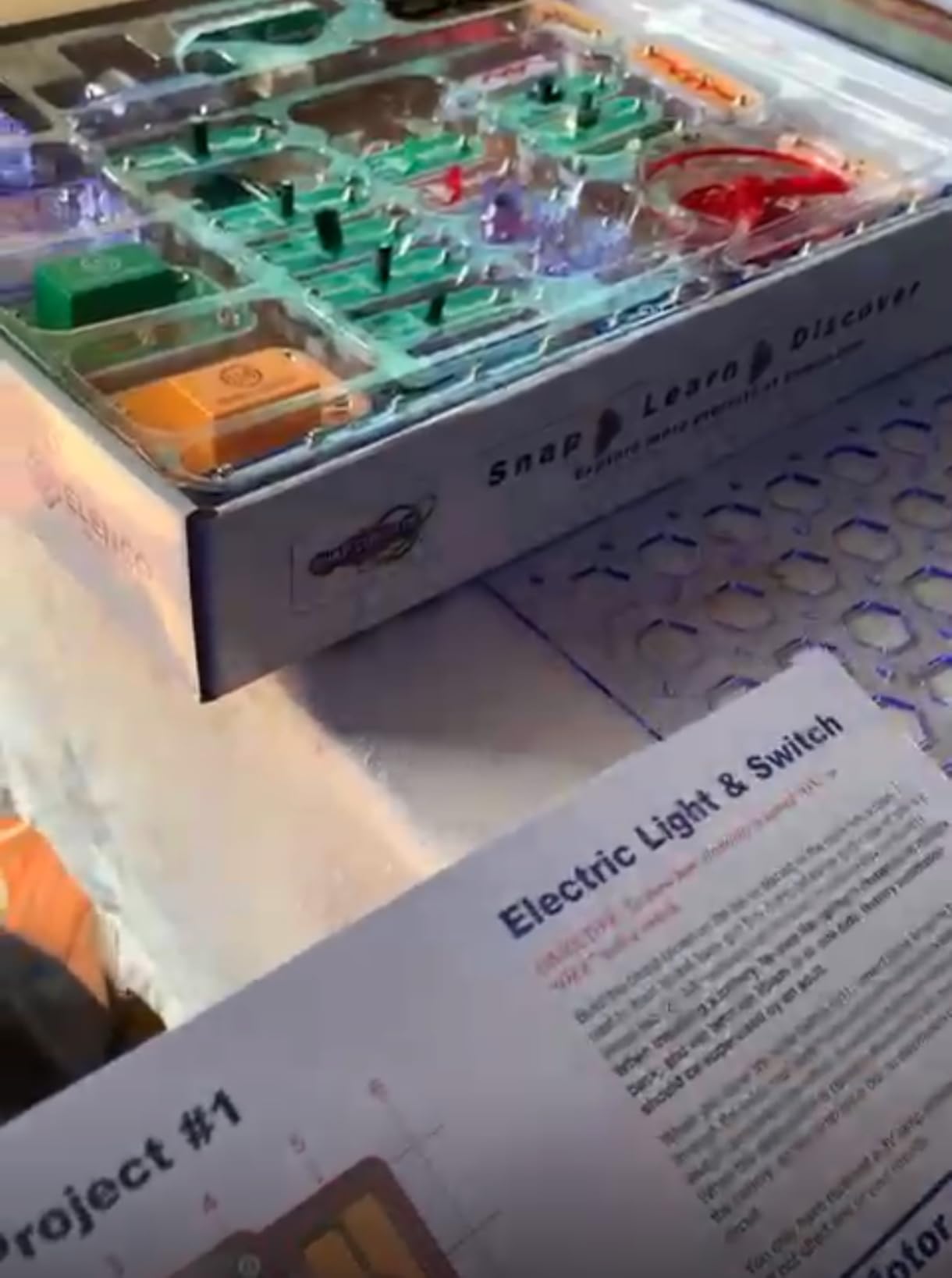
This is the kit we keep coming back to. Parts snap onto a reusable plastic grid, and the full-color manual walks through more than 100 circuits in rising difficulty. Assembly is genuinely tool-free, which means no soldering iron, no screwdrivers and no lost hardware tray.
At 4.8 stars across 29316 reviews, this is the highest-rated kit in our lineup and the one with the largest review base, so its strengths and limits are both well documented. Owners consistently note it works well past the stated age of eight, which is exactly what you want at 10.
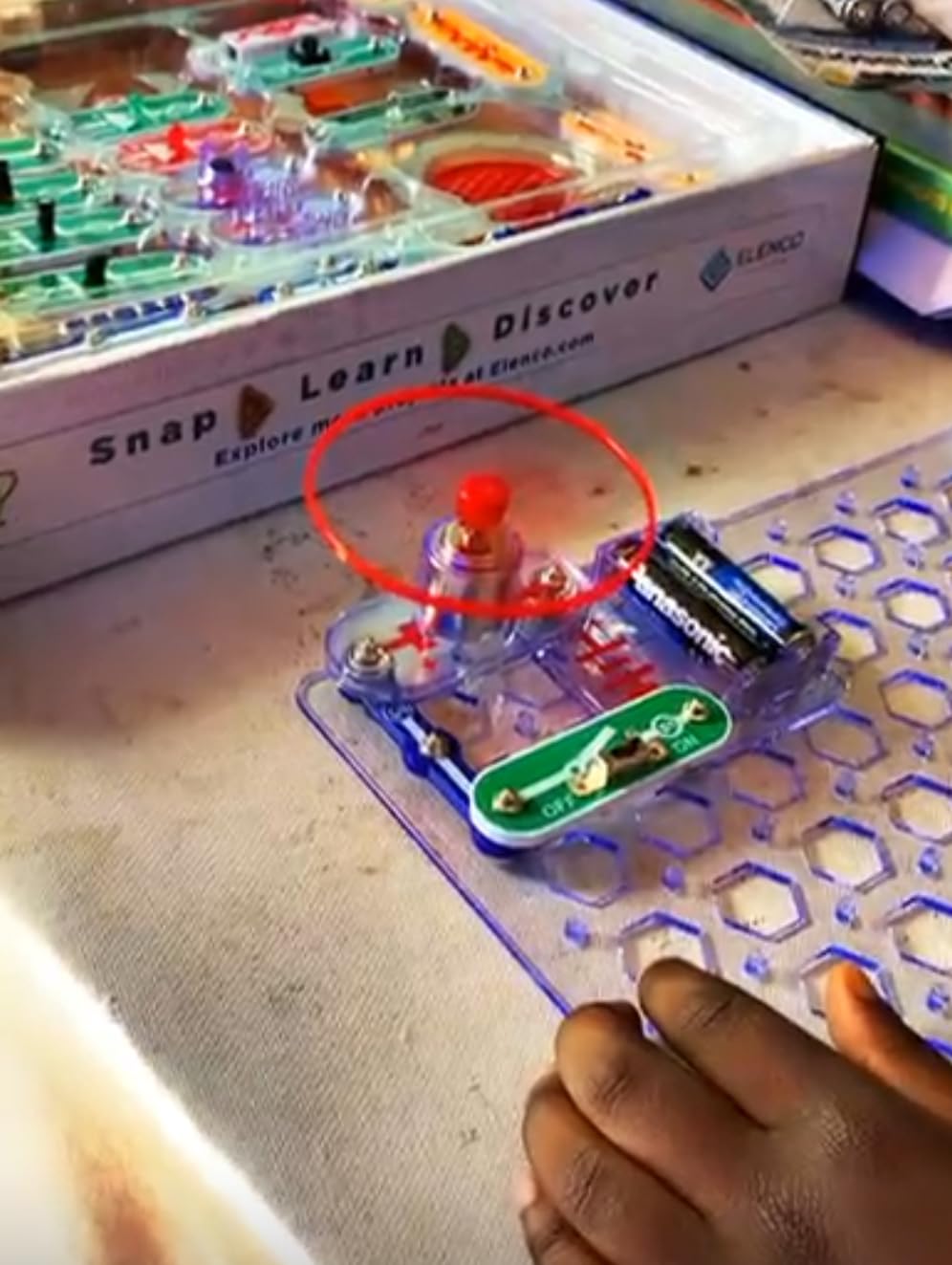
What a 10-year-old actually builds: working light circuits, sound alerts, simple motor spins, a fan, an alarm and a light-sensitive switch. The first ten projects take an evening. Somewhere around project 40 the same child starts predicting the circuit before checking the manual, and that is the actual learning moment.
The grid is reusable, so tearing a project down to start a new one takes a few seconds. That speed matters more than it sounds. Kits where parts are consumed or glued become single-use; kits that reset instantly get played with for years.
Why a 10 year old keeps coming back to it
Because the difficulty curve is long enough to hide new challenges inside familiar hardware. A 10-year-old who has mastered the first fifty projects still has fifty more with the same parts, and the electrical thinking transfers to school science long before anyone calls it physics.
It also survives siblings. Because the parts are generic modules rather than a single model, an older child can start on the harder builds while a younger one works through the basics on the same kit. That is unusual at this age band.
When to skip it
Skip it if your child wants a physical model to keep rather than a working system. A snap grid does not look like a robot when it is finished, and a child who judges a toy by how it looks on the shelf will lose interest faster than a child who judges it by what it does.
Also plan for batteries. The working projects need alkaline cells, and once they are flat the kit becomes a static diagram. Keep a spare pack with the manual and swap them in a minute. Later projects in the book do lean on adult help, so a 10-year-old can go solo early but will want a parent for the final stretch.
2. Sillbird 12-in-1 Solar Robot Kit – Twelve Solar-Powered Builds
Sillbird 12-in-1 Solar Robot Building Kit STEM Gift for Boys Ages 8-13
190 parts
12 models
Ages 8 to 13
No batteries needed
Pros
- 12 models with rising difficulty
- Large solar panel gives real movement
- Works indoors under a lamp
- Clear step-by-step instructions
Cons
- Solar movement is slow under artificial light
- Small parts feel light and fiddly
- Later models need patience
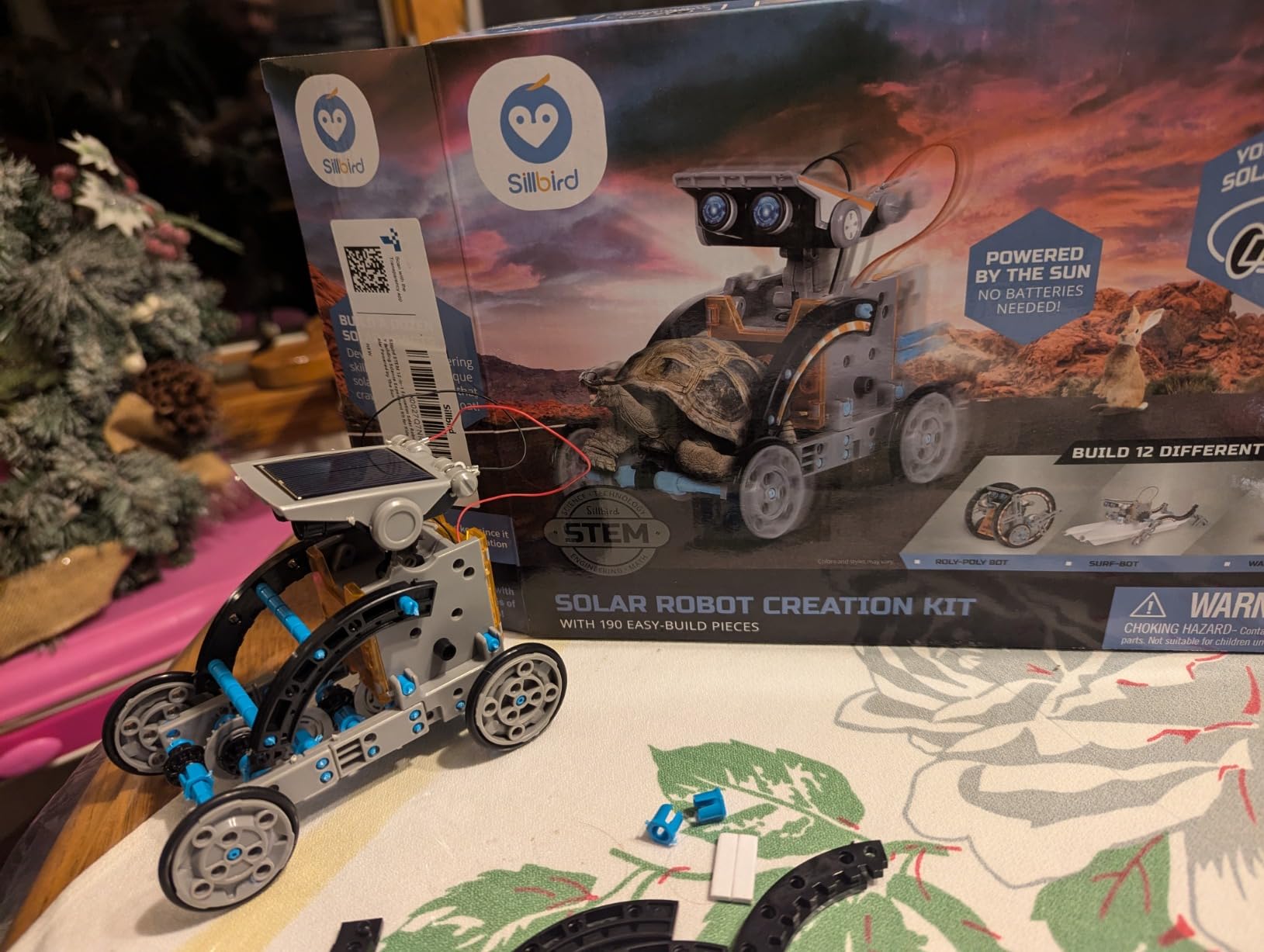
This is the energy kit. Your child builds robots, cars and vehicles from 190 ABS pieces, and every one of them runs on a solar panel rather than batteries. For a 10-year-old, that turns a toy into a lesson about power output, because weak light means weak movement and the cause is visible.
It is also the lowest-rated kit in our set at 4.3 stars across 15909 reviews, and the reason is straightforward: build quality. Owners like the model count and the clear instructions, but reviewers repeatedly mention the modest plastic and how slow the solar-driven movement looks indoors.
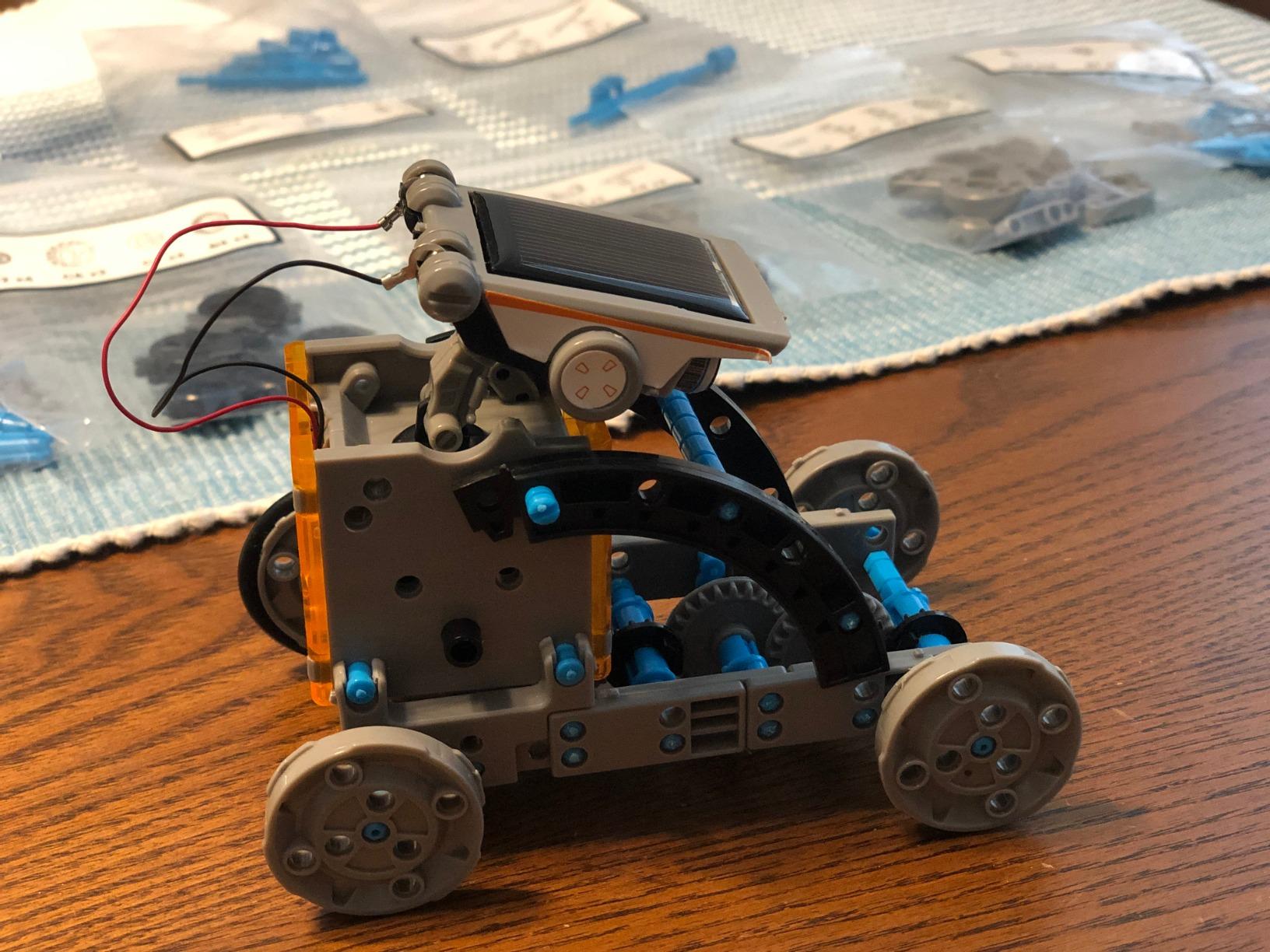
What a 10-year-old actually builds: twelve models, from a simple two-wheel robot up through a walking unit and a vehicle with a rotating mechanism. The manufacturer lists age 10 and up, which matches this kit almost exactly, one of the few on this list where the stated age and the real difficulty line up.
Indoors, a strong lamp or a flashlight works. Outdoors on a bright day, the upgraded panel produces enough power for genuine movement. The difference between the two is genuinely instructive rather than frustrating, as long as you set the expectation before the first build.
Why the 12 models matter at this age
Twelve builds means twelve chances to start over, and a 10-year-old who burns out on model three still has nine ahead. That single number is the strongest anti-shelfware feature in this list.
The parts also combine. A child who finishes all twelve will usually start mixing modules to make something not in the manual, which is the moment a kit stops being a kit and becomes a toy. Instructions are clear enough that a 10-year-old can work through the early models independently.
When to skip it
Skip it in a climate where the sun is unreliable and you are not willing to run a desk lamp for it. Weak artificial light produces a robot that barely creeps, and a child who sees it fail twice will put it in a drawer rather than debug the physics.
The fiddliness is real too. Small pieces and light-feeling plastic are the two most common complaints. A child with developing fine motor control will ask for help with connectors, and later, more complex models take real patience to finish in one sitting.
3. National Geographic Earth Science Kit – 100+ Earth and Geology Activities
National Geographic Earth Science Kit with 100+ Activities for Kids 8-12
100+ experiments
Ages 8 to 12
2.6 pounds
8.66 x 3.15 x 12 inches
Pros
- 100+ activities covering geology and weather
- Two geologic dig kits included
- All supplies in the box
- Clear instructions build confidence
Cons
- Messier activities need adult supervision
- Consumable experiments run out
- A few activities feel repetitive
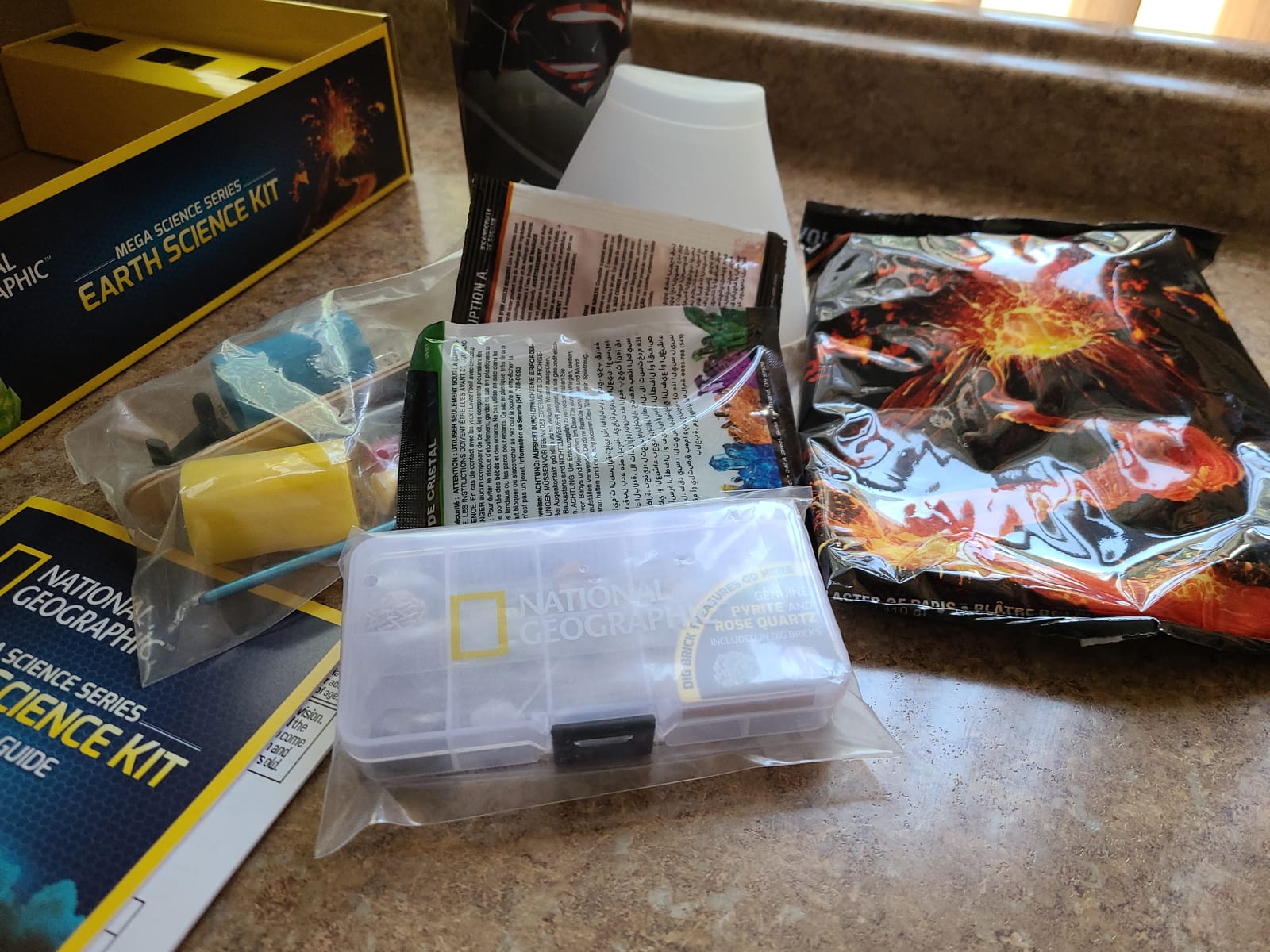
This is the widest science box in the lineup. It covers crystal growth, erupting volcanoes, rock collecting, weather and water experiments, and it includes two geologic dig kits plus a full-color learning guide that explains the science behind each activity. Nothing needs to be bought separately.
At 4.7 stars from 17359 reviews with an 81 percent five-star share, sentiment is consistently positive. Reviewers regularly single out the two dig kits and the crystal-growing activity as the hits, and many note that the box splits well among siblings or a small group.

What a 10-year-old actually builds: dueling water tornadoes, a volcano, a crystal garden and a pair of dig kits to excavate and identify specimens. The reading load is moderate, so a 10-year-old can run most of it alone, and the guide gives them vocabulary to use afterwards.
The honest caveat is that the 100+ count is partly a headline. A number of the activities are variations on the same core experiment, and the consumable ones do eventually run out. Treat the figure as roughly 30 to 40 genuinely distinct projects rather than 100.
Why this is the safest all-round science pick
Because it does not require a device, a parent, or a specific interest. A child who loves dinosaurs, weather, rocks or slime can all find a corner in this box, which is exactly what you want when you do not yet know which branch of science will stick.
It is also easy to share with a sibling. With a 2.6 pound box and activities that run in any order, two children can work in parallel without competing for parts, which makes it a strong birthday or holiday gift when two siblings are close in age.
When to skip it
Skip it if your child has strong reactions to mess or needs a controlled space. Several activities involve digging, liquid and mixing, and reviewers consistently advise an adult being nearby. This is a kitchen-table or outdoor kit, not a quiet-room kit.
Skip it too if you want a project that ends in something permanent and impressive. There is no finished model here. The payoff is knowledge and a set of small results, which some children find less thrilling than a finished build they can show off.
4. National Geographic Magic Chemistry Set – Ten Chemistry Tricks to Perform
National Geographic Magic Chemistry Set with 10 Tricks for Kids Ages 8-12
10 experiments
Ages 8 and up
12.96 ounces
No batteries required
Pros
- Staged as performance pieces
- Every supply included in the box
- Guide explains the real science
- Compact enough for travel or sleepovers
Cons
- Only ten activities so play value fades
- Mixing and cleanup need an adult
- Instructions are hard work for younger readers
These are real chemistry experiments staged as magic tricks, and that framing is the whole point. Your child does not mix a solution and read a result; they perform. Tricks include instant snow, a floating coin and bubbles caught in an open hand, and a wand and white gloves are included for the full effect.
At 4.7 stars from 13184 reviews, satisfaction stays high even though the box is small. Owners describe using it for grandparent week, birthday parties and classroom demos, and the recurring praise is that nothing extra has to be bought. Everything needed for all ten tricks is in the box.

What a 10-year-old actually builds: ten performance-ready chemistry tricks, each paired with an illustrated guide entry explaining the real scientist technique behind the illusion. No batteries, no power source, no device. Total weight is under a pound, so it travels.
At 10, a child has the patience for the cleanup steps and the nerve to perform in front of an audience. This is one of the few kits on the list where the social payoff is as strong as the learning payoff, and that is what makes it a genuinely good birthday gift.

Why the performance framing works at 10
Because at this age a child is starting to care about being interesting. A kit that produces a result they can show to a friend converts an afternoon experiment into a social event, and social events are what get repeated. Owners report using the kit for parties, sleepovers and classroom demos, where one child performs for several.
The science is not sacrificed to the trick, which is the part that separates this from a magic toy. The guide names the reaction and explains the method, so the child learns while performing rather than just fooling people.
When to skip it
Skip it if you are looking for long-term replay. Ten activities is a modest project count, and reviewers are candid that the novelty passes. Once all ten tricks are learned, the box has no further use, which makes this a short-term purchase rather than an investment.
Adult supervision is also worth planning around. The mixing and cleanup need a nearby grown-up, and while the materials are basic, gloves and a protected surface make the difference between fun and a cleanup argument.
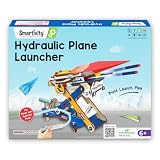
5. Smartivity Hydraulic Aeroplane and Dart Launcher – A Screen-Free Pneumatic Build
Smartivity 2in1 Hydraulic Aeroplane & Dart Launcher STEM Kit Ages 6-14
58 parts
Ages 6 to 14
172 g
Hydraulic mechanism
Pros
- Two builds in one launcher
- Visible hydraulic pressure demonstration
- Sturdy engineered wood
- Free replacement parts from the maker
Cons
- MDF parts can chip at the joints
- Only one aeroplane and a few darts included
- Limited play options after assembly
The concept is simple and it works: one hydraulic launcher that fires both paper aeroplanes and foam darts. A 10-year-old builds it from 58 engineered wood parts, then immediately sees why pressure moves things, because the piston is visible and the flight path is not.
At 4.6 stars across 5763 reviews with a 79 percent five-star share, sentiment is consistently strong. Reviewers mention the satisfying launch performance, the durability of the wood and real appreciation for the free replacement parts policy, which takes the sting out of a dropped part.
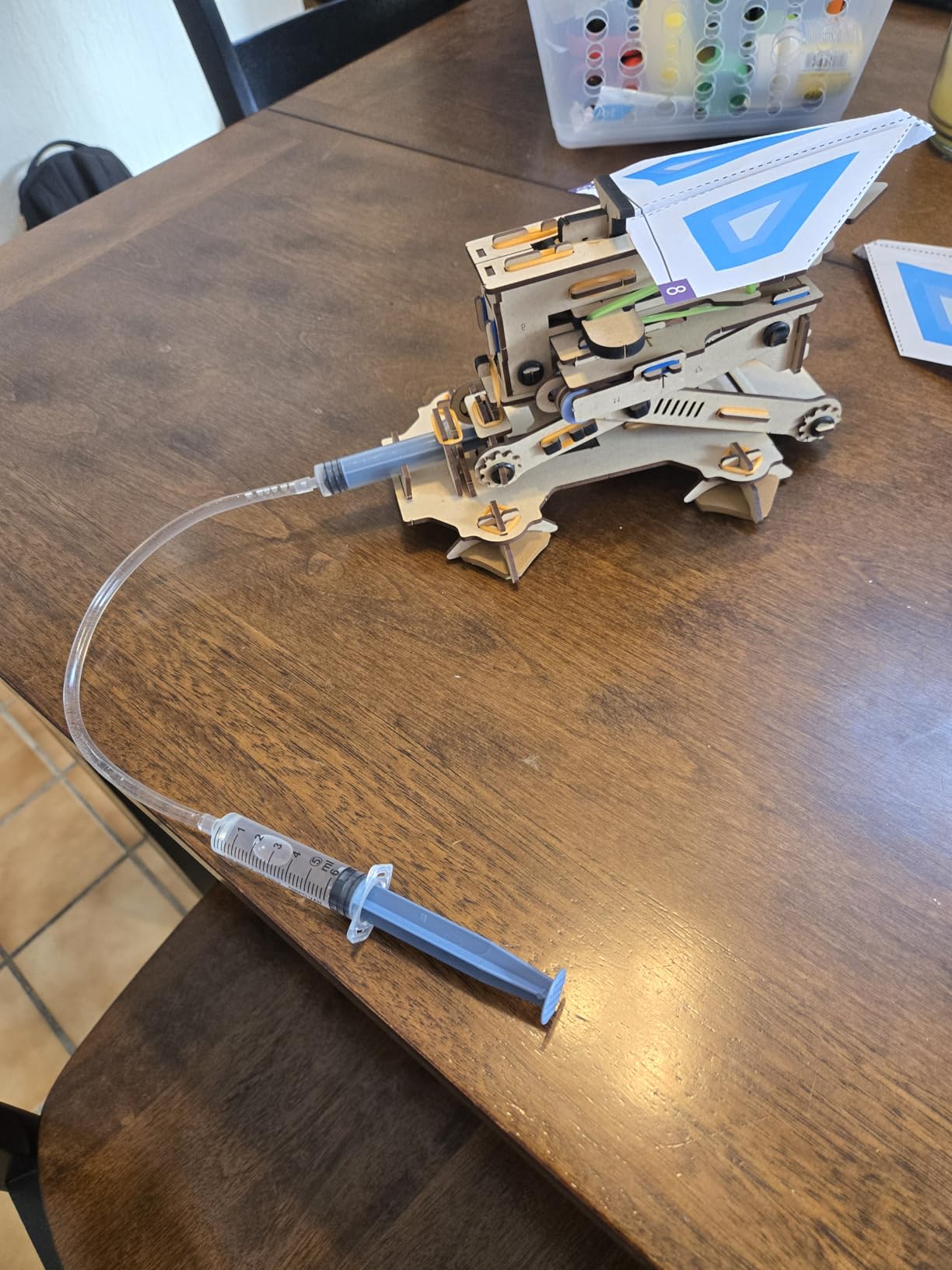
What a 10-year-old actually builds: a working launcher and, in the process, learns how a hydraulic piston converts a squeeze into force. The manufacturer rates it for ages 6 to 14, and the step-by-step manual is clear enough that a 10-year-old can assemble it without an adult sitting beside them.
It is fully screen-free and fully mechanical. There is no app, no firmware and nothing to charge, which makes it equally good for a rainy weekend, a sleepover or a build alongside a parent.
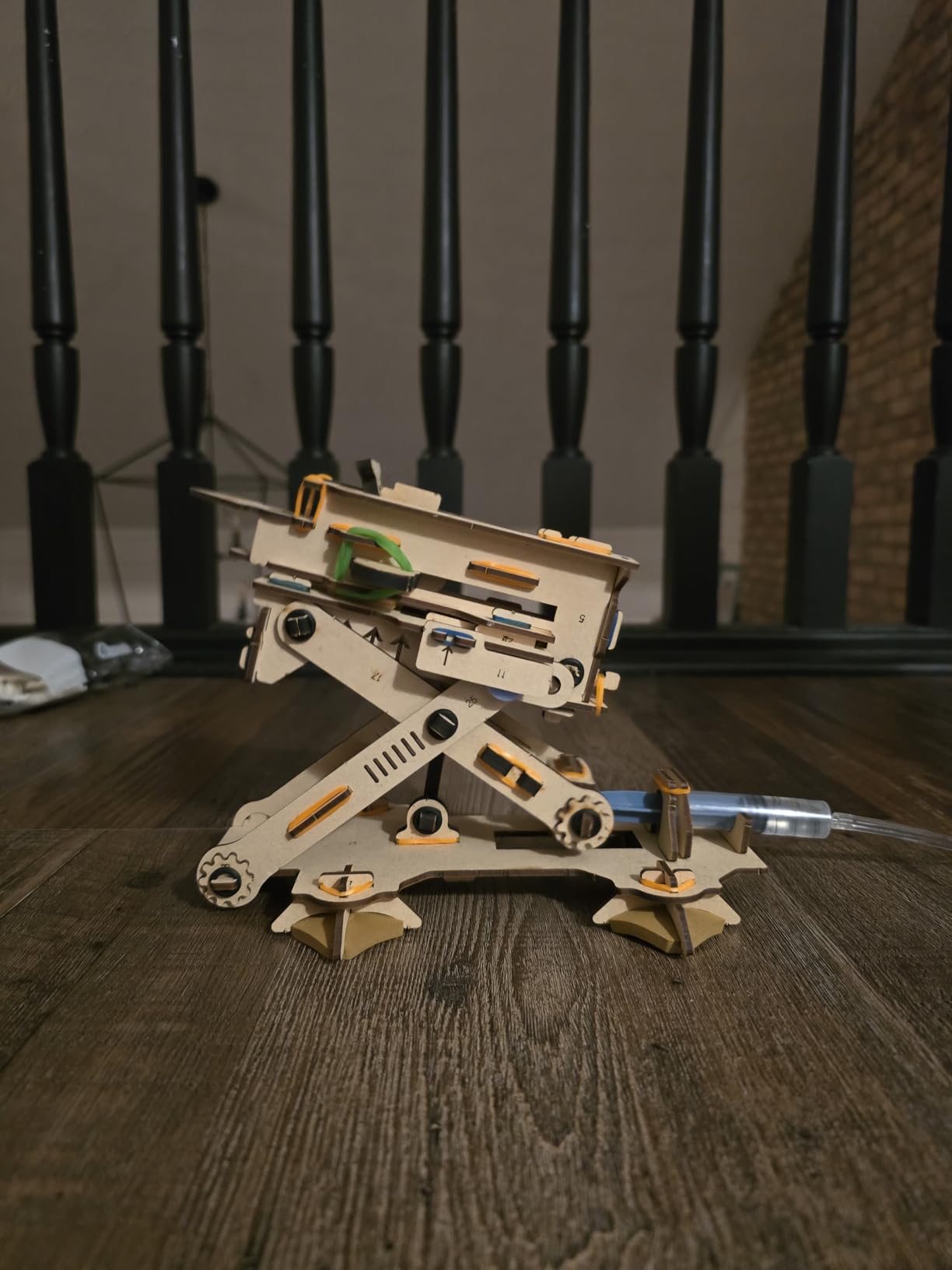
Why two-in-one beats a bigger box
Because a launcher that does two different things gives two reasons to open the box again, without doubling the part count. The paper aeroplane flight is a physics lesson in wing shape, and the dart flight is a straight pressure demonstration, so the same device supports two conversations.
It is also one of the few kits here that stays useful after assembly. A child can fold new paper designs and test them, which turns the finished model into an activity rather than a display piece.
When to skip it
Skip it if you expect long independent play. Once the launcher is built, the number of things to do with it is small, and reviewers commonly note narrower replay value than they expected. Budget for one focused build session plus some paper aeroplane crafting rather than a month of use.
The material has a limit too. Engineered wood is sturdy but MDF joints can chip if forced, and pushing a 10-year-old to hurry the assembly is how that happens. Slow it down and the build lasts as long as it should.
6. National Geographic Gross Science Kit – 45 Polymer and pH Experiments
National Geographic Gross Science Kit with 45 Experiments for Kids 8-12
45 experiments
Ages 8 and up
2.1 pounds
No batteries required
Pros
- Theme holds attention far longer than a standard chemistry set
- 15 supplied plus 30 household experiments
- Teaches polymers and pH
- Illustrated guide
Cons
- Messy work needs an adult and a protected surface
- Bonus experiments are simple variations
- Slime and foam consumables run out fast
This is the kit that holds a child’s attention longer than a standard chemistry set, and the reason is the theme. Boiling boogers, glowing worms and test tube vomit sound juvenile right up until a 10-year-old tries them and then insists on showing a friend.
At 4.7 stars from 5687 reviews with an 84 percent five-star share, sentiment is consistently enthusiastic. Reviewers consistently credit the kit for holding attention, and the bonus booklet of household-ingredient experiments is praised for extending play without another purchase.
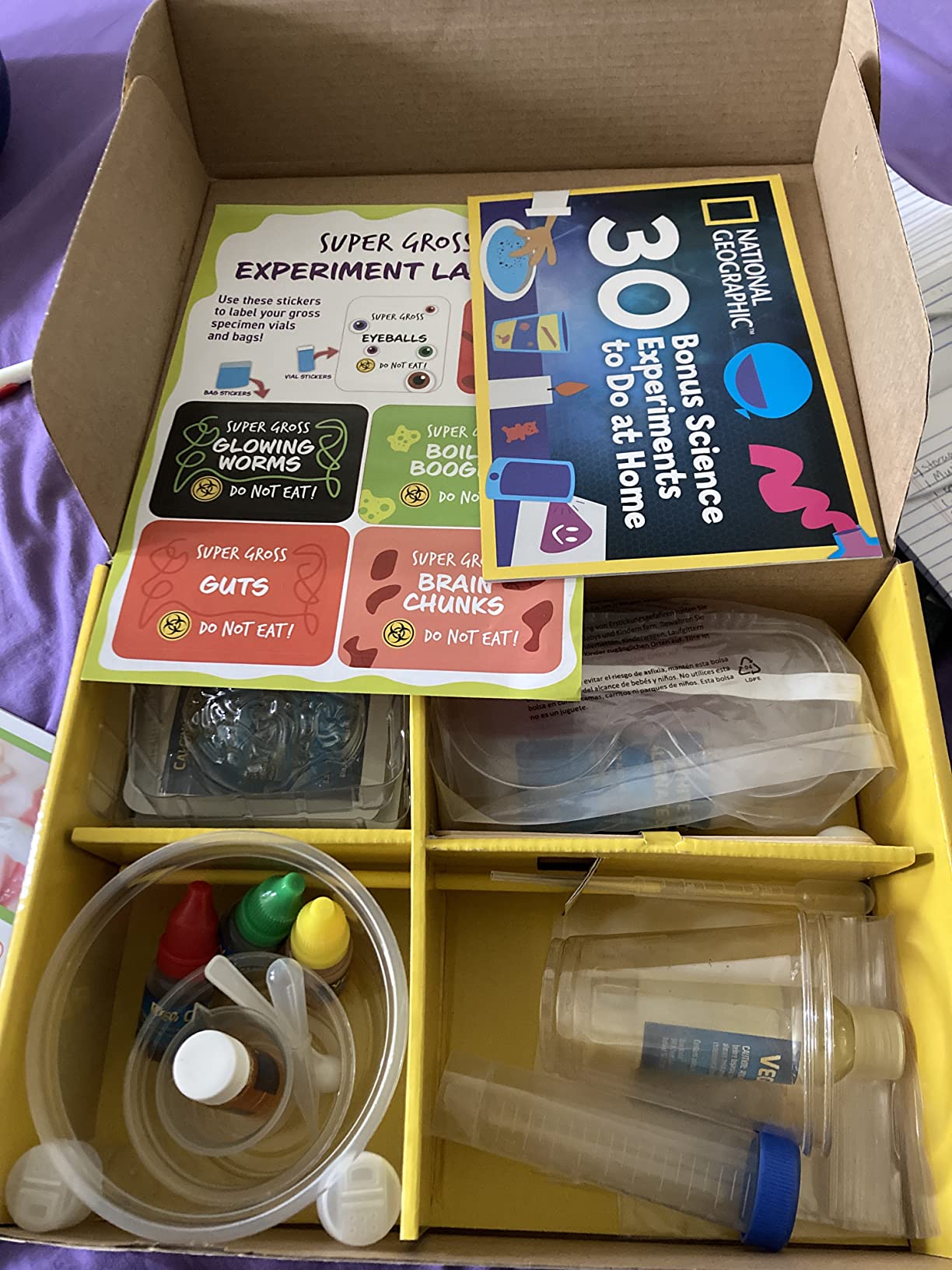
What a 10-year-old actually builds: 15 fully supplied experiments plus 30 more using ordinary items from the kitchen, covering polymers, chemical reactions and pH. The illustrated guide keeps steps simple, and a 10-year-old can handle the reading without an adult translating every line.
The supplied experiments are the strong part. The 30 bonus activities are genuine extensions, but several are simple variations on the supplied set, so treat the 45 figure as roughly 20 distinct experiences with 25 encores.

Why the theme beats a tidy chemistry set
Because engagement is the bottleneck at this age, not capability. A 10-year-old can handle real chemistry; the problem is the child will simply not choose it over slime, and a kit that disguises a genuine polymer lesson as a gross-out trick gets chosen. Once the child is engaged, the science is actually delivered.
The bonus experiments matter too. Because 30 of them run on pantry ingredients, the play does not end when the supplied slime mix or foam runs out, which is the single most common reason kits become shelfware.
When to skip it
Skip it indoors on good carpets, or if anyone in the house has a low tolerance for slime on the ceiling. Reviewers repeatedly advise doing it in the kitchen or outdoors, and the mess is not optional. An adult should be within reach.
Skip it for a child who is squeamish about textures, even at 10. The appeal is the whole mechanism here, and a child who does not want to touch it will not be persuaded by the science content underneath.
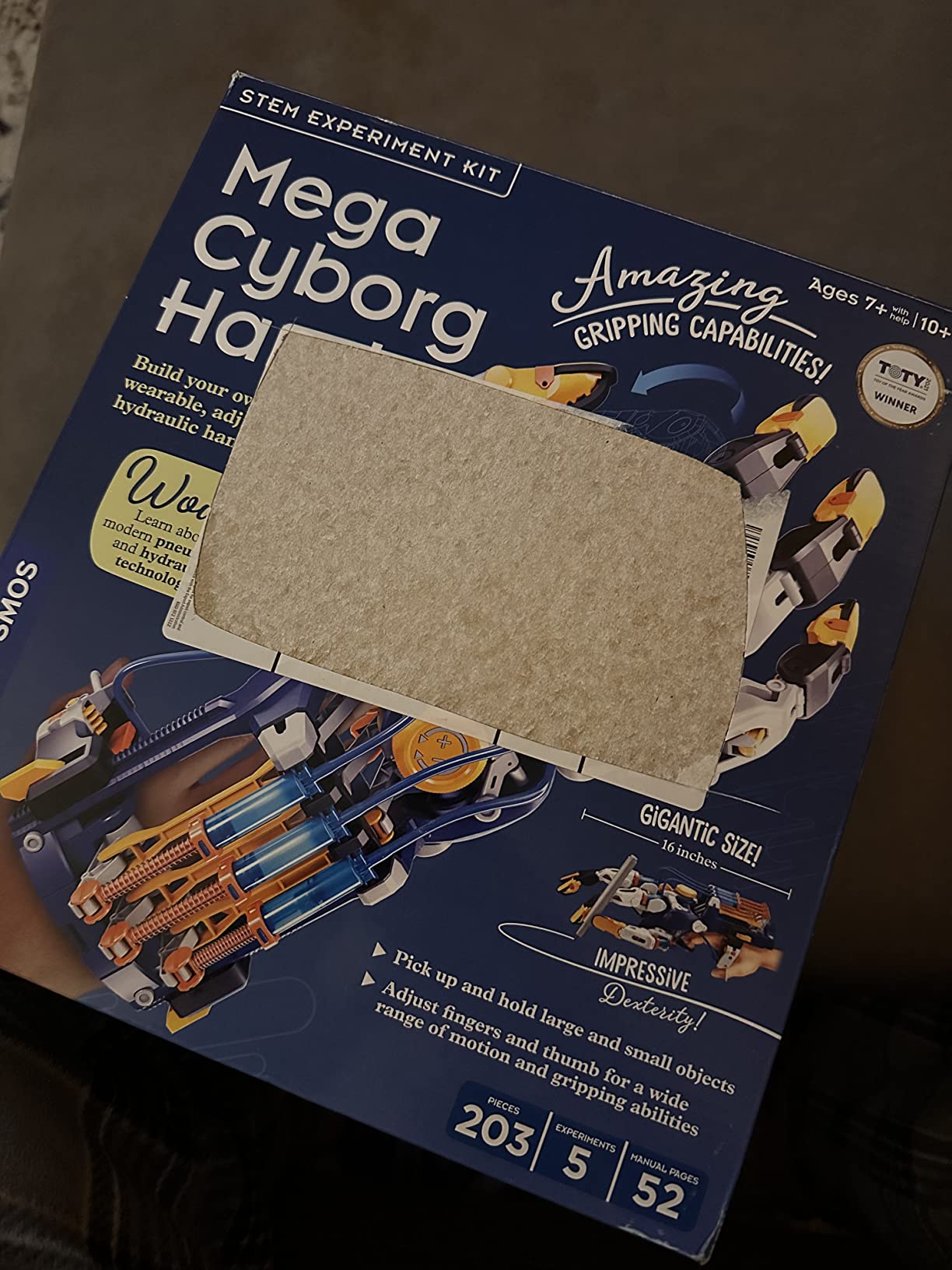
7. Thames and Kosmos Mega Cyborg Hand – A Multi-Hour Pneumatic Build
Thames & Kosmos Mega Cyborg Hand STEM Experiment Kit | Build Your Own GIANT Hydraulic Amazing Gripping Capabilities Adjustable for Different Sizes Learn Pneumatic Systems
2021 STEAM Toy of the Year
Ages 8 plus
1.8 pounds
No motors or batteries
Pros
- Finished hand genuinely lifts objects
- Real hydraulic pistons driven by squeezing
- Adjustable for either hand or claw
- Manual mixes diagrams with physics facts
Cons
- Build takes three to four hours and needs adult help under 10
- Small screws are hard for younger fingers
- Sprue parts can have sharp edges to sand
This is a proper weekend project. Your child builds a wearable mechanical hand driven by hydraulic pistons, then wears it and picks up real objects with their own fingers. There are no motors and no batteries, which means the movement is genuinely mechanical rather than simulated.
At 4.4 stars from 4208 reviews with a 73 percent five-star share, the sentiment is more mixed than the other kits here, and the 6 percent one-star share reflects real complaints. The positives describe a satisfying family build and a genuine teaching moment on pneumatics, with the manufacturer praised for shipping replacement parts quickly.
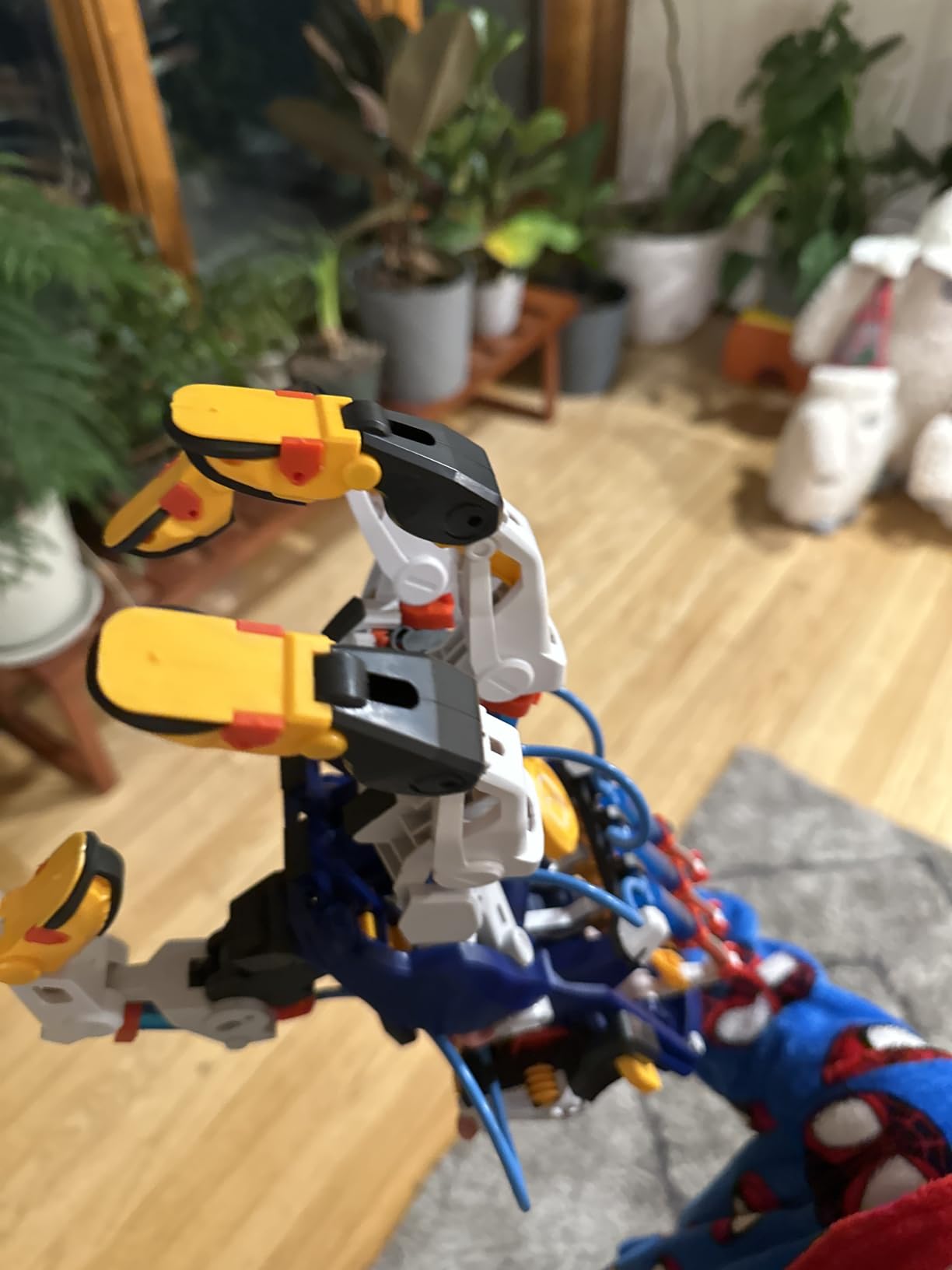
What a 10-year-old actually builds: a full-size hand with adjustable finger joints, three configurations including right hand, left hand and claw, and enough gripping force to lift objects off a table. It was the 2021 Toy Association STEAM Toy of the Year winner, and the hydraulics lesson it teaches is more advanced than anything else in this roundup.
Honest planning note: the build takes three to four hours. Below age 10 it mostly needs an adult, and reviewers flag the small screws as the hardest part for younger fingers. Parts also come on sprues and may need sanding before assembly.
Why this is a parent-child project rather than solo play
Because the friction is the point. Threading small screws, aligning tubing and checking piston seals is a genuine engineering process, and doing it alongside an adult turns three hours of assembly into a shared afternoon that the child will remember more clearly than the finished hand.
It also genuinely spans ages. Reviewers note that an 8-year-old and a 14-year-old can both engage with the same box at different depths, which makes it a strong sibling gift where the age gap is four or five years.
When to skip it
Skip it if your child wants instant results or works best in short bursts. A three-to-four-hour build with no working part until the end is a real test of persistence, and a child who abandons long projects will abandon this one.
Skip it if small screws cause frustration, and be aware that cylinder and piston seal spares are not included if one fails. Reviewers also mention that a finished hand can be hard to operate for small, weak hands, so test the squeeze once it is built.
8. Smartivity Robotic Mechanical Hand – An Engineered Wood Build for Two Kids
Smartivity Robotic Mechanical Hand STEM Toy for Kids 8-14
Ages 8 to 14
Wood construction
0.25 kg
Illustrated manual
Pros
- Solid wood construction that holds together
- Finger levers move the hand convincingly
- Clear illustrated instructions for a 10-year-old
- Free replacement parts
Cons
- Assembly takes several hours
- Reach and grip are limited on small hands
- Plays more like a one-off demonstration
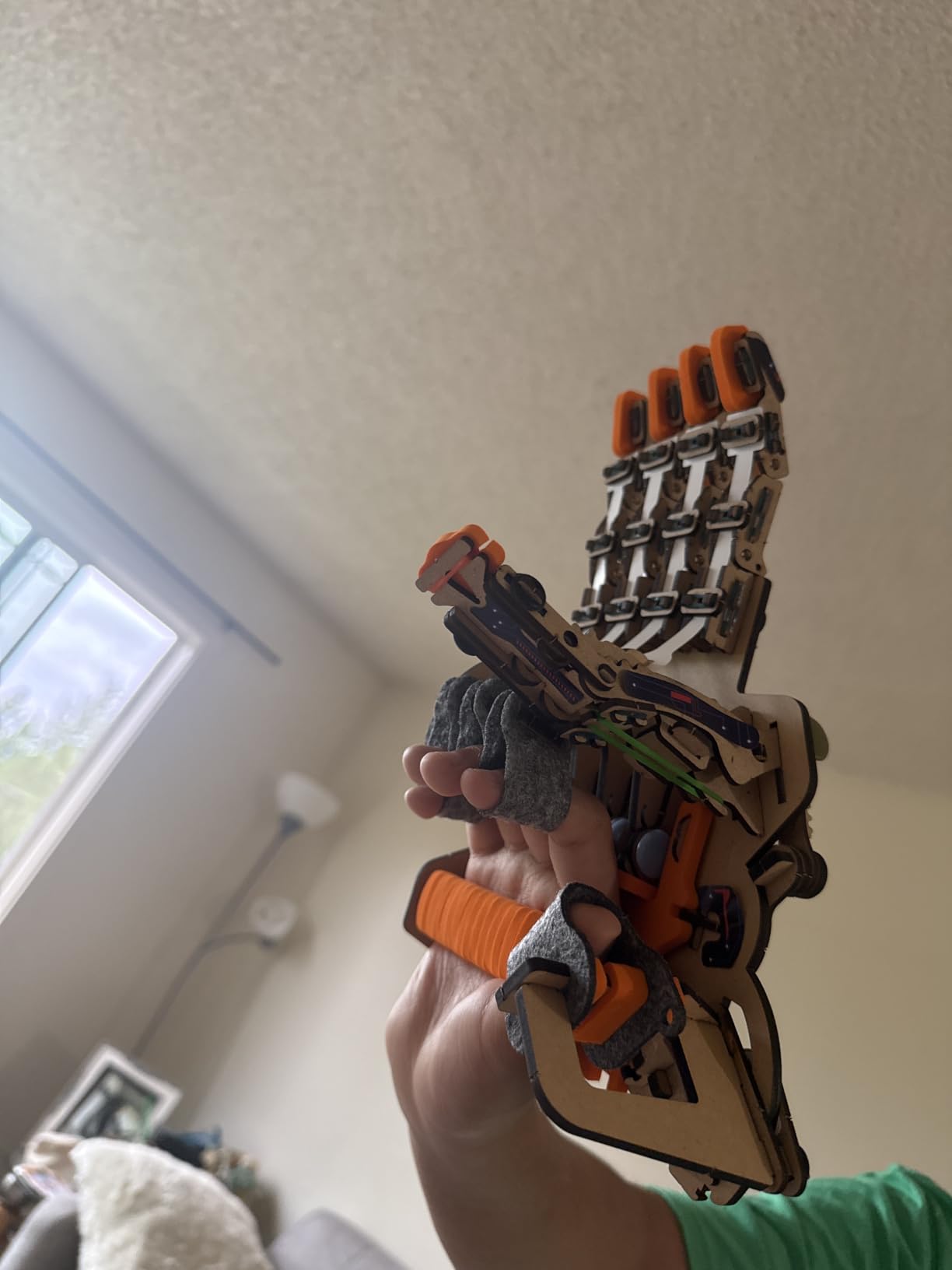
This is the wooden counterpart to the hydraulic hand, and it makes a good pair rather than a duplicate. Your child builds a functional mechanical hand driven by finger levers, from engineered wood rather than plastic tubing, and it was a Parents’ Choice Award winner and a 2022 Toy of the Year finalist.
At 4.6 stars from 3914 reviews, reviewers are enthusiastic about build quality and about how convincingly the hand moves once finished. Several note it works well alongside the Thames and Kosmos version when siblings are a few years apart, which is the clearest recommendation in the reviews.
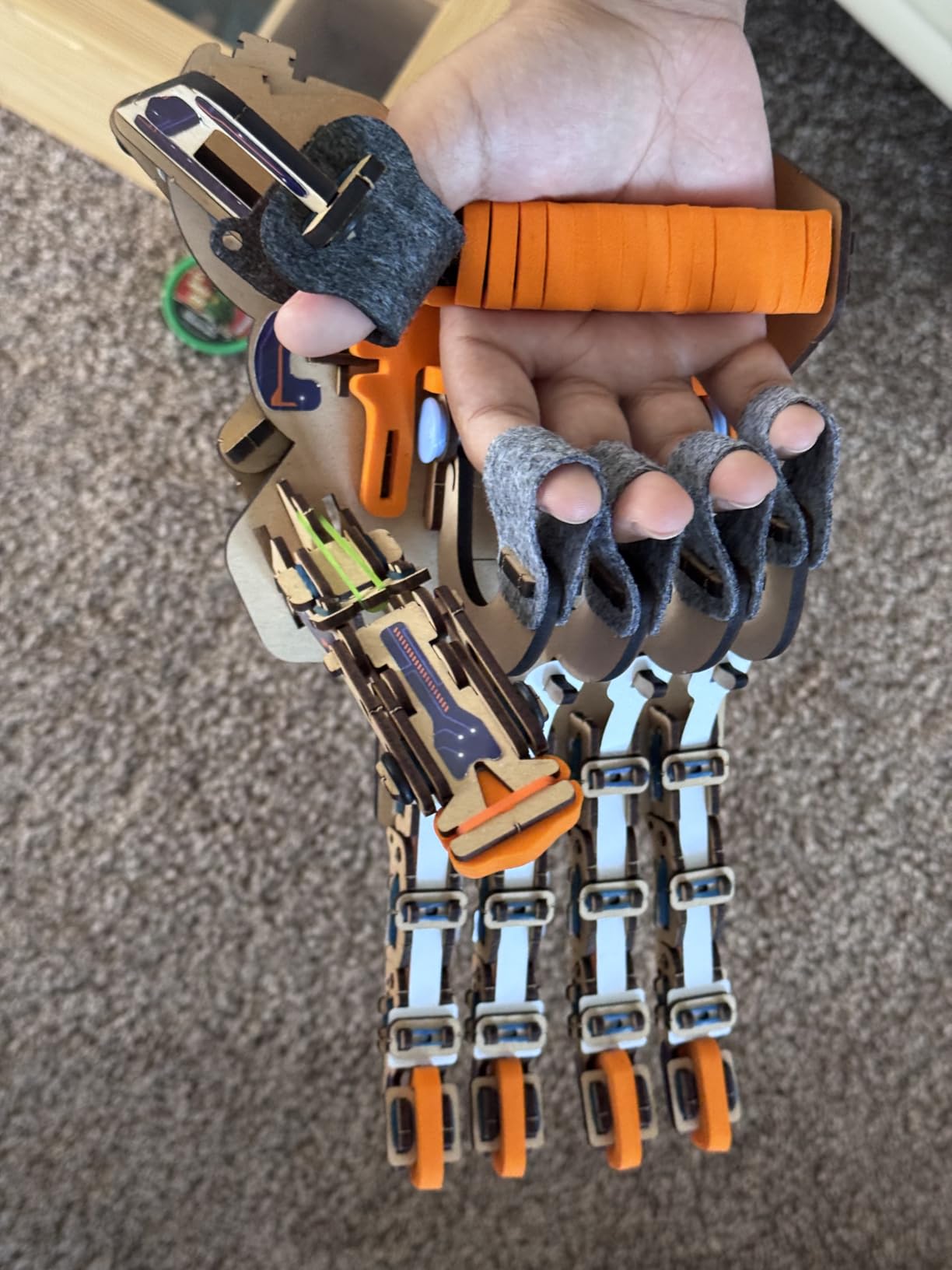
What a 10-year-old actually builds: a working hand with articulated fingers moved by pulling levers, from wood parts with an illustrated step-by-step manual. The wood feels substantial in the hand and holds together well, which is the opposite of the light-plastic feel that disappoints with cheaper kits.
The manual is the stand-out feature here. Reviewers repeatedly note that the clear illustrated instructions keep a 10-year-old on track, and the design carries STEM.org approval. Rated for ages 8 to 14, which brackets our target age neatly.
Why it suits two children better than one
Because assembly is the activity, and two sets of hands on one build removes the slowest part. One child fits pieces while the other reads the manual and checks orientation, which is a genuine team-building exercise as well as a faster build.
The lifetime free replacement parts policy matters for a kit that will be handled roughly. Screws loosen, levers snap, and knowing replacements arrive without a purchase changes how willing a parent is to hand it over.
When to skip it
Skip it if you want an object that keeps being used daily. Reviewers describe it as closer to a one-off demonstration than ongoing free play, and the grip strength and reach are limited on smaller hands. A 10-year-old will run out of things to test it with faster than with the circuit kit.
It also takes several hours and benefits from an adult nearby, so it is not an independent weekend activity. If your child needs something they can start and finish alone on Saturday morning, pick a smaller project.
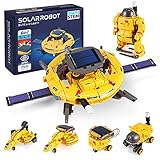
9. COBFDHA 6-in-1 Solar Robot Kit – Six Robots That Run on Sun or Batteries
COBFDHA STEM Projects for Kids Age 8-12, Science Kits Boys, Solar Robot Space Toys Gifts 8-14 Year Old Teen Boys Girls, 120Pcs Building Experiments Robots Teenage Ages 9 10 11 12 , Yellow
120 pieces
Six robots
Ages 8 to 12
Solar or battery power
Pros
- Six buildable robots in one box
- Solar outdoors and battery indoors
- 120 ABS pieces feel sturdy
- Works well for camp or back-to-school
Cons
- Solar models are slow in low light
- AA batteries not included for battery builds
- Later robots repeat the first one
- Instructions are basic
This is the solar kit that solves the weather problem. Six land-moving robots come out of one box of 120 ABS pieces, and each can run from a solar panel outdoors or from batteries indoors, so a dark week does not end the play.
At 4.4 stars from 3493 reviews with a 70 percent five-star share, it is solidly positive without being as glowing as the National Geographic kits. Parents value the number of robots and the ability to run them indoors when the weather is poor, which is exactly the reason to buy this one rather than a pure solar kit.
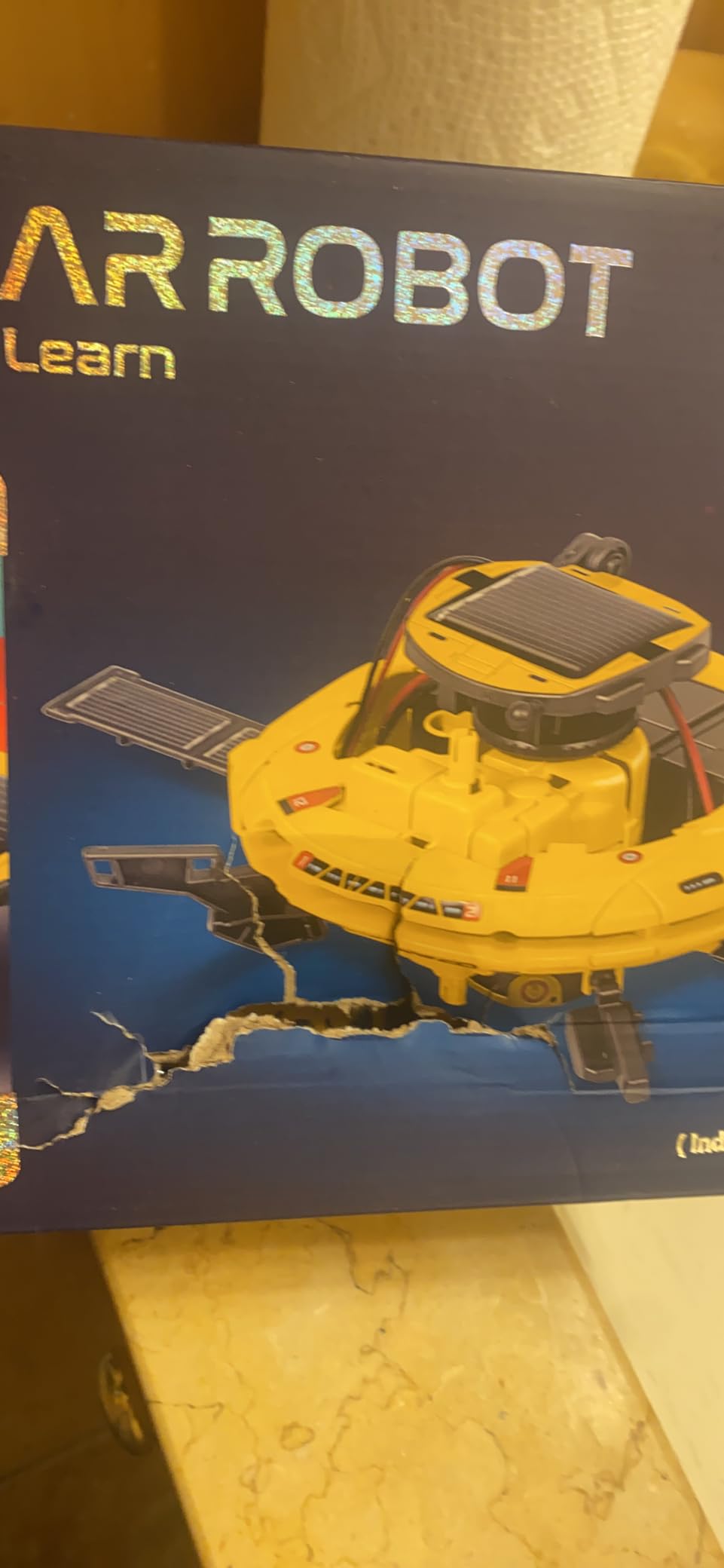
What a 10-year-old actually builds: six different walking or rolling robots in a space theme, developing manual dexterity, problem solving and logical thinking as the shapes change. The manufacturer rates it for ages 8 to 12, so a 10-year-old sits in the middle of the band rather than at the edge.
It is also a good fit for structured settings. Reviewers mention summer camp and back-to-school use, because six builds from one box keep a group of children busy without a screen in the room.

Why dual power beats solar only at this age
Because a solar-only kit has a natural off-season. A dual-power kit works on a Tuesday afternoon in December, and at 10 the child is old enough to understand why the same robot behaves differently under each power source. That comparison is a real lesson, not a workaround.
Buy a pack of AA cells on the same shopping trip, because the battery-powered builds need them and the box does not include them. That is the most common practical complaint in the reviews.
When to skip it
Skip it if you want six genuinely different builds. Once the first robot is complete, the remaining five follow similar assembly logic, and reviewers describe the sequence as repetitive. Six in the box numbers well but produces less variety than the marketing implies.
Skip it if the child is already building with better parts. The 120 ABS pieces feel sturdy for the price but not premium, and the instructions are basic with limited detail compared with the photography-driven manuals in this roundup.
10. Smartivity DIY Pinball Machine – A Build That Ends in a Playable Game
Smartivity DIY Pinball Machine I Global Award Winning Game Ages 8-99 Years
176 wooden pieces
Ages 8 and up
529.5 g
Rubber band powered
Pros
- Real playable game rather than a display model
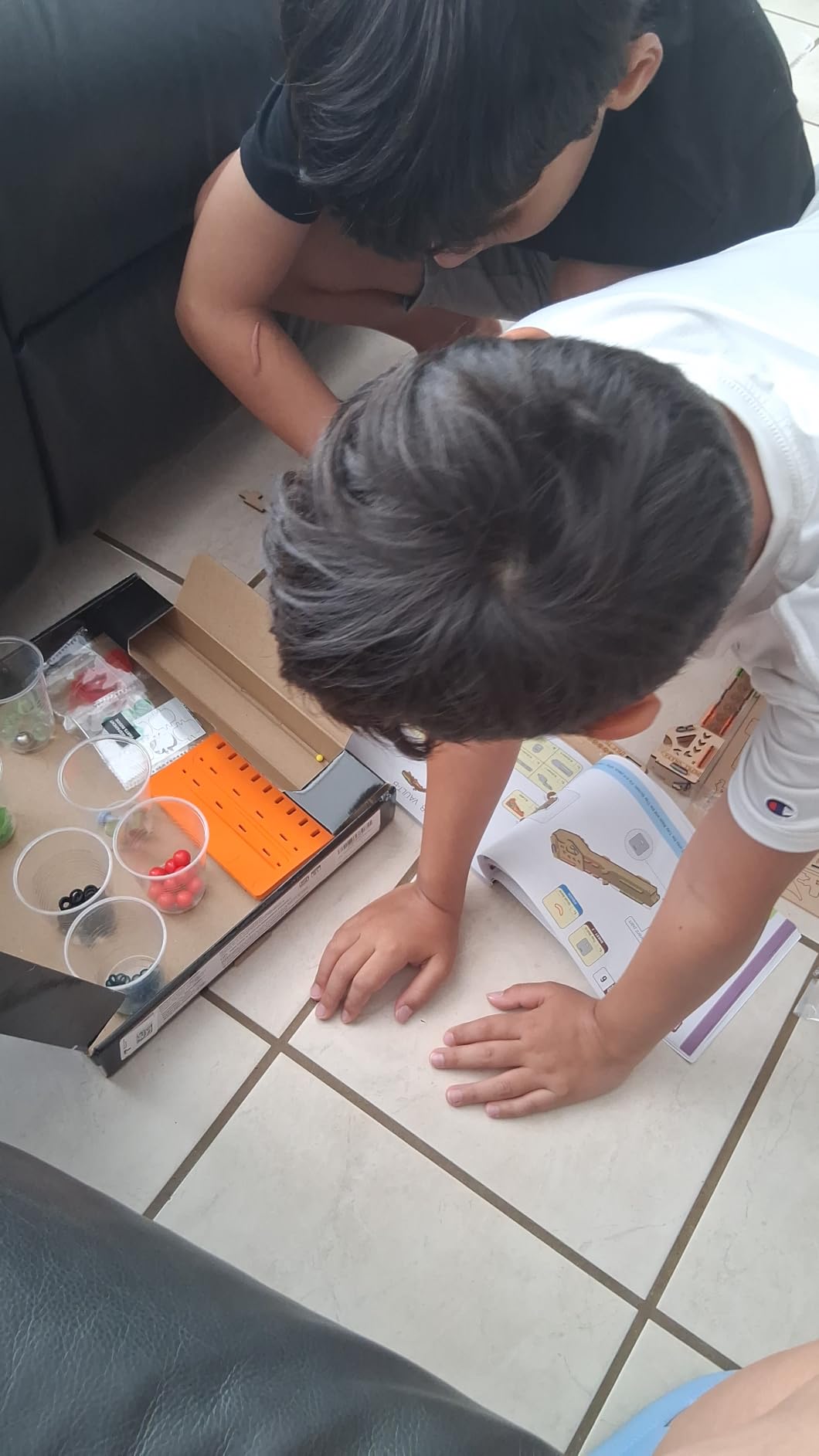
- Exceptionally clear photo instructions
- Mostly rubber bands rather than glue
- Spares and extra bands included
Cons
- Build takes two to four hours
- Small pieces are easy to lose during the build
- Some steps have colour mismatches
- Rubber bands wear out over time
Most STEM kits are a build that ends. This one ends with a game your family will actually play. Your child constructs a tabletop pinball machine with a spring launcher, flippers and scoring targets, and 176 wooden pieces plus rubber bands and marbles go into it.
At 4.5 stars from 3237 reviews, the dominant theme is exactly that: children and adults playing the finished machine for hours in the first week. Reviewers also praise the instructions as the best in the category, with several comparing them favorably to other STEM kits by name.
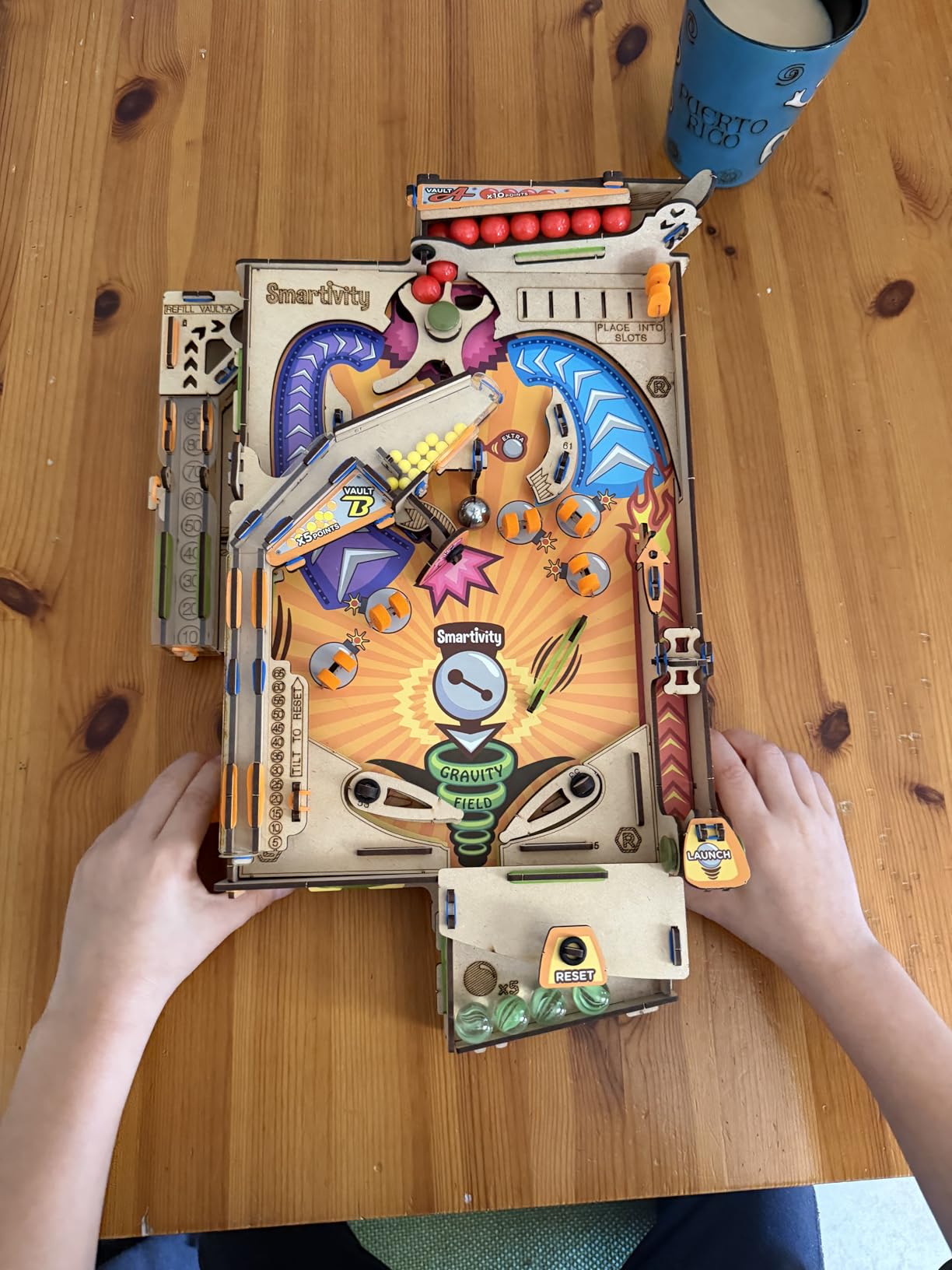
What a 10-year-old actually builds: a working pinball machine with moving parts, no batteries and no electronics at all, entirely mechanical and rubber-band powered. The manual closes with science questions, which turns the end of the build into one more activity rather than a finish line.
Spare parts and extra rubber bands are in the box for later repairs, which matters for a toy designed to be played with rather than displayed. It won the 2022 Innovative Toy of the Year award in the Netherlands and was a Toy of the Year finalist.
Why post-build playability changes the value calculation
Because replay value is usually measured in projects, when it should also be measured in what happens after. A kit that ends in a game gets used for years, and family play around it is free. A kit that ends in a static model gets looked at once.
It is also one of the few kits here that a parent will genuinely use with a child, which is a different kind of engagement than a supervised build. Competitions over who can last longest are the sort of thing a 10-year-old will invent unprompted.
When to skip it
Skip it if you need a one-afternoon gift that is ready to play. The build runs two to four hours and works best as a parent-child project, so a child opening this on Christmas morning will be assembling it for days. If you gift it, build it first.
Budget a clear table and a parts tray, because the small pieces are easy to lose or crush while staging the assembly, and a few steps have colour mismatches between the foam and wooden parts that slow children down. Rubber bands will need replacing eventually.
11. Makeblock mBot – Block-Based Coding From the First Afternoon
Makeblock mBot STEM Coding Toys Robotics for Kids Ages 8-12
Assembles in about 15 minutes
Scratch and Arduino
0.93 kg
Metal and plastic
Pros
- Teaches block-based coding through Scratch
- Builds in about 15 minutes
- Works as remote control with line-follow mode
- Open-source with 100+ module compatibility
Cons
- Robot and remote batteries not included
- Scratch coding has a ceiling
- Software setup needs parental effort
This is the only true coding kit in the lineup, and if your child wants to program rather than assemble, it is the one to buy. Block-based coding through Scratch is the entry point, with an Arduino upgrade path once the block ceiling is reached. It assembles in about 15 minutes, so programming starts the same afternoon.
At 4.6 stars from 2874 reviews, it is the most advanced kit here and the only one that needs a device. The near-universal praise is the transition from building to programming and the speed of assembly. Recurring practical notes concern the batteries and the software setup step, which reviewers say a short video walkthrough solves.
What a 10-year-old actually builds: a programmable robot that works out of the box as a remote-control car, then adds line-following and obstacle-avoidance modes, then gets programmed by the child. The system is open-source and connects to more than 100 electronic modules and LEGO-compatible parts, so it does not dead-end at 10.
Block-based programming is the right starting point for this age. Dragging blocks into a sequence teaches sequence, conditionals and debugging without syntax errors getting in the way, which is why Scratch-based kits work so well for 9 to 12 year olds.
Why the 15-minute build changes everything
Because the barrier is not the robot, it is the wait. A child who spends an hour assembling before anything works has usually lost interest by the time the first program runs. Fifteen minutes of build and the programming starts while attention is still high, which is why this kit holds a 10-year-old better than bigger builds with the same goal.
It also survives the age gap. The 100-plus module compatibility and the Arduino path mean the same robot can carry a 10-year-old into early teens, which none of the other kits in this list can honestly claim.
When to skip it
Skip it if the household has no tablet or computer and no plan to add one, and skip it if your child is anti-screen. This kit needs a device for its main purpose, which is the opposite of what the other eleven picks offer.
Also buy batteries up front. The robot needs 4 AA cells and the remote needs one CR2025, neither included, and reviewers flag the software setup on a tablet or computer as a step that benefits from a parent sitting down once. Scratch has a ceiling, so a child ready for real text-based languages will outgrow it faster than the other kits here.
12. Poraxy 5-in-1 Wooden Vehicle STEM Kit – Five Laser-Cut Models on a Budget
Poraxy 5 in 1 STEM Kits for Kids Age 8-10, Science Building Project Craft for 8-13, Model Car Kit, STEM Toys for Boys Girls Age 8-12, Wooden 3D Puzzles, Birthday Gifts for 6 7 8 9 10 11 12 13 Year Old
Five models
Wood construction
0.61 kg
Ages 6 to 14
No glue needed
Pros
- Five working models in one box
- Laser-cut wood fits with no glue
- Models can be painted and decorated
- Quiet screen-free activity
Cons
- Wood only
- so no electronics or code
- Pieces arrive loose and need organizing
- Play value limited after the builds
- Instructions are minimal
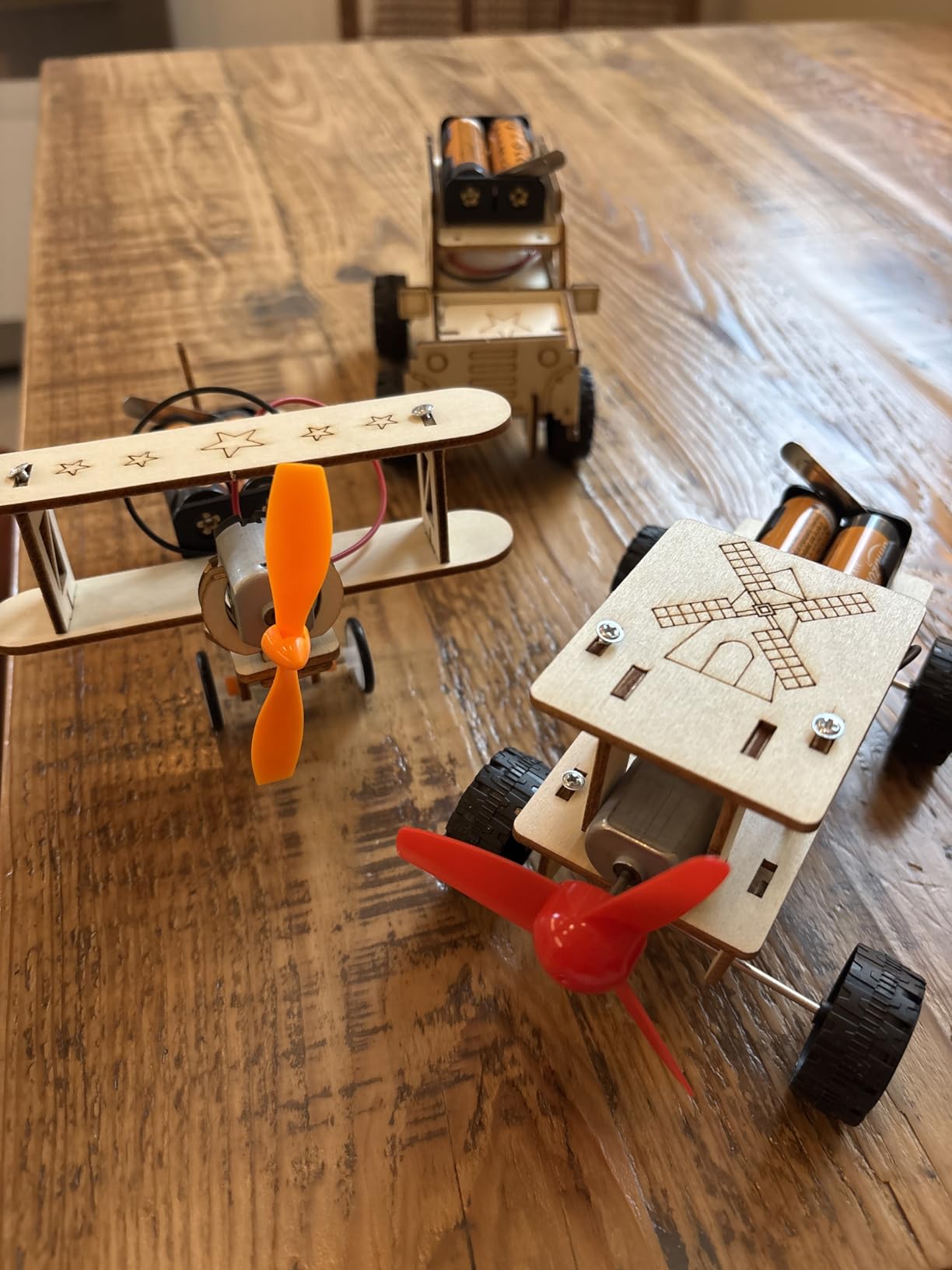
This is the entry point. Five working models come out of one box: a mini tank, a racing car, an aircraft car, an off-road car and a wind-powered car. The laser-cut wood is engineered to fit without glue, so assembly is satisfying and fast.
At 4.6 stars from 1621 reviews, this has the smallest review base in the set and the most uncomplicated sentiment. Owners cite the number of finished models and the quality of the laser cuts. The recurring criticism is scope, and it is worth being clear about that before you buy.
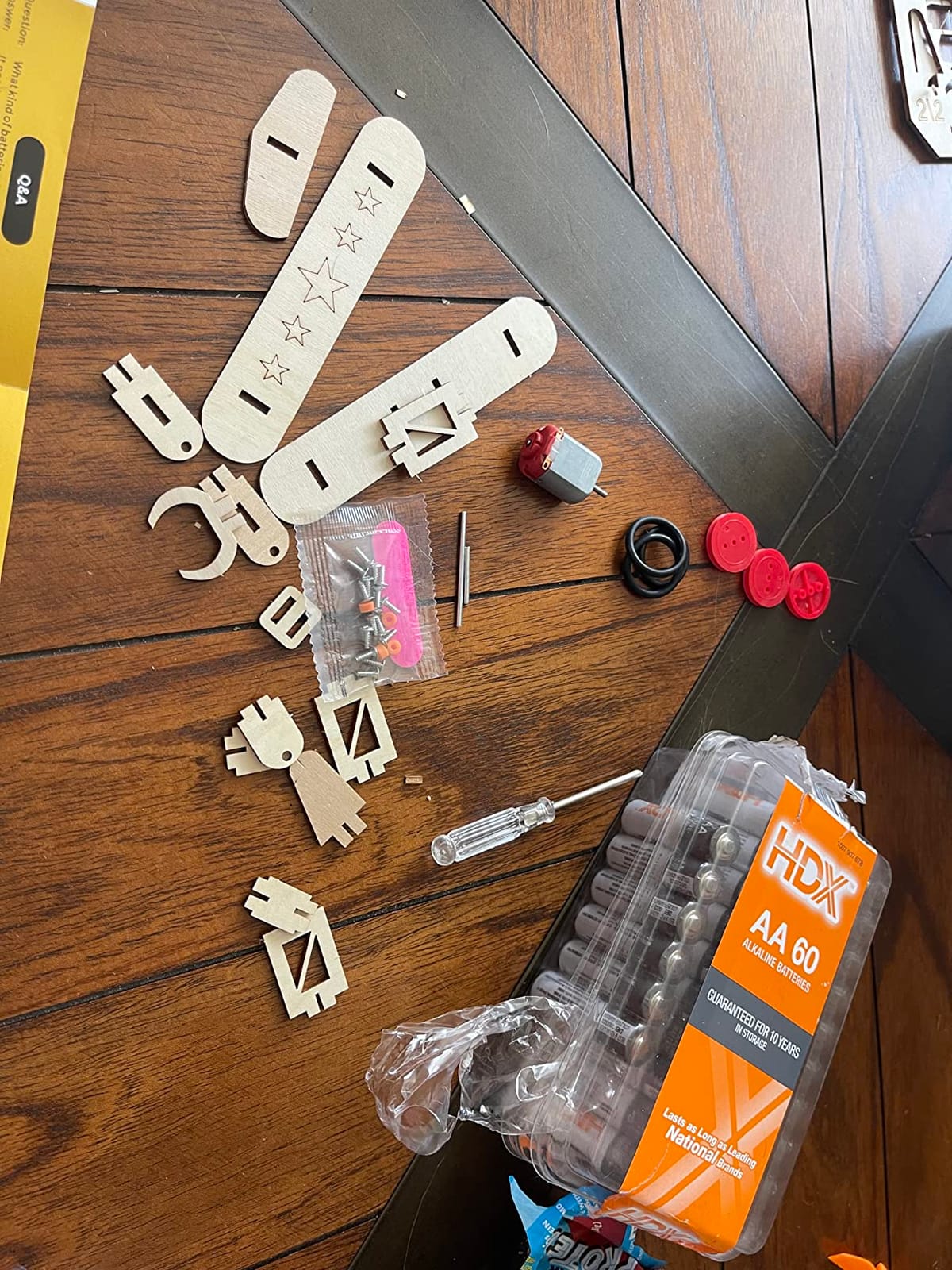
What a 10-year-old actually builds: five self-propelled wooden vehicles, several of which move under their own power, and each can be painted and decorated for customization. Rated for ages 6 to 14, so 10 sits comfortably inside the band rather than at the top of it.
It is a quiet, screen-free activity, which makes it useful in a house where noise is a factor or for a rainy afternoon that does not involve a device. The finished models are also the only place in this list where a child can add their own creative layer through paint and decoration.
Why five finished models is a real result
Because a completed model is a visible artefact. A 10-year-old can put a finished, painted car on a shelf and feel the result of two hours of work, and five of them is a small fleet. That sense of completion separates this from an electronics kit that is never quite finished.
It is also a genuinely good first kit for a child who has never had one. Five straightforward builds teach patience, tool handling and following a sequence without the frustration of a three-hour hydraulic project, and they set up the leap to something harder later.
When to skip it
Skip it if you are hoping to teach electronics or coding. It is wood and mechanics only, and reviewers are explicit that expectations should be set accordingly. If the child already builds with a circuit or robot kit, this is a step backwards rather than a step up.
Once a model is built, play value is limited, and the instructions are minimal compared with the larger kits in this roundup. Pieces also arrive loose, so expect a few minutes of sorting before the first build. Give it as a companion kit rather than your main STEM purchase.
How to Choose a STEM Kit for a 10 Year Old
Age labels are marketing, not measurement. A kit stamped 8+ may be finished in an afternoon, and a kit stamped 12+ may need a reading level and a patience level that a 10-year-old does not have. Judge on the seven criteria below instead.
1. Project count and difficulty curve. Look for 10 or more builds with rising difficulty. A single-build kit is a demo, and a kit with 30 similar projects is a grind. The ideal is 10 to 20 distinct builds where the last ones are visibly harder than the first.
2. Screen requirement. Eleven of our twelve picks work with no device at all. Only the Makeblock mBot needs a tablet or computer, and it is worth knowing that before you buy rather than after. If your child is being weaned off screens, treat screen-free as a hard filter.
3. Solo play versus supervised build. Short projects with picture instructions, like Snap Circuits Jr and the Poraxy wooden kit, can be finished independently. Multi-hour builds like the Mega Cyborg Hand and the pinball machine are parent-child weekend projects. Be honest about which kind of Saturday you are buying for.
4. Replay value. Replay value is how often the kit is used after the last project, and it is the most useful single number nobody lists. It comes from three things: number of builds, whether parts combine in new ways, and whether the finished object is still playable.
5. Consumables versus reusable parts. Chemistry kits run out. Slime mix, foam and crystal solutions are used up, while circuit parts and wooden pieces are not. A kit with 30 household-ingredient experiments will outlast one with 30 supplied ones, because the kitchen restocks it.
6. Expansion path. Snap Circuits modules work with other kits in the range, and the Makeblock system connects to 100-plus modules. A kit that leads somewhere is a purchase that grows rather than one that ends. Check whether an expansion path exists before buying a single kit. If a child is ready to move past snap-together parts and actually hold a soldering iron, our beginner soldering kits guide covers that next step.
7. Safety and supervision. At 10, small screws and connectors are a real frustration point rather than a safety one, but magnetic kits, slime materials and digging kits need an adult nearby. Several kits in this list carry small parts that need sorting, so allocate a tray and a clear table rather than a carpeted floor.
On budget, three tiers cover this age well. The entry tier covers a solar robot set, a wooden vehicle kit or a magic chemistry set, and it is enough for a first kit. The middle tier covers circuit kits, earth science boxes and hydraulic builds with 45-plus projects. The top tier is a programmable robot with an expansion path, and the jump in cost is real. Use the price button on any card to see the current figure, since these move around.
On gifting for a 10-year-old girl, the honest answer is that the split by gender on this category is pure marketing. Girls at this age gravitate toward the same kits boys do, and the themes that reliably work across every child are construction, surprise and something that keeps playing. Pick on interest, not on packaging. When a child is close to being ready for a machine rather than a box of parts, our beginner sewing machines for 12 year olds guide is the step up to look at next.
One last shelfware check. If a child finishes a kit, the fix is not another box. It is a free follow-along project from a library makerspace, a cardboard-and-tape build, or reusing the remaining parts in a new challenge. Kids abandon kits, not categories.
Frequently Asked Questions
What is a good STEM kit for a 10-year-old?
A good STEM kit for a 10-year-old has 10 or more projects with rising difficulty, readable instructions a 10-year-old can follow without help, and parts that can be reused for a new build. Our top pick is the Snap Circuits Jr. SC-100, which packs more than 100 circuit projects into one box with no soldering and no tools. Kit type matters too: a 10-year-old who will not sit still should get a hands-on build kit, while a child who already codes should get a programmable robot.
Are STEM kits worth the money?
Yes, but only the multi-build ones. A kit earns its place when it contains 10 or more projects, when difficulty rises across those projects, and when there is a path to expand the parts set. A kit with one model, no add-on path and a flat manual usually gives you a single demo session. That is not a bad purchase, but it is a party trick rather than a learning investment.
What is a good chemistry set for a 10-year-old?
A good chemistry set for a 10-year-old includes every supply in the box, offers enough distinct activities to avoid repetition, and pairs each experiment with a short explanation of the reaction behind it. The National Geographic Magic Chemistry Set stages ten experiments as performance tricks with a wand and gloves, which works well for a 10-year-old who wants to show friends. The National Geographic Gross Science Kit is better if your child is drawn to slime and polymers. Both need adult supervision for mixing and cleanup.
Do STEM kits need a tablet or phone?
Most do not. Eleven of the twelve kits we recommend, including every Snap Circuits, National Geographic and wooden engineering kit here, work entirely without a screen. The exception is the Makeblock mBot, which needs a tablet or computer for its block-based coding software and uses three free apps. Check the device requirement before buying, and buy the batteries separately, since the mBot needs 4 AA cells and one CR2025 that are not included.
How long does a STEM kit keep a kid engaged?
A kit with 10 or more projects of rising difficulty typically stays in rotation for several months, and a kit that ends in something playable, such as the Smartivity pinball machine, stays in use for years. A single-build kit gives you one good session. The bigger risk is not boredom but repetition, so a kit with 30 similar activities can fade faster than one with 12 varied ones. Look for parts that combine in new ways after the manual runs out.
The Verdict: Which STEM Kit Should You Buy?
If you want one kit that works for a 10-year-old today and still holds interest next year, the Snap Circuits Jr. SC-100 is the pick. It has the highest rating in our set at 4.8 from 29316 reviews, more than 100 projects in one box, reusable parts and no tools or screen required.
For a child who will not sit still with electronics, the National Geographic Earth Science Kit gives the widest range of activities. For a child already writing code, the Makeblock mBot is the only real option here, and it is the one kit on the list to buy batteries for separately.
The best STEM kits for 10 year olds share three traits: many projects, rising difficulty and an expansion path. Judge on those three, ignore the age stamp, and the wrong kit rarely gets past week two.