
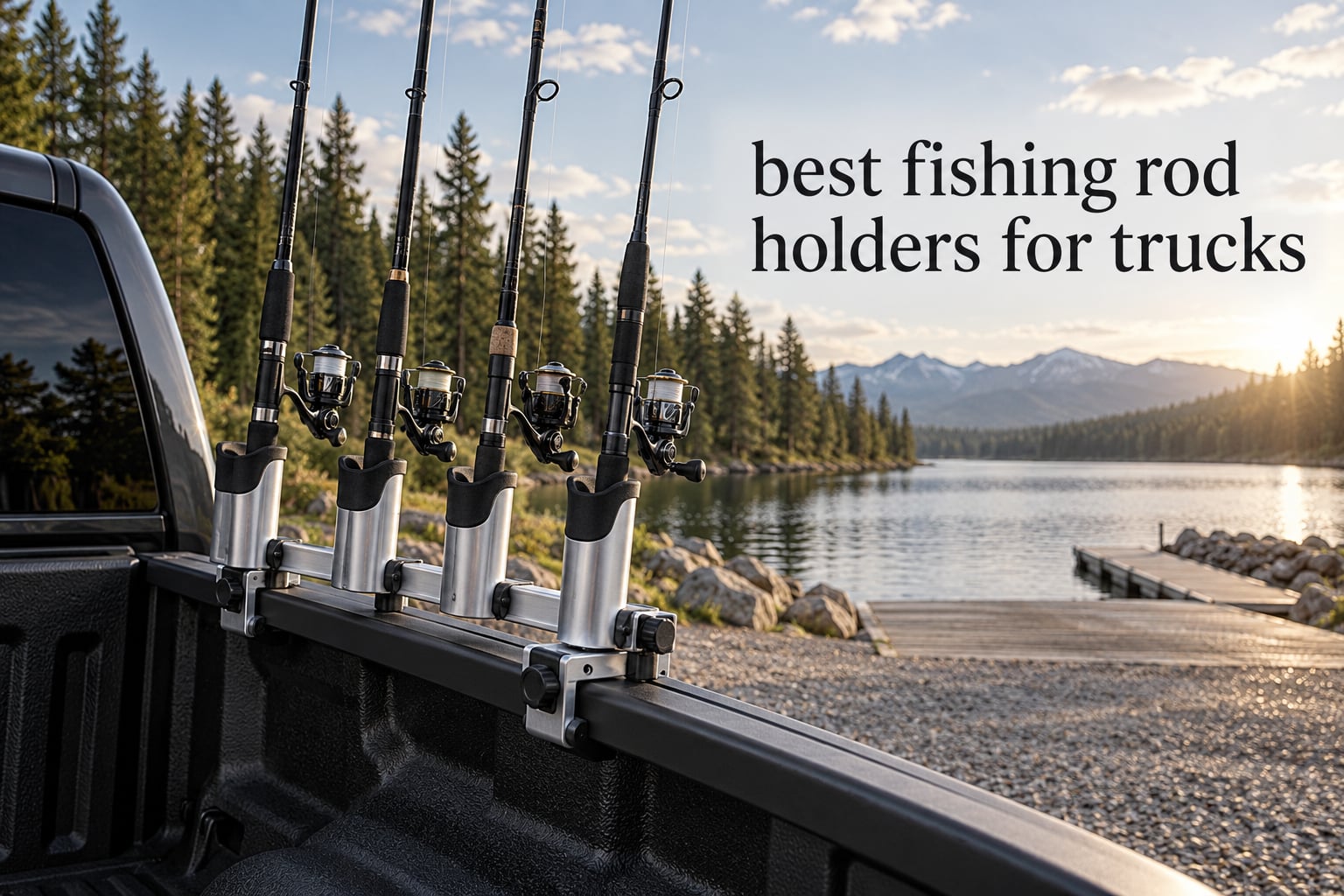
Rods lying loose in a pickup bed do not survive the drive to the lake. A cooler slides a quarter foot on the first expansion joint, a tackle box lands on a rod blank, and by the ramp you are unpicking line from a bent guide. That is the entire reason people buy a truck bed rod holder, and it is why the best fishing rod holders for trucks are the first thing most owners add after a bed liner. If you are still deciding which truck to run the rods in, our notes on shocks for trucks come first, because nothing else you bolt to the bed will stay quiet if the suspension is worn out.
What makes this category confusing is that the twelve products below attach in six different ways. Some clamp to the bed rail, some span the bed with a ratcheting bar, some hang off the hitch receiver, and a couple bolt straight to the tailgate. Each approach protects rods differently, and each one costs you something: bed space, tailgate function, or the ability to close a tonneau cover.
We compared all twelve on the details that decide whether a holder works on a real truck: rod capacity, what the mount grips, whether it drills, how the rods are cushioned, and what happens to the holder at highway speed. Every rating and review count here is copied straight from the current listing data, and the drawbacks are the ones owners actually reported rather than the marketing version.
Table of Contents
Top 3 Picks: Best Fishing Rod Holders for Trucks (October 2026)

BigTron 3-Tube Bracket
- 3-tube capacity
- Propene polymer
- 8 screws included
- Boat
- truck
- garage or kayak

Portarod 5-Rod In-Bed System
- 5 rod holders
- 53-84 inch ratcheting bar
- No-drill install
- Mill finish aluminum
Brocraft 4-Rod Clamp Rack
- 4-rod capacity
- C-clamp opens to 2.5 inch
- 6061-T6 aluminum
- Bungee retention
All 12 Truck Bed Rod Holders at a Glance
Every holder below is grouped by where it attaches. The features column is pulled from each listing so you can scan for capacity and mount style before reading the write-ups.
| Product | Specifications | Action |
|---|---|---|
| BigTron 3-Tube Rod Holder Bracket |
|
Check Latest Price |
| Portarod 5-Rod In-Bed System |
|
Check Latest Price |
 VEYWANE 2-Pack 3-Rod Rack VEYWANE 2-Pack 3-Rod Rack |
|
Check Latest Price |
 GADFISH 4-Link Hitch Rack GADFISH 4-Link Hitch Rack |
|
Check Latest Price |
| Brocraft 4-Rod Clamp Rack |
|
Check Latest Price |
 Extreme Max 6-Rod Pivoting Hitch Holder Extreme Max 6-Rod Pivoting Hitch Holder |
|
Check Latest Price |
 Rod Hauler Tailgate Carrier Rod Hauler Tailgate Carrier |
|
Check Latest Price |
 SPIRRELAB 4-Rod Truck Bed Holder SPIRRELAB 4-Rod Truck Bed Holder |
|
Check Latest Price |
 JOYTUTUS 6-Rod Clamp Holder JOYTUTUS 6-Rod Clamp Holder |
|
Check Latest Price |
 GOORIDA 5-Tube Hitch Rack GOORIDA 5-Tube Hitch Rack |
|
Check Latest Price |
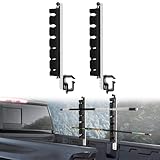 GADFISH 6-Rod Adjustable Bed Holder GADFISH 6-Rod Adjustable Bed Holder |
|
Check Latest Price |
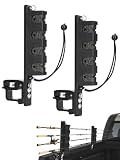 Calfca 4-Rod Pair with C-Clamps Calfca 4-Rod Pair with C-Clamps |
|
Check Latest Price |
1. BigTron 3-Tube Rod Holder Bracket: The Surface-Mount Workhorse
BigTron Fishing Rod Holder Bracket, Tube 3 Rod Rack, Fishing Rod for Boat Kayak Garage Storage or Truck with Screws Side-Mount (1)
3 tubes per bracket
Propene polymer body
12.4 x 1.97 x 10.63 inch
8 screws included
Pros
- Holds 3 rods plus small tools in the middle gap
- Countersunk bolt heads will not scratch rod blanks
- Mounts to trucks
- boats
- garage walls or kayak crates
- Certified for fresh and brackish water
Cons
- Only 3 rods per bracket
- Tube opening suits lighter freshwater rods
This bracket has been on truck beds, garage walls and kayak milk crates longer than anything else in the group, and the owner feedback reflects that. It carries a 4.7 rating across 1394 reviews, the largest sample in this roundup by a wide margin.
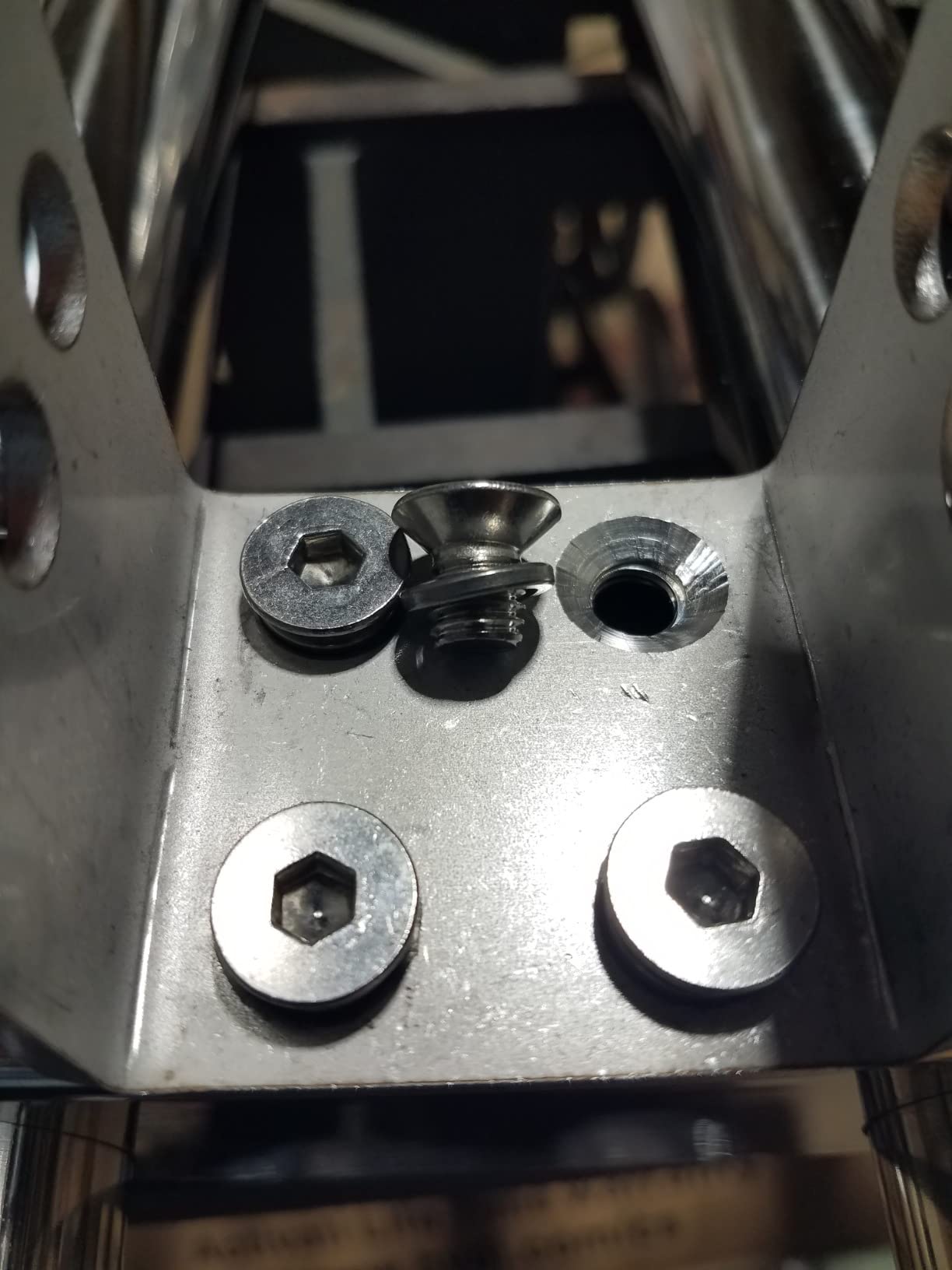
The detail we like most is the countersunk screw fixing. After the bolts are driven in, the heads sit below the surface, so a rod sliding across the tube never lands on hardware. That is a small engineering choice that prevents the kind of blank scratching that shows up after one season.
The middle gap between tubes is genuinely useful. Lures, a filet knife, pliers and a pack of leader all live there instead of rolling around the bed floor.
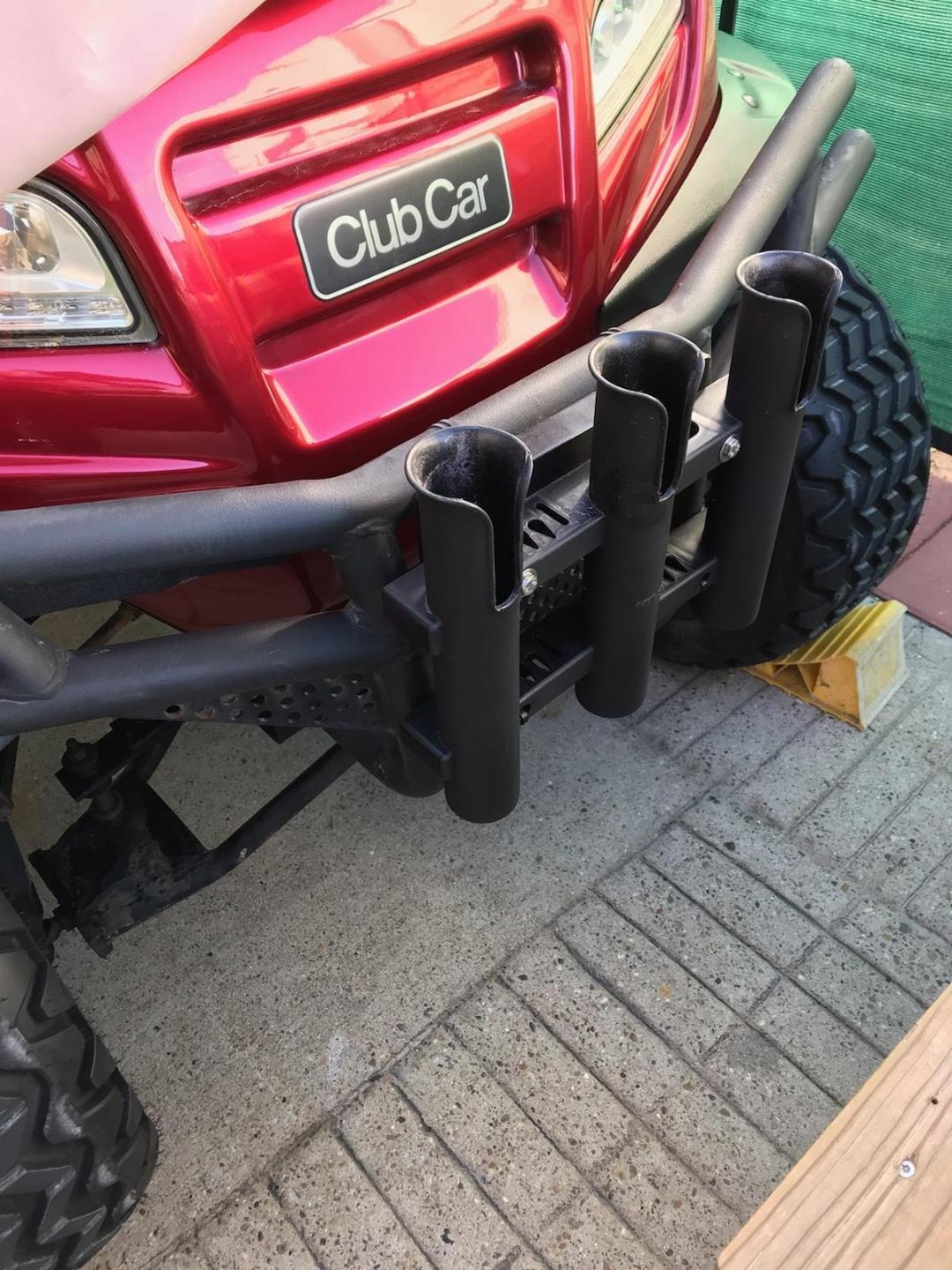
Reviewers describe it as sturdy, easy to install in a range of ways, and good value for the money. Several owners run the same bracket on milk crates for kayaking and inside a Jeep, which tells you how versatile the footprint is.
Beware of the plastic tube diameter when you load it. The opening is sized more toward lighter freshwater rods, so a heavy surf stick or a large salmon rod can sit proud of the tube rather than seated in it.
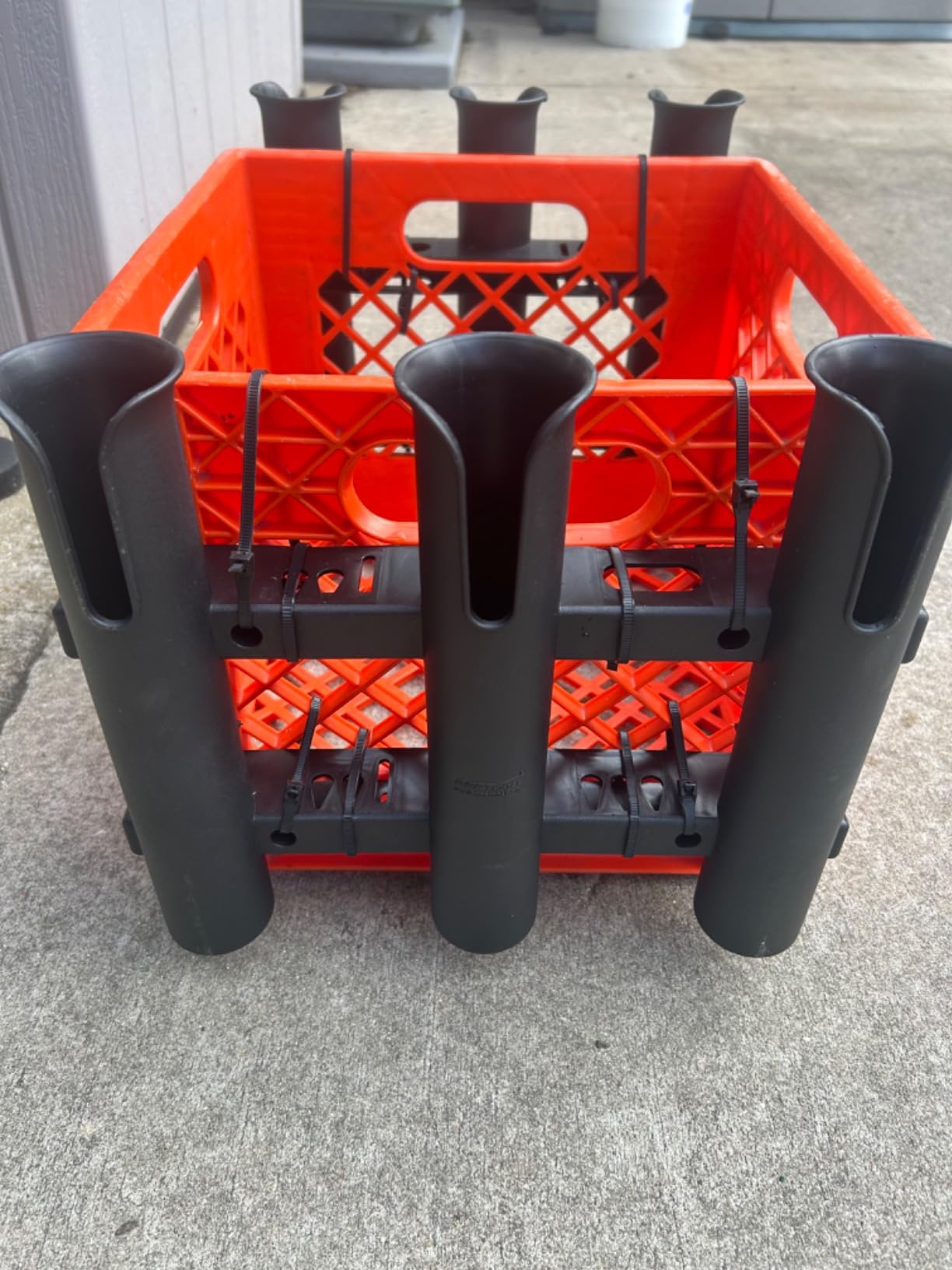
What this bracket decides for you
If you carry two or three rods and want a mounting point that costs little, screws into anything flat, and never interferes with a tailgate or a tonneau cover, this is the simplest answer in the roundup. The drilling is into a bedside panel, a toolbox or a bed rail cap rather than into the bed floor.
It is also the natural choice for people who split their time between the truck and the garage. The same three tubes that hold rods on the way to the lake become off-season rod storage on a workshop wall.
Where it falls short
Three rods per bracket is genuinely limiting. A solo angler who wants six or seven rods needs two of them, and the mounting footprint doubles with it.
Because it is a fixed surface mount rather than a clamp, you are committing to screw holes. That is fine on a toolbox lid and a bad idea on a truck you plan to sell, and some bed rail caps are too thin to hold the screws properly.
2. Portarod 5-Rod In-Bed System: Best Fit Across Truck Widths
Portarod Inshore Rod Holder for Truck Bed (5 Rod Holder)
5 rod holders included
Ratcheting bar spans 53-84 inch
9 pounds
No drilling or bolts
Pros
- Ratcheting support bar fits a very wide range of bed widths
- Adjustable rod angle and holder spacing
- Removes in seconds and stores in a garage
- Mill finish aluminum with stainless hardware
Cons
- Heaviest piece in the group at 9 pounds
- Wide beds with box lids may need the bar cut
- Rods can lean against the bed wall
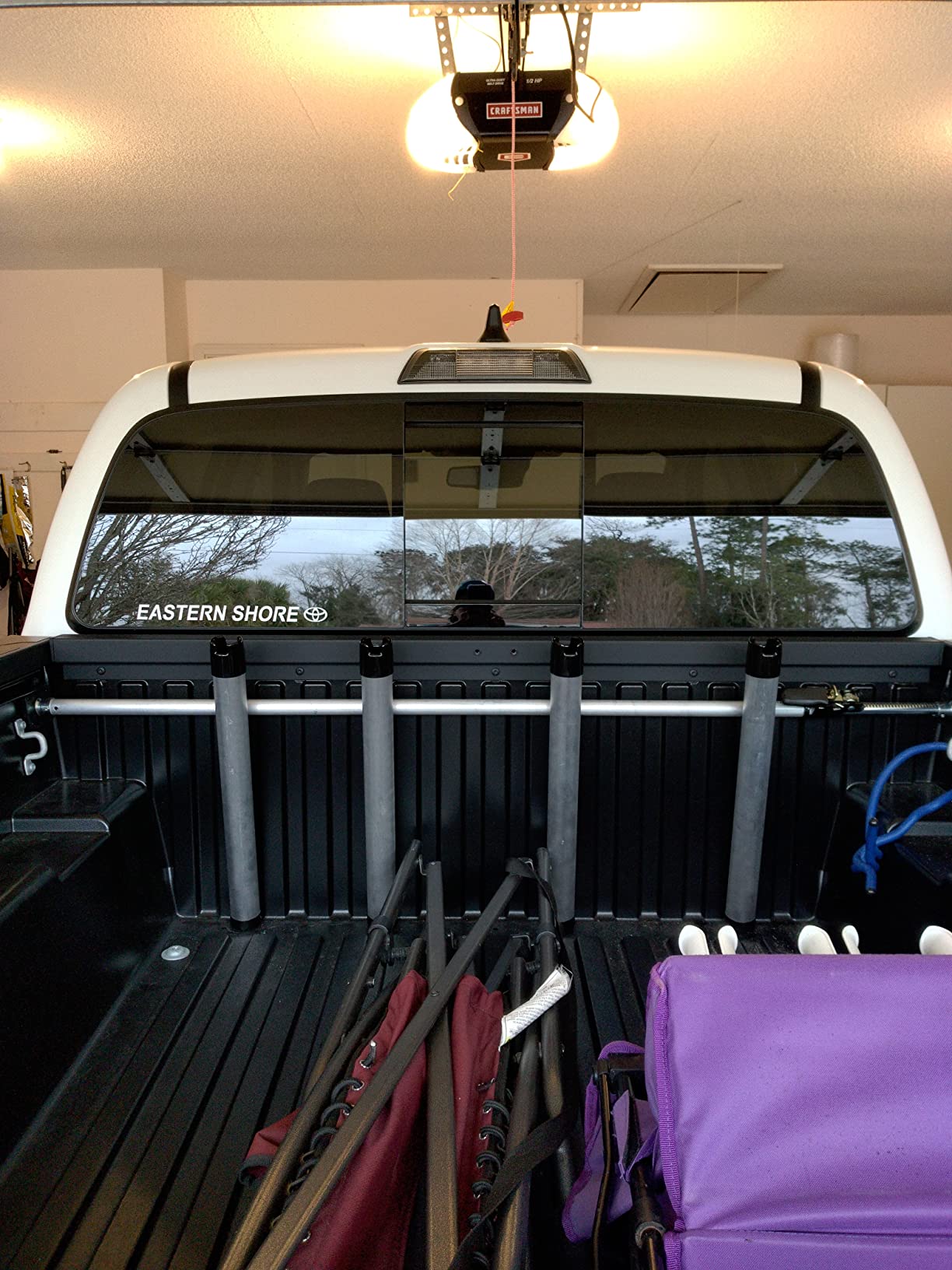
This is the only in-bed system in the roundup, and that changes what it can do. Instead of gripping a rail, the support bar spans the bed and the rod holders clamp along it, so the rack sits at any position you choose across the width.
The ratcheting bar expands from 53 to 84 inches, which is the single most useful number in this whole category. Most bed rail clamps fail on width or rail thickness; a bar that ratchets across that range adapts to a short narrow bed and a full-size crew cab without a second purchase.
Owners on SurfTalk describe the Portarod as impressively effective and one of the best fishing purchases they have made. The same threads that argue about whether a rack protects rods better than laying them flat tend to concede this one point: the adjustability is the reason it lasts across different trucks.
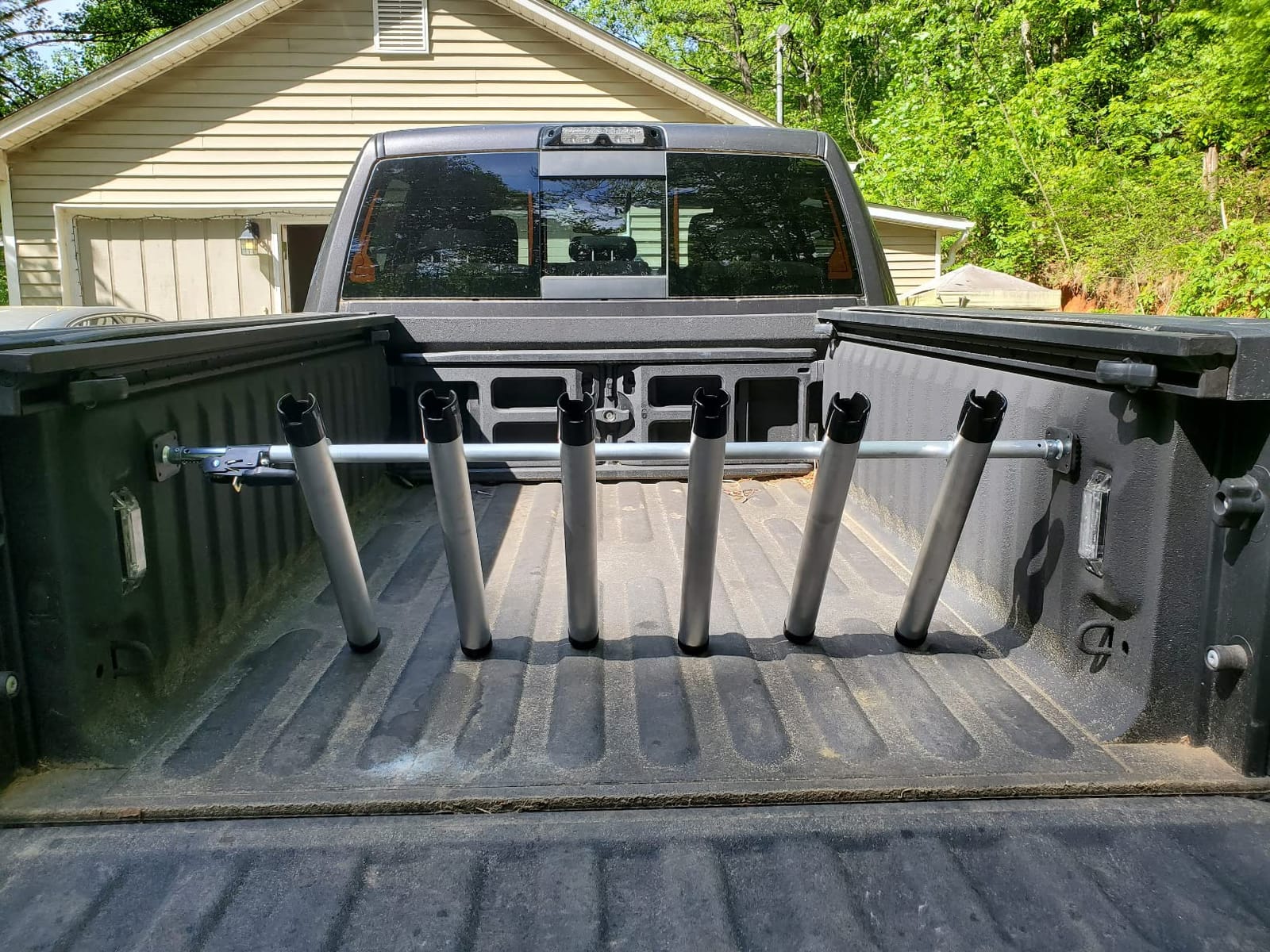
The build is mill finish aluminum with stainless screws and galvanized components, which is the material recipe you want for a rack living in a wet bed. Drilling holes in a bed floor is off the table entirely.
The trade is bulk. At 9 pounds this is by far the heaviest piece here, and the ratchet bar is a full-width obstacle across the bed. If you haul gear under it you gain that space back, but you are not getting an unobstructed bed floor.
What this rack decides for you
Choose the in-bed system when your bed width is unusual, when you move between trucks, or when you want rod height under your control rather than set by rail height. Adjusting the vertical angle of the rods and the spacing between holders is what makes it work with anything from a spinning rod to a heavy baitcaster.
It is also the strongest answer for someone who genuinely wants the bed floor back. Nothing else in this group recovers usable bed space the way a ratcheting bar does.
Where it falls short
Some owners with wide beds and box lids had to cut the support bar to fit, which is a modification step the listing does not promise. Measure your inside bed width and your box lid clearance before you commit.
Because the holders stand on a bar rather than a wall, rods can lean against the bed sidewall and stay supported rather than sit centered in a tube. If you want each rod cradled on all sides, a rail or tailgate mount does that better.
3. VEYWANE 2-Pack 3-Rod Rack: Garage Wall and Boat Deck Value
VEYWANE Fishing Rod Racks for Boat/Wall/Truck Bed, 3-Poles Storage Holders with Rubber Band Clips
Two racks, 3 rods each
ABS plastic
Rubber band clips
2.4 x 5.6 x 7.7 inch each
Pros
- Low cost with quick installation
- Rubber band clips allow one-handed rod access
- Lightweight build suits overland racks and golf carts
- Mounts horizontally or vertically
Cons
- Rigid plastic offers no cushioning
- Some units cracked within a day
- Fasteners may need modification for slotted holes
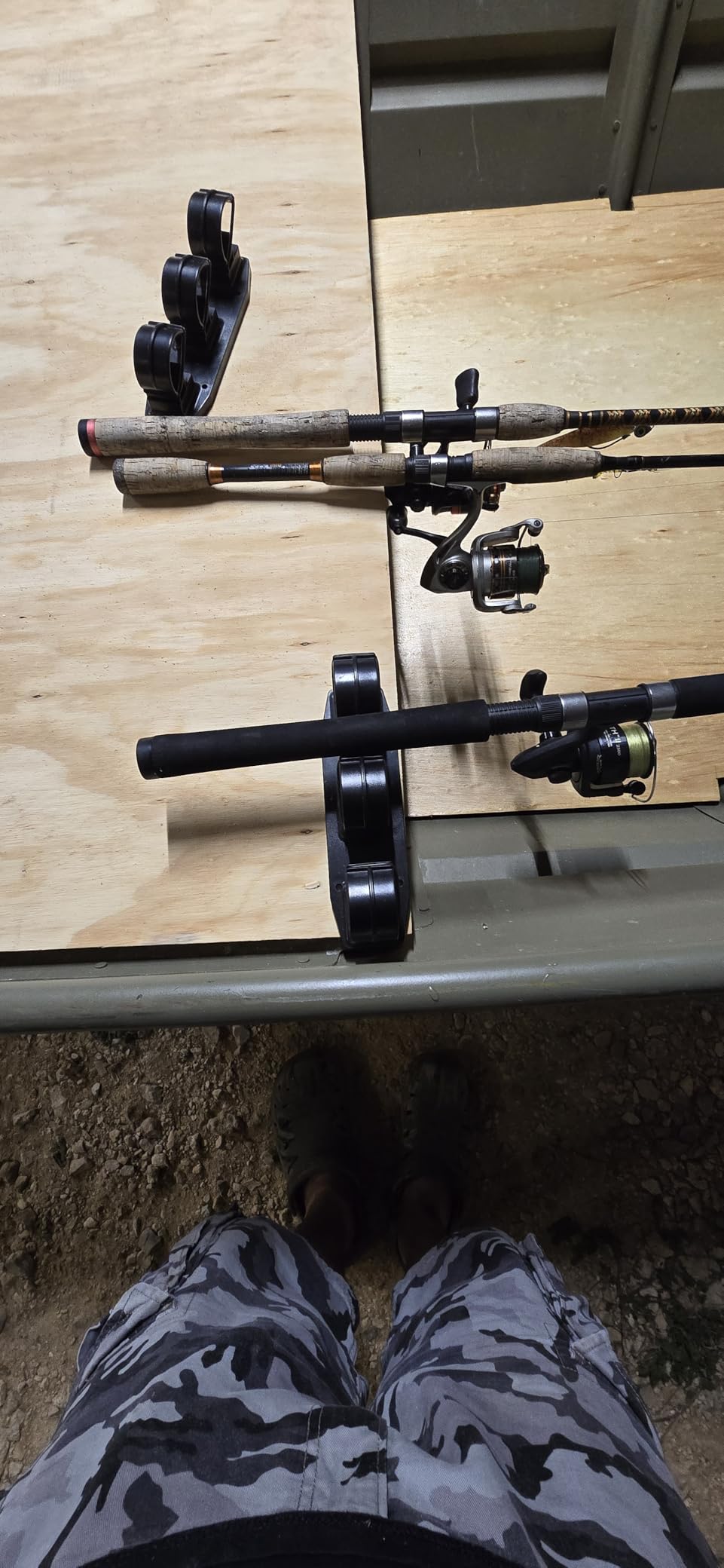
This is the most flexible set in the roundup, because it is not built for the bed specifically. Two racks, three rods each, and the listing explicitly calls out wall, boat deck and truck bed mounting.
Most buyers like the value and the speed of mounting, particularly on truck racks, golf carts and garage walls. The rubber band clips let you pull a rod out one-handed, which matters when you have wet hands and a loaded bed.
We like this for a very specific truck job: securing rods in a bed with a camper shell or overland rack where there is no clean rail to clamp. Screw the racks to the shell frame and the problem is solved for a fraction of the cost of a bed rack.
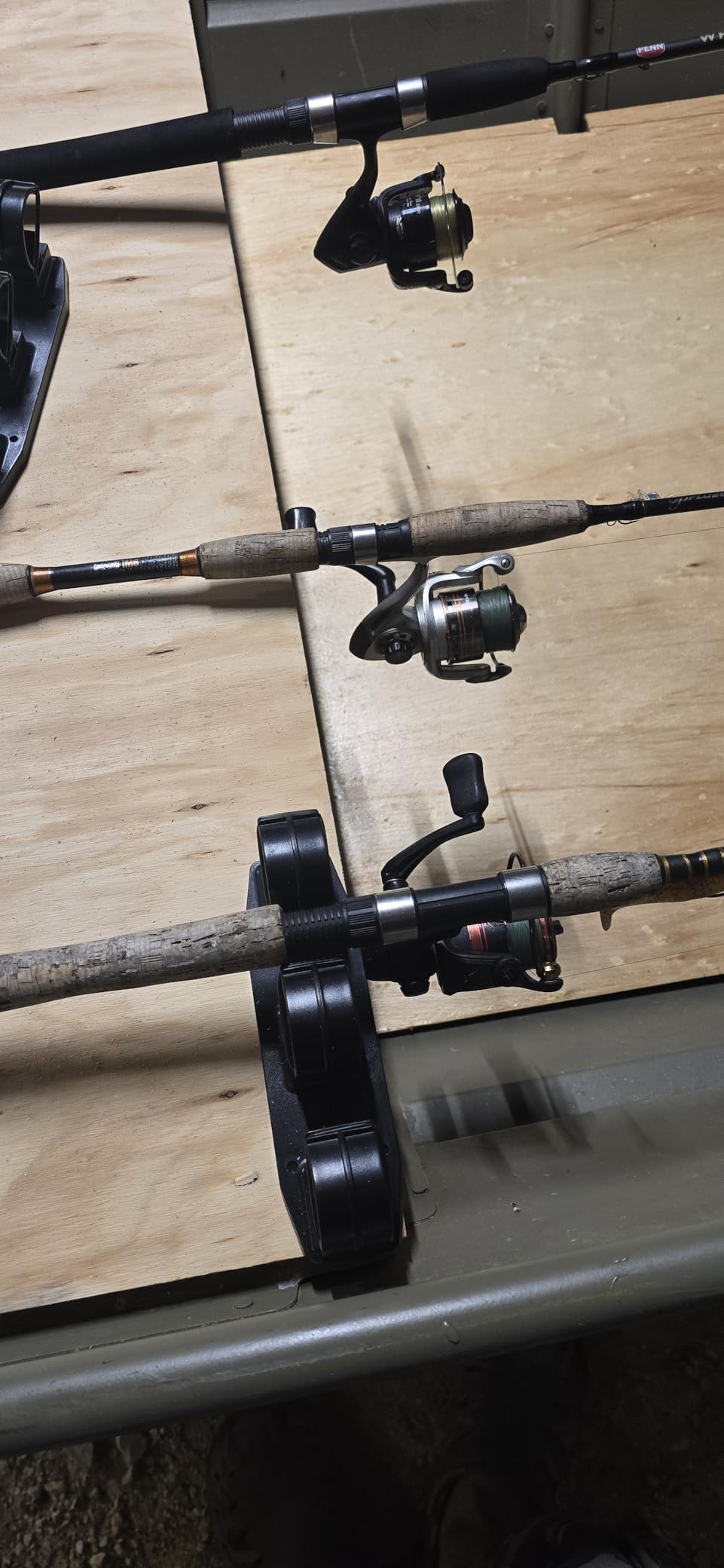
Be realistic about the material. These are rigid ABS tubes, so there is no give at all between the rod and the holder. On a carpetless aluminum bed with a lot of washboard road, that rigidity transmits more of the jolt to the blank than a foam-lined tube does.
A small number of buyers reported units cracking within a day, and the included fasteners may not line up with slotted rack holes without modification. Treat it as a light-duty and occasional-use holder rather than a highway rack.
What this rack decides for you
Pick it if you move between a boat, a golf cart and a truck, or if your only goal is getting six rods off the bed floor cheaply. Two racks mounted side by side along a bed wall gives you a working capacity of six rods.
It is also a sensible garage companion. Off-season, the same six tubes that carried rods to the water become a wall-mounted storage row, which is exactly how owners on fishing forums repurpose cheap racks.
Where it falls short
No cushioning means rod blanks take every bump directly. If your route to the lake is rough gravel rather than paved highway, step up to a foam-lined rack.
Fitment is on you. The hardware is included but not guaranteed to match every mounting surface, and drilling is required because nothing clamps.
4. GADFISH 4-Link Hitch Rack: Best Tailgate Clearance
Stainless Steel Hitch Fishing Rod Holder, GADFISH Hitch Mount Rod Holder, 4 Link Tube for 2″ Hitch Receivers with Quick Release Pin,Truck Adjustment Fishing Rod Rack, Fishing Pole Holder
4 stainless link tubes
Quick release pin
Fits 2 inch receivers
16 x 2 x 5 inch
Pros
- Polished stainless tubes include protective rubber inserts
- Quick release pin keeps rods from slipping out
- Tilt function clears the tailgate
- Assembles in about 20 minutes
Cons
- Some play in the assembly can shake rods at speed
- Some units shipped with unthreaded screws
- Rubber tube protectors can come loose
Hitch racks solve a different problem from bed racks. They take the rods out of the truck entirely, which means the bed stays clear for gear and a locked tailgate stays possible.
This one holds four rods in stainless link tubes sized for blanks up to 1.57 inch in diameter. The silicone wraps resist salt water corrosion and fading, which matters more than most buyers expect once a rack has been through a coastal winter.
The dual adjustment mode is the feature owners mention most. Rotating the rack vertical or tilting it away from the vehicle without blocking the tailgate means you can open the tailgate on a truck where the exhaust and hitch packaging would normally get in the way.
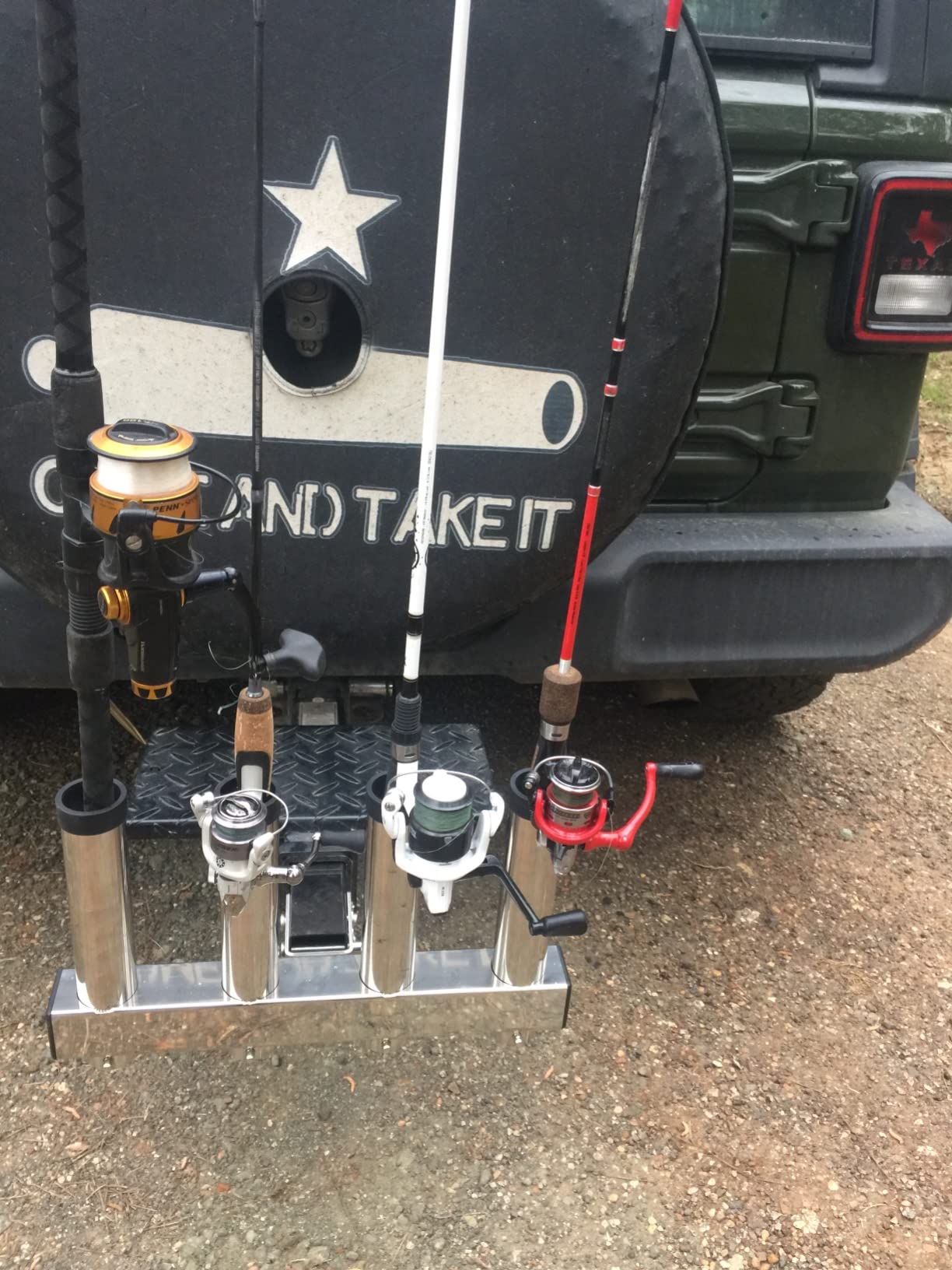
Owners like the polished finish and the tailgate-friendly tilt. The quick release pin prevents rods slipping out on bumpy, muddy roads, and the hollow tube bottoms help with positioning and drainage.
Where owners split is assembly quality. Some report play in the joints that lets rods rattle at highway speeds, and a few units arrived with unthreaded screws or misaligned drill holes and went back.
What this rack decides for you
Go hitch-mounted when the bed is working space rather than storage. Two coolers, a tackle center and a boat ramp load all fit around a rack that is not in the bed at all, and the rods stay out of sight at the ramp.
It is also the cleanest answer for someone with a short bed who cannot make the length math work. Rods travel behind the truck, not above it.
Where it falls short
Vertical play at the receiver turns into rattles over 70 and 80 mph runs. Adding a receiver bracket tightens it, and it is the first thing we would change on an otherwise good unit.
Link tubes are rigid. There is no foam, so the silicone sleeves are the only thing between the road grit and your blank, and those sleeves can work loose over time.
5. Brocraft 4-Rod Clamp Rack: Best All-Round Clamp Design
Brocraft 4 Rod Truck Bed Rod Holder, Aluminum Clamp-On Fishing Rod Rack for Truck, Boat, Canoe and Pontoon
4-rod capacity
C-clamp opens to 2.5 inch
6061-T6 aluminum track
Fiberglass-injected nylon parts
Pros
- Sturdy aluminum build that has held up over several seasons
- Clamp-on design installs and removes without drilling
- Bungee retention holds rods tight at highway speed
- Mounts horizontally or vertically
Cons
- C-clamp may not fit beds with a rail cap or cover
- Clamp screws can loosen and need tightening
- Hook ends may need trimming for heavy surf rods
The Brocraft is the reference design for a rail clamp. A 6061-T6 aluminum track carries four rods, and the C-clamp opens to 2.5 inches, which is a wider bite than most clamp racks in this roundup manage.
Buyers describe it as well made and secure, with recurring caveats about clamp fit on capped beds and the need to occasionally tighten the clamp. That caveat is worth reading twice, because rail cap thickness is the number one install variable for this style.
Integrated bungee cords do the retention work rather than rigid tube walls. That is why the track can be repositioned or removed easily and why it works equally on trucks, boats, canoes and pontoons.
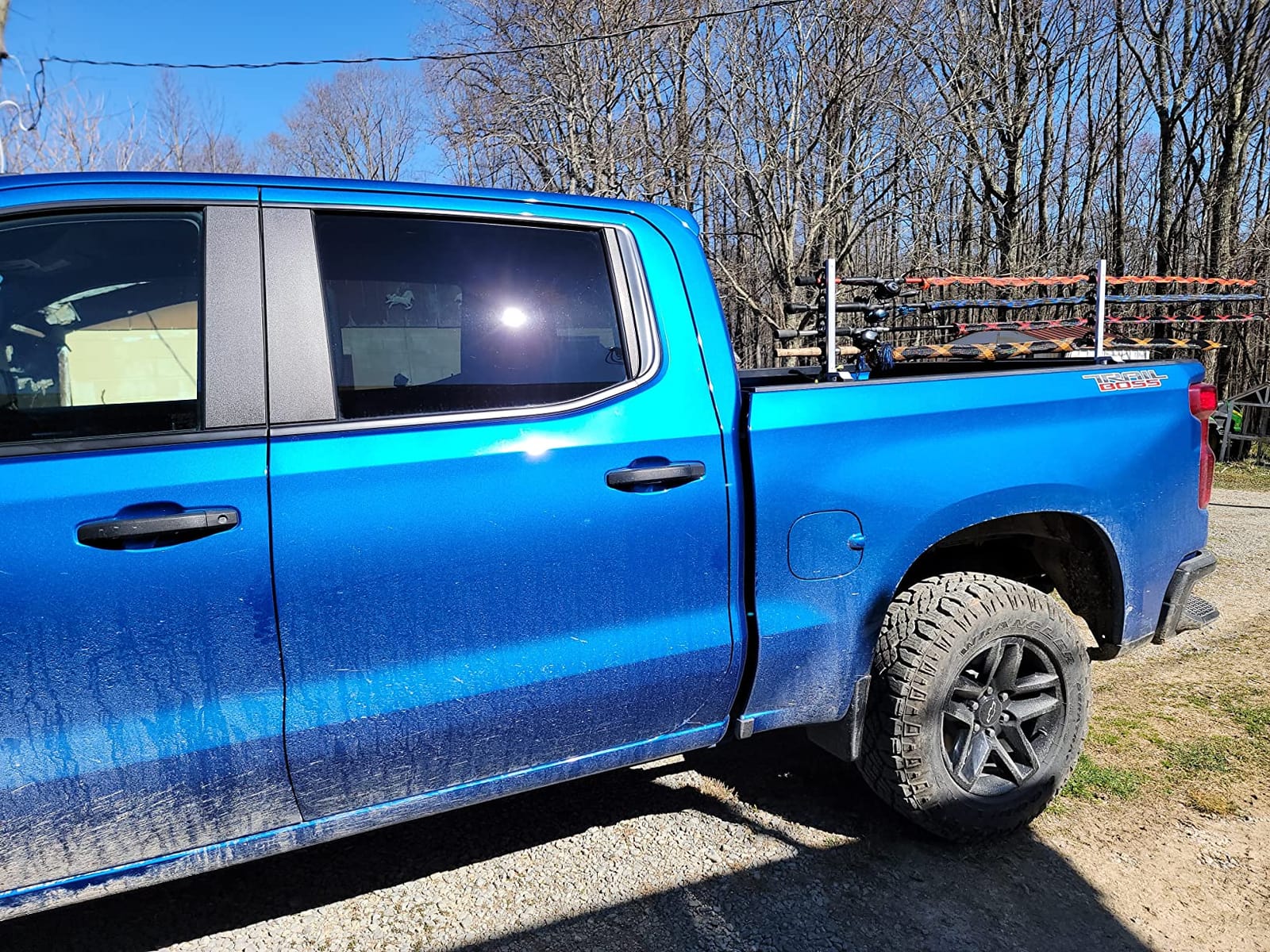
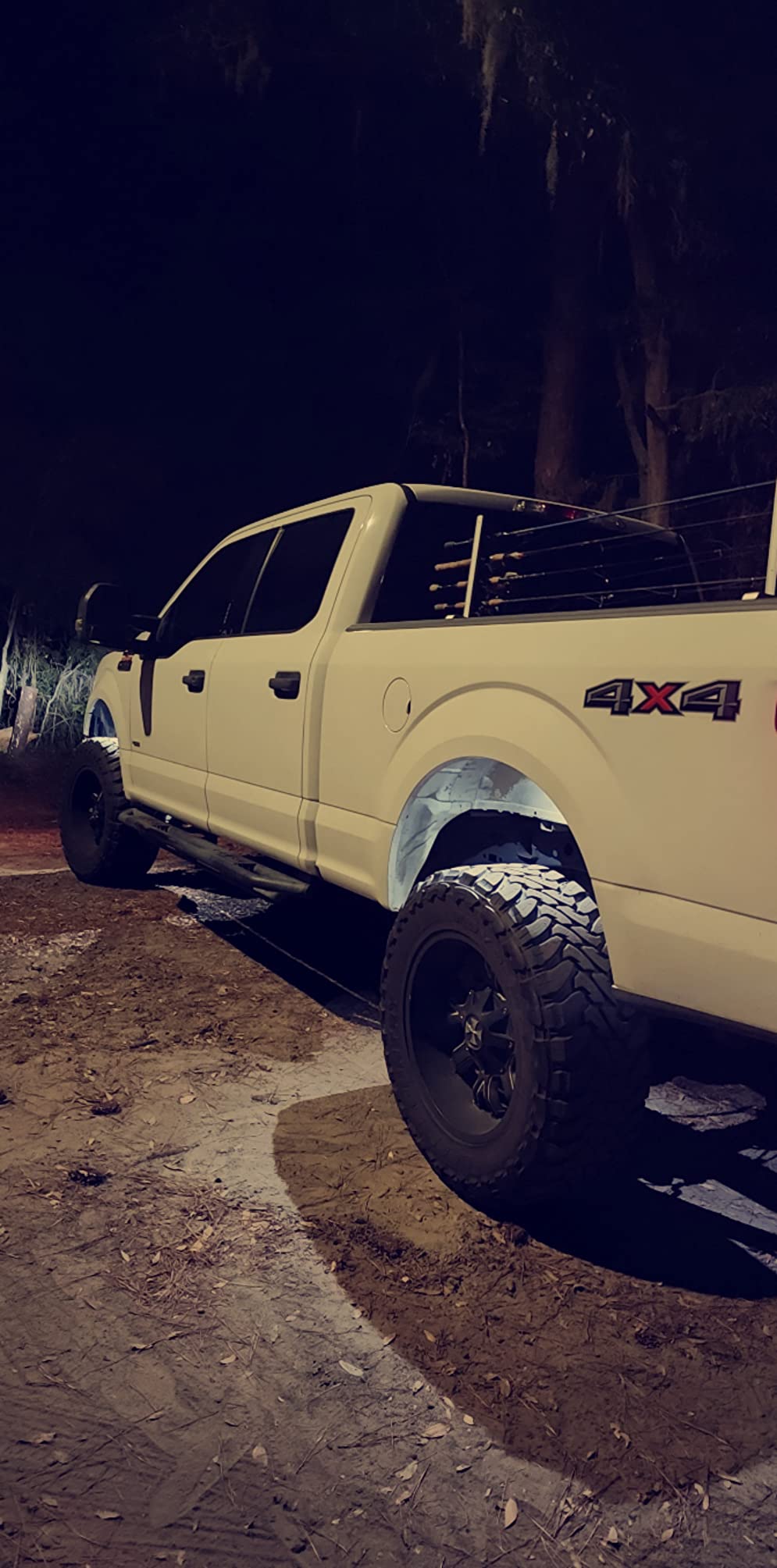
The mounting flexibility is genuinely useful. Mounted along the bed rail the rods lie close to horizontal, which keeps the profile low. Mounted vertically the same rack stands the rods up above the sidewall, which is the answer for a bed that has to stay usable underneath.
Two-piece and heavy surf rods can foul on the hook ends of the track. Some owners trim those ends, and that is an easy ten-minute modification if you run that style of rod.
What this rack decides for you
Choose it if you want one rack that handles both transport and storage, and if your bed rail is thick enough to clamp without a rail cap or tonneau interference. Four rods is a realistic solo-and-partner capacity, and the bungee keeps them from rattling on the highway.
The C-clamp is the reason people buy this style at all. No holes in the bed, no permanent install, and the whole rack comes off in a couple of minutes when you need the rail for a ladder or a kayak.
Where it falls short
Rail caps, bed covers and camper tops are the enemy here. If your rail has a plastic cap thicker than the clamp bite, no amount of tightening will seat it properly.
Clamp screws work loose with miles on them, so check them every few hundred miles on a rough route. The same suspension wear that shakes a rod holder rattles the clamps hardest, which is also why riders replacing truck shocks see clamp checks drop off their maintenance list.
6. Extreme Max 6-Rod Pivoting Hitch Holder: Most Capacity Behind the Truck
Extreme Max 3005.4275 Aluminum Pivoting Fishing Rod Holder for 2″ Hitch Receivers – 6-Rod Capacity, Grey
6 rod tubes
Rod fit up to 1-5/8 inch
Pivots three positions
2-year warranty
Pros
- Pivoting design keeps it clear of an opening tailgate
- Lightweight aluminum that assembles easily
- Vinyl tube caps protect rod blanks from road wear
- Six-rod capacity keeps bulky gear out of the cab
Cons
- Some vertical play in the receiver causes rattles
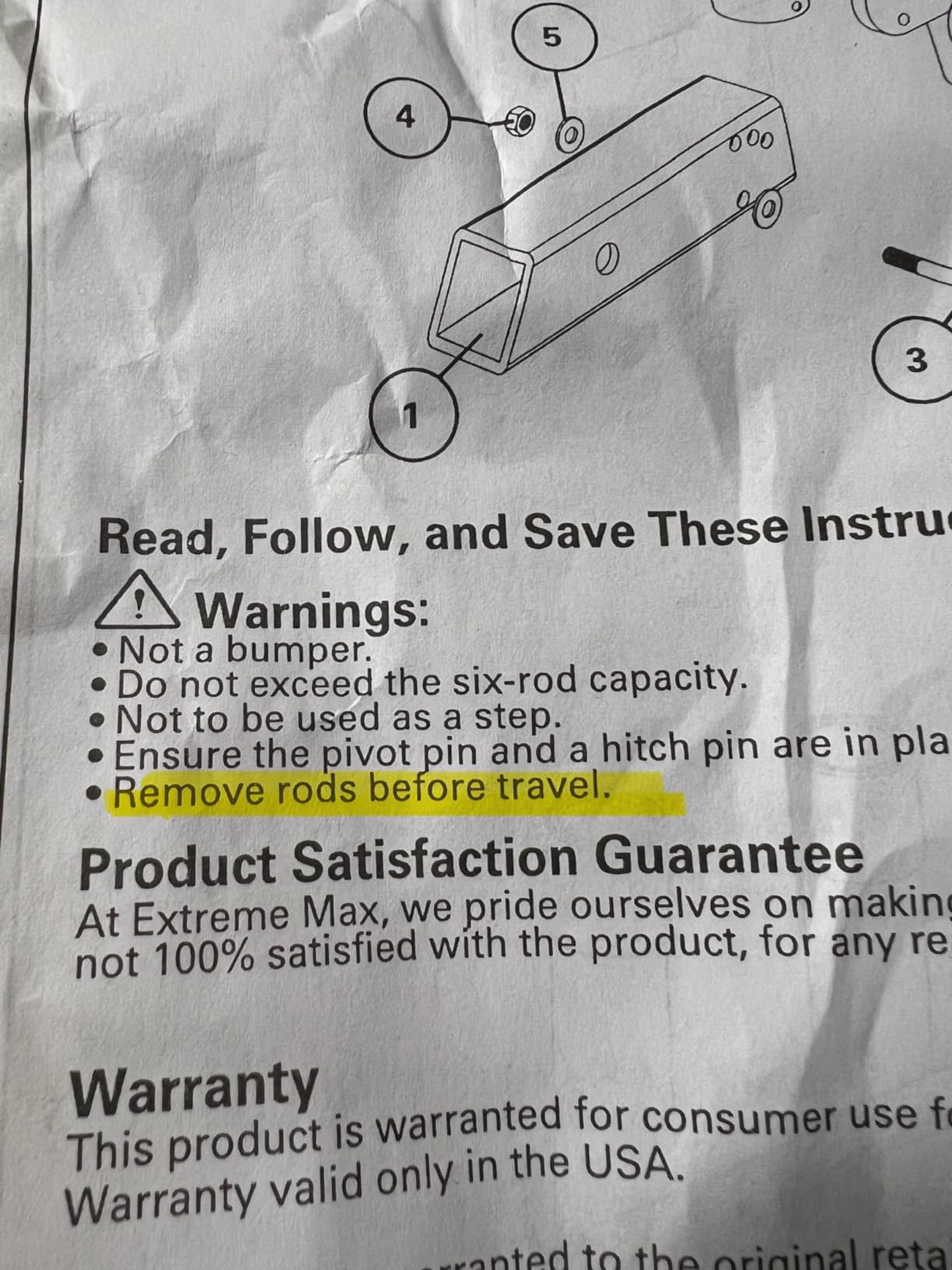
- Hitch pin is not included
- Tubes are short for long surf rods
This is the capacity leader among the hitch options, with six tubes each taking a rod up to 1-5/8 inch in diameter. For a two-person trip with a rack of baitcasters and spinners, that is the whole spread in one unit.
The pivot is the clever part. The holder rotates into vertical, angled away from the vehicle, or clear of an opening tailgate, so you choose the geometry instead of working around it. Owners who tow and fish appreciate being able to swing the whole rack out of the way.
Soft-touch vinyl caps line the tubes, which reduces the scratching and road wear you get when a blank is exposed in a bare metal tube for a 90 minute drive.
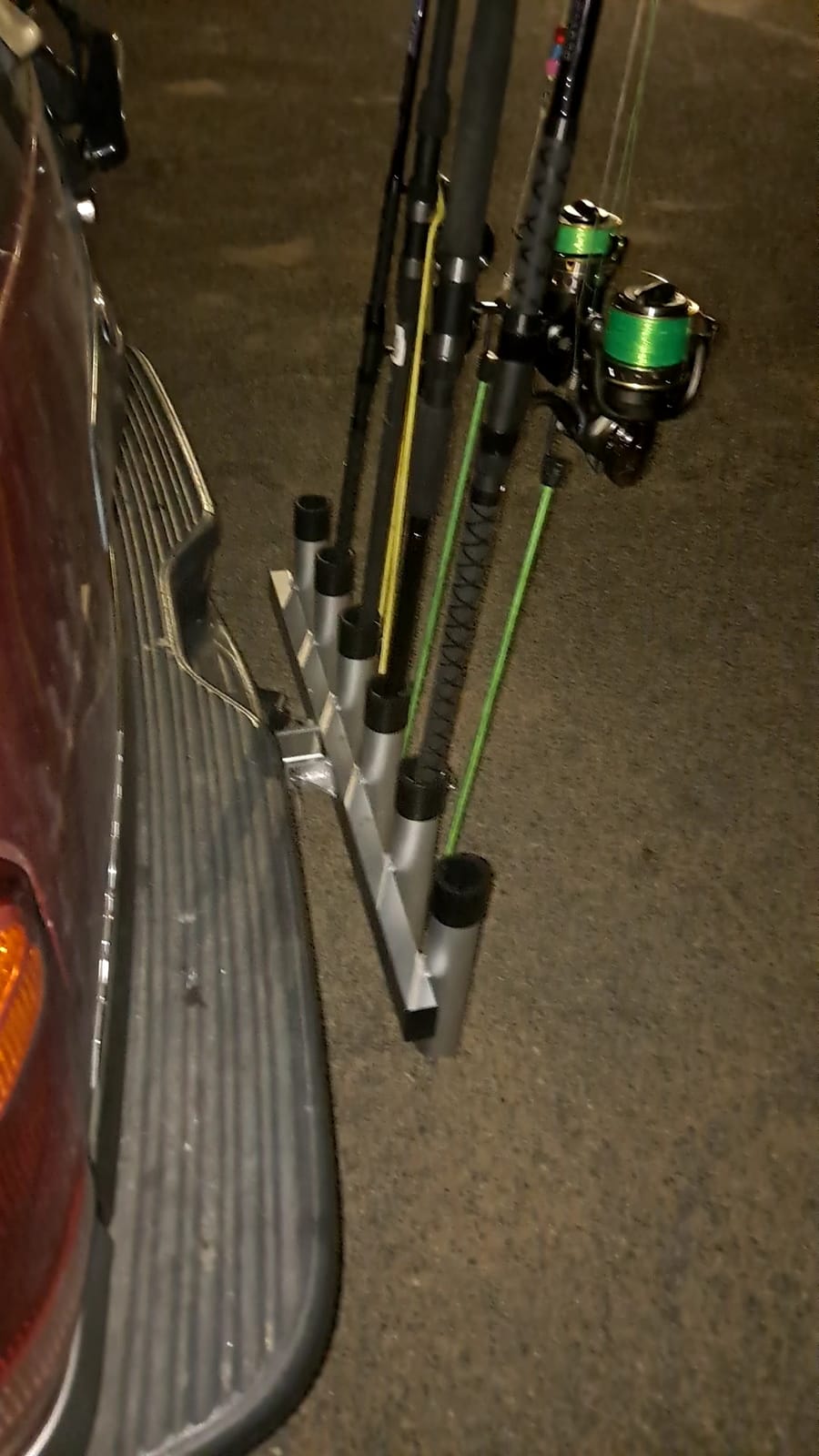
Two details to know before you buy. The hitch pin is not included, so you need one on hand, and a small number of owners report vertical play in the receiver that adds rattle without an added bracket.
Tube length is the other catch. Owners running long surf rods report the tubes are short, and the closed tube bottoms can limit reel clearance for rods with larger reels hanging below the butt.
What this rack decides for you
Pick it if you carry more than four rods, if tailgate access matters for loading, or if you want the bed completely clear for a cooler and a boat ramp run. The two-year warranty is also the longest stated coverage in this group.
Because it hangs behind the vehicle rather than above it, it also sidesteps the rod tip height problem entirely on a lifted truck.
Where it falls short
Receiver play is the honest drawback. A loose receiver sleeve is the usual culprit, and it turns into a rattle you hear at highway speed until you add a bracket or shim the pin.
It also does nothing for you if you have no 2 inch receiver, or if your hitch is permanently occupied by a bike rack or a recovery setup. Measure before you order.
7. Rod Hauler Tailgate Carrier: Bed Space Without a Footprint
Rod Hauler Fishing Rod Holder for Truck Tailgate – Transport 4 Rods Securely with Soft Foam Inserts & Straps – Fishing Pole Rack for Pickup Truck Bed – Easy Tailgate Rod Carrier
4-rod capacity
Strap mount with hook-and-loop
Soft foam inserts
10.88 ounces
Pros
- Tool-free strap installation in under five minutes
- Soft foam inserts cradle rods without scratching blanks
- Lowered tailgate function stays intact
- Stands up on dirt roads and highway speeds
Cons
- Can wiggle slightly on some tailgate shapes
- Foam insert area is limited for very long rods
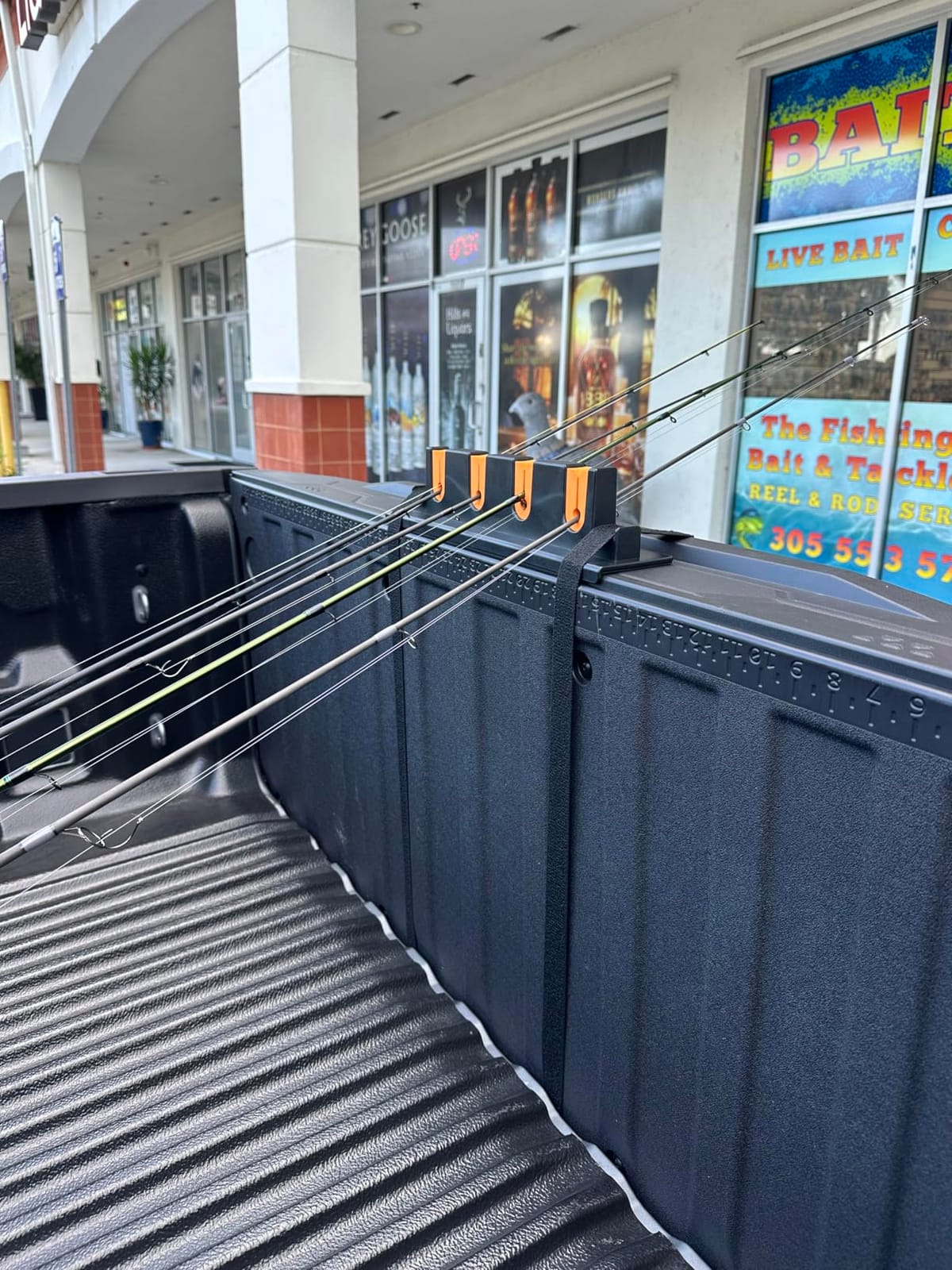
A tailgate carrier is the least invasive install in the roundup. Close the tailgate, wrap the straps, and the rods stand upright behind the bed. Nothing bolts to the bedside and nothing reaches over the sidewall.
Owners highlight easy tailgate mounting, foam protection against rod damage, and no marks left on the tailgate. The two hook-and-loop straps are the entire mounting system and the install takes under five minutes.
At 10.88 ounces this is the piece you will not think about. It comes out for winter rod storage, it fits in a glovebox, and it does not need a wrench.
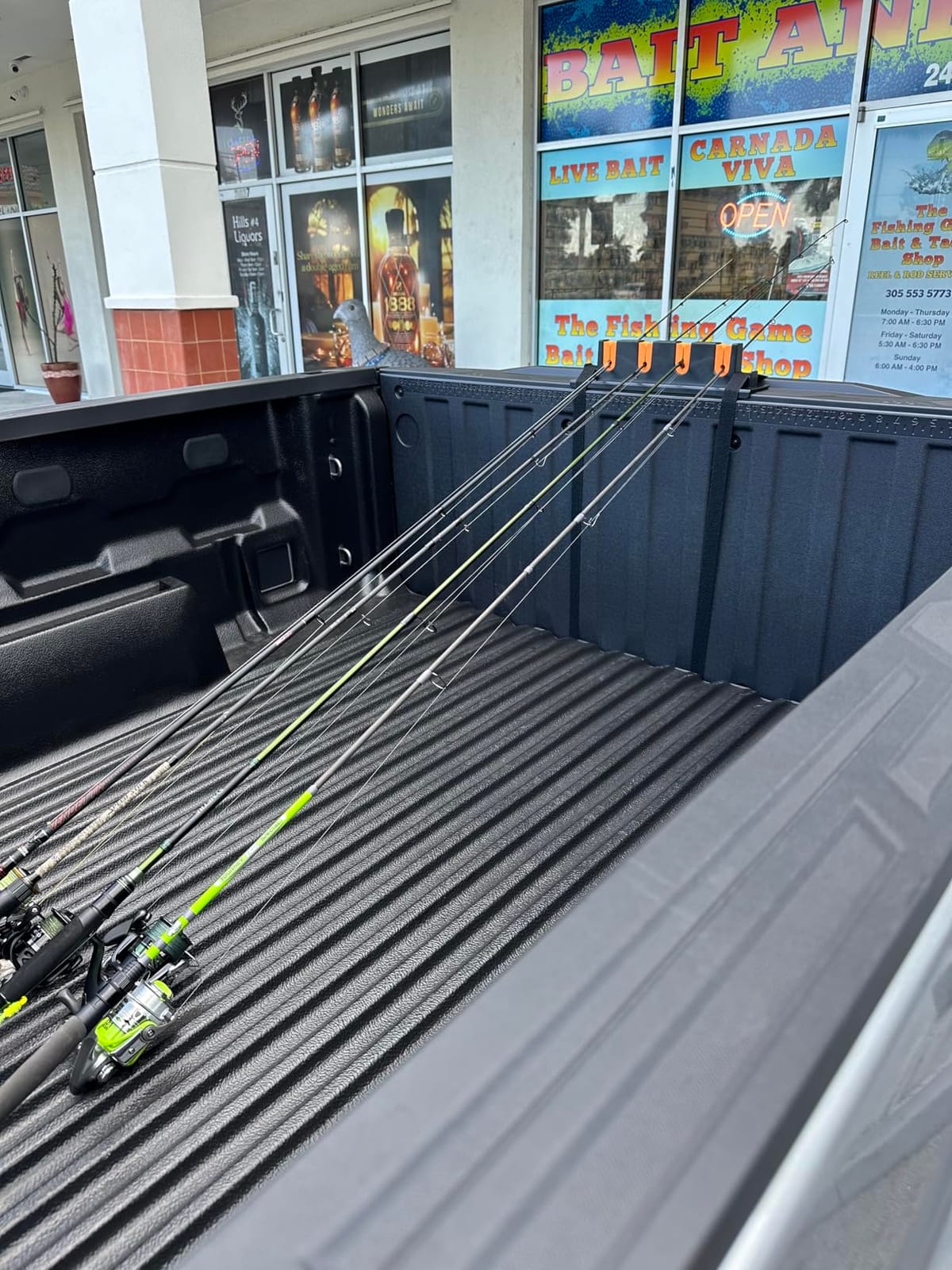
Soft foam inserts cradle the blanks and keep four rods separated so they cannot collide or tangle during travel. That separation is the whole reason this style works at speed on a dirt road.
The compromise is the tailgate itself. With the carrier strapped on, the tailgate stays down, which costs you the ability to load a long board or a boat ramp bumper through that opening.
What this carrier decides for you
Choose it if you do not want holes in the truck, you want the sidewalls and rail completely free, and you only need rods standing at the back of the bed. It is the cleanest answer for a fiberglass or aluminum truck where you would rather not drill anything.
It is also the best temporary option. Rods live in the bed all season, and the carrier comes off in seconds when you need a flat load floor.
Where it falls short
It can wiggle slightly depending on tailgate shape, and the foam insert area is limited for very long rods. Sections of a longer rod can extend past the cradle and catch wind.
Foam is also a consumable. Once the inserts flatten out, rod protection drops noticeably, so check them each season before a long drive.
8. SPIRRELAB 4-Rod Truck Bed Holder: Best Foam Fit for Fly Rods
SPIRRELAB Truck Bed Fishing Rod Holders for 6 Rods, Fishing Gift for Men
Holds up to 4 rods
1.5 inch aluminum C-clamps
24.5 inch wide
1.13 kg
Pros
- Bolts to the top and underside of the bed rail in about ten minutes
- High quality foam gives a snug fit for one-piece and fly rods
- Bungee cords front and rear add retention against bumps
- Mounts horizontally or vertically
Cons
- Does not fit a 2025 Tacoma bed without drilling
- Clamps can be difficult to get tight
- No security when the vehicle is unattended
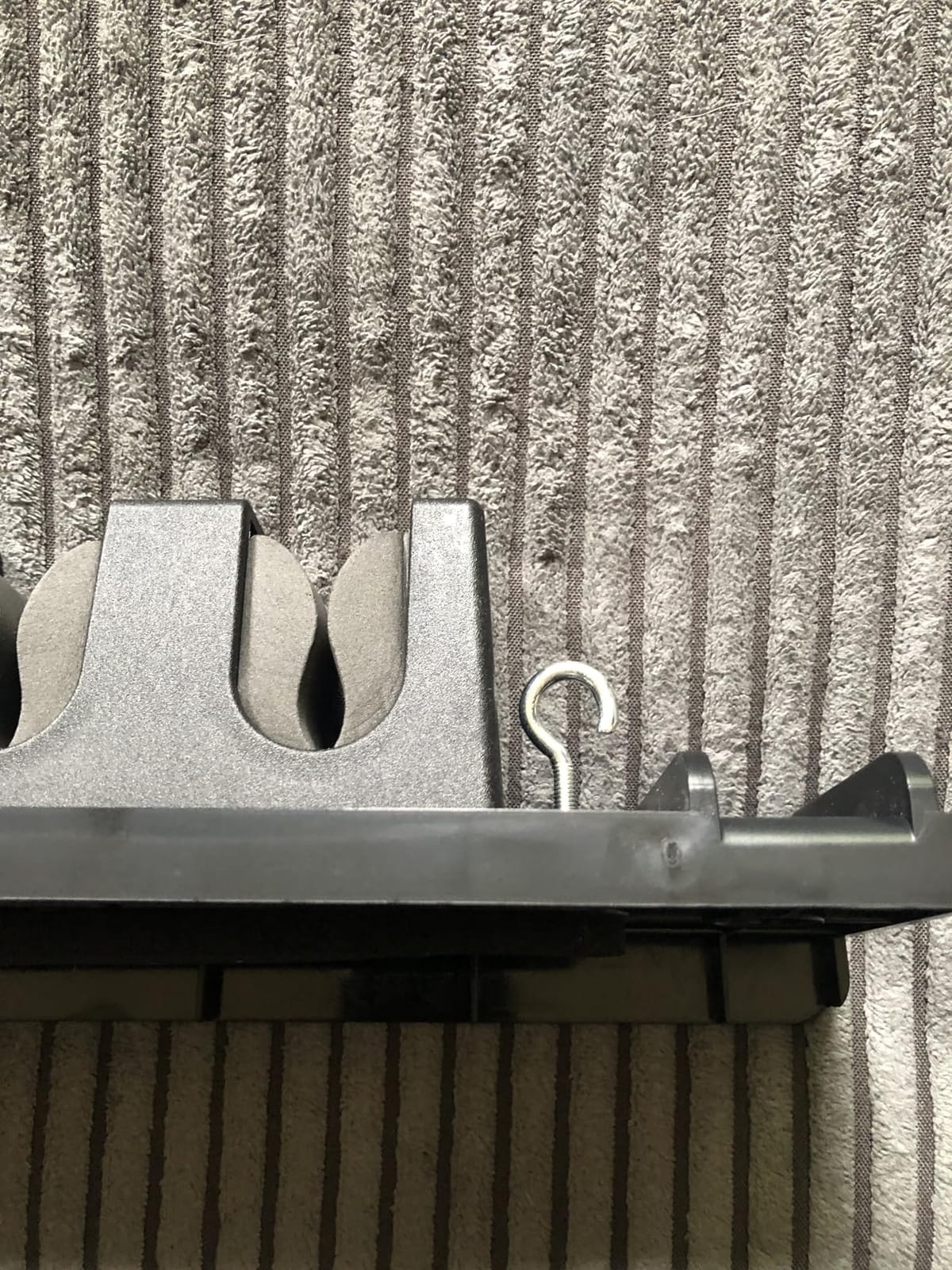
This is the holder we would point fly fishing owners toward. The EVA foam cushions are cut to a snug fit for one-piece rods, which is exactly the profile of a fly rod section, and the bungee cords front and rear keep them from walking during long drives.
The clamp design uses 1.5 inch aluminum C-clamps with scratch-proof rubber pads, gripping the top and underside of the bed rail. Installation takes about ten minutes and slides rods in and out without tangling line.
Buyers like the foam fit, the build quality and the mounting flexibility. The same reviews point out the two real limitations: fitment on newer beds and clamps that are hard to get tight.
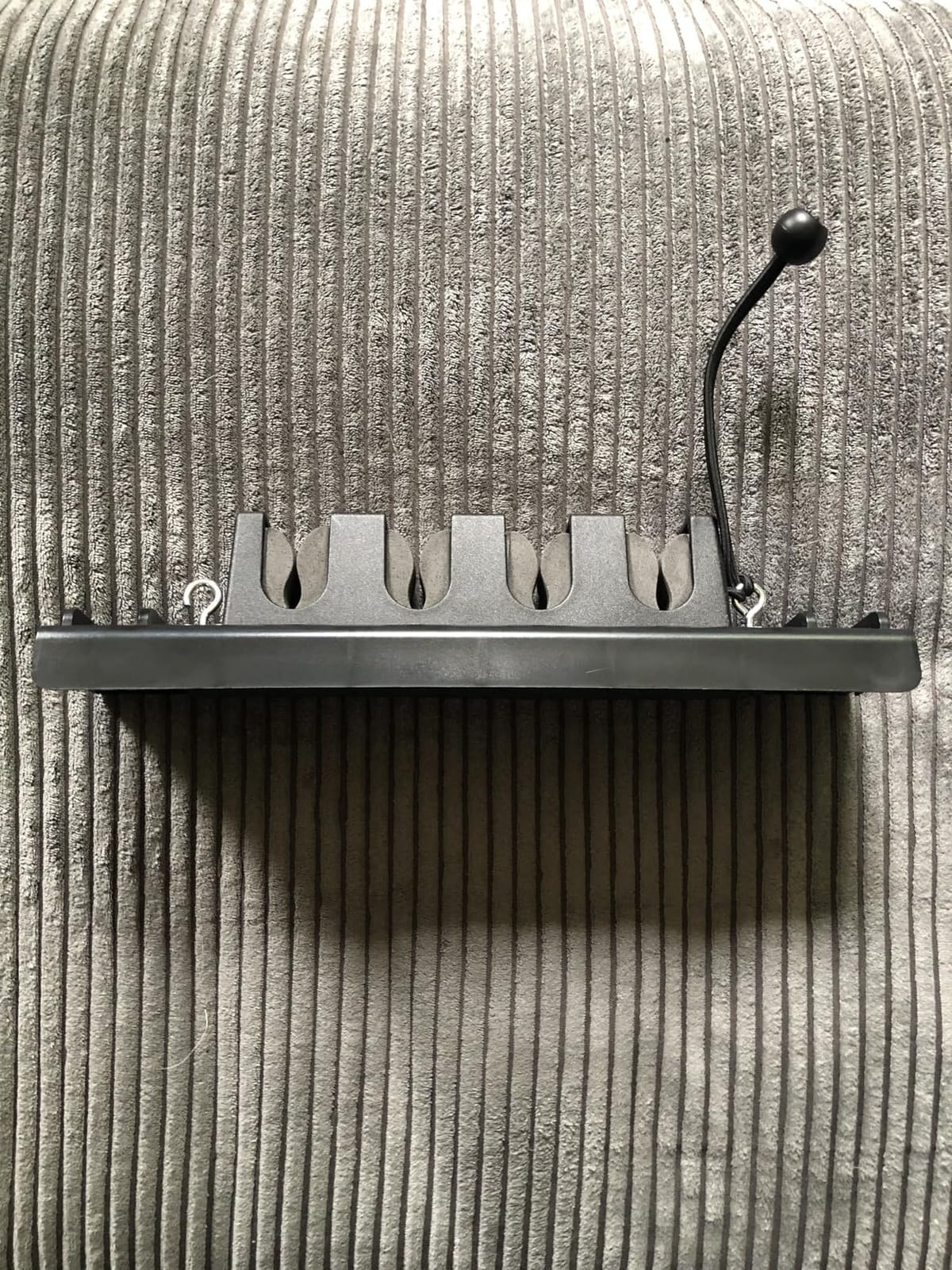
The listing is specific about exclusions. It is not for bed slides, bed covers or camper tops, and at least one owner found it would not mount to a 2025 Toyota Tacoma bed without drilling. Check your rail profile before you order.
At 24.5 inches wide and 7 inches tall, the four-rod version fits a standard bed rail comfortably. A six-rod version in the same line runs longer and is worth a look if you travel with a partner.
What this holder decides for you
Choose it if your rods are fly rods or any thin one-piece where blank protection matters more than raw capacity. Foam plus bungee is a kinder combination for a delicate blank than a rigid aluminum tube.
The horizontal or vertical choice also lets you match the rack to the trip. Horizontal along the rail for highway runs, vertical against the sidewall when you want the rods up and out of the way of a loaded bed.
Where it falls short
Fitment is the honest problem. A C-clamp needs a rail of consistent thickness, and newer beds with thicker lips or integrated rail structures can defeat it.
There is no security for gear when the vehicle is unattended, and when the rack is full the reels can knock together. If you leave rods at the ramp, add a cable lock through the rack.
9. JOYTUTUS 6-Rod Clamp Holder: Highest Bed Capacity on a Rail
JOYTUTUS Truck Bed Fishing Rod Holder, 6-Rod Capacity
6-rod capacity
C-clamp fits rails to 1.6 inch
Metal with drainage holes
2 kg
Pros
- Clamp-on install takes seconds with no drilling
- Recovers significant bed space and stops rod tangles
- Metal construction with drainage holes suits outdoor use
- Works on truck beds and boat gunwales
Cons
- Thin vertical bars can bend if over-tightened
- Grip is weak on rails with plastic covers
- Not snug on thinner rod tips
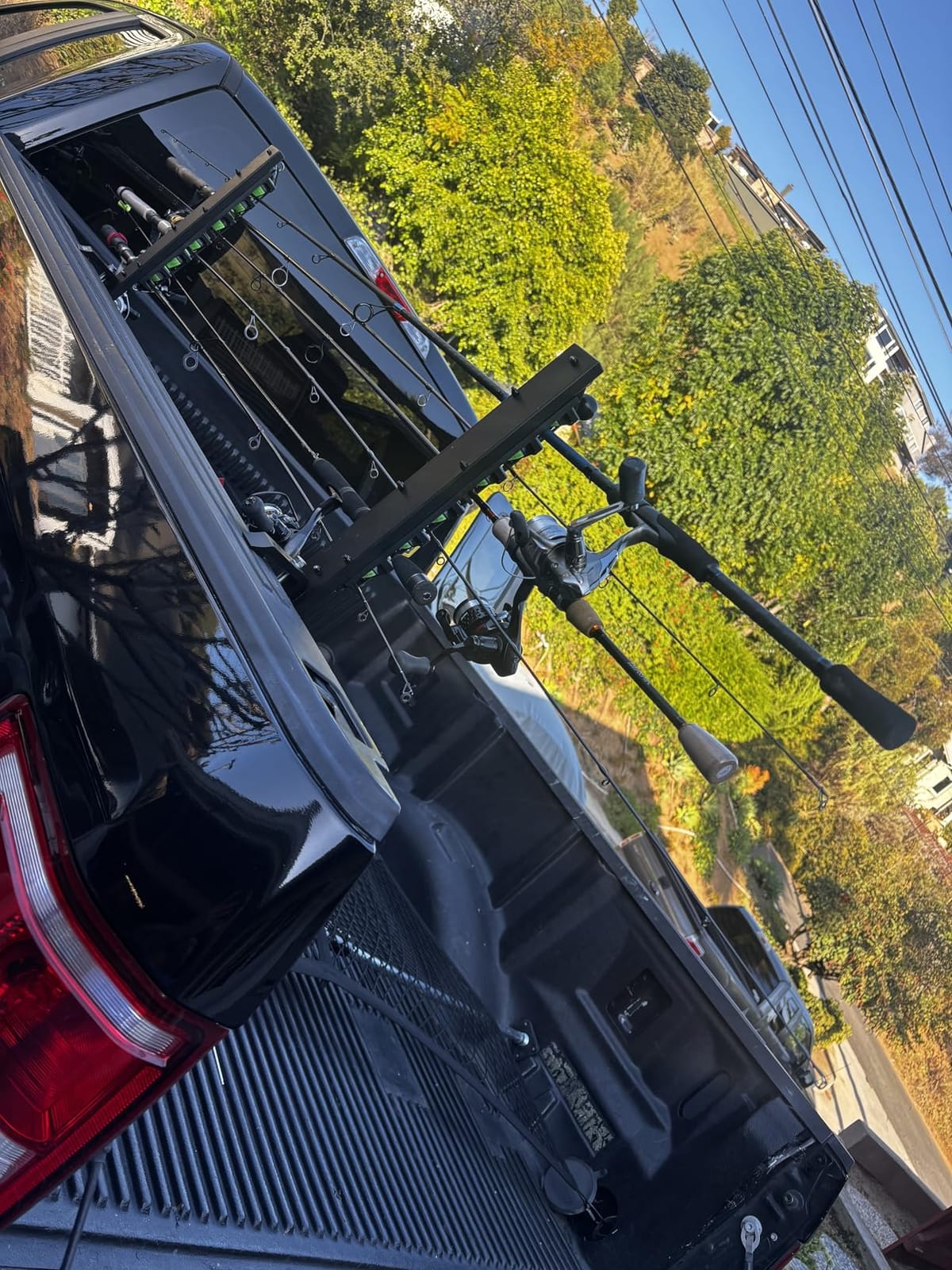
If six rods on a bed rail is your target and you want the lowest-cost route to it, this is the one. The heavy-duty C-clamp fits bed rails up to 1.6 inch thick and installs in seconds without drilling.
Reviewers like the clamp-on convenience and the bed space it frees up. Metal construction with drainage holes means water does not sit in the tubes after a wet morning, and the rack doubles as a boat gunwale holder.
The listing names the trucks it fits, including the F-150, Silverado, RAM and Tacoma, and names what it does not fit: slide rails and cargo covers.
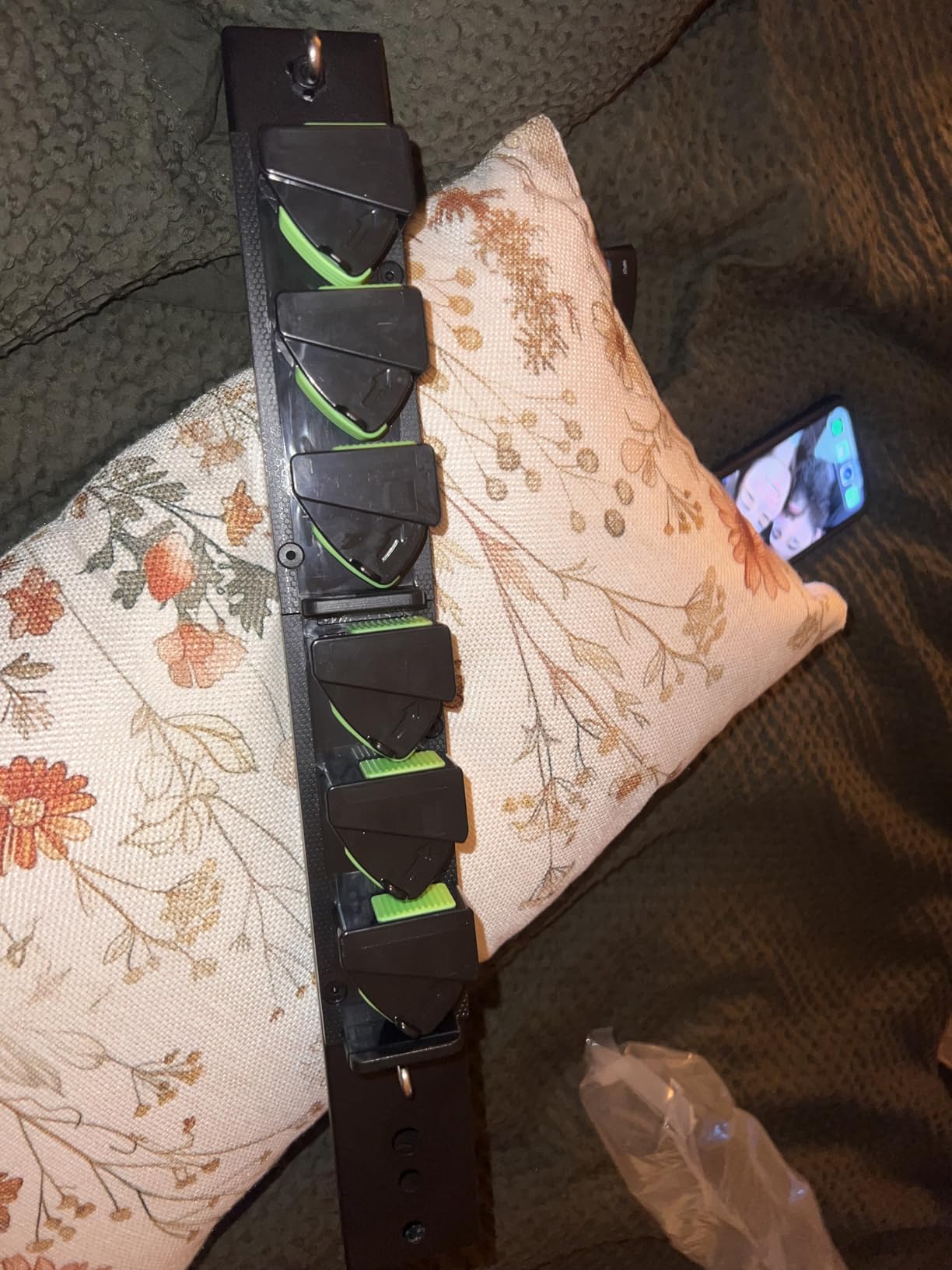
The honest weakness is the thin vertical bars. Several reviewers describe them as thin and easy to damage, and over-tightening a thin bar is exactly how it gets bent. Tighten to firm, not to maximum.
Grip is also weaker on bed rails with plastic covers, and it needs retightening on those setups. On thin rod tips the fit is not snug, so a light breeze at speed can rattle a spinning rod in its channel.
What this holder decides for you
Choose it when rod count is the priority and you want the whole rack off in under a minute. Six rods on one rail also means you can carry two people without doubling the mounting footprint.
If the same rack works on your boat gunwale, you get a second location out of the purchase, which is more value than the count of rods alone suggests.
Where it falls short
Thin bars bend. Treat it as a holder for freshwater and moderate rods rather than a heavy offshore spread, and never lean on it to tighten the clamp.
Rail caps and cargo covers defeat the grip entirely, and thin rod tips are not held firmly. If you run light tackle, add a wrap of hook-and-loop or a foam sleeve at the tip end.
10. GOORIDA 5-Tube Hitch Rack: Budget Hitch Option with Sleeve Variety
GOORIDA Hitch Mount Fishing Rod Holder, Fishing Pole Rack for Truck with 5-Rod Tubes, Adjustable for 2″ Hitch Receivers & Easy to Use with Quick Release Pin
5 tube capacity
Quick release pin
Three sleeve sizes
16.54 x 12.2 x 9.84 inch
Pros
- Quick release pin keeps rods from sliding out during travel
- Silicone sleeves in three sizes improve grip and protect rods
- Tilts to clear the tailgate
- Stores in a trunk or hangs on a garage wall
Cons
- Only four rod tubes in practice despite the 5-tube listing
- Weld and hardware finish is less refined than premium racks
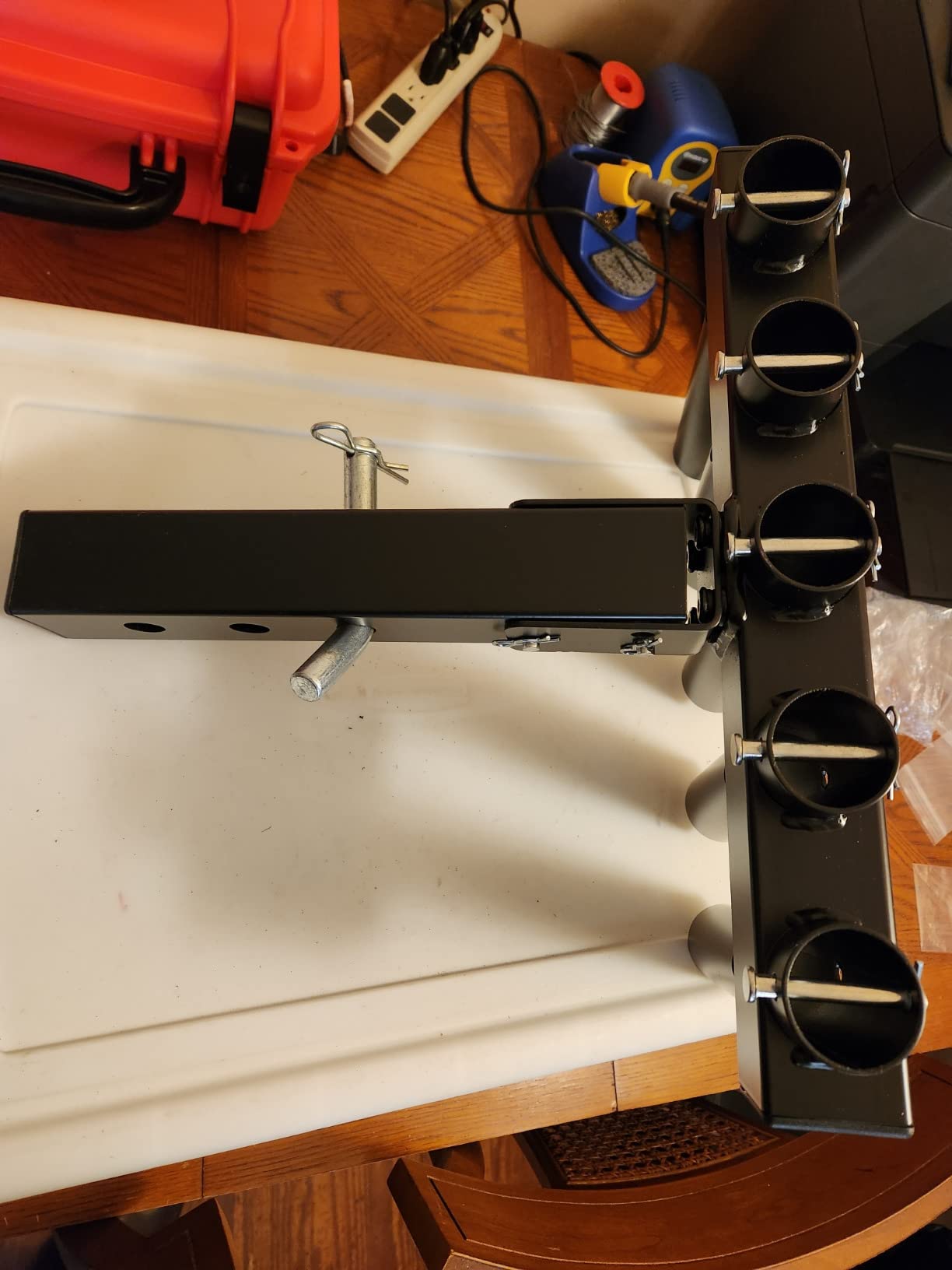
This is the second hitch option and it competes on accessories rather than polish. The silicone sleeve set comes in three sizes, which lets you match the tube to the rod diameter instead of living with one loose or one tight fit.
Feedback centers on the quick release pin, the sleeve grip and the tailgate tilt working as described. Rotation plus vertical or tilted positioning means you can set the rack up around a swinging tailgate.
It also stores sensibly. Owners keep it in a trunk between trips or hang it on a garage wall, so the rack is not permanently occupying the hitch when you are towing.
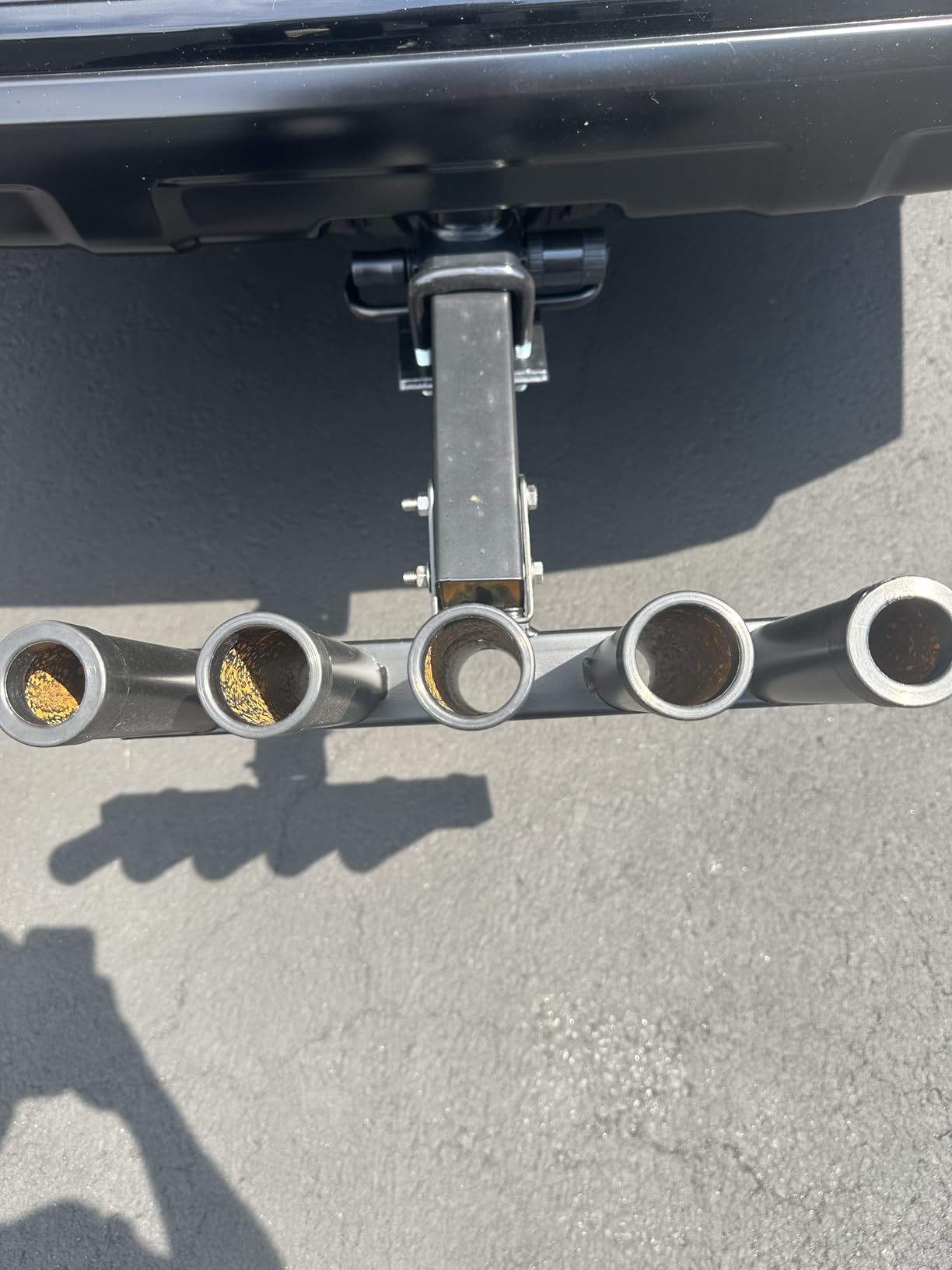
The build is alloy steel rather than stainless, and owners describe the weld and hardware finish as less refined than premium hitch racks. It works; it just does not look like jewelry on the back of the truck.
One recurring complaint is a capacity mismatch. The listing says five tubes, and owners report reliably getting four usable ones, so plan your rod count with a margin.
What this rack decides for you
Choose it when you want the bed completely clear, you carry four to five rods, and your rods vary in diameter. The three sleeve sizes solve a fit problem the single-size tubes on some other hitch racks create.
It is a good match for someone who also uses the hitch for a bike rack on weekends. A hitch rod holder is only useful when the hitch is free.
Where it falls short
Four usable tubes rather than five means a six-rod trip does not fit. Check your rod count against the real capacity, not the listing number.
Alloy steel in a wetter climate will show surface rust faster than stainless. If you fish salt water year round, wipe it down after salt water exposure or step up to a stainless rack.
11. GADFISH 6-Rod Adjustable Bed Holder: For Camper Shell and Boxy Beds
GADFISH Fishing Rod Holder for Truck Bed, Hold 6 Fishing Rods At Once, Adjustable Fishing Rod Holder Fits Most Fishing Rods, 2 Mounting Options
6-rod capacity
Adjustable rod clamps
Aluminum alloy
8 x 2 x 3 inch each
Pros
- Adjustable clamps grip different rod diameters including thin spinners
- Two mounting options for vertical or bed-angle layouts
- Fits camper shell beds without bending brackets
- Lightweight aluminum with rubber band retention
Cons
- May need a wrench or socket to tighten the mounts
- Some units arrived with stripped hardware
- Mounting can interfere with a bed cover
This is the answer for a bed you cannot clamp to. It accommodates plywood panels up to 3 inches thick, which means a camper shell, a homemade bulkhead or a flatbed panel becomes a legal mounting surface.
The adjustable clamps are the reason it works with a mixed load. They grip tapered profiles and thin spinner rods that would rattle in a fixed-diameter tube, and a rubber band rope with multi-layer reinforcement does the retention.
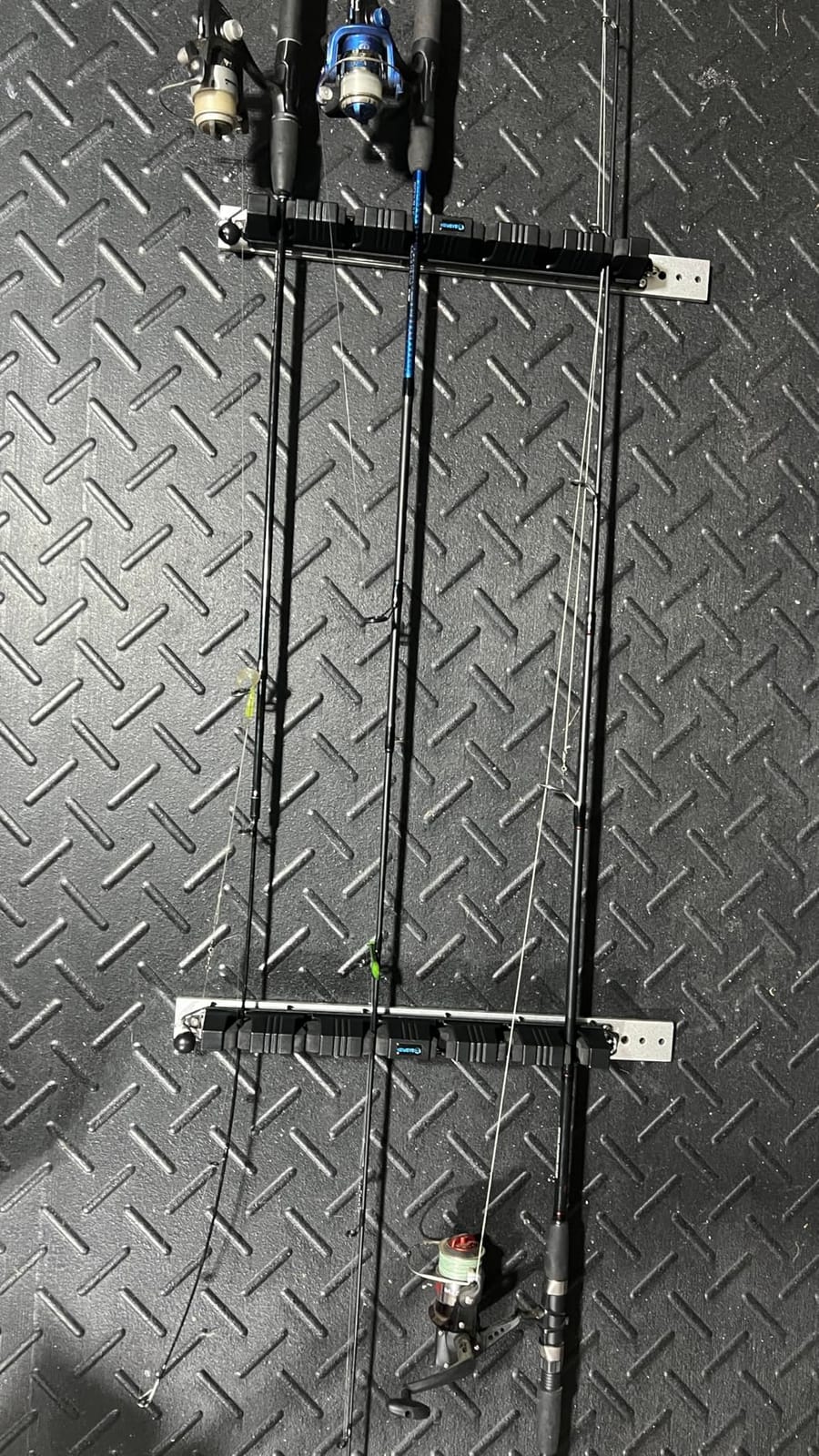
Reviewers call it well made and versatile, including for garage wall use, while noting the mounts need real force to secure. Six rods storable vertically or horizontally along the bed angle is a lot of flexibility for a light piece.
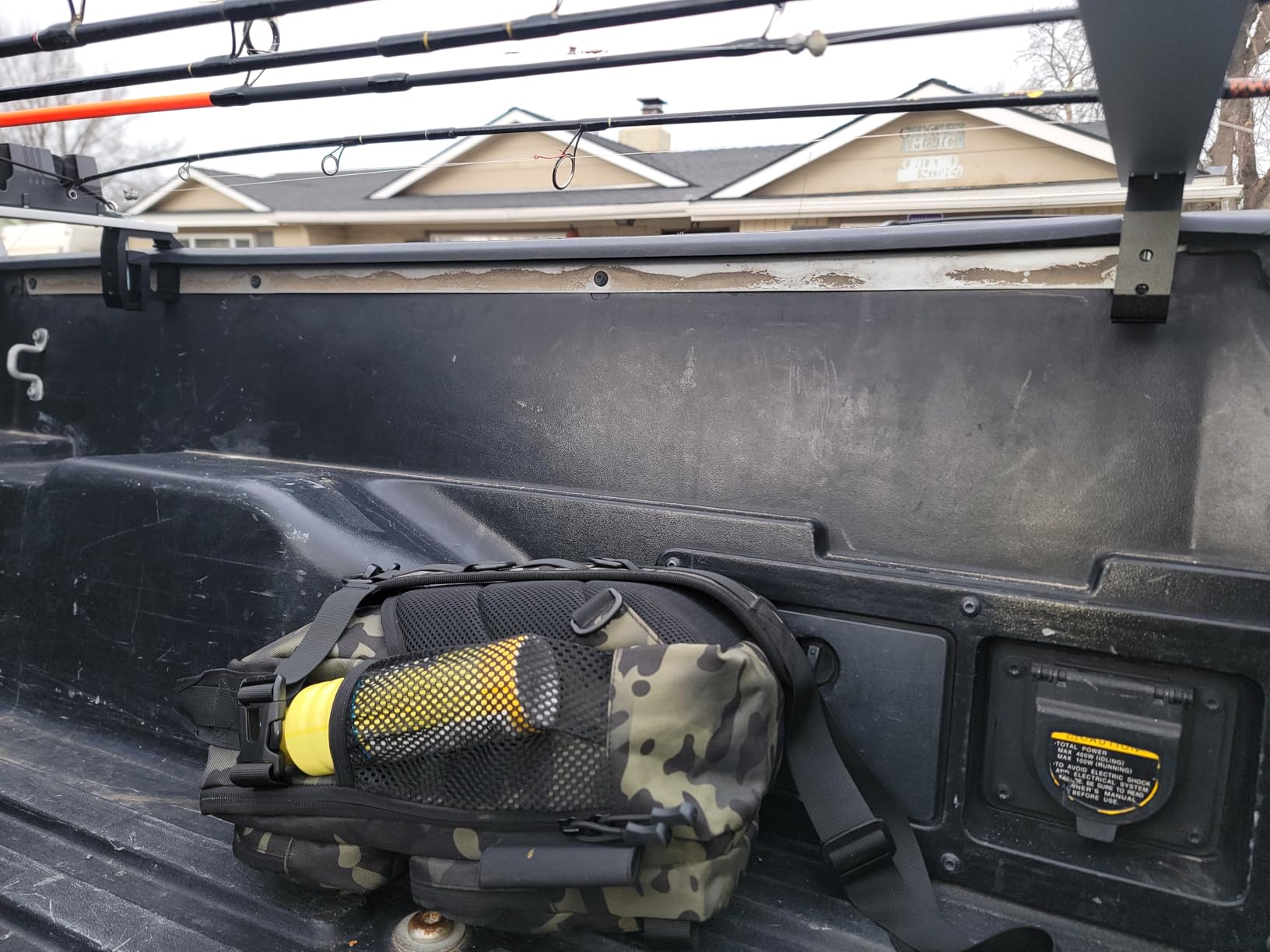
Two practical notes. The mounts often need a wrench or socket to reach proper tension, so this is not a tool-free install despite looking like one. And a few units arrived with stripped hardware, which is a packing issue rather than a design flaw.
Mounting can interfere with a bed cover. If your truck has one, check the clearance with the rack empty before you commit to a spot.
What this holder decides for you
Choose it if you run a camper shell or a flat panel bed, or if your rails are too thick or too thin for a C-clamp. Six adjustable rod positions in a small footprint solves a lot of specific problems.
Because the units are small and light, you can mount several in different spots rather than one large rack in one place, which is useful when you want rods at the front and the back of the bed.
Where it falls short
It is surface mount only. There is no clamp, so the mounting surface has to be flat and thick enough, and that rules out most standard bed rails.
Tensioning the mounts takes tools and real effort, and interference with a bed cover is a live possibility depending on where you place it.
12. Calfca 4-Rod Pair with C-Clamps: Both Bed Rails Covered
Fishing Rod Holder for Truck Bed, Holding 4 Rods Truck Bed Fishing Rod Holder, Aluminum Fishing Pole Holders for Truck
4 rods per unit
Sold as a pair
6061-T6 aluminum with fiberglass
No-drill C-clamp
Pros
- C-clamp installs in under five minutes with no drilling
- Shock-absorbing silicone pads damp road vibration
- 6061-T6 aluminum and fiberglass resist rust and weather
- Sold as a pair so both rails can be covered
Cons
- Not compatible with bed slides
- bed covers or camper tops
- Foam-lined grooves suit rods up to about 1.4 inch diameter
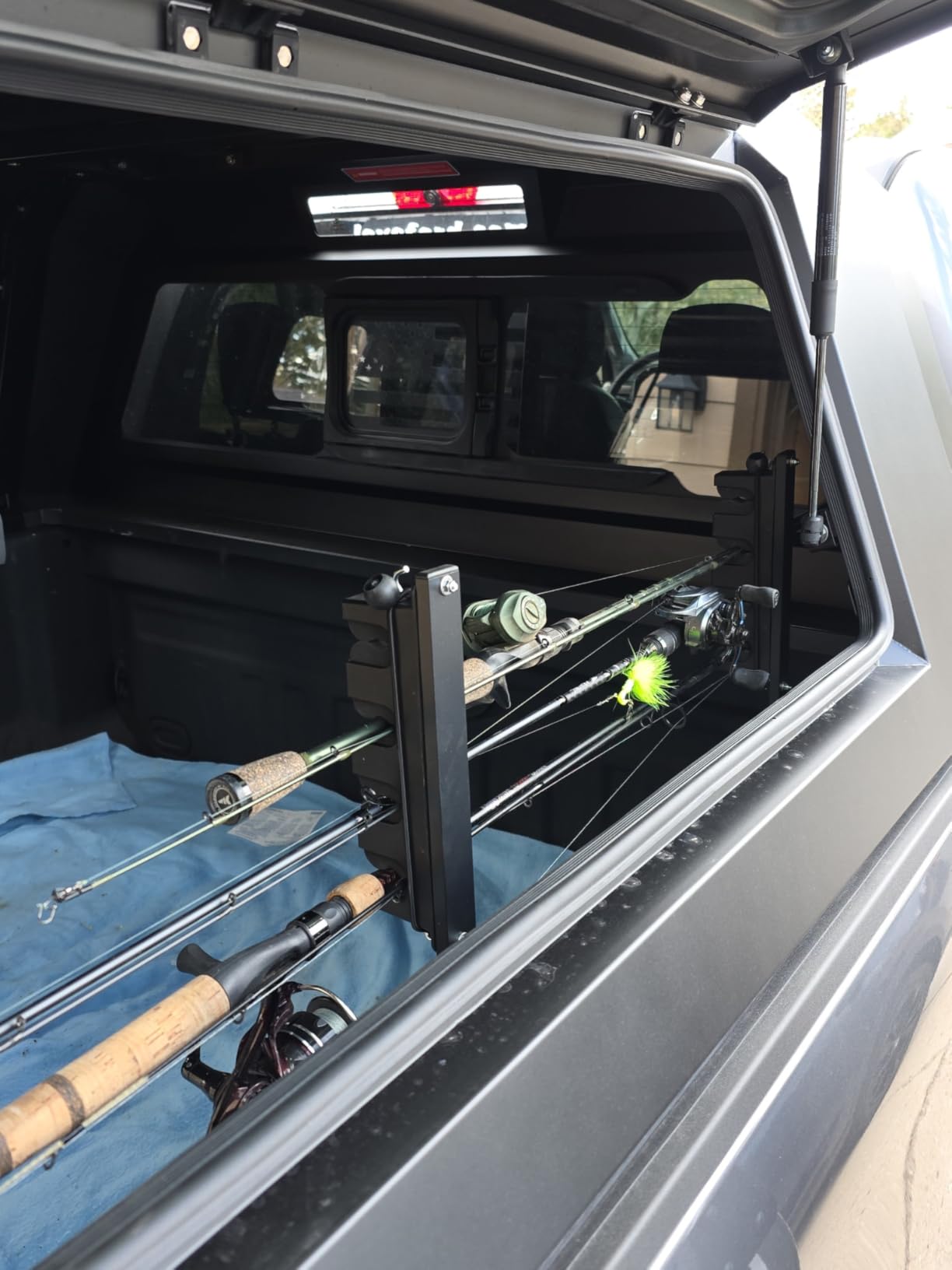
Selling as a pair is the smart move here. Most bed racks put everything on one rail and leave the other side bare, but a two-rail layout keeps rods spread out, balances the weight, and gives you two rows of four.
Each rod rests in its own foam-lined groove with an adjustable bungee cord lock, and a shock-absorbing silicone pad sits between the clamp and the rail. The listing says that pad was tested over hundreds of miles of rugged road to take the edge off bumps and vibration.
The build mixes 6061-T6 aluminum, reinforced fiberglass and weather-resistant nylon, and the listing claims resistance to rust, sun and saltwater.
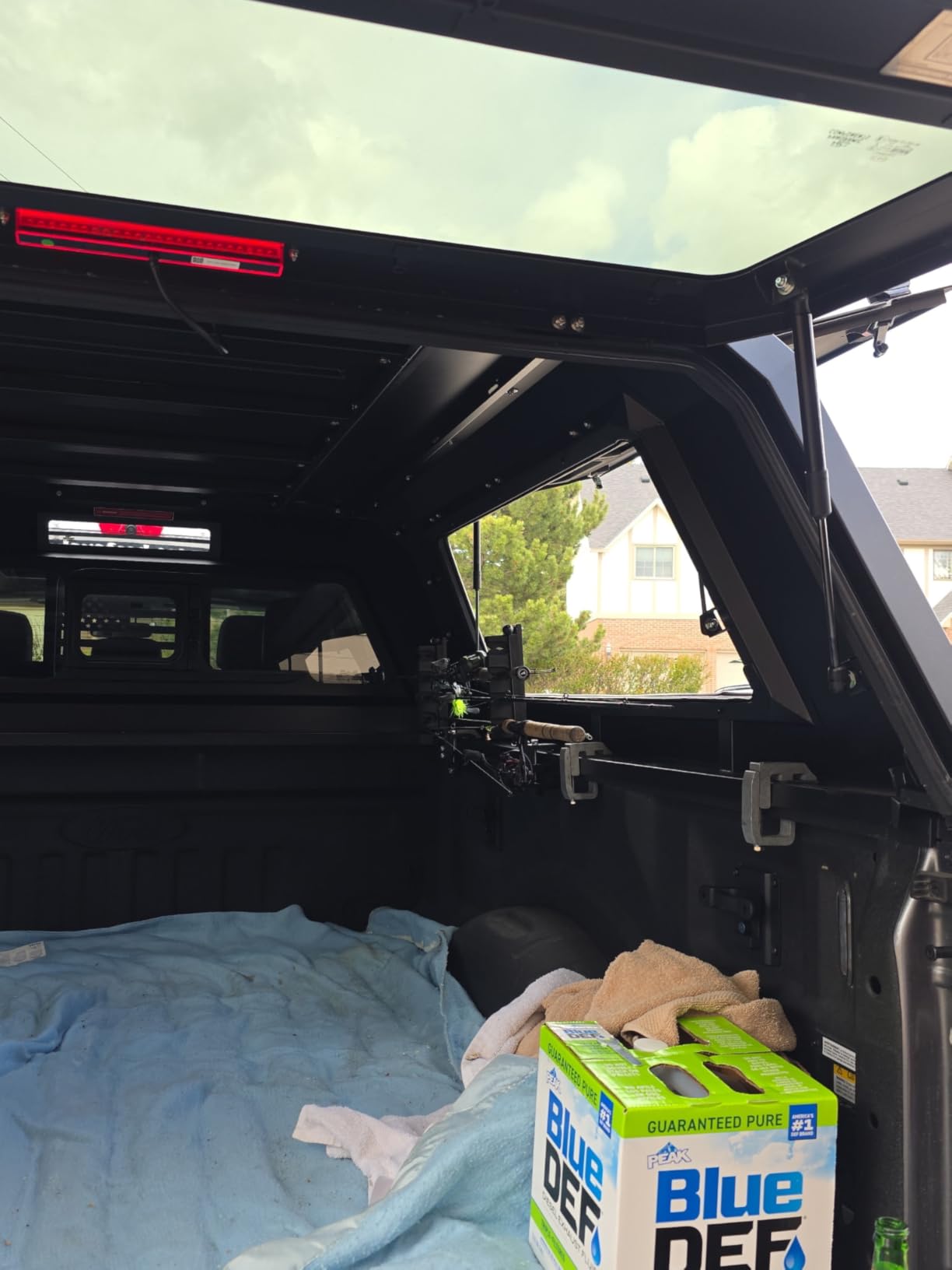
This listing carries the smallest review base in the group at 44, so treat the owner feedback as early rather than settled. What reviewers do confirm is simple no-drill installation, sturdy mixed-material construction, and stable rod retention on rough roads.
Two limits are stated plainly. It does not fit trucks with bed slides, bed covers or camper tops, and the foam-lined grooves are sized for rods up to about 1.4 inch in diameter.
What this holder decides for you
Choose it if you want eight rod positions without a single large rack across the bed, and if you value vibration damping over maximum capacity per unit. The silicone pads are a genuine advantage on washboard roads and on a truck with a firmer suspension setup.
Horizontal or vertical mounting on each rail independently also lets you mix layouts, upright on one side and low on the other, which is a genuinely useful option when the bed is half loaded with gear.
Where it falls short
Bed slides, bed covers and camper tops are all excluded, which is the same exclusion several clamp racks in this roundup carry. Check your bed before ordering.
Rods thicker than about 1.4 inch will not seat in the foam groove, and the small review base means long-term durability is less documented than it is elsewhere here.
How to Choose a Truck Fishing Rod Holder for Your Bed
Start with the mount, because every other decision follows from it. There are six common approaches and they solve genuinely different problems.
Clamp-on bed rail is the default choice. A C-clamp grips the top and underside of the rail, installs without drilling and comes off in minutes. The catch is rail thickness: capped rails, bed slides and covers defeat most clamps in this category.
In-bed ratcheting systems span the bed on an adjustable bar and let you choose rod height and position. They recover the most bed space and adapt across truck widths, at the cost of a full-width bar across the floor.
Hitch mounts hang behind the vehicle. They keep the bed completely free, take the rods out of sight at the ramp and avoid rod tip height problems, but they occupy your receiver and rattle if the fit is loose.
Tailgate straps are the least invasive option: close the tailgate, strap on, drive. Nothing touches the bed walls, and the whole carrier weighs about a third of a pound. The trade is a tailgate that stays down.
Surface mounts bolt or screw to a flat panel. They are the answer for camper shells, bulkheads and boxy beds where no clean rail exists, and the weakest option for a standard bed.
Cab and interior mounts cover the other end of the problem. Suction cup and magnetic holders keep a rod or two inside the cab for quick launches, and they matter for anyone who does not want anything visible from outside the truck.
Beyond mount type, three questions narrow the field fast. How many rods do you actually carry, not how many you could buy. Whether you need to close a tonneau cover with the rack empty. And whether rods stay in the bed unattended.
On no-drill versus drilling: buyers are reluctant to drill a truck bed, and that reluctance is well founded. Every clamp and strap option in this roundup leaves the truck exactly as it was found in minutes. If you tow often or plan to trade up, that reversibility is worth more than a rigid mount.
On materials, marine-grade stainless and anodized aluminum are the right answer for coastal and salt water use. Powder-coated steel works inland and costs less, but the coating chips and the steel underneath will not forgive you.
On lockability, be realistic. Almost none of these holders are lockable by design. What matters is whether a cable can pass through the frame, which is easiest on a hitch rack and hardest on an in-bed rack sitting flat against the bed floor.
Will Your Rods Actually Fit? Bed Length and Rod Length Math
This is the most-asked and least-answered question in the buyer threads we pulled, so here is the arithmetic. A 6.5 ft bed gives you about 78 inches of usable length between the bed wall and the tailgate when closed, and a one-piece rod listed at 7 ft is 84 inches long.
That means a 6 ft 9 in to 7 ft 2 in one-piece rod does not lie flat in a 6.5 ft bed. You have three ways out: let the rod angle up over the tailgate, use a vertical rack, or break the rod down if it is a two-piece or multi-piece model.
Match this against the mounting position rather than the bed. A horizontal rail rack lets a longer rod run fore and aft along the sidewall. A vertical rack uses bed length for nothing at all, so rod length stops mattering.
For fly rods, sections are the unit of measurement. A four-piece fly rod in a horizontal rack needs the sections spread along the track, which is why foam-lined racks with adjustable clamps fit fly anglers better than fixed tube racks.
A 5 ft 7 in bed is tighter still, and an 8 ft bed is forgiving. On the short beds, the tailgate carrier and the vertical rail rack are the two options that actually solve the problem rather than working around it.
Tonneau Cover Compatibility: What to Measure
Tonneau compatibility is not one condition, it is two. The first is whether the cover closes with the rack empty, and the second is whether it closes with rods loaded. Several racks pass the first and fail the second.
Measure with the rack installed and empty, then measure again with your longest rod in it. Roll-up and retractable covers have more give than hard slider and drawer covers, which sit flatter and need more vertical room.
Rail-mounted clamp racks are the most likely to interfere, because the clamp occupies exactly the lip the cover rail runs along. Hitch racks avoid the problem entirely since nothing in the bed changes.
Low bulk is the deciding factor when a cover is involved. The tailgate carrier and any rack that sits below the sidewall line will close under a cover; anything standing a rod handle above the sidewall in a short bed generally will not. A roll-up cover is the most forgiving if you ever want a rack higher than the rail, since it takes up far less vertical space than a rigid one, the same reason underbody fairings on heavy trucks are shaped to stay clear of the drive shafts they sit above.
Rack Them Upright or Lay Them Flat: The Vibration Reality Check
Two camps argue this in the buyer threads and neither is wrong. The lay-flat camp uses reel covers and a bed liner and reports years without damage. The racking camp reports gear-crushed blanks and says a rack is the best protection of the rods in those conditions.
The variable is not the rack, it is the bed. If your bed is shared with coolers, tackle boxes and loose gear, laying rods flat is a gamble that a single shift on a bump settles. If the bed is clean and padded, laying flat is genuinely fine.
Orientation changes protection in a specific way. Vertical holds the blank above the bed floor where nothing can hit it, but it exposes the guides to wind and road grit. Horizontal keeps the rod low and protected but occupies bed space.
Material matters more than orientation. Foam, EVA and silicone absorb what a rigid aluminum tube transmits, so a foam-lined horizontal rack can protect a blank as well as a vertical one. That is the part of this debate the product data actually settles.
One more real-world constraint nobody should ignore: on a lifted truck, a rack that raises a 7 ft rod above a tall bed rail puts a lot of height above the road, and wind load on long rods is what people argue about on owner forums. If that is your truck, a hitch rack removes the issue instead of solving it.
Keeping Rods Secure at the Boat Ramp
Rods in an open bed at a busy ramp are a visible target, and no holder in this roundup is lockable on its own. What you can do is change how visible and how reachable the rods are.
First, move them out of sight. A hitch rack puts the rods behind the vehicle and under a closed tailgate, which is the single most effective change you can make without buying anything.
Second, choose a rack that can be run through with a cable lock. A hitch rack with open tubing is easiest, a tailgate carrier can be strapped and locked, and a bed rack with an open frame is workable. A rack bolted flat to the bed floor is the hardest.
Third, take the rods with you. The two-rod cab and interior option exists for exactly this: a suction cup or magnetic mount inside the cab keeps valuable rods with you while the expensive spread stays under a lock in the bed.
Fourth, do not leave a multi-piece fly rod kit strapped across the bed in view while you fish. Moving the most valuable pieces to the cab solves more theft exposure than any lock does.
Frequently Asked Questions
What is the best fishing rod holder for a truck bed?
The best fishing rod holder for a truck bed is usually a clamp-on bed rail rack that installs without drilling and carries your actual rod count. For the widest fit across bed widths, a ratcheting in-bed system adjusts from 53 to 84 inches. If the bed must stay clear for coolers and gear, a hitch mount is the better answer.
How to carry fishing rods in a truck bed?
Carry fishing rods in a truck bed in one of four ways: clamp a rail rack to the bed rail for a low profile, span the bed with a ratcheting in-bed system for adjustable rod height, strap a carrier to the tailgate for a no-drill option, or hang a rack off the hitch to keep the bed entirely free. Each trades bed space, tailgate access or receiver access for the others.
Is it better to store fishing rods vertically or horizontally?
Vertical storage keeps blanks above the bed floor where shifting gear cannot hit them, but exposes guides to wind and road grit. Horizontal storage is lower and more protected from weather but takes bed space and can be crushed. The deciding factor is cushioning: a foam, EVA or silicone lined horizontal rack protects rods as well as a vertical one.
Do rod holders protect rods from highway vibration?
They help, but the material matters more than the mount. Foam, EVA and silicone inserts absorb bumps and vibration that a rigid aluminum or stainless tube transmits straight into the blank. Two details also matter in practice: bungee or strap retention stops rods walking along a tube, and clamp screws on rail racks need periodic tightening because they work loose with mileage.
Will a rod holder fit under a tonneau cover?
Test it empty first, then test it loaded with your longest rod installed. Rail clamp racks are the most likely to interfere because the clamp occupies the lip the cover rail runs along. Hitch racks and low-profile tailgate carriers clear almost any cover. Measure vertical clearance in two states, since a cover that closes over an empty rack may not close over a loaded one.
What is the best fishing rod holder for transport?
For transport specifically, prioritise retention and cushioning over capacity. A rack with bungee or strap retention plus foam or silicone liners keeps rods seated through expansion joints and washboard road. Owners running four to six rods across highway speeds most often choose a clamp-on rail rack or a hitch rack with soft tube caps.
How many rods can a truck bed rod holder hold?
Capacity in this category ranges from 3 rods on a small surface-mount bracket to 6 on a clamp-on rail rack or pivoting hitch holder. Most rail racks carry 4 rods, hitch racks carry 4 to 6, and two-rod tailgate and interior mounts cover quick-launch needs. Plan on real capacity rather than listing capacity, since some owners report fewer usable tubes than advertised.
Final Verdict: Which Truck Rod Holder Should You Buy?
For most pickup owners, the best fishing rod holders for trucks come down to one honest question: is your bed storage or is it working space. If it is storage, the BigTron 3-tube bracket is the buy, with a 4.7 rating across 1394 reviews, countersunk hardware that will not scratch a blank, and a mounting footprint that works on a truck, a boat or a garage wall.
If the bed has to hold coolers and tackle boxes at the same time, the Portarod in-bed system is the answer, because a ratcheting bar spanning 53 to 84 inches is the only design here that adapts to almost any truck and returns the space under the rods.
If the bed is working space, stop putting rods in it. The Extreme Max six-rod pivoting hitch holder carries the whole spread behind the truck, clears an opening tailgate and keeps everything out of sight at the ramp.
Whatever you pick, check the exclusions before you order. Bed slides, bed covers, camper tops and rail caps rule out several of the racks here, and measuring first is faster than returning one.