
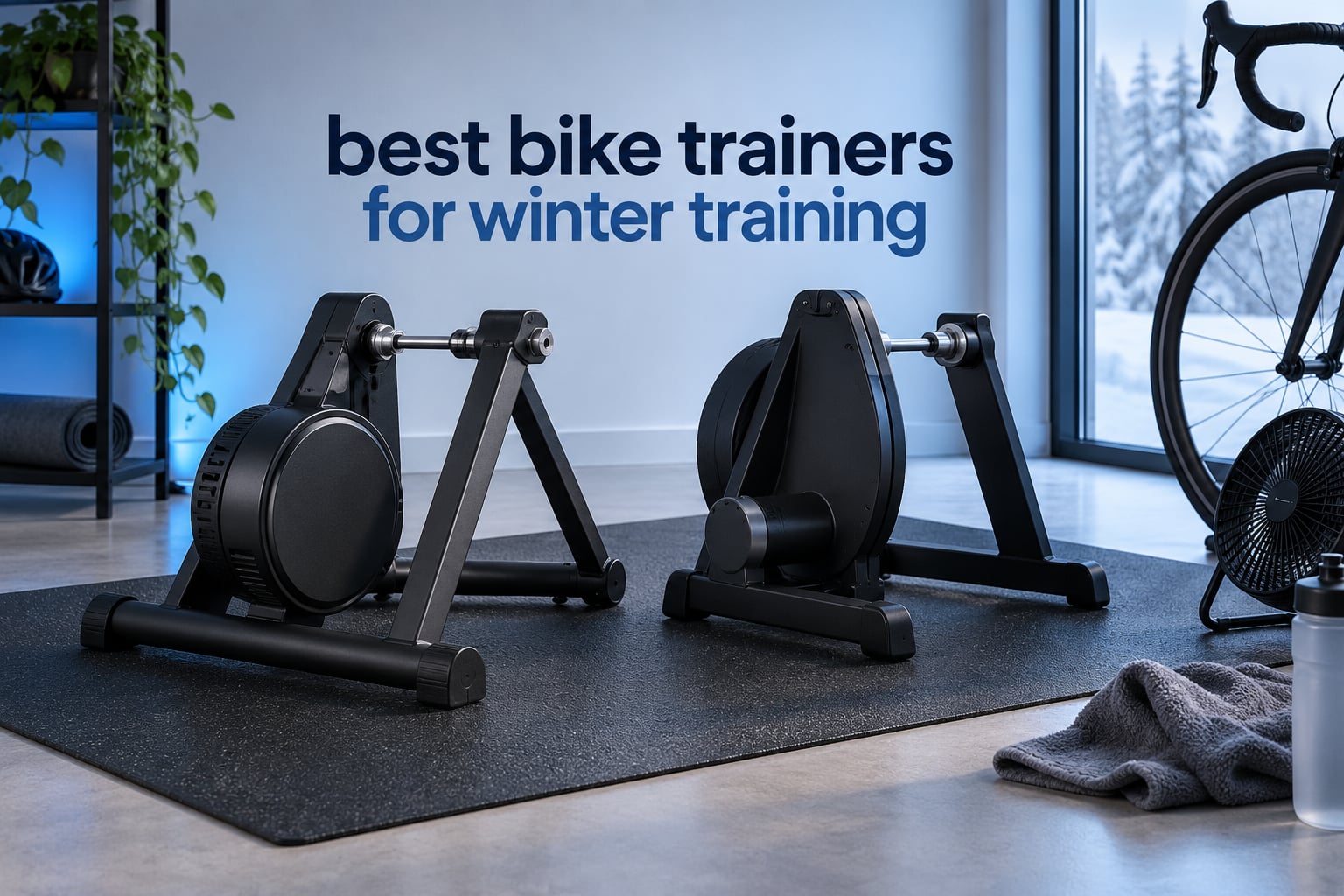
A winter bike trainer holds your bike off the ground and turns the rear wheel, or a cassette-mounted axle, into a variable resistance unit. That lets you ride structured workouts indoors through the cold months. Everything in this roundup is entry-level hardware: magnetic and fluid wheel-on stands, plus one connected electromagnetic unit.
That matters for expectations. The best bike trainers for winter training at the premium end control your exact wattage, simulate hills and link to Zwift. None of the ten trainers below do that on their own. What they do is give you a stable, repeatable, quiet-enough platform to keep your legs turning for a season, and several accept an external sensor if you later want app data.
Here is the short version before we get into detail:
Best overall: Elite Novo Force – the smoothest magnetic progression here and the highest satisfaction score of the group.
Best value: Sportneer Magnetic – a weighted steel build with genuinely quiet operation on road tires.
Quietest apartment pick: Yaheetech – shock-absorbing mounting fittings and leveling feet damp the resonance that reaches your downstairs neighbour.
Best smart option under a modest budget: Saris M2 – electromagnetic resistance, dual ANT+ FE-C and Bluetooth, Zwift certified.
Best ride feel: Tacx Boost – a real 1.65 kg flywheel that behaves far more like a wheel than a roller.
We compared ten trainers on build material, resistance mechanism, weight, load rating, axle compatibility, noise claims and the complaints owners actually report. Noise and accuracy figures come from manufacturer or owner measurements, and we label which is which rather than blending them into a single score.
One honest note before we start. If you want your trainer to hold 250 watts exactly, none of these will do that on its own. Our guide to smart bike trainers for indoor riding covers the direct-drive models that do, and it is worth reading before you spend if structured intervals are your goal. If you are simply trying to stay fit through February, keep reading.
Table of Contents
Top 3 Picks for Winter Training in 2026

Elite Novo Force Trainer
- Progressive magnetic resistance
- Up to 690W at 40 km/h
- Folds flat for storage

Sportneer Magnetic Trainer
- 6 magnetic resistance levels
- Quiet on slick road tires
- 300 lb load capacity
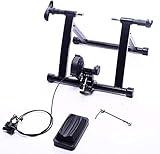
BalanceFrom Bike Trainer Stand
- 8 magnetic resistance levels
- Quick release clamp
- Fits 26-28 inch and 700C
Best Bike Trainers for Winter Training (October 2026)
Noise below means what the manufacturer states, unless we say an owner measured it. None of these units hold a set wattage except the Saris M2, which reports its own readings within a stated tolerance.
| Product | Specifications | Action |
|---|---|---|
| Elite Novo Force Trainer |
|
Check Latest Price |
| Sportneer Magnetic Trainer |
|
Check Latest Price |
| BalanceFrom Bike Trainer Stand |
|
Check Latest Price |
 Yaheetech Magnetic Trainer Yaheetech Magnetic Trainer |
|
Check Latest Price |
 Alpcour Foldable Magnetic Stand Alpcour Foldable Magnetic Stand |
|
Check Latest Price |
 Sportneer Fluid Resistance Trainer Sportneer Fluid Resistance Trainer |
|
Check Latest Price |
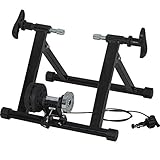 FDW Magnetic Trainer M8 FDW Magnetic Trainer M8 |
|
Check Latest Price |
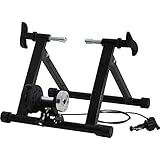 FDW Magnetic Stand M8 FDW Magnetic Stand M8 |
|
Check Latest Price |
 Saris M2 Smart Trainer Saris M2 Smart Trainer |
|
Check Latest Price |
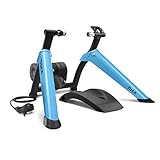 Garmin Tacx Boost Trainer Garmin Tacx Boost Trainer |
|
Check Latest Price |
1. Elite Novo Force Trainer – The Best Overall Pick for Winter Training
Elite Novo Force Trainer, Magnetic Resistance Bike Trainer, 8 Levels, Novo Force, for Wheel Sizes 24-29 inches, White
Magnetic
8 levels
Up to 690W at 40 km/h
Folds flat
Pros
- Progressive magnetic feel with realistic road resistance
- Generates up to 690 watts at 40 km/h
- Compact frame that folds flat for storage
- Handles road gravel MTB and city bikes
- Highest average rating of the ten at 4.5 stars
Cons
- No app connectivity without buying a Misuro B+ sensor
- Thru-axle bikes need an optional extra kit
- Fixed magnetic steps are less smooth than fluid or electronic trainers
The Novo Force is the one I would put in a flat with thin walls. Its magnetic unit ramps in a genuinely progressive way rather than jumping between eight hard steps, which is what makes a two-hour base session bearable rather than tedious.
The resistance ceiling is the underrated part. Owners regularly push it to 690 watts at 40 km/h, which is far more than most magnetic stands of this size manage. That means genuine threshold and VO2max work is possible without a direct-drive unit.
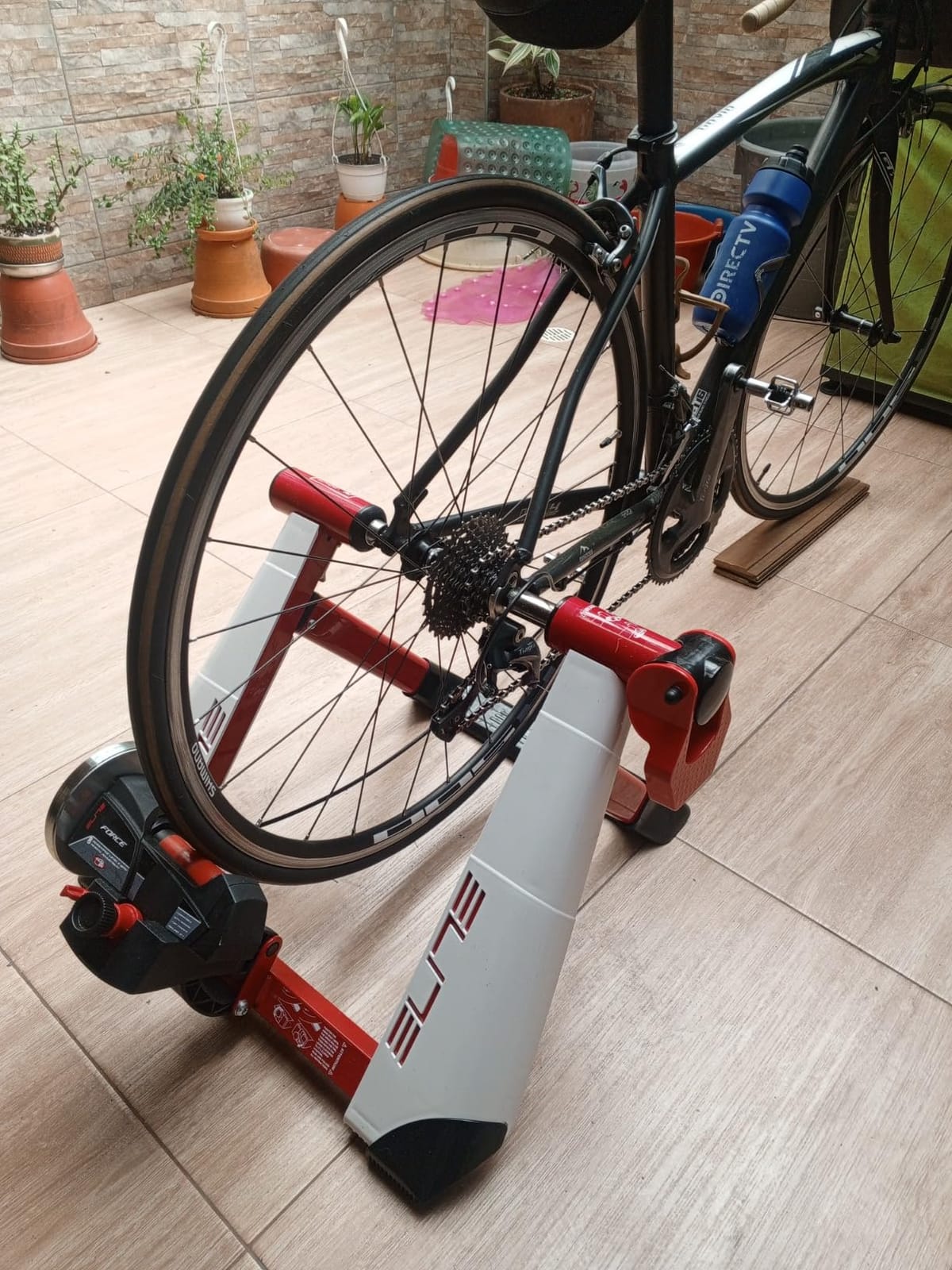
What it cannot do is tell you what power you are producing. There is no telemetry, no calibration routine and no app link. If you want data, the Misuro B+ sensor is the official bridge to Rouvy, Kinomap and My E-Training, and it costs extra.
The frame is the part that keeps winning over reviewers. It folds flat, carries easily and has a wide footprint, so a hard sprint does not tip the bike out of the wind.
Who the Novo Force suits
It suits anyone doing steady winter volume on road, gravel or a city bike and who wants the quietest mechanical operation per pound spent. Riders who already own a power meter or a head unit gain accuracy data instantly.
Where it falls short
It falls short for anyone chasing the feel of a real wheel, because a magnet against a tyre is not a flywheel. Modern thru-axle frames need the optional adapter kit, so check your axle before ordering.
2. Sportneer Magnetic Trainer – The Best Value Pick
Sportneer Bike Trainer – Magnetic Indoor Cycling Trainer Stand for 26-28″ & 700C Wheels, 6 Resistance Levels Stationary Bike Stand with Quick Release Lever & Front Wheel Riser Block Black
Magnetic
6 levels
19.3 lb
300 lb capacity
Pros
- Weighted steel build feels planted under hard efforts
- Very quiet with slick road tires
- Works with quick releases and nutted axles
- Quick-release skewer included
- One year warranty
Cons
- Rear clamp is fiddly to align when mounting repeatedly
- Careless clamping can bend a derailleur arm
- Roller needs careful initial tightening to avoid tyre wear
- Assembly visuals could be clearer
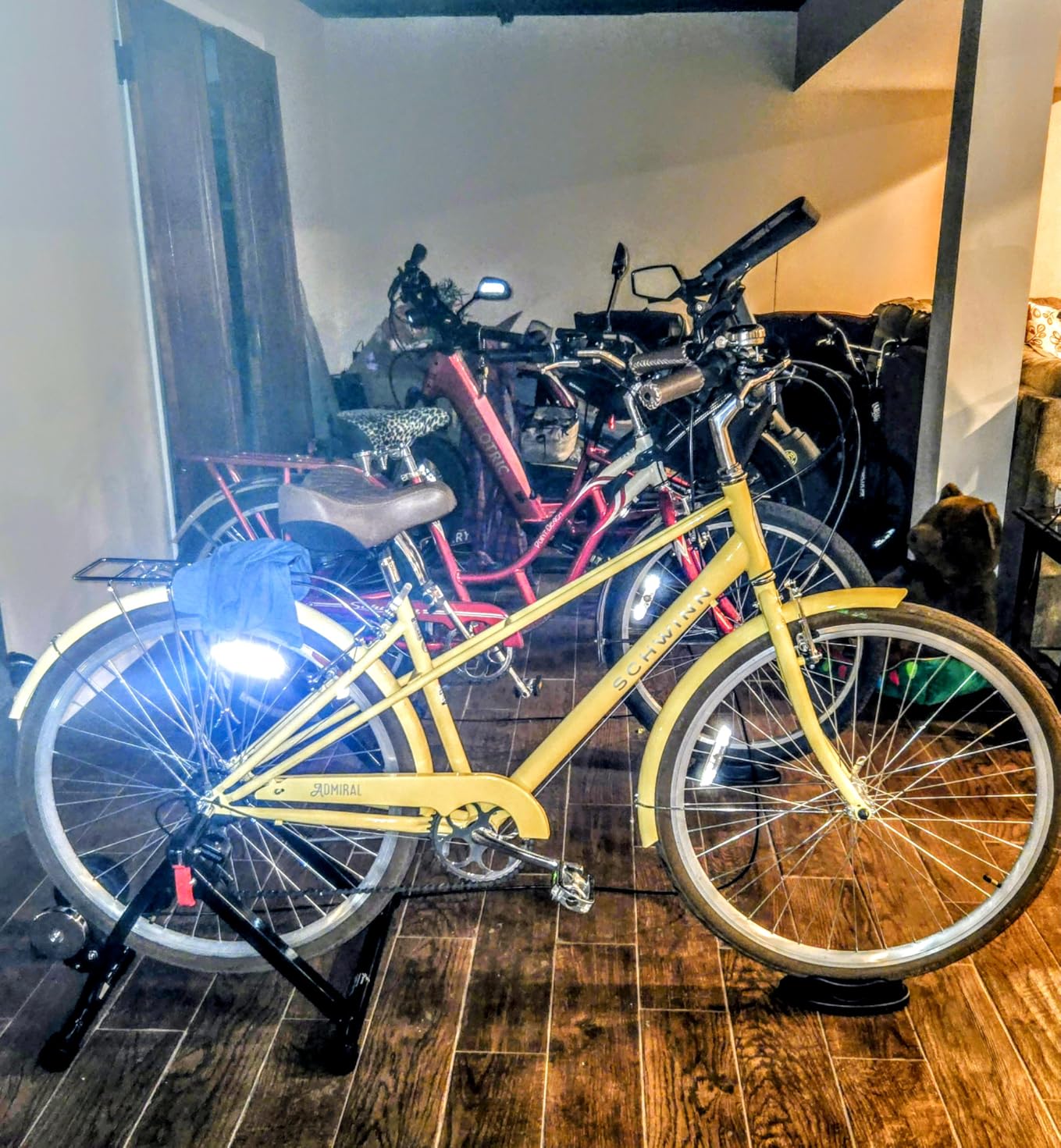
This is the trainer most riders on forums describe when they say the sensible buy. It is heavy at 19.3 pounds, and that mass is the feature: when you stand to sprint, the whole rig stays where it is.
Owners with slick road tires describe a machine that is nearly silent, generating only a light vibration at the tyre contact point. Swap to a knobby mountain bike tyre and the character changes completely, so match the trainer to the bike you actually ride indoors.
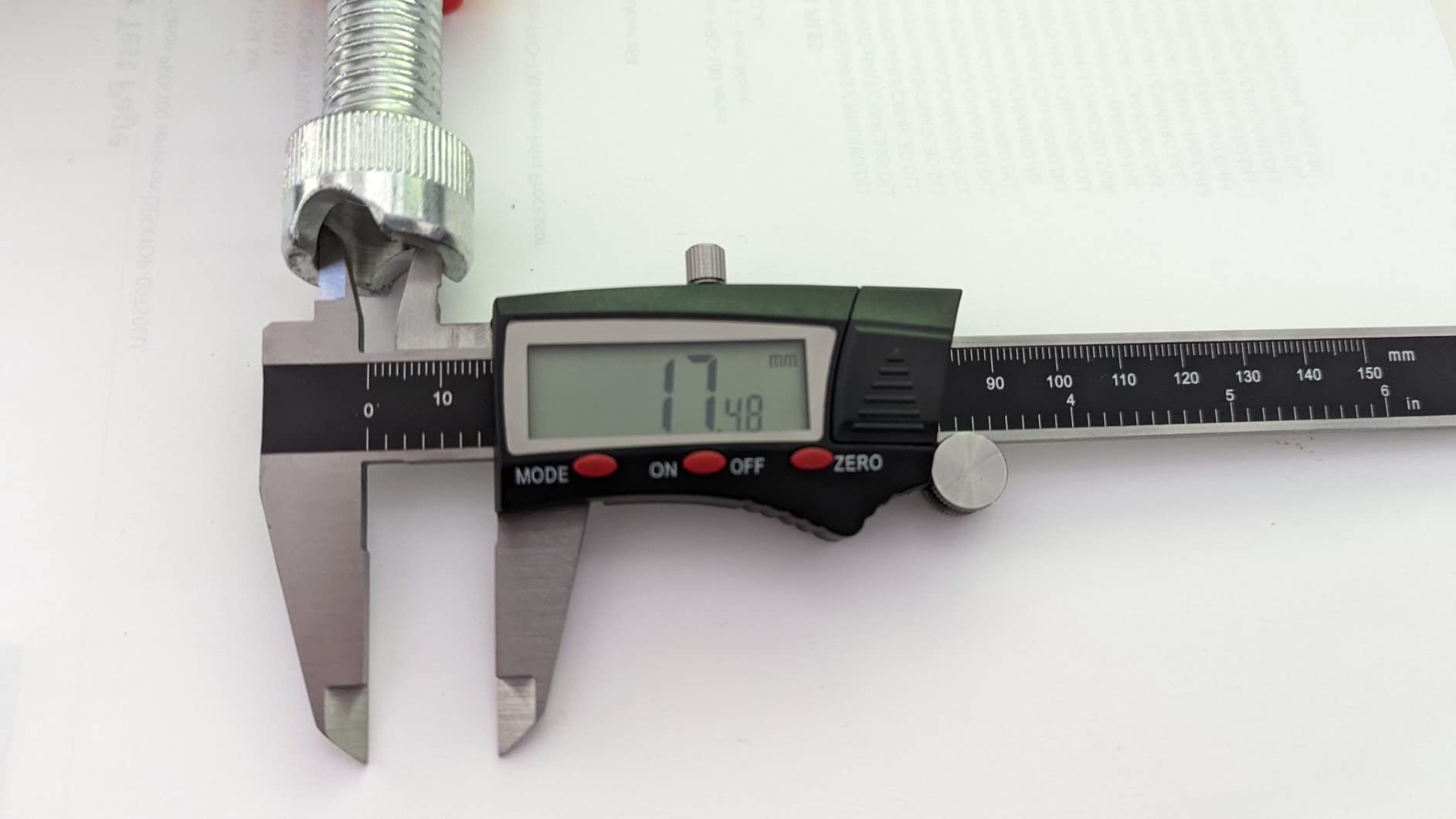
The axle range is unusually wide at 4.92 to 6.57 inches, which covers quick releases and nutted axles alike. A skewer comes in the box, and five adjustable anti-slip feet handle uneven flooring.
One recurring complaint deserves flagging. Owners who mount and dismount the bike many times a day report that the rear clamp is awkward to line up, and that rushing it can bend a derailleur arm on an indexed bike. Take your time the first few times.
What works well here
This trainer handles long, moderately hard sessions in a small room without complaint. The six resistance levels change enough in practice to shape intervals when you combine them with your own gearing.
What to watch out for
Watch the roller itself. Owners report a high-pitched whine if the resistance roller is not tightened correctly at first assembly, and tyre wear follows from the same problem. Also note that thru-axle bikes need a separately sold adapter.
3. BalanceFrom Bike Trainer Stand – Most Versatile With the Most Owners
BalanceFrom Bike Trainer Stand Steel Bicycle Exercise Magnetic Stand with Front Wheel Riser Block
Magnetic
8 levels
330 lb capacity
Alloy steel
Pros
- Quick to assemble with essentially one bolt to mount
- Most reviewed trainer in this roundup
- Folds up and moves between rooms
- Rubber feet protect wooden floors
- Works with road or mountain bikes
Cons
- Drone and whir rise with aggressive tyre tread
- Bar mounted dial only fine adjusts within a gear
- Instructions are pictorial rather than clear
- Two inch front lift is awkward for less agile riders
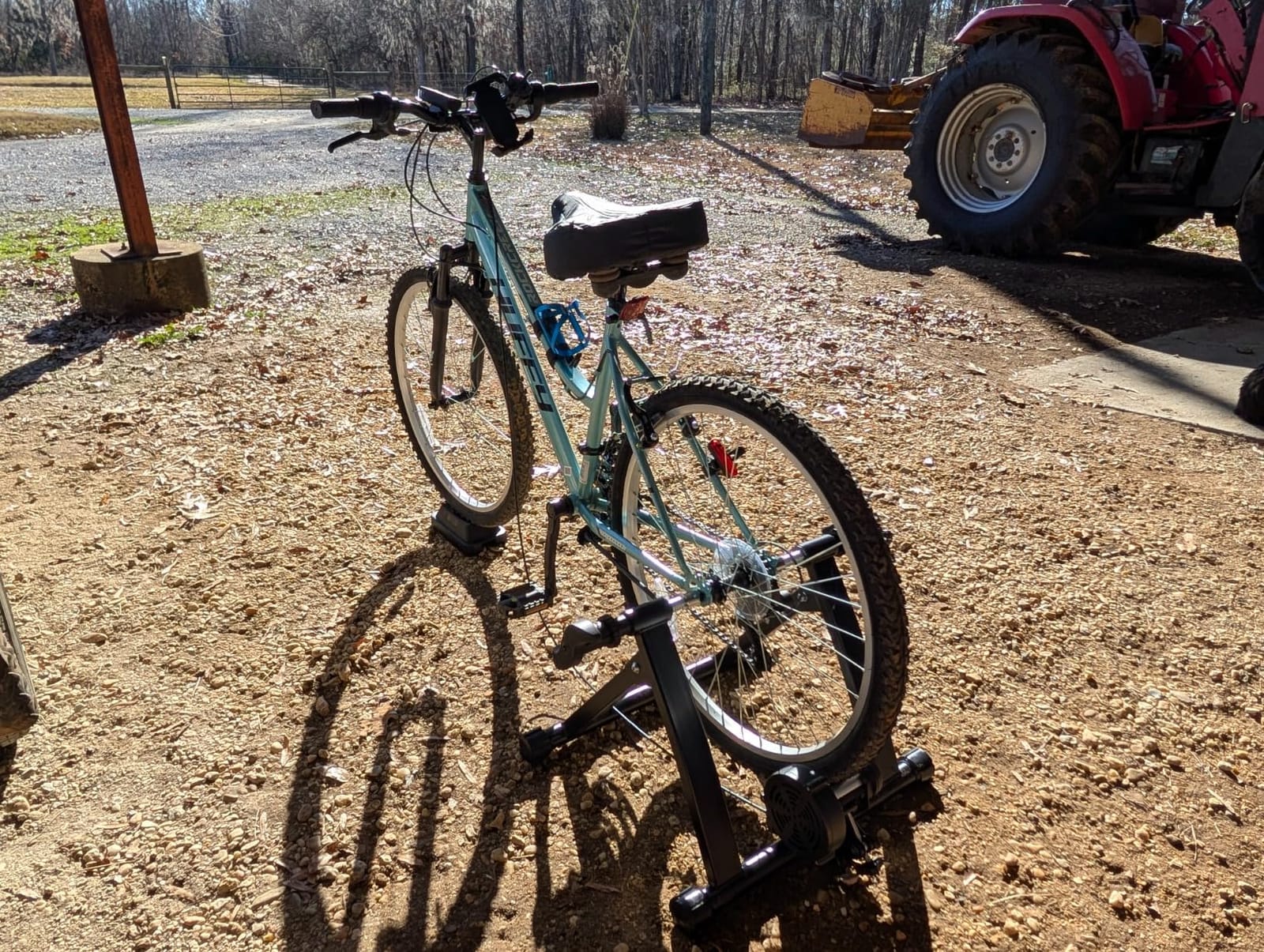
With more than fourteen thousand ratings, this is the trainer the most people in the world have actually lived with, and the feedback pattern is remarkably consistent. It works, it folds, it is quiet on road tires, and it is loud on knobbies.
Assembly is the easiest in the group. Owners describe mounting the resistance unit with a single bolt and being pedalling within minutes of opening the box. That matters in winter, when the difference between training and not training is often how quickly you can set the thing up after a long day.
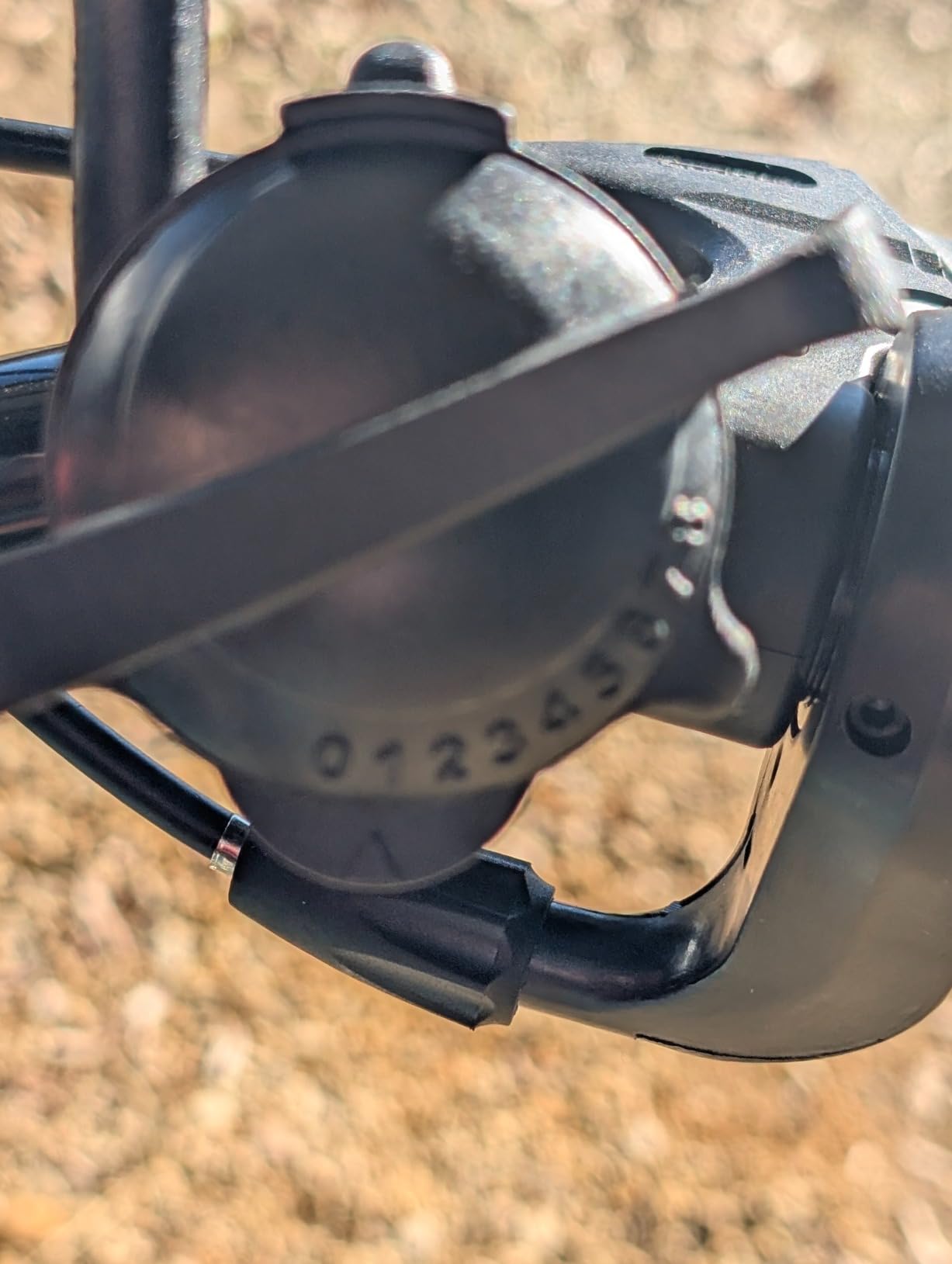
The eight magnetic levels give you more adjustment granularity than most rivals here, though the handlebar controller only makes small changes inside a single gear. Your bike’s own gearing does the fine work.
Two practical notes. Several buyers report the front riser block arriving separately from the unit, so check the box before you start. The 330 pound load rating is the highest of the magnetic stands we looked at.
Where it earns its place
It earns its place as a first winter setup: inexpensive, quick to assemble, easy to stow against a wall when the season ends. For riders who just want to hold their fitness through a dark winter, it does the job without ceremony.
Where it will frustrate you
It will frustrate anyone riding a mountain bike indoors, because knobby tread on a magnetic roller produces a sustained whir. Riders with limited agility can also find the two-inch front lift awkward when getting on and off.
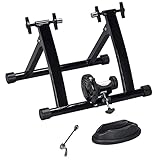
4. Yaheetech Magnetic Trainer – The Quietest Pick for an Apartment
Yaheetech Magnetic Steel Bike Trainer Stand for Indoor Riding, 26-28in/700C
Magnetic
13.8 lb
Leveling feet
Shock fittings
Pros
- Noise comes from tyre friction rather than the trainer
- Slowly rotating leveling feet damp floor transfer
- Shock absorbing mounting fittings buffer resonance
- Light enough to carry between rooms at 13.8 lb
Cons
- Quick release axles only with thru-axle adapter sold separately
- Resistance adjusted by hand rather than from the bar
- Load rating of 265 lb is below several rivals
- Slick tyres and carpet recommended to reduce humming
Here is the detail that matters more than any published decibel figure: this trainer does not hum because there is no motor and no spinning resistor to rattle. The only sound is your tyre rolling against the roller.
The mounting fittings use shock-absorbing plastic to buffer resonance, and the four foot caps are variable-tooth and levelness-adjustable. Both of those features attack floor vibration rather than airborne sound, which is the problem that actually wakes people up downstairs.
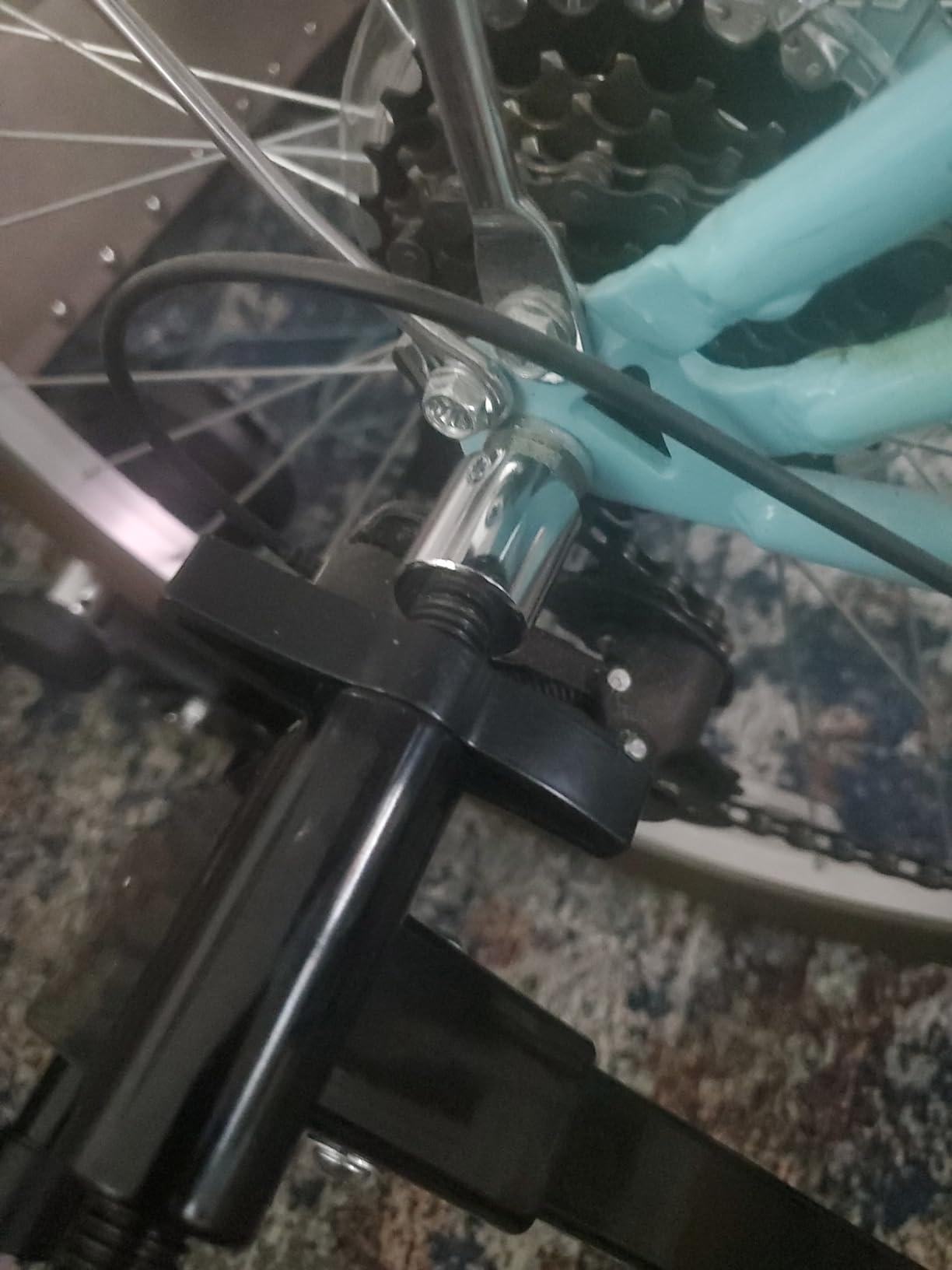
At 13.8 pounds it is the lightest trainer here, which matters in a flat where the difference between a corner and a blocked hallway decides whether you keep the thing or give up on it.
The limitation is compatibility. It is built around quick-release skewers, so a thru-axle bike requires a separate adapter that is not supplied. If your frame is modern and carbon, this is the first thing to check.
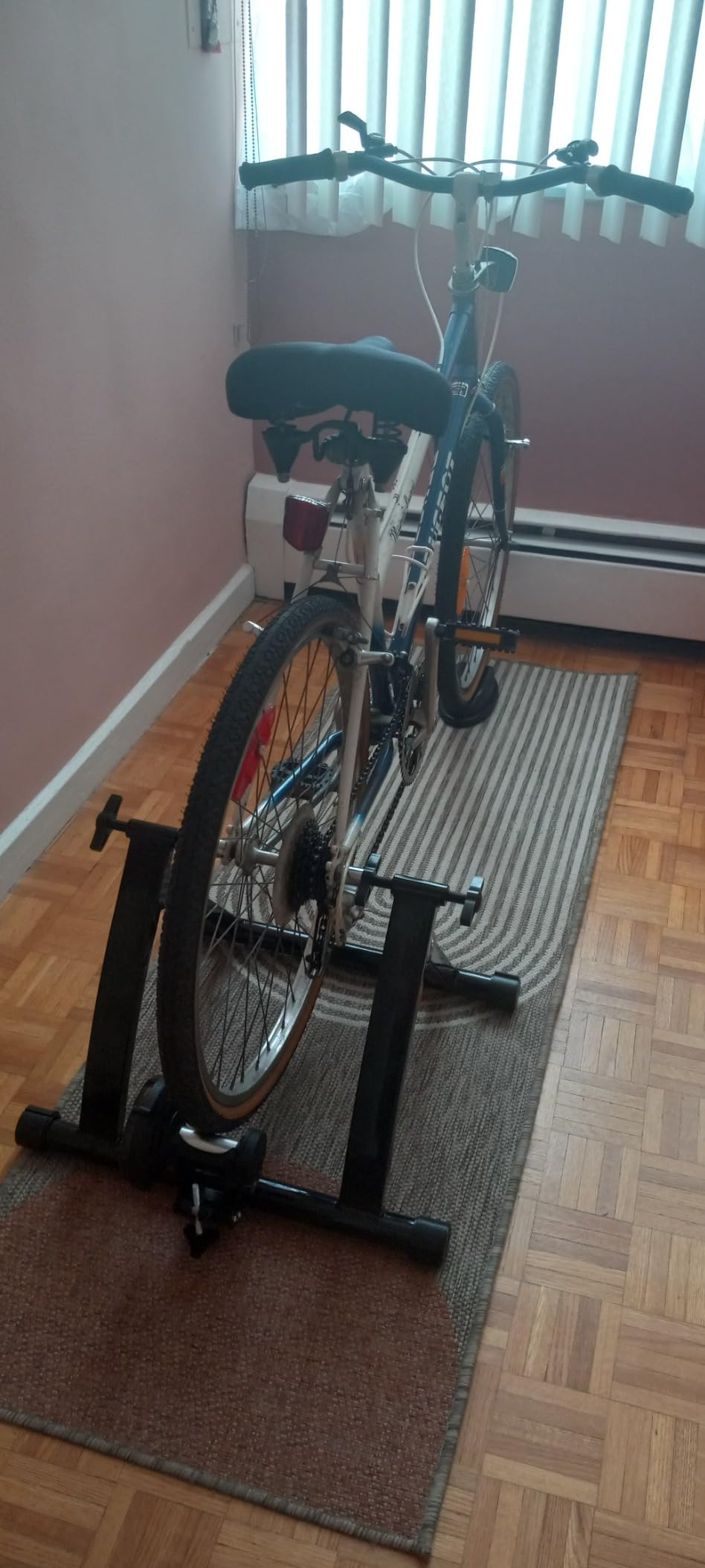
Who this trainer is for
It is for upstairs riders, flat sharers and anyone who lives above someone else. The light weight and the vibration-damping fittings make it the least neighbourly of the magnetic stands here.
Who should skip it
Skip it if your bike has a 12 mm thru-axle and you do not want to buy an extra adapter, or if you ride out of the saddle often. A 265 pound load rating also puts a ceiling on rider plus bike weight.
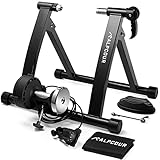
5. Alpcour Foldable Magnetic Stand – The Sturdiest Build at This Level
Alpcour Bike Trainer Stand for Indoor Riding – Portable Foldable Magnetic Stainless Steel Indoor Trainer, Noise Reduction, 6 Resistance Settings & Bag – Stationary Exercise for Road & Mountain Bikes
Stainless steel
6 levels
250 lb capacity
Folds flat
Pros
- Stainless steel frame is noticeably more rigid than cheaper stands
- Assembly is one bolt plus the resistance cable
- Carry bag included for moving between rooms
- Stable enough for riders recovering from injury
- Front riser block and anti slip pads supplied
Cons
- Louder than expected with knobby tyres at higher levels
- Wide stance rocks when standing out of the saddle
- Handlebar controller clamp is small and hard to attach
- Rear clamp can seize against the skewer nut
Alpcour builds this one in stainless steel rather than painted carbon steel, and riders notice the difference immediately. Where cheaper stands flex when you apply torque at the crank, this one stays put.
That rigidity has a practical payoff for a specific group. Owners returning from injury or older riders who are cautious about balance repeatedly describe it as stable and confidence-inspiring, which matters more than raw wattage for a lot of winter sessions.
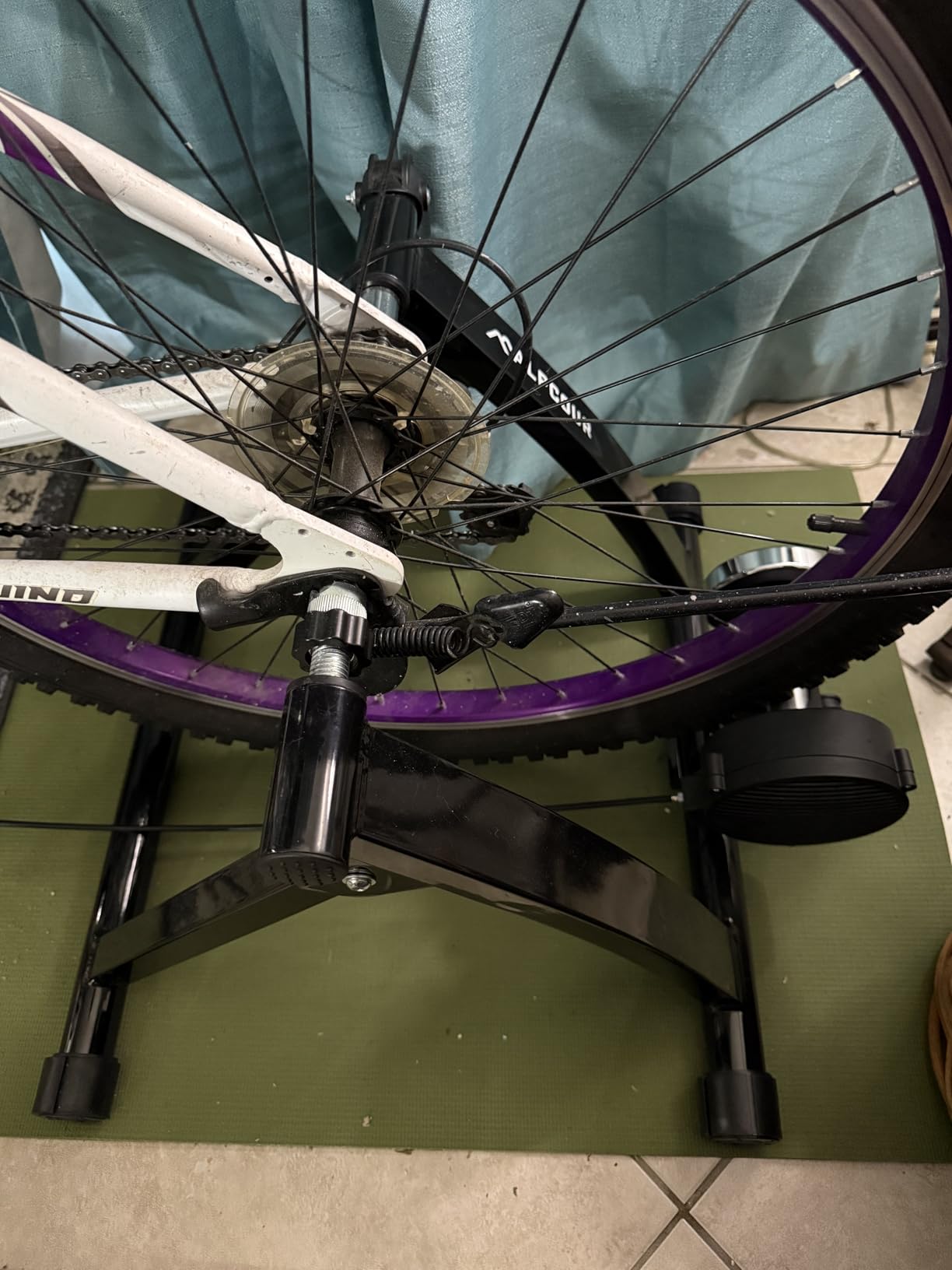
The folding frame plus the supplied carry bag is genuinely useful in a small space. Six resistance levels come from a handlebar-mounted cable controller, and the front wheel riser block is included.
The noise story is mixed. Owners call it quiet with road tires and complain loudly about knobbies, with some noting a high-pitched whoosh at the upper settings that competes with a television in the next room.
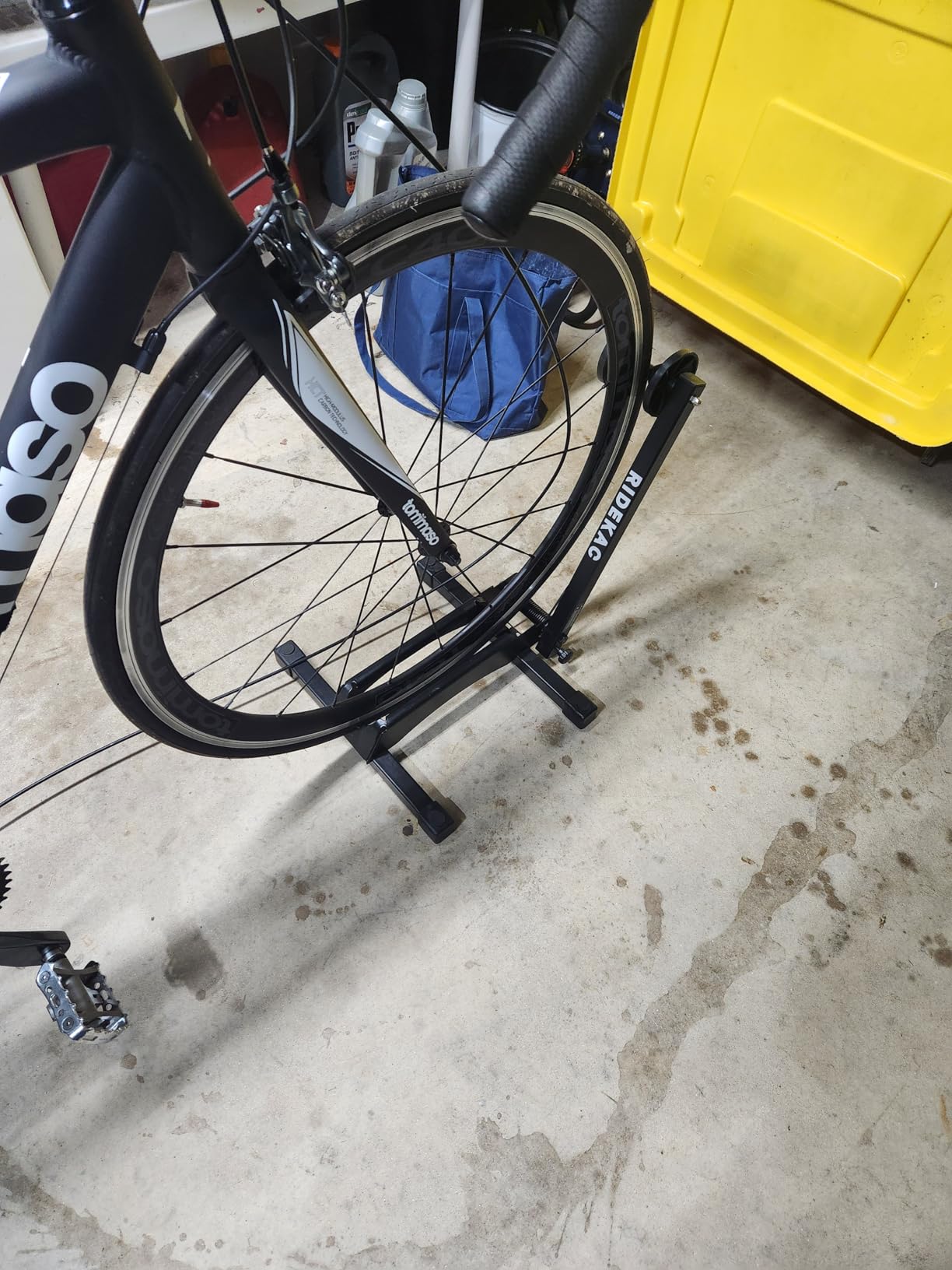
The case for buying it
Buy it if stiffness and stability outrank silence in your ranking. The stainless frame holds position during standing efforts that would rock lighter stands, and the fold-flat design keeps it out of the way when the season ends.
The case against
Pass if your household includes someone sensitive to sound, or if you plan to ride a mountain bike on it. The small handlebar clamp and the rear clamp tendency to seize against the skewer nut are both recurring complaints.
6. Sportneer Fluid Resistance Trainer – The Quietest Mechanism in the Roundup
Sportneer Fluid Indoor Bike Trainer Stand – Indoor Riding Cycling Exercise Stationary Bicycle Stands Trainers with Noise Reduction Wheel for Road Bike Black 21.3 x 7.9 x 25.2″
Fluid resistance
8 settings
24.3 lb
Folds to 24 inch
Pros
- Fluid resistor is the quietest mechanism tested here
- Weight gives a planted feel for climbing work
- Resistance grows progressively with wheel speed
- Folds to 24 by 7.9 by 25.2 inches
- Customer service resolved damage quickly
Cons
- Front legs cannot fully lock out on 29 inch wheels
- Arrives with minimal instructions and thin packaging
- Rough hole in the resistance wheel can cut large tyres
- Through axle bikes need a separately sold trainer axle
A fluid trainer works differently from every magnetic stand in this list. There is no magnet gap to adjust. Instead a sealed wheel of fluid spins under your tyre, and resistance rises naturally as speed climbs, which is why riders describe the feel as the most road-like of the affordable options.
At 24.3 pounds it is the second-heaviest trainer here, and riders use that word as a compliment. Climbing repetitions feel controlled rather than nervous, because the mass resists tipping.
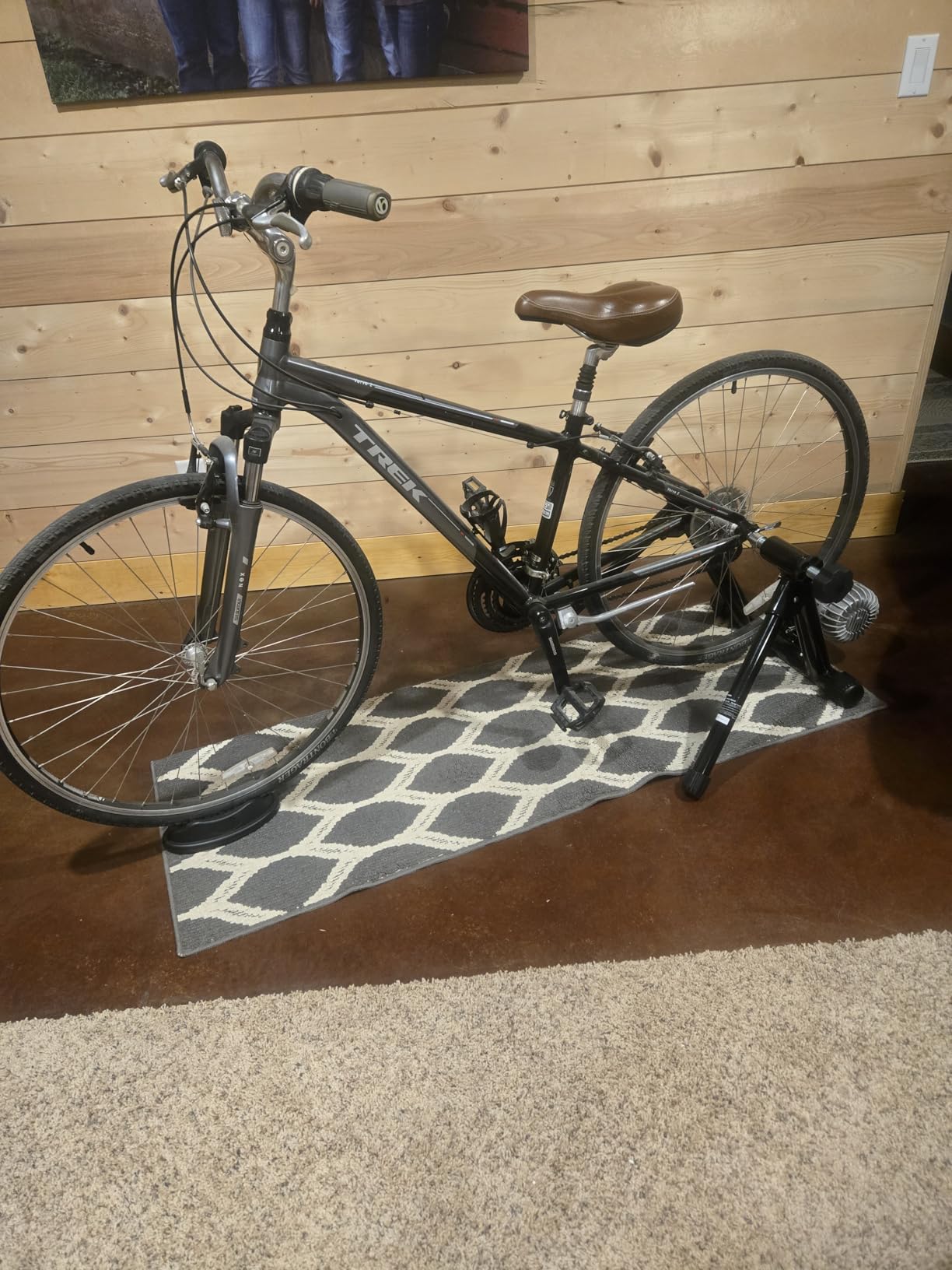
One owner measured roughly 73 decibels with knobby all-terrain tyres at 70 rpm, which is a reminder that no mechanical trainer is silent once the tyre is the problem. With road tires, owners describe only a faint hum at the contact point.
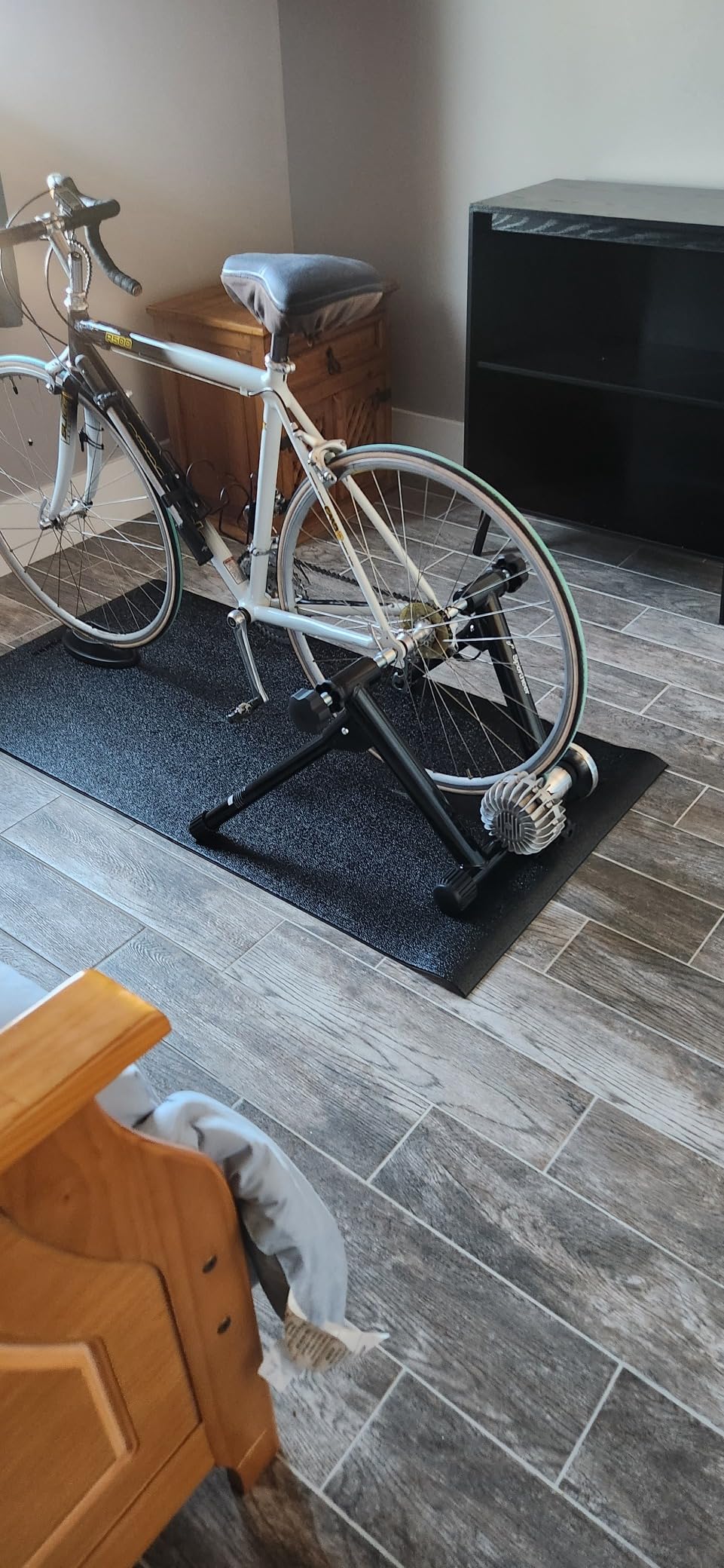
There are two hardware caveats worth planning around. The front legs cannot fully lock out on 29 inch wheels, particularly on soft mats, and thru-axle bikes need an adapter you buy separately.
Where fluid resistance wins
It wins on feel and on noise. If your winter training is long steady rides rather than short sharp intervals, the progressive curve does more for you than extra resistance steps would.
Where it frustrates
Frustrates anyone who wants hard repeatable interval work, since a fluid resistor cannot change quickly or measure output. Owners also report minimal documentation and packaging that arrived damaged on at least one unit.
7. FDW Magnetic Trainer M8 – Best for First-Time Indoor Riders
FDW Magnetic Bike Trainer Stand for Indoor Riding, Steel Bicycle Exercise Training Stand with Noise Reduction Wheel,Stationary Bike Resistance Trainer for Road & Mountain Bikes
Magnetic
5 levels
300 lb capacity
Under 60 dB claimed
Pros
- Five resistance levels from flat road to hill climb feel
- Assembles in roughly 15 minutes
- Folds flat for a car trunk or room corner
- Rated to support riders up to 300 pounds
Cons
- Instruction manual is minimal and assembly takes some working out
- Lock levers can feel loose during hard pedalling
- Plastic roller housing and cable feel cheap on some units
- Vibration and rattling reported on lower quality units
The FDW is the simplest answer to the question I get asked most often in winter: what do I buy if I just want to ride indoors for an hour without thinking about it. Five stepped levels cover a flat-road feel through to a hill-climb effort, and that is genuinely enough for keeping fit.
The manufacturer states that the noise reduction wheel keeps output under 60 decibels at the lowest setting. Treat that as a best case with smooth road tires rather than a promise across the range.
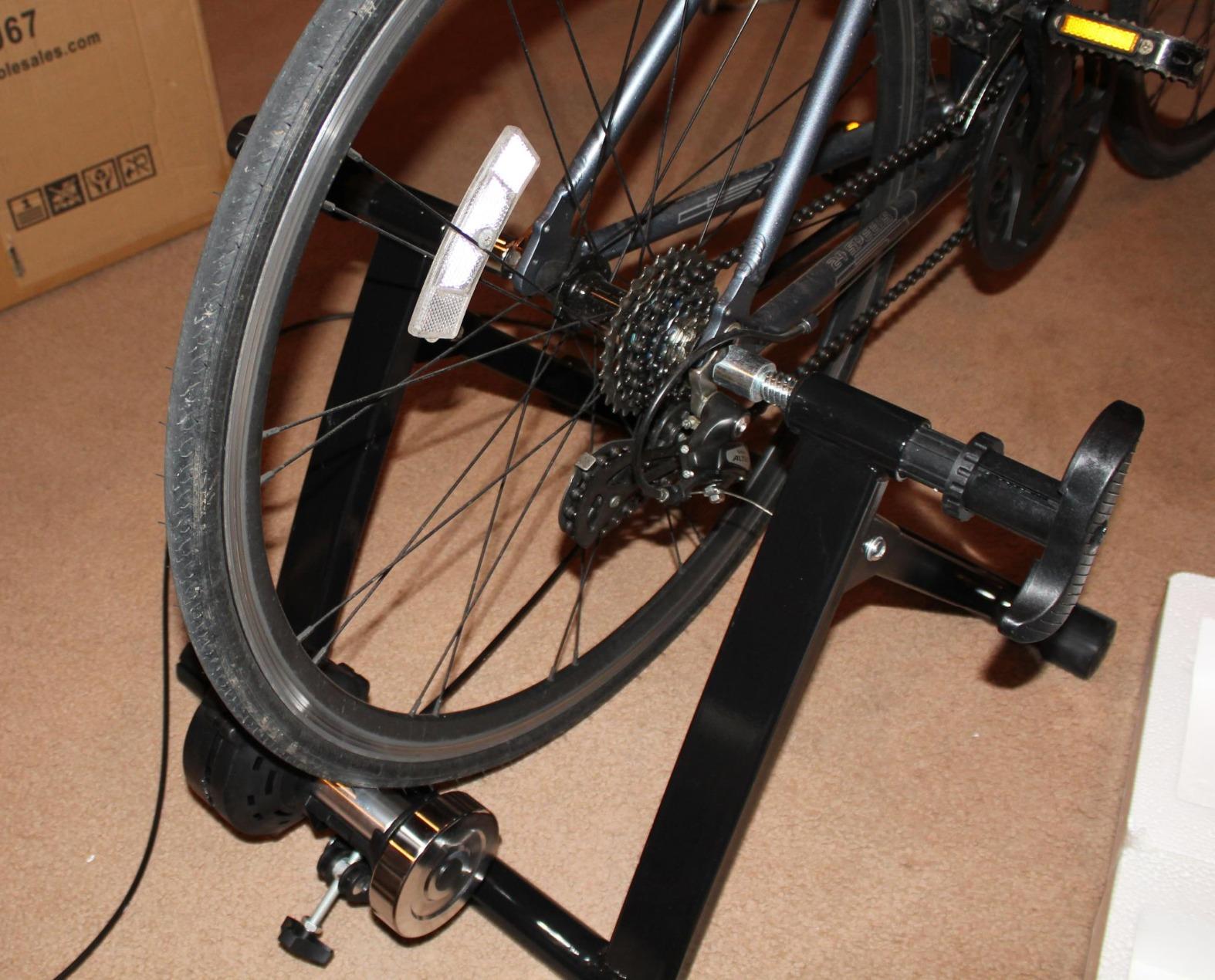
Carbon steel construction is rated for riders up to 300 pounds, and the frame folds flat for storage between sessions. Assembly takes about 15 minutes with minimal hardware.
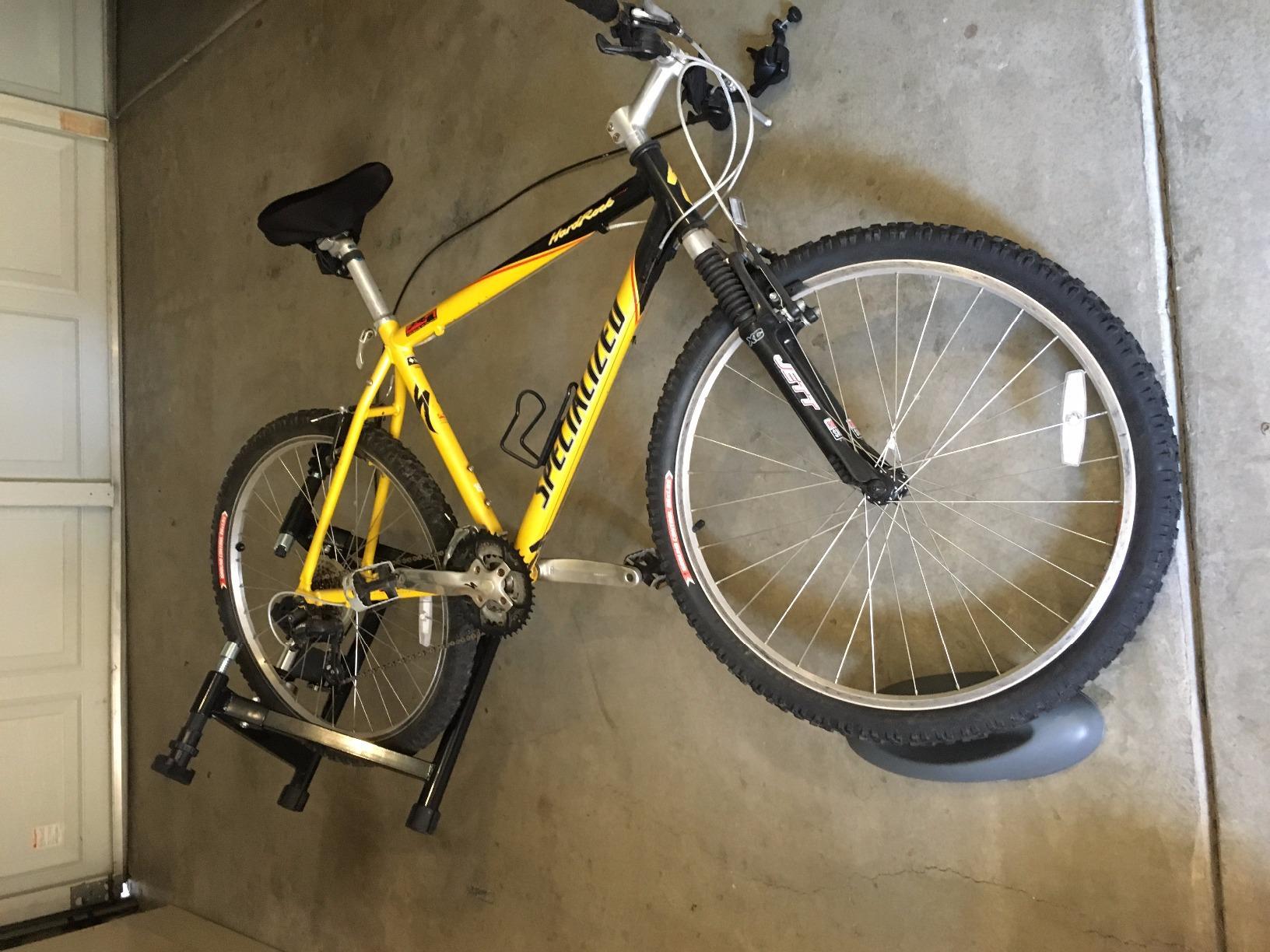
Where it struggles is refinement. Owners report lock levers that loosen under aggressive pedalling, a plastic roller housing that feels cheap, and a shifting cable that only indexes part of the range on some units.
Good first-season fit
It suits someone on their first winter indoors who will ride in zone 2 and occasionally stand up. Set it up on a rug, add a fan, and it will do its job for months.
Poor long-term fit
It is a poor choice if you ride in a shared wall situation where a loose lever rattling is going to be heard, or if you intend to keep the same trainer for a decade. The 90 day warranty offers no protection there.
8. FDW Magnetic Stand M8 – Best for Setting Up Fast After Work
Bike Trainer Stand for Indoor Riding, Bicycle Exercise Training Stand with Magnetic Flywheel,Noise Reduction,5Resistance Settings Stationary Bike Resistance for Road
Magnetic
5 settings
15 minute assembly
Carbon steel
Pros
- Riders are usually pedalling within 10 minutes of delivery
- Adjusts to fit riders of different heights
- Stable and quiet enough for a small space
- Folds away for storage between seasons
Cons
- Minimal instructions and one buyer received none
- Lock levers loosen with vigorous pedalling
- cheap plastic roller housing on some builds
- Shift cable only indexes part of the range
This listing covers the same FDW-M8 design as the previous entry, and the owner feedback matches closely. We keep both because they reach different buyers, and there is no value in pretending they are different machines.
The distinguishing note is how quickly people get moving. Owners repeatedly report being pedalling within about ten minutes of the unit arriving, and that speed of setup is the main reason to choose this style over something heavier.
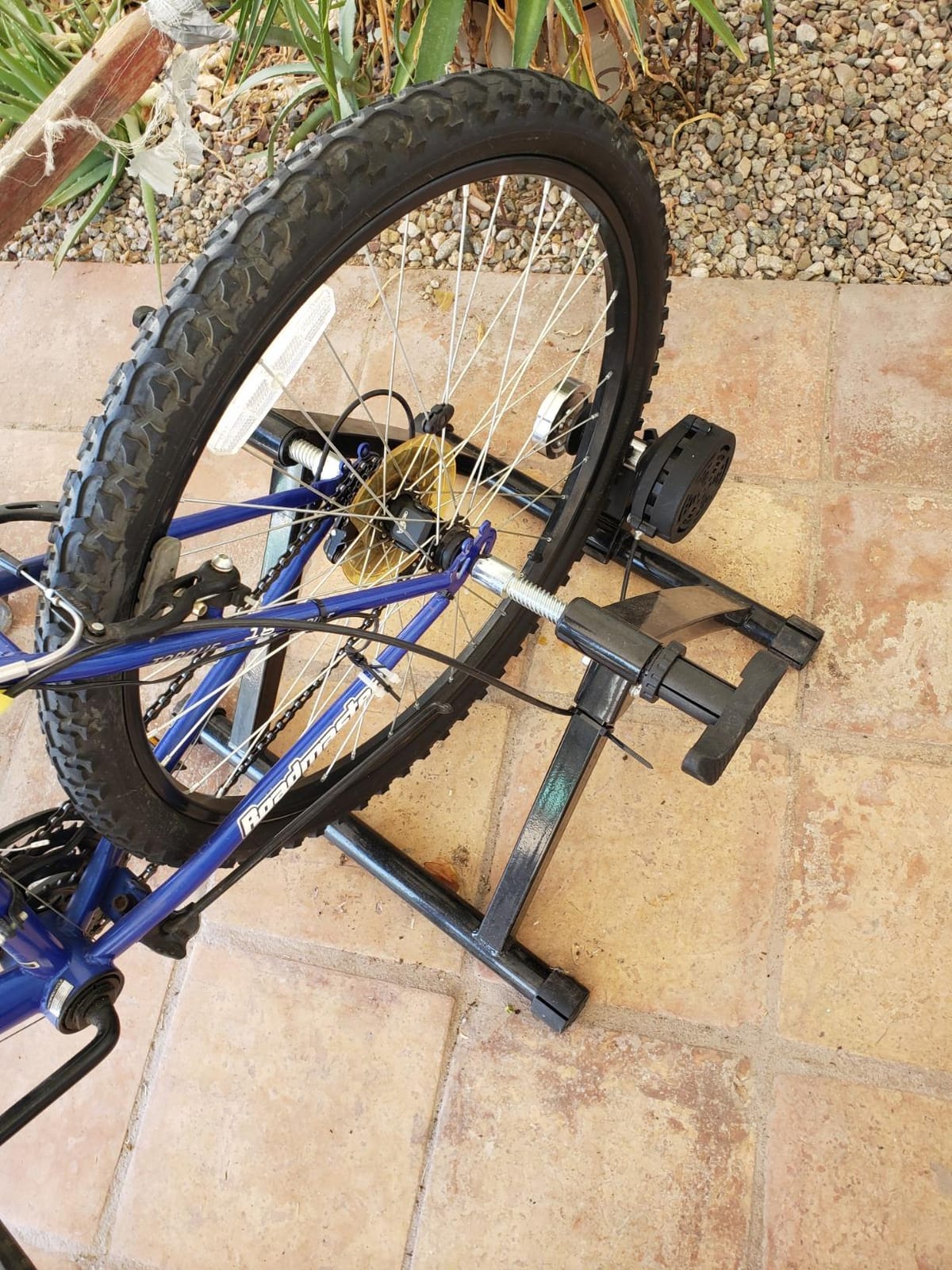
It also adjusts easily for households with riders of different heights, which is useful when one trainer serves two bikes and two people. The fold-flat design keeps it in a corner rather than a dedicated room.
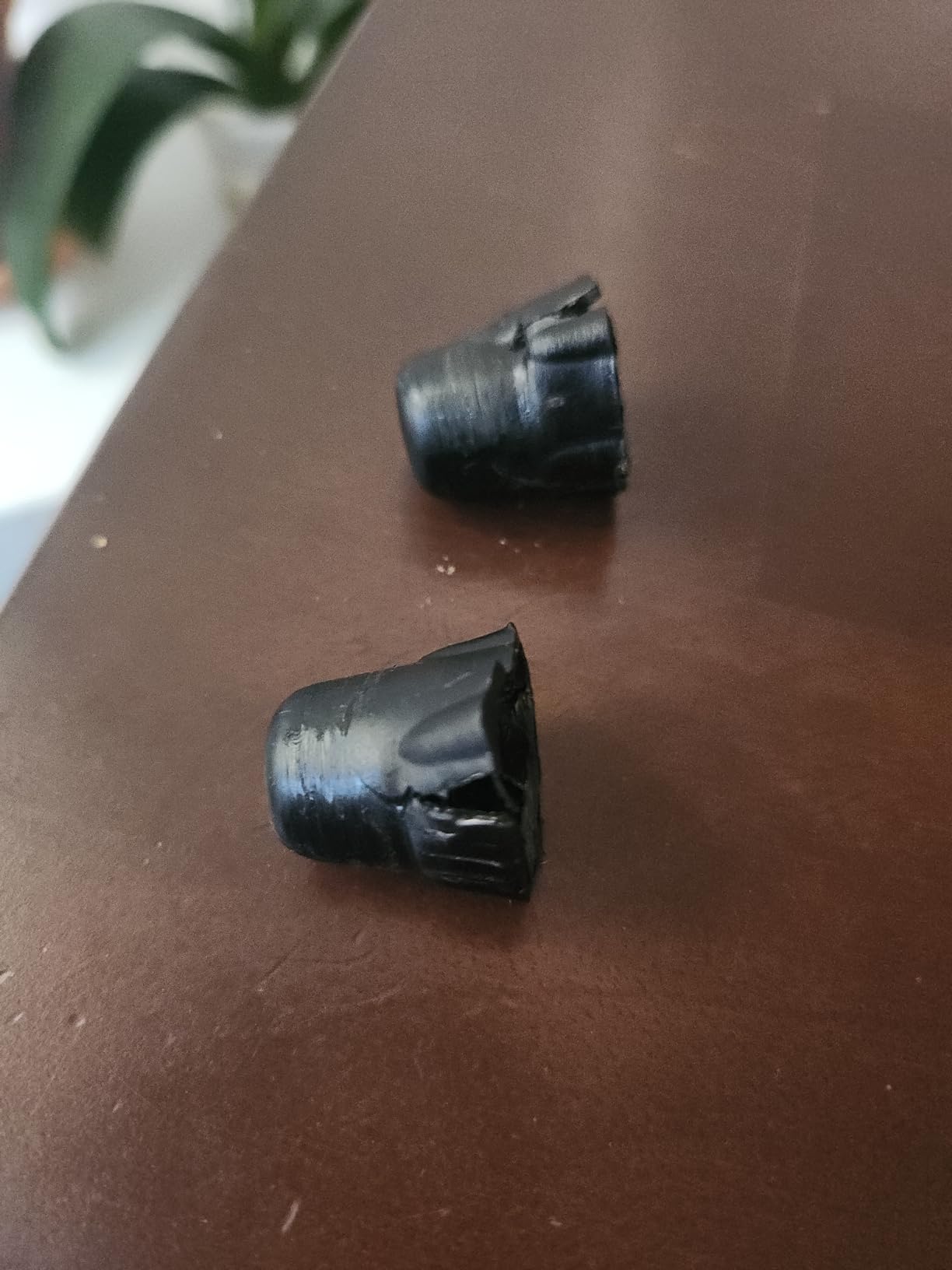
The same weaknesses as the other FDW apply: minimal documentation, a lock lever that can loosen under hard pedalling, and a cheap-feeling roller housing on some units. Budget for a replacement if the lever rattles.
Where it fits well
It fits a shared household, a small flat, and anyone who will not start a session if setup takes more than a few minutes. Casual riders planning three sessions a week through winter are the ideal owner.
Where it does not
It does not suit hard interval work, because five coarse steps cannot hold a repeatable effort. Riders who care about noise in a shared space will also find the reported vibration unsettling.
9. Saris M2 Smart Trainer – Best Connected Option on a Modest Budget
Saris M2 Smart Indoor Bike Trainer, Compatible with Zwift App, Black, Made in the USA
Electromagnetic
Plus or minus 5 percent
ANT+ FE-C and Bluetooth
Zwift certified
Pros
- Electromagnetic resistance gives a measured repeatable effort
- Dual ANT+ FE-C and Bluetooth works out of the box
- Wheel-on design needs no wheel removal
- Steel quick release skewer included
- Limited lifetime warranty
Cons
- Noticeably louder than fluid trainers at speed
- Single resistance mode with a coarser feel than premium trainers
- Approaches smart tier pricing without their refinement
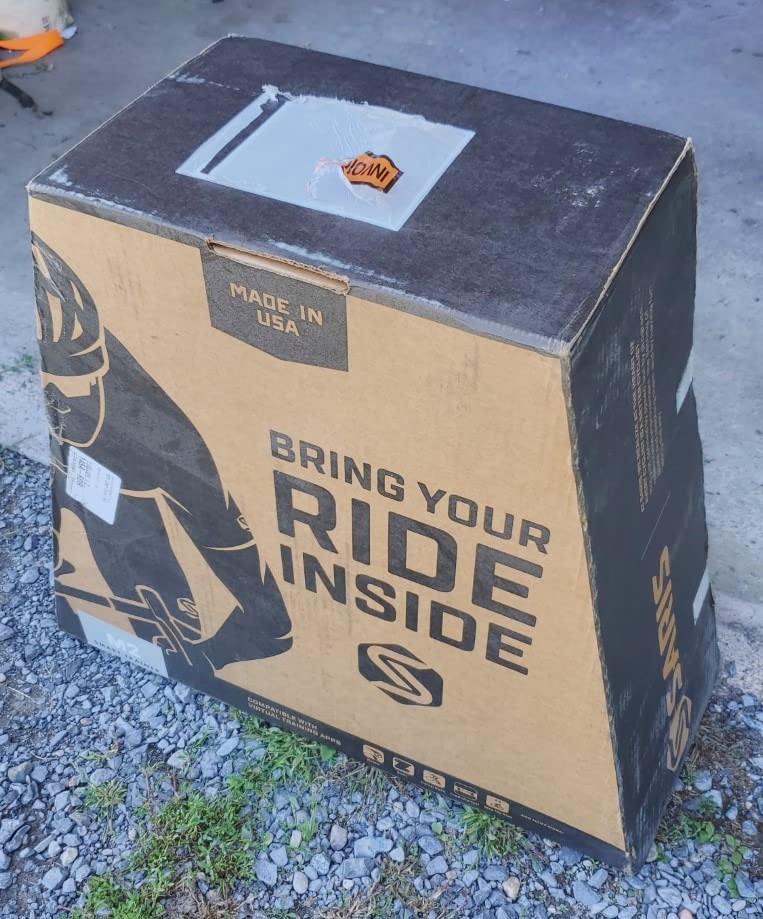
This is the only trainer in the roundup that reports what you are producing. Electromagnetic resistance holds an effort within a stated plus or minus 5 percent, which is not laboratory accuracy but is far better than guessing with your own gears.
It is also the only one that talks to apps out of the box. Dual ANT+ FE-C and Bluetooth means Zwift and Rouvy pair without a separate sensor, and a month of Rouvy is included.
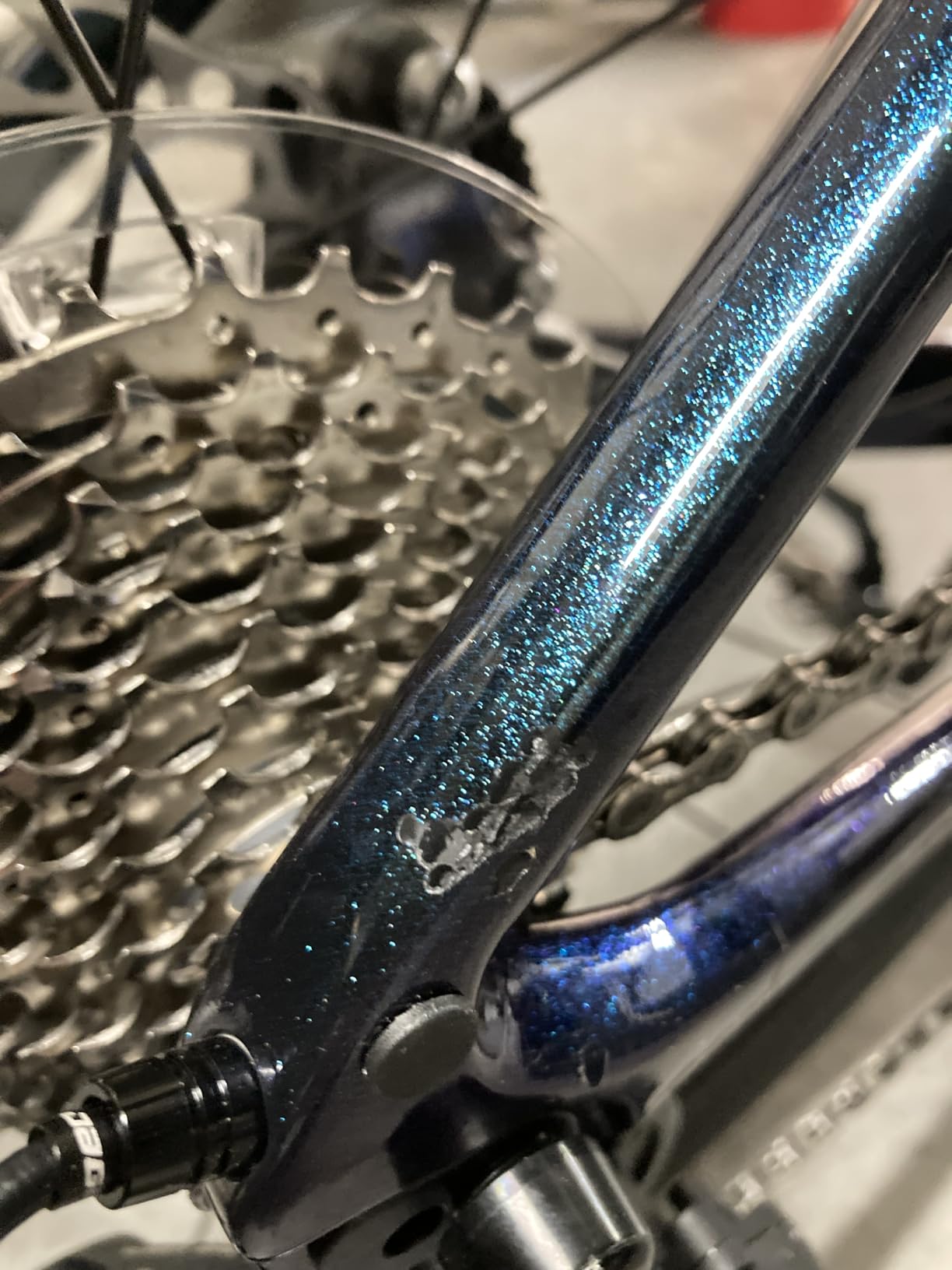
The wheel-on format means no wheel removal and no disassembly, which matters for someone who rides to work or to the shop in the same bike. The steel skewer covers most road and mountain frames.
Two cautions. Saris rates it at 69 decibels at 20 mph, which is louder than the fluid and road-tire magnetic options here. And the resistance feel is coarse compared with true premium smart trainers, with a single mode rather than fine control.
Why this one earns a spot
It earns a spot for riders who want their winter sessions recorded and repeatable but do not want direct-drive pricing. Pair it with a chest strap and you have most of the value of a much costlier setup.
Why it might not be enough
It falls short if noise is your primary constraint, or if you want realistic gradient simulation and instantaneous resistance changes. For shared-wall living, the fluid option is the calmer neighbour.
10. Garmin Tacx Boost Trainer – Best Ride Feel With a Real Flywheel
Garmin TacX Boost Trainer, Indoor Bike Trainer with Magnetic Brake
Magnetic
10 levels to 1050W
1.65 kg flywheel
8.5 kg
Pros
- Real 1.65 kg flywheel gives a far more natural ride
- Closed resistance unit is quieter than most at this weight
- Two click mounting and unmounting
- Front wheel support doubles as a carry handle
- 10 handlebar levels reaching 1050 watts
Cons
- Requires a separately sold thru axle for many modern bikes
- Not a smart trainer with no app or power metering
- Flywheel slows faster than a road freewheel
- Tyre slip reported at higher resistance settings
The Boost is the odd one out here, because it uses an actual flywheel rather than a magnet or a fluid resistor. At 1.65 kg it is heavy enough to smooth the pedal stroke in a way nothing else in this list does, and riders describe the sensation as noticeably closer to riding outdoors.
Resistance runs to 1050 watts across ten handlebar-lever levels, which is more headroom than any other trainer on this list. The closed resistance unit also keeps it quieter than its weight class suggests.
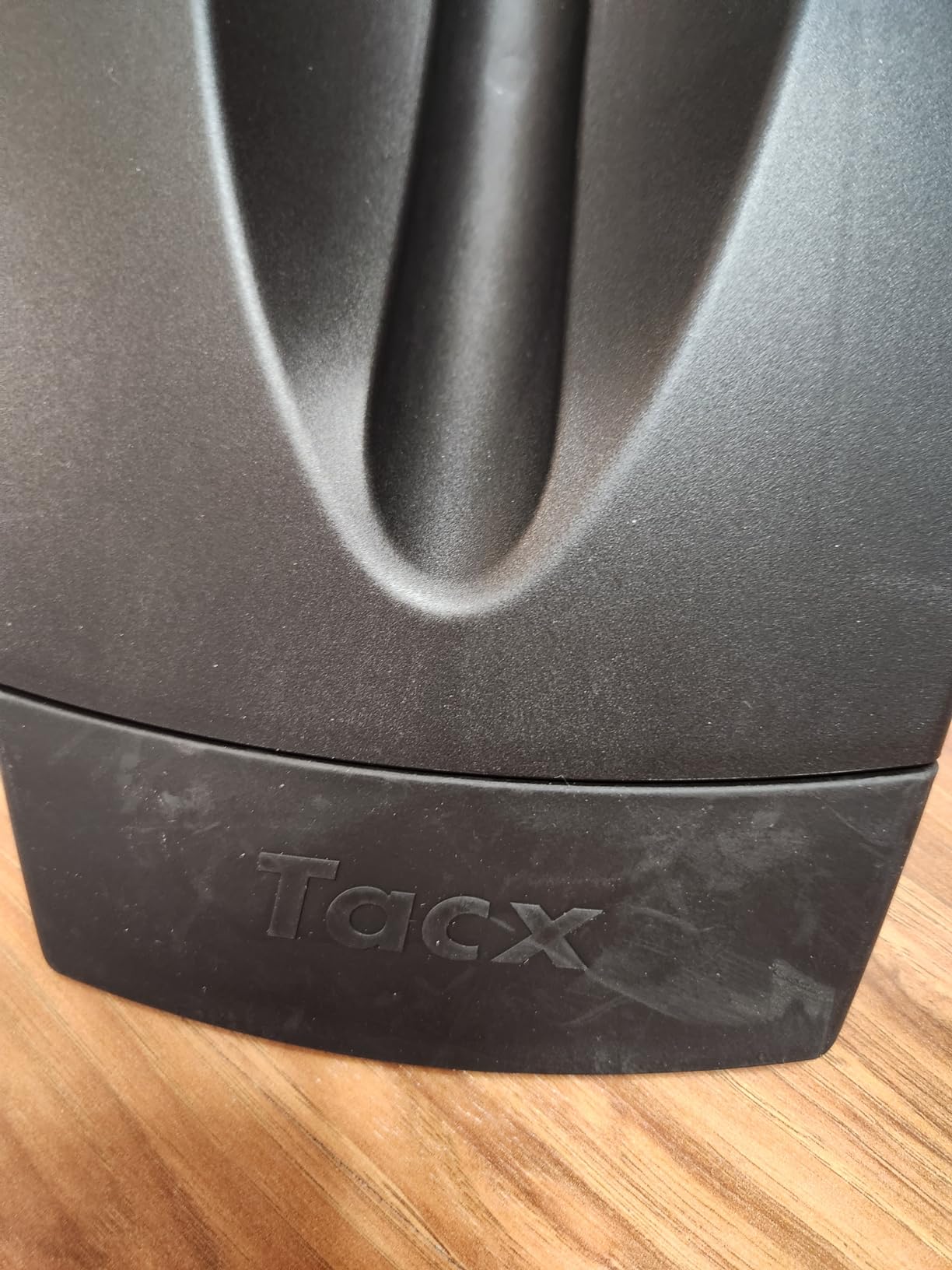
Mounting is a two-click operation, and the front wheel support doubles as a carry handle, so moving between rooms is genuinely easy at 8.5 kg.
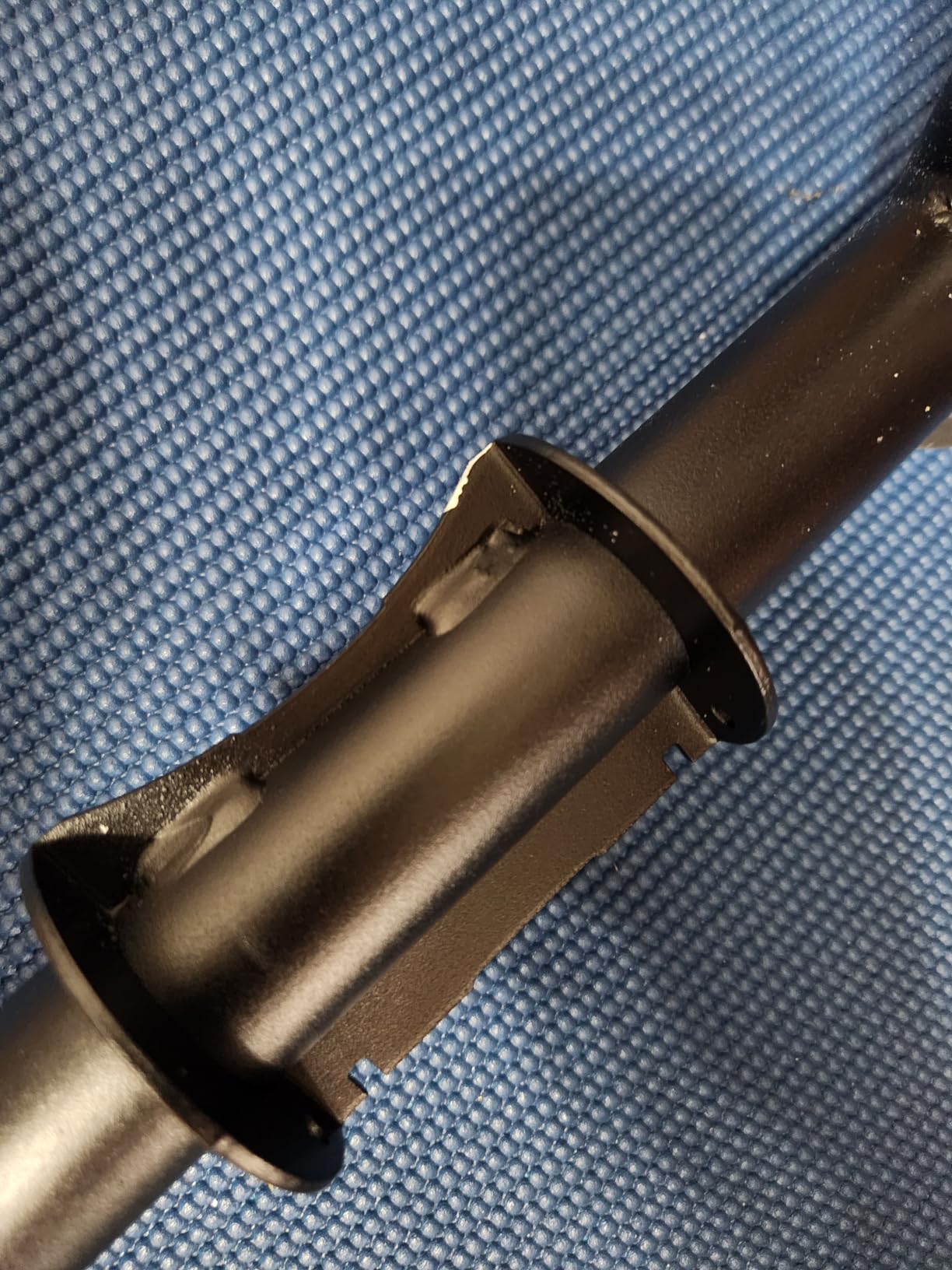
The catch is the axle. Many current bikes need a separately sold thru-axle, and that is a real cost on top of the trainer. Owners also report the flywheel slowing faster than a road freewheel, which makes pedalling feel abrupt at the end of a hard effort.
Best reasons to choose it
Choose it for ride feel, for the highest resistance ceiling here, and if you want your indoor sessions to look and feel like outdoor riding. It is also the trainer we would pick for bike-to-bike daily use.
Reasons to look elsewhere
Look elsewhere if you need app connectivity, which it does not offer, or if your bike requires a thru-axle you will need to source separately. And that is the lowest-rated trainer here at 4.0 stars from 259 reviews.
How to Choose a Bike Trainer for Winter in 2026
The single biggest decision is not brand, it is whether you want to control your power. Everything else follows from that answer, and it is worth reading our guide to home gym trainers for the wider layout question before you commit floor space.
Four types of hardware, and which one you need
Wheel-on magnetic stands clamp the rear axle and press the tyre onto a roller. Resistance depends on wheel speed and a magnet gap, so it is cheap, simple and light to move. This covers the BalanceFrom, Sportneer magnetic, Yaheetech, Alpcour and both FDW stands.
Wheel-on fluid stands work the same way but replace the magnet with a sealed fluid resistor. Resistance rises naturally with speed, which feels closer to the road and is quieter. That is the Sportneer fluid trainer.
Flywheel magnetic units use a heavier rotating mass to smooth the stroke. That is the Tacx Boost, and it is the most convincing of the affordable options.
Electromagnetic smart trainers add a powered resistance unit that measures and holds output. That is the Saris M2, and it is the only trainer here that reports power without an extra sensor.
Noise and floor vibration are two different problems
Airborne noise is what your neighbours hear. Structure-borne vibration is what they feel through the floor, and it travels further than sound because it moves through joists and shared walls at low frequency.
A floor-isolation setup works in layers. Put a closed-cell rubber mat down first, a decoupling board of roughly 12 mm plywood on top of that, and the trainer on the board. The mat absorbs the high-frequency buzz and the board breaks the rigid path to the joists.
Choosing the quietest trainer is only half the job. Fitting slick tyres rather than winter knobbies, and placing the rig away from a shared wall, finishes the problem.
ERG mode versus simulation mode
ERG mode holds a fixed wattage target and asks you to change gear to stay there. Simulation mode pushes a road profile at you and lets your gearing decide. Use ERG for threshold and VO2max repeats, and simulation for climbs and descents where you want to feel the gradient.
The trap riders describe constantly is the spiral of death. In simulation mode, if your cadence drops below the point where the resistance becomes sustainable, the load increases and you slow further. If your trainer supports ERG, use it for structured work and treat simulation as a reward.
Plenty of riders use the winter months to keep strength up off the bike as well. Our picks for speed training parachutes cover the plyometric side of that, which pairs well with a low-impact winter block on the trainer.
Compatibility checks before you order
Confirm your axle type first. Quick-release bikes work with most units here, but the Yaheetech and Tacx Boost need an extra adapter for 12 mm thru-axle frames, and fluid models typically need a separately sold trainer axle.
Then check whether the trainer needs a cassette. None of the ten wheel-on trainers do, which is a genuine advantage over direct-drive trainers that demand a cassette and a matching freehub body for 11 or 12 speed drivetrains.
The winter maintenance protocol
Your chain gets dusty from winter riding, so wipe it before it goes on the trainer. Lube it lightly, and expect to wipe the chain down after each session because sweat is corrosive on alloy cockpit bolts and bearings.
Check tyre pressure monthly and keep the trainer tyre at the upper end of its range, since a harder tyre rolls more quietly. Wipe down the resistance unit, leave a fan pointed at your face, and keep a towel on the handlebars.
Frequently Asked Questions
How noisy is a turbo trainer indoors?
A magnetic stand is quiet on slick road tyres and noticeably loud on knobby ones, because most of the sound is tyre against roller rather than the trainer itself. FDW states under 60 decibels at its lowest setting, Saris rates its M2 at 69 decibels at 20 mph, and one Sportneer fluid owner measured roughly 73 decibels with knobby all-terrain tyres at 70 rpm. Fitting slick tyres and isolating the floor matters more than the model you pick.
Which is quieter, a wheel-on trainer or a direct-drive smart trainer?
At these price levels the answer is not the drive system, it is the tyre. A wheel-on unit has no motor and no powered resistor, so the only noise is tyre contact plus whatever the roller and frame make. Direct-drive trainers add a motor, so they are usually louder airborne, though their mass helps damp structure-borne vibration through the floor. Isolate the floor with a rubber mat and a plywood board, and the difference shrinks considerably.
Do I need a smart trainer for winter training?
No, not if your goal is base mileage and staying fit. A magnetic or fluid stand gives you repeatable resistance across weeks and costs a fraction of a connected unit. You only need a smart trainer when you want the machine to hold a set wattage, hold a gradient, or record your sessions for later analysis. Add a chest strap heart rate monitor and a pedal-based power meter later if you change your mind.
Do I need a cassette for these indoor trainers?
None of the trainers in this roundup need one. They are all wheel-on units that clamp the rear axle and press the tyre onto a roller or fluid wheel, so your existing cassette stays on the bike and takes no extra wear. Cassettes are a direct-drive requirement, where the trainer clamps the frame and reads a cassette. That is also why wheel-on units remain the cheapest way into winter training.
Will a bike trainer damage my frame?
The risk comes from clamping rather than from resistance. Wheel-on stands grip the rear axle, so your frame barely carries load, and the crash risk is the fork when you mount or dismount. Direct-drive trainers clamp the frame dropouts, which is where expensive frames and manufacturer warranty rules come into play. Fit the correct adapter for your axle, tighten to the specified torque rather than maximum effort, and re-check after the first few sessions.
Which of these trainers suits a mountain bike with a Boost hub?
Check your axle before anything else. The Alpcour, BalanceFrom, Sportneer magnetic and both FDW units take quick releases, while the Yaheetech, Tacx Boost and fluid Sportneer trainer need a separately sold thru-axle adapter for 12 mm through-axle frames. Once it fits, run a slick tyre rather than a knobby for indoor work, since tread is the single biggest noise source on any wheel-on trainer.
How should I train on a bike trainer during winter?
Structure the season in three blocks: base miles in zone 2 to build tolerance, threshold work at roughly the middle of your hour points, then short VO2max repeats. Use ERG mode for intervals because it holds your watts steady, and save simulation mode for virtual climbs where gearing feels natural. Add a fan, towel and screen riser, and stick to the trainer for four to six weeks before switching back to outdoor rides in spring.
The Verdict: Best Bike Trainers for Winter Training in 2026
The Elite Novo Force takes our editors’ choice because it combines the smoothest magnetic progression in this group with the highest satisfaction score of the ten, and its 690 watt ceiling is enough for real threshold work without a direct-drive budget.
Buy the Sportneer magnetic trainer if you want planted stability at a lower outlay, and the Yaheetech if you live under someone who does not want to hear you. Go for the Saris M2 if you want recorded sessions and Zwift pairing without a cassette, and treat the Tacx Boost as the most convincing ride feel available at this price.
Whichever you pick, put a mat under it, fit slick tyres, and start with easy hours. That is the difference between a winter you finish strong and one you abandon in January.