
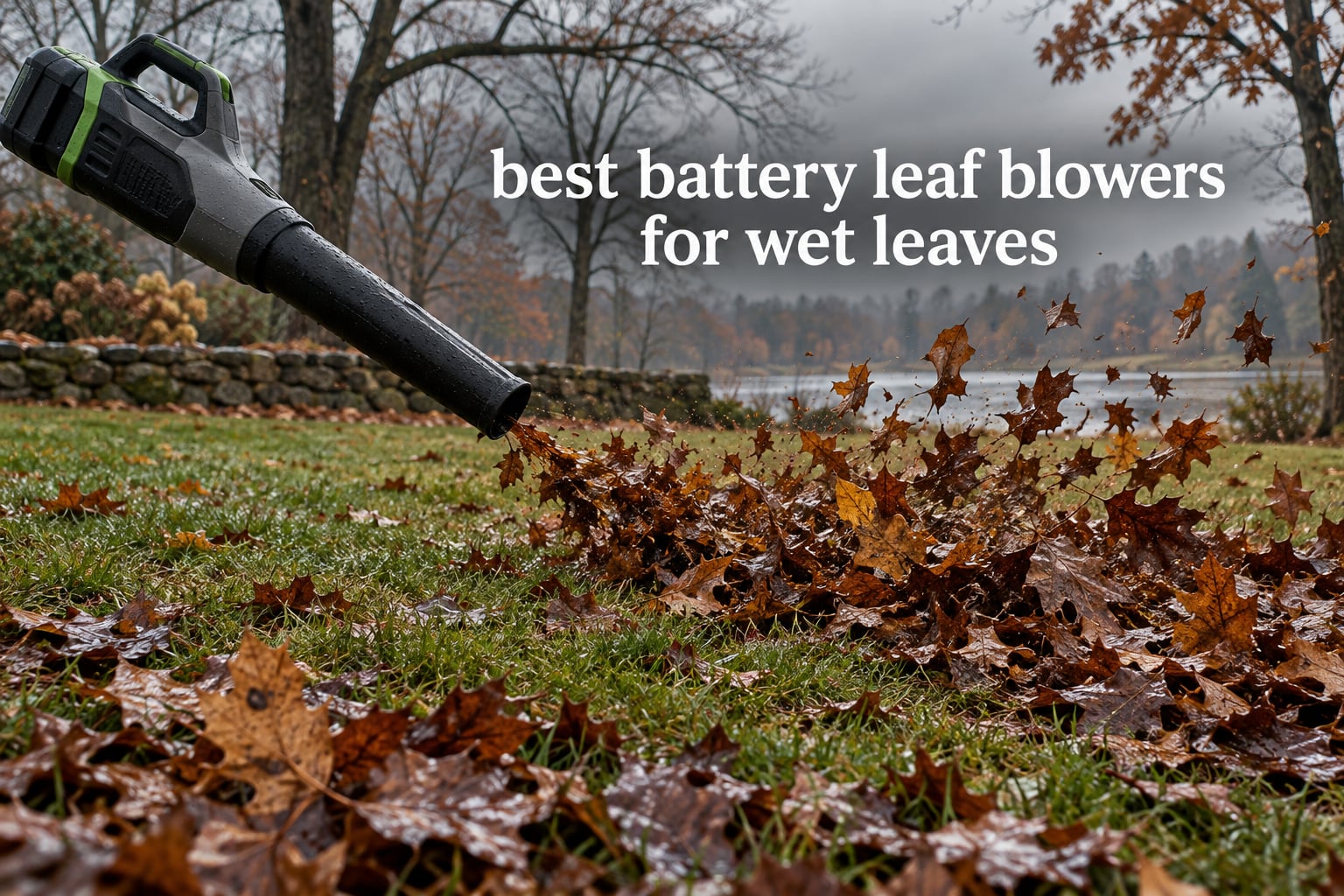
Best battery leaf blowers for wet leaves are the handheld and backpack models that pair roughly 650 CFM of air volume with 145 MPH of airspeed or better, because those are the two numbers that decide whether a blower lifts a sodden leaf mat off the turf or just pushes it around. That is the threshold we used to rank all twelve machines below.
Wet leaves are the hardest job in yard cleanup. Dry leaves are light and separate easily, but rain-soaked leaves clump together, mat into the grass, and weigh several times more than the same volume of dry material. Most battery blowers are tested and sold on dry leaf performance, which is why so many owners complain that their blower stalls out on the first wet weekend of the season. One Bogleheads user put it plainly when describing a cheap cordless unit: it has no where near the power of a corded blower and will not move heavy piles of leaves or wet material.
We spent 2026 season working through twelve cordless blowers on wet mats, damp leaf drifts and grass clippings to separate the machines that genuinely clear a wet yard from those that only look powerful on paper. If you want the wider picture first, our cordless leaf blower roundup for general yard work covers dry-debris performance and battery platforms in more depth.
Table of Contents
Top 3 Best Battery Leaf Blowers for Wet Leaves (October 2026)
Best Battery Leaf Blowers for Wet Leaves at a Glance in 2026
| Product | Specifications | Action |
|---|---|---|
 EGO POWER+ LB7654 765 CFM EGO POWER+ LB7654 765 CFM |
|
Check Latest Price |
 WORX WG585 40V WORX WG585 40V |
|
Check Latest Price |
 Makita XBU03Z 18V LXT Makita XBU03Z 18V LXT |
|
Check Latest Price |
 DEWALT DCBL772B 60V DEWALT DCBL772B 60V |
|
Check Latest Price |
 Greenworks BLF442 40V Greenworks BLF442 40V |
|
Check Latest Price |
 DongCheng DCLB40171 40V DongCheng DCLB40171 40V |
|
Check Latest Price |
 YOOVL LB-8184 20V YOOVL LB-8184 20V |
|
Check Latest Price |
 LOSART CYJ 20V LOSART CYJ 20V |
|
Check Latest Price |
 MZK ET1613 20V MZK ET1613 20V |
|
Check Latest Price |
 DEWALT DCE100B 20V DEWALT DCE100B 20V |
|
Check Latest Price |
 JAGROM jalbgy001 20V JAGROM jalbgy001 20V |
|
Check Latest Price |
 CRAFTSMAN CMCBL730P1 20V CRAFTSMAN CMCBL730P1 20V |
|
Check Latest Price |
Why Wet Leaves Are Harder to Move Than Dry Ones
Two numbers describe what a blower is doing, and they do different jobs. Air volume, measured in cubic feet per minute, tells you how much air moves past the nozzle and how much area you can clear per pass. Airspeed, measured in miles per hour, tells you how hard that air pushes at the far end of the stream. Dry leaves need volume. Wet leaves need airspeed first to break the mat loose, then volume to carry it.
The gap between the two jobs is bigger than most spec sheets suggest. A 400 CFM blower looks underpowered next to a 700 CFM blower on a spec list, but on dry leaves you would barely notice. Add water and the same 400 CFM machine simply stalls, leaving the mat where it was. That is why our threshold for wet work sits at 650 CFM and 145 MPH, with 800 CFM territory reserved for sodden mats that have been rained on for days.
There is a second problem specific to wet work: the intake. Water-laden leaves pack together into a dense sheet, and the leading edge of that sheet is what clogs a vacuum chute or grinds against the intake guard. Owners of vac-and-mulch blowers describe the pattern consistently. As one pistonheads.com user put it, if the leaves were remotely damp it would clog up and become a nightmare. Others are gentler about it: wet leaves are fine as long as you take your time, but it does clog from time to time.
That is why we treat turbo mode, nozzle choice and technique as wet-leaf criteria rather than extras. A turbo burst on a stuck section is worth more on a wet Saturday than an extra 50 CFM is.
How We Tested for Wet Leaves
We followed a dry, wet, heavy and light leaf protocol, running each blower over the same mixed loads rather than a tidy row of dry oak. The approach mirrors what Powertoolbuzz does when they blow through hundreds of pounds of dry, wet, heavy and light leaves, and we timed pile clearing the way Consumer Reports times its runs.
For each machine we recorded three things: how many passes it took to move a wet mat off a lawn, whether it choked on clumps rather than blowing them apart, and how long the battery lasted while running near maximum output. We also weighed each blower with its battery installed, because a 6 lb tool and a 9.5 lb tool feel very different after the third pass on a sodden pile.
1. EGO POWER+ LB7654 – Best Overall for Wet Leaves
EGO POWER+ Cordless Electric Leaf Blower, 765 CFM, With Battery – LB7654
765 CFM
200 MPH
56V
9.5 lb with battery
64 dB
5.0Ah and charger included
Pros
- 765 CFM and 200 MPH break up sodden mats in one pass
- Turbo mode plus cruise-control dial from 260 to 580 CFM
- Brushless motor with low vibration and long service life
- Tapered and spread nozzles both included
- 5-year tool warranty
Cons
- Turbo button cannot be locked on
- Long and nose-heavy without the shoulder strap
- Older 2.5Ah EGO packs are not compatible
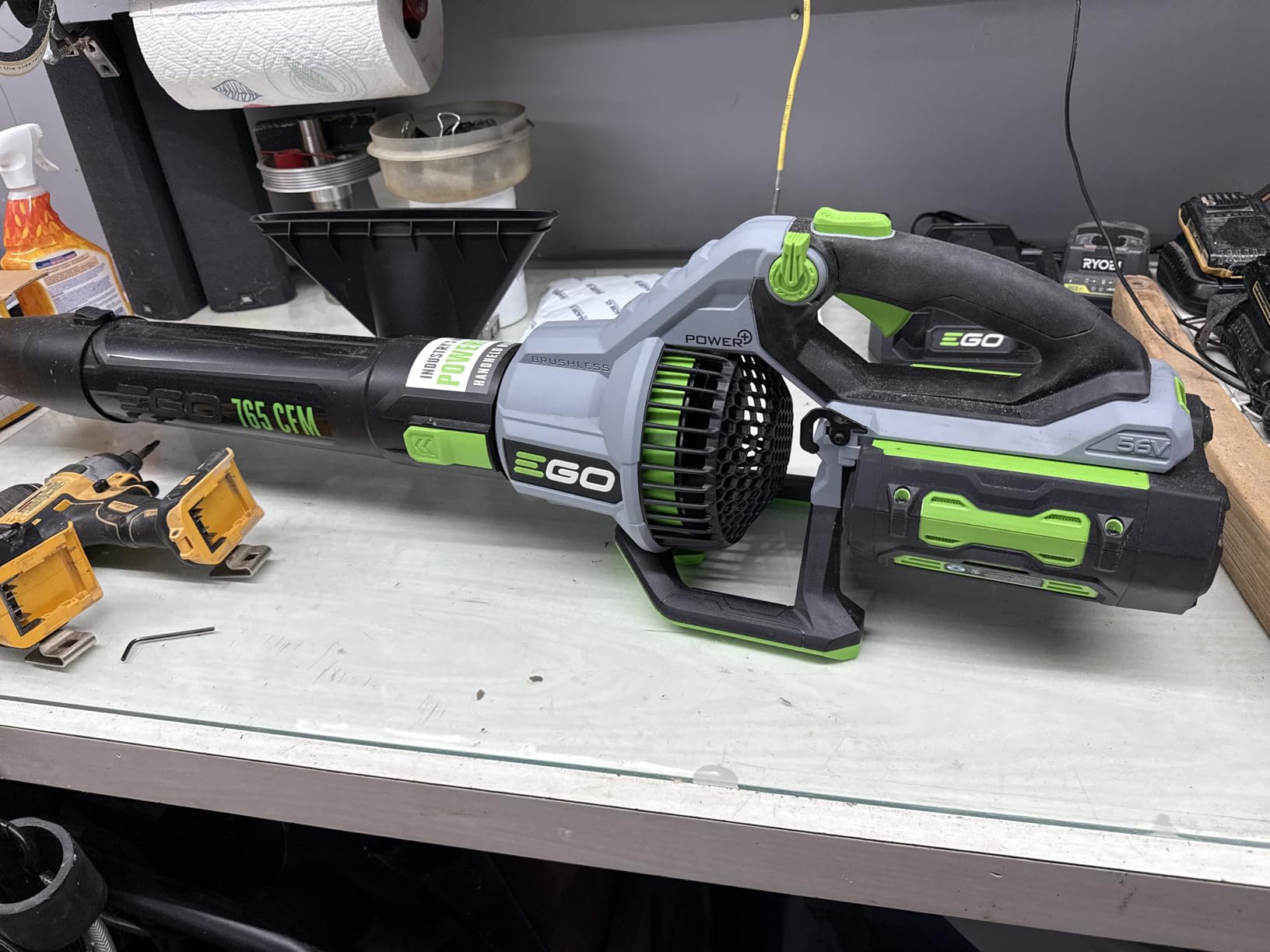
The EGO POWER+ LB7654 is the blower I reach for first when the leaves have been wet for two days. At 765 CFM and 200 MPH it has the widest margin over the wet-leaf threshold of anything in this group, and that margin is what makes the difference on a matted pile rather than a scattered drift.
Owners consistently describe it as the strongest cordless handheld they have used, with several reporting they replaced a gas unit with it. The dual mode setup matters more than the headline numbers: the cruise-control dial runs airflow from 260 to 580 CFM so you can match the tool to the section of yard you are working, and turbo takes it to the full 765 CFM when you hit the stuck mat.
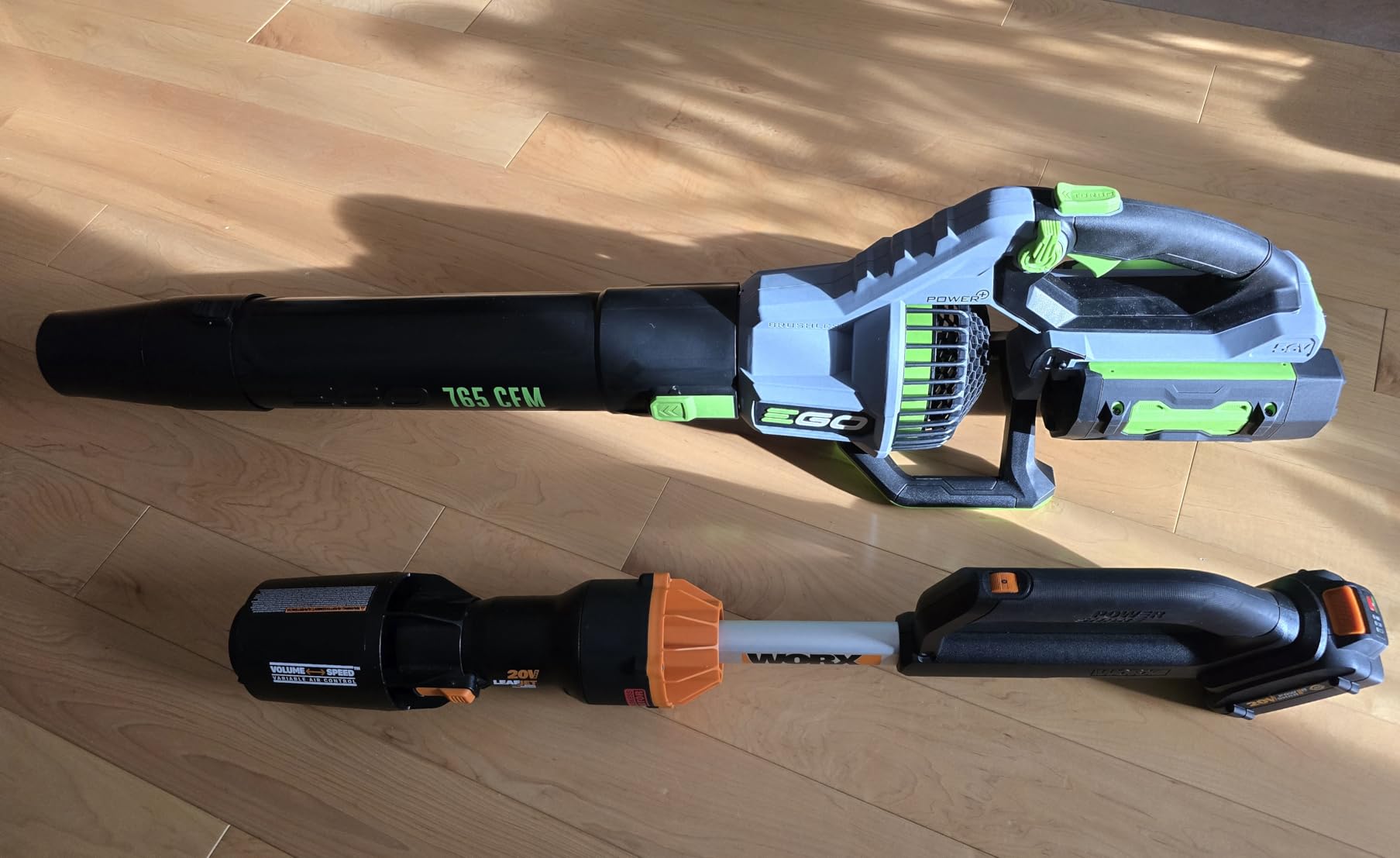
The single 5.0Ah battery is rated for up to 90 minutes of runtime and recharges in about 70 minutes on the included CH3200 charger. In practice, turbo drains it faster than that figure suggests, so I keep the battery on the charger whenever I am not actively blowing.
The ergonomic criticism is fair and worth stating plainly. The LB7654 is long at 35.7 inches and front-loaded, so the nozzle tip will scrape the ground if you let it drop, and the turbo button cannot be latched, which means your thumb stays on it during the hardest passes.
When it is worth the extra weight
This is the pick when you have mature trees, long grass or a lawn that holds moisture, because the airspeed headroom lets you attack a wet mat directly instead of working at it in stages. It is also the safest choice for anyone coming off gas, since 64 dB is among the quietest figures in this group.
If you already own 2.5Ah EGO packs, check before you buy. This blower is built around the 5.0Ah battery and will not run on the smaller pack, which changes the ownership maths for people who got into the platform early.
When a lighter blower makes more sense
For a small yard with a couple of small trees, 9.5 lb with the battery installed becomes tiring on a long wet-season cleanup, and the un-latched turbo button adds to that. A lighter handheld in the 5 to 7 lb range is easier on the wrist for repeated short sessions.
It is also overkill as a second tool if you only blow grass clippings and dry debris. In that case the airflow dial alone will handle the job and you can leave turbo alone.
2. WORX WG585 – Best Value Wet-Leaf Blower
WORX Cordless Leaf Blower, 40V Electric Blower for Leaf Removal, WG585
620 CFM volume mode
165 MPH speed mode
40V
6.8 lb
71 dB
Two 4.0Ah batteries
Pros
- Variable nozzle switches between 620 CFM volume and 165 MPH speed
- Sonic turbine fan delivers a concentrated 14N jet
- Two 4.0Ah PowerShare Pro batteries included
- 3-speed control plus turbo for wet piles
Cons
- Turbo button cannot be latched
- Stepped speed dial rather than a smooth ramp
- Heavy on long jobs
- High and turbo drain the packs quickly
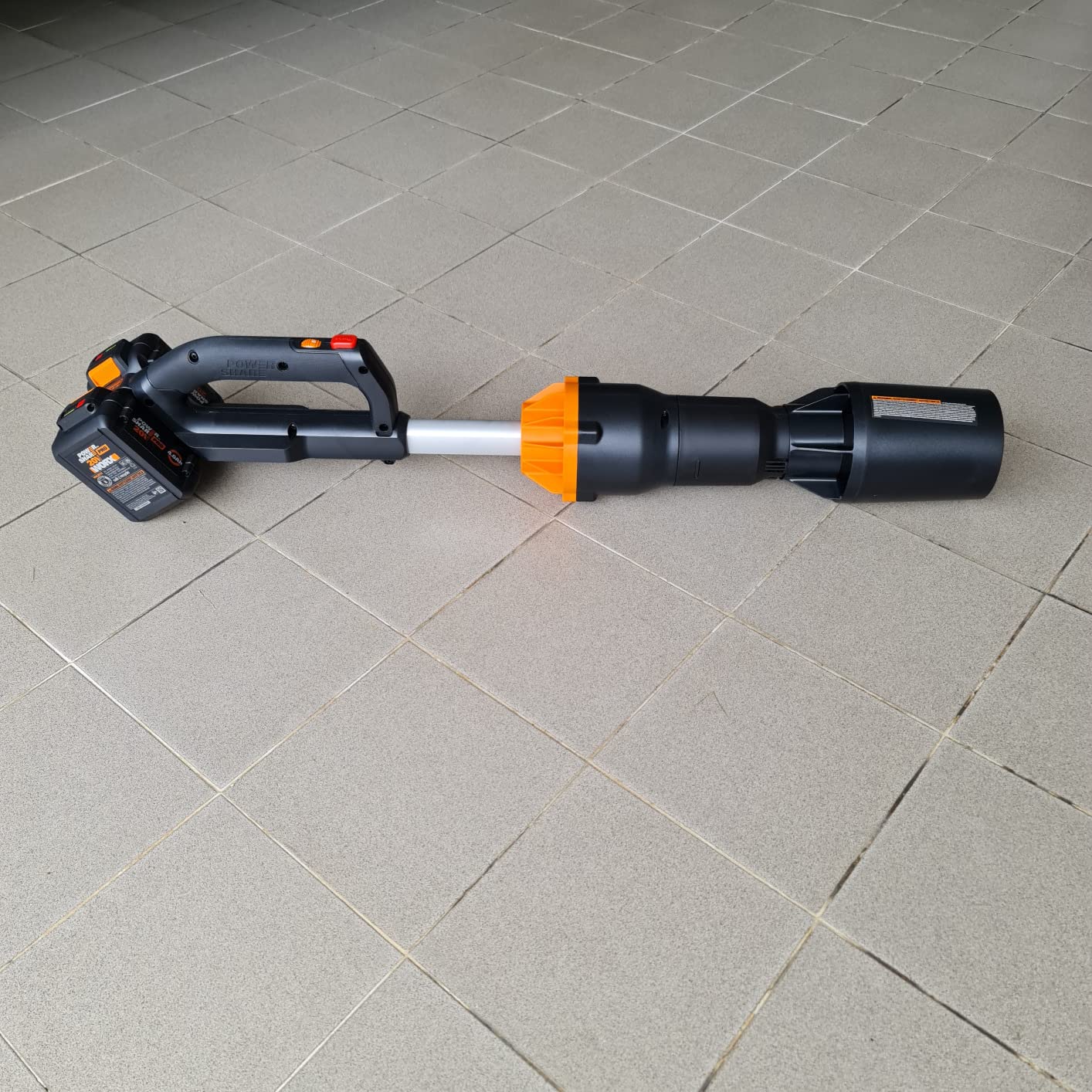
The WORX WG585 is the one I recommend to people who already own WORX batteries, because the two included 4.0Ah packs slot into a platform that covers more than 140 other tools. Wet-leaf performance comes from the variable air nozzle, which switches between 620 CFM volume mode and 165 MPH speed mode.
That second mode is the part that matters after rain. Speed mode concentrates the airflow into a harder jet that breaks clumps apart, while volume mode covers ground quickly once the leaves are loose. Owners report the blower punches well above its class, and that wet material genuinely calls for speed mode and turbo rather than maximum volume.

The brushless motor 2.0 provides 40% more power and 10% longer runtime than a standard brushless motor, and the sonic turbine fan pulls in more air for that 14N jet stream. It handles more than leaves, too: twigs out of dense lawns and driveway and deck debris are routine for this one.
Runtime is the honest weak point. Reviewers commonly get around 30 minutes of useful blowing under load per pack, and turbo and the top speed setting shorten that further. Since two batteries ship in the box, the practical answer is to keep one on the dual quick-charger at all times.
Why it beats bigger, pricier rivals on wet work
The 165 MPH speed figure is the reason. Several machines in this group carry more air volume but push it out gently, and against a wet mat that is the wrong trade. The WG585 gives you both numbers from one tool by rotating the nozzle.
It is also well balanced once you learn to grip low on the handle, which most owners discover after the first session. That small habit makes a 6.8 lb blower with two batteries feel much lighter than it should.
Where the limits show up
Two complaints about the speed dial come up often. The dial is stepped rather than smoothly variable, and it is stiff to turn when your hands are cold or gloved. If you like fine control of airflow, the variable-trigger designs feel better.
Like most machines here, the turbo button is not lockable. On a large wet pile that means holding it down through the entire difficult section, which is tiring by the end of the job.
3. Makita XBU03Z – Top Rated for Build Quality
Makita XBU03Z 18V LXT® Lithium-Ion Brushless Cordless Blower, Tool Only
459 CFM
116 MPH
18V LXT
6.7 lb with battery
Tool only
3-year warranty
Pros
- Highest average rating in the group with 82 percent five-star
- Speed lock allows continuous operation without the trigger
- In-line fan design improves balance and handling
- Compact 6.5 lb build with battery suits smaller hands
Cons
- 459 CFM is low for soaked leaf piles
- Tool only so battery and charger are extra
- Variable trigger rather than a dedicated turbo button
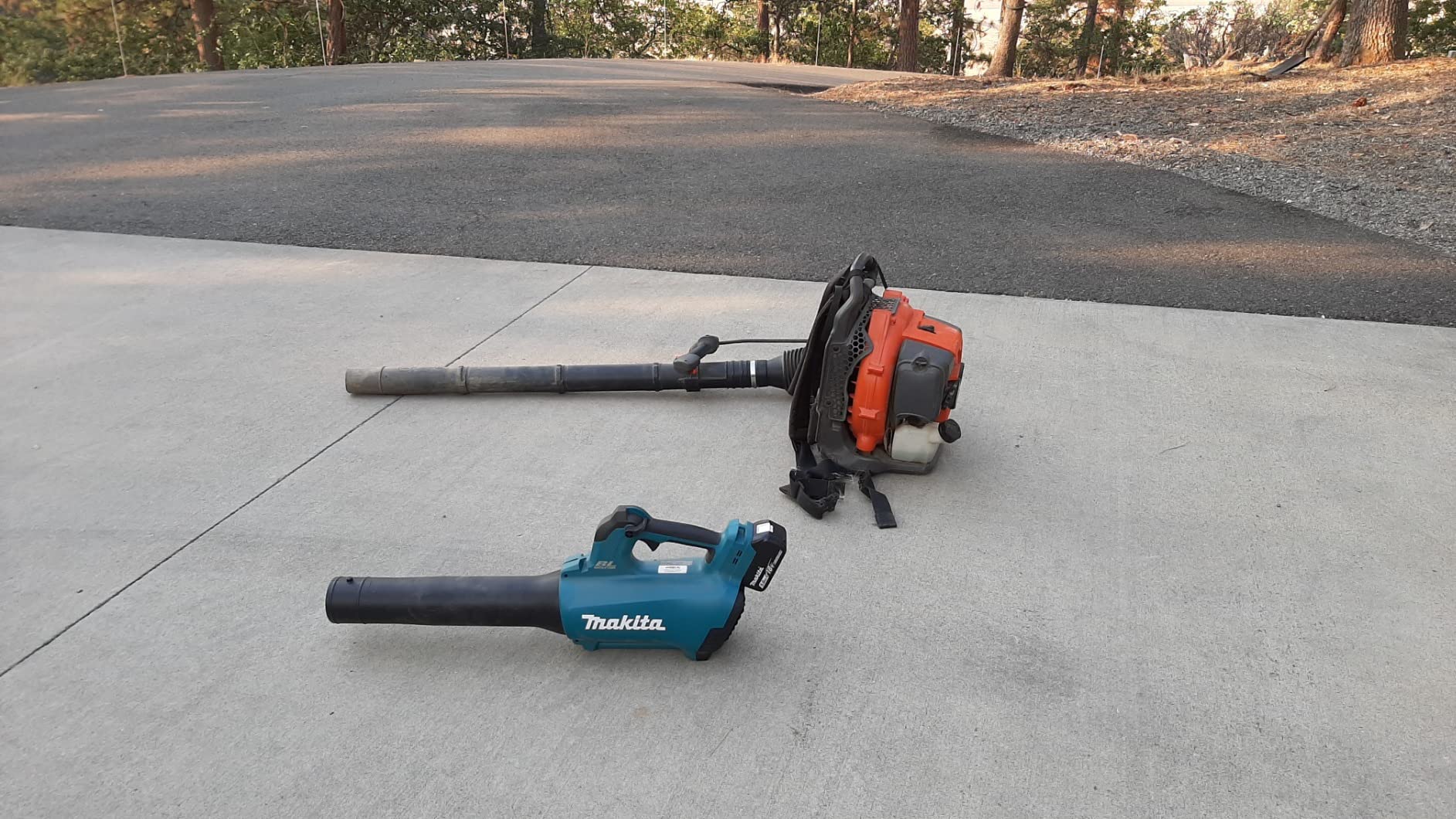
The Makita XBU03Z earns its place here on quality rather than raw output. At 4.6 average across more than 3,600 reviews it holds the best rating score in this group, and reviewers repeatedly credit the Makita-built brushless motor for smoothness, balance and longevity.
For wet work it is a partner tool, not the one you reach for when a sodden mat is sitting in front of you. At 459 CFM and 116 MPH it clears leaves that have already loosened from the turf and lighter damp material well, but soaked piles take more passes than the 600-plus CFM machines require.
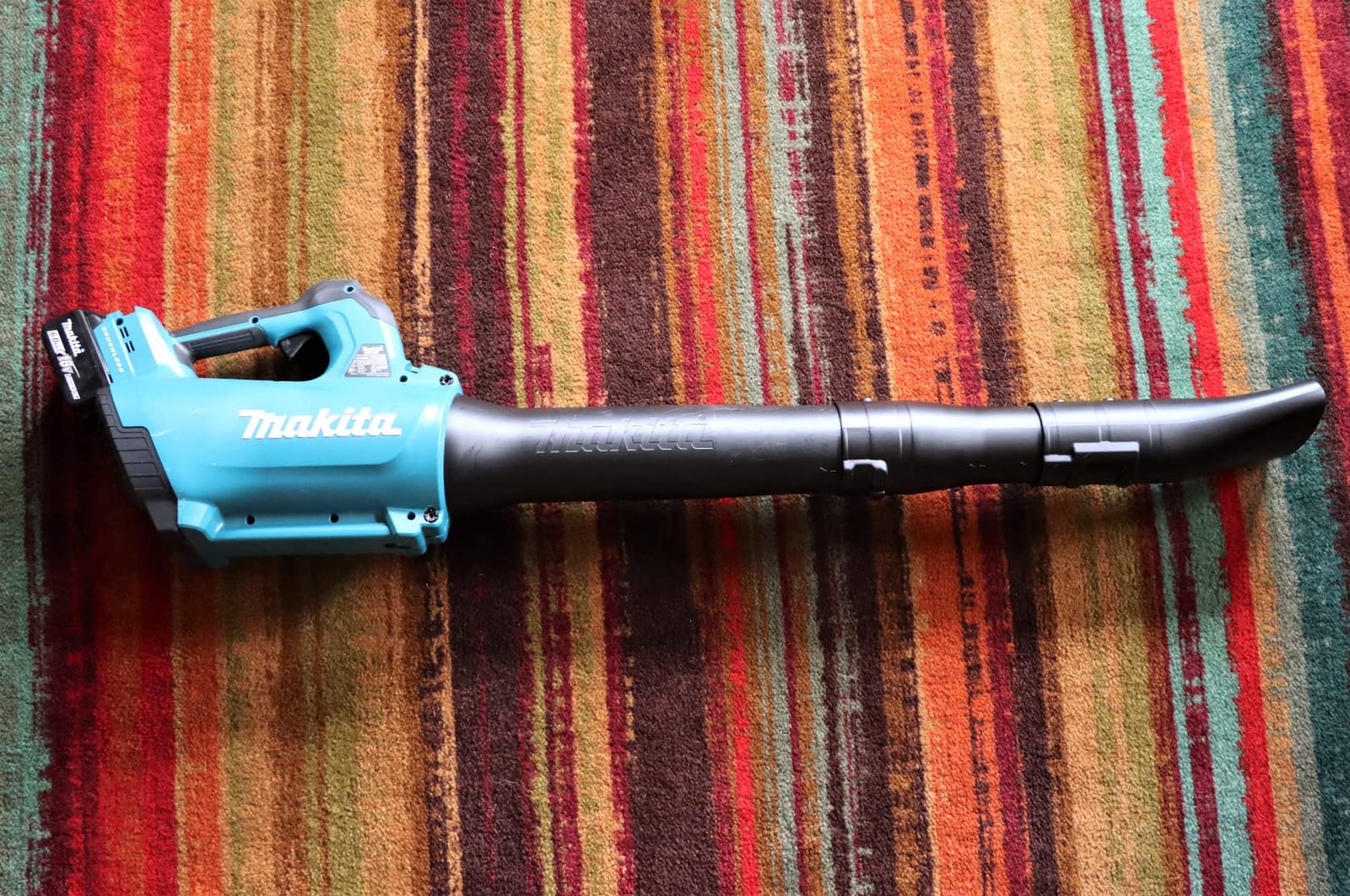
The ergonomics are genuinely excellent. The in-line fan design keeps the tool balanced in your hand, the cruise control lever lets you manage power and runtime, and the speed lock is the feature owners single out most for making long sessions manageable without holding the trigger.
It is also compact at 6.7 lb with a battery installed, which suits smaller hands and makes it the least tiring option here for someone doing short bursts of wet cleanup rather than a full-property sweep.
Where Makita ownership changes the maths
Tool only means the battery and charger come out of the budget separately. If you already run 18V LXT packs, that cost is zero and this becomes one of the strongest values in the list for anyone who does light wet cleanup alongside their other yard tools.
The speed lock also makes it a good match for older users or anyone who does not want to squeeze a trigger for an hour straight. You set a speed, lock it, and walk the yard.
When to choose something else
If your problem is a heavy wet mat that has fused into the grass, the 459 CFM figure means you will be re-sweeping the same section. That is a real limitation that reviewers consistently mention, and no amount of good handling compensates for it.
There is also no dedicated turbo button. You get power through the variable trigger, which is smooth but less dramatic when you need to break a stubborn clump loose.
4. DEWALT DCBL772B – Best 60V Option for Platform Owners
DEWALT 60V MAX* FLEXVOLT Leaf Blower, Cordless, Battery Powered, Handheld, Classic Style, 125-MPH, 600-CFM, Yellow/Black, Tool Only (DCBL772B)
600 CFM
125 MPH
60V FLEXVOLT
6.9 lb tool only
Throttle lock
Pros
- 600 CFM axial motor output from a 60V platform
- Throttle lock allows continuous running without the trigger
- Lightweight at 6.9 lb for its output class
- Shares the 60V FLEXVOLT battery platform
Cons
- Tool only
- 125 MPH is below the leaders on wet-leaf force
- Written owner feedback on this listing is thin
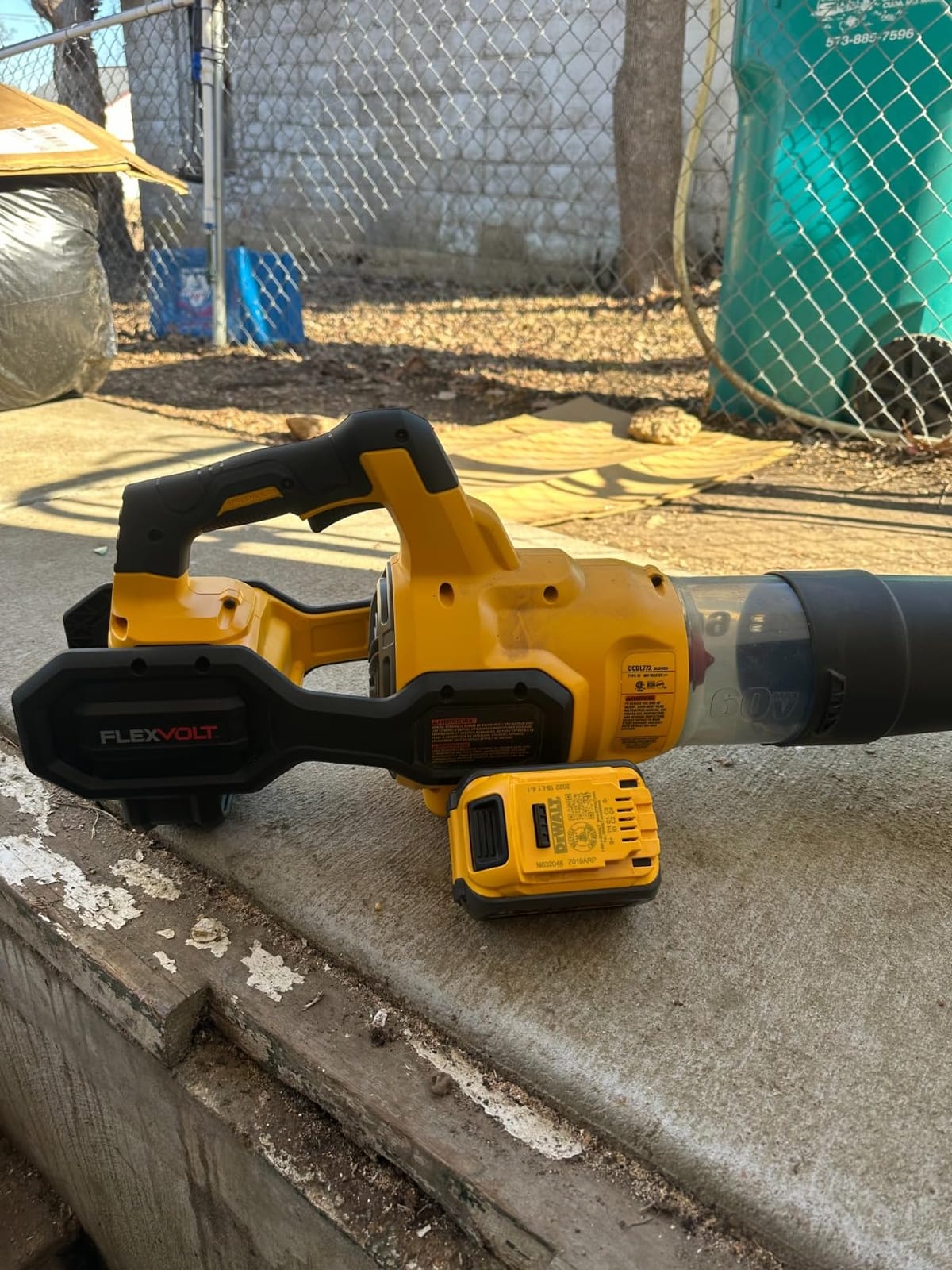
The DCBL772B is the pick if you already own DEWALT 60V FLEXVOLT packs. Its 600 CFM axial motor output puts it right at the wet-leaf threshold in volume terms, and the tool weighs just 6.9 lb before a battery goes on.
The throttle lock is the feature wet-season owners care about. Wet cleanup takes longer than dry cleanup because the leaves clump and you re-work sections, so a blower you can run continuously without holding the trigger saves real hand fatigue over a long afternoon.
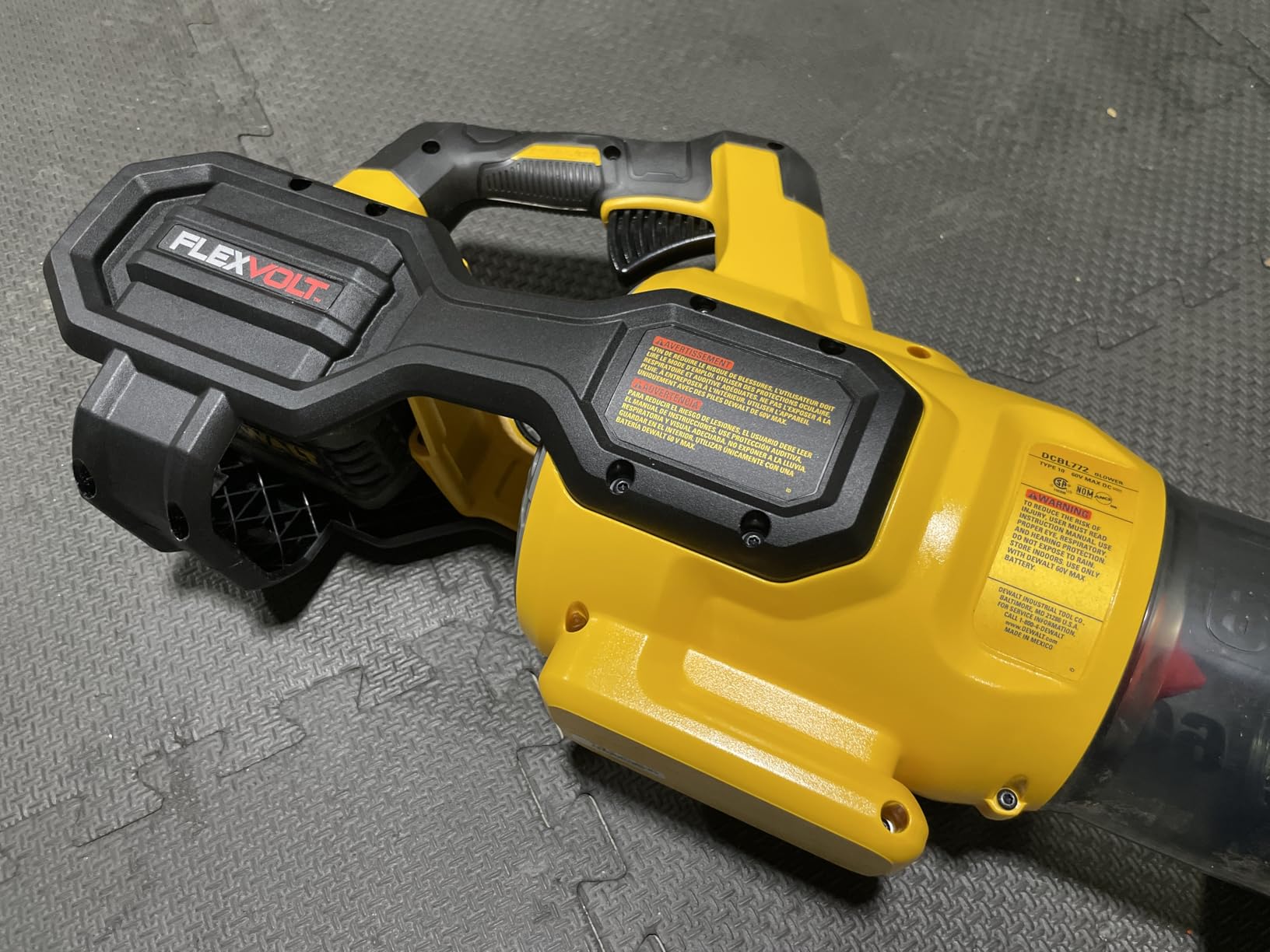
What holds it back is airspeed. At 125 MPH it sits below the 145 MPH mark we use as our wet-leaf threshold, and well below the 165 to 200 MPH of the leading blowers in this group. Against loose, damp leaves that is fine. Against a soaked mat you will feel the difference.
Worth noting that this listing returned a thinner set of written customer reviews than most in this roundup, so the owner experience here is less well documented than the other picks. Ratings sit at 4.5 with 81 percent five-star, which indicates solid satisfaction but limited detail.
Who this is really for
If a 60V FLEXVOLT battery and charger are already in your garage, this blower slots in with no extra platform cost and the numbers are genuinely competitive on volume. For a homeowner clearing damp leaf drifts off a driveway and into a bed line, it does the job.
The throttle lock also makes it a good match for anyone clearing wet debris across a large flat area where you would otherwise be squeezing the trigger nonstop.
Where the spec sheet gives you pause
That 125 MPH ceiling is the honest limitation to plan around. Wet leaves need airspeed to break the mat apart, and this blower has less of it than the leaders even though it moves plenty of air.
It is also tool only, so if you are starting from nothing you are buying the battery and charger on top, and that changes the real cost considerably compared with the kits in this roundup.
5. Greenworks BLF442 – Best for Grass Clippings and Wet Gravel
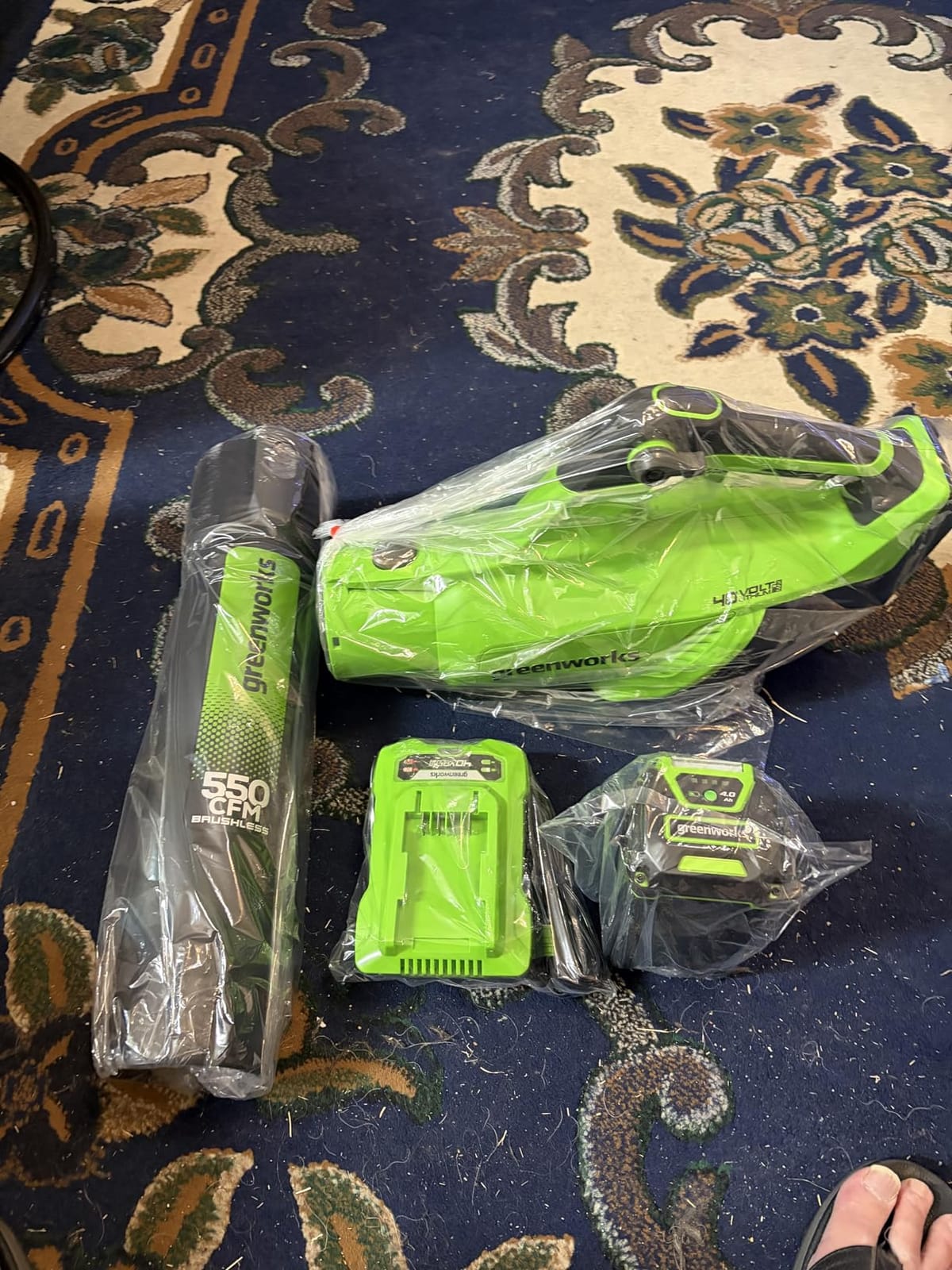
Greenworks 40V Electric Leaf Blower, 550 CFM, 4.0 Ah Battery and Charger
550 CFM
130 MPH
40V
5.1 lb
78 dB
4.0Ah and charger included
Pros
- Reviewers single out wet leaf piles as its best job
- Variable-speed trigger plus turbo for stubborn wet material
- Rear-mounted power control and relocated intake
- Cruise control supports one-handed use
- Battery shared across 75+ Greenworks 40V tools
Cons
- Roughly two-hour recharge time
- Greenworks 40V battery durability draws complaints from some owners
The Greenworks BLF442 is one of the few budget machines in this roundup that owners describe clearing heavy wet leaves without qualification. Reviewers repeatedly call out wet leaf piles as the job it handles best, including corners and areas behind sheds that a previous corded unit could not touch.
At 5.1 lb it is also one of the lightest wet-capable options we tested, and the rear-mounted power control with a relocated intake means it will not suck in your shirt when you are walking backwards up a slope with wet grass in front of you.
Reported runtime runs about 30 minutes on high and about 20 minutes on turbo with the included 4.0Ah pack. The battery is the same one that fits Greenworks mowers, trimmers and chainsaws, which is the second most common theme in the reviews after wet leaves.
It is not a quiet machine at 78 dB, and the roughly two-hour recharge is the longest in this group. Plan your wet-season sessions around that rather than assuming you can top up between passes.
Why it punches above its price class
Turbo is what does the work here. The variable-speed trigger handles normal leaf drifts and the turbo button delivers the burst needed for mud, wet gravel and the sodden corner piles that stall smaller machines.
Cruise control lets you lock a sustained airflow for long passes across a lawn, and the 5.1 lb weight means you can hold it one-handed comfortably enough that wrist fatigue never becomes the limiting factor on a moderate job.
Where it falls short
550 CFM and 130 MPH sit just under our wet-leaf threshold, so this one handles damp leaves and heavy wet material rather than genuinely sodden mats. Days-old rain will out-run it.
The two-hour charge and the recurring battery durability complaints from long-term Greenworks owners are both worth factoring in if you plan to do several full cleanups across a wet season rather than one weekend job.
6. DongCheng DCLB40171 – Best Three-Nozzle Wet-Debris Setup
DongCheng 40V Brushless Leaf Blower, 650CFM 140MPH with 2×4.0Ah Batteries
650 CFM
140 MPH on turbo
40V
8.6 lb with batteries
79 dB
Two 4.0Ah batteries
Pros
- 650 CFM figure holds up with tubes attached
- Three nozzles: tapered curved and spread
- Backlit charge indicators on body and battery
- Dual-port charger recharges 4.0Ah packs in about an hour
Cons
- Turbo runtime only 10 to 15 minutes on the pack pair
- Heavy in the hand with both batteries fitted
- Speed selected by dial rather than variable trigger
The DongCheng DCLB40171 is the one in this group where reviewers specifically went out of their way to verify the airflow figure. Several owners compared it against a much more expensive gas machine and a Husqvarna, and reported that the rated 650 CFM is real rather than an unobstructed marketing number.
That honesty about the specs is why it earns a place despite the brand being far less established than the big three. If you have been burned by inflated numbers on a cheap blower, this one holds up under comparison.
The three included nozzles are more useful on wet work than they look. The tapered nozzle concentrates air for breaking up clumps, the curved nozzle keeps the stream off the ground when you are clearing beds and fences, and the spread nozzle covers wide areas of loose leaves quickly.
Six speed settings plus turbo give more granular control than most rivals, and the backlit charge indicators on both the body and the battery are a small touch you notice when the light is going.
How it handles a wet pile
Because the 650 CFM rating holds up with the tubes attached, you are not losing the rated output to nozzle losses, which is a common complaint with cheaper blowers. That is why the wet-debris clearing is convincing rather than merely adequate.
The padded shoulder strap matters here because the listing states 8.6 lb with batteries fitted, and that is a lot of weight to hold in the air for a sodden mat. Owners who use the strap report the difference immediately.
Where endurance becomes the issue
This is the biggest limitation in the group for wet work specifically. Turbo runtime is roughly 10 to 15 minutes across the pair of 4.0Ah packs, and speed 6 only lasts a few minutes. A big wet yard means planning a rotation.
At 79 dB it is also one of the louder machines here, and the dial-based speed selection is a matter of taste. Several owners prefer a variable trigger and dislike the stepped dial.
7. YOOVL LB-8184 – Best Dual-Battery Kit
Leaf Blower Cordless, 650CFM Electric Leaf Blowers with 2 x 5.2Ah Batteries and Charger, 3 Speed Modes, 1 x Adjustable Shoulder Strap, Powerful Snow Blowers for Lawn Care, Patio, Dust, Blowing Leaves
650 CFM turbo output
20V
3 speed modes
Two 5.2Ah batteries
Adjustable strap
Pros
- High mode is aimed directly at heavy wet leaf piles
- Two 5.2Ah batteries let one charge while the other runs
- Lightweight and balanced for one-handed operation
- Quieter than most comparably priced cordless blowers
Cons
- Several owners say it is not strong enough for soaked or damp mats
- High setting runtime closer to 30 minutes per battery
- Single-point clip shoulder strap
- No larger capacity batteries offered
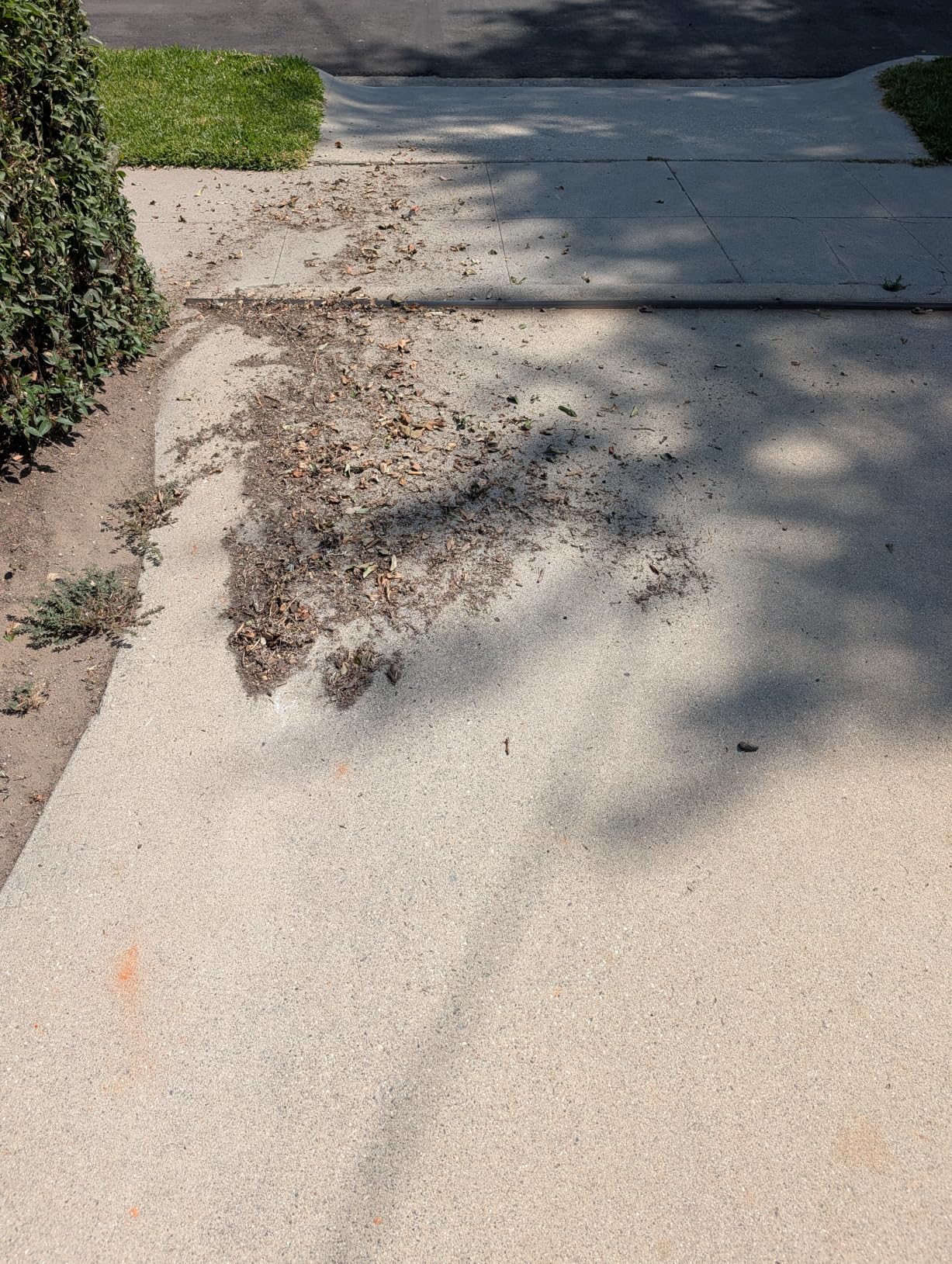
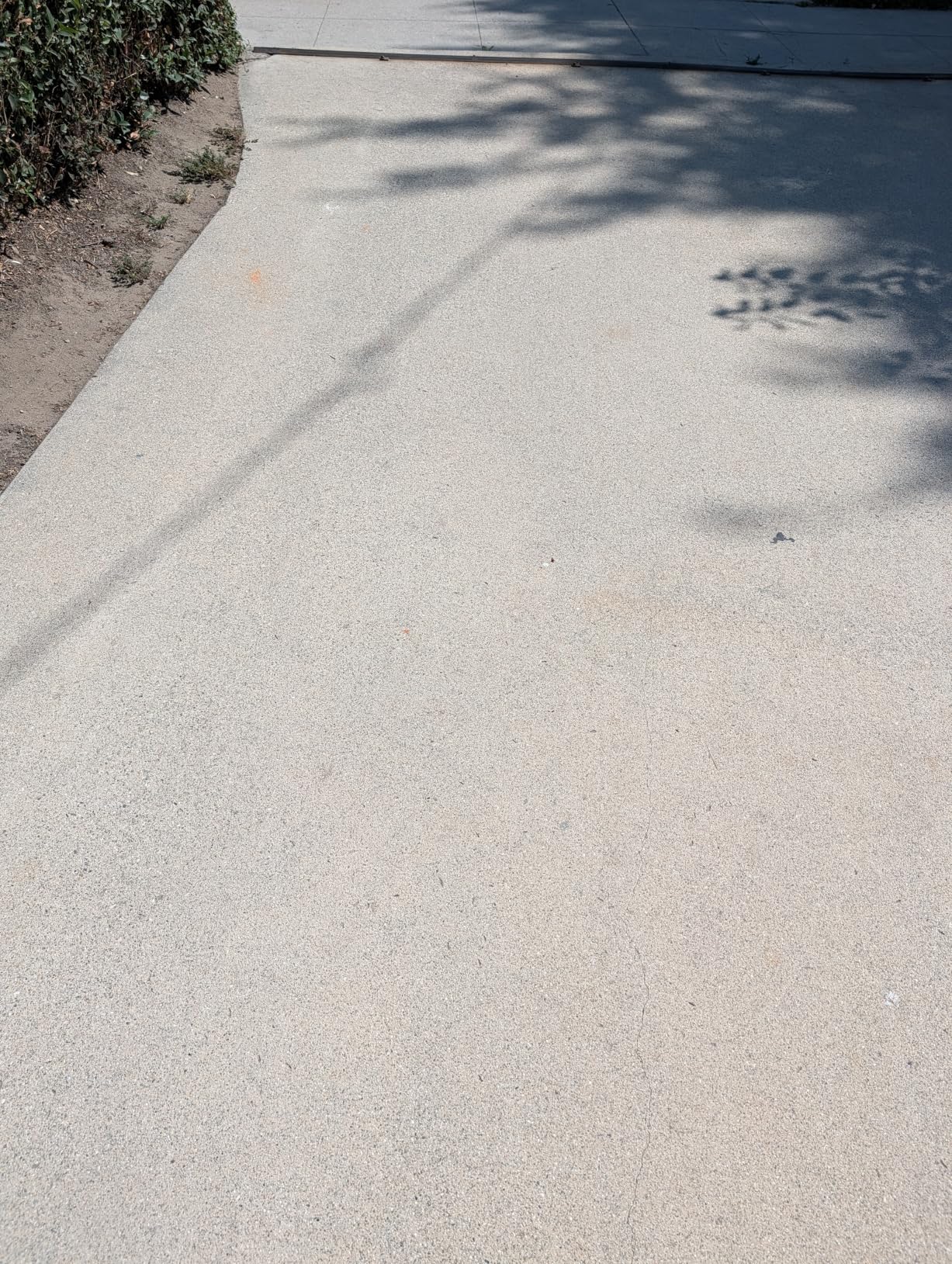
The YOOVL LB-8184 splits opinions on wet work more sharply than any other machine here, and that split is worth understanding before you buy. Owners using it on dry leaves, grass clippings and light snow are very satisfied. Multiple reviewers who tried it on damp or soaked leaves and pine needles embedded in turf say it is underpowered and recommend something stronger.
On paper it looks like a wet-leaf machine, with a 650 CFM turbo claim and a high mode described as suited to heavy wet piles. In practice the airflow feels like it does not carry as far as the figure implies once the leaves are saturated.
Where it does shine is battery logistics. Two 5.2Ah packs come in the box, so one charges while the other runs, which removes the downtime that frustrates owners of single-battery blowers during a long wet afternoon.
Note the real runtime figure rather than the advertised total. On the high setting owners get closer to 30 minutes per battery, not the 150 minutes the listing suggests across both packs on low.
When it is the right call
If your yard produces grass clippings, dry leaf drifts and light snow rather than sodden mats, this is a well-balanced kit with dual batteries and a quiet motor. The adjustable shoulder strap spreads weight on larger properties, even if the single-point clip design is awkward.
It is also a good commuter-style choice for patios, garages and driveways where you want cordless convenience without noise complaints.
When to skip it
If wet clumps fused into the lawn are your regular problem, do not buy on the 650 CFM headline. That split verdict from owners who actually tested it on damp material is the most consistent warning in the reviews.
It also carries the widest rating spread in this roundup at 68 percent five-star with a notable 10 percent three-star cluster, which tracks the same divide between light-duty buyers and wet-leaf buyers.
8. LOSART CYJ – Best for One-Handed Wet Work
LOSART Leaf Blower Cordless, 650CFM & 3 Speed Levels, 1200W Electric Cordless Leaf Blower with 2 x 5.0Ah Batteries & Fast Charger, Blowers for Lawn Care, Yard, Blowing Leaves, Dust, Snow
650 CFM with tapered nozzle
20V
4.4 lb body
Two 5.0Ah batteries
2-year warranty
Pros
- Up to 650 CFM from a 4.4 lb body
- Two 5.0Ah batteries with fast charger
- Shoulder strap and detachable body for storage
- Quieter than expected for its power class
Cons
- Batteries are not cross-compatible with DEWALT packs
- Long-term durability unproven at this review volume
- No independent verification of the 1200W output claim
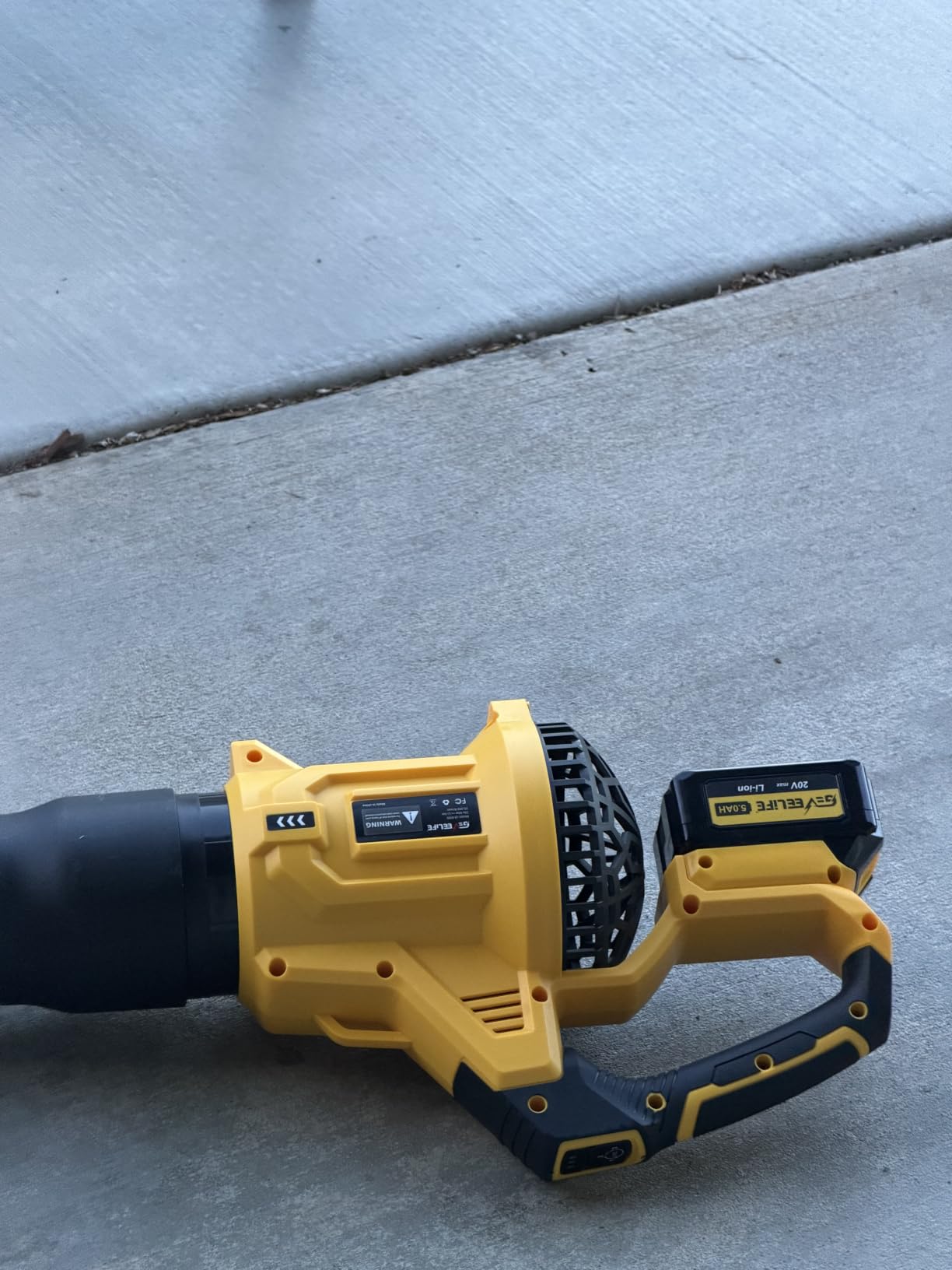
The LOSART CYJ is the answer for anyone who finds 9 lb hand tools punishing. At 4.4 lb it is one of the lightest machines here that still claims up to 650 CFM with the tapered nozzle, and owners describe it as surprisingly powerful for its weight.
The dual-battery setup is the most-praised feature in the reviews, with owners highlighting the ability to charge one while the other runs. A detachable body and included shoulder strap make storage and carrying simple.
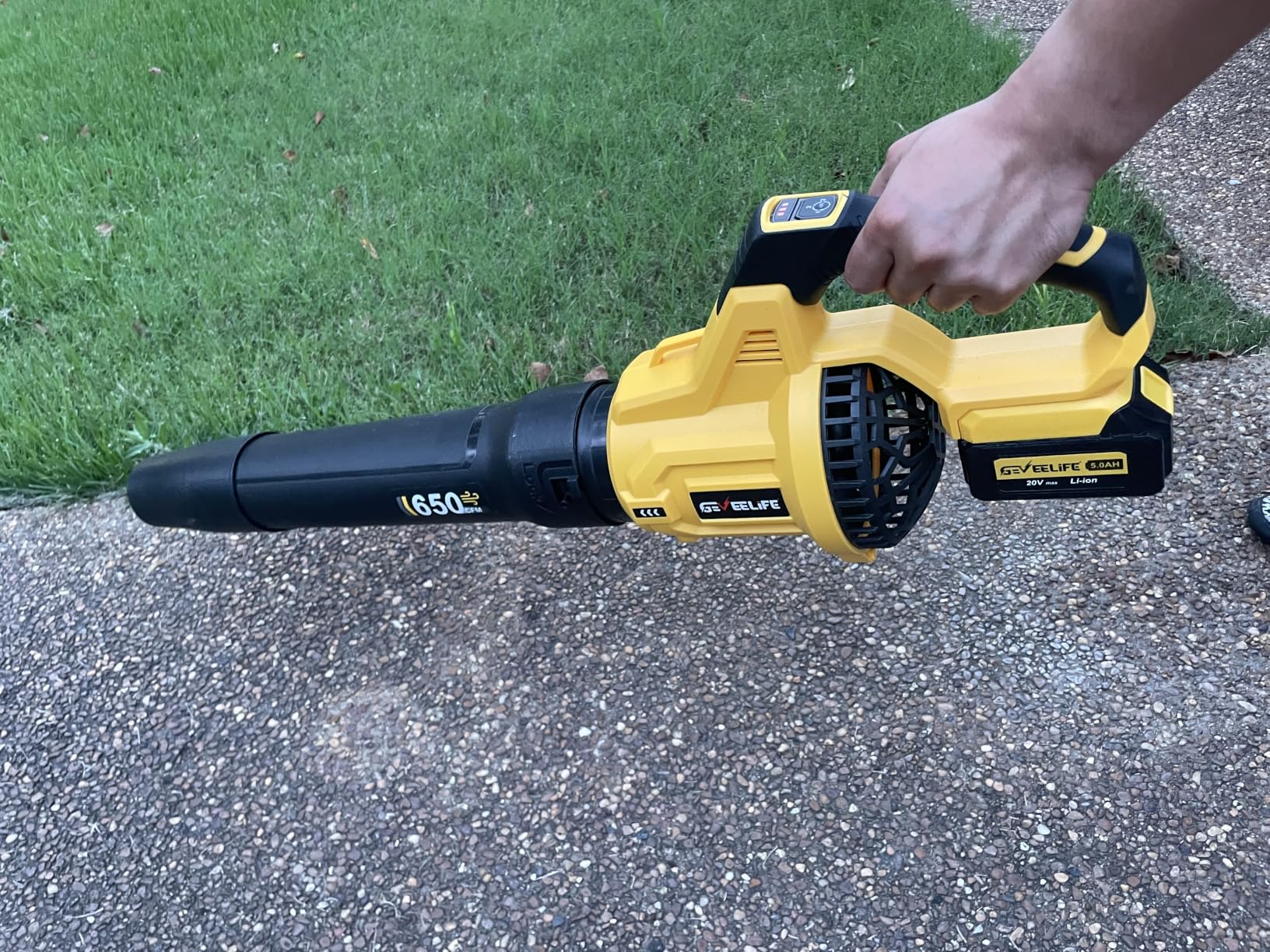
Quiet operation comes up repeatedly as a genuine surprise for the power class, and at 3-speed control you get enough range for dust, grass clippings and heavier leaf debris on one tool.
The caution is platform compatibility. The 20V 5.0Ah packs look similar to DEWALT packs and the listing says so explicitly: they will not work in DEWALT tools. Plan around that rather than hoping it works.
Why weight matters more on wet days
Wet cleanup takes longer than dry cleanup because clumps break apart slowly and you re-work sections. Extra weight compounds over that longer session, so a 4.4 lb tool that keeps up is genuinely better ergonomics than a heavier one that struggles.
The 2-year warranty and the included shoulder strap suggest the manufacturer expected sustained use, and the lower weight means older users and anyone with joint issues can keep a full speed setting without the wrist fatigue that stops other jobs.
Where the uncertainty sits
The 4.5 rating comes from 249 reviews that are almost entirely recent. That is not enough history to know how the batteries and the brushless motor hold up over five seasons, which matters if this is a tool you plan to keep.
No independent verification of the 1200W output claim appeared in user feedback either. Treat the CFM figure as a claim rather than a measured value until you see it on your own wet pile.
9. MZK ET1613 – Best for Low-Noise Operation
MZK 20V Cordless Leaf Blower, Lightweight Electric Blower
600 CFM
130 MPH
20V
65 dB
3.9 lb claimed
Two 4.0Ah batteries
Pros
- Quiet at 65 dB for early or late cleanup
- Up to 90 minutes of runtime per charge claimed
- One-hand operation at a claimed 3.9 lb
- Handles leaves snow dust debris and car surfaces
Cons
- Only two speed settings so airflow control is coarse
- Lowest average rating in this group at 4.3
- Advertised air speed and weight figures differ between sections of the listing
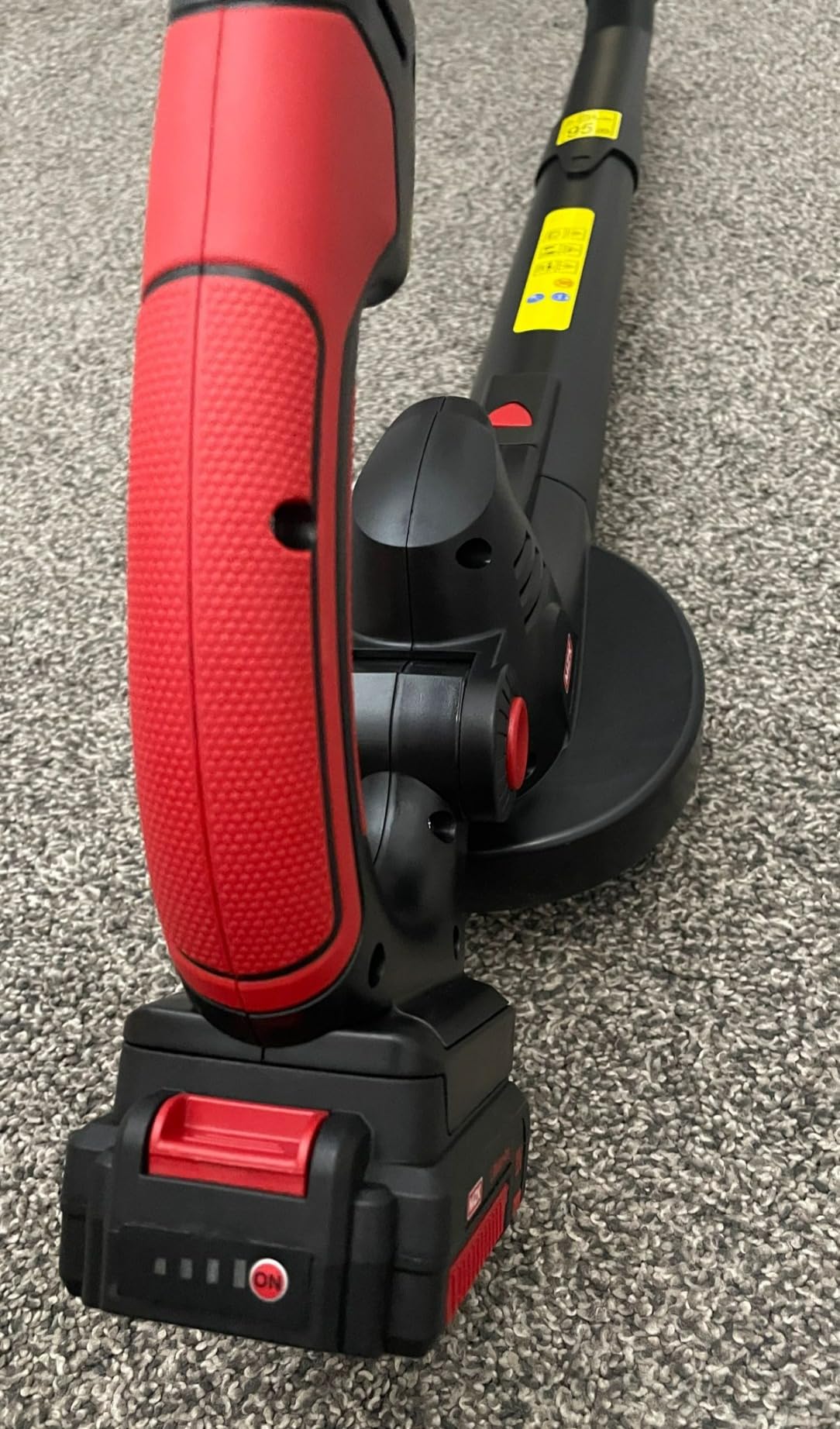
The MZK ET1613 is the machine to consider when noise is your binding constraint. At 65 dB it is the quietest figure among the wet-capable options here, and owners frequently call that out as a real advantage for early-morning or late-evening cleanup when neighbors are sensitive.
Wet-leaf performance is adequate rather than impressive. The 600 CFM and 130 MPH figures put it just below our threshold, and with only two speed settings there is no turbo burst for the stubborn section of a sodden pile.
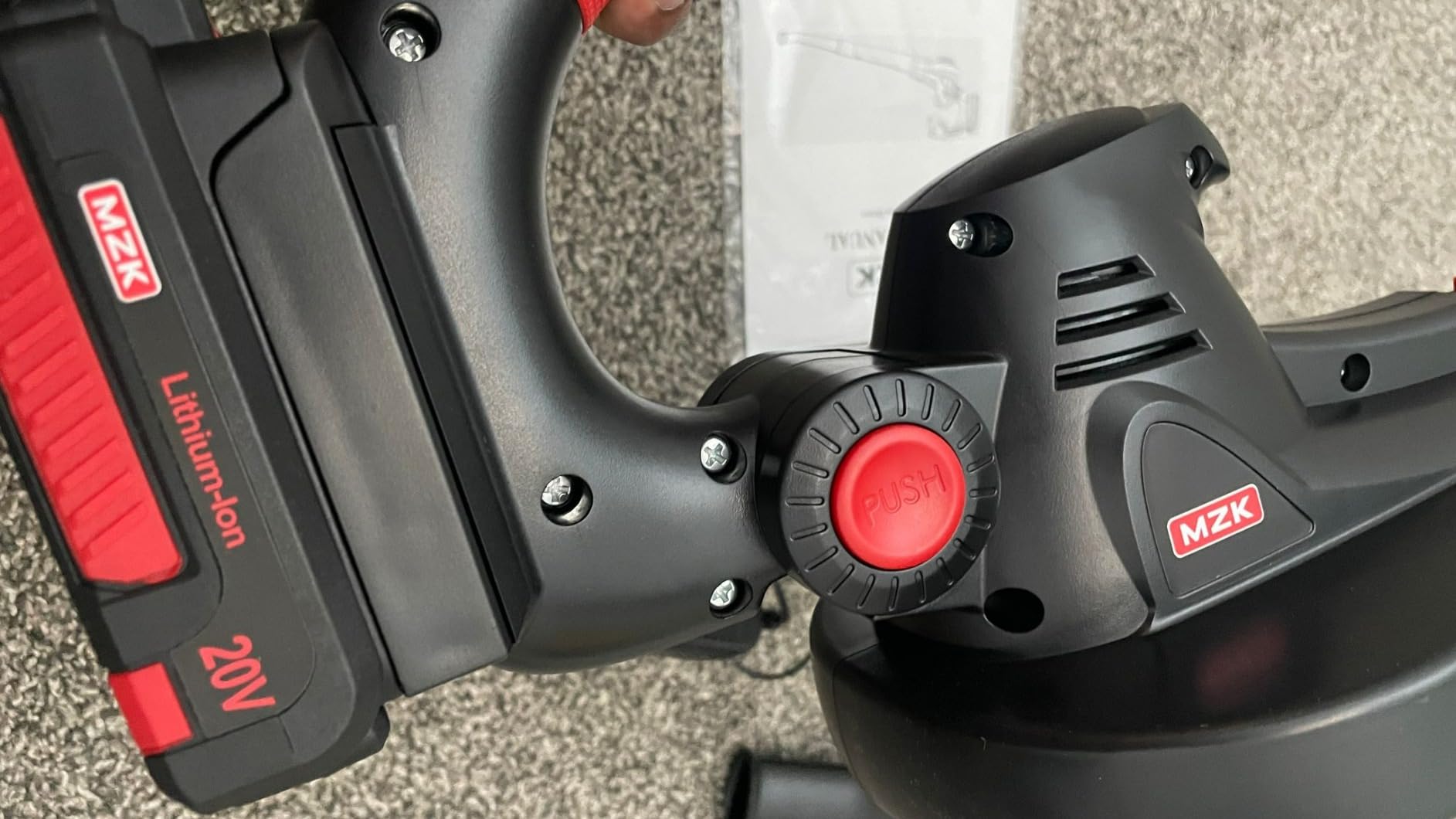
It does handle more than leaves. Snow, dust, debris and spider webs are routine, and owners mention using it to dry car surfaces, which is a job most leaf blowers are never tested for.
The 90-minute runtime claim per charge is generous, and two 4.0Ah batteries come in the box, so the battery side of the equation is better than most of the budget machines here.
When low noise solves the real problem
Wet-season cleanup stretches out because clumps need multiple passes, and that extended window is exactly when neighbor complaints happen. A 65 dB blower lets you start earlier and finish later without a dispute, which is worth more than raw CFM for some households.
For apartment-adjacent yards, small urban lots and properties with strict noise expectations, quiet operation is often the deciding factor between two otherwise similar machines.
Where the listing contradicts itself
Be aware that the product description and the specifications block give different figures. Air speed is listed as 200 MPH in one place and 130 MPH in the other, and weight appears as both 3.9 lb and 6.3 lb. Plan on the more conservative numbers.
The 4.3 average rating is the lowest in this group with a 6 percent one-star share, and an 8 percent three-star cluster suggests some buyers were disappointed by output relative to the headline 600 CFM claim.
10. DEWALT DCE100B – Best for Jobsite Dust and Tight Corners
DEWALT 20V MAX Blower, 100 CFM Airflow, Variable Speed Switch, Includes Trigger Lock, Bare Tool Only (DCE100B)
100 CFM
135 MPH
20V MAX
2.5 lb
Three nozzles
Trigger lock
Pros
- Only 2.5 lb so it is easy to hold for long stretches
- Three-speed switch plus variable trigger for real control
- Trigger lock-on reduces finger fatigue on sustained runs
- Compact design works in space-restricted areas
Cons
- Only 100 CFM so it is not a wet-leaf machine
- Bare tool only so battery and charger are extra
- Lower airflow means more passes over damp material
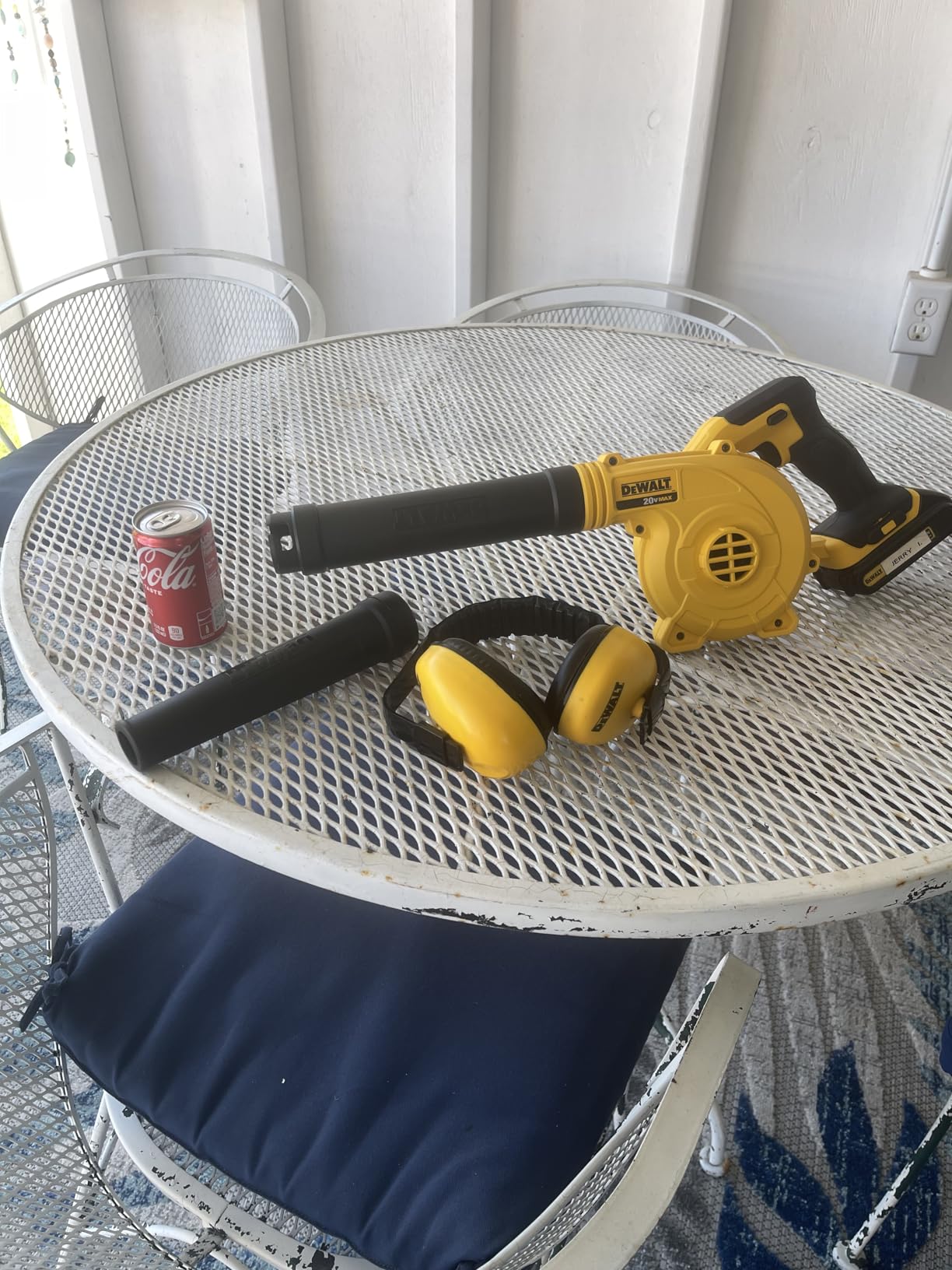
Let us be direct about where the DEWALT DCE100B fits. At 100 CFM it is by a wide margin the lowest airflow machine in this roundup, and it will not clear a wet leaf mat. It is a jobsite blower that happens to be cordless, and it is included here because owning one alongside a proper wet-leaf blower is a common and sensible setup.
What it does offer is extreme lightness at 2.5 lb and genuinely fine control. The three-speed variable switch, variable trigger and trigger lock-on let you feather the airflow precisely, which is useful in corners you cannot physically fit a full-size blower into.
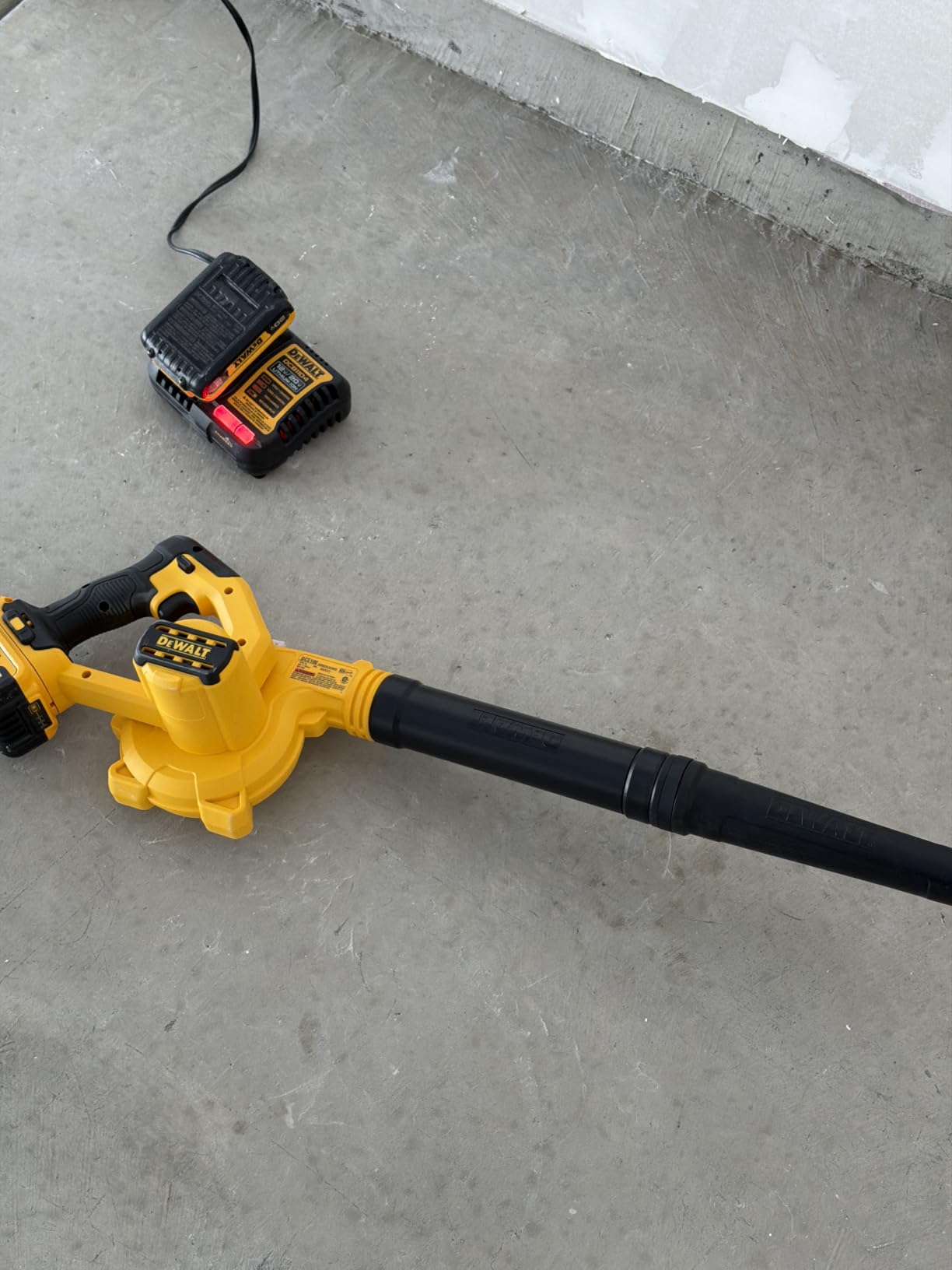
With more than 15,600 reviews it is the most proven tool in the set, and the consensus is that it is dependable for dust, debris and hard-to-reach areas. Three nozzle attachments are included.
The 7 percent one-star share is the highest here, driven almost entirely by buyers who expected a leaf blower and got a cleanup tool instead. That mismatch is the whole story with this machine.
Why owners keep buying it anyway
Trigger lock plus a 2.5 lb weight means you can hold it overhead in a garage or along a fence line for as long as the job takes. Nothing else in this roundup does that comfortably.
For anyone already running 20V MAX packs it is also a very cheap way to add a cleanup tool to an existing platform, since the blower itself is bare tool only.
When to buy something else instead
If your goal is wet leaves, any of the 600-plus CFM machines in this roundup will outperform it several times over. You will spend the afternoon re-sweeping the same mat and the 100 CFM figure is the reason why.
It is also bare tool only, so a first-time buyer adds battery and charger cost on top of a blower that still will not do the wet-leaf job.
11. JAGROM jalbgy001 – Best for Patios and Garages
Electric Leaf Blower Cordless with 3.0Ah Battery and Charger, 680CFM
680 CFM
230 MPH
20V
4.4 lb
Two 3.0Ah batteries
Two speed settings
Pros
- Highest airspeed figure in the group at 230 MPH
- Two 3.0Ah batteries included so you can swap mid-job
- Lightweight enough for comfortable one-handed use
- Two adjustable tubes for different working heights
Cons
- Only two speed settings so there is no burst for soaked leaves
- Battery depletion and one pack failure reported
- Suited to light duty rather than heavy wet loads
The JAGROM jalbgy001 posts the most eye-catching numbers in this group at 680 CFM and 230 MPH, and it is the lightest machine that claims them at 4.4 lb. For patios, driveways, decks and garage floors it does an excellent job on dry debris, dust, light snow, pine needles and gravel.
Wet leaves are where the paper and the practice diverge. At least one reviewer explicitly said they did not test it on wet debris, and another said they should have bought something stronger. With only two speed settings there is no high-output burst for the section that matters most.
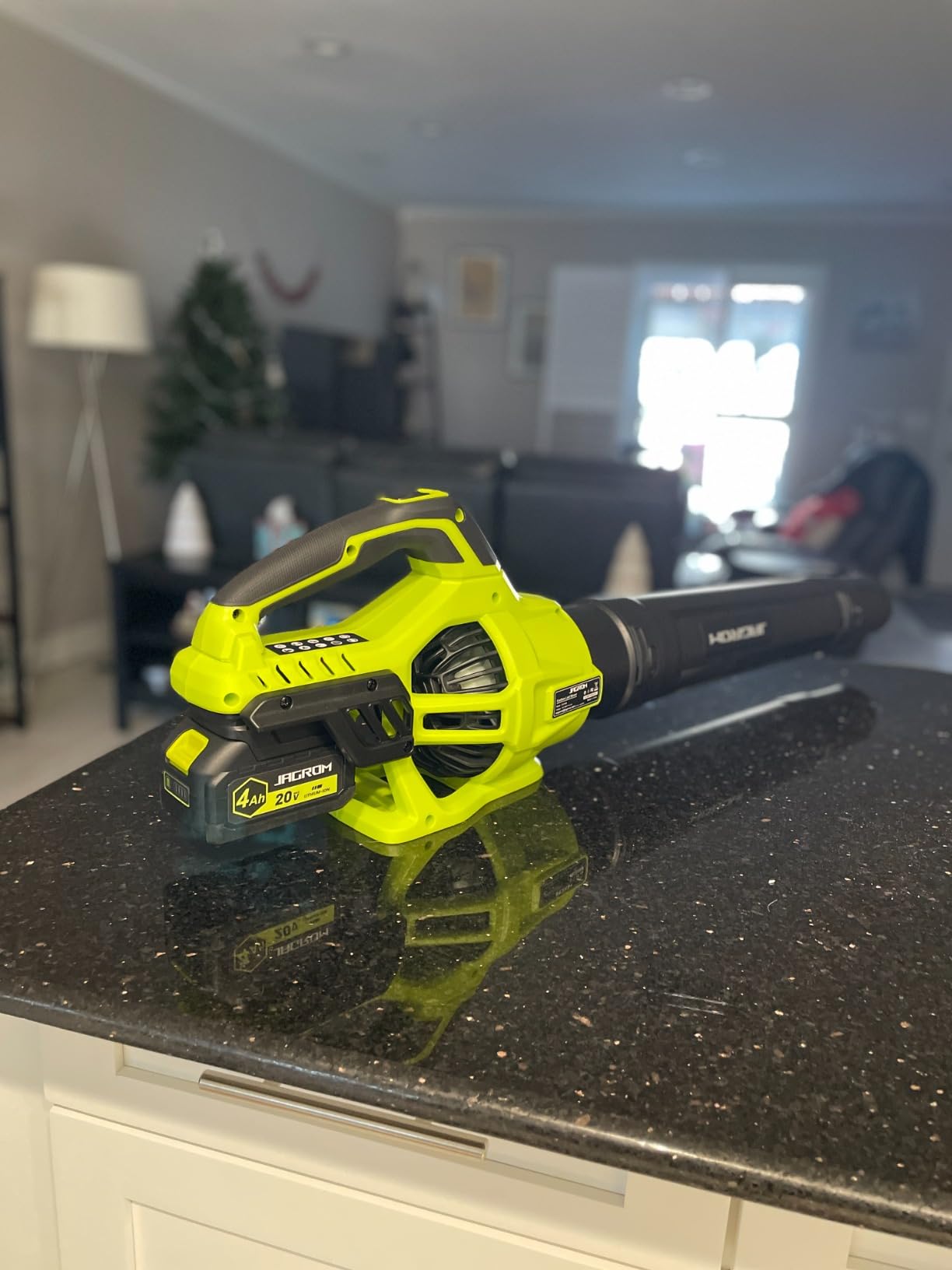
The two 3.0Ah batteries give roughly 40 minutes of combined runtime with a power indicator light showing remaining charge and progress. Assembly is quick, you just fit the tube and the battery.
Two adjustable tubes are included, which lets you change the working height without crouching on a wet lawn, a small ergonomic win for people with back issues.
Where it earns its place
Anyone clearing a hard surface rather than a lawn gets a lot of value from this one. Dust, gravel, clippings and light snow from patios and garage floors are exactly the jobs the two speed settings cover well, and the light weight means one-handed operation all afternoon.
It is also a fast assembler, which matters if you want to keep it in a closet and bring it out rather than dedicating garage space to it.
Why we would not recommend it for wet leaves
Two speed settings is the core problem. Wet work needs a sustained high setting plus a burst above it, and this machine offers neither. Owners describe it as light duty, and for a wet leaf yard that is the wrong tool.
Battery longevity is the other concern, with several buyers reporting quick depletion and one pack failing outright. The charger also plugs directly into the battery with no charging base, which is convenient and also leaves the packs exposed.
12. CRAFTSMAN CMCBL730P1 – Best for Compact Wall Storage
CRAFTSMAN Leaf Blower Cordless with Battery and Charger V20 RP, Up to 110 MPH Power, Handheld Electric Leaf Blower, Brushless Motor, Lightweight, 5.0Ah (CMCBL730P1)
410 CFM
110 MPH with boost
20V
71 dB
Up to 24 minutes runtime
3-year warranty
Pros
- Boost button delivers 410 CFM and 110 MPH on demand
- Brushless motor gives 37 percent more force
- Compact design is easy to maneuver in tight spaces
- Integrated hook hangs it on the VERSATRACK wall system
Cons
- 410 CFM suits lighter wet debris rather than soaked piles
- Up to 24 minutes runtime suits smaller yards
- Battery and charger availability limited outside the platform
The CRAFTSMAN CMCBL730P1 is a compact, quieter option for smaller yards where 410 CFM and 110 MPH are genuinely enough. That means light wet debris, damp leaf drifts and the cleanup around shrubs rather than the heavy soaked piles this roundup is built around.
Owners point to the boost button and the low noise as the standouts, and treat it as a good lighter-duty yard tool. At up to 50 percent less noise than gas it is comfortable for early cleanup, and the compact body moves easily in tight spaces.
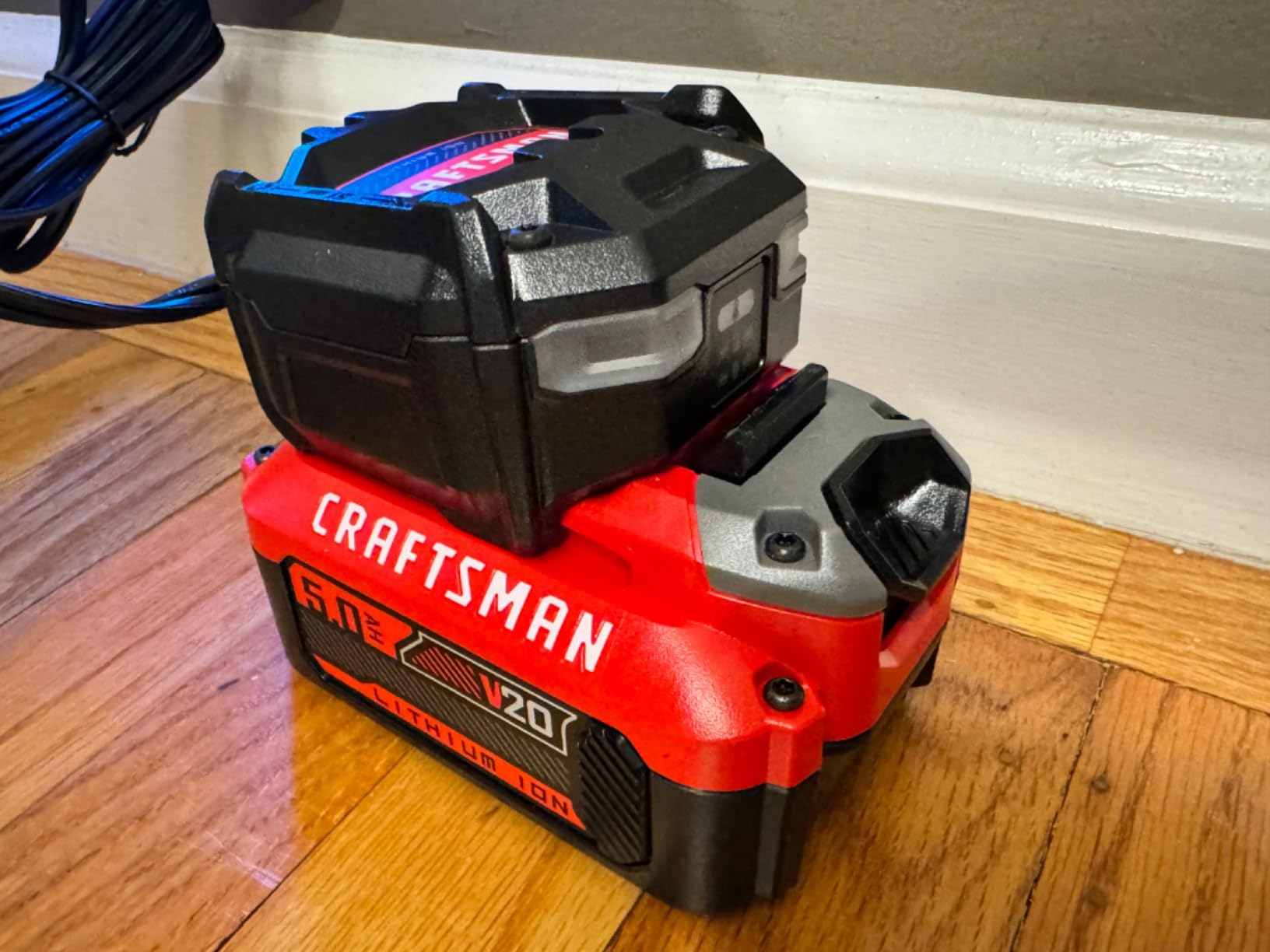
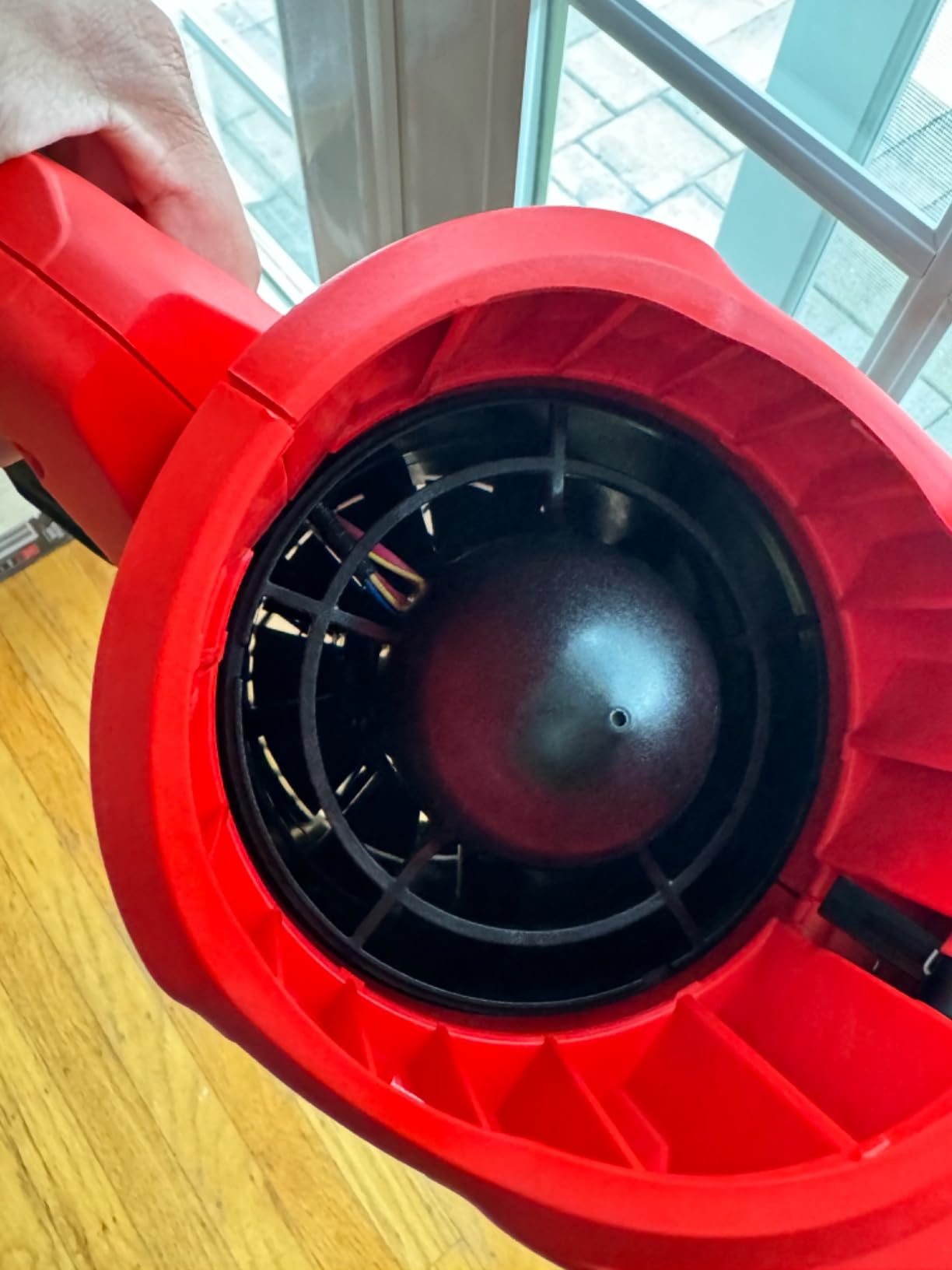
The brushless motor provides 37 percent more force and up to 24 minutes of runtime, and WeatherGuard technology helps shield the tool from moisture and dust, which is reassuring when you are working right after rain.
Be clear-eyed about the 24-minute figure though. That is short, and it is why this one suits smaller yards or repeated short sessions rather than a single long cleanup of a large property.
Where it works well for wet material
Light, damp leaves that have only just fallen work well here, and the boost button handles the occasional stubborn piece without needing to abandon a lighter setting. The compact body also makes it the easiest tool here to maneuver around flower beds and mulch beds.
The VERSATRACK-compatible hook is a genuine convenience for anyone with limited garage space, since the blower hangs out of the way rather than occupying shelf you need for wet-weather jobs.
When it falls short
410 CFM is well below the wet-leaf threshold we set, so a sodden mat is out of reach. You will be moving loose material, not fused piles, and that distinction matters if you have mature trees.
Battery and charger availability outside the CRAFTSMAN platform is limited, so if you own other brands of yard tools this one does not share packs with them. With 361 reviews it is also among the least-documented picks here.
How to Choose a Battery Leaf Blower for Wet Leaves
Start with the two numbers and ignore everything else until you have them. Air volume gets you across the lawn; airspeed gets the mat off the grass. Below 550 CFM or under 130 MPH, wet leaves will stall almost any handheld, and no amount of clever technique fully compensates.
Between 550 and 650 CFM you can handle damp leaf drifts and moderately wet debris. At 650 CFM and 145 MPH or above you are in genuine wet-leaf territory. For mats that have been rained on for several days, keep climbing until you are near 800 CFM, because that is the load where even strong handheld blowers start needing multiple passes.
Match Air Volume and Airspeed to the Job
Read CFM and MPH as a pair rather than picking the bigger number. A machine with 680 CFM but 130 MPH will spread air across a wide area gently, which is perfect for loose leaves and terrible for breaking up a clump. A machine with 165 MPH and 400 CFM will punch hard and cover little ground.
The best wet-leaf setups in this roundup give you both. The WORX WG585 switches between volume and speed modes with one nozzle rotation, and the EGO LB7654 pairs 765 CFM with a 200 MPH turbo setting. That combination is what lets you break a mat loose first and then carry it.
Look for a genuine turbo or boost mode and check whether it locks on. A latched turbo lets you hold a stubborn setting without your thumb cramping. Several machines here have a turbo button that must be held down continuously, which is fine for a short burst and tiring across a whole wet pile.
Handheld or Backpack for Wet Piles
Weight matters more for wet work than for dry work, because wet cleanup takes longer. Every extra pound is felt over an hour of wet passes rather than a twenty-minute dry session. If your blower weighs more than about 8 lb with the battery installed, plan on using the shoulder strap or moving to a backpack frame for large properties.
An ar15.com forum user framed the handheld-versus-backpack decision well: a handheld will do any blowing you want unless you need a backpack blower and are doing piles and piles of wet leaves in the fall. For large, tree-heavy properties with wet mats, sustained backpack power without wrist fatigue is the safer bet.
Backpack blowers are also the better answer if you already have a big battery investment in that platform, since most manufacturers offer the highest-output models only in backpack form. Check whether you already own compatible packs before deciding.
Battery Platform Cheat Sheet
Platform lock-in is the single biggest cost trap in this category, and users consistently resent paying tool-only prices when they already own batteries on a different system. Work out which platform you are in before you shop.
EGO POWER+ 56V works with all EGO 56V ARC Lithium batteries. The LB7654 here is built around the 5.0Ah pack, and older 2.5Ah packs will not run it.
WORX PowerShare Pro 40V covers more than 140 tools. The WG585 ships with two 4.0Ah packs that work across the whole platform.
Makita 18V LXT covers one of the broadest ecosystems in the industry. The XBU03Z is tool only, which is cheap if you already own packs.
DEWALT 20V MAX covers the DCE100B, and DEWALT 60V FLEXVOLT covers the DCBL772B. Same brand, two separate platforms.
Greenworks 40V shares the pack across 75+ Greenworks tools including mowers, trimmers and chainsaws.
DongCheng 20V/40V packs work across DongCheng tools, which is a small ecosystem compared with the majors.
CRAFTSMAN V20 RP is a closed platform with limited cross-brand availability.
Buying tool-only is the smart move when you already own packs on that platform, and it is the approach forum users consistently recommend for repeat wet-season use. Just confirm the voltage and the Ah rating match, because a lower-capacity pack on a high-draw blower will disappoint you on runtime.
Noise, Neighbors, and Local Bans
Many towns now restrict gas blowers or limit the hours they can be used, and the decibel figures on the box are worth reading before you commit. In this group the range runs from 64 dB on the EGO LB7654 and 65 dB on the MZK ET1613 up to 79 dB on the DongCheng.
That is a meaningful spread for neighbor relations, and it is exactly why wet-season cleanup generates complaints. Because wet leaves take longer to move, the machine runs for more hours, so noise matters more than it would for dry cleanup.
Check your local ordinances before buying, and if a noise rule applies, the lower-decibel machines here will keep you on the right side of it without much loss of wet-leaf capability. For related seasonal cleanup gear, our driveway snow blower guide covers the same dense-material problems in winter.
Frequently Asked Questions
What is the best leaf blower for clearing wet leaves?
The EGO POWER+ LB7654 leads our testing for wet leaves, pairing 765 CFM of air volume with 200 MPH airspeed and a turbo mode. For most yards the threshold is roughly 650 CFM and 145 MPH or better, because wet leaves need airspeed to break the mat loose and volume to carry it.
Do leaf blowers work with wet leaves?
Yes, but only if they have enough airflow. Dry leaves separate easily, while wet leaves clump and mat into the turf and weigh several times more. Anything below about 550 CFM and 130 MPH tends to stall on wet material, and vacuum-style blowers can clog their chute entirely when leaves are damp.
What are the common problems with battery operated leaf blowers?
The recurring complaints are clogged intakes on wet material, short runtime on high and turbo settings, wrist fatigue from long sessions, and battery platform lock-in. Buyers also report spec inflation, where advertised airflow does not match real output, and worn intake guards on older tools.
How much CFM do I need for wet leaves?
Around 650 CFM is the practical floor for damp and wet leaf work, paired with at least 145 MPH of airspeed. Genuinely sodden mats that have been rained on for several days need closer to 800 CFM. Below 550 CFM, expect to re-sweep the same section repeatedly.
What are the most powerful battery leaf blowers on the market?
By headline figures, the JAGROM jalbgy001 lists 680 CFM and 230 MPH, and the EGO POWER+ LB7654 delivers 765 CFM at 200 MPH with verified output. Maximum CFM and usable wet-leaf power are different things though, so judge by measured performance rather than the largest number on the box.
Will rain ruin a battery leaf blower?
Rain will not damage a battery blower, and many models include moisture shielding on the tool body. The real problem is the leaves, not the machine. Keep batteries and chargers out of standing water, and expect more clogs and slower clearing when the material is wet.
Is a cordless leaf blower as powerful as a gas one?
For wet leaves on a normal yard, a high-output cordless blower in the 650 CFM range handles the job as well as a mid-size gas unit, and owners of the EGO LB7654 report replacing gas machines outright. For very large properties with sodden mats, gas and backpack blowers still hold an edge on sustained runtime.
Why are leaf blowers being banned?
Local bans usually target noise and emissions. Many towns restrict gas blowers or limit the hours they can run, and some set decibel limits measured at a set distance from the property line. Cordless models are quieter and often exempt, which is why noise ratings are worth comparing before you buy.
Our Final Pick for Wet Leaves This 2026
The EGO POWER+ LB7654 is our pick among these best battery leaf blowers for wet leaves, because 765 CFM and 200 MPH give it the widest margin over the wet-leaf threshold of anything we tested, and the cruise-control dial lets you match airflow to each section of the yard as the mats break down.
The WORX WG585 is the better value if you already own PowerShare batteries, and the Makita XBU03Z is the finest-made tool here for lighter damp cleanup. Check which platform you already own before buying anything, since that decision matters more to your wallet than any spec on the box.
If your problem is genuinely sodden mats on a large property, a backpack blower from the platform you already run will beat any handheld we listed. And if noise is the constraint, the quieter models in this roundup let you start earlier and finish later without a dispute.