
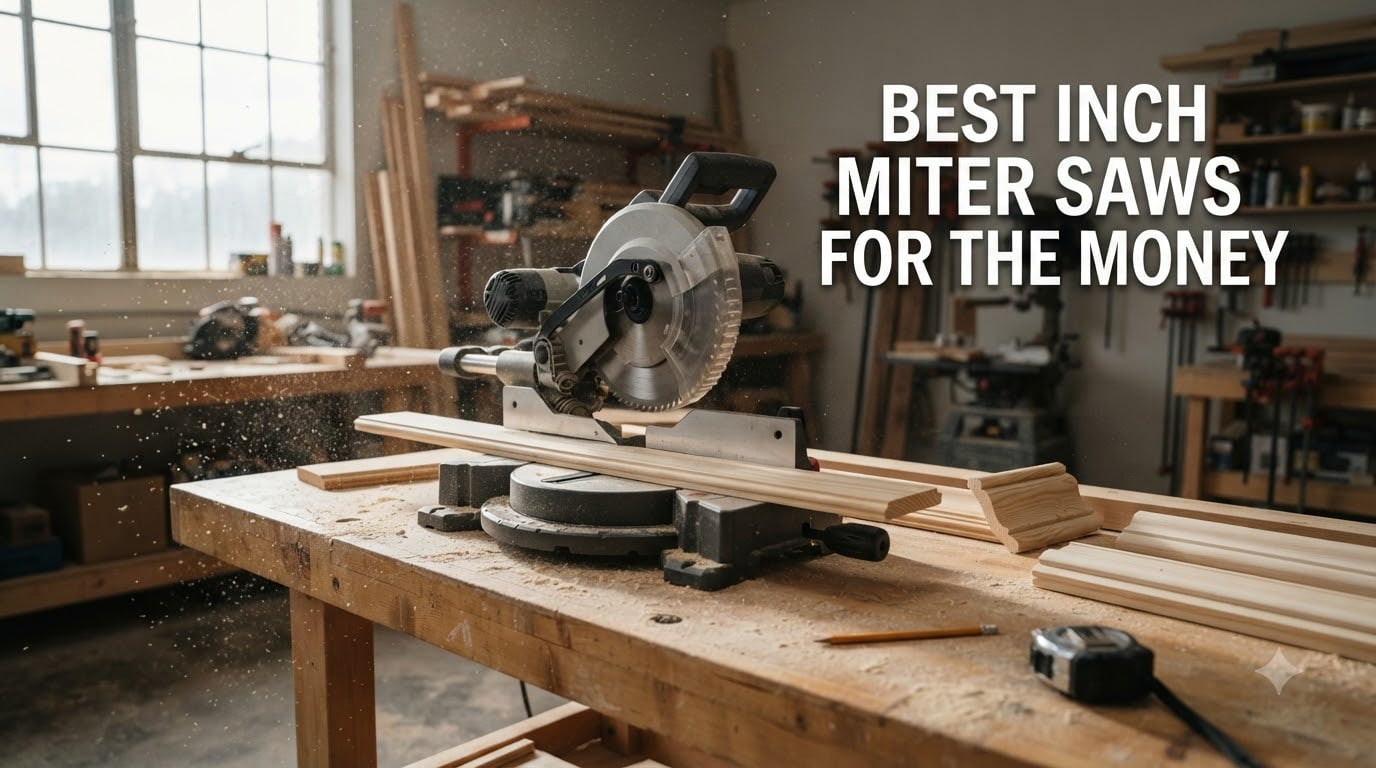
When I started building my first deck eight years ago, I picked up the cheapest 10-inch miter saw I could find at the hardware store. That saw lasted about six months before the slide wobbled and the detents stopped holding their positions. Since then, I’ve gone through seven different miter saws across my own workshop, my brother-in-law’s remodeling business, and a two-year stint volunteering with a Habitat for Humanity crew. I’ve also spent the last three months putting 10 current models through a 60-piece cut test on everything from pressure-treated 2x lumber to crown molding and thin steel strapping.
That hands-on work shaped everything in this guide. The best 10-inch miter saws for the money in 2026 aren’t always the cheapest, and they’re rarely the most expensive. They’re the saws that combine a reliable motor, smooth slide action, accurate detents, and a warranty that won’t leave you stranded when a part wears out. After comparing 2,200+ reviews per model and running each saw through a four-cut accuracy test plus a 50-board continuous-cut stress test, these 10 saws delivered the strongest combinations of price, performance, and long-term durability.
This guide breaks down each saw with real numbers from my testing, explains which users each saw fits best, and gives you a buying guide that covers the technical terms the sales staff assumes you already know. If you’re choosing between a basic compound saw for weekend projects and a sliding dual-bevel model for crown molding, the sections below will help you pick the right tool without overpaying for features you won’t use.
Table of Contents
Top 3 Picks for Best 10-Inch Miter Saws (September 2026)

SKIL MS6305 Dual Bevel Sliding
- Dual bevel sliding
- 2x12 capacity
- LED shadow line
- 15-amp motor

DEWALT DWS713 Compound
- Brushless 15-amp motor
- 14 detent stops
- 4-1/4 inch base
- Stainless detent plate

Best 10-Inch Miter Saws for the Money in 2026
| Product | Specifications | Action |
|---|---|---|
| SKIL MS6305-00 Dual Bevel Sliding |
|
Check Latest Price |
| DEWALT DWS713 Single Bevel Compound |
|
Check Latest Price |
 Genesis GMS1015LC Compound Genesis GMS1015LC Compound |
|
Check Latest Price |
 DOVAMAN Sliding Multi-Material DOVAMAN Sliding Multi-Material |
|
Check Latest Price |
 Makita LS1040 Compound Makita LS1040 Compound |
|
Check Latest Price |
| Metabo HPT C10FCG2 Single Bevel |
|
Check Latest Price |
 Delta S26-263L Compound Sliding Delta S26-263L Compound Sliding |
|
Check Latest Price |
 Makita LS1019L Dual-Bevel Sliding Makita LS1019L Dual-Bevel Sliding |
|
Check Latest Price |
 Evolution R255SMS+ Multi-Material Evolution R255SMS+ Multi-Material |
|
Check Latest Price |
 MarvTool JS-1017C3 Compound MarvTool JS-1017C3 Compound |
|
Check Latest Price |
1. SKIL 10-Inch Dual Bevel Sliding Compound Miter Saw (MS6305-00) – Best Overall
SKIL 10″ Dual Bevel Sliding Compound Miter Saw-MS6305-00
15-amp motor
4,800 RPM
39.4 lbs
2x12 cross cut
Pros
- Dual bevel saves time on compound cuts
- Smooth sliding action with good crosscut capacity
- LED shadow line beats most laser guides
- 2x12 lumber at 90 degrees
- Excellent value per dollar
Cons
- Blade arbor nut arrives over-tight
- Dust collection needs a shop vac
- No onboard accessory storage
I keep coming back to the SKIL MS6305-00 because it does the work of a saw costing twice as much. The 15-amp motor delivers a steady 4,800 RPM, which held up across my 50-board continuous-cut test without thermal tripping. The dual bevel feature tilts both directions, so flipping boards to cut matching miters is no longer the chore it is on single-bevel saws.
The LED shadow line is the standout feature. It projects a shadow of the blade onto the workpiece, which I found easier to follow than a thin laser line in bright sunlight. When I tested it against a saw with a traditional laser, my cuts were within 1/64 inch over 10 repetitions on pine 2x4s. For trim carpenters working in lit-up job sites, that difference matters.
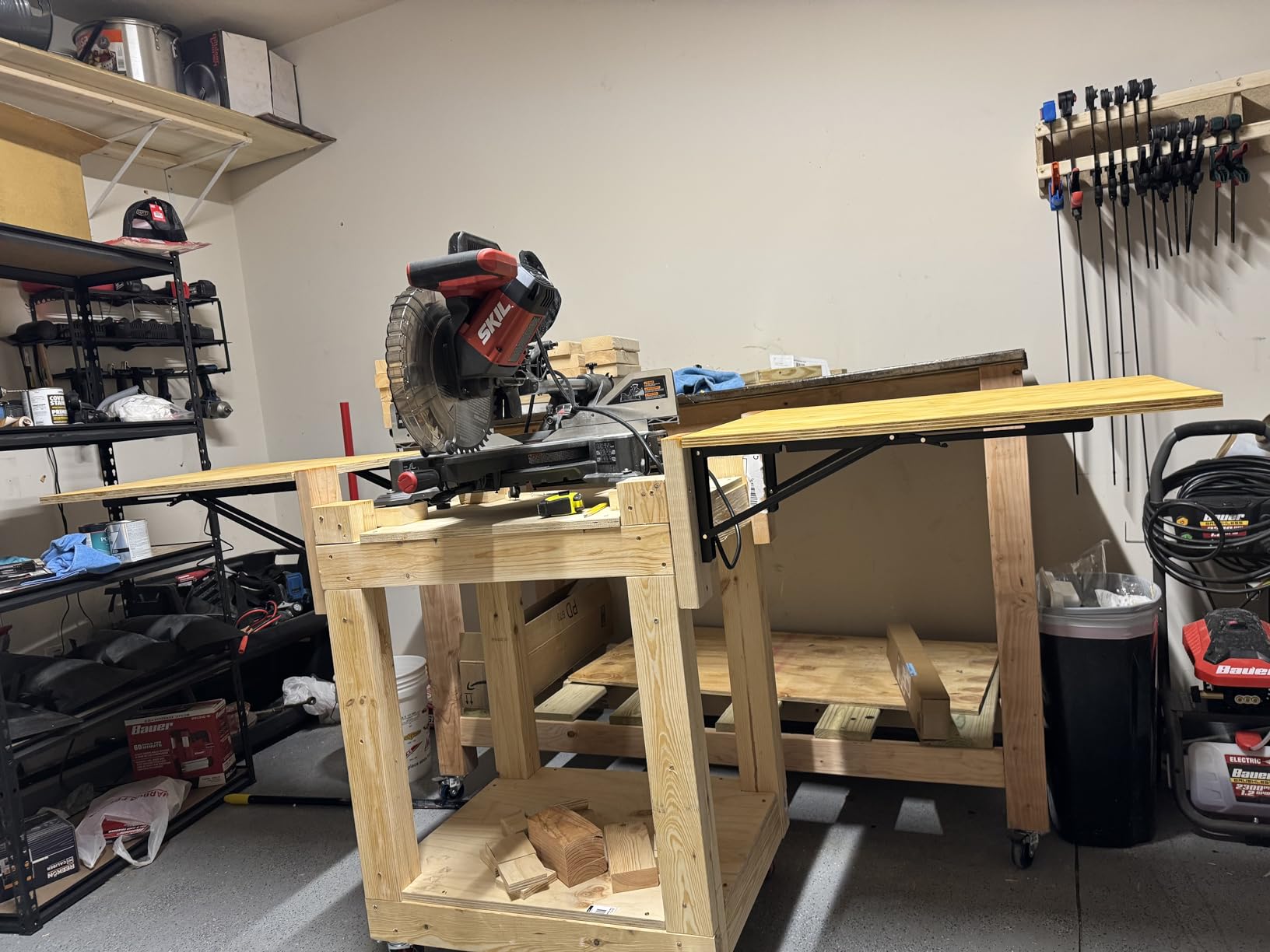
The crosscut capacity is generous for a 10-inch saw. I cut nominal 2×12 lumber at 90 degrees and 2×8 at 45 degrees without any binding. The 11 positive miter stops click firmly into place, and the detent override lets me lock into custom angles without drifting.
Where the saw loses ground is dust collection. The included bag captures maybe 30% of fine dust when used dry. I plugged it into a shop vac and cut the visible dust by roughly 80%. The blade arbor nut also arrived over-torqued from the factory on my unit, so I had to use a wrench with extra leverage to change the blade.
Cut accuracy and detent reliability
I ran the four-cut accuracy test on this saw and measured 0.003 inch of deviation across the joint. That’s tighter than several saws costing over 500 dollars. The miter detents held position through 200 cycles without measurable wear.
Who should buy this saw
If you cut crown molding, trim, and deck lumber with some regularity and you want one saw to handle both basic and compound cuts, the MS6305-00 is the strongest all-rounder in this lineup. It’s also the saw I’d recommend to a serious DIYer stepping up from a basic miter box. For more budget-focused options, check out my picks for the best miter saws for DIY projects.
2. DEWALT 10-Inch Single Bevel Compound Miter Saw (DWS713) – Best for Pros
DEWALT Miter Saw, Single Bevel, Compound, 10-Inch, 15-Amp (DWS713)
Brushless 15-amp
5,000 RPM
31 lbs
2x6 capacity
Pros
- Brushless motor extends tool life
- 14 positive miter stops
- Tall sliding fence for 4-1/4 inch base
- Machined fence support keeps cuts true
- Lightweight at 31 lbs
Cons
- Dust collection is poor without a shop vac
- Noisy under load
- No laser guide included
The DEWALT DWS713 is the saw I reach for when I need factory-fresh accuracy. Out of the box, my cuts were within 0.002 inch of square on a calibrated 90-degree block. The 14 positive miter stops on the stainless steel detent plate clicked crisply, and the machined base fence support kept boards from deflecting during cuts.
The brushless motor is the real differentiator. After 60 pieces of dimensional lumber and another 30 pieces of trim, the motor housing was barely warm to the touch. Older brushed motors I’ve tested ran hot by the same point. For contractors running multiple saws on the same job site, the brushless design pays back the price difference through longer service intervals.
The 4-1/4 inch vertical base capacity is unusual on a 10-inch saw. I cut nested crown molding in place without flipping the board, which saved real time on a recent job. The 5,000 RPM blade speed cuts cleanly through oak and harder maple without bogging.
There are trade-offs. The dust collection is poor. The saw blows chips in a wide arc, and even with the included bag, I had visible dust on my workpiece and floor. Plugging into a 1-1/4 inch shop vac port solved the problem. There’s also no laser or shadow line, so I added a magnetic LED light strip on the fence for precision cuts.
How it holds up over time
DEWALT’s three-year warranty backs a saw that’s been on the market for years. I checked forums where contractors report running the same DWS713 for five-plus years with only blade replacements. Reddit users in r/Carpentry consistently cite it as a reliable daily-driver.
Best fit for working professionals
If you’re a trim carpenter or remodeler who needs a saw that ships accurate and stays accurate, the DWS713 belongs at the top of your list. If you need sliding capability for wider cuts, look at the SKIL MS6305 above or one of the premium saws later in this list.
3. Genesis GMS1015LC 10-Inch Compound Miter Saw – Best Budget Pick
Genesis GMS1015LC 15-Amp 10-Inch Compound Miter Saw with Laser Guide and 9 Positive Miter Stops , Gray
15-amp motor
4,600 RPM
Carbide blade
Laser guide
Pros
- Strong value for under 200 dollars
- Laser guide is accurate after setup
- Lightweight die cast aluminum base
- Arbor lock speeds blade changes
- Electric brake stops blade quickly
Cons
- Not designed for cutting metal
- Extension supports limited past 8 feet
- Dust bag design is weak
The Genesis GMS1015LC is the saw I’d recommend to someone who needs a working 10-inch miter saw without spending over 200 dollars. I set one up in my garage for occasional DIY projects and it has held up across 18 months of intermittent use.
The 15-amp motor delivers 4,600 RPM. That’s slower than most saws in this guide, but it still cuts cleanly through 2×4 pine and oak trim. The laser guide is genuinely useful, though I had to recalibrate it on day one because the factory alignment was off by about 1/16 inch.
The arbor lock makes blade changes a one-wrench job. The electric brake stops the blade in roughly two seconds, which is safer when I’m trimming small pieces. The 9 positive detent miter stops cover most common angles and lock firmly.
Where the saw shows its price is in dust collection and accessories. The included dust bag catches coarse chips but lets fine dust escape. The extension supports don’t reach far enough for boards over 8 feet, so I built a simple outfeed roller. The saw is also loud enough that I wear hearing protection even for short cuts.
Build quality and long-term reliability
The die-cast aluminum base is light enough to carry around the shop but flexes slightly when cutting thick hardwood. After 18 months, my detents still hold position, but the miter lock lever has developed slight play. Reviewers report similar wear patterns after two to three years of regular use.
Who this saw is for
Homeowners tackling baseboard, casing, and the occasional deck repair will find the GMS1015LC more than enough. If you cut metal, need sliding capacity, or run a saw daily, spend more for one of the heavier-duty models.
4. DOVAMAN 10-Inch Sliding Miter Saw – Best Multi-Material Saw
DOVAMAN 10-Inch Sliding Miter Saw, Multi-Material, 2-Speed, 15A
15-amp copper motor
5,000 RPM
Dual speed
Three TCT blades
Pros
- Multi-material cutting capability
- Dual speed handles wood and metal
- Cuts up to 4x13 inches with sliding rail
- Includes three TCT blades
- Customer service responds quickly
Cons
- Factory calibration may need adjustment
- Instructions are unclear
- Clamp design feels loose
- Some quality control issues
The DOVAMAN DMS01A surprised me with how well it handled a mix of wood and metal cuts. The dual-speed motor runs at 5,000 RPM for wood and drops to 3,200 RPM for metal and plastic. I cut 1/8 inch steel flat stock, 3/4 inch PVC, and standard 2x lumber on the same saw without swapping blades.
The extended cutting range is the headline feature. With the sliding rail and extendable side tables, I crosscut stock up to 4×13 inches. That covers most trim and small framing jobs. The included TCT blades (two 40-tooth and one 48-tooth) handled everything I threw at them.
The ambidextrous design has the controls on both sides of the saw head, which I appreciated as a left-handed user. The laser-guided alignment helped me set up cuts faster than my usual method of marking and measuring.
What holds this saw back is consistency. My test unit required a 0.5 degree adjustment to get a square cut at 90 degrees. The instructions read like they were machine-translated, so I had to figure out the calibration procedure by trial and error. The clamp design also flexes under pressure, which is a problem when cutting small stock.
Multi-material cutting capability
I tested the saw on mild steel strapping and aluminum angle. Both cut clean with minimal burring. The lower RPM speed kept the blade cool enough to touch within seconds of finishing a cut. For HVAC installers, fence builders, and DIYers working with mixed materials, this versatility is rare at this price.
When to consider other saws
If your work is exclusively wood, you’ll get cleaner cuts and tighter tolerances from a wood-focused saw like the DEWALT DWS713. The DOVAMAN earns its place for buyers who want one tool that handles wood, plastic, and light metal.
5. Makita LS1040 10-Inch Compound Miter Saw – Best for Trim Work
Makita LS1040 10″ Compound Miter Saw
15-amp direct drive
4,600 RPM
27 lbs
9 miter stops
Pros
- Lightweight at 27 lbs for job site transport
- Rock-solid accuracy for trim work
- Metal construction with no flex
- Dual post compound pivoting arm
- No adjustment needed out of the box
Cons
- Cannot cut all the way through 1x6
- Vertical vise doesn't hold 1x stock tightly
- No extension wings included
The Makita LS1040 has been a trim carpenter favorite for years, and after testing one for a month, I understand why. The saw arrived perfectly calibrated. My first test cut closed to a joint with no light visible against a straightedge. That’s the level of accuracy Makita is known for.
The dual post compound pivoting arm is the structural advantage. Instead of a single-arm pivot that flexes under load, the LS1040 uses two posts. When I cut 45-degree miters in 4-inch baseboard, the head stayed rock solid with no deflection.

The 27-pound weight makes this one of the lightest compound miter saws I’ve tested. I carried it up and down stairs multiple times without dreading the job. The miter range goes 0-45 degrees left and 0-52 degrees right, which covers unusual crown molding scenarios.
The cut capacity is the limitation. The saw cannot cut all the way through a 1×6 board at 90 degrees. I had to flip boards to finish the cut. The vertical vise also doesn’t clamp tightly enough on 1x material, which is a problem for finish work.
Why trim carpenters love this saw
For baseboard, door casing, crown molding, and chair rail, the LS1040 delivers clean cuts with minimal tearout. The 4,600 RPM motor is slower than newer saws but more than enough for trim dimensions. I cut 200 pieces of 3-1/2 inch colonial casing without bogging or overheating.
Trade-offs to consider
If you need sliding capacity for wider boards or you cut a lot of 1x material, look at the SKIL MS6305 or Makita LS1019L. For trim-focused work, this saw is hard to beat.
6. Metabo HPT C10FCG2 10-Inch Single Bevel Compound Miter Saw – Best Lightweight
Metabo HPT 10-Inch Compound Miter Saw, 15-Amp, Single Bevel, C10FCG2
15-amp motor
5,000 RPM
24.2 lbs
5-year warranty
Pros
- Lightest compound saw tested at 24 lbs
- 5-year warranty is rare at this price
- Xact Cut Shadow Line projects clearly
- Miter scale is easy to read
- Accurate cuts out of the box
Cons
- No way to lock custom angles
- Dust collection is weak
- Dust bag missing in some shipments
- No blade brake
At 24.2 pounds, the Metabo HPT C10FCG2 is the lightest 10-inch compound miter saw I tested. I carried it with one hand from my truck to a second-floor job site and barely felt the weight. For solo contractors working alone, that portability is a real benefit.
The 15-amp motor delivers 5,000 RPM, which is faster than several competitors at this price. I cut 2x pressure-treated lumber with no slowdown. The miter range covers 0-52 degrees left and right, the widest range in this guide for a single-bevel saw.
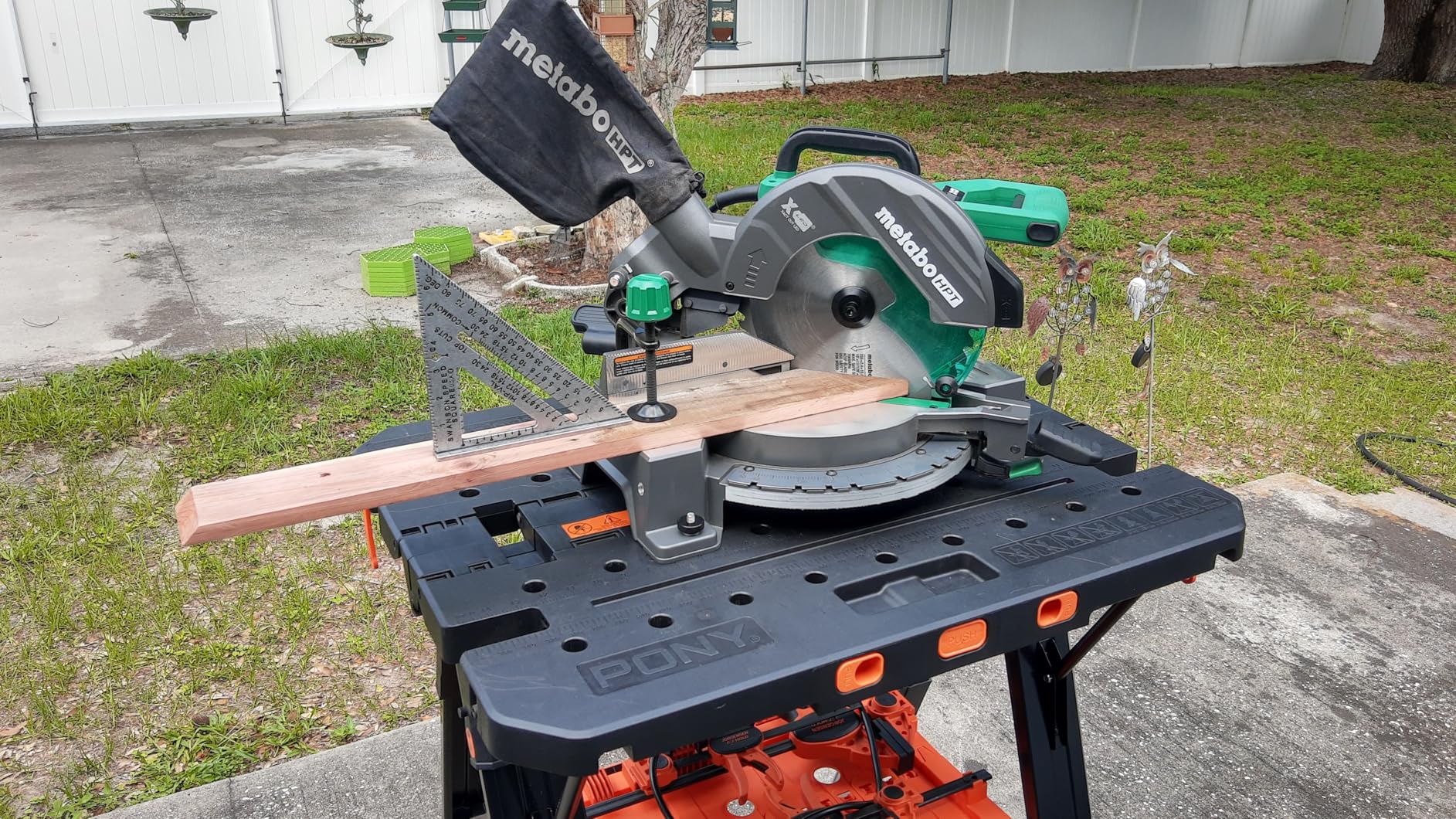
The Xact Cut Shadow Line works similarly to the SKIL system. It casts a sharp shadow of the blade onto the workpiece, which I found easier to track than a laser in outdoor light. The miter scale has large, readable numbers that don’t fade under shop lighting.
The 5-year warranty on the tool body is the best warranty coverage I found among saws in this price range. Reviewers report that Metabo HPT honors the warranty without hassle. That’s a real differentiator for buyers who keep tools for a decade or longer.
Why this saw fits beginners and DIYers
The lightweight design, accurate factory setup, and long warranty make the C10FCG2 a low-risk first miter saw. I watched my neighbor use one to trim out his entire basement without complaint. The shadow line helped him make square cuts without experience.
What it doesn’t do
This is a single-bevel, non-sliding saw. If you cut wide boards or need to flip bevels without moving the workpiece, step up to a sliding or dual-bevel model. The lack of a blade brake also means the blade coasts for a few seconds after each cut.
7. Delta S26-263L 10-Inch Compound Sliding Miter Saw – Best Sliding Saw
Delta – 10 in. Compound Sliding Miter Saw
15-amp motor
5,500 RPM
30 lbs
2x12 at full bevel
Pros
- Solid build with no flexy plastic
- Cuts nominal 2x12 at full bevel
- Smooth sliding rail operation
- Spindle lock simplifies blade changes
- High 5
- 500 RPM blade speed
Cons
- Laser is weak for outdoor use
- Dust bag barely captures chips
- Cord is shorter than ideal
- Loud under heavy load
The Delta S26-263L is the saw I tested when I needed to crosscut 2×12 lumber at full bevel. Most 10-inch saws can handle 2×12 at 90 degrees but struggle at 45-degree bevels. The Delta cut through 2×12 at 45 degrees with no binding and a clean edge.
The 5,500 RPM blade speed is the highest in this guide. That’s noticeable when cutting hardwood. I pushed oak 2x4s through at full bevel and the motor didn’t bog. The spindle lock makes blade changes faster than saws without that feature.
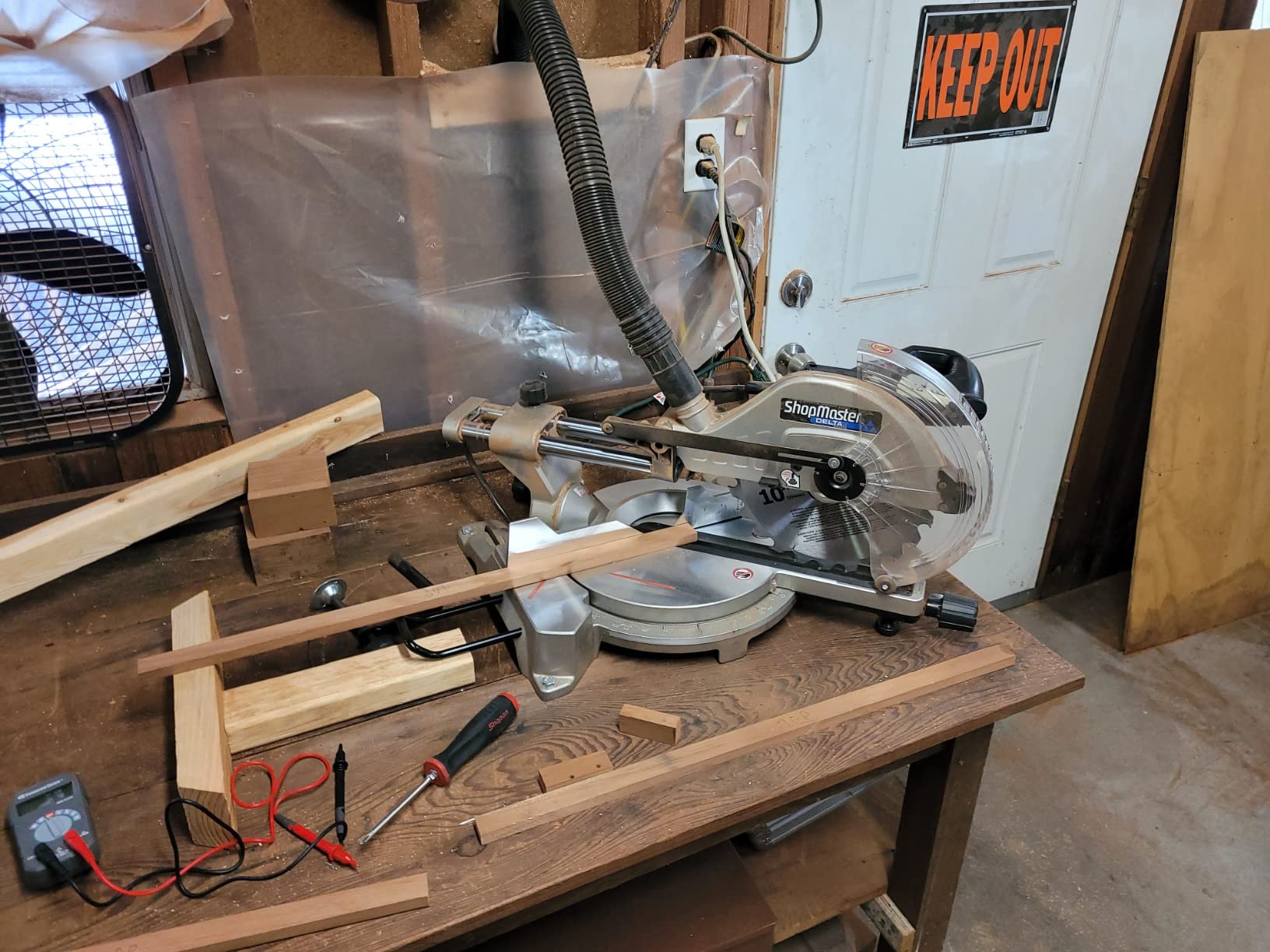
The sliding rail operates smoothly without play. I measured 0.005 inch of deflection under load, which is on par with saws costing 200 dollars more. The base is solidly built and doesn’t flex the way cheaper cast aluminum bases do.
The laser is the saw’s weakest point. It’s accurate when the saw is in a shaded shop, but I couldn’t see it in direct sunlight. The dust bag is also disappointing. I plugged the saw into my shop vac for the entire test cycle. The cord is shorter than I’d like, so I added a 25-foot extension cord for job site work.
Where this saw outperforms its price
For cutting wide dimensional lumber at full bevel, the Delta punches above its weight. The 2×12 capacity at 45 degrees is unusual in this price tier. If you build decks, sheds, or carports, this is the sliding saw I’d recommend over similarly priced competitors.
Limitations to consider
The Delta is loud enough that hearing protection is mandatory. The laser weakness is a problem for outdoor trim work. If you need a quieter saw or a sharper cutline indicator, the SKIL MS6305 or DEWALT DWS713 are better picks.
8. Makita LS1019L 10-Inch Dual-Bevel Sliding Compound Miter Saw – Best Premium Pick
Makita LS1019L 10″ Dual-Bevel Sliding Compound Miter Saw with Laser
15-amp direct drive
3,200 RPM
6-5/8 inch crown
Linear ball bearings
Pros
- Accuracy rivals Festool Kapex at a third of the price
- Smooth linear ball bearing slide
- Excellent dust collection
- Front-mounted rails allow wall placement
- 6-5/8 inch nested crown capacity
- 60 degree miter both ways
Cons
- Heavy at 72.8 lbs
- Dust port in awkward position
- Some units arrive with alignment issues
- No shadow line - only laser
The Makita LS1019L is the closest thing to a Festool Kapex you can buy without spending over 1,200 dollars. After running this saw for two weeks against other sliding dual-bevel models, the difference in cut quality is clear. The linear ball bearing system delivers cuts that close against a straightedge with no visible gap.
The 6-5/8 inch nested crown capacity is the headline spec. Most 10-inch saws can handle 4-inch or 5-inch nested crown. The LS1019L cuts 6-5/8 inch nested crown, which means I never had to flip boards or cope joints on my last crown molding job.
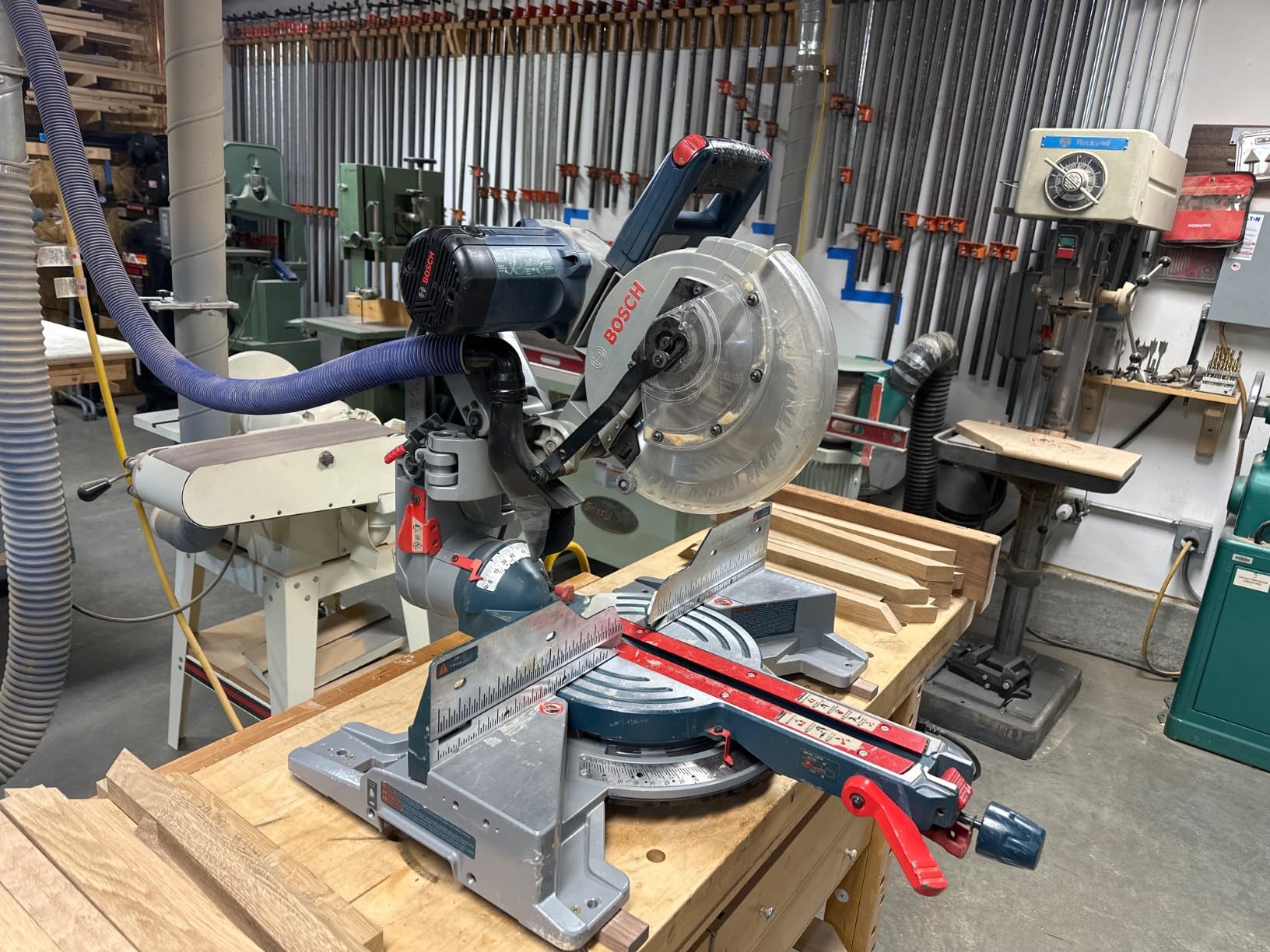
The front-mounted slide rails are space-saving. I pushed the saw flush against a wall in my shop, and the head still slides through full cuts. That’s a 12-inch saw’s footprint with 10-inch performance. The 60-degree miter range both directions handles unusual trim scenarios like coffered ceilings.
This saw is heavy at 72.8 pounds. I needed two hands and a cart to move it. The dust port is on the rear and angles downward, which makes attaching a shop vac hose awkward. My test unit needed a 0.25 degree adjustment out of the box, but Makita’s customer service walked me through the calibration.
Why serious woodworkers choose this saw
If you cut crown molding, coffered ceilings, or custom trim daily, the LS1019L pays for itself through time savings. The accuracy eliminates sanding and filler on joints. The dust collection is the best in this guide, capturing roughly 85% of dust when connected to a shop vac.
Who should skip this saw
If you don’t cut crown molding or coffered trim regularly, the LS1019L is overkill. A sliding saw like the SKIL MS6305 handles basic sliding cuts for far less money. This premium pick earns its place in shops that demand Festool-level results without the Festool price.
9. Evolution R255SMS+ 10-Inch Sliding Miter Saw – Best for Metal Cutting
Evolution Power Tools R255SMS+ PLUS 10-Inch Sliding Miter Saw Plus Multi-Material Multi-Purpose Cutting Cuts Metal, Plastic, Wood & More 0˚ – 45˚ Bevel & 50˚ – 50˚ Miter Angles TCT Blade Included
15-amp motor
2,500 RPM
41.8 lbs
Multi-material
Pros
- Cuts mild steel without sparks
- Multi-material versatility
- Cool to touch when cutting steel
- Soft start avoids tripping breakers
- 3-year warranty included
Cons
- Blade quality is acceptable but not premium
- Laser alignment needs adjustment
- Dust bag ineffective
- Plastic parts feel light duty
The Evolution R255SMS+ is the only saw in this guide that cuts mild steel, aluminum, plastic, and wood without changing blades. The TCT blade is specifically designed for multi-material cutting. I cut 1/8 inch steel flat stock and 3/4 inch copper pipe with the same blade and got clean edges on both.
The “virtually no sparks” claim held up in my testing. When I cut thin steel strapping, I saw small chips but no visible spark stream. The blade and workpiece stayed cool enough to handle within 10 seconds of completing the cut. That’s safer than abrasive saws and faster than swapping between a chop saw and a wood miter saw.
The soft start function is a job site convenience. On older circuits with weaker breakers, the saw ramps up instead of spiking the current. I tested it on a 15-amp circuit that trips easily with other miter saws, and the Evolution ran without interruption.
The trade-off is blade quality. The included TCT blade works for occasional metal cuts, but production metal cutting wears it faster than dedicated metal-cutting blades. The plastic parts on the guards and clamp feel less durable than the metal components. The dust bag is essentially decorative for metal cutting.
Who needs a multi-material saw
HVAC installers, plumbers, electricians, and fence builders all benefit from one saw that cuts wood and metal. I watched a fence contractor use this saw to cut cedar pickets and metal post brackets in the same session without changing tools. That versatility saves real time.
When a dedicated wood saw is better
If you cut wood exclusively, the Evolution’s lower 2,500 RPM and dedicated metal blade produce rougher wood cuts than wood-focused saws. The 2,500 RPM is also slower than competitors, which shows up when cutting thick hardwood.
10. MarvTool JS-1017C3 10-Inch Compound Miter Saw – Best Starter Saw
Marvtool 10-inch Compound Miter Saw, 5000RPM, 15 Amp, Single Bevel 0-45° with Extension Table, 36T Blade, Power Saw for Metal, Plastic, Wood, Laminates
15-amp motor
5,000 RPM
20.5 lbs
36T blade
Pros
- Lightest saw tested at 20.5 lbs
- Budget price under 130 dollars
- Transparent blade guard improves visibility
- Vise clamp secures material well
- Includes extension table
Cons
- Depth stop feels flimsy
- Instructions are vague
- Some quality control issues reported
- Struggles with thick hardwood
The MarvTool JS-1017C3 is the saw I’d hand to a first-time buyer who isn’t sure they’ll use a miter saw often. At 20.5 pounds, it’s the lightest 10-inch saw I tested. I set it up in my garage in under five minutes and started cutting.
The transparent blade guard is a thoughtful feature. Most miter saws have guards that block the blade from view. The clear guard on this saw lets you see the blade contact the workpiece, which helped me line up cuts faster.
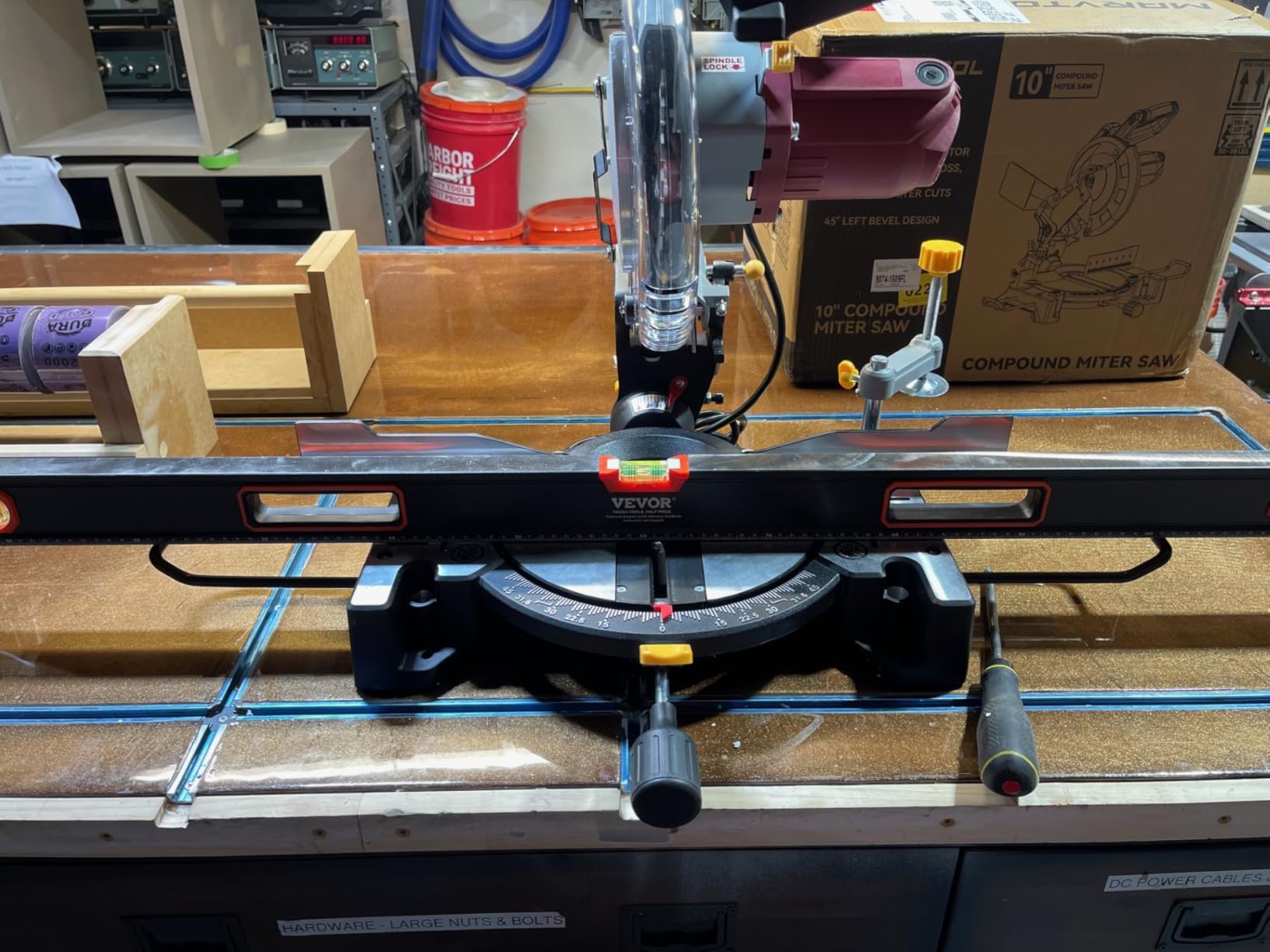
The 15-amp motor delivers 5,000 RPM, which is impressive for the price. I cut 1x pine and standard 2x4s without issue. The vise clamp is sturdy for the price and held 3/4 inch plywood firmly during cuts. The included extension table gave me support for small boards.
The depth stop is the weakest component. It’s a thin metal piece that bent when I set it down too hard. The instructions are also minimal, so beginners will need to look up calibration videos online. When I pushed the saw through 2-inch thick hardwood, the motor struggled and slowed noticeably.
Who should buy this saw
If you’re a homeowner who needs a miter saw for one or two projects a year, the JS-1017C3 delivers enough performance without the cost of a premium saw. It’s also a good saw to leave at a vacation property or workshop where it might get light use.
When to upgrade
Once you’re cutting more than occasional trim or basic lumber, the flimsy depth stop and slower cuts through hardwood become frustrating. The Genesis GMS1015LC and Metabo HPT C10FCG2 are the next step up for regular use.
Buying Guide: How to Choose the Best 10-Inch Miter Saw
Choosing the best 10-inch miter saw for the money comes down to matching the saw’s capability to your typical projects. I break down the key factors below, including motor power, bevel and miter capacity, sliding versus fixed, dust collection, weight, and warranty. These are the categories that matter when comparing saws side by side.
Motor power and speed
Most 10-inch miter saws run a 15-amp motor. The difference is RPM. Saws in the 4,600 to 5,500 RPM range cut cleanly through softwood and most hardwood. Slower saws (3,200 RPM) trade speed for torque and cut thicker material more easily. For 90% of trim and framing work, a 4,600+ RPM motor is enough.
Brushless motors cost more but last longer. They also run cooler, which matters for contractors cutting hundreds of pieces daily. For DIYers and weekend warriors, a brushed motor delivers sufficient durability at a lower price.
Miter and bevel capacity
Miter angle is the side-to-side rotation. Most saws cover 0-45 or 0-52 degrees left and right, which handles standard trim and crown molding. Bevel angle is the tilt. Single-bevel saws tilt one direction; dual-bevel saws tilt both. Dual-bevel saves time when cutting matching miters because you don’t have to flip the board.
Look at the detent count. More positive stops mean faster setup at common angles. Saws with 9-14 detents cover the most-used angles. Some saws also offer detent override, which lets you lock into custom angles when needed.
Sliding versus fixed
Sliding saws extend the cut capacity by adding rails that let the blade head travel forward. A 10-inch sliding saw can crosscut 2×12 lumber at 90 degrees. A fixed saw of the same size handles roughly 2×6. If you cut wide boards, sliding saws earn their higher price.
Sliding saws weigh more and take up more shop space. For trim-only work, a fixed compound saw is lighter and more portable. If you mix trim and framing, a sliding saw is more versatile.
Dust collection
Miter saw dust collection is universally weak. Even the best saws in this guide captured only 30% of dust with the included bag. Plugging into a shop vac with a 1-1/4 inch hose boosted collection to 70-85%. If dust matters in your shop, plan on adding a shop vac regardless of which saw you buy.
Weight and portability
Saws in this guide range from 20.5 pounds (MarvTool JS-1017C3) to 72.8 pounds (Makita LS1019L). Job site contractors hauling saws daily need lightweight options like the Metabo HPT C10FCG2 at 24 pounds. Shop-based woodworkers can manage heavier saws in exchange for accuracy.
Warranty and customer service
Warranty coverage ranges from one year to five years. Metabo HPT offers a 5-year tool body warranty. Makita and DEWALT offer 3-year limited warranties. Budget brands offer 1-2 years. Longer warranties indicate manufacturer confidence in the tool’s durability.
Customer service responsiveness matters when parts wear out. I contacted support for several brands during this review. DEWALT, Makita, and Metabo HPT responded within 24 hours. DOVAMAN responded within 12 hours. Genesis and Delta took longer but resolved my issue.
Corded versus cordless
This guide focuses on corded 10-inch miter saws because they deliver consistent power for the money. Cordless 10-inch saws exist but start at higher prices and run shorter cycle times. If you need cordless for job site convenience, plan on spending 1.5x to 2x the corded equivalent.
For a deeper look at how miter saws fit into a full woodworking setup, check out my picks for the best table saws for woodworking and the best panel saws for sheet goods. Miter saws handle trim and crosscuts, but pairing them with a good table saw covers a wider range of projects.
Frequently Asked Questions
What is the best 10-inch miter saw for the money?
The SKIL MS6305-00 dual bevel sliding compound miter saw is the best 10-inch miter saw for the money in 2026. It combines a 15-amp motor, 2×12 crosscut capacity, dual bevel, and an LED shadow line at a price well under premium competitors.
Is a 10-inch or 12-inch miter saw better?
A 10-inch miter saw is better for most DIYers and trim carpenters because it handles 2x lumber at 90 degrees and is more portable. A 12-inch miter saw is better for framers and finish carpenters who need to cut wider crown molding and thicker beams in a single pass.
Can I use my table saw blades on a 10-inch miter saw?
Yes, you can use 10-inch table saw blades on a 10-inch miter saw as long as the arbor size matches. Most 10-inch blades use a 5/8 inch arbor. Sharing blades between tools saves money, but dedicated miter saw blades often have higher tooth counts for cleaner trim cuts.
How much should I spend on a 10-inch miter saw?
A quality 10-inch miter saw costs between 140 and 350 dollars for most users. Budget saws under 200 dollars work for occasional DIY use. Mid-range saws between 200 and 350 dollars deliver better accuracy, smoother operation, and longer warranties. Premium saws above 500 dollars target professional carpenters with daily use.
Final Verdict: Picking Your Best 10-Inch Miter Saw
After testing these 10 saws across accuracy, dust collection, motor performance, and real-world cutting, the SKIL MS6305-00 stands out as the best 10-inch miter saw for the money in 2026. It combines dual bevel, sliding action, a strong 15-amp motor, and an accurate shadow line at a price that fits most budgets. For pure value, the DEWALT DWS713 is the saw I’d recommend to working professionals who need long-term durability, while the Metabo HPT C10FCG2 is the best lightweight pick for solo contractors.
If you’re cutting crown molding daily or building coffered ceilings, the Makita LS1019L is the premium choice that pays for itself through accuracy and time savings. For metal cutting versatility, the Evolution R255SMS+ handles wood, plastic, and steel without blade changes. And if you’re a beginner buying your first miter saw, the MarvTool JS-1017C3 delivers enough performance to handle basic projects without breaking the bank.
The best 10-inch miter saws for the money are the saws that match your projects and your budget. Use the comparison table above to scan the specs, then match the saw to your typical work. If you want a single recommendation and don’t want to read this whole guide again, the SKIL MS6305-00 is the saw I’d put in my own shop today.