
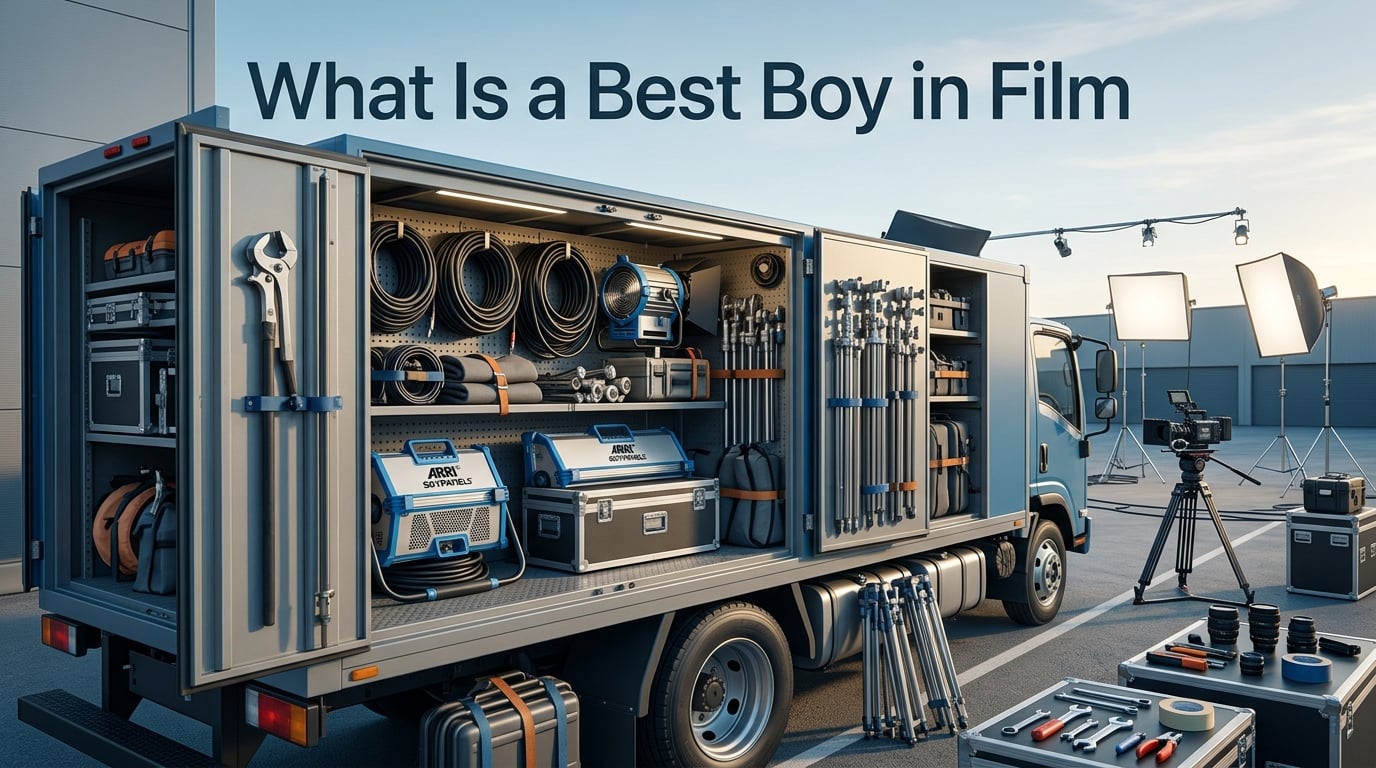
Next time you sit through the end credits of a movie, you might notice a title that stops you cold: “Best Boy.” It sounds like a compliment or maybe a joke, but in film production it means something very specific — and very important.
Understanding what a best boy in film actually does clears up one of the most commonly misread credit lines in the business. The short answer: a best boy is the chief assistant and operational manager within either the electrical department or the grip department on a production set.
I’ve spent time talking with working film crew members and following industry discussions on forums like Reddit’s r/Filmmakers, and one thing comes up constantly: people either assume the best boy is a junior position or have no idea what the role involves at all. Neither is accurate. This guide covers everything — the full definition, both types of best boys, day-to-day duties, the strange history behind the name, how the role fits the production hierarchy, the skills required, how to break into the field, and what you can expect to earn.
Table of Contents
What Is a Best Boy in Film?
A best boy in film is the second-in-command within either the electrical department or the grip department on a movie or television production.
The title actually refers to two completely separate roles that share the same name:
- Best Boy Electric — the assistant to the Gaffer, who is the head electrician and chief lighting technician on set
- Best Boy Grip — the assistant to the Key Grip, who heads the grip department responsible for camera rigging and physical equipment support
In both cases, the best boy functions as the department’s foreman. The department head focuses on the creative and technical execution of their work. The best boy manages all the logistics that make that execution possible — scheduling the crew, tracking equipment, handling the department budget, and acting as the communication link between their boss and the rest of the team.
On union productions in the United States, the Best Boy Electric carries the official IATSE designation of Assistant Chief Lighting Technician (ACLT). The Best Boy Grip may also be referred to as the 2nd Company Grip. Both titles appear in union contracts and official crew documentation, though “best boy” remains the universal shorthand you’ll hear on any set.
The best boy reports directly to either the Gaffer or the Key Grip. Both of those roles in turn report to the Director of Photography (DP), who holds creative authority over the visual look of the entire film.
Best Boy Electric vs Best Boy Grip: The Key Difference
The biggest source of confusion about this job is that two very different roles share the same name. Here’s how to tell them apart, and what each one actually does.
Best Boy Electric
The Best Boy Electric is the right hand of the Gaffer. Their world is electricity, light, and the crew that works with both.
On a typical production, the Best Boy Electric:
- Oversees the electrical crew — often called “juicers” or lamp operators
- Manages the lighting truck and all electrical equipment assigned to the production
- Coordinates power distribution on set, including generators, tie-ins, and cable runs
- Orders all electrical gear from rental houses and tracks every piece of equipment through the shoot
- Handles daily crew scheduling for the electrical department
- Ensures all electrical work meets safety codes and production safety standards
- Acts as the direct communication link between the Gaffer and the electricians working under them
The Best Boy Electric doesn’t typically light scenes directly — that’s squarely the Gaffer’s territory. Instead, they make sure the Gaffer has everything physically and logistically in place to execute the Director of Photography’s lighting vision.
Think of the Best Boy Electric as an operations manager who keeps the lights running so the creative work can happen without interruption.
Best Boy Grip
The Best Boy Grip is the assistant to the Key Grip. Where the electrical best boy deals with light, the grip best boy deals with everything related to camera support, equipment rigging, and the physical mechanics of a shoot.
The Best Boy Grip is responsible for:
- Managing the grip crew day to day
- Overseeing the grip truck and all grip equipment — dolly and track systems, cranes and jibs, C-stands, flags, diffusion frames, sandbags, and camera mounts
- Coordinating camera rigging setups alongside the Key Grip
- Tracking the complete equipment inventory and managing returns to rental houses
- Scheduling grip crew members based on daily shot requirements and call sheets
- Enforcing safe rigging practices on set and flagging any unsafe conditions
One thing many people outside the film industry don’t realize is that grip work has almost nothing to do with physically holding things up. It’s a skilled trade built around physics, load calculations, and deep knowledge of how to safely support cameras and control light (grips use flags and diffusion materials to shape light, though they never work with live electricity — that’s the electrical department’s responsibility).
What Does a Best Boy Actually Do All Day?
On paper, the best boy’s job looks like a straightforward assistant role. In practice, it’s a constantly shifting balance between hands-on technical work and active management duties that changes from hour to hour.
A typical day often starts well before the crew arrives on set. The best boy has already spent days coordinating with the department head, confirming which crew members are working, verifying that rented equipment has arrived and is functioning, arranging transport logistics for the gear, and reviewing the shot list to anticipate what the department will need for each setup.
Once on set, the best boy rarely stops moving. They’re fielding questions from crew members, troubleshooting equipment problems, relaying information between departments, and making sure their department head never has to think about logistics.
The core daily responsibilities include:
- Crew management — setting daily call times, managing overtime requests, handling last-minute sick calls or crew replacements
- Equipment tracking — monitoring every piece of gear that comes on and off the truck, coordinating with rental houses, dealing with anything that gets damaged or stops working mid-shoot
- Budget monitoring — working within the department’s approved budget, flagging any additional costs to the production manager before they become a problem
- Safety enforcement — conducting checks throughout the day, making sure cables are properly taped, rigging is load-tested, and all electrical setups meet applicable codes
- Communication — functioning as the primary interface between the department head and the rest of the crew, and between the department and production coordination
At wrap — the end of the shooting day — the best boy oversees the entire breakdown of the department’s equipment, confirms everything is safely stored and accounted for, and starts preparing the gear list for the following day’s shoot.
One best boy on Reddit’s r/Filmmakers summarized the role this way: “I’m the one who makes sure the Gaffer can focus on the art. Every logistical problem that could interrupt that gets routed through me first.” That kind of behind-the-scenes operational work doesn’t end up in anyone’s highlight reel, but without it, entire departments fall apart under the pressure of a production schedule.
Where Does the Name Best Boy Come From?
The origin of the term “best boy” is one of those pieces of Hollywood history where no single explanation has ever been definitively confirmed. Several theories have been passed down through the industry, and all of them are plausible.
The most widely accepted explanation traces the term back to the early days of Hollywood production. When a department head on one film needed extra skilled help, they would ask a neighboring production company if they could borrow their “best boy” — meaning the most skilled and reliable crew member available. Over time, this informal request became a formal title that stuck in the industry’s vocabulary.
A second theory connects the term to circus and vaudeville traditions, where a “best boy” referred to the top apprentice or most capable helper to a skilled artisan. Entertainment production techniques borrowed heavily from those earlier industries as film production developed its own structure in the early twentieth century.
A third origin story points to maritime tradition, where “best boy” described the most capable and trusted young sailor on a vessel — someone given responsibilities beyond their years because of demonstrated skill and reliability. Hollywood drew on multiple professional traditions in its formative decades, and the term may have entered film vocabulary through that influence.
What’s not in dispute is the timeline. By the 1930s and 1940s, “best boy” was firmly established in Hollywood production language, appearing in union agreements and official crew documentation from that era. Whatever its exact origin, the term has been part of American film production for nearly a century and shows no signs of going anywhere.
How a Best Boy Fits Into the Film Crew Hierarchy
Knowing where the best boy sits within the crew structure helps explain exactly how much responsibility the role actually carries.
In the electrical department, the chain of command works like this:
Director of Photography (DP) → Gaffer → Best Boy Electric → Electricians and Lamp Operators
In the grip department, the structure mirrors that arrangement:
Director of Photography (DP) → Key Grip → Best Boy Grip → Grips and Dolly Grips
The DP has overall creative authority over all lighting and camera work. The Gaffer translates the DP’s visual intentions into practical lighting setups. The Key Grip manages all camera support systems, rigging, and physical equipment movement. In each department, the best boy sits directly below the department head and directly above the working crew.
A common assumption is that the best boy is essentially just a senior assistant with a fancy title. In reality, on a mid-to-large production, the best boy may manage a crew of anywhere from five to thirty or more people. They carry hiring authority over their crew, manage equipment budgets that can run into six figures on major productions, and hold significant safety responsibility under production law.
The best boy also operates across departmental lines constantly. They work with the transportation department on truck logistics, coordinate with the production manager on scheduling and budgeting, interface with the assistant director team on daily timing, and occasionally need to align with the art department on set construction and decoration that affects their work.
The role requires as much skill in navigating human dynamics as it does technical knowledge — possibly more.
Skills Every Best Boy Needs
Getting to a best boy position takes years of hands-on experience and the development of a specific skill set. Most of it can’t be learned from a classroom.
Technical skills depend on which department you’re working in. A Best Boy Electric needs deep knowledge of electrical systems, power distribution, and lighting equipment. A Best Boy Grip needs expertise in rigging, camera support systems, and the full range of grip gear. Both need a thorough understanding of set safety protocols specific to film production — electrical codes, load ratings for rigging, and the safety standards their union and production company require.
Management and organizational skills that matter every day include:
- Crew scheduling and coordination across multiple shoot days simultaneously
- Inventory management — tracking dozens to hundreds of pieces of equipment across a multi-week or multi-month shoot
- Budget awareness and accurate cost reporting to production management
- Clear communication up and down the chain of command without creating confusion or conflict
- Ability to handle interpersonal problems within the crew professionally and without escalating to the department head unless necessary
Soft skills that experienced best boys consistently emphasize:
- Calm under pressure — film sets are high-stress environments with unforgiving schedules and little margin for panic or indecision
- On-the-fly problem solving — equipment fails at the worst times, crew members call out sick, locations change at the last minute, and the best boy is expected to have solutions
- Leadership presence — the best boy is in charge of people, and those people need to trust and respect their judgment
- Attention to detail — a single overlooked equipment issue or missed safety check can delay a shoot by hours or cause a serious injury
A theme I’ve heard repeatedly from working crew members: the technical skills are learnable by anyone who puts in the time on set. The people management is what separates a competent best boy from an exceptional one.
How to Become a Best Boy in Film
There’s no single direct route into this role, but there is a logical progression that most working best boys follow. The path is long — realistically, five to ten years on set before reaching this level on significant productions — but it’s achievable with the right approach.
Step 1: Get on set in any capacity. The most accessible entry point is as a production assistant in the electrical or grip department. On smaller independent productions, you may be able to get hired as a day-playing electrician or grip even with limited experience. The goal at this stage is simple: get on set and start learning how it all works from the ground up.
Step 2: Choose your department and commit to it. Decide early whether you want to work in the electrical department — which leads toward Best Boy Electric — or the grip department, which leads toward Best Boy Grip. These are genuinely separate career tracks with different skill sets and professional identities. People rarely cross between them once established.
Step 3: Advance through the crew ranks. In the electrical world, a typical progression looks like: Electrician → Lamp Operator → Rigging Electrician → Best Boy Electric. In grip, the track often runs: Grip → Dolly Grip → Rigging Grip → Best Boy Grip. Each step requires demonstrating competence and earning the trust of the people above you.
Step 4: Build your network aggressively. Film production runs almost entirely on relationships. Most best boy positions are filled through direct recommendations from department heads and other crew members who have worked with you. Showing up prepared, working hard, and being professionally reliable on every single job — regardless of how small — builds the reputation that leads to bigger opportunities.
Step 5: Consider joining your local IATSE union. In the United States, joining IATSE (specifically Local 728 for studio electricians or Local 80 for grips in Los Angeles, with equivalent locals in other markets) opens the door to higher-budget productions and brings standardized pay rates, working condition protections, and health and pension benefits. Getting into a union typically requires hours worked and a sponsor from within the union, which is another reason networking matters so much.
Best Boy Salary and Career Outlook
Pay for best boys varies considerably based on location, union membership, production scale, and the department you’re working in.
On union productions in the United States, best boys work under IATSE rate agreements that set minimum day rates. In major markets like Los Angeles and New York, experienced best boys on studio productions can earn rates that put them well into the six-figure annual income range during busy periods, though the project-based nature of film work means income isn’t always consistent across the year.
On non-union independent productions, rates are lower and often negotiated individually. Entry-level positions on smaller productions pay considerably less than what union work provides, and the working conditions and benefit structures differ significantly.
One reality of the job that surprises people is that most best boys work on a project-by-project basis rather than holding a permanent staff position. Income can fluctuate substantially between active production seasons and quieter periods, which is why many experienced crew members maintain savings and financial flexibility as part of how they manage a career in film.
The natural career ceiling for a best boy is the department head role itself — Gaffer for electrical best boys, Key Grip for grip best boys. Both are senior positions that carry significant creative and technical authority on set, and reaching them represents the top of the craft ladder within their respective departments.
A Note on Gender-Neutral Terminology
The film industry has historically used “best boy” as a gender-neutral title — women working in this role have traditionally been called “best girl” in some productions, while others have simply used “best boy” as the standard title regardless of gender.
In 2026 and recent years, there has been a gradual shift toward more inclusive language on set. Some productions now use “best” as a standalone title, or use clearer functional descriptions like “lead electrician” or “lead grip.” In the United Kingdom and several other countries, the role may be called something different entirely depending on local production traditions.
The term “best boy” remains the industry standard in American film and television production. You’ll continue to see it in credits, union contracts, and on-set call sheets. But the conversation about inclusive language in film production is ongoing, and terminology is slowly evolving alongside it.
Frequently Asked Questions About the Best Boy Role
How much do best boys get paid?
Pay for best boys depends heavily on union membership, location, and production budget. On union productions under IATSE agreements in major markets like Los Angeles and New York, experienced best boys on studio productions can earn substantial day rates that translate to six-figure annual income during active shooting periods. Non-union independent productions pay considerably less, and most best boys work project to project rather than holding permanent staff positions, so annual income can vary significantly year to year.
What is the difference between a gaffer and a best boy?
The gaffer is the department head — the chief lighting technician who works directly with the Director of Photography to design and execute the lighting for every scene. The best boy electric is the gaffer’s assistant and operational manager, handling crew scheduling, equipment logistics, and departmental administration. The gaffer makes the creative and technical decisions; the best boy makes sure everything is in place to carry those decisions out.
Why are they called the best boy?
The most accepted explanation is that in early Hollywood, a department head who needed extra skilled help would borrow another company’s best boy — their most capable crew member. The informal phrase became a formal title that stuck. Other theories trace the term to circus or vaudeville traditions, where a best boy was the top apprentice to a skilled artisan, or to maritime culture, where the term described a trusted and capable young sailor. By the 1930s and 1940s, best boy was firmly established in Hollywood production vocabulary regardless of its exact origin.
How do you become a best boy?
The path to becoming a best boy typically takes five to ten years of hands-on set experience. Most people start as production assistants or day-playing crew members in either the electrical or grip department, then advance through the crew ranks (electrician to lamp operator to best boy electric, or grip to dolly grip to best boy grip). Joining IATSE and building strong professional relationships on set are both critical to advancing into the role on higher-budget productions.
Final Thoughts
So, what is a best boy in film? It’s the person who makes sure an entire department functions smoothly so the creative work can actually happen. Whether we’re talking about the Best Boy Electric keeping power and lighting running for the Gaffer, or the Best Boy Grip managing rigging and camera support for the Key Grip, the role is fundamentally the same: operational management that supports creative excellence.
The next time you see “Best Boy Electric” or “Best Boy Grip” in a film’s closing credits, you’ll know that behind that unusual title is someone who spent years learning their craft from the ground up, managed a skilled crew through long shooting days, and solved a hundred problems most viewers never see.
It’s one of those roles where the best work is invisible — and that’s exactly how a great best boy would want it.