
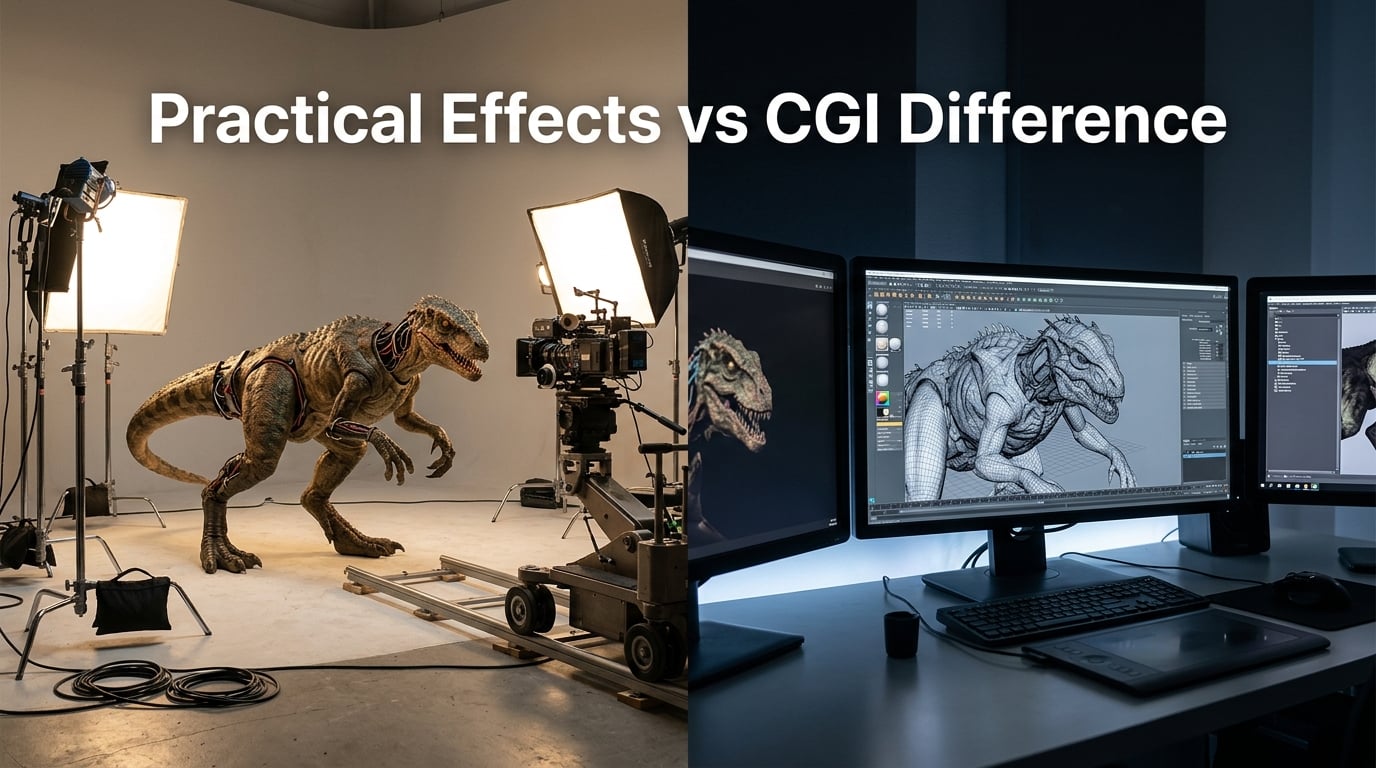
When I watched the original Jurassic Park as a kid, the T-Rex scene felt terrifyingly real. Years later, I learned that what looked like a fully computer-generated creature was actually a 9-foot animatronic puppet filmed in rain at night. That moment of discovery is exactly what the practical effects vs CGI debate is about: how filmmakers make you believe what you see.
The practical effects vs CGI difference comes down to one core idea. Practical effects are physical filmmaking techniques using tangible objects like makeup prosthetics, miniatures, and animatronics. CGI (computer-generated imagery) creates visual effects digitally using 3D modeling and rendering software. Both can look stunning, but they age, feel, and cost in completely different ways.
In this guide, I will break down exactly how each technique works, where it shines, and when modern productions blend them. Our team has compared both approaches across dozens of films, and I will share what we have learned about why your brain often trusts a puppet more than a pixel.
Table of Contents
What Are Practical Effects?
Practical effects are physical special effects created on set using real objects, materials, and mechanical rigs. They happen in front of the camera during production, giving actors something tangible to react to.
The main categories of practical effects include:
Prosthetics and makeup: Foam latex, silicone, and gelatin appliances that transform actors into creatures, aliens, or burn victims.
Animatronics: Mechanically driven puppets, often radio-controlled, used for creatures like the Jurassic Park raptors or the Alien xenomorph.
Miniatures: Scaled physical models of buildings, ships, or cityscapes, famously used in Star Wars and Blade Runner.
Pyrotechnics and explosions: Controlled fire, smoke, and detonations captured in-camera.
Wireworks and rigs: Cables, harnesses, and gimbal systems that simulate flight, falling, or zero gravity.
Weather effects: Rain machines, snow fans, and wind effects built into set pieces.
Because practical effects exist in the real world, they reflect light naturally and interact with gravity. That is why a face covered in prosthetic aging still looks believable under harsh close-up lighting.
What Is CGI in Film?
CGI stands for computer-generated imagery. It refers to anything created or manipulated digitally using 3D modeling, animation, and rendering software. CGI is added in post-production, frame by frame, often after filming has wrapped.
Modern CGI pipelines typically involve:
3D modeling: Artists sculpt digital geometry that defines the shape of a creature, environment, or object.
Texturing and shading: Surfaces are painted and assigned physical properties like skin, metal, or fabric.
Rigging and animation: Digital skeletons are built so characters can move believably.
Lighting and rendering: Software calculates how light interacts with every pixel, often taking hours per frame.
Compositing: CGI elements are layered with live-action footage to create the final shot.
CGI gives filmmakers near-total control. A digital dragon can be resized, recolored, or moved across the frame with a few keystrokes. No physical limitations apply.
Practical Effects vs CGI: Side-by-Side Comparison
This side-by-side table summarizes the most important differences between practical effects and CGI. Use it as a quick reference when deciding which technique fits a given shot.
| Factor | Practical Effects | CGI |
|---|---|---|
| Medium | Physical, on set | Digital, post-production |
| Realism in close-ups | Excellent – real light interaction | Variable – depends on render quality |
| Actor interaction | Tangible objects to react to | Tennis ball or imaginary stand-in |
| Flexibility after filming | Limited – locked at shoot | Highly flexible – changes anytime |
| Cost for small scenes | Often cheaper | Often cheaper |
| Cost for massive scenes | Expensive (sets, crews, materials) | Cheaper at scale (digital armies, cities) |
| Aging over decades | Ages well – real materials hold up | Often reveals its era quickly |
| Best use cases | Close-ups, creature suits, props | Aerial shots, massive crowds, impossible physics |
| Risk on set | Higher (fire, rigs, weather) | None during filming |
| Revision cost | Re-shoot required | Edit the file |
Advantages of Practical Effects
Practical effects carry a weight that audiences feel even when they cannot explain why. Light hits real skin, real fabric drapes under real gravity, and real fire throws real shadows. That is hard to fake.
The biggest strength is actor interaction. When an actor slams a fist into a physical animatronic, the recoil, the breathing, and the fear response all happen organically. No director has to ask them to imagine a monster that is not there.
Practical effects also dominate in close-ups. Audiences forgive imperfections in wide shots but scrutinize every pore in a hero shot. A prosthetic nose with subtle sweat reads as more human than a perfectly rendered digital face that lacks micro-expression.
Finally, practical effects age remarkably well. Compare the original Alien from 1979 to many CGI creatures from 2005. The practical puppet still looks credible. The CGI often reveals outdated rendering techniques and lighting models.
Advantages of CGI
CGI offers something practical effects cannot: infinite flexibility. A digital environment can be reshot, recolored, and re-lit indefinitely without rebuilding a set. That freedom is invaluable for reshoots and director changes.
CGI also handles scale that physical production cannot match. Avengers: Endgame featured battles with thousands of digital characters. No practical crew could build that many extras, let alone choreograph them in real-time combat.
Impossible physics is another CGI win. Need a hero to survive a planet-crushing explosion, or a spaceship to flip through Saturn’s rings? CGI solves it. Practical effects are constrained by gravity, weather, and safety regulations.
CGI also keeps insurance costs predictable. Studios know exactly how many compute hours a sequence will take. Practical stunts carry unpredictable injury and liability risk.
Cost Comparison: Which Is Cheaper?
Cost is where the practical effects vs CGI difference gets complicated. There is no universal winner – it depends on what you are building.
For small-scale scenes, practical effects are usually cheaper. A convincing prosthetic wound costs a few hundred dollars in materials. Building that same effect digitally can cost thousands in artist hours.
For massive-scale scenes, CGI wins on cost. Constructing a full-scale practical city for a disaster sequence would require millions in materials and weeks of labor. A digital city built once can be reused across dozens of shots.
For ongoing franchises, CGI often costs less over time. Marvel has reused Hulk and Thanos assets across 20+ films. Practical suits must be built, stored, and replaced every few years.
Indie filmmakers should lean heavily on practical effects. Our team has produced low-budget horror films where a well-lit practical creature outperformed a six-figure digital composite every time.
When to Use Each Technique
Choosing between practical effects and CGI is a creative decision, not just a budget one. Here is the framework I use when consulting on short films.
Reach for practical effects when:
The shot is a close-up on a face, hand, or creature.
Actors need to physically interact with the effect.
You want the result to age gracefully for decades.
The effect involves fire, water, or weather you can stage.
Budget is tight and the effect is small in scope.
Reach for CGI when:
The shot requires impossible physics or environments.
You need thousands of digital extras or creatures.
The effect will be reused across multiple films or scenes.
Revisions are likely after principal photography.
Safety risks make the practical version too dangerous.
Hybrid Workflow Approaches: The Modern Standard
The best productions today rarely pick one technique. They build hybrid workflows where practical elements anchor the scene and CGI extends it. This is where the practical effects vs CGI difference stops being a debate and becomes a toolkit.
Jurassic Park pioneered this approach. Spielberg used a full-size animatronic T-Rex for ground-level shots where actors needed eye contact with the creature. For wide pan shots and full-body movement, he blended in CGI extensions of the same model. The result felt both real and impossible.
Mad Max: Fury Road took hybrid even further. Most vehicles were real, most crashes were real, most dust was real. CGI cleaned up rigs, removed safety equipment, and extended horizon lines. Director George Miller has said that 80% of what audiences saw was practical.
The hybrid workflow offers three major benefits:
Authentic actor performances: Real objects trigger real reactions.
Visual flexibility: CGI fills the gaps practical cannot reach.
Budget efficiency: Practical covers the expensive close-ups, CGI scales the cheap wide shots.
Modern productions from Dune to Avatar: The Way of Water follow this same blueprint. Build practical where it counts, render digital where it does not.
Industry Trends and the Decline of Practical Effects
Between 1995 and 2015, CGI rapidly replaced practical effects in many Hollywood productions. Studios favored digital work because it reduced on-set risk, simplified scheduling, and gave directors near-unlimited revision power.
By the late 2010s, audiences started pushing back. Films overloaded with CGI felt weightless and synthetic. Christopher Nolan, Denis Villeneuve, and the Safdie brothers became known for insisting on practical effects even in tentpole productions.
Today, the pendulum is swinging back. Practical effects are no longer the default, but they are no longer extinct either. They survive as the foundation of hybrid workflows, especially in horror, science fiction, and creature features.
FAQs
Is Rocky CGI or practical effects?
The original Rocky (1976) used almost entirely practical effects. Stallone trained for months, the boxing scenes used real hits with safety equipment, and the meat locker scene was filmed in a real Philadelphia locker. CGI did not exist in mainstream filmmaking at the time, so every punch, sweat bead, and bruise was physical.
Is it cheaper to do practical effects or CGI?
It depends on scale. For small effects like makeup wounds, props, or single creature shots, practical is usually cheaper because materials and labor costs are low. For massive effects like digital armies, city destruction, or impossible physics, CGI is cheaper because once a digital asset is built it can be reused across hundreds of shots. Mid-budget productions often use a hybrid to balance both.
Why don’t movies do practical effects anymore?
They still do, but less often than in the 1980s and 1990s. Studios shifted to CGI in the 2000s because digital effects reduced on-set safety risk, simplified scheduling, and allowed revisions after filming. Recent years have seen a partial return to practical effects because audiences respond better to tangible, physical objects, especially in close-ups and creature work.
Why do people prefer practical effects over CGI?
Audiences tend to prefer practical effects because the human brain is wired to detect authenticity. Practical effects reflect real light, respond to real gravity, and give actors something physical to react to, which produces more believable performances. CGI can match this quality, but it requires massive render budgets and skilled artists. When practical and CGI are both done well, the difference becomes harder to notice.
Conclusion: Choosing the Right Technique
The practical effects vs CGI difference is not a battle. It is a decision framework. Practical effects win when authenticity, actor interaction, and long-term quality matter most. CGI wins when scale, flexibility, and impossible physics are non-negotiable.
If you are planning a film in 2026, start by asking what each shot needs. Then choose the technique that fits. In most modern productions, that answer is both. Build practical where actors need it, render digital where cameras cannot go, and let the two techniques support each other. That hybrid mindset is how the most believable visual effects of our era get made.