
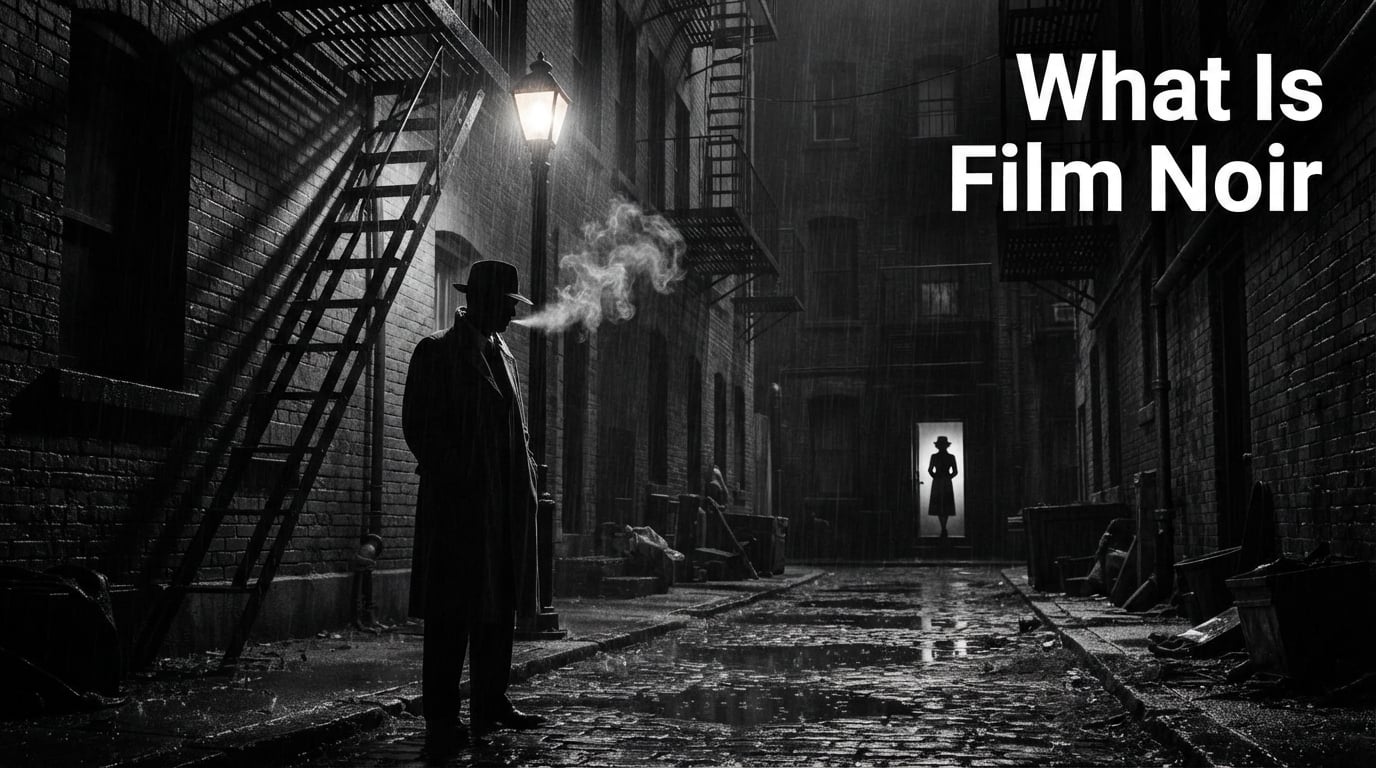
Film noir is a cinematic term that literally translates from French as “black film,” used to describe a wave of stylish American crime dramas produced mainly between the early 1940s and late 1950s. These films share a shadowy visual style, morally ambiguous characters, and a pessimistic worldview shaped by post-World War II disillusionment. If you have ever watched a detective story told through flashbacks, lit by a single desk lamp while rain streaks the window, you have already seen film noir at work.
I spent a month rewatching the classic noir catalog while researching this guide, and the pattern is unmistakable. Once you learn the visual cues and character types, you start spotting them in modern thrillers, television crime shows, and even video games. This article walks through what film noir means, where it came from, how it looks on screen, and why it still shapes the stories we watch in 2026.
Table of Contents
Film Noir Definition: What “Black Film” Actually Means
The film noir definition starts with the language. The phrase comes from French critic Nino Frank, who in 1946 used “film noir” to describe a new strain of Hollywood crime pictures that felt darker than anything released before the war. In French, “noir” simply means black, so “film noir” translates directly to “black film,” a label that captures both the mood and the look of these stories.
You pronounce it “film nwahr,” with the “noir” sounding closer to “nwahr” than the English word “nor.” Most Americans soften the French r, and either pronunciation is widely accepted. The key is keeping the French vowels so the term keeps its literary weight.
Here is the working definition I use when explaining film noir to friends: it is a cinematic style and storytelling tradition marked by cynical heroes, stark lighting effects, intricate plots, and an atmosphere of doom. Britannica frames it the same way, calling film noir a “style of filmmaking characterized by such elements as cynical heroes, stark lighting effects, frequent use of flashbacks, intricate plots, and atmospheric photography.”
One debate that surfaces in every serious discussion is whether film noir is a genre or a style. Scholars like James Damico and others argue that noir is really a style of storytelling that can show up inside any genre, from crime drama to romance to science fiction. In practice, I find that view more useful, because it explains why a courtroom drama like Witness for the Prosecution and a science fiction film like Blade Runner can both feel like noir without sharing a single plot beat.
When Did Film Noir Begin? Post-War Origins and Golden Age
Film noir emerged between 1941 and 1958, a period film historians usually call the classic noir cycle or the golden age. The earliest accepted examples include The Maltese Falcon (1941), Double Indemnity (1944), Murder, My Sweet (1944), and Laura (1944). By the late 1950s, the studio system that produced these films had collapsed, television had pulled audiences away from theaters, and the Production Code had loosened enough that filmmakers were free to push into color and new subject matter.
The mood of these films grew directly out of the world that produced them. The Great Depression had scarred a generation, World War II had demolished any lingering faith in progress, and the early Cold War brought McCarthyism, the atomic bomb, and a creeping sense that institutions could not be trusted. Noir told stories about ordinary people caught in systems larger than themselves, and the characters almost always lost. That pessimism was not accidental. It mirrored what audiences were already feeling.
Two specific influences shaped the visual language. The first was German Expressionism, a 1920s film movement that used distorted sets, exaggerated shadows, and unstable camera angles to express psychological states. Directors like Fritz Lang and cinematographers like Karl Freund had fled Nazi Germany and brought those techniques to Hollywood. The second was hard-boiled pulp fiction from writers like Dashiell Hammett, Raymond Chandler, and James M. Cain. Their snappy first-person narration, down-on-his-luck detectives, and dangerous women became the spine of noir storytelling.
You will often see film noir defined as a genre, but most critics now describe it as a cycle or a movement. That matters because a cycle can come back, and that is exactly what happened in the 1960s with French New Wave homages and again in the 1970s with what we now call neo-noir. The first serious essays about these films, written by French critics in the late 1940s, gave the movement its name, but the films themselves were almost entirely American studio productions.
Film Noir Lighting: Chiaroscuro, Shadows, and Visual Style
The look of film noir is what most viewers notice first, and it is built almost entirely on a single technique called chiaroscuro lighting. Chiaroscuro is the practice of using very strong contrasts between light and dark to model a scene, and it gives noir its sculptural, almost photographic quality. The light source in a noir frame is usually hard, narrow, and angled from above or the side, so it throws sharp-edged shadows across faces, walls, and streets.
Low-key lighting is the technical term cinematographers use. Low-key means the overall scene is lit far below normal exposure, with most of the frame falling into deep shadow and only the key areas of interest catching a sliver of light. The result is a high-contrast image where eyes, cheekbones, and cigarette tips glow while everything else disappears into black. This is the opposite of the bright, even lighting of comedies and musicals from the same era.
Several recurring visual motifs show up across the canon. Venetian blind shadows slice across a bedroom wall during an interrogation. A single desk lamp throws a cone of light across a face while the rest of the room vanishes. Rain streaks down a window and catches neon from a passing car. Smoke from a cigarette curls through a shaft of light and reveals a hidden expression. These are not just decoration. They signal that something is being concealed and that the truth is partial.
The camera work often matches the lighting. Directors like Orson Welles and Robert Siodmak used wide-angle lenses to exaggerate the depth of rooms, pushing ceilings out of frame and making characters look trapped by their own architecture. Skewed, low-angle shots make ceilings loom over the hero and tilted frames suggest that the moral ground beneath him is unstable. Urban streets, rain-slicked alleys, neon signs, and train stations become the recurring geography of the style.
Sound design plays a quieter but equally important role. The German Expressionist roots of noir pushed composers toward moody jazz scores, brooding orchestral cues, and the kind of smoky saxophone music associated with lonely nightclubs. Voice-over narration, almost always delivered by a male protagonist, became a defining narrative device. The narrator is usually unreliable, often confessing to a crime or recounting events with hindsight, which lets the audience know from the start that things have already gone wrong.
Flashbacks are the other signature storytelling tool. Most noir plots are structured as investigations into a past crime, so the film naturally jumps between timelines as the detective, or the criminal, pieces together what really happened. This structure gives noir its dreamlike, fragmented quality and lets writers withhold information from the audience until the final act.
Classic Film Noir Characters: The Anti-Hero and Femme Fatale
The characters in film noir are the second thing viewers usually notice, and they are drawn from a small, recurring set of archetypes. The most important is the noir hero, more accurately called the anti-hero. He is almost always a private detective, a cop on the edge, a writer, a crook, or a war veteran, and he is defined less by his profession than by his moral exhaustion. He drinks too much, sleeps too little, and trusts no one, including himself.
The hard-boiled detective is the clearest example. Sam Spade in The Maltese Falcon, Philip Marlowe in The Big Sleep, and Walter Neff in Double Indemnity all share the same code. They are cynical about authority, honest in a limited way, and fatally drawn to the wrong woman. Their first-person narration usually opens the film with a flat, world-weary line that tells the audience this is going to end badly.
The femme fatale is the other half of the formula. Her name literally means “fatal woman,” and she uses charm, sex appeal, and lies to manipulate men into doing her bidding. Phyllis Dietrichson in Double Indemnity, Brigid O’Shaughnessy in The Maltese Falcon, and Kathie Moffat in Out of the Past are the textbook cases. She is not always evil, but she is always dangerous, and she almost always brings down the man who falls for her. Counter-typing does happen, especially later in the cycle, but the femme fatale remains one of cinema’s most recognizable character types.
A few other archetypes round out the cast. The honest but doomed woman exists in contrast to the femme fatale, often representing the normal life the hero can never have. The corrupt official, whether a police captain, a district attorney, or a wealthy businessman, supplies the institutional rot that the hero tries to expose. The hitman or hired killer shows up to add violence and remove moral pretense. None of these characters are heroic in the classical sense. They are simply the people caught in a world that does not reward good behavior.
Worth noting: there is an ongoing argument about whether the femme fatale archetype is a critique of female power or a punishment of it. Feminist film scholars like Janey Place have argued for decades that the femme fatale is essentially punished for stepping outside her assigned role, while others read her as the only character in the film who actually exercises agency. Both readings are supported by the films themselves, which is part of why noir keeps generating fresh criticism.
Core Film Noir Themes: Cynicism, Fatalism, and Betrayal
Every film noir is built on a small set of recurring themes, and they are tightly linked to the historical context I described earlier. The four most important are cynicism, fatalism, moral ambiguity, and betrayal.
Cynicism is the baseline. Noir characters do not believe in justice, the police, the courts, or the American Dream. They have seen too much to pretend otherwise. This is what separates noir from earlier crime films, which usually ended with the criminal caught and the hero rewarded. Noir ends with a body, often the hero’s, and a shrug.
Fatalism runs even deeper. Noir characters often sense that the bad turn is coming and walk into it anyway. Walter Neff in Double Indemnity knows he is making a mistake and records his confession anyway. Jeff Bailey in Out of the Past understands that the past always catches up with you. The plot itself usually moves toward an inevitable, often violent, conclusion that the audience can see coming from the first scene.
Moral ambiguity means there is no clean good guy. The detective takes bribes, the lawyer lies, the judge is corrupt, and the supposed love interest is hiding something. Even the protagonist’s voice-over narration is unreliable. Audiences are forced to keep up rather than be guided, which is why noir plots feel sharper and more modern than the musicals and westerns released in the same years.
Betrayal is the engine of most noir plots. Friends betray friends, lovers betray lovers, and institutions betray the people who trust them. The classic love triangle in noir usually involves a man caught between a virtuous woman and a femme fatale, and he almost always picks wrong. The femme fatale betrays the hero, the hero betrays himself, and the resolution is a corpse and a one-way ticket out of town.
Several supporting themes show up often enough to mention. Paranoia, often tied to the McCarthy-era context, where characters cannot trust the people around them. Urban alienation, where the city itself becomes a hostile character. Crime as a symptom, not a cause, of broken systems. And doomed romance, where love is presented as a trap rather than a reward. Together these themes turn what could have been straightforward whodunits into something closer to Greek tragedy.
What Is Neo-Noir? How Film Noir Shapes Modern Cinema
Neo-noir is the term for films made after the classic cycle ended that consciously borrow from noir’s visual style, themes, or storytelling structure. The prefix “neo” simply means new. A film qualifies as neo-noir if it uses noir lighting and noir themes, even if it is set in the present, told in color, or built around a science fiction premise.
Three early examples define the category. Roman Polanski’s Chinatown (1974) brought noir back to theaters with a 1930s detective played by Jack Nicholson. Ridley Scott’s Blade Runner (1982) transplanted the femme fatale, the corrupt system, and the rain-soaked city into a dystopian Los Angeles. And the Coen Brothers, Quentin Tarantino, the Wachowskis, and countless others have kept pulling on those threads ever since.
Modern neo-noir is a remarkably wide category. Films as different as L.A. Confidential, Memento, Pulp Fiction, The Man Who Wasn’t There, Drive, Nightcrawler, Zodiac, and The Girl with the Dragon Tattoo all qualify, and so do thrillers in other languages, including French, Korean, and Japanese productions. Even video games like L.A. Noire and Max Payne borrow heavily from noir narration and lighting.
Television has become the most active neo-noir playground of 2026. True Detective uses voice-over, religious symbolism, and broken detectives straight from the noir playbook. Fargo layers Midwestern crime stories with noir visuals. Breaking Bad tracks the slow moral collapse of an anti-hero. Better Call Saul is essentially a noir origin story told across six seasons. None of these shows call themselves noir, but the influence is unmistakable.
The noir tradition also keeps showing up in superhero films, sci-fi, and horror. The Dark Knight treats Gotham like a noir city. Sin City literally rotoscoped the noir comic style. Watchmen, Joker, and even parts of the modern Marvel and DC catalogs use noir framing devices, flashbacks, and unreliable narrators. The reason is simple: when you want a story about a flawed person making impossible choices, noir already invented the grammar.
Frequently Asked Questions
What is the best example of film noir?
The most commonly cited classic example is The Maltese Falcon (1941), which established the hard-boiled detective, the femme fatale, and the morally ambiguous plot. Double Indemnity (1944) and The Big Sleep (1946) are equally strong starting points, and Chinatown (1974) is the standard neo-noir reference.
Are Alfred Hitchcock movies considered film noir?
Only some of them. Vertigo (1958) is often classed as noir because of its obsessive protagonist and moody San Francisco visuals. Rebecca (1940) and Shadow of a Doubt (1943) share noir themes. Most of Hitchcock’s other thrillers lean suspense rather than noir.
Is the Godfather film noir?
Not strictly. The Godfather is usually filed under the crime drama or gangster genre, but it borrows heavily from noir themes, including moral corruption, family betrayal, and a doomed anti-hero. Many critics include it in the broader noir tradition.
What is the darkest film noir?
The darkest classics are usually considered to be Detour (1945), which is bleak on a shoestring budget, and The Third Man (1949), whose cuckoo-clock speech and shadowy Vienna exteriors set the standard. Touch of Evil (1958) and In a Lonely Place (1950) also compete for the title.
Final Thoughts on Film Noir
Film noir started as a French label for a handful of American crime pictures and grew into one of the most influential storytelling traditions in modern cinema. Its low-key lighting, cynical heroes, and fatalistic plots still shape the thrillers, television dramas, and games we watch in 2026.
The next time a story opens with a voice-over confession, a slatted shadow on the wall, or a detective lighting a cigarette in a dark office, you will know exactly which tradition you are looking at. If you want to start exploring, queue up The Maltese Falcon on a rainy evening, keep the lights low, and let the genre do its work.