
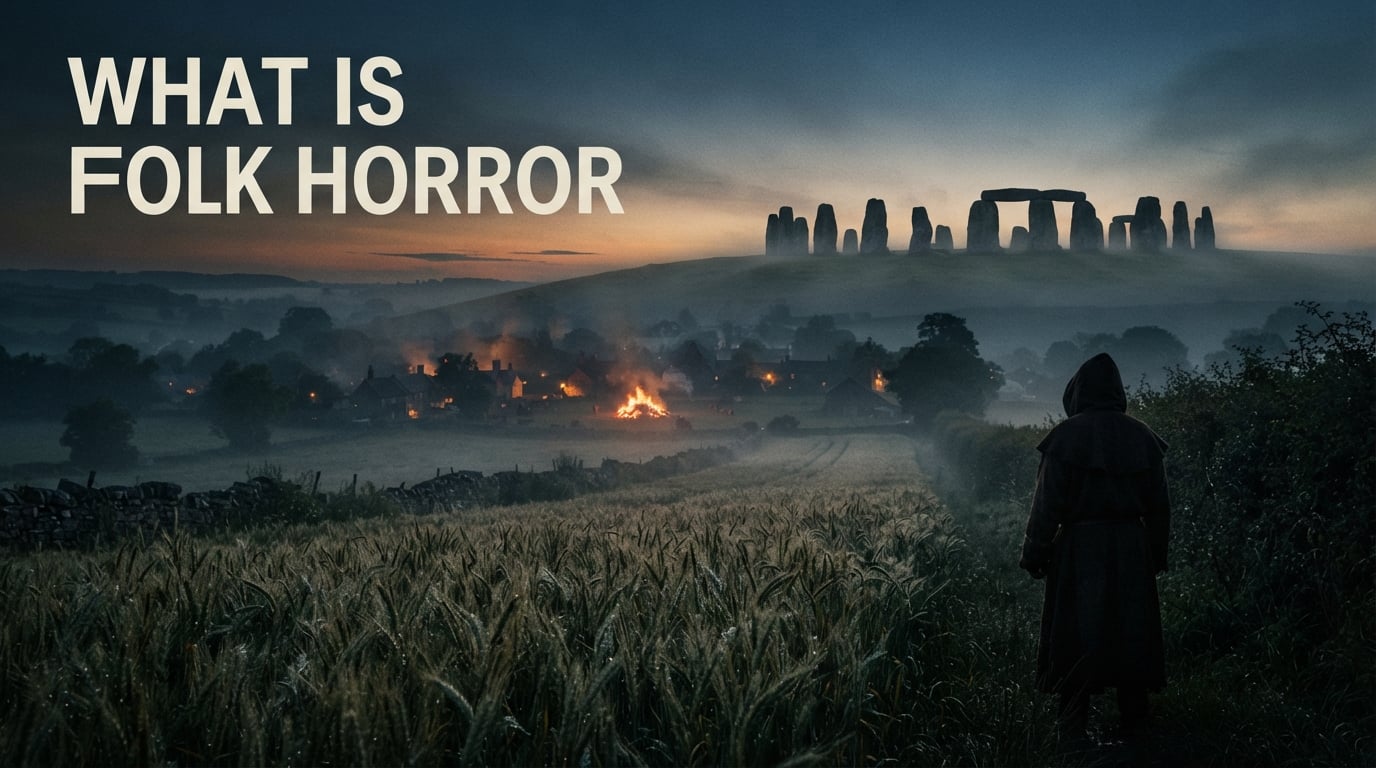
Folk horror pulls you into a world where the wheat fields whisper, the harvest holds secrets, and a smiling neighbor might be your worst nightmare. I have spent the better part of a decade digging through dusty film prints, scholarly essays, and midnight Reddit threads on r/folkhorror, and this genre still surprises me. If you have ever felt the chill of The Wicker Man or stayed awake thinking about Midsommar, you already know why folk horror matters in 2026.
By the end of this guide, you will know exactly what folk horror is, where it came from, and why it has surged back into popular culture. I will walk you through the key characteristics, the classic films, the modern revival, and even how you can write your own folk horror story. The genre spans film, literature, television, and video games, so there is something here for every kind of horror fan.
Horror fans often ask what separates folk horror from general horror. The short answer is that folk horror trades jump scares for creeping dread, monsters for communities, and haunted houses for ancient landscapes. The longer answer is what the rest of this guide is for. Let us get into it.
Table of Contents
What Is Folk Horror?
Folk horror is a subgenre of horror that explores the dark side of tradition, folklore, and the natural world by setting modern characters against isolated rural communities bound to ancient, often pre-Christian beliefs.
The term “folk horror” describes a specific kind of dread. Unlike slasher films or ghost stories, folk horror builds fear from atmosphere, ritual, and the slow realization that an entire community might be complicit in something terrible. You will find three core ingredients in almost every folk horror work: a remote rural setting, an outsider character, and old beliefs that refuse to die.
The genre traces its roots to a specific moment in film history. Between the late 1960s and early 1970s, British cinema produced a cluster of films so distinct that critics later named them the “Unholy Trinity” of folk horror. These were The Wicker Man (1973), Witchfinder General (1968), and The Blood on Satan’s Claw (1971). All three films shared a preoccupation with pagan rituals, rural superstition, and the brutal enforcement of community belief.
The phrase “folk horror” itself was popularized by director Piers Haggard in the 2000s, though scholar Adam Scovell later codified its key features in his book Folk Horror: Hours Dreadful and Things Strange (2017). Scovell described what he called the “folk horror chain”: a sequence of events beginning with a specific landscape, followed by a wrong turn or arrival, then a community with hidden rules, and ending with a final sacrifice or horror reveal. That chain has become a useful tool for identifying folk horror even in works that never set out to make the genre.
Today, folk horror has exploded beyond its British roots. American, Scandinavian, and Eastern European filmmakers have all contributed to the canon, and streaming platforms like Shudder have built entire libraries around the genre. Writers like Andrew Michael Hurley, Thomas Tryon, and Gemma Files have expanded it in fiction. As a horror fan who has watched the genre evolve in real time, I can tell you that folk horror in 2026 feels more relevant than ever because it speaks to anxieties about community, environment, and the breakdown of shared certainty.
Key Characteristics of Folk Horror
Every folk horror work shares a handful of defining traits. Once you learn to spot them, you will start noticing them in everything from prestige dramas to video games. Here are the five elements I look for first.
1. Rural Isolation and Remote Landscapes
Folk horror demands a setting cut off from the modern world. Think windswept moors, forgotten hamlets, remote islands, or dense forests with no cell service. The isolation matters because it strips characters of their usual resources and social networks.
When the protagonist cannot simply call for help or drive away, the dread intensifies. Films like The Witch (set in 1630s New England) and Midsommar (set in a Swedish commune) use geography itself as a weapon. The further you travel from civilization, the closer you come to something older and less forgiving.
2. The Outsider Protagonist
Almost every folk horror story centers on a character who does not belong. This outsider might be a city dweller, a person of the wrong faith, or simply someone who questions what the community accepts without question.
The outsider serves two functions. First, they let the audience see the community’s customs through fresh eyes, which makes familiar rituals feel strange and threatening. Second, the outsider’s fate often delivers the genre’s signature bleakness. In folk horror, the protagonist rarely wins. The community almost always does.
3. The Clash of Belief Systems
Folk horror thrives on conflict between modern rationalism and ancient belief. A scientist, a priest, or a skeptic walks into a community that still worships old gods, observes harvest rituals, or marks sacred trees with offerings.
This clash is more than background flavor. It drives the plot, raises the stakes, and gives the genre its philosophical weight. Is the protagonist’s modern worldview correct, or has the community preserved something humanity forgot? Folk horror refuses to give a clean answer, and that ambiguity is part of its power.
4. Nature as Antagonist
In folk horror, the natural world is rarely peaceful. Forests feel watchful. Crops grow in patterns that suggest intention. Animals behave strangely. The boundary between the natural and the supernatural dissolves.
This is a key distinction from Gothic horror, where crumbling castles carry the weight of the past. Folk horror pushes that anxiety outward into fields, hills, and skies. The land itself remembers things humans have chosen to forget, and it does not forgive easily.
5. Rituals, Sacrifice, and Communal Tradition
At the heart of folk horror lies the ritual. Maypole dances, harvest sacrifices, trial by ordeal, blood offerings to unnamed gods. These rituals are not just scary because they are violent. They are scary because the community performs them willingly, even joyfully.
Sacrifice in folk horror is rarely the work of a single villain. It is the collective action of an entire village, coven, or clan. That communal complicity is what makes the genre so unsettling. The horror is not that one person went mad. The horror is that everyone agreed, and no one saw a reason to stop.
Classic Folk Horror Films: The Foundation
Three films built the foundation that modern folk horror still stands on. Known as the Unholy Trinity, these pictures set the template for rural dread, pagan ritual, and the outsider’s doom.
The Wicker Man (1973)
The Wicker Man is the gold standard of folk horror. The film follows Sergeant Neil Howie, a devout Christian police officer who travels to the remote Scottish island of Summerisle to investigate a missing girl. He expects to find evidence of murder. What he finds is a community that has quietly abandoned Christianity for older pagan gods.
Director Robin Hardy shot the film with minimal professional lighting on the Isle of Man and used local residents as extras. That choice gives the film its unsettling authenticity. The locals do not feel like actors. They feel like a real community with real secrets. The film’s final scene, in which the community gathers to burn Howie alive inside a giant wicker figure, has been parodied countless times but never matched in pure dread.
The film was poorly received on release and nearly lost when the studio attempted to bury the negative. Decades later, it has become the film every folk horror director is measured against. Christopher Lee, who played Lord Summerisle, called it the best film he ever made.
Witchfinder General (1968)
Michael Reeves directed this brutal British film starring Vincent Price as Matthew Hopkins, a real historical figure who toured England during the English Civil War hunting and executing women accused of witchcraft. The film is less about supernatural horror and more about how communities weaponize belief against outsiders.
What makes Witchfinder General a folk horror classic is its cynical view of rural England. Reeves shows villages that welcome Hopkins not because they believe in witches but because the witch trials let them settle old scores. The horror comes from human nature, not magic, and the film’s violence remains shocking even by modern standards.
The Blood on Satan’s Claw (1971)
Piers Haggard’s film is the most overtly supernatural of the three. Set in 17th-century England, the story follows a rural community whose children begin digging up a demonic skull in a farmer’s field. Soon the children form a coven, marking their faces, murdering adults, and preparing to summon a demonic entity.
What separates The Blood on Satan’s Claw is its structure. Rather than following a single outsider, it shows a community unraveling from within. The folk horror here is about how easily old beliefs resurface when social order breaks down. Haggard himself later helped define the genre in interviews, describing his intent to capture a specifically British rural unease.
Modern Folk Horror: The Resurgence
After decades of dormancy, folk horror returned with a vengeance in the 2010s. A new generation of filmmakers brought the genre to streaming platforms and festival circuits, and the creative boom shows no signs of slowing in 2026.
The Witch (2015)
Robert Eggers’ directorial debut is set in 1630s New England. The film follows a Puritan family banished from their plantation who build a new farm on the edge of an ominous forest. Their youngest son vanishes, their crops fail, and a goat named Black Phillip begins to speak.
Eggers did what few horror directors attempt. He based the dialogue on period documents, used authentic colonial tools, and cast the film with people who could handle the archaic language. The result is folk horror that feels lived in. The Witch also gave the genre a new signature line: “Wouldst thou like to live deliciously?” It has become a folk horror meme and a rallying cry for fans.
Midsommar (2019)
Ari Aster followed up his horror hit Hereditary with this bright, sunlit nightmare set in a Swedish commune that celebrates a once-in-90-years midsummer festival. Midsommar is folk horror in daylight. There are no shadowy corridors or thunderstorms. The horror happens under a clear blue sky.
The film broke new ground by centering a woman’s grief and rage within the folk horror framework. Dani, played by Florence Pugh, loses her family and travels with her emotionally distant boyfriend to a village that seems welcoming at first. By the end, she is crowned May Queen while her boyfriend burns inside a ritual bear carcass. The film splits folk horror fans to this day, but its cultural impact is undeniable.
Apostle, The Ritual, and Other Recent Gems
Gareth Evans’ Apostle (2018) brought folk horror to a Welsh island inhabited by a cult that worships a mysterious goddess. David Bruckner’s The Ritual (2017) followed a group of friends who stumble into a Norse-pagan ceremony in a Scandinavian forest. Both films showed that folk horror could travel anywhere, mixing British, American, and Scandinavian traditions with fresh visual styles.
More recent entries include In the Earth (2021), Gaia (2021), Enys Men (2022), and the Western-horror hybrid Bone Tomahawk (2015). Streaming services like Shudder and horror-focused labels such as A24 and NEON have built entire businesses around this revival, proving that audiences hungry for atmospheric dread have somewhere to find it.
Folk Horror in Literature and Other Media
Folk horror did not begin with film. Some of the genre’s most influential works come from books, and the form has spread into television and video games as well.
Shirley Jackson’s The Lottery
Published in 1948, Shirley Jackson’s short story “The Lottery” is often cited as the gateway to literary folk horror. Set in a small American town on a summer morning, the story describes an annual ritual in which one resident is selected by lottery to be stoned to death. The community participates willingly. The horror is in the ordinariness of it.
Jackson never explains why the lottery exists. She simply shows it happening, in calm, declarative prose. That approach has influenced generations of horror writers who learned from her that the scariest rituals are the ones a community will not defend with words. The story’s initial reception was famously hostile, with readers cancelling The New Yorker subscriptions in protest. It has since become one of the most anthologized American stories ever written.
Arthur Machen and the Literary Roots
Long before The Wicker Man, Welsh author Arthur Machen wrote stories in the 1890s and early 1900s that planted the seeds of folk horror. His novella The Great God Pan (1894) and stories like “The White People” drew on rural Welsh folklore, pre-Christian rituals, and the idea that ancient gods still walk the woods.
Algernon Blackwood’s stories, particularly “The Willows” (1907), added a sense of nature as a vast, indifferent intelligence. Together, Machen and Blackwood gave the genre its literary spine, and modern folk horror writers like John Langan, Laird Barron, Thomas Tryon, and Catriona Ward all draw on that lineage.
Folk Horror in TV and Video Games
Television has embraced folk horror with shows like The Terror (2018), Yellowjackets (2021), and the cult anthology Channel Zero. Video games have produced their own folk horror classics. Resident Evil 4‘s rural village, Silent Hill‘s cult rituals, Hellblade: Senua’s Sacrifice‘s Norse mythology, and Folklore (2007) all draw on the genre’s toolkit of isolation and ritual.
The indie scene has been especially fertile. Games like Faith: The Unholy Trinity, Devotion, and Mundaun have proven that folk horror works brilliantly as an interactive medium. A forest you must walk through alone, with no cutscene to protect you, is more frightening than any film can manage.
Folk Horror vs Other Horror Subgenres
Folk horror overlaps with several other genres, and the boundaries are genuinely debated among fans and critics. Here is how folk horror differs from its closest cousins.
Folk Horror vs Gothic Horror
Gothic horror lives in castles, mansions, and crumbling estates. Its dread is architectural, focused on family secrets, ancestral curses, and repressed sexuality. Folk horror moves the action outside, into villages and wild landscapes. Where Gothic horror asks what the family is hiding, folk horror asks what the community is hiding.
Both genres love ancient beliefs and atmospheric dread, but Gothic horror points inward toward psychology, while folk horror points outward toward the land and the collective. Think of it this way: Gothic horror locks you in a room. Folk horror leaves you in a field with no walls at all.
Folk Horror vs Cosmic Horror
Cosmic horror, pioneered by H.P. Lovecraft, centers on entities so vast that human minds cannot comprehend them. Folk horror works at the opposite scale. Its terrors are local, human-sized, and rooted in specific traditions. You do not need to read ancient tomes to understand a folk horror threat. You just need to notice that the villagers stopped smiling.
That said, the two genres blend well. Films like The Blair Witch Project (1999) and The Ritual (2017) mix folk horror’s communal rituals with cosmic horror’s sense of incomprehensible forces lurking just beyond human perception.
What About Blair Witch and Texas Chainsaw?
These are the two films folk horror fans argue about most. The Blair Witch Project (1999) shares folk horror’s rural isolation and reliance on local legend, but it works more as a found-footage psychological horror. Most critics place it on the edge of the genre, leaning folk horror for its rural setting and outsider characters.
The Texas Chain Saw Massacre (1974) is harder to classify. It features rural isolation and a community of killers, but its threat is modern, industrial, and rooted in a deranged family rather than ancient tradition. It is usually called “backwoods horror” or “hillbilly horror” instead. Both films share folk horror’s sense of rural dread, but neither fully commits to the ancient-ritual framework that defines the genre.
Writing Folk Horror: Tips for Aspiring Creators
If you want to write your own folk horror story, here are three tips drawn from the genre’s best examples. First, build your setting like a character. Spend time describing the land, the weather, the smell of the soil. Readers need to feel rooted in place before the dread can take hold.
Second, make your community believable. The scariest folk horror villains are not monsters. They are parents, teachers, and shopkeepers who participate in the ritual because everyone they love does. Give them reasons, even if those reasons are wrong.
Third, research real folklore. Every region of the world has its own harvest rituals, saint days, and folk beliefs. Drawing from real traditions gives your story authenticity and lets you build dread from details readers half-recognize. Avoid made-up gods and instead twist traditions readers already know. The uncanny works best when it feels almost familiar.
Frequently Asked Questions About Folk Horror
What is the difference between horror and folk horror?
Folk horror is a subgenre of horror that focuses on rural isolation, ancient traditions, and the clash between modern beliefs and pre-Christian rituals. General horror covers a much wider range of fears including monsters, slashers, ghosts, and psychological torment. The key difference is that folk horror uses an entire community, its customs, and its relationship with the land as the source of dread.
What are some folk horror examples?
Classic folk horror examples include The Wicker Man (1973), Witchfinder General (1968), and The Blood on Satan’s Claw (1971). Modern folk horror includes The Witch (2015), Midsommar (2019), The Ritual (2017), Apostle (2018), and In the Earth (2021). Literary examples include Shirley Jackson’s The Lottery and Arthur Machen’s The Great God Pan.
Is Blair Witch Project folk horror?
The Blair Witch Project (1999) shares many folk horror traits including rural isolation, local legend, and outsider protagonists. However, most critics place it at the edge of the genre because it works primarily as a found-footage psychological horror. Its use of rural Maryland folklore and community legend gives it folk horror credentials, even if supernatural forces remain ambiguous.
Is Texas Chainsaw Massacre folk horror?
The Texas Chain Saw Massacre (1974) features rural isolation and a family of killers, which overlaps with folk horror, but it is usually classified as backwoods horror or hillbilly horror. The threats in Texas Chainsaw are modern and industrial rather than rooted in ancient ritual or pre-Christian tradition, which is the defining feature of folk horror. Some critics include it within the broader folk horror umbrella, but most place it in adjacent subgenres.
The Enduring Pull of Folk Horror
Folk horror endures because it speaks to something modern audiences cannot shake. It asks whether the communities we build truly protect us or quietly demand our complicity. It asks whether progress has truly left old beliefs behind, or whether they wait just past the tree line, patient and hungry.
If you want to explore folk horror further, I would suggest starting with The Wicker Man and The Witch, then moving into Shirley Jackson’s short stories. Once you have those locked in, the modern folk horror canon will reward you with films and books that keep giving for years. Folk horror is not a passing trend. It is a way of seeing the world that, once learned, becomes impossible to unsee.