
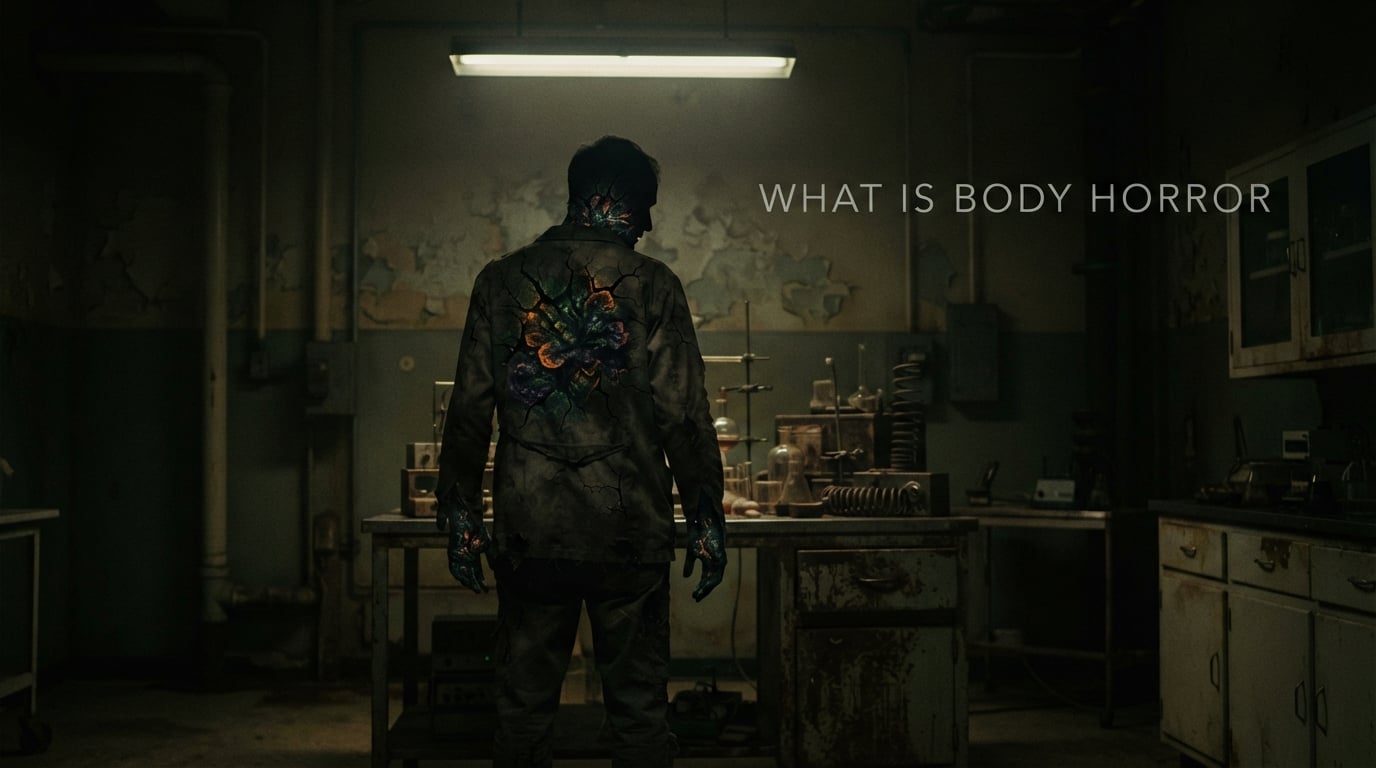
I still remember the first time body horror actually got under my skin. I was thirteen, sneaking a horror VHS from my older brother’s room, and the scene unfolded in slow motion: someone touched a doorknob, and their hand turned into something else entirely. I didn’t sleep for two days. That feeling of dread, of biology turning against you, is exactly what defines body horror, and it’s why this genre has haunted audiences for generations.
Body horror is one of horror’s most psychologically potent subgenres, and if you’ve ever wondered what makes it so uniquely disturbing, you’re in the right place. I’ll walk you through what body horror actually is, where it came from, why it works on us so deeply, and what makes it different from run-of-the-mill gore. By the end, you’ll have a clear picture of why this corner of horror keeps pulling viewers back in for more.
Table of Contents
What Is Body Horror?
Body horror, also called biological horror, is a subgenre of horror fiction that intentionally showcases grotesque or psychologically disturbing violations of the human body. It derives its terror from the unnatural destruction, mutation, or violation of the physical form, focusing on loss of bodily autonomy, unsettling transformations, and visceral disgust at what the body becomes.
Unlike simple shock or jump scares, body horror makes the viewer’s own biology the source of fear. It weaponizes the fact that we live inside our bodies and depend on them working properly. When a body horror story shows a body mutating, splitting open, fusing with something else, or being taken over from the inside, it touches something primal. It whispers: what if your own skin stopped feeling like yours?
The term itself has roots in academic horror studies and was popularized through filmmakers like David Cronenberg, whose work in the 1970s and 80s essentially defined the genre on screen. But the themes of body horror stretch back centuries, through gothic literature, folklore, and even religious imagery about saints and martyrs. The genre isn’t a modern invention. It’s the surface expression of very old fears about what bodies can do to us.
Core Characteristics of Body Horror
Body horror has a recognizable set of ingredients that separate it from other horror subgenres. When I sit down with a body horror film, I look for these core traits, and if a piece hits several of them, I’m in for a rough night. Here are the defining characteristics of the genre.
Loss of Bodily Autonomy
The single most important feature of body horror is the loss of bodily autonomy. Characters cannot control what their own bodies are doing. They might wake up transformed, feel something growing inside them, or watch their flesh behave in ways that defy their will. This is the deepest fear the genre taps: that your body might stop being yours.
Grotesque Transformation
Transformation is where body horror gets its iconic imagery. A human body mutates into something else, often something that crosses a category boundary: human to insect, human to plant, human to machine. The transformations tend to be slow, detailed, and hard to look away from, which is part of why the genre is so effective.
Visceral Disgust
Body horror deliberately provokes visceral disgust. Skin crawling, teeth grinding, stomach lurching disgust. Filmmakers and writers use fluids, textures, and biological detail to make readers feel like they’re watching something happen inside their own body. The disgust response is a feature, not a bug, because it bypasses the thinking brain and goes straight to the lizard brain.
Invasion and Contagion
Many body horror stories revolve around an invader: a parasite, a virus, a fungus, a foreign organism that takes root inside a host. The invasion can be literal, like an alien creature, or metaphorical, like a disease that warps the body from within. This theme taps into real fears about infection and what lives on and inside us.
Dehumanization
Body horror often strips away what makes a character recognizable as human. Through mutation, fusion, or replacement, the person becomes something other, and the story forces us to ask what makes us human in the first place. When the body stops reading as a body, identity itself comes into question.
Psychological Disturbance
The best body horror messes with your head as much as your stomach. Characters (and viewers) start to distrust their own senses. They wonder if what they’re seeing is real. They lose the boundary between self and other. This psychological disturbance is what gives the genre its lasting power, far beyond any single gross-out moment.
Body Horror vs Gore: What’s the Difference?
Body horror and gore often get lumped together, but they’re actually different beasts. Body horror uses the body as the source of dread, while gore is about graphic depictions of physical damage, usually for shock value. The distinction matters because it changes how a story works on you.
Gore is generally concerned with the visible result of violence. Lots of blood, exposed bone, dismemberment. It’s loud, immediate, and often plays for a reaction in the moment. Gore can show up in any horror film, comedy, action movie, even war films. It’s a visual register, not a genre.
Body horror, by contrast, is a subgenre with thematic commitments. The gore in body horror serves the story’s bigger questions about identity, autonomy, and transformation. A slash in a slasher film is gore. A surgical scene in which a character’s body is being slowly fused to a chair is body horror, because what happens to the body is the point, not just the result.
Another way to put it: gore asks, “How much can you watch?” Body horror asks, “What does it mean when your body becomes a stranger to you?” One is about tolerance for imagery. The other is about confronting the limits of selfhood. Both can be unpleasant, but they’re doing different things in your brain.
The Origins and History of Body Horror
Body horror didn’t appear out of nowhere. Its roots go deep, and tracing them helps explain why the genre feels so timeless. From gothic literature to modern cinema, body horror has been with us for as long as humans have told scary stories about what bodies can do.
Early Literary Roots
Long before the term existed, writers were playing with body horror themes. Mary Shelley’s Frankenstein (1818) is often considered one of the earliest and most influential examples. The novel centers on a being assembled from dead body parts and the revulsion his creator feels at what he’s made. That moment of looking at a constructed body and recoiling from it is pure body horror, decades before the genre had a name.
Other 19th-century works, like Robert Louis Stevenson’s Strange Case of Dr Jekyll and Mr Hyde (1886), continued the trend. Jekyll’s transformation into Hyde is a slow, unwilling surrender to a body that no longer reflects his identity. Gothic fiction was obsessed with the body as a site of horror, and these early works set the template for everything that followed.
The Cronenberg Era
If any single filmmaker defined body horror on screen, it’s David Cronenberg. His 1970s and 1980s films, including Shivers (1975), Rabid (1977), The Brood (1979), Videodrome (1983), and The Fly (1986), established the genre’s visual vocabulary and thematic concerns. Cronenberg treated the body as a porous surface, something the world could enter and reshape from within.
The Fly, in particular, became a defining text of the genre. Jeff Goldblum’s slow transformation from scientist to insect-creature is one of the most detailed, empathic depictions of body horror ever filmed, and it works because we care about the person disappearing as the body mutates. Cronenberg showed that body horror could be thoughtful, even tragic, rather than just gross.
Japanese Influence
Japanese horror, often called J-horror, brought its own wave of body horror to global audiences. Hideo Nakata’s Ringu (1998) and Takashi Shimizu’s Ju-On series (2002 onward) used slow, creeping transformations and uncanny body imagery to create dread. Manga and anime also pushed the genre forward, with works like Junji Ito’s Uzumaki exploring grotesque transformation in obsessive, illustrated detail.
Japanese horror often emphasized atmosphere and psychological dread over explicit imagery, but the body remained central. Characters with wrong proportions, faces that won’t quite settle, hair that grows impossibly. The result is a strain of body horror that gets under your skin without showing you everything, which can be even more unsettling.
Why Body Horror Resonates: The Psychology of the Genre
If body horror were just about grossing people out, it would have faded decades ago. The reason it’s stuck around is that it speaks to something deeply real about being a body in the world. The genre resonates because the fears it dramatizes are fears we already carry around, often without realizing it.
The Fear of Losing Control
At its core, body horror is about control, specifically the loss of it. You can’t control your heartbeat, your digestion, your aging, or how your cells behave. Most of the time, we don’t notice this, but body horror brings it to the surface. When a character in a body horror story watches their body betray them, they’re confronting a fear we all share but rarely acknowledge.
Reddit threads about why people like (or avoid) body horror often come back to this point. Many viewers describe the genre as a way of confronting fears about illness, aging, and bodily change in a controlled environment. The story does the imagining for you, so you don’t have to. That’s part of why it’s cathartic for some and unbearable for others.
Puberty and Adolescence
There’s a reason many people encounter body horror most powerfully during adolescence. Puberty is, biologically and emotionally, a body horror story: things grow, things change, your body doesn’t feel like yours anymore, and you can’t stop the process. Body horror taps directly into this experience, which is why it hits so hard in teenage years and why so many horror fans trace their love of the genre back to that time.
Chronic Illness and Disability
Another important angle, often missed in mainstream discussions, is the connection between body horror and real experiences of chronic illness or disability. People living with conditions that change how their body looks or functions sometimes find body horror cathartic because it validates, in exaggerated form, the strangeness of inhabiting a body that doesn’t match cultural scripts.
That said, body horror has a long history of ableist tropes, including using disability, disfigurement, or illness as shorthand for something monstrous. Responsible body horror today often tries to interrogate those tropes rather than reinforce them, and writers like Junji Ito and filmmakers like Julia Ducournau (Titane, Raw) have pushed the genre in directions that question, rather than simply exploit, those associations.
Why Some People Seek It Out
If body horror is so uncomfortable, why do audiences keep coming back? Several explanations come up again and again in fan discussions. One is the thrill of confronting scary ideas from a safe distance. You face something unthinkable, but you can close the book or walk out of the theater. That distance creates a kind of controlled fear that’s almost exhilarating.
Another is the catharsis of recognition. If you’ve ever felt alienated from your own body, watching a character go through a version of that experience can feel strangely validating. The genre gives shape to feelings that are hard to put into words. There’s also a community aspect: horror fans bond over shared endurance of difficult material, and body horror is a kind of badge of honor in that community.
Notable Body Horror Films and Works
Body horror has produced some of the most memorable films, books, and games of the last fifty years. Here are some standout examples across media, all worth knowing if you want to understand the genre.
Body Horror in Film
- The Fly (1986) – David Cronenberg’s masterpiece, in which a scientist’s teleportation experiment slowly fuses him with a fly.
- Videodrome (1983) – A television signal begins to physically reshape its viewers, blurring the line between flesh and video.
- Tetsuo: The Iron Man (1989) – A Japanese cyberpunk film in which a man’s body fuses with metal in escalating, frenetic ways.
- The Thing (1982) – John Carpenter’s shape-shifting alien horror, in which any body might become anything else.
- Raw (2016) – Julia Ducournau’s debut about a veterinary student whose relationship with her own body spirals in unexpected directions.
Body Horror in Literature
Body horror has a long literary history beyond the screen. Kafka’s “The Metamorphosis” (1915) is a foundational text: a man wakes up transformed into a giant insect, and the story is really about how his family treats his new body. Shirley Jackson’s work often plays with bodily discomfort and dread, and contemporary writers like Laird Barron and Carmen Maria Machado have pushed the genre into literary fiction.
Body Horror in Manga and Anime
Japanese manga and anime have produced some of the most extreme and influential body horror imagery. Junji Ito’s Uzumaki (1998-1999) is built around obsessive spiral imagery and bodies warped by cosmic patterns. Tomie (1987) follows a girl whose presence drives those around her to horrifying transformations. These works have shaped the global imagination of what body horror can look like.
Body Horror in Video Games
Video games are a relatively newer home for body horror, but they’ve taken to it quickly. The Silent Hill series uses bodily transformation as a constant visual motif. Resident Evil puts players up against mutating creatures at every turn. More recent games like Scorn (2022) and the Hellblade series place the player inside a body that’s actively being unmade, making the body’s fragility part of the gameplay itself.
Body Horror in Modern Media
Body horror has had a strong resurgence in the 2020s, and it’s showing up in places that would have surprised earlier audiences. The genre’s core fears, about identity, autonomy, and what bodies can do to us, feel especially relevant in an era of pandemic anxiety, body politics, and rapid technological change.
Recent films like Titane (2021), Crimes of the Future (2022), and Beau Is Afraid (2023) put the body at the center of their horror in ways that feel fresh but draw on the genre’s long history. Streaming series, indie comics, and TikTok horror creators have also picked up the torch, often mixing body horror with social commentary about gender, illness, and transformation.
What’s striking is how the genre keeps finding new surfaces to work on. As technology gets more intimate with our bodies, through implants, screens, and AI, body horror finds new ways to dramatize what it feels like when the boundary between self and system breaks down. The genre may be old, but the fears it dramatizes are constantly being updated.
Frequently Asked Questions About Body Horror
What is body horror vs gore?
Body horror is a subgenre of horror that uses transformation, mutation, and loss of bodily autonomy as the central source of dread. Gore is graphic imagery, usually of wounds or violence, that can appear in any genre and aims for shock value. Body horror uses the body to ask questions about identity and control, while gore focuses on the visible damage itself.
Why is body horror so scary?
Body horror is so scary because it makes the viewer’s own body the source of fear. It dramatizes losing control of your flesh, your identity, and your physical form, which are fears almost everyone carries. The genre also provokes strong visceral disgust, a reaction that bypasses rational thought and goes straight to gut-level alarm.
How do you describe body horror?
Body horror, also called biological horror, is horror that derives its terror from the unnatural destruction, mutation, or violation of the human body. Common elements include grotesque transformation, loss of bodily autonomy, invasion by parasites or disease, and dehumanization. The genre is defined by what happens to bodies, not just how much blood is shown.
What is the scariest body horror movie?
The scariest body horror movie is subjective, but standout choices include The Fly (1986) for its tragic transformation, Tetsuo: The Iron Man (1989) for its industrial body fusion, and Raw (2016) for its intimate coming-of-age horror. Older films like Videodrome (1983) and modern entries like Titane (2021) are also widely cited for their disturbing body imagery.
Final Thoughts on Body Horror
Body horror is one of horror’s most psychologically honest subgenres, and once you understand what it’s really about, it’s hard to look at it the same way. The genre isn’t just about how much a body can take. It’s about what it feels like to live inside a body at all, and what happens when that relationship breaks down.
If you’re new to body horror, start with The Fly or Raw. Both are accessible, well-crafted, and central to understanding the genre. If you’re already a fan, the 2020s have been a golden era, with new films, games, and books pushing the form in directions that feel fresh. There’s more good body horror being made right now than at almost any point in the genre’s history.
The reason body horror endures is simple. We all have bodies. We all know what it’s like to feel them change, betray us, or surprise us. Body horror just takes those everyday feelings and turns them up until we have to pay attention. That’s uncomfortable, but it’s also why the genre keeps finding new audiences, year after year.