
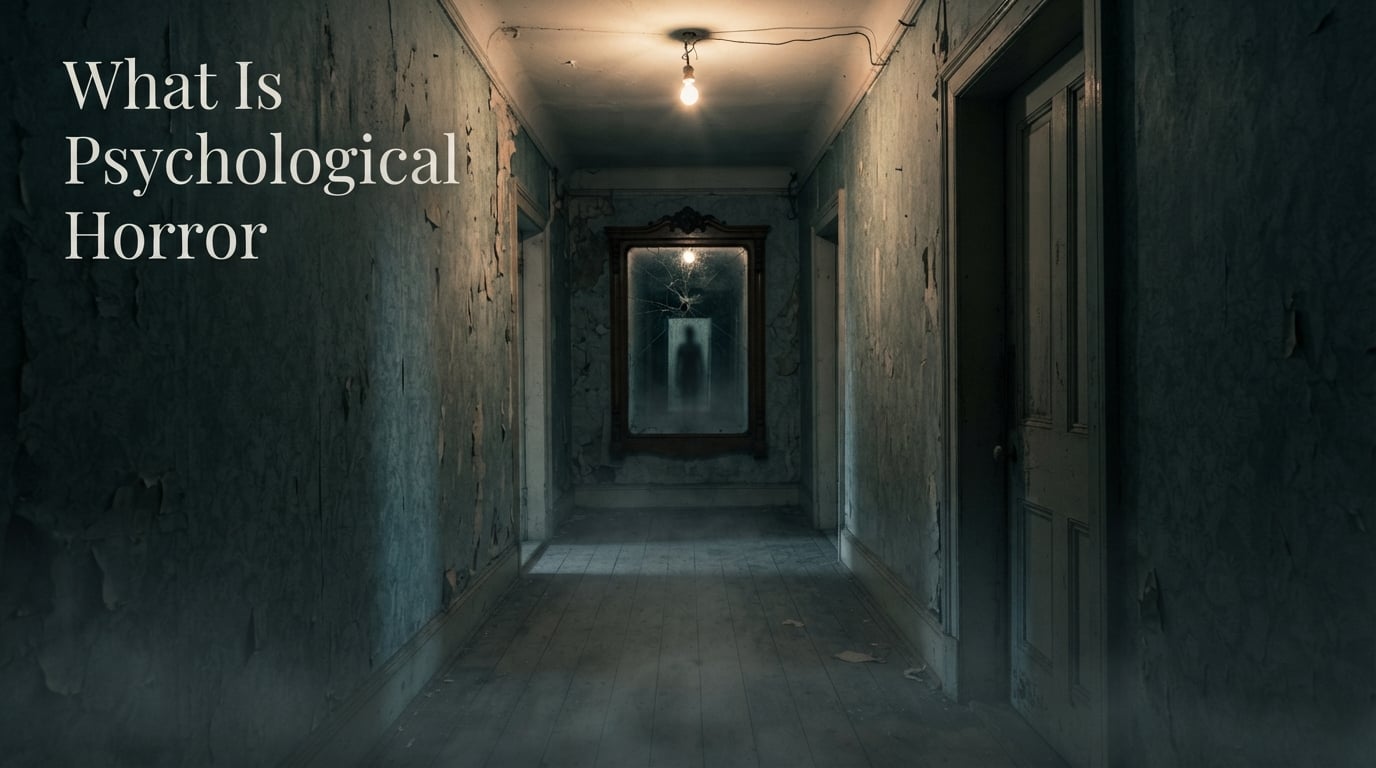
Psychological horror is a horror subgenre that frightens audiences by attacking the mind instead of the body. It replaces gore and monsters with mental states, atmosphere, and slow-burn dread. If you have ever felt more unsettled by a story’s whispered idea than by anything shown on screen, you already know what psychological horror tries to do.
I started digging into this genre after finishing a quiet novel that scared me more than anything with a chainsaw. That made me want a clear answer to a simple question: what is psychological horror, really, and why does it stick with people long after they close the book or leave the theater? In this guide I’ll walk you through the definition, the key traits, where the genre came from, and the techniques creators use to get inside your head.
You’ll see how it differs from supernatural horror and from psychological thrillers, plus film, book, and video game examples you can explore next. By the end, you’ll have a working definition you can use and a clearer sense of why this quieter style of horror hits so hard.
Table of Contents
What Is Psychological Horror?
Psychological horror is a subgenre of horror and psychological fiction that focuses on mental, emotional, and psychological states to frighten, disturb, or unsettle its audience. The dread comes from inside a character’s mind, and often from inside the reader or viewer’s mind. The goal is to leave you questioning what is real, not to make you flinch.
Most working definitions borrow from Wikipedia’s plain framing: it is “horror of the mind.” That phrase captures the entire genre in two words. There may still be tension, suspense, and even the occasional violent scene, but the engine is internal, not external.
The genre leans on atmosphere, suggestion, and emotional truth. A creaking door is just a sound in regular horror. In psychological horror, a creaking door can become proof that reality itself is cracking.
Why This Definition Matters
Without a clear definition, the term gets stretched to mean “any horror with a sad protagonist.” That dilution is exactly what newcomers complain about on Reddit’s horror subs. A useful definition has to do three things at once.
- It has to point at fear, not just feelings. Sad is not enough; the work has to unsettle the reader or viewer.
- It has to come from inside a person. Monsters can appear, but the threat must live in the mind.
- It has to rely on mental and emotional mechanics. Paranoia, denial, trauma, and unreliable perception are the tools.
When all three are present, you have psychological horror. When even one is missing, you probably have something else, often a thriller with a gothic coat of paint.
Key Characteristics of Psychological Horror
The genre has a recognizable fingerprint. Even when stories look nothing alike on the surface, these traits keep showing up. If a story checks most of these boxes, you are almost certainly looking at psychological horror.
- Mental anguish drives the plot. Characters spiral, break, or fight to hold themselves together.
- Atmospheric dread replaces jump scares. Lighting, sound, and pacing build creeping fear.
- Suspense matters more than action. The gap between events is where the genre lives.
- The uncanny keeps creeping in. Familiar spaces feel slightly wrong and the reader notices before the character does.
- The pace is slow-burn. The story takes its time so dread has room to accumulate.
- An unreliable narrator is common. You often cannot trust what the protagonist sees or remembers.
- Reality itself can blur. You may finish the story unsure what was real.
- Gore and graphic violence are dialed back, sometimes to almost nothing.
That last point is a tell. Many fans land on psychological horror precisely because they want horror that does not depend on gore. The British Fantasy Society put it well when it said the genre “opens up our skulls and peeks inside.”
Mental Anguish as the Engine
Mental anguish is the most reliable signal of the genre. A character who is struggling, suppressed, or breaking is doing the heavy lifting. The reader mirrors that struggle through identification. We do not need to see the monster in the closet because the real fight is happening at the bedroom mirror.
This is also where the genre touches real life. Trauma, grief, paranoia, isolation, and grief again show up on the page not as decoration but as lived experience. When writers handle these carefully, the result feels less like fiction and more like recognition.
A Brief History of Psychological Horror
The genre did not appear out of nowhere. It grew out of older forms that already cared more about dread than spectacle.
Gothic and Victorian Roots
Gothic literature in the 1700s and 1800s set the template. Mary Shelley’s Frankenstein in 1818 asked what happens when a creator can no longer control what he made. The novel is less about the creature and more about Victor Frankenstein’s guilt, obsession, and collapse. Poe in the 1830s and 1840s turned the camera inward with stories like “The Tell-Tale Heart” and “The Fall of the House of Usher,” where a narrator’s perception is the unreliable thing.
Henry James pushed the form further with “The Turn of the Screw” in 1898. Whether the ghosts in that novella are real is still debated more than a century later. The story’s power lives in that gap, which is exactly the engine psychological horror still runs on today.
20th Century Codification
Alfred Hitchcock’s Psycho (1960) shook mainstream cinema. The famous shower scene used violence, yes, but the film’s deepest scares came from Norman Bates’s fractured mind. Shirley Jackson’s The Haunting of Hill House (1959) and We Have Always Lived in the Castle (1962) showed that interior horror could carry a novel without a single supernatural threat.
Stephen King expanded the audience in the 1970s and 1980s. The Shining (1977) and Misery (1987) turned addiction, isolation, and obsession into things that felt monstrous. By the time films like Rosemary’s Baby (1968), The Blair Witch Project (1999), and Black Swan (2010) hit theaters, the language of psychological horror was fully shared between book, film, and eventually games.
The Modern Era
In 2026, the genre is bigger than ever. Films like Get Out (2017), Hereditary (2018), and The Babadook (2014) brought it back to the cultural center, and streaming-era shows such as The Haunting of Hill House (2018) and Brand New Cherry Flavor (2021) extended the form into long-format storytelling.
Video games have done some of the most creative work in the past two decades, but I’ll cover that separately below.
Psychological Techniques That Make It Work
Writers and filmmakers use a small toolbox of techniques over and over. Knowing them helps you spot the genre instantly, and it helps creators understand how to build dread deliberately.
Unreliable Narrator
The story is told by someone we cannot fully trust. The narrator may be lying, lying to themselves, or simply unable to perceive reality. The reader has to piece events together from clues the narrator misses.
Reality Blurring
Events, dreams, hallucinations, and memories slide into each other. The story keeps the reader slightly off-balance because any scene might be imagined. This is the gear that powers stories like Black Swan and House of Leaves.
Paranoia and Surveillance
Characters feel watched, tracked, or hunted. Sometimes they are. Often they are not. The genre is happy to leave that question open.
Trauma Response
Characters cope with past events in ways that distort their present. Dissociation, hypervigilance, avoidance, and intrusive memories all show up. This is where the genre touches real mental health in ways that careful writers earn.
Show, Don’t Tell Dread
Subtle details carry the weight: a clock that stops, a door left open, an off-key note in music. Readers notice these before the characters do, which makes them feel smarter than the protagonist and therefore more exposed when things go wrong.
Famous Psychological Horror in Film
Film is where most readers first feel psychological horror. These five are good starting points because they each show a different technique in action.
- Psycho (1960): The textbook case for split-personality horror and the limits of “knowing” a character.
- Rosemary’s Baby (1968): Slow paranoia about who to trust at home and in your own body.
- The Shining (1980): Isolation, addiction, and a family under one roof that cannot hold together.
- Black Swan (2010): Reality blurring driven by perfectionism and ambition turning predatory.
- Get Out (2017): Social horror that uses race and gaslighting together to build a uniquely modern dread.
Psychological Horror in Literature
Books let the genre stay inside the narrator’s head for hundreds of pages. That long exposure is why novels in this genre can haunt readers for years.
- The Turn of the Screw by Henry James (1898): A governess sees ghosts. Or she does not. The debate is the point.
- The Haunting of Hill House by Shirley Jackson (1959): A haunted house story where the haunting is mostly inside the protagonist.
- Misery by Stephen King (1987): Captivity, dependency, and obsession between a writer and his “biggest fan.”
- American Psycho by Bret Easton Ellis (1991): A surface-perfect narrator whose reality keeps sliding away from the reader.
- House of Leaves by Mark Z. Danielewski (2000): A novel that uses layout, footnotes, and unreliable sources to trap the reader.
Psychological Horror in Video Games
Video games are an underserved corner of this genre, even though they may be where the form is being pushed hardest. A game can put you in the protagonist’s head and then quietly remove the floor.
- Silent Hill 2 (2001): Grief, guilt, and a fog that may or may not be alive. Often called the genre’s reference point.
- Amnesia: The Dark Descent (2010): No weapons, no combat, just you and whatever the dark is doing to your mind.
- Soma (2015): Identity and consciousness under pressure, with endings that stay with you long after the credits roll.
- Layers of Fear (2016): A painter slowly loses touch with reality, and so does the player.
- Hellblade: Senua’s Sacrifice (2017): Builds its atmosphere from a respectful depiction of psychosis that doubles as gameplay.
These games show what the genre can do when it can hear your heartbeat through your headphones. The screen becomes a one-way mirror back at you.
Psychological Horror vs Supernatural Horror
This is the comparison people reach for first, and rightly so. The two overlap more than purists like to admit, but the working difference is clear.
Supernatural horror draws its fear from forces that exist outside normal reality. Think vampires, demons, haunted houses, and other planes. The audience can point at the threat and ask how to stop it.
Psychological horror draws its fear from the human mind. The threat lives inside the protagonist, the antagonist, or the reader. Sometimes a supernatural thing shows up, but it usually functions as a mirror for a mental state. Rosemary’s Baby features a coven, yet the deepest fear is that no one will believe the protagonist, including her husband and her doctor.
The two can absolutely coexist. Ghost stories can be psychological horror when the ghost stands in for something the character cannot face. The key is what the story wants you to leave thinking about: the monster in the dark, or the mind standing in the dark with it.
Psychological Horror vs Psychological Thriller
This is the confusion forum users bump into most. The two genres are close cousins and they share DNA, but they want different things from the reader.
A psychological thriller’s goal is suspense, tension, and a satisfying resolution, often a reveal or a takedown of the antagonist by the end. The reader leaves feeling tense, then relieved when the puzzle resolves.
Psychological horror’s goal is disturbance. Even after the plot resolves, the reader is meant to feel uneasy, hollow, or unsettled. The story’s job is to leave a residue.
Look at the endings and you can often tell the difference. A clean twist payoff points toward thriller. An ending that refuses to close the wound points toward horror. The Shining ends with a photograph and a question. That question is doing the horror.
Why Psychological Horror Works on Us
The genre works because the things it threatens are real. We can be skeptical about werewolves. We all know what it feels like to lose sleep, doubt our own memory, or wonder if a friend has changed behind our back.
That relatability is the engine. Fear of losing your mind, fear of being controlled, fear of discovering that someone you trust does not have your interests at heart, these are fears the audience already carries. The genre does not invent dread. It borrows it.
There is also a lingering quality. A jumpscare is over in a second and the body returns to baseline. A slow, well-built piece of psychological horror can change how the reader moves through their own house for a week. That is the genre’s whole commercial.
Frequently Asked Questions
What classifies as psychological horror?
A story that builds fear through mental and emotional states, atmosphere, and suspense rather than gore or external monsters. Mental anguish, unreliable perception, and slow-burn dread are the usual markers.
Is psychological horror actually scarier?
Many readers and viewers say yes, because it uses fears that already feel real: loss of control, paranoia, trauma, and doubt about what is true. Jump scares fade fast, but interior fear lingers.
What is the difference between horror and psychological horror?
Horror is the umbrella. Psychological horror is a subgenre that locates the threat inside a character’s mind, using atmosphere and suggestion. Supernatural horror often points at an outside threat; psychological horror points inward.
What is an example of psychological horror?
Psycho (1960), The Shining (1980), and Black Swan (2010) are classic film examples. In books, The Haunting of Hill House, Misery, and House of Leaves are common touchstones. Silent Hill 2 and Amnesia are leading video game examples.
How does psychological horror work?
It works by making the audience identify with a character’s mental state, then eroding the reader’s trust in that character’s perception. Atmosphere, pacing, and small details do the heavy lifting instead of loud scares.
Final Thoughts on Psychological Horror
Psychological horror is what happens when horror decides the scariest place in the story is the inside of a person’s head. It trades gore and monsters for atmosphere, suggestion, and the slow erosion of trust, in the narrative and sometimes in the reader themselves.
The genre rewards attention. It punishes easy answers. If you want a starting point, try The Haunting of Hill House if you like books, Psycho if you want a film that runs under two hours, or Amnesia: The Dark Descent if you want to feel the genre operate in real time. Each one uses a different tool, and each one shows what the genre does best.
Once you see the techniques at work, you will start spotting them everywhere. That is not a warning. It is the point.