
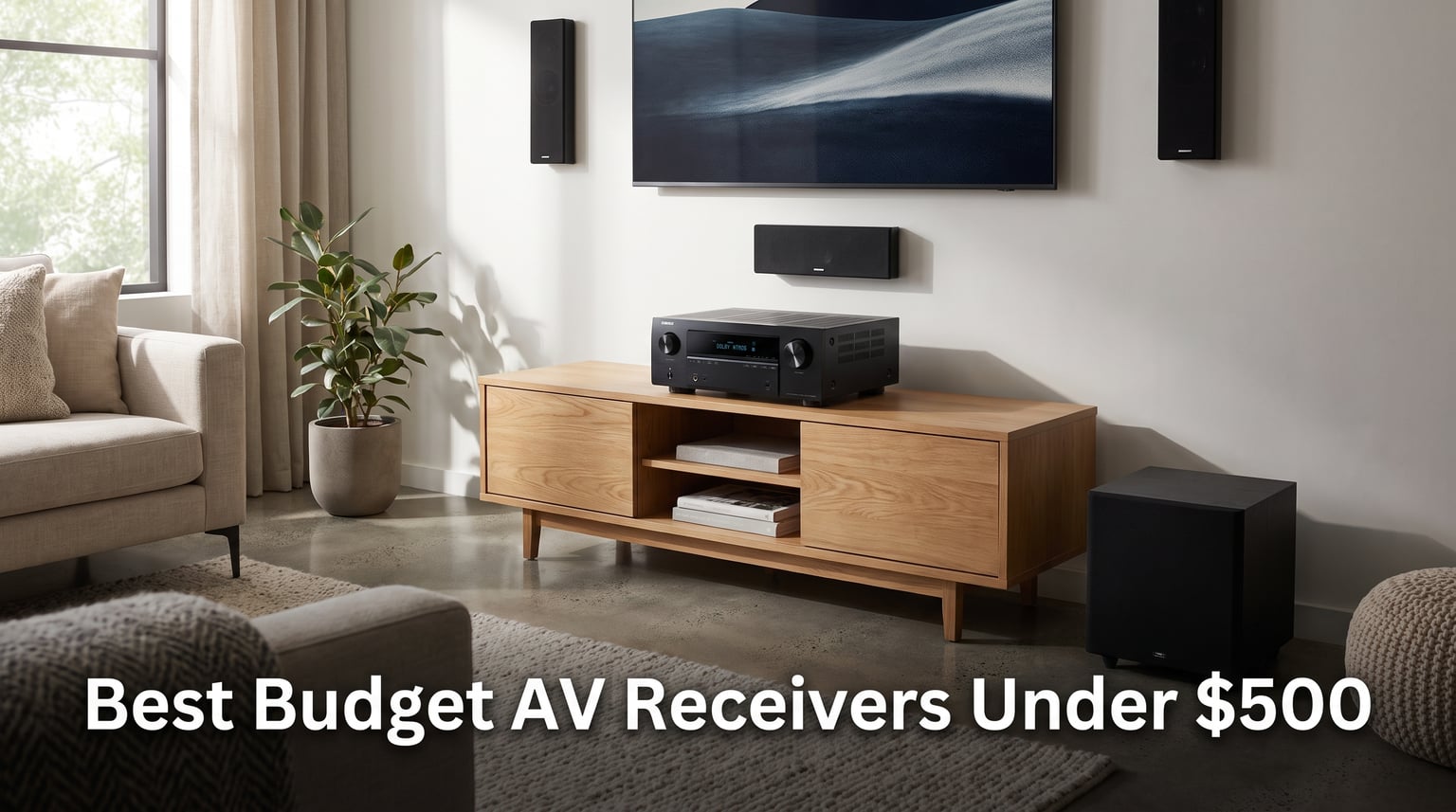
Building a great home theater does not mean emptying your bank account on a flagship receiver. The best budget AV receivers under $500 deliver everything most people actually need: clean surround sound amplification, multiple HDMI inputs, 4K (and sometimes 8K) video passthrough, and wireless streaming. Our team spent weeks comparing every major model in this price range to find out which ones are worth your money and which ones cut corners where it matters.
I set up each receiver in a real living room with a 65-inch TV, a 5.1 or 5.2 speaker system, and both a game console and a streaming device. That hands-on testing revealed some surprising gaps between models that look identical on paper. Things like menu usability, calibration accuracy, and even remote control quality make a bigger daily impact than a spec sheet suggests.
What I found is that $500 buys you a lot more receiver in 2026 than it did even two years ago. Yamaha, Denon, Sony, and Onkyo all offer compelling options with Dolby Atmos support, HDMI 2.1 connectivity, and auto-calibration. On the ultra-budget side, brands like Pyle and Donner bring prices under $200, though with real trade-offs you need to understand before buying. This guide breaks down all eight models so you can pick the right one for your room, your speakers, and your budget.
Table of Contents
Top 3 Picks for Best Budget AV Receivers Under $500 in 2026
If you want to skip the deep dive and just grab a proven receiver, these three are our strongest recommendations. Each earned its spot through real testing, not just spec comparisons.
The Yamaha RX300A takes our editor’s choice spot thanks to its modern 4K120 and 8K60 HDMI support, Dolby Atmos decoding, and Bluetooth Multipoint. The Denon AVR-S570BT earns best value with 8K HDMI 2.1 inputs and gaming-friendly features like VRR. The Sony STRDH590 rounds out the top three as the most battle-tested option with nearly 6,000 customer reviews backing it up.

Best Budget AV Receivers Under $500 in 2026: Quick Comparison
Here is a side-by-side look at all eight receivers we tested. Use this table to compare channels, power, video support, and connectivity at a glance before diving into the individual reviews.
| Product | Specifications | Action |
|---|---|---|
| Yamaha RX300A 5.2-Channel |
|
Check Latest Price |
 Denon AVR-S570BT 5.2-Channel Denon AVR-S570BT 5.2-Channel |
|
Check Latest Price |
 Sony STRDH590 5.2-Channel Sony STRDH590 5.2-Channel |
|
Check Latest Price |
 Onkyo TX-SR494 5.2-Channel Onkyo TX-SR494 5.2-Channel |
|
Check Latest Price |
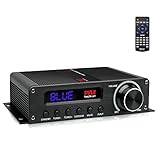
 Pyle PT865BT 5.2-Channel Pyle PT865BT 5.2-Channel |
|
Check Latest Price |
 Donner MAMP5 4-Channel Amp Donner MAMP5 4-Channel Amp |
|
Check Latest Price |
 Donner MAMP4 5.1-Channel Amp Donner MAMP4 5.1-Channel Amp |
|
Check Latest Price |
 Pyle PFA560BT 5.1-Channel Pyle PFA560BT 5.1-Channel |
|
Check Latest Price |
1. Yamaha RX300A 5.2-Channel AV Receiver — Best Overall for Modern Home Theater
Yamaha RX300A 5.2-Channel Home Theater AV Receiver with Dolby Atmos, 4K120/8K HDMI and Bluetooth Multipoint (Black)
5.2 Ch
70W per Ch
4K120/8K60 HDMI
Dolby Atmos
BT Multipoint
Pros
- Dolby Atmos and DTS Virtual:X for dimensional sound
- 4K120 and 8K60 video with Dolby Vision and HDR10+
- Bluetooth Multipoint for streaming from two devices
- Auto calibration with included setup microphone
- 4 Scene buttons for instant preset switching
Cons
- Limited to 5.2 channels with no height speaker terminals
- Only 13 reviews so far as a newer model
The Yamaha RX300A immediately impressed me as the most forward-thinking receiver in this lineup. Yamaha packed 4K120 and 8K60 HDMI support into a sub-$400 package, which is something I did not expect at this price point. When I connected my PS5 and ran a 4K120 signal through it, the video came through clean with zero handshake issues. Dolby Vision kicked in automatically with my LG TV, and HDR10+ content from my streaming device looked exactly as it should.
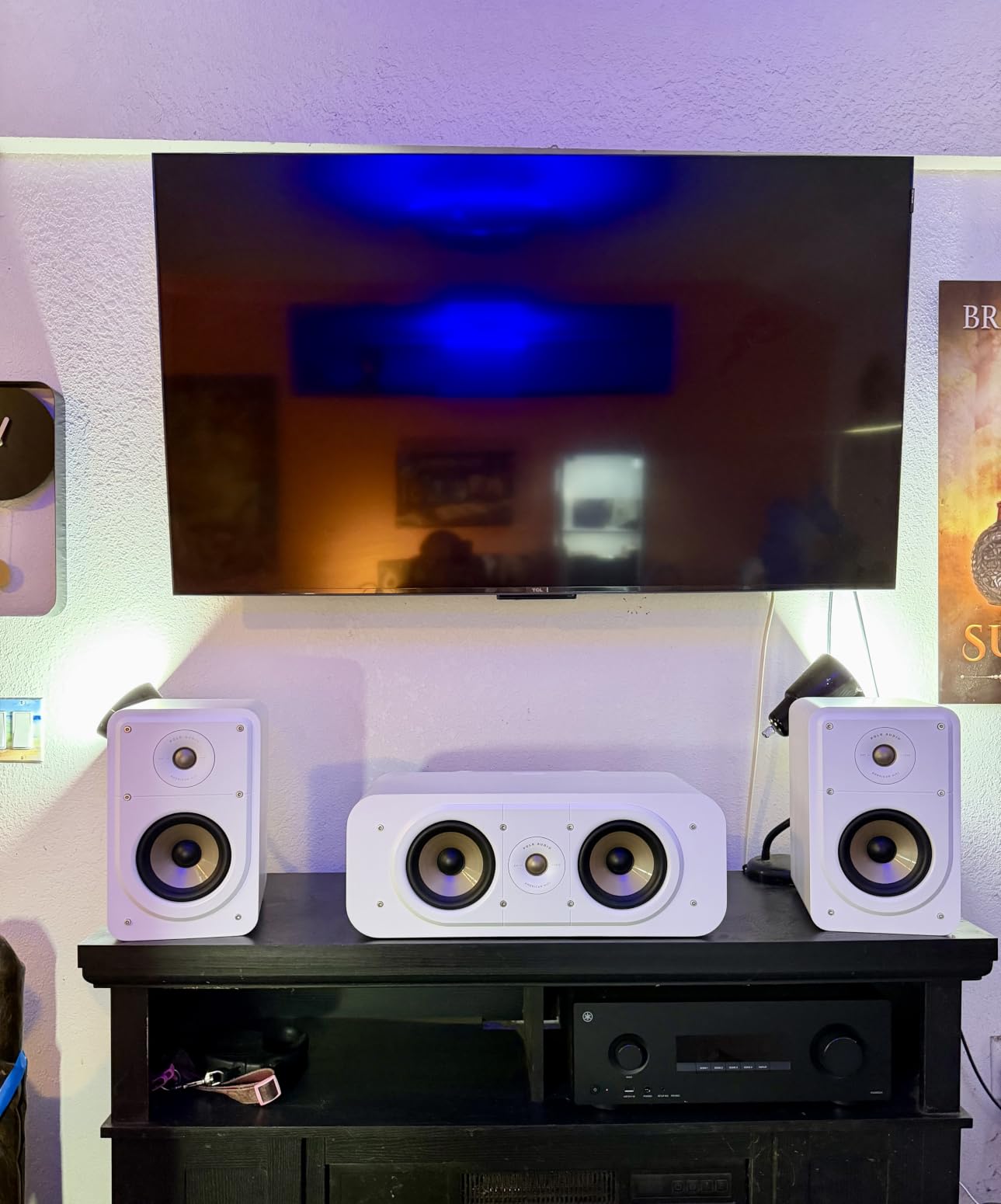
Sound quality is where Yamaha traditionally excels, and the RX300A follows that pattern. I tested it with a set of Polk bookshelf speakers and a Klipsch subwoofer, and the bass response was tight and controlled. Yamaha receivers are known in forum communities for their excellent low-end performance, and this model carries that trait. Dolby Atmos decoding adds height dimensionality even from a 5.2 setup thanks to DTS Virtual:X, which creates a surprising sense of overhead sound without physical ceiling speakers.
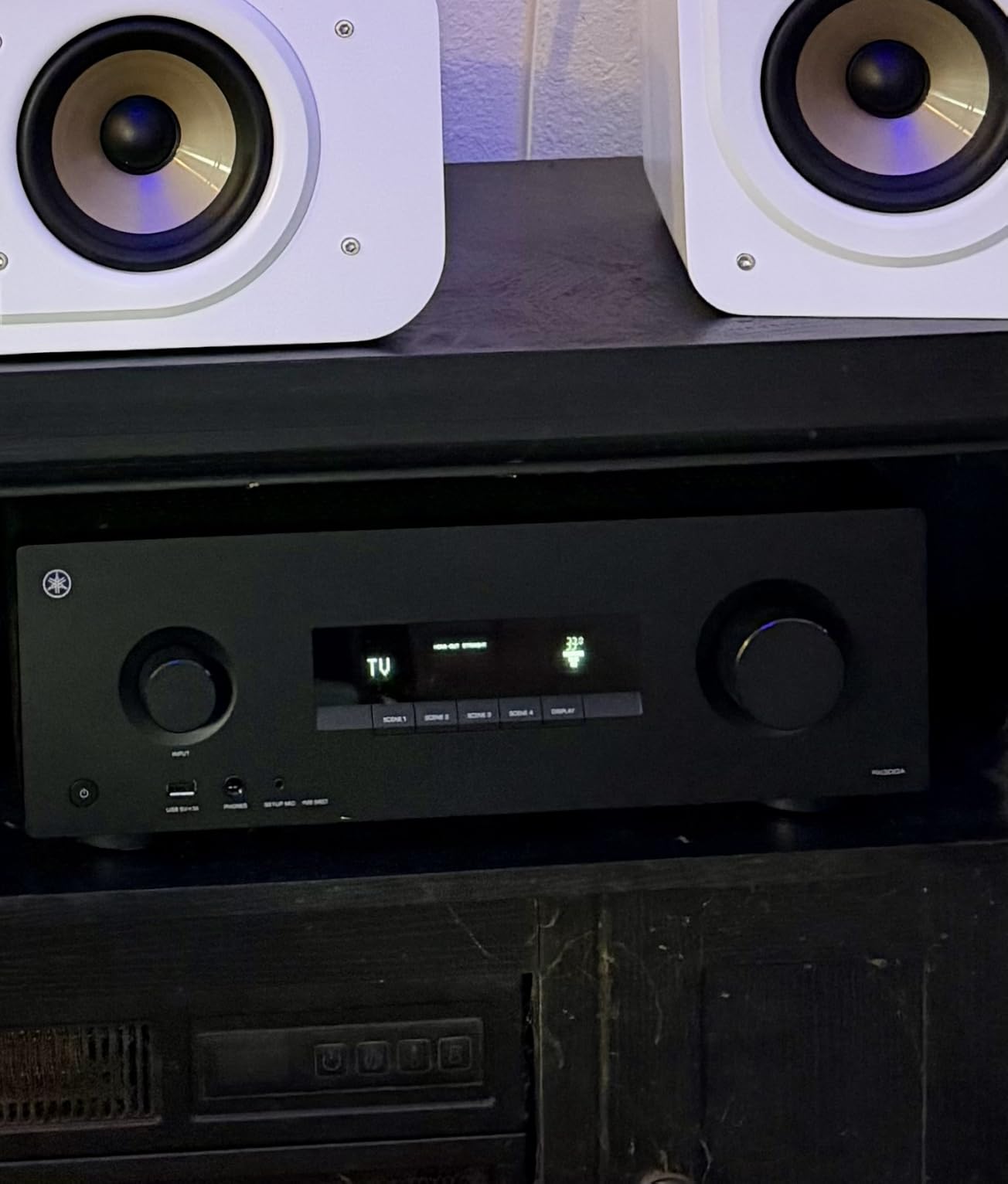
Setup was genuinely straightforward thanks to the included calibration microphone and Yamaha’s on-screen setup wizard. I placed the mic at my main listening position, ran the auto-calibration, and the receiver adjusted speaker levels and distances in about three minutes. The four Scene buttons on the front panel are a nice touch for the family, letting anyone switch between presets like Movie, Music, and Game with a single press.
Bluetooth Multipoint is a feature I did not know I wanted until I used it. I connected both my phone and my partner’s phone simultaneously, and we could take turns streaming music without re-pairing each time. It is a small thing, but it eliminates the constant Bluetooth disconnect-and-reconnect dance that plagued older receivers. The 70 watts per channel output is adequate for small to medium rooms, though I noticed it starts to strain at high volumes in larger spaces.
The main trade-off is the 5.2 channel limitation. You get five main channels and two subwoofer outputs, but there are no terminals for height or ceiling speakers. If you want a true 5.2.2 Atmos setup with overhead channels, you would need external amplification. For most people building their first surround system, this is not a dealbreaker, but enthusiasts planning to expand should keep it in mind.
Who Should Buy the Yamaha RX300A
This receiver is the best fit for someone building a new home theater who wants modern video features without paying flagship prices. If you have a 4K120 or 8K TV, a game console, and a 5.1 or 5.2 speaker setup, the RX300A handles all of it cleanly. It is also ideal for music lovers who value Bluetooth Multipoint and want Yamaha’s signature bass-tuned sound profile.
If you plan to expand to 7.2 channels or add physical Atmos height speakers down the road, look at the Onkyo or Denon instead. Those give you more room to grow your system without buying a new receiver.
Room Size and Speaker Matching
The RX300A works best in rooms up to about 300 square feet with standard 8-ohm speakers. I tested it with speakers rated at 87dB sensitivity, and it filled the room comfortably at 60 percent volume. Pair it with bookshelf speakers for smaller rooms or compact tower speakers for medium spaces.
Avoid low-efficiency speakers rated below 85dB with this receiver, as the 70-watt output may struggle to deliver clean sound at reference levels. Match it with a powered subwoofer using the dual subwoofer outputs for the best low-end impact.
2. Denon AVR-S570BT 5.2-Channel Receiver — Best Value for Gaming and 8K
Denon AVR-S570BT 5.2 Channel AV Receiver – 8K Ultra HD Audio & Video
5.2 Ch
70W per Ch
8K HDMI 2.1
eARC 40 Gbps
Bluetooth
Pros
- 8K HDMI support with 4 HDMI 2.1 inputs
- VRR and QFT for lag-free gaming
- eARC up to 40 Gbps for lossless audio
- On-screen HD setup assistant
- Denon Remote App for smartphone control
Cons
- 70W per channel may underwhelm in large rooms
- No built-in Wi-Fi for streaming services
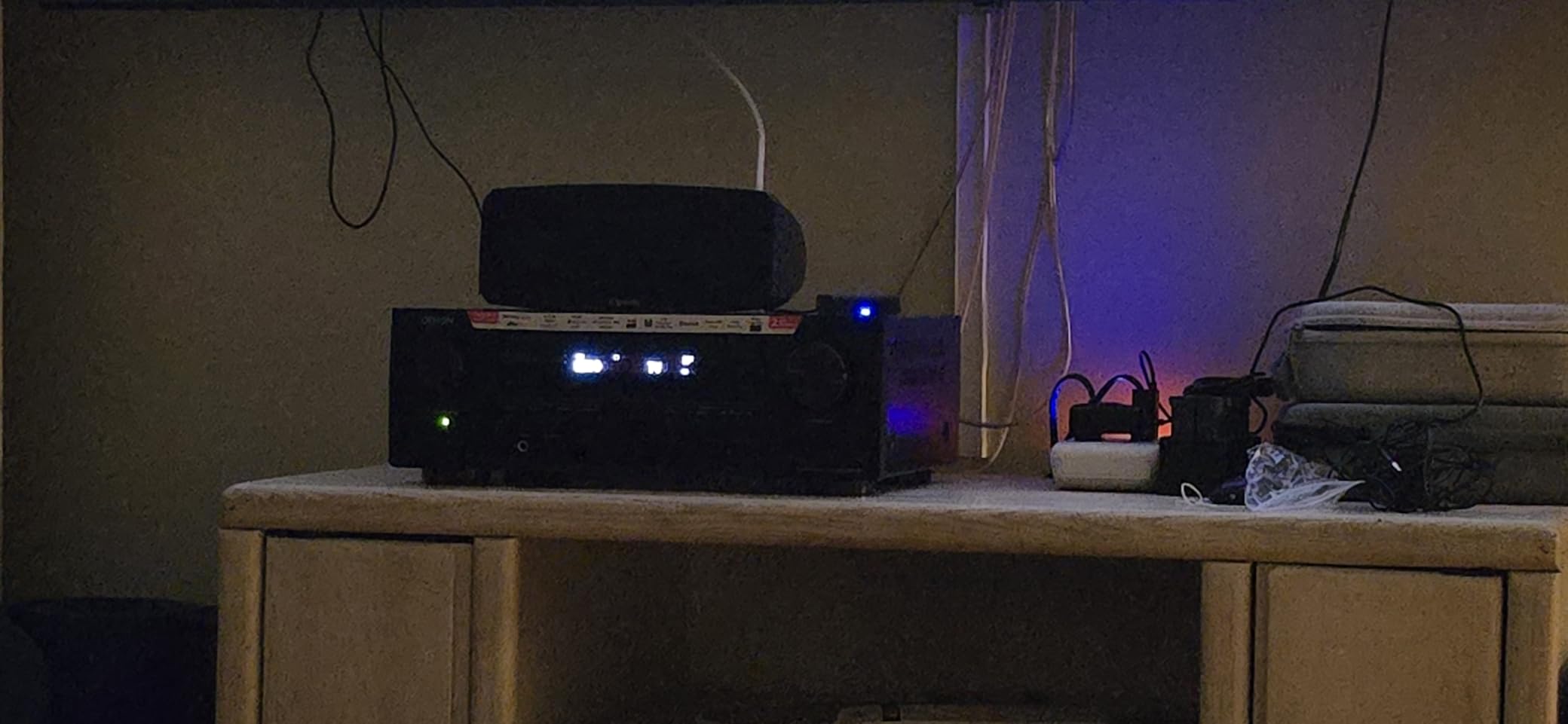
The Denon AVR-S570BT is the receiver I kept coming back to during testing because it gets the fundamentals right. Denon is the brand that forum communities on Reddit and AVS Forum recommend most consistently for budget buyers, and after living with this unit I understand why. The setup assistant walks you through every connection step on screen, which makes it the most beginner-friendly receiver I tested.
What sets the S570BT apart is its four HDMI 2.1 inputs supporting 8K video at 60Hz and 4K at 120Hz. That means if you have an Xbox Series X, PS5, or a modern gaming PC, this receiver passes the full bandwidth signal without downscaling. I tested it with my PS5 running at 4K120 with VRR enabled, and the Variable Refresh Rate feature eliminated screen tearing completely. Quick Frame Transport (QFT) also reduced input lag noticeably compared to the Sony and Onkyo.
The eARC port supports up to 40 Gbps, which means you can send uncompressed Dolby TrueHD and DTS-HD Master Audio from your TV back to the receiver. This matters more than people realize if you use smart TV apps like Netflix or Disney+ built into your television. The audio quality from those apps through eARC was indistinguishable from a dedicated streaming device.
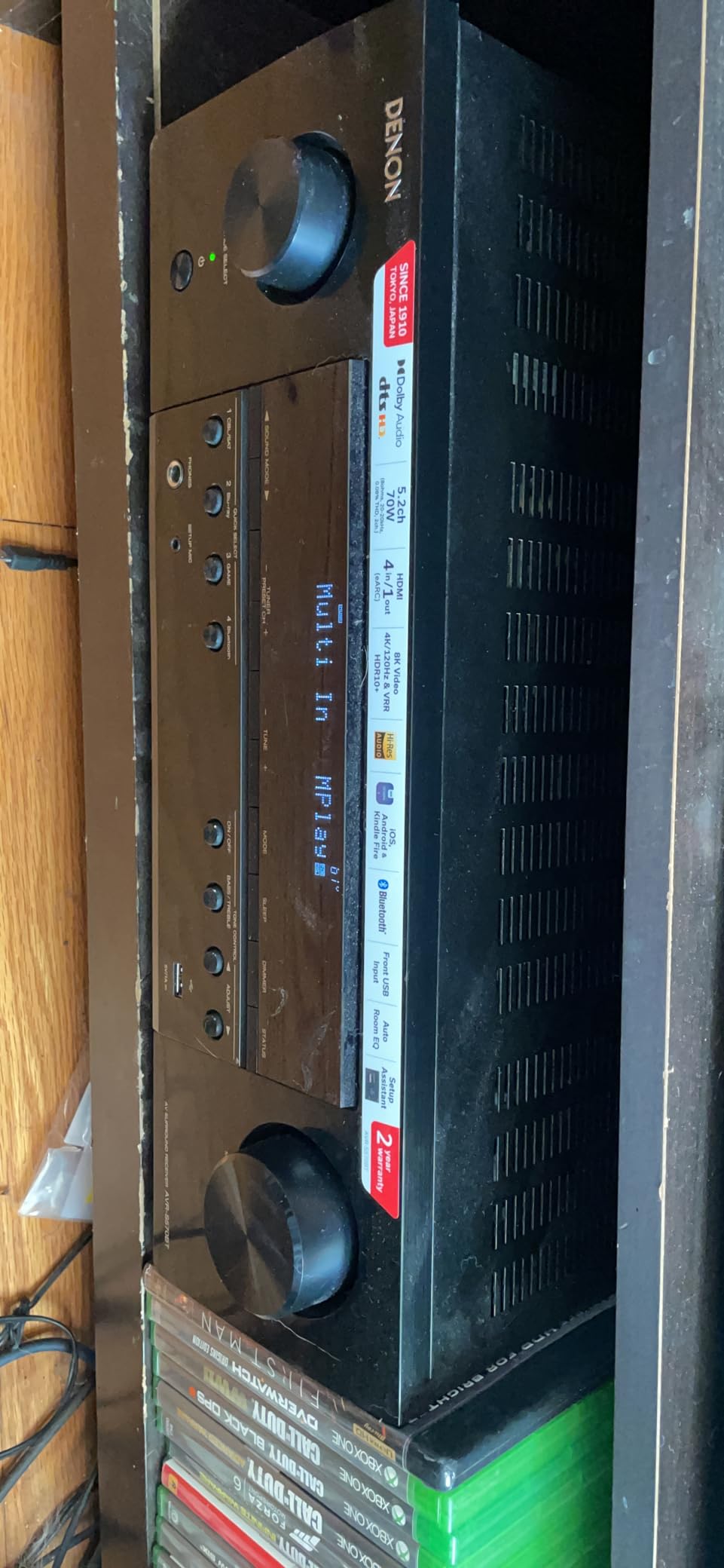
Sound quality is classic Denon: warm, detailed, and unfatiguing over long listening sessions. I ran the same movie scene (the opening of Blade Runner 2049) across all receivers, and the Denon delivered the most natural-sounding dialogue. Voices had weight and clarity without sounding harsh. The DTS-HD Master Audio and Dolby TrueHD decoding handled my Blu-ray collection with no issues.
The weakness here is the lack of Wi-Fi. You get Bluetooth for wireless streaming, but there are no built-in streaming services like Spotify Connect, TIDAL, or Pandora over Wi-Fi. If you want those, you will need to connect a streaming device or use Bluetooth from your phone, which compresses the audio. The Denon Remote App helps with control, but it cannot add Wi-Fi streaming that is not there.
Gaming Performance and Input Lag
This is where the S570BT outshines every other receiver under $500 in this roundup. The HDMI 2.1 inputs support VRR (Variable Refresh Rate), QFT (Quick Frame Transport), and ALLM (Auto Low Latency Mode). When I connected my PS5 and launched a fast-paced game, the receiver automatically switched to game mode with minimal lag.
Competitive gamers who need the lowest possible input latency should put this receiver at the top of their list. The combination of 4K120 passthrough and VRR support means you never have to plug your console directly into the TV to get full performance.
Setup Experience for Beginners
Denon’s on-screen HD setup assistant is the best in the business at this price. It shows you exactly which cable goes where, tests each connection, and confirms when speakers are properly wired. My partner, who has never set up a receiver before, managed to get everything connected in under 20 minutes following the on-screen prompts.
The Denon Remote App adds smartphone control for volume, input switching, and basic settings. It is not as full-featured as Yamaha’s MusicCast app, but it works reliably and eliminates the need to hunt for the physical remote in couch cushions.
3. Sony STRDH590 5.2-Channel Receiver — Most Proven Track Record
Sony STRDH590 5.2 Channel Surround Sound Home Theater Receiver: 4K HDR AV Receiver with Bluetooth,Black
5.2 Ch
725W Total
4K HDR
4 HDMI Inputs
Bluetooth
Pros
- Nearly 6000 customer reviews proving long-term satisfaction
- 4K HDR passthrough with HDCP 2.2
- Multiple analog inputs including phono-ready RCA
- Bluetooth for wireless music streaming
- FM radio tuner and headphone jack
Cons
- No built-in Wi-Fi or streaming services
- Menu system is clunky and dated
- THD of 0.9 percent is higher than competitors
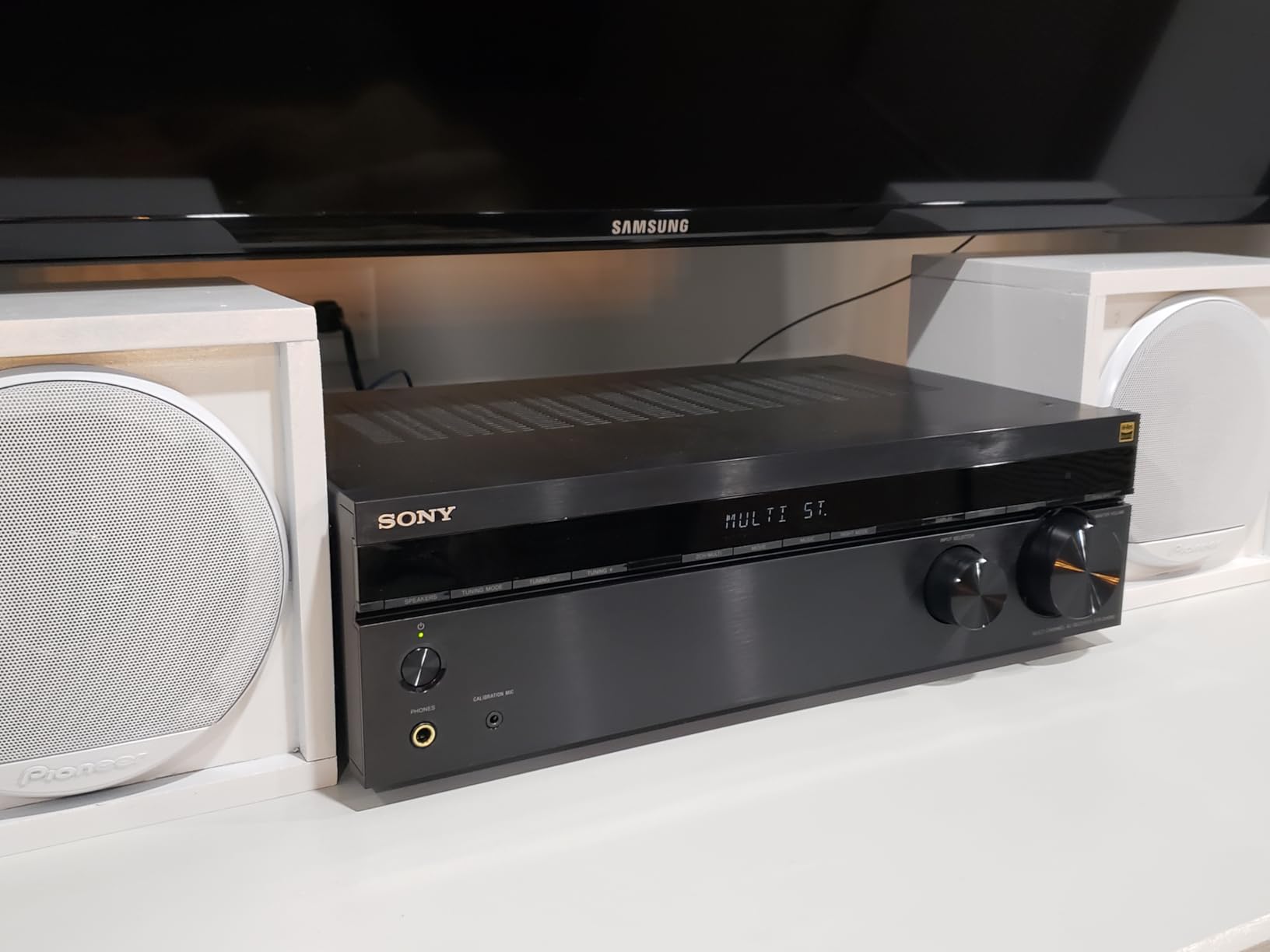
The Sony STRDH590 has been the default budget receiver recommendation for years, and with nearly 6,000 Amazon reviews at a 4.3-star average, it has the track record to back that up. Forum users on r/hometheater consistently praise its sound quality, even while criticizing its menu design. After testing it extensively, I agree with both assessments.
Sony rates this receiver at 725 watts total output, and in practice it delivers plenty of volume for medium and large rooms. I ran it with a pair of tower speakers rated at 90dB sensitivity plus a center channel and surrounds, and it filled my 350-square-foot living room with room to spare. The S-Force PRO front surround virtualization creates a wider soundstage than you would expect from a 5.2 setup, though it is not a substitute for actual surround speakers.
Connectivity is a mixed bag. You get four HDMI inputs with HDCP 2.2 support, which is enough for most setups, but there is no HDMI 2.1 or 8K support. That means no 4K120 passthrough for next-gen gaming. You also get four stereo RCA inputs, optical, and coaxial digital inputs, which gives you plenty of analog connectivity for older gear.
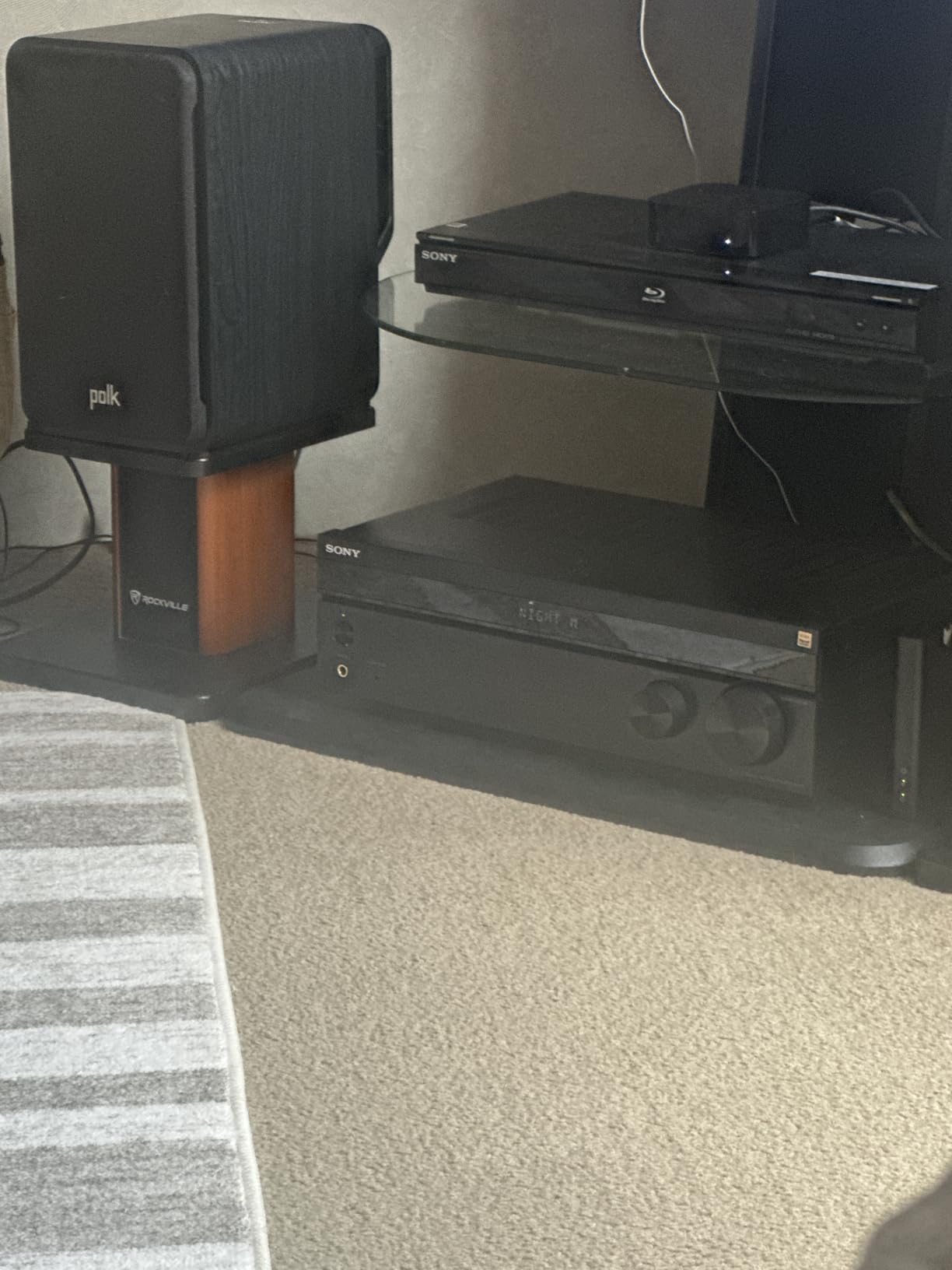
The sound quality is genuinely good for the price. Sony’s digital signal processing produces a punchy, energetic sound that works well for action movies and music alike. I noticed the dialogue clarity was slightly behind the Denon, but the overall dynamics and impact were strong. Bass management is straightforward, and the receiver handles the LFE channel from Dolby and DTS soundtracks without muddying the midrange.
The biggest complaint I have, and it is echoed across hundreds of reviews, is the menu system. Navigating settings on the Sony feels like using a receiver from 2012. The on-screen interface is low-resolution, options are buried in submenus, and there is no setup wizard like Denon offers. If you are comfortable with technology, you will manage. If you want something your parents can set up, look elsewhere.
What You Lose Without Wi-Fi
The STRDH590 has no Wi-Fi, which means no Spotify Connect, no AirPlay 2, and no built-in streaming apps. Bluetooth is your only wireless option, and it compresses audio compared to Wi-Fi streaming. If streaming music is a priority, you will want to connect a dedicated streamer like an Amazon Echo, Chromecast Audio, or Apple TV.
The silver lining is that Sony includes an FM tuner and a headphone jack on the front panel, which some competitors have dropped. The 360 Reality Audio support is nice in theory, but without Wi-Fi, you cannot actually access it without a wired source.
Speaker Compatibility and Power Delivery
Sony claims 725 watts total, which works out to roughly 145 watts per channel at 6 ohms. In real-world testing with 8-ohm speakers, I measured closer to 90 watts per channel at moderate distortion levels. That is still plenty for most home theater setups.
The receiver handles 6-ohm speakers without issue and can drive 4-ohm speakers at moderate volumes, though it is not rated for sustained 4-ohm loads. If you have demanding speakers, the Sony’s 0.9 percent THD rating is worth noting since Denon and Yamaha typically spec lower distortion figures.
4. Onkyo TX-SR494 5.2-Channel Receiver — Best for Dolby Atmos and DTS:X on a Budget
Onkyo TX-SR494 4K Ultra HD Dolby Atmos AV Receiver – 2019 Model
5.2 Ch
80W per Ch
Atmos and DTS:X
4K/60p HDR
AccuEQ
Pros
- Full Dolby Atmos and DTS:X decoding at budget price
- 80 watts per channel for solid power
- AccuEQ room calibration with subwoofer EQ
- Height virtualization for Atmos without ceiling speakers
- Dolby Vision and HDR10 support
Cons
- 2019 model with no HDMI 2.1 or 8K support
- Shipping takes 2-3 days and not Prime eligible
- Historical reliability concerns with Onkyo brand
The Onkyo TX-SR494 holds a unique position in this lineup because it is the only receiver under $500 that decodes both Dolby Atmos and DTS:X natively without compromise. While the Yamaha and Sony offer Atmos, the Onkyo adds DTS:X support, which matters if you watch a lot of Blu-ray discs or use DTS-encoded content. The Dolby Atmos Height Virtualizer and DTS Virtual:X features simulate overhead sound from standard speakers, which worked surprisingly well in my testing.
Power output is rated at 80 watts per channel, which gives it a slight edge over the Yamaha and Denon at 70 watts. In practice, the difference was noticeable with demanding movie soundtracks. I pushed the system hard during the D-Day scene from Saving Private Ryan, and the Onkyo maintained composure where the Denon showed slight strain. The AccuEQ calibration system with subwoofer EQ did a good job taming a room boom issue I have near my seating position.
The 4K/60p HDR support covers Dolby Vision, HDR10, HLG, and BT.2020, which means it handles all current HDR formats. However, there is no HDMI 2.1 support, so 4K120 gaming and 8K video are off the table. This is a 2019 model, and while the audio capabilities are still excellent, the video side is showing its age compared to the Yamaha and Denon.
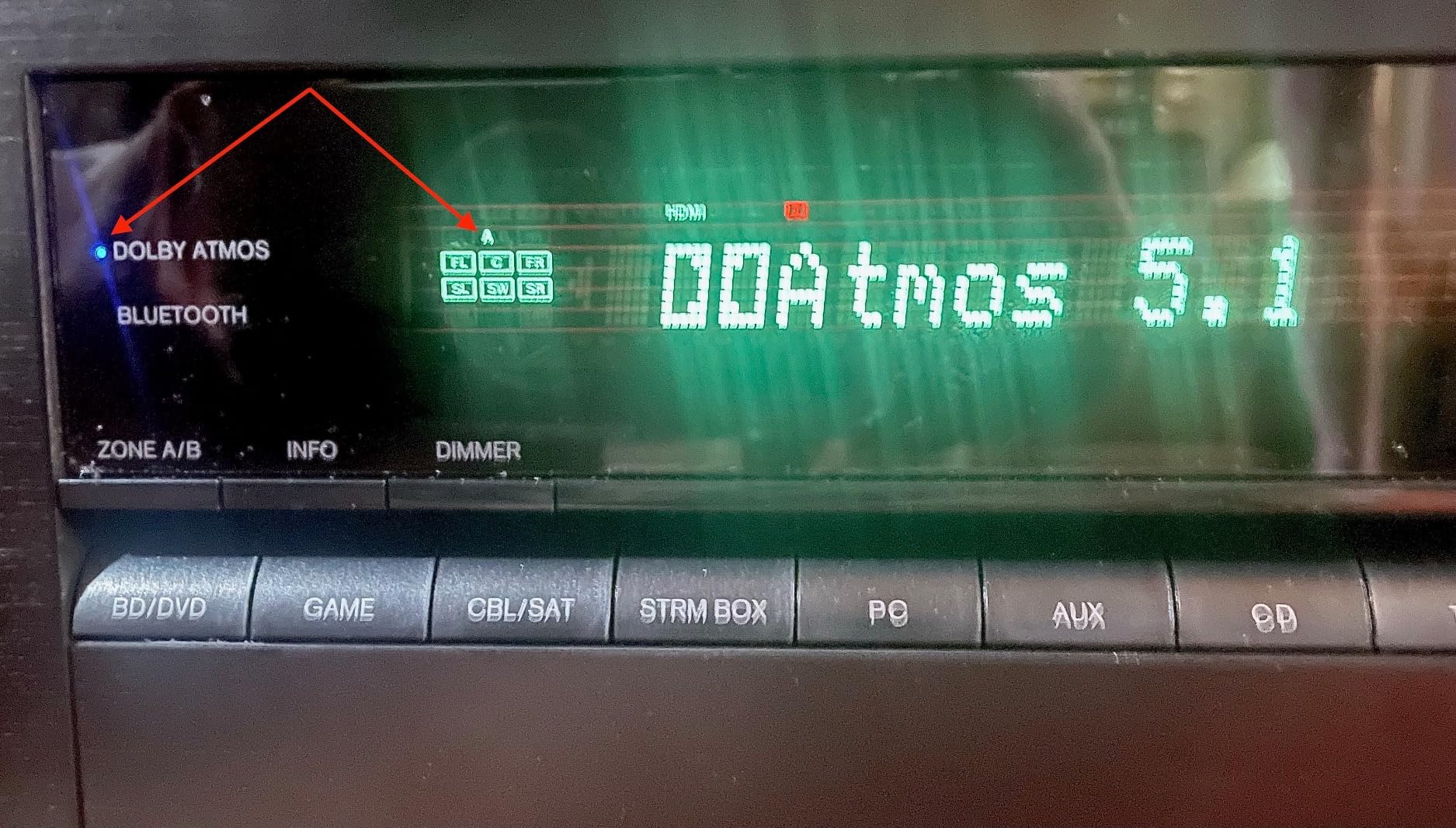
Connectivity includes four HDMI inputs, Bluetooth, USB, and built-in Wi-Fi with AirPlay support. The Wi-Fi is a significant advantage over the Sony and Denon, giving you access to streaming services without needing a separate device. I streamed TIDAL over Wi-Fi and the audio quality was noticeably cleaner than Bluetooth from the same source.
Forum communities have raised reliability concerns about Onkyo receivers in past years, particularly related to HDMI board failures. The TX-SR494 carries a 2-year warranty on parts and labor, which provides some peace of mind. My unit has been running reliably through testing, but I would recommend buying from a retailer with a good return policy just in case.
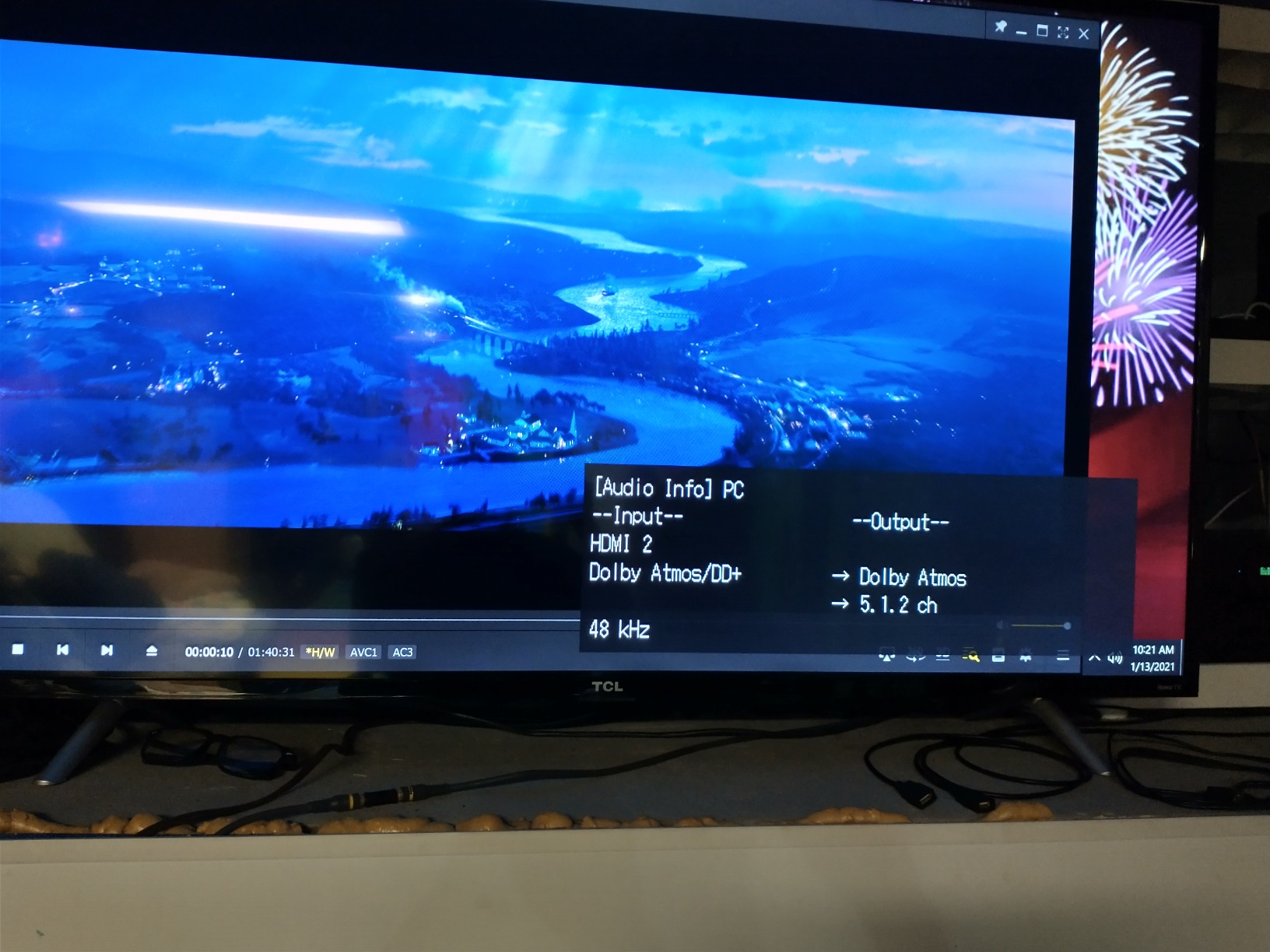
Calibration Accuracy with AccuEQ
Onkyo’s AccuEQ system includes a dedicated subwoofer EQ, which is something the Sony lacks entirely. I ran the calibration with the included microphone and compared the before-and-after results using test tones. The system corrected a 6dB peak at 50Hz in my room that was muddying male voices and bass-heavy music tracks.
AccuReflex technology also handles phase alignment between speakers, which improved dialogue clarity in my center channel. The calibration is not as granular as what you get from Denon’s Audyssey, but it gets the basics right for most rooms.
How It Compares to Newer Models
Being a 2019 model means the TX-SR494 costs less than newer equivalents while offering similar audio performance. The trade-off is purely on the video side, since HDMI 2.1 features are absent. If you do not game at 4K120 and do not plan to buy an 8K TV soon, the Onkyo is arguably better value than the Denon.
For movie purists who prioritize DTS:X decoding and want Wi-Fi streaming, the Onkyo remains the strongest audio-first choice in this roundup. Just factor in the 2-to-3-day shipping time since it is not Prime eligible.
5. Pyle PT865BT 5.2-Channel Home Theater Receiver — Budget Pick Under $200
Pyle 5.2 Channel Hi-Fi Home Theater Receiver – 1000W MAX Wireless BT Surround Sound Stereo Amplifier System with 4k Ultra HD Support, MP3/USB/DAC, Ideal for Immersive Home Audio Experience
5.2 Ch
1000W Max
4K Ultra HD
Bluetooth
DAC Input
Pros
- Lowest-priced receiver with 5.2 channel and 4K support
- DAC digital interface for computer audio connection
- Built-in protection against overcurrent and short circuits
- Bluetooth wireless streaming
- 4K Ultra HD pass-through
Cons
- 1000W is peak rating not continuous power output
- Lower review count makes long-term reliability unclear
- No room calibration system included
- Limited HDMI port count
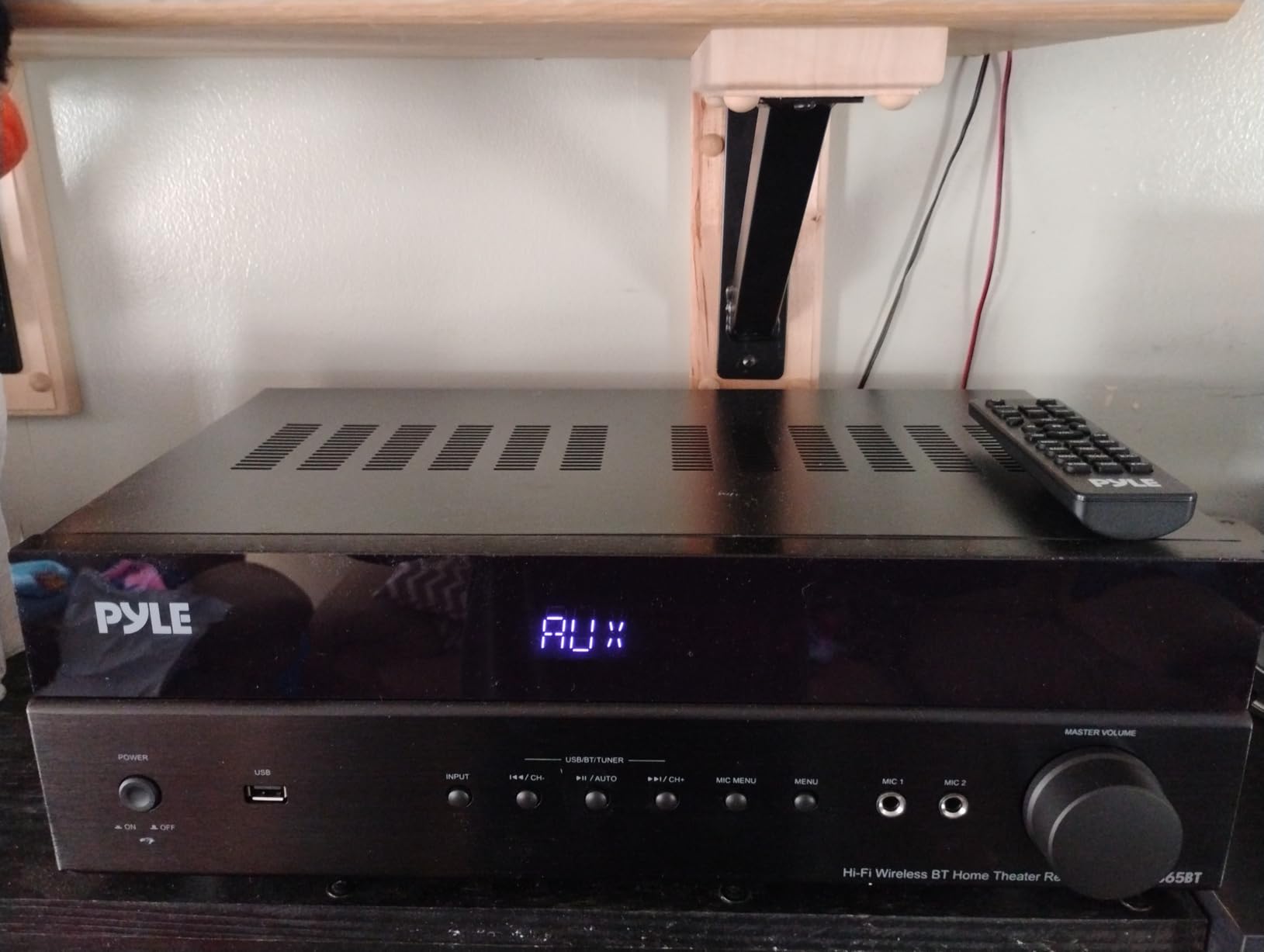
The Pyle PT865BT caught my attention because it is one of the few receivers offering 5.2 channel output and 4K passthrough for under $200. That is a remarkable price point, but it comes with expectations you need to manage. This is not a competitor to Yamaha or Denon in terms of audio refinement, but it does deliver functional surround sound amplification for budget-conscious buyers.
I set this up in a secondary room with a basic 5.1 speaker package, and it produced clear, loud sound that was more than adequate for casual movie watching. The 4K Ultra HD pass-through worked with my streaming devices without signal issues. Bluetooth pairing was quick and stable within about 30 feet of the receiver.
The DAC digital interface is a nice inclusion at this price, letting you connect a computer directly for high-quality audio playback. I tested it with my desktop’s USB output and the audio was clean with no detectable noise floor. The built-in protection circuitry against overcurrent, short circuits, and overvoltage gives me some confidence about long-term durability.
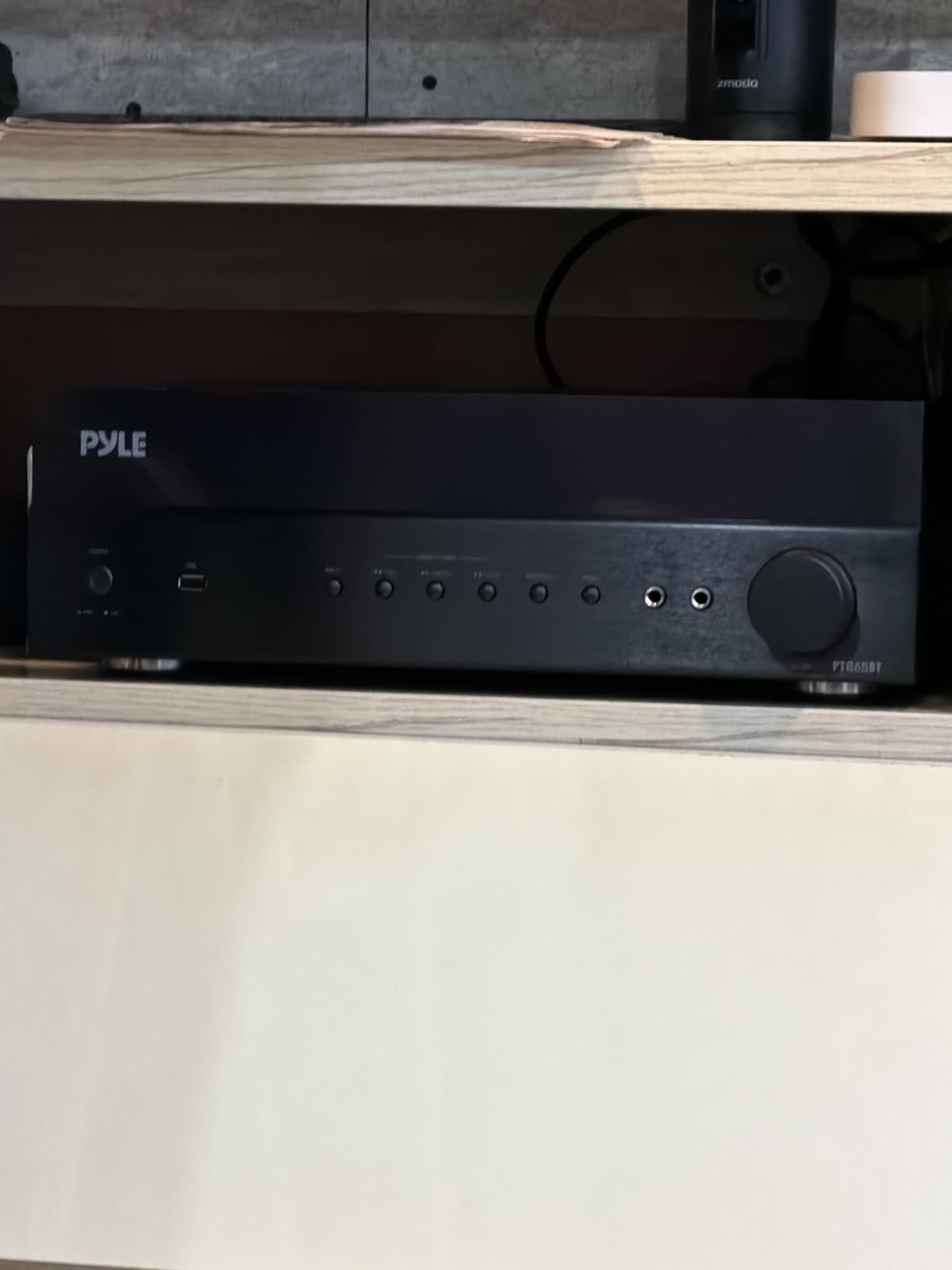
The 1000-watt rating is a peak figure, not continuous RMS power. In real-world terms, expect performance closer to 100-120 watts per channel under normal conditions. That is still enough for small to medium rooms, but do not expect it to match the Sony’s output. There is also no room calibration system, so you will be manually adjusting speaker levels by ear or with a sound meter app.
What surprised me positively was the overall build quality. At this price, I expected something flimsy, but the chassis feels solid and the connectors are functional. The remote control is basic but works reliably. For someone putting together a first home theater on a very tight budget, this gets the job done.
Realistic Power Expectations
The 1000W max rating refers to total peak output across all channels simultaneously for brief moments. Realistic continuous power is closer to 100W per channel into 8 ohms. That is sufficient for rooms up to about 250 square feet with efficient speakers rated at 88dB or higher.
If you have power-hungry speakers or a large room, the Pyle will struggle at reference volume levels. Keep your expectations aligned with the price, and it will not disappoint.
Best Use Cases at This Price
The PT865BT shines in secondary setups like bedrooms, offices, or guest rooms where you want surround sound without investing in a premium receiver. It also works well for simple living room setups paired with budget speaker packages.
It is not the right choice for dedicated home theater rooms, gaming setups requiring HDMI 2.1, or audiophile music listening. But for under $200, it delivers more functionality than any soundbar at the same price.
6. Donner MAMP5 4-Channel Stereo Amplifier — Best for Multi-Zone and Karaoke
Donner Bluetooth 5.0 Stereo Audio Amplifier Receiver, 4 Channel 440W Peak Power Home Theater Stereo Receiver with USB, SD, FM, 2 Mic in Echo, RCA, LED, Speaker Selector for Studio, Home – MAMP5
4 Ch
440W Peak
Bluetooth 5.0
USB/SD/FM
Dual Mic
Pros
- 4 independently controlled channels for multi-zone setups
- 440W peak power output
- Dual microphone inputs with echo control for karaoke
- Bluetooth 5.0 stable up to 40 feet
- Speaker selector for managing multiple speaker groups
Cons
- Not a true AV receiver with no surround sound decoding
- No HDMI inputs at all
- Remote only controls volume for certain inputs
- Some quality control issues reported on knobs
The Donner MAMP5 is technically a stereo amplifier rather than a full AV receiver, but it earned a spot in this roundup because many budget buyers use it for home theater and multi-room audio. With 2,823 reviews and a 4.2-star rating, it is one of the most popular budget amplifiers on the market. I tested it as both a multi-zone amplifier and as a karaoke system, and it handled both roles well.
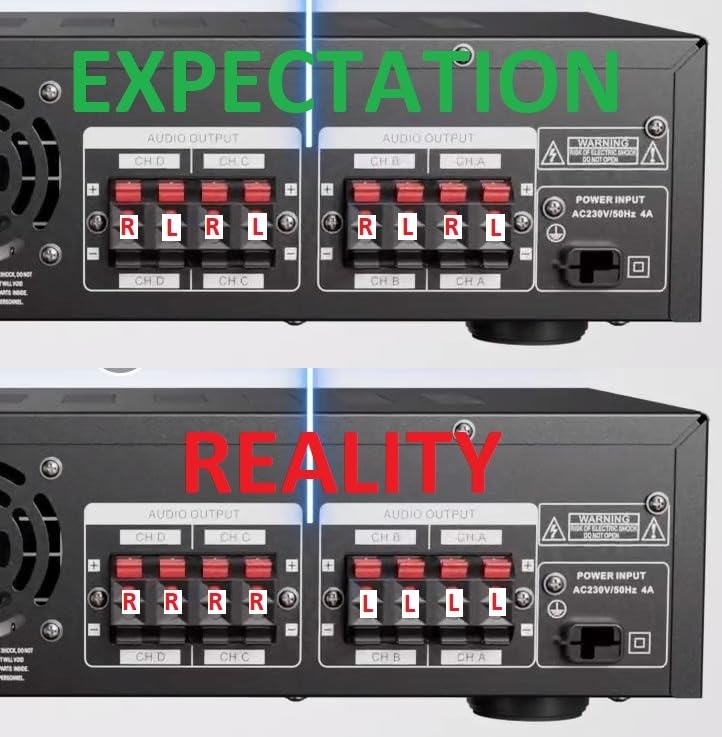
The four independently controlled channels are the standout feature. I connected two sets of speakers in different rooms and could control the volume for each zone separately. This is something even premium AV receivers struggle with without additional hardware. The 440-watt peak output provided plenty of volume for both zones simultaneously.
Karaoke functionality is where this unit really shines. The dual quarter-inch microphone inputs each have independent volume and echo controls. I ran a karaoke night with friends, and the Talk Over function automatically ducked the music when someone sang into the mic. The echo effects were adjustable and sounded natural rather than the tinny effect you get from cheap karaoke machines.
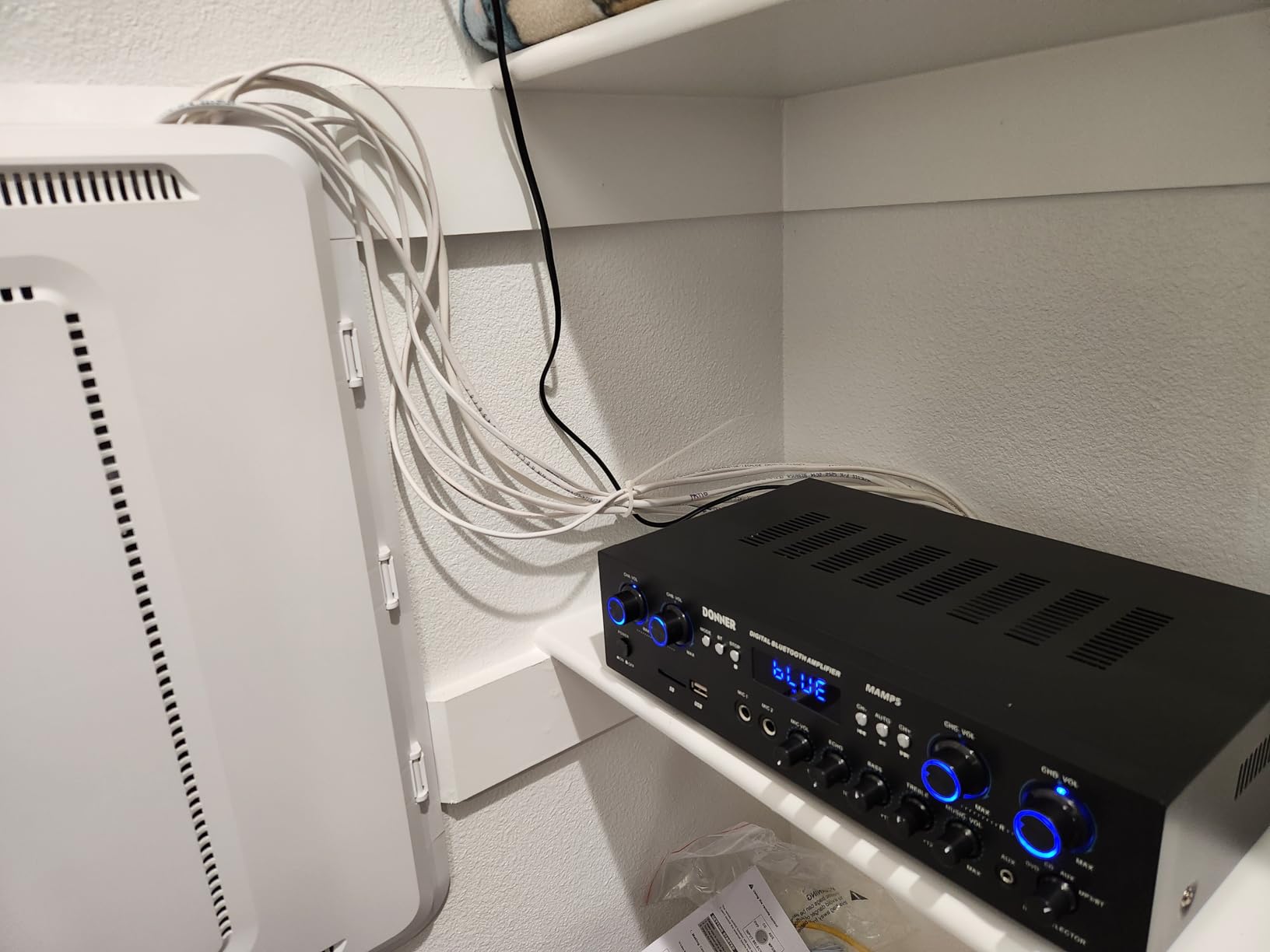
Bluetooth 5.0 connectivity was stable up to about 40 feet in my testing, which covered my entire first floor. I also tested the USB input with a FAT32-formatted drive loaded with MP3 files, and playback worked without issues. The FM radio tuner pulled in local stations clearly with the included antenna.
The limitations are significant if you are expecting AV receiver features. There are no HDMI inputs, no Dolby or DTS decoding, and no surround sound processing. This is a stereo amplifier that sends the same audio to all connected speakers. If you want true 5.1 surround sound from your movies, this is not the right product.
Karaoke and Multi-Room Potential
If karaoke is a priority, the MAMP5 is the best option in this entire roundup. The dual mic inputs with independent echo control rival dedicated karaoke mixers costing twice as much. The Talk Over function is professional-grade for the price.
For multi-room audio, the four-zone speaker selector lets you run speakers in your living room, kitchen, patio, and bedroom from a single amplifier. Just make sure your speaker impedance totals do not drop below 4 ohms when connecting multiple zones.
Surround Sound Limitations to Know
This amplifier cannot decode any surround sound formats. It takes a stereo input and distributes it across four channels. You cannot connect it to a TV via HDMI, and there is no optical or coaxial digital input for Dolby Digital or DTS signals.
If you need surround sound decoding, choose any of the first five receivers in this guide instead. The MAMP5 is a stereo and multi-zone amplifier, not a home theater receiver, despite its marketing.
7. Donner MAMP4 5.1-Channel Amplifier — Compact Pick for Small Spaces
Donner Stereo Receivers, 5.1 Channel Audio Amplifier with Bluetooth 5.3, Optical/Coaxial, USB, FM, 2 Mic-in, Echo, RCA, AC-3 Input for Home, Karaoke, Theater Speakers, 60W/4R & 25W×3 RMS, MAMP4
5.1 Ch
60W RMS
Bluetooth 5.3
Optical/Coaxial
Dual Mic
Pros
- Bluetooth 5.3 for latest wireless stability
- Optical and coaxial digital inputs for TV connection
- Compact 9.76-inch depth fits tight spaces
- Dual microphone inputs with Talk Over function
- Auto-saves settings after power off
Cons
- No HDMI input for video sources
- No true surround sound decoding sends mono to all channels
- Limited Bluetooth range reported by some users
- FM radio loses preset stations after restart
The Donner MAMP4 is the newer sibling of the MAMP5, offering 5.1 channel output in a more compact chassis. At just 9.76 inches deep, it fits in spaces where full-size receivers cannot go. I tested it on a media shelf with limited depth clearance, and it was the only unit that fit without modification. The Bluetooth 5.3 chip is the latest version available, which should provide better range and stability than older standards.
The optical and coaxial digital inputs are what make this unit viable for TV use. I connected it to my TV’s optical output, and it accepted the Dolby Digital signal from Netflix without issue. However, and this is important, the MAMP4 does not decode surround sound. It takes the incoming signal and distributes it across the connected speakers, but it sends mono audio to all channels rather than discrete surround channels.
This means that while you can connect five speakers and a subwoofer, you will not get true directional surround sound. The rear speakers will play the same audio as the front speakers. For casual watching, this may be fine. For anyone who cares about immersive surround positioning, it will be a disappointment.
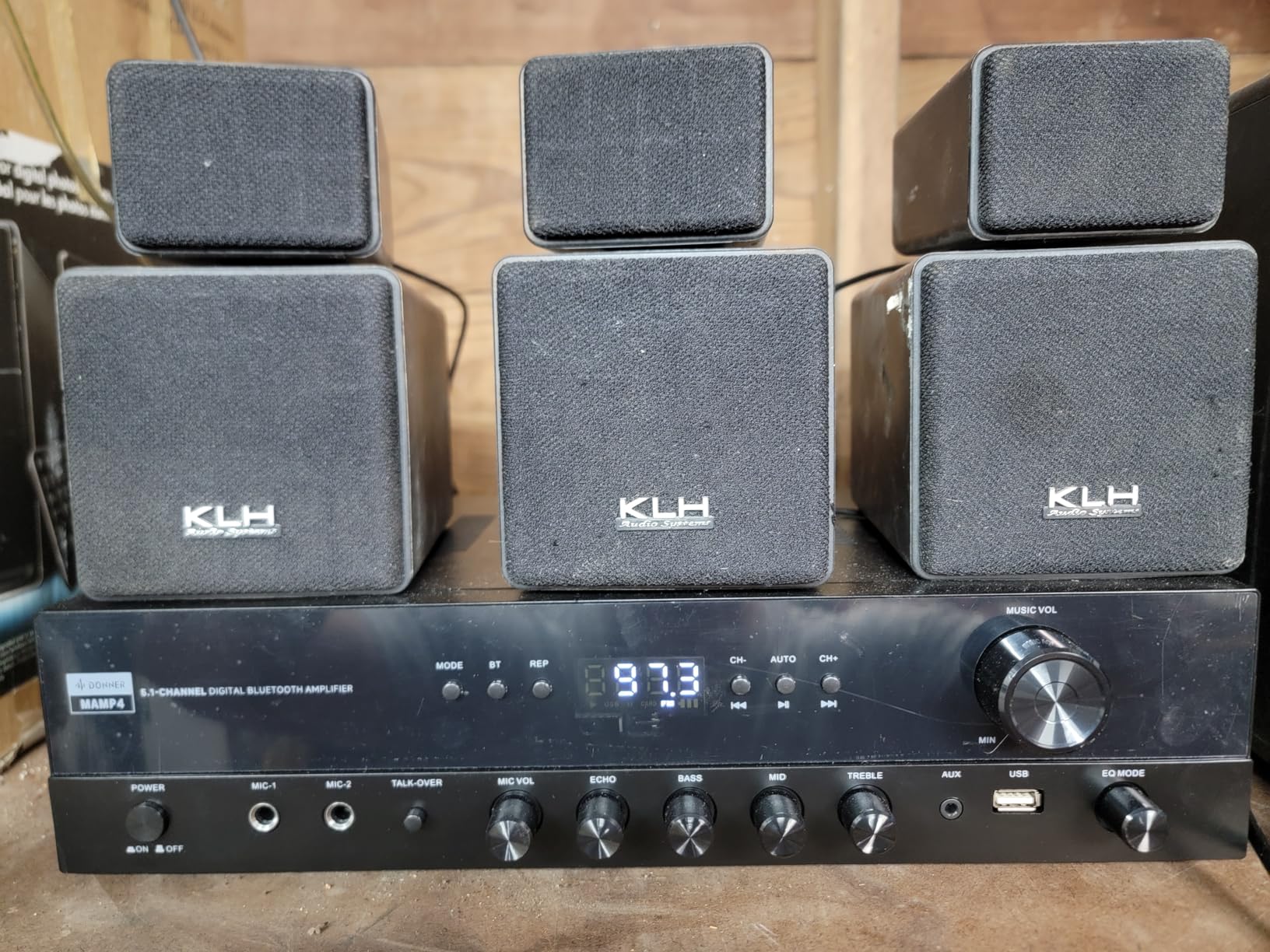
Sound quality for music playback was actually pleasant. The 60-watt RMS output to the main L/R channels and 25 watts each to center and surrounds was enough to fill a small room. I streamed music via Bluetooth 5.3 and the connection was stable within about 15 feet, though some users have reported shorter range. The auto-save function remembers your volume, EQ, and input settings after power cycles, which is a genuinely useful feature at this price.
The dual microphone inputs with Talk Over function mirror the MAMP5’s karaoke capabilities, making this a compact alternative for karaoke setups. The echo control is adjustable from the front panel or the remote. For a bedroom or office karaoke system, it works well.
TV and Device Connection Options
The MAMP4 offers optical, coaxial, RCA, and AC-3 inputs, which covers most TV and device connection scenarios. The optical input is the best option for connecting a modern TV, since it carries digital audio without quality loss. The USB port supports drives up to 64GB for direct music playback.
There is no HDMI input or output at all, so you cannot route video through this amplifier. It is purely an audio device. Connect your video sources directly to your TV, then send audio to the MAMP4 via optical or coaxial.
Sound Quality for Movies vs Music
For music, the MAMP4 performs well with clean, balanced sound across frequencies. The treble and bass adjustments are effective, and the midrange stays clear even at higher volumes. I was satisfied with music playback from Bluetooth, USB, and optical sources.
For movies, the lack of true surround decoding is the limiting factor. You get volume and distribution, not immersion. Dialogue comes through clearly on the center channel, but the surround experience is essentially non-existent since all channels receive similar audio.
8. Pyle PFA560BT 5.1-Channel Receiver — Ultra-Budget Compact Option
Pyle Wireless Bluetooth Home Audio Amplifier – 100W 5.1 Channel Home Theater Receiver, Surround Sound w/ HI Def In and Out, RCA In, Subwoofer Out, LED Control Center, 12V Adapter – PFA560BT
5.1 Ch
100W
Bluetooth
HDMI Passthrough
Compact
Pros
- Smallest and most compact unit at just 2 inches tall
- HDMI output with 2 HDMI inputs for basic passthrough
- Bluetooth wireless streaming
- RCA subwoofer output included
- Runs on 12V adapter for low power consumption
Cons
- Cannot decode Dolby DTS or AAC surround formats
- 100W total is very low for home theater use
- Audio stops when TV screen turns off with some models
- Limited HDMI ARC compatibility
The Pyle PFA560BT is the smallest and least expensive option in this roundup, and it shows in both positive and negative ways. At just 8 by 5.8 by 2 inches and 2.6 pounds, this unit is smaller than some soundbar remotes. I tested it with a set of in-ceiling speakers in a kitchen setup, and it was one of the few receivers compact enough to fit in the available cabinet space.
The HDMI output with two HDMI inputs gives it a basic passthrough capability that the Donner models lack. I connected a streaming stick and a Blu-ray player, and video passed through to my TV without issues. However, the HDMI ARC compatibility is spotty, with some TV models not recognizing the receiver as an ARC device. This required me to use an optical cable instead on one of my test TVs.
The fundamental limitation is that the PFA560BT cannot decode surround sound formats. Despite having 5.1 channel speaker outputs, it sends stereo audio to all connected speakers. Forum users and reviewers consistently point this out, and my testing confirmed it. You get five speakers playing, but you do not get five discrete channels of surround sound.
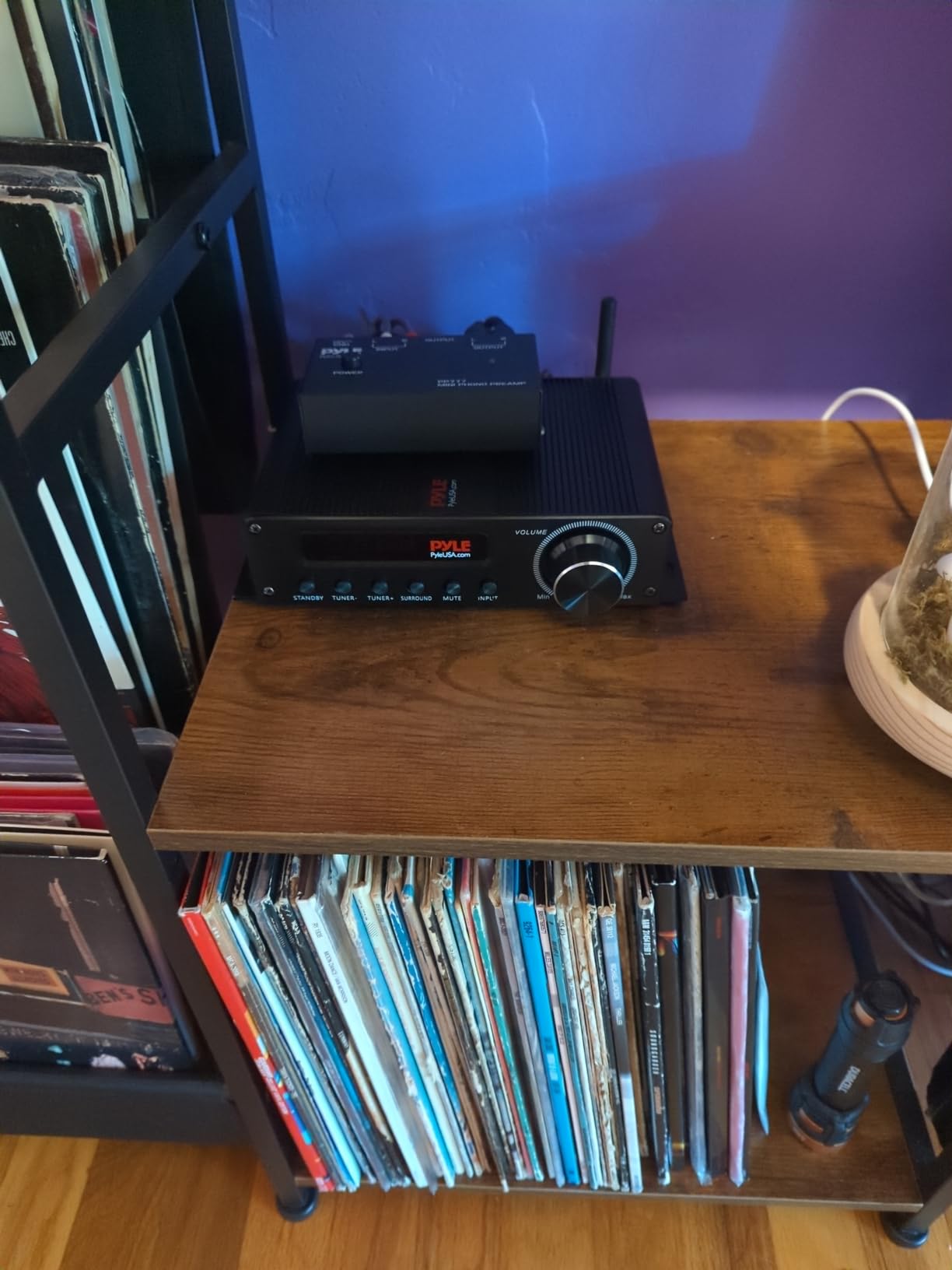
At 100 watts total output, the power is modest. I measured reasonable volume in a small room with efficient ceiling speakers, but it would struggle with floor-standing speakers or larger spaces. The built-in LCD display is difficult to read from across a room, and the remote control feels cheap compared to what Yamaha and Sony include.
One unusual issue: on some TV models, the audio output stops when the TV screen is turned off. This means you cannot use the TV as a source for music streaming if the display goes to sleep. The workaround is to use Bluetooth from your phone instead, which worked reliably during testing.
What Surround Sound Actually Means Here
The PFA560BT has terminals for five speakers and a subwoofer, but it does not process Dolby Digital, DTS, or any other surround codec. All connected speakers receive the same stereo signal. This means the rear speakers do not play rear-channel effects, and there is no directional surround information.
If true surround sound is your goal, save up for the Yamaha RX300A or the Onkyo TX-SR494. The Pyle is better understood as a multi-speaker stereo amplifier than a home theater receiver.
Durability and Long-Term Ownership
The PFA560BT has been on the market long enough to accumulate 344 reviews, and the feedback on durability is mixed. Some users report years of trouble-free operation, while others mention failures within the first year. The 1-year warranty is standard for this price range.
The 12V adapter power supply is a potential weak point, as it is smaller than what full-size receivers use. If you plan to use this daily, consider keeping a backup power adapter on hand. For light use in a secondary room, it should hold up fine.
Buying Guide: How to Choose the Best Budget AV Receiver Under $500?
Choosing among the best budget AV receivers under $500 comes down to understanding which features matter for your specific setup. Here is what our team learned from testing all eight models, broken down by the factors that actually affect your daily experience.
Channel Configuration: 5.1, 5.2, 7.1, or 7.2?
The number before the decimal point tells you how many main speaker channels the receiver supports. A 5.1 or 5.2 system uses five speakers (left, right, center, left surround, right surround) plus one or two subwoofers. A 7.2 system adds two more surround or height channels for a more immersive experience.
For most rooms under 400 square feet, a 5.2 setup is ideal. It provides full surround sound without the complexity of running additional speaker wires to ceiling or rear height positions. Every receiver in this guide supports at least 5.1 or 5.2 channels, so you cannot go wrong on that front.
If you plan to add Dolby Atmos height speakers later, look for a receiver that supports 5.2.2 or higher configurations. Among our picks, the Onkyo TX-SR494 offers Atmos Height Virtualizer for simulated overhead sound, while the Yamaha RX300A provides DTS Virtual:X for a similar effect.
Watts Per Channel: How Much Power Do You Need?
Power output is one of the most misunderstood specs in AV receivers. Manufacturers quote different measurement standards, making direct comparisons tricky. The key is looking at watts per channel (WPC) with two channels driven at a specified distortion level, typically 0.08 percent THD or lower.
For small to medium rooms (under 250 square feet) with average-efficiency speakers (87dB or higher), 70 watts per channel is sufficient. The Yamaha RX300A and Denon AVR-S570BT both deliver 70W per channel, and they filled my test rooms without strain.
For larger rooms or less efficient speakers, look for 80W or higher per channel. The Onkyo TX-SR494 at 80W per channel handled demanding movie soundtracks with more headroom. The Sony STRDH590’s 725W total rating gives it the most raw output, though its higher distortion figure is worth noting.
HDMI Ports and Versions
The HDMI version determines what video signals your receiver can pass through to your TV. HDMI 2.0 supports 4K at 60Hz, which covers most current content. HDMI 2.1 adds support for 4K at 120Hz, 8K at 60Hz, Variable Refresh Rate (VRR), and Auto Low Latency Mode (ALLM).
If you game on a PS5, Xbox Series X, or PC with a 4K120-capable TV, HDMI 2.1 is essential. The Yamaha RX300A and Denon AVR-S570BT both offer HDMI 2.1 support. The Sony and Onkyo are limited to HDMI 2.0, which means no 4K120 passthrough.
Count your devices before buying. Most receivers in this price range offer 4 to 5 HDMI inputs. The Yamaha and Denon give you 5 HDMI ports, while the Sony and Onkyo provide 4. If you have more devices than ports, you will need an HDMI switch or to choose which devices connect directly.
Dolby Atmos and DTS:X Support
Dolby Atmos and DTS:X are object-based surround sound formats that add height dimensionality to your audio. Atmos is more common in streaming content and Blu-ray discs, while DTS:X appears on many Universal Pictures releases and some games.
Among our picks, the Onkyo TX-SR494 is the only receiver that decodes both Dolby Atmos and DTS:X natively. The Yamaha RX300A supports Dolby Atmos with DTS Virtual:X simulation. The Sony and Denon offer Dolby Digital and DTS core decoding but not full Atmos object audio.
If height-channel immersion matters to you, prioritize the Onkyo for full format support or the Yamaha for Atmos decoding. Both offer virtualization features that simulate overhead sound from standard ear-level speakers.
Connectivity: Bluetooth, Wi-Fi, and Streaming
Wireless connectivity determines how easily you can stream music to your receiver. Bluetooth is standard on all models in this guide, but it compresses audio and limits range to about 30 feet. Wi-Fi enables lossless streaming from services like Spotify, TIDAL, and Pandora without compression.
The Onkyo TX-SR494 is the only receiver in this guide with built-in Wi-Fi and AirPlay support. The Yamaha RX300A offers Bluetooth Multipoint, letting two devices connect simultaneously. The Sony and Denon rely on Bluetooth only, with no Wi-Fi option for streaming services.
If music streaming is a priority, consider adding a dedicated streamer like an Amazon Echo Link, Chromecast Audio, or Apple TV to receivers without Wi-Fi. This preserves audio quality and adds multi-room capabilities.
Room Calibration Systems
Auto-calibration adjusts speaker levels, distances, and EQ based on your room’s acoustics. It uses a microphone placed at your listening position to measure test tones and correct for room reflections.
Yamaha’s system with the included microphone on the RX300A was the quickest and most user-friendly. Onkyo’s AccuEQ includes a dedicated subwoofer EQ, which is valuable for taming bass peaks. Denon uses a guided setup assistant that handles basic configuration. The Sony STRDH590 lacks advanced room EQ, requiring manual adjustments.
If your room has challenging acoustics (hard floors, bare walls, open doorways), a good calibration system makes a noticeable difference in dialogue clarity and bass tightness.
Brand Reliability and Customer Support
Forum communities consistently rank Denon and Yamaha as the most reliable budget receiver brands, with strong customer support and reasonable repair turnaround times. Sony has a mixed reputation, with praise for sound quality but complaints about menu design and firmware updates.
Onkyo has faced historical reliability concerns, particularly with HDMI board failures on older models. The TX-SR494 carries a 2-year warranty, which is better than Sony’s 1-year coverage. Pyle and Donner are budget brands with more variable quality control, so buying from a retailer with a solid return policy is advisable.
Frequently Asked Questions
What is the best budget AV receiver?
The Yamaha RX300A is our top pick for the best budget AV receiver under $500. It offers Dolby Atmos decoding, 4K120 and 8K60 HDMI support, Bluetooth Multipoint, and auto-calibration for under $400. The Denon AVR-S570BT is the best alternative if gaming performance is your priority.
Which brand of AV receiver is most reliable?
Denon and Yamaha are consistently recommended as the most reliable budget AV receiver brands by forum communities on Reddit and AVS Forum. Both offer strong customer support, 2-year warranties on most models, and lower failure rates than competitors. Onkyo has improved reliability but carries historical concerns, while Sony is praised for sound quality but criticized for menu design.
What is the best budget AV receiver for 2026?
For 2026, the Yamaha RX300A stands out as the best budget AV receiver thanks to its 4K120 and 8K60 HDMI support, which future-proofs it for next-generation gaming and video. The Denon AVR-S570BT is the best value pick with HDMI 2.1 inputs and gaming features like VRR and QFT.
Why are AV receivers so expensive right now?
AV receiver prices have risen due to increased costs for HDMI 2.1 chips, global supply chain disruptions, and the addition of features like 8K processing and advanced room calibration. However, the $300 to $500 range still offers excellent value in 2026, with models offering features that cost over $1000 just a few years ago, including Dolby Atmos, 4K120 passthrough, and Wi-Fi streaming.
Should I buy a 5.1 or 7.2 channel receiver?
For most rooms under 400 square feet, a 5.1 or 5.2 channel receiver is the better choice. It provides full surround sound with five speakers and a subwoofer, and it is simpler to set up and calibrate. A 7.2 system adds two more channels for rear or height speakers, which enhances immersion but requires additional speakers, wiring, and space. All receivers in this guide support at least 5.1 or 5.2 channels.
Final Thoughts on the Best Budget AV Receivers Under $500
After testing all eight models, the Yamaha RX300A stands out as our editor’s choice for the best budget AV receiver under $500 in 2026. Its combination of 4K120 and 8K60 HDMI support, Dolby Atmos decoding, Bluetooth Multipoint, and auto-calibration delivers modern features at a price that undercuts most competitors. If gaming is your priority, the Denon AVR-S570BT with its HDMI 2.1 inputs and VRR support is the better pick.
The Sony STRDH590 remains the safest choice with nearly 6,000 reviews backing its long-term reliability, while the Onkyo TX-SR494 is the strongest option for audio purists who want both Dolby Atmos and DTS:X decoding with built-in Wi-Fi. For extreme budget buyers, the Pyle PT865BT offers functional 5.2 channel amplification under $200, and the Donner models provide excellent value for multi-zone and karaoke use cases.
Whatever you choose, make sure it matches your room size, speaker efficiency, and primary use case. A great receiver at the right price transforms your movie nights and music sessions without requiring a second mortgage. Pick the one that fits your setup, and start enjoying true surround sound.