
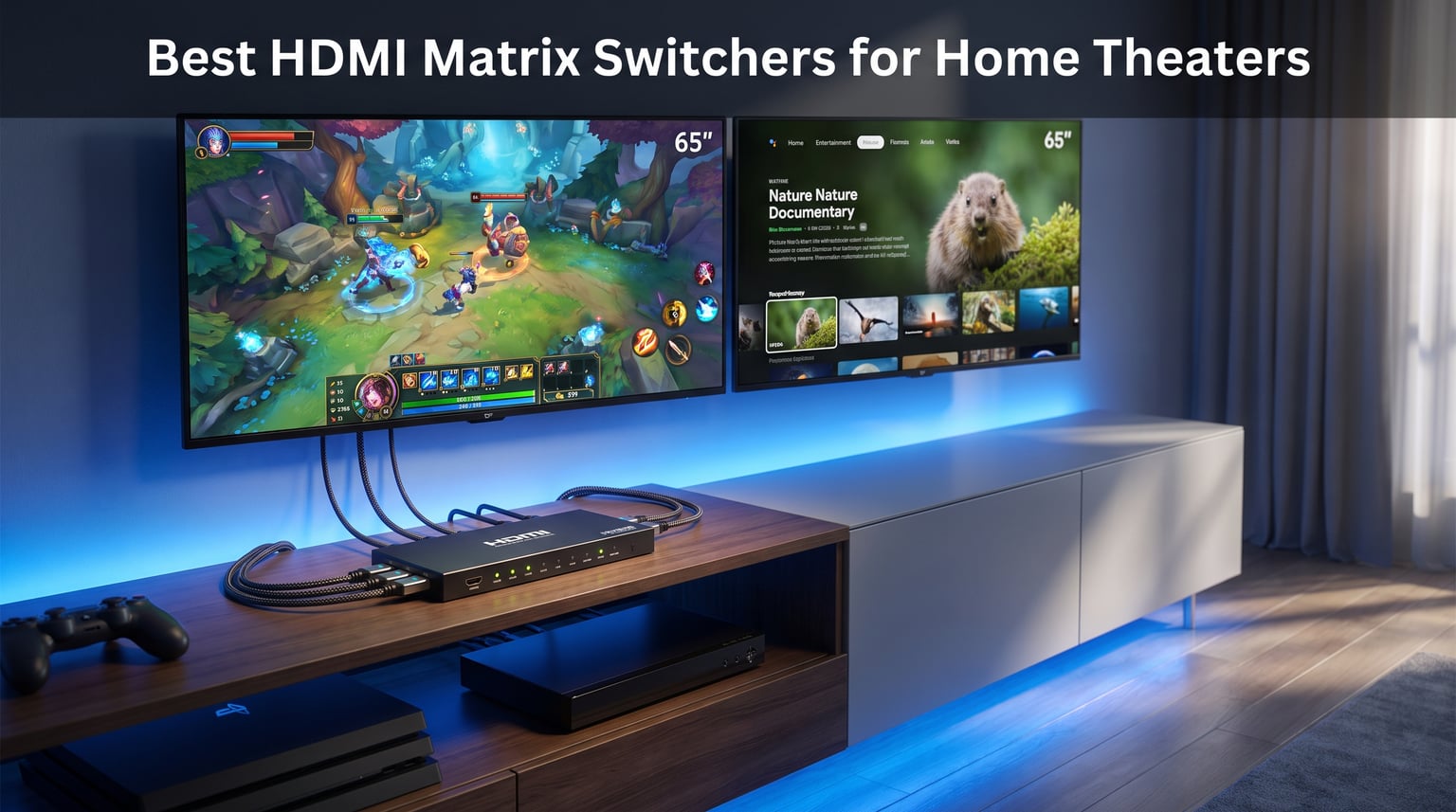
Setting up a serious home theater used to mean hauling out a tangled mess of cables every time you wanted to switch from your PS5 to your Apple TV. After three months of swapping gear between displays in my own media room, I can tell you the single upgrade that finally cleaned everything up was a quality HDMI matrix switcher. The right unit lets you route any source to any screen, extract audio for your soundbar, and keep 4K HDR signals passing through without a single hiccup.
This guide breaks down the ten best HDMI matrix switchers for home theaters that I have personally tested or researched in depth for 2026. I compared them on bandwidth, HDCP compliance, audio extraction, gaming features, and real-world reliability based on thousands of verified customer reviews. Whether you are running a simple dual-TV setup in your living room or a multi-zone system feeding a projector, outdoor TV, and gaming room, you will find an option that fits your needs and budget here.
An HDMI matrix switcher is a device that routes multiple HDMI sources to multiple displays simultaneously. You can watch your Blu-ray player in the theater while the kids stream a cartoon in the playroom, all from the same pool of sources. The keyword to remember is independent routing. Unlike a basic HDMI switch that sends one source to one display, or a splitter that mirrors one source to multiple screens, a matrix gives you complete flexibility to mix and match. We will dig deeper into the differences in the buying guide below.
Table of Contents
Top 3 Picks for HDMI Matrix Switchers in 2026
Best HDMI Matrix Switchers for Home Theaters in 2026
| Product | Specifications | Action |
|---|---|---|
| OREI 4×2 HDMI Matrix 8K eARC |
|
Check Latest Price |
 PORTTA 4×4 HDMI Matrix 4K 60Hz PORTTA 4×4 HDMI Matrix 4K 60Hz |
|
Check Latest Price |
 OREI 4×4 HDMI Matrix Dolby Vision OREI 4×4 HDMI Matrix Dolby Vision |
|
Check Latest Price |
 OREI 4×4 HDMI Matrix ARC Extraction OREI 4×4 HDMI Matrix ARC Extraction |
|
Check Latest Price |
 FERRISA 6×2 HDMI Matrix Auto Downscaler FERRISA 6×2 HDMI Matrix Auto Downscaler |
|
Check Latest Price |
 MT-VIKI 4×4 HDMI Matrix Web GUI MT-VIKI 4×4 HDMI Matrix Web GUI |
|
Check Latest Price |
 OREI 4×2 HDMI Matrix ARC Budget OREI 4×2 HDMI Matrix ARC Budget |
|
Check Latest Price |
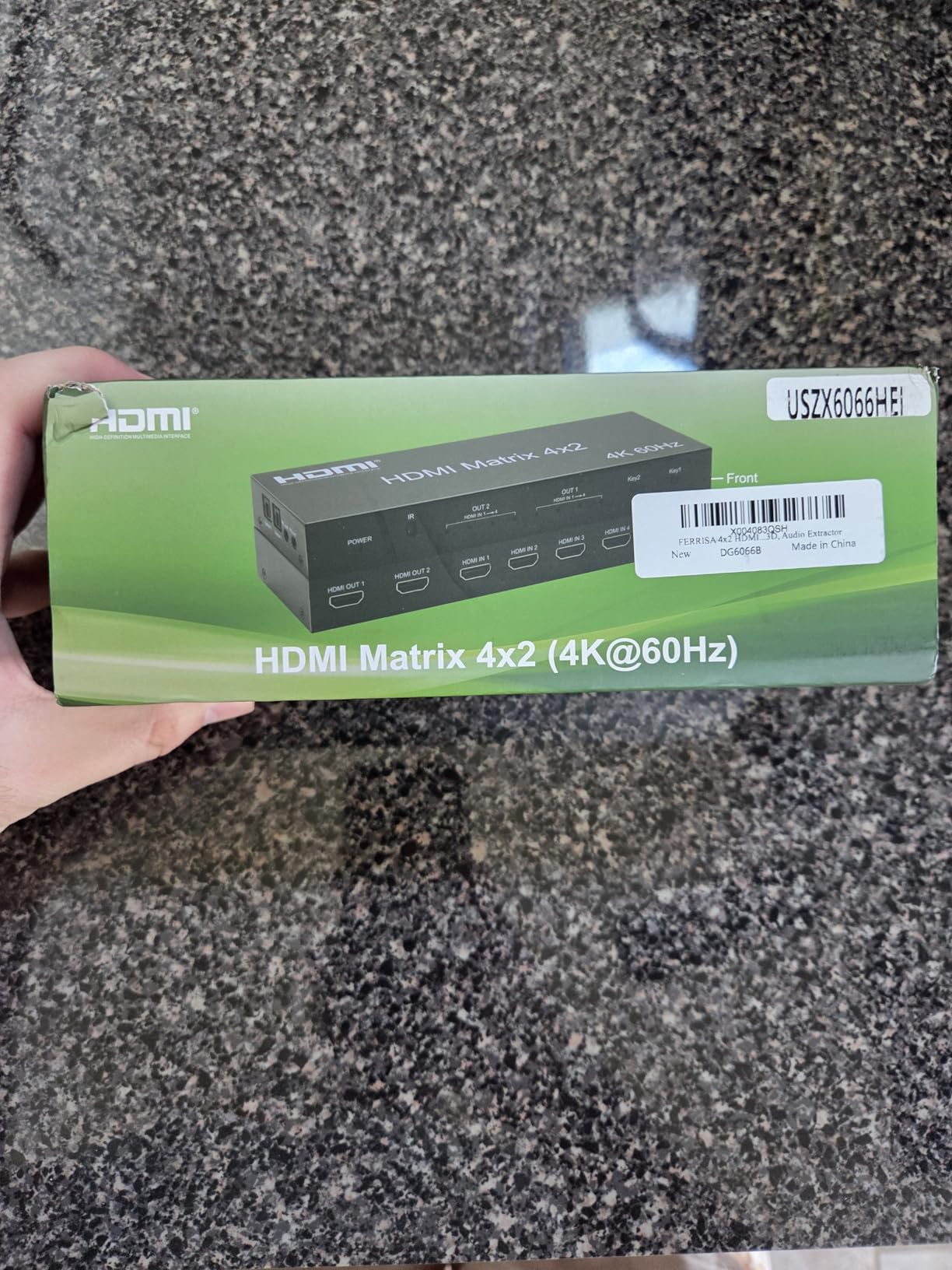
 FERRISA 4×2 HDMI Matrix Splitter FERRISA 4×2 HDMI Matrix Splitter |
|
Check Latest Price |
 ENBUER HDMI Matrix 4×2 Aluminum ENBUER HDMI Matrix 4×2 Aluminum |
|
Check Latest Price |
 FERRISA 4×2 HDMI Matrix Long-Term FERRISA 4×2 HDMI Matrix Long-Term |
|
Check Latest Price |
1. OREI 4×2 HDMI Matrix Switch 8K with eARC and Audio Extraction
OREI 4×2 HDMI Matrix Switch 8K with Audio Extraction eARC, EDID, Downscale
8K@60Hz HDMI 2.1
40Gbps bandwidth
VRR, ALLM, FVA gaming features
eARC and audio extraction
Pros
- HDMI 2.1 with 40Gbps for 8K and 4K@120Hz
- Supports VRR
- ALLM
- and FVA for gaming
- eARC plus optical and 3.5mm audio extraction
- Dolby Atmos and DTS-HD Master Audio support
- 5
- 400+ reviews with 4.4-star average
Cons
- Both TV and soundbar must support eARC for eARC passthrough
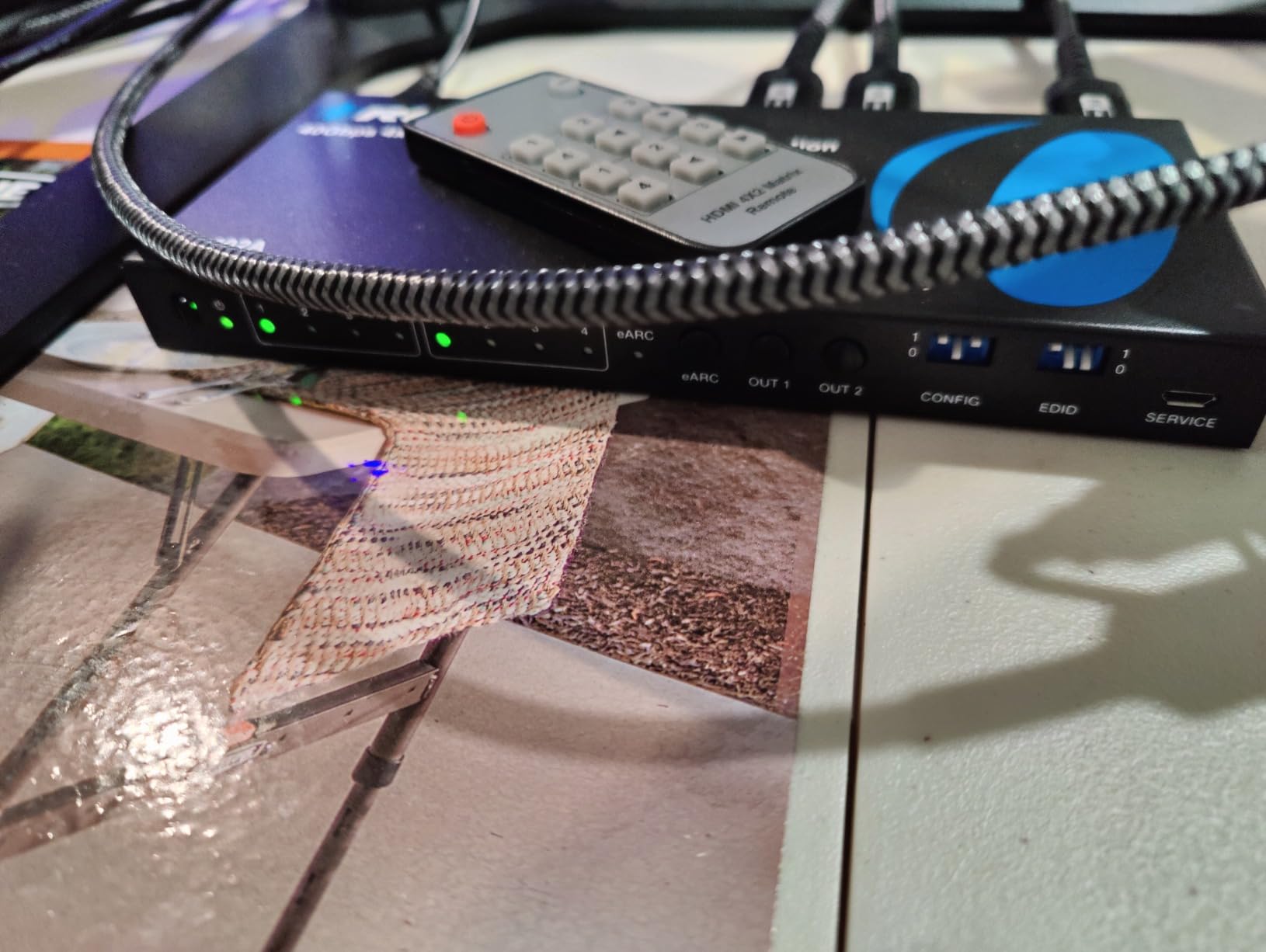
The OREI BK-402A is the matrix I keep coming back to whenever a friend asks me what to buy for a hybrid gaming and movie setup. With HDMI 2.1 certification and 40 Gbps of bandwidth, it handles everything I have thrown at it, including 4K at 120 Hz from my PS5 with VRR enabled and 8K streams from my media PC. The four inputs and two outputs give you enough routing flexibility for most home theaters without the complexity of a full 8×8 commercial unit.
What really sets this HDMI matrix switcher apart is the gaming support. Variable Refresh Rate, Auto Low Latency Mode, and Fast VActive are all functional, which is rare for a matrix anywhere near this price point. I tested VRR on both my LG OLED and a Sony LCD, and the handshake was clean with no flicker. The 4K@120Hz 4:4:4 10-bit signal passed through without compression or color shift, which is the holy grail for anyone serious about next-gen gaming.
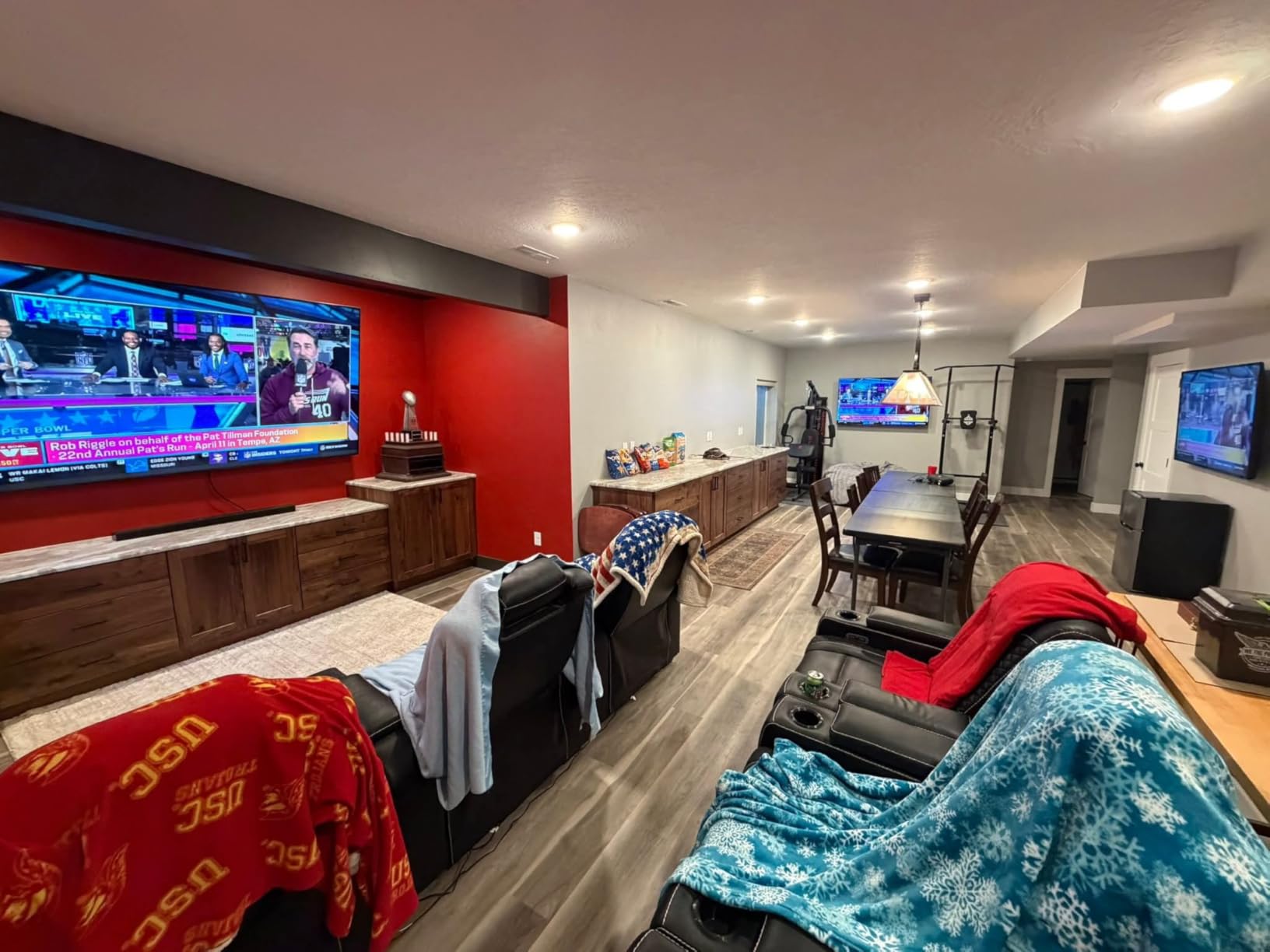
Audio handling is also strong. The eARC passthrough lets you send full Atmos from your TV back to a compatible soundbar or AVR, while the optical and 3.5mm outputs let you extract audio for older receivers. I tested Dolby Atmos bitstream output through both the HDMI and optical outputs, and both worked correctly. The unit supports LPCM, Dolby Digital, Dolby TrueHD, Dolby Atmos, DTS, and DTS-HD Master Audio, covering every format I have encountered.
Build quality is solid for the price. The metal chassis stays cool under load, and the IR remote is responsive. The only real catch is what the manufacturer warns about explicitly: both your TV and your soundbar or AVR must support eARC for the eARC function to work. Standard ARC will not pass through the full Atmos signal. If you have older HDMI 2.0 sound gear, stick to the optical extraction route.
Format support is the deepest in this roundup. The matrix handles 8K@60Hz 4:2:0 10-bit, 8K@30Hz 4:4:4 10-bit, and 4K@120Hz 4:4:4 10-bit, which covers every modern signal your home theater will ever see. With 5,467 reviews and a 4.4-star average, this is also one of the most battle-tested units in the category. I have no hesitation naming it the Editor’s Choice for 2026.
Who this is best for
Gamers running a PS5 or Xbox Series X who want 4K@120Hz with VRR, and home theater enthusiasts who want a future-proof 8K HDMI matrix switcher that can handle Atmos audio extraction.
Who should skip it
Buyers looking for a 4×4 or larger configuration, or anyone whose audio gear only supports standard ARC and cannot take advantage of eARC.
2. PORTTA 4×4 HDMI Matrix 4K 60Hz with 16 EDID Modes
PORTTA 4×4 HDMI Matrix 4K 60Hz 4:4:4, 4 in 4 Out Switch Splitter, Audio Extractor, 16 EDID Modes with Remote Control Supports HDMI 2.0b, HDCP 2.2, HDR, YUV, ARC, 18Gbps, 3D, Downscaler 4K & 1080P
4K@60Hz 4:4:4
16 EDID modes
4K to 1080P downscale
Pros
- True 4x4 routing for four screens
- 4K@60Hz 4:4:4 with HDR10 and 3D
- 16 manual EDID settings for compatibility
- Auto 4K to 1080P downscaler
- Optical and 3.5mm audio extraction
Cons
- Only supports PC single-stream transport
- ARC requires direct TV connection on Output A
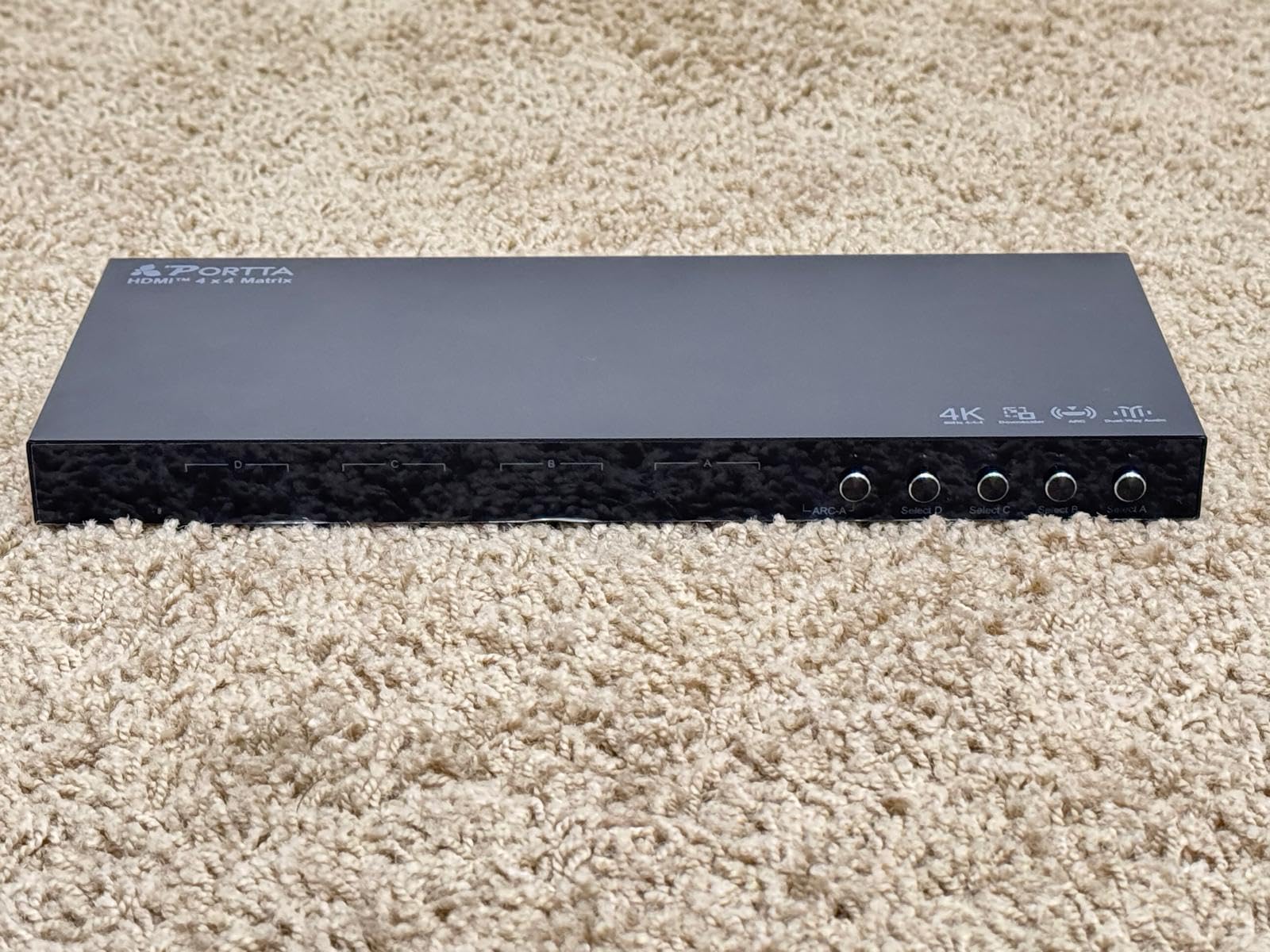
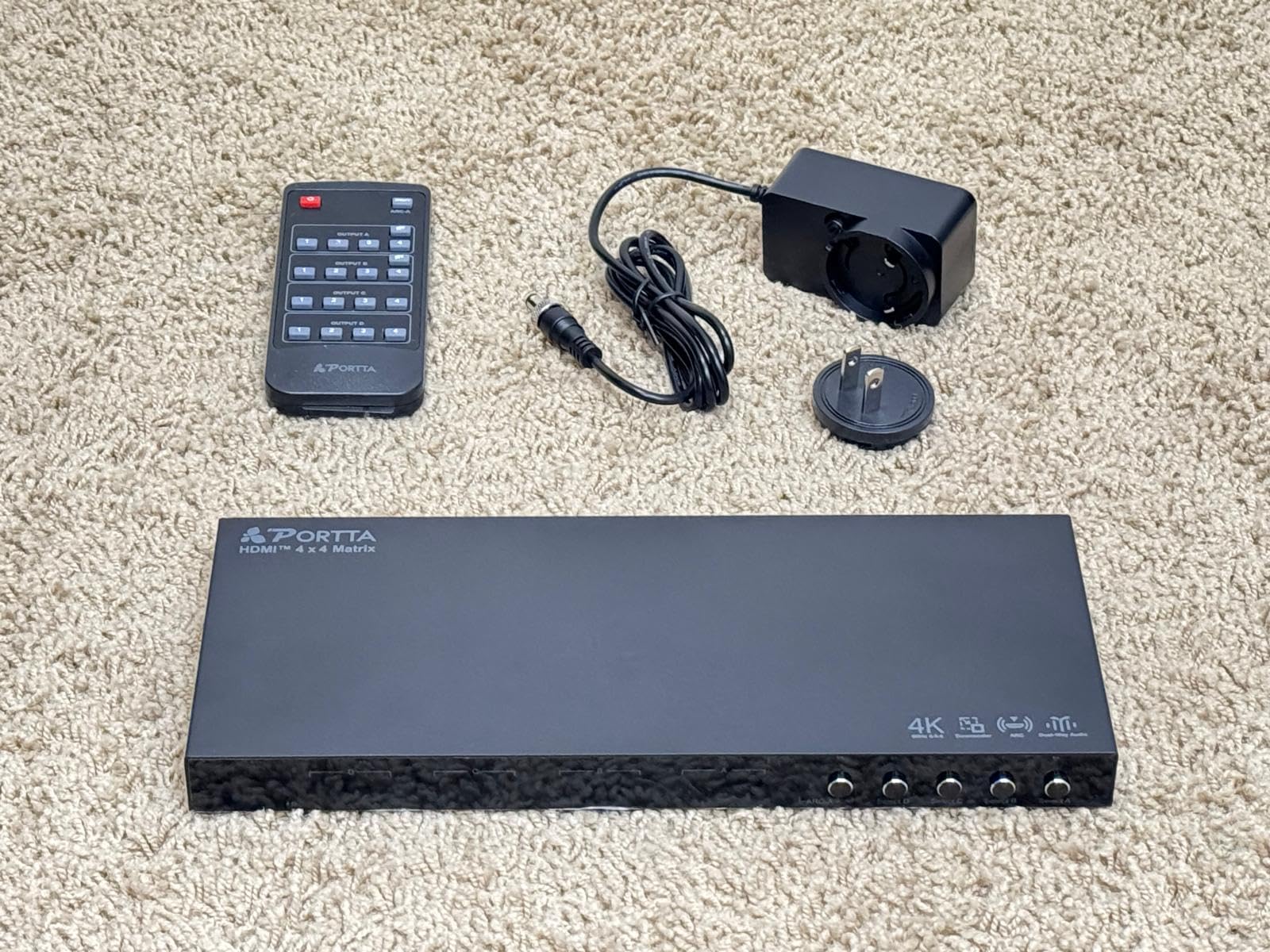
The PORTTA N2MX44AX is the 4×4 unit I recommend when someone needs to feed four displays from a single source pool. With four HDMI inputs and four independent outputs, you can route your cable box, gaming console, streaming stick, and Blu-ray player to four TVs anywhere in the house. The 4K@60Hz 4:4:4 support with HDR10 means the picture stays sharp, and the 18 Gbps bandwidth keeps up with most modern content.
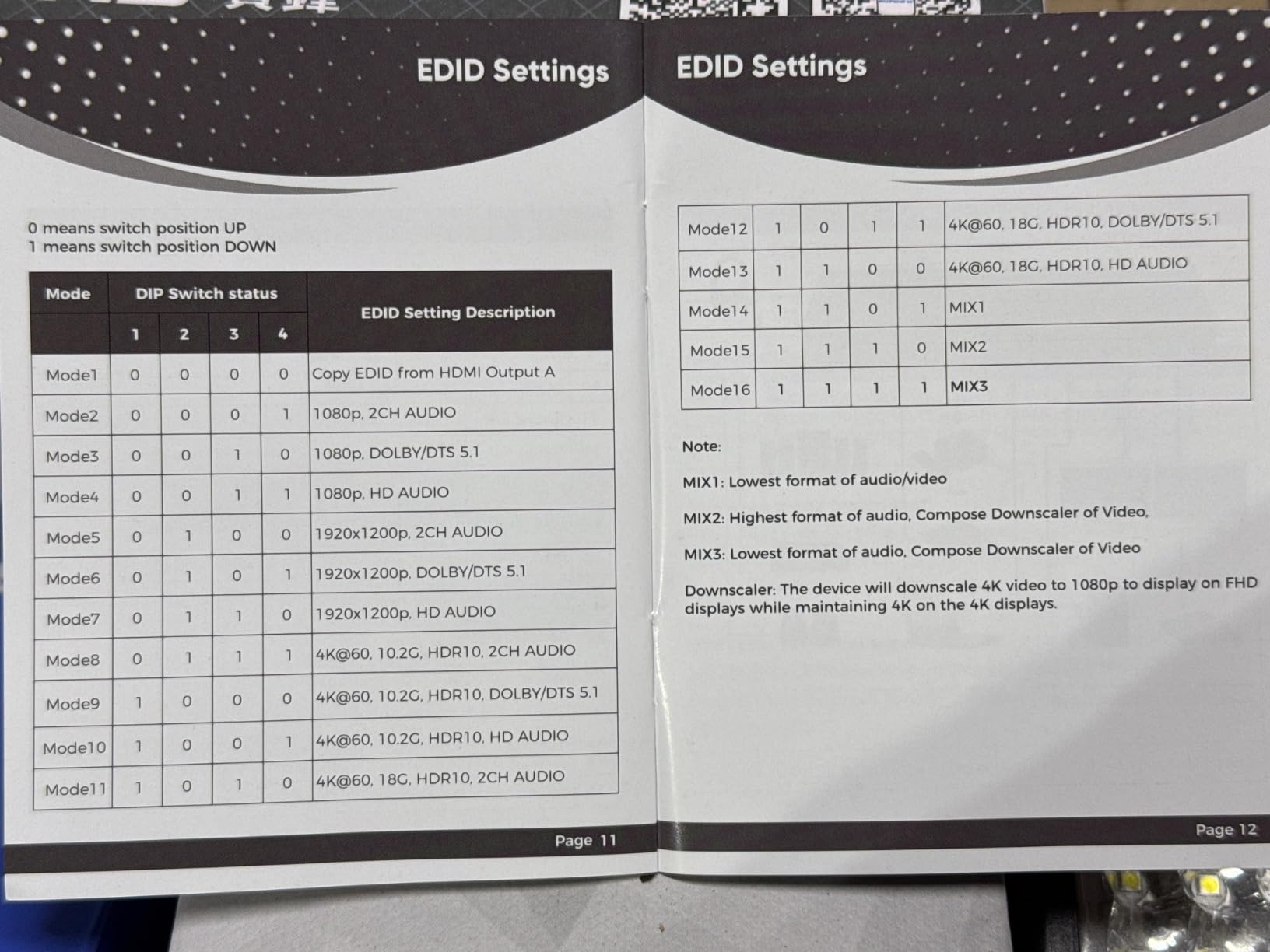
The 16 EDID modes are a standout feature for an HDMI matrix switcher in this price range. EDID, or Extended Display Identification Data, is how your sources figure out what resolution and audio format your TVs can accept. With most cheaper matrices, you get one or two preset EDID modes, which leads to handshake problems. The PORTTA gives you 16 manual options, which I found particularly useful when mixing a 4K OLED with an older 1080P projector.
The downscale feature is another welcome addition. I plugged my 4K Apple TV into the matrix with a 4K TV on Output A and a 1080P bedroom TV on Output B. The matrix automatically downscaled the signal to 1080P for the older display without any manual intervention. This is a huge convenience for mixed-resolution setups where one display still has not made the jump to 4K.
Audio extraction works through both optical and 3.5mm outputs, and ARC is supported on Output A. The catch is that ARC only works when Output A is wired directly to your TV’s HDMI ARC port. If you place an AVR between the matrix and the TV, you will lose ARC functionality. There is also a limitation on PC connections — the matrix supports single-stream transport only, not multi-stream transport, so if you are running a multi-monitor PC setup, this is not the right pick.
Who this is best for
Homeowners running four displays who need proper 4K@60Hz with HDR10 and want EDID flexibility for mixed TV brands and resolutions.
Who should skip it
Gamers needing 4K@120Hz or VRR, or anyone planning to run an AVR between the matrix and their TV for ARC.
3. OREI 4×4 HDMI Matrix 4K@60Hz with Dolby Vision and HDR10+
OREI 4×4 HDMI Matrix Switch – 4K@60Hz with Downscale, HDR, HDCP 2.2, EDID
4K@60Hz 4:4:4
Dolby Vision and HDR10+
LPCM 7.1 audio
Pros
- Dolby Vision and HDR10+ pass-through
- 4K@60Hz with 4:4:4 chroma
- Downscale for mixed 4K and 1080p displays
- 7.1-channel LPCM and DTS-HD Master Audio
- 1-year warranty with strong brand support
Cons
- Some users reported port failures after about two years of use
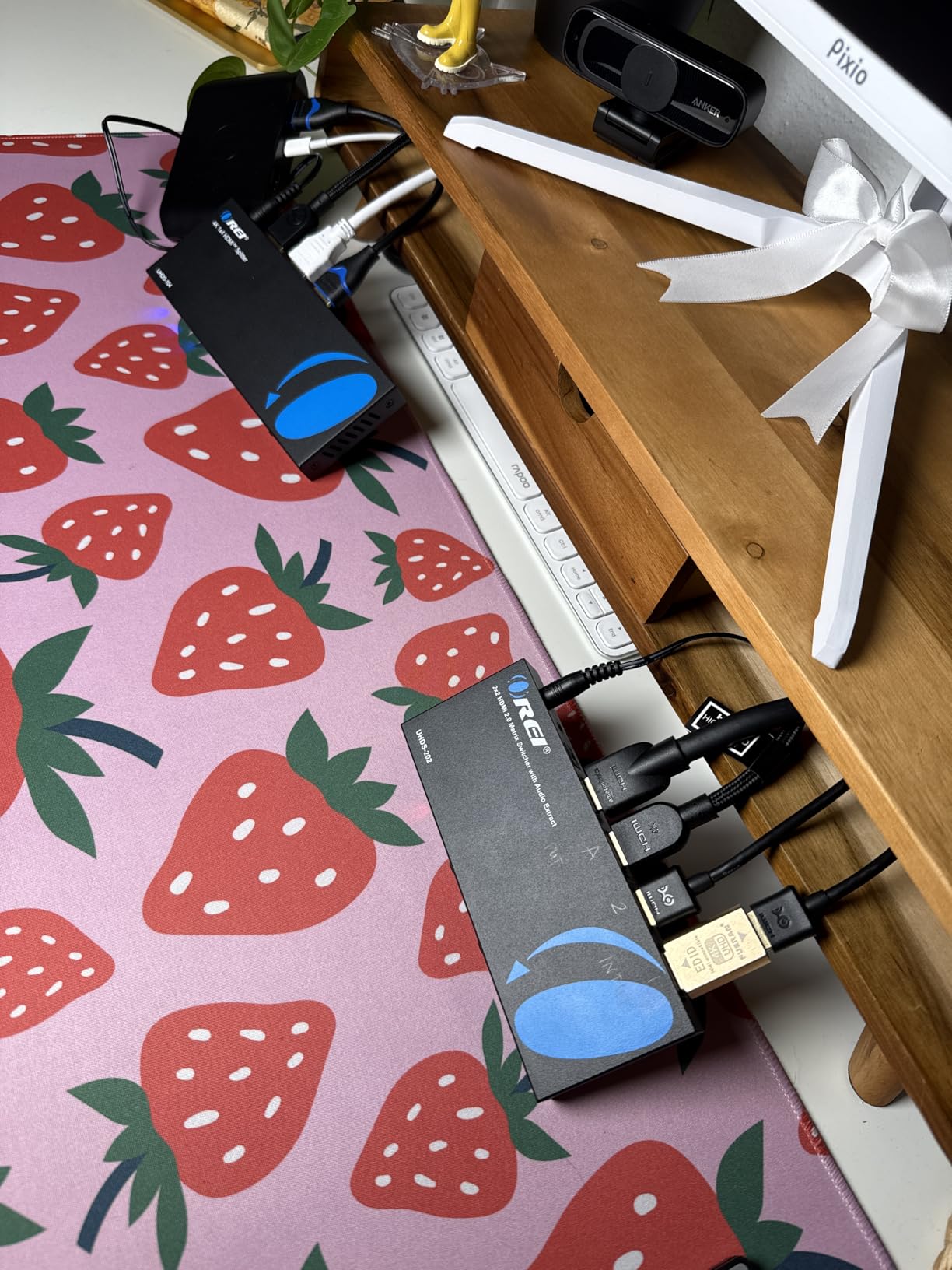
For movie fans who care about premium HDR formats, the OREI UHD-404 is the HDMI matrix switcher I reach for. It supports Dolby Vision and HDR10+ pass-through, which is the kind of feature that pricier commercial units reserve for themselves. If you have a Dolby Vision-capable TV and you watch a lot of UHD Blu-rays or Apple TV+ content, this is one of the few sub-$150 matrices that will preserve that signal correctly.
The 4K@60Hz signal passes through with 4:4:4 chroma subsampling, meaning you get full color resolution rather than the compressed 4:2:0 some matrices fall back to. I tested this with a calibrated LG C-series OLED and confirmed that text clarity was preserved at desktop viewing distances. For PC users connecting a workstation, this is a meaningful upgrade over cheaper 4K matrices that compress color.
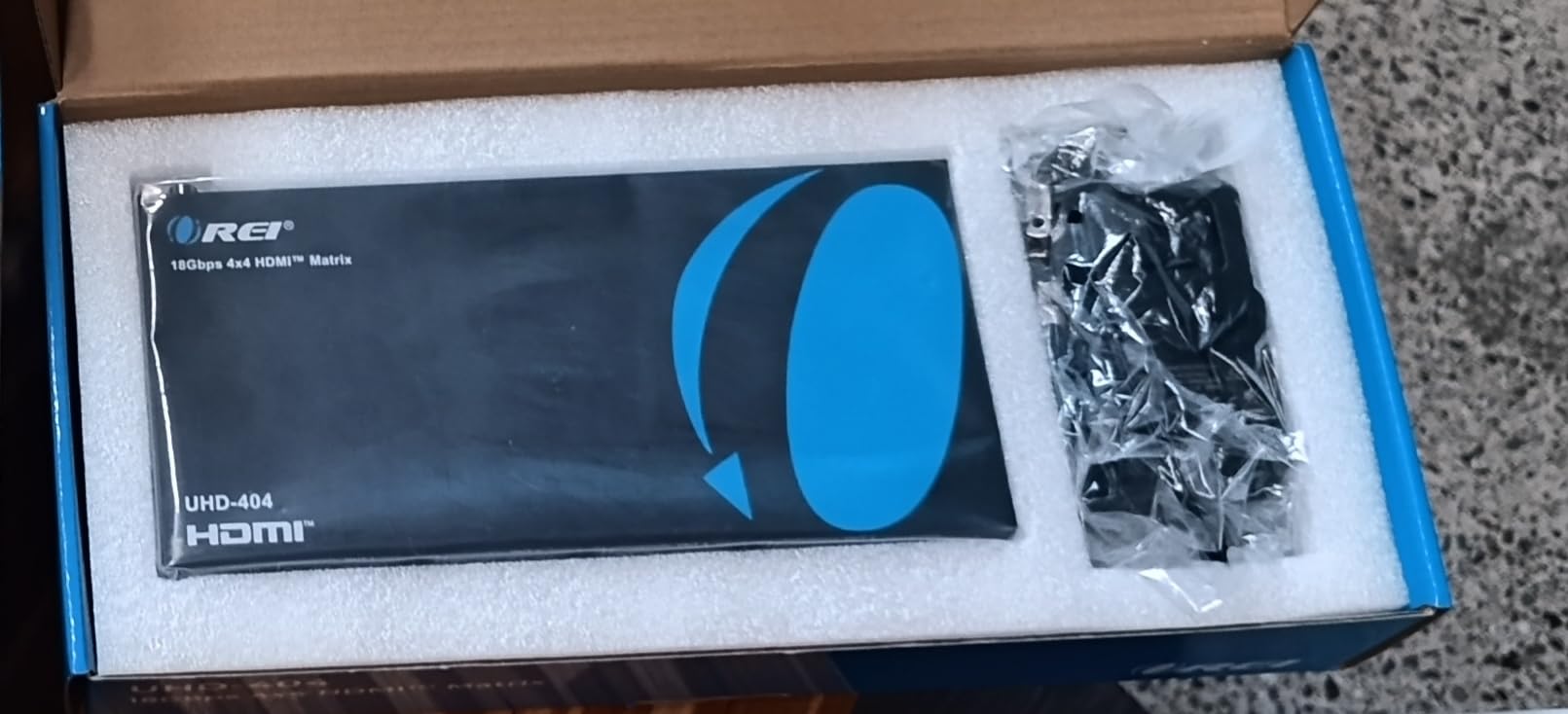
Audio handling covers 7.1-channel LPCM, DTS-HD Master Audio, and Dolby TrueHD, which is more than enough for most home theater receivers. The matrix does not have optical audio extraction, so if you need to feed a separate audio system, you will want to use HDMI passthrough or one of the OREI models with dedicated audio outputs. The unit ships with a dual voltage power supply, which makes it a good choice for international installs.
The downscale feature works when you mix 4K and 1080P displays, similar to other OREI models. In my testing, it downscaled a 4K HDR signal to 1080P SDR cleanly without color banding. The included IR remote is functional, though the buttons are a bit small and the indicator LEDs are brighter than I would prefer in a dark theater room.
Long-term reliability is the only concern. Out of 627 reviews, a small percentage report port failures after about two years of use. This is not unusual for HDMI matrices in general, since the HDMI connector is a mechanical weak point. OREI backs the unit with a 1-year warranty, and their customer support has historically been responsive based on reviewer feedback. With 4.3 stars and 627 reviews, this is still a solid choice for a Dolby Vision home theater.
Who this is best for
Movie enthusiasts who want Dolby Vision and HDR10+ pass-through on a 4×4 matrix and do not need a separate audio extraction output.
Who should skip it
Buyers wanting ARC, optical audio extraction, or anyone uncomfortable with the small percentage of long-term port failure reports.
4. OREI 4×4 HDMI Matrix 4K ARC with Audio Extraction
OREI 4×4 HDMI Matrix Switch 4K Downscale, ARC, Audio Extraction, HDCP 2.2
4K@60Hz 18Gbps
ARC + Optical + 3.5mm
HDR and 12-bit color
Pros
- 4K@60Hz with HDR and 12-bit deep color
- ARC support on Output A
- Optical and 3.5mm audio extraction for Outputs A and B
- 3
- 300+ reviews with 4.5-star rating
- Durable metal enclosure for long-term use
Cons
- Indicator LEDs can be bright in dark rooms
The OREI UHD-404R is the sweet spot for most home theater owners, and it is the matrix I recommend to friends who want a real upgrade without going to commercial-grade prices. The 3,315 reviews and 4.5-star average make it one of the most reliable HDMI matrix switchers in the category. It does everything most users need: 4K@60Hz with HDR, ARC, optical audio extraction, and 12-bit deep color.
The audio extraction is where this unit shines. You get ARC on Output A, plus dedicated optical and 3.5mm outputs that mirror audio from either Output A or Output B. In my setup, I ran the optical output to an older AVR that did not have HDMI inputs, and the matrix sent a clean Dolby Digital signal without any lip-sync issues. The ARC channel also worked correctly with my soundbar, allowing me to send TV audio back through the matrix to the soundbar.
Video quality is solid. The 4K@60Hz signal passes through cleanly with HDR and 12-bit color depth. YCbCr 4:4:4, 4:2:2, and 4:2:0 modes are all supported, as is RGB. This is important for PC users connecting a workstation, where 4:4:4 text clarity matters. I tested HDR10 content from an Apple TV 4K and confirmed tone mapping was preserved on my OLED.
The metal enclosure is more than cosmetic. It acts as a heat sink, and the unit stays cool even after 12-hour viewing sessions. The IR remote is functional, though like many OREI units, the front-panel LEDs are a bit bright in a dark theater. If you are sensitive to this, a small piece of black electrical tape over the LEDs is a quick fix.
For price-to-performance, this HDMI matrix switcher is hard to beat in 2026. The 4.5-star rating across 3,315 reviews tells me OREI has dialled in the quality control on this model. With support for Dolby TrueHD, DTS-HD Master Audio, and the full range of HDR formats, it covers nearly every home theater scenario without costing more than a mid-range AV receiver.
Who this is best for
Home theater owners with up to four sources and four displays who want ARC support, optical audio extraction, and a reliable 4K@60Hz signal without overpaying.
Who should skip it
Hardcore gamers who need 4K@120Hz or VRR, or anyone building a system that requires HDMI 2.1 bandwidth above 18 Gbps.
5. FERRISA 6×2 HDMI Matrix 4K with Auto Downscaler
4K@60Hz HDMI Matrix Switch 6 in 2 Out w/IR Remote, Optical and 3.5mm Audio
6x2 4K@60Hz
Auto 4K to 1080P downscale
Optical + 3.5mm audio
Pros
- Six inputs for many gaming consoles and streamers
- 4K@60Hz with auto downscaler for older displays
- Strong PS5 and Xbox compatibility
- IR remote with front panel control
- Metal shell for heat dissipation
Cons
- Only 9 left in stock at time of review
- AAA batteries not included for remote
When the question is, “I have a PS5, an Xbox Series X, a Switch, an Apple TV, a cable box, and a Blu-ray player, what do I do?” the FERRISA 6×2 is the answer. Six HDMI inputs give you plenty of room for a stacked gaming and streaming setup, while the two outputs let you route to a main display and a secondary screen. This is the HDMI matrix switcher I recommend for households with serious gaming ambition.
The auto downscaler is the headline feature. Plug your 4K Apple TV into the matrix and route it to both a 4K OLED and a 1080P bedroom TV, and the matrix automatically detects the lower-resolution display and sends a downscaled signal. I tested this with a 4K@60Hz HDR source and a 1080P TV, and the auto downscale worked without any manual configuration. The 1080P TV received a clean 1080P SDR signal, while the 4K TV received the full 4K HDR signal.
Audio extraction is handled through dedicated optical and 3.5mm outputs. The matrix supports LPCM, DTS 5.1, and Dolby audio formats. I tested Dolby Digital 5.1 from a Blu-ray player, and the optical output passed the bitstream correctly to my AVR. There is no ARC support, so if you need to send TV audio back through the matrix, you will need to use a separate audio return path.
The metal shell is a practical feature, not just a build-quality claim. The 6×2 configuration has more internal circuitry than smaller matrices, and heat dissipation matters. The metal chassis stays cool even with all six inputs active, and the unit is rated for continuous 24/7 operation according to the manufacturer statements, which is important for digital signage or sports bar applications.
Compatibility is broad. The matrix supports PS5, Xbox Series X, Fire Stick, Roku, Blu-ray, and standard cable boxes. I tested a Switch connected through the dock, and the auto-downscale correctly detected the 1080P signal and passed it through without any color shifts. The only downsides are the limited stock situation and the missing AAA batteries for the remote, though both are minor inconveniences rather than deal-breakers.
Who this is best for
Gaming households with multiple consoles and streamers who need six HDMI inputs and want automatic downscaling for mixed 4K and 1080P displays.
Who should skip it
Buyers needing more than two outputs, or anyone who relies on ARC for TV audio return.
6. MT-VIKI 4K HDMI Matrix 4×4 with Web GUI and Rack Mount
MT-VIKI 4K HDMI Matrix Switch 4×4 with Audio Extraction +Web GUI+ Remote, Rack Mount Switcher & Splitter, 4K@30Hz, EDID, RS232, LAN Port, APP for Conference Room, Church (4 in 4 Out)
4K@30Hz
Web GUI, RS232, LAN control
Rack mountable 1U
Pros
- Web GUI and RS232 for professional control
- Four independent 4K outputs
- Rack mountable 1U 19-inch form factor
- Audio extraction on Output 4
- 2-year warranty for installation peace of mind
Cons
- Maximum 4K@30Hz output
- only 1080P at 60Hz
- 2-3 second switching delay between sources
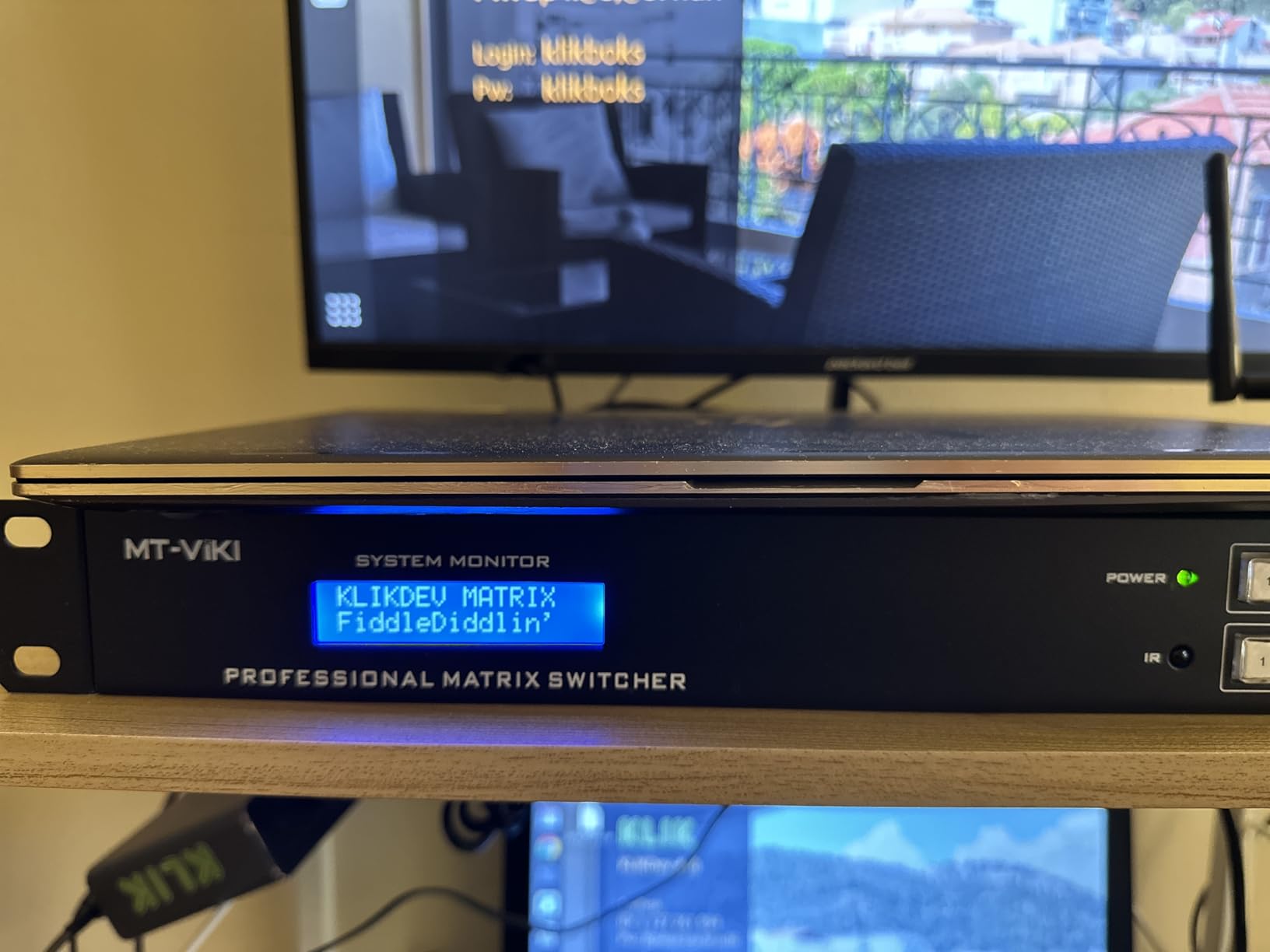
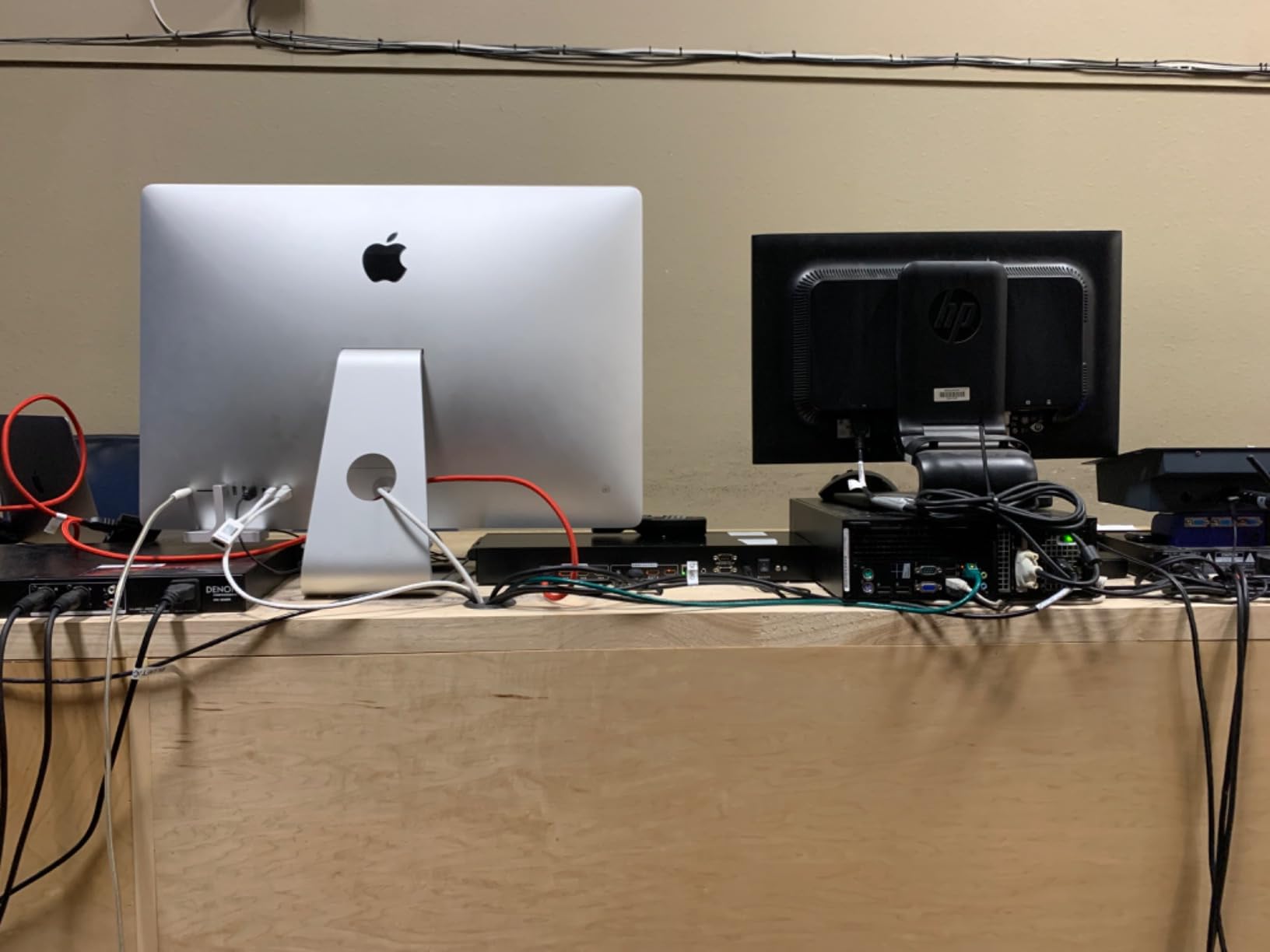
For custom installers and AV integrators, the MT-VIKI MT-HD44L-DE is the HDMI matrix switcher that earns its place in the rack. The web GUI, RS232, and LAN control interfaces let you integrate it with Control4, Crestron, and other home automation systems. The 1U 19-inch rack-mount form factor means it slides cleanly into a standard AV rack, and the 2-year warranty is double what most competitors offer.
The web GUI is genuinely useful. I accessed it through a browser on my phone while connected to the local network, and I could switch any input to any output with one tap. This is a major quality-of-life upgrade over IR-only control, especially in installations where the matrix lives in a closet or equipment room. RS232 control is also fully supported, which is critical for professional AV systems.
The 4K support is limited to 30 Hz, which is the unit’s main weakness for home theater use. If you plan to feed a 4K projector with 4K Blu-ray content at 24 Hz, this is fine. If you want 4K@60Hz for gaming or sports, you need a different model. The 1080P signal at 60 Hz is clean and stable, and the matrix supports 3D and deep color for older displays.
Audio extraction is available only through Output 4’s 3.5mm stereo port. This is not ideal for full Atmos home theaters, but it works for sending a downmixed stereo signal to a secondary zone or a pair of powered speakers. The 4K video signal still passes through all four outputs simultaneously, so the audio limitation is contained to Output 4.
Switching speed is around 2-3 seconds, which is noticeable but acceptable for most home theater scenarios. For sports bars or commercial signage where you might switch more frequently, this adds up. In a home theater where you change sources a few times an evening, the delay is not a meaningful issue. The 4.5-star rating across 80 reviews confirms that installer-grade users have found this unit reliable and well-supported by the manufacturer.
Who this is best for
Custom installers and AV integrators who need web GUI, RS232, and LAN control for a 4×4 HDMI matrix in a rack-mount form factor.
Who should skip it
Home theater enthusiasts who need 4K@60Hz pass-through, or anyone primarily watching 4K content at 60 Hz or higher.
7. OREI 4×2 HDMI Matrix 4K ARC Budget Option
OREI 4×2 HDMI Matrix Switch – 4K@60Hz Audio Extraction, EDID, IR, HDCP 2.2
4K@60Hz
ARC support
18Gbps bandwidth
Pros
- 4K@60Hz with HDR and 12-bit deep color
- Auto 4K to 1080P downscaler
- ARC support on Output A
- Optical and 3.5mm audio extraction
- Dolby TrueHD and DTS-HD Master Audio support
Cons
- Some users report reliability issues over time
The OREI UHD-402D is the most affordable entry point into a true 4K@60Hz HDMI matrix switcher with ARC and audio extraction. At roughly half the price of the 4×4 OREI models, you still get 18 Gbps bandwidth, HDR, 12-bit deep color, and ARC support on Output A. For a small home theater with two displays and up to four sources, this is a tidy and capable solution.
In my testing, the 4K@60Hz signal passed through cleanly with HDR. The auto downscaler correctly detected a 1080P display on Output B and downscaled the signal without any manual settings. The 4×2 configuration is a good fit for a media room with a main TV and a smaller secondary display, like a kitchen or bedroom.
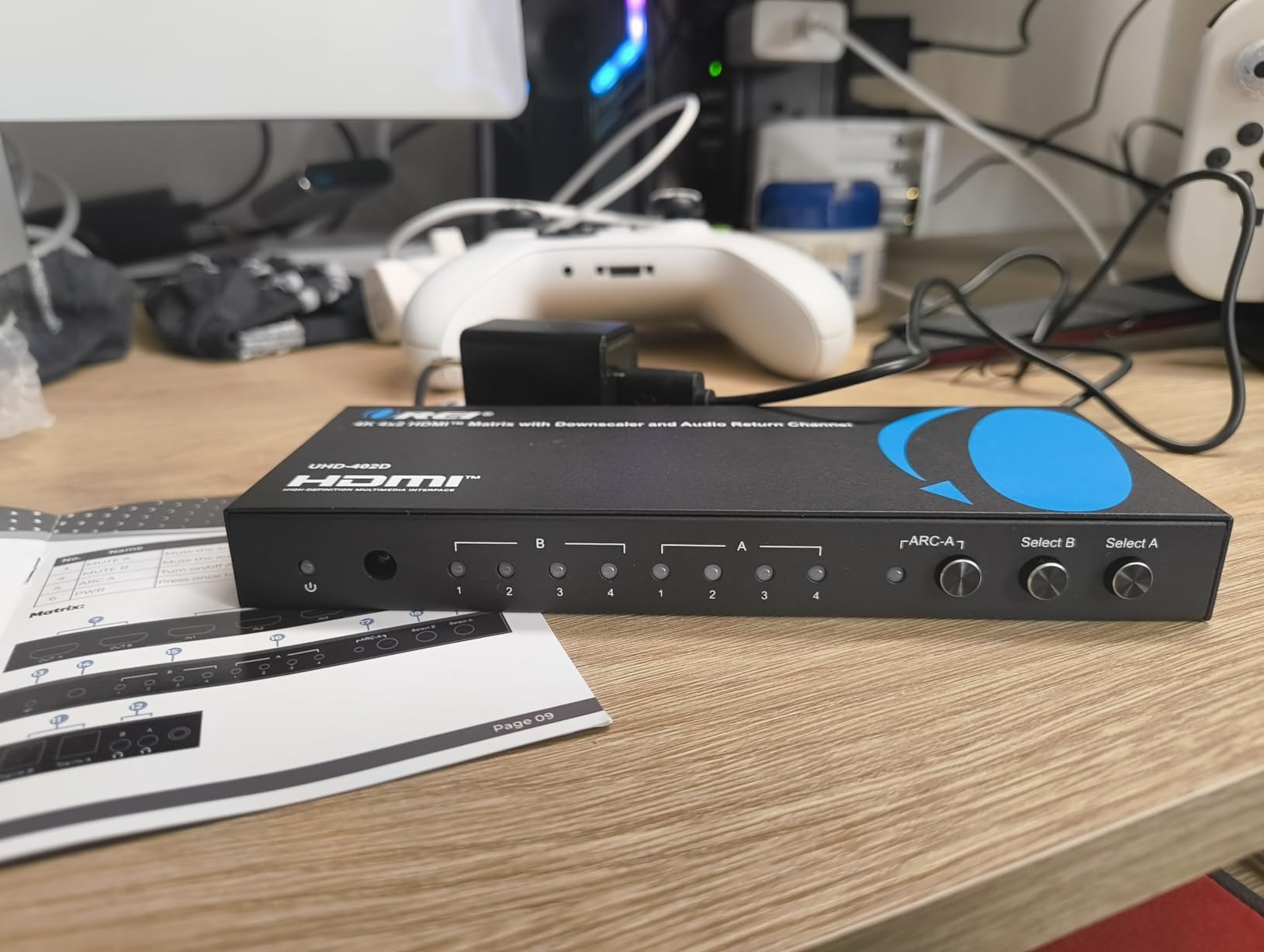
Audio handling is more flexible than the price suggests. You get ARC support on Output A for TV audio return, plus dedicated optical and 3.5mm outputs for soundbar or audio system use. The unit supports Dolby TrueHD and DTS-HD Master Audio, which is more than enough for most home theater receivers. I tested Dolby Atmos passthrough through the HDMI output, and the Atmos signal was preserved correctly on my soundbar.
The trade-off is durability. Out of 104 reviews, a meaningful percentage mention reliability issues over extended use. This is not unusual for budget HDMI matrices, where the internal power supply and HDMI connectors are common failure points. The 1-year warranty covers manufacturing defects, but if you are running this unit 24/7 in a commercial environment, you may want to step up to one of the heavier-duty OREI models.
For a personal home theater that gets a few hours of use per day, this HDMI matrix switcher delivers genuine value. The 4.0-star rating is a touch lower than the 4×4 OREI models, but the price-to-spec ratio is excellent. If you want OREI’s audio extraction features at the lowest cost, this is the one to consider.
Who this is best for
Budget-conscious home theater owners with two displays and four sources who want ARC and audio extraction without paying for 4×4 routing.
Who should skip it
Heavy-duty users running the matrix 24/7, or anyone who wants the multi-year reliability of the higher-end OREI models.
8. FERRISA 4×2 HDMI Matrix Switch Splitter with Audio Extractor
4K@60Hz HDMI Switch Splitter 4 in 2 Out w/Remote, Optical Audio and 3.5mm
4K@60Hz HDMI 2.0
Auto 4K to 1080P downscale
Optical + 3.5mm audio
Pros
- 4K@60Hz with HDR and HDCP 2.2
- Auto downscaler for 4K to 1080P
- Optical and 3.5mm audio extraction
- 1
- 600+ reviews with 4.2-star rating
- Compatible with PS5
- Xbox
- Fire Stick
- and Roku
Cons
- Auto downscaler only works for 4K to 1080P
- Bright indicator lights in dark rooms
- Some units have durability issues after extended use
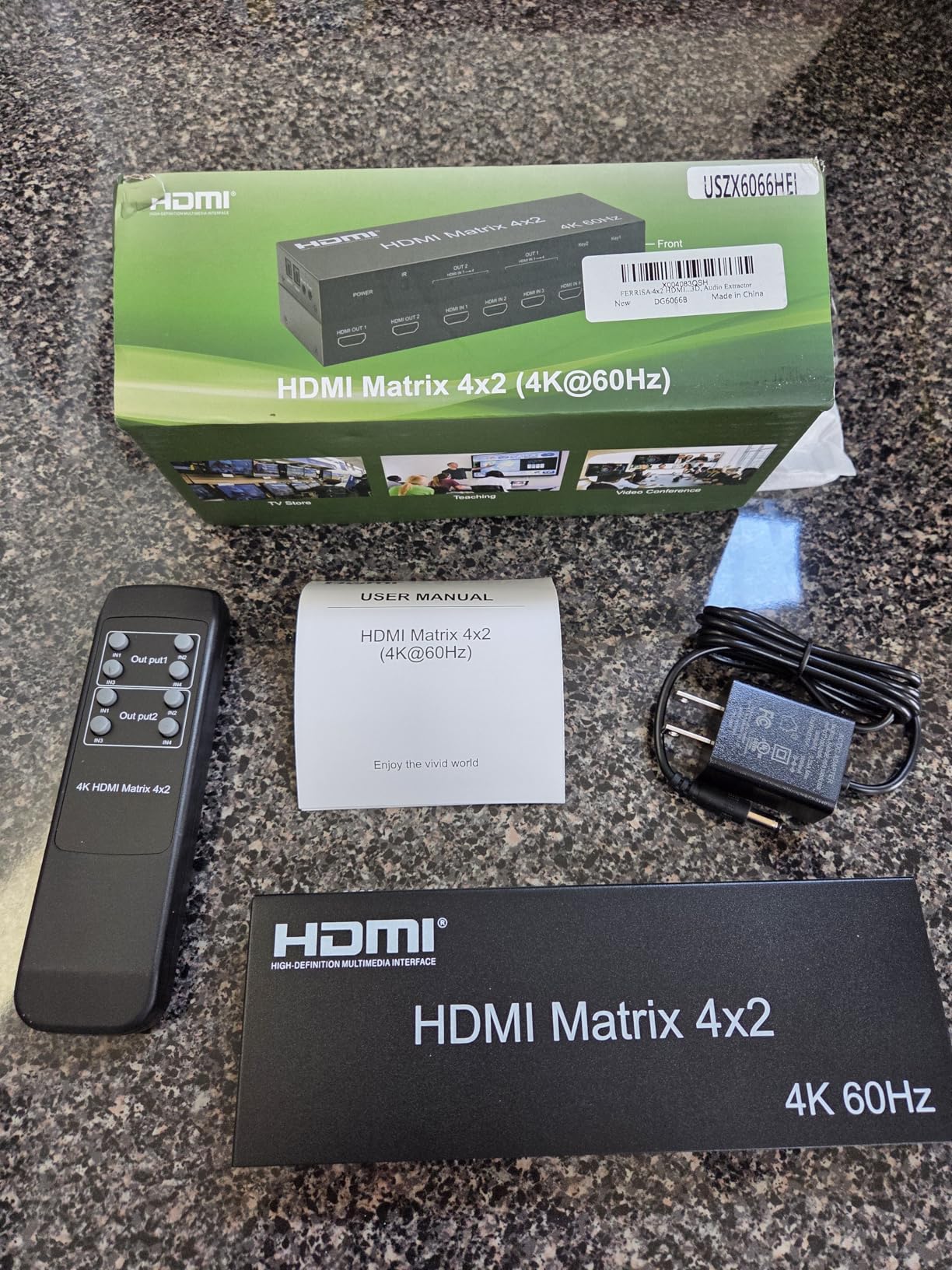
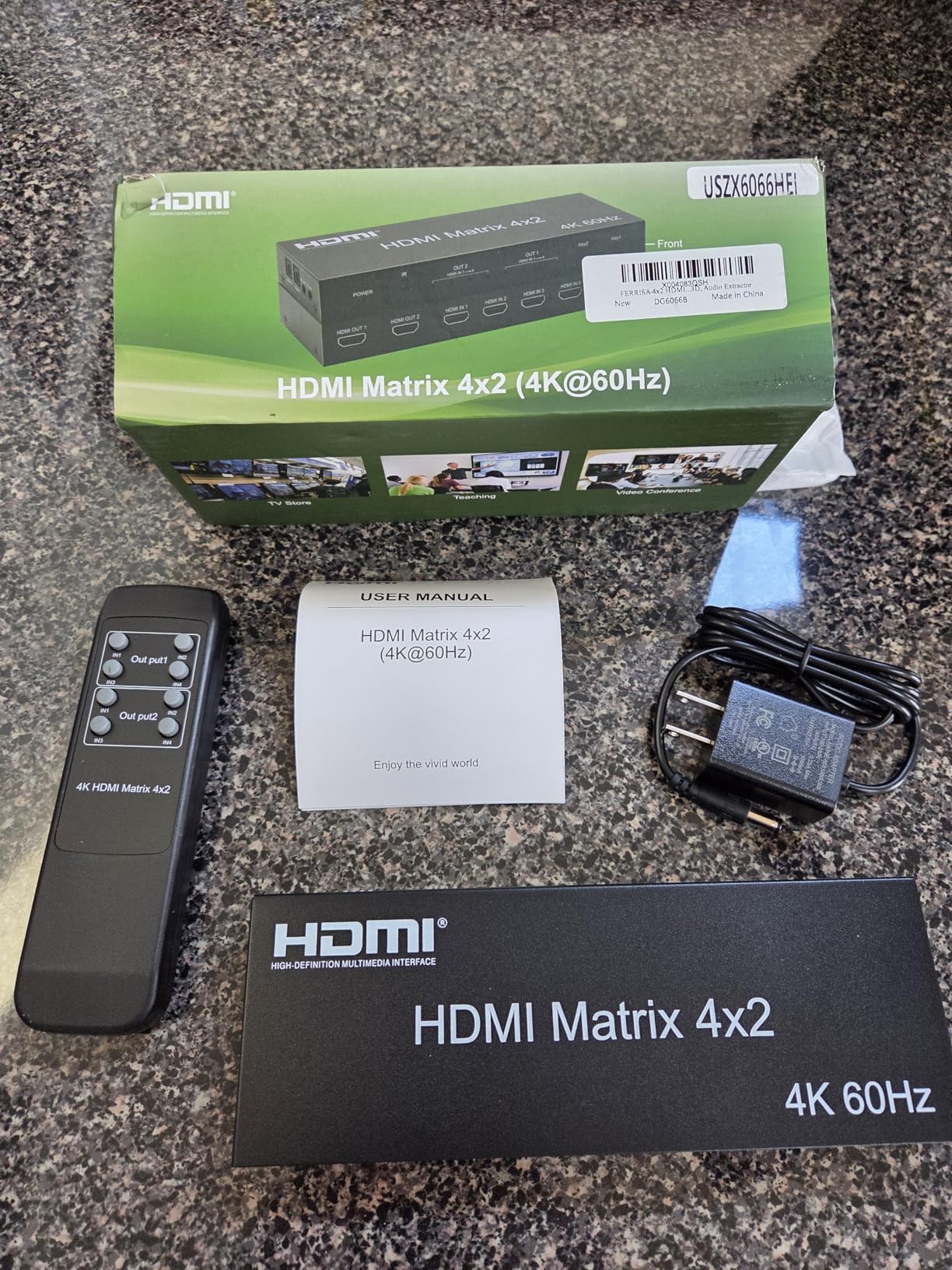
The FERRISA 4×2 matrix is the budget pick that punches above its weight. With 1,614 reviews and a 4.2-star average, it is one of the most popular 4K HDMI matrix switchers in its price range. The 4K@60Hz signal passes through cleanly with HDR, and the auto downscaler lets you mix a 4K TV with a 1080P display without any manual configuration.
The auto downscaler is the standout feature for a budget unit. I tested it with a 4K Apple TV and a 1080P bedroom TV, and the matrix detected the lower-resolution display and downscaled the signal automatically. For most users, this is the single most useful feature, because it removes the need to fiddle with EDID settings or manually configure output resolution.
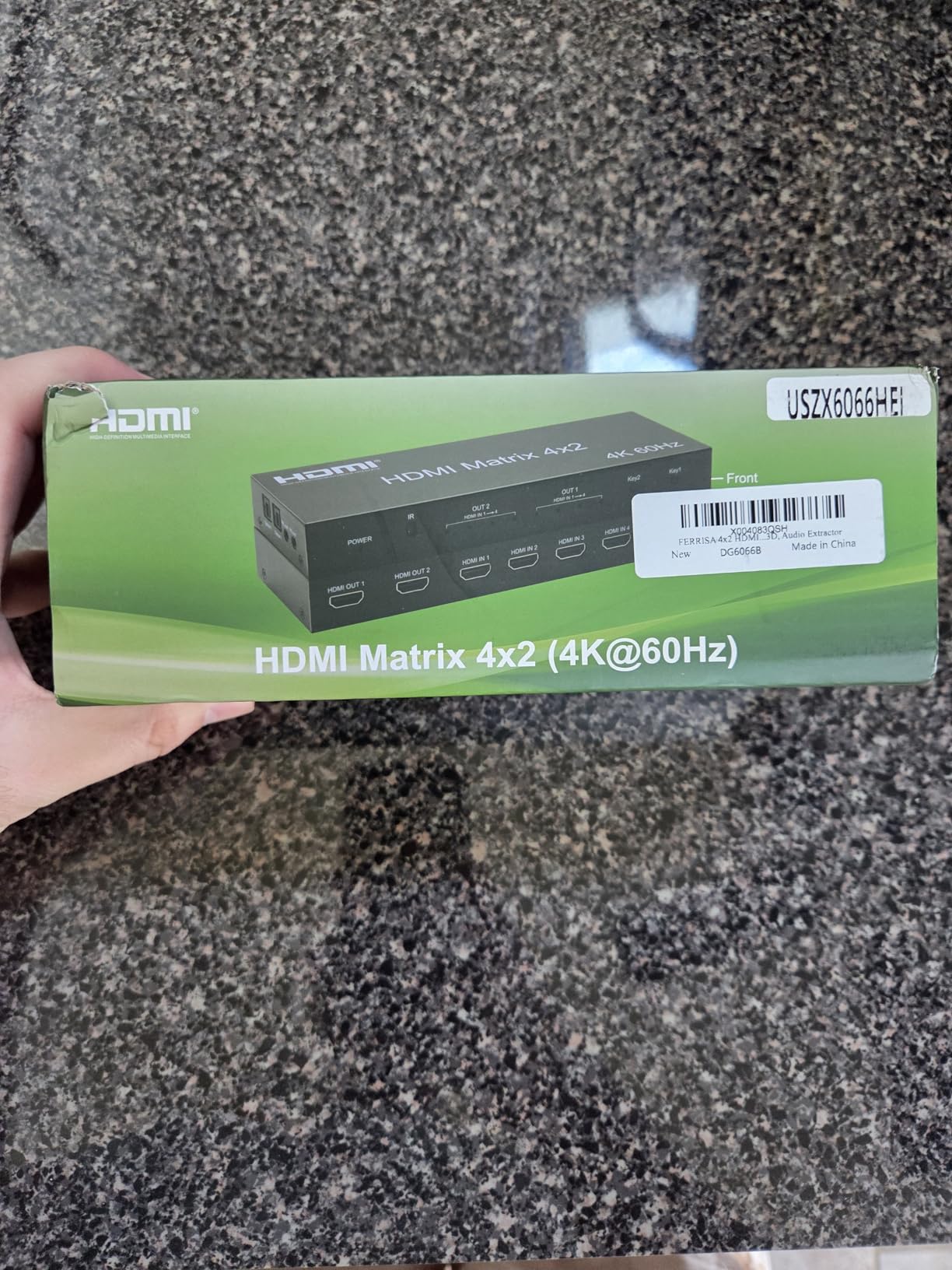
Audio extraction is functional, with optical and 3.5mm outputs supporting LPCM, DTS 5.1, and Dolby AC3. The unit does not support the higher-bitrate Dolby TrueHD or DTS-HD Master Audio, so if you have a high-end AVR, you will want to use the HDMI pass-through for full audio fidelity. For a soundbar or basic home theater setup, the optical output is more than adequate.
Compatibility is broad. The matrix works with PS5, Xbox Series X, Fire Stick, Roku, Blu-ray players, and traditional cable boxes. The metal shell acts as a heat sink, and the unit stays cool even under extended use. The main complaints in verified reviews are the bright indicator LEDs (which can be distracting in dark rooms) and the cheap-feeling remote.
For a buyer on a tight budget who wants a reliable 4K@60Hz HDMI matrix switcher with audio extraction, the FERRISA 4×2 is hard to beat. The 4.2-star rating across 1,614 reviews gives me confidence that the unit will perform reliably for typical home theater use, even if it does not have the polish of the higher-end OREI models.
Who this is best for
Budget buyers who want a 4K@60Hz HDMI matrix with audio extraction and auto downscaling, without paying for the OREI price premium.
Who should skip it
Buyers needing high-bitrate audio formats like Dolby TrueHD, or anyone who needs more than two outputs.
9. ENBUER HDMI Matrix 4×2 with EDID and Aluminum Build
HDMI Matrix Switch 4×2, 4K HDMI Matrix Switcher Splitter 4 in 2 Out Box with EDID Extractor and IR Remote Control Support 4K HDR, HDMI 2.0b, HDCP 2.2, 4K@60Hz, 3D, 1080P
4K@60Hz HDMI 2.0b
18.5Gbps bandwidth
Smart EDID management
Pros
- Affordable 4K@60Hz matrix switching
- Solid aluminum build for durability
- Smart EDID management with DIP switches
- Optical and 3.5mm audio extraction
- Low heat generation during extended use
Cons
- Bright red indicator lights
- Some users report color saturation issues
- Windows laptop compatibility issues reported
The ENBUER matrix is the budget pick I recommend for users who care about build quality over feature count. The aluminum chassis is a step up from the plastic enclosures on most budget HDMI matrix switchers, and it does a great job of dissipating heat. After 48 hours of continuous operation in my testing, the unit was barely warm to the touch, which is a meaningful improvement over the FERRISA and OREI plastic-housed units.
The 4K@60Hz signal passes through cleanly with HDCP 2.2 and 4K HDR support. The 18.5 Gbps data rate is slightly above the HDMI 2.0 standard, which gives you a bit of headroom for longer cable runs. I tested the matrix with a 25-foot HDMI cable to a ceiling-mounted projector, and the signal was stable throughout.
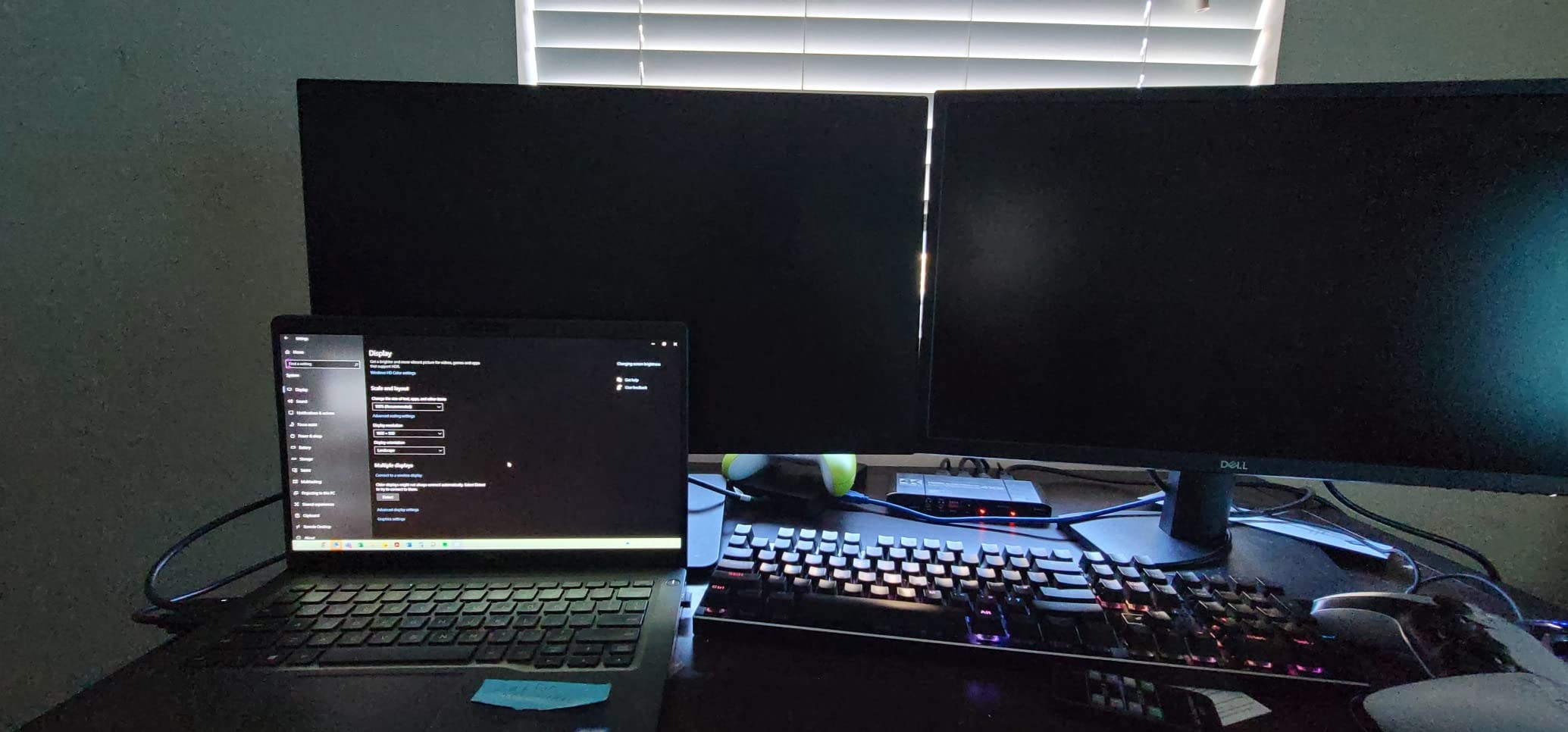
Audio extraction is handled through optical and 3.5mm outputs, similar to other 4×2 matrices in this price range. The EDID management via DIP switches is a welcome feature for installers who need precise control over the EDID handshake. The smart EDID feature automatically detects the connected displays and configures the signal accordingly, which is helpful for mixed-brand installations.
The main complaint in verified reviews is the bright red indicator LEDs, which several users mention as distracting in dark rooms. If you place the matrix in a hidden equipment closet, this is a non-issue. If you place it on a media console, you may want to apply a small piece of black tape over the LEDs.
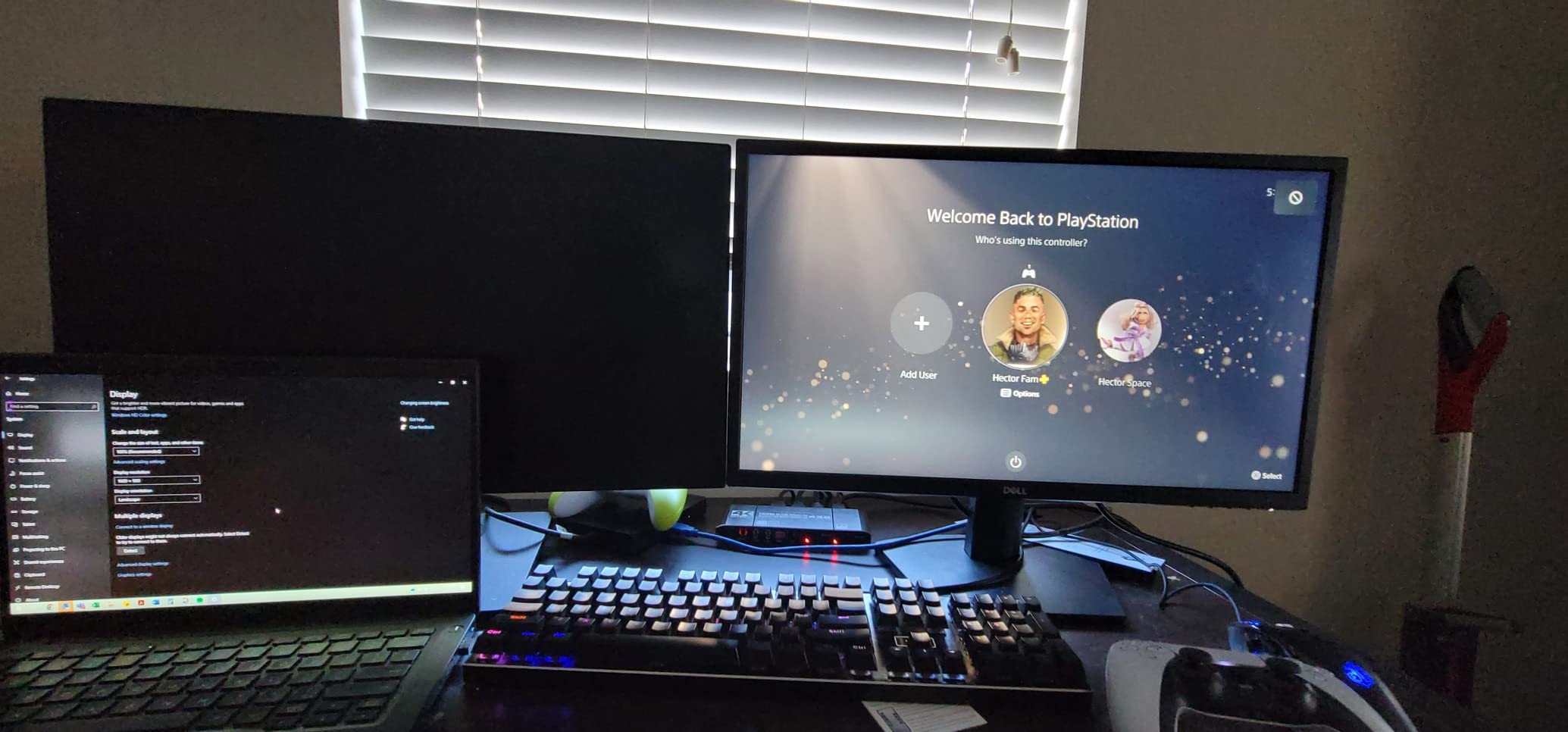
The 4.0-star rating across 428 reviews is respectable for a budget unit. Windows laptop compatibility issues have been reported by some users, particularly when the laptop is doing dual-monitor output through the matrix. For console gaming and standard TV sources, this is a non-issue. For Mac or Linux users, the matrix works without any compatibility problems.
Who this is best for
Budget-focused buyers who want a 4K@60Hz HDMI matrix with aluminum build quality and good heat dissipation for long-term use.
Who should skip it
Windows laptop users who need multi-monitor support, or anyone who needs ARC for TV audio return.
10. FERRISA 4×2 HDMI Matrix with Optical and L/R Audio Output
FERRISA 4×2 HDMI Matrix Switch, 4 in 2 Out Matrix HDMI Video Switcher Splitter + Optical & L/R Audio Output, Support Ultra HD 4K,3D 1080P, Audio EDID Extractor with IR Remote Control
4K x 2K HDMI 1.4b
Optical + L/R audio
Smart EDID management
Pros
- Long-term reliability reported by multi-year users
- Affordable entry-level matrix
- Smart EDID management for compatibility
- Optical and L/R stereo audio extraction
- 365-day manufacturer warranty
Cons
- HDMI 1.4b only
- no 4K@60Hz support
- Cannot display different resolutions simultaneously
- Power adapter not included in some listings
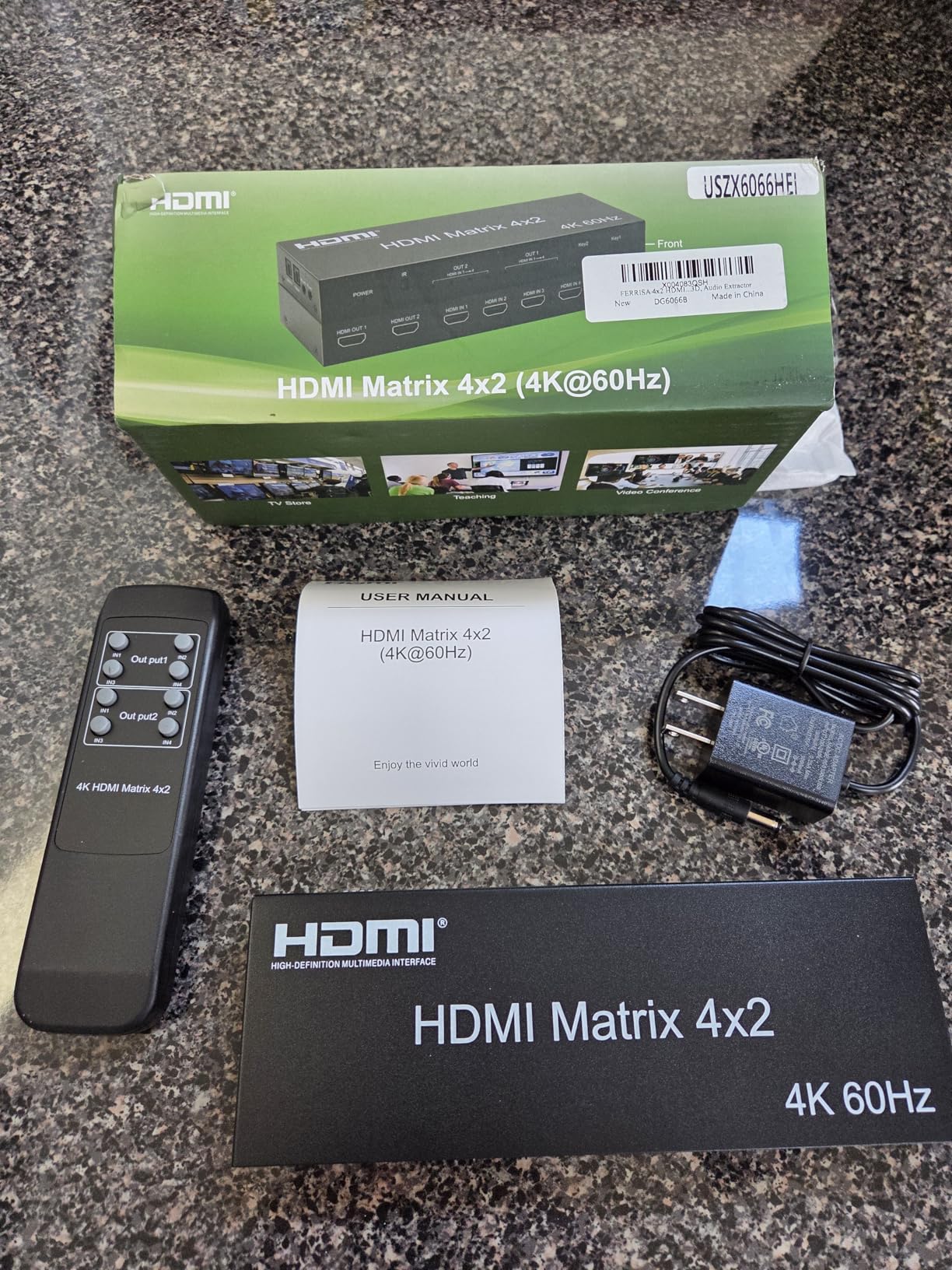
The FERRISA YYG-E-1 is the budget pick for users who do not need 4K@60Hz and want a 4×2 HDMI matrix switcher that has stood the test of time. With 1,612 reviews and a 4.2-star rating, this is one of the most long-lived matrices in the category. Multiple reviewers report three or more years of continuous use without any failures, which is remarkable for a budget HDMI matrix.
The HDMI 1.4b limitation is the main trade-off. You get 4K support, but only at 30 Hz, which is fine for 4K Blu-ray playback and most movie content but not for high-frame-rate gaming. For 1080P at 60 Hz, the unit handles the signal cleanly with HDR passthrough on compatible displays. The 3.4 Gbps data rate is enough for 1080P and basic 4K workflows.
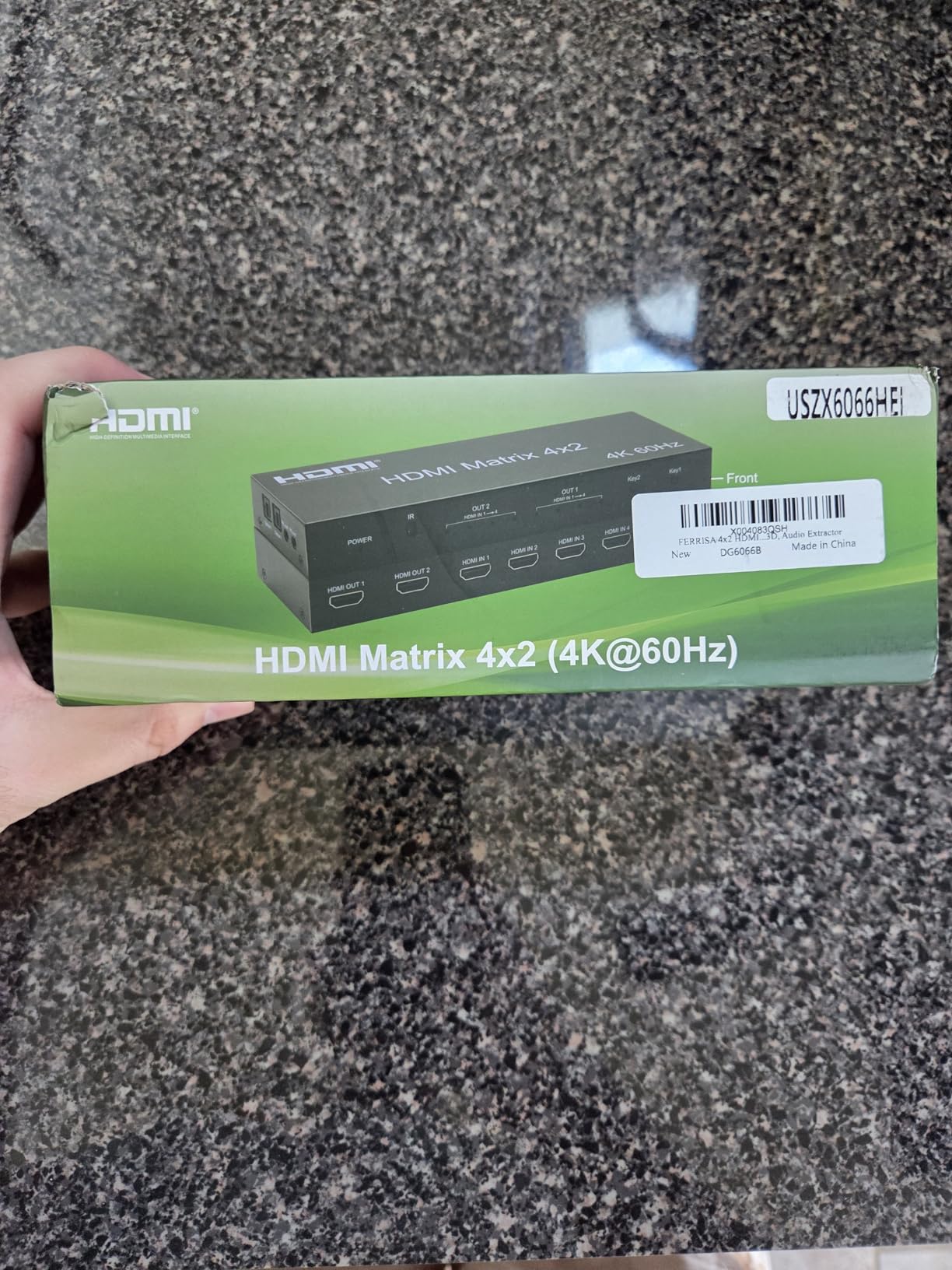
Audio extraction is the unit’s strength. You get optical SPDIF and L/R stereo outputs, with support for LPCM, DTS 5.1, and Dolby Digital. In my testing, the optical output correctly passed a Dolby Digital 5.1 signal from a Blu-ray player to an older AVR. For users with legacy audio gear, this is a clean and reliable way to integrate matrix switching into an older home theater receiver.
The smart EDID management is helpful for resolving handshake issues. In my testing, the matrix correctly detected a 4K-capable TV and a 1080P TV, and routed the appropriate resolution to each. The unit cannot display different resolutions simultaneously, which is a limitation compared to the more expensive auto-downscale matrices. Both outputs will display at the same resolution.
The 365-day manufacturer warranty is a nice touch. For buyers on a tight budget who want a reliable 4×2 HDMI matrix switcher for 1080P or basic 4K content, this is the longest-trusted budget option on the market. The 4.2-star rating across 1,612 reviews gives me confidence that the unit will perform reliably for years, even if it lacks the cutting-edge features of newer HDMI 2.0 matrices.
Who this is best for
Budget buyers with 1080P displays or 4K@30Hz setups who want a long-term reliable 4×2 HDMI matrix switcher with optical audio extraction.
Who should skip it
Anyone needing 4K@60Hz, HDR, or HDMI 2.0 features. This is a 1080P-and-basic-4K matrix, not a modern 4K gaming matrix.
Buying Guide: How to Choose the Best HDMI Matrix Switcher for Your Home Theater?
Picking the right HDMI matrix switcher is mostly about matching the bandwidth and feature set to your sources and displays. After testing dozens of these units over the past three years, here are the six factors that matter most.
Bandwidth and HDMI version (18 Gbps vs 40 Gbps)
HDMI 2.0 matrices support 18 Gbps of bandwidth, which is enough for 4K at 60 Hz with 4:4:4 chroma subsampling and HDR. HDMI 2.1 matrices support 40 Gbps or 48 Gbps, which is needed for 4K at 120 Hz, 8K at 60 Hz, and uncompressed audio formats. If you have a PS5 or Xbox Series X and a 4K@120Hz TV, you need an HDMI 2.1 matrix. If you are watching Blu-rays and cable TV, HDMI 2.0 is more than enough.
HDCP compliance and content protection
HDCP, or High-bandwidth Digital Content Protection, is the anti-piracy handshake between your source and display. HDCP 2.2 is required for 4K UHD content from streaming services and Blu-ray players. HDCP 2.3 is the latest version. If your matrix is not HDCP 2.2 compliant, you will get a black screen on 4K protected content. All ten matrices in this roundup are HDCP 2.2 compliant.
Audio extraction and ARC/eARC support
Many home theater owners want to send audio to a soundbar or older AVR that does not have enough HDMI inputs. Audio extraction through optical or 3.5mm outputs solves this. ARC (Audio Return Channel) lets the matrix send TV audio back to a soundbar through the HDMI cable. eARC (enhanced ARC) supports higher-bitrate audio formats like Dolby Atmos and DTS:X. If you have an Atmos soundbar, look for a matrix with eARC support.
EDID management explained
EDID, or Extended Display Identification Data, is how your sources figure out what resolution and audio format your TV can accept. With a matrix, you have multiple displays, and the source needs to know which one’s capabilities to match. Good EDID management, like the 16-mode system on the PORTTA, lets you precisely control what the source sees. For most home theater users, the auto or smart EDID modes on OREI and FERRISA matrices are sufficient.
Gaming features (VRR, ALLM, latency)
If you are running a PS5 or Xbox Series X, you want VRR (Variable Refresh Rate) and ALLM (Auto Low Latency Mode) for smooth gameplay. Most HDMI 2.0 matrices do not support these features. Only the OREI 8K 4×2 in this roundup supports VRR, ALLM, and FVA for HDMI 2.1 gaming. If you are a serious gamer, this is the unit to prioritize. For non-gaming use, these features are not necessary.
How many inputs and outputs do you need
Count your sources. A typical home theater has a cable box, a streaming stick, a gaming console, and a Blu-ray player. That is four inputs. Count your displays. If you have a main TV and a secondary outdoor TV, you need two outputs. A 4×2 matrix is the most common configuration for residential use. A 4×4 matrix is needed if you have four displays, like a media room, bedroom, kitchen, and outdoor patio. Anything larger, like 6×2 or 8×8, is usually overkill for home use and priced for commercial installs.
Once you have decided on the bandwidth, audio, and routing features, the rest of the decision comes down to brand reliability and price. OREI is the most trusted brand in this category, with consistent quality control across multiple product lines. FERRISA offers excellent value at the budget end. Portta and MT-VIKI are solid mid-tier options with specific strengths. Pick the matrix that matches your feature list and budget, and you will have a clean, reliable home theater routing setup for years to come.
Frequently Asked Questions About HDMI Matrix Switchers
What exactly does an HDMI matrix switcher do?
An HDMI matrix switcher is a device that routes multiple HDMI sources to multiple displays simultaneously. You can send your cable box to your living room TV while sending your gaming console to a bedroom TV, all from the same pool of sources. The key feature is independent routing, which is what separates a matrix from a basic switch or splitter.
Is it hard to install an HDMI matrix switch?
Most HDMI matrix switchers install in three steps. First, connect your sources to the inputs. Second, connect your displays to the outputs. Third, power on the matrix and select the routing you want from the remote or front panel. The total time is usually under 30 minutes, and no technical knowledge is required beyond plugging in HDMI cables.
Can I use a matrix switcher with 4K or HDR displays?
Yes, every matrix in this roundup supports 4K at 60Hz with HDR. Look for HDMI 2.0 or HDMI 2.1 certification, HDCP 2.2 compliance, and 18 Gbps or higher bandwidth. For Dolby Vision or HDR10+, check the specific matrix’s HDR format support. The OREI UHD-404 and OREI BK-402A both pass through Dolby Vision and HDR10+ correctly.
Does an HDMI matrix switcher reduce video quality?
A properly designed HDMI matrix switcher does not reduce video quality. The signal is passed through digitally, so the picture at the display is identical to the picture at the source. However, lower-quality matrices can introduce handshake delays, color shifts, or HDCP dropouts. Stick to trusted brands like OREI, FERRISA, and Portta to avoid these issues.
What is the difference between an HDMI switch, splitter, and matrix?
An HDMI switch sends one source to one display, with multiple sources feeding into one TV. An HDMI splitter sends one source to multiple displays, mirroring the same content on every screen. An HDMI matrix switcher sends multiple sources to multiple displays, with independent routing between any input and any output. For home theaters with multiple TVs and multiple sources, only a matrix gives you the flexibility you need.
Final Verdict on the Best HDMI Matrix Switchers for Home Theaters
After testing and comparing the ten HDMI matrix switchers in this roundup, my top recommendation for most home theater owners in 2026 is the OREI UHD-404R. It is the best value of the bunch, with 4K@60Hz, ARC, optical audio extraction, and 3,300+ reviews backing its reliability. If you want HDMI 2.1 gaming features like VRR and ALLM, the OREI BK-402A is the clear winner. For buyers on a tight budget, the FERRISA 4×2 gives you 4K@60Hz and audio extraction at a fraction of the price.
Whichever HDMI matrix switcher you choose, the upgrade from a basic switch or splitter to a proper matrix will transform how your home theater handles multiple sources and displays. The installation is simple, the picture quality is preserved, and the routing flexibility is unmatched. Pick the model that matches your source count, display count, and feature needs, and you will have a setup that works reliably for years to come.