
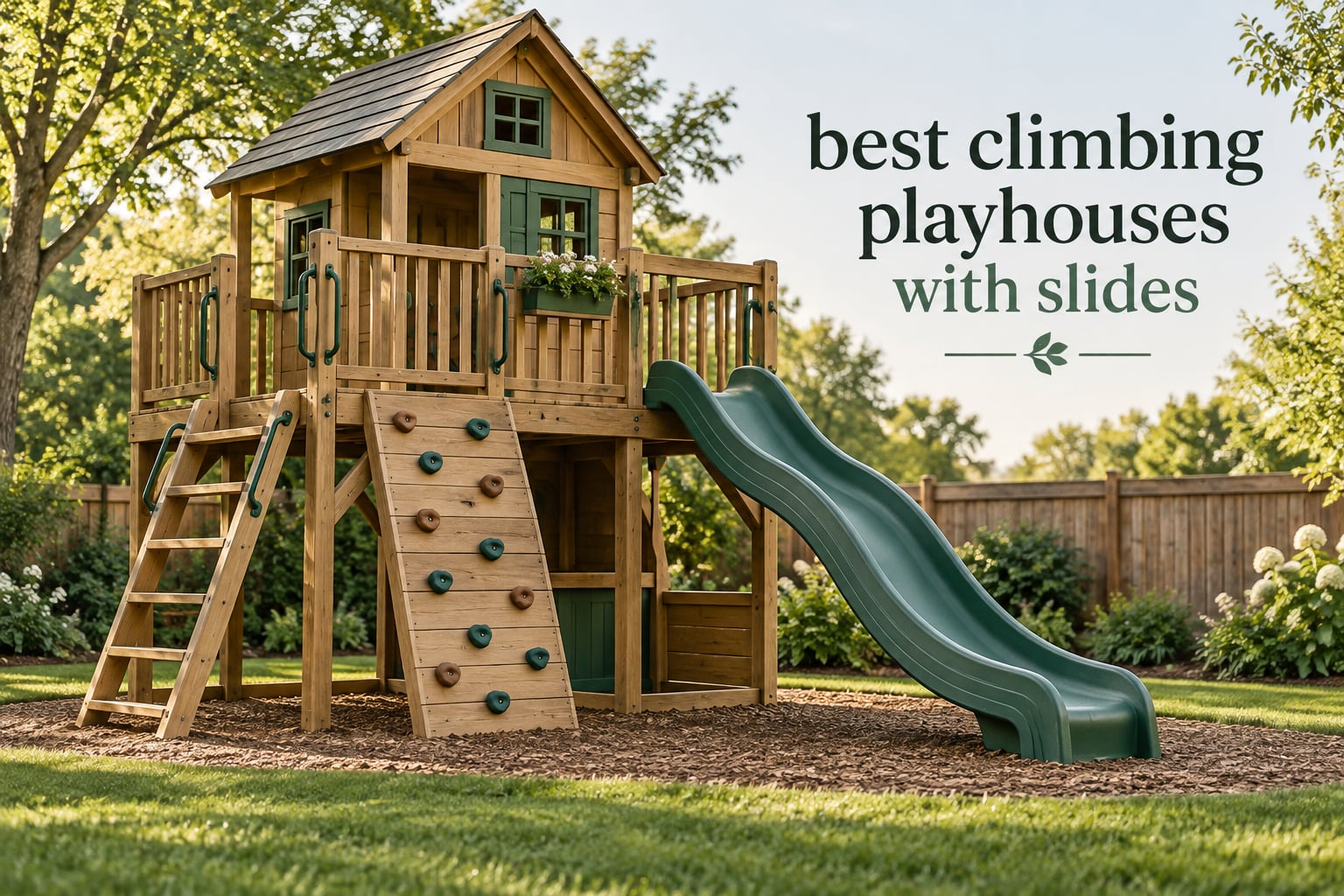
A climbing playhouse with a slide is a backyard structure that combines a child-scale pretend-play house with a raised deck you reach by climbing, usually a molded rock wall or a ladder, plus a slide that runs from that deck back to the ground. One footprint then delivers active gross-motor play and indoor-style pretend play at the same time.
That combination is the whole reason this category exists. A plain playhouse gets outgrown the moment a child is tall enough to stand up inside it. A plain slide stops being interesting the second climbing it becomes easy. Pair the two and a single structure keeps working from roughly age 2 through age 10.
We spent October 2026 reading specification sheets, digging through thousands of owner reviews, and comparing six structures that genuinely hit the playhouse-plus-climbing-plus-slide intersection. Most of what passes for a climbing playhouse online is a generic swing set with a slide, so this list is short on purpose. Six options survived the filter, and we explain below exactly how we filtered.
One thing surprised us while reading the reviews, and it shapes every recommendation here. Owners almost never complain about the slide or the climbing wall in isolation. They complain when there is only one way up. Give a family a ladder and a rock wall, or a climber and a crawl-through, and a structure built for a 2-year-old keeps working for an 8-year-old. Give them a single route and the youngest wins until the day the oldest child loses interest.
If you want the broader picture before the picks, our guides to the best outdoor playhouses and the best kids playhouses overall cover the pretend-play end of the market without a climbing element.
Table of Contents
Top 3 Picks for Climbing Playhouses With Slides in 2026
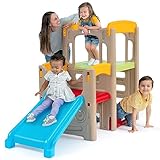
Simplay3 Adventure Climber
- Wide slide surface
- Two-tier platform
- Crawl-through fort
- 180 lb max weight

Step2 Woodland Climber II
- Two climbing walls
- Under-deck hideaway
- 75 inch length
- 2 player rating

Step2 Play Ball Fun Climber
- Ball drop wall
- Compact 53 inch length
- Indoor and outdoor
- 20 kg max weight
Best Climbing Playhouses With Slides in 2026
Every structure below has a play element, a climbing route, and a slide. That is the floor we set, and it eliminated most of what comes up when you search the phrase. The table is the fast version; the reviews underneath are the reasoning.
| Product | Specifications | Action |
|---|---|---|
| Simplay3 Young Explorers Adventure Climber and Slide |
|
Check Latest Price |
| Step2 Woodland Climber II |
|
Check Latest Price |
| Step2 Play Ball Fun Climber |
|
Check Latest Price |
 Simplay3 Young Explorers Modular Play System Simplay3 Young Explorers Modular Play System |
|
Check Latest Price |
 Little Tikes Hide and Seek Climber and Swing Little Tikes Hide and Seek Climber and Swing |
|
Check Latest Price |
 Step2 Play Naturally Playful Lookout Treehouse Step2 Play Naturally Playful Lookout Treehouse |
|
Check Latest Price |
How We Picked and What We Checked
Six products out of a much larger catalogue. The filter was simple and I will show you the whole thing, because you can run the same filter yourself.
First, the structure has to have all three elements: somewhere to pretend, a way to climb, and a slide. That alone removes most listings, because a large share of search results are swing sets with a slide attached and no enclosed play space. Second, we required a rating of 4.0 or better and at least 100 reviews, which removes the clusters of near-identical plastic sets sitting in the high threes with a handful of ratings. Third, we read the review text, not just the star count.
From there we looked hard at five things: the number of routes up, the deck height against the stated age range, the weight limit, the footprint plus the clear space needed at the slide exit, and what real owners said about assembly and durability after a season or two of use.
We did not test these on a physical backyard. What we did do is read more than five thousand owner reviews across the six products, cross-check every specification against the manufacturer listing, and apply the same decision framework to each one so the picks stay comparable.
1. Simplay3 Young Explorers Adventure Climber and Slide – Editor’s Choice
Simplay3 Young Explorers Adventure Climber and Slide – Indoor Outdoor Backyard Playset for Toddlers and Kids
Ages 18mo-6yr
70 x 28.5 x 49.5 inch
180 lb max weight
Wide slide with side rails
Pros
- Highest rating in this group at 4.7 stars
- Wide slide surface gives a more secure ride than typical toddler slides
- Two-tiered platform plus a ground-level crawl-through to a secret fort
- Fits through a standard doorframe for indoor or backyard play
- Double-wall plastic that is weather and UV resistant
Cons
- Narrow 28.5 inch width caps how many children fit up top
- Ground-level crawl entry needs clear space in front of the unit
The first thing I checked on this one was the number, because 4.7 stars across 1,933 reviews is the largest review base of anything we shortlisted. That matters for a category where listings get cloned and relabelled constantly. A large review pool is the closest thing to an independent check on whether the copy matches the box.
Owners keep pointing at the same detail: the slide is wide. On most plastic climbers at this age band, the riding surface is narrow enough that a preschooler slides off sideways if they twist. This one has easy-grip side rails and a surface wide enough to sit down on properly, which is the difference between a slide a child uses confidently and one they are tentative about for months.
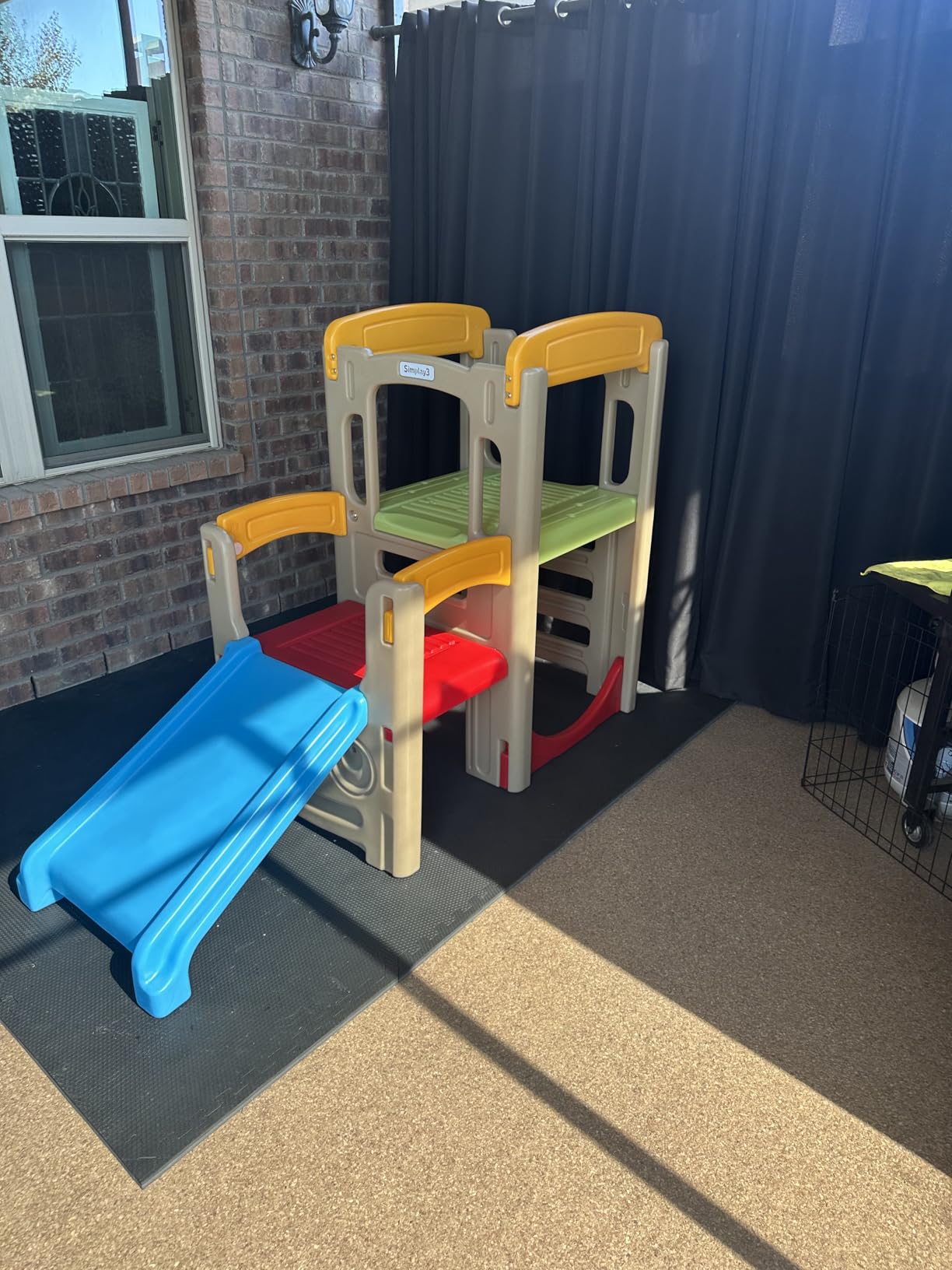
The two-tiered platform is the second route up story. You reach the upper deck by ladder, then step down to a lower tier, and separately you can crawl in at ground level into a fort space underneath with a steering wheel. Reviewers describe the under-deck hide-and-seek zone as the feature their children use most, and parents repeatedly note that the ground-level entry means a 2-year-old and a 6-year-old can play the same structure at the same time without negotiating.
That is the two-route-up principle in miniature, and it is why this one earns the top spot. It is rated for 18 months through 6 years, carries a 180 lb maximum weight, and it is 70 inches long by 28.5 inches wide by 49.5 inches tall. It is also the only structure here that fits through a standard doorframe, so the same piece works in a playroom in February and on the lawn in June.
What tells you it will outlast the toddler years
Weight capacity is the number most listings bury, and it is the number that decides how long a structure stays useful. A 180 lb limit on the Simplay3 means a 6-year-old, a 7-year-old, and eventually two children at once can share it. A limit of 20 kg ends the conversation when the child turns four, which is exactly what happens on the budget picks later in this list.
The double-wall plastic is the second longevity signal. Owners report that it still looks new after heavy use, and that the material resists chipping, fading, and cracking rather than merely delaying it. The rounded child-friendly edges matter too, because that is where plastic climbers injure wrists and knees.
Who should skip it
Skip it if you have more than two children using the structure at once, or if your yard is deep but not wide. At 28.5 inches across, only one or two children fit on the upper platform, and the top becomes a queue. The crawl-through also needs a clear approach in front of the unit, so a wall or fence within a few feet will spoil the best part.
I would also pass if your child is already past 6 and climbing seriously. The manufacturer tops out at 6 years, and although the 180 lb limit suggests headroom, the deck height and hold spacing are scaled for small hands.
2. Step2 Woodland Climber II – Best for Two Routes Up
Step2 Woodland Climber II Kids Playset, Ages 2 –6 Years Old, Toddler Slide and Climbing Wall, Outdoor Playground for Backyard, Sturdy Plastic Frame, Easy Set Up
Ages 24mo-6yr
75 x 47 x 53.75 inch
2 climbing walls
Double-wall plastic
Pros
- Two separate climbing walls give genuine route choice
- Roomy deck with a hideaway underneath
- Earthy colors and textures that blend into a yard
- Double-walled plastic resists chips
- fading
- cracks and peels
- Rinses clean quickly
Cons
- Outdoor use only
- Rated for 2 players so larger groups share the deck
This is the structure I would put in a yard with two children of different ages, and the reason is the two climbing walls. Most plastic climbers at this size offer a ladder and a rock wall, which sounds like two routes and is really one route with a step ladder bolted to the side. This one has two distinct molded walls, and owners with a 3-year-old and a 7-year-old report that both kids climb independently and at the same time.
The included parts list reads like a short manifest: two climbing walls, a platform with base and sides, a slide, two steering wheels, and a ladder. The two steering wheels are a small thing that parents mention more than you would expect, because a structure with two steering positions invites two children to play the same game rather than fighting over it.
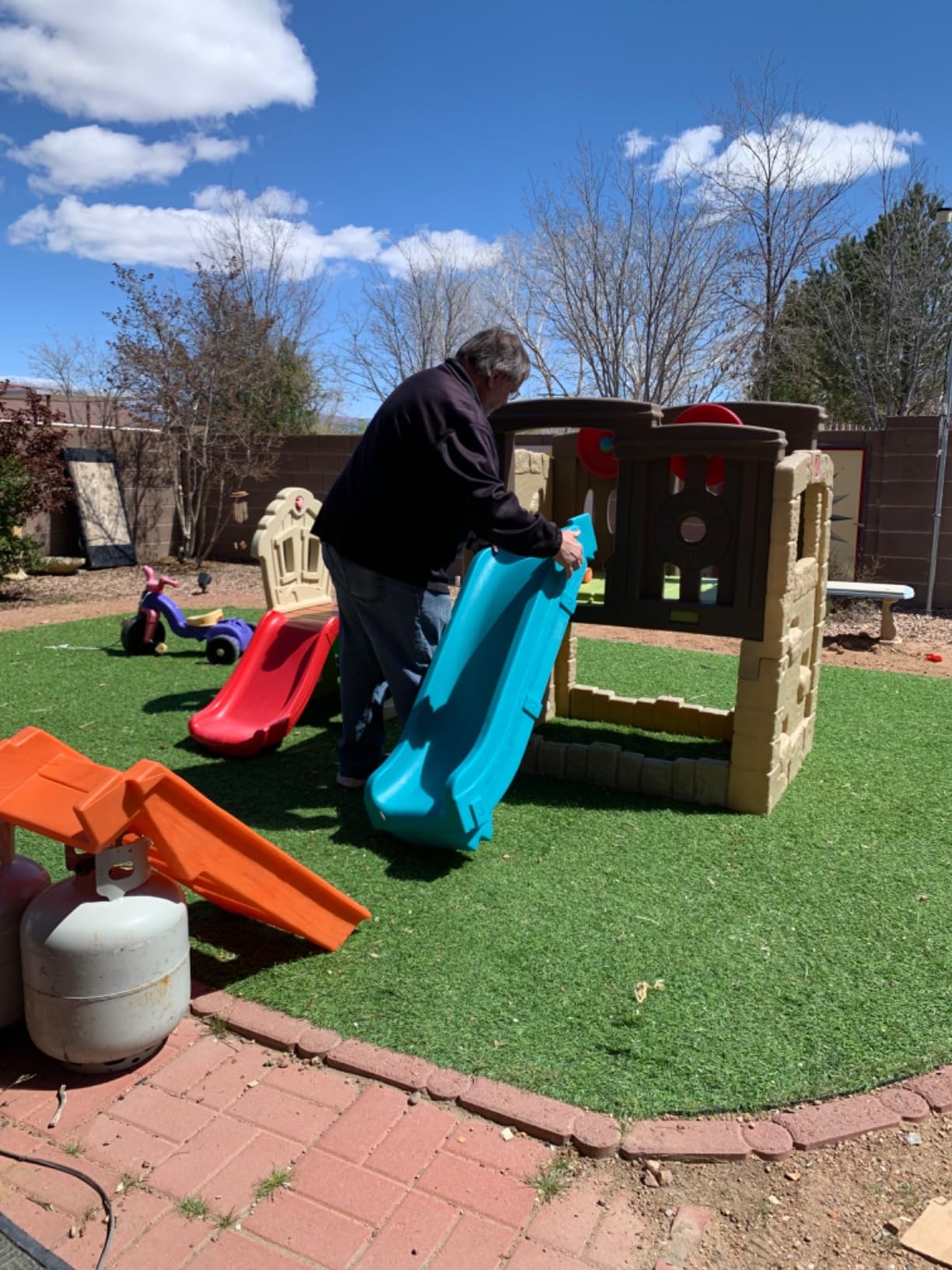
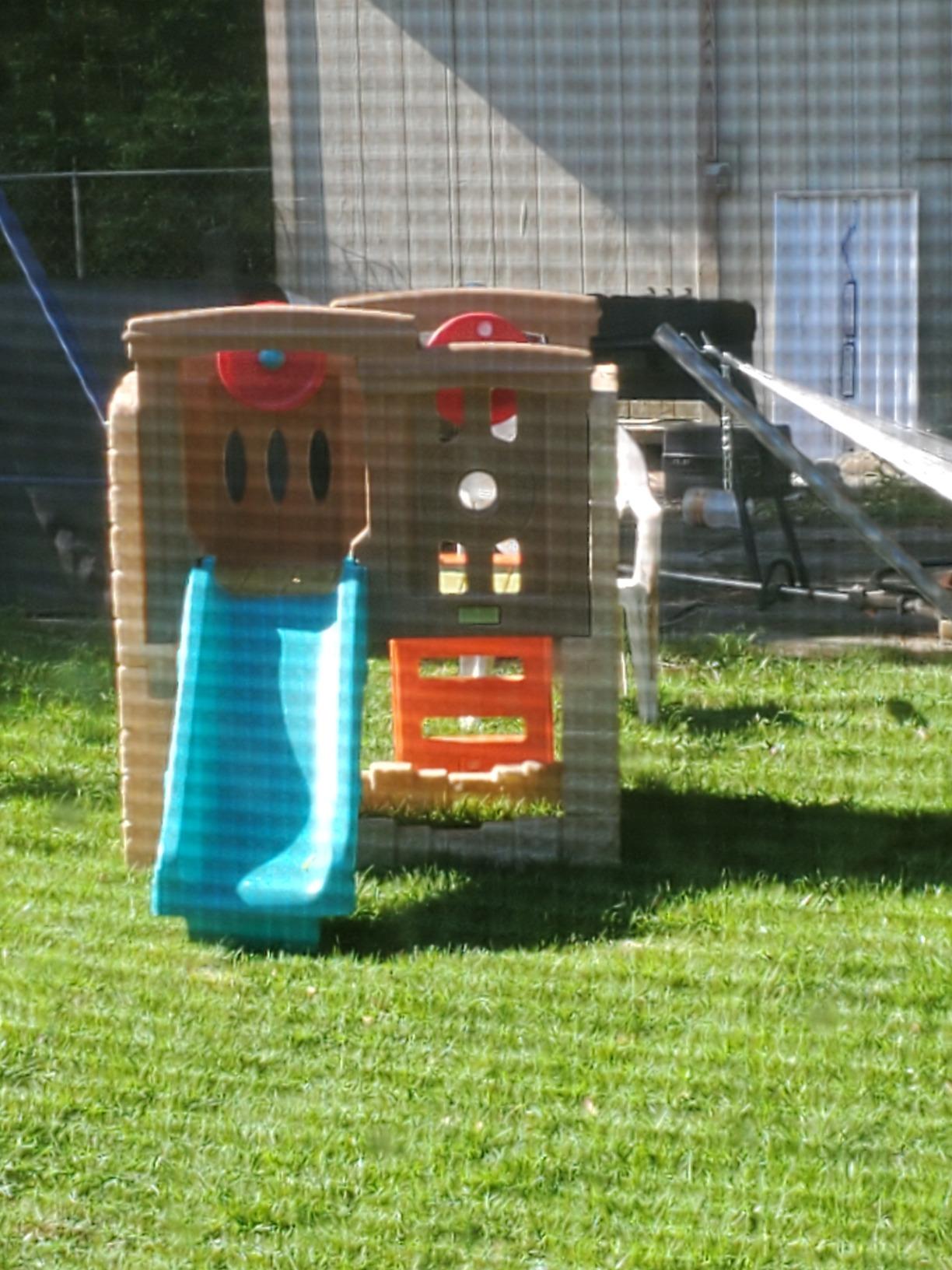
At 75 inches long by 47 inches wide by 53.75 inches tall, it is the largest footprint of the compact plastic options here, and that length is what buys the roomy deck. The under-deck space is a genuine hideaway rather than a crawl gap, and the review summary is unusually consistent about it: owners call out the under-deck hideaway as a fort and toy storage area in the same breath.
It carries a 4.7 rating across 1,453 reviews, sits at number 4 in the Playground Climbers category, and comes with a 3 year limited warranty. The double-walled plastic is specified to resist chips, fading, cracks, and peels, and it rinses clean quickly, which matters more than it sounds in a climate with pollen and dust.
Why the earthy finish matters more than the spec sheet
Most plastic climbers look like playground equipment. This one uses nature-inspired colors and realistic textures, and owners in the review set mention that it blends into a backyard rather than dominating it. If your child uses it as much for pretend play as for climbing, that matters, because the visual design is doing half the work of making the hideaway feel like a real place.
The practical side is the warranty. Three years of limited coverage on a structure rated for ages 24 months through 6 years is a reasonable signal on build quality, and combined with the 2 player rating it sets clear expectations for how many children should be on it at once.
Who should skip it
Skip it if you need indoor use. It is specified for outdoor use only, so it will not work in a playroom or a covered patio in a cold climate. Also skip it if you have three or more children who will use it simultaneously, because the 2 player rating is a real constraint rather than a formality, and the deck gets busy fast.
Finally, measure before you order. At 75 inches long plus the slide run-out, this is the largest of the compact options on the list, and the extra length is exactly what gives you the roomy deck.
3. Step2 Play Ball Fun Climber – Best Value
Step2 Play Ball Fun Climber, Kids Outdoor/Indoor Playset, Backyard Playground Set, Slide, Ladder, Ball Drop Maze, Outside Jungle Gym, For Toddlers 1.5+ Years Old
Ages 18mo-4yr
53.25 x 35.75 x 38.25 inch
20 kg max weight
10 balls included
Pros
- Slide
- ladder
- platform and a ball drop wall in one compact piece
- 1897 reviews is the largest pool here after the top pick
- Under-slide space works as a hideout
- Ball pit side doubles as a water table
- Light enough to move between rooms and lawn
Cons
- Assembly is fiddly with no pre-drilled holes
- Black and white instructions are hard to follow
- Young children can climb around the sides unsupervised
At 1,897 reviews this has the second-largest review base in the group, and the sentiment is unusually clean: 82 percent five star, 11 percent four star. When a product that size is bought mostly for grandparents and as a first play structure, that distribution tells you it does one thing very reliably rather than several things adequately.
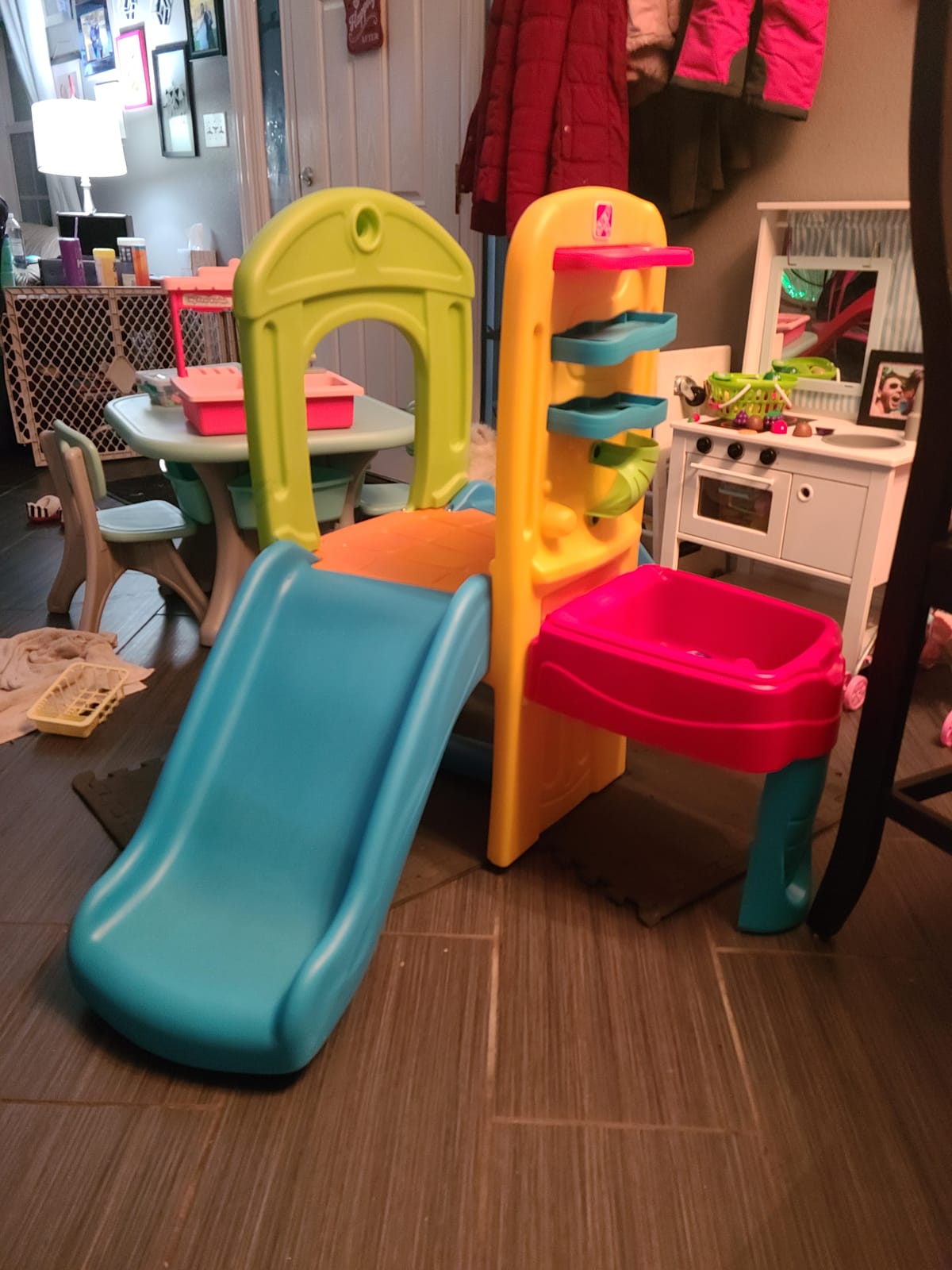
The thing it does is slide, climb, and drop. The ball drop wall ships with 10 balls, and there is a rubber stopper for optional water table use, so the same panel changes jobs depending on the season. The space under the slide works as a hideout, and the slide itself has a deep run, which is the specific thing parents praise. A short slide makes toddlers cautious, and this one does not.
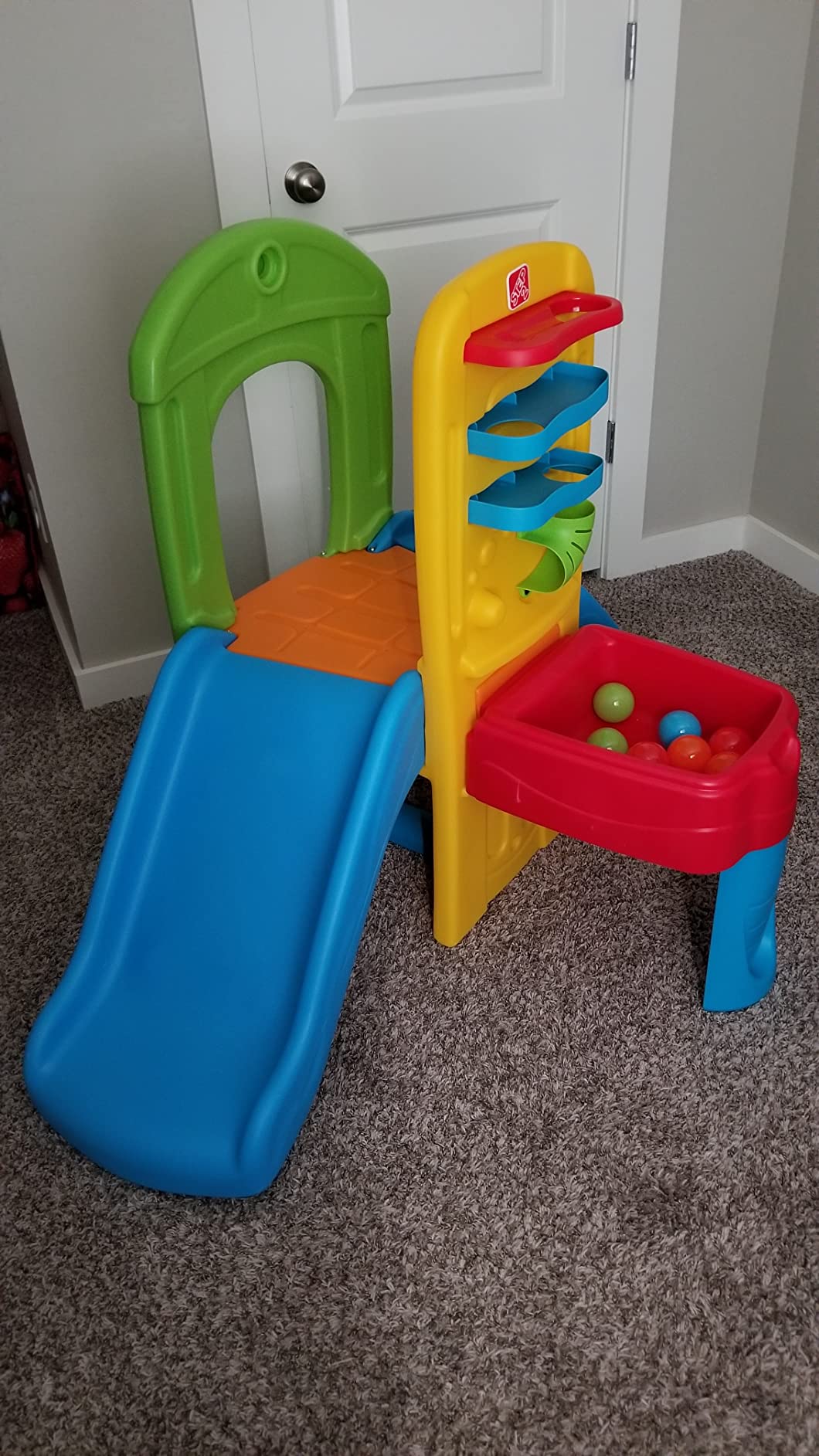
At 53.25 inches long by 35.75 inches wide by 38.25 inches tall and 26.2 pounds, it is the easiest to reposition of anything on the list. Parents move it from carpet to lawn and back, which extends the usable months of the year considerably if you live somewhere with a hard winter.
Two things to hold in mind before you commit. The manufacturer age range is 18 months through 4 years, and the maximum weight recommendation is 20 kg. That is a genuine ceiling, and it is the main reason this one is not higher on the list despite the rating. It also has a documented tendency to slide across smooth floors when in use.
How to handle the assembly complaint
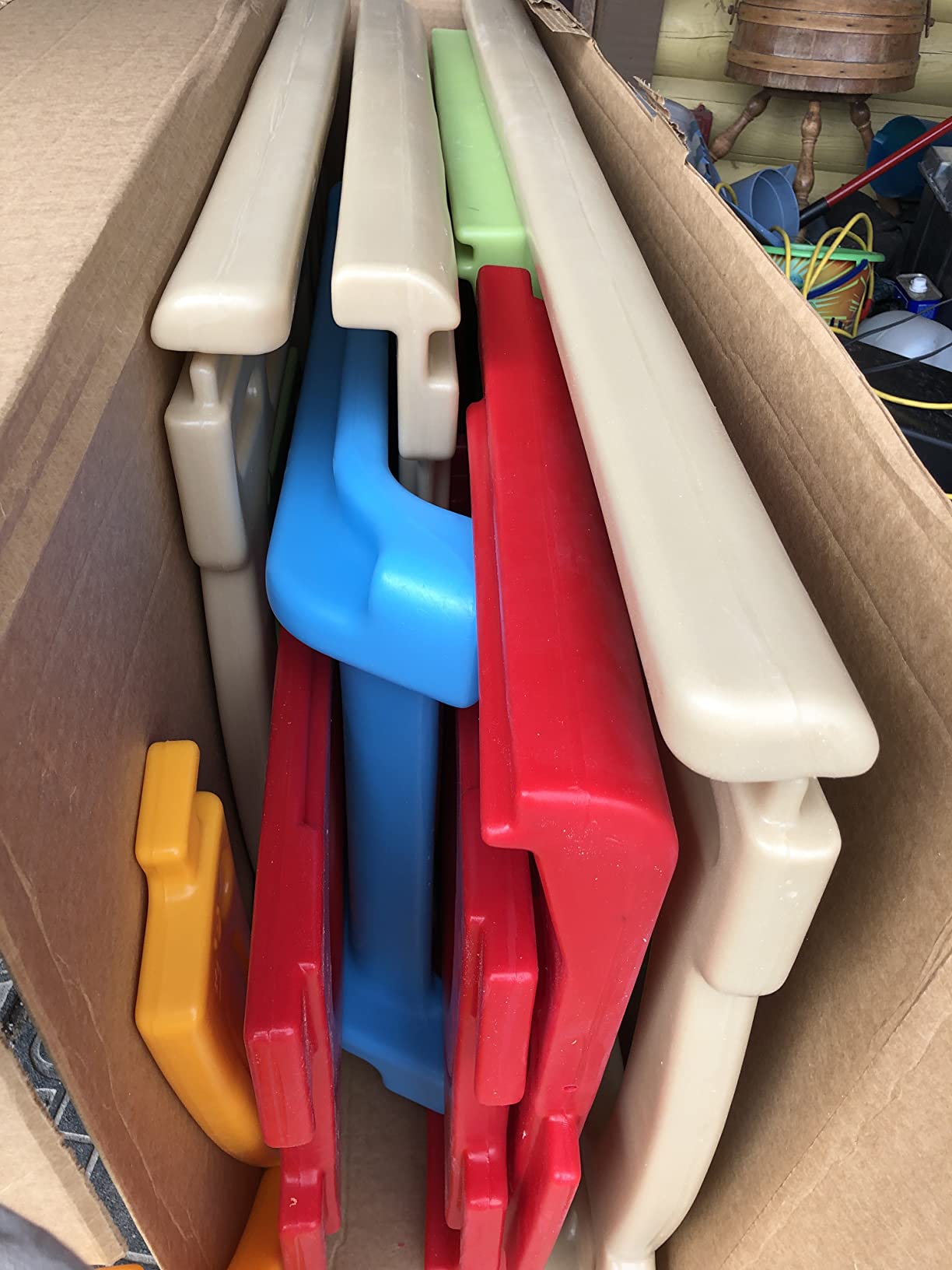
Assembly is the dominant negative in the reviews, and it is consistent enough to plan around. The complaint is not weight or complexity. It is that there are no pre-drilled holes, the instructions are black and white, and the screws need real force. Nearly every owner describes it as a two-adult job with a power driver.
Budget an hour and a half with two adults rather than the quick-build expectation the packaging implies. If you can drill pilot holes yourself before assembly, the job gets dramatically easier, and that single step is the difference between an hour and an evening.
Who should skip it
Skip it if you have a child 5 or older. A 20 kg limit and an age range topping out at 4 mean this is a structure your family will outgrow while the hardware is still perfectly good, which makes it a short-term investment by design. I would also pass if you need something rated for multiple children of mixed sizes at once.
One more caution from the reviews: young children can climb around the sides of this unit rather than using the intended routes, so it needs close supervision. That is normal for the age band and not a defect, but it should shape where you put it.
4. Simplay3 Young Explorers Modular Play System – Best for Modular Layouts
Simplay3 Young Explorers Modular Play System, Kids Activity Outdoor Playset for Children Age 18 mos – 6yrs, Toddler Playground Slide, Climb and Playhouse
Ages 18mo-6yr
139 x 82 x 51 inch
3 modules
12 configurations
Pros
- Three modules combine into a full playground with a real enclosed playhouse
- Attachable in 12 different configurations to fit smaller yards
- Doubles as indoor play equipment
- Climbing ramps
- tunnels
- kitchenette
- easel and double doors
- Rated for 9 players
Cons
- Assembly takes a couple of hours even with two adults
- Some buyers reported individual pieces breaking after use
This is the only true playhouse in the group, and the reason is the second module. The system combines an Adventure Climber, a Discovery Playhouse, and an Activity Climber, so you get a genuine enclosed house with double doors, plus the climbing and slide elements on either side of it. Everything else on this list is a climber styled as a playhouse. This one is the reverse.
The modularity is the real feature. It attaches in 12 different configurations, and because the same double-wall plastic works indoors or outdoors, you can pull it into a playroom for winter and rebuild it outside for summer. For a family in an apartment or a house with no usable yard, that is the argument for owning this rather than a compact plastic climber.

At 139 by 82 by 51 inches and 128 pounds, this is by far the largest and heaviest option here, and the floor space it demands is the real cost of that versatility. It is rated for 9 players, and the feature list is long: climbing ramps, ladders, a crawling tunnel, steering wheels, a kitchenette, an easel, and double doors. Owners consistently rate the build quality and the breadth of play features as the strengths.
I want to be straight about the weakness of this pick. It has 107 reviews, the smallest pool on the list, and a 4.4 rating that is the lowest of the six even though it remains solidly positive. The most common criticisms are assembly time, the high relative cost, and pieces breaking after use, and those last reports are not a small minority in the text.

When modular beats a single fixed structure
The case for this one is narrow and specific. If you have a family room or finished basement with enough clear floor, or a yard where you genuinely want three separate play zones rather than one combined structure, the reconfigurability earns its keep. You can start with the playhouse and a climber and add the third module later, or arrange all three in a line, an L, or a compact cluster.
It is also the right answer when the two children are far apart in age, because the modules spread the play out. A toddler can work in the kitchenette and easel at ground level while an older child climbs at the other end, which is a harder problem to solve on a single deck.
Who should skip it
Skip it for a small yard, a patio, or any space under about 12 by 8 feet of clear ground once you allow for the slide run-out. Skip it if assembly day is going to be one person. Parents report a couple of hours even with two adults, and that is before you account for the 128 pound shipping weight.
Also weigh the scale honestly. Owners note the system is sized best for ages 3 to 4, and that older children outgrow the deck and the slide openings sooner than the 6 year upper age suggests. Treat the 6-year rating as a stretch goal, not a planning assumption.
5. Little Tikes Hide and Seek Climber and Swing – Best for Small Spaces
Little Tikes Hide & Seek Climber and Swing, Indoor Outdoor with Slide – Easy Set Up – Toddler Playset, 53.50”L x 52.00”W x 41.00”H
Ages 12mo-3yr
51.91 x 53.52 x 41 inch
Slide, swing, rock wall
40.8 kg max weight
Pros
- Four play zones in one 53 inch footprint
- Assembles in minutes with no tools
- Three-point safety belt on the swing
- Light at 36 pounds so it moves easily between rooms
- Works on carpet or hard flooring indoors
Cons
- Small slide deck that a child can slip backwards on
- The whole structure slides around during use
- Swing is low to the ground and cannot be raised or removed
This is the only structure here with a swing, and the swing changes the footprint math in a way that catches people out. Four play zones in a 51.91 inch by 53.52 inch space is genuinely impressive density, and 1,064 reviews at 4.6 stars reflects how well it performs inside that space. The swing seat hangs just 8 inches off the ground, which is why the whole footprint is a square rather than a long rectangle.
The stated numbers are unusually transparent, which I appreciate. Slide height from ground to the top of the slide is 19.75 inches, platform height is 18 inches, the climbing wall is 12.50 inches, and the manufacturer age range is 12 months through 3 years. Maximum weight is listed at 40.8 kg. Those numbers tell you everything about whether this fits your child.
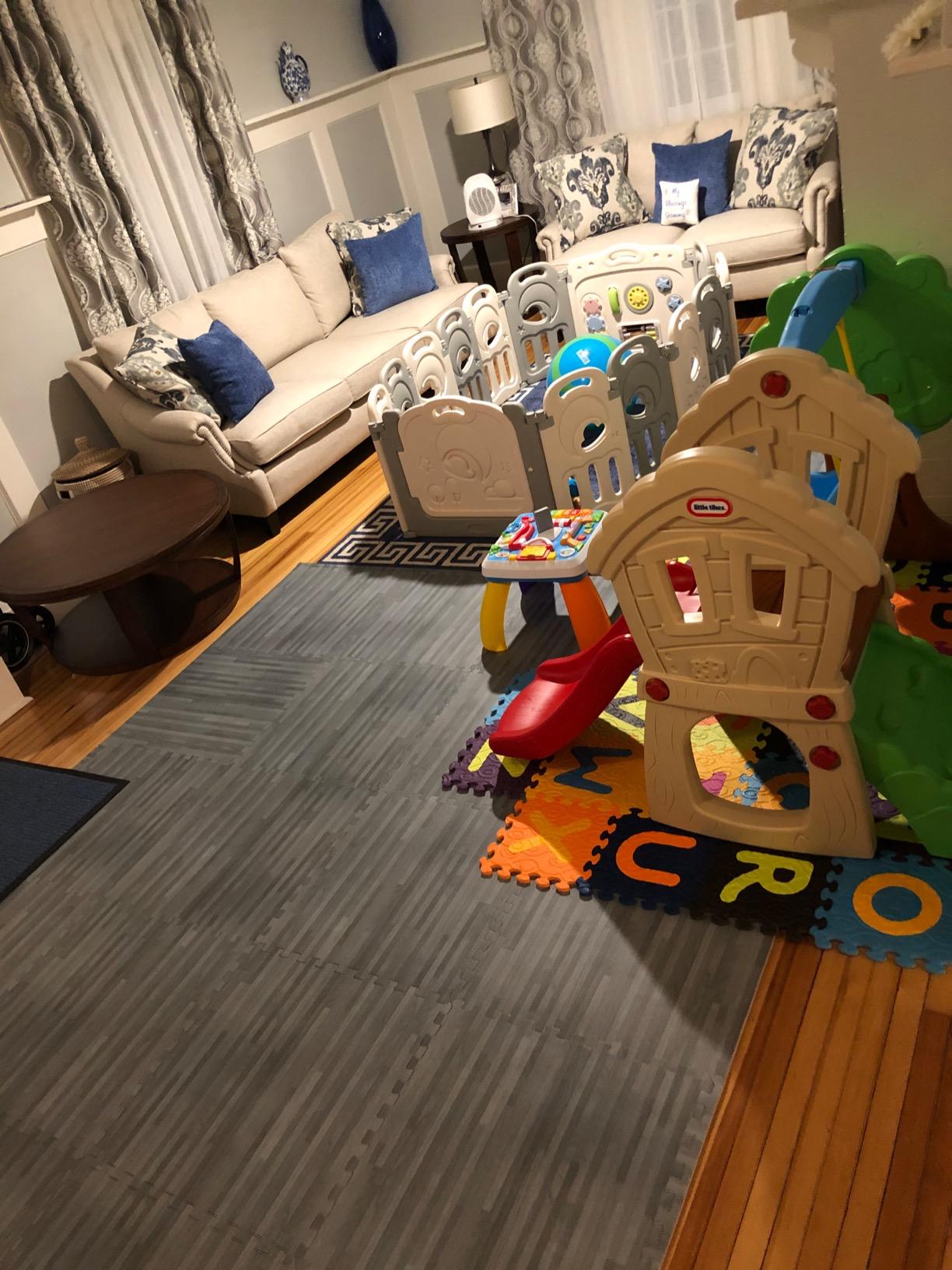
The rock-climbing wall at 12.50 inches is the part to look at hardest. It is a beginner’s wall, appropriate for a child learning to coordinate hands and feet, and it is one of the very few genuine climbing elements on this list that a 2-year-old can manage. That is a real distinction, because most molded rock walls on plastic climbers are unusable below age 3.
Assembly is the quiet strength. No tools required, and owners describe it as minutes rather than hours. The warranty is 90 days against manufacturer defects, which is the shortest on the list by a wide margin, so the build quality has to earn its keep on reviews instead.

What the four play zones really cost you
Fit is the argument. At just over 51 inches square, this packs four play zones into a near-square footprint that leaves room around it for a lawn, and parents with small yards or apartment patios report that compact climbers under about 5 feet are the only ones that actually fit and stay in use. At 36 pounds it is light enough to lift and reposition without help, which matters most on hard flooring.
The trade is stability. Recurring complaints name the small slide deck, the structure sliding around during use, and the fixed low swing that cannot be detached or raised out of the way. On hard floors the sliding is worse, so this belongs on carpet or lawn rather than a smooth patio.
Who should skip it
Skip it if you want a playhouse. There is no enclosed pretend-play space here. Skip it if your child is past 3 or past 40.8 kg, because the age range and the weight limit end together. The swing is also a reported weak point, with some owners describing it collapsing under heavier children, so if your 3-year-old is on the tall side, supervise closely.
And skip it if you need a climbing challenge. A 12.50 inch wall is an introduction to climbing, not a challenge, and a child who has outgrown the unit will not find a reason to stay on it.
6. Step2 Play Naturally Playful Lookout Treehouse – Best for Toddlers 1.5 to 5
Step2 Play Naturally Playful Lookout Treehouse, Kids Outdoor Playset, Backyard Playground Set, Slide, Ladder, Pivoting Periscope, Outside Jungle Gym, For Toddlers 1.5+ Years Old
Ages 18mo-5yr
66.5 x 25 x 57.5 inch
66 lb max weight
Pivoting periscope
Pros
- Treehouse styling with a pivoting periscope gives a real playhouse look
- Easy entry steps with sure-grip rails suit beginners
- Space underneath works for storage or hide-and-seek
- Double-wall plastic resists chipping
- fading and cracking
- 3 year limited warranty
Cons
- Narrow 25 inch depth limits the space inside the clubhouse
- Treehouse styling is decorative rather than an enclosed cabin
The distinguishing feature here is the pivoting periscope, and I would not dismiss it as a gimmick. It is the one part of this structure that is not functional climbing or sliding, and in practice it is what makes the top deck feel like a lookout rather than a platform. Owners mention it more often than any other single detail, alongside the treehouse look itself.
For a toddler, the climbing access is the real design work. The manufacturer recommends 18 months through 5 years, and the easy entry steps with sure-grip rails are the reason that range is credible rather than optimistic. A 2-year-old can get up on their own, which is the whole point at this age.
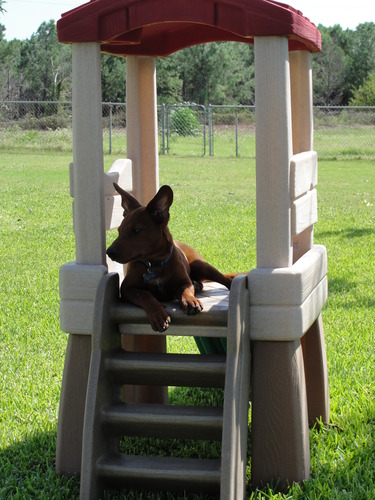
Maximum weight is listed at 66 pounds, and the unit itself weighs 30 pounds. The dimensions are 66.5 inches long by 25 inches wide by 57.5 inches tall, and that 25 inch width is the single most important number to check before you order. It is a corridor, not a room. One child fits comfortably, two is tight.
Because it is only 25 inches deep, it also has the smallest visual footprint on the list in one direction, which makes it attractive against a fence line. The space underneath works as toy storage or a hide-and-seek spot, and the double-wall plastic holds up as well as anything else in this price tier.
How to decide if 25 inches is enough
Measure the deck against your child rather than the room. A 25 inch width accommodates a single preschooler sitting, or one child climbing while another waits at the bottom. If you are buying for one child aged 2 to 4, that is fine and the play value is high. If you are buying for two children who will fight over the top, it is not.
The height of 57.5 inches is also worth noting. It is the tallest of the compact options here, and while the manufacturer rating stops at 5 years, tall 5-year-olds will be near the top of the age range sooner than short 5-year-olds.
Who should skip it
Skip it if you want pretend play inside a space. The treehouse styling is decorative. There is no enclosed cabin, no door to close, and no kitchen. It is an open-frame climber that looks like a treehouse, and the reviews are honest about that distinction.
Also skip it if you have children spaced more than about two years apart. A 66 lb weight limit and a 5 year ceiling mean the second child inherits a structure that is already at the end of its useful life.
Buying Guide: Nine Things That Decide It
Match the age range to the deck height, not the label
Every manufacturer prints an age range and most of them are honest, but they are nearly useless on their own. The number that governs whether a child can use a climbing playhouse with a slide is deck height, because it determines the step a child has to clear to get up.
Under about 20 inches, a child can manage independently from roughly 18 months. Between 20 and 36 inches, expect to lift or assist a 2-year-old. Above 36 inches, the ladder becomes a two-person operation for anyone under 4. The Little Tikes platform at 18 inches with its 12.50 inch beginner rock wall, and the Step2 treehouse with its easy entry steps and sure-grip rails, are the two genuinely toddler-usable climbing elements here, and that is not a coincidence.
One declarative safety note, because it is the one most listings bury: molded rock walls with holds spaced for adult grip are not for children under 3. A 2-year-old can manage a low beginner wall with a continuous rail, not a vertical climbing wall. If you buy a structure with a proper rock wall and a toddler, the wall is not the toy yet.
Count the routes up, not the features
This is the single decision that determines whether one structure serves siblings of different ages, and no competitor roundup states it plainly. Count the number of genuinely independent ways to reach the deck or the top of a module.
A ladder and a rock wall count as two. A climber and a crawl-through count as two. A ladder and a slide do not count, because both go in the same direction. When you have two children and only one route, the younger child blocks the older one, and within a few months the older child finds something else to do. Owners describe this failure mode more than any other, and it is what ends play early regardless of build quality.
The weight limit is the longevity number
Read the maximum weight recommendation before the price, and treat it as the best proxy for how long the structure will be in use. A 20 kg ceiling ends play at age 4. A 66 lb ceiling ends it around 5 or 6. A 180 lb ceiling carries a structure into the school-age years and lets two children share it.
Four of the six here publish a limit at all, which tells you how inconsistently this category handles the one number that predicts longevity. On the ones that do publish it, the range runs from 20 kg to 180 lb, and that single spread explains most of the difference in how long these structures stay in use.
Measure the fall zone before you measure the playset
This is the mistake almost everyone makes, and it is the single largest gap in every roundup we read. The published footprint is the structure itself. What you need on the ground is the footprint plus a clear run-out.
Plan for at least 6 feet of clear space beyond the slide exit, measured in the direction of travel, with nothing hard in that path. A fence, a patio edge, a planter, or a swing set leg landing there converts a slide into an injury. For a wave or tube slide, or any structure where a child will exit at speed, 8 to 10 feet is safer.
Then think about surfacing under the exit. Grass is acceptable if it is level and mown. Mulch, engineered wood fibre, or rubber surfacing tiles are better, and the review data suggests rubber mulch and loose-fill both work, with the deciding factor being that the surface must be maintained and replenished. Never put a slide exit on concrete.
For more on sizing the slide itself rather than the whole structure, our guide to the best backyard slides breaks down the buffer zone and surfacing question in more detail.
Wood or plastic: what actually lasts
Every product in this group is double-wall or rotational-molded plastic, and that is worth saying plainly. It is not a compromise in this price band. It is the category standard, it survives a full-sun backyard without annual sealing, and it will not split on assembly.
The trade is appearance and long-term stiffness. Cedar playhouses look better, take a stain, and last longer in absolute terms, but owners consistently describe the annual sealing as a genuine chore they sometimes skip and then regret. Plastic asks nothing of you beyond a rinse, and the specification language on all six products claims resistance to chipping, fading, cracking, and peeling rather than just weathering.
The real plastic failure mode is not UV fade. It is impact cracking at the base of a climbing wall, where a hard landing with a shoe concentrates the force. That is what the double-wall construction is defending against, and it is why we weighted products with two walls over single-wall imitations.
Assembly staffing and honest time
Parent-reported times for this category run from about 90 minutes to a full day, and the manufacturer estimate is consistently optimistic. These are the realistic figures.
Tool-free plastic under 40 inches, one adult, 20 to 30 minutes. The Little Tikes is the only product here that genuinely fits this description.
Compact plastic climber with un-pre-drilled holes, two adults and a power driver, 60 to 90 minutes. The Step2 Play Ball Fun Climber is the clearest example.
Larger plastic climber with two climbing walls, two adults and a power driver, 2 to 3 hours. Budget more than you think for the Step2 Woodland Climber II.
Three-module modular system, two adults minimum, 2 to 4 hours. The Simplay3 Modular Play System at 128 pounds is not a one-person job by any reading.
Drilling your own pilot holes before assembly is the single highest-leverage thing you can do on any plastic model, and it is the most common complaint in the review sets. Cedar splits without them; plastic screws strip without them.
Anchoring and wind
Yes, anchor it. This comes up constantly in parent forums and it is missing from most roundups, but a tall plastic climber with a broad top surface acts like a sail. The models on this list are lightweight by design, which is convenient for moving and terrible in a gust.
For a compact unit, drive ground anchors at two corners or weigh the base with pavers at the swing end. For the modular system, anchor each separate module. Do this before anyone uses it, not after the first bad storm.
Position matters as much as hardware. A structure sitting in an open lawn catches wind from every side. The same structure tucked against a fence on the leeward side of the house is dramatically more stable, and the fence doubles as a boundary for the run-out.
Build versus buy
Building one is cheaper in parts and almost never cheaper in time once you count tools, lumber, a weekend of building, and the fact that you now own a structure whose safety you are personally responsible for. Parents on forums who have built their own tend to say the same thing: the build is fun once, and every repair afterward is on you.
Buying is more expensive upfront and gives you a specified age range, a stated weight limit, a warranty, and a tested slide geometry. For a structure a child will climb on, those four things are worth paying for. Build it yourself if you enjoy the work and your child is under 3 with no slide requirement. Buy it if a slide and a climb are the point.
Total cost of ownership over five years
Plastic asks for nothing beyond cleaning, and the two Simplay3 products are specified as weather and UV resistant, which means no seasonal treatment. The Step2 models carry 3 year limited warranties, and the Little Tikes carries 90 days, so warranty length is one honest signal of expected lifespan even though it is rarely a promise of service.
Budget for a replacement, not an upgrade, if your child is your last likely user of this category. The structures that survive longest are the ones with a weight limit above 100 lb, because they absorb a second and third child without modification. Everything else is a five-year tool at best, and often closer to three.
For the slide component specifically, comparing against our best playground slides for backyards is worthwhile if you already own a structure and only need to replace or add the slide.
Frequently Asked Questions
What age is a play house with slides suitable?
Most climbing playhouses with a slide suit children from 18 months to 6 years, with larger cedar and modular systems reaching further. The real limit is deck height, not the printed label. A platform under 20 inches works for a child from about 18 months, 20 to 36 inches needs a lift for a 2-year-old, and above 36 inches the ladder becomes a two-person job. Check the stated platform height before you buy.
What is the best slide and climber for a toddler?
For a toddler, look for a low platform around 18 inches, a climbing wall with a continuous grip rail rather than spaced holds, and a slide with a deep run and side rails. The Little Tikes Hide and Seek Climber has an 18 inch platform and a 12.50 inch beginner rock wall, and the Step2 Play Ball Fun Climber has easy entry steps with sure-grip rails. Avoid molded rock walls with adult-spaced holds below age 3.
What is the best climbing frame for an older child?
For children 6 and up, weight capacity matters more than any other spec, because a low limit ends play at age 4 or 5. Look for a structure rated at 100 pounds or more and built with double-wall plastic rather than single-wall. The Simplay3 Young Explorers Adventure Climber is rated to 180 pounds and is the strongest option here for school-age children, though its manufacturer age range stops at 6 years.
What are the most durable playhouses?
In this price band, durability comes from double-wall or rotational-molded plastic rather than wood. All six structures reviewed use double-wall plastic, which resists chipping, fading, cracking, and peeling, and needs no annual sealing. Cedar lasts longer in absolute terms but requires re-staining each year. Check the warranty length as a quality signal: three years on the Step2 models versus 90 days on the Little Tikes unit.
How much space does a playhouse with a slide need?
Plan for the published footprint plus at least 6 feet of clear run-out beyond the slide exit in the direction of travel, and 8 to 10 feet for a wave or tube slide. Keep the slide exit away from fences, patio edges, and hard surfaces, and lay mulch, wood fibre, or rubber tiles under the exit zone.
Is it cheaper to build or buy a playset?
Building is cheaper in parts but rarely cheaper in time once you count tools, lumber, and a weekend of building, and you become responsible for its safety. Buying costs more upfront and gives you a stated age range, weight limit, warranty, and tested slide geometry. For a structure your child will actually climb, those specifications are usually worth the cost. Build your own only if the child is under 3 and a slide is not required.
The Verdict for 2026
The best climbing playhouses with slides are not the ones with the longest feature list. They are the ones with two ways up, a weight limit that outlasts the toddler years, and enough clear ground behind the slide to land safely in.
Take the Simplay3 Young Explorers Adventure Climber and Slide if you want one structure that works from 18 months to 6 and carries a 180 lb limit. It has the widest slide, the highest rating across the largest review pool on the list, and a crawl-through fort that keeps a toddler busy while an older child climbs. Take the Step2 Woodland Climber II if you have two children of different ages and need two real climbing walls, a roomier deck, and a hideaway underneath. Take the Step2 Play Ball Fun Climber if you want the highest-value route to a first play structure and can accept a two-adult assembly and a 4 year ceiling.
Go bigger with the Simplay3 Modular Play System only if you have genuine space and a genuine need for pretend play inside an enclosed house. Go smaller with the Little Tikes Hide and Seek Climber and Swing if your yard is tight or you are starting at 12 months, and accept that you are buying three years. Go narrow with the Step2 Play Naturally Playful Lookout Treehouse if one child ages 2 to 5 and you want a real climbing step and a periscope, with no expectation of indoor play space.
Before any of them goes in the ground, measure the run-out, anchor the base, and count your routes up twice. That last one is what decides whether the structure is still fun in four years.
If your child is already past the age these structures serve, the next step is a proper climbing programme rather than a bigger plastic set, and our guide to climbing harnesses for sport climbing covers where that transition usually starts.