
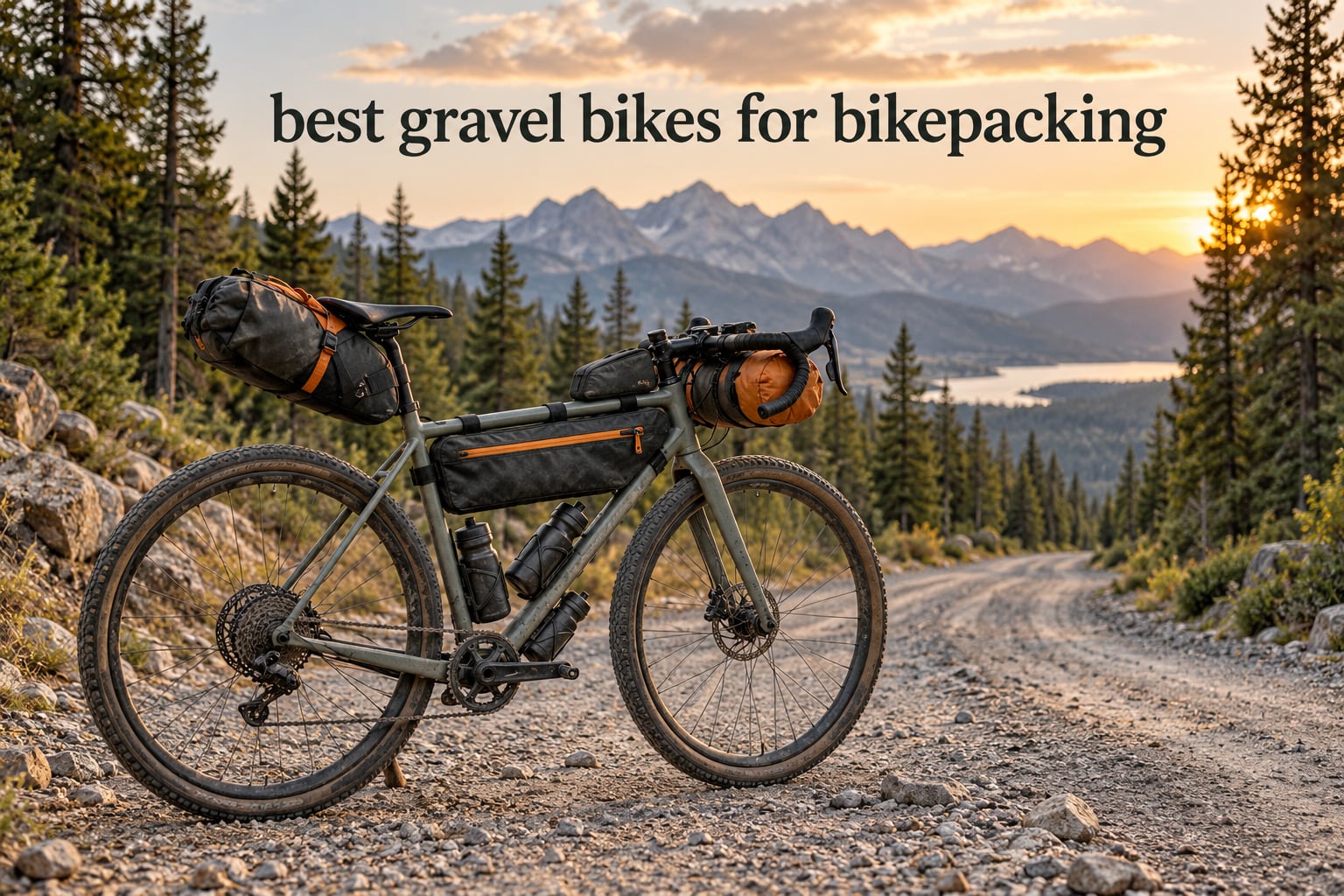
Yes, gravel bikes are good for bikepacking. They carry a sleeping bag, shelter, cooking kit and clothes in soft bags while rolling fast on the paved connector miles that make up most of a bikepacking route. What separates a good one from a bad purchase is tire clearance, mounting points, gearing under load and how much weight you end up hauling.
That is the filter we used to pick the best gravel bikes for bikepacking in this roundup. Every bike below ships with drop bars, 700c wheels and disc brakes, so all seven can carry gear. Beyond that, they differ a lot: two are alloy with lifetime frame warranties, five are carbon, drivetrains run from a 21-speed Tourney set to a GRX820 12-speed, and complete bike weights range from 8.7 kg to 10.4 kg.
We spent weeks reading spec sheets, rider reviews and forum threads on loaded riding, then cross-checked every figure against the manufacturer data. Where a spec was not published, we say so rather than guess. We also flag the bikes that cannot take a rear rack, cannot run wider tires, or arrive with an integrated handlebar that limits how you can fit a handlebar roll.
If you are still deciding between bike types, our gravel bikes for adventure riding guide covers the lighter-load side of the sport. This page is only about carrying camping gear for multiple days.
Table of Contents
Top 3 Gravel Bikes for Bikepacking in 2026

SAVADECK Carbon GRX400 20-Speed
- T800 carbon frame and fork
- Shimano GRX400 2x10
- Shimano RX400 hydraulic discs
- 10.4 kg complete bike
Tommaso Sentiero Sport
- Aluminum frame with lifetime warranty
- Shimano Claris 24-speed
- Disc brakes
- 700x40c tires
Tommaso Siena Sport
- Complete gravel bike for less
- Shimano Tourney 21-speed
- Avid BB5 mechanical discs
- Lifetime frame warranty
Our number one pick is the SAVADECK GRX400. It is the only bike here that pairs a carbon frame with hydraulic disc brakes and a two-by-ten wide-range drivetrain at 10.4 kg, which is exactly the combination a loaded rider wants: enough low gearing for a wall with 15 kg of bags on the bars and lever power you can modulate with one finger on a long descent.
The Tommaso Sentiero takes the value slot because it has the largest body of owner feedback in this group at 69 reviews and a lifetime frame warranty, which matters when you are planning to bolt racks and frame bags onto the bike. The Tommaso Siena is the entry-level route into gravel and shares that same lifetime frame coverage.
Best Gravel Bikes for Bikepacking (October 2026)
| Product | Specifications | Action |
|---|---|---|
| SAVADECK Carbon GRX400 20-Speed |
|
Check Latest Price |
| Tommaso Sentiero Sport |
|
Check Latest Price |
| Tommaso Siena Sport |
|
Check Latest Price |
 KABON T800 Carbon Sora 18-Speed KABON T800 Carbon Sora 18-Speed |
|
Check Latest Price |
 SAVADECK T800 Carbon GRX610 12-Speed SAVADECK T800 Carbon GRX610 12-Speed |
|
Check Latest Price |
 SAVADECK Gelaro S8 GRX820 SAVADECK Gelaro S8 GRX820 |
|
Check Latest Price |
 KABON T800 Carbon 105 R7000 22-Speed KABON T800 Carbon 105 R7000 22-Speed |
|
Check Latest Price |
Two columns matter more than anything else when you filter this table. The first is weight, because the bare bike is only half of what you lift. Add a frame bag, seat pack, handlebar roll and a sleep system and you are regularly walking around 20 kg of rig, and that extra mass sits high and behind you.
The second is drivetrain type. The two-by-ten and two-by-eleven bikes here give you a gear for every climb plus a chainring small enough to pedal into a headwind loaded. The one-by-twelve GRX bikes trade that away for a single ring and a much larger cassette range, which means one less thing to think about when your hands are on the bars and your bags are full.
1. SAVADECK Carbon GRX400 20-Speed – Best Overall
SAVADECK Carbon Gravel Bike – T800 Carbon Frame & Fork, Shimano GRX400 20-Speed Groupset, Hydraulic Disc Brakes, 700C x 40mm Tires – Lightweight Design for Road & Off-Road Adventures(Black,51cm)
T800 carbon frame and fork
Shimano GRX400 2x10
GRX400 hydraulic discs
10.4 kg
700x40c tires
Pros
- Only carbon bike here with hydraulic brakes and a double ring
- 10.4 kg keeps the loaded rig manageable
- 2x10 range covers loaded climbs without a bailout wheel
- 45-spoke rims add durability
Cons
- Rear derailleur needed adjustment out of the box
- Assembly instructions are not included
- Gearing cables needed fine tuning after setup
This is the bike I would load up and point at a two-week trip. The frame and fork are both T800 carbon with internal cable routing and a tapered head tube, and the complete bike weighs 10.4 kg. Riders describe the geometry as upright, which is what you want when a seat pack is strapped behind you and you are spending eight hours a day in the saddle.
The drivetrain is the real reason it wins. A Shimano GRX400 two-by-ten with RX400 hydraulic disc brakes gives you a 2×10 gear spread that is genuinely low at the bottom, and hydraulics give one-finger stopping with the same pressure all the way down a long loaded descent. Mechanical discs on several cheaper bikes here need a stronger squeeze and fade more on repeated stops with a full load.
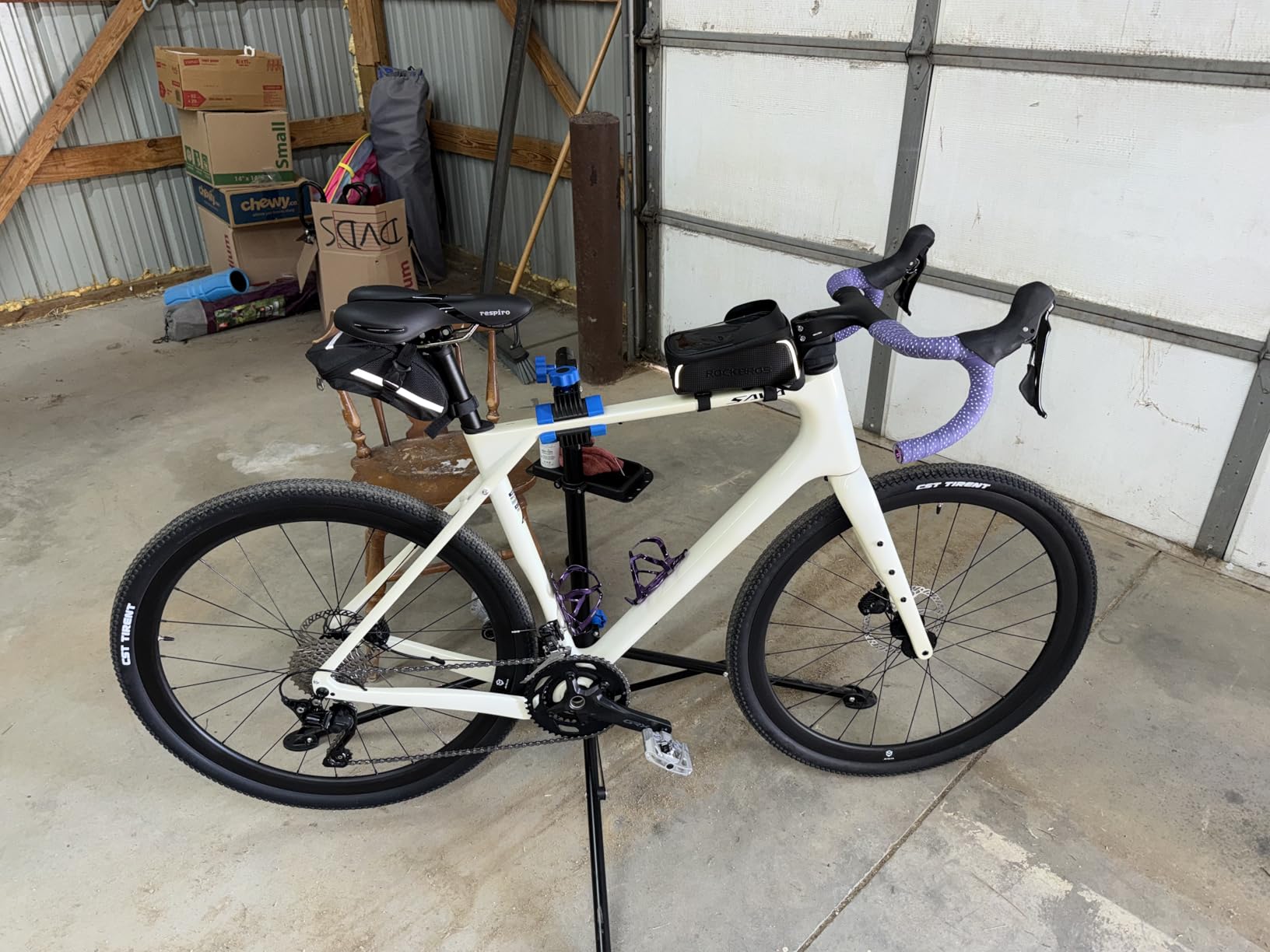
Riders consistently describe smooth shifting and confident braking once dialled in. They also mention the same small frictions: the rear derailleur wants adjusting before the first ride, the gear cables need fine tuning, and no written assembly instructions come in the box. Plan on an hour at a shop or an hour on your own with YouTube open.
What it cannot do is take very wide tires. It ships on 700x40c, and the fork and frame are built around that width. If your route turns to sustained singletrack and you are planning on 50mm-plus rubber, this is not the bike to build a rig around.
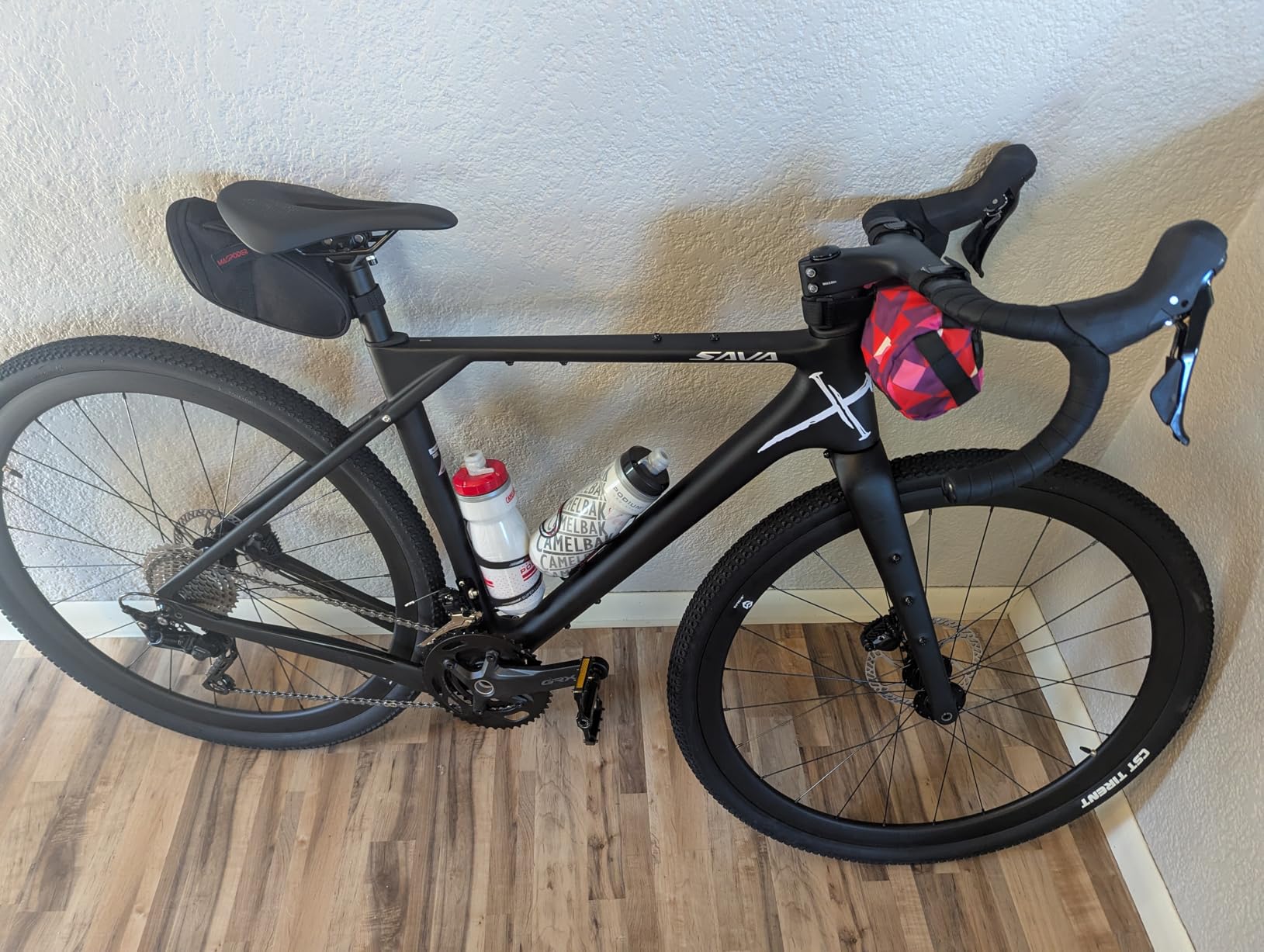
What a loaded GRX400 actually carries well
The frame has internal routing and a tapered head tube, which gives you clean boss locations to work with rather than cables crossing the top tube. A handlebar roll and a top tube bag fit without fouling the shifting cables, and the tapered head tube leaves room for a fork-mounted load if you want to move weight forward.
At 10.4 kg empty, adding a typical soft-bag kit brings the bike alone to roughly 13 kg. Riders running this bike loaded describe it as steady rather than nervous, with no front-to-rear wobble on rough surfaces.
Where it falls short for bikepacking
With 29 reviews, it has more owner history than most carbon bikes in this group but fewer than the Tommaso alloy frames, which carry 69 and 53 reviews. That is worth factoring in if you want proven long-term durability rather than the best spec sheet.
Second, the double ring means more places to lose a chain on rough ground, and the small chainring is one more component to clean after a week of dust. Riders who run fully loaded and heavily technical terrain often prefer a single-ring setup for that reason.
2. Tommaso Sentiero Sport – Best Value
Tommaso Sentiero Sport Performance Aluminum Gravel Bike – Shimano Claris 24 Speeds – Road Bicycle for Men & Women – Small 53cm
Premium aluminum frame
Lifetime frame warranty
Shimano Claris 24-speed
Disc brakes
700x40c tires
Pros
- Largest owner review base here at 69 ratings
- Lifetime frame warranty covers the load-bearing frame
- 24-speed drivetrain with more gears than any other bike here
- TC-20D rims with 28 spokes
Cons
- Flat handlebars rather than drop bars
- Professional assembly is needed to validate the warranty
- Some riders report slow shifting
The Sentiero is the alloy bike riders keep recommending for a first bikepacking rig, and the 69 ratings here are the most owner feedback we had on any bike in this roundup. The aluminum frame comes with a lifetime frame warranty, which for a bike you intend to bolt racks, fenders and bags onto is arguably the most valuable feature on the spec sheet.
The drivetrain is a full Shimano Claris 24-speed set with Acera Rapid Fire shifters, which gives you more gear steps than any other bike here. On a loaded bike that extra granularity matters, because you are constantly finding the gear that matches the gradient your weight plus your bags produce.
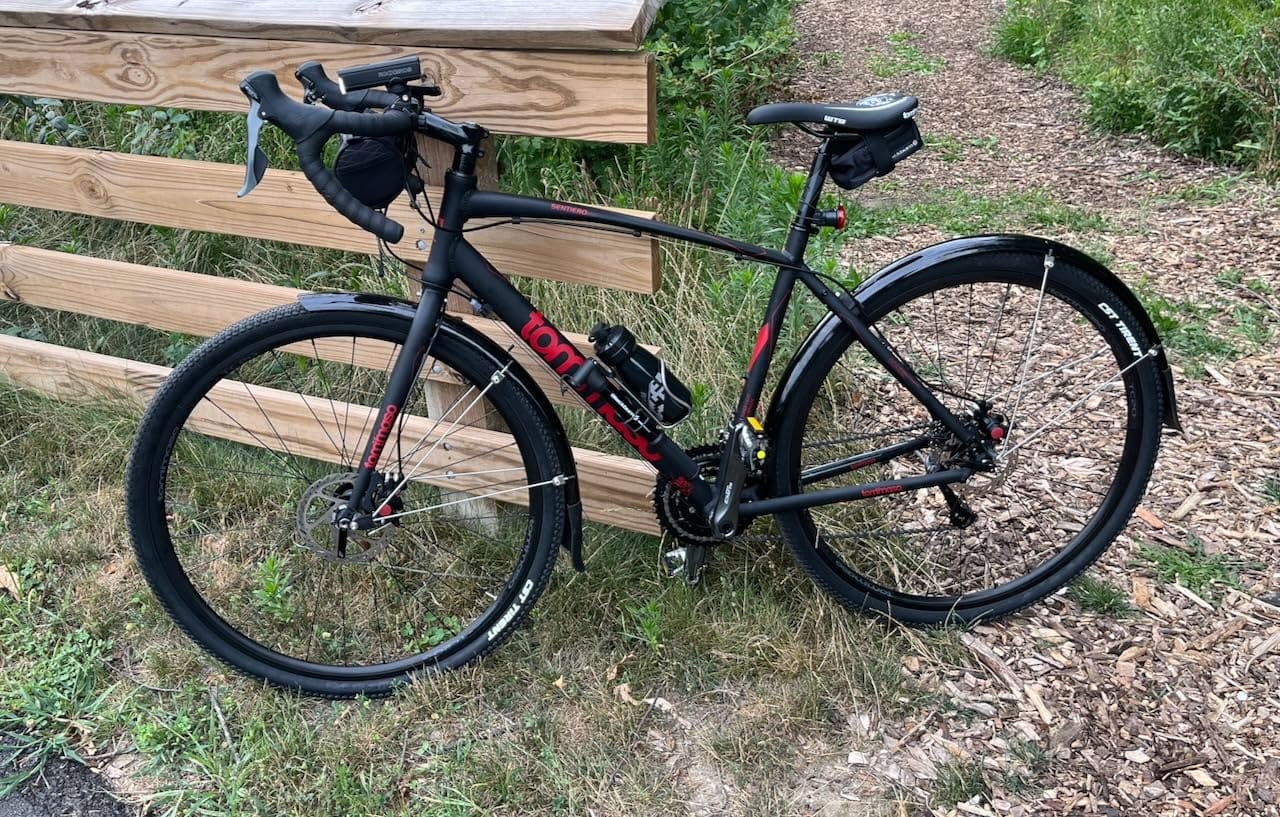
Owners praise the value, the Shimano components and the comfortable upright geometry for long days. They also flag the same three things: the flat handlebars, which are unusual on a gravel bike and not what most bikepackers expect, the need for professional assembly before the warranty applies, and occasional reports of slow shifting.
TC-20D rims with 28 spokes and 700x40c tires give you a firm, fast setup on gravel roads and hardpack. This is a bike for routes that are mostly dirt road and pavement rather than technical trail.
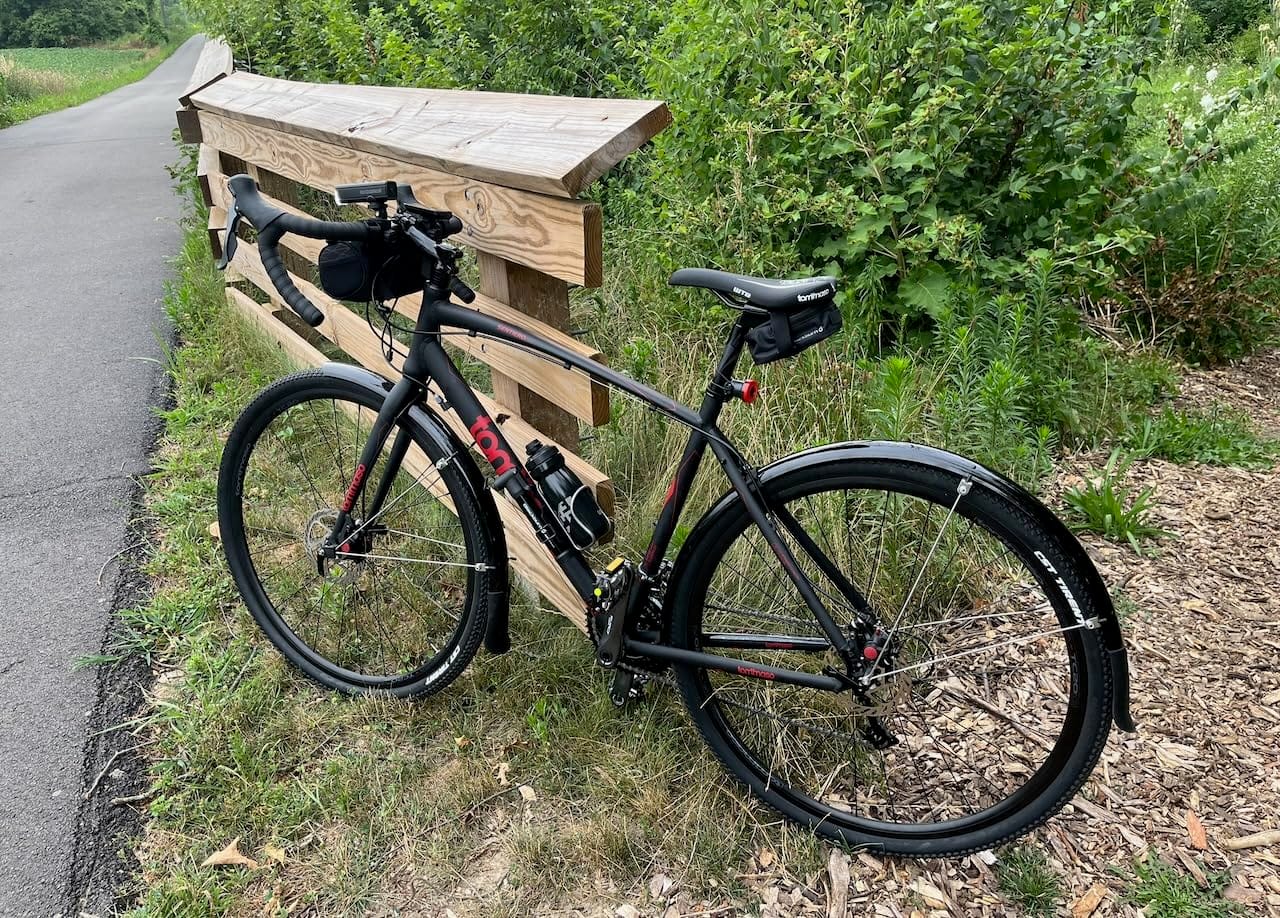
Why the warranty matters more on a bikepacking bike
Frame warranties are rare and valuable precisely because the frame takes the punishment. Bags get strapped to it, fenders bolt through it, and it absorbs the twisting forces that riders report as wobble on softer frames. A lifetime warranty on the frame is a genuine long-term saving on a bike you will keep for years.
The 24-speed drivetrain also gives you low gears without swapping to a smaller chainring. Riders using this bike loaded note that climbing feels manageable on road gradients with a seat pack and handlebar roll attached.
Where the flat bars and alloy frame work against you
Flat handlebars are the biggest mismatch with the bikepacking use case. They put your weight further forward and higher than drop bars do, which is fine for commuting but tiring over multi-day distances, and they make a handlebar roll awkward to mount. Riders who want a traditional riding position should skip this one.
Second, the wheels are 28-spoke rims rather than the 45-spoke builds on the carbon bikes, and the alloy frame carries more mass. It is still a durable package, but it will not climb as freely as the 8.7 kg carbon builds once your bags are on it.
3. Tommaso Siena Sport – Best for Newcomers on a Budget
Tommaso Siena – Shimano Tourney Gravel Adventure Bike with Disc Brakes Perfect for Road Or Dirt Touring, Matte Black – Small
Premium aluminum frame
Lifetime frame warranty
Shimano Tourney 21-speed
Avid BB5 mechanical discs
700x40c tires
Pros
- Complete gravel bike with disc brakes at an entry-level outlay
- Same lifetime frame warranty as the Sentiero
- Full Shimano Tourney drivetrain
- Disc brakes for reliable stopping in wet conditions
Cons
- Mechanical Avid BB5 brakes rather than hydraulics
- 130mm rear dropout limits future wheel upgrades
- Front derailleur often needs adjusting out of the box
- Professional assembly required for warranty
The Siena is the entry-level complete gravel bike in this roundup, and it still arrives with disc brakes, a Shimano drivetrain and a lifetime frame warranty. Several owners say outright that it rivals bikes costing twice as much, and with 53 ratings the feedback pool is deep enough to trust that pattern.
That makes it the bike to buy if your budget is better spent on bags. Buyers of durable frames repeatedly make the same point: put the money into good bags and a sleep system rather than a premium frame, and buy something that will last. The Siena is the cheapest way to do that here.
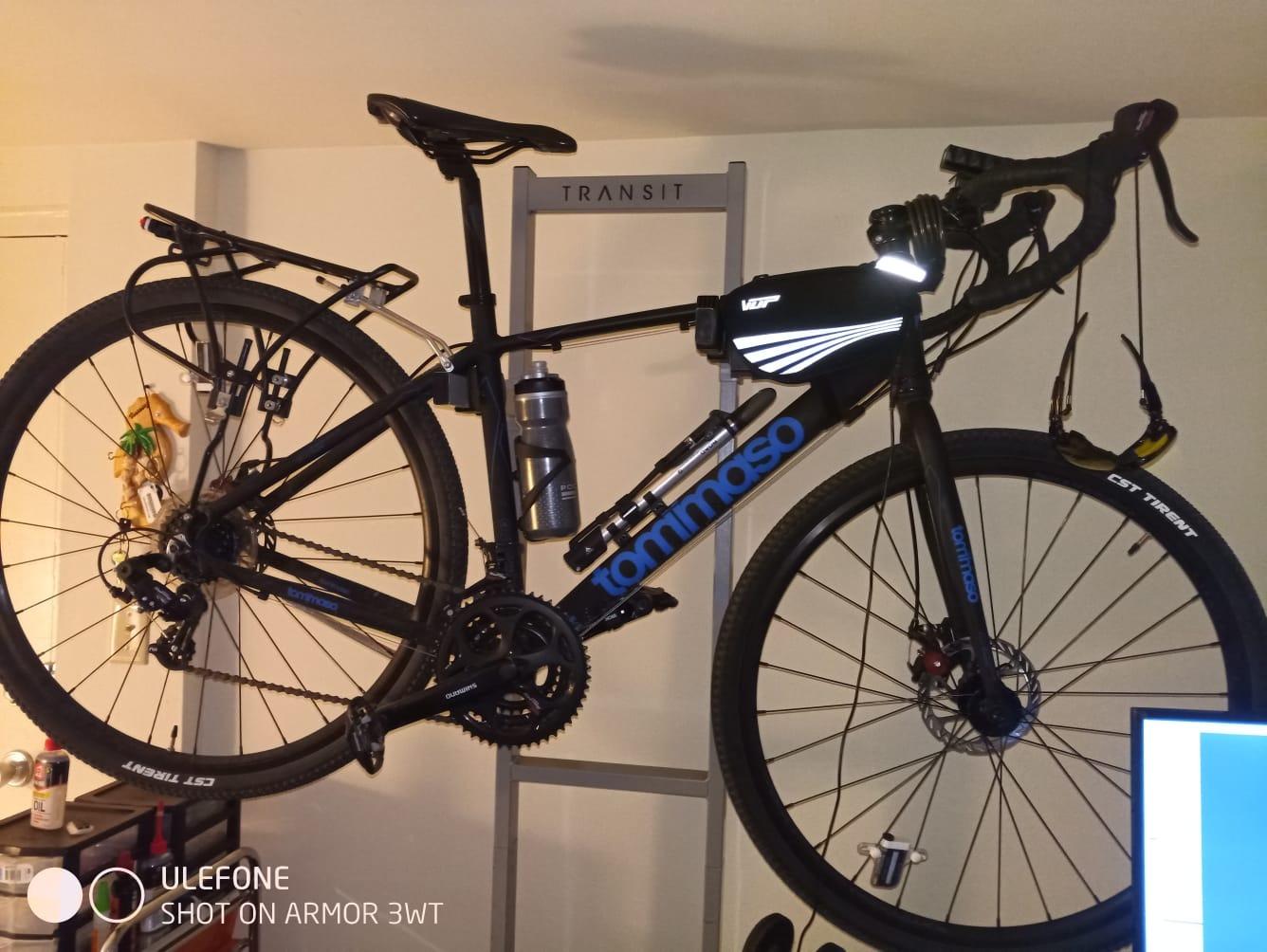
The Shimano Tourney 21-speed drivetrain is the lowest-tier groupset here, and it shows. Riders report front derailleurs needing adjustment out of the box, slower shifts than the Claris model, and pedal quality that some owners replace immediately.
The Avid BB5 mechanical disc brakes work but need a firmer hand than hydraulics. On a loaded descent with 15 kg of gear, one-finger braking with predictable modulation is the difference between confidence and white knuckles.
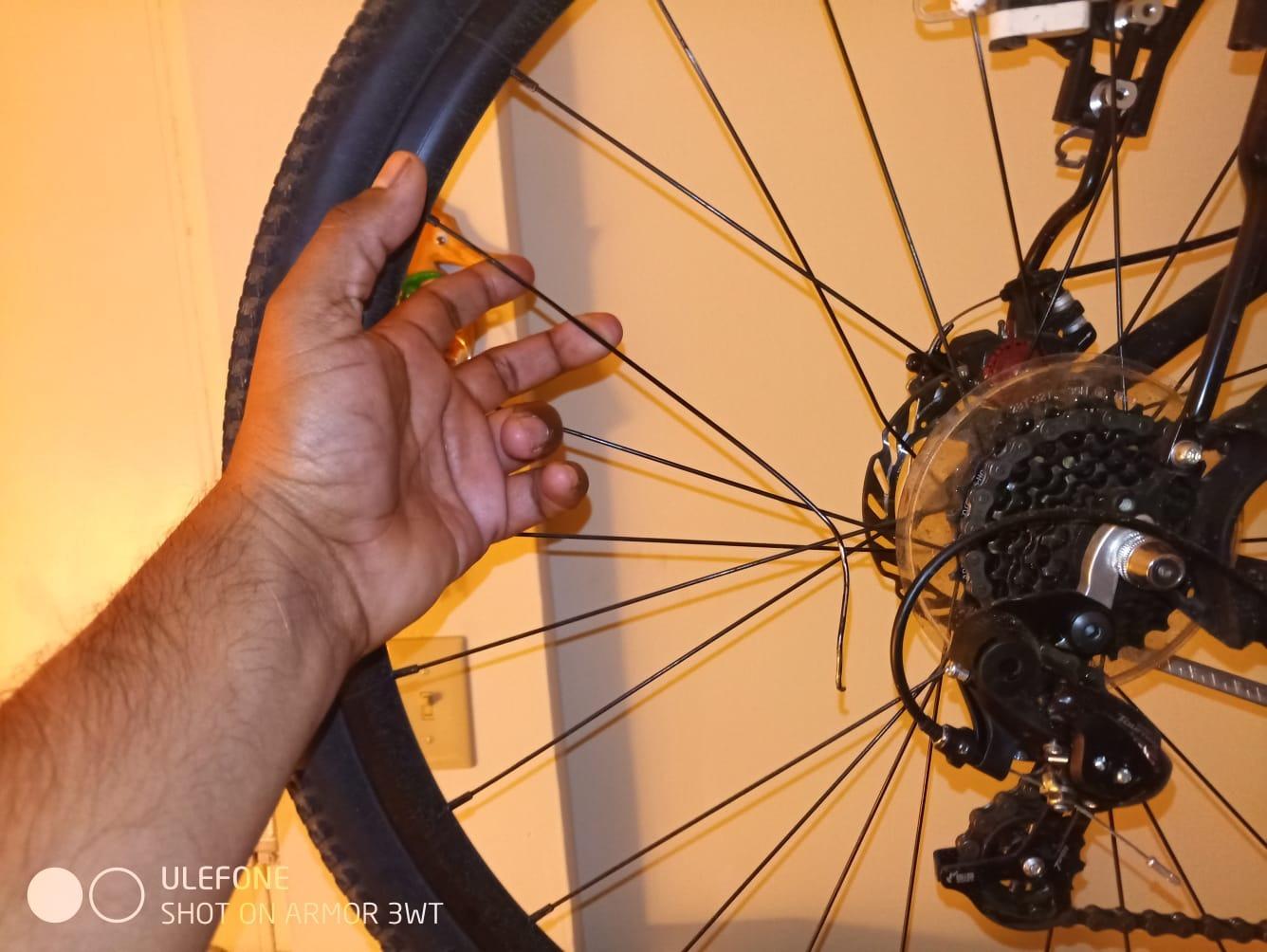
How much gear a Tourney drivetrain really gives you
Twenty-one speeds across a triple chainring is a wide total range, but the gear steps are spread out. That means you will spend more time hunting for the right gear on a loaded climb than you would with the 24-speed Claris bike. For a first rig on mostly flat-to-rolling routes, that trade is easy to accept.
Riders using this bike loaded report that 700x40c tires on TC-20D rims handle gravel roads and hardpack well, provided you keep pressures sensible for the weight you are carrying.
Where the 130mm rear dropout limits you
The rear dropout spacing of 130mm is the detail most riders miss and most regret. It means modern 12mm through-axle wheels will not fit, so you cannot later upgrade to a stronger, better wheelset or swap in tubeless-ready rims of the current generation. Budget for that constraint before you load the bike up.
Riders also report tire clearance concerns at the supplied 40c width on these narrow rims. If your route wants 45mm-plus tires, check the fit with the shop before committing to a loading plan built around wide rubber.
4. KABON T800 Carbon Sora 18-Speed – Best Double-Duty Build
KABON Carbon Gravel Road Bike, T800 Carbon Fiber Frame 700C Road Bike with 18 Speeds Drivetrain, Integrated Carbon Handlebar, Disc Brakes Racing Bicycle for Adult Unisex (Black, 53cm)
T800 carbon frame, fork, bar and post
8.7 kg
Shimano Sora R3000 2x9
Mechanical disc brakes
700x40c tires
Pros
- 8.7 kg complete weight among the lightest here
- Full carbon cockpit including bar and seatpost
- Pre-assembled so setup is quick
- Multiple frame sizes available
Cons
- Mechanical disc brakes rather than hydraulics
- Integrated carbon handlebar limits bag and bar fit choices
- Component warranty is only 6 months
The KABON Sora build is the one to buy if you want the same bike to be fast on the road between trips. At 8.7 kg for the complete bike, with a carbon frame, fork, handlebar and seatpost, it sits in the lightest weight class in this roundup and it comes pre-assembled.
The integrated carbon handlebar does a lot of the work. Carbon bar and post together remove a surprising amount of vibration from rough gravel, which is exactly the fatigue you accumulate on back-to-back loaded days. Riders praise the smooth Shimano Sora R3000 18-speed shifting and the value for a full carbon build.
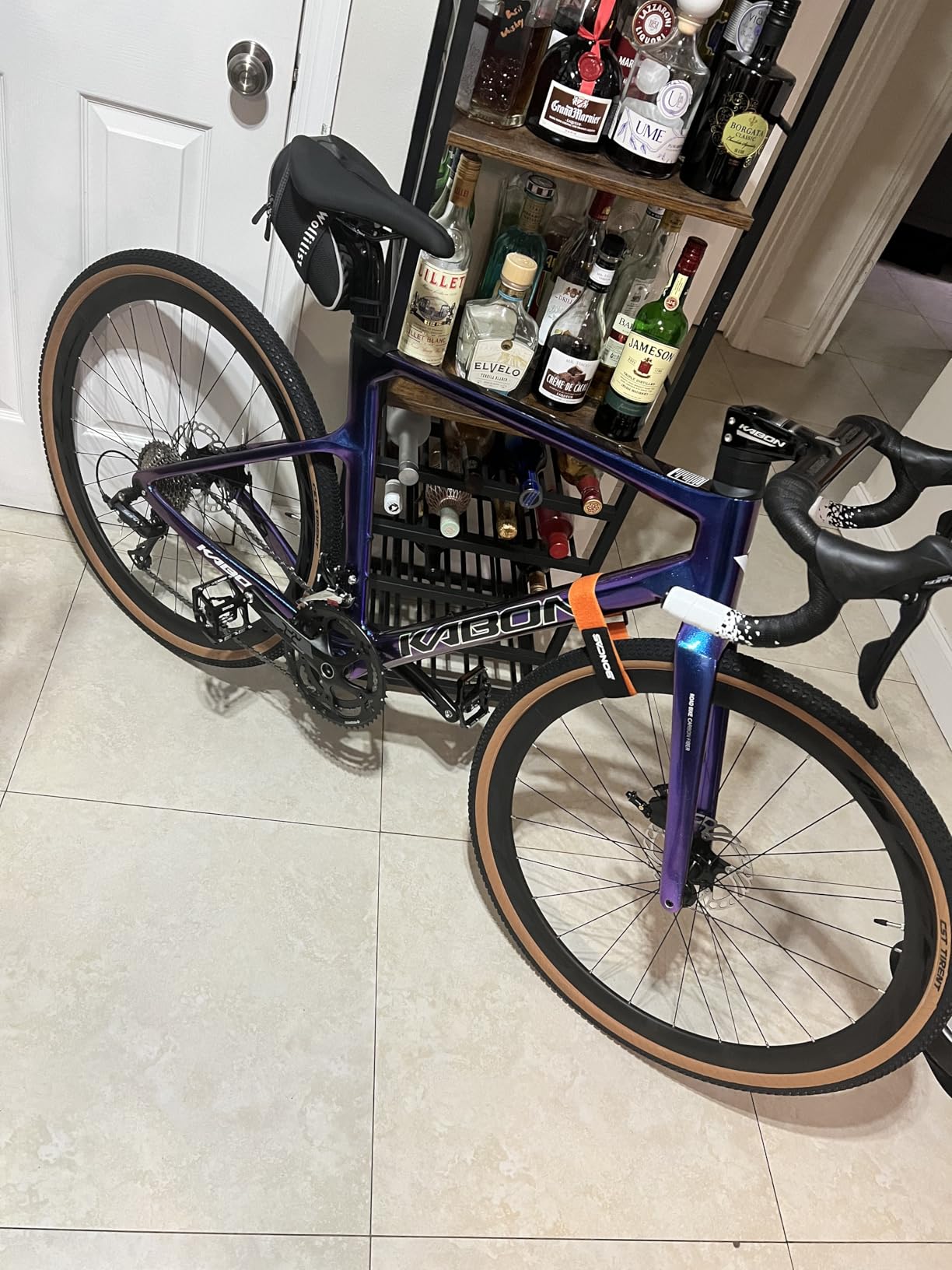
The trade-offs are clear and all of them appear in rider feedback. The brakes are mechanical rather than hydraulic, which matters more the further you are from home. The integrated bar cannot easily be swapped for a wider flared bar or adapted to a handlebar roll setup without replacing the cockpit.
Component warranty runs only 6 months, though the frame is covered longer. With 13 ratings, the long-term record on this build is still thin compared with the alloy frames.
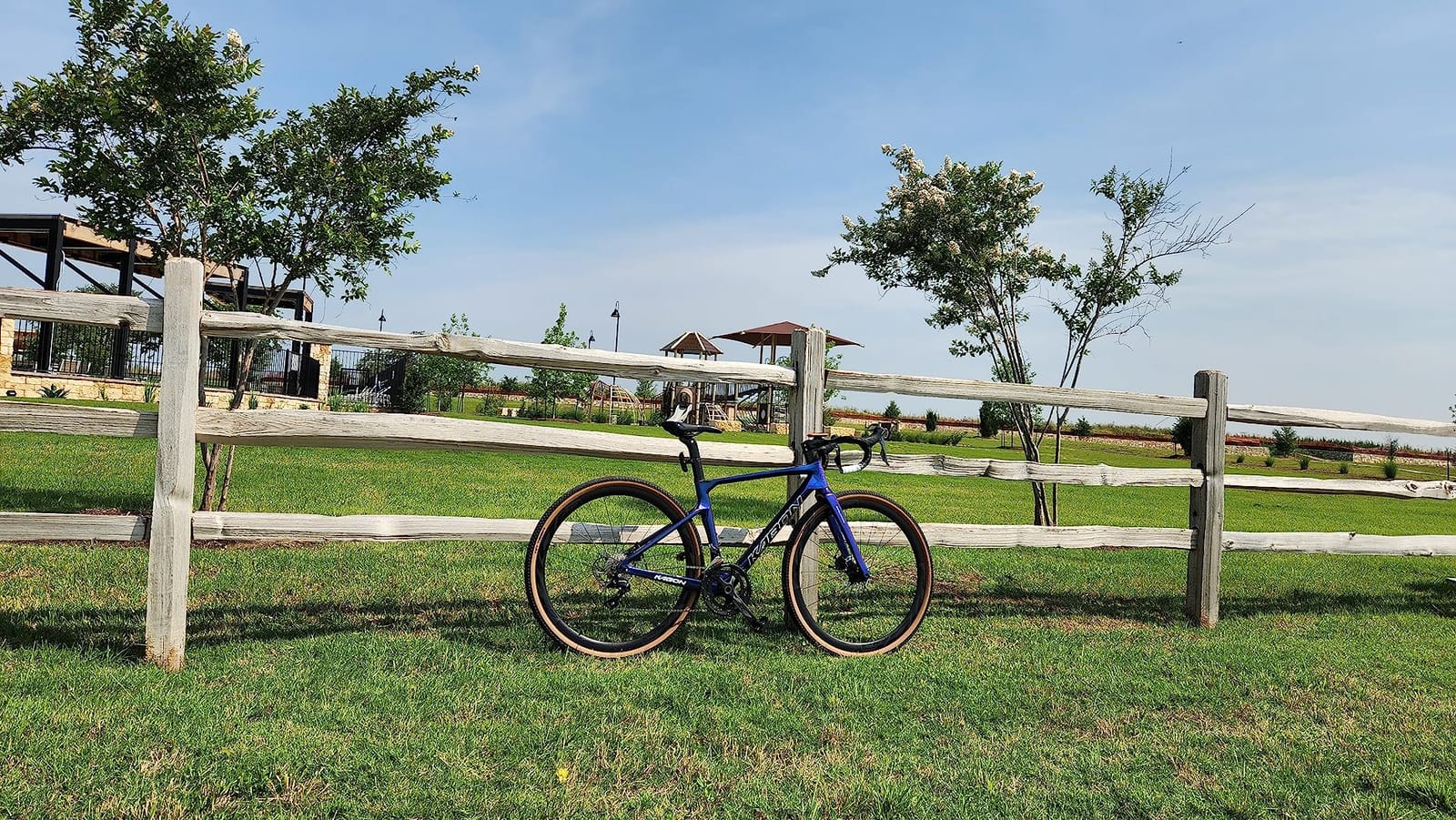
One bike for road speed and loaded trips
At 8.7 kg empty, this is the bike that will feel fastest once your bags go on, because you are hauling less frame and no rack hardware. Add a typical soft-bag kit and you are looking at roughly 11 kg of bike, which is lighter than any other pick here with a similar load.
For riders who keep the bike on a rack or in a garage door between trips, the carbon cockpit means it rides like a fast road bike on pavement with no parts swapped out.
Where an integrated cockpit limits a bikepacking build
The handlebar is the constraint. It is described as integrated carbon, and riders note it may not suit all fit preferences. A handlebar roll, a compass or an off-road flared bar all become more complicated on a cockpit you cannot easily change.
Mechanical disc brakes on a loaded bike are the second limitation. Riders planning long descents with a heavy rear load will feel the difference against the hydraulic models in this roundup, and pads on this build are worth checking before a first trip.
5. SAVADECK T800 Carbon GRX610 12-Speed – Best 1x Setup
SAVADECK T800 Carbon Gravel Bike, with Shimano GRX610 12-Speed, Hydraulic Disc Brakes, 700x40c Tires for Road & Off-Road Adventure, Men’s/Women’s Bicycle(Elegant White, 51cm)
T800 carbon frame and fork
Shimano GRX610 1x12
GRX410 hydraulic discs
M6100 cassette
10.4 kg
Pros
- 1x12 with the wide-range M6100 cassette
- Shimano GRX410 hydraulic disc brakes
- Full internal cable routing leaves the frame clean for bags
- 45-spoke carbon rims
Cons
- Review base is only 8 ratings so long-term data is thin
- No written assembly instructions included
- Frame warranty is limited
This is the simplest drivetrain in the roundup and the one I would trust most on rough loaded ground. A single chainring with a Shimano GRX610 shifter and a wide-range 12-speed M6100 cassette means no front derailleur to snag, no chain drop across two rings and one less thing to adjust in the dark at a campsite.
The braking side is GRX410 hydraulics on a T800 carbon frame and fork, with full internal cable routing and 45-spoke carbon rims. Owners describe the ride as smooth, the shifting as clean and the response as upright and comfortable for long days. The complete bike weighs 10.4 kg.
The wide cassette is what makes the single ring work loaded. The M6100 gives you a low enough bottom gear to climb with a seat pack and a handlebar roll on your back, which is the failure point that makes riders abandon one-by-twelve setups for trip use.
Why a single ring suits a loaded bike
Loaded riding puts more torque through the chain at exactly the moment the ground gets unpredictable. A two-ring system that shifts under power can drop the chain, and a dropped chain on a climb with 15 kg of gear is a genuinely bad morning. Removing the front derailleur removes that entire failure mode.
Internal cable routing also means fewer cables crossing the frame, which leaves cleaner routes for a top tube bag or frame bag to sit against without interference.
Where the thin review history matters
With eight ratings, this is a young build and the long-term durability picture is thin. There are no owner photos to cross-check fit or finish, which means you are trusting the spec sheet more than rider evidence on this one.
At 10.4 kg it carries more mass than the 9.8 kg GRX820 build, and the frame warranty is limited rather than lifetime. If you want a proven frame that will last decades of trips, the two Tommaso alloy bikes carry stronger warranty coverage and far more owner history.
6. SAVADECK Gelaro S8 GRX820 – Best Lightest Carbon Rig
SAVADECK Gelaro S8 Carbon Gravel Bike – Shimano GRX820 12-Speed, Hydraulic Disc Brakes, 700x40c Tires for Road & Off-Road Adventure(White,49cm)
T800 carbon frame and fork
9.8 kg
Shimano GRX820 12-speed
GRX820 hydraulic discs
2 year warranty
Pros
- 9.8 kg complete weight
- among the lightest builds here
- GRX820 gives the highest-grade shifting and braking here
- 45-spoke rims and 2 year warranty
- Endurance geometry aimed at all-day comfort
Cons
- Review base is only 5 ratings
- Long-term reliability data is limited
- Component grade costs more than lower-tier builds
The Gelaro S8 is the flagship of the SAVADECK range and one of the lightest bikes here at 9.8 kg complete. It runs a full Shimano GRX820 12-speed groupset with GRX820 hydraulic disc brakes, an RX822 rear derailleur paired with the M6100 12-speed cassette, and 45-spoke rims.
Owners describe excellent geometry for long-distance comfort, which fits the endurance positioning these bikes are built around. At 9.8 kg empty, adding a soft-bag kit leaves you carrying less than the other carbon pick in this roundup, and on a multi-day route that difference compounds daily.
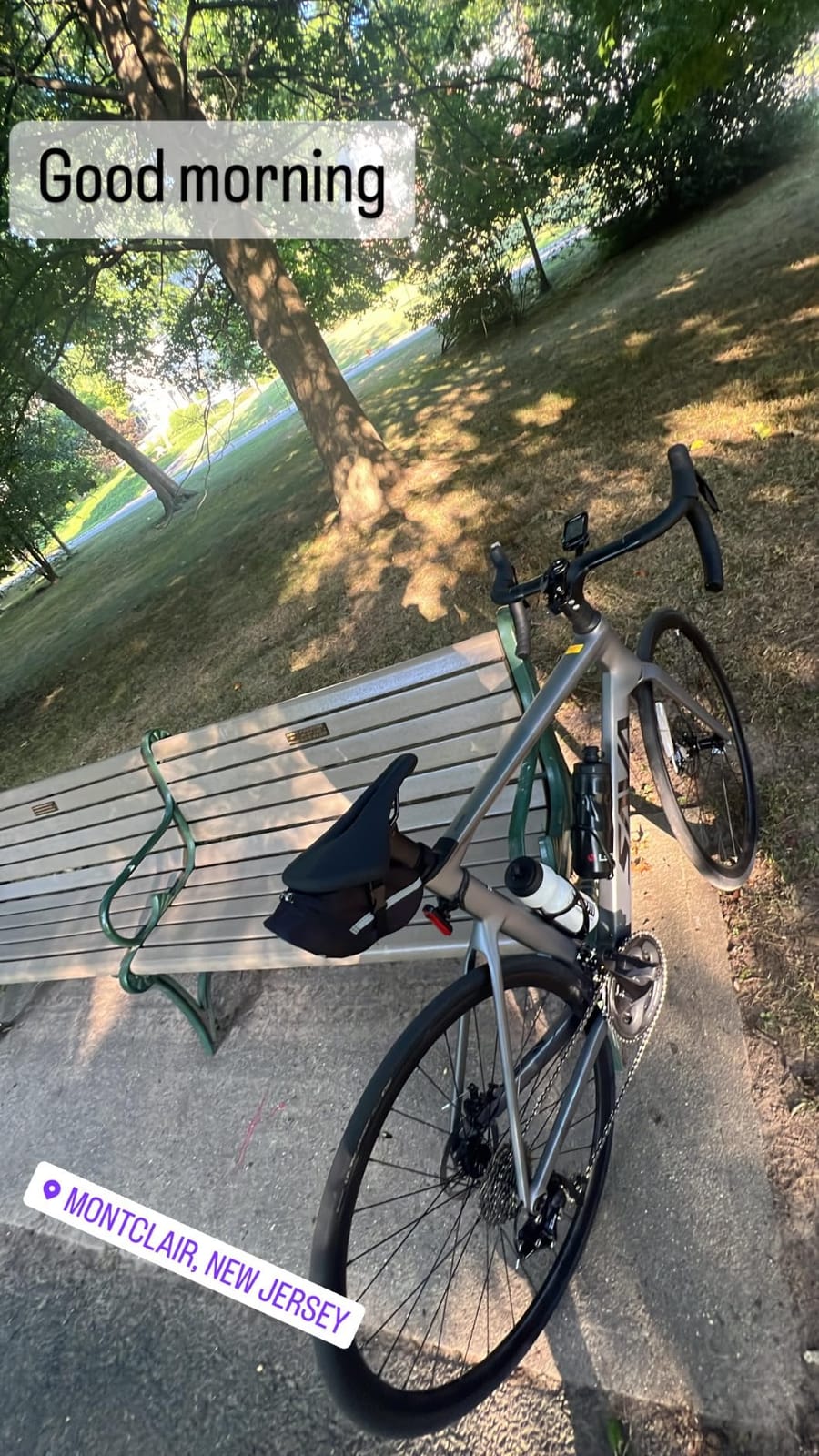
Reviewers of the model point out the same limitation, along with the fact that it carries a higher component grade than lower-tier builds.
The 2 year warranty is the strongest coverage in the carbon group here and a real improvement on the limited warranty on the other carbon models.
Where saving weight actually pays on a bikepacking trip
Weight matters most on gradients and on rough surfaces, where you are standing on the pedals. A 0.6 kg saving against a 10.4 kg bike is not dramatic on the flat, but over a week of loaded climbing it is the difference between arriving at camp tired and arriving intact.
GRX820 shifting and braking is also the highest grade in this roundup, which means the controls you use constantly are the ones with the most refinement.
Where buying the flagship is a gamble
Five ratings cannot tell you how a frame and drivetrain hold up over three seasons of loaded riding, and that is exactly the data a bikepacking buyer needs. Riders weighing this bike against a lower-spec model with more owner history are trading proven durability for component grade.
If your trips are shorter and lighter, the component upgrade matters less than the feedback pool. If you are planning multi-week loaded tours, a frame with a lifetime warranty and a deep review record may serve you better.
7. KABON T800 Carbon 105 R7000 22-Speed – Best for Long Distance
KABON Carbon Gravel Road Bike, T800 Carbon Fiber Frame Adventure Bicycle with Shimano 105 22 Speed Disc Brake Racing Bicycle for Men and Women (Chameleon Blue, 56cm)
T800 carbon frame, fork, bar and post
8.7 kg
Shimano 105 R7000 2x11
Mechanical discs
5 year frame warranty
Pros
- Only 5 year frame warranty
- the longest fixed term here
- 150 kg maximum rider weight rating
- 8.7 kg full carbon build with a 22-speed groupset
- Fully internal cable routing
Cons
- Mechanical disc brakes rather than hydraulics
- Factory brake pads reported weak by one rider
- Handlebar drops described as non-ergonomic
- Review base is only 4 ratings
The KABON 105 build pairs the joint-lightest weight in the roundup with the longest fixed-term frame warranty. Five years of frame coverage and a 150 kg maximum rider weight rating is meaningful for bikepacking, because it means the frame is specified for riders and loads above what most of this group rates for.
The Shimano 105 R7000 22-speed two-by-eleven groupset sits a tier above the Sora build and gives you the widest gear selection of any bike here alongside the Claris 24-speed. Fully internal cable routing, wind-tunnel developed, keeps the frame clean and protected, and 700x40c tires are ready for gravel roads.
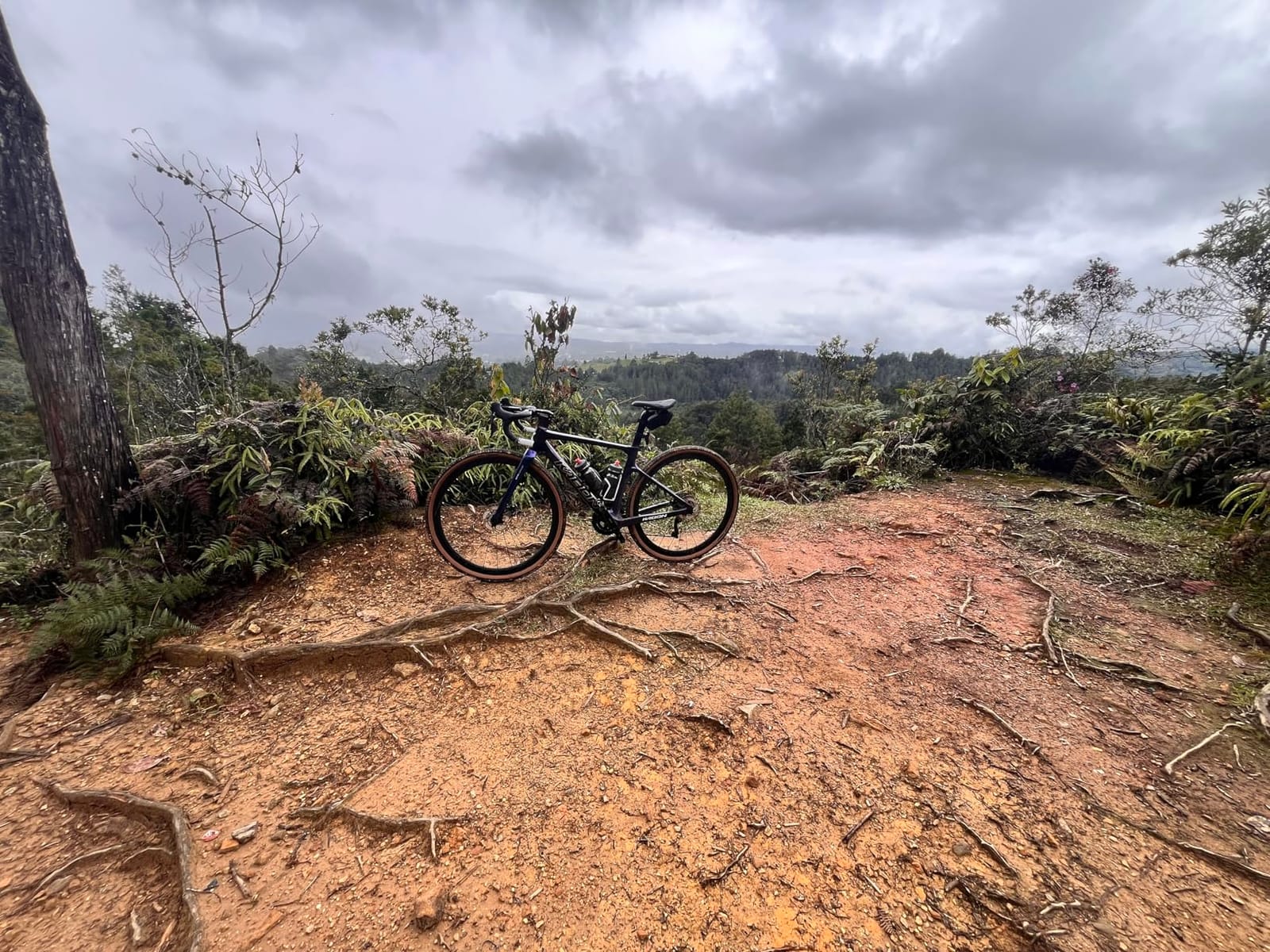
Its weak point is the brakes. These are mechanical discs, and one reviewer reported that the factory pads felt weak. Swapping pads is a cheap fix, but on a loaded descent the underlying lever feel is still firmer than the hydraulic models.
Another reviewer found the handlebar drops less ergonomic than expected, which is a fit issue rather than a fault. With four ratings all at five stars, this is the thinnest evidence base in the roundup, so treat the spec sheet as the guide.
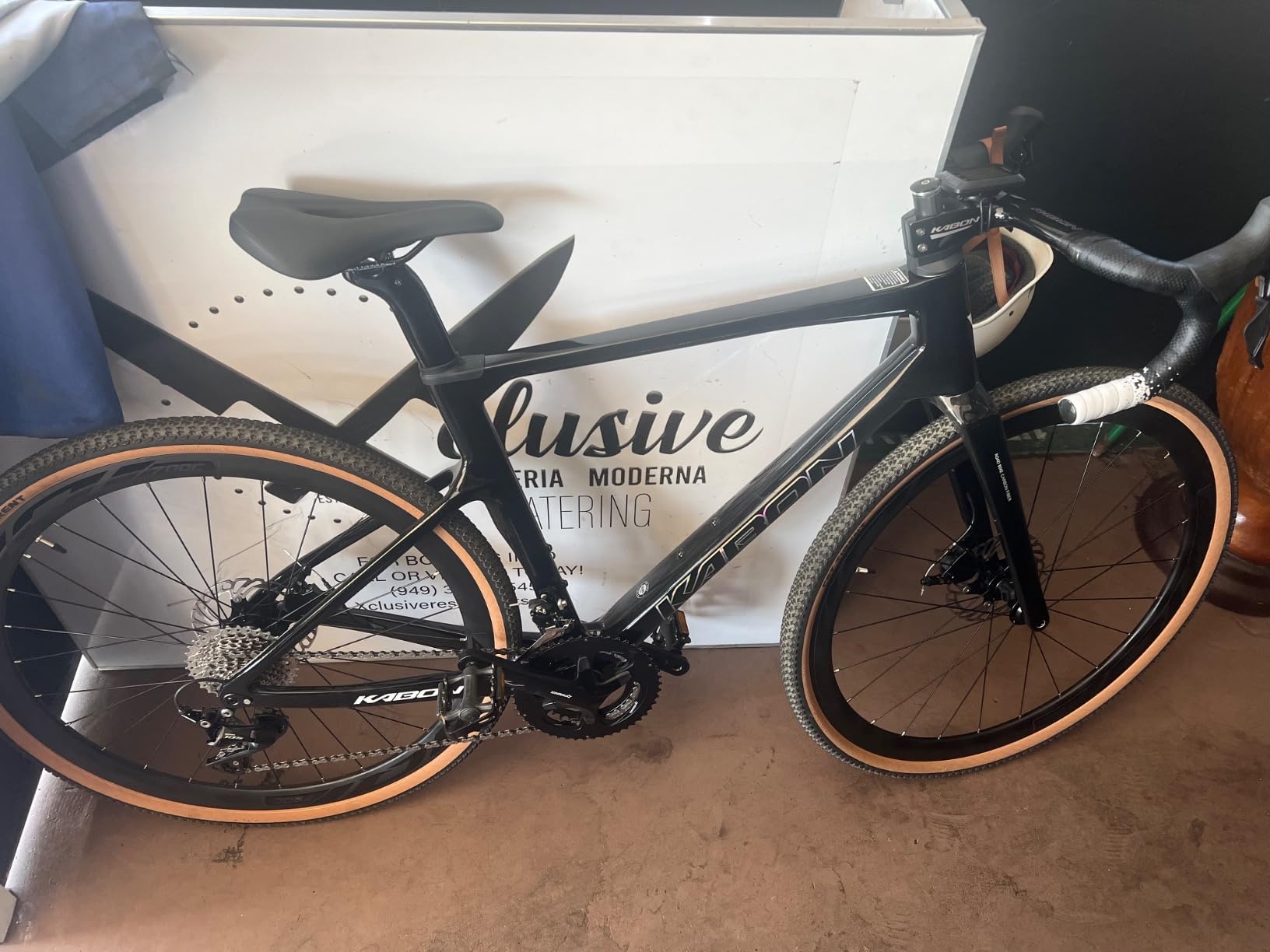
Why a 150 kg rating and a 5 year warranty matter here
Most gravel frames are rated well above what any rider weighs, so a published maximum matters mostly as a signal about how the manufacturer tested it. A 150 kg rating paired with a five-year warranty reads as a frame built for heavier use than average, which is reassuring when you plan to load it to 20 kg of gear.
The 22-speed 2×11 drivetrain gives fine gear steps across a very wide range. On long loaded climbs that granularity means you can hold a steady cadence without hunting between gears.
Where it stops short
Mechanical disc brakes are the recurring limitation across the KABON builds and this is the heaviest-loaded use case of all. On long descents with a loaded rear rack, hydraulic discs give noticeably better modulation and less hand fatigue.
Second, a full carbon cockpit cannot be swapped easily, and with only four ratings there is no long-term durability picture yet. Riders who want the lightest bike and the longest fixed-term frame warranty will find both here; riders who want proven hydraulic braking should look at the GRX models earlier in this roundup.
What Tire Clearance Do You Actually Need for Bikepacking?
Run the widest tire your frame allows, within reason. Tire clearance is the maximum width a frame and fork can take, it is limited by the rear triangle more often than anything else, and it is usually not printed on the bike. Riders routinely buy first and discover afterwards that their route needs more rubber than their frame accepts.
For most bikepacking routes, 45mm to 50mm on 700c wheels is the sweet spot. That gives you lower pressure, more traction on loose surfaces and better control over rough gravel without the rolling resistance and handling changes that very wide tires bring on pavement.
40mm on 700c: fine for gravel roads and hardpack with a light load. Fastest option, least comfortable when loaded.
45mm on 700c: the safe all-rounder for multi-day trips on dirt road and pavement connectors.
50mm on 700c: best for routes with rough surfaces, washboard and loose gravel descents.
55mm on 650b or 32in: worth it when the route turns technical or you ride with a heavy load. Note that 32in frames often skip smaller sizes.
Every bike in this roundup comes with 700x40c tires, which is a dry-condition starting point rather than a bikepacking setup. Riders consistently report that factory tires are the first thing to fail on loaded mixed terrain.
Start pressures in the 30 to 45 psi range, roughly 2.1 to 3.1 bar, then adjust for the weight you are actually carrying. A rider carrying 20 kg of rig on 45mm tires needs less pressure than a 75 kg rider on the same bike at the same tires, and running too high causes the squirm that makes loaded bikes feel vague.
Mounting Points: Frame Bags, Racks or Panniers
Count the mounting points before you commit, because that is what decides your load layout. Threaded bosses on the top tube, down tube, seatstays and fork legs let you run soft bags with no rack at all, and for most riders doing multi-day trips that is the better answer.
The three layouts differ more than most roundups admit. Frame bags sit low and central, so they barely affect steering and keep weight between your legs. Racks move capacity outward, which is good for bulky gear like a tent but makes the bike noticeably less stable at speed. Panniers hang low and swing, and riders report them rattling and bouncing off anything rougher than smooth asphalt.
On drop-bar gravel bikes, a rear rack is often the hardest part of the whole build. Racks that clamp to the seatstays or fork crown can interfere with the tire, the brake calipers or a seat pack, and moving parts mean nothing clamps cleanly. Confirm your rack spacing before you plan around one.
None of the seven bikes here publishes a mount point count, which is a real gap. Before buying any of them, ask the manufacturer or retailer specifically where the top tube, down tube and fork bosses are located, and whether fenders clear at the tire width you intend to run.
How to Set Up a Gravel Bike for Bikepacking in 7 Steps
Setting up a gravel bike for bikepacking takes an afternoon once you have the bags. The order matters, because each step depends on the one before it.
Choose your bag layout first. Decide whether you run a seat pack, a handlebar roll and a frame bag, or a front and rear rack. This determines where weight sits and how the bike steers.
Pick your tires for the route. Match the tread to the surface. Riders report that semi-slick 40mm tires are the standard for road-plus-gravel trips, and that dedicated trail tread becomes necessary once routes turn to sustained singletrack.
Set tire pressures for the loaded weight. Calculate your actual rig weight, then start in the 30 to 45 psi range and adjust on the first ride until the bike stops feeling vague.
Seal the tires tubeless. If your rims support it, add sealant and run tubeless. Loaded rides generate more punctures, and a sealant repair mid-trip saves the day.
Check your gearing under load. Load the bags fully, then find a hill near your home that matches the steepest gradient on your route. Confirm you can climb it without grinding and without spinning the cassette.
Pack a repair kit. Spare tubes, tire levers, a patch kit, a multi-tool, a chain quick link and a tubeless plug kit all fit in a small saddle bag.
Do a loaded test ride before you leave. Ride 20 km fully loaded and check for bag bounce, loose straps, wheel rub and steering vagueness. Fix all four before the trip, not on day two.
Frame bags and top tube bags are the working standard in community setups, with popular choices including Oveja Negra front loaders and Revelate Designs rear rolls. Trash compactor bags are repeatedly recommended for seat packs because they make waterproofing and durability much easier to achieve.
Frame Stiffness Under Load: The Spec Nobody Mentions
Frame stiffness under load is the specification that decides whether a loaded gravel bike feels controlled or vague. Once bags are attached, twisting forces travel through the frame, and a drop-bar bike has less steering leverage to resist them than a flat-bar equivalent. The symptom riders describe is a front-to-rear wobble on rough surfaces that they cannot tell whether comes from the frame or their setup.
Carbon frames are the stiffest in this group. The four carbon bikes here use T800 carbon frames and forks, which resist the torsional load of a full frame bag far better than the two aluminum Tommaso frames. That is the single strongest technical argument for spending more on a carbon build if you intend to carry gear regularly.
Geometry helps as much as material. The SAVADECK bikes use a tapered head tube and describe their geometry as upright or endurance-oriented, both of which reduce the steering loads that feed the wobble. Racks and panniers make it worse because they move mass away from the frame centreline.
The practical takeaway is that if you load a frame bag low and keep weight close to the head tube, you reduce stiffness demands on any frame. If you hang panniers out wide on a softer alloy frame, that is where the vagueness comes from.
Gravel vs Mountain Bike for Bikepacking
A gravel bike is the better bikepacking bike when your route is mostly gravel road, fire road and pavement connectors with occasional rough surface. A mountain bike is better when singletrack, technical terrain or rough descents dominate. Choosing wrong in either direction means carrying a heavier bike or running tires you cannot fit.
Gravel wins on speed and weight. The bikes here weigh 8.7 kg to 10.4 kg complete, where hardtails and full-suspension bikes add several kilos before any load goes on. On a route with 80 percent dirt road, that weight difference compounds daily.
The mountain bike wins on control and tire clearance. Wider tires and suspension absorb rough ground that would deflect a fully loaded gravel bike, and flat bars give more steering leverage when loaded. Full suspension adds a rack compatibility problem: a moving rear triangle does not accept a conventional rear rack.
Forum debate on this question tends to land in the same place. Riders doing long distances on mixed surfaces choose gravel for efficiency, and riders who want to take technical lines or carry heavy camera or camping gear choose a hardtail. Most people end up owning one of each eventually.
Frequently Asked Questions
Are gravel bikes good for bikepacking?
Yes. A gravel bike is one of the two best bike types for bikepacking, alongside the hardtail mountain bike. It carries camping gear in soft bags mounted to the frame, bars and saddle, or on front and rear racks, and it stays fast on the paved connector miles that make up most of a route. It wins when the surface is mostly gravel road, fire road and pavement rather than technical trail.
What size tires are best for bikepacking?
For most multi-day gravel bikepacking routes, 45mm to 50mm on 700c wheels is the sweet spot. It allows lower pressure, better traction on loose surfaces and better control on rough gravel without the extra rolling resistance of very wide tires. Riders doing mostly gravel road with a light load can run 40mm, while technical routes justify 55mm on 650b or 32in wheels.
Is a mountain bike better for bikepacking than a gravel bike?
Only when technical terrain dominates. A hardtail handles rough descents, singletrack and wider tires better, and its flat bars give more steering leverage when loaded. A gravel bike is lighter, usually 8.7 kg to 10.4 kg complete, and much faster on the dirt road and pavement that make up most of a bikepacking route. Full suspension adds a rear rack compatibility problem because the rear triangle moves.
How many mounting points does a bikepacking gravel bike need?
Enough for your chosen bag layout. Frame bag, top tube bag and fork-mounted loaders need bosses on the down tube, top tube and fork legs. Racks need dedicated eyelets or a rack-compatible dropout, which are separate from bag bosses. None of the bikes in this roundup publish a mount count, so confirm boss locations and fender clearance with the manufacturer before buying.
What gearing do I need for bikepacking when fully loaded?
A wide-range drivetrain with a low enough bottom gear to climb a steep gradient with 15 to 20 kg of bags on board. A double ring such as the two-by-ten or two-by-eleven setups here gives you the smallest gears, while a single ring with a wide-range 12-speed cassette gives you the simplest shifting and no chain drops on rough ground. Load the bike fully and test the steepest hill on your route before you leave.
What tire pressure should I run for bikepacking?
Start between 30 and 45 psi, roughly 2.1 to 3.1 bar, then adjust based on your total loaded weight. A heavier rig needs lower pressure to preserve the same contact patch. Running too high causes the squirm that makes a loaded bike feel vague on rough ground, so test pressures on a loaded ride near home rather than guessing once you are on the route.
The Best Gravel Bike for Bikepacking: Final Verdict
The SAVADECK GRX400 is our pick for the best gravel bikes for bikepacking. It is the only bike in this group that gives you a carbon frame, hydraulic disc brakes and a double-ring wide-range drivetrain at 10.4 kg, which is the combination that makes a multi-day loaded trip genuinely comfortable rather than merely possible.
Start with the GRX400 if your trips are multi-day and your routes mix pavement with gravel. Start with the Tommaso Sentiero if you want a durable frame with a lifetime warranty and the largest owner review base here, and spend your budget on bags instead. Start with the Tommaso Siena if cost is the deciding factor and your routes stay on graded surfaces.
Whichever you choose, verify the mounting points and fender clearance before you buy, replace the factory tires, and do one fully loaded test ride before you leave. Riders who follow that sequence report far fewer problems on the road. For readers building a lighter-load rig instead, our guide to recumbent setups covers a very different comfort-first approach.