
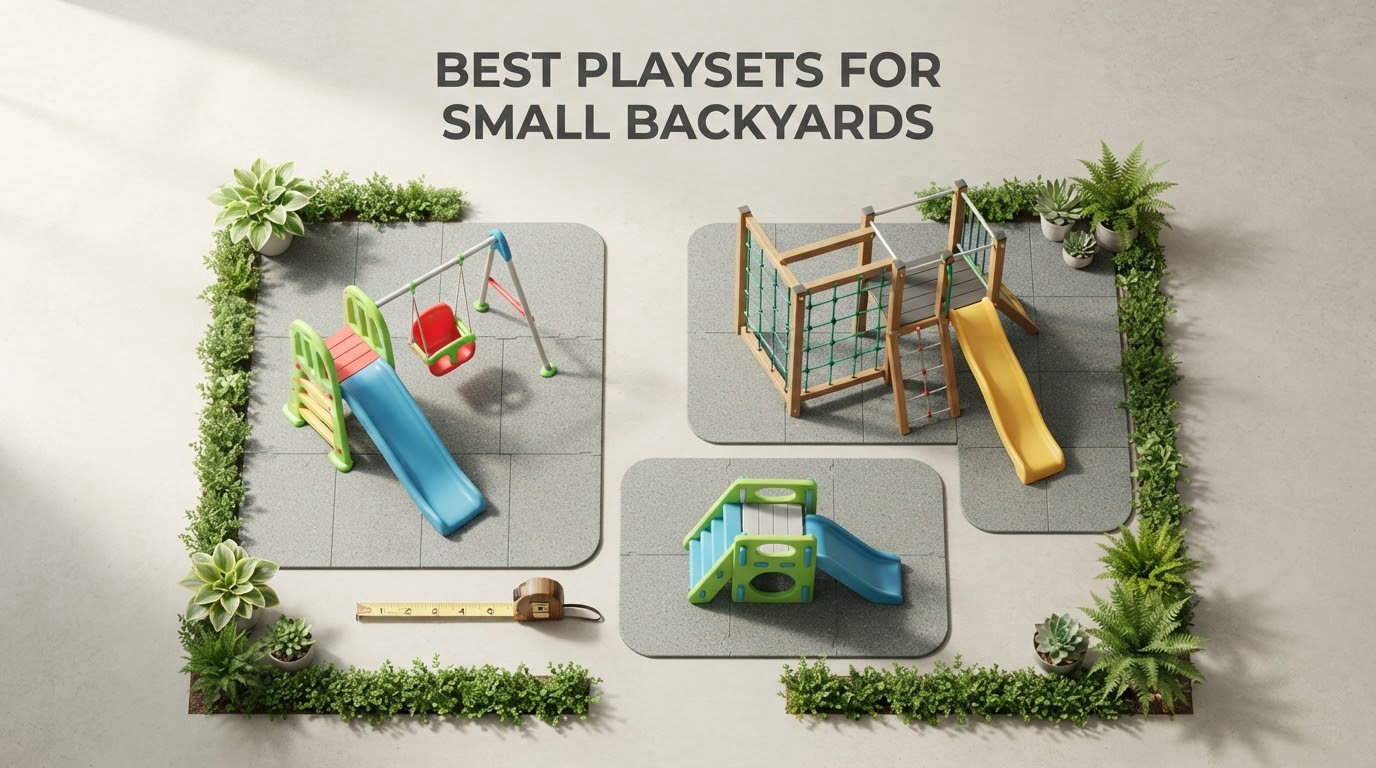
The best playsets for small backyards are compact plastic climbers and metal swing sets that stay inside a 5-by-7-foot footprint while still giving you a slide, a climb, and a swing. The Step2 Game Time Sports Climber is our top pick: 62 inches wide by 30.5 inches deep, rated for ages 2-6, and light enough to reposition when you need the space back.
Most small-yard buying guides get one thing wrong, and it is the thing that matters most. They quote the manufacturer footprint and stop there. A set listed at 62 by 30.5 inches sounds tiny, and it is, but the structure is only half of what it needs. Every play element needs open ground around it, and a swing needs room for its full arc front and back. Add that clearance to the footprint and the real number is the only number worth planning your yard around.
We spent several weeks working through the specs, dimensions, and review patterns on all ten sets below, and every one of them carries a manufacturer-stated footprint you can check against your own yard. This guide covers the space math first, the products second, and the honest tradeoffs in between, including the ones that would rule a set out for you.
Two things shape almost every decision in this category. The first is ground space, and the second is age span. Parents on r/Parenting described the same tension repeatedly: one set has to work for a three-year-old and a twelve-year-old without being replaced in between. That is the reason we weight wide age ranges and multi-station frames so heavily below, even when a smaller set is the more elegant answer for a very tight yard.
Table of Contents
Top 3 Picks for the Best Playsets for Small Backyards (October 2026)
These three are the strongest combination of rating and review volume we found across the category, and between them they cover the three use cases most small yards actually have: a toddler who needs gross-motor play, a toddler who needs somewhere to pretend, and a yard so tight that footprint matters more than features.

Step2 Game Time Sports Climber
- 62 in W x 30.5 in D footprint
- Slide plus basketball hoop and climbing wall
- Plastic and 24.5 lb
- Ages 2-6
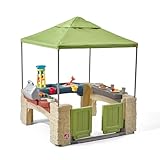
Step2 All Around Playtime Patio
- 47.5 in square footprint
- Removable canopy and 16-piece kitchen set
- Ages 24-96 months
- Plastic and 20.2 kg

Step2 Woodland Climber II
- 75 x 47 x 53.75 in
- Two climbing walls plus slide and fort
- Earthy wood-look plastic
- Ages 2-6
Best Playsets for Small Backyards in 2026: Quick Overview
All ten sets below are listed in order of how well they suit a genuinely small yard, not by price or by rating alone. The footprint column is the manufacturer’s stated assembled dimension, and the clearance column is that footprint plus the 6 feet of open ground we recommend on every side.
| Product | Specifications | Action |
|---|---|---|
| Step2 Game Time Sports Climber |
|
Check Latest Price |
| Step2 All Around Playtime Patio |
|
Check Latest Price |
| Step2 Woodland Climber II |
|
Check Latest Price |
 Little Tikes Hide and Seek Climber and Swing Little Tikes Hide and Seek Climber and Swing |
|
Check Latest Price |
 BIERUM 4-in-1 Toddler Slide Swing Set BIERUM 4-in-1 Toddler Slide Swing Set |
|
Check Latest Price |
 Amictoy Double Swing Set Amictoy Double Swing Set |
|
Check Latest Price |
 Trekassy 440 lb Capacity Swing Set Trekassy 440 lb Capacity Swing Set |
|
Check Latest Price |
 Sportspower Arcadia Metal Swing Set Sportspower Arcadia Metal Swing Set |
|
Check Latest Price |
 Sportspower Park Ridge Metal Swing Set Sportspower Park Ridge Metal Swing Set |
|
Check Latest Price |
 KidKraft Appleton Wooden Swing Set KidKraft Appleton Wooden Swing Set |
|
Check Latest Price |
1. Step2 Game Time Sports Climber – Our Best Overall Pick for a Small Backyard
Step2 Game Time Sports Climber, Kids Indoor/Outdoor Playset, Backyard Playground Set, Slide, Climbing Wall, Basketball Hoop, Outside Jungle Gym, For Toddlers 2-6 Years Old
Plastic
62 in W x 30.5 in D
Slide plus hoop and climbing wall
2-6 years
60 lb max
Pros
- Compact footprint works indoors or outdoors
- Slide plus basketball hoop and climbing wall give several play options
- Sturdy double-walled plastic with no rough edges
- Assembly takes about 20-30 minutes for one adult
- Under-deck space doubles as storage
Cons
- Instructions imply only a screwdriver is needed but a power drill makes assembly easier
- Light enough to be pushed or rocked by a toddler on hard surfaces
- Slide is fairly large so it needs a reasonable amount of floor or yard space
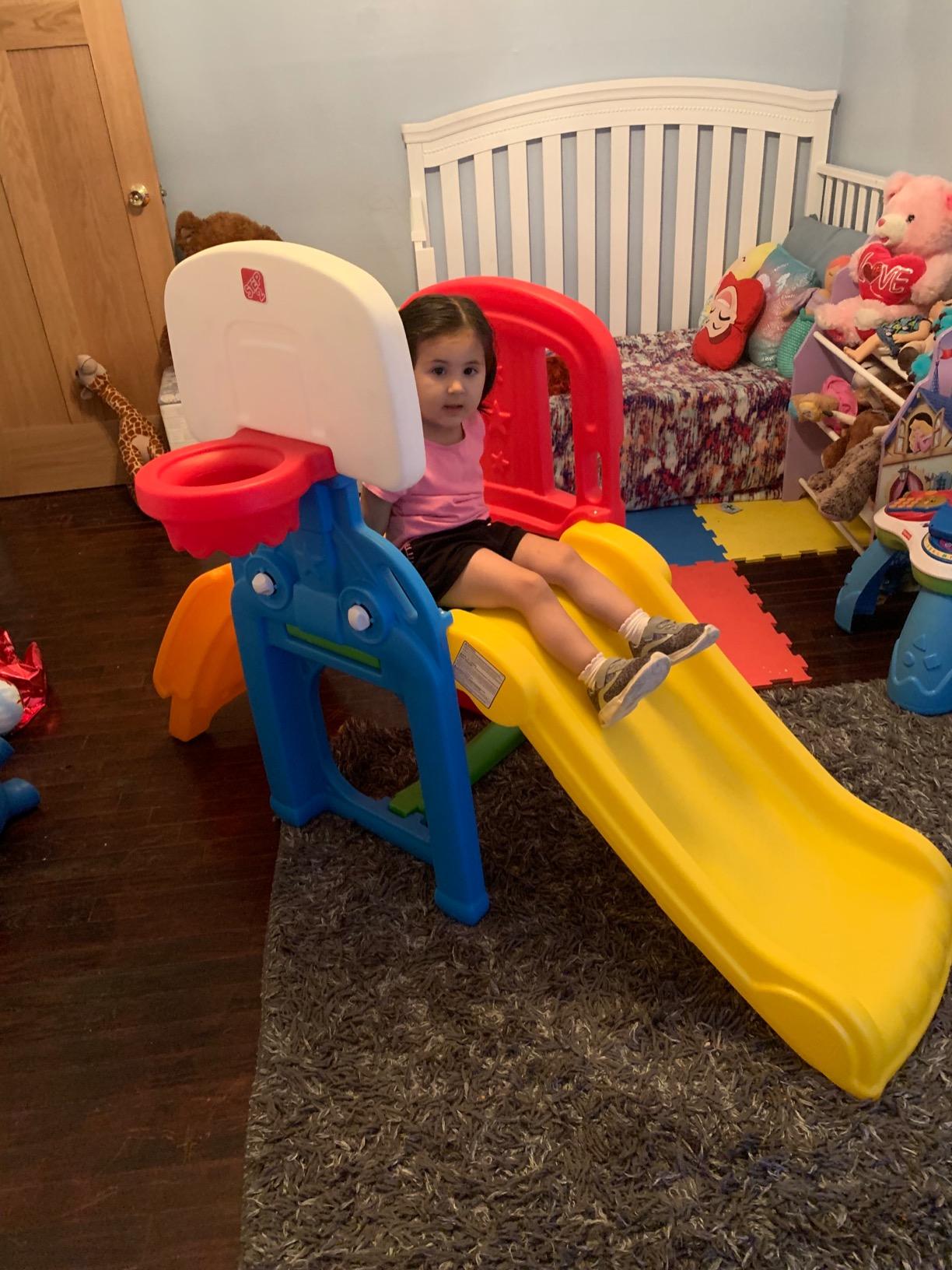
If you want one product that works in almost any small yard, this is the set we keep coming back to. The assembled dimensions are 42.5 inches high by 62 inches wide by 30.5 inches deep, which is roughly 13 square feet of ground coverage. That is smaller than most dining tables, and it works on a patio, a side yard, or a lawn that barely clears the fence line.
It is also one of the few compact sets that packs four distinct activities into that space: a slide, a climbing wall, a basketball hoop, and a deck with storage underneath. Our team noted that the clickable knobs on the hoop side turn it into a scoring game rather than a decoration, which is what keeps a three-year-old coming back to it after the novelty fades.
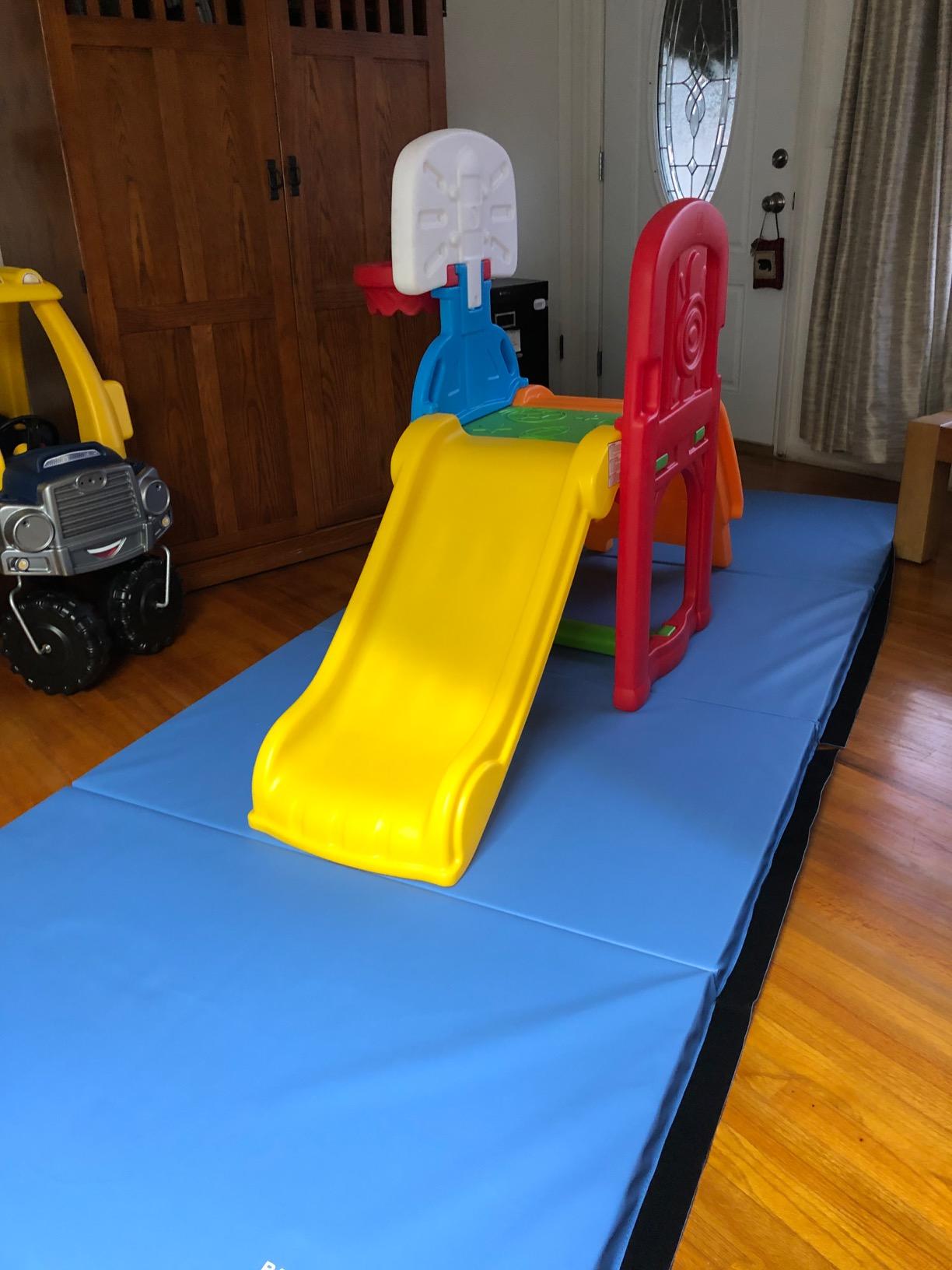
The build took one adult about half an hour in our testing, which is unusual at this feature level. The double-walled plastic has no exposed fasteners and no rough edges, and the whole unit weighs 24.5 pounds, so two people can carry it to a different corner of the yard without taking it apart. That portability is the real reason it fits small spaces well: you can reclaim the ground when you need it for a party or a project.
Owners report children as young as 12 months climbing and sliding unaided, and the manufacturer rates it for ages 2-6 with a 60-pound maximum. Step2 backs it with a 3-year limited warranty, which is a shorter term than the wooden sets in this guide but perfectly reasonable for a plastic climber used by a preschooler.
Will It Actually Fit Your Yard
With a 62 by 30.5 inch footprint, this is one of the few playsets here that genuinely fits beside a house rather than needing its own corner. Add 6 feet of clearance on all sides and you need roughly 15 feet by 13 feet of clear ground. If your yard is narrower than that in either direction, it will not work, no matter how compact the listing looks.
The slide exit and the climbing access both face outward, so the 6-foot margin matters more here than on a set with a full fort. Watch for low-hanging branches, air-conditioning units, and fence lines within that margin, because a slide that ends near a fence is the most common reason a compact set feels cramped in practice.
Who Should Skip It
Skip it if you have a child over about 6 who needs climbing height, because the deck and slide are scaled for a preschooler. Skip it if you need a swing, since this set has none. And skip it if your ground is hard concrete or packed clay, because reviewers note the unit can rock or be pushed when a child stands on the deck.
We would also think twice if you need something that ages past the preschool years. This is a two-and-a-half-year solution, not a grow-with-your-kids solution, and the honest way to buy it is as a first playset that a second set can complement later.
2. Step2 All Around Playtime Patio – Best for Pretend Play in a Tight Corner
Step2 All Around Playtime Patio with Canopy Playset – Shaded Outdoor Playhouse for Kids with Realistic, Interactive Features, Room for Multiple Toddlers to Play – Dimensions: 60″ H x 47.5″ W x 47.5″ D
Plastic playhouse
47.5 in W x 47.5 in D
Removable canopy
24-96 months
Pros
- Compact 47.5-inch footprint works in small yards and patios
- Removable canopy provides shade outdoors and comes off indoors
- 16-piece kitchen accessory set adds role-play value
- Doorway accommodates wheelchairs and strollers
- Double-walled plastic wipes clean easily
Cons
- Adult assembly required with accessories attached separately
- No climbing or sliding element so gross-motor play is limited
- Canopy panels need removal before the unit fits some doorways
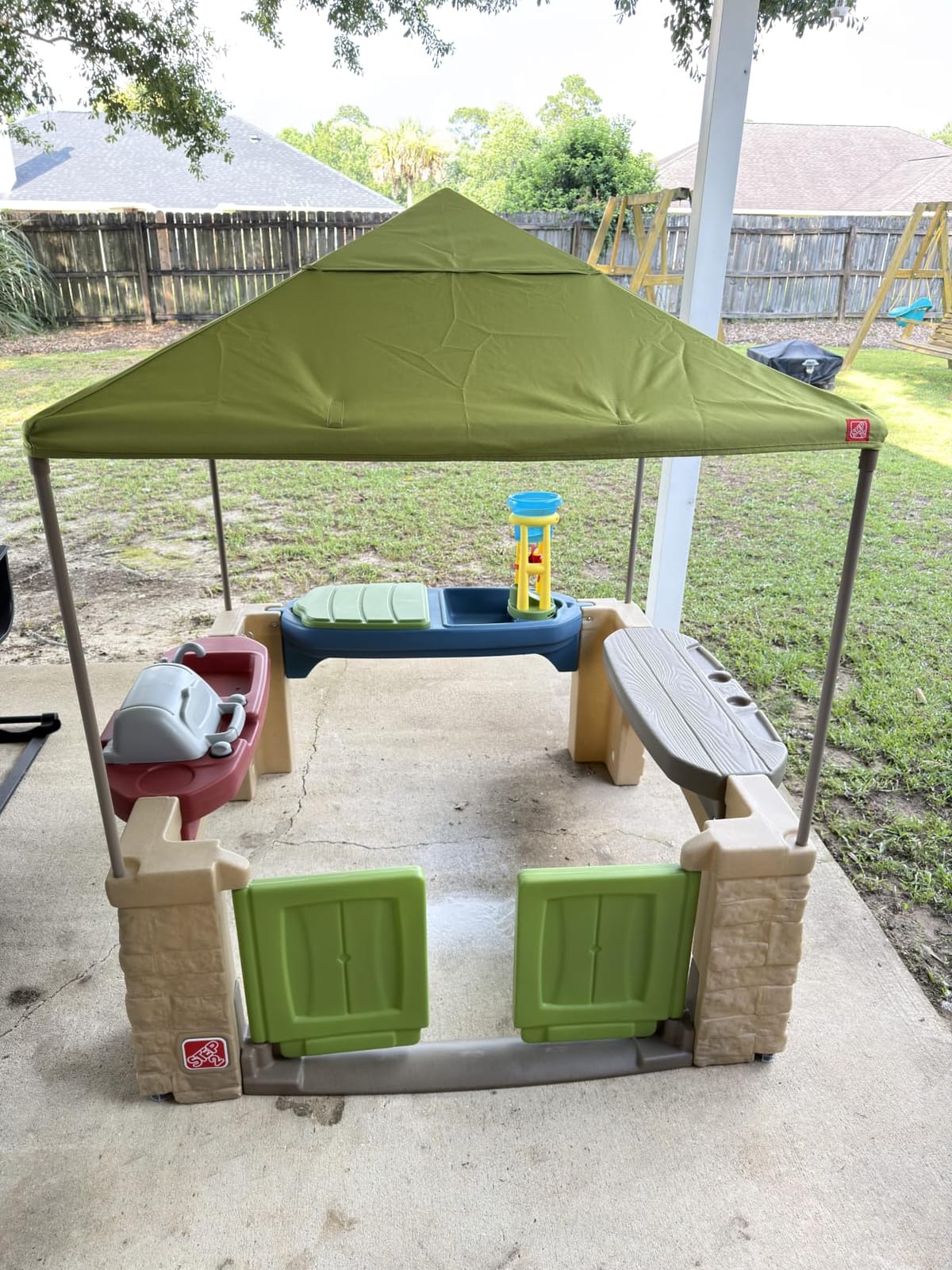
This is the smallest true footprint in the guide at 47.5 inches square, which makes it the pick when ground space matters more than physical play. The All Around Playtime Patio is a playhouse rather than a playset: a pretend grill, a large countertop, a water and sand table, four windows, and a 16-piece accessory set with pots, pans, plates, and sand toys.
What makes it interesting for a small yard is the removable canopy. Outdoors it shades the deck, and indoors you take it off to reclaim the ceiling height. That dual role is why it lands high on a list about small yards, where a structure that serves a patio in summer and a playroom in winter is genuinely useful.
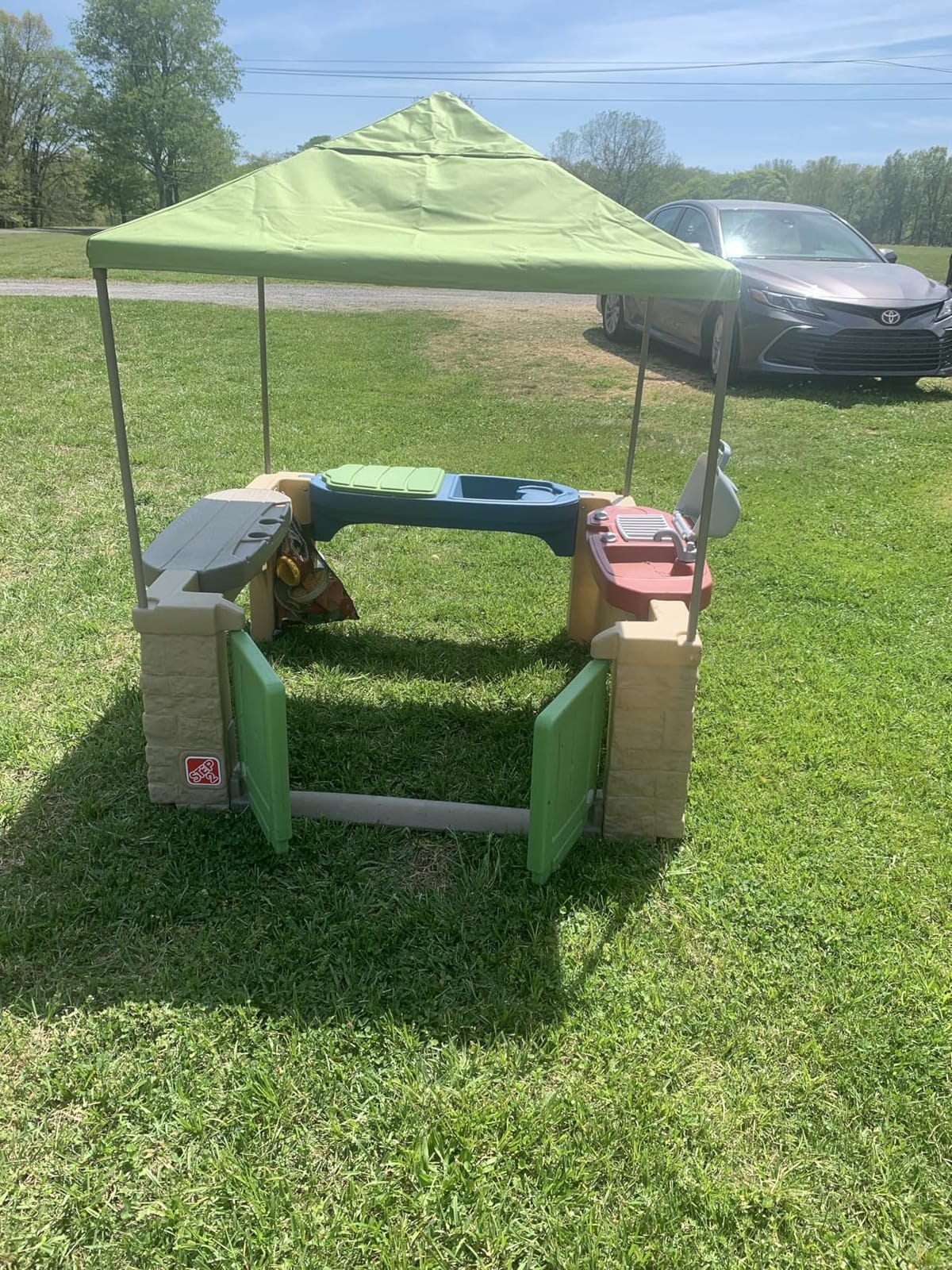
The age range is unusually wide for a playhouse, listed as 24 months to 96 months, and the doorway is wide enough for wheelchairs and strollers. That is a real advantage if you have more than one small child, because several can be inside at once rather than taking turns at a single station.
Cleaning is trivial. The double-walled plastic wipes down with disinfectant or household cleaners, which matters a great deal if the structure ends up under a patio overhang or in a covered corner. The unit weighs 20.2 kg, so moving it takes two people or a dolly.
Where This One Fits and Where It Does Not
At 47.5 inches square, the required clear ground with 6 feet of margin is roughly 10 feet by 10 feet. That is the smallest usable envelope in this guide, and it will fit beside most suburban houses in a corner that a slide set could never occupy.
The catch is that this structure has no slide, no climbing, and no swing. If your child burns energy through gross-motor play, they will use this for role play and then go find the grass. Parents on r/toddlers describe that pattern clearly: the imagination-driven items get daily use, and the physical ones get occasional use.
Who Should Skip It
Skip it if you are buying a playset for a child who is climbing and sliding constantly, because none of that hardware exists here. Also consider the assembly step carefully: adult assembly is required and several accessory pieces attach separately, so budget an hour even though the main shell is straightforward.
If your doorway is narrow, plan ahead. Reviewers note the canopy panels have to come off before the unit will clear some doorframes, which matters if you intend to bring it inside for winter rather than leaving it out year-round.
3. Step2 Woodland Climber II – Best Compact Set With Two Ways to Climb
Step2 Woodland Climber II Kids Playset, Ages 2 –6 Years Old, Toddler Slide and Climbing Wall, Outdoor Playground for Backyard, Sturdy Plastic Frame, Easy Set Up
Plastic climber
75 x 47 x 53.75 in
Two climbing walls and slide
2-6 years
Pros
- Sturdy frame that does not tip when climbed on
- Two steering wheels plus ladder slide and two climbing walls
- Under-deck hideout sparks imaginative play
- Earthy colors blend into a backyard
- Rinses clean easily
Cons
- Assembly is the hardest part with the slide and steps tight to fit
- Takes roughly 2.5 hours for one adult
- Wheels on the steering accessories spin poorly
- Larger footprint than most toddler playsets
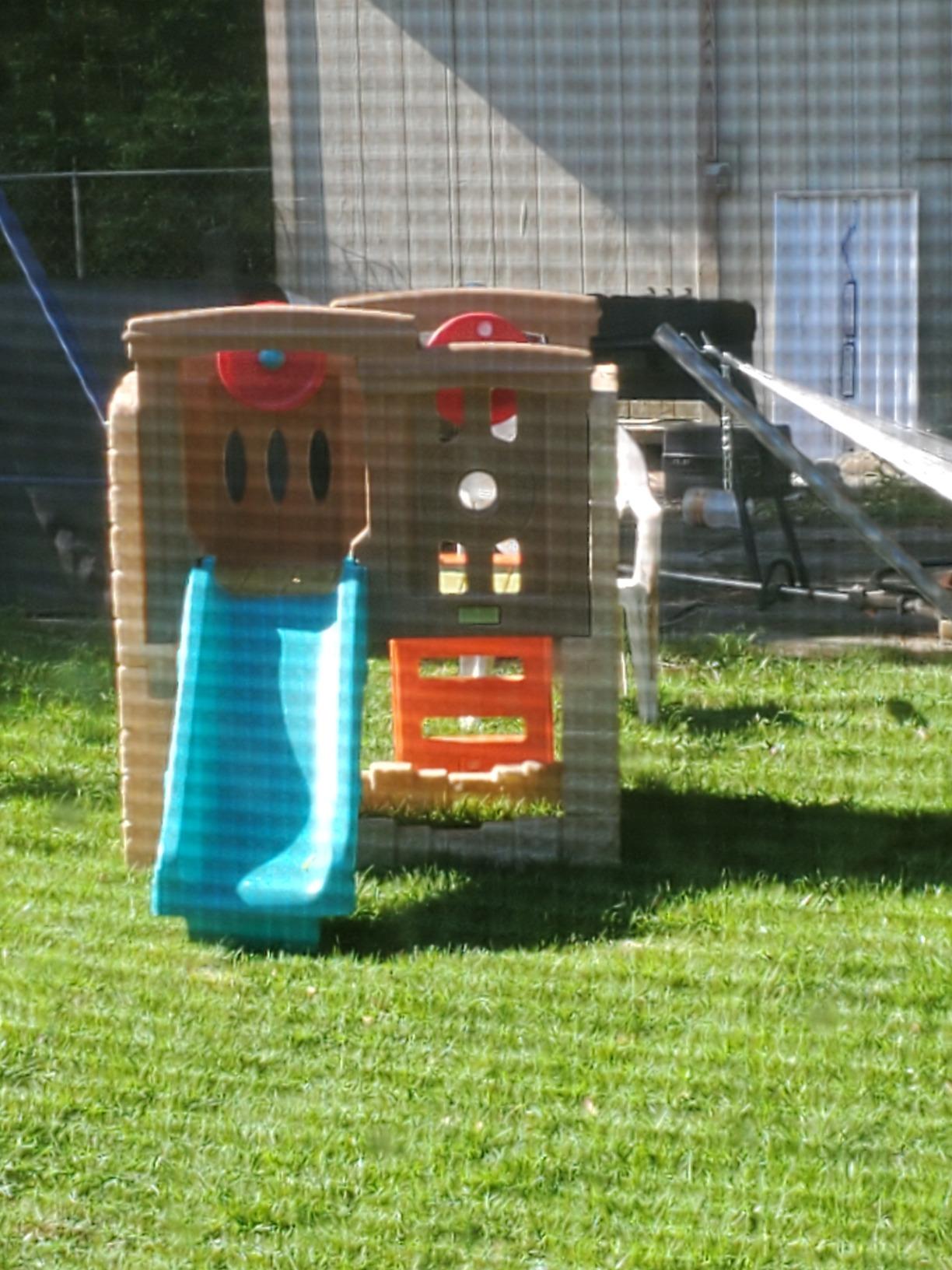
The Woodland Climber II is the best option when a toddler needs more physical challenge than the Game Time Sports Climber offers. Two climbing walls flank a roomy deck, with a slide, a ladder, two steering wheels, and an under-deck area that works as a fort or a toy stash.
What sets it apart from other plastic climbers here is that reviewers describe the frame as solidly built and rarely tipping. With a 75 by 47 by 53.75 inch footprint and a maximum of two players, it is a bigger structure than the first two picks, but it is still far smaller than any wooden set in this guide.
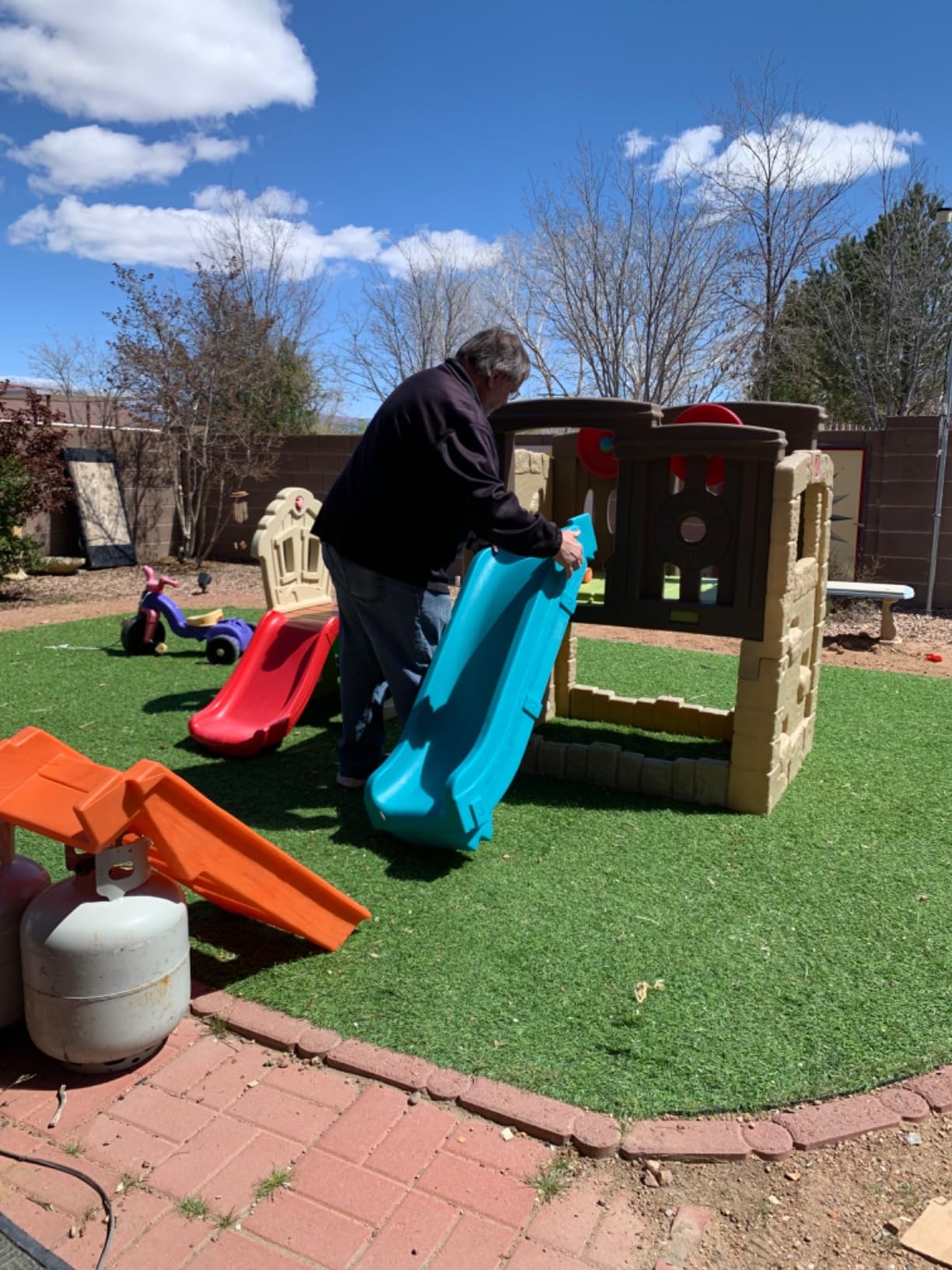
The nature-inspired styling is worth noting for small yards specifically. Earthy brown colors and realistic surface textures blend into a landscape rather than looking like a bright plastic appliance sitting in the middle of a lawn, which is a genuine advantage in a yard where every visual element competes for attention.
Everything rinses clean with a hose, there are no batteries to deal with, and Step2 covers it with a 3-year limited warranty. The double-walled plastic is described as resisting chips, fading, cracks, and peels, which is the same material claim as the other plastic sets here.
Does a 75-Inch Length Work in a Small Yard
It can, but the margin is tighter. With 6 feet of clearance on all sides, a 75 by 47 inch frame needs roughly 19 feet by 15 feet of clear ground. That is workable in a typical suburban backyard but tight in an urban lot, and the length means you need the slide exit on a long axis rather than a short one.
Parents on r/Parenting repeatedly raised the fear of over-buying and ending up with a set that dominates the yard. This is where that fear shows up. If your usable area is under about 300 square feet, the Sports Climber is a better fit even though it gives up the second climbing wall.
What to Know Before Assembly
The build is the weak point. Owners report roughly 2.5 hours for a single adult, and the slide and steps are tight to fit. Soapy water on the slide channel and a power drill for the hardware solve most of the friction that reviewers describe.
A few buyers also note the steering-wheel accessories spin poorly, and several mention the price sits above smaller plastic climbers. If assembly time is a dealbreaker for your household, budget the afternoon rather than the evening.
4. Little Tikes Hide and Seek Climber and Swing – Best Four Stations in the Smallest Frame
Little Tikes Hide & Seek Climber and Swing, Indoor Outdoor with Slide – Easy Set Up – Toddler Playset, 53.50”L x 52.00”W x 41.00”H
Plastic
53.5 in L x 52 in W x 41 in H
Harness swing
40.8 kg max
Pros
- Four play stations in a compact 53.5 by 52 inch footprint
- Tool-free assembly that takes minutes
- Harness-style toddler swing keeps very young children secure
- Light enough to move between rooms or across the yard
- Works on carpet or rugs for indoor play
Cons
- Plastic base slides around on smooth or hard floors during swinging
- Slide is short so bigger toddlers outgrow it quickly
- Swing must be undone to let another child use the structure
- Compact platform is a tight seat for an older child
The Hide and Seek Climber and Swing packs four stations, a slide, a swing, a rock wall, and a platform, into 53.5 by 52 inches of floor. That makes it the most feature-efficient footprint in the guide, and the only compact plastic set here that includes an actual swing.
What sets it apart for the youngest end of the range is the three-point safety belt harness on the swing seat. That is not a belt-style seat a toddler can slip out of, and combined with a beginner-friendly rock wall and a 19.75-inch slide height, it is one of the few options here rated for children from about 12 months.
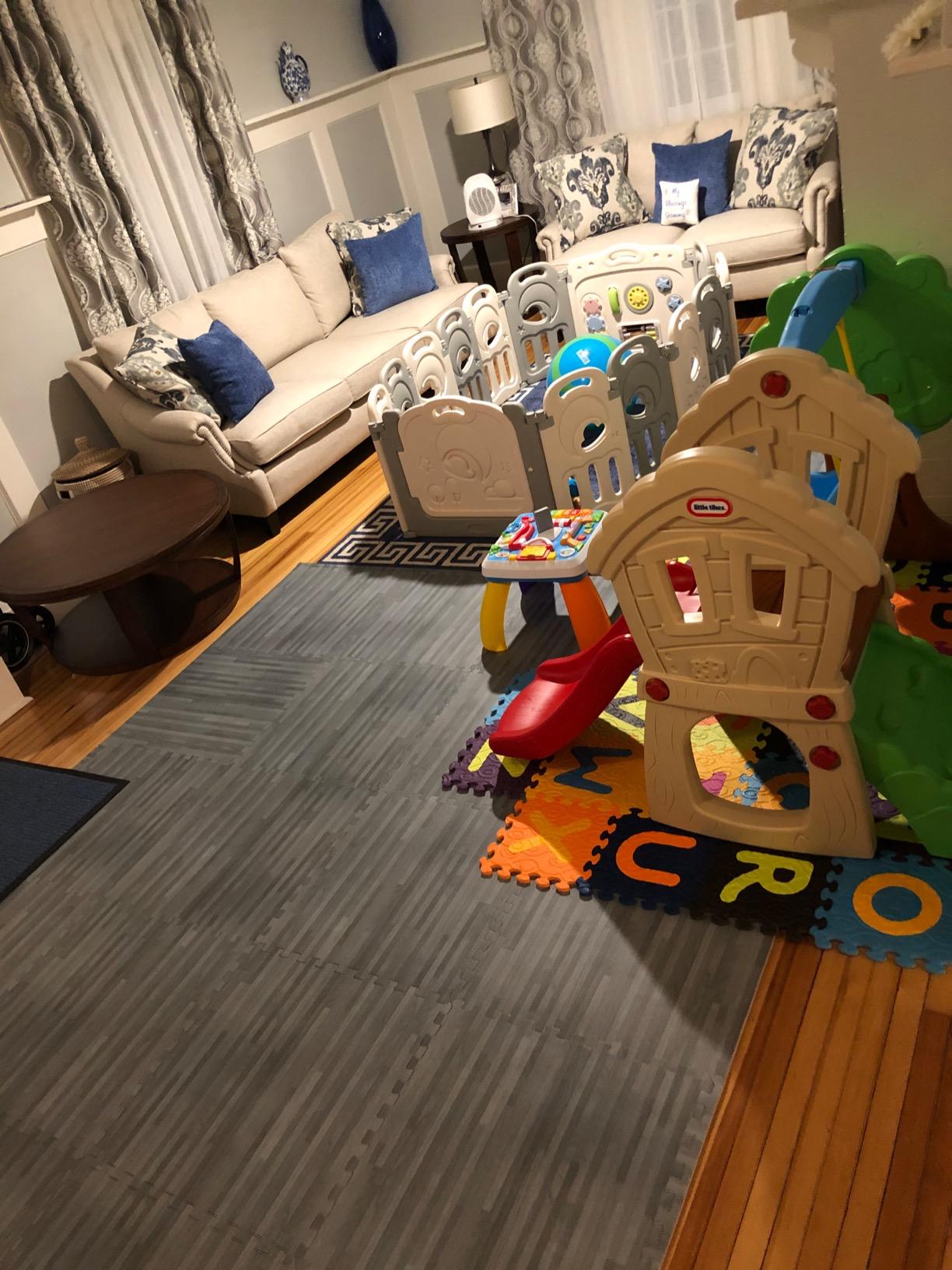
Assembly requires no tools at all, which reviewers consistently call out as the main reason to buy this set. It weighs roughly 36 pounds and works on carpet, so the same unit can move between a playroom, a garage, and a lawn depending on the weather.
The manufacturer lists a maximum recommended weight of 40.8 kg and a 90-day warranty against manufacturer defects, which is the shortest warranty in this guide. That is a fair reflection of where the product sits: a first-year play piece for a very young child rather than a long-term backyard fixture.
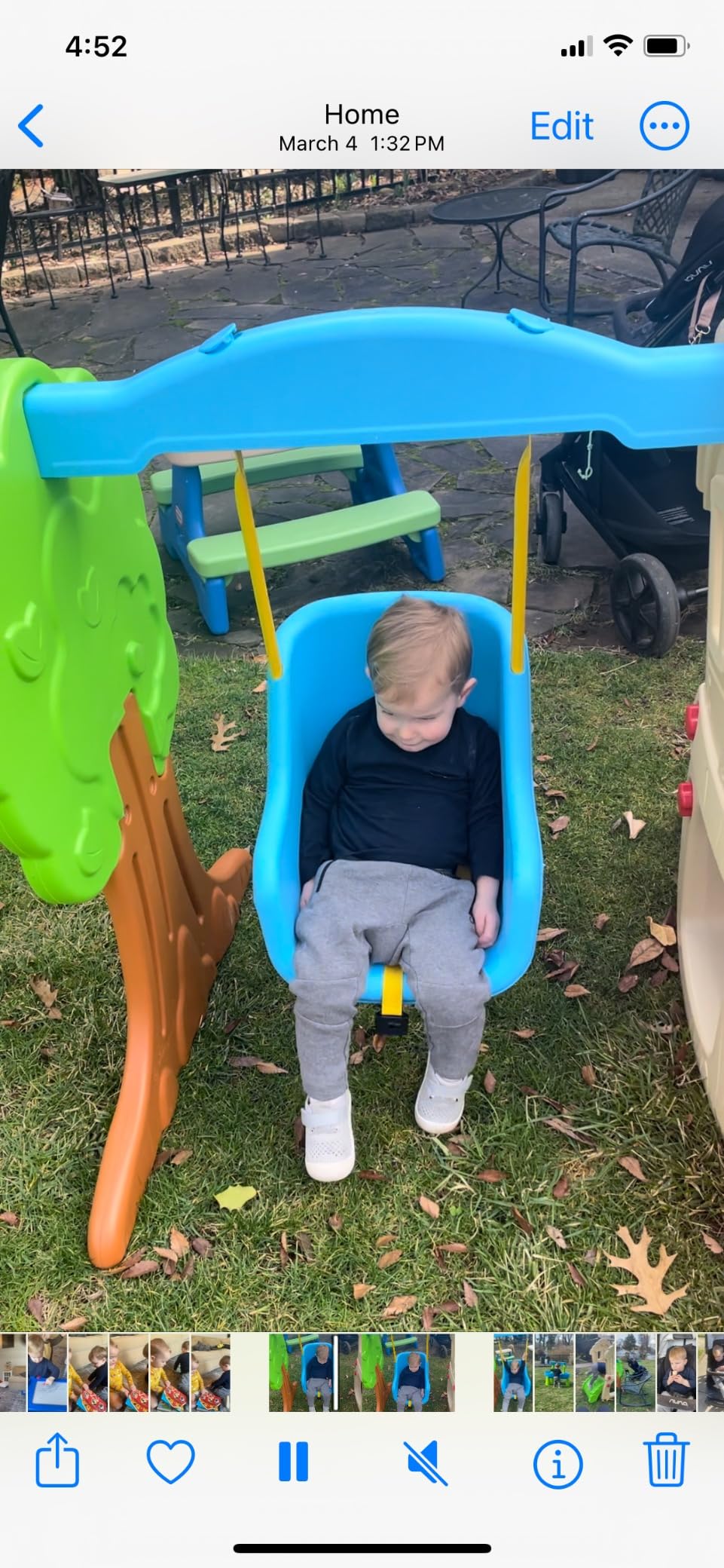
One Swing, One Child at a Time
The single-seat configuration is the detail most likely to surprise you. The swing is fixed to one side of the frame and has to be undone before another child can use the climbing side. In a household with two toddlers, that halves the usable capacity of a structure that looks, from a distance, like it has room for a crowd.
Buyers also report the plastic base slides around on smooth or hard floors while swinging, and that the short slide gets outgrown quickly. On grass or a soft surface this is a non-issue, but on a patio it matters.
Who Should Skip It
Skip it if you have two children in the 1-to-4 range who need to play at the same time, because the swing bottleneck will frustrate you within a week. Skip it if you need something that survives past the toddler years, because the 19.75-inch slide and the tight platform seat are age-limited by design.
There are also a few isolated reports of missing hardware and a swing that collapsed under a heavier child, so check the hardware inventory on arrival. It is worth spending five minutes inspecting the frame before the first swing.
5. BIERUM 4-in-1 Toddler Slide Swing Set – Budget Pick for the Tightest Yards
BIERUM 4-in-1 Toddler Slide Swing Set for Kids 1-2, Indoor/Outdoor
HDPE plastic
57.2 x 47.2 x 33.8 in
Slide swing and hoop
120 lb max
Pros
- Small footprint that fits a tight yard or living room
- Four activities in one with slide swing stairs and hoop
- Smooth plastic with no sharp edges
- Tool-free assembly with all parts included
- Suction cups and a safety baffle help secure the swing
Cons
- Compact size means a short slide and a low ceiling on play value
- Needs water or sand in the base to stay stable outdoors
- Small accessories such as the basketball net can break with regular use
- Not built for children above roughly 33 inches tall
The BIERUM 4-in-1 is the entry point of this list: four activities, a small footprint, and a 2-year manufacturer warranty. It is rated to 120 pounds, which is the highest stated capacity among the plastic sets here, though that number reflects material strength rather than recommended age.
Its real use case is a very young child in a very small space. At 57.2 by 47.2 by 33.8 inches, it needs roughly 14 feet by 11 feet of clear ground once you add safety clearance, and it works on a living room floor as readily as a lawn.
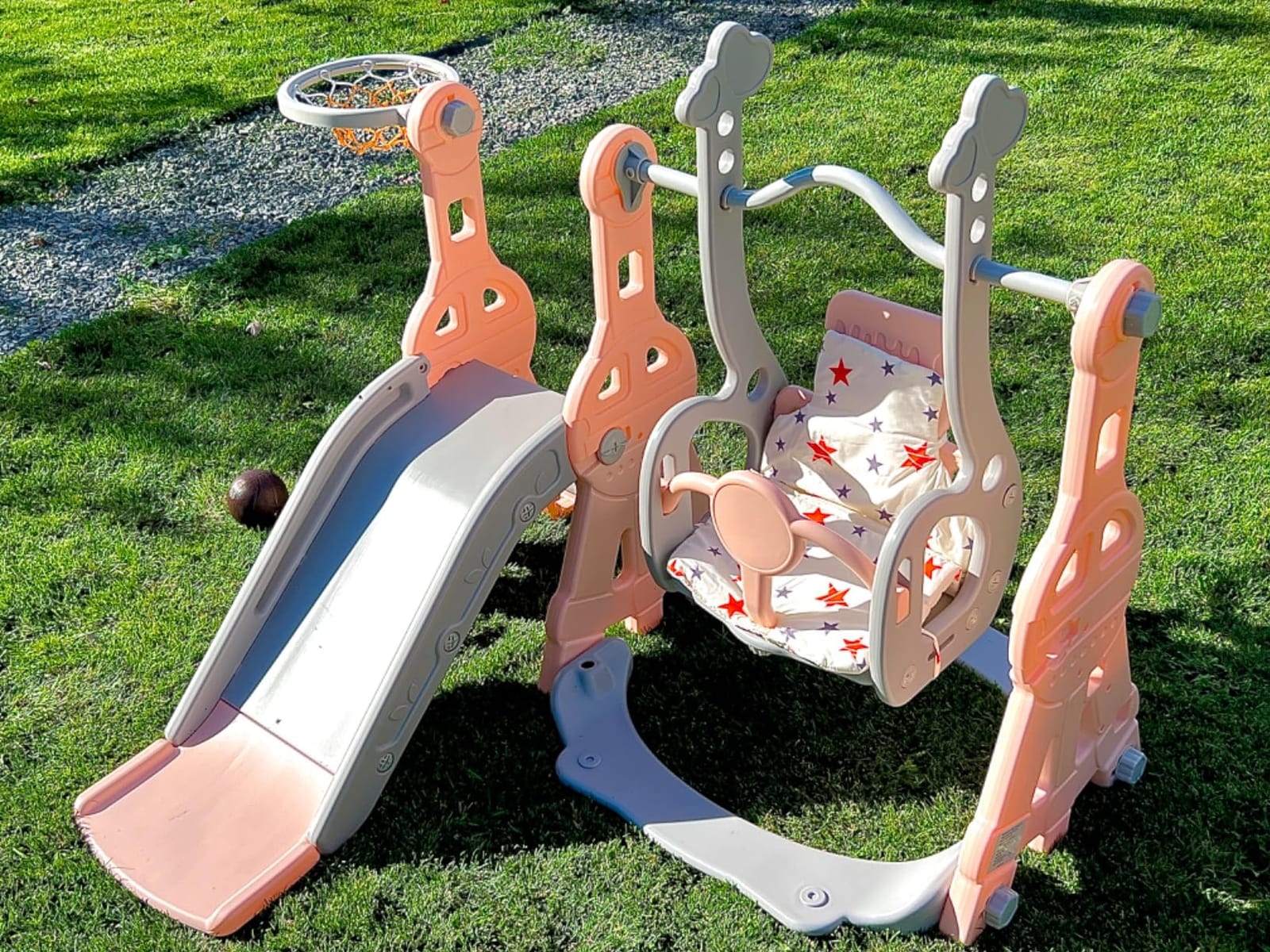
The staircase design is the part that impressed us. It uses closed steps with acceleration, deceleration, and buffer zones rather than an open ladder, which reduces the slipping risk that owners of simpler plastic sets complain about. The swing also carries a detachable cushion, a safety baffle to stop a child leaning forward, and four base suction cups.
The construction is high-density polyethylene certified to ASTM and CPSIA standards, described as odorless, and the sliding surface is smooth with no sharp edges. Assembly needs no additional tools and includes a basketball, hoop, cushion, socks, and the four suction cups.
Outdoor Stability Needs Extra Work
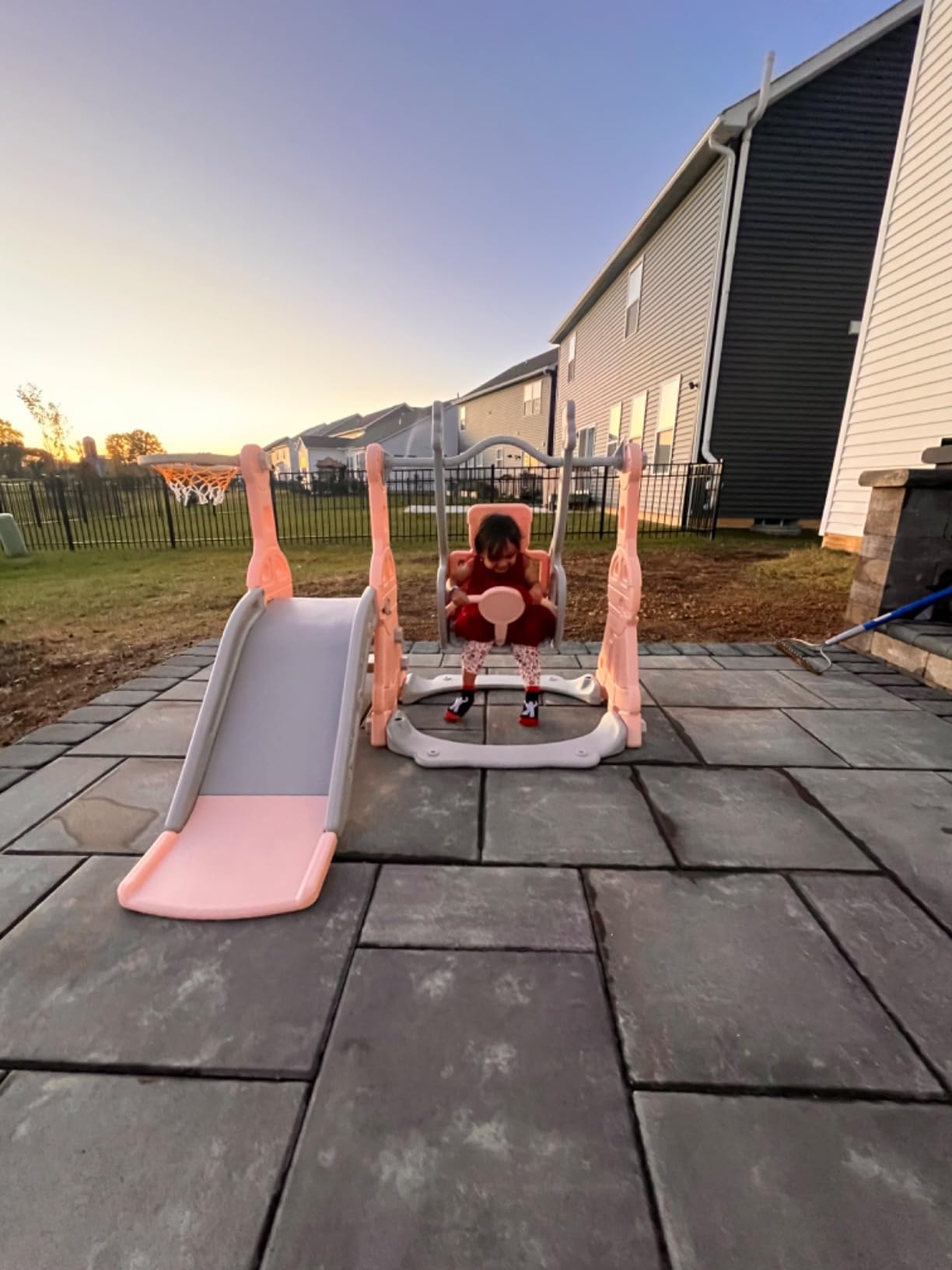
This is the one set here that asks you to modify the ground before you use it. The manufacturer recommends adding water or sand to the base for outdoor stability, and the suction cups alone are not enough on grass or a patio. Budget ten minutes and a watering can before anyone climbs on.
Buyers also report the small accessories take a beating. The basketball net in particular is called out as breakable after limited outdoor use, which is a fair warning if a toddler treats the hoop as a primary target rather than a side activity.
When to Choose This One
Choose it for a child aged 1 to 3 who is under about 33 inches tall and who needs four stations in a space where nothing else will fit. It is the least expensive way to cover a genuinely tiny yard or a patio with no permanent installation.
Skip it if you need a set that lasts beyond the toddler years, or if you want something that looks permanent in a finished garden. It is a short, intense solution rather than a backyard fixture, and treating it that way is how you get your value from it.
6. Amictoy Double Swing Set – Best Dual Swing Pair in a Metal Frame
Amictoy Swing Set for Backyard, 32″ Saucer and Belt Seat, 440 lb Frame
Metal frame
60 in D x 80 in W x 72 in H
32 in saucer and 26.2 in belt seat
440 lb capacity
Pros
- Two swing styles in one frame with a 32 in saucer and 26.2 in belt seat
- Low swing height is easy for toddlers to climb into unassisted
- Compact enough to move and fits small yards
- Roughly an hour of tool-free assembly
- Anti-rust paint finish for wind and rain
Cons
- Swings shift noticeably when both are in use unless anchored
- Glossy paint fades in strong sun over a season or two
- Nuts and bolts look nearly identical which slows assembly
- Children over roughly 6 outgrow the seat height quickly
Two swings, one frame, 80 inches wide. The Amictoy set pairs a 32-inch saucer swing in quick-drying Teslin fabric with a 26.2-inch polymer belt seat, which is a combination no other compact set in this guide offers. A saucer holds one child flat and invites them to lie down; the belt seat is the conventional upright swing.
The metal A-frame carries a stated capacity of 440 pounds, and the anti-rust paint finish is designed for wind and rain. At 60 inches deep by 80 inches wide by 72 inches high, the footprint is modest for a set that swings rather than climbs, and the low seat height means toddlers can climb in without help.
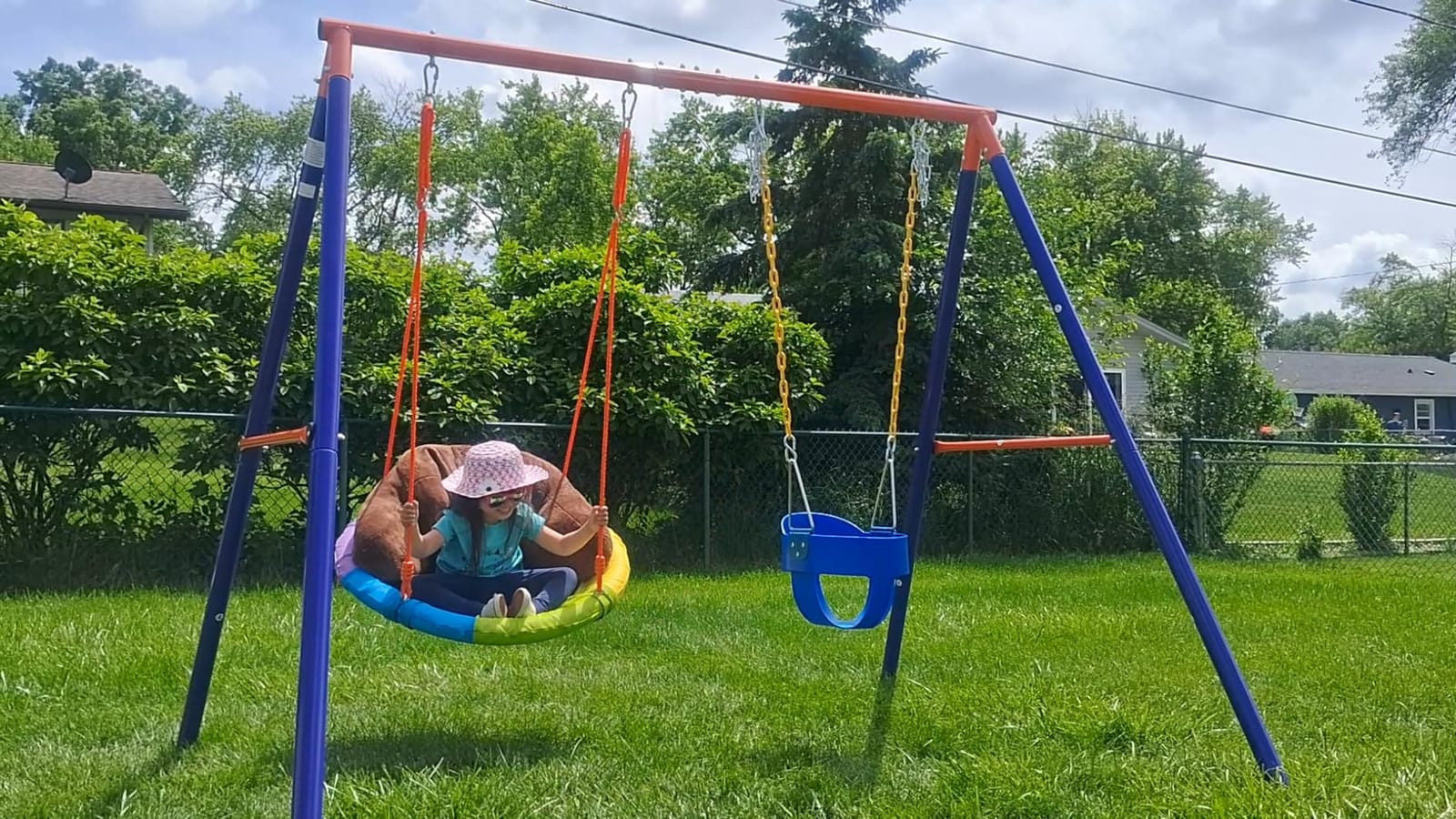
Assembly is roughly an hour and tool-free, with all hardware included and clear instructions. Buyers call out the small-yard fit specifically, and the frame is light enough for one person to reposition, which is a real advantage in a yard where the swing needs to move for mowing.
One number deserves a warning. The 440-pound figure describes the frame’s structural rating, not its intended use. The manufacturer is not certifying this set for adults, and the practical load is two children well under that ceiling.
Anchoring Is Not Optional
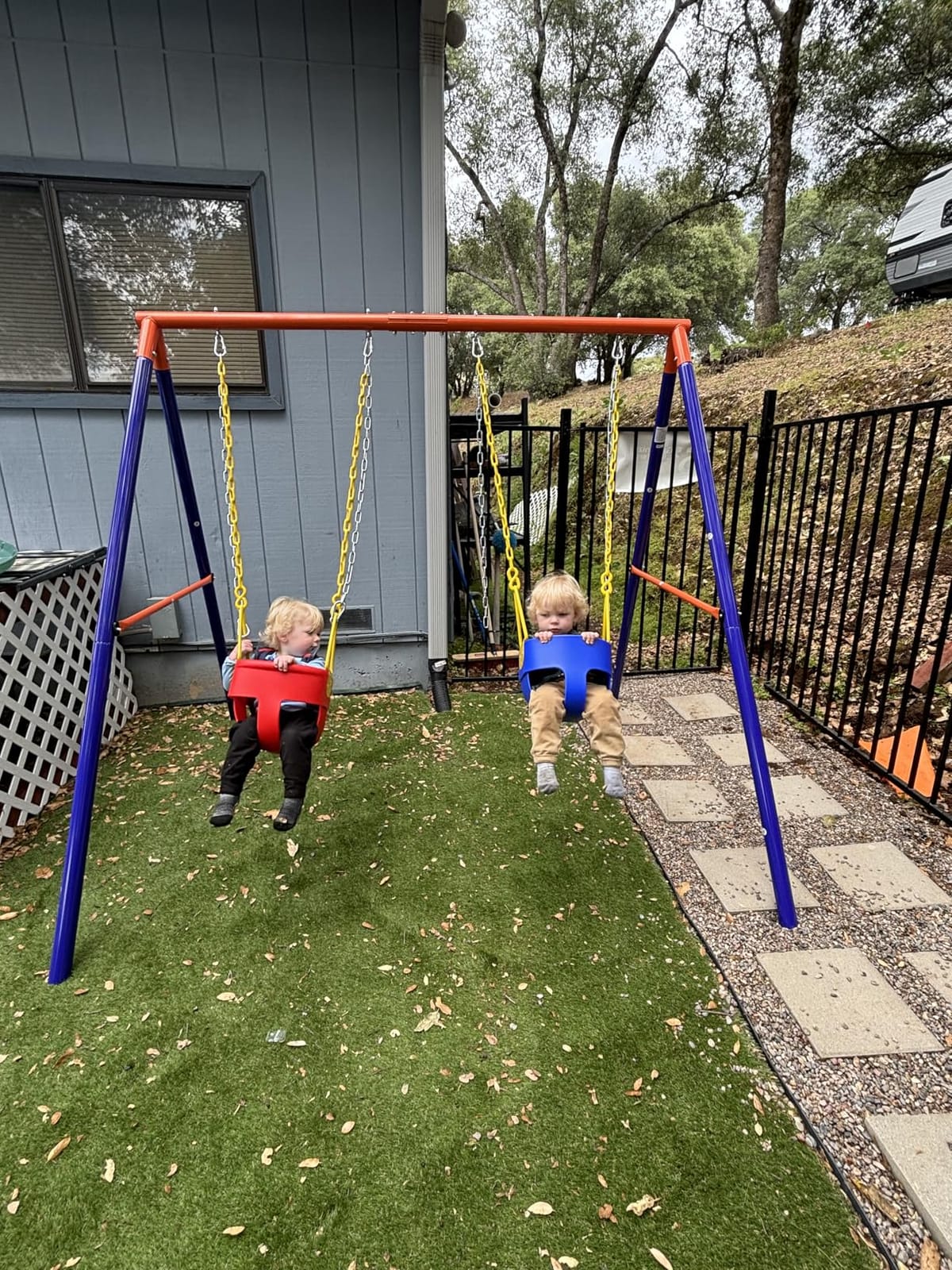
The most common complaint across reviews is that the swings shift noticeably when both are in use, and the fix is ground anchors. The set can be moved single-handed when unloaded, but the same lightness that makes it convenient lets it creep or lift under active swinging.
Plan the swing arc before you set the frame. A swing set needs open ground front and back, not just to the sides, and a 60-inch depth plus 6 feet of clearance at each swing end means you need close to 16 feet of depth for comfortable use.
Who Should Skip It
Skip it if your children are past about age 6, because the seat height is the limiting factor and taller children will scrape the ground. Also skip it if you have hard surfaces under the swing area with no rubber surfacing, since the seat height that works for a toddler does not work for a bigger child.
Two smaller issues to note: the glossy paint fades in strong sun over a season or two, and the nuts and bolts are nearly identical, which slows assembly more than the one-hour estimate suggests. Sort the hardware into groups before you start.
7. Trekassy 440 lb Capacity Swing Set – Best Metal Value for a Small Yard
Trekassy 440lbs Swing Sets for Backyard, 2 Seat Saucer & Belt Swing – Green
Alloy steel
64.57 in D x 86.61 in W x 66.93 in H
32 in saucer and belt swing
440 lb capacity
Pros
- Compact footprint works in small yards and even front lawns
- Two swing types suit a wide age range and a baby swing can be swapped in
- Carabiner height adjustment is quick as kids grow
- Included ground anchors hold in compacted soil
- Rust-resistant chains and wipe-clean seats
Cons
- Must be anchored or it can lift off the ground when swung hard
- Cannot build as much swing height as larger sets
- Ground anchors are hard to drive into rocky or compacted soil
- Screwing the frame together is tedious
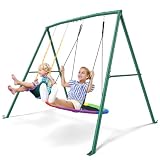
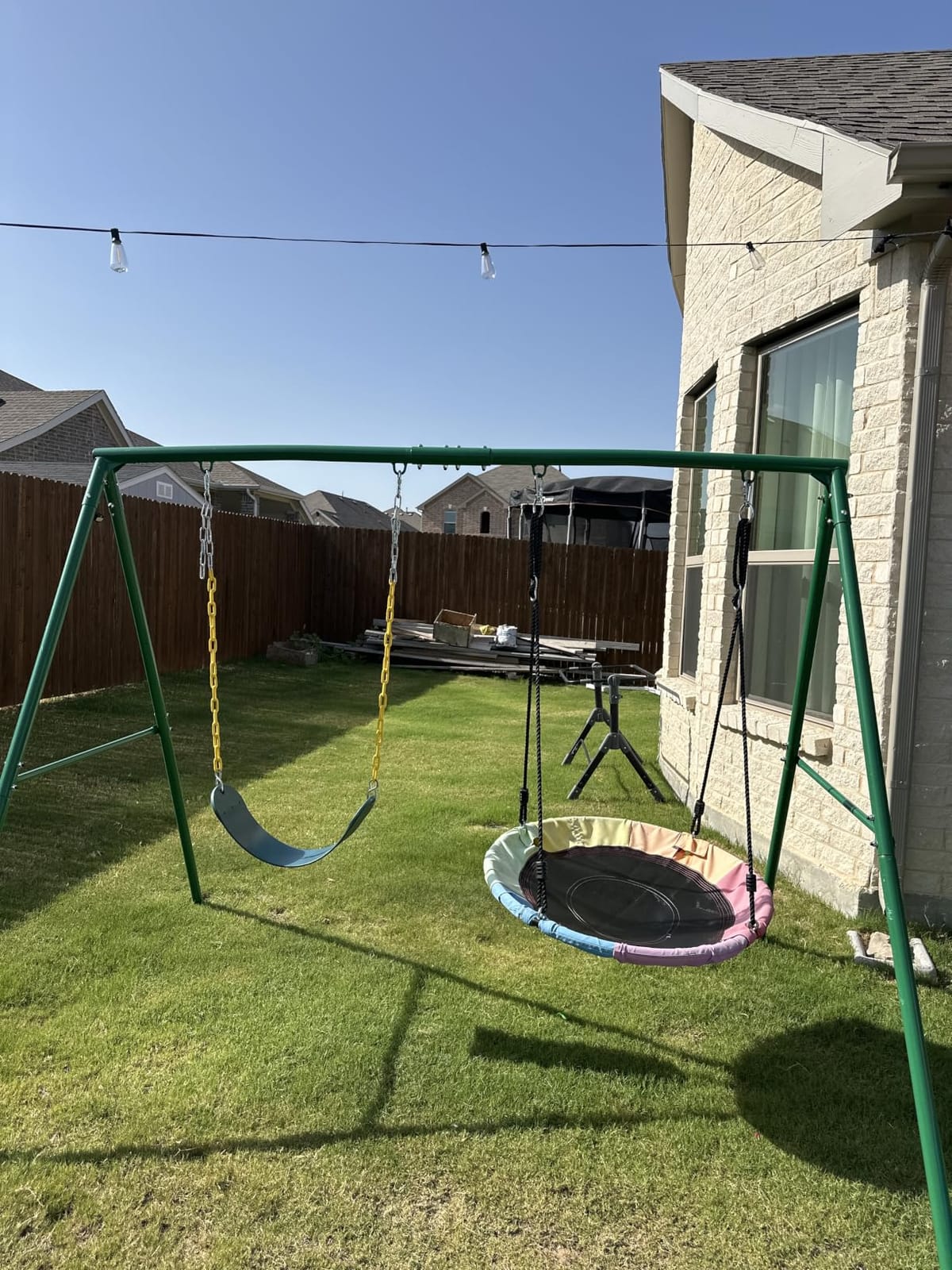
The Trekassy set is the strongest small-yard swing frame in this guide, and the reason is the seat combination plus the hardware. It ships with a 32-inch saucer swing on adjustable rope and a non-slip EVA belt seat, and reviewers note a baby swing can be substituted for the belt position as a child grows.
The frame is powder-coated alloy steel with multiple support bars and a stated capacity of 440 pounds. Ground anchors are included, and the chains on the belt swing are zinc-plated for rust resistance. At 64.57 inches deep by 86.61 inches wide by 66.93 inches high, it is wider than the Amictoy but shallower.
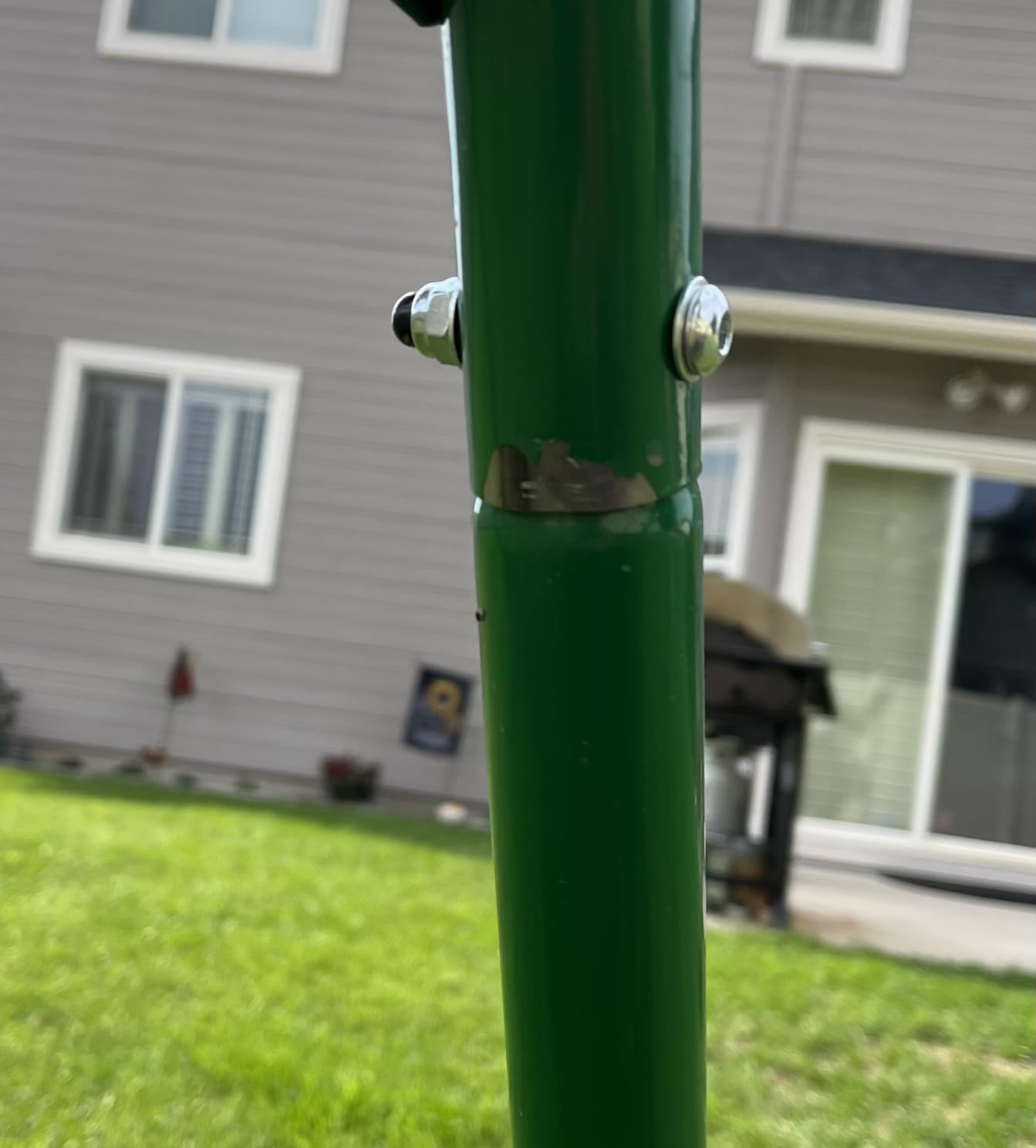
Two years of reviews point to a stable set that families keep using for several seasons, with children from toddlers up to about age 9 still swinging. The height adjustment is done with carabiners at pre-drilled holes, so changing the seat height as a child grows takes seconds rather than tools.
That wide age range is the reason this is the metal set we would put ahead of the larger Sportspower frames below for a small yard. You get a swing that a 12-year-old can still use without a structure that eats the whole lawn.
Anchors Decide Whether This Set Works
Reviews are near-unanimous on one point: buy separate sturdy ground stakes. The included anchors help, but the frame can shift or lift off the ground when swung hard, and compacted or artificial turf is where owners report the most movement.
Soak the soil before driving anchors in, and if your ground is rocky or hard, expect the anchoring step to be the hardest part of assembly. That is worth knowing before you commit, because a swing frame that moves is both unpleasant and unsafe.
Where It Falls Short
The trade-off for the compact frame is swing height. Buyers consistently note it cannot build as much height as larger sets, which means the seats hang lower. That is a benefit for toddlers and a limitation for older children, and it is also why the included ground anchors matter more than they would on a taller frame.
Assembly is tool-free apart from screwing the frame together, which owners describe as tedious. The seats wipe clean, which is a genuine advantage in wet seasons or with younger children who bring everything with them.
8. Sportspower Arcadia Metal Swing Set – Most Play Stations, but the Biggest Footprint
Sportspower Arcadia Metal Swing Set for Kids – Trapeze, 2-Person Glider, 5ft Slide, Anchor Kit, 6.1ft Durable Steel Frame – Outdoor Backyard Playset with 600 lbs Capacity
Steel frame
11.1 ft L x 8.3 ft W x 6.1 ft H
Trapeze glider and 5 ft slide
600 lb capacity
Pros
- Six play stations in one frame fitting up to six children
- Heavy duty 2 inch steel tubes with welded joints
- Vinyl-covered chains and adjustable swing seats
- Foam-padded frame legs
- Anchor kit included with lifetime limited slide warranty
Cons
- Largest footprint in this group at 11.1 by 8.3 feet so it needs real yard space
- Adult assembly required and takes several hours
- Best suited to ages 5-10 rather than toddlers
- Longer slide creates a fast exit that some younger children find intimidating
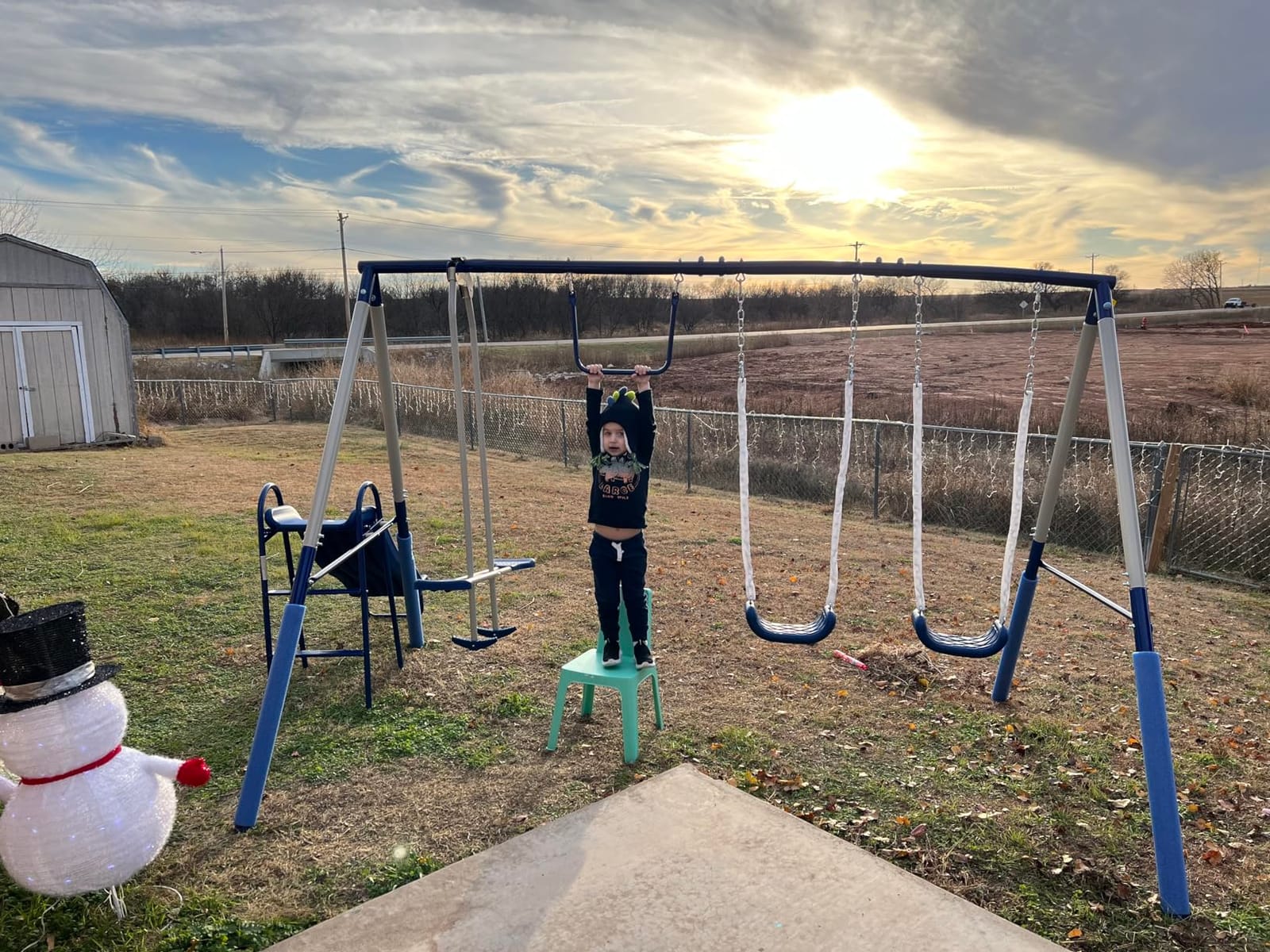
The Arcadia is the feature-packed set in this guide, with six play stations in one frame: two adjustable belt swings, a trapeze bar, a two-person glider, a five-foot wavy slide, and foam-padded leg covers. It is the only set here that comfortably handles a group, with room for up to six children.
Build quality is genuine. The frame uses two-inch weather-resistant steel tubes with welded joints and an A-frame design, powder-coated for corrosion resistance, and the chains are vinyl-covered so small hands do not pinch. The slide carries a lifetime limited warranty, and the frame a 1-year limited warranty.
It meets or exceeds ASTM and CPSIA safety standards, and an anchor kit is included. The vinyl-covered chains adjust as children grow, which extends useful life across siblings of different ages, and the foam-padded legs protect against the collision points most common in a busy set.
The honest issue is footprint. Assembled dimensions are 11.1 feet long by 8.3 feet wide by 6.1 feet high, and the unit weighs 81.4 pounds. With 6 feet of clearance on all sides, the required clear ground is closer to 23 by 20 feet.
Does 23 Feet of Space Rule It Out
For most small backyards, yes. The Arcadia needs a genuinely large lawn, not a compact urban lot. If your usable area is under about 400 square feet after you subtract the house, patio, and garden beds, this set is the wrong answer even though its feature list is the most impressive here.
The swing arc matters more than the frame dimensions. Two belt swings plus a glider need open ground front and back, and if that ground is shared with a patio, a swing hitting a chair is a predictable outcome.
Age Fit and Build Time
The manufacturer recommends ages 5 to 10, so this is not a toddler set. Reviewers also note the longer slide creates a fast exit that some younger children find intimidating at first, which is worth considering if you have a preschooler and a school-age child sharing the yard.
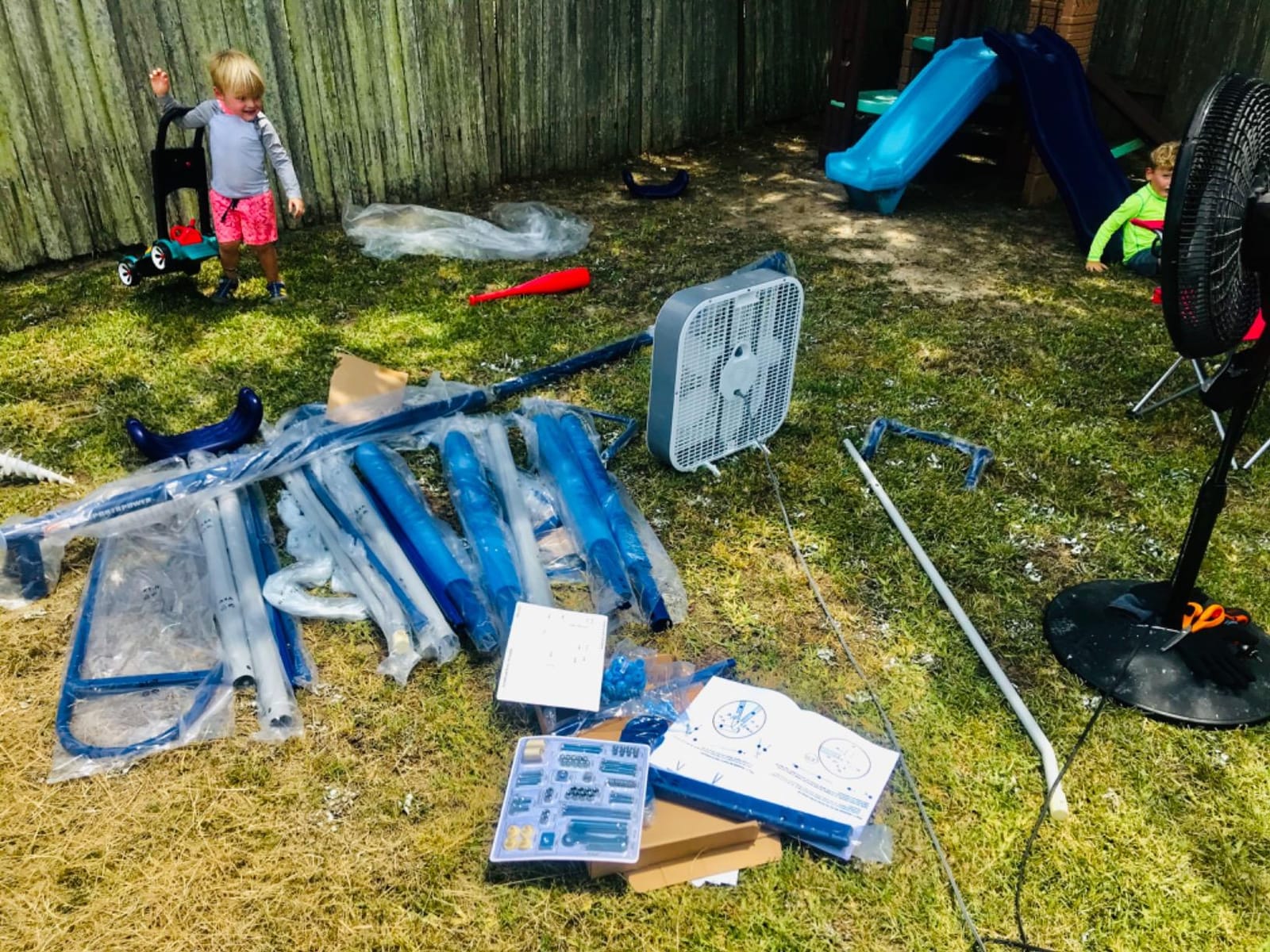
Assembly requires adults and takes several hours. For a metal set of this size, we would plan a full weekend and expect two people at minimum. If you intend to hire installation, get quotes before you buy, because a set this size is a significant labor item.
9. Sportspower Park Ridge Metal Swing Set – Built for Groups, Not for Small Yards
Sportspower Park Ridge Metal Swing Set for Ages 3-8, 2 Swings, Standing Swing, Roman Glider, Teeter Totter, on 5ft Slide, 6.1ft Durable Steel Frame, Anchor Kit, 800lbs
Powder-coated steel
90.55 in D x 159.45 in W x 72.83 in H
Teeter totter and Roman glider
800 lb capacity
Pros
- Five activity zones including a teeter totter and Roman glider
- Powder-coated steel frame rated to 800 lbs total
- Anchor kit included and chains are PVC-covered
- Foam-padded legs add safety around the frame
- Holds a group of cousins and friends playing at once
Cons
- Very wide at 159 inches so it needs a large yard and careful leveling
- Small printed labels and similar washers slow assembly
- Some report slide ladder steps breaking after light use
- Teeter totter is short and can pinch small hands
We include the Park Ridge for completeness rather than as a small-yard recommendation. It is the largest set in this guide by a wide margin at 159.45 inches wide, and it is built for a specific situation: a household that regularly has a large group of children in the yard.
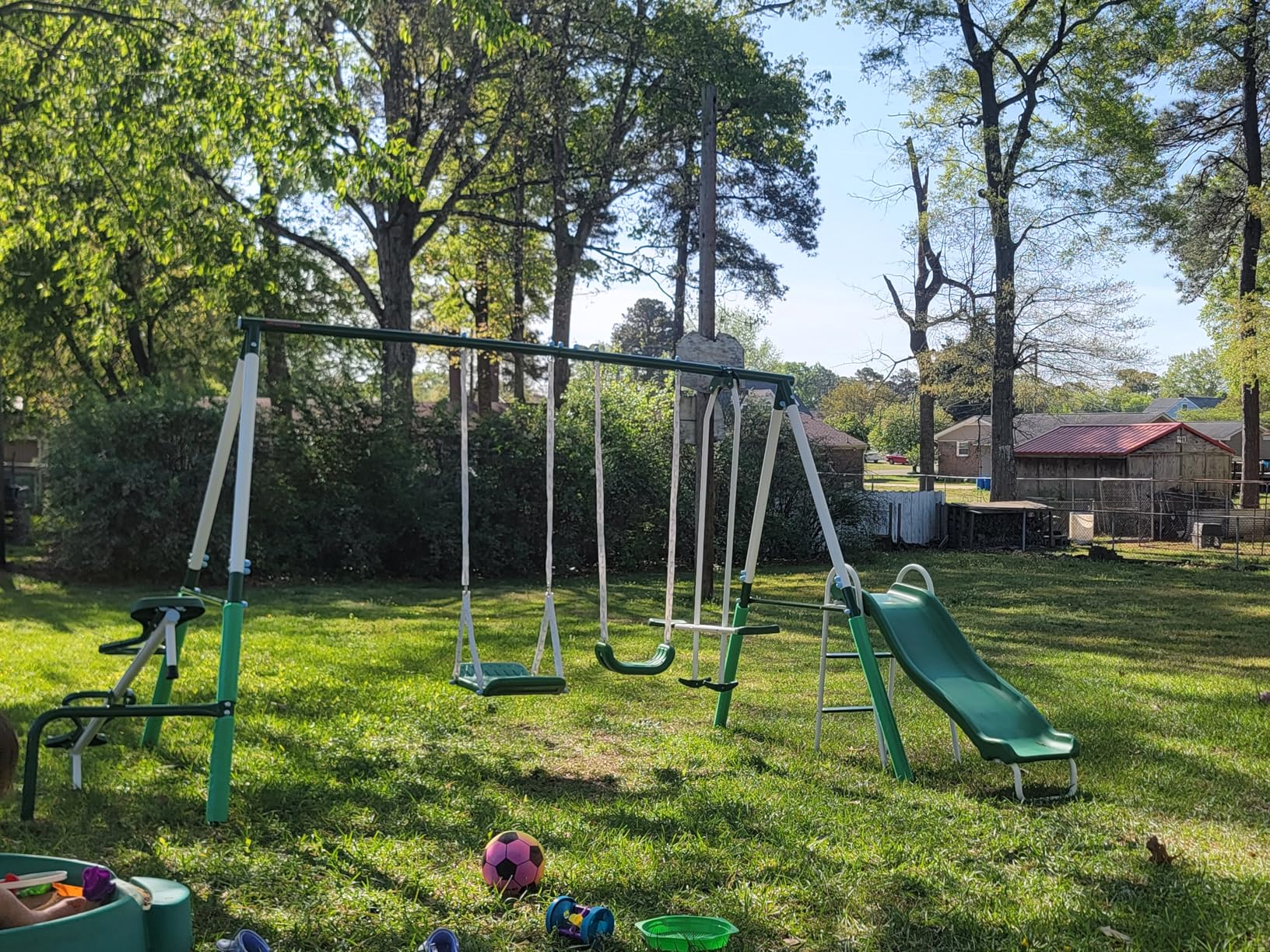
The feature count is high. There is a teeter totter, a 5-foot wavy slide, a two-person Roman glider, a standing or sitting blow-molded swing, and two blow-molded belt swings, with a frame rated to 800 pounds total for up to eight children at 100 pounds each.
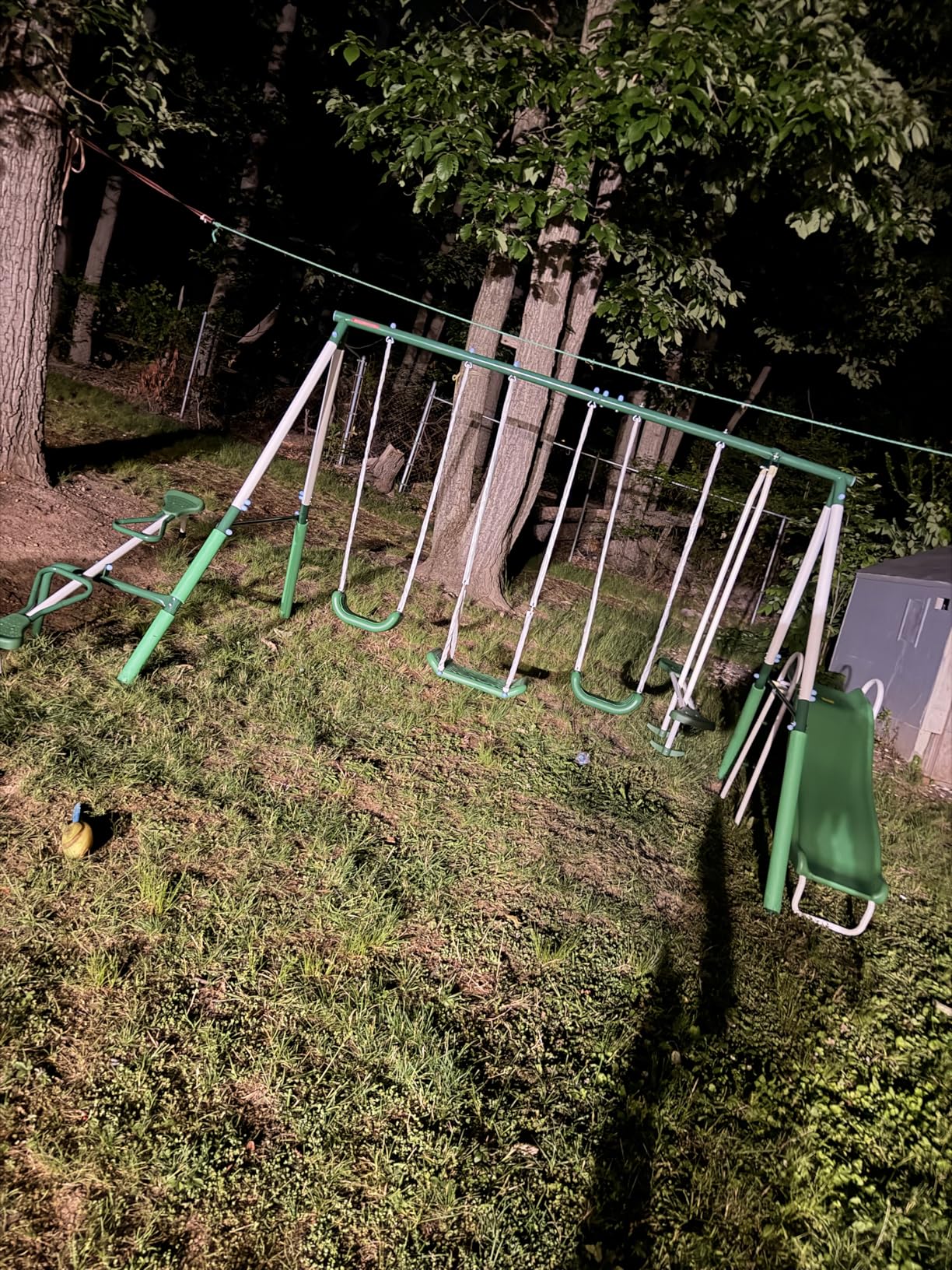
Safety details are solid. The chains are PVC-covered, the frame legs are foam-padded, the set meets or exceeds ASTM and CPSIA standards, and a four-piece anchor kit is included. The slide carries a limited lifetime warranty, and the corrosion-resistant powder-coated frame is rated for ages 3-8.
Owners mostly report that children and their friends use it daily and that the set looks attractive once assembled. The 4.1 rating here reflects genuine complaints, not noise, and they are worth reading before you buy.
Why We Do Not Recommend It for Small Yards
At 90.55 inches deep by 159.45 inches wide, adding 6 feet of clearance on all sides means you need roughly 24 feet by 27 feet of clear ground. That is a suburban backyard, not a small one, and the width also means the ground must be level along a long axis.
The assembly complaints are concrete: printed labels are too small to read and the washers are hard to distinguish, both of which turn a build into an evening-long puzzle. We would not buy this set without a second adult and a printed manual in hand.
Quality Concerns Worth Reading
Some reviewers report slide ladder steps breaking after light use, and one report describes hardware already rusting during disassembly. The teeter totter is short and can pinch small hands, which matters if you have children under 5 using the yard.
Our honest take is that this set delivers capacity the others do not, and it does so by demanding space. If you have the room and regularly host groups, the 800-pound frame and eight stations are real. If your yard is small, the Trekassy in position 7 gives you a similar swing experience in a third of the width.
10. KidKraft Appleton Wooden Swing Set – Best Wooden Set, With a Real Age Ceiling
KidKraft Appleton Wooden Swing Set, (Amazon Exclusive)
Wood with plastic slide
108 in D x 123 in W x 95 in H
Rock wall sandbox and swings
36 months-7 years
Pros
- Cedar-family wood with a water-repellent stain
- Rock wall wavy slide two swings sandbox and chalk wall
- Low deck height suits toddlers and keeps parents comfortable
- Instructions extremely detailed with pieces stamped and hardware bagged
- Holds up well after a season outdoors
Cons
- Assembly takes 4 to 8 hours for two people and longer solo
- Cedar planks are soft and can split if screws are overtightened
- Small by playground standards and kids over about 5 outgrow it
- Slide ejects children quickly
- Box is heavy and large so moving it takes more than one person
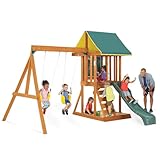
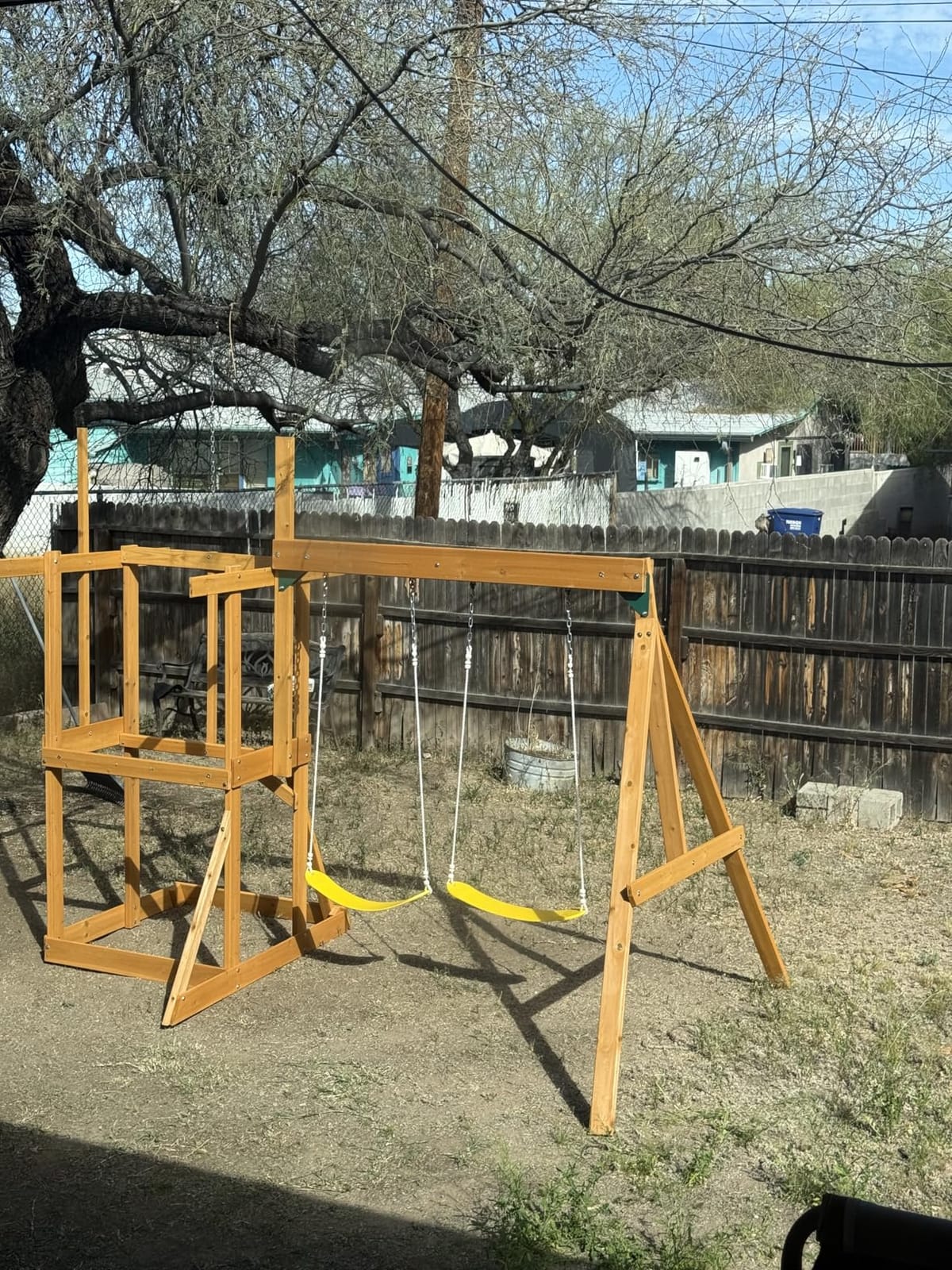
The KidKraft Appleton is the only wooden set in this guide, and it earns its place by packing five play elements into a frame that is only 123 inches wide: a rock wall, a wavy slide, two swings, a below-deck sandbox area, and a chalk wall, with a tarp canopy shading the upper deck.
What makes it worth the extra effort is the wood itself. The lumber is pre-treated with a water-based stain that includes UV and mold protection, the manufacturer rates it for ages 36 months to 7 years, and the warranty covers five years on parts. The stated capacity is 660 pounds across up to six seats.
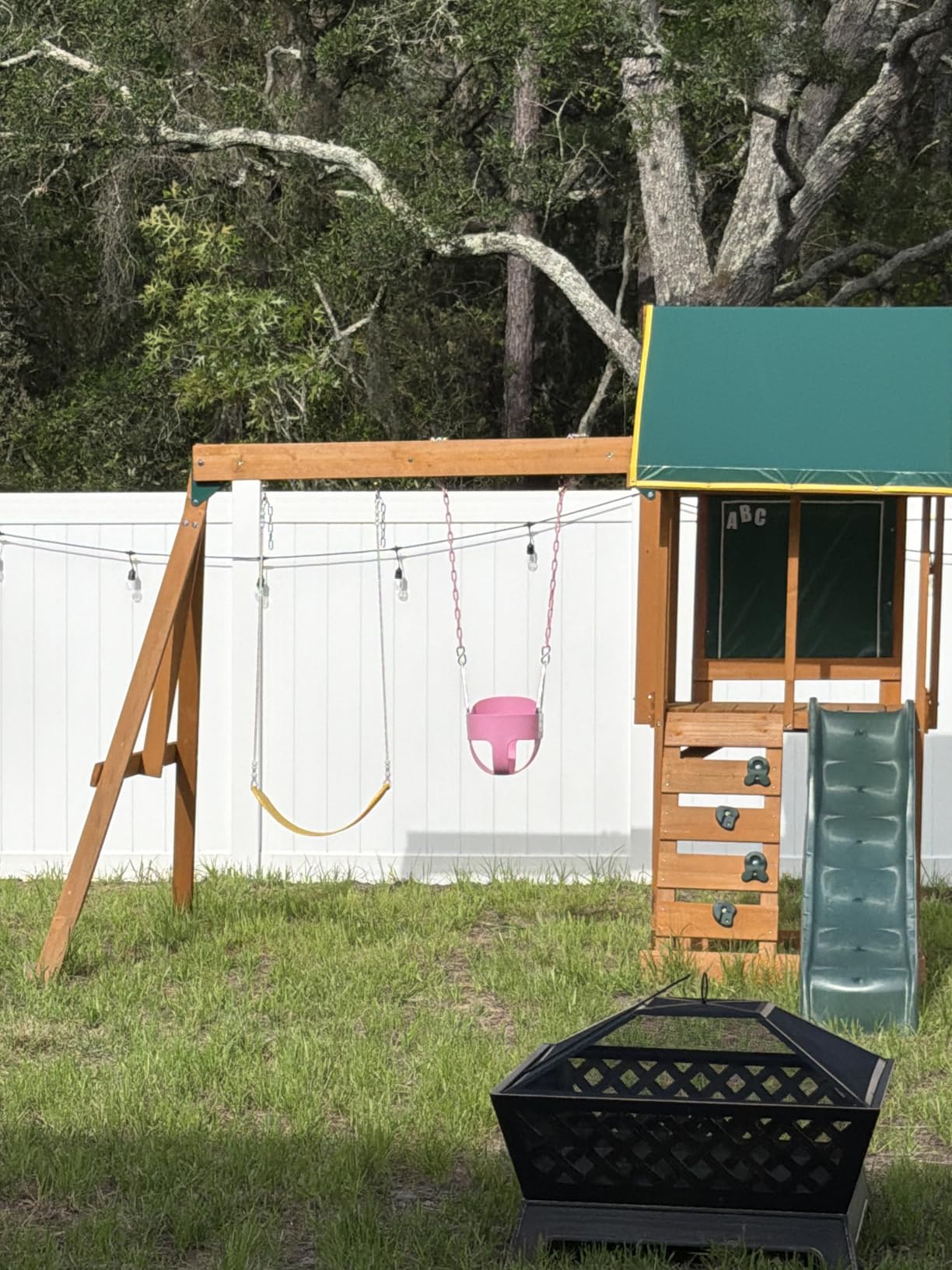
Buyers consistently call the value excellent for a full wooden set and single out the packaging: wood is precut and pre-drilled, every piece is stamped, and the hardware is bagged by assembly step. That level of organization is genuinely unusual and it is the reason this build is more predictable than most wooden sets.
The sandbox area is worth calling out specifically. Parents on community boards describe a large sandbox as the single most-used item in their yard, almost daily weather permitting, and the Appleton gives you one built into the frame with sand not included.
The Age Ceiling Is the Real Limit
Buyers are clear that this set is small by playground standards and that children over about 5 begin to outgrow it. The manufacturer rating of 36 months to 7 years is honest in a way that many listings are not, and it matches the parent feedback.
With 6 feet of clearance on all sides, a 108 by 123 inch footprint needs roughly 20 by 19 feet of clear ground. That is larger than most plastic sets here, though still well within a normal suburban yard.
Plan for a Full Day of Assembly
Two people should expect 4 to 8 hours, and a single adult considerably longer. The unit weighs 135 pounds and the box is large, so moving it after assembly takes more than one person.
Handle the cedar carefully. Owners report the planks are soft and can split or blow out if screws are overtightened, which is easy to do on the re-tightening pass a few weeks after the first build. Use an impact driver at low torque and check every connection before the first slide.
How Much Yard Space a Small Playset Actually Needs
Every playset needs 6 feet of clearance on all sides, and that rule is where most small-yard purchase plans break down. Add 6 feet to the length and 6 feet to the width of the footprint, and you get the real space requirement.
Worked example. The Step2 Game Time Sports Climber is listed at 62 inches wide by 30.5 inches deep, or roughly 5.2 by 2.5 feet. Add the clearance and you need about 17.2 by 14.5 feet of clear ground, not 13 square feet. A set listed as 10 by 10 feet needs close to 22 by 22 feet of actual clear yard.
The clearance matters for a reason beyond the swing arc. A child can fall from a slide exit, and a swinging seat travels well beyond its resting position. Six feet is the margin that accounts for both. If you have a fence, a hedge, a neighbor’s fence, a play pool, or a garden bed inside that margin, the set does not really fit.
A second factor specific to small yards is direction. Measure the longest clear run for the slide exit and the swing arc, not just the square. A 5-foot-wide yard can accommodate a 3-foot-wide set comfortably in the right orientation and fail completely in the wrong one.
What we found across the ten sets here: every product below roughly 100 inches wide can work in a modest suburban backyard once clearance is added, and everything above 120 inches wide is a large-yard purchase. That line falls between the KidKraft Appleton at 123 inches and everything else on the list.
Wood, Metal, or Plastic: Which Material Fits Your Yard
Cedar and redwood resist decay naturally, but wooden sets generally need a protective stain or sealant every 1 to 2 years, so wood buys you a better feel and a maintenance schedule. Metal needs no sealing and will not rot, but it can rust where coating fails. Plastic needs no maintenance at all until a part cracks.
Wood suits a family that wants a structure to stay for a decade and can accept a weekend build plus an annual re-seal. The KidKraft Appleton is the only example here, and its five-year parts warranty is the longest in this guide.
Metal suits coastal, humid, or shaded yards where rot is a genuine risk, and it suits families that want something movable. The Trekassy and Sportspower sets are powder-coated or painted steel; expect paint fade over a season or two in direct sun, which reviewers on the Amictoy set mention specifically.
Plastic suits small yards above all else, because the sets are the lightest, the cheapest, and the smallest, and they can be moved indoors. The tradeoffs are honest ones: a 3-year limited warranty rather than 5 years, colours that fade in prolonged sun, and a shorter age span. A parent on What to Expect noted their Costco set was well received specifically because it had two slides, which is a reminder that feature count drives satisfaction more than brand.
On the brand question that comes up constantly: Gorilla and Backyard Discovery build heavier sets that are excellent when you have the space, and KidKraft covers the budget-to-mid wooden range with models like the Appleton. For a genuinely small yard, the heavy-duty premium sets are the wrong shape, and a well-built compact plastic or metal set serves you better.
Sizing One Playset for a Toddler and a Preteen
One set can serve children aged 3 to 12 if you buy a swing-heavy design with an adjustable seat rather than a toddler climber with a fixed low deck. Adjustable height is the single feature that extends a set’s life, and it is the reason we rank the Trekassy set highly despite its lower rating.
Plastic climbers in this guide are all sized for ages 2 to 6, and the KidKraft Appleton is rated 36 months to 7 years. A parent in r/toddlers described prioritising a set their very active two-year-old would enjoy for years, and that goal is only realistic with a frame that grows.
Look for carabiner or chain adjustment on the swing, a toddler bucket that can be swapped for a belt seat, and a rock wall that stays useful at a taller climb. The Sportspower Arcadia does this well for ages 5-10, but its footprint makes it a large-yard answer.
Be realistic about the age-out point. Kids over about 5 tend to outgrow a compact wooden set, and a short slide gets abandoned quickly. The realistic answer for a wide age span is a swing set plus a separate ground-level feature, not one structure pretending to do both.
Assembly, Anchoring, and the Upkeep Schedule
Build versus buy depends almost entirely on your tools and your free weekend. A basic plastic climber assembles in 20 to 30 minutes, a plastic set like the Woodland Climber takes about 2.5 hours for one adult, a metal frame takes about an hour, and the KidKraft wooden set takes two people 4 to 8 hours.
Installation cost is a real budget line, not an afterthought. On r/Parenting, parents with a generous all-in playset budget treated installation as part of the figure, not a discount. We cannot quote a labor rate, but we can say plainly: anything with a wooden frame or an 11-foot metal footprint is a two-person job, and that is where professional assembly starts to be worth it.
For maintenance, check hardware and anchors twice a year, rinse plastic sets, and re-stain or re-seal wood every 1 to 2 years as the manufacturer guidance recommends. For metal, watch the coating at weld points and touch up scratches before they become rust.
Anchoring deserves its own line. The Trekassy, Sportspower Arcadia, and Sportspower Park Ridge reviews all warn that an unanchored frame can shift or lift. Soak the soil before driving stakes, and if your ground is rocky, choose a plastic set instead.
Before You Buy: Measure the Yard, Then Check the Rules
Measure the narrowest and longest clear runs of your yard, then subtract 6 feet from each. Whatever remains is the largest footprint that will work. Do this before you fall for a listing, because the difference between a set that fits and a set that must be returned is a wasted weekend.
Also measure the swing direction separately. A frame with a 60-inch depth needs close to 16 feet front to back once the arc is accounted for, and that run often crosses the middle of a yard where you walk to the back door.
Ground surfacing matters under swings and slide exits. If your yard is grass, fine. If it is bare soil, concrete, or gravel, add mulch or rubber surfacing under the fall zones. If you are short on space, surfacing competes with the clearance margin, so plan it into the measurement.
On permits, the short answer is that a residential swing set usually needs none, but you should check your HOA rules and any local setback or zoning requirements before you build. Some communities restrict visible structures above a fence line or require certain materials and finishes.
If you are also trying to reclaim space for storage, our guide to the [best storage sheds for backyards](https://www.spencerlocke.net/best-storage-sheds-for-backyards/) covers footprint planning in the same way, and [best gazebos for backyards](https://www.spencerlocke.net/best-gazebos-for-backyards/) is worth a look if you want a covered play area instead of an open playset. For the rest of the yard, [best compost bins for backyards](https://www.spencerlocke.net/best-compost-bins-for-backyards/) helps place something useful in the corner a playset cannot occupy.
One last practical note from the forums: what children use daily is often not the structure. A sandbox, a saucer swing, or a water table gets played with almost every day regardless of what else is installed. In a small yard, budget for one of those alongside a compact set rather than hoping the set alone fills the space.
Frequently Asked Questions
What is the best outdoor playset for a small yard?
The Step2 Game Time Sports Climber is our top pick for a small yard. Its assembled footprint is 62 inches wide by 30.5 inches deep, it holds up to 60 pounds, and it covers ages 2 to 6 with a slide, climbing wall, and basketball hoop. With 6 feet of clearance on all sides it needs roughly 15 by 13 feet of clear ground.
What is a good small swing set for a backyard?
For a small backyard, the Trekassy 440 lb swing set is a strong pick: a 32-inch saucer swing plus a belt seat, carabiner height adjustment, and a 64.57 by 86.61 inch footprint. The Amictoy double swing set is a good lower-cost alternative at 60 by 80 inches, and the Little Tikes Hide and Seek climber adds a swing in only 53.5 by 52 inches.
Is KidKraft or Gorilla playsets better?
Gorilla builds heavier, larger sets that last longer and suit big yards. KidKraft covers the budget-to-mid wooden range and makes more genuinely compact frames, like the 123-inch-wide Appleton. If your yard is small, KidKraft is the better fit; if you have 20 by 20 feet of clear space or more and want a structure that stays for a decade, Gorilla is worth the larger footprint.
Is it cheaper to build or buy a playset?
Building is usually cheaper on materials but not on time. A wooden swing set requires tools, experience, and a full weekend, plus ongoing stain and seal work every 1 to 2 years. Buying a compact set is cheaper overall for most small yards, and professional installation is the line item that pushes a build past the price of a mid-range set.
Do I need a permit to put a playground in my backyard?
Usually no. A residential swing set or playset on private property generally needs no building permit. You should still check your HOA or community rules, since some restrict structure height above a fence line or require specific materials, and any local zoning or setback requirements that apply to lot coverage.
How much yard space do you need for a swing set?
Add 6 feet of clearance to every side of the listed footprint. A 62 by 30.5 inch climber needs about 15 by 13 feet of clear ground. A set listed at 10 by 10 feet needs close to 22 by 22 feet. Also leave open space front and back for the swing arc, not just around the sides.
Our Picks for Small Backyards in 2026
For most small yards, the Step2 Game Time Sports Climber is the answer: a 62 by 30.5 inch footprint, four play options, and a 20-to-30-minute build. If your priority is pretend play rather than climbing, the Step2 All Around Playtime Patio fits in even less space at 47.5 inches square.
For swinging, the Trekassy set gives you the widest age range in the guide, and the Little Tikes Hide and Seek climber adds a harness swing in a 53.5 by 52 inch frame if your child is under 3. If you want wood and a built-in sandbox, the KidKraft Appleton is the one to plan a weekend for.
Start with a tape measure. Subtract 6 feet from every side of your available ground, and buy only what fits inside the number that is left. That single step prevents almost every disappointing playset purchase we hear about.