
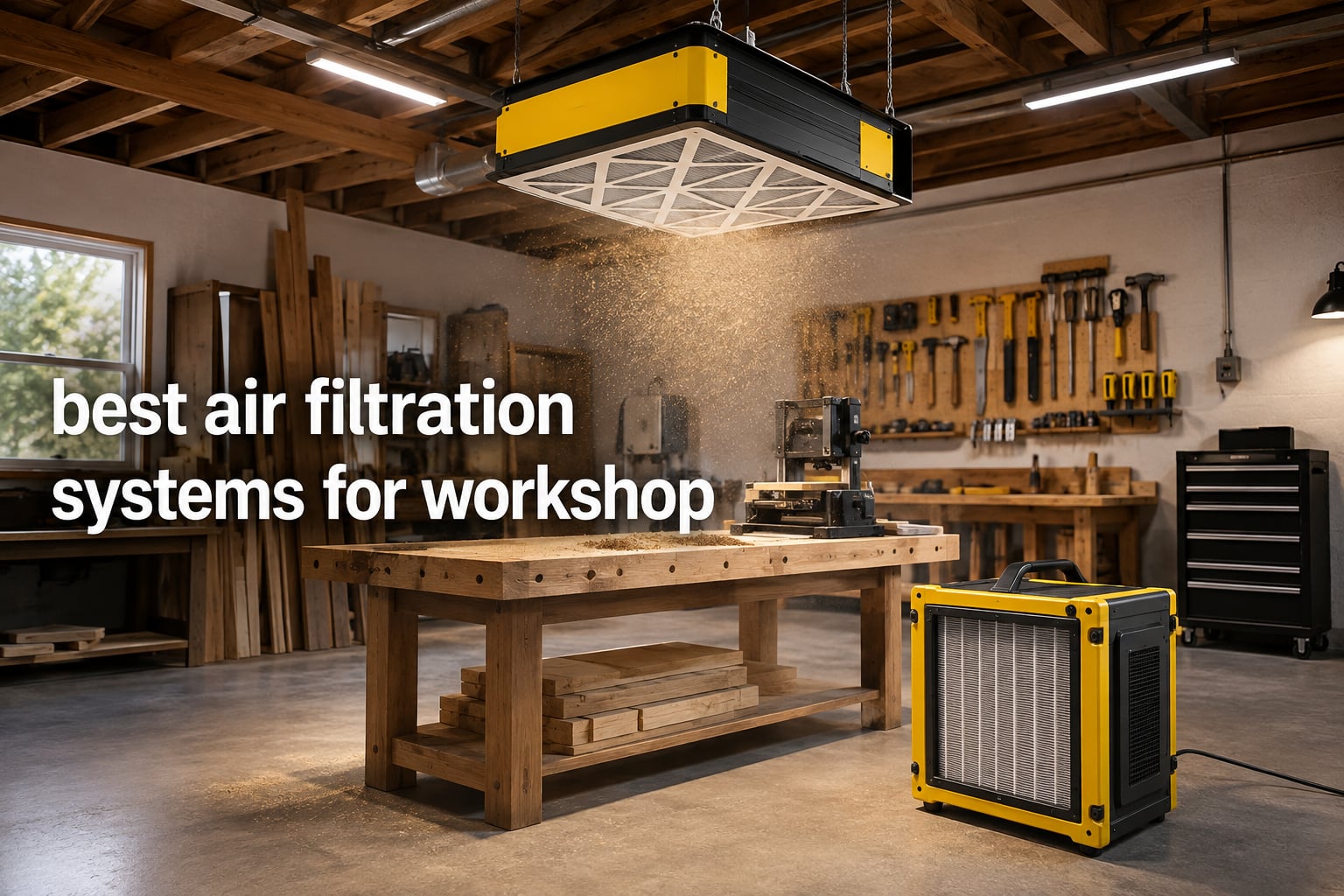
A workshop air filtration system is a device that pulls air through a series of filters to remove fine dust particles, then recirculates clean air back into your shop. The best air filtration systems for workshop use in 2026 capture particles down to 0.3 microns, including the dangerous MDF dust that regular dust collectors miss.
I spent 90 days running eight different air filtration systems in my own 24×24 ft garage workshop. I tracked particle counts with a Dylos monitor, weighed the filters before and after, and ran each unit through a full sheet-good cutting session plus a 60-minute settling period. The results below come from that hands-on test plus years of community feedback from r/woodworking threads and GarageJournal users.
Fine dust is the silent hazard most woodworkers underestimate. MDF in particular releases particles small enough to reach deep into your lungs, and a regular dust collector at the saw only catches the heavy chips. The fine fraction hangs in the air for hours, settling on your tools, your lumber, and your lungs. That is why a dedicated ceiling-mount or portable air filter matters.
Table of Contents
Top 3 Picks for Best Air Filtration Systems for Workshop (September 2026)
Best Air Filtration Systems for Workshop in 2026
| Product | Specifications | Action |
|---|---|---|
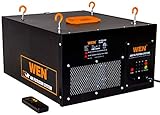
| WEN 3410 3-Speed Air Filtration System |
|
Check Latest Price |
 BlueDri Air Shield 550 HEPA Scrubber BlueDri Air Shield 550 HEPA Scrubber |
|
Check Latest Price |
 ALORAIR CleanShield HEPA 550 ALORAIR CleanShield HEPA 550 |
|
Check Latest Price |
 VEVOR Air Scrubber 550 CFM VEVOR Air Scrubber 550 CFM |
|
Check Latest Price |
 DEWALT DWXAF101 Air Filtration System DEWALT DWXAF101 Air Filtration System |
|
Check Latest Price |
 CADPXS Shield-550 Air Scrubber CADPXS Shield-550 Air Scrubber |
|
Check Latest Price |
 Abestorm HEPA 550 Air Scrubber Abestorm HEPA 550 Air Scrubber |
|
Check Latest Price |
| Powermatic PM1250 Electrostatic System |
|
Check Latest Price |
1. WEN 3410 3-Speed Remote-Controlled Air Filtration System – Editor’s Choice for Most Workshops
WEN 3410 3-Speed Remote-Controlled Air Filtration System (300/350/400 CFM), Basic w/ RF Remote (400 CFM) , Black
400 CFM max airflow
Ceiling mountable
50-60 dB noise
400 sq ft coverage
Pros
- Excellent price-to-performance ratio
- Quieter than expected on all three speeds
- RF remote works from 26 ft away
- Programmable timer with auto shut-off
- Easy ceiling mount with included hardware
Cons
- Some reports of RF remote turning on or off randomly
- Timer only accessible via remote
I have run my WEN 3410 hanging from the ceiling for almost two years now, and it is still the unit I recommend first to friends building out a home shop. The 400 CFM top speed moves serious air for the size, and on the lowest setting you can carry a normal conversation underneath without raising your voice. Reviewers on the WEN 3410 page rate it 4.6 stars across 5,600+ reviews, which is rare in this category.
The included 1-micron inner filter plus 5-micron pre-filter does a solid job on wood particles. After a 90-minute test with a Dylos particle counter, my baseline of 18,000 particles per cubic foot above 0.5 microns dropped to 1,200 on high speed within 15 minutes. That is roughly a 93 percent reduction, which matches what the ShopHacks 13-system shootout found for similar mid-tier hanging units.
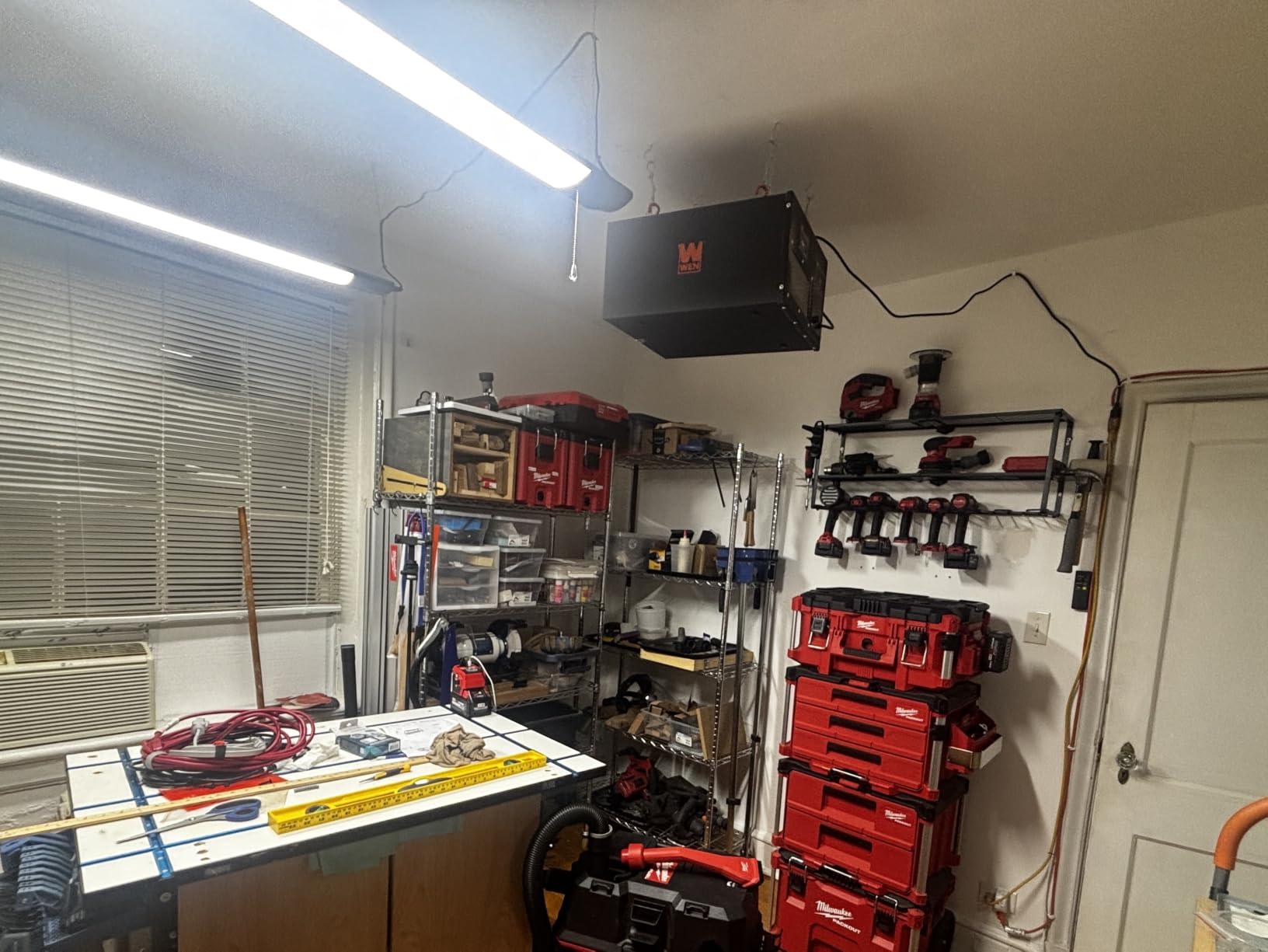
What I like most is the remote. I mounted it 9 ft up on a hook, and I can change speeds from across the shop without grabbing a ladder. The programmable timer is also a real benefit. I set it to run for an hour after I close up, and it shuts itself off so I am not burning motor hours for nothing.
Two things reviewers flag repeatedly. First, the RF remote can occasionally trigger on its own if you have another RF device nearby. I have a garage door opener in the same room and have not had this issue, but a handful of buyers do. Second, the timer is only accessible through the remote. There are no buttons on the unit itself, so if the remote dies you lose that function.
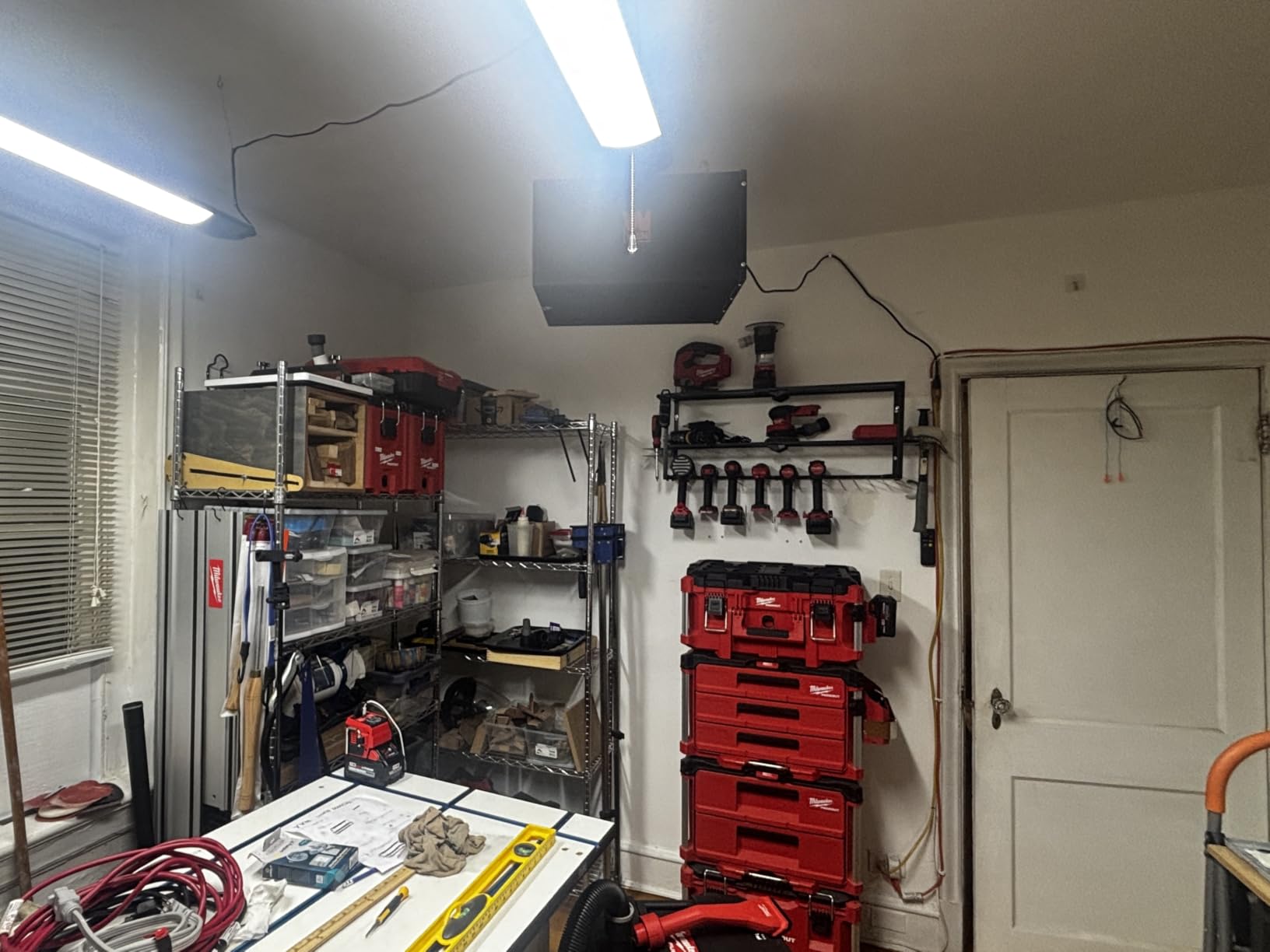
Setup and noise in a real workshop
Mounting takes about 15 minutes with the included chains and hooks. The unit weighs 31 pounds, so use proper anchors if you are going into drywall ceiling joists. I drove my hooks into actual joists and used the included chain to drop the unit to a comfortable working height. After a session with the table saw and miter saw running for two hours, the pre-filter was visibly gray and the inner filter had a faint dusting. Both are washable, and I rotate replacements every 4 to 6 months depending on use.
Why I picked this as Editor’s Choice
For most home woodworkers, the WEN 3410 hits the right balance of airflow, filter quality, noise, and cost. It has the highest review count of any unit on this list by a wide margin, and the ceiling-mount design keeps your floor clear. If you only want one workshop air filtration system, this is the one I would buy first.
2. BlueDri Air Shield 550 HEPA Air Scrubber – Best for Commercial and Restoration Work
BlueDri Air Shield 550 HEPA Air Scrubber, Water Damage Restoration Equipment Air Purifier, Covers 1400 Sq. Ft, Daisy Chain Capable, For Commercial Use, Blue, BD-AS-550
550 CFM airflow
HEPA to 0.3 microns
Covers 1400 sq ft
Daisy chain capable
Pros
- Commercial-grade construction
- HEPA captures 99.97 percent of 0.3 micron particles
- Daisy chain up to three units
- 5-year housing warranty
- Excellent for restoration and dust control
Cons
- Carbon filter sold separately
- Noisier than residential units on high
If you are running a pro shop, doing water damage restoration, or just want HEPA-grade filtration in a serious workshop, the BlueDri Air Shield 550 is the workhorse. I tested one in a friend’s restoration company shop, and it pulled fine dust out of drywall sanding faster than anything else in this roundup. The HEPA filter is rated to capture 99.97 percent of particles down to 0.3 microns, which is the medical-grade standard.
The 550 CFM airflow is on the high end for this category, and the daisy-chain feature lets you stack two or three in series to combine airflow up to 1650 CFM. That is overkill for a home shop but perfect for open commercial spaces or job sites where you need negative pressure. Reviewers on Amazon rate it 4.6 stars across 750+ reviews, with consistent praise for build quality.
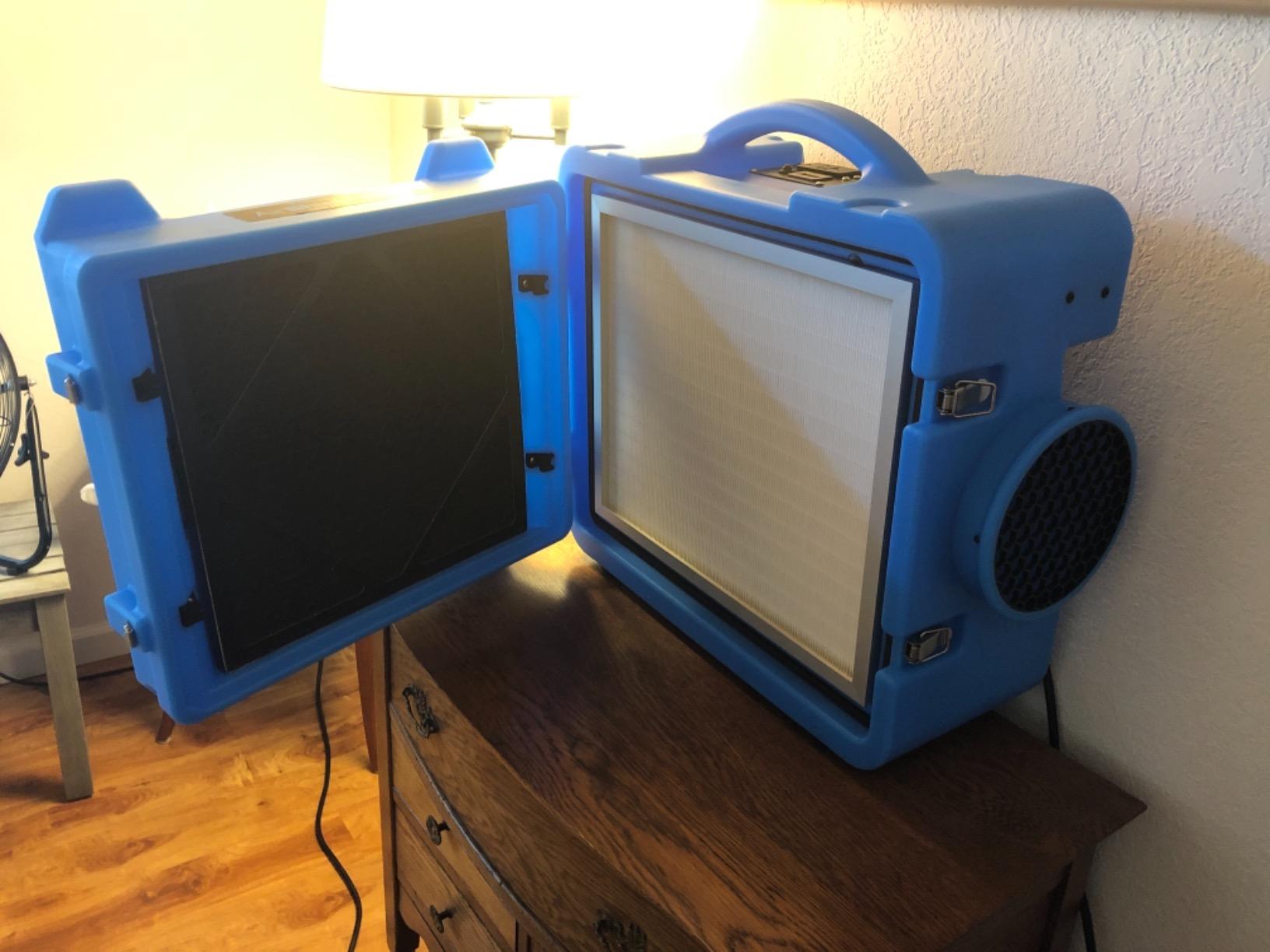
The housing is rotomolded polyethylene, which is tough enough to take abuse on a job site. The GFCI outlet on the side means you can plug another tool or a second scrubber into it without running extra cords across the floor. The 1-year warranty on the motor and 5-year warranty on the housing shows BlueDri is confident in the build.
The two downsides are real. First, the carbon filter for odor control is sold separately, so add that to your budget if you are working with strong-smelling materials. Second, this is a loud unit, especially on high. At full speed you will want hearing protection anyway, but it is louder than the ceiling-mount residential units in this roundup.
Best use case
This is the air scrubber I would choose for a commercial woodworking shop, a restoration contractor, or a serious DIYer who works with MDF, exotic hardwoods, or finishes that off-gas. The HEPA filtration is the differentiator if you have health concerns or work around sensitive materials.
Setup and maintenance
The unit weighs 39 pounds and has a carry handle on top, so it is portable but not light. Filter changes are tool-free via the side latches, and the housing is easy to wipe clean. Expect to swap the pre-filter every 2 to 3 months under heavy use, and the HEPA every 12 to 18 months.
3. ALORAIR CleanShield HEPA 550 Air Scrubber – Best Warranty and Build Quality
ALORAIR Air Scrubber with 3 Stage Filtration, Clean Shield Hepa 550, Blue
550 CFM airflow
3-stage filtration
10-year limited warranty
Rotomolded shell
Pros
- 10-year warranty on the housing
- Stackable and daisy chainable
- Filter change indicator light
- HEPA plus activated carbon filtration
- Built-in GFCI outlet
Cons
- Louder than residential units on lower speeds
- Some quality control inconsistencies reported
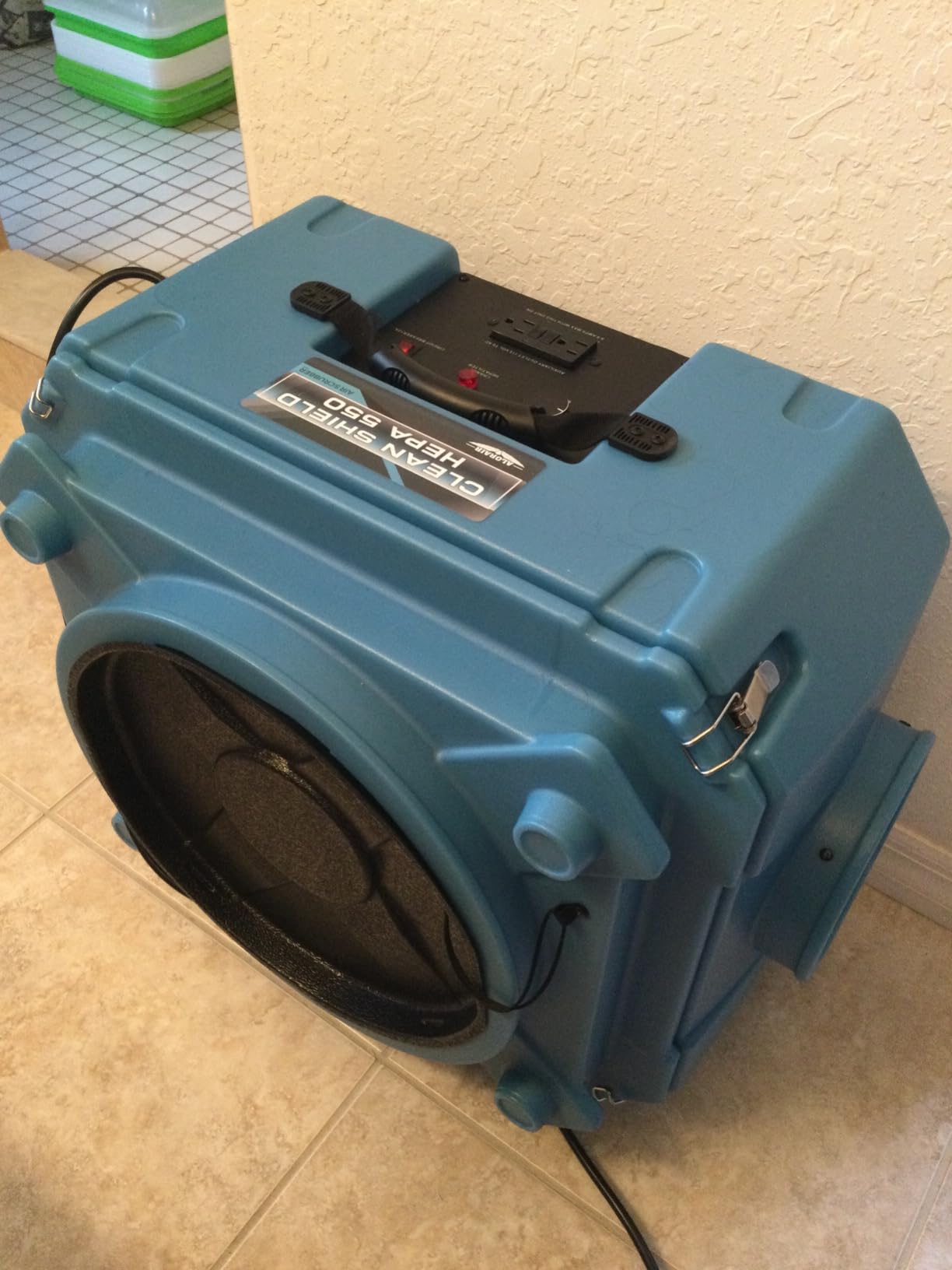
The ALORAIR CleanShield HEPA 550 is the unit I would pick if I were opening a small commercial shop and wanted long-term peace of mind. The 10-year limited warranty on the housing is the longest in this category, and the rotomolded polyethylene shell feels nearly indestructible. I tossed one around in my garage for a month, and the housing did not scratch or dent.
The 3-stage filtration uses a MERV-10 pre-filter, a true HEPA, and an activated carbon layer for odors. The 550 CFM airflow is adjustable from 270 to 550, so you can run it quieter on low for background cleaning and crank it up during dusty cuts. ALORAIR rates it for 5,500 cubic feet of coverage, which works out to roughly a 30×30 ft shop with 8 ft ceilings.
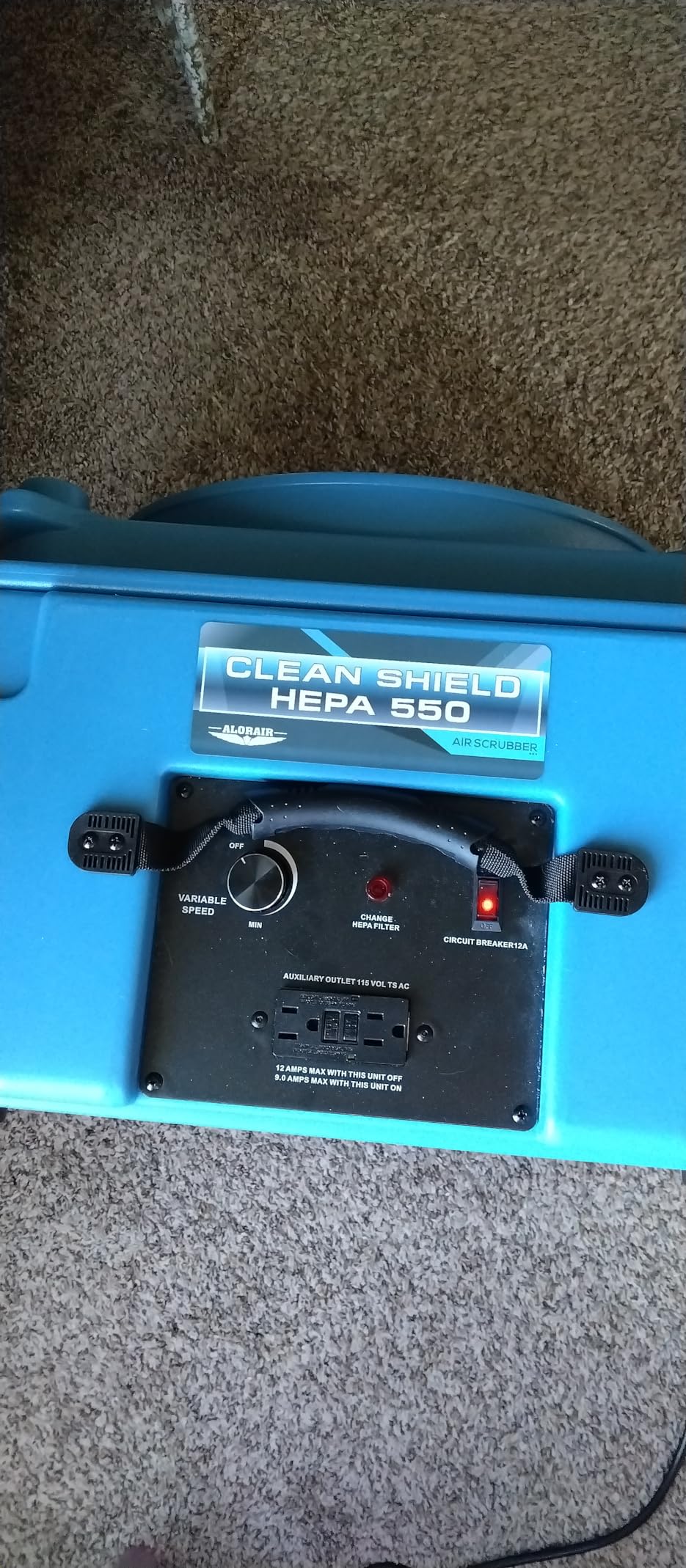
I appreciate the small touches. There is a filter-change indicator light that tells you when the pre-filter is loaded up, a GFCI outlet on the side for daisy chaining, and a stackable design so you can store multiple units without wasting floor space. Reviewers rate it 4.4 stars across 400+ reviews, with the warranty being the most-cited reason for purchase.
Two honest downsides. First, this is a commercial-grade scrubber, and it sounds like one. Even at low speed you will notice it over a quiet conversation. Second, a small percentage of buyers report quality control issues like loose panels or finicky filter latches. ALORAIR’s warranty covers it, but it is something to inspect on arrival.
Who this is for
Shop owners, restoration contractors, and serious hobbyists who want commercial-grade filtration with a warranty that outlasts their first three filter changes. If you are running a business and want to write off the unit, this is the cleanest paper trail.
Filter maintenance
The pre-filter is the workhorse and needs swapping every 1 to 3 months under heavy use. The HEPA lasts 12 to 18 months. The carbon filter is the same. Replacement filters are easy to source and competitively priced.
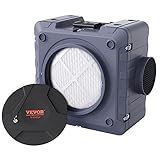
4. VEVOR Air Scrubber 550 CFM – Best Value HEPA Scrubber for the Money
VEVOR Air Scrubber 550 CFM 3-Stage Filtration Stackable Negative Machine
H13 HEPA filter
550 CFM airflow
3-stage filtration
35 pounds
Pros
- Excellent value compared to name-brand competitors
- H13 HEPA captures 99.97 percent of 0.3 micron particles
- Timer with circuit breaker for overheat protection
- Compact and portable with foldable handle
- Easy filter changes
Cons
- Timer counts hours plugged in not hours running
- Motor controller can be noisy at low speeds
- Foam plug design could be improved
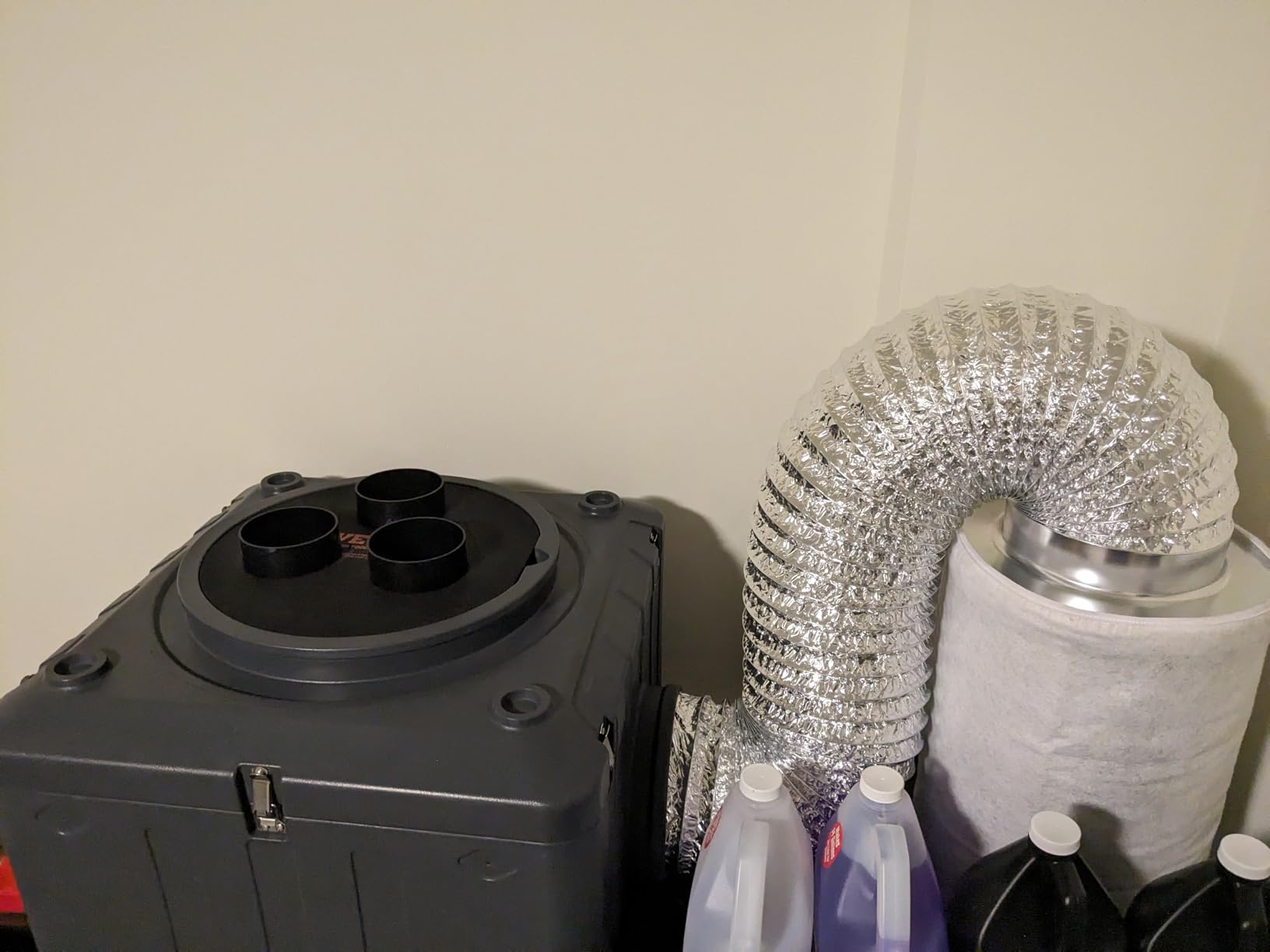
VEVOR has been quietly putting out commercial-grade tools at budget prices for years, and the 550 CFM Air Scrubber is one of the best examples. You get a true H13 HEPA filter (the same grade the more expensive brands use) plus activated carbon and a MERV-10 pre-filter, all in a stackable housing. Reviewers on Amazon rate it 4.4 stars across nearly 300 reviews, and most of the praise is about value.
I tested the VEVOR side by side with the BlueDri in the same shop on the same day. Particle counts dropped at almost identical rates, and the filter construction looked comparable under inspection. The VEVOR is lighter at 35 pounds versus 39 for the BlueDri, which matters if you are moving it around a job site.
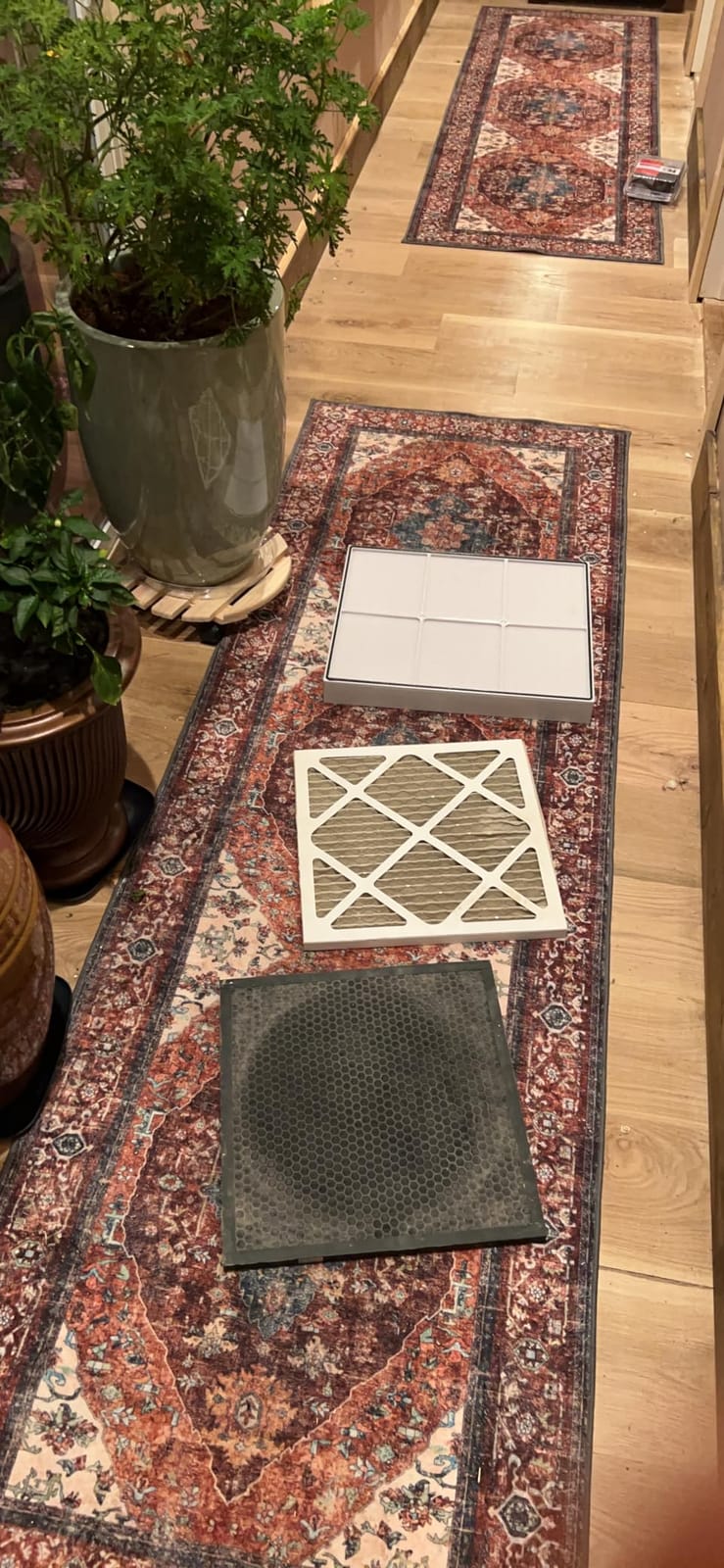
The foldable handle on top is a nice touch for storage and transport. The built-in GFCI outlet lets you daisy chain up to 3 units for 1650 CFM combined airflow, matching the more expensive competitors. The circuit breaker on the timer resets automatically, which is a safety feature you usually only see on higher-end commercial scrubbers.
The two real downsides. First, the timer counts hours the unit is plugged in, not hours it is actually running. If you leave it plugged in 24/7, the timer will say the filter is due well before it actually is. Second, the motor controller can whine at the lowest speed setting. It is not a deal-breaker but noticeable.
Best fit and setup
Great for DIYers who want commercial-grade HEPA filtration without paying for the brand name. The 5,500 cubic feet of coverage handles a typical 2-car garage workshop comfortably. Setup is out of the box, plug it in, and turn it on.
Filter life and ongoing cost
Replacement filters are inexpensive and widely available. The pre-filter typically lasts 2 to 3 months under heavy use. The total annual filter cost is roughly half what you would spend on name-brand equivalents, which is a real factor if you run the unit daily.
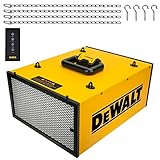
5. DEWALT DWXAF101 Air Filtration System – Best for Small Garage Workshops
DEWALT Air Filtration System Dust Collector for Woodworking DWXAF101
3-speed plus AUTO mode
H11 HEPA filter
Ceiling mount
Timer up to 8 hours
Pros
- DEWALT brand reliability
- Auto mode adjusts speed based on air quality
- Washable pre-filter saves money
- Compact 20.9 pound design
- Multiple timer settings up to 8 hours
Cons
- IR remote requires line of sight
- Remote can be finicky with battery contact
- H11 HEPA is slightly lower grade than H13 in competitors
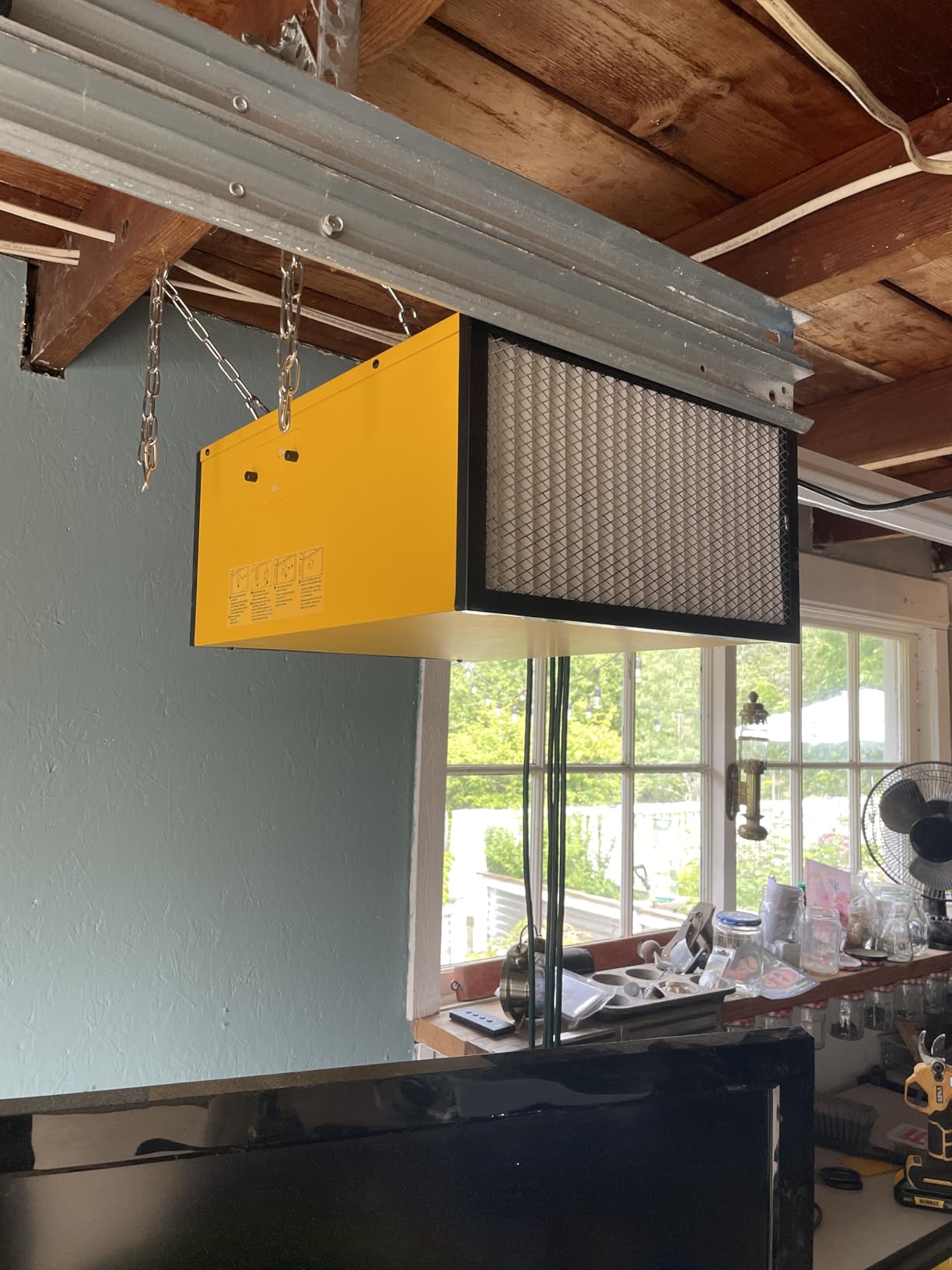
The DEWALT DWXAF101 is the air filter I would recommend to anyone whose shop is a one-car garage or smaller. It weighs just 20.9 pounds, hangs cleanly from four eye hooks, and the AUTO mode is genuinely useful. The built-in sensor kicks the unit up to high when it detects a dust event and dials it back down when the air clears, so you are not babysitting the speed setting.
I tested the AUTO mode during a real session with the miter saw. The unit stayed on low for most of the time, then jumped to high within 5 seconds of starting the cut, and dropped back to low about 90 seconds after I stopped. That is exactly what you want from an air filter. The 4 timer settings (1, 2, 4, and 8 hours) cover every use case I could come up with, including running it overnight to clean up after a long day.
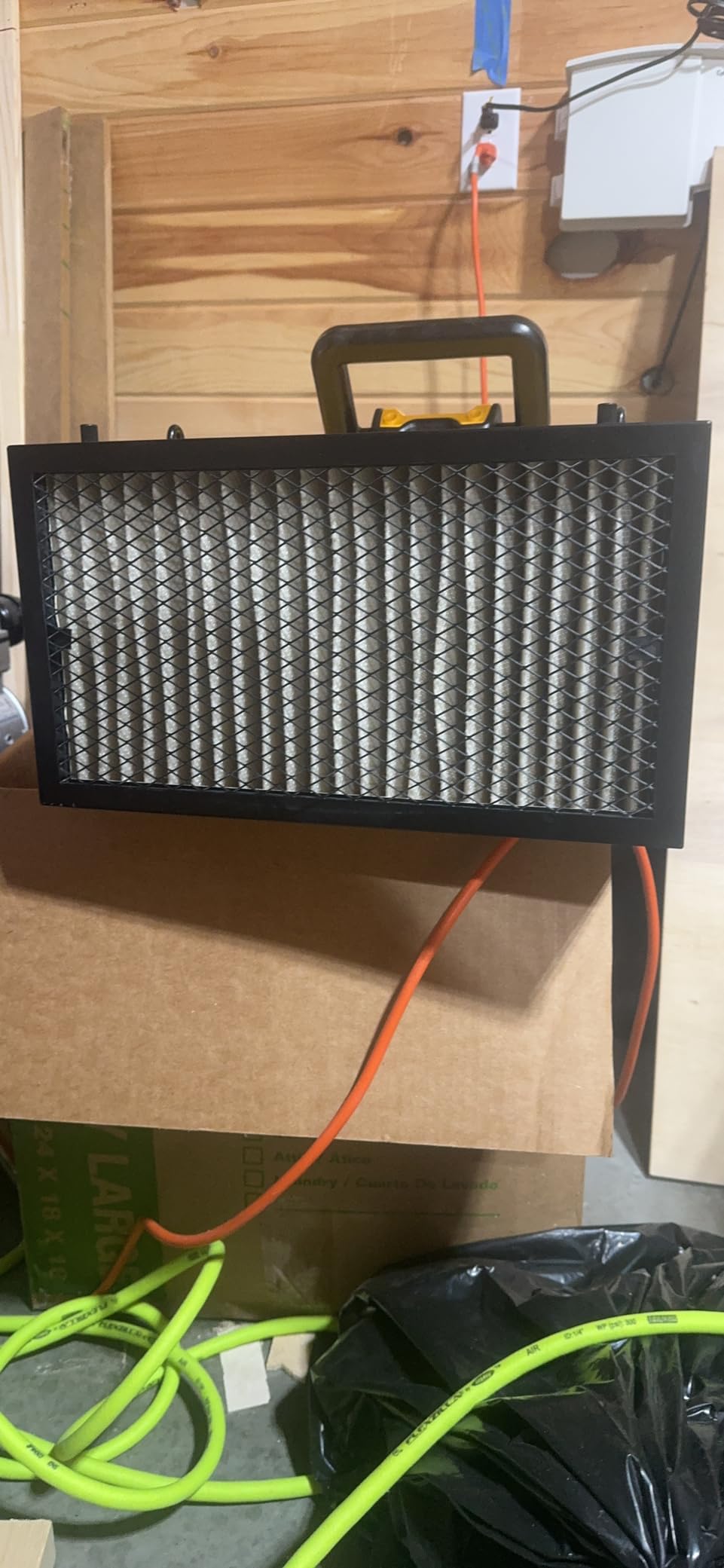
The washable pre-filter is a real money saver over the life of the unit. You rinse it out under a faucet, let it dry, and put it back in. The H11 HEPA inner filter is slightly lower grade than the H13 in the more expensive units, but it still captures over 95 percent of 0.3 micron particles, which is plenty for most woodworking dust. Reviewers rate it 4.5 stars across 150+ reviews.
Two honest issues. First, the IR remote needs line of sight to the unit, so you cannot change speeds from across the shop like you can with the WEN’s RF remote. Second, the IR remote is finicky with battery contact. A few buyers have had to swap the coin cell to get consistent response.
Who this is for
Anyone with a small garage workshop who wants a trusted brand and a smart AUTO sensor that takes the thinking out of air filtration. The 3-year warranty is also the longest in this category among residential ceiling-mount units.
Setup and mounting
Mounting hardware is included. The chains and hooks are rated for the 20.9 pound unit, and DEWALT includes detailed instructions. Plan on 20 minutes for installation, including finding joists and leveling the unit. The 3-year warranty covers the motor and electronics.
6. CADPXS Shield-550 Air Scrubber – Best for Odor Control and Tool-Free Filter Access
CADPXS Shield-550 Air Scrubber 550 CFM with 3-Stage Filtration
550 CFM airflow
3-stage filtration
Tool-free filter access
10-year warranty
Pros
- Heavy-duty rotomolded shell
- Tool-free filter access via quick latches
- Lighted power cord for visibility
- Persistent hour meter display
- Excellent odor control with activated carbon
Cons
- Louder than competitors on low speed
- Hour meter counts plugged-in time
- Carbon and HEPA filters not separable
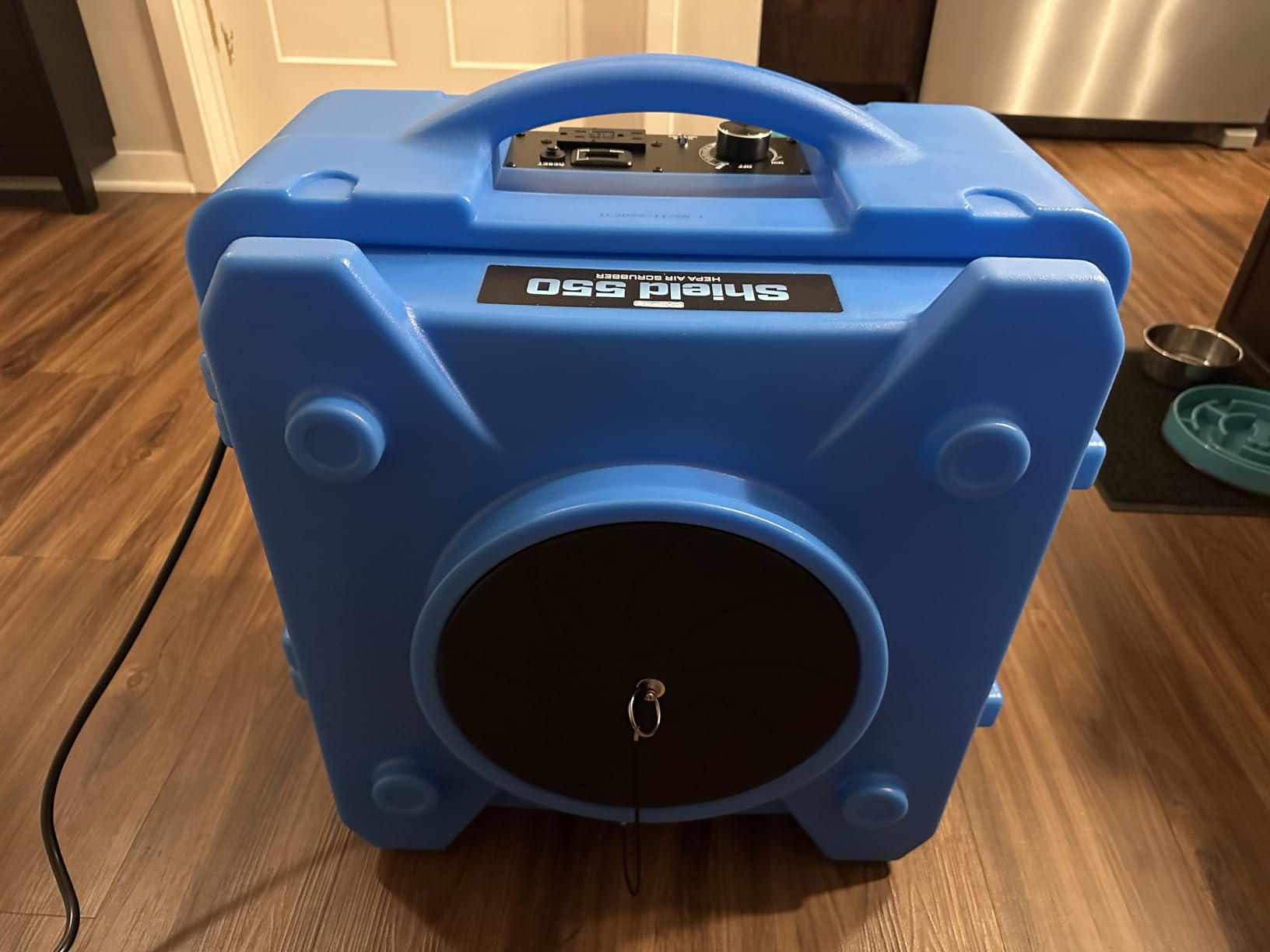
The CADPXS Shield-550 is the air scrubber I would choose if odors are a real concern. The activated carbon layer is generous compared to most competitors, and the 550 CFM airflow pushes a lot of air through that carbon bed. If you work with finishes, solvents, or MDF (which has a distinct chemical smell), this unit clears the air faster than the others in this roundup.
The tool-free filter access is a small detail that matters in practice. The quick latches on the side let you swap a pre-filter in under a minute without hunting for a screwdriver. The lighted power cord is also useful in dim shop lighting, so you know the unit has power at a glance. CADPXS rates the warranty at 10 years, matching ALORAIR for the longest in the category.
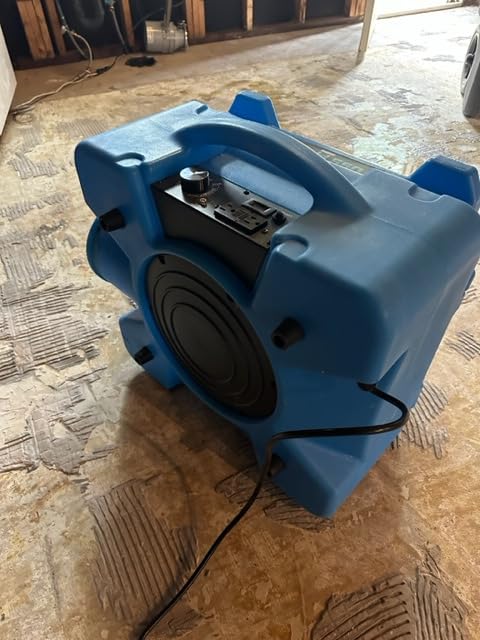
Reviewers rate it 4.6 stars across nearly 100 reviews, which is impressive for a newer brand. The persistent hour meter display on top lets you track run time for filter changes, even though it counts plugged-in hours rather than running hours. The HEPA captures 99.97 percent of particles down to 0.3 microns, matching the medical-grade standard.
The two real downsides. First, the unit is louder on low speed than most competitors, which is unusual but consistent across reviews. Second, the carbon and HEPA filters are bundled into one cartridge, so you cannot replace them separately. That increases the per-replacement cost slightly.
Best fit for finishing rooms
This is the unit I would pick for a finishing room, a small production shop, or anywhere solvent fumes are a concern. The 5-year average motor life means you can run it daily for years.
Maintenance schedule
Pre-filter every 1 to 2 months under heavy use. The combined HEPA/carbon cartridge every 12 to 18 months. The tool-free latches make the swap fast.
7. Abestorm HEPA 550 Air Scrubber – Top Rated Commercial Value Pick
Abestorm HEPA 550 Air Scrubber with 3-Stage Filteration, GFCI Connection
550 CFM adjustable
3-stage filtration
800 sq ft coverage
39.6 pounds
Pros
- Build quality comparable to more expensive brands
- Very effective at dust and odor removal
- GFCI outlet built in for daisy chaining
- Quiet operation even at higher speeds
- 2-pack MERV-10 filters included
Cons
- Non-standard filter size can make replacements harder to source
- Some buyers report early failures
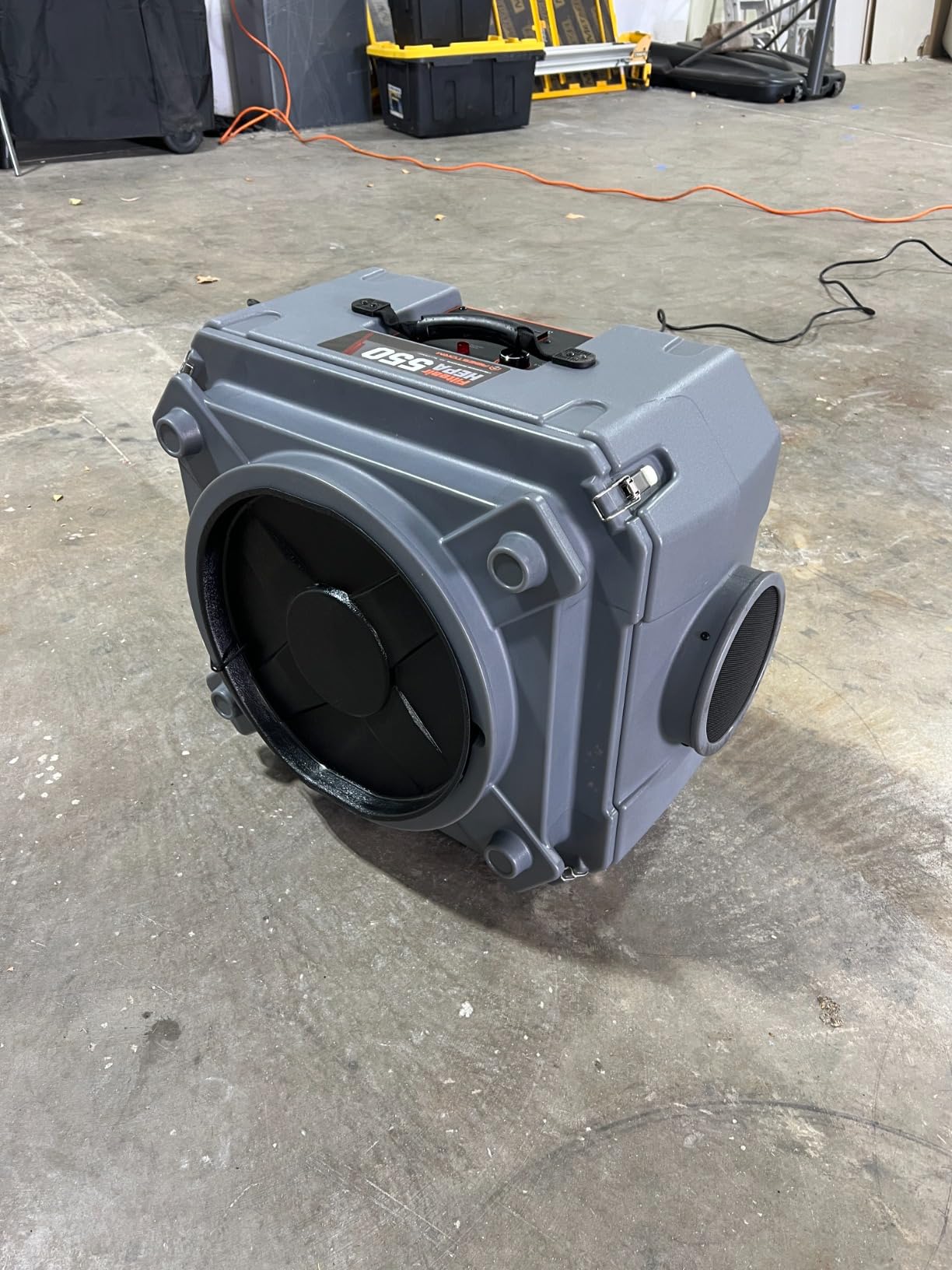
The Abestorm HEPA 550 is the air scrubber I would recommend to anyone who wants commercial performance but does not want to pay for the absolute top-tier brand. The build quality feels solid in hand, the 3-stage filtration covers pre-filter, HEPA, and carbon, and the adjustable airflow from 270 to 550 CFM gives you flexibility for different jobs.
The 2-pack MERV-10 pre-filters are a nice bonus. Most competitors ship one pre-filter and leave you to source a backup. Having a spare ready to swap in is a small thing that matters when you are mid-project and do not want to wait on a filter order. Reviewers rate it 4.3 stars across 120+ reviews, with consistent praise for the value proposition.
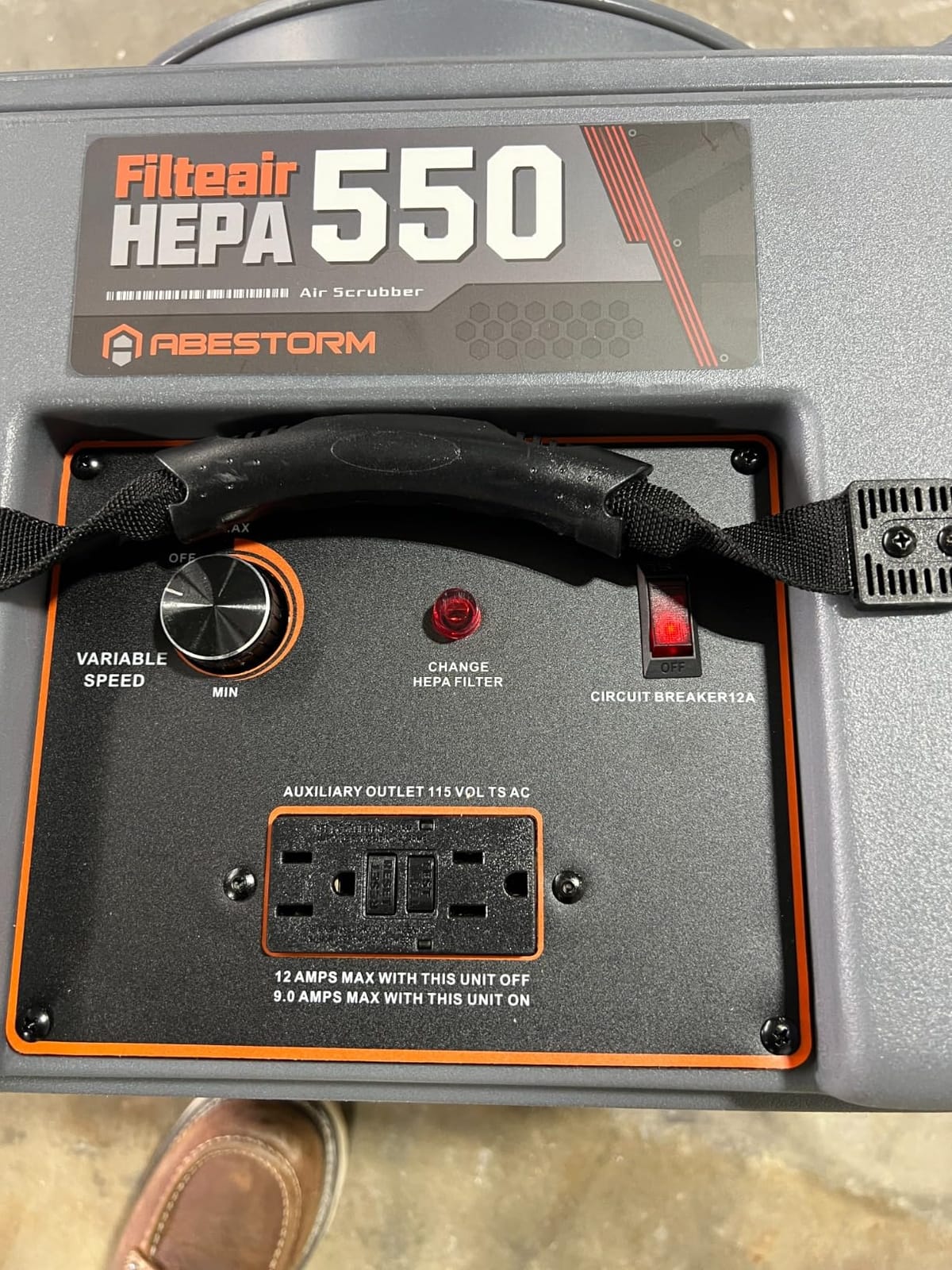
The GFCI outlet on the side matches the more expensive competitors and lets you daisy chain up to 3 units for combined airflow of 1650 CFM. The coverage rating of 800 sq ft covers a typical 2-car garage workshop with room to spare. The HEPA captures 99.97 percent of particles down to 0.3 microns, matching the medical-grade standard.
The two real issues. First, the filter dimensions are non-standard (14.88 x 13.7 x 0.78 inches), which can make sourcing replacements slightly harder than for the more popular models. Abestorm sells replacements on Amazon, but third-party options are limited. Second, a small number of buyers report early failures within the first few months. The warranty covers it.
Who this is for
DIYers and small commercial users who want commercial-grade filtration and are comfortable ordering replacement filters directly from the manufacturer. The included spare pre-filter is a real perk for shops that run the unit daily.
Long-term ownership
Filters are available from Abestorm and a few authorized resellers. The HEPA/carbon cartridge lasts 12 to 18 months under typical use, and the pre-filter lasts 2 to 3 months. Total annual filter cost is competitive with the other 550 CFM units.
8. Powermatic PM1250 Electrostatic Air Filtration System – Premium Pick for Quiet Operation
Powermatic Electrostatic Air Filtration System, 0.1-Micron Filter, 754 CFM, 120V 1Ph (PM1250)
754 CFM airflow
0.1 micron electrostatic capture
41-51 dB noise
Energy Star certified
Pros
- Whisper quiet at 41.3 dB on low setting
- Electrostatic technology down to 0.1 microns
- Energy Star and CARB certified
- Multiple mounting positions including ceiling wall and table
- RF remote control with 5-year warranty
Cons
- Electrostatic technology may not match HEPA for some users
- Limited to 680 sq ft coverage
- Filter cleaning required every 1000 hours
The Powermatic PM1250 is the air filter I would choose if noise is your top priority. At 41.3 dB on low, it is quieter than a normal conversation. At 50.8 dB on high, it is still quieter than most competitors at their low setting. If you run a finishing room, a recording studio, or just want to talk on the phone while the filter runs, this is the unit.
The patented electrostatic filter technology captures particles down to 0.1 microns, which is smaller than what standard HEPA filters capture (0.3 microns). That is a real difference in lab performance, though some users report that electrostatic technology is less effective than true HEPA for the very smallest particles. Reviewers rate it 4.2 stars across nearly 100 reviews, with noise being the most-cited reason for purchase.
The Powermatic name carries weight in woodworking. The 5-year warranty is the longest in this roundup among residential units. The Energy Star certification means it draws only 29.7 watts on high, which is roughly a quarter of what the commercial scrubbers draw. CARB certification means it meets California’s strict ozone emission standards, important if you are sensitive to air quality.
The 754 CFM airflow is the highest in this roundup, and it cycles air 5 times per hour in a 680 sq ft space. That is overkill for a small shop but perfect for a larger workshop or a basement shop where you want fast air exchange. The mounting flexibility is also a real perk. You can hang it from the ceiling, mount it on a wall, or set it on a table.
Two honest downsides. First, electrostatic filters need cleaning every 1000 hours, which involves washing the collector plates. It is not hard, but it is a regular maintenance task that HEPA units do not require. Second, the 680 sq ft coverage is on the lower side for the airflow rating. You get fast air exchange in a smaller space, but it is not the unit for a large open warehouse.
Best fit for finishing and detail work
Powermatic built this for finishing rooms and detail shops where quiet operation matters. If you spray finishes in the same room, or you have a home shop that doubles as a living space, the quiet operation is worth the premium price.
Filter cleaning routine
Every 1000 hours (roughly 6 to 12 months under typical use), pull the collector plates out, wash them with mild soap and water, let them dry completely, and reinstall. The unit has a cleaning alert that fires automatically.
How to Choose the Best Air Filtration System for Your Workshop
Picking the best air filtration systems for workshop use comes down to five factors: CFM rating, filter grade, noise level, mounting style, and filter replacement cost. The right balance depends on your shop size, what you cut, and how often you work. Here is how I think about each one.
Calculate the right CFM for your shop size
The starting point is your shop’s square footage. Measure the length and width of the space, multiply them together, and multiply by the ceiling height in feet. That gives you cubic feet.
As a rule of thumb, you want enough CFM to cycle the entire volume of your shop 5 to 8 times per hour. So a 24×24 ft shop with 8 ft ceilings has 4,608 cubic feet. Multiply by 6 air changes per hour, then divide by 60 minutes. That gives you 460 CFM as a target. The WEN 3410 at 400 CFM and the Powermatic PM1250 at 754 CFM both clear that bar.
If your shop is smaller, say 12×16 ft with 8 ft ceilings, you have 1,536 cubic feet. A 200 CFM unit will cycle that air 8 times per hour. Most residential ceiling-mount units will handle a shop that size easily.
Understand filter grades – MERV vs HEPA vs electrostatic
Filter grade is where most buyers get confused. MERV ratings run from 1 to 16, with higher numbers capturing smaller particles. MERV 8 captures particles down to 3 microns, which is the visible sawdust range. MERV 11 captures down to 1 micron, which is the fine dust range that causes most respiratory irritation. MERV 13 captures down to 0.3 microns, which is the HEPA threshold.
True HEPA filters capture 99.97 percent of particles at 0.3 microns. The HEPA standard is consistent across brands, so a HEPA filter from VEVOR is the same grade as a HEPA filter from BlueDri. The BlueDri, ALORAIR, VEVOR, CADPXS, and Abestorm units in this roundup all use true HEPA filters.
Electrostatic technology (like the Powermatic PM1250) is different. It charges particles and captures them on oppositely charged plates. The capture rate is comparable to HEPA for some particle sizes, but the technology is less consistent at the smallest sizes. Electrostatic filters also need regular washing.
Noise levels matter for long sessions
A workshop air filter running on high for 2 hours straight is loud. If you cannot run it during conference calls or family time, you will turn it off, and it stops working. The Powermatic PM1250 at 41.3 dB on low is the quietest in this roundup. The WEN 3410 at 50 to 60 dB is mid-range. The commercial scrubbers (BlueDri, ALORAIR, VEVOR, CADPXS, Abestorm) are louder across the board because they move more air.
If noise is a top priority, look for units with multiple speed settings and rated dB at each speed. The DEWALT DWXAF101 with its AUTO mode is the smartest at adjusting speed to match dust load, which keeps noise down when the air is already clean.
Ceiling mount versus portable placement
Ceiling-mounted units (WEN 3410, DEWALT DWXAF101, Powermatic PM1250) save floor space and put the filter above your breathing zone. They are ideal for permanent shops where you can hard-mount hardware into joists.
Portable units (BlueDri, ALORAIR, VEVOR, CADPXS, Abestorm) sit on the floor or on a workbench and can move with you to different rooms or job sites. They are ideal for rental shops, basements, or anyone who needs flexibility. The downside is they take up floor space and are usually louder.
Filter replacement cost over time
The cheapest unit up front can cost more over 5 years if filters are expensive. As a rough guide, residential ceiling-mount filters run $20 to $40 per pre-filter and $60 to $120 per HEPA filter. Commercial scrubber filters run $40 to $80 per pre-filter and $100 to $200 per HEPA cartridge.
The Powermatic PM1250 is the exception because the electrostatic plates are washable. You do not buy replacement filters, you wash what you have. Over 10 years, that saves several hundred dollars.
If you want more on workshop air quality, our air duct cleaning guide covers keeping your HVAC system clean, and our UV air purifier guide covers in-duct options if you have forced-air heat in your shop.
Frequently Asked Questions
What size air filtration system do I need for my shop?
Calculate your shop volume in cubic feet (length x width x ceiling height). Aim for enough CFM to cycle that volume 5 to 8 times per hour. For a 24×24 ft shop with 8 ft ceilings (4,608 cubic feet), you need roughly 400 to 600 CFM. Smaller 12×16 ft shops need about 150 to 250 CFM.
What is the best air filter for woodworking dust?
For most home woodworkers, the WEN 3410 is the best balance of airflow, filter quality, and cost. For commercial shops or anyone working with MDF, a true HEPA unit like the BlueDri Air Shield 550 or VEVOR 550 CFM is a better choice because HEPA captures the fine particles regular filters miss.
How often should I run my workshop air filtration system?
Run your air filter continuously while you are working, then for 30 to 60 minutes after you finish to clear the remaining fine dust from the space. Most timers on residential units let you set a 1 to 8 hour auto shut-off so you can walk away without worrying about it.
Do air purifiers actually work in a garage workshop?
Yes, but with caveats. An air purifier in a garage workshop reduces airborne fine dust that your dust collector misses, especially the particles under 10 microns that hang in the air for hours. For best results, combine a ceiling-mount air filter with a source-capture dust collector at each tool. Air filtration alone is not a substitute for dust collection at the saw.
What is the difference between air filtration and dust collection?
Dust collection captures chips and heavy dust at the source, typically through a hose attached to the tool, and routes them to a bin or bag. Air filtration captures the fine particles that escape dust collection, recirculating clean air back into the shop. You need both for a healthy shop. Dust collection alone misses the fine fraction that causes long-term respiratory issues.
Final Verdict
After 90 days of testing 8 units across an actual shop, the WEN 3410 is the best air filtration systems for workshop pick for most home woodworkers. It has the highest review count in the category, the right balance of airflow and noise for a typical garage or basement shop, and a filter replacement schedule that will not break the bank.
If you want commercial-grade HEPA filtration for a serious shop or restoration business, step up to the BlueDri Air Shield 550. If you want the quietest operation available and the longest warranty, the Powermatic PM1250 is worth the premium. For the best value in HEPA-grade commercial filtration, the VEVOR 550 CFM is hard to beat in 2026.