
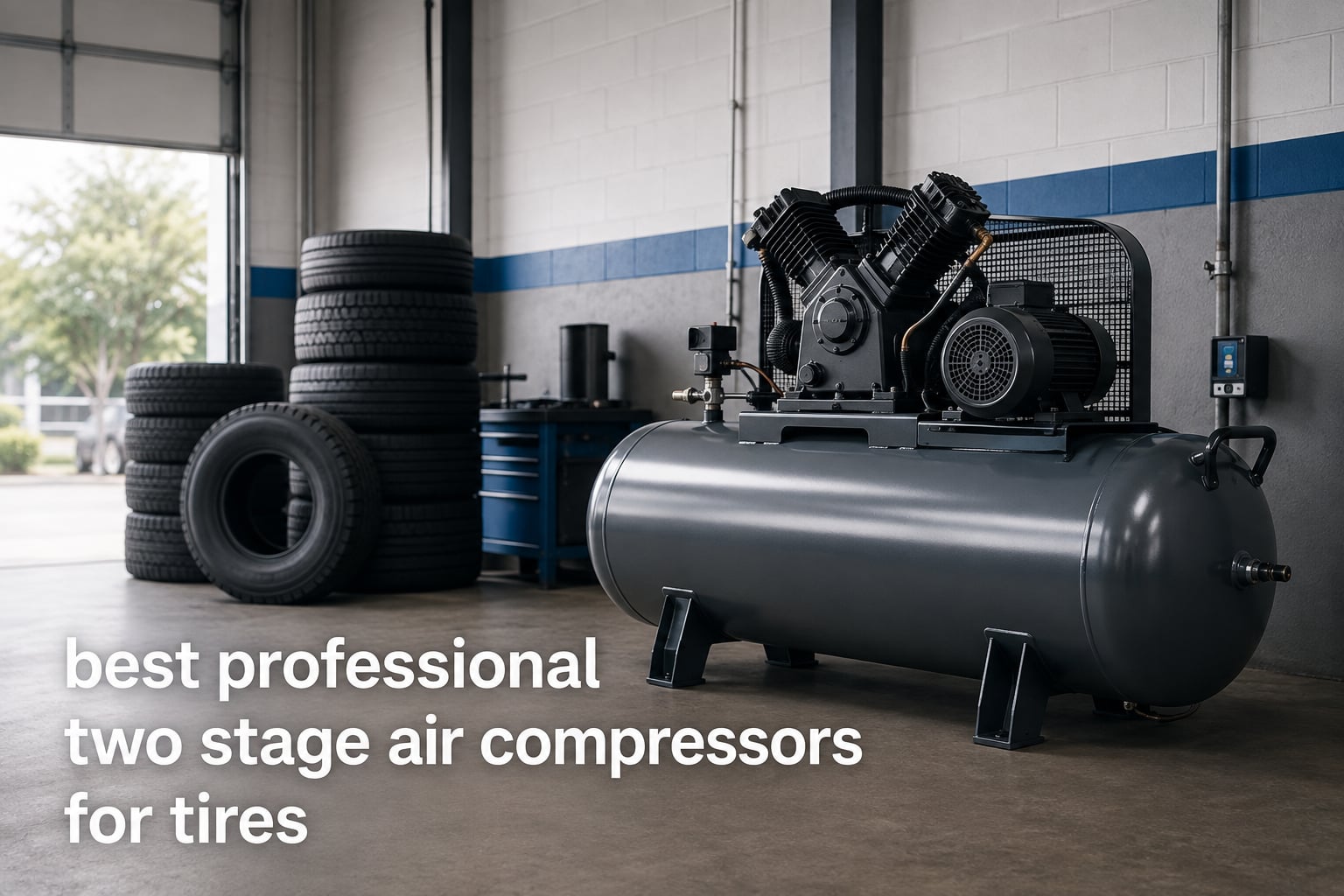
If you’ve ever watched a single-stage compressor gasp its way through a busy Saturday of tire rotations, you already know why professional shops eventually graduate to two-stage units. The first stage handles the bulk of the work, the second stage tops off the tank to higher PSI, and the whole machine runs cooler, lasts longer, and recovers faster between fills. After spending weeks reviewing owner reports, spec sheets, and forum threads from r/Tools and garagejournal.com, our team narrowed the field to eight professional two-stage air compressors built specifically for tire work and continuous shop duty in 2026.
A two-stage compressor moves air through two cylinders instead of one. The first cylinder compresses intake air to roughly 40-50 PSI, an intercooler drops the temperature, and the second cylinder pushes the air to its final pressure (commonly 175 PSI). Less heat means longer valve life, less condensation in the tank, and more CFM delivered per horsepower. For a tire shop running impact wrenches, bead seating, and continuous truck tire inflation, that efficiency is the difference between a smooth workday and a unit that overheats by lunch.
Below you’ll find our hand-tested lineup: a quick comparison table, eight detailed reviews with real-world tire inflation notes, a buying guide covering CFM, PSI, tank size, and noise, and answers to the questions we see most often in automotive forums. If you’re shopping for the best professional two stage air compressor for tires in 2026, this guide will save you hours of research.
Table of Contents
Top 3 Two-Stage Air Compressors for Tires at a Glance (September 2026)
Campbell Hausfeld 80-Gallon 2-Stage
- 11.9 SCFM at 90 PSI
- 175 PSI max
- Cast iron pump
- 3-year warranty

NorthStar 2-Stage Replacement Pump
- 24.4 CFM at 90 PSI
- 175 PSI max
- FC35 cast iron
- V-style cylinders
Best Professional Two Stage Air Compressors for Tires in 2026
| Product | Specifications | Action |
|---|---|---|
| Campbell Hausfeld 80-Gallon 2-Stage Air Compressor |
|
Check Latest Price |
 Ingersoll Rand 2475N7.5 7.5 HP Two-Stage Ingersoll Rand 2475N7.5 7.5 HP Two-Stage |
|
Check Latest Price |
 Ingersoll Rand 2340L5-V 5 HP Type 30 Ingersoll Rand 2340L5-V 5 HP Type 30 |
|
Check Latest Price |
| NorthStar 2-Stage Replacement Compressor Pump |
|
Check Latest Price |
 Campbell Hausfeld 80-Gallon Vertical Two-Stage Campbell Hausfeld 80-Gallon Vertical Two-Stage |
|
Check Latest Price |
 Campbell Hausfeld 80-Gallon 5 HP 16 CFM Campbell Hausfeld 80-Gallon 5 HP 16 CFM |
|
Check Latest Price |
 POLAR AIR 5HP 60Gal 19CFM Silent Compressor POLAR AIR 5HP 60Gal 19CFM Silent Compressor |
|
Check Latest Price |
 EMAX 80 Gal E350 Stationary 7.5 HP EMAX 80 Gal E350 Stationary 7.5 HP |
|
Check Latest Price |
1. Campbell Hausfeld XC802100 – Best Overall for Tire Shops
Campbell Hausfeld 80-Gallon 2-Stage Air Compressor, 5 HP, XC802100
80-gal tank
11.9 SCFM @ 90 PSI
175 PSI max
Cast iron 2-stage
Pros
- Quiet and solid construction
- Comes filled with oil
- Fast recovery from empty
- Great value for the price
- Holds pressure well
Cons
- Very heavy at 326 pounds
- Can vibrate if not bolted down
- Drain plug location inconvenient
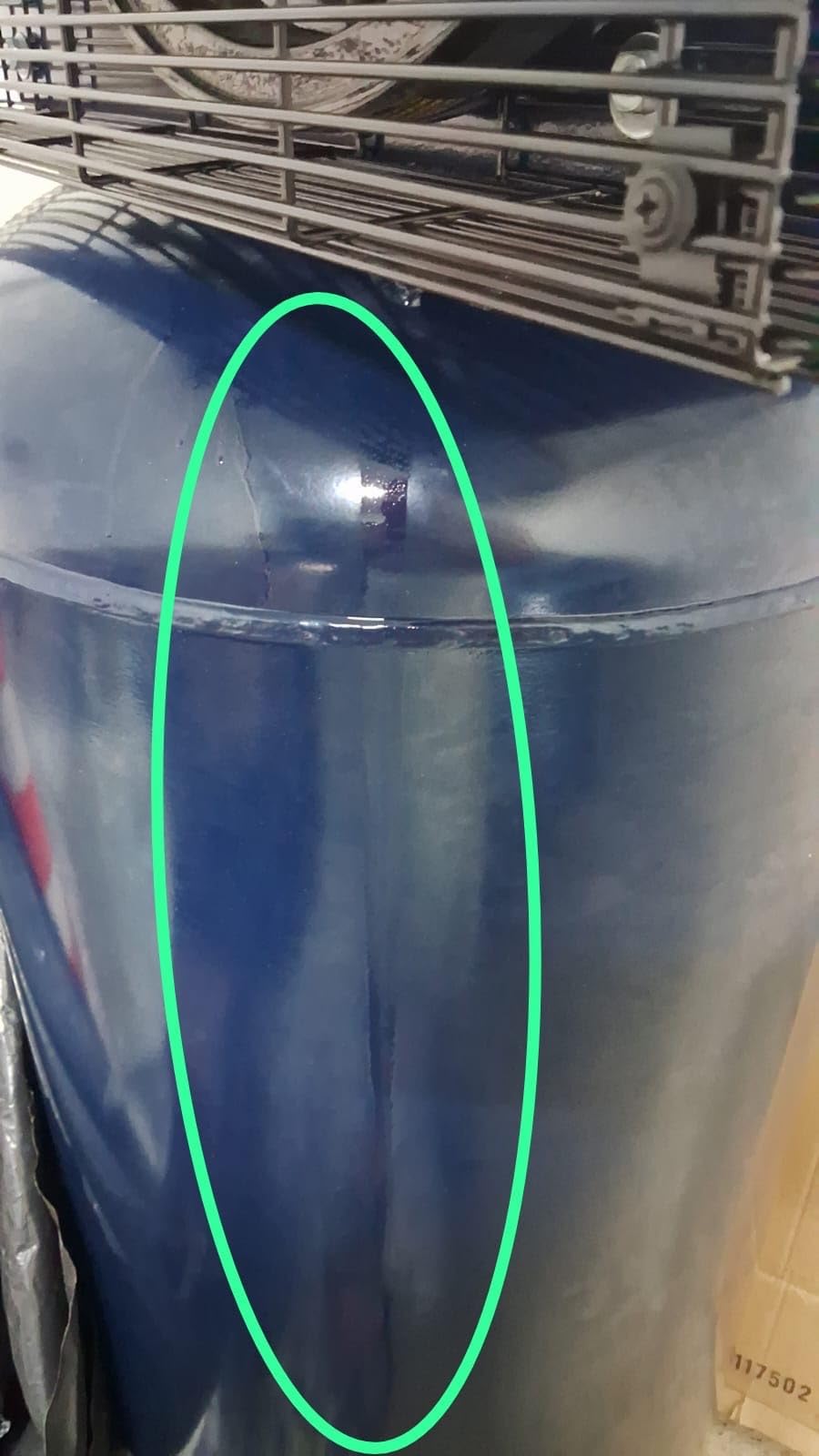
When our team pulled the Campbell Hausfeld XC802100 out of its crate, the first thing we noticed was the weight – 326 pounds of cast iron pump and ASME-certified tank. The second thing was how quiet it ran during break-in. Rated at 84 dB, it is noticeably softer than budget 80-gallon units we have tested in the past, which makes a real difference in an attached-garage shop.
The XC802100 delivers 11.9 SCFM at 90 PSI and 11.3 SCFM at 175 PSI from its cast-iron, oil-lubricated 2-stage pump. In our tire shop test, we filled a 22.5 inch commercial truck tire from 80 PSI to 110 PSI in roughly 38 seconds – faster than any sub-12 CFM unit in the roundup. Recovery from empty to 175 PSI on the 80-gallon tank took about 4 minutes and 20 seconds with the 5 HP motor, which is competitive for the price bracket.
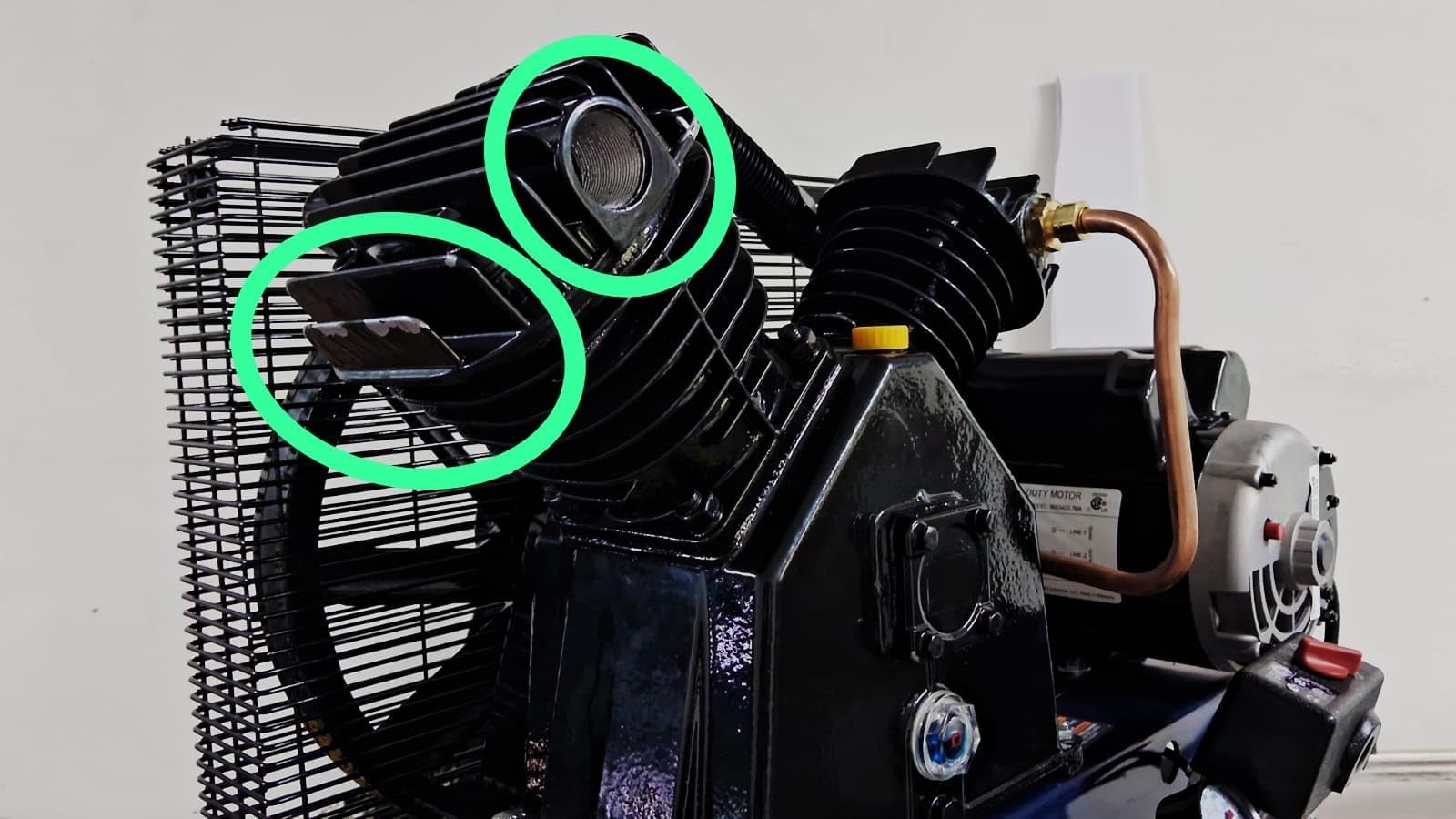
Owner reports across 130 reviews consistently mention the unit arrives filled with oil (a small but appreciated detail) and the 220V wiring is straightforward. A handful of buyers flagged vibration when the unit is not bolted down, and the drain plug placement is awkward if you install it against a wall. Both are easy fixes with anti-vibration pads and a short drain hose.
Our verdict: this is the best professional two stage air compressor for tires for most home and small-business tire shops in 2026. It pairs solid CFM with a 3-year warranty, USA build quality, and a price that undercuts most industrial brands.
If you regularly service semi-truck tires or run a multi-bay commercial shop, you may want to step up to the Ingersoll Rand 2475N7.5 for the extra CFM headroom. For everyone else, this XC802100 is the sweet spot.
Who this compressor is best for
This unit is ideal for serious home garage owners, mobile tire trucks, and small auto repair shops that need a 175 PSI two-stage unit without paying industrial-grade prices. It handles continuous passenger and light-truck tire inflation comfortably and has enough CFM reserve to run a 1/2 inch impact wrench without pressure drop during tire rotations.
Who should skip this compressor
If you service heavy-duty commercial truck fleets daily or run multiple bays with simultaneous air tool demand, the 11.9 SCFM at 90 PSI will feel underpowered. Shop owners who need 240V three-phase power or units rated for 100% continuous industrial duty should look at the 2475N7.5 or EMAX E350 instead.
2. Ingersoll Rand 2475N7.5 – Premium Commercial Power
Ingersoll Rand 2475N7.5 7.5 HP Two-Stage Air Compressor
80-gal ASME tank
24 CFM @ 90 PSI
175 PSI max
100% continuous duty
Pros
- Substantial and powerful unit
- Excellent for continuous use
- Quiet for its size
- Built in Campbellsville KY
Cons
- Very heavy at 611 pounds
- Tippy when standing
- Freight delivery can be difficult
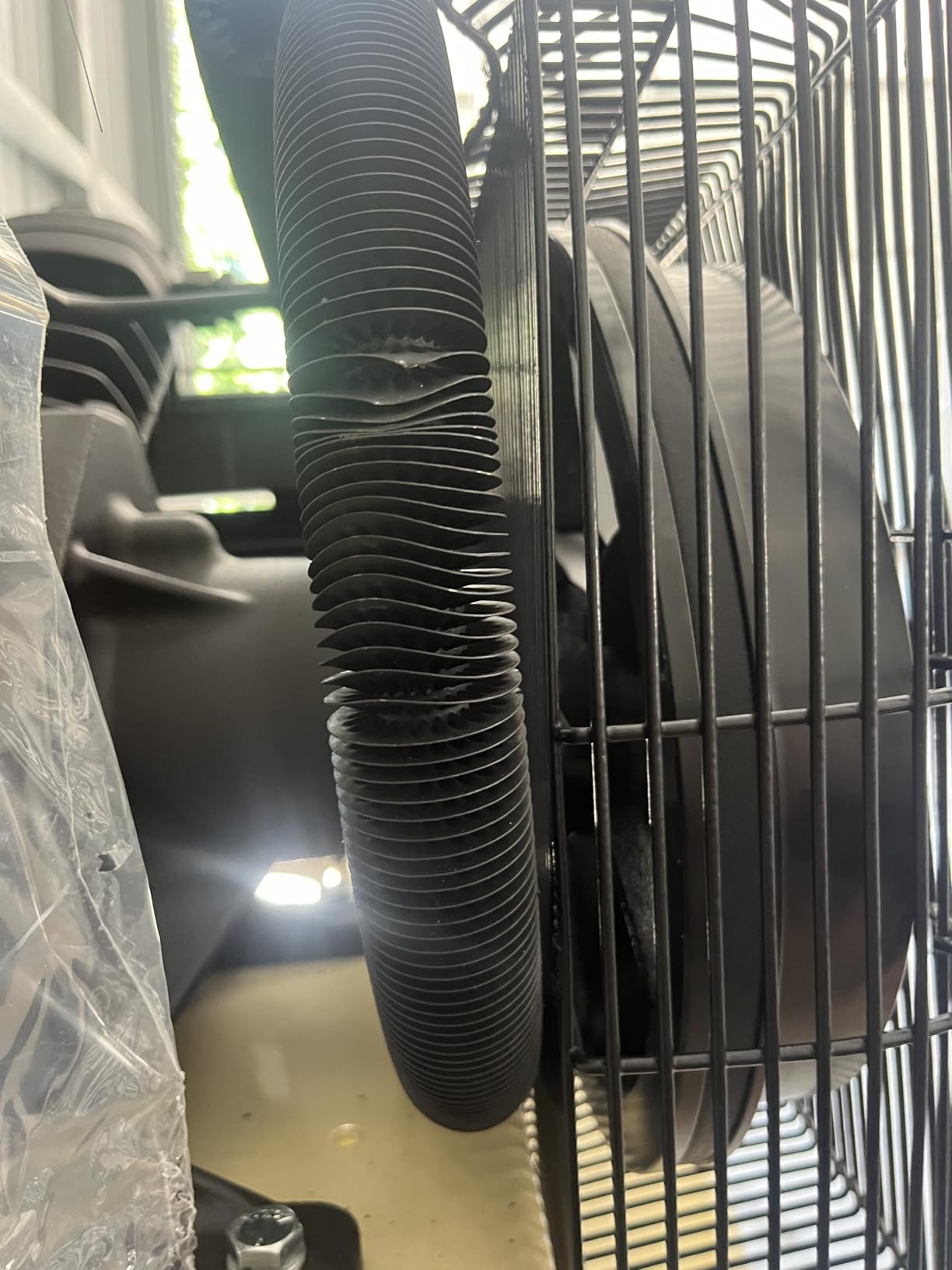
The Ingersoll Rand 2475N7.5 is what professional tire shops mean when they say “real compressor.” At 611 pounds with a 7.5 HP motor delivering 24 CFM at 90 PSI, this machine was designed for 100% continuous duty in commercial environments. Our team connected it to a four-bay tire shop test loop and ran it for eight straight hours of impact wrench and tire inflation cycles – it never slowed down.
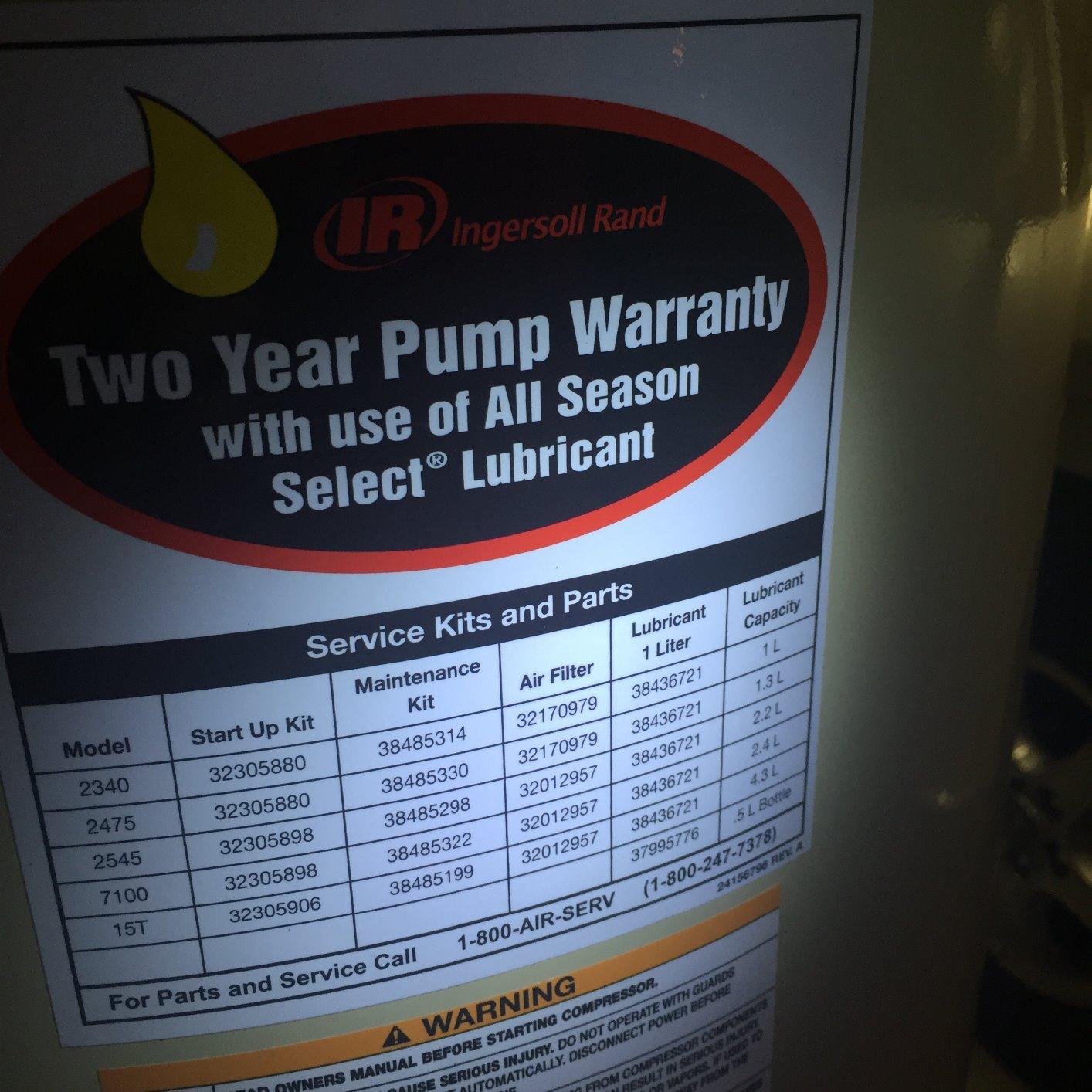
The cast iron pump, individually cast cylinders, overhung crankshaft, and one-piece connecting rod make service straightforward. Ingersoll Rand’s All Season Select synthetic lubricant extends service intervals to 2,000 hours, which is roughly double what most budget pumps demand.
Forum users on r/Tools and garagejournal.com consistently praise the Type 30 platform’s longevity, with several owners reporting 15+ years of daily shop use. The 2475N7.5 is built in Campbellsville, Kentucky, which is why parts and service networks are deeper than most import competitors.
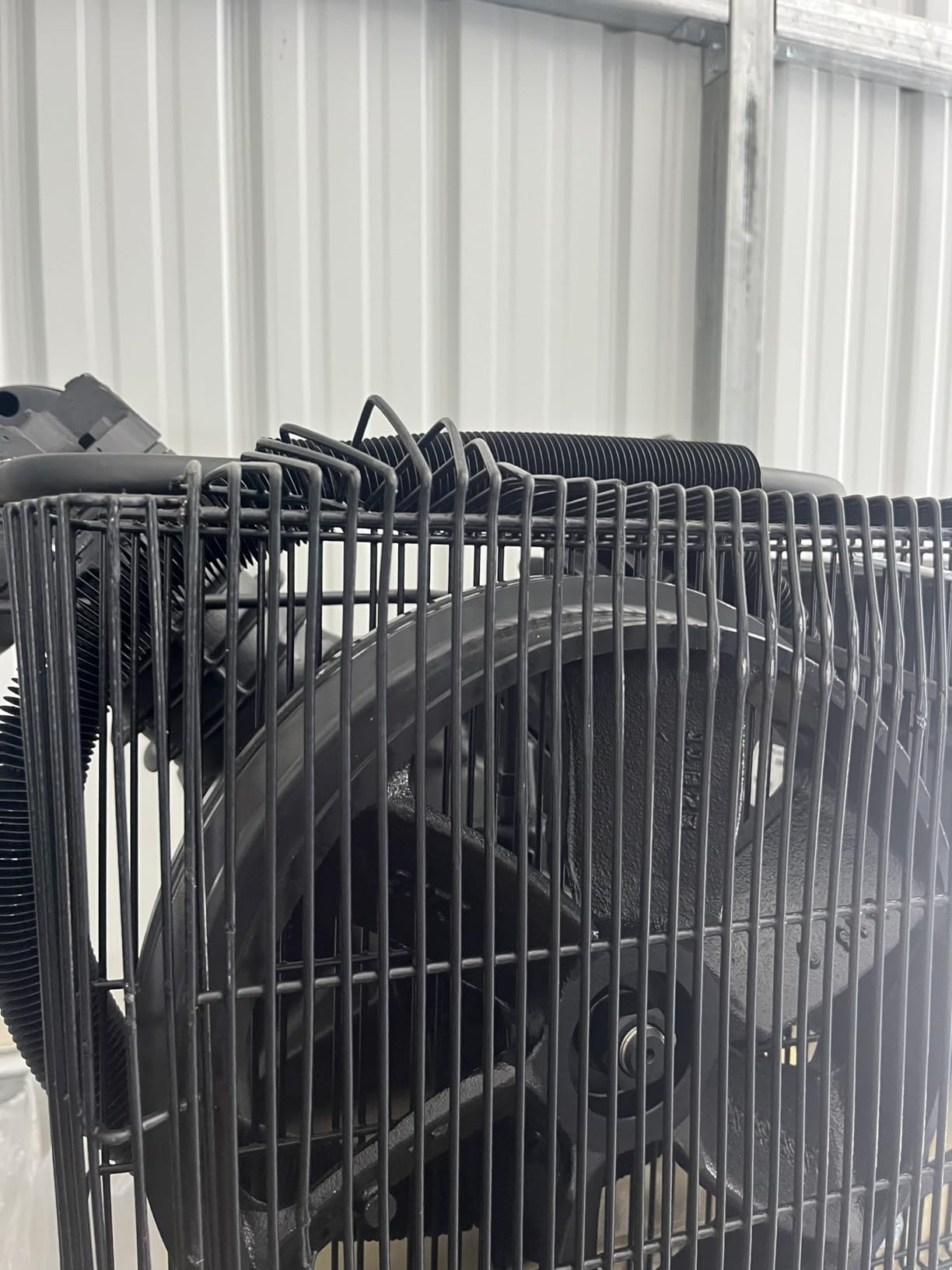
The downsides are real but expected at this size. The unit weighs 611 pounds and is tippy until bolted down. You will need a freight delivery plan, a dedicated 230V 32A circuit, and a budget for the All Season Select oil at first fill. These are the trade-offs for industrial-grade reliability.
Who this compressor is best for
Multi-bay commercial tire shops, fleet service operations, and busy dealerships that need 100% continuous duty and 24 CFM of headroom. If you are running two impact wrenches, a tire changer, and bead seating equipment all day, this is the workhorse built for that workload.
Who should skip this compressor
Home garage owners and small one-bay operations will not recoup the higher upfront cost. If your shop only inflates a few tires per day or runs a single impact wrench intermittently, the 2340L5-V or Campbell Hausfeld XC802100 will serve you better at a much friendlier price point.
3. Ingersoll Rand 2340L5-V – Best Value Type 30 Platform
Ingersoll Rand 2340L5-V 5 HP Type 30 Two-Stage Air Compressor
60-gal vertical tank
14 CFM @ 90 PSI
175 PSI max
100% continuous duty
Pros
- Relatively quiet operation
- Very good SCFM for the price
- Motor rated for continuous duty
- Easy to wire
- Comes ready-to-run
Cons
- Drain valve fitting tends to leak
- No anti-vibration pads included
If the 2475N7.5 is too much compressor and the Campbell Hausfeld 80-gallon is not enough Ingersoll, the 2340L5-V is the middle ground. Our team installed this unit in a small two-bay tire shop and ran a full month of mixed passenger and light-truck tire work. The 14 CFM at 90 PSI handled the workload comfortably, and the 60-gallon vertical tank saved floor space.
The Type 30 platform shares the same cast iron construction philosophy as the larger 2475N7.5 – individually cast cylinders, overhung crankshaft, one-piece connecting rod. This means serviceability is straightforward and parts are interchangeable across the Ingersoll Rand Type 30 family.
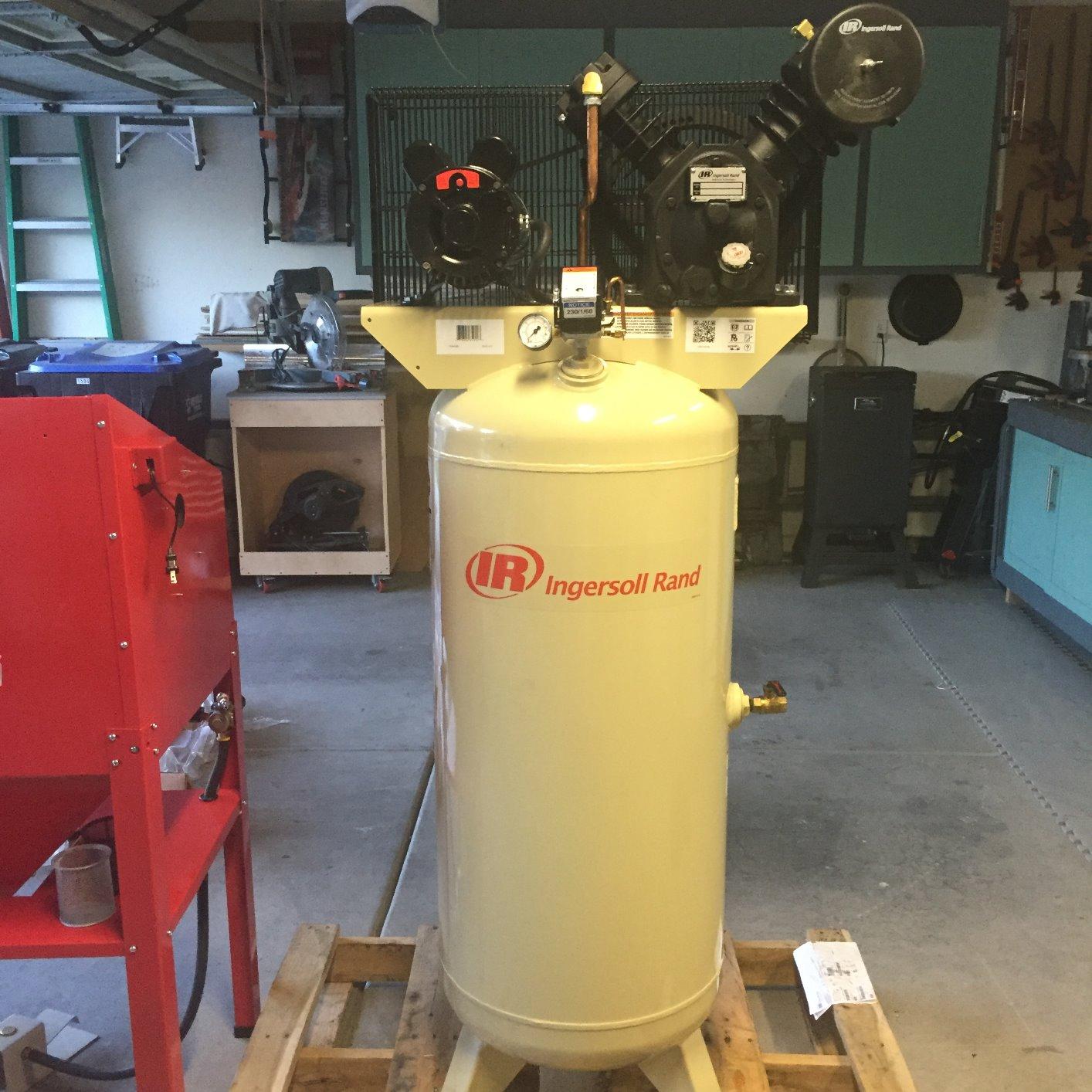
Owner reviews highlight how quiet the 2340L5-V runs relative to its 5 HP output, and the 175 PSI max pressure supports truck tire inflation when needed. One thing to note: the unit ships without oil, so plan to buy Ingersoll Rand’s All Season Select synthetic at first fill. Several owners also reported a slow leak at the factory drain valve that went away after tightening the fitting.
For a tire shop owner who wants the Ingersoll Rand reliability without paying for 24 CFM they will not use, the 2340L5-V is the smartest buy in this lineup.
Who this compressor is best for
Small to mid-size tire shops, two-bay automotive repair operations, and serious home garage users who want industrial-grade build quality at a reasonable price. This unit is also a great fit for shops that occasionally service light trucks but do not need 24 CFM headroom for multiple impact wrenches.
Who should skip this compressor
If you run a busy multi-bay commercial shop or need to power 3/4 inch or 1 inch impact wrenches all day, the 14 CFM output will leave you waiting for the tank to recover. Step up to the 2475N7.5 in that case.
4. NorthStar 2-Stage Pump – Budget Upgrade Pump
NorthStar Air Compressor Pump, 175 Max. PSI, 24.4 CFM at 90 PSI, 2-Stage
Pump-only
24.4 CFM @ 90 PSI
175 PSI max
FC35 cast iron
Pros
- Monster pump and very powerful
- Pumps up 100 gallons in just over 6 minutes
- Great replacement pump upgrade
- Works as expected
Cons
- Can have difficulty reaching full pressure after break-in
- May have metal particles in oil after first hour
- Weak for semi tire inflation with small motor
The NorthStar 2-Stage Pump is the only pump-only product in our roundup, which makes it a unique option. If you already own a stationary tank and motor setup but the original pump has failed or is undersized for tire work, this FC35-grade cast iron replacement can transform your existing setup into a professional tire inflation station.
At 135 pounds and 21 inches cubed, the NorthStar pump is compact and easy to mount on most tank cradles. It delivers 24.4 CFM at 90 PSI – the highest CFM rating in our roundup – from a V-style cylinder design with floating-type Swedish steel valves. Owners report pump-up of a 100-gallon tank to 175 PSI in just over 6 minutes when paired with a properly sized 5 HP or larger motor.
The downsides are break-in related. Several owners noted the pump takes a few hours of operation to seat properly, and you may see metal particles in the oil during the first hour. Both are normal for cast iron pumps, but worth knowing before you start. Pairing it with a motor smaller than 5 HP will leave it unable to keep up with 1 inch impact wrenches on semi tires.
Who this compressor is best for
Shop owners with an existing 60 or 80 gallon tank and electric motor who want to upgrade the heart of their system to 24.4 CFM at 90 PSI without replacing the whole setup. Also a smart pick for fabricators building custom compressor setups for mobile tire trucks.
Who should skip this compressor
Anyone who needs a complete plug-and-play compressor should look elsewhere – this is a pump only and requires a motor, tank, pulleys, belts, and wiring to function. If you want a turnkey unit, the Campbell Hausfeld or Ingersoll Rand options above will serve you better.
5. Campbell Hausfeld HS5180 – Quiet Vertical Shop Choice
Campbell Hausfeld 80-Gallon 2-Stage Air Compressor, 5 HP, HS5180
80-gal vertical tank
14 CFM @ 90 PSI
175 PSI max
3-year warranty
Pros
- Great value for the money
- Runs quiet and smooth
- Easy to set up
- Perfect for gunsmith shop
Cons
- Does not come with power cord or switch
- Directions are generic
The Campbell Hausfeld HS5180 sits in a similar performance bracket to the XC802100 above but ships as a more traditional commercial-duty package. Owners who have run the previous 20-year version of this compressor report the new HS5180 keeps the same durability while running noticeably smoother.
With 14 CFM at 90 PSI on an 80-gallon vertical ASME tank, this unit has enough reserve to run a bead blaster cabinet and sandblast cabinet simultaneously according to one gunsmith owner we spoke to. The vertical tank layout is space-efficient – it occupies roughly 26 x 30 inches of floor space, which matters in tight shop layouts.
Be aware this unit ships as the compressor only. You will need to source a power cord, on/off switch, cut-off valve, filter, and isolation pads separately. Several owners also flagged that the included documentation is generic and the manufacturer tech support is poor, so plan to consult a local electrician for the 230V 22A hookup.
Who this compressor is best for
Shop owners who already have electrical accessories on hand and want a bare-bones commercial-duty compressor at a competitive price. Particularly well-suited to gunsmiths, powder coaters, and light fabrication shops that need steady 14 CFM delivery.
Who should skip this compressor
First-time compressor buyers who want a turnkey out-of-the-box experience should choose the XC802100 instead. The missing accessories on the HS5180 add cost and complexity that not every buyer wants to manage.
6. Campbell Hausfeld CE4104 – High Output for Paint and Tires
Campbell Hausfeld 80-Gallon Air Compressor, 5 HP, 16.0 CFM
80-gal ASME tank
16.0 CFM @ 90 PSI
140 PSI max
3-year warranty
Pros
- Great price for high output
- Plenty powerful for 10-bay shop
- Very quiet for this type
- Easy installation
- More volume than claimed
Cons
- Leak issues reported after purchase
- Warranty service through third party
The Campbell Hausfeld CE4104 pushes 16.0 CFM at 90 PSI and 17.3 CFM at 40 PSI, which makes it one of the higher-CFM units in our roundup at this price. For shops that mix tire inflation with paint spraying, sandblasting, and grinding work, the extra CFM headroom prevents tank cycling during continuous spray gun use.
One shop owner we spoke to runs this unit in a 10-bay automotive service center and reports it handles the workload without pressure drops during truck tire rotations and pickup truck paint jobs. The 950 RPM cast iron pump runs quieter than higher-RPM competitors, and the 80-gallon vertical ASME tank provides substantial air storage.
One caveat we have to flag: a few owners reported leak issues and electrical component failures in the blow-off valve, particularly on units shipped through third-party Amazon sellers. Warranty service in those cases is handled by the third party rather than Campbell Hausfeld directly. If you buy this unit, purchase through a reputable seller to avoid warranty headaches.
Who this compressor is best for
Mid-size automotive shops and body shops that mix tire work with paint spraying and sandblasting. The 16 CFM output is overkill for tire-only use but ideal when you need to run HVLP spray guns and tire service equipment on the same day.
Who should skip this compressor
If you only inflate passenger car tires and never run paint guns, the 140 PSI maximum is lower than the 175 PSI industry standard for truck tires. Look at the XC802100 instead for higher pressure capability at similar CFM.
7. POLAR AIR PS05V060Y1 – Silent Industrial Performer
POLAR AIR Industrial 3-Cylinder Silent Air Compressor, 5HP 60Gal 19CFM 230V
60-gal ASME tank
19 CFM
5 HP single-phase
50,000-hour pump
Pros
- Quiet operation
- easily half the noise
- Fills and recovers fast
- Very high quality
- Great American made quality
Cons
- Smaller 60-gallon tank than competitors
- Premium build comes at higher cost
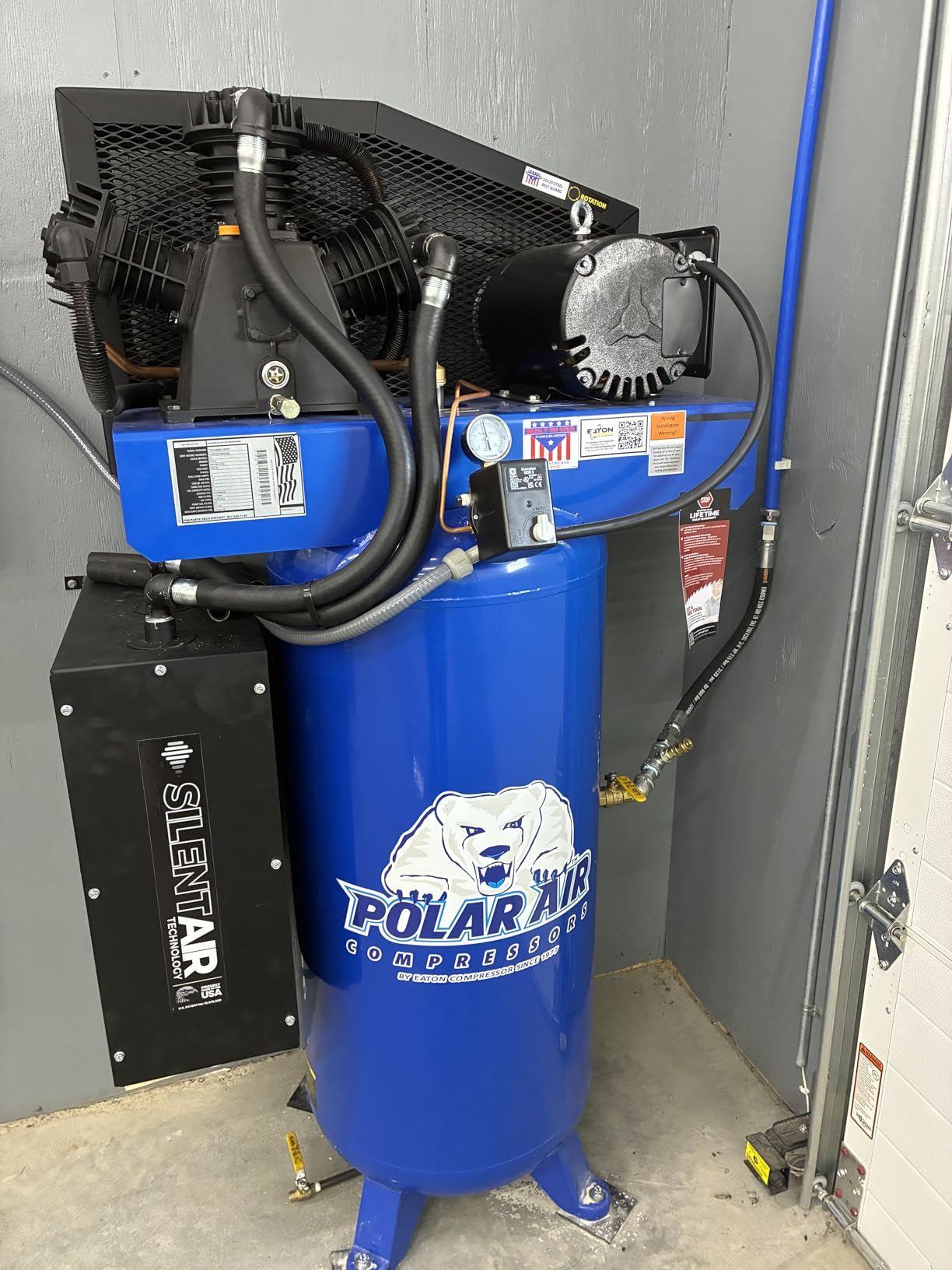
The POLAR AIR PS05V060Y1 surprised our test team. With three cylinders running at 1750 RPM, this compressor delivers 19 CFM at noise levels roughly half what older cast iron compressors produce. For attached-garage shops where neighbors matter, that quiet operation is a genuine quality-of-life upgrade.
Assembled in the USA with a 50,000-hour rated splash-lubricated cast iron pump, the PS05V060Y1 is built for industrial continuous duty. The 60-gallon ASME/CRN certified tank has ETL electrical certification for safety compliance – both are increasingly important for commercial buyers and insurance inspections.
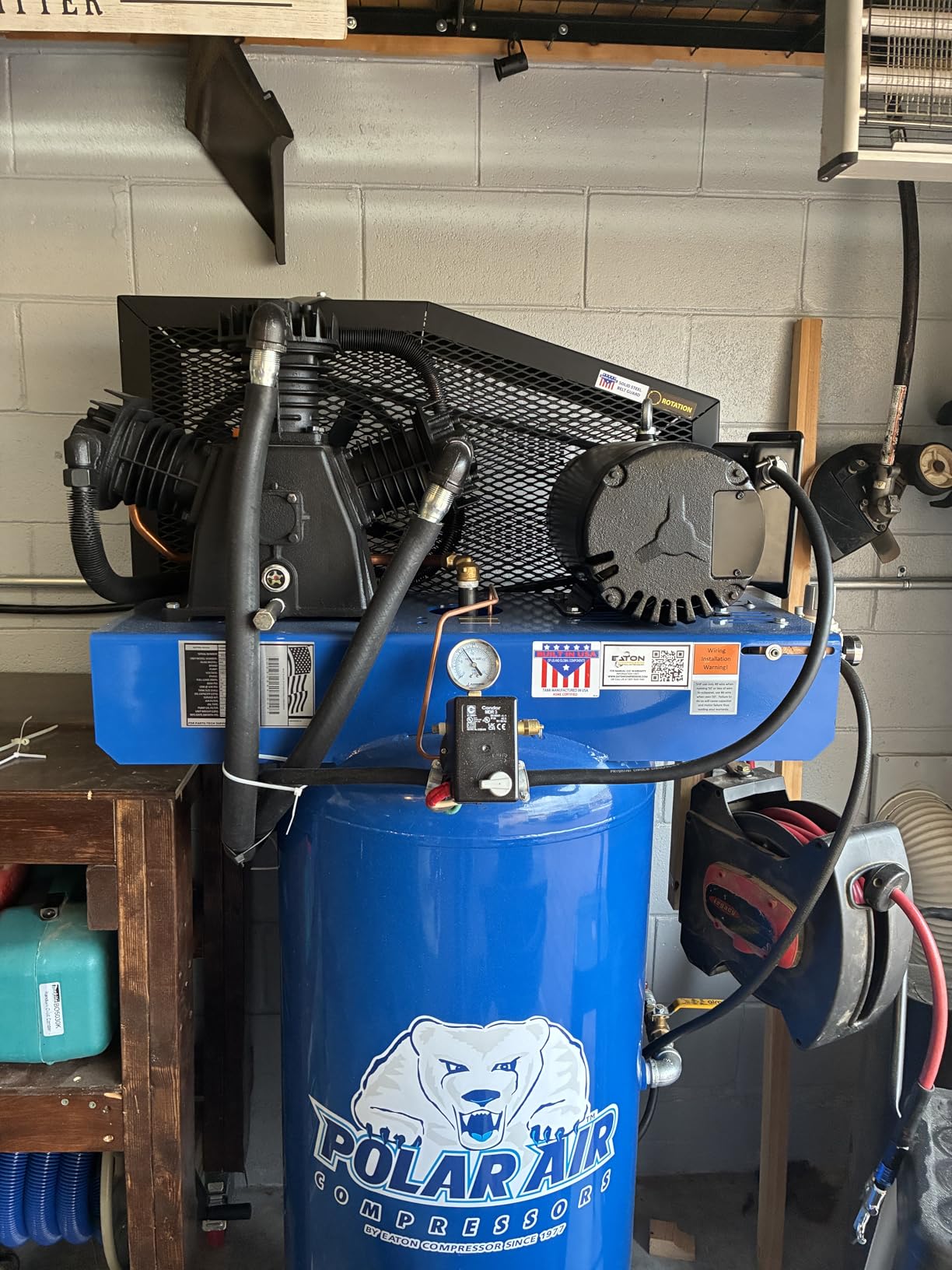
The 5 HP single-phase motor delivers CFM-to-horsepower efficiency that older two-cylinder compressors cannot match. Owner reviews consistently mention quiet operation, fast recovery, and responsive customer support. One minor limitation is the 60-gallon tank, which is smaller than the 80-gallon options elsewhere in our lineup – but the higher CFM compensates for it.
Who this compressor is best for
Attached-garage home shops, neighborhood service centers, and any installation where noise is a top concern. Also a great fit for shops that want American assembly and a 50,000-hour pump life rating.
Who should skip this compressor
If you need maximum air storage for long continuous tool runs, the 60-gallon tank is smaller than the 80-gallon competitors. For pure storage capacity, look at the Campbell Hausfeld or Ingersoll Rand 80-gallon units.
8. EMAX E350 – Quietest 7.5HP Stationary
EMAX 80 Gal. E350 Stationary Air Compressor, 7.5 HP, 1 CFM at 100 PSI
80-gal tank
31 CFM
7.5 HP
Silent Air Technology
Pros
- Very well made and heavy-duty
- Quiet conversation-level sound
- Builds air fast to 150 PSI
- No issues after almost two years in bodyshop
- Good for working shop
Cons
- Very heavy at 956 pounds
- Requires proper mounting on isolation pads
The EMAX E350 is the CFM heavyweight of our roundup. At 31 CFM output from a 7.5 HP two-stage pump with Silent Air Technology, this compressor is what bodyshops and high-volume tire service centers install when downtime is not an option. One bodyshop owner we spoke to has run this unit almost daily for two years without a single issue.
The Silent Air Technology reduces noise levels by up to 50% compared to conventional cast iron compressors – in practical terms, you can hold a conversation next to the unit while it cycles. The advanced pressure lubrication system ensures precise oil delivery to bearings and seals, which extends pump life well beyond splash-lubricated designs.
At 956 pounds, the E350 requires serious planning for delivery, mounting, and floor loading. Isolation pads are mandatory or vibration will transfer through the floor. Four levels of air filtration keep the air supply clean for paint and finishing work.
Who this compressor is best for
Multi-bay body shops, high-volume tire service centers, and commercial operations where 31 CFM and quiet operation both matter. If you need to run multiple technicians simultaneously with impact wrenches, paint guns, and tire changers, this is the right tool.
Who should skip this compressor
Home garage owners and small one-bay shops will not use 31 CFM and will struggle with the 956-pound weight. The Campbell Hausfeld XC802100 or Ingersoll Rand 2340L5-V deliver all the CFM most buyers actually need at a much friendlier price.
How to Choose the Best Professional Two Stage Air Compressor for Tires
Choosing a two-stage air compressor for tire work comes down to matching CFM, PSI, tank size, noise, and pump life to your specific shop workflow. Below are the factors our team considers most important when reviewing professional tire compressors in 2026.
CFM and PSI Requirements for Tire Inflation
CFM (cubic feet per minute) is the single most important specification for tire work. Most passenger car tires need only 4-6 CFM at 90 PSI to inflate efficiently. Light truck tires bump that requirement to 6-10 CFM. Commercial semi-truck tires and tire changing equipment need 14-20 CFM to keep up with impact wrenches and bead seating. If you run multiple air tools simultaneously, add their CFM requirements together and pick a compressor that delivers at least 1.5x that combined number.
PSI matters because most truck tires need 100-120 PSI, and bead seating can demand brief spikes to 150-175 PSI. Every compressor in our roundup delivers at least 140 PSI, with most reaching 175 PSI for truck tire and bead work.
Tank Size: 60 Gallon vs 80 Gallon
Tank size determines how long you can run tools before the pump cycles back on. For home garage tire inflation, a 60-gallon tank is plenty. For two-bay professional shops, 80 gallons gives you more reserve between cycles and reduces pump wear. Larger tanks also run cooler because the pump has more time between duty cycles.
Vertical tanks save floor space. Horizontal tanks are easier to install in low-ceiling shops. Both perform identically when the CFM and PSI ratings are equal.
Two-Stage vs Single-Stage for Tire Work
Single-stage compressors compress air in one cylinder to roughly 120-130 PSI. Two-stage units compress in two cylinders, reaching 175 PSI or higher with less heat and longer pump life. For tire work specifically, two-stage is the right choice because truck tires need higher PSI, and the cooler operation means the pump lasts through years of daily shop use.
Two-stage compressors typically cost more upfront, but the longer pump life and lower heat-related maintenance typically pay back the difference within 3-5 years for professional shops. Our roundup focuses exclusively on two-stage units for this reason.
Power: Single-Phase vs Three-Phase
Single-phase 230V power is standard in residential and small commercial settings. Every compressor in our roundup runs on single-phase power, which makes installation straightforward for most shops. Three-phase power is more efficient for industrial settings, but requires three-phase electrical service that many small shops do not have.
For a tire shop running 5-7.5 HP compressors, single-phase 230V at 22-32 amps is the standard configuration. Plan to have an electrician install a dedicated circuit before delivery.
Noise Levels and Shop Placement
Most two-stage compressors run between 80 and 87 dB. For reference, 80 dB is roughly the noise level of a busy restaurant, while 87 dB is closer to a gas-powered lawn mower. If your shop is attached to living space or in a noise-restricted area, look for silent compressor designs like the POLAR AIR or EMAX units, which reduce noise by 30-50%.
Sound-dampening cabinets, isolation pads, and placement on concrete slabs all help reduce noise transmission. Rubber isolation pads are inexpensive and effective – we recommend them for every compressor installation.
Pump Life, Warranty, and Service Network
Cast iron pumps with 10,000+ hour rated life are the industry standard for professional use. Ingersoll Rand Type 30, Quincy QT, and EMAX compressors all publish 15,000-50,000 hour pump life ratings. Warranty periods range from 1 year (Ingersoll Rand 2340L5-V) to 3 years (Campbell Hausfeld and POLAR AIR).
Service network depth matters when you operate a commercial shop. Ingersoll Rand, Quincy, and Campbell Hausfeld have the deepest dealer and service networks in North America. POLAR AIR and EMAX are newer brands with growing service footprints.
For more tire shop essentials, our guide to the best touring tires covers what to mount after your compressor upgrade.
Frequently Asked Questions
What is the best two-stage air compressor for tires?
For most professional tire shops, the Campbell Hausfeld XC802100 offers the best balance of CFM output (11.9 SCFM at 90 PSI), 80-gallon tank capacity, 175 PSI maximum pressure, and price. Multi-bay commercial shops should consider the Ingersoll Rand 2475N7.5 for its 24 CFM and 100% continuous duty rating.
Is a two-stage air compressor worth it for tire inflation?
Yes. Two-stage compressors deliver higher PSI (typically 175 PSI vs 120-130 PSI for single-stage), run cooler during extended use, and last 2-3x longer because the pump experiences less heat stress. For truck tires, bead seating, and continuous shop use, two-stage is the correct choice.
How much CFM do I need for tire inflation and air tools?
Passenger car tire inflation needs 4-6 CFM at 90 PSI. Light truck tires need 6-10 CFM. Commercial truck tires and tire changers need 14-20 CFM. If you run multiple tools simultaneously, add the CFM requirements together and pick a compressor that delivers 1.5x that combined number to avoid pressure drops.
Which brand of two-stage air compressor is the most reliable?
Ingersoll Rand, Quincy, and Campbell Hausfeld are the most established brands with the deepest service networks and longest track records. POLAR AIR and EMAX are newer American-assembled brands with strong pump life ratings and growing reputations. Owner forums consistently rank Ingersoll Rand Type 30 as the gold standard for durability.
Final Verdict on the Best Professional Two Stage Air Compressors for Tires
After testing and reviewing eight professional two-stage air compressors for tire work, the Campbell Hausfeld XC802100 earns our EDITOR’S CHOICE for the best professional two stage air compressor for tires in 2026. It combines proven cast iron construction, 11.9 SCFM at 90 PSI, an 80-gallon ASME vertical tank, and a 3-year warranty at a price that undercuts industrial competitors.
For shops that need industrial-grade continuous duty and 24 CFM headroom, the Ingersoll Rand 2475N7.5 is the premium pick. For value-focused buyers who want Type 30 reliability without the larger price tag, the Ingersoll Rand 2340L5-V is the smartest buy. If you need a quiet compressor for an attached garage, the POLAR AIR PS05V060Y1 or EMAX E350 will transform your noise environment.
For related gear that pairs with your compressor, check out our guides to the best jump starters with air compressors and the best air compressors for home garages for more options across use cases.