
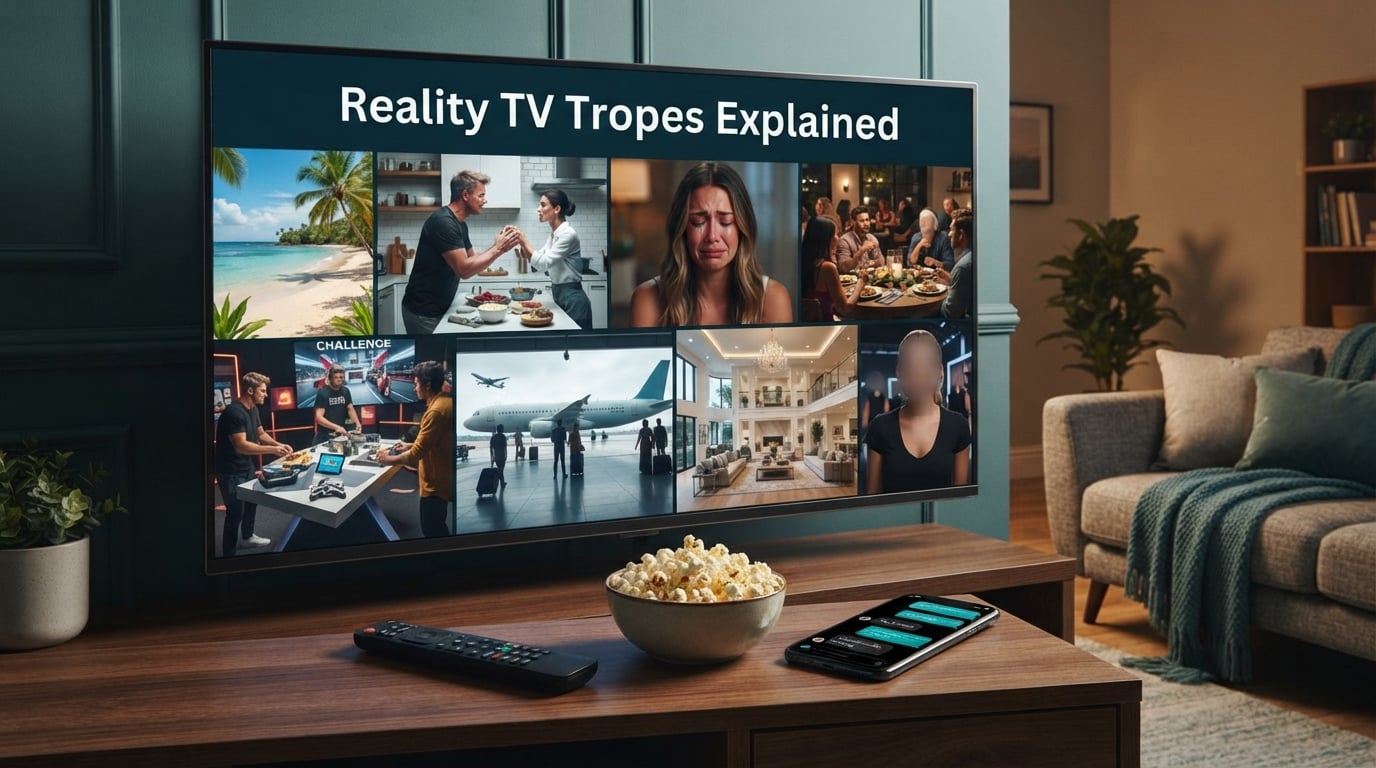
You know that feeling when a contestant looks at the camera and says, “I did not come here to make friends”? That is a reality TV trope in action. After watching more reality shows than I can count over the years, I started noticing the same patterns repeating across every franchise. The same music swells, the same villain emerges, the same breakup montage plays out.
I wrote this guide because once you see these patterns, you cannot unsee them. Reality TV tropes are the invisible scaffolding that holds the entire genre together. They show up in everything from Survivor to Love Island to Selling Sunset, and understanding them changes how you watch.
This is your complete Reality TV Tropes Explained guide for 2026. I will walk you through the definitions, the most overused patterns, the editing tricks producers rely on, the character archetypes casting directors chase, and how streaming and social media have reshaped these formulas. By the end, you will watch your next episode with completely different eyes.
Table of Contents
What Are Reality TV Tropes? A Clear Definition
Reality TV tropes are recurring patterns, character archetypes, and dramatic formulas that producers reuse across shows to create predictable entertainment. Think of them as the genre’s shared vocabulary. A trope can be a character type, a scene structure, an editing technique, or a catchphrase.
The term comes from the broader concept of “tropes” used in literary criticism, which simply means a common or overused device. When applied to reality television, tropes describe the conventions that make a show feel familiar before you even know the cast.
For example, the “confessional cam” (those one-on-one interviews where contestants talk directly to the camera) is a trope. So is the “elimination ceremony” with dramatic music and a host delivering a catchphrase. These elements repeat because they work. They compress hours of raw footage into a story viewers can follow.
Not every trope is negative. Some create genuine suspense or emotional payoff. But most exist to manufacture drama, and once you recognize them, the seams of the production become obvious.
Why Reality TV Relies on Tropes to Survive
Reality television depends on tropes because they are cheap, reliable, and instantly recognizable. A show does not need to teach viewers how to watch if it follows established patterns. The audience already knows that the rose ceremony means elimination, the group date means jealousy, and the two-on-one date means someone is going home.
From a production standpoint, tropes solve a massive problem. Reality shows shoot hundreds of hours of footage with amateur cast members who are not trained actors. Tropes give editors a framework to turn chaos into narrative. The villain edit, the underdog arc, the slow-building rivalry. These structures impose order on unscripted events.
There is also an economic reason. Networks and streaming platforms greenlight shows that fit proven templates. If The Bachelor works, every dating show borrows its formula. If Selling Sunset succeeds, a wave of real-estate docusoaps follows. Tropes reduce risk for executives writing the checks.
Viewers play a role too. Research on audience behavior shows people find comfort in familiarity. We return to shows partly because we know what we are getting. The trope is not a bug. It is the product.
This is why Reality TV Tropes Explained matters as a topic. Understanding these patterns makes you a more active viewer rather than a passive consumer of manufactured emotion.
The Most Iconic Reality TV Tropes Explained
Here are the tropes you will spot in almost every reality franchise, ranked by how often they appear and how much they shape the viewing experience.
1. The Villain Edit
The villain edit is the single most recognizable reality TV trope. Producers and editors select one or two cast members to frame as antagonists, using reaction shots, out-of-context quotes, and ominous music to make them look worse than they are.
Contestants have spoken out about being misrepresented this way. Reddit communities regularly debate which villains were “real” and which were manufactured. The trope persists because every story needs conflict, and a clearly defined villain gives viewers someone to root against.
2. The Confessional Cam
The confessional cam is the sit-down interview where cast members reflect on events to camera. It provides exposition, emotional commentary, and the illusion of intimacy with the viewer. The Real World popularized it in the 1990s, and now nearly every reality show uses some version.
The confessional is also where frankenbites happen. Editors splice together sentences from different moments to create a statement the person never actually said in that sequence. More on that in the editing section.
3. The Manufactured Misunderstanding
This trope drives endless plotlines. Two cast members have a conflict that could be resolved with a twelve-second conversation. Instead, the show stretches it across an entire episode or season. Reddit users repeatedly cite this as their most hated trope.
“I can explain” scenes are a subcategory. A contestant approaches someone, promises to explain, and then the episode cuts to commercial before the explanation happens. By the time we return, the conversation has moved on.
4. The Forced Music Cue
Audio cues tell you how to feel before anything happens on screen. A sad piano means someone is about to cry. A dramatic sting means a fight is brewing. Upbeat pop means a montage of fun times is coming.
Forum discussions on r/television and r/LoveIslandTV frequently call out how manipulative these cues feel. Once you notice them, you realize the music is doing most of the emotional work.
5. The Surprise Pregnancy or Secret Reveal
The surprise pregnancy twist appears constantly in docusoaps and dating shows. A contestant reveals they are pregnant, or an ex shows up unannounced, or a secret relationship is exposed. Screen Rant and Cracked both rank this among the most overused tropes.
The pattern is always the same. Hints drop in earlier episodes, tension builds, and the reveal lands during a finale or reunion special designed to maximize ratings.
6. The Elimination Catchphrase
Every elimination show has its signature line. “The tribe has spoken” from Survivor. “Will you accept this rose?” from The Bachelor. “You’re fired” from The Apprentice. These phrases become brand assets.
The catchphrase does more than create tension. It gives the show a quotable moment that fans repeat and that marketing teams can clip for promos. It is branding disguised as drama.
7. The Reunion With an Ex
Bringing back a former partner to disrupt a current relationship is a staple of dating and docusoap formats. Reddit threads about Love Island regularly complain about this pattern, noting that the reuniting couple almost never stays together anyway.
The trope exists to create a love triangle without needing new cast members. It recycles existing drama and forces current couples to react.
8. “At the End of the Day”
This phrase is the unofficial motto of reality TV confessionals. Cast members say it constantly, especially when justifying a decision or delivering a soundbite. It became such a cliché that viewers now predict it before contestants speak.
Other overused lines include “I’m not here to make friends,” “I gave it 110 percent,” and “this is a once-in-a-lifetime opportunity.” These scripted-sounding phrases get repeated because they package complex feelings into clean quotes for promos.
9. The Sudden Focus Shift
When a show suddenly gives a background cast member a storyline, it usually means their role has been upgraded for drama purposes. Cracked ranks this among the worst tropes because the shift feels arbitrary. A person who had two lines in episode one suddenly gets a full arc.
This happens when producers realize mid-season that a character is more interesting than expected, or when another storyline falls flat and they need a replacement.
10. The Immediate Distrust
New contestants arrive and immediately distrust everyone. Long-time friends turn on each other over a rumor. This trope compresses weeks of relationship-building into instant conflict. It speeds up narrative momentum but strains credibility.
Reddit’s r/BravoRealHousewives discusses this constantly. Viewers note that genuine friendships are more compelling than forced rivalries, but forced rivalries generate clips that go viral.
Character Archetypes: The Villain, The Hero, and The Underdog
Casting is where tropes begin. Reality show casting directors actively look for specific personality types that fit proven archetypes. Once cast, editors shape each person’s footage to reinforce that role across the season.
The Villain creates conflict, confronts others, and says the things no one else will. The Hero stands up for the group, plays with integrity, and usually reaches the finale. The Underdog starts at a disadvantage but earns viewer sympathy through resilience.
Other recurring archetypes include the Comic Relief, the Instigator who stirs drama without ever being the target, the Love Interest brought in solely for romantic tension, and the Voice of Reason who provides perspective the show ignores.
Writer Nicola Martin has noted that novelists can borrow these archetypes to build compelling fictional characters. They work in fiction for the same reason they work on television. They tap into recognizable human dynamics that audiences immediately understand.
The danger is that real people get flattened into roles. A complex contestant becomes “the villain” for an entire season even if their behavior was nuanced. The edit simplifies reality into story.
Confessional Culture and Its Signature Tropes
The confessional is reality television’s defining invention. It is the direct-to-camera interview that lets viewers hear a contestant’s thoughts in real time, or at least what appears to be real time.
Confessionals create intimacy. When someone speaks directly to the lens, it feels like they are confiding in you. This builds parasocial attachment, which keeps audiences coming back episode after episode.
The trope within the trope is that confessionals are rarely spontaneous. They are scheduled, the questions are producer-guided, and responses are sometimes re-recorded after events unfold to match the desired narrative. Contestants have described being asked to rephrase statements to fit a storyline.
Frankenbites take this further. An editor takes words from one confessional, combines them with words from a completely different session, and stitches them into a single quote. The result sounds coherent but never happened as delivered. This is one of the most powerful and deceptive editing tools in the genre.
Elimination Rituals and Catchphrases We Cannot Escape
Elimination rituals are choreographed ceremonies designed to maximize suspense. The tribal council on Survivor, the rose ceremony on The Bachelor, the live eviction on Big Brother. Each has its own lighting, music, and pacing.
The ritual structure is always the same. Build tension, pause for a commercial break, deliver the verdict, capture reactions. The repetition trains viewers to feel anxiety on cue.
Catchphrases anchor these moments. Jeff Probst’s “the tribe has spoken” is not just a line. It is a brand identifier that viewers associate with the entire show. These phrases get trademarked, licensed, and used in marketing for years.
Elimination rituals also create what fans call the “exit interview” trope. The eliminated contestant delivers a reflective confessional about what they learned, often framed as personal growth. Whether that growth is genuine is something viewers debate endlessly on forums.
How Producers Manufacture Drama Through Editing
Editing is where reality television stops being real. The footage shot on set is raw material. The final product is a constructed narrative shaped by hundreds of editorial decisions. Understanding these techniques is central to Reality TV Tropes Explained.
Frankenbites are the most notorious editing trick. As mentioned, editors combine audio from different moments to create sentences contestants never said in sequence. A person might describe a mild disagreement in one interview and a separate fight in another, then the edit merges them into one dramatic confrontation.
Reaction shots are another staple. An editor takes a facial expression from a completely unrelated moment and places it after someone else’s comment to imply a reaction that did not happen. Someone rolling their eyes at lunch becomes evidence of disapproval during an argument filmed two days later.
Selective editing controls what stays and what gets cut. If a contestant is kind for 99 percent of the shoot but snaps once, only the snap makes the final edit. The narrative becomes that they are volatile, regardless of the broader context.
Audio cues direct emotion. A somber cello underscoring a breakup scene makes it feel tragic even if the couple split amicably. A pulsing beat during a confrontation manufactures urgency. Viewers on Reddit frequently note that watching reality shows on mute removes half the drama.
Producer interference goes beyond editing. Producers ask leading questions in interviews, suggest conversations between cast members, and sometimes stage scenarios. The line between “encouraged” and “scripted” is blurry, and contestants have differing accounts of how much pressure they faced.
Audio enhancements like added sound effects, crowd reactions layered over quiet moments, and music that swells at calculated points all contribute to a version of events that feels more dramatic than what cameras actually captured.
Tropes Specific to Dating Shows
Dating shows have their own specialized tropes that competition and docusoap formats do not share. The Bachelor franchise, Love Island, and similar programs rely on these patterns heavily.
The Hometown Visit trope sends the lead to meet contestants’ families, always resulting in an awkward parent moment. The Fantasy Suite episode implies intimacy without showing it, letting the audience fill in blanks. The After the Final Rose special addresses what happened since filming, often revealing a breakup.
The love triangle is the backbone of dating show structure. Two contestants compete for one person, and the show alternates focus between them to maintain uncertainty about who will be chosen.
The “right reasons” accusation is a dating show staple. Contestants accuse each other of being on the show for fame rather than love. This trope has become so predictable that contestants now preemptively defend themselves in their intro packages.
How Social Media Changed Reality TV Tropes
Social media transformed how tropes operate. Before Twitter and TikTok, viewers consumed reality shows passively and discussed them the next day at work. Now, live-tweeting during broadcasts and clipping moments for TikTok happen in real time.
This created the instant-meme trope. Editors now craft moments designed to be screenshotted and shared. A dramatic one-liner or a shocked reaction gets produced with virality in mind. The show’s narrative bends toward creating clips that travel.
Reddit communities function as unofficial trope detectives. Subreddits like r/LoveIslandTV and r/BravoRealHousewives analyze episodes frame by frame, calling out frankenbites and producer manipulation that casual viewers miss. This collective analysis has made audiences more sophisticated.
Cast members also play into tropes deliberately now. They know that being the villain generates engagement, follower counts, and sponsorship deals. The trope economy rewards bad behavior, which has intensified the types of conflict shows produce.
Social media also created the backlash trope. When a contestant is edited harshly, fans rally online to defend them, sometimes forcing shows to address the criticism publicly. The conversation between audience and production is more direct than ever.
The Evolution of Tropes in the Streaming Era
Netflix, Hulu, and other streaming platforms reshaped reality TV tropes starting around 2026 and the years surrounding it. Streaming shows drop entire seasons at once, which changes pacing. Binge consumption rewards cliffhangers within episodes rather than week-to-week suspense.
Streaming budgets allowed for glossier production. Shows like Selling Sunset and The Circle brought cinematic editing to a genre that once felt raw. The tropes are the same, but the polish is higher.
International formats cross borders faster now. Love Is Blind spawned versions in multiple countries, each adapting the same core tropes to local sensibilities. The globalization of reality TV means certain patterns are now recognizable worldwide.
Algorithms also influence which tropes survive. Platforms track what viewers rewatch and skip, then greenlight shows that replicate successful patterns. The data loop reinforces existing tropes rather than encouraging innovation.
Are Reality TV Tropes Harmful?
This question comes up constantly in forum discussions, and the honest answer is complicated. Tropes are not inherently dangerous, but they shape how viewers perceive relationships, conflict, and social dynamics.
The villain edit can cause real harm to real people. Contestants have lost jobs, received online harassment, and dealt with mental health consequences after being portrayed as villains. The harm extends beyond the show itself into their actual lives.
Gendered tropes deserve scrutiny. The “cat fight” framing pits women against each other for entertainment. Reddit’s r/AskWomen threads highlight how female contestants are often reduced to simplified roles like the hot-but-dumb one or the brainy-but-plain one.
On the other hand, recognizing tropes builds media literacy. When viewers understand that what they see is constructed, they engage more critically. The goal is not to stop watching reality TV. It is to watch with awareness of how the sausage gets made.
The Future of Reality TV Tropes
Tropes will keep evolving as formats and platforms shift. We are already seeing experiments with interactive formats, AI-generated content, and cross-platform storytelling that blends shows with social media presence.
Audiences are also pushing back. The success of shows that feel more authentic, or that subvert expectations, suggests viewers want variety. But the core tropes are unlikely to disappear because they are too effective at creating the drama that drives engagement.
Expect the next wave to lean into self-awareness. Shows that openly acknowledge their own tropes, or that parody them, may become more common. Meta-reality is already a niche genre, and it could grow as audiences become more media-literate.
FAQs
What is the most overused reality TV trope?
The most overused reality TV trope is the manufactured misunderstanding, where two cast members have a conflict that could be resolved with a brief conversation but instead gets stretched across an entire episode or season. Other extremely common tropes include the villain edit, forced music cues, the elimination catchphrase, and contestants saying phrases like ‘at the end of the day’ or ‘I did not come here to make friends.’
What is the fakest reality show?
There is no single answer since most reality shows use a mix of real footage and manufactured drama. However, shows that rely heavily on frankenbites, staged scenarios, and producer interference tend to feel the most scripted. Contestants from numerous franchises have publicly described being coached, having conversations suggested to them, and having their words edited out of context.
What is the point of TV tropes?
TV tropes serve as a shared vocabulary for understanding recurring patterns in storytelling. In reality television specifically, tropes give producers and editors a framework to turn raw footage into a coherent narrative. They help viewers follow the story, create emotional payoff, and reduce risk for networks by following proven formulas.
What are the 4 types of reality TV?
The four main types of reality TV are competition shows (Survivor, American Idol), dating and romance shows (The Bachelor, Love Island), docusoaps following real people’s lives (Keeping Up With the Kardashians, The Real Housewives), and lifestyle or transformation shows (Selling Sunset, home renovation programs). Some analysts add a fifth category for social experiment formats like Big Brother.
Are reality TV shows actually scripted?
Most reality TV shows are not fully scripted in the traditional sense, but they are heavily produced. Producers ask leading questions in interviews, suggest conversations between cast members, stage scenarios, and use editing techniques like frankenbites and selective cutting to shape narratives. The result is a constructed version of events that feels unscripted but is carefully assembled.
Conclusion
Reality TV tropes are everywhere because they work. They compress chaos into story, manufacture drama from mundane footage, and keep audiences hooked season after season. Once you can name them, you watch differently.
The goal of this Reality TV Tropes Explained guide is not to ruin your favorite shows. It is to give you the tools to enjoy them more consciously. You can still love the villain edit, the confessional, and the elimination catchphrase while understanding exactly how they are constructed.
Next time you settle in for an episode, listen for the music cues, watch for the reaction shots, and count how many times someone says “at the end of the day.” You will be amazed at how quickly the patterns reveal themselves.